North Korea demonstrates remarkable capabilities during Shoigu’s visit
By Drago Bosnic | July 29, 2023
On July 26, Russian Defense Minister Sergei Shoigu held high-level defense talks with his North Korean counterparts. In a clear message to the United States, Pyongyang is also conducting a series of ballistic missile tests that serve as a warning to Washington DC’s belligerence. Namely, the US is escalating tensions with everyone in the area, including by sending its nuclear-powered submarines to South Korean ports. Apart from various guided missile submarines (SSGNs), the US Navy also sent the USS “Kentucky”, a nuclear-armed ballistic missile submarine (SSBN), that docked in the southern port city of Busan on July 18. It should be noted that this was the first such visit since the 1980s, marking not only a symbolic, but an actual US return to Cold War-era posturing.
Sending SSBNs such as the USS “Kentucky” to the region is not only a message to North Korea, but also Russia and China. This Ohio-class submarine can be armed with up to 20 UGM-133A “Trident II” SLBMs (submarine-launched ballistic missiles), which, albeit over 30 years old at this point, can carry up to 14 warheads each, including the latest very low yield W76-2, with the power of approximately 2–7 Kt (kilotons of TNT). While such warheads are not nearly as destructive as the original W76, they’re equipped with new advanced fuses and their primary purpose is the destruction of enemy ballistic missiles while they’re still in silos. Such weapons are a direct threat to all three (Eur)Asian nuclear powers, as it gives the US certain first-strike capabilities that are yet to be matched by anyone outside Russia.
Such US moves are certainly part of the reasons why Shoigu visited Pyongyang and held talks with his North Korean counterpart Kang Sun-nam. He reiterated President Putin’s message about friendly bilateral relations that are “bound to be improved in all fields”. Shoigu expressed confidence that the meeting would strengthen military cooperation between the two countries.
“I am confident that today’s talks will contribute to strengthening cooperation between our defense ministries. Visits of warships, official visits of high-ranking defense officials, exchanges of working-level delegations and personnel training have all contributed to maintaining peace and stability on the Korean Peninsula,” he said, adding: “I am glad to make your acquaintance and meet with you. I happily accepted your invitation to visit Pyongyang, the capital of a friendly state. I am grateful to my Korean friends for the rich program you have offered. From the very first minute, I felt your care and attention. I hope we will manage not only to work actively, but also to learn a lot of interesting things about [North] Korea, your culture and traditions and see the sights.”
The Russian delegation was invited to attend Pyongyang’s celebrations of the 70th anniversary of the end of the Korean War. The ceremonies also included a massive military parade and the display of a plethora of advanced weapons that North Korea has developed in recent years. The visit by Russian officials will be the first of this kind in several years. China is also sending a delegation of high-ranking officials to the anniversary, marking its intention to not only maintain, but also strengthen relations with its eastern neighbor. In a recent push against US plans for NATO expansion in the Asia-Pacific region, both Moscow and Beijing are coordinating their efforts with Pyongyang, as the “pocket superpower” has significant strategic capabilities, completely disproportionate to its small size (relative to the giants surrounding it).
And while North Korea’s portrayal by the mainstream propaganda machine is unflattering, mildly speaking, Shoigu’s visit has demonstrated that underestimating Pyongyang isn’t only foolish, but also patently dangerous. It should be noted that such reverie is wholly limited to the infowar arena, as the Pentagon is deeply alarmed by North Korea’s recent advances in various military technologies that rival even that of global superpowers. Pyongyang’s innovations include not only missiles, but also advanced strategic drones. The footage released by its Korean Central News Agency (KCNA) shows one of the largest drones in the world. Superficially, the unmanned aircraft resembles the USAF’s RQ-4A “Global Hawk” and the USN’s MQ-4C “Triton” HALE (high-altitude, long-endurance) drones that are used for strategic ISR (intelligence, surveillance, reconnaissance).
In addition to these platforms, North Korea seems to have developed a strike drone, as demonstrated by the presence of one that resembles the US MQ-9 “Reaper”. Developing such capabilities shows that Pyongyang is anything but “technologically backward”. These developments are a landmark achievement for its rapidly growing military industry that in some aspects has surpassed even the US. Namely, North Korea is only the third country in the world to field hypersonic weapons (including HGVs – hypersonic glide vehicles), something the Pentagon has been unable to accomplish after repeated tests have failed spectacularly, despite several decades of futile attempts and massive investments.
Drago Bosnic is an independent geopolitical and military analyst.
Staggering Towards the Abyss
By William Schryver | imetatronink | July 28, 2023
I have long asserted, and I continue to be convinced, that the US could NOT establish air superiority against Russia, China, nor even Iran — not in a week; not in a year. Never. It simply could not be done.
American air power would prove substantially inferior to the extremely potent and abundantly supplied air defenses arrayed against it in any of those three countries.
American suppression of enemy air defenses would prove woefully inadequate to the task.
And even if any of the US’s aerial wunderwaffen were to prove, in ideal circumstances, to be potent weapons, US air power as a theater-wide undertaking could not be sustained in the context of a non-permissive regional and global battlefield.
In a high-intensity combat scenario in either eastern Europe, the China seas, or the Persian Gulf, the maintenance requirements for US aircraft could not be met. Mission-capable rates would plummet even lower than their notoriously abysmal peacetime standards.
The US would, quite literally after only a few days, see sub-10% mission-capable rates for the F-22 and F-35, and sub-25% rates for almost every other platform in the inventory.
It will be a huge scandal for the Pentagon … but hardly a huge surprise.
And this is hardly hyperbole. It is more or less common knowledge among those who think about these aspects of war — the only aspects that really matter in the final analysis.
US supply lines would be severely attrited on both a regional and a global scale.
Russian and Chinese submarines and long-range anti-ship missile systems would wreak havoc on US seaborne logistics.
I repeat: The US could not fight an overseas war in a non-permissive environment against a peer adversary. It doesn’t have the means, let alone the experience and competence, to do so.
In eastern Europe, Russia would savage NATO bases and supply routes. The Baltic and Black seas would effectively become Russian lakes where NATO shipping could not move.
And anyone who believes I am making unfounded hysterical assertions is either ignorant of the simple military and mathematical realities of the situation, or so blinded by American exceptionalism and its attendant ills that they are unable to discern things as they really are.
I have come across relatively little discussion of the crescendo pace with which Russia, China, and Iran have been conducting military coordination in general and naval drills in particular over the past few years.
Russia and China are now engaging in joint naval patrols of the western Pacific!
Russia, China, and Iran are engaging in regular joint exercises in the Arabian Sea.
This is not meaningless posturing. These are the actions of countries who intend to engage in mutual defense in the event of an existential attack on any one of them.
I am increasingly persuaded that, if the US chooses to make direct war against either Russia, China, or Iran, it will result in a war against all three simultaneously.
As I wrote in a previous article:
Building the Perfect Beast
Even more significantly, in a development I and many others have predicted for several years now – in the face of almost universal ridicule, I might add – the empire’s seemingly endless string of hubris-driven blunders has rapidly accelerated the formation of what is quite arguably the single most potent military / economic / geostrategic alliance seen in modern times: the tripartite axis of Russia, China, and Iran.
In its misguided and short-sighted gambit to thwart the long-dreaded Russo-German rapprochement — incomprehensibly punctuated by the late September 2022 sabotage of the Nordstream gas pipelines — the empire has astoundingly managed to jump from the frying pan of a regional proxy war against Russia into the fire of a global conflict all three of its steadily strengthening adversaries now view as existential.
In my considered opinion, this is almost certainly the single most inexplicable and portentous series of geopolitical blunders in recorded history.
For the time being, the fighting will remain confined to Ukraine. But the entire complexion of this war has been irreversibly altered.
In conclusion, I return again to my initial argument: the US could NOT establish air superiority against Russia, China, nor even Iran — not in a week; not in a year. Never. It simply could not be done.
And that, amazingly enough, is just one of multiple hard truths that the #EmpireAtAllCosts cult, and those acquiescing to its delusional designs, ought to give more serious consideration as they continue staggering towards the abyss of a war they cannot win.
What a coincidence: Dengue cases skyrocket just as dengue vaccine approaches licensure
And just as Bill Gates is rolling out his genetically engineered mosquitos
BY MERYL NASS | JULY 26, 2023
One dengue vaccine was licensed in the US in 2019 after killing dozens of kids in the Philippines. Philippine Ministry of Health and Sanofi officials went on trial for manslaughter in that case, just before the FDA issued the same vaccine a license. While the license was only issued for people aged 9-16, and only if they had had dengue once already, your tax dollars rolled it out all over Puerto Rico. Will all vaccinators follow those strictures?
Here’s what CDC notes about the licensed vaccine:
This vaccine is different from other vaccines in that it is only recommended for people who have already been infected with dengue virus. The reason is that children without previous dengue infection are at increased risk for severe dengue disease and hospitalization if they get dengue after they are vaccinated with Dengvaxia. Therefore, healthcare providers should check for evidence of a laboratory-confirmed previous dengue infection before vaccination.
Another dengue vaccine has come before the VRBPAC FDA committee twice, and I blogged those meetings. It appears it only works for 2 of the 4 dengue strains. It supposedly did not need a blood test before use. Takeda is the manufacturer and it describes the vaccine here.
Epoch Times reports:
The World Health Organization (WHO) has warned that cases of dengue fever could reach record highs this year.
Dengue rates are rising globally, with reported cases since 2000 up eight-fold to 4.2 million in 2022, a WHO official said on July 21.
In January, the WHO claimed that dengue is the world’s fastest-spreading tropical disease and alleged it could be a “pandemic threat.”
The disease was found in Sudan’s capital Khartoum for the first time on record, according to a health ministry report in March, while Europe has reported a surge in cases and Peru declared a state of emergency in most regions.
About half of the world’s population is now at risk, Raman Velayudhan, a specialist at the WHO’s control of neglected tropical diseases department, told journalists in Geneva on Friday.
Cases reported to the WHO hit an all-time high in 2019 with 5.2 million cases in 129 countries, said Mr. Velayudhan via video link.
I’m wondering how big the dengue market will get, given that no one had heard of RSV a year ago, and now the GSK and Pfizer RSV vaccines for elders are predicted to be worth $9 billion. No one had heard of dengue. But they will hear about it now.
‘Health Program or Military Program’? White House Taps Military Official to Lead New Pandemic Policy Office
By Michael Nevradakis, Ph.D. | The Defender | July 26, 2023
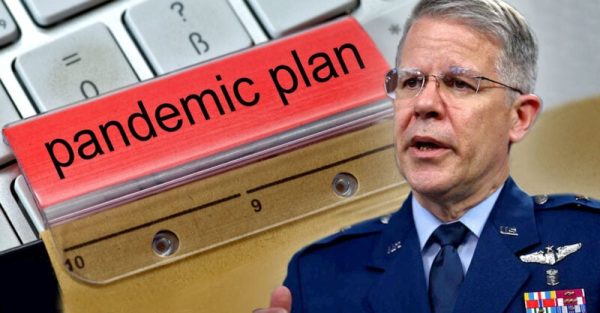
Just weeks after ending the COVID-19 national and public health emergencies and the resignation of COVID-19 Response Coordinator Ashish Jha, the White House launched its Office of Pandemic Preparedness and Response Policy (OPPR).
Retired Major General Paul Friedrichs, a military combat surgeon, will lead the office, the White House said.
According to the White House, the OPPR will be “a permanent office in the Executive Office of the President (EOP) charged with leading, coordinating, and implementing actions related to preparedness for, and response to, known and unknown biological threats or pathogens that could lead to a pandemic or to significant public health-related disruptions in the United States.”
The OPPR will take over the duties of President Biden’s COVID-19 and monkeypox response teams, including “ongoing work to address potential public health outbreaks and threats from COVID-19, Mpox, polio, avian and human influenza, and RSV [respiratory syncytial virus],” the announcement stated.
The OPPR also will oversee efforts to “develop, manufacture, and procure the next generation of medical countermeasures, including leveraging emerging technologies and working with HHS [U.S. Department of Health and Human Services] on next generation vaccines and treatments for COVID-19 and other public health threats.”
According to The New York Times, Friedrichs, set to take office Aug. 7, will have the authority to “oversee domestic biosecurity preparedness.” He will work on the development of next-generation vaccines, ensure adequate supplies in the Strategic National Stockpile and “ramp up surveillance to monitor for new biological threats.”
Several medical, biosecurity and civil liberties experts questioned the selection of a career military and biosecurity individual to head a new office charged with pandemic preparedness.
They also told The Defender they saw parallels between the White House’s establishment of the OPPR and ongoing United Nations (U.N.) efforts to draft a global declaration on Pandemic Prevention, Preparedness and Response (PPPR).
‘Is OPPR a health program or a military program?’
Friedrichs, a board-certified physician, is currently a special assistant to the president and senior director for Global Health Security and Biodefense at the National Security Council.
He previously served as joint staff surgeon at the U.S. Department of Defense (DOD) and as medical adviser to the Pentagon’s COVID-19 task force.
Throughout his career, the White House said, Friedrichs worked closely with federal, state, tribal, local and territorial government partners, as well as industry and academic counterparts.
According to the White House:
“As the United States’ representative to the North Atlantic Treaty Organization Committee of Military Medical Chiefs, he worked closely with many of America’s closest allies and partners throughout the pandemic and in developing medical support to the Ukrainian military.”
In his previous roles at the National Security Council and DOD, Friedrichs was a strong proponent of COVID-19 vaccines and countermeasures.
The Times reported that, in a February speech, Friedrichs said, “The military health system became the pinch-hitter that stepped in to help our civilian partners as we collectively struggled to work through that pandemic.”
In a February 2022 podcast, Friedrichs praised the COVID-19 vaccines and also appeared to blame those who were unvaccinated for placing “stress on our system.”
And in remarks shared in January 2022 with the Association of the United States Army, Friedrichs asked military families to continue holding off on gatherings so that service members are “able to do the things that our nation depends on them to do.”
Does Friedrichs’ appointment signal more vaccine mandates?
Describing Friedrichs’ appointment as “a joke and a fraud,” Francis Boyle, J.D., Ph.D., a bioweapons expert and professor of international law at the University of Illinois who drafted the Biological Weapons Anti-Terrorism Act of 1989, told The Defender :
“DOD has routinely enforced experimental medical vaccines on U.S. Armed Forces, in gross violation of the Nuremberg Code on Medical Experimentation — that is, a Nuremberg crime against humanity — from today’s COVID-19 ‘vaccines’ and going all the way back in recent history to the ‘vaccines’ that produced Gulf War sickness starting in 1990-1991, when Friedrichs was a U.S. Military medical doctor.
“Of 500,000 U.S. troops inoculated, 11,000 died and 100,000 were disabled. I do not recall that Friedrichs was among the handful of courageous and principled military medical doctors who refused, as a matter of principle, to inflict Nuremberg crimes on our own troops. Did he? That needs to be investigated.”
Michael Rectenwald, Ph.D., author of “Google Archipelago: The Digital Gulag and the Simulation of Freedom,” said the selection of Friedrichs, who supported military vaccine mandates, may signal similar future mandates for the general public.
“We should not forget that the DOD mandated the COVID-19 vaccine for service members,” Rectenwald said. “The OPPR will mandate vaccines for the nation.”
And writing on her blog, Dr. Meryl Nass, an internist, biological warfare epidemiologist and member of the Children’s Health Defense scientific advisory committee, questioned if the OPPR plans “to use the military’s OTA [other transaction] authority again to bypass the FDA [U.S. Food and Drug Administration] and vaccinate us with untested junk that turned out to be poison, like it did for COVID.”
Is OPPR “a health program or a military program?” Nass wrote.
Nass told The Defender that if the main purpose of the OPPR was to respond to pandemics and pandemic threats, an epidemiologist or infectious disease doctor would have been tapped to head the office instead of a military general.
Similarly, Dr. David Bell, a public health physician, biotech consultant and former director of Global Health Technologies at Intellectual Ventures Global Good Fund, told The Defender :
“COVID-19 demonstrated that the sort of interventions envisioned by the pandemic preparedness lobby such as lockdowns and coerced mass vaccination, have poor public health outcomes.
“Public health should be concentrated on informing the public to make personal decisions about health, rather than the population-control approaches we saw for COVID-19 that are most profitable to the corporate world. We must hope this new health bureaucracy is more independent of vested interests, and will take an evidence-based approach.”
Nass suggested that Friedrich’s selection belies a broadly encompassing biosecurity agenda, which would include censorship of non-establishment medical information, surveillance and mass, or mandatory, vaccination, tied to U.N. and World Health Organization (WHO) “pandemic preparedness and response” efforts.
A ‘WHO globalist worldwide medical and scientific police state’ here in the U.S.?
Other experts also noted the similarities between the name of the OPPR, the U.N.’s draft PPPR and a similar recent agreement among WHO member states.
Still in “zero draft” form, the PPPR is scheduled to be discussed by the U.N. General Assembly in September 2023. It would also be tied to the WHO’s proposed pandemic treaty and amendments to the International Health Regulations.
Similarly, a June 28 document from the WHO said, “Member States … have agreed to a global process to draft and negotiate a convention, agreement or other international instrument under the Constitution of the World Health Organization to strengthen pandemic prevention, preparedness and response.”
And a separate but similar set of proposals — part of the U.N.’s “Pact for the Future” and “Our Common Agenda” — would give the U.N. secretary-general unprecedented emergency powers not only for pandemics but seemingly for an unlimited range of other potential crises. The U.N. will discuss these proposals in September 2024.
Boyle told The Defender the OPPR is “obviously being coordinated with the U.N. [and] the Biden administration to establish the effective functioning of a WHO globalist worldwide medical and scientific police state here in the United States.”
“You need the mentality of an unprincipled military medical major general to do that,” Boyle said. “All the trains will run on time.”
Rectenwald drew similar connections, telling The Defender the OPPR and Friedrichs’ selection:
“Signifies the militarization of pandemic responses in the U.S., in line with the ‘global governance’ measures outlined by the U.N.’s Pandemic Preparedness, Prevention and Response declaration.
“This new wing of the executive branch is the means by which this ‘global governance’ (read: one-world totalitarian system) is being introduced to the U.S., using pandemic preparedness as the pretext.”
Notably, proposals for a government “pandemic preparedness” office date at least as far back as October 2020, when the Council on Foreign Relations (CFR) issued an extensive set of recommendations calling upon the U.S. government to “adopt a robust strategy for domestic and global pandemic preparedness.”
The report recommended that the U.S. “finally treat pandemics as a serious national security threat, translating its rhetorical support for pandemic preparedness into concrete action.”
According to the CFR, this would entail “bolstering the White House’s leadership role in preparing for and responding to pandemics, improving congressional input into and oversight over executive branch efforts, reforming the CDC so that it can perform more effectively, and clarifying the often confused division of labor across federal, state, and local governments in pandemic preparedness and response.”
“The president should designate a focal point within the White House for global health security, including pandemic preparedness and response,” the report added. “This office would have lead responsibility for coordinating the multiple federal departments and agencies in anticipating, preventing, and responding quickly to major disease outbreaks.”
OPPR reports to Congress required only every 5 years, not annually
The establishment of the OPPR resulted from the passage of the PREVENT Pandemics Act in December 2022.
The bill, introduced by Sen. Patty Murray (D-Wash.) and the now-retired Sen. Richard Burr (R-N.C.), passed as part of an omnibus spending bill, contained a requirement for the creation of a White House pandemic preparedness and response office.
Though the bill was passed in December 2022, the White House was unable to immediately establish a pandemic preparedness office and name a director.
A Politico report in May said these efforts were “hindered by concerns over whether [the office] will have the influence within the administration and the financial resources needed to fulfill its broad mission — especially as COVID plummets down the list of political priorities.”
According to the White House announcement, OPPR will “Develop and provide periodic reports to Congress” as required by law, including drafting and delivering to Congress “a biennial Preparedness Review and Report and Preparedness Outlook Report every five years.”
On her blog, Nass wrote, “Instead of the more customary yearly reports, the reporting to Congress is being delayed considerably, perhaps until after many of us have died from the countermeasures — a great way to evade oversight.”
In a separate blog post, Nass also observed that the Centers for Disease Control and Prevention requested $20 billion for “pandemic preparedness” in its fiscal year 2024 budget.
Michael Nevradakis, Ph.D., based in Athens, Greece, is a senior reporter for The Defender and part of the rotation of hosts for CHD.TV’s “Good Morning CHD.”
This article was originally published by The Defender — Children’s Health Defense’s News & Views Website under Creative Commons license CC BY-NC-ND 4.0. Please consider subscribing to The Defender or donating to Children’s Health Defense.
Revealed: Dark Money Funders Behind ‘Disinformation Dozen’ Report
By Brenda Baletti, Ph.D. | The Defender | July 27, 2023
A new report published Monday by GreenMedInfo revealed nine of the dark money sources funding the Center for Countering Digital Hate (CCDH), an influential nonprofit that allegedly colluded with social media platforms and the White House to censor Children’s Health Defense (CHD), Robert F. Kennedy Jr., CHD’s chairman on leave and others for spreading “disinformation.”
The report identified CCDH’s funders primarily as U.K.-based philanthropic organizations whose directors and trustees are affiliated with legacy media organizations, the U.K. government and major global philanthropic organizations such as the Open Society Foundations and the Ford Foundation.
Despite claims by Imran Ahmed, CCDH’s CEO and founder, that the organization has “never taken government money,” the report also found at least one of its funders has received U.K. government funding.
“It appears that CCDH may be an astroturf front operation for both NGOs [nongovernmental organizations] and the U.K. government to directly interfere with and target the constitutional rights of U.S. citizens, and this should be a concern for all Americans,” report author Sayer Ji told The Defender.
CCDH famously drafted a list of the so-called “Disinformation Dozen,” which included Kennedy, Dr. Joseph Mercola, the founders of The Truth About Vaccines and The Truth About Cancer websites Ty and Charlene Bollinger, and Ji, founder of the natural health website GreenMedInfo.
CCDH alleged in its report that just 12 accounts produced the majority of “anti-vaccine disinformation” on social media.
Facebook investigated and dismissed the report, releasing a statement saying that “There isn’t any evidence” to support its claims and that the small sample used in CCDH’s analysis was “in no way representative of the hundreds of millions of posts that people have shared about COVID-19 vaccines.”
“There is no justification for [CCDH’s] claim that their data constitute a ‘representative sample’ of the content shared across our apps,” Facebook stated.
Yet, the report was used by the White House and Twitter to censor those individuals and by legacy media outlets such as NPR, The Guardian and countless others to discredit the people on the list.
Despite its baseless claims, the report was extremely effective, Ji said.
Ji told The Defender :
“CCDH’s factually baseless campaign was amplified and disseminated globally by hundreds of colluding media outlets, such that today you can find over 3,400 news articles online uncritically citing their defamatory construct ‘disinformation dozen.’
“This has wrought profound reputational damage, and has dramatically curtailed our ability to share our message, given that over 2 million of our followers have been removed, following the deplatforming efforts of those spreading these lies.”
In Kennedy’s testimony before a U.S. House of Representatives hearing organized by the Select Subcommittee on the Weaponization of the Federal Government last week, he cited his inclusion on CCDH’s list as part of a “new form of censorship, which is called ‘targeted propaganda,’ where people apply pejoratives like ‘anti-vax’ … to silence me.”
The latest “Twitter Files” released July 18 by investigative journalist Paul D. Thacker detailed how Twitter and the White House used CCHD’s “Disinformation Dozen” report as justification for censoring the people on the list.
Thacker also profiled Ahmed, who previously worked for Merrill Lynch and was a British Labour Party political operative, and is the co-author of “The New Serfdom: The Triumph of Conservative Ideas and How to Defeat Them… .” Ahmed emerged during the pandemic as a “vaccine and disinformation expert,” although lacking any experience that would qualify him as such, Thacker reported.
Thacker raised questions about who funds CCDH and reached out to the organization to investigate, but received no response.
Ji’s report published Monday provides a partial answer to that question, seeking to “contribute to the collective effort to shed a sterilizing light on the dark agenda spear-headed by astroturfing organizations like CCDH,” he wrote in the report.
CCDH’s funders primarily global but U.K.-based nonprofits
Although CCDH does not make its funders publicly available and failed to respond to Thacker’s inquiries, Ji was able to identify some of them by examining the public grant-reporting website 360 GrantNav, along with other publicly available sites, including CCDH’s 2020 website archived on the Wayback Machine.
The funders identified are primarily U.K.-based charities, some of which operate globally and generally contribute to a wide variety of causes that cluster around issues of environment and poverty, rather than health or science.
According to the report, the Paul Hamlyn Foundation in 2021 gave CCDH a £100,000 grant earmarked for “growing the digital presence and impact of the Center for Countering Digital Hate.” The foundation’s trustees include the former general-director of the BBC Tony Hall, Baron Hall of Birkenhead, and Sir Anthony Saltz, formerly on BBC’s board of governors.
The Esmée Fairbairn Foundation, a large U.K. charity with a £1.5 billion endowment, whose mission is “to improve the natural world, create a fairer future and strengthen community bonds in the UK,” gave CCDH £200,000 in October 2021 to support a salary at the organization and to “disrupt the spread of online hate and misinformation.” It awarded CCDH a second £13,333 grant in January of this year.
The Joseph Rowntree Reform Trust, which, according to the report, is a U.K.-based limited company — not a charity and therefore able to fund political causes — gave CCDH £53,400 in 2020.
CCDH is also funded by the Oak Foundation, a global environmentalist grantmaking foundation that gave CCDH $100,000 to help it shine a “spotlight on digital misinformation platforms that are polluting the public discourse.”
CCDH reported on its website that it received an undisclosed amount of money from the Barrow Cadbury Trust, whose mission is to “tackle profound social ills, including juvenile crime and urban poverty.”
The Pears Foundation, a U.K. charity that Ji’s report says focuses on “Israel-related projects” gave CCDH £250,000 over three years. The foundation is funded by the William Pears group and the U.K. government, according to the report.
The Hopewell Fund is a U.S.-based 501(c)(3) organization managed by a Washington, D.C.-based philanthropy consulting firm and is dedicated to funding “innovative social change projects.” It gave CCDH a small $15,000 grant in 2021.
Unbound Philanthropy, the final donor identified by the report, is a New York-based 501(c)(3) nonprofit organization whose executive director Taryn Higashi also sits on the advisory board of Soros’ Open Society Foundations and who formerly worked at the Ford Foundation.
But this is just a partial list, and in his report, Ji appealed to the public to continue researching the “dark money” behind the organization.
Ji also invited readers to take action on the Stand for Health Freedom campaign website “to send the message that the targeting of U.S. citizens to illegally suppress protected speech is unacceptable.”
The Defender examined CCDH’s 990 — the tax form nonprofits must file annually with the IRS — from fiscal year 2021, where the organization reported receiving $1,471,247 in contributions and grants and listed $860,457 in total assets.
The list of contributors was marked as “restricted,” and further information was not provided. It did report spending $12,633 on “lobbying activities.”
While The Defender was only able to find the single 2021 federal form 990, we did locate CCDH’s U.K. financial reporting form for fiscal year 2022 (ending Oct. 31, 2022), showing the organization received $904,452 from donations in 2022 and $638,499 in 2021.
Financial filings also reveal CCDH board member affiliations
The U.S. 990, the U.K. financial statements and the U.K.’s company information service also revealed CCDH’s frequently changing board members and directors, many of whom have close ties to government and media organizations.
Notable figures include Simon Clark, board chair, who was a resident senior fellow at the Atlantic Council’s Digital Forensic Research Lab. The Atlantic Council is a NATO, arms industry and Persian Gulf monarchies-funded think tank.
Prior to his work at the Atlantic Council, Clark was a senior fellow at the Center for American Progress, where he led the work that informed the Biden White House’s National Strategy for Countering Domestic Terrorism.
Ji found it “unsurprising” that “CCDH’s rhetorical points made it into several U.S. Department of Homeland Security terrorism bulletins equating free speech and open debate about mRNA vaccine safety and efficacy, or Covid origins, as possible new forms of domestic terrorism.”
Another CCDH director, Kirsty McNeill has also worked as Save the Children’s executive director for Policy, Advocacy and Campaigns since 2016, a period during which the Bill & Melinda Foundation donated more than $40 million to the organization.
Save the Children has also partnered with Gavi, the Vaccine Alliance. Gavi maintains a core partnership with the World Health Organization and the World Bank.
McNeill previously worked as a special adviser and speechwriter for former Prime Minister Gordon Brown. She is a member of the think tank European Council on Foreign Relations, funded by such entities as the Open Society Foundations, the United Nations and the Gates Foundation.
Aleen Keshishian and Zack Morgenroth are both CCDH board members and work at Lighthouse Management & Media, a Hollywood management agency representing top stars including Jennifer Aniston, who famously cut ties with her unvaccinated friends.
Damian Noel Thomas Collins, who joined CCDH in 2022, is a British Conservative Party politician who formerly served as a junior Minister for Tech and the Digital Economy in the Department for Digital, Culture, Media & Sport.
CCDH sought to silence the voices that were ‘most effective’ at warning the public
In addition to its government, social media and legacy media connections, CCDH has partnered with “fact-checking” firm NewsGuard — specifically, its HealthGuard product, described as “a vaccine against medical misinformation” and against critiques targeting the healthcare industry and global public health authorities.
According to an article by Off-Guardian, CCDH claimed the COVID-19 pandemic “will only be overcome by the most ambitious vaccination programme in human history” and those who question this program have “fringe and extremist views,” which “should not be permitted and should indeed be banned.”
They have also advocated for the imprisonment of “anti-vaxxers.”
Ji told The Defender that CCDH’s targeted campaign spoke to the validity of the ideas of those it sought to deplatform.
He said:
“George R. R. Martin once said, ‘When you tear out a man’s tongue, you are not proving him a liar, you’re only telling the world that you fear what he might say.’
“I believe CCDH’s campaign was intended to silence those of us who they believed were most effective at warning the public about the true dangers of the mRNA vaccine rollout and how this mass experiment violated the medical ethics principle of informed consent.”
Brenda Baletti Ph.D. is a reporter for The Defender. She wrote and taught about capitalism and politics for 10 years in the writing program at Duke University. She holds a Ph.D. in human geography from the University of North Carolina at Chapel Hill and a master’s from the University of Texas at Austin.
This article was originally published by The Defender — Children’s Health Defense’s News & Views Website under Creative Commons license CC BY-NC-ND 4.0. Please consider subscribing to The Defender or donating to Children’s Health Defense.
Documents show White House pressured Facebook to censor speech
RT | July 27, 2023
Newly unearthed documents from Facebook have revealed that US President Joe Biden’s administration pressured the world’s largest social media platform to censor commentary by its users, potentially violating their constitutional right to free speech.
US House Judiciary Committee Chairman and Republican Jim Jordan obtained the documents amid his panel’s investigation of the administration’s alleged “weaponization” of government. The documents prove that Facebook and Instagram censored posts and changed their moderation policies because of “unconstitutional pressure from the Biden White House,” Jordan said on Thursday.
Among the evidence cited by the lawmaker was an April 2021 email from a Facebook employee to top executives Mark Zuckerberg and Sheryl Sandberg. “We are facing continued pressure from external stakeholders, including the White House and the press, to remove more Covid-19 vaccine-discouraging content,” the sender said. The message noted, for example, that the White House had pushed for the censoring of a humorous meme that suggested the jabs might be unsafe.
Around the same time period, Nick Clegg, Facebook’s president for global affairs, sent a message informing his colleagues that Andy Slavitt, a senior adviser to Biden on Covid-19 policies, was “outraged” that the platform didn’t take down the anti-vaccine meme. Clegg said he countered that removing the content “would represent a significant incursion into traditional boundaries of free expression in the US,” but Slavitt disregarded that concern and argued that the meme would hinder the government’s vaccine-rollout effort.
Social media platforms themselves can legally choose how to restrict their content, but government intervention to influence those decisions could infringe on free-speech rights. After a report last October showed that the administration had set up a portal through which federal officials could make content-moderation requests to Big Tech, the American Civil Liberties Union said, “The First Amendment bars the government from deciding for us what is true or false – online or anywhere. Our government can’t use private pressure to get around our constitutional rights.”
Jordan warned earlier this week that his committee would vote to hold Zuckerberg in contempt of Congress unless Facebook provided the documents it had subpoenaed on government interventions into content moderation. He claimed that the committee had seen enough evidence to believe that Facebook was holding back on turning over evidence that would show it faced the same sort of government pressure that was previously revealed by Twitter.
Facebook executives feared repercussions if they didn’t appease the White House, Jordan said. Three months after Biden took office, Facebook’s vice president for public policy, Brian Rice, wrote in an April 2021 email that Slavitt’s pushback felt “very much like a crossroads for us with the White House in these early days.” He added, “Given what is at stake here, it would also be a good idea if we could regroup and take stock of where we are in our relations with the White House and our internal methods, too.”
Another document showed that “talking points” were prepared for Clegg to help smooth over relations with the administration. One of the suggestions was that he point out the company’s handling of a Tucker Carlson video that angered the White House. Although the video didn’t violate the platform’s policies, Facebook throttled back its distribution by 50% while it was queued to be “fact-checked.”
More F-35s arrive in West Asia in latest anti-Iran deployment
The Cradle | July 27, 2023
A squadron of US F-35 fighter jets have arrived in the region, Washington’s air force announced on 26 July, coming as part of increased efforts to “beef up deterrence against Iran,” US media outlet Fox News wrote on 26 July.
“The Iranian navy did make attempts to seize commercial tankers lawfully transiting international waters. The U.S. Navy responded immediately and prevented those seizures,” US Fifth Fleet spokesman Tim Hawkins said.
Washington repeatedly accuses Iran of attempting to ‘hijack’ foreign vessels. However, Tehran maintains that it pursues foreign tankers who are either involved in fuel smuggling, or who have violated international regulations by colliding with Iranian vessels and fleeing – as has happened on a number of occasions.
The F-35s were deployed to the US CENTCOM ‘Area of Responsibility’ and serve as an augmentation to those already patrolling the Strait of Hormuz.
According to the military, they aim to provide cover for ships in the region in order to prevent Iranian seizures. They also aim to “deliver ‘increased capacity’ to the region and ‘allow the U.S. to fly in contested airspace across the theater if required,’” an air force press release cited by Fox News reads.
The F-35 jets will also “be available to help in Syria,” Fox News said. US troops currently occupy Syria, controlling its oilfields in coordination with proxy militias, while claiming to be carrying out anti-ISIS operations.
“This deployment demonstrates the U.S.’s commitment to ensure peace and security in the region, through maritime support and support to the coalition’s enduring mission to defeat ISIS in Syria,” the US air force said.
This latest jet deployment comes as Washington has been cementing its military presence across West Asia, seemingly in preparation for a confrontation with Iran. This has seen the US recently deploy a nuclear submarine and a navy destroyer to the Persian Gulf.
In Syria specifically, Washington and Moscow have recently gotten closer to coming to blows.
On 26 July, a US MQ-9 Reaper surveillance and attack drone locked its weapons on two Russian warplanes, reportedly forcing the jets to drop flares that “damaged” the drone’s wings.
This marked the second incident in three days where Russian jets dropped flares on a US drone attempting to lock weapons on them.
According to an anonymous US military official cited in a report earlier this month, Russian and Iranian forces in Syria have been coordinating with the specific aim of forcing Washington’s troops to eventually withdraw from the country.
As a result, Washington has been continuously reinforcing its military bases in Syria, and is reportedly planning to deploy an additional 2,500 troops to the country.
Remember the Atrocities of the Korean War, Not the Propaganda
By Jim Bovard | The Libertarian Institute | July 27, 2023
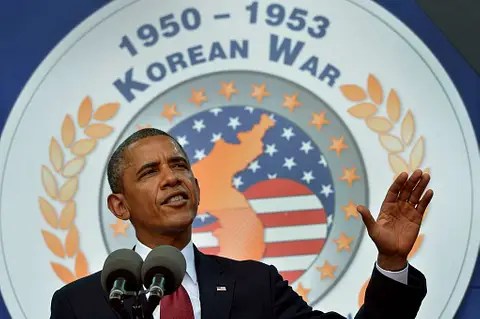
Today is the 70th anniversary of the armistice that ended the fighting between North and South Korea. Almost 40,000 American soldiers died pointlessly in that conflict. If politicians and policymakers were honest and prudent, the Korean War would have vaccinated America against the folly and evil of foreign intervention. Instead, the war was retroactively redefined. As Barack Obama declared in 2013, “That war was no tie. Korea was a victory.”
The war began with what Harry Truman claimed was a surprise invasion on June 25, 1950, by the North Korean army crossing the dividing line with South Korea that was devised after World War II. But the U.S. government had ample warnings of the pending invasion. According to the late Justin Raimondo, co-founder of Antiwar.com, the conflict actually started with a series of attacks by South Korean forces, aided by the U.S. military:
“From 1945-1948, American forces aided [South Korean President Syngman] Rhee in a killing spree that claimed tens of thousands of victims: the counterinsurgency campaign took a high toll in Kwangju, and on the island of Cheju-do—where as many as 60,000 people were murdered by Rhee’s U.S.-backed forces.”
The North Korean army quickly routed both South Korean and U.S. forces. A complete debacle was averted after General Douglas MacArthur masterminded a landing of U.S. troops at Inchon. After he routed the North Korean forces, MacArthur was determined to continue pushing northward regardless of the danger of provoking a much broader war. By the time the U.S. forces drove the North Korean army back across the border, roughly 5,000 American troops had been killed. The Pentagon had plenty of warning that the Chinese would intervene if the U.S. Army pushed too close to the Chinese border. But the euphoria that erupted after Inchon blew away all common sense and drowned out the military voices who warned of a catastrophe. One U.S. Army colonel responded to a briefing on the Korea situation in Tokyo in 1950 by storming out and declaring, “They’re living in a goddamn dream land.”
The Chinese military attack resulted in the longest retreat in the history of America’s armed forces—a debacle that was valorized in the 1986 Clint Eastwood movie, Heartbreak Ridge. By 1951, the Korean War had become intensely unpopular in the United States—more unpopular than the Vietnam War ever was. Truman insisted on mislabeling the war as a “police action,” but it destroyed his presidency regardless. When the ceasefire was signed in 1953, the borders were nearly the same as at the start of the war.
While the friends of leviathan paint Truman as the epitome of an honest politician, he was as demagogic on Korea as Lyndon Johnson was on Vietnam. When Republicans criticized the Korean War as useless, President Harry Truman condemned “reckless and irresponsible Republican extremists” and “the false version of history that has been copyrighted by the extremists in the Republican Party.”
Perhaps the biggest disaster of the Korean war was that intellectuals and foreign-policy experts succeeded in redefining the Korean conflict as an American victory. As Georgetown University professor Derek Leebaert noted in his book Magic and Mayhem, “What had been regarded as a bloody stalemate transformed itself in Washington’s eyes; ten years later it had become an example of a successful limited war. Already by the mid-1950s, elite opinion began to surmise that it had been a victory.” Leebaert explained, “Images of victory in Korea shaped the decision to escalate in 1964-65 helping to explain why America pursued a war of attrition.” Even worse, the notion that “‘America has never lost a war’ remained part of the national myth, and the notion of having ‘prevailed’ in Korea became a justification for going big in Vietnam.” But as Leebaert noted, “in Vietnam, [the U.S. Army] had forgotten everything it had learned about counterinsurgency in Korea as well.”
On last year’s armistice anniversary, President Joe Biden proclaimed, “During the Korean War, nearly 1.8 million Americans answered the call to serve and defend the freedoms and universal values that the people of South Korea enjoy today.” The “call to serve” mostly came from summons from draft boards for military conscription. American media commemorations of the Korean War have almost entirely ignored perhaps the war’s most important lesson: the U.S. government has almost unlimited sway to hide its own war crimes.
During the war, Americans were deluged with official pronouncements that the U.S. military was taking all possible steps to protect innocent Korean civilians. Because the evils of communism were self-evident, few questions arose about how the United States was thwarting Red aggression. When a U.S. Senate subcommittee appointed in 1953 by Senator Joseph McCarthy (R-WI) investigated Korean War atrocities, the committee explicitly declared that “war crimes were defined as those acts committed by enemy nations.” This same standard prevailed in Vietnam, Iraq, Afghanistan, and practically any other place where the U.S. has militarily intervened.
In 1999, forty-six years after the cease fire in Korea, the Associated Press exposed a 1950 massacre of Korean refugees at No Gun Ri. U.S. troops drove Koreans out of their village and forced them to remain on a railroad embankment. Beginning on July 25, 1950, the refugees were strafed by U.S. planes and machine guns over the following three days. Hundreds of people, mostly women and children, were killed. The 1999 AP story was widely denounced by American politicians and some media outlets as a slander on American troops.
The Pentagon promised an exhaustive investigation. In January 2001, the Pentagon released a 300-page report purporting to prove that the No Gun Ri killings were merely “an unfortunate tragedy” caused by trigger-happy soldiers frightened by approaching refugees.
President Bill Clinton announced his “regret that Korean civilians lost their lives at No Gun Ri.” In an interview, he was asked why he used “regret” instead of “apology.” He declared, “I believe that the people who looked into it could not conclude that there was a deliberate act, decided at a high-enough level in the military hierarchy, to acknowledge that, in effect, the Government had participated in something that was terrible.” Clinton specified that there was no evidence of “wrongdoing high-enough in the chain of command in the Army to say that, in effect, the Government was responsible.”
But the atrocities against civilians had been common knowledge among U.S. troops 50 years earlier. As Charles Hanley, Sang-Hun Choe, and Martha Mendoza noted in their 2001 book, The Bridge at No Gun Ri, the Pentagon in 1952 “withdrew official endorsement from RKO’s One Minute to Zero, a Korean War movie in which an Army colonel played by actor Robert Mitchum orders artillery fire on a column of refugees.” The Pentagon fretted that “this sequence could be utilized for anti-American propaganda” and banned the film from being shown on U.S. military bases.
In 2005, Sahr Conway-Lanz, a Harvard University doctoral student, discovered a letter in the National Archives from the U.S. Ambassador to Korea, John Muccio, sent to Assistant Secretary of State Dean Rusk on the day the No Gun Ri massacre commenced. Muccio summarized a new policy from a meeting between U.S. military and South Korean officials: “If refugees do appear from north of U.S. lines they will receive warning shots, and if they then persist in advancing they will be shot.” The new policy was radioed to Army units around Korea on the morning the No Gun Ri massacre began. The U.S. military feared that North Korean troops might be hiding amidst the refugees. The Pentagon initially claimed that its investigators had never seen Muccio’s letter. Louis Caldera, who was Army secretary in 2001, declared, “Millions of pages of files were reviewed and it is certainly possible they may have simply missed it.” But Muccio’s letter was in the specific research file used for the official exoneration report.
Conway-Lanz’s 2006 book Collateral Damage: Americans, Noncombatant Immunity, and Atrocity after World War II quoted an official U.S. Navy history of the first six months of the Korean War stating that the policy of strafing civilians was “wholly defensible.” An official Army history noted, “Eventually, it was decided to shoot anyone who moved at night.” A report for the aircraft carrier USS Valley Forge justified attacking civilians because the Army insisted that “groups of more than eight to ten people were to be considered troops, and were to be attacked.”
In 2007, the Army recited its original denial: “No policy purporting to authorize soldiers to shoot refugees was ever promulgated to soldiers in the field.” But the Associated Press exposed more dirt from the U.S. archives: “More than a dozen documents—in which high-ranking U.S. officers tell troops that refugees are ‘fair game,’ for example, and order them to ‘shoot all refugees coming across river’—were found by the AP in the investigators’ own archived files after the 2001 inquiry. None of those documents was disclosed in the Army’s 300-page public report.” A former Air Force pilot told investigators that his plane and three others strafed refugees at the same time of the No Gun Ri massacre; the official report claimed that “all pilots interviewed…knew nothing about such orders.” Evidence also surfaced of massacres like No Gun Ri. On September 1, 1950, the destroyer USS DeHaven, at the Army’s insistence, “fired on a seaside refugee encampment at Pohang, South Korea. Survivors say 100 to 200 people were killed.”
Slaughtering civilians en masse became routine procedure after the Chinese army intervened in the Korean War in late 1950. MacArthur spoke of turning North Korean-held territory into a “desert.” The U.S. military eventually “expanded its definition of a military target to any structure that could shelter enemy troops or supplies.” General Curtis LeMay summarized the achievements: “We burned down every town in North Korea… and some in South Korea, too.” Yet, despite the hit-anything-still-standing bombing policy, most Americans believed the U.S. military acted humanely in Korea. Historian Conway-Lanz noted: “The issue of intention, and not the question of whose weapons literally killed civilians or destroyed their homes, became the morally significant one for many Americans.”
A million civilians may have been killed during the war. A South Korean government Truth and Reconciliation Commission uncovered many previously unreported atrocities and concluded that “American troops killed groups of South Korean civilians on 138 separate occasions during the Korean War,” The New York Times reported.
Truth delayed is truth defused. The Pentagon strategy on Korean War atrocities succeeded because it left facts to the historians, not the policymakers. The truth about No Gun Ri finally slipped out—ten presidencies later. Even more damaging, the Rules of Engagement for killing Korean civilians were covered up for four more U.S. wars. If U.S. policy for slaying Korean refugees (or anyone who “moved at night”) had been exposed during that war, it might have curtailed similar killings in Vietnam (many of which were not revealed until decades after the war).
Former congressman and decorated Korean War veteran Pete McCloskey (R-CA) warned, “The government will always lie about embarrassing matters.” The same shenanigans permeate other U.S. wars. The secrecy and deceit surrounding U.S. warring has had catastrophic consequences in this century. The George W. Bush administration exploited the 9/11 attacks to justify invading Iraq in 2003, and it was not until 2016 that the U.S. government revealed documents exposing the Saudi government’s role in financing the 9/11 hijackers (15 of 19 whom were Saudi citizens). The Pentagon covered up the vast majority of U.S. killings of Iraqi civilians until Bradley Manning and WikiLeaks exposed them in 2010.
When politicians or generals appear itching to pull the United States into another foreign war, remember that truth is routinely the first casualty. Governments that recklessly slay masses of civilians won’t honestly investigate and announce their guilt to the world. Self-government is a mirage if Americans do not receive enough information to judge killings committed in their name.
Jim Bovard is the Junior Fellow for The Libertarian Institute. He is the author of Public Policy Hooligan (2012), Attention Deficit Democracy (2006), Lost Rights: The Destruction of American Liberty (1994), and 7 other books.
Biden Regime Played Vital Role in Crimean Bridge Attacks – Sy Hersh
Sputnik – 27.07.2023
WASHINGTON – The Biden Administration played a vital role in both recent deadly attacks on the Crimean Bridge, providing Ukraine with the necessary technology, US journalist Seymour Hersh reported on Thursday, citing a US official.
“Of course it was our technology,” the US official was quoted by Hersh as saying. “The drone was remotely guided and half submerged—like a torpedo.”
When Hersh asked if there was any thought before the bridge attacks about the possibility of Russia’s retaliation, the official responded with “What will Putin do? We don’t think that far. Our national strategy is that Zelensky can do whatever he wants to do. There’s no adult supervision.”
On October 8, 2022, a car detonated on the Crimean Bridge, which connects the Crimean Peninsula with Russia’s mainland. Five people, including the driver of the truck, were killed. The bridge itself was seriously damaged.
On July 17, a submersible drone carried out another attack on the Crimean Bridge, killing a woman and a man and wounding their teenage daughter.
Ukraine Shipped Drugs and Russian Oil to Europe Under Cover of Grain Deal
In addition, the journalist reported that Ukraine shipped drugs and Russian oil under the cover of the UN-mediated Black Sea Grain Deal, an accord that was meant to bolster global food security.
Russia refused to extend the Black Sea deal last week, following its long-time criticism of the UN’s failure to facilitate its own grain and fertilizer exports as was required under the agreement.
The decision also came following the July 17 attack on the Crimean bridge with marine surface drones, which killed a couple who were driving across when the blast occurred and wounded their teen daughter.
US, Ukraine No Longer Project Counteroffensive Success, Russia Has Upper Hand
According to the correspondent, the US and Ukrainian military now abstain from making forecasts regarding future success in the counteroffensive because Russia has a clear advantage on the battlefield.
“The American and Ukrainian military are no longer making any predictions,” the US official was quoted by Hersh as saying. “The Ukrainian army has not gotten past the first of three Russian defense lines. Every mine the Ukrainians dig up is replenished at night by the Russians.”
The reality, the interlocutor clarified, “is that the balance of power in the war is settled. Putin has what he wants.”
Ukraine is not capable of returning Crimea, Donetsk, Kherson, Lugansk and the Zaporozhye Region, the official stressed, while Volodymyr Zelensky has “no plan, except to hang on,” the interviewee observed.
Ukraine launched a counteroffensive in early June, trying to break through the defense lines of the Russian armed forces in the Donetsk and Zaporozhye regions. Their attempts have been unsuccessful and resulted in heavy losses in armored equipment and manpower of Kiev’s forces, according to the Russian Defense Ministry.
Featured Video

Iranians Want Revenge /Sulaiman Ahmed
or go to
Aletho News Archives – Video-Images
From the Archives
Are There 50,000 ‘Israeli-born’ Individuals Living in the UK?
By Professor David Miller | August 18, 2026
Recent disclosures by the Zionist regime show that some 2,069 British nationals were serving in the IDF as of March 2025, according to Freedom of Information (FoI) requests submitted to the occupation forces (1,686 dual British-Israeli, plus 383 multinational). We cannot tell from the figures how many of these were already settler colonists and intend to stay in the colony, and how many will return or have returned to the UK. Presumably, those returning to the UK will number far fewer than 2,000, since many are known to have become permanently residents of the colony.
Additionally, the IDF figures only provide a snapshot, and do not tell us how many have served in the Jewish supremacist military either before or after March 2025. One way into the question of how many genocidaires are living in Britain is to ask how many current British residents were born in the Zionist colony. There is data on that, as we shall see. … continue
Blog Roll
 Aletho News
- Iranians Want Revenge /Sulaiman Ahmed
- ‘Israel’ bombs Nasser Medical Complex in Khan Younis, killing 5
- The beginning of the end: Israel at the heart of America’s political civil war
- US-Israeli war on Iran cost Persian Gulf states nearly $1T in damage, lost growth: Report
- Congress probe could put ‘Israel’ in dock over Iran war: Israeli media
- Spanish public prosecutor backs US demand to extradite pro-Palestine philanthropist Fergie Chambers
- Zelensky spent over 740 days outside Ukraine while West serves as his real home
- Indian captain of Russian ‘shadow fleet’ tanker faces 10-year jail term in UK
- Europe, US face higher heating bills amid Iran war fallout
- The Leak That Arrived Right on Cue
- If Americans Knew
- These Democrats Are Bringing a Christian Case Against Israel’s War to Congress
- Netanyahu calling Trump ‘every day’ to push for renewed war on Iran
- What will big wins by Democrats actually mean for Palestine?
- What is Section 219 of the US defense bill, and what would it mean for Israel?
- Hegseth dodges impeachment after using troops and vets for cover
- Israel Bombs Lebanon’s Churches
- Israel Targets U.S. Conservatives in New Influence Operation
- Declassified FBI Files Reveal Early U.S. Counterintelligence Probe into Israeli Espionage and Smuggling Networks
- Israelis perpetrated 1,182 arson attacks in the West Bank in past 3 years
- DAILY UPDATE: Latest essential news on Palestine, Israel, & region
- No Tricks Zone
- German Authorities Start Initiative To Evaluate Public Register For Climate “Disinformation” Spreaders!
- Zonal Asymmetry of Temperature Change in the Antarctic Circumpolar Current
- New Study: The Net Fossil Fuel Contribution To Rising Atmospheric CO2 Has Been Zero For 500 Years
- Germany’s Green Energy Transition Becoming Increasingly Expensive…Another 6 Trillion Euros!
- Sudden Stratospheric Warming, Powerful El Niño Combination May Lead To Extreme Europe Cold, Energy Crisis!
- Two New Studies Find Thwaites Glacier Melt Cannot Be Driven By Human Activity Or A Warming Ocean
- E-Cars Reduce CO2 Emissions By Only 41% Compared To Internal Combustion Engine Vehicles
- Predictions Made By Renowned Climate Professor Over Past Decades Have Been Proven To Be Poor
- New Study Suggests Large Regions Of The Pacific Ocean Have Been Cooling For The Last 80 Years
- Germany’s Green Energy Debacle: High Energy Costs Force Kahla Porzellan to Close After 182 Years!

