Pfizer Whistleblower Will Appeal After Federal Judge Dismisses Lawsuit Alleging Fraud
By Michael Nevradakis, Ph.D. | The Defender | April 4, 2023
A federal judge in Texas has dismissed a lawsuit alleging Pfizer and two of its contractors manipulated data and committed other acts of fraud during Pfizer’s COVID-19 clinical trials.
Brook Jackson, a former employee of the Ventavia Research Group — which conducted some of the clinical trials for the Pfizer-BioNTech COVID-19 vaccine — in January 2021 sued Pfizer, Ventavia and ICON PLC, another Pfizer contractor, alleging the companies committed numerous violations of the False Claims Act (FCA) during the clinical trials.
According to Jackson’s complaint, the three companies “deliberately withheld crucial information from the United States that calls the safety and efficacy of their vaccine into question,” and as a result, they defrauded the U.S. government which purchased the vaccines.
The FCA allows the government or a party suing on its behalf, such as Jackson, to attempt to recover money for false claims made by parties in order to secure payment from the government.
Those parties can be held liable under the FCA if they knowingly made a false claim or used a false record or statement in order to secure payment.
Also under the FCA, whistleblowers can be rewarded for confidentially disclosing fraud that results in a financial loss to the federal government.
In February 2022, the federal government declined to intervene in the lawsuit on Jackson’s behalf.
In his March 31 ruling, U.S. District Judge Michael Truncale of the U.S. District Court for the Eastern District of Texas-Beaumont Division ruled Jackson had not proved the companies violated the FCA.
However, in a footnote accompanying his decision, Judge Truncale left the door open for Jackson and her legal team to file an appeal, stating:
“The Court observes, however, that while Ms. Jackson has failed to state a claim for retaliation under the FCA, she may be able to bring her claim under another statute.
“The Court does not opine on the likelihood of success with respect to asserting retaliation under a different statute.”
In a statement posted on Twitter, Jackson sharply criticized Truncale’s ruling, writing:
“The dismissal of Pfizer’s case is a despicable & heinous betrayal of justice, a slap in the face to vaccine injured and whistleblowers, a blatant example of corruption, incompetence and cowardice, a declaration that the powerful are above the law.”
Jackson also tweeted:
A blueprint for federal contractors to commit fraud and get away with it?
Jackson, who had over 15 years of experience working with clinical trials, claimed she “repeatedly informed her superiors of poor laboratory management, patient safety concerns and data integrity issues” during the approximately two weeks she was employed by Ventavia in September 2020.
She also gave The BMJ a cache of internal company documents, photos and recordings highlighting alleged wrongdoing by Ventavia.
Ventavia, which describes itself as the largest privately owned clinical research company in Texas, operated several sites where it conducted clinical trials on behalf of Pfizer.
The documents Jackson provided contained evidence of falsified data, blind trial failures and awareness on the part of at least one Ventavia executive that members of the company’s staff were “falsifying data.”
Jackson’s documents also provided evidence of administrators who had “no training” or medical certifications, or who provided “very little oversight” during the trials.
According to The Epoch Times, the federal government’s agreement with Pfizer set, as its only condition of payment, delivery of a vaccine that was authorized or approved by the U.S. Food and Drug Administration (FDA).
As Emergency Use Authorization (EUA) for the Pfizer-BioNTech COVID-19 vaccine has not been withdrawn, the federal government’s agreement with Pfizer remains valid, according to Judge Truncale, who wrote:
“In sum, Ms. Jackson has failed to plead that the Government conditioned payment on Defendants’ certification of compliance with regulatory provisions or clinical trial protocol.
“The upshot is that there is no liability under the FCA for making or using a false record or statement where the claimant is entitled to the payment. Pfizer was entitled to its claims for payment. Therefore, Ms. Jackson has not stated a claim for false record liability.”
Jackson described Judge Truncale’s decision as a “blueprint” on how government contractors can “commit fraud and get away with it. She and her lawyers said they will appeal the dismissal.
Judge: FCA not created to ‘second-guess’ federal policymakers
Judge Truncale said the FCA places the onus on the federal government to determine whether it had been defrauded.
He quoted another ruling finding that the FCA was not created to “second guess decisions made by those empowered through the democratic process to shape public policy.”
“When the government, at appropriate levels, repeatedly concludes that it has not been defrauded, it is not forgiving a found fraud — rather, it is concluding that there was no fraud at all,” that ruling went on to state.
This very argument was put forward by Pfizer during the case. As quoted by The Epoch Times, Judge Truncale asked the defense, “So if the FDA gets it wrong, they just get it wrong, and we live with it?”
To this, Pfizer attorney Carlton Wessel replied, “Exactly.”
Judge Truncale noted that the federal government has been aware of Jackson’s claims “for several years,” but despite this, granted an EUA “multiple times” and “continues to authorize and provide Pfizer’s vaccine at no cost.”
He also noted that Jackson’s complaint did not “identify any safety risk that was hidden from the FDA.”
A 2016 U.S. Supreme Court decision that expanded the scope of a legal principle known as “materiality” resulted in a series of federal court decisions in which fraud cases brought under the FCA were dismissed.
As interpreted by the Supreme Court, if the government continued paying a contractor despite the contractor’s fraudulent activity, the fraud was not considered “material” to the contract.
The FCA also allows whistleblowers to file claims on the basis of harassment, retaliation and threats if they are engaged in a “protected activity,” defined as being “motivated by a concern regarding fraud against the government.”
It is this aspect of Jackson’s claim that will be allowed to proceed on appeal.
Ventavia hired Jackson in September 2020. She reported problems she observed with the Pfizer vaccine trial to the company’s management that same month. When management didn’t respond, she took her claims to the FDA on Sept. 25, 2020. Ventavia fired her that same day.
Judge Truncale ruled that Jackson had not engaged in protected activity under the standard set by the FCA, but left open the possibility that she could file a retaliation claim under a different statute.
Pfizer previously was heavily fined in connection with the FCA. As part of a 2009 settlement, the company paid $2.3 billion in fines — the largest healthcare fraud settlement in the history of the U.S. Department of Justice — stemming from allegations of illegal marketing of off-label products not approved by the FDA.
In an attempt to strengthen the FCA’s anti-retaliation provisions and install new safeguards against industry-level blacklisting of whistleblowers seeking employment, Congress in July 2021 introduced the False Claims Amendments Act of 2021.
In December 2021, Pfizer hired a well-connected lobbyist, Hazen Marshall, and the law firm Williams & Jensen to lobby against the bill, which ultimately faltered in Congress.
A new bill, the Administrative False Claims Act of 2023 (S.659), was filed as part of the current Congressional session, sponsored by Sen. Chuck Grassley (R-Iowa), who also sponsored the 2021 version of the bill.
This version of the bill passed the Senate via unanimous consent on March 30. It remains pending before the U.S. House of Representatives. However, its provisions are significantly more limited than the 2021 version of the bill, raising “the maximum amount of a fraud claim that may be handled administratively from $150,000 to $1 million.”
By contrast, the 2021 version of the bill stated:
“In determining materiality, the decision of the Government to forgo a refund or to pay a claim despite actual knowledge of fraud or falsity shall not be considered dispositive if other reasons exist for the decision of the Government with respect to such refund or payment.”
This language appears to be missing from the 2023 version of the bill.
It is not known if Judge Truncale issued his decision on March 31 in anticipation of the bill passing the House and potentially becoming law.
Michael Nevradakis, Ph.D., based in Athens, Greece, is a senior reporter for The Defender and part of the rotation of hosts for CHD.TV’s “Good Morning CHD.”
This article was originally published by The Defender — Children’s Health Defense’s News & Views Website under Creative Commons license CC BY-NC-ND 4.0. Please consider subscribing to The Defender or donating to Children’s Health Defense.
OPEC: Saudis aren’t afraid of US anymore
BY M. K. BHADRAKUMAR | INDIAN PUNCHLINE | APRIL 4, 2023
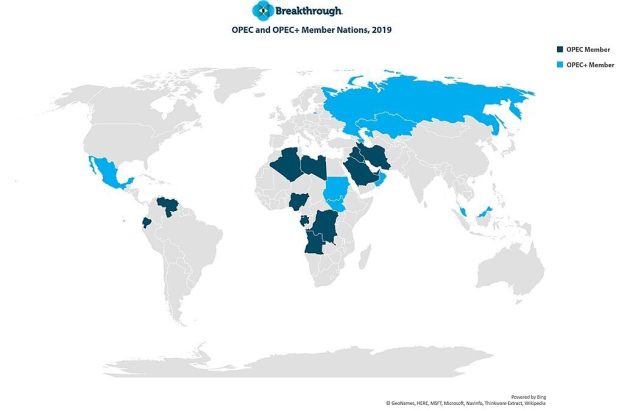
The shock oil production cuts from May outlined by the OPEC+ on Sunday essentially means that eight key OPEC countries decided to join hands with Russia to reduce oil production, messaging that OPEC and OPEC+ are now back in control of the oil market.
No single oil producing country is acting as the Pied Piper here. The great beauty about it is that Saudi Arabia and seven other major OPEC countries have unexpectedly decided to support Russia’s efforts and unilaterally reduce production.
While the 8 OPEC countries are talking about a reduction of one million b/d from May to the end of the year, Russia will extend for the same period its voluntary adjustment that already started in March, by 500,000 barrels.
Now, add to this the production adjustments already decided by the OPEC+ previously, and the total additional voluntary production adjustments touch a whopping 1.6 million b/d.
What has led to this? Fundamentally, as many analysts had forewarned, the Western sanctions against Russian oil created distortions and anomalies in the oil market and upset the delicate ecosystem of supply and demand, which were compounded by the incredibly risky decision by the G7, at the behest of the US Treasury, to impose a price cap on Russia’s oil sales abroad.
On top of it, the Biden administration’s provocative moves to release oil regularly from the US Strategic Petroleum Reserve in attempts to micromanage the oil prices and keep them abnormally low in the interests of the American consumer as well as to keep the inflationary pressures under check turned out to be an affront to the oil-producing countries whose economies critically depend on income from oil exports.
The OPEC+ calls the production cuts “a precautionary measure aimed at supporting the stability of the oil market.” In the downstream of the OPEC+ decision, analysts expect the oil prices to rise in the short term and pressure on Western central banks to increase due to the possible spike in inflation.
What stands out in the OPEC+ decision is that Russia’s decision to reduce oil production by the end of the year has been unanimously supported by the main Arab producers. Independent but time-coordinated statements were made by Saudi Arabia, the UAE, Kuwait, Iraq, Algeria, Oman and Kazakhstan, while Russia confirmed its intention to extend until the end of the year its own production reduction by 500,000 barrels per day, which began in March.
Significantly, these statements have been made precisely by those largest oil producers in OPEC, who have a record of fully utilising their existing quota. Put differently, the reduction in production is going to be real, not just on paper.
Partly at least, the banking crisis in the US and Europe prompted the OPEC+ to intervene. Although Washington will downplay it, in March, Brent oil prices fell to $70 per barrel for the first time since 2021 amid the bankruptcy of several banks in the US and the near-death experience of Credit Suisse, one of the largest banks in Switzerland. The events sparked concern about the stability of the Western banking system and fear of a recession that would affect oil demand.
There is every likelihood that tensions may increase between the US and Saudi Arabia as higher oil prices will push inflation and make it even more difficult for the US Federal Reserve to find a balance between raising the key rate and maintaining financial and economic stability. Equally, the Biden administration must be furious that practical cooperation is still continuing between Russia and the OPEC countries, especially Saudi Arabia, notwithstanding the West’s price cap on Russian oil and Moscow’s decision to unilaterally cut production in March.
However, the Biden administration has only a limited range of options to respond to the OPEC+’s surprise move: one, go for another release of oil from the Strategic Petroleum Reserve; two, pressure US producers to increase domestic oil output; three, back legislation that would allow the US to take the dramatic step of suing OPEC nations; or, four, curb the US’ export of gasoline and diesel.
To be sure, the OPEC+ production cut goes against the Western demand to increase oil output even as sanctions were imposed against Russian oil and gas exports. On the other hand, the disruption in oil supplies from Russia contributed to the rising inflation in the EU countries.
The US wanted the Gulf Arab states to step in and step up oil production. But the latter did not oblige because they felt that there wasn’t enough economic activity in the West and there were clear signs of recession contrary to expectation.
Thus, as a result of the sanctions against Russia, Europe is facing the complex situation of inflation and near-recession known as stagflation. In reality, the adaptive and agile OPEC + read the situation correctly and has shown that it is willing to act ahead of the curve. At a time when the world economy is struggling to grow at a healthy rate, the demand for oil would be relatively less, and it makes sense to cut oil production to maintain the price balance.
All that the Western leaders can complain about is that the OPEC+ cut in oil output has come at an inappropriate time. But the woes of Western economies cannot be laid at the door of OPEC+ as there are inherent problems which are now coming to the surface. For instance, the large scale protests in France against pension reform or the widespread strikes in Britain for higher wages show that there are deep structural problems in these economies, and the governments seem helpless in tackling them.
In geopolitical terms, the OPEC+ move came after a meeting between Russian Deputy Prime Minister Alexander Novak and Saudi Energy Minister Prince Abdulaziz bin Salman in Riyadh on March 16 that focused on oil market cooperation. Therefore, it is widely seen as the tightening of the bond between Russia and Saudi Arabia. In fact, in May, as the largest members of OPEC join Russia in its unilateral reduction, the balance of quotas and the ratio of market shares between and amongst the participants in the OPEC + deal will return to the level set when it was concluded in April 2020.
The big question is, how Moscow might profit from the OPEC+ decision. The rise in crude oil prices particularly benefits Russia. Simply put, the production cuts will tighten up the oil market and thus help Russia to secure better prices for the crude oil it sells. Second, the new cuts also confirm that Russia is still an integral and important part of the group of oil producing countries, despite the western attempts to isolate it.
Third, the consequences of Sunday’s decision are all the greater because, unlike the previous cuts by the OPEC+ group at the height of the pandemic or last October, today, the momentum for global oil demand is up, not down — what with a strong recovery by China expected.
That is to say, the surprise OPEC+ reduction further consolidates the Saudi-Russian energy alliance, by aligning their production levels, thus placing them on equal footing. It is a slap in the face for Washington.
Make no mistake, this is another signal regarding a new era where the Saudis are not afraid of the US anymore, as the OPEC “leverage” is on Riyadh’s side. The Saudis are only doing what they need to do, and the White House has no say in the matter. Clearly, a recasting of the regional and global dynamics that has been set in motion lately is gathering momentum. The future of petrodollar seems increasingly uncertain.
OPEC+ Oil Pumping Cut Brings Market ‘Stability’ and Busts Sanctions on Russia
By James Tweedie – Sputnik – 04.04.2023
OPEC’s cut in production has undermined US-led attempts to cap the export price of Russian oil. Geopolitical analyst Mohammed Alhamed, president of the Saudi Elite group and economist, and Professor Mark Frost said the US should back off and let market forces rule.
OPEC’s latest crude oil production cut will stabilize the world market while foiling US-led attempts to impose “price cap” sanctions on Russian exports.
OPEC+, which includes the organization’s 13 member states plus 11 others, including Russia, announced a 1.66 million barrel-per-day cut in production on Monday, sending the price of crude soaring on international markets.
Russia’s deputy prime minister said Moscow may also extend its 500,000 barrel-per-day production cut until the end of this year.
The US, UK, European Union, and Japan agreed earlier this year on a $60-per-barrel price limit on Russian crude, with a $100 cap on refined gasoline and diesel and $45 on household fuel oil as part of sanctions over Russia’s military operation in Ukraine. Moscow warned that those measures would have negative consequences.
Mohammed Alhamed told Sputnik that while the US had called the production cut “ill-advised,” OPEC+ had been “instrumental in bringing stability and transparency to the oil market, which has benefited the world economy while many American banks are facing bankruptcy.”
He said threats by US congressmen and women to ban weapons sales to Saudi Arabia over the previous oil production cut were “likely seen as a stupid idea” which would “reflect negatively on US interests in the Middle East.”
“A strained relationship with the US could have negative repercussions on both countries” the analyst said, cautioning Washington not to interfere in OPEC+, which “operates independently and has the right to make decisions that benefit its members.”
The US, still a major oil producer itself, should “focus on addressing its own oil and climate change agenda before criticizing other countries,” Alhamed said.
“Saudi Arabia and OPEC+ have made significant efforts to bring stability to the oil market and should be commended for their efforts.”
Professor Mark Frost told Sputnik that the production cut was a “signal” to the US that “you’re taking us for granted.”
He noted that in “any cartel, there’s a strong incentive to cheat” — and that the rising price of oil would allow European countries to pay prices above the Western-imposed cap on seaborne crude shipments from Russia.
“I think somebody got on the phone and said, ‘hey, Biden, we’re going to buy some oil. And if you don’t like it, that’s tough,’” Frost said.
“You can’t have volatile inflation forever. Markets start to shut down. People start to lose faith,” he added. “People start to become risk averse, and at the extreme, the risk is we become Japan in the nineties, where it requires negative interest rates to get people to borrow any money.”
Frost pointed to fast-food chain McDonald’s announcement of mass lay-offs, saying: “That’s a leading indicator because whether people like it or not, capitalism is trickle-down economics.”
The academic said that the rampant inflation caused by sanctions on Russia — one of the world’s biggest food as well as energy producers — combined with the US Federal Reserve raising interest rates in “quantitative tightening” in response means “we’re going to see at least two million people directly starve to death.”
“A lot of people don’t realize a lot of the world doesn’t do that well,” Frost stressed. “And relatively small increases in crucial things like rice, cooking oil and things like that causes people to starve to death.”
Scott Ritter: US Complicit in Ukraine’s War on Journalists
By Scott Ritter – Sputnik – 03.04.2023
On Sunday, April 2, 2023, the well-known Russian journalist/blogger, Vladlen Tatarsky, whose real name was Maxim Fomin, was killed in what appears to have been a targeted assassination.
At the time of his murder, Tatarsky had over 560,000 followers on his Telegram channel, making him one of the most influential voices when it came to covering the ongoing Russian special military operation in Ukraine.
The Russian government has publicly condemned the attack, with Russian Ministry of Foreign Affairs spokeswoman Maria Zakharova condemning the role played by the West, noting that the harassment of Russian journalists by the West constitutes a veritable “witch hunt” that represents an acquiescence, if not outright complicity, in the murder of persons like Tatarsky and Daria Dugina, the daughter of the noted Russian philosopher, Alexander Dugin, and a journalist in her own right.
“Not a single case of the violent death of a Russian journalist hailed as a ‘success’ by the Kiev regime and its thugs, has been investigated by Western countries, international organizations, or foreign professional communities, and not even basic human sympathy has been shown,” Zakharova noted.
The double standard of the collective West, and in particular the United States, which prides itself for its ostensible support of a free press, has been put on display for all the world to see. In 2012, Marie Colvin, a war correspondent for The Sunday Times, was killed while covering the conflict in Syria.
In February 2019, Judge Amy Berman Jackson, of the US District Court in Washington, DC, awarded Marie Colvin’s estate damages in the amount of $300 million, claiming that Colvin had been “specifically targeted” by the Syrian government “because of her profession.” Judge Jackson further stated that “The murder of journalists acting in their professional capacity could have a chilling effect on reporting such events worldwide,” adding that “a targeted murder of an American citizen whose courageous work was not only important, but vital to our understanding of war zones and of wars generally, is outrageous.” [Note: The Syrian government denies that Marie Colvin was specifically targeted. She died when a so-called “media center” in a rebel-held town that doubled as a command center was struck by Syrian artillery. Colvin was operating in Syria without the permission of the Syrian government, in an active war zone.]
The murder of Daria Dugina and Vladlen Tatarsky clearly represents the deliberate targeting of journalists operating in their professional capacity. Both Dugina and Tatarsky provided reporting that was “vital to our understanding of war zones and war,” and yet, because this “understanding” came with a Russian slant, the US government remains silent.
The “chilling effect” which Judge Amy Jackson warned about is, it seems, to be embraced when those chilled speak Russian, or whose facts sustain a Russian narrative.
The compassion shown Marie Colvin by the US government, in the defense of a free press, is exposed as a lie when confronted by the silence that followed the deaths of Daria Dugina and Vladlen Tatarsky. But this was to be expected — after all, the US is seeking the extradition of WikiLeaks founder Julian Assange so he can be prosecuted for the crime of publishing so-called “secrets” that exposed war crimes and other official malfeasance on the part of the US government and military in both Iraq and Afghanistan.
Putting a journalist in jail for 175 years (the maximum sentence Julian Assange would face if found guilty) is the same thing as a death sentence. Free speech, American-style, is not free — it comes with a heavy price, especially if one publishes material that runs against the US-backed official narrative.
Both Daria Dugina and Vladlen Tatarsky were included on the notorious “Myrotvorets” “kill list,” purportedly promulgated by the Ukrainian Security Services, along with hundreds of others—many of them minor children—similarly marked for death for the crime of speaking out against the policies of the Ukrainian government.
I, too, am on that list, along with scores of other Americans and non-Ukrainians.
To date, the US government has yet to condemn the Ukrainian government for targeting US citizens to die for exercising their Constitutionally protected right of free speech.
If the US government won’t protect its own citizens, one cannot expect it to speak out in the defense of the lives of non-US citizens designated for speech-related assassination.
But this isn’t simply a case of remaining silent in the face of crimes being committed by others. The US government is an active participant in the Ukrainian government’s campaign to silence dissenting voices using whatever means possible, including targeted assassination. The US government funds, helps organize, and actively supports the work of the Center for Countering Disinformation, or CCD, a Ukrainian agency operating under the auspices of the Office of the President of Ukraine. The CCD publishes a so-called “black list” containing the names of persons designated by the Ukrainian government as facilitating “Russian propaganda,” and designates those whose names appear on this list as “information terrorists” and “war criminals” who must be prosecuted to the full extent of the law.
Just to be clear, the US actively hunts down and kills persons designated as terrorists. To fund and support similar designations of its own citizens by a foreign government — Ukraine — known to arrest, torture, and murder dissenting voices means the US, implicitly, supports marking them for death.
This is the truth behind the US silence in the face of the murders of Russian journalists like Daria Dugina and Vladlen Tatarsky. A nation founded on the principles of free speech cannot tolerate free speech when it is practiced by those who oppose the US-backed narrative. Rather than engaging these dissenting voices in fact-based debate, dialogue, and discussion, the US —cognizant of the fact that their side could not prevail in such a contest — opts to silence these voices forever. For Julian Assange, this means life in prison.
For Daria Dugina and Vladlen Tatarsky, this meant death.
This is how you kill a free press. Hopefully the voices of dissent that remain will not be “chilled” by this result, but rather opt to double down on their commitment to pursue the truth, whatever the cost.
I know I will.
Court Orders Merck to Turn Over Gardasil Adverse Event Databases
By Brenda Baletti, Ph.D. | The Defender | April 3, 2023
A North Carolina district court ordered Merck to turn over all of its Gardasil adverse events databases to plaintiffs suing the pharmaceutical giant for injuries allegedly caused by the human papillomavirus (HPV) vaccine.
The databases, which include information from the Merck Adverse Event Reporting and Review System (MARRS) — Merck’s version of the Vaccine Adverse Event Reporting System (VAERS) — should contain all of the reports pertaining to Gardasil adverse events submitted by physicians, patients and publications, plaintiffs’ attorney Michael Baum told The Defender.
In his March 20 order, U.S. District Judge Robert J. Conrad, Jr., said, “Plaintiffs’ and their experts should have the same opportunity as Merck to review and analyze the entirety of the data.”
Merck until now has refused to make the entire MARRS databases available to the plaintiffs’ attorneys.
Gardasil is a widely used vaccine commonly administered to teens and young adults before they are sexually active to protect against HPV infections, which can be sexually transmitted later in life.
HPV infections may lead to the development of cervical cancer. However, most infections are benign and resolve on their own.
The firm Baum Hedlund Aristei & Goldman and Robert F. Kennedy, Jr., Children’s Health Defense chairman-on-leave, have filed more than two dozen lawsuits on behalf of young people injured by Gardasil, alleging Merck knowingly and fraudulently concealed the vaccine’s risks.
The lawsuits are some of the more than 80 pending in the federal court system, and that number is expected to grow. In August 2022, a judicial panel consolidated the lawsuits into a single federal courtroom.
Some of the signature impacts observed following HPV vaccination — which afflict a number of the plaintiffs — include permanently disabling autoimmune and neurological conditions such as postural orthostatic tachycardia syndrome (POTS), fibromyalgia and myalgic encephalomyelitis/chronic fatigue syndrome, The Defender reported.
There have been thousands of reports of adverse events worldwide, peer-reviewed scientific literature from the U.S., Australia, Denmark, Sweden, France and Japan, and statistics published by public health agencies in each of these countries that demonstrate plausible associations between HPV vaccination and autoimmune conditions.
Merck maintains there is no safety signal in the data for autoimmune conditions. The plaintiffs allege Merck made this argument by discounting reports.
Baum told The Defender access to this full database of adverse event reports should allow experts to better analyze the full extent of post-Gardasil autoimmune symptom clusters, and demonstrate there is a “statistically significant causal connection between Gardasil and autoimmune conditions.”
Gardasil’s long history of autoimmune adverse events
While Merck markets Gardasil as “safe and effective,” safety signals emerged even early, during the vaccine’s clinical trials. However, the U.S. Food and Drug Administration (FDA) granted the vaccine Fast Track approval after only a six-month review process.
In 2006, Gardasil was licensed across the U.S. and Europe. But within a few years, reports of serious adverse events appeared — first in the media and then in academic journals.
In 2013, Gardasil was responsible in the U.S. for three-fifths of all serious vaccine reactions reported in young women under age 30, including 64% of deaths and 81% of cases of permanent disability.
Similarly, disproportionately high rates of adverse events were reported in Australia, Japan, and other European countries at that time.
Yet in 2014, the FDA approved a new version of the vaccine, the nine-valent Gardasil 9. And in 2016 — when GlaxoSmithKline (GSK) withdrew its poorly competing bivalent HPV vaccine Cervarix from the U.S. market — Gardasil 9 became “the only game in town.”
Gardasil 9 is FDA-approved for males and females ages 9 through 45 years.
In 2015, because of the high number of serious adverse events reports in Denmark and around the world, the Danish Health and Medicines Authority asked the European Commission to investigate the relationship between Gardasil and serious adverse events.
Several months later, the European Medicines Agency (EMA) — a European equivalent to the FDA — issued a report concluding there was no link between HPV vaccines and serious neurological adverse events.
But a leaked, confidential EMA document showed substantial disagreement among the agency’s experts.
An article published in The BMJ Evidence-Based Medicine also revealed the EMA made its evaluation based on flawed data and analysis provided by vaccine manufacturers, dismissed compelling evidence from independent researchers and the Uppsala Monitoring Centre, and sought input from experts with financial conflicts of interest, in violation of its own rules.
Given the ongoing safety concerns associated with the revelations of the EMA’s flawed study, Rebecca Chandler et al. conducted further research on the link between the HPV vaccine and autoimmune disorders, which was published in Drug Safety in 2017.
Autoimmune disorders can be difficult to identify and take a long time to diagnose because they are typically characterized by combinations of a wide range of symptoms that can be linked to a number of illnesses.
Any one symptom on its own may not provide enough information to alert a physician to the underlying cause.
To identify autoimmune disorders associated with the HPV vaccine, Chandler and her team did a cluster analysis of VigiBase, the World Health Organization (WHO) international database of suspected adverse drug reactions.
They conducted a statistical analysis of reports on HPV adverse events, looking for clusters of symptoms associated with autoimmune conditions like POTS, CRPS and CFS — rather than looking only for cases where an autoimmune disorder was definitively diagnosed — and found statistically significant rates of serious adverse events associated with Gardasil.
It is one of several recent studies linking Gardasil with autoimmune issues.
As part of this now-consolidated lawsuit, the plaintiffs have been seeking access to Merck’s database for several years in order to do a cluster analysis on all of the data Merck has collected.
Suing Big Pharma for vaccine injury difficult — but possible
Vaccine makers can be held liable for injuries caused by a fully licensed vaccine — unless that vaccine is added to the CDC’s childhood vaccination schedule.
The HPV vaccine is listed on that schedule.
People injured by vaccines listed on the childhood schedule can seek compensation through the taxpayer-funded National Vaccine Injury Compensation Program (VICP), a no-fault alternative to the traditional legal system for resolving vaccine injury claims.
But many people are unaware that claimants who are dissatisfied with the outcome of the VICP process can sue the pharmaceutical company directly in civil court as long as that claimant completed the VICP process.
Baum told The Defender that the VICP has paid out more than $70 million to people making claims regarding Gardasil, but that over the last few years, they stopped making payments for autoimmune conditions, without explanation.
The lawsuits against Merck alleging the HPV vaccine caused debilitating autoimmune complications are a result of this process.
Baum also told The Defender that a claimant has only three years from the onset of symptoms to file a complaint, but because autoimmune disorders are challenging to diagnose, many people are not diagnosed until the statute of limitations has expired.
Brenda Baletti Ph.D. is a reporter for The Defender. She wrote and taught about capitalism and politics for 10 years in the writing program at Duke University. She holds a Ph.D. in human geography from the University of North Carolina at Chapel Hill and a master’s from the University of Texas at Austin.
This article was originally published by The Defender — Children’s Health Defense’s News & Views Website under Creative Commons license CC BY-NC-ND 4.0. Please consider subscribing to The Defender or donating to Children’s Health Defense.
US Scientist Sounds Alarm About Incident Involving American Nuke at Dutch Air Base

US troops examine a damaged nuclear bomb at a Dutch military base. © Photo : Los Alamos National Laboratory / Federation of American Scientists
Sputnik – 03.04.2023
The Netherlands is one of a handful of European nations hosting nuclear weapons. The International Campaign to Abolish Nuclear Weapons estimates that about 20 American B61 nukes are held at the Volkel Air Base in the country’s south.
The US and Dutch militaries may have suffered a recent nuclear weapons-related incident at Volkel Air Base and failed to inform the public about it, the Federation of American Scientists has reported, citing photographic evidence of a damaged B61 nuclear bomb being examined by troops.
The photo, featured in a 2022 briefing at the Los Alamos National Laboratory, Shows three US servicemen, including two members of the military’s Explosive Ordnance Disposal unit, looking at a B61 bomb strapped into a trolley that’s somehow been misshapen and missing one of its tail stabilizer fins. A fourth soldier is seen holding a folder dotted with red edge markings similar to those typically used to indicate “secret” clearance.
It’s not clear when the photograph was taken, and a cursory examination of media reports shows no recent admissions by the US or Dutch governments about any accidents involving American nuclear weapons at Volkel Air Base.
FAS researcher Hans M. Kristensen, director of the non-profit’s Nuclear Information Project, indicated that if it was confirmed that the image comes from Volkel, and that the misshapen B61 is a real bomb, and not just a dummy trainer, this “would constitute the first publicly known case of a recent nuclear weapons accident at an airbase in Europe.”
The researcher noted that judging by the image, the bomb appears to have been hit with “significant force,” speculating that it may have been hit by a vehicle during transit, “or bent out of shape by the weapons elevator of the underground storage vault.”
The background details of the photo lead Kristensen to believe that the photo was taken in one of the protective aircraft shelters at the base, which have been featured in press photos put out by the Dutch military.
The 312th Squadron of the Dutch Air Force’s 1st Wing operates nuclear-capable F-16 fighters, with their US nuclear payloads placed under US control during peacetime, but made available to Amsterdam and NATO in the event of a war.
Kristensen noted that if the photo is genuine, the US would likely classify it as an “incident,” which involves “evident damage to a nuclear weapon or nuclear component that requires major rework, replacement, or examination or re-certification by the Department of Energy,” rather than an “accident,” which is reserved by the Air Force to refer to incidents involving a nuke’s destruction or loss.
The scientist noted that although security features built into the B61 make the chance of accidental detonation extremely minute, the detonation of high explosives in the bomb could spread plutonium and other radioactive materials throughout the surrounding environment.
A Pentagon spokesperson assured that the US “maintains the highest level of standards for personnel and equipment supporting the strategic arsenal,” and said US policy forbids the military from either confirming or denying “the presence or absence of nuclear weapons at any general or specific locations.” The spokesperson did not comment on the photograph.
Washington did not follow in Moscow’s footsteps in removing its nuclear weapons from European soil after the Cold War, and is believed to maintain such weapons at about half a dozen bases across Western and Central Europe and Turkiye. NATO conducts annual “nuclear-sharing” drills known as “Steadfast Noon,” and simulates the use of American nuclear weapons by allies.
The B61 thermonuclear gravity bomb began to be produced in the 1960s, and since that time over 3,000 B61s of 13 different variants have been built. The bomb has a blast yield of between 0.3 and 340 kilotons (for comparison, the atomic bomb dropped on Hiroshima in 1945 had a yield of about 15 kilotons of TNT). The bomb’s newest variant, the B61-12, completed flight testing in 2020, and began production in late 2021. US media reported last October that the Pentagon wanted to accelerate the weapon’s deployment to Europe.
Will Zelensky Take Back Crimea?
By Rick Sterling | Global Research | April 3, 2023
Seventeen months ago the US State Department officially declared the US will “NEVER” recognize Crimea as part of Russia. Three months ago Ukrainian President Zelensky vowed to “take back” Crimea. Is this possible?
In June 2016 I visited Crimea with a delegation from the Center for Citizen Initiatives (CCI). This is a US organization which has conducted people to people exchanges with Russia for decades. They have never received financial support from Russia but did receive some grants from USAID in the 1990’s. CCI especially promotes exchanges with Rotary clubs.
In Crimea, we were based in Yalta, a small city on the Black Sea. From Yalta we did trips to the capitol Simferopol, the naval port at Sebastopol, the “valley of death” and many other destinations.
Crimea is beautiful and the people were very friendly and happy to see us. At that time, they had been under Western sanctions for two years because of their decision to secede from Ukraine in March 2014. Tourist ships that previously visited their ports no longer stopped because of sanctions. Students who graduated from Crimean universities no longer had their academic achievements recognized in the Europe. Visa and Mastercard could not be used. The sanctions caused a myriad of problems.
We met with many groups including the elected city council of the capital Simferopol, college students, high school students, Armenian and Tatar ethnic groups, a Rotary business group and more. They all said the decision to secede from Ukraine was overwhelmingly popular. The official referendum results confirmed what they said: with 83% of the voting public participating, 97% of voters said they wanted to “re-unify” with the Russian Federation.
When we asked why they preferred to be part of Russia, there were various explanations. Everyone referred to the Feb 2014 coup which overthrew President Yanukovich. Over 75% of the Crimean population voted for Yanukovich in the 2010 election which was deemed to free and fair by European monitors. They did not like the violent coup which ousted their elected president.
Another reason was because the coup government immediately repealed legislation that the Russian language could be used in schools and institutions. The majority of the population in eastern Ukraine and Crimea have Russian as their native language. The hostility of the coup government was unmistakable.
A third reason was because of the violence and thuggery of the forces which drove the coup. Over a few days almost 100 people were killed on the Maidan plaza. There is overwhelming evidence the killing was done by snipers shooting from rooms and the roofs of opposition controlled buildings. The fact that BOTH protesters and police were killed indicates purposeful intent to exacerbate and ignite the crisis which is exactly what happened.
A fourth reason for the Crimean decision was because of an incident on the night of Feb 20. Hundreds of Crimeans had gone to Kyiv to peacefully demonstrate in favor of the government and against the increasingly violent mob. When the killing peaked on Feb 20, they realized it was too dangerous and peaceful protests were hopeless. They headed home in an 8 bus convoy. One hundred miles south of Kyiv the bus convoy was stopped by ultra-nationalist thugs. All the passengers were terrorized, many were beaten and seven killed. News of this violence rapidly spread and shocked the people of Crimea. The referendum was quickly organized and held without violence on March 16. Turnout was huge and the results decisive. Two days later, Russia welcomed Crimea into the Russian Federation.
When we visited, just two years after the coup, we learned there were no regrets about the decision to leave Ukraine despite the problems caused by western sanctions. People told us that Crimea had been neglected under Ukraine. Now, as part of the Russian Federation, all sorts of infrastructure improvements were being made. We saw this first hand at the new Simferopol airport. We heard about the coming Kerch Straight bridge, which was completed a few years later. We saw the remodeling and rebuilding of the famous Artek youth summer camp.
It was very interesting to meet with young Tatars. This is an Muslim indigenous ethnic group in Crimea. When asked if western NGOs were active in promoting opposition, they smiled and said “Yes … Soros”. Looking it up later, I learned that the US billionaire gave grants of $230 million to influence Ukraine.
On our trip we also learned about Crimea’s long history as part of Russia. The Crimea peninsula and naval port at Sebastopol has been Russian ever since 1783. It has been the Russian Navy’s only southern freshwater port for 240 years.
In 1954 Crimea was designated to the Ukrainian republic by Soviet Premier Krushchev. There was no consultation but it was not critical because they were all part of a centralized Soviet Union. When the Soviet Union broke up, 94% of Crimean voters wanted to leave Ukraine and re-establish the Crimean Soviet Socialist Republic. Those wishes were ignored by Kyiv.
The 2014 coup was the last straw. The Maidan violence, coup government decisions on language, and attacks on civilians made it imperative to quickly secede. Russia already had soldiers in Crimea at the leased naval base at Sebastapol. The referendum proceeded quickly and peacefully.
Western hypocrisy and double standards are breathtaking. The West actively promoted the breakup of Yugoslavia, the secession of Kosovo from Serbia and South Sudan from Sudan. The right and popular will of Crimeans to secede from Ukraine and re-unify with Russia is clear. Yet the West continues to falsely claim that Russia “occupies” Crimea.
In November 2021 the US signed a “Charter on Strategic Partnership” with Ukraine. It declares, “The United States does not and will never recognize Russia’s attempted annexation of Crimea.” Evidently it does not matter what the Crimeans think and want. What kind of “democracy” is this?
Any attempt by a Ukrainian government to “take back” Crimea would be met with firm opposition and resistance from the people who live there. The chance of this happening is near zero.
The misinformation about Crimea shows how distorted media coverage of the entire Ukraine conflict is.
Simultaneous US aggression in Black Sea and Mediterranean as multipolarity accelerates
By Drago Bosnic | April 3, 2023
Following the recent engagements between illegal American occupation forces in northeastern Syria and what the Pentagon called “pro-Iranian forces”, leaving dead and wounded on both sides, the United States has decided to further escalate tensions in Syria and the Middle East as a whole. As the multipolar, or should we say the actual world, is engaging in real and masterful diplomacy (in stark contrast to the US), reconciling archrivals such as Iran and Saudi Arabia and slowly but surely normalizing relations between Syria and Turkey, the stabilization of the globe seems like an unstoppable process. This is deeply alarming to the political West, the only entity on the planet in constant need of widespread death, destruction and chaos so it can maintain the illusion of the “garden-jungle” geopolitical framework.
Using the recent clashes as an excuse, Washington DC announced an extension of the CSG (carrier strike group) deployment led by USS “George H.W. Bush” Nimitz-class supercarrier, over 9.000 km away from its home port of Norfolk in Virginia. On Friday, US CENTCOM (Central Command) spokesman Colonel Joe Buccino stated that the extension of the “George H.W. Bush” CSG, inclusive of the “USS Leyte Gulf”, the “USS Delbert D. Black” and the “USNS Arctic” allows options to “potentially bolster the capabilities of CENTCOM to respond to a range of contingencies in the Middle East”. At the time of the announcement, the CSG was near Sicily. Apparently, the deployment will also include “a scheduled, expedited deployment of a squadron of A-10 attack aircraft to the region.”
According to Reuters, at least one US official, “speaking on the condition of anonymity”, confirmed that the George H.W. Bush CSG was “expected to remain in the European Command area of responsibility”, most likely until further notice, meaning that the US wants to keep tensions as high as possible for as long as possible. For the mainstream propaganda machine, the conflict in Syria is still called the “Syrian Civil War”, although it is anything but. Washington DC and its numerous satellite states in the region have been attacking the unfortunate country for over a decade now, resulting in hundreds of thousands of dead and millions of refugees. In addition, the US maintains an illegal occupation of northeastern Syria, where it’s supposedly “guarding” (i.e. stealing) the country’s oil reserves.
However, US militancy in Syria (and the wider Middle East) is only a fraction of the belligerent thalassocracy’s aggression against the world. Concurrently, Washington DC and its numerous NATO satellite states also conducted naval drills off the coast of Romania’s Tulcea County on the country’s Black Sea coast. The region borders the Odessa Oblast (an area currently occupied by the Kiev regime). Apparently, the war games included a scenario where thousands of NATO soldiers simulated coastal defense against a large-scale attack by an “unnamed aggressor” (obviously referring to Russia). Dubbed “Sea Shield 23”, the naval drills started on March 20 and were concluded on Sunday, April 2.
In total, close to 3,500 servicemen from the US and eleven other NATO vassals took part, including at least 30 naval ships, 14 aircraft and 15 other “fast intervention” boats. The live-fire drills were conducted both in the Black Sea and the Danube Delta, approximately 30 km from the border with Odessa Oblast. Since Russia started the special military operation (SMO), the US has conducted a number of large-scale military exercises in Eastern Europe to simulate a potential conflict with Moscow. This includes a recent simulated nuclear attack on Saint Petersburg, Russia’s second-largest city with close to six million inhabitants. A USAF B-52H “Stratofortress” flying in Estonian airspace circled in an area barely 100 km from the Russian border.
To put that into perspective, we should imagine a Russian Tu-95MS “Bear” strategic bomber/missile carrier flying just 60 miles off Manhattan, simulating a thermonuclear strike on New York City, one of the most important urban areas in the US. Still, that doesn’t prevent the US from doing everything in its power to provoke Russia. Considering that the “deep diving pro-Ukrainian group” that conducted the Nord Stream terrorist attacks has now also been dangerously close to the Turk (formerly South) Stream pipelines, the Russian Black Sea Fleet will need to be as vigilant as ever. The pipeline is the only major energy hub supplying natural gas to Turkey and Southeast Europe.
In the meantime, the world is working towards creating conditions for peaceful coexistence and cooperation of the globe’s numerous civilizations. Organizations such as BRICS and SCO (Shanghai Cooperation Organization) are rapidly expanding by admitting new members, with Iran being the most recent constituent of SCO. Saudi Arabia also became a dialogue partner on March 29, marking an important milestone in the organization’s history, which now includes all major oil producers in Eurasia and the Middle East. This also marks a crucial step toward eliminating Western currency dominance, the key provision to limiting the belligerent power pole’s ability to conduct military and economic aggression against the world.
Drago Bosnic, independent geopolitical and military analyst.
Xi, Biden show contrasting styles of world leadership
On the one hand, we see peace deals; on the other, exploding pipelines
By George Koo | Asia Times | April 3, 2023
Early in January, I opined in Asia Times that “2023 bodes poorly for US international relations” under US President Joe Biden. I based my conclusion on China’s impressive success in making new friends versus the Biden administration’s inability to make any.
In less than three months since then, developments around the world have been seismic and spectacular and have made a prophet out of me, if I do say so myself.
In January, I reported that Chinese President Xi Jinping received red-carpet treatment from Saudi Arabia, concluded a US$25 billion deal for oil and met with the six Middle East nations that make up the Gulf Cooperation Council. Hosted by the Saudis, they talked about China buying energy and helping to build their infrastructure.
Two years earlier, China entered a 25-year strategic cooperation agreement with Iran. Thus China has become friends of both major sects of Islam that have been historically bitter rivals. (To be honest, I did not expect anything earthshaking out of all this.)
Then this March, China announced that after four days of meetings and discussion in Beijing, Saudi Arabia and Iran had agreed to resume diplomatic relations.
A peace deal for the ages
This was a big deal and caught the world by surprise. Heretofore, Saudi representing the Sunnis and Iran the Shiites have been bitter sectarian foes for centuries. Yet China was able to play the role of an honest broker and brought the two sides together.
China has the right set of credentials to be a mediator for peace. China is the second-strongest global power, but does not try to bully any lesser countries and seeks to get along with everyone.
China emphasizes three principles in its international relations: It respects the national sovereignty of other, does not interfere with the internal affairs of others, and seeks joint development based on common interests and mutual benefits.
A few days later, Xi called on his “good friend,” Russian President Vladimir Putin in Moscow, and brought with him a 12-point peace plan to resolve the conflict between Ukraine and Russia.
The West promptly labeled the peace plan as vague, ambiguous and failing to include terms that would revert Russian-occupied territories back to Ukraine. But the West missed the point that was clear to everybody else in the world: Namely, a true mediation for peace does not begin by stipulating what the outcome should look like.
Zelensky would like China to step in
But as pointed out in Asia Times, Ukrainian President Volodymyr Zelensky may find China’s peace proposal an acceptable starting point. He is facing Western allies getting weary of supporting the war. Without such support, Zelensky knows his goose is cooked.
While Japanese Prime Minister Fumio Kishida was visiting Kiev acting as Washington’s envoy to encourage keeping the war going, Zelensky publicly welcomed China’s participation to broker a peace deal. He obviously found comfort in China’s role that brought peace to Saudi Arabia and Iran.
While Xi Jinping is enhancing his stature as a world leader that is proactive for peace, what has happened to Joe Biden during the same period?
History will show that blowback from two of Biden’s worst decisions ever made has come to haunt him in the first quarter of 2023.
Biden imposed economic sanctions and confiscated all the Russian dollar holdings held in the US in an attempt to bring Russia to its knees. But it didn’t work. Russia’s economy turned out to be far more resilient than Washington expected.
Weaponizing the dollar
Barred from trade with the European Union and others in the West, Russia turned to trade with China, India, East Asia and the Global South. Trade with China will surpass $200 billion this year, and Russia has agreed to accept China’s renminbi to settle their transactions.
As Russia earns a bounty of yuan from energy sales to China, other countries see the advantage of accepting the yuan from Russia for their trade. They avoid the extra cost of having to convert their own currency into dollars. Since China is likely to be their most important trading partner, yuan from Russia can simply be used when they do business with China.
By weaponizing the dollar, Biden has succeeded in implanting the idea in other central banks that the dollar is no longer a reliable reserve currency.
Recently, members of the Association of Southeast Asian Nations (ASEAN) held a meeting to discuss ways to avoid using the dollar, euro or yen to settle their trade accounts. If not those, what then? Probably China’s yuan and their own currencies.
Indeed, China and even Japan have been reducing their dollar holdings. In recent months, China and Russia have been the major buyers of gold, no doubt with the dollars they owned.
The recent collapse of Silicon Valley Bank is an indicator that the US economy is caught between a rock and a hard place. To tamp down inflation, the Federal Reserve had to raise interest rates. Rising interest rates meant a devaluation of the long-term Treasury bills that the bank bought paying a lower interest rate. Thus the decline in the value of the collateral assets owned by SVB made the bank vulnerable to a bank run.
Most American banks operated in much the same way as SVB but were more fortunate because the Treasury Department quickly stepped in and injected liquidity to reassure depositors that their banks wouldn’t go the way of SVB.
US economy needs China’s help
To use a Chinese expression, US Treasury Secretary Janet Yellen and Commerce Secretary Gina Raimondo have been acting like ants racing around a hot griddle, wanting and waiting for an invitation to visit Beijing. Why? Because Yellen urgently wants China to continue buying American IOUs and Raimondo would like to raise the level of bilateral trade, which would help keep the US economy going.
Somehow, these Biden cabinet officials do not know how to ask nicely or diplomatically. They seem to assume that an announcement of their wish is good enough for Beijing to express-mail an invitation to their offices. It has not occurred to them that they need to let Beijing know what’s in it for China to agree to meet with them.
The Biden administration has the arrogance to presume that it can pick and choose the economic sectors that it can decouple from China and which to select for collaboration with China. Apparently, Biden does not understand that China does not see itself as a vassal state and has its own priorities.
Obviously there exists a huge deficit of trust between the US and China. Nothing Biden has done is in the direction of healing the rift.
Blowing up Nord Stream
The revelation by Pulitzer Prize–winning journalist Seymour Hersh that Biden ordered the destruction of the Nord Stream pipelines has further emphasized that Biden is an unethical and ruthless national leader who cannot be trusted.
Biden has shown that he has no qualms in committing a war crime by severing the key economic linkage between Russia and the EU. Cutting off cheap energy from Russia has wreaked economic turmoil on Biden’s European allies. That Biden would do this to his own allies will shake the trust and confidence the EU allies hold for the US for a long time to come.
As matters stand now, Xi Jinping represents a proactive world leader who will apply his influence and prestige to work for world peace. Despite all the slander heaped on him and the blackening of China by Washington and the Western media, a long queue of world leaders jostle to meet with him in Beijing to discuss economic cooperation and collaboration on world peace.
At the other end of the world is Joe Biden, a world leader who is dishonest and unethical and has earned the wary distrust of virtually every national leader in the world. He gives lip service to peace while creating conflict and intimidating smaller countries to join the US military alliance and prepare for proxy wars.
Even his closest ally has to watch its back lest it’s abruptly discarded when it no longer figures in the US national interest.
George Koo retired from a global advisory services firm where he advised clients on their China strategies and business operations. Educated at MIT, Stevens Institute and Santa Clara University, he is the founder and former managing director of International Strategic Alliances. He is currently a board member of Freschfield’s, a novel green building platform.
Biden’s Sham Summit Won’t Save World Democracy
By Jim Bovard | The Libertarian Institute | April 3, 2023
President Joe Biden triumphantly saved world democracy last week (at least according to the White House scorecard). Biden co-hosted another Summit for Democracy, a repeat performance after the December 2021 test run. Biden sounded like a Quaalude Savior as he recycled his “inflection point of history” cliché. But the summit proved again that politicians are perils to freedom regardless of their prattle.
Biden promised that “we are seeing real indications that we are turning the tide” in favor of democracy around the globe. Practically no one who’s not on Biden’s payroll agrees. The president’s boast was like taking a victory lap around the deck of the Titanic.
Last year democracy “declined around the world for the 17th consecutive year,” according to Freedom House. Twice as many nations are veering “toward authoritarianism” as towards democracy, according to The Economist. Most shocking: the United States is now categorized as a less free nation than Mongolia, Mauritius, and 56 other nations says Freedom House (funded by the U.S. government, so they must be trustworthy).
Team Biden believes a big problem with democracy is that politicians don’t have enough power: “Weak state capacity.” In reality, elected rulers around the globe are turning themselves into dictators who increasingly repress their citizens. Rather than representative governments, elected regimes have turned into Leviathan Democracies far superior to the citizenry.
Consider Biden’s record in the Oval Office. Federal judges and/or the Supreme Court have struck down Biden’s eviction moratorium for deadbeat renters, his $400 billion cancellation of federal student debt, his “climate change” decree shutting down power plants, his mask mandate for airline passengers, and his edict compelling all employees of large companies and all federal employees to get COVID vaccine injections. But all of Biden’s decrees are supposedly “pro-democracy” because he won the 2020 election.
“Democracy delivers” was a key talking point for Team Biden at the summit. Presumably, any increase in government handouts automatically increased government legitimacy. Unfortunately, “leashing politicians” is not on the Biden Bingo Card for Saving Democracy™. The American Bar Association recently warned that “the Rule of Law is in Decline Globally” but it is “not a central focus of the U.S. Government’s approach” on democracy. A top ABA official warned, “Discussing sustainable development in the absence of rule of law…is at best delusional and at worst dishonest.” Three-quarters of nations representing almost 85% of the world’s population recently “experienced declines in rule of law,” according to the World Justice Project. In lieu of “government under the law,” Team Biden offers “the People Centered Justice Multistakeholder Cohort’s Declaration and Call to Action.” Sloshing out more government handouts to activist groups who score media headlines was “close enough for government work” to the rule of law.
Rather than a system of informed consent, democracy is degenerating into regimes which blindfold citizens and demand unlimited submission. At the summit, government officials made it clear that freedom of speech is a luxury that democracy can no longer afford. Secretary of Anthony State Blinken declared, “The misuse of technology and the spread of digital authoritarianism must end. We must stand for an affirmative, values-driven, and rights-respecting vision of democracy in the digital era.” “Affirmative” and “values-driven” become code words to legitimize pervasive government censorship. Blinken “proposed a ‘delicate balance’ between ‘openness and security,’ ‘protecting speech and preventing incitement,’ and ‘fostering innovation and limiting the power of Big Tech,’” as Tom Parker observed for Reclaim the Net.
Homeland Security Secretary Alejandro Mayorkas sermonized on a “Countering the Rise of Digital Authoritarianism” panel. He was joined by YouTube CEO Neil Mohan, who could have boasted of how Washington censors his channel. An internal DHS document reveals plans to crack down on “inaccurate” information on “the efficacy of COVID-19 vaccines, racial justice, U.S. withdrawal from Afghanistan, and the nature of U.S. support to Ukraine.” Any facts which embarrass Team Biden are automatically “inaccurate’ and ripe for suppression. Federally-funded entities spearheaded the censorship of true information on COVID vaccine side effects to bolster Biden’s effort to inject every American.
Eight governments, including Ukraine and Poland, issued a call for more censorship on the first day of the summit. They called for tech companies to take action “against disinformation that undermines our peace and stability” and to suppress posts that “weaken our support to Ukraine amid Russia’s war of aggression.” The letter asserted that “hostile foreign powers are using [social media] to spread false narratives that contradict reporting from fact-based news outlets,” especially the endless reports on the glorious victories of the Ukrainian army. Facebook responded by promising to ramp up its censorship, including relying on “a third-party fact-checking service to determine if posts contain false claims.” Some “third-party fact checking services” have been government fronts. As journalist Aaron Maté scoffed, “We are fueling a proxy war in Ukraine in order to defend freedom, such as the freedom to censor dissenting views on our proxy war in Ukraine.”
Is the “will of the people” so fragile that it can no longer survive exposure to any thoughts that officialdom disapproves? Does winning an election automatically convert tinhorn politicians into minor deities entitled to control the thoughts of any voter? Nullifying freedom of speech converts citizens into vassals that politicians can use and abuse as they please.
Throughout the summit proceedings, piety was thicker than hog slop at an Iowa slaughterhouse. Secretary Blinken declared on March 28, “No woman or girl should face harassment and abuse in-person or online.” The State Department’s effort on this score was propelled by its Global Engagement Center, which previously pressured Twitter to cancel hundreds of thousands of accounts, including vast numbers of hapless Americans. That Center is leading the fight against “gendered disinformation” and whooped up a report on “the need for more research to tackle this scourge.” According to the United Nations, a prime example of this “scourge” is “Zoom Bombing.” That atrocity occurs when uninvited people crash a Zoom meeting and make rude comments. Is it an international human rights crisis because boneheaded Zoom organizers fail to require pass codes to attend a meeting?
As part of its summit festivities, the Biden administration announced new crackdowns to make it “more difficult for corrupt actors to conceal their identities, assets, and criminal activities.” Despite reform promises at the first summit, there has been no worldwide progress. The U.S. ranks #24 on the international corruption index—even worse than France, according to Transparency International. And that score was calculated before the latest revelations of the Biden family pocketing vast sums from smarmy foreign companies.
Biden boasted that his administration plans to spend more than $9 billion to support democracy worldwide by the end of next year. But U.S. foreign aid programs obliterate the anti-corruption initiatives of the U.S. government. An American Economic Review analysis concluded that “increases in [foreign] aid are associated with contemporaneous increases in corruption,” and that “corruption is positively correlated with aid received from the United States.” As a Brookings Institution analysis observed, “The history of U.S. assistance is littered with tales of corrupt foreign officials using aid to line their own pockets, support military buildups, and pursue vanity projects.” Torrents of U.S. “aid” helped make Afghanistan one of the most corrupt places on Earth. John Sopko, the Special Inspector General for Afghan Reconstruction (SIGAR), observed, “We need to understand how U.S. policies and practices unintentionally aided and abetted corruption.” The U.S. has been “fighting corruption” in Ukraine since the end of the Cold War, and in those decades Ukraine became one of the most corrupt nations in Europe. Biden administration officials helped defeat a congressional proposal to create an Inspector General to audit and oversee the $100 billion the U.S. government has pledged to the government of Ukraine.
But another handout will fix that problem. The Biden administration is bankrolling foreign journalists to fight “kleptocracy”—government of thieves. There is even an aid program entitled “Empowering the Truth Tellers.” (Julian Assange need not apply.) The Biden administration claims to support “independent media” by effectively putting foreign journalists on the U.S. payroll. Those journalists are “independent” because the U.S. government says so, and anyone who disagrees will be labeled an enemy of democracy. Besides, the United States is no role model: it ranks a pathetic #42 in the World Press Freedom Index, worse than Moldova and Guyana, according to Reporters Without Borders.
Biden is “saving” democracy” with buckets of goofy new acronyms: SHE PERSISTS, one of the rallying cries for Hillary Clinton’s 2016 presidential campaign, now stands for Supporting Her Empowerment: Political Engagement, Rights, Safety, and Inclusion Strategies to Succeed Investing. And then there was SHE WINS (Support Her Empowerment: Women’s Inclusion for New Security). The Agency for International Development is whooping up PxP—Powered by the People. Did the White House believe acronyms should look like drug prescriptions? ADD stands for Advancing Digital Democracy but policymakers should have worked in an ‘H’ to reflect their cluelessness. ACRF stands for the Anti-Corruption Response Fund. They should have tweaked that one to make it ARF-ARF, to symbolize officialdom’s cravenness to the powers that be.
To safeguard democracy, the Biden administration is creating “the Global Network for Securing Election Integrity [GNSEI], to align on standards and practices for supporting clean elections.” On that score, the Biden administration touts its ballot expanding efforts here at home. The White House “fact sheet” detailing progress on democracy touts the Biden proposal to spend $5 billion on the Postal Service to “support for vote-by-mail, including making ballots postage-free and reducing the cost of other election-related mail for jurisdictions and voters.” Ballot harvesting and unverified absentee ballots will save democracy everywhere! Who knew that the “will of the people” was so fragile that it could be blighted by requiring citizens to purchase one first-class stamp to send in their ballot?
Comic relief failed to redeem the summit. The State Department wanted Americans to make short videos with the hashtag #SummitForDemocracy whooping up “What has democracy made possible in your own life?” Such as falling living standards, soaring inflation, sporadic financial panic, and a befuddled commander-in-chief who doesn’t know if he is in Canada or China? A search on Twitter indicates that almost all the videos made with #SummitforDemocracy hashtags were done by governments or by government-funded entities. Biden’s democracy spiel can’t compete with cat videos.
Revealing all the levels of hypocrisy at the summit would be on par with peeling an onion. Mexico President López Obrador declared at the gathering, “Many of the great crimes against humanity have been committed in the name of God, or in the name of democracy.” Many of the nations showcased at the summit are dutiful U.S. allies, meaning that Washington ignores their oppression.
In his speech last Wednesday, Biden declared that “the power of these summits” is “not just to speak high-minded words.” But even U.S. government officials feared the summit would be an “inconsequential talk shop,” according to The Washington Post. Council on Foreign Relations President Richard Haass scoffed, “The summit for democracy is a bad idea that won’t go away… American democracy is hardly a model for others.”
Unfortunately, the Pentagon missed the memo on democracy. Since 2008, foreign soldiers who received training from the U.S. military “attempted at least nine coups (and succeeded in at least eight) across five West African countries,” as journalist Nick Turse reported. The Pentagon denies responsibility for the debacles. But, as Antiwar.com reported, Rep. Matt Gaetz (R-FL) declared at a recent congressional hearing, “I think we should at least know how many countries we train the coup plotters.”
Biden concluded his spiel to the Summit, “The great strength of democracy is that it gives us all the tools we need for self-government and self-improvement.” But the tools are controlled by politicians who equate ever greater submission with the triumph of the “will of the people.” Self-government is being defined down to little more than coronating whichever of the rascal’s political parties can offer voters more stuff. With politicians openly championing censorship, Leviathan Democracy is dropping its mask and no longer pretending to give a damn about freedom.
Jim Bovard is the Junior Fellow for The Libertarian Institute. He is the author of Public Policy Hooligan (2012), Attention Deficit Democracy (2006), Lost Rights: The Destruction of American Liberty (1994), and 7 other books.
Featured Video

Seyed M. Marandi: US-Iran War Inevitable: Kuwait and Bahrain May Fall
or go to
Aletho News Archives – Video-Images
From the Archives
Oil and the Israel Lobby
Reknowned economist M. Shahid Alam offers this excellent critique of Noam Chomsky’s defective analysis of the relative influence of Oil versus the Israel lobby over US foreign policy: … continue
Blog Roll
 Aletho News
- ICC ignored ‘very well-documented’ NATO crimes – ex-Libyan minister
- SNSC secretary dismisses US response to Iran’s conditions as ‘inadequate’
- Sanaa says Taiz roads open, secure for residents, warns Saudi forces
- Iraqi resistance group urges Saudi leadership to admit defeat, lift Yemen siege
- Trump’s Retreat: How Al-Aqsa Flood Took Down the US Empire
- Israel’s Military Actions in Lebanon Grossly Violate International Law — Lavrov
- Seyed M. Marandi: US-Iran War Inevitable: Kuwait and Bahrain May Fall
- Leaders Condemn Ansarallah Attack on Saudi Arabia While Ignoring Illegal War Against Yemen
- Leaked: Britain’s Covert Iraqi Psyops Network
- Yemeni Armed Forces Warn Airlines Against Using Saudi Airports, Exempt Mecca and Medina
- If Americans Knew
- After Oct 7, IDF policy allowed civilian casualties for even the lowest-ranking targets
- Israel’s Destruction of Southern Lebanon Intensified After the Cease-Fire
- The Last-Minute Decision That Gave Israel Its Name
- The American Conservative: How Trump Made the World Go Nuclear
- Meet the US generals and admirals advancing Israeli policy
- Opinion: Why news organizations should boycott Israel
- The Israeli witch hunt of Sami Abu Shehadeh exposes the lie of the ‘Jewish and democratic’ state
- No state has a ‘right’ to exist – least of all Israel
- Testimonies about Gaza’s civilian death toll expose Israel’s atrocities – Daily Update
- How Israel Conquered the Latin American Right
- No Tricks Zone
- Germany’s Green Energy Debacle: High Energy Costs Force Kahla Porzellan to Close After 182 Years!
- New Study: 50 Years Of The Most Aggressive ‘Net Zero’ Policies Can Only Affect The Global Climate By 0.03°C
- US September “Heat” Was No Record…Many Records Set Decades Ago
- Latest European Green Energy Debacle; Portugal’s Largest Flagship Solar Park Insolvent!
- Green Energy Debacle: German Expert Professor Fritz Vahrenholt Warns Of Severe Economic And Social Consequences
- Two More Paleo Reconstructions Affirm Meters-Higher Sea Levels Across Ireland, Brazil 7000-6000 Years Ago
- New Study: Earth And Venus Surface Warmth Largely Explained By Convection And Lapse Rate, Not CO2 Or Radiation
- 2025 Nature Paper Claiming Worsening Global Drought Gets RETRACTED …Heavily Flawed
- New Study: ‘Global Drought Shows No Detectable Recent Acceleration Under Climate Warming’
- Economic Masterminds: German Socialists Suggest Taxing Productivity Gains Stemming From Using AI

