Yemeni FM berates Biden for faking ‘concern’, says US complicit in war, siege
Press TV – April 5, 2023
Yemen’s foreign minister says the United States is bent on whitewashing its complicity in the Saudi-led aggression against the impoverished Arab country by pretending to be concerned about achieving peace there.
Hisham Sharaf was cited by the Yemeni Saba news agency as making the remarks on Tuesday, two days after US President Joe Biden released a statement on the anniversary of the start of an UN-sponsored ceasefire in Yemen and stressed Washington’s “support” for all efforts aimed at reaching a comprehensive peace in the war-ravaged country.
Underlining that the US was “trying to evade its responsibilities” as a party responsible for the Saudi-led war and was profiting from it, Sharaf challenged Washington to “prove” its sincerity in wanting peace in Yemen by taking “concrete steps on the ground” and condemning the actions of the Saudi-led coalition.
“The countries that claim to be keen on achieving peace in Yemen should be sincere in their intentions by condemning the aggression and siege on Yemen for the ninth year in a row, stopping the supply of weapons and military experts to aggression countries, and putting pressure on the aggression countries,” Sharaf said.
The top Yemeni diplomat said Biden’s statement and the concern he showed regarding achieving permanent peace in Yemen are “not commensurate with what America is doing in reality by providing cover for the aggression countries.”
“The United States of America is trying with such a statement to evade its responsibilities as a party that participated in the aggression and siege on Yemen, which caused the largest humanitarian crisis in contemporary history, and to present itself as a dove of peace,” he added.
Emphasizing Yemen’s call for a just peace, Sharaf concluded by expressing Sana’a’s readiness to defend the Yemeni people through all legitimate means and the country’s ability to meet the legitimate demands of the Yemeni people.
Omani-hosted talks between the sides in the protracted conflict have been ongoing for the past several months, with the Iran-Saudi rapprochement having increased hopes that an end to the war could be imminent.
Saudi Arabia and the United Arab Emirates — the closest allies of the US in the region after the Israeli regime — have been waging the war on Yemen since March 2015.
The invasion has been seeking to change Yemen’s ruling structure in favor of the impoverished country’s former Riyadh- and Washington-friendly rulers and crush the popular Ansarullah resistance movement. The Saudi-led coalition has failed to meet any of its objectives.
The war, which has been enjoying unstinting arms, logistical, and political support on the part of the United States, has killed hundreds of thousands of Yemenis and turned the entire country into the scene of the world’s worst humanitarian crisis.
Yemen’s defense forces, which feature the country’s army and its allied Popular Committees, have, however, vowed not to lay down their arms until the country’s complete liberation from the scourge of the aggression.
Ukrainization is Destroying American Politics
Sputnik – 06.04.2023
The persecution of former US President Donald Trump takes a page out of the Zelensky regime’s playbook, Ukrainian opposition leader Viktor Medvedchuk wrote in a commentary for The Other Ukraine Telegram channel.
Judge for yourself: the US government declares that it is ready to finance the war in Eastern Europe forever and indefinitely.
Of course, the American people have questions about why the country needs this war, why it has no end, and where the voters’ taxes are actually going. The American voter is not interested in funding a war on the other side of the globe because they see serious problems at home. Against this backdrop, the politics of peace becomes attractive to the American voter and is destined for a quick victory.
And now watch the hands. The country’s justice system is politically violated, and a peacekeeper is declared a criminal without any serious evidence, based solely on political desires. All this has already happened in Ukraine. First of all, we accuse politicians who stand for peace of crimes that do not exist. But it is impossible to stop here, as the Ukrainian experience shows. Next, the “wrong” media and parties with a pro-peace agenda must be shut down, churches that preach peace must be persecuted, the “wrong” political movements must be banned, and active citizens who advocate peace must be thrown in jail. And call all this a victory for democracy. This is what the American disciples did in Ukraine. But as far as the US is concerned, all this can only lead to a large-scale war, which Trump warns of in every speech.
All this means one thing: the much-praised Ukrainian “democracy” imposed by the United States in Ukraine has crawled into America and will destroy the state institutions of this country, just as Ukrainian statehood was destroyed before.
This is what Trump warns of: “We are in many ways a third world country. We are a country whose economy is floundering, whose supply chains are broken, whose stores are not full, whose deliveries are not coming in, and whose education system is at the bottom of every list…” And recently, he said, “Our country is going to hell.”
And here it is impossible not to agree with him, because Ukraine is already in hell, and it is dragging the US with it. Ukrainian students have surpassed their American teachers and have become teachers of legal chaos themselves. It only remains to add that Ukraine was pushed into a hell of lawlessness and arbitrariness by American policies, and today it is reaping the fruits of its own actions. As the saying goes, “God will repay each one according to his deeds.”
F-35 readiness rates get in way of NATO war planning
By Drago Bosnic | April 6, 2023
Last year, NATO officially declared that Russia is its primary adversary, officially restarting the Cold War. Since then, the belligerent alliance’s war machine has started revamping its strategic posturing towards Moscow, but after decades of numerous wars of aggression against relatively helpless opponents, NATO’s conventional fighting capabilities have atrophied significantly. This seems to be affecting all branches of major NATO militaries, including their air forces, particularly those operating the deeply troubled F-35 JSF (Joint Strike Fighter), a pan-Western effort to unify all NATO and NATO-aligned countries into “a well-oiled joint fighting force with near flawless coordination and battlefield information sharing”. At least that was the original idea.
However, the reality is much different. Publicly, the Pentagon is quite happy with “the best fighter jet ever made”. Privately, the situation is starkly different. For at least a decade, numerous reports on the F-35’s countless flaws have turned out to be not only true, but even overoptimistic, as the actual scale of issues plaguing the program is much worse. This has resulted in repeated delays in deliveries, as well as serious issues with modernization efforts. By the time many of the reported issues are resolved, the US Air Force already has new mission requirements that essentially nullify all the previous work and force the developers “back to the drawing board”. In short, the F-35 has proven to be unable to adapt to new threats despite being devised (and marketed) to do exactly that.
According to various sources, over 900 F-35s have been completed and delivered by April this year, but the fleet is still suffering from many of the same issues as when the jet was inducted into service nearly a decade ago. A plethora of maintenance issues and performance defects are causing disastrous availability rates. Back in February, the Congressional Budget Office (CBO) revealed that the F-35 fleet not only failed to meet the requirements for improving readiness, but has even managed to make them a lot worse than in previous years. Availability rates for both the conventional F-35A and STOVL (short take-off, vertical landing) F-35B fell by 11% in 2022, with only the naval F-35C variant making small improvements in this category.
“Between 2021 and 2022, F-35As’ availability fell by 11 percentage points, from 65 to 54”, CBO stated in a report, adding: “F-35Bs’ availability also fell, by 7 percentage points, from 61 to 54, while F-35Cs’ availability rose by 5 percentage points to 58.”
And yet, even these reports turned out to be overoptimistic as Lockheed Martin once again resorted to using semantics to make the performance of its products seem better than they actually are. According to Bloomberg, the percentage of F-35s capable of flying any mission at any given moment, otherwise known as full mission-capable rates, was just over 29%, manager of the program Air Force Lieutenant General Michael Schmidt said in written testimony for the March 29 hearing of the House Armed Service Committee’s aviation subcommittee. This is nearly 10% less than the full mission-capable readiness in 2020, which stood at 39% at the time. Such a drop effectively nullified possible advantages provided by deliveries of new jets.
“This is unacceptable and maximizing readiness is my top priority,” Schmidt said in his prepared remarks, adding: “[Our] goal is to increase readiness rates by at least 10% in the next 12 months.”
This is just the latest in a series of now well over a hundred scathing reports issued over the years by both military and civilian US officials. As there are currently close to 540 F-35s in service with the US military, the latest readiness figures indicate that no more than 160 are fully mission-capable, meaning it’s among the very lowest, “bested” only by the F-22 “Raptor” jets and the atrociously maintenance-heavy B-2 strategic bombers. Ironically, F-35s were designed to have low maintenance requirements and operational costs to replace F-16s and A-10s for USAF, F-18s for USN (Navy) and AV-8Bs for USMC (Marines). The jet’s many issues resulted in a spending “death spiral”, as the program’s overall cost is getting ever closer to the staggering $2 trillion.
A major issue with the F-35 is its troubled F135 engine prone to overheating, resulting in issues with its ability to fly supersonic, a feat considered standard practice for fighter jets ever since WWII. Defense Secretary under the Trump administration, Christopher C. Miller, was so frustrated with the jet that he referred to it as “a monster” and “a piece of… (well , you get the idea)”. Even the late John McCain, well known for anything but enmity towards the US MIC (Military Industrial Complex), called it “a textbook example of our broken defense acquisition system”, stating in one of his Senate briefings that “the F-35 program’s record has been both a scandal and a tragedy with respect to cost, schedule and performance”.
US vassals and satellite states have also found numerous issues with the F-35. For instance, during 18 months of operational testing (from January 2021 to June 2022), South Korea reported findings about nearly 250 critical flaws in the jets it acquired from the US in 2019. As late as December, Israel (one of the first F-35 operators) had to ground its entire fleet during preparations for a possible war with Iran. Others, such as Japan and the UK, have also suffered similar issues, even resulting in crashes and deaths. However, while the F-35 has certainly been a disaster, it might prove to be a major contributor to improving global security, as diminishing the political West’s ability to wage war is by far the best way to preserve peace across the world.
Drago Bosnic is an independent geopolitical and military analyst.
Trump Is Being Politically Persecuted To Prevent Him From Brokering Peace With Russia
By Andrew Korybko | April 5, 2023
Former US President and leading Republican presidential candidate Donald Trump is facing 34 felony charges related to allegedly falsifying business records, which ordinarily would have just been a slew of misdemeanors had the prosecutor not “bumped them up” on a shadowy pretext. The domestic political context extends credence to criticisms that this is actually a persecution that’s also partially being carried out to galvanize the Democrats’ base, but there’s a crucial international dimension to all this too.
The argument can be made that the real reason why this witch hunt and all prior ones were commenced against him is due to his envisaged policy of brokering peace with Russia through a series of mutual compromises that can be referred to as a “New Détente”. It was this grand strategy that he campaigned on in 2016 and which prompted his opponent Hillary Clinton to concoct the Russiagate conspiracy theory falsely misportraying him as “Putin’s puppet”.
What Trump and his team had in mind wasn’t treasonous but pragmatic from the perspective of the US’ objective interests in that there’s a reasonable logic to de-escalating tensions with Russia in Europe so as to more effectively “contain” China in the Asia-Pacific. To that end, he sincerely wanted to compel Kiev into implementing the Minsk Accords but ultimately failed because influential figures in his country’s military, intelligence, and diplomatic bureaucracies (“deep state”) were opposed to this.
These individuals and their European counterparts are unofficial members of the cult known as liberal–globalism, which preaches that their Western way of life – particularly its radical liberal variant thereof – must be imposed onto the rest of the world “for their own good”. Due to a combination of ideological and strategic reasons, they believed that the US should prioritize “containing” Russia over China, hence why they united to sabotage Trump’s well-intended plans that were explained above.
The NATO-Russian proxy war in Ukraine that began last February when Moscow was forced to resort to military means for protecting the integrity of its national security red lines after this US-led bloc clandestinely crossed them there could in theory have been prevented had Trump still been in office. At the same time, however, his prior capitulation to the “deep state’s” demands to impose more sanctions on Moscow challenges this prediction, but it’s still worth considering in any case.
Despite the aforesaid skepticism, Trump recently doubled down on his envisaged pragmatic approach towards Russia by proclaiming that he’d broker peace with it and Kiev through a deal that he hinted would recognize the ground realities by legitimizing Moscow’s control over former Ukrainian territory. While the felony charges against him were already being pursued behind the scenes before this, there’s no doubt that his policy reaffirmation gave his opponents an urgent impetus to derail his re-election bid.
The former leader’s socio-economic and domestic political platform undoubtedly goes against the interests of the US elite, but they likely wouldn’t have discredited themselves by so openly persecuting him in the way that they’ve since done had he not so powerfully challenged their international interests. The reader should be remembered that ideological and strategic drivers are behind their obsession with “containing” Russia over China since the influential military-industrial complex still benefits either way.
The indisputable desperation with which his opponents are trying to derail his re-election bid exposes their true intentions in politically crucifying him all these years. They regard him as the greatest threat to their liberal-globalist cult not just because of his polar opposite socio-cultural policies at home, but because his grand strategy prioritizes reaching a “New Détente” with Russia, which the “deep state” considers to be the embodiment of everything that their belief system is against.
By hook or by crook, whether in the open or in the shadows, they’ll stop at nothing to prevent Trump from regaining the presidency during next year’s elections and fulfilling his vision. The stakes have never been higher for the liberal-globalist cult since that outcome could discredit their fellow travelers in the EU and thus possibly bring about the unraveling of their transatlantic ideological project with time. Trump must therefore be stopped at all costs, which explains his present political persecution.
China is the Rock Upon Which the U.S. World Order Breaks
By Ted Snider | The Libertarian Institute | April 4, 2023
In March, Chinese President Xi Jinping visited Russian President Vladimir Putin in Moscow, where they not only “reaffirm[ed] the special nature of the Russia-China partnership,” but “signed a statement on deepening the strategic partnership and bilateral ties which are entering a new era.” As Xi was leaving the Kremlin, he told Putin that “Together, we should push forward these changes that have not happened for 100 years.” That goodbye was Xi’s not so coded call for the end of the American century.
In his February 7 State of the Union Address, U.S. President Joe Biden got carried away by his excitement and arrogantly and ineptly went off script and called out, “Name me a world leader who’d change places with Xi Jinping. Name me one. Name me one.”
But the deflating truth is that the world is lining up behind China and Russia’s vision of a multipolar world no longer exclusively led by the United States. From Africa and its unanimous attendance at the recent Russia-Africa in a Multipolar World conference, to the Middle East and its long list of countries lining up to join the Chinese and Russian led multipolar organizations BRICS and the SCO, to Latin America and most of Eurasia and Asia, including India, the weight of the world is going to Xi’s place to balance American hegemony and support a multipolar world.
Biden’s outburst was an insult and confrontation that was a personal microcosm of U.S. provocation and confrontation of China on a global level. And it has had a corrosive and dangerous effect. An angry China is not answering America’s phone calls. Biden had hoped to talk to Xi on the phone in mid-March, but Chinese officials are not responding to U.S. requests to arrange the call. Defense Secretary Lloyd Austin’s calls to set up talks with his Chinese counterpart have also not been answered.
China is emerging as the rock upon which the U.S.-led alliance breaks.
China’s growing economic, diplomatic, and political influence is beginning to be more powerfully felt on the world stage. The rapid growth of international organizations that support China and Russia’s multipolar world vision is just one piece of evidence. China’s emergence as an influential broker is another.
Beijing has become a power that can shape the world, leaving Washington out of the process. They shocked the world in March by brokering a region transforming agreement between archrivals Saudi Arabia and Iran. And they upset the U.S. in February by initiating a peace process for the war in Ukraine. Both initiatives left the U.S. out in the cold.
The world is no longer unipolar: a world with multiple poles of power is emerging. China’s foreign policy seeks economic growth that demands the fostering of stability in the world; U.S. foreign policy seeks hegemony that demands hostility and schisms that punish and isolate resisters. The problem with China’s emergence as a broker is that it breaks U.S. hegemony. But it is also that China’s peace plans get in the way of America’s war plans.
The U.S. is not ready for peace in the Russo-Ukrainian War. Though peace plans may serve a devastated Ukraine, they do not serve the larger U.S. goals being served by the devastated Ukraine. The United States is not ready for Ukraine to go to the table and end the war before their larger goals are accomplished. As State Department spokesperson Ned Price said in March 2022, “This is a war that is in many ways bigger than Russia, it’s bigger than Ukraine.”
Biden rejected China’s potential role as a broker in the war, insisting that “the idea that China is going to be negotiating the outcome of a war that’s a totally unjust war for Ukraine is just not rational.” National Security Council spokesman John Kirby said that the U.S. does not believe that a Chinese peace proposal “is a step towards a just and durable peace.” He claims that “We all want to see the war end… And a ceasefire, at this time, while that may sound good, we do not believe would have that effect.” Kirby then added that “we don’t support calls for a ceasefire right now. We certainly don’t support calls for a ceasefire that would be called for by the [People’s Republic of China] in a meeting in Moscow that would simply benefit Russia.”
The U.S. has long insisted that no decisions will be made without Ukraine. But if a Chinese-brokered peace were to succeed, it would be because Ukraine has agreed to it. It is remarkable that it is up to Ukraine to continue the war but not up to Ukraine to end it.
China’s peace plans for the Middle East also get in the way of America’s war plans. A U.S.-led unipolar world demands the isolation of Iran. A key piece of that plan is the establishment and maintenance of a regional coalition against Iran. At the heart of that coalition is Saudi Arabia firmly in the anti-Iran camp. The recent Chinese brokered Saudi-Iran agreement breaks that coalition and mends that schism.
The Saudi-Iran agreement has had immediate effects in the region that further challenge American efforts to shape it in their own way. Fast in the wake of the agreement, Saudi Arabia and Iranian ally Syria agreed to reopen their embassies. And the shift in shape is not just bilateral, but regional. Saudi Arabia’s foreign minister is reported to be on his way to Damascus to formally invite Syrian President Bashar al-Assad to this May’s Arab League summit in Riyadh. The invitation, Syria’s first since 2011, would “formally end Syria’s regional isolation.” On April 1, Syria’s foreign minister went to Cairo for the first official visit in twelve years to begin the process of reinstating Syria in the Arab League.
That “leap forward in Damascus’s return to the Arab fold” frustrates U.S. plans to continue the isolation of Assad and Syria. The U.S. has opposed normalization of relations with Syria by countries in the Middle East. The State Department says their “stance on normalization remains unchanged” despite Saudi Arabia’s new stance and the changes in the region.
China has emerged as a diplomatic force that can broker agreements and shape the world in a way that shatters U.S. hegemony in a unipolar world. Some countries are willing to break with the United States and work with China.
France has communicated to China its “appreciation for China’s positive role in promoting peace talks.” Macron’s Diplomatic Advisor, Emmanuel Bonne, told Wang Yi, China’s Director of the Office of the Central Commission for Foreign Affairs, that “France is ready to make joint efforts with China to facilitate cessation of hostilities and seek a peaceful solution.”
France is a major European NATO ally. China’s emergence as a diplomatic superpower has created a crack in the structure of the U.S.-led alliance.
France is not alone in its willingness to work with China. Where France’s independent position reveals a rift within the U.S.-led alliance, Brazil’s independent position reveals the emergence of other poles in the newly emergent multipolar world.
The independent course charted by Brazil and its willingness to work with America’s rival reveals, not only the loss of U.S. hegemony in its own hemisphere, but the loss of U.S. hegemony globally because partnering with China is partnering with BRICS, the large international organization whose goal is to balance U.S. hegemony of a unipolar world.
Brazilian President Luiz Inácio Lula da Silva has supported China’s efforts at negotiating a peace proposal and criticized the United States for speaking “very few words about peace.” But he has also proposed a joint effort, or a “peace club” that could include BRICS members China, India and Brazil and possibly Indonesia. Indonesia has been a leader in the nonaligned world and was recently welcomed as a guest at the BRICS Foreign Ministers’ Meeting.
China’s diplomatic entry into the war in Ukraine highlights a multipolar world that could shape a post world war and sideline the United States.
As China’s economy and the gravitational pull of its multipolar world grow, and as its force is further felt, not only economically but politically and diplomatically, the U.S. stance may stiffen, and Washington may more solidly confront China, not only by increasing sanctions, but by calling on its allies to do the same.
That call could be a challenging one for America’s European allies to answer. If Seymour Hersh’s reporting is correct, it took cutting Germany off from their Russian oil supply by a historic act of sabotage—an act of war—to keep Germany fully on board in America’s sanction regime on Russia. China has been Germany’s most important trading partner for seven consecutive years. Since the Russian invasion of Ukraine, Germany has only increased its investments in and economic dependence on China. It will be more difficult to pressure Germany to cut economic ties with China than it was to pressure it to cut ties with Russia. And it will be asking a lot of Germany to ask it to cut ties with both.
Dr. Suzanne Loftus, Research Fellow at the Quincy Institute Eurasia Program, told me that, “China is Germany’s most important trading partner. Having to sanction China would put Germany in a very difficult position seeing as how it has already had to sanction another one of its significant trading partners (Russia) and is also struggling with U.S. protectionist policies (Inflation Reduction Act).” Loftus continued “[f]acing difficulties at home, Germany will most likely opt out of having to sanction China if the U.S. started to put pressure on Germany to do so. It would otherwise face too much of an economic shock and increased domestic turmoil as a result.”
A hint of that potential split with the United States was provided in November when German Chancellor Olaf Scholz’s defied Washington by going to Beijing, accompanied by the CEOs of Volkswagen, BMW, BASF, Bayer and Deutsche Bank, in part to discuss trade.
On the eve of his trip, Scholz wrote that “new centers of power are emerging in a multipolar world, and we aim to establish and expand partnerships with all of them.” He said that, though China is an economic power that will “play a key role on the world stage in the future,” this does not “justif[y]… calls by some to isolate China.” Scholz then wrote clearly that “even in changed circumstances, China remains an important business and trading partner for Germany and Europe—we don’t want to decouple from it.”
Future American calls to sanction China could force Europe into a choice between solidity with the U.S.-led alliance and continued economic partnership with China. For the U.S., there is a hazardous forecast that that choice could weaken that solidity.
The growing reality of China’s multipolar world vision, China’s emergence as a broker of peace plans that interfere with American war plans, the world’s shifting of shape that sees important countries willing to work with China, and the need for countries to strengthen trade ties with Beijing all suggest that China could be the rock upon which the U.S.-led alliance breaks.
RFK Jr: ‘The Neocon Projects’ in Iraq and Ukraine Have ‘Made a Laughingstock of U.S. Military Power and Moral Authority’
By Chris Menahan | InformationLiberation | April 4, 2023
Neocon control of America has led to the collapse of American global hegemony and the shredding of our nation’s moral authority, according to Robert F. Kennedy, Jr.
“The collapse of U.S. influence over Saudi Arabia and the Kingdom’s new alliances with China and Iran are painful emblems of the abject failure of the Neocon strategy of maintaining U.S. global hegemony with aggressive projections of military power,” Kennedy said Monday on Twitter, sharing an article from Reuters on OPEC+ cutting production to spike the price of oil in defiance of the Biden regime.
“China has displaced the American Empire by deftly projecting, instead, economic power,” Kennedy continued. “Over the past decade, our country has spent trillions bombing roads, ports, bridges, and airports. China spent the equivalent building the same across the developing world.”
“The Ukraine war is the final collapse of the Neocon’s short-lived ‘American Century.’ The Neocon projects in Iraq and Ukraine have cost $8.1 trillion, hollowed out our middle class, made a laughingstock of U.S. military power and moral authority, pushed China and Russia into an invincible alliance, destroyed the dollar as the global currency, cost millions of lives and done nothing to advance democracy or win friendships or influence,” Kennedy said.
Kennedy is absolutely correct.
His point was further underlined last month when Mexican President Andres Manuel Lopez Obrador went off on the U.S. State Department for accusing Mexico of “human rights abuses” when the Biden regime is working to imprison former President Donald Trump, extradite Julian Assange and bombed the Nord Stream pipelines.
NATO expansionism in Scandinavia helps America, but puts Finland in line of fire
By Drago Bosnic | April 5, 2023
It’s quite obvious that NATO has always been an auxiliary extension of the United States. This has been the case since the unfortunate inception of the belligerent alliance 74 years ago. Thus, NATO’s crawling aggression should always be observed from the perspective of US expansionism, as the bellicose thalassocracy keeps moving its military infrastructure ever closer to the borders of its geopolitical adversaries. This has been the case in the (First) Cold War and it’s no different nowadays when the US is pushing one European country after another into a broader anti-Russian coalition that now includes the entire European Union. Washington DC is attempting to do the same by constituting a near carbon copy of NATO in the Pacific in a virtually identical step, only aimed against China.
US State Secretary Antony Blinken and NATO Secretary General Jens Stoltenberg attended the admission ceremony with Finnish Foreign Minister Pekka Haavisto. The Office of the President of Finland said in a statement: “Finland has today become a member of the defense alliance NATO. The era of military non-alignment in our history has come to an end. A new era begins. Each country maximizes its own security. So does Finland. At the same time, NATO membership strengthens our international position and room for maneuver. As a partner, we have long actively participated in NATO activities. In the future, Finland will make a contribution to NATO’s collective deterrence and defense.”
The formal admission of Finland is the latest move in the process of “globalizing” NATO. The buzzword in this particular case is “formal”, not “(NATO) admission” and the reason is quite simple. Finland was never truly neutral, not even during the (First) Cold War and particularly not since it entered the EU. It has always been packed with US/NATO intelligence assets, although this has escalated significantly in the last several decades. Since then, the country has essentially become a NATO member in all but name. Yesterday, this was merely formalized. Although NATO Secretary General Jens Stoltenberg dubbed it “a historic event”, this was just PR and optics aimed to “coincide” with NATO’s 74th anniversary. As for Sweden, it will probably have to wait another year, since publicity is everything for NATO.
Although Stoltenberg told reporters on Monday he was hopeful that Sweden would be joining in the following months, this is highly unlikely if Stockholm keeps meddling in Ankara’s internal affairs. Still, he insisted that Finland’s NATO membership “will be good for [its] security, for Nordic security, and for NATO as a whole.” How exactly this is “good for Finland’s security” is yet to be explained by either Brussels or Helsinki. Russia and Finland share a very long border (over 1,300 km), meaning the move has nearly tripled the line of direct contact between NATO and Russia, as the combined border between them has previously been approximately 700 km. Now being well over 2,000 km long, the border could be a major source of tensions.
Considering that Moscow previously never saw Finland as a potential threat, its membership in NATO, a hostile and extremely aggressive military alliance that openly declared and targeted Russia as its primary enemy, Helsinki has unilaterally changed this, prompting Moscow to completely revamp its strategic posturing towards Helsinki. In an interview with RIA Novosti, Russian Deputy Foreign Minister Alexander Grushko stated that “[Russia] will strengthen [its] military potential in the western and northwestern direction” and that “[Moscow] will take additional steps to reliably ensure Russia’s military security in the event that the forces and resources of other NATO members are deployed in Finland”.
During a briefing at the Kremlin, presidential spokesman Dmitry Peskov dubbed the move “an aggravation of the situation” and reiterated Grushko’s warning that Russia will be forced to take countermeasures to maintain its security. “The Kremlin believes that this is another aggravation of the situation. The expansion of NATO is an infringement on our security and Russia’s national interests,” he stated. However, Peskov did acknowledge that the situation certainly wasn’t as bad as with the Kiev regime, which the West has long tried to turn into a springboard for active aggression against Russia.
“The situation with Finland, of course, is radically different from the situation with Ukraine, because, firstly, Finland has never had anti-Russian rhetoric, and we have had no disputes with Finland. With Ukraine, the situation is the opposite and potentially much more dangerous,” Peskov added.
Still, from a military standpoint, the situation can hardly be considered optimistic. Finland directly broke from its neutrality when it decided to acquire F-35 fighter jets from the US in late 2021. The Pentagon has direct access to everything the F-35’s sensors can detect, meaning that Finland would be sharing key military data with the US regardless of whether it was a NATO member or not. On the other hand, being a member also means that it’s more likely to see the deployment of US offensive weapons in close proximity to St. Petersburg, Russia’s second most important city.

Restored DC-2 plane shows the wartime insignia of the Finnish air force
In this regard, Stoltenberg was right to say that the admission of Finland is truly historic, but only in the sense that Helsinki is essentially repeating the same mistake as over 80 years ago when it joined the Axis led by Nazi Germany. Now when it’s among “old friends” once again, maybe Finland should dust off the history books and pay very close attention to how this ended the last time.
Drago Bosnic is an independent geopolitical and military analyst.
Turkey’s 2023 election a choice between Eurasianism and Atlanticism
By Ahmed Adel | April 5, 2023
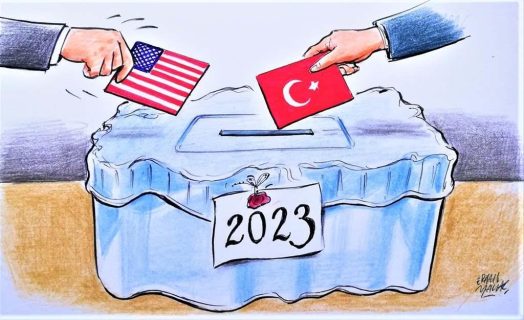
The Turkish President refuses to speak any further with the American ambassador to Ankara. The reason: a recent meeting between the diplomat and the leader of the Turkish opposition only a month and a half before the presidential election. Importantly though, this election will determine whether Turkey will continue its course towards Eurasianism, or revert back completely to the NATO bloc.
With the approach of the presidential election, Recep Tayyip Erdoğan reacted strongly following the meeting that American ambassador Jeffry Flake had with the leader of the opposition pro-American Republican People’s Party (CHP), Kemal Kılıçdaroğlu.
“Joe Biden spoke, and now you see what his ambassador here does. He visited (Kılıçdaroğlu). It is a shame. You are an ambassador, and you have to know how to act. You should be engaged with the President (not Kılıçdaroğlu),” Erdoğan said in Istanbul on April 2.
“I wonder if he will be ashamed to ask for an appointment from my office. But I tell him now. Our doors are closed to him from now on because he does not know his place. You should know how an ambassador should act,” he added.
Erdoğan’s outburst was instigated because it is evident that Flake, as head of the American diplomatic mission in Turkey, is endorsing Kemal Kılıçdaroğlu and the Alliance of the Nation coalition, which is made up of seven political parties.
“Ambassador Flake met with CHP Chairperson Kemal Kılıçdaroğlu today as part of continuing conversations with Turkish political parties on issues of mutual interest between our two countries. He expressed American solidarity and condolences for Türkiye’s earthquake losses,” the American Embassy wrote in a tweet on April 2.
The current president, Kılıçdaroğlu, and two other candidates, Sinan Oğan and Muharrem İnce, will face each other on May 14. At the surface level, the vote will determine who will be the President of Turkey for a five-year term, whilst at the same time the legislative elections will take place.
However, at a deeper level, Erdoğan represents Turkey’s slow pivot towards Eurasianism, where he believes a pan-Turkic world has its place, whilst Kılıçdaroğlu represents Ankara’s traditionally close ties with Washington and NATO. Effectively, Turkish citizens have a very deep ideological decision to make.
Respected Turkish public opinion research centre MetroPOLL conducted a survey with the participation of 2,046 people in 28 Turkish provinces between January 13 and March 14. The survey showed that 44.6% of respondents would vote for Kılıçdaroğlu, while Erdoğan would receive 42% of the votes. This makes the upcoming election one of the biggest challenges to the Turkish president’s long rule.
As this election will be close, the US is hoping that it can do its part to ensure that Kılıçdaroğlu wins. Although the US and Turkey are NATO allies, they have many outstanding issues, particularly relating to Washington’s refusal to sell F-35 fighter jets, US support for the Syrian offshoot of the Kurdistan Workers Party, and Turkey’s purchase of the Russian-made S-400 missile defence system.
Tensions significantly escalated even before President Joe Biden entered the White House in 2020. “What I think we should be doing is taking a very different approach to him [Erdoğan] now, making it clear that we support the opposition leadership,” Biden said in a New York Times interview, adding that Erdoğan had to pay the price.
The Kılıçdaroğlu-led opposition bloc has become the darling child of Western media recently, with more anti-Erdoğan coverage appearing on publications like The Economist. The Wall Street Journal, for their part, recently published an article by former US National Security Adviser and notorious warhawk John Bolton, who called on the US to support the opposition or force Turkey out of NATO if Erdoğan won the elections.
It is recalled that Flake had already angered Turkish officials after he shut down the US embassy last year over supposed “security concerns” that Turkey denied. Although the US did not shut down its consulate in Istanbul, it is noted that the mayor of Turkey’s largest city is the immensely popular Ekrem İmamoğlu of the CHP. This again is another signal that the US is backing the CHP in the elections.
But as Interior Minister Süleyman Soylu pointed out regarding Flake back in February: “Türkiye has the misfortune of having US ambassadors seeking to plot coups in our country. Every US ambassador has been engaged in efforts to harm Türkiye. They also try to dispel same advice to ambassadors of other countries.”
In this way, Turkish citizens have a generational choice to make – to continue with Erdoğan’s pursuit of sovereignty and balancing relations with the Great Powers, or a complete submission to Washington and a reversal of the many years of effort made by the Turkish president to achieve sovereignty.
Ahmed Adel is a Cairo-based geopolitics and political economy researcher.
Featured Video

Seyed M. Marandi: US-Iran War Inevitable: Kuwait and Bahrain May Fall
or go to
Aletho News Archives – Video-Images
From the Archives
Oil and the Israel Lobby
Reknowned economist M. Shahid Alam offers this excellent critique of Noam Chomsky’s defective analysis of the relative influence of Oil versus the Israel lobby over US foreign policy: … continue
Blog Roll
 Aletho News
- ICC ignored ‘very well-documented’ NATO crimes – ex-Libyan minister
- SNSC secretary dismisses US response to Iran’s conditions as ‘inadequate’
- Sanaa says Taiz roads open, secure for residents, warns Saudi forces
- Iraqi resistance group urges Saudi leadership to admit defeat, lift Yemen siege
- Trump’s Retreat: How Al-Aqsa Flood Took Down the US Empire
- Israel’s Military Actions in Lebanon Grossly Violate International Law — Lavrov
- Seyed M. Marandi: US-Iran War Inevitable: Kuwait and Bahrain May Fall
- Leaders Condemn Ansarallah Attack on Saudi Arabia While Ignoring Illegal War Against Yemen
- Leaked: Britain’s Covert Iraqi Psyops Network
- Yemeni Armed Forces Warn Airlines Against Using Saudi Airports, Exempt Mecca and Medina
- If Americans Knew
- After Oct 7, IDF policy allowed civilian casualties for even the lowest-ranking targets
- Israel’s Destruction of Southern Lebanon Intensified After the Cease-Fire
- The Last-Minute Decision That Gave Israel Its Name
- The American Conservative: How Trump Made the World Go Nuclear
- Meet the US generals and admirals advancing Israeli policy
- Opinion: Why news organizations should boycott Israel
- The Israeli witch hunt of Sami Abu Shehadeh exposes the lie of the ‘Jewish and democratic’ state
- No state has a ‘right’ to exist – least of all Israel
- Testimonies about Gaza’s civilian death toll expose Israel’s atrocities – Daily Update
- How Israel Conquered the Latin American Right
- No Tricks Zone
- Germany’s Green Energy Debacle: High Energy Costs Force Kahla Porzellan to Close After 182 Years!
- New Study: 50 Years Of The Most Aggressive ‘Net Zero’ Policies Can Only Affect The Global Climate By 0.03°C
- US September “Heat” Was No Record…Many Records Set Decades Ago
- Latest European Green Energy Debacle; Portugal’s Largest Flagship Solar Park Insolvent!
- Green Energy Debacle: German Expert Professor Fritz Vahrenholt Warns Of Severe Economic And Social Consequences
- Two More Paleo Reconstructions Affirm Meters-Higher Sea Levels Across Ireland, Brazil 7000-6000 Years Ago
- New Study: Earth And Venus Surface Warmth Largely Explained By Convection And Lapse Rate, Not CO2 Or Radiation
- 2025 Nature Paper Claiming Worsening Global Drought Gets RETRACTED …Heavily Flawed
- New Study: ‘Global Drought Shows No Detectable Recent Acceleration Under Climate Warming’
- Economic Masterminds: German Socialists Suggest Taxing Productivity Gains Stemming From Using AI

