Russia makes ‘goodwill’ missile pledge to US
RT | March 30, 2023
Russia will continue to inform the US about its ballistic missile launches despite Moscow suspending its participation in the New START treaty, Deputy Foreign Minister Sergey Ryabkov has stated.
Russia placed its participation in the New START treaty – the last remaining nuclear accord with Washington – on hold in February.
Explaining the move, President Vladimir Putin said that the 2010 deal had been signed under different circumstances, when Russia and the US did not perceive each other as adversaries. The West had also denied Russian requests to inspect nuclear facilities even though this was allowed for under the treaty, Putin claimed.
Speaking about data sharing between Moscow and Washington on Thursday, Ryabkov stated that “all types of information exchanges, as well as other elements of verification activities in accordance with the New START, have been suspended.”
However, he noted the announcement by Moscow that it will “adhere to the basic quantitative restrictions established in the New START treaty, and will continue to implement the 1988 agreement on the exchange of notifications on missile launches.” Russia will do so “out of good will,” Ryabkov added.
The New START treaty limits the number of strategic nuclear warheads deployed by Russia and the US to 1,550. It also confines the two nations to 800 deployed and non-deployed intercontinental ballistic missile (ICBM) launchers, submarine-launched ballistic missile (SLBM) launchers and nuclear-capable heavy bombers, as well as to 700 ICBMs, SLBMs and strategic bombers equipped to carry nuclear armaments.
Ryabkov said that Russia had informed the US of its decision to suspend participation in the New START treaty in both verbal and written form, but that Moscow had not received any such notification from Washington.
This means that the US violated its commitments under the New START treaty when it refused to provide Moscow with a biannual report on nuclear stockpiles earlier this week, Ryabkov argued.
US National Security Council spokesperson John Kirby said on Wednesday that Washington was ready to continue exchanging information with Moscow in line with the New START treaty, but only on a reciprocal basis. “Since they [Russia] have refused to be in compliance… we have decided to likewise not share that data,” Kirby said.
Large quantities of US weapons lost, stolen in Iraq, Syria: Report

The Cradle – March 31 2023
Hundreds of thousands of dollars in US artillery equipment, unspecified “weapons systems,” and specialized ammunition meant for US forces in Syria and Iraq have been stolen in recent years, The Intercept reported on 30 March.
According to criminal investigations files obtained under the Freedom of Information Act by The Intercept, at least four large-scale thefts and one loss of US equipment valued at some $200,000 have occurred in Iraq and Syria between 2020 and 2022. The lost items include 40mm high-explosive grenades stolen from US Special Forces.
The losses continue a previous pattern. The Intercept notes further that a 2020 audit by the Pentagon’s inspector general found that Special Operations Joint Task Force–Operation Inherent Resolve, the main unit that partners with the Kurdish-led Syrian Democratic Forces (SDF) to illegally occupy northeast Iraq, did not properly account for $715.8 million of equipment purchased for the SDF.
The recent failure to prevent the theft of, and account for, US-supplied weapons is concerning because this previously played a key role in the rise of Al-Qaeda affiliated groups, including the Nusra Front and ISIS, in Iraq and Syria.
In the spring of 2015, an extremist coalition led by the Nusra Front successfully conquered Syria’s Idlib governorate, in large part thanks to US-manufactured and supplied TOW anti-tank missiles. The missiles were originally supplied to Free Syrian Army (FSA) groups working with closely with Nusra.
When Russia intervened in the Syria conflict to prevent the fall of the government to Al-Qaeda groups – including Nusra, ISIS, and Ahrar al-Sham – a few months later, in September 2015, US officials drastically escalated TOW missile shipments to FSA units working with these groups.
When journalist Sharmine Narwani asked why US-supplied weapons allegedly meant for FSA groups were showing up in the hands of the Nusra Front, CENTCOM spokesman Lieutenant Commander Kyle Raines responded: “We don’t ‘command and control’ these forces – we only ‘train and enable’ them. Who they say they’re allying with, that’s their business.”
ISIS was also a major beneficiary of US-supplied weapons. Conflict Armament Research (CAR), a UK-based organization that tracks the supply of weapons into conflict-affected areas, reported that “Unauthorised retransfer – the violation of agreements by which a supplier government prohibits the re-export of materiel by a recipient government without its prior consent – is a significant source of [ISIS] weapons and ammunition. The US and Saudi Arabia supplied most of this material without authorization, apparently to Syrian opposition forces.”
By way of example, CAR noted that it had recovered US-supplied anti-tank missiles used by ISIS in Ramadi in February 2016. CAR confirmed that the missiles had been exported from the United States in December 2015. This indicates that the weapons were diverted to ISIS “in a matter of days or weeks after their supply.”
US ‘disappointed’ with UN court ruling on Iran
RT | March 31, 2023
The US State Department has criticized a ruling by the International Court of Justice (ICJ), which found that some Iranian funds were seized illegally by American authorities.
Judges at the UN’s top court in The Hague concluded on Thursday that a 2016 decision by the US Supreme Court was in violation of the 1955 Treaty of Amity, Economic Relations and Consular Rights between the two countries. Back then, the US court ruled that certain assets belonging to Iranian companies should be paid to victims of terrorist attacks blamed by Washington on Tehran.
“Iran is entitled to compensation for the injury caused,” the ICJ said, adding that the US has 24 months to agree on an amount for the payout, or the court will determine one itself.
However, the judges rejected Tehran’s bid for $1.75 billion in assets owned by Iran’s Central Bank (Bank Markazi) in the US to be unblocked, arguing that the ICJ does not have jurisdiction over the matter.
“We are disappointed that the Court has concluded that the turnover of assets of other Iranian agencies and instrumentalities to US victims of Iran’s sponsorship of terrorism was inconsistent with the Treaty,” US State Department spokesman Vedant Patel said on Thursday.
The 1955 agreement, signed more than two decades before the Islamic Revolution that toppled the US-backed government in Iran, “was never intended to shield Iran from having to compensate US victims of its sponsorship of terrorism,” he insisted. The US withdrew from the treaty in 2018.
Speaking at a news conference on the same day, Patel argued that the ICJ’s decision to keep the funds of Bank Markazi frozen was “a major blow to Iran’s attempt to avoid its responsibility, in particular to the families of US peacekeepers, who were killed in the 1983 bombing of the Marine Corps barrack in Beirut.”
Iran denies its involvement in the attack in the Lebanese capital, which killed 299 people of whom 241 were US troops, as well as other terrorist incidents blamed by Washington on Tehran.
The Iranian Foreign Ministry welcomed the ruling by the ICJ, calling it “proof of the Islamic Republic of Iran’s righteousness and the violations by the US government.”
NATO Holds War Games Miles From Ukraine’s Border
By Kyle Anzalone | The Libertarian Institute | March 30, 2023
The US and its NATO partners are conducting military drills in a region of Romania that borders Ukraine. Thousands of soldiers will gather to simulate repelling an invasion on the Black Sea coastline.
Dubbed “Sea Shield 23,” the war games kicked off on March 20 and will run until April 2. The US and 11 other NATO countries are participating in the Romanian-led military exercises. Nearly 3,500 soldiers, 30 naval ships, 14 aircraft and 15 other “fast intervention” boats are participating in the live-fire operations, which will occur in the Black Sea and Romania’s Danube Delta. Troops taking part in the Sea Shield drills will come within 20 miles of the Ukrainian border.
“The multinational exercise ‘Sea Shield 2023’ is the most complex training event, planned and conducted by the Romanian Naval Forces, through the Naval Component Command, in the 2023 training year,” the Romanian Navy said in a press release.
Since the Russian invasion of Ukraine, the US has conducted several rounds of war games in Eastern Europe to simulate a similar conflict and develop strategies for Kiev. Investigative journalist Seymour Hersh reported that last summer, the Joe Biden administration used the cover of war games in the Baltic Sea to plant explosives on the Nord Stream pipelines. In September, those explosives were detonated destroying the natural gas pipelines linking Russia and Germany.
Over the past year, the North Atlantic alliance has increased its force posture in what it regards as its “eastern flank,” which is made up of eight countries that stretch from the Baltics to the Black Sea, including Romania. NATO is concurrently conducting the “Crystal Arrow 23” war games in Latvia, which will see Danish soldiers train Riga’s Mechanized Infantry Brigade.
Russia Had Every Right To Arrest That Wall Street Journal Employee For Espionage
By Andrew Korybko | March 31, 2023
The US-led Western Mainstream Media (MSM) is furious after Russia arrested a Wall Street Journal (WSJ) employee on charges of espionage earlier this week. According to the FSB, that individual “acted in the interests of the US government” while trying to obtain classified information. The Yekaterinburg lawmaker with whom he was meeting confirmed that the so-called “journalist” wanted to learn about very specific details pertaining to Russia’s military-industrial complex in his region.
The Russian Foreign Ministry spokeswoman wrote on Telegram that “Unfortunately, this is not the first time that the status of a ‘foreign correspondent’, a journalist visa, and accreditation have been used by foreign nationals in our country to cover up activities that are not journalism.” Around the same time, the Kremlin spokesman confirmed that the arrested individual was indeed “caught red-handed” while meeting with the earlier mentioned local lawmaker when the FSB swooped in to stop him.
Keeping in mind what that Yekaterinburg official told TASS in the hyperlinked news item shared in the last sentence of the first paragraph, there’s no doubt that Russia had every right to arrest that WSJ employee for espionage. After all, if a Russian, Chinese, or Iranian citizen in the US on a journalist visa met with a local lawmaker to inquire about “whether the enterprises change their profile, how many shifts there are, and if they are appropriately staffed”, then they’d surely have been arrested as well.
There’s a very clear line between journalism and espionage. The first can only delve into very sensitive national security matters if a citizen from that same country is investigating particular leads, but even then, it might still be illegal depending on whatever regulations that particular country might have in place. As for the second, this always concerns sensitive information of serious interest for a foreign power such as specific details of its military-industrial complex, especially if a foreigner is seeking them.
That being the case, the WSJ employee indisputably crossed the very clear line between journalism and espionage by asking detailed questions of a local official in a foreign country about their military-industrial complex. He’d either done this before with someone else and thus got on the FSB’s radar or his outreach to that Yekaterinburg lawmaker indicated that he was illegally seeking certain information. Nothing else explains how he was able to be caught in the act red-handed like what happened.
In the first scenario, the FSB could have been aware of his meeting with that local official and coordinated with the latter to eavesdrop on the conversation in preparation of arresting that WSJ employee if he broke the law during their meeting. As for the second, that local official would have informed the FSB on his own for patriotic reasons and then offered to cooperate with them to help catch that individual in the act after they realized he planned to behave as a spy in their meeting.
Quite clearly, security officials in any country have the right to arrest foreigners like that WSJ employee who try to obtain specific information about ultra-sensitive national security issues from a local official, let alone during an ongoing conflict and not to mention while being a citizen of an unfriendly country. Russia’s arrest of that individual wasn’t so-called “political repression” like the MSM is dishonestly spinning it as, but the flexing of its sovereign rights in accordance with international law to defend itself.
Florida will not extradite Trump – DeSantis
RT | March 31, 2023
Donald Trump’s potential top rival for the Republican Party’s 2024 presidential nomination, Florida Governor Ron DeSantis, has ripped the New York City prosecutor behind the criminal indictment of the former president.
“Florida will not assist in an extradition request given the questionable circumstances at issue with this Soros-backed Manhattan prosecutor and his political agenda,” DeSantis said in a tweet on Thursday.
So far there has been no reports of any potential extradition requests, as a spokesman for the Manhattan district attorney’s office told AP that prosecutors had reached out to Trump’s legal team to “arrange a surrender” and a court appearance, expected sometime next week.
DeSantis previously said he wouldn’t get involved in the case “in any way,” indicating that he wouldn’t try to help block the Florida resident’s extradition to New York, but has now echoed Trump’s belief that Manhattan District Attorney Alvin Bragg “is stretching the law to target a political opponent.”
“The weaponization of the legal system to advance a political agenda turns the rule of law on its head. It is un-American,” DeSantis added.
Trump did not reveal his next steps, but warned in a post on Truth Social that this “witch-hunt will backfire massively on Joe Biden,” while his lawyer Joe Tacopina vowed to “vigorously fight this political prosecution in court.”
Contract shows how the FBI purchases massive amounts of online data
Something the FBI only recently admitted to
By Didi Rankovic | Reclaim The Net | March 30, 2023
The FBI was a customer of a private company Team Cymru, a contract shows. The company is in the business of harvesting NetFlow – network protocol for collecting IP traffic information and monitoring network flow – data from ISPs in return for threat intelligence, and then selling it on.
The contract became public knowledge thanks to a Freedom of Information Act (FOIA) request filed by Motherboard which reveals that the federal agency’s Cyber Division spent “tens of thousands” of dollars to get its hands on this data.
The deal was worth $76,450 and was made in 2017.

NetFlow data provides information about traffic volume and flow on a network, such as servers communicating with each other. This is something that is known only to the server owner, or an ISP – and, thanks to deals companies like Team Cymru have with ISPs, also to the FBI and other buyers.
Team Cymru openly states that the product it sells can track traffic through VPNs, Motherboard writes. The company also offers data like visited URLs and cookies, however, the internal FBI document detailing the deal does not say if this was part of the package.
“Commercially provided net flow information/data – 2 months of service,” is what the document on what the FBI purchased states.
The FBI is not alone in showing interest in NetFlow data – the military does it as well, and according to a whistleblower who went to Senator Ron Wyden with their information, one of the customers is the Navy’s Naval Criminal Investigative Service (NCIS), a civilian federal law enforcement agency.
Several days ago, Wyden said that he asked the Department of Justice inspector general to look into how the FBI is buying and using metadata, also based on a whistleblower report, and now, concerning NetFlow data, the senator sees it as yet more proof that the FBI is buying metadata capable of showing “the websites Americans visit, as well as sensitive information such as what doctor a person sees, their religion or what dating sites they use.”
And for that, Wyden said in a statement, the FBI explained what data concerning Americans’ browsing history it buys and why.
“It is not acceptable for the government to go around the courts by using a credit card to buy private information, which is why I have proposed the Fourth Amendment is Not for Sale Act to ban the purchase of this kind of private data,” he concluded.
According to Motherboard, neither the FBI nor Team Cymru were in the mood to offer any comment at this time.
Russian central bank reveals how it braced for Western dollar grab
RT | March 30, 2023
The Bank of Russia had been preparing for an escalation of Western sanctions since 2014 and was beefing up additional funds as a hedge against future restrictions on its foreign exchange reserves, the regulator revealed on Wednesday.
Amid “increasing geopolitical risks” the central bank ramped up investments in assets “that cannot be blocked by unfriendly nations” and transferred part of its reserves to gold, Chinese yuan and foreign currency in cash, the regulator announced in its annual report.
The central bank managed to stash billions of imported dollars “in volumes limited by logistics capabilities,” the report said without specifying the amount of accumulated funds. Alternative reserves in dollars and gold bars have been stockpiled in the vaults of the Bank of Russia.
“This safety cushion was created in the form of alternative reserves – less liquid and convenient in everyday life, but more reliable in the face of a tough geopolitical scenario,” the regulator explained.
It was impossible to abandon reserves in dollars and euros, as these currencies were used for settlements in international trade as well as in the domestic financial sector, the central bank added.
“Therefore the structure of foreign exchange reserves needed to take into account the needs of citizens and businesses,” the regulator concluded.
The central bank could have “unloaded” part of this money to banks during the first wave of Western sanctions to stabilize Russia’s banking system and offset the withdrawal of dollars and euros by “panicking depositors,” the chief analyst from Ingosstrakh-Investment, Viktor Tunyov, believes.
According to some estimates, last year almost $20 billion was withdrawn by depositors from the country’s second largest bank, VTB, alone.
In 2022, Russia was hit by sweeping Western economic sanctions, which included measures to cut the Russian central bank off from the international financial system, while around $300 billion of the bank’s foreign reserves were frozen. Moscow has criticized the seizure of its assets, saying it constitutes theft.
China ready to boost military cooperation with Russia
RT | March 30, 2023
China is ready to strengthen cooperation with the Russian military in order to jointly uphold international justice, peace and security, Chinese Defense Ministry spokesman Tan Kefei stated on Thursday.
The announcement comes after a summit between President Xi Jinping and his Russian counterpart, Vladimir Putin, in Moscow earlier this month. The two leaders reaffirmed the principles of partnership between their nations, and agreed to improve bilateral relations and military coordination.
According to Tan, China is “willing to work together with the Russian military to fully implement the important consensus reached by the two heads of state.” That includes further strengthening strategic communication and coordination, he added.
The diplomat stated that the two nations plan to regularly organize joint maritime and air patrols, as well as holding training exercises and strengthening various other areas of cooperation. According to Tan, the aim is to “deepen military mutual trust” with Russia to help ensure international justice and make new contributions to international and regional security. This would “serve the building of a community with a shared future for mankind,” he asserted.
Tan noted the increasingly strong relations between Moscow and Beijing, but insisted that they do not amount to a Cold War-style military-political alliance. According to the spokesman, the ties “transcend this model of state relations” and have a nature of “non-alignment, non-confrontation and non-targeting of third countries.”
The US, meanwhile, has called the growing ties between Russia and China “very troubling.” Officials have also described China as a “challenge,” with the Pentagon requesting a 2024 defense budget of up to $842 billion.
During his press conference, Tan argued that is China a “builder of world peace” and “contributor to global development.” In contrast, he claimed that the US uses its mammoth defense budget – which is the highest in the world – to “wage wars and create turmoil everywhere,” thus making it “the biggest threat to world peace, security and stability.”
‘Russia alone can already confront the entire West…’

BY M. K. BHADRAKUMAR | INDIAN PUNCHLINE | MARCH 30, 2023
The Russian media reported that President Vladimir Putin made an extraordinary gesture as President Xi Jinping left the Kremlin following the state dinner last week on Tuesday evening by escorting him to the limousine and seeing him off.
And Xi during the goodbye handshake reportedly responded, “Together, we should push forward these changes that have not happened for 100 years. Take care.”
Xi was alluding to the past 100 years of modern history that witnessed the United States transforming from a country to the north of Mexico in the Western Hemisphere to a superpower and global hegemon.
With his profound sense of history and dialectical mind, Xi was recalling the intense talks with Putin that dwelt on the contemporary realities burying the US’ unipolar moment in the dustbin and on the imperatives of China and Russia joining hands to consolidate the transition of the world order toward democratisation and multipolarity.
It was an appropriate finale to a state visit that began the previous evening with Xi expressing confidence that Russians will support Putin at the presidential elections next year. At one stroke, Xi “cancelled” the West’s demonising of Putin, mindful of the absurdity of even arranging an arrest warrant against the Kremlin leader to detract from his talks in Moscow.
China has a scrupulous policy of refraining from commenting on the internal politics of other countries. However, in the case of the situation surrounding Russia, Xi has made a notable exception by signalling his keenness for Putin’s proactive leadership in such tumultuous times. The majority of world opinion, especially in the Global South, will agree.
Won’t the erudite Russian public opinion take cognisance too — with a roar of approval? Yes, Putin’s consistent 80 percent rating is a signpost. Xi may have poured cold water on the last desperate western ploys of instigating a bunch of Russian oligarchs to spearhead a regime change in the Kremlin.
To be sure, the timing of Xi’s state visit in the middle of the war in Ukraine messaged the highest importance that China attaches to the relations with Russia. There is great deliberation in doing so, as both China and Russia are locked in spiralling tensions vis-a-vis the United States.
There has been a dramatic change of mood in Beijing. The nadir was reached with the boorish behaviour by President Biden in his State of the Union address on February 7 when he went off-script and hysterically shouted, “Name me a world leader who’d change places with Xi Jinping.”
In the Eastern culture, such boorishness is taken as unforgivably scandalous behaviour. In the weeks since the US shot down the Chinese weather balloon and maligned China internationally, Beijing has rebuffed several attempts by the White House seeking telephone conversation for Biden with President Xi.
Beijing has had enough of Biden’s hollow promises to mend ties while on the sly strengthening alliances across the Asia-Pacific region, inserting the NATO into the Asia-Pacific power dynamic and sending additional forces and firepower to places like Guam and the Philippines, apart from single-mindedly striving to weakening China’s economy.
Xi’s Moscow visit became a great occasion for Russia and China to reaffirm their “no limit” partnership and scatter the western attempts since the war broke out in Ukraine to create rift in the Sino-Russian relationship.
To quote Professor Graham Allison at Harvard University, “Along every dimension—personal, economic, military and diplomatic—the undeclared alliance that Xi has built with Russian President Vladimir Putin has become much more consequential than most of the United States’ official alliances today.”
However, alliance or not, the fact remains that this “new model of major-country relations featuring mutual respect, peaceful coexistence and win-win cooperation” — to quote Xi Jinping — is anything but a hierarchical order.
America’s pundits have a problem comprehending equal relationships between two sovereign and independent nations. And in this case, neither Russia nor China is inclined to declare a formal alliance because, simply put, an alliance inevitably requires assuming obligations and limiting the optimal pursuit of interests in deference to a collective agenda.
What emerges, therefore, is that Putin’s strategic calculus in Ukraine will be shaped much more heavily by events on the battlefield than on any Chinese input. Russia’s reaction to the Chinese “peace plan” regarding Ukraine testifies to that reality.
No sooner than Xi departed from Moscow, Putin in an interview with with Russia 1 TV, set the record straight that Russia is outproducing the West’s ammunition supplies to Kiev. He said, “Russia’s output level and its military-industrial complex are developing at a very fast pace, which was unexpected by many.”
While multiple Western countries will provide Ukraine with munitions, “the Russian production sector on its own will produce three times more ammunition for the same period of time,” Putin added.
He repeated that the West’s arms shipments to Ukraine are of concern to Russia only because they constitute “an attempt to prolong the conflict” and will “only lead to a bigger tragedy and nothing more.”
However, this is not to belittle the great significance of the partnership for both countries in the political, diplomatic and economic spheres. The salience lies in the two countries’ growing interdependency in multiple directions that cannot be quantified yet and keeps “evolving” (Xi) and appears seamless.
The Ukraine war, paradoxically, is turning out to be a wake-up call — a war that can prevent another world war rather than engender one. China understands that Russia has single-handedly taken on the “collective West” and shown it is more than a match.
This assessment in Beijing cannot escape the West’s attention and will impact the western thinking too for the medium and long term — not only for Eurasia but also the Asia-Pacific.
A recent article in the Global Times some weeks ago by Hu Xijin, the former editor-in-chief of the Chinese Communist Party Central Committee daily highlighted the ‘big picture.’
Hu wrote that the war in Ukraine “has evolved into a war of attrition between Russia and the West… While NATO is supposed to be much stronger than Russia, the situation on the ground doesn’t appear so, which is causing anxiety in the West.”
Hu drew some stunning conclusions: “The US and the West have found it much more difficult than expected to defeat Russia. They know that China has not provided military aid to Russia, and the question that haunts them is: if Russia alone is already so difficult to deal with, what if China really starts to provide military aid to Russia, using its massive industrial capabilities for the Russian military? Would the situation on the Ukrainian battlefield fundamentally change? Furthermore, Russia alone can already confront the entire West in Ukraine. If they really force China and Russia to join hands, what changes will there be in the world’s military situation?”
Isn’t the notion prevalent in the US and Europe that the Russia-China alliance is an alliance of unequals itself a self-serving western fallacy? Hu is spot on: Although China’s comprehensive strength is still short of that of the US, in combination with Russia, there is a paradigm shift in the balance and the US is no longer entitled to act as it pleases.
It is the common concern of Russia and China that the world order must return to an international system with the UN at its core and a world order based on international law. There is no question that the two countries’ strategy is to overturn the “rules-based order” dominated by the US and return to an international order centred on the UN.
In fact, Article 5 is the very soul of the joint statement issued in Moscow: “The two sides reaffirm their commitment to firmly upholding the international system with the United Nations at its core, the international order based on international law and the basic norms governing international relations based on the purposes and principles of the UN Charter, and oppose all forms of hegemonism, unilateralism and power politics, the Cold War mentality, confrontation between camps and the establishment of cliques targeting specific countries.”
Make no mistake that this is not about removing the US as the boss and replacing it with China, but about effectively checking the US from bullying smaller, weaker states, and thereby ushering in a new international order with primacy on peaceful development and political correctness that overrides all ideological differences.
Featured Video
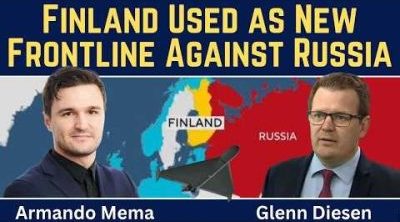
Armando Mema: Finland Used as New Frontline Against Russia
or go to
Aletho News Archives – Video-Images
New Documentary
Hospital Horror
Documented in the film,“Bad Medicine”

Blog Roll
 Aletho News
- Poland and Bulgaria put brakes on Ukraine weapons funding
- Russia Reaffirms Its Support for Sovereignty, Territorial Integrity of Lebanon – Russian MFA
- Araghchi: Failure to punish aggressors against Iran endangers all nations
- Iran tells UN Security Council to stop reversing roles of ‘aggressor and victim’
- Disgraced neocons Feith & Libby: stop whining about ‘endless war’
- CENTCOM rejects Israeli claims of preparations for new Iran attacks
- Your Shopping Bag Runs Through Hormuz
- Armando Mema: Finland Used as New Frontline Against Russia
- Gestapo 2.0? Germany grants spy agencies sweeping new powers
- Franco-Palestinian group seeks court ban on Israeli real estate fair in Paris
- If Americans Knew
- An error has occurred; the feed is probably down. Try again later.
- No Tricks Zone
- New Study: Barents Sea Temperatures Were Warmer And Sea Ice Less Extensive In The 1700s Than Today
- German Authorities Start Initiative To Evaluate Public Register For Climate “Disinformation” Spreaders!
- Zonal Asymmetry of Temperature Change in the Antarctic Circumpolar Current
- New Study: The Net Fossil Fuel Contribution To Rising Atmospheric CO2 Has Been Zero For 500 Years
- Germany’s Green Energy Transition Becoming Increasingly Expensive…Another 6 Trillion Euros!
- Sudden Stratospheric Warming, Powerful El Niño Combination May Lead To Extreme Europe Cold, Energy Crisis!
- Two New Studies Find Thwaites Glacier Melt Cannot Be Driven By Human Activity Or A Warming Ocean
- E-Cars Reduce CO2 Emissions By Only 41% Compared To Internal Combustion Engine Vehicles
- Predictions Made By Renowned Climate Professor Over Past Decades Have Been Proven To Be Poor
- New Study Suggests Large Regions Of The Pacific Ocean Have Been Cooling For The Last 80 Years

