Australian premiers spar over nuclear sub waste disposal
RT | March 16, 2023
The Australian political establishment is divided as to where the federal government should dispose of nuclear waste associated with the country’s expanded submarine deal with its AUKUS allies.
An accord was struck by the leadership of the countries which make up the trilateral AUKUS alliance – Australia, the United States and the United Kingdom – when they met in San Diego, California earlier this week, which rubber-stamped the sale of nuclear-powered submarines by Washington to Canberra.
In addition, Australia Prime Minister Anthony Albanese confirmed that his country would construct its own fleet of nuclear submarines, which will be delivered in the early 2040s. The terms of the agreement stipulate that the Australian government will be responsible for the disposal of nuclear waste from the vessels – but this appears to have opened a new political front for the country’s various state leaders.
“I think the waste can go where all the jobs are going,” said Victorian Premier Daniel Andrews via the Australian Broadcasting Corporation on Thursday, referencing the 8,000 jobs which are expected to be generated in South Australia during the construction of the military submarines. “I don’t think that’s unreasonable, is it?”
West Australian Premier Mark McGowan has also indicated that nuclear waste disposal sites are unwelcome in his state, joining Andrews in suggesting South Australia as the most appropriate location.
Susan Close, the acting South Australian premier who doubles as the region’s environment minister, responded to the suggestions by saying the decision on nuclear waste locations should be dictated by science and not by “state leaders trying to move nuclear waste that doesn’t yet exist across the border.”
A final decision on the location of the site is not expected for another 12 months, and the site that is eventually selected won’t be required for use until around 2055.
The AUKUS deal will see Australia become the seventh nation with nuclear-powered submarines in its military arsenal, and comes amid Western concerns about China’s military expansion in the Indo-Pacific region. Beijing has rebuked the AUKUS nuclear submarine agreement, saying it contradicts accepted norms of nuclear non-proliferation.
MQ-9 Drone Incident: Biden’s Dangerous Escalation
By Scott Ritter – Sputnik -16.03.2023
A US surveillance drone crashed off the coast of Crimea after an encounter with a Russian fighter aircraft. What does this incident say about the current state of the war in Ukraine and where Russia and the US might go from here.
In 2015, the United States established a permanent training facility in Yavoriv, western Ukraine, for the express purpose of training Ukrainian soldiers for combat against Russia.
At that time the conflict in Ukraine was an internal affair, pitting the Ukrainian Army against Ukrainians of ethnic-Russian background who had rebelled against a US-backed coup which, in February 2014, saw the constitutionally elected government of President Viktor Yanukovych replaced by a pro-American government.
This new Ukrainian government, hand-picked by the US, was deeply infused with radical ultra-nationalism linked to the ideology of Stepan Bandera and the Organization of Ukrainian Nationalists, or OUN, which fought alongside Nazi Germany during the Second World War and whose members were responsible for the murder of hundreds of thousands of civilians.
Many of the Ukrainians being trained by the US military were affiliated with the neo-Nazi Azov Battalion, an organization which many in the US Congress at the time found so odious that the passed an amendment to the defense authorization act prohibiting US taxpayer dollars from being used to train its members.
These restrictions aside, there can be no doubt that the purpose of the US training mission in Ukraine was to prepare the Ukrainian military to go to war against Russia. That the US training not only instructed the Ukrainians troops on modern combined arms maneuver warfare, but also sought to elevate the Ukrainians to the same standard used to train the forces of the North Atlantic Treaty Organization (NATO), provided the first inkling that any future conflict between Ukraine and its disenfranchised ethnic Russian population that involved Russia would be far more than a simple confrontation between two regional neighbors, but a larger war between Russia and the US and NATO—the so-called “collective west”, using Ukraine as a proxy.
This reality was amplified further with the provision by the US and NATO of advanced anti-tank missile systems and other lethal military assistance.
Even before Russia initiated the Special Military Operation, in February 2022, the United States, the United Kingdom, and NATO began a program of intelligence sharing with the Ukrainian armed forces at the highest levels. Once the Russian troops moved across the border, the nature of this intelligence relationship shifted away from providing indications and warning of an impending attack, to the provision of operational and tactical intelligence about Russian military disposition, capabilities, and intent that was used by Ukraine to target Russian forces.
While the US and its NATO allies are understandably reticent about the nature of this intelligence, and the sources from which it is derived, over time it has become clear that every available intelligence collection platform is being used to gather relevant data about Russian military operations in support of the Special Military Operation.
It is also clear that this intelligence is used by joint operational planning cells comprised of US/NATO/Ukrainian forces to develop targets in real time, which are then transmitted to Ukrainian forces.
One of the more ubiquitous intelligence resources employed by the US in support of Ukraine is the MQ-9 Reaper. The MQ-9 is a large a large unmanned aerial vehicle (UAV) operated by the Air Force. It is remotely operated by a two-person team from a ground control station that is connected to the MQ-9 using satellite equipment. The team includes a qualified pilot who is responsible for flying the aircraft and an enlisted aircrew member who is charged with operating any onboard sensors or weapons the MQ-9 might be carrying.
The MQ-9 has a wingspan of 66 feet, is 36 feet long, 12 feet high, and weighs approximately 4,900 pounds. It is capable of flying at altitudes as high as 50,000 feet and has a range of some 1,400 miles. It can carry a wide variety of weapons and intelligence collection pods. Each MQ-9 costs about $32 million. The MQ-9 Reapers operating over the Black Sea are flown out of a Romanian Air Force base in Campia Turzii by members of the US Air Force’ Detachment 1, 31st Expeditionary Operations Group.
On March 14, 2023, an MQ-9 Reaper operating out of Campia Turzii was flying in international airspace over the Black Sea, west of Crimea. This was a standard flight profile for the MQ-9 Reaper, one that had the Russians concerned, given its proximity to sensitive Russian military installations.
Ukraine had a history of launching operations against Russian forces in Crimea using aerial and underwater drones, and the potential for intelligence collected by the MQ-9 Reaper being used in support of such attacks was very real. For this purpose, the Russian military had declared certain areas off the coast of Crimea as being off limits.
The US, however, does not recognize Russia’s claim to Crimea, or for that matter the four new territories of Kherson, Zaporozhye, Donetsk and Lugansk, that joined the federation following referendums held in September 2022 and, as such, does not recognize any claim regarding the establishment of no-fly zones by Russia in support of its ongoing military operations against Ukraine. The decision to fly the MQ-9 Reaper was made knowing Russia would object, or worse.
Indeed, Russia dispatched a pair of Su-27 fighter aircraft to intercept the MQ-9 Reaper. After making 19 passes at the Reaper, the Su-27’s conducted what can only be described as aggressive maneuvering designed to either compel the MQ-9 Reaper to depart the area, or else bring it down. After one particular incident, which may or may not have involved one or more Su-27 aircraft dumping fuel onto the Reaper, the MQ-9 lost control and crashed into international waters off the coast of Crimea.
It is believed that Russian forces dispatched from Crimea recovered most, if not all, the wreckage, including the top-secret intelligence pod that had been mounted under the left wing of the aircraft. If this is the case, critical US intelligence collection capabilities would have been compromised, allowing Russia to better protect itself from sensors like the one carried onboard the downed MQ-9 Reaper aircraft.
While the US State Department has declared that the US will continue to fly missions in international airspace, the Commander of US forces in Europe, General Christopher Cavoli has ordered all MQ-9 Reaper operations to be halted pending a review of the incident and a decision on how best to proceed.
The fact that the US is using the MQ-9 Reaper to fly in direct support of Ukrainian military forces make the aircraft a direct participant in the conflict, and as such a legitimate target for Russia. Russia’s decision not to shoot the MQ-9 down, but rather provide multiple opportunities for the US aircraft to disengage and leave the contested airspace, is indicative of Russia’s desire to avoid unnecessary escalation of the conflict, especially one that could have US and Russian forces engaged in direct combat.
One of the options that the US could consider would be to fly the MQ-9 with a US fighter escort. But this would be contested by Russia, leading to the possibility of a dogfight that could result in casualties on both sides, and the probability of escalation. At the end of the day, the US will probably seek to fly an MQ-9 Reaper on a course that comes close to, but does not violate, a declared Russian no-fly zone, after which MQ-9 Reaper flights along the Crimean coast will probably be discontinued.
There are other ways to collect the intelligence that the MQ-9 Reaper gathers which do not put US military assets at risk, and which do not provide the possibility of military escalation between the US and Russia.
Such a decision would be a sharp departure from the confrontational stance taken to date by the US when it comes to intelligence collection targeting Russia. However, the devolving military situation in Ukraine, with the Ukrainian military facing a decisive defeat in Bakhmut and in general, alters the risk-gain analysis that accompanies the decision to fly missions such as the one that resulted in the downed MQ-9 aircraft. With little chance of a Ukrainian victory in sight, the US will be looking for ways to deescalate, rather than escalate, its involvement in the Ukrainian conflict.
Whether or not the MQ-9 Reaper incident will result in a top-down review of incidents of this nature, for example prompting the Biden administration to reflect on the apparent hypocrisy of the US approach toward responding to the Chinese balloon “threat”, namely by shooting the balloon down, while condemning the more restrained approach taken by Russia in responding to a genuine military threat on its borders in an active warzone, is yet to be seen. Such an abut-face would be unlikely, given the current political climate, where Russophobia runs rampant.
The fact remains that as long as the US is engaged in the implementation of a wartime policy that seeks the strategic defeat of Russia, the possibility for rational, logic-based policy formulation and implementation on the part of the US is almost nil.
The shortest path for the normalization of US-Russian relations lays in a decisive victory being achieved by Russia over Ukraine and the collective west in the shortest time possible. Such an outcome would force the US and its NATO allies to reexamine their approach toward Russia based upon the new realities that would accrue from such an outcome.
The U.S. War of Aggression Against Iraq
By Jacob G. Hornberger | FFF | March 16, 2023
The U.S. invasion of Iraq, whose 20th anniversary occurs this month, provides a perfect demonstration of why so many people around the world believe that the U.S. government suffers from a very grave case of hypocrisy. While U.S. officials decry Russia’s invasion of Ukraine with great vehemence, they somehow block out of their minds their own deadly and destructive invasion, war of aggression, and long-term occupation of Iraq.
Not only have U.S. officials not even offered an apology for what they did to the Iraqi people, they still expect the American people to thank the troops for what they did to the people of Iraq.
Let’s keep one important, undisputed fact in mind: Iraq never attacked or invaded the United States. It was the United States that was the invader and the aggressor. That’s why I use the term “war of aggression.” It is a term that was used at the Nuremberg War Crimes Tribunal to convict and condemn German officials who did the same thing to other countries in World War II that the U.S. did to Iraq.
That means that under international law, U.S. troops had no legal authority to kill even one Iraqi. Yet, they killed hundreds of thousands of Iraqis. We are still expected to thank the troops for their “service” in killing an enormously large number of people they had no right to kill.
There is another important, undisputed fact to keep in mind: Congress never declared war on Iraq. Yet, our Constitution requires a congressional declaration of war before the president can legally wage war with his army against another nation. That makes the U.S. invasion, war of aggression, and occupation illegal under our own form of government.
Thus, the killing, maiming, injuring, or torturing of Iraqi citizens was illegal under our own form of government. Yet, we are still expected to thank the troops for their “service.”
U.S. officials have long claimed that their invasion of Iraq was based on an innocent mistake. They say that they honestly thought that Iraq possessed “weapons of mass destruction.”
But there is a serious flaw in that justification: The U.S. government had no legal authority to enforce WMD resolutions that had been enacted by the United Nations. Only the UN has the legal authority to enforce its own resolutions. It is undisputed that the UN never authorized an invasion of Iraq to enforce its WMD resolutions.
Equally important, the WMD claim was clearly a lie on the part of U.S. officials to garner American support for the invasion. After all, if it was truly an innocent mistake, once it became clear that there were no WMDs U.S. officials would have apologized for their deadly and destructive invasion and ordered the troops to return home. Instead, they keep the troops in Iraq, who continued killing, injuring, maiming, and torturing Iraqis.
Moreover, once it became clear that there were no WMDs, U.S. officials quickly shifted their justification for their invasion, war of aggression, and occupation to bringing “freedom” to the Iraqi people. That’s why they called their war of aggression “Operation Iraqi Freedom.” But under international law, a nation is prohibited from invading another nation for the purpose of bringing “freedom” to the invaded country. Moreover, at the risk of belaboring the obvious, all those hundreds of thousands of Iraqis they killed are not enjoying “freedom” because they are dead.
Moreover, notice something else of importance: There has never been an official U.S. investigation — not even by Congress — into whether the WMD claim was, in fact, an innocent mistake or an intentional, deliberate, and knowing lie. Even while U.S. officials cry out for war-crimes indictments of Russian officials for supposed war crimes in Ukraine, they steadfastly oppose any indictments or even criminal investigations of U.S. officials who ordered and presided over the U.S. invasion, war of aggression, and long-term occupation of Iraq.
It is always easy to point out the faults, failures, and misdeeds of foreign regimes. It is much more difficult to focus on the faults, failures, and misdeeds of one’s own regime. We should bear in mind that when U.S. officials point their accusatory finger at Russia, China, Iran, Cuba, North Korea, Venezuela, and other regimes, there are three more hypocritical fingers pointing back at them.
Fauci: “I doubt if I’ve ever met him [Ralph Baric]”
By John Leake | Courageous Discourse | March 15, 2023
Dr. McCullough and I often marvel at how the mainstream media somehow fails to see and report facts of enormous importance—facts that are documented in academic papers, grant proposals, e-mail correspondence, and video footage.
All a journalist has to do is read the documents and report their content. And yet, somehow, most legacy media journalists are apparently unable to gain awareness of and report what is immediately at hand.
Take the 2015 paper published by UNC Chapel Hill Professor Ralph Baric et al. titled A SARS-like cluster of circulating bat coronaviruses shows potential for human emergence. As the authors (including Zhengli-Li Shi at the Wuhan Institute of Virology) state in their abstract:
Here we examine the disease potential of a SARS-like virus, SHC014-CoV, which is currently circulating in Chinese horseshoe bat populations1. Using the SARS-CoV reverse genetics system2, we generated and characterized a chimeric virus expressing the spike of bat coronavirus SHC014 in a mouse-adapted SARS-CoV backbone. The results indicate that group 2b viruses encoding the SHC014 spike in a wild-type backbone can efficiently use multiple orthologs of the SARS receptor human angiotensin converting enzyme II (ACE2), replicate efficiently in primary human airway cells and achieve in vitro titers equivalent to epidemic strains of SARS-CoV.
The purported purpose of this Gain-of-Function work—i.e., generating a chimeric virus (combining genetic material from two different viruses) capable of infecting human airway cells—was to lay the groundwork for vaccine development and testing in the event that a wild bat coronavirus were eventually to infect humans.
Under the paper’s section titled Biosafety and biosecurity, the authors wrote:
Reported studies were initiated after the University of North Carolina Institutional Biosafety Committee approved the experimental protocol (Project Title: Generating infectious clones of bat SARS-like CoVs; Lab Safety Plan ID: 20145741; Schedule G ID: 12279). These studies were initiated before the US Government Deliberative Process Research Funding Pause on Selected Gain-of-Function Research Involving Influenza, MERS and SARS Viruses (http://www.phe.gov/s3/dualuse/Documents/gain-of-function.pdf). This paper has been reviewed by the funding agency, the NIH. Continuation of these studies was requested, and this has been approved by the NIH.
So there it is. Ralph Baric and his colleague at the Wuhan Institute of Virology plainly state that they engineered a bat coronavirus, using Gain-of-Function methods, that infected the respiratory tract of humanized mice, and the NIH approved their study because it was initiated before the US Government pause on Gain-of-Function Research.

UNC Professor Ralph Baric
Anyone familiar with Ralph Baric’s storied career as the world’s greatest authority on bat coronaviruses (both natural and chimeric) has, for the last three years, wondered: “Where is Professor Baric? Why isn’t he an official consultant on the nature of SARS-CoV-2? Why hasn’t he been a member of any pandemic response task force?”
Until late 2022, no one in Congress, the White House, or in any of the federal health agencies ever mentioned the name Ralph Baric in any official public discussions. This is probably the most glaring omission in the history of scientific investigations. It’s the equivalent of a Congressional investigation into the development of the atomic bombs dropped on Japan without questioning or even mentioning Robert Oppenheimer or Enrico Fermi.
Finally, on November 23, 2022, Dr. Fauci was deposed by John Sauer, counsel for the State of Missouri, on the origins of SARS-CoV-2. As the Epoch Times reported on March 8, 2023, the attorneys general of Missouri and Louisiana told a federal court in a recent filing that parts of Dr. Fauci’s testimony are not credible.
Especially conspicuous and dubious were his statements about Ralph Baric. To quote the Epoch Times report:
“I know who he is. I doubt if I’ve ever met him,” Fauci said during the late 2022 deposition—the first time he answered questions under oath since the pandemic began.
Fauci acknowledged the U.S. National Institute of Allergy and Infectious Diseases, which he headed until around the New Year, provided funding for Baric.
“But you don’t remember ever meeting him in person?” he was asked.
“I don’t recall. I could have met him. I run into several thousands of scientists that we refer to, but I don’t recall, certainly, having a relationship with him,” Fauci responded.
But Fauci’s official calendar lists a one-on-one meeting with Baric on Feb. 11, 2020. And a newly revealed message from a professor who recounted Baric’s account of the meeting showed they talked about man-made virus combinations.
“I talked to Ralph for a long time last night. He sounds beat,” Matt Frieman, a University of Maryland professor, wrote in a Feb. 18, 2020, message. “He said he sat in Fauci’s office talking about the outbreak and chimeras.”
Why did Dr. Fauci claim he had no memory of meeting Dr. Baric and conversing with him about man-made coronaviruses?
Israel and its US lobby Dealt Major Blow by China Saudi Iran Peace Initiative
By Grant F. Smith | Institute for Research: Middle Eastern Policy | March 12, 2023
On Thursday the New York Times ran yet another report about Saudi Arabia’s entry into an “Abraham Accord,” but if only certain conditions could be met. It quoted longtime Israel lobby heavyweight Martin Indyk and reported on the American Israel Public Affairs Committee’s think tank the Washington Institute for Near East Policy “expert” delegation’s visit to Riyadh to finalize a deal. Then on Friday explosive news broke that China had successfully concluded a secret peace agreement between Iran and Saudi Arabia.
The plan aims to restore diplomatic relations by reopening embassies within two months. They also agree to restart their April 2001 Security Cooperation. Also back on the front burner is a 1998 General Agreement covering economic, trade, investment, technology, science, culture, sports and youth ties. It is well worth reading the entire statement.
As it often does, the New York Times quickly updated its March 9 story in an attempt not to look foolish having given too much credence to Israel lobby guidance.
Too late.
Israel and its lobby have for decades attempted to steer the United States into attacking Iran. The neocon policy coup of 2001 was not only a plan to get the U.S. to attack Israel’s arch enemy Iraq, it was also designed to steer the U.S. into attacking seven countries in seven years, most prominently Iran.
When the U.S. invasion of Iraq quickly turned into a quagmire, two American Israel Public Affairs Committee executives tried to place stolen classified Department of Defense information incriminating to Iran into circulation at the Washington Post. The operation failed, the Pentagon colonel leaking classified information was prosecuted, while the longtime AIPAC officials were dismissed.
Israel’s foreign influence operation AIPAC has steadily lobbied against Iran on behalf of Israel including punishing economic warfare from the U.S. Treasury’s OTFI unit, which AIPAC lobbied to set up for just this purpose in the aftermath of 9/11.
The Trump era “Abraham Accords” were yet another attempt to isolate Iran while harnessing Arab countries to Israel’s undue foreign influence and war on Iran machine. Under the scheme, the U.S. sacrifices its remaining international reputation to compel Arab governments to sign diplomatic and commercial accords with Israel their populations overwhelmingly reject. Target governments get access to advanced U.S. weapons, or recognition of illegal land grabs in exchange for normalization.
Saudi Arabia was always the toughest prospect for sticking its head into the yoke of an Abraham Accord. The Saudi Initiative, or Arab Peace Initiative endorsed by the Arab League in 2002, re-endorsed in 2007 and 2017 was a legitimate path toward a somewhat just settlement through the creation of a Palestinian state with East Jerusalem as its capital in exchange for Arab normalization.
Under constant Israel lobby pressure, there was never any serious U.S. consideration of the Saudi led plan. Instead, Israel surrogates Jared Kushner and former real estate lawyer turned ambassador to Israel David M. Friedman among others pushed the so-called “Deal of the Century” that offered tenuous promises of economic development to Palestinians in exchange for relinquishing their rights under international law. A 2019 IRmep poll revealed that 68 percent of Americans would have rejected a similar deal if they were in Palestinians’ shoes, and the deal collapsed.
The Abraham Accords then attempted to “transcend” the Palestine question by making Palestinian claims under international law and the Arab Peace Plan irrelevant.
The new Joint Trilateral Statement signals a rejection of the Abraham Accords and yoking Saudi Arabia to Israel and its lobby’s foreign policy intrigues and domestic meddling. Saudi Arabia may not want to become as subject to Israeli prerogatives as America and has obviously been learning how to avoid it. Saudi Arabia skillfully cushioned the bad news by end-running AIPAC and placated the American military industrial congressional complex by simultaneously agreeing to purchase $35 billion in Boeing passenger jets. That is nearly the same amount as military aid the US agreed to give to Israel gratis over ten years under the Obama administration.
Israel and its lobby will not take this bad news lying down and still have many levers to pull in the region, establishment U.S. media, Congress, the State Department, and the White House. But for now, the Saudi rejection of the Abraham Accords could signal the way out for UAE, squeezed by Israel and AIPAC to invest in sketchy Israeli schemes such as “Project Jonah,” and get into a war footing with Iran. UAE may be inspired and try to disentangle themselves from the Israeli undue influence and Palestine justice minimization machine.
© 2002-2023 Institute for Research: Middle Eastern Policy, Inc.
China comments on ‘Ukrainian theory’ of Nord Stream sabotage

RT | March 15, 2023
Chinese Foreign Ministry spokesman Wang Wenbin found it unusual that major outlets in the West uncritically embraced the claim by unnamed US officials that a “pro-Ukrainian group” was responsible for the bombing of Nord Stream natural gas pipelines.
At the press briefing on Wednesday, Wang described the pipelines as “vital cross-border infrastructure projects,” whose destruction had a “serious impact on the global energy market and ecological environment.” China wants “an objective, impartial and professional investigation” into the bombing and those responsible held to account, the sooner the better, he added.
Asked to comment on the so-called “Ukrainian theory,” first put forth by anonymous US officials in the New York Times last week, Wang noted the sudden change of behavior by Western media, after they spent a month ignoring the report by journalist Seymour Hersh that blamed the US and Norway.
“We have noted that some Western media have been mysteriously quiet after Hersh reported that the US was behind the Nord Stream blast. But now these media are unusually simultaneous in making their voice heard. How would the US account for such abnormality? Is there anything hidden behind the scene?” Wang said.
Nord Stream 1 and 2, pipelines built under the Baltic Sea to carry Russian natural gas to Germany and onward to Western Europe, were damaged in a series of explosions in September 2022.
In early February, Hersh published a report detailing how Washington had the pipelines destroyed, describing how US divers planted the explosives and a Norwegian airplane sent the detonation signal. The US government denied all accusations, labeling Hersh’s report “utterly false and complete fiction,” while Russia and China called for an independent and transparent investigation.
The Times report quoted unnamed US officials who suggested that the saboteurs were “most likely Ukrainian or Russian nationals, or some combination of the two,” citing unspecified new intelligence. The anonymous officials insisted no US or British nationals were involved, and that there was no evidence President Vladimir Zelensky or any other Ukrainian official directed the attack, either. Kiev has officially denied any responsibility for the Nord Stream blasts.
When he was shown the Times article during an interview, Hersh laughed and asked “Are they that stupid?” referring to the outlet’s anonymous sources. Nonetheless, the story was dutifully repeated by all major Western outlets.
Russian president Vladimir Putin was likewise unconvinced. During an interview with Rossiya-1 on Tuesday, he dismissed as “complete nonsense” the notion that non-state actors could be behind the complex act of sabotage. The attacks could have only been “carried out by specialists, and supported by the entire power of a state possessing certain technologies,” he said.
AUKUS deal ‘worst in history’ – former Australian PM
RT | March 15, 2023
Former Australian Prime Minister Paul Keating has fired a broadside against the current government for its endorsement of the AUKUS security bloc and the purchase of American submarines. It doesn’t help protect the country and drags it into the US attempt to preserve its hegemony by containing China, he has argued.
Keating, who chaired the Australian government in the 1990s, reiterated his negative view of the purchase of Virginia-class nuclear-powered boats in a lengthy rebuke this week. He branded it the “worst international decision” by an Australian Labor government since conscription in World War I. Speaking to journalists from the National Press Club of Australia on Wednesday to make the case for his position, he added “it must be the worst deal in all history.”
Prime Minister Anthony Albanese formally confirmed the acquisition on Monday during a visit to California, where he and British Prime Minister Rishi Sunak were hosted at a naval base by US President Joe Biden. The plan was first announced in 2021, with Keating blasting the then-Conservative government in Canberra.
Figures in the British government were “looking around for suckers,” the famously acerbic Aussie politician said of the prelude to the announcement two years ago. “And they found – whoo! – here is a bunch of accommodating people in Australia.” The Albanese cabinet was just as eager to push the deal forward, he added.
The Australian Royal Navy is buying up to five attack submarines from the US and possibly building three more with the UK’s help. The deal is estimated to cost 360 billion Australian dollars ($240bn).
With that investment, Australia could have 40 to 50 domestically-built Collins-class diesel-electric submarines instead, Keating suggested.
A larger fleet would be far better at protecting Australia from a possible invasion, which would require an “armada of troops ships” reaching its coast, he believes. Meanwhile, the nuclear subs would be sent to the Chinese coast to potentially take part in a US-Chinese conflict, the former prime minister suggested.
“It’s a strange way to defend Australia to have your submarines sunk on the Chinese continental shelf chasing Chinese submarines,” Keating mused.
“We are part of a [US] containment policy against China,” he added. “It’s about one matter only: the maintenance of US strategic hegemony in Southeast Asia.”
The politician dismissed as “rubbish” the idea that China poses a military threat to Australia in the first place and shamed national journalists peddling it.
Pakistan’s Fascist Post-Modern Coup Regime Risks Replicating The East Pakistan Tragedy
By Andrew Korybko | March 15, 2023
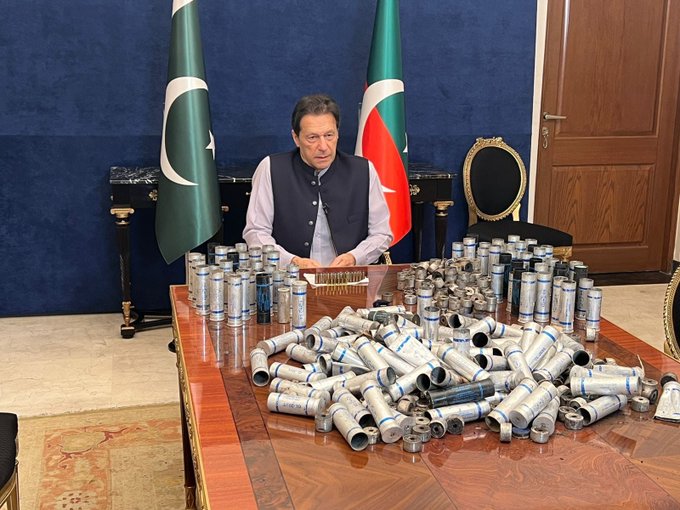
The fascist authorities who were installed in Pakistan following last April’s US-orchestrated but superficially “democratic” post-modern coup against former Prime Minister Imran Khan risk replicating the East Pakistan tragedy if they don’t immediately stop shooting at their own people. The ousted leader’s supporters are rallying around his residence to prevent the local police from serving him an arrest warrant on a trumped-up graft charge that was concocted against him as “lawfare”.
Instead of reconsidering the wisdom of clashing with unarmed and purely peaceful civilians, the fascist authorities ordered their goons to assault them all with tear gas, rubber bullets, and reportedly even live ammunition that was shot into the air according to some accounts. This de facto declaration of war by the fascist post-modern coup regime on its own people could dangerously place the country’s political-security trajectory on the irreversible path towards civil war.
Former Prime Minister Khan warned as much in a tweet on Wednesday that he shared alongside a photo of himself sitting down in front of a pile of tear gas canisters that were shot at his home the other day. He wrote that “My house has been under heavy attack since yesterday afternoon. Latest attack by Rangers, pitting the largest pol party against the army. This is what PDM and the enemies of Pakistan want. No lessons learnt from the East Pakistan tragedy.”
The military-intelligence establishment must urgently rescind their de facto declaration of war on the Pakistani people, do whatever’s required behind the scenes to have the fascist post-modern coup’s leading figures resign as the first step towards national reconciliation, and then hold early elections. It’s only through this three-step process that the worst-case scenario of replicating the East Pakistan tragedy can potentially be avoided since anything less than that makes this more likely by the hour.
One of the most populous countries in the world is being pushed towards civil conflict by those conspirators who illegally usurped power with the US’ help last April and subsequently crashed the economy. This factual framing of Pakistan’s latest political-security dynamics proves that the increasingly violent clashes provoked by the fascist post-modern coup regime against its own people could lead to a global crisis in the event that they soon spiral even further out of control.
If the military-intelligence establishment continues waging war on the Pakistani people, then their victims should consider publicly calling on their iron brothers in China to urgently rein them in as a last resort to avert the worst-case scenario that former Prime Minister Khan just warned about. China’s diplomatic miracle in brokering the Iranian–Saudi rapprochement last week proves that it has the political capabilities to peacefully resolve the Pakistani Crisis if the people request for it to do so.
After all, the People’s Republic also stands to geostrategically lose if that neighboring nation descends into civil war. The China-Pakistan Economic Corridor (CPEC), which is the flagship project of Beijing’s Belt & Road Initiative (BRI) that’s aimed at creating a Community of Common Destiny for Mankind, would practically become inoperable should that happen. Not only could that block off China’s shortcut to the Indian Ocean, but it would deal an immense blow to its soft power and BRI’s reputation as well.
Without intending to come off as “conspiratorial”, observers can’t preclude the possibility that the fascist post-modern coup regime’s US backers encouraged them to provoke a civil war partially for the purpose of advancing America’s anti-Chinese “containment” strategy via unconventional means. At the very least, its military-intelligence establishment wouldn’t so publicly violate its people’s human rights and possibly even countenance war crimes against them without the US’ advance approval.
This means that the latest escalation of the nearly year-long Pakistani Crisis is connected to the US just like its origin is, thus extending credence to the preceding concerns that the events which Washington set into motion last April are actually part of its larger Hybrid War on China. This South Asian state was knocked out of the geostrategic game at the most sensitive moment in the global systemic transition shortly after this process accelerated following the start of Russia’s special operation.
That outcome hasn’t just proven disastrous for the Pakistani people who’ve suffered as a result of the crippling economic crisis that followed, but it also unexpectedly offset a key pillar of China’s grand strategy related to its reliance on CPEC as a non-US-controlled shortcut to the Indian Ocean. Furthermore, both the political and especially economic dimensions of the US-provoked Pakistani Crisis also raised serious doubts about CPEC’s future as well as that of BRI more broadly.
Nobody can therefore deny that the US’ regime change in Pakistan last year had very serious consequences for China that are becoming worse by the hour as that country’s fascist post-modern regime risks pushing it into civil war after de facto declaring war on its own people. China might already be working behind the scenes to try and de-escalate the latest and thus far most dangerous phase of this nearly year-long crisis on its borders, but it would still help a lot if Pakistanis publicly requested this.
That’s because this could compel China into taking urgent action behind close doors if it hasn’t already done so, not to mention creating the optics of Pakistan’s US-backed fascist post-modern coup regime literally shooting at Chinese-friendly peaceful protesters, which would force China to get involved. No other party apart from the US has the influence to peacefully resolve this crisis, and seeing as how Washington’s interests are perversely advanced by exacerbating it, the onus thus falls on Beijing.
Practically speaking, China has a credible chance of brokering peace and thus averting another Pakistani Civil War, but this best-case scenario can only happen if the fascist post-modern coup regime has the political will to save their country from this US-engineered collapse. If they do, then China can simply propose the previously suggested three-step peace plan related to immediately ceasing fire against unarmed peaceful protesters, creating a caretake government, and holding early elections.
The coup regime might agree to this in exchange for a Chinese bailout that could replace the IMF’s continually delayed one that’s full of strings and has thus far been withheld by that body’s US leader for the purpose of keeping its proxies in check in case they consider “defecting”. That last-mentioned observation is precisely what China would be tempting them to do, basically “defect” from the US in exchange for much-needed aid and thus averting the seemingly impending civil war.
The latest and thus far most dangerous phase of the nearly year-long Pakistani Crisis is rife with unpredictability since everything is moving so rapidly right now so it’s difficult to predict what might come next. In any case, it would greatly help the cause of peace and preventing a replication of the East Pakistani tragedy that former Prime Minister Khan just warned about if his unarmed peaceful protesters publicly called on China to diplomatically intervene and prevent this from becoming a global crisis.
Germans’ Support for Kiev May Wane Amid ‘Contrived’ Nord Stream Reports, Ex-US Official Says
Sputnik – 15.03.2023
Chancellor Olaf Scholz may fail to maintain public support in Germany for arming Kiev amid hardly credible reports blaming Ukraine for the Nord Stream attack, former Pentagon analyst Karen Kwiatkowski told Sputnik.
In early February, Pulitzer Prize-winning journalist Seymour Hersh reported that US navy divers planted explosives on the Nord Stream pipelines. Just a few days after Scholz held talks with President Joe Biden at the White House on March 3, American and German media reports surfaced placing the blame for the attack on a pro-Ukraine group.
In an interview aired earlier on Monday, Russian President Vladimir Putin called the version of the involvement of Ukrainian activists in the explosion at Nord Stream “complete nonsense.” Putin told the Rossiya 1 broadcaster that the explosion was carried out by specialists supported by all the might of a state with certain technologies.
Kwiatkowski suggested Germans opposed to continued war aid could use the stories to blame Ukraine for Germany’s economic challenges, or they could use the “contrived” story as another example of US and NATO lies.
“Overall, the ‘story’ is an insult to the intelligence of the average German, and as such it will both weaken German support for [Ukrainian President Volodymyr] Zelensky, and increasingly show German voters that Scholz himself is a tool of Washington, DC, putting US desires for war on the continent above the needs and the sovereignty of actual Germans,” Kwiatkowski said.
“That support has been declining due to cost, economic turmoil in Germany, and the pressure and stress of hosting and supporting over a million Ukrainians, most of whom intend to stay there.”
The amateur statesmen and spymasters in Washington, Kwiatkowski added, barely conceived of this story in time for Scholz’s visit, she said.
“And it appears they may have needed the German Chancellor’s advice and consent, before providing the unsubstantiated and vague storyline to friendly media,” the former Pentagon analyst said.
If the report itself were more believable, Kwiatkowski explained, or was accompanied by arrests, actual evidence and data, it perhaps would not be as damaging.
Kwiatkowski said it is unlikely that German intelligence has not known the basic facts of the pipeline attacks for many months, but until Hersh’s reporting Scholz and his party could simply remain silent, “as they did.”
The pipeline sabotage was an act of war by the United States, Kwiatkowski argued, as documented by Hersh, but it remains to be seen whether this was an act of war against Russia, against Germany, “or horrifyingly, both.”
“It is most certainly a ploy to shift the focus, because if an act of war were to be committed by the dominant NATO member against the next strongest NATO member, the entire NATO construct would collapse,” she added. “This possibility must not only be denied, it must be suppressed and eliminated.”
Former CIA station chief and analyst Phil Giraldi told Sputnik the new reports do not seem credible versus what Hersh revealed from sources involved in the actual destruction of Nord Stream. He also said the timing of the new narrative is suspicious coming after the “nothing-happened” meeting between Biden and Scholz.
Eurasia Group Vice President Earl Rasmussen said the stories emerging in the wake of Scholz’s visit to Washington are obviously no coincidence and the entire embarrassing affair will diminish Germany’s respect world-wide.
Russia Had The UN-Enshrined Right To Direct The US Drone Away From Crimea
By Andrew Korybko | March 15, 2023
The over year-long NATO-Russian proxy war in Ukraine just saw its first semi-kinetic engagement between those two on Tuesday after Moscow directed an allegedly armed US drone away from Crimea. Washington claims that its opponent’s jets dumped fuel on its drone that was supposedly in international waters prior to somehow or another damaging its propeller in order to force it into the Black Sea. The Kremlin, however, claims that the drone was in restricted airspace and denies hitting it.
Regardless of whatever the truth might be, Russia had every right to intercept that hostile object. The US drone, irrespective of whether or not it was armed, was obviously conducting reconnaissance on the peninsula that this Eurasian Great Power reunified with nine years ago in preparation of Kiev attempting yet another attack against it. US-Ukrainian intelligence cooperation is well-known and the former regularly helps the latter calibrate its strikes against Russian forces.
Even in the unlikely event that the US is telling the truth about its drone supposedly being in international waters, this doesn’t change the abovementioned military calculation related to Russia directing that hostile object away from Crimea in order to preempt forthcoming attacks from Kiev. All countries have the UN-enshrined right to self-defense, which is what Russia would have been applying in that scenario, even if it did allegedly dump fuel on that drone and subsequently damage its propeller.
About those last two claims, they’d actually show that Russia was behaving responsibly if they did indeed transpire despite its denial, unlike the US’ description of them as irresponsible. There’s no doubt that Russia could have simply shot down that drone if it really wanted to, but that could have dramatized its right to self-defense, thus inadvertently running the risk of a serious crisis that could easily be exploited by Washington’s warmongers.
Instead, it either directed the US drone away from Crimea or damaged its propeller in some uncertain way, either version of which resulted in that hostile object plummeting into the Black Sea. The indisputable outcome is that this mission didn’t succeed in helping Kiev calibrate whatever forthcoming strike it was planning against Crimea, thus saving lives at the expense of an unmanned aerial vehicle. It also sent the message that Russia isn’t weak and will defend its military red lines against anyone.
The average Westerner was under the false information warfare-driven perception that the entirety of Russia’s armed forces are in crisis as a result of the special operation, though the truth is that they’re still extremely strong and have only been holding back in that campaign for political reasons. President Putin only authorized a special operation and not an official “war”, hence why he ordered the former to be fought with comparative restraint, at least for the time being.
Even so, Kiev is still losing and its forces are actually at serious risk of collapse according to the Washington Post’s surprisingly truthful report about that crumbling former Soviet Republic’s true state of military affairs that was published earlier this week. This places the drone incident in context since it suggests that the US wanted to help Kiev score a symbolic success through a forthcoming strike against Crimea in order to distract from this “politically inconvenient” reality.
Segueing back to the direct subject of this analysis, it should now therefore be completely understandable to all observers why Russia either directed the US drone away from Crimea after it trespassed in restricted airspace or employed semi-kinetic means to down it in international waters. No matter the version of events that one ascribes to, the fact of the matter is that Russia had the UN-enshrined right to preemptively defend itself from Kiev’s US-facilitated imminent attack.
What Was US Doing Flying a Combat Drone Off Russia’s Coast?

By James Tweedie – Sputnik – 15.03.2023
Tuesday’s alleged downing of a US Air Force drone over the Black Sea by Russian fighters raised fears of military escalation between the nuclear powers. International affairs and security analyst Mark Sleboda pointed out the MQ-9 Reaper was an armed UAV, flying near Russian territory.
A statement from the US European Command late on Tuesday said two Russian Su-27 jet fighters had intercepted a US Air Force MQ-9 Reaper drone over the Black Sea.
The statement claimed the drone, of the same model used in armed attacks on civilians in Afghanistan and Pakistan, was on an “Intelligence, Surveillance, and Reconnaissance” mission over “international waters.”
It alleged that the Russian planes buzzed the drone, dumped fuel in its path and finally clipped its rear-mounted propeller, causing it to crash into the sea.
Mark Sleboda told Sputnik on Tuesday that the US military’s protests over the incident glossed over the drone’s offensive role.
“There’s a big question of what the US is doing flying a Reaper drone in the Black Sea, which is a combat drone,” Sleboda pointed out. “It is not an air intelligence surveillance and reconnaissance platform.”
The Russian Ministry of Defence said the Reaper was detected near the Crimean Peninsula, which voted to reunite with Russia in 2014 after the Euromaidan coup d’etat in Ukraine.
The drone was flying “in the direction of the state border of the Russian Federation” with its identification transponders turned off, the MoD said, “violating the boundaries of the temporary airspace regime established for the special military operation.” It said the unmanned combat air vehicle lost control and crashed after making radical manoeuvres.
“The Russian aircraft did not use on-board weapons, did not come into contact with the unmanned aerial vehicle, and returned safely to their home airfield,” the ministry clarified.
The analyst stressed that Ukraine had already launched a series of attacks on the Crimea with both aerial and underwater drones, provided by the US and UK and guided by intelligence gathered by those countries’ surveillance aircraft.
“Numerous drone attacks that have been launched against Crimea in the past four weeks, all of which have been brought down through a combination of air defense, and Russia’s excellent electronic warfare systems,” Sleboda said. “But there is always a U.S. surveillance drone flying over the Black Sea coordinating these activities at the time.”
He said that while Russia still acknowledges that the US is not “actively participating” in the attacks, it is telling the US: “We know what you’re doing” and to “knock off the bull faeces.”
Featured Video

Seyed M. Marandi: US-Iran War Inevitable: Kuwait and Bahrain May Fall
or go to
Aletho News Archives – Video-Images
From the Archives
Oil and the Israel Lobby
Reknowned economist M. Shahid Alam offers this excellent critique of Noam Chomsky’s defective analysis of the relative influence of Oil versus the Israel lobby over US foreign policy: … continue
Blog Roll
 Aletho News
- ICC ignored ‘very well-documented’ NATO crimes – ex-Libyan minister
- SNSC secretary dismisses US response to Iran’s conditions as ‘inadequate’
- Sanaa says Taiz roads open, secure for residents, warns Saudi forces
- Iraqi resistance group urges Saudi leadership to admit defeat, lift Yemen siege
- Trump’s Retreat: How Al-Aqsa Flood Took Down the US Empire
- Israel’s Military Actions in Lebanon Grossly Violate International Law — Lavrov
- Seyed M. Marandi: US-Iran War Inevitable: Kuwait and Bahrain May Fall
- Leaders Condemn Ansarallah Attack on Saudi Arabia While Ignoring Illegal War Against Yemen
- Leaked: Britain’s Covert Iraqi Psyops Network
- Yemeni Armed Forces Warn Airlines Against Using Saudi Airports, Exempt Mecca and Medina
- If Americans Knew
- After Oct 7, IDF policy allowed civilian casualties for even the lowest-ranking targets
- Israel’s Destruction of Southern Lebanon Intensified After the Cease-Fire
- The Last-Minute Decision That Gave Israel Its Name
- The American Conservative: How Trump Made the World Go Nuclear
- Meet the US generals and admirals advancing Israeli policy
- Opinion: Why news organizations should boycott Israel
- The Israeli witch hunt of Sami Abu Shehadeh exposes the lie of the ‘Jewish and democratic’ state
- No state has a ‘right’ to exist – least of all Israel
- Testimonies about Gaza’s civilian death toll expose Israel’s atrocities – Daily Update
- How Israel Conquered the Latin American Right
- No Tricks Zone
- New Study Suggests Large Regions Of The Pacific Ocean Have Been Cooling For The Last 80 Years
- Germany’s Green Energy Debacle: High Energy Costs Force Kahla Porzellan to Close After 182 Years!
- New Study: 50 Years Of The Most Aggressive ‘Net Zero’ Policies Can Only Affect The Global Climate By 0.03°C
- US September “Heat” Was No Record…Many Records Set Decades Ago
- Latest European Green Energy Debacle; Portugal’s Largest Flagship Solar Park Insolvent!
- Green Energy Debacle: German Expert Professor Fritz Vahrenholt Warns Of Severe Economic And Social Consequences
- Two More Paleo Reconstructions Affirm Meters-Higher Sea Levels Across Ireland, Brazil 7000-6000 Years Ago
- New Study: Earth And Venus Surface Warmth Largely Explained By Convection And Lapse Rate, Not CO2 Or Radiation
- 2025 Nature Paper Claiming Worsening Global Drought Gets RETRACTED …Heavily Flawed
- New Study: ‘Global Drought Shows No Detectable Recent Acceleration Under Climate Warming’

