Washington Attempts To Bully India Into Cutting Ties With Russia
By Conor Gallagher | naked capitalism | November 13, 2022
For months the US has repeatedly tried to coerce India into cutting ties with Russia, thereby abandoning its national interests. New Delhi, however, continues to spurn American attempts to subject its economy to Washington’s dictates.
The latest fuss concerns the G7 price cap on Russian oil and EU and UK bans on shipping and related services for Russian crude. India continues to have no interest in joining the US-led initiative as it gets a steep discount on oil from Russia and wants to maintain the relationship with a long-time strategic partner. Indian Foreign Affairs Minister Subrahmanyam Jaishankar was just in Moscow on Nov. 8 to discuss continued sales of oil. From the South China Morning Post :
India’s foreign minister hailed New Delhi’s “strong and steady” relationship with Moscow on Tuesday, during his first visit there since Russia invaded Ukraine in February.
Subrahmanyam Jaishankar also declared India’s intention to continue to buy Russian oil, again disregarding the US appeal to allies and partners to isolate Russia from the global markets.
The G-7 plans are likely to send oil prices higher (despite US Treasury Secretary Janet Yellen claiming the opposite) and reduce tanker availability, both of which will threaten India’s energy security and hurt its economy as India is the third-largest consumer and importer of oil worldwide.
Russia has said it will not sell to any countries that participate in the price cap scheme, and Jaishankar has repeatedly stated that India cannot afford to buy oil at high prices – at least not without undermining its economic growth, which is forecast to be 6.1 percent in 2023, the fastest-growing major economy in the world. According to Energy Intelligence :
Russia emerged as India’s top crude supplier in October, shipping over 900,000 barrels per day or roughly a fifth of India’s demand. The two countries’ biggest concern is ensuring that Russian oil continues to flow after the Dec. 5 EU and UK bans and related G7 price cap.
But despite Jaishankar’s bullish stance in Moscow, India’s state refiners have not placed orders for crude lifting beyond Dec. 5 due to uncertainties about whether shipping and insurance will be available, Energy Intelligence understands. And a recent attempt by an Indian buyer to use the price cap in negotiations with a Russian seller prompted the latter to abandon the deal, market sources said.
The ongoing lack of clarity on the G-7 could be by design. Russian oil exports have already begun to dip, and Bruce Paulsen, a sanctions expert and partner at law firm Seward & Kissel, told American Shipper, “ If guidance on [price cap] compliance doesn’t come soon, some industry players may sit on the sidelines until they can determine that shipments under the price cap are safe.”
The US, in a neat sleight of hand, quit pressuring India to adhere to the price cap, and Yellen now says Washington is “happy” for New Delhi to continue buying as much Russian oil as it wants, including at prices above a G7-imposed price cap. But there are just a few caveats: India wouldn’t be able to use western insurance, finance, or maritime services to transport the oil.
“Russia is going to find it very difficult to continue shipping as much oil as they have done when the EU stops buying Russian oil,” Yellen told Reuters on Friday. “They’re going to be heavily in search of buyers, and many buyers are reliant on Western services.”
More from Energy Intelligence on why this amounts to a de facto price cap:
Indian refiners have the capacity to soak up another 600,000 b/d of Russian crude, provided it outcompetes the staple Mideast grades that are the lifeline of the country’s 5 million b/d refining base. But the availability of shipping and insurance — and payment channels — is key. From Dec. 5, tankers and shipping insurance linked to EU and G7 countries — which dominate oil shipping globally — will be barred from trading Russian crude unless those volumes are sold under the price cap, as yet undetermined.
About 90% of India’s liquids trade is shipped by foreign tankers, presenting challenges, independent energy analyst Narendra Taneja said. Insurance does not appear as problematic, and analysts say that Russian and Chinese firms can handle it.
This could leave Russia reliant on a shadow fleet of older tankers with opaque ownership that do not transact in dollars. According to Freight Waves :
Brokerage Braemar reported that 33 tankers previously handling Iranian or Venezuelan exports have carried Russian exports since April, mostly to China and secondarily to India.
Braemar defined the dark fleet as tankers that have carried Iranian or Venezuelan crude at least once in the past year. It put the current total at 240 tankers, mostly smaller and midsized, with 74% 19 years or older. Eighty of those vessels are very large crude carriers (VLCCs, tankers that carry 2 million barrels) that won’t fit in Russian ports but could be used for ship-to-ship transfers for Russian cargoes.
If the entire dark fleet switched to Russian service and were as efficient as the “mainstream fleet,” it would be more than enough to keep Russian exports flowing, but “vessels engaged in illicit trading are highly inefficient,” Braemar emphasized.
At the same time Washington is pressuring New Delhi to comply with the price cap, it is importing from India more vacuum gasoil, which is mostly used at refineries to produce other products such as gasoline and diesel. From Reuters :
Russia used to be a key VGO supplier to U.S. refiners before the Ukraine war broke out.
“Given that the U.S. is not buying Russian oil, they are looking for any and all alternatives,” said Roslan Khasawneh, senior fuel oil analyst at Vortexa…
U.S. and EU sanctions do not apply to refined products produced from Russian crude exported from a third country as they are not of Russian origin. In India, refiners boosted imports of discounted Russian oil to 793,000 barrels per day between April and October, up from just 38,000 bpd in the same period a year ago, trade data showed.
India joins a list of countries – including Saudi Arabia, Serbia, and Turkey – that are causing heads to explode in Washington for refusing to be bullied into submission.
This all must be coming as a shock in Washington as its Indo-Pacific strategy in recent years has always included a “like-minded” India helping to counter China and do the US’ bidding in southeast Asia. The possibility that India might pursue its own national interests didn’t seem to factor into the strategy.
The tension over the Russian price cap is just the latest in a series of disagreements between New Delhi and Washington. US sanctions on Iran’s oil exports deprive India of cheap Iranian oil, and force it to buy more expensive US energy exports. India is now the largest oil export destination for the US.
Similar to the way Washington is arming Greece and Cyprus in an effort to bully Turkey into breaking off its friendly ties with Russia, the US is doing the same in Pakistan to pressure India. The US has begun to accommodate Pakistan again after the ouster of former Pakistani prime minister Imran Khan, who blames his loss of power in a no-confidence vote on the US.
In September, the U.S. State Department enraged India when it approved a $450 million deal to upgrade Pakistan’s F-16 fleet. Shortly after, the US ambassador to Pakistan created more tension during a visit to the Pakistani-held part of Kashmir, which he called by its Pakistani name instead of the United Nations-approved name “Pakistan-administered Kashmir.”
On Nov. 8 US State Department spokesman Ned Price lectured India on what are in its best interests:
We’ve also been clear that now is not the time for business as usual with Russia, and it’s incumbent on countries around the world to do what they can to lessen those economic ties with Russia. That’s something that’s in the collective interest, but it’s also in the bilateral interest of countries around the world to end and certainly over the course of time to wean their dependence on Russian energy. There have been a number of countries that have learned the hard way of the fact that Russia is not a reliable source of energy. Russia is not a reliable supplier of security assistance. Russia is far from reliable in any realm. So it is not only in the interest of Ukraine, it is not only in the interest of the region, of the collective interests that India decrease its dependence on Russia over time, but it’s also in India’s own bilateral interest, given what we’ve seen from Russia.
We’ll have to wait and see if the Indian people get the message because as of now the opposite is true. India’s Observer Research Foundation released poll results on Nov. 2 that showed that 43 percent of Indians regarded Russia as their country’s most reliable partner, which was far ahead of the US at 27 percent.
Washington would be hard pressed to explain how New Delhi scaling back its economic ties with Russia would be a good thing for India.
Fuelled by a surge in import of oil and fertilizers, India’s bilateral trade with Russia has soared to an all-time high of $18.2 billion over the April-August period of this financial year, according to the latest data available with the Department of Commerce. That makes Russia India’s seventh biggest trading partner — up from its 25th position last year. The US, China, UAE, Saudi Arabia, Iraq, and Indonesia remain ahead of Russia.
India, Iran, and Russia have also spent the past twenty years developing the International North-South Transport Corridor to increase trade between the countries, and it took on increased importance with the western sanctions on Moscow. From The LoadStar :
RZD Logistics, a subsidiary of Russian railway monopoly RZD, has begun regular container train services from Moscow to Iran to serve growing trade with India by transloading.
This is aimed at maximizing use of the alternative International North South Transport Corridor (INSTC), a Central Asia cross-border multimodal freight network helping the two strategic partners work around supply chain challenges created by western sanctions on Russia.
The inland-ocean leg involves an estimated transit time of 35 days, compared with about 40 with previous traditional shipping, according to industry sources.

©Peter Hermes Furian
In much the same way that US heavy-handedness is backfiring elsewhere, the pressure applied on India seems to only be encouraging New Delhi to find a way around the dollar. The Loadstar adds that the Reserve Bank of India is also implementing new regulatory guidelines to help exporters settle shipments in rupees, instead of US dollars that had run into sanctions-related bottlenecks:
The Federation of Indian Export Organizations has also been pressing government leaders to extend the alternative currency method beyond Russian markets.
“While the Russia-Ukraine war is a setback to our exports in the short run, we are looking to increase our exports to Russia once the rupee payment mechanism gets operationalised,” FIEO noted.
While India has been benefitting from the discounted Russian crude, it also wants to maintain good ties with Moscow to avoid pushing Russia closer to China and potentially Pakistan, India’s biggest rivals in Asia.
Pakistan is also now asking the Russian Trade Ministry to introduce a currency swap arrangement to strengthen economic ties between the two countries.
Obama and Bush to present seminars about tackling online “misinformation”

By Christina Maas | Reclaim The Net | November 14, 2022
Former US Presidents George W. Bush and Barack Obama are to hold conferences encouraging more online censorship.
According to Axios, the conferences by the two former presidents will “highlight rising threats from authoritarianism and disinformation — and how to combat them globally and at home.”
On November 16, the George W. Bush Institute will hold a conference called “The Struggle for Freedom.” The conference will address revitalizing democracy globally. The conference’s third panel is titled “Emerging Technology and the Future of Freedom.”
The conference will be attended by President Volodymyr Zelenskyy of Ukraine.
Bush’s conference only subtly hints at tackling “misinformation” and “disinformation.” Obama’s conference, the Democracy Forum, more broadly states disinformation will be a topic.
The first panel of the conference is titled “Tackling Disinformation, Protecting Democracy.” Anil Dash, CEO of Glitch, a platform that claims to be “the friendly place where everyone builds the web, is listed among the key speakers.”
The second panel is titled “Lightning Talk: Dismantling Hate in the Digital Age.” One of the key speakers is Vidhya Ramalingam, CEO of Moonshot, a company dedicated to developing tech solutions to “expose threats, disrupt malicious actors and protect vulnerable audiences online.”
Obama has been a vocal supporter of content moderation and has called “disinformation” a threat to democracy.
“Solving the disinformation problem won’t cure all that ails our democracies or tears at the fabric of our world, but it can help tamp down divisions and let us rebuild the trust and solidarity needed to make our democracy stronger,” Obama said at an event at Stanford University earlier this year.
Despite most Republicans calling for less censorship, Bush has encouraged content moderation.
Did Federal Censors Swing the 2020 Election?

By Jim Bovard | The Libertarian Institute | November 14, 2022
Did the Russiagate conspiracy entitle the federal government to censor Americans forever? Did federal shenanigans swing the 2020 election? A new report reveals how a new federal agency and federal grantees exploited a 2016 scam to launch the greatest covert censorship campaign in U.S. history.
In 2016, top FBI officials and the Obama administration fueled a conspiracy that the Trump presidential campaign was colluding with the Russian government. Numerous false FBI claims spurred a massive wiretapping operation approved by the Foreign Intelligence Surveillance Court. The allegations led to the appointment of Special Counsel Robert Mueller, who spent two years investigating before admitting that there was nothing to prosecute for his primary charge. But by that point, Trump had been irredeemably tainted and the Democrats had exploited the controversy to capture control of the U.S. House of Representatives in 2018.
Thanks to Russiagate, Congress created a new federal agency in 2018—the Cybersecurity Infrastructure Security Agency (CISA) in the Department of Homeland Security (DHS). CISA was purportedly intended to fight foreign threats to election security and U.S. infrastructure. But the agency quickly shifted its target to American citizens. As a report last week from the Foundation for Freedom Online (FFO) revealed, “Any U.S. citizen posting what DHS considered misinformation’ online was suddenly conducting a cyber attack against US critical infrastructure.”
CISA and DHS realized that they could not directly muzzle Americans so they colluded with a number of federal grantees who comprised the Election Integrity Project, a coalition formed in mid-2020. The result was “censorship by proxy,” as law professor Jonathan Turley observed, bludgeoning social media companies into submission. The DHS-spurred crackdown in 2020 resulted in the suppression of “22 million tweets labeled ‘misinformation’ on Twitter” and “hundreds of millions of individual Facebook posts, YouTube videos, TikToks, and tweets impacted” thanks to changes that would not have occurred without “‘huge regulatory pressure’ from government,” FFO reported.
Once the government claims a prerogative to censor “misinformation,” the definition of misinformation mushrooms to serve political purposes. The Election Integrity Partnership bragged about how social media posts were targeted that were merely purportedly guilty of offenses such as “exaggerate issue,” “misleading stats” and “out of context.” Many of those alleged factual infractions were piddling compared to the sweeping falsehoods continually uncorked by presidential candidates Trump and Biden.
Prior to the 2020 election, “the censorship focus was always and consistently foremost targeted at speech casting doubt on mail-in ballots,” FFO reported. Democrats exploited the COVID-19 pandemic to push through electoral changes that opened the floodgates to unverified mail-in ballots. Some states like Michigan sent absentee ballots to all voters, violating the Election Clause of the Constitution (which specifies that state legislatures make the rules for federal elections).
Election regimes that scrutinized mail-in ballots routinely had a high rejection rate. New York City relied on mail-in ballots for a June 2020 primary that the New York Daily News derided as a “dumpster fire.” Up to 20% of ballots “were declared invalid before even being opened, based on mistakes with their exterior envelopes,” The Washington Post noted, thanks largely to missing postmarks or signatures. Trump claimed that the shift to mail-in ballots could result in “the most corrupt vote in our nation’s history.”
But federal string-pulling minimized controversies. FFO noted, “Pre-censoring U.S. citizen debate about mail-in ballots five months before an election has the impact of devastating the ability of concerned citizens to pressure their state representatives to take legal action on changing voting procedures.” Rather than the traditional scrutiny for mail-in ballots, many locales defaulted to accepting practically any piece of paper with a mark. Mail-in ballots determined the outcome of the 2020 election. Trump received more votes on Election Day but 43,000 mail-in ballots in three states sealed Biden’s victory—a minuscule portion of the tens of millions of mail-in votes he received.
In a July 28, 2020 article for the American Institute for Economic Research, I warned that the controversies over mail-in ballots could lead to “the death of political legitimacy…Deep State federal agencies are a Godzilla that have established their prerogative to undermine if not overturn election results.”
Until I read the new FFO report, I did not realize that “the biggest category for [2020] censorship was ‘delegitimization’… defined to mean any speech that ‘casts doubt’ on any kind of election process, outcome or integrity issues [which] made all conservative and populist criticism of the administration of the election pre-banned at the narrative level, five months in advance of Election Day.” Damn, no wonder that article of mine got so little traction on Twitter and Facebook! “Delegitimization” resulted in “72% of its censorship tickets and targeted over 99% of the posts throttled by narrative during the 2020 election.”
The entire process looks like a Monty Python parody of democracy. As Mike Benz, the former State Department official who heads FFO, observed, “The same obscure DHS subagency tasked with election security also gained the power to censor any questions about election security.”
How much impact did federal censorship and suppression have on the most recent elections? The Election Integrity Project browbeat tech companies to accept “that social media posts about the 2022 elections be censorable under a low bar of simply ‘misleading,’” according to FFO. For the midterm elections, “the Election Integrity Project is tightly monitoring and working to censor ‘discussions surrounding the delays in counting ballots’ being ‘framed as fraud,’” FFO reported. Damned convenient considering the debacle in Arizona—which was foreseen if not foreordained. In a Washington speech just before the election, President Biden told listeners that “in some cases we won’t know the winner…until a few days after the election. It takes time to count all legitimate ballots in a legal and orderly manner.” Biden stressed that citizens must be “patient. That’s how this is supposed to work.”
But it never consistently worked that way before in American history. Arizona’s voting machines dismally failed on Election Day and Democrats are vehemently resisting a hand recount of all ballots.
The real goal is to control Americans’ minds—and not just on Election Day. Jen Easterly, the NSA honcho who Biden chose to run CISA, declared that “the most critical infrastructure is our cognitive infrastructure, so building that resilience to misinformation and disinformation… is incredibly important.” And the most important cognitive “fix” is to train Americans to never doubt Uncle Sam. In a March 2022 meeting with top Twitter executives, FBI official Laura Dehmlow “warned that the threat of subversive information on social media could undermine support for the U.S. government,” The Intercept recently reported. The FBI has 80 agents on a task force to curb “subversive data utilized to drive a wedge between the populace and the government.”
“Disinformation” is often simply the lag time between the pronouncement and the debunking of government falsehoods. If the feds can censor most if not almost all of their online critics, their cons become almost irrefutable. Perhaps that is the only way that many federal policies can retain any shard of legitimacy. As Mike Benz warns, “DHS is carrying out an official state policy that if public trust is not earned, it must be installed.” That is a recipe for the death of democracy.
Jim Bovard is the author of Public Policy Hooligan (2012), Attention Deficit Democracy (2006), Lost Rights: The Destruction of American Liberty (1994), and 7 other books. He is a member of the USA Today Board of Contributors and has also written for the New York Times, Wall Street Journal, Playboy, Washington Post, and other publications. His articles have been publicly denounced by the chief of the FBI, the Postmaster General, the Secretary of HUD, and the heads of the DEA, FEMA, and EEOC and numerous federal agencies.
US aid to Ukraine ‘invested’ in crypto FTX scheme

Free West Media | November 14, 2022
The sudden collapse of a crypto exchange linked to the Democratic Party in the US, has revealed that FTX presently suffers from $10-$50 billion in liabilities and virtually no assets. And among those liabilities, are “investments” made by Ukraine’s leadership clique.
The company FTX, in its bankruptcy filing appears to have held tens-of-billions in American “military aid” to Ukraine. Instead of using the alleged funds to fight Russia, the money was ‘invested’ in the FTX Ponzi scheme.
From the bankruptcy filing it is clear that this money has now disappeared.
“Instead of using US military aid to fight Russia, Ukraine ‘invested’ part or all of it, into FTX, and right now, it looks like all the money’s gone,” said Hal Turner, a well-known American radio host.
The crypto money from unsuspecting clients was also used to fund the Democratic Party in the United States. More evidence has surfaced suggesting that the funds may have been stolen.
The CEO of FTX, Sam Bankman-Fried, was one of the top donors to the Democrats, with only George Soros outperforming his largesse. Recently, he also shared a podium with inveterate globalists Tony Blair and Bill Clinton.
According to Turner, it seems that Ukraine was receiving money from the US, and then sent it to FTX, and FTX sent it to the same Democrats, who had originally voted to send it to Ukraine. “At this hour, it appears to some observers to be pure, criminal, money-laundering, and a criminal conspiracy to violate campaign finance laws,” said Turner.
Reuters exclusively reported that the founder and CEO FTX transferred $10 billion of customer funds from FTX to the trading company Alameda Research, which is run by his girlfriend Caroline Ellison.
Sam Bankman-Fried was born in 1992 on the campus of Stanford University into a family of academics. Born and raised to an upper-middle-class Jewish family in California, he is the son of Barbara Fried and Joseph Bankman, both professors at Stanford Law School. His aunt Linda P. Fried is the current dean of Columbia University Mailman School of Public Health. His brother, Gabe Bankman-Fried, is a former Wall Street trader and the director of the non-profit Guarding Against Pandemics.
He was the second-largest individual donor to Democratic causes in the 2021–2022 election cycle with total donations of $39,8 million, only behind Soros. Of this, $27 million was given to Protect our Future PAC, bankrolled by Bankman-Fried.
The US Securities and Exchange Commission and the Commodity Futures Trading Commission are currently looking into whether FTX.com mishandled customer funds. Bankman-Fried is also being investigated by the US Securities and Exchange Commission for potential violations of securities rules.
More bad news: new US coordination center in Stuttgart for Ukraine operations a landmark on the way to WWIII
By Gilbert Doctorow | November 13, 2022
Earlier today I received an email from my good friend Professor of Law at the University of Illinois Francis A. Boyle regarding the creation in Stuttgart of a new U.S. coordination center for war operations in Ukraine headed by a 3-star general. The news item seems to have been sidelined this past week by Western mainstream coverage of the Russian withdrawal from Kherson and entry of Ukrainian forces into that city. However, judging by Boyle’s interpretation, there is every reason to put a spotlight on this issue and to seek the broadest possible discussion in Alternative News electronic and print media.
I offer the following quote from Boyle’s email with his permission:
The story below is a pure cover story by the Pentagon. You do not need a 3 Star General and a Staff of 300 to keep tabs on U.S. Weapons in Ukraine. This is a War Command to wage war against Russia. The last time I dealt personally with a 3 Star General was when I lectured at West Point on “Nuclear Deterrence” in their Senior Conference on that subject in front of, among others, the 3 Star General in Charge of War Operations at the Pentagon. The Pentagon puts a 3 Stars General in Charge of War Operations—not Inventory. And you do not need a Headquarters Staff of 300 to do an Audit. It’s a War Headquarters Staff. We are going to war against Russia unless the American People can figure out some way to stop it!
Francis A. Boyle
Professor of Law
STUTTGART, Germany — A three-star general will lead a new Army headquarters in Germany that will include about 300 U.S. service members responsible for coordinating security assistance for Ukraine, a senior U.S. military official said this week.
I refer those unfamiliar with Francis Boyle to his brief biography in the University of Illinois website.
To that I can add, that his ‘political science’ studies for the Masters and Ph.D. degrees at Harvard were primarily in Russian/Soviet affairs, and that in his time at Harvard he worked under many of the same professors as did I. In this sense, Boyle is a well qualified Russia expert, even if his primary listing at Illinois is as defender of human rights. He is also particularly noteworthy this year for his efforts to promote among several key Congressmen the articles of impeachment against President Biden that he has drafted; the charges – waging undeclared war on Russia in violation of the Constitution. So far that has gained little traction, but when the new Congress with Republican majority takes its seats in 2023 the prospects of finding sponsors may be significantly improved.
Notwithstanding the worrisome or alarming news above, I close this essay with a glimmer of hope that the world has not yet gone completely mad. From my volunteer translator in Germany, I have learned about the start of what should be a nationwide “Ami Go Home” movement in the Federal Republic. It will begin with mass demonstrations in the East German city of Leipzig on 26 November. The protests are inspired by the thinking of Oskar Lafonteine, a German politician who held leading positions in the SPD and later in Die Linke: namely the notion that it is high time for the United States occupation forces to leave Germany so that the country may recover its sovereignty. Those new to German politics may more easily identify Lafonteine as the husband of the eloquent Opposition member of the Bundestag Sahra Wagenknecht. It behooves me to add that per the advice of my translator when he forwarded to me news about the ‘Ami Go Home’ demonstration that the actual organizers are not on the German Left but, on the contrary, on the Hard Right. This interpretation has been reconfirmed by a well informed reader living in Berlin. Call this yet another ‘impersonation’ or imposter phenomenon if you will. We are living through interesting times.
©Gilbert Doctorow, 2022
Russia strategises with Iran for the long haul in Ukraine

Ali Shamkhani (L), representative of Supreme Leader and Secretary of Supreme National Security Council, met Nikolai Patrushev, Secretary of Russia’s Security Council, Tehran, Nov. 9, 2022
BY M. K. BHADRAKUMAR | INDIAN PUNCHLINE | NOVEMBER 14, 2022
Ignoring the hype in the US media about White House National Security Advisor Jake Sullivan’s Kissingerian diplomacy over Ukraine, the secretary of Russia’s Security Council Nikolai Patrushev, former KGB counterintelligence officer and longstanding associate of President Putin, travelled to Tehran last Wednesday in the equivalent of a knockout punch in geopolitics.
Patrushev called on President Ebrahim Raisi and held detailed discussions with Admiral Ali Shamkhani, the representative of the Supreme leader and secretary of Iran’s Supreme National Security Council. The visit marks a defining moment in the Russia-Iran partnership and plants a signpost on the trajectory of the war in Ukraine.
The Iranian state media quoted Raisi as saying, “The development of the extent and expansion of the scale of war [in Ukraine] causes concern for all countries.” That said, Raisi also remarked that Tehran and Moscow are upgrading relations to a “strategic” level, which is “the most decisive response to the policy of sanctions and destabilisation by the United States and its allies.”
The US State Department reacted swiftly on the very next day with spokesman Ned Price warning that “This is a deepening alliance that the entire world should view as a profound threat… this is a relationship that would have implications, could have implications beyond any single country.” Price said Washington will work with allies to counter Russian-Iranian military ties.
Patrushev’s talks in Tehran touched on highly sensitive issues that prompted President Vladimir Putin to follow up with Raisi on Saturday. The Kremlin readout said the two leaders “discussed a number of current issues on the bilateral agenda with an emphasis on the continued building up of interaction in politics, trade and the economy, including transport and logistics. They agreed to step up contacts between respective Russian and Iranian agencies.”
In this connection, Patrushev’s exceptionally strong support for Iran over the current disturbances in that country must be understood properly. Patrushev stated: “We note the key role of Western secret services in organising mass riots in Iran and the subsequent spread of disinformation about the situation in the country via Persian-language Western media existing under their control. We see this as overt interference in the internal affairs of a sovereign state.”
Russian security agencies share information with Iranian counterparts on hostile activities of western intelligence agencies. Notably, Patrushev sidestepped Iran’s suspicions regarding involvement of Saudi Arabia. Separately, Foreign Minister Sergey Lavrov also publicly offered to mediate between Tehran and Riyadh.
All this is driving Washington insane. On the one hand, it is not getting anywhere, including at President Biden’s level, to raise the spectre of Iran threat and rally the Arab regimes of the Persian Gulf all over again.
Most recently, Washington resorted to theatrics following up an unsubstantiated report by Wall Street Journal about an imminent Iranian attack on Saudi Arabia in the coming days. The US forces in the West Asian region increased their alert level and Washington vowed to be ready for any eventuality. But, curiously, Riyadh was unmoved and showed no interest in the US offer of protection to ward off threat from Iran.
Clearly, the Saudi-Iranian normalisation process, which has been front-loaded with sensitive exchanges on their mutual security concerns, has gained traction neither side gets provoked into knee-jerk reaction.
This paradigm shift works to Russia’s advantage. Alongside its highly strategic oil alliance with Saudi Arabia, Russia is now deepening its strategic partnership with Iran.
The panic in spokesman Price’s remarks suggests that Washington has inferred that the cooperation between the security and defence agencies of Russia and Iran is set to intensify.
What alarms Washington most is that Tehran is adopting a joint strategy with Moscow to go on the offensive and defeat the weaponisation of sanctions by the collective West. Despite decades of sanctions, Iran has built up a world class defence industry on its own steam that will put countries like India or Israel to shame.
Shamkhani underscored the creation of “joint and synergistic institutions to deal with sanctions and the activation of the capacity of international institutions against sanctions and sanctioning countries.” Patrushev concurred by recalling the earlier agreements between the national security agencies of the two countries to chart out the roadmap for strategic cooperation, especially in regard of countering western economic and technological sanctions.
Shamkhani added that Tehran regards the expansion of bilateral and regional cooperation with Russia in the economic field as one of its strategic priorities in the conditions of US sanctions, which both countries are facing. Patrushev responded, “The most important goal of mine and my delegation in traveling to Tehran is to exchange opinions to speed up the implementation of joint projects along with providing dynamic mechanisms to start new activities in the economic, commercial, energy and technology fields.”
Patrushev noted, “Creating synergy in transit capacities, especially the rapid completion of the North-South corridor, is an effective step to improve the quality of bilateral and international economic and commercial cooperation.”
Patrushev and Shamkhani discussed a joint plan by Russia and Iran “to establish a friendship group of defenders of the United Nations Charter” comprising countries that bear the brunt of illegal western sanctions.
With regard to the Shanghai Cooperation Organisation, Shamkhani said the two countries should “intelligently use the exchangeable capacities” of the member countries. He said the danger of terrorism and extremism continues to threaten the security of the region and stressed the need to increase regional and international cooperation.
Patrushev’s visit to Tehran was scheduled in the run-up to the conference on Afghanistan being hosted by Moscow on November 16. Iran and Russia have common concerns over Afghanistan. They are concerned over the western attempts to (re)fuel the civil war in Afghanistan.
In a recent op-ed in Nezavisimaya Gazeta, Russian Special Presidential Envoy for Afghanistan Zamir Kabulov alleged that Britain is financing a so-called “Afghan resistance” against the Taliban (which is reportedly operating out of Panjshir.) Kabulov wrote that the US is baiting two Central Asian states by offering them helicopters and aircraft in lieu of cooperation in covert activities against the Taliban.
Kabulov made a sensational disclosure that the US is blackmailing the Taliban leaders by threatening them with a drone attack unless they broke off contacts with Russia and China. He said, specifically, that the US and Britain are demanding that Kabul should refrain from restricting the activities of Afghanistan-based Uyghur terrorists.
Interestingly, Moscow is exploring the creation of a compact group of five regional states who are stakeholders in Afghanistan’s stabilisation and could work together. Kabulov mentioned Iran, Pakistan, India and China as Russia’s partners.
Iran is a “force multiplier” for Russia in a way no other country — except China, perhaps — can be in the present difficult conditions of sanctions. Patrushev’s visit to Tehran at the present juncture, on the day after the midterms in the US, can only mean that the Kremlin has seen through the Biden administration’s dissimulation of peacemaking in Ukraine to actually derail the momentum of the Russian mobilisation and creation of new defence lines in the Kherson-Zaporozhya-Donbass direction.
Indeed, it is no secret that the Americans are literally scratching the bottom of the barrel to deliver weapons to Ukraine as their inventory is drying up and several months or a few years are needed to replenish depleted stocks. (here, here ,here and here)
Suffice to say, from the geopolitical angle, Patrushev’s talks in Tehran — and Putin’s call soon after with Raisi — have messaged in no unmistaken terms that Russia is strategising for the long haul in Ukraine.
False and Misleading Efficacy Claims — What is the Motivation?
Dr. Rochelle Walensky Tweeting Counterfactuals with Intent
By Peter A. McCullough, MD, MPH | Courageous Discourse | November 10, 2022
CDC Director, Rochelle Walensky, MD, MPH, for the record, continues to make false claims about the COVID-19 vaccine boosters with the apparent motivation of getting more Americans “fully vaccinated.” This is in the backdrop of an 8.4% rate of Americans over age 5 taking one of them.[i]
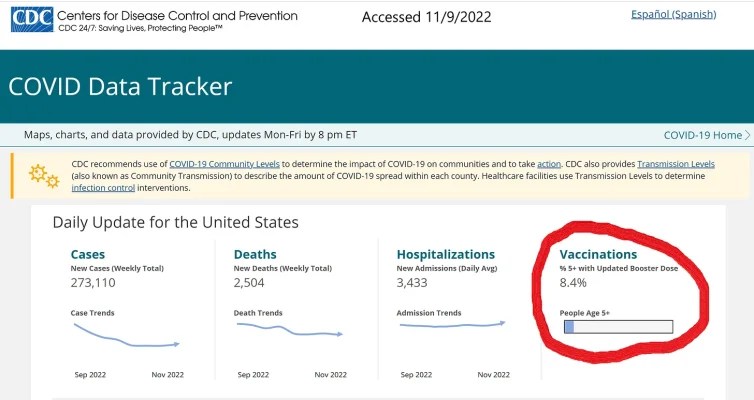
No matter how hard the internal pressure is at the CDC to get a “needle in every arm,” what would be such a strong motivation for Walensky to blatantly deceive Americans with such obvious counterfactual information?
She states “COVID-19 vaccines may not prevent every infection (as apparent in her personal case), but they do provide us important protection against severe illness, hospitalization, and death…”

In order for that claim to be valid by US regulations, a COVID-19 vaccine would need to reduce the risk of adjudicated COVID-19 hospitalization and death as a primary endpoint in a prospective, double blind, randomized, placebo-controlled trial. The benefit would need to be meaningful, e.g., ~20% relative risk reduction, and statistically significant, e.g., p<0.05. The conclusive study should have no significant threats to validity such as loss to follow-up. There has been no pivotal randomized trial, and no one can claim COVID-19 vaccines reduce hospitalization and death. The shortest section on the FDA Pfizer Fact Sheet is the “Benefits” section! This is given with the consent form and makes no claims about severity, hospitalization, and death.[ii]

She goes on to promote a two-month period between the last injection (presumably legacy mRNA) and the new bivalent vaccine. This schedule has never been tested and demonstrated to be safe in human beings. Even more shocking, the bivalent boosters which failed in animal studies to stop Omicron, have never been tested for safety or efficacy in human RCTs with clinical outcomes. In academic medicine and the pharmaceutical regulatory community, the question is WHY does Walensky cross the line into making false claims, an illegal act for fully FDA approved and marketed drugs/vaccines? Only senate or congressional hearings with direct questions will get the truth out of her.
Here are some possibilities: 1) she is following orders from higher governmental authorities, 2) she knows the claims are false but truly believes the only way for vaccination to work is to keep everyone vaccinated on a continuous basis no matter what the costs, 3) she is in a form of a trance or psychological state driven by fear in herself and for humanity where COVID-19 vaccination has become like a talisman with special powers and cannot be challenged. Indeed, Walensky has never comprehensively discussed safety of COVID-19 vaccination, and she has not disclosed who should NOT take a COVID-19 vaccine. So, the next time someone in your circles claims you or your loved one should take a COVID-19 vaccine to be “safe” or “protected” from serious outcomes, ask them to take a look at the consent fact sheet and read the tiny benefit section.
[i] CDC COVID Tracker, Accessed November 9, 2022
[ii] VACCINE INFORMATION FACT SHEET FOR RECIPIENTS AND CAREGIVERS ABOUT COMIRNATY (COVID-19 VACCINE, mRNA), THE PFIZER-BIONTECH COVID-19 VACCINE, AND THE PFIZER-BIONTECH COVID-19 VACCINE, BIVALENT (ORIGINAL AND OMICRON BA.4/BA.5) TO PREVENT CORONAVIRUS DISEASE 2019 (COVID-19) FOR USE IN INDIVIDUALS 12 YEARS OF AGE AND OLDER, August 22, 2022
First RSV Emergency Declared as Pfizer and GSK Race to Get Vaccines Approved

By Michael Nevradakis, Ph.D. | The Defender | November 8, 2022
Southern California’s Orange County Health Department this month declared a local health emergency over concerns around the rising number of pediatric cases of Respiratory Syncytial Virus (RSV).
County officials also declared a Proclamation of Local Emergency, allowing them to access state and federal resources in response to the spread of RSV.
The news came amid media warnings of a looming “tripledemic” of RSV, influenza and COVID-19 and news that Pfizer and GlaxoSmithKline (GSK) are close to securing regulatory approval for their RSV vaccine candidates — including Pfizer’s RSV vaccine for pregnant women.
RSV was first identified in 1956, and frequently affects children, with a majority of childhood cases occurring before age 2. For most children, symptoms are similar to those of the common cold, according to the Centers for Disease Control and Prevention (CDC).
It can, however, cause serious symptoms in the very young and the elderly, although childhood deaths are infrequent, according to CDC data.
According to California attorney Rita Barnett-Rose, there’s no evidence to support claims that Orange County hospitals are overextended, or to justify a state of emergency.
In an interview with The Defender, Barnett-Rose drew parallels between Orange County’s emergency declaration for RSV and other state, local and federal emergency declarations for COVID-19:
“One of the other alarming things that happened with COVID is when [Gov. Gavin] Newsom declared the state of emergency in COVID. He also waived the 30 and 60-day review periods for all local governing boards.
“So, yeah, so that’s what everyone is concerned about, this perpetual state of emergency.
“And the other thing that it triggers is it asks, once they declare a state of emergency, aside from getting the funding, it also triggers a request to Governor Newsom to declare a statewide state of emergency and then also to have Newsom ask President Biden to declare a national state of emergency.”
That could lead to Emergency Use Authorization (EUA) of RSV vaccines, according to Barnett-Rose, who told The Defender there may be an avenue to challenge the legality of the latest Orange County emergency declaration.
Is pharma using the COVID playbook to push RSV vaccines?
Dr. Regina Chinsio-Kwong, Orange County’s health officer, said in a press release county officials issued the declaration due to “rapidly spreading virus infections causing record numbers of pediatric hospitalizations and daily emergency room visits.”
The declaration will allow the county to access state and federal resources and to allow non-pediatric hospitals to offer beds to sick children, Chinsio-Kwong said.
Children’s Health Defense (CHD) California Chapter notes that this declaration was unanimously ratified “over the objections by members of the public who showed up to speak against the declarations.”
Dr. Melaine Patterson, chief nursing officer for Children’s Health Orange County, said area hospitals are seeing an “unprecedented” volume of children visiting their emergency rooms — approximately 400 per day, with wait times of “four to 12 hours.”
She also said that, as of Nov. 1, there were 285 patients in her hospital, compared to 188 on that date last year, adding that 11 of those current patients were placed in ICU as a result of RSV infections. RSV cases also are on the rise nationally.
Chinsio-Kwong advised the public to remain “up to date with other vaccinations such as flu and COVID-19” to “reduce the burden on hospitals this fall and winter.”
“Our best shot at protecting ourselves and our children from respiratory illnesses continues to be the same things we practiced throughout the pandemic including the use of masks when indoors around others and staying home when you are sick,” Chinsio-Kwong said.
However, Barnett-Rose said hospitals in Orange County may be overextended not due to an unusually high number of admissions, but due to unvaccinated staff having been let go.
She told The Defender :
“I do think that has a big role in it, and a lot of people pointed that out during the hearings and public comments were made about that.
“They were trying to claim … there were not enough pediatric experts or pediatric-trained doctors and medical professionals, so they needed to go outside of the county. And I do think a big part of that is that they did let go of many pediatric nurses and pediatric physicians that refused to take the vaccines. So I do think that this is a crisis of their own making … if there is even a crisis.”
San Diego County also issued a warning to its residents Nov. 4 over rising RSV cases but stopped short of declaring an emergency.
CHD California questioned why Orange County would declare a “Local Health Emergency” now — even though local COVID-19 states of emergency haven’t been lifted.
Despite claims that the purpose of these new declarations is exclusively meant to help county hospitals, CHD California said, “the language of the emergency Resolutions says something else entirely”:
“Both the Resolution to ratify the Local Health Emergency under Health & Safety Code section 101080 and the Proclamation of a Local Emergency under Government Code section 8630 declare the need for these local emergencies not only based on the asserted need to handle allegedly rising cases of RSV — but also because of other unnamed ‘other respiratory illnesses’ that were not discussed during the special meeting or otherwise disclosed to the public.”
Barnett-Rose provided insights into the legal meaning underlying these declarations. She told The Defender :
“There’s a local health emergency, which is declared by the public health officer as opposed to the [county] board … and that is when the health officer says … ‘I’ve been talking to the hospitals and we’ve done some assessments and there’s an increasing rate of respiratory illnesses and the children’s hospitals, and so, because of this, I am asking to declare a local health emergency.’ …
“But her authority to declare a local health emergency only lasts for seven days unless it’s ratified by our board of supervisors. And so, on Nov. 2, our board ratified that, which means now it’s in place and it needs to be renewed or looked at every 30 days, unless Governor Newsom waives that condition.”
CHD California argued that the “overly broad language used in these emergency declarations should be deeply concerning to anyone wary of a repeat of the “public health” measures ordered under COVID-19,” noting that adding the vague statement referring to “other respiratory viruses” creates “plenty of room for further abuse.”
Barnett-Rose told The Defender that, during the Nov. 2 meeting, Chinsio-Kwong said, “No restrictions are currently [emphasis added] in place,” a statement that “caused … a little bit of an uproar during the hearing because of her wording, which suggests that indeed they may end up rolling out mask mandates or some other mandates.”
Under this type of “slippery language,” argued CHD California, even the common cold could be used to issue an emergency declaration.
Barnett-Rose agreed:
“How do you measure that? How do you dispute it? How do you examine it? How do you end it?
“If you’re going by one infectious disease, at least you can try to find some data on hospitalizations or cases or deaths or ICU beds. But when it’s everything, it can still include COVID, flu, cold, COPD, a whole bunch of things that would qualify as respiratory illnesses.”
Barnett-Rose said that attempts will be made to legally challenge these declarations as “overbroad,” noting, however, that while case law precedent exists to challenge overbroad legislation, there is no such precedent in place for states of emergency.
Barnett-Rose she’s looking into whether there’s some way to litigate against these broad states of emergency.
When statutes are overbroad, she said, sometimes you can challenge them for being overley broad or too vague, but she’s not sure if there’s a similar precedent for challenging an overly broad state of emergency.
Declaring a local state of emergency at the county level could trigger a chain of events leading all the way to a national declaration of emergency, according to CHD California:
“By ratifying and/or declaring these local emergencies, the Board has now triggered an official request to Governor Newsom that he also declare a state-wide state of emergency on the same overly broad basis — and to ask the President of the United States to declare a national state of emergency.”
“A nationally declared state of emergency may trigger all of the same measures that have already deeply divided our country: masks on airplanes, business and school closures, and coercive school and employee mandates for experimental ‘vaccines’ offered as the ‘only solution’ back to Freedom,” CHD California argued.
Barnett-Rose said the emergency declaration in Orange County may be tied to the fact that there are multiple RSV vaccines already in the pipeline:
“The reason this is becoming really huge news is because this is what happened with the COVID state of emergency, too, it kind of went like that in dominoes.
“Once Biden declares a national state of emergency, then that triggers all of the emergency use authorizations that allowed the so-called vaccines for COVID. And I’m sure you already know that there’s vaccines in the works now for RSV that they’re floating out there in the news as well.”
Recounting events that occurred in relation to COVID-19, Barnett-Rose told The Defender that Orange County and some other counties in California declared a state of emergency, “then it went to the state, then it went national, and then, of course, once there’s a national emergency, you can go into Iowa.”
“So I do think that this is very suspicious timing, the articles that we are seeing in the news about being close to this RSV vaccine,” Barnett-Rose said. “And so, I do think that they’re trying to repeat the same playbook.”
Up to 30 RSV vaccine candidates already in pipeline
Pharmaceutical industry publication FiercePharma reported that Pfizer and GSK “moved closer to regulatory approvals” in the past week, and “could each see the first-ever approvals for an RSV vaccine in 2023.”
GSK’s candidate will be reviewed May 3, 2023, while Pfizer is “eyeing an approval filing by year-end.”
In all, up to 30 RSV candidate vaccines have been identified by the National Institutes of Health (NIH).
GSK has secured priority review status for its RSV vaccine following the submission of data from its AReSVi-006 phase 3 trial. The candidate vaccine exclusively targets adults 60 and older, and the data reportedly “showed high overall vaccine efficacy against RSV lower respiratory disease” at a rate of 82.6%, Fierce Biotech reported.
GSK initially intended to develop an RSV vaccine for older adults and for infants, but plans for the latter were shelved due to a “safety concern.” Nevertheless, GSK CEO Emma Walmsley in a call last week with investors described GSK’s new vaccine as “a very significant scientific achievement.”
Previous efforts to develop an RSV vaccine have failed because they “had a persistent tendency to cause worse disease,” due to “a phenomenon known as antibody-dependent enhancement (ADE).”
Dr. Ruth Karron, a pediatrician and professor of international health at the Johns Hopkins Bloomberg School of Public Health, said, “The difference this year is the general public for the first time is probably eagerly awaiting an RSV vaccine, because they’re seeing firsthand just how much of a problem RSV can be,” in a statement drawing a clear connection with the reported increase in RSV cases this year.
Pfizer announced Nov. 1 that its own candidate RSV vaccine wrapped up its phase 3 trial for efficacy early. Unlike GSK’s candidate vaccine, Pfizer’s vaccine targets pregnant women. The vaccine is designed to be administered early in the third trimester with the intent that the vaccine-induced antibodies be passed from the mother to her newborn.
Pfizer, in its Nov. 1 announcement, claimed that its bivalent RSV prefusion vaccine candidate RSVpreF, also known as PF-06928316, delivered “broadly positive” results — namely, a significant reduction in the rate of respiratory illness in newborns and their mothers.
Pfizer claimed 81.8% efficacy against severe cases of RSV for babies up to three months, and 69.4% efficacy after six months.
Pfizer’s MATISSE (MATernal Immunization Study for Safety and Efficacy) trial involved 7,400 pregnant women and their newborns, tracking the infants for one year following birth, and some for two years. It was conducted in 18 countries beginning in June 2020.
Pfizer’s vaccine trial did not deliver statistically significant results regarding the prevention of infant medical visits caused by RSV, including for non-severe cases.
Nevertheless, Pfizer said there are “no major safety concerns” with its product, adding:
“At the recommendation of the DMC [Data Monitoring Committee], and in consultation with the U.S. Food and Drug Administration (FDA), Pfizer has stopped enrollment in the study.
“Based on these positive results Pfizer plans to submit a Biologics License Application (BLA) to the FDA by the end of 2022 for the vaccine candidate followed by other regulatory authorities in the coming months.”
Pfizer’s phase 3 trial data has not yet been vetted by independent experts, and has not been peer-reviewed or published.
On March 2, 2022, Pfizer’s candidate vaccine received a Breakthrough Therapy Designation from the FDA, while previously, in November 2018, the FDA granted it Fast-Track status, according to the Pfizer release.
“Pfizer’s investigational RSV vaccine candidate builds on foundational basic science discoveries including those made at the National Institutes of Health (NIH),” the vaccine maker said in its press release.
The NIH research in question also was “key to the hugely successful COVID-19 vaccines,” according to ABC 7 Los Angeles.
Others looking to develop an RSV vaccine include Moderna and AstraZeneca and Sanofi, in a joint initiative. Moderna received fast-track designation from the FDA on Aug. 3, 2021, for its mRNA-1345 RSV vaccine for older adults, while AstraZeneca and Sanofi are developing a viral vector RSV vaccine by the name of “nirsevimab.”
An August 2021 article in The Defender predicted that RSV would represent the “new frontier for vaccine development,” as pharmaceutical companies would be “lured by the prospect of a large untapped global RSV vaccine market,” leading to a vaccine development “gold rush.”
Media tout benefits, ignore safety concerns
Online news portal Vox described the development of new RSV vaccines as “very, very good news” in a recent article.
Coupled with media coverage about “rising” RSV cases nationwide, it appears the stage is being set to create an emergency in the public consciousness, which could lead to EUAs being granted to the new vaccines and a rush to get the public vaccinated.
Blogger James Roguski, however, called into question the results of the Pfizer phase 3 trial, raising many safety concerns that are indicated in the company’s own data but were downplayed by Pfizer in its public proclamations. In a recent post, he wrote:
“In the Phase II study, researchers found that women who received RSVpreF vaccine containing aluminum hydroxide had a higher incidence of local reactions than those who received RSVpreF vaccine without aluminum hydroxide.
“It seems like 1 of the 117 infants in the placebo group suffered fetal death and 6 infants in the ‘vaccinated’ group are unaccounted for.”
Roguski also highlighted the many adverse events that were recorded for both infants and pregnant mothers who participated in the study, none of which were recorded for the placebo group.
For infants, some of these adverse events included acute respiratory failure, bronchiolitis, cardiac murmur, chordee (bent penis), conjunctival hemorrhage, hypoglycemia, jaundice, low birth weight, neonatal hypoxia, neonatal respiratory failure, seizure, sepsis, upper respiratory tract infection and vascular malformation.
Pregnant women, in turn, experienced adverse events including fetal growth restriction, fetal tachycardia, gestational diabetes, nonreassuring fetal heart rate pattern, premature labor, premature separation of placenta, vaginal hemorrhage and thrombocytopenia.
For some, these safety concerns are conjuring up memories of previously failed attempts to develop an RSV vaccine.
A vaccine tested in 1966 led to the deaths of two toddlers as a result of “enhanced disease symptoms,” while many infants “suffered worse symptoms than usual, and needed to be hospitalized.”
As previously reported by The Defender, RSV itself originated in monkeys housed in a Maryland facility where they were used to conduct polio vaccine research. Remarking on this and the connection to RSV vaccine development today, Brian Hooker, CHD’s chief scientific officer, told The Defender, “It is incredible that the vaccine industry can create a disease — RSV from the polio vaccine — and then create another vaccine to ‘prevent’ that disease. Talk about a business proposition!”
Michael Nevradakis, Ph.D., based in Athens, Greece, is a senior reporter for The Defender and part of the rotation of hosts for CHD.TV’s “Good Morning CHD.”
This article was originally published by The Defender — Children’s Health Defense’s News & Views Website under Creative Commons license CC BY-NC-ND 4.0. Please consider subscribing to The Defender or donating to Children’s Health Defense.
Trump alleges election fraud in Arizona
RT | November 12, 2022
Former US President Donald Trump claimed on Friday that Republican candidate Blake Masters lost his bid for the Senate due to “voter fraud” in Arizona. Masters was preliminarily declared to have lost to Democrat Mark Kelly on Friday, after an election marred by malfunctioning machines and slow counting of votes.
“They’re at it again,” Trump wrote on his Truth Social platform. “Voting machines in large numbers didn’t work, but only in Republican districts. People were forced to wait in line for hours, then got exhausted… and left the voting lines by the thousands.
“This is a scam and voter fraud, no different from stuffing the ballot boxes,” he continued, referencing his own allegations that pro-Democrat poll workers engaged in ballot harvesting to deliver Arizona to President Joe Biden in 2020.
“They stole the election from Blake Masters,” he concluded, demanding that officials in the state “do election over again!”
Kelly was declared the winner by multiple US media outlets on Friday night, with the Democrat incumbent leading Masters by 52% to 46%. Masters has not conceded, however, and 13% of the vote remains to be counted. Should Kelly prevail or Masters accept defeat, control of the US Senate will hinge on Nevada, where Republican Adam Laxalt is leading by less than a percentage point; and Georgia, where a runoff election is set for next month. Republicans need both seats to gain a majority in the upper chamber.
Maricopa County is the largest and most populous county in Arizona, encompassing the cities of Phoenix, Scottsdale, and Tempe. Republicans began sounding the alarm when one in five voting machines in more than 200 polling stations throughout the county broke down on Tuesday. With long queues forming, Masters and a number of other Republican candidates filed an emergency suit to extend voting hours, which was rejected.
Republican suspicions of fraud were heightened when the counting of ballots slowed to a trickle after election day. Although officials in Maricopa County say that tabulating these ballots can take a week or longer, the state of Florida manages to count almost all of its ballots in a single night, despite having four times the population of Maricopa County.
Yemen and KSA inch forward with ceasefire talks despite ‘deliberate obstruction’ by US
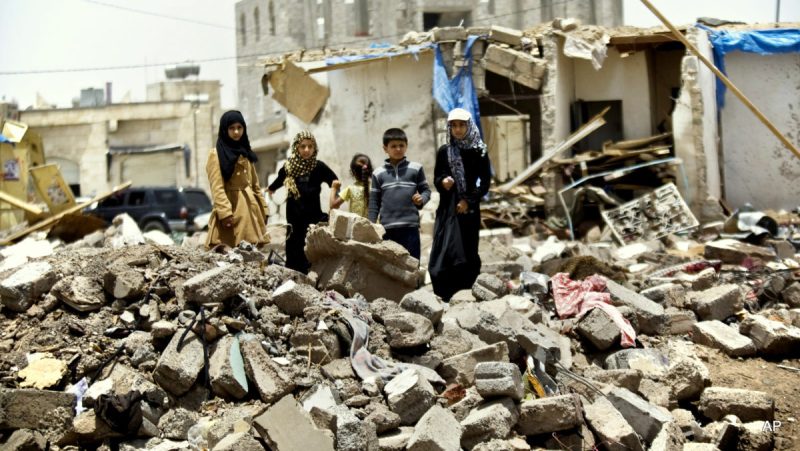
Photo Credit: AP Photo/Hani Mohammed
The Cradle | November 12, 2022
Talks between Yemeni and Saudi delegations in Oman have continued “uninterrupted” since the end of the UN-brokered ceasefire on 2 October, according to sources in the know that spoke with Lebanese daily Al Akhbar.
The report claims the Saudi delegation has shown “remarkable flexibility” in several of the outstanding issues, most notably offering to secure funding for the payment of state employees’ salaries.
They have also shown openness to lift road blockades and to allow flights from Sanaa International Airport to reach more destinations than the two currently allowed: Jordan and Egypt.
Nonetheless, issues still remain, as Riyadh reportedly wants to publicly label these measures as “helping the brothers in Yemen,” not as compensation for seven years of war.
Yemeni officials allegedly shot down this idea, as it would misrepresent Riyadh’s role in ravaging Yemen and pushing it to the brink of famine. Moreover, they have also rejected an offer for the head of Yemen’s Supreme Political Council, Mahdi al-Mashat, to lead an official delegation to the Saudi capital.
Earlier this month, The Washington Institute published a report based on a visit to the kingdom by Executive Director Robert Satloff and David Schenker, in which they assert that “Saudi Arabia clearly wants out of the [Yemen] conflict today.”
However, the behind-the-scenes progress to achieve this goal comes despite increased efforts by the Saudi-led coalition, Israel, the US, and the UK to consolidate their military presence in southern Yemen and on the country’s islands.
Earlier this week, Mashat warned that the US role in the ceasefire talks “is malicious and dangerous.”
“The armistice negotiations had previously reached a level of good understanding, but the US envoy, Tim Linderking, deliberately sabotaged them during his most recent tour of the region,” the head of Yemen’s Supreme Political Council said on 7 November.
“The US is trying to impede any sincere efforts to achieve sustainable peace in Yemen,” Yemen’s Ansarallah resistance group warned in a statement earlier this month.
According to the sources who spoke with Al Akhbar, the growing rift between Washington and Riyadh has spilled over onto their cooperation in Yemen, as the US now favors “interim solutions” rather than a comprehensive end to the war in order to maintain a “playing card” to use against Saudi leaders.
US and UK troops train to ‘pacify Russian civilians’
RT | November 12, 2022
US and UK military forces have held a joint exercise to practice interoperability and test their latest gadgets and combat techniques on terrain similar to the “Ukrainian steppe,” reportedly including war-gaming on how they would “pacify” mobs of angry Russian-speaking civilians.
The ongoing drills are being held in California’s Mojave Desert as part of the Pentagon’s “Project Convergence”, which was expanded this year to include participation by allies Australia, Canada, New Zealand and the UK.
The troops, including an elite British infantry regiment, practiced “lessons learned” from the Russia-Ukraine conflict while training on open desert landscapes deemed “similar to the flat terrain of the Ukrainian steppe,” the UK’s Times newspaper said.
The drills took place at Fort Irwin, a sprawling US Army base that includes realistic-looking mock villages built with the help of Hollywood set designers. In years past, Arabic and Afghan speakers were hired and brought in from the Los Angeles area to play the part of civilians. This time around, with the Russia-Ukraine conflict raging in Eastern Europe, most of the civilians were played by Russian speakers.
“The fake civilians even have their own social media networks – “Fakebook” and “Twatter” – on which they whip up an unruly mob by reporting any examples of US troops behaving poorly,” the Times said. “The soldiers must then pacify the crowds.”
The exercise marked the first time that members of the UK’s new Ranger Regiment deployed alongside the US 75th Ranger Regiment, according to a UK government statement. It allowed troops to test advanced technology – such as artificial intelligence, robotics and new drones – while practicing information-sharing procedures with their allies.
For instance, swarms of drones identified targets and British rocket launchers fired at enemy positions spotted by US F-35 fighter jets, the Times said. UK defense procurement minister Alex Chalk said the exercise demonstrated the progress that the British Army is making as a “more lethal, agile and expeditionary force, through key collaboration with our longstanding international allies and partners.”
Russia isn’t alone in drawing the attention of Western military planners. The Pentagon has identified China as the top threat to US national security. An earlier stage of Project Convergence simulated a conflict breaking out on a Pacific island.
Featured Video

Why Hamas Really Attacked Israel on Oct. 7
or go to
Aletho News Archives – Video-Images
From the Archives
Confronting the Threat of Ethnic Bioweapons
By Tony Cartalucci – New Eastern Outlook – 29.11.2017
The United States Air Force’s 59th Medical Wing’s molecular biology branch recently was revealed to have been collecting specifically Russian RNA and synovial (connective) tissue samples, prompting fears in Russia of a possible US directed ethnic-specific bioweapons program. … continue
Blog Roll
 Aletho News
- Why Yemen Is Bombing Saudi Arabia’s Airports: The War Behind the Headlines
- Sally Rooney’s books pulled from UK over support for Palestine Action
- Bombs for Tel Aviv, Promises for Riyadh
- Israeli ad agency conducted vast global espionage campaign using online ads: Report
- Oct. 7 Forever Marks The Big Reveal: ‘We See You, Israel, We Revile You, We Reject You!’
- Meet the US generals and admirals advancing Israeli policy
- Israel’s Straw Widow Protocol: The Kill Zones Where Civilians Were Labelled ‘Terrorists’
- Leading Israeli Think Tank Publishes Psychotic Israeli ‘National Security’ Doctrine
- Are the United States and Israel in Decline-and-Fall Mode?
- Why Hamas Really Attacked Israel on Oct. 7
- If Americans Knew
- Israeli firm used online ads to run vast spy operation, researchers say
- No, the world zionist movement is not an antisemitic conspiracy theory
- Hundreds of IDF investigations into killings still have no public outcome, BBC Verify finds
- After Ashley Moody Epstein Probe, Donors Linked to Him Poured Money Into her Senate Campaign
- Worried about Russian meddling in UK politics? Wait till you see what Israel is up to
- Israeli settlers attack West Bank center for disabled children, church leader calls for int’l action
- Pulling Out Teeth Just to Live: How Israel Has Devastated Dental Care in Gaza
- Gaza’s “ceasefire” death toll passes 1,500 – Daily Update
- Activists Abused By Israel Return to New Freedom Flotilla Mission
- 60 Minutes won’t tell the full truth about Israeli settler violence
- No Tricks Zone
- New Study Suggests Large Regions Of The Pacific Ocean Have Been Cooling For The Last 80 Years
- Germany’s Green Energy Debacle: High Energy Costs Force Kahla Porzellan to Close After 182 Years!
- New Study: 50 Years Of The Most Aggressive ‘Net Zero’ Policies Can Only Affect The Global Climate By 0.03°C
- US September “Heat” Was No Record…Many Records Set Decades Ago
- Latest European Green Energy Debacle; Portugal’s Largest Flagship Solar Park Insolvent!
- Green Energy Debacle: German Expert Professor Fritz Vahrenholt Warns Of Severe Economic And Social Consequences
- Two More Paleo Reconstructions Affirm Meters-Higher Sea Levels Across Ireland, Brazil 7000-6000 Years Ago
- New Study: Earth And Venus Surface Warmth Largely Explained By Convection And Lapse Rate, Not CO2 Or Radiation
- 2025 Nature Paper Claiming Worsening Global Drought Gets RETRACTED …Heavily Flawed
- New Study: ‘Global Drought Shows No Detectable Recent Acceleration Under Climate Warming’

