Moscow demands answers on Nord Stream blasts
Samizdat | October 13, 2022
Russia will not recognize the results of the ongoing investigation into the explosions at the Nord Stream 1 and Nord Stream 2 gas pipelines in late September unless its experts are allowed to take part in the probe, Moscow has said. Russia’s foreign ministry revealed on Thursday it had summoned the representatives of Germany, Denmark and Sweden to convey its “bewilderment” over a lack of official reaction to a request for cooperation sent earlier this month by Russian Prime Minister Mikhail Mishustin.
In its press statement, the ministry noted that while Russian authorities and the country’s energy giant, Gazprom, have still not been granted access to the investigation, reports have been appearing which suggest that Berlin, Copenhagen and Stockholm have been far more accommodating to similar requests made by other nations, including the US.
Russian diplomats emphasized that if its calls for cooperation are ignored, Moscow will assume that the three European countries “have something to hide or [that] they are covering up the perpetrators of these terrorist attacks.”
“Russia will, of course, not recognize any ‘pseudo-results’ of such an investigation, unless Russian experts take part in it,” the statement read.
The warning comes after Swedish Prime Minister Magdalena Andersson announced on Monday that Stockholm would not share with Moscow the results of its investigation into the explosions that severely damaged the two conduits created to pump gas from Russia to Europe.
“In Sweden, our preliminary investigations are confidential, and that, of course, also applies in this case,” she explained.
The premier added, however, that Russia may conduct its own probe at the site if it so wishes.
Meanwhile, Swedish authorities have said they’d found evidence that points to sabotage.
Also on Monday, Russian President Vladimir Putin hinted that despite the denial of access to the probe, “we all know well who the ultimate beneficiary of this crime is.” Earlier, he had publicly laid the blame for the attack at the doorstep of the “Anglo-Saxons,” a Russian colloquialism for the US-UK bond.
Commenting on the blasts, US Secretary of State Antony Blinken had described them as a “tremendous opportunity” for Europe “to once and for all remove the dependence on Russian energy.”
The Nord Stream 1 and 2 pipelines were rendered inoperable on September 26 following a series of powerful underwater explosions off the Danish island of Bornholm.
Democrats block resolution calling for Biden admin to turn over docs related to Big Tech pressure
By Dan Frieth | Reclaim The Net | October 13, 2022
House Energy and Commerce Committee member Rep. Buddy Carter (R-GA) proposed a resolution to ask The White House to submit documents on its efforts to coerce Big Telecom companies to censor certain media organizations and the pressure on the FCC to regulate Big Tech. The resolution was backed by ranking member Rep. Cathy McMorris Rodgers (R-WA).
We obtained a copy of the resolution for you here.
The resolution states: “This resolution requests from the President certain information and documents that concern regulating the content of multichannel video programming distributors (e.g., cable operators), broadcast stations, and video streaming services. The resolution also requests information or documents in which the President asks the Federal Communications Commission to take action to regulate Big Tech.”
The resolution came after telecoms like AT&T’s DirecTV blocked One America News Network (OAN) after pressure from Democrats on the committee, which has oversight over tech companies and telecoms, voted against the resolution, Breitbart reported.
Following the vote, Rep. Carter blasted Democrat’s, accusing them of trying to hide the truth about the Biden administration’s censorship efforts.
“Unfortunately, the left is waging a war on our right to free speech,” said Rep. Carter. “Every single committee Democrat voted against my commonsense resolution to require the FCC be transparent about politically-motivated censorship.
“The Biden Administration and Washington Democrats are keeping information out of the hands of the American people – information we deserve to have. What do they have against transparency? What do they have to hide? Free speech is a First Amendment right for a reason. Without it, we don’t have a democracy.”
THERE IS NO SINGLE WAR IN UKRAINE AND NATO IS IN TROUBLE
By Larry Johnson | A Son Of The New American Revolution | October 11, 2022
Not to beat a dead horse, but most of the world has a delusional image in their head of the war in Ukraine. As I have written previously, much of the fault lies with Hollywood, which through a plethora of movies has conditioned the masses to think of war as the conquest of critical territory. But that is a misleading image when it comes to Ukraine. Yes, there are strategically important pieces of territory that must be captured or defended, but there also are vast swaths of plains (we call them prairies here in the United States) that are tactically difficult to control and, if you succeed in capturing an area of land, you create a problem of how to defend it.
Russia has a decisive advantage over Ukraine when it comes to battling for this territory, even though it ceded some of it a few weeks ago to advancing Ukrainian troops. Why? Because Russia’s air force is still intact and can be used to attack massed Ukrainian units. Ukraine’s air capability has been eviscerated. Russia also enjoys a lopsided advantage in tanks.
At the beginning of its full-scale invasion in Feb., Russia had around 3,330 operational tanks (2,840 with the ground forces, 330 with its naval infantry, and 160 with its airborne forces), according to the Military Balance 2021 database. . . .
However, Russia still has some 2,000 battle-ready tanks at hand, as well as an enormous amount in storage.
The Military Balance 2021 database says Russian storage facilities have around 10,200 tanks, including various T-72s, 3,000 T-80s, and 200 T-90s.
Tank battles on rolling plains is great grist for a Hollywood blockbuster, but the real peril for Ukraine has been on display over the last two days–Russia’s hypersonic missiles, cruise missiles and air launched rockets mangling power nodes and military headquarters throughout Ukraine. The Russian strikes in the last two days significantly degraded Ukraine’s ability to supply electricity and critical heat to its major cities. The attacks also are disrupting Ukraine’s cell phone network and its ability to move troops and equipment from the west to the frontlines in the east.
Ukraine does not have a comparable capability to counter the Russian attacks. Moreover, the Russian missile barrage has highlighted the weakness, if not absence, of Ukraine’s anti-missile defense system. It is neither a mistake nor a coincidence that Russia’s strikes in major Ukrainian cities–more than 100 missiles– caused very few human casualties, especially on the civilian side of the ledger. Despite Ukrainian claims that Russia’s strikes killed civilians, the evidence suggests otherwise–Ukraine’s own anti-missile system failed to intercept the Russian targets and then fell to earth and hit apartments and schools.
What is the United States and NATO going to do? Immediately deploy the Iron Dome anti-missile system? Unfortunately, these Western anti-missile systems are not designed to defeat the missiles Russia is launching. Then there is the logistics problem–i.e., getting those systems deployed and training personnel to operate them. This will take weeks, if not months. And Ukraine does not have the luxury of time in this regard. Making matters worse, the United States and NATO do not have the reserves to quickly resupply Ukraine:
The United States will soon be unable to supply Ukraine, as it has up to now, with the sophisticated equipment essential for its defense against Russia as its reserves are reaching their limits, especially in terms of ammunition. . . .
But US stockpiles of certain equipment are “reaching the minimum levels necessary for war and training plans” and getting weapons stockpiles back to pre-invasion levels could take years, Mark Cancian wrote in a recent analysis. of the Center for Strategic and International Studies.
Washington is “learning lessons” from the conflict about ammunition needs in a very powerful war, and that it is “much larger” than expected, said a US military official who requested anonymity.
Then there is the nightmare scenario for Ukraine and NATO of Russia invoking the Collective Security Treaty Organization (CSTO) and Russia asking Belarus to join the fray. Russian and Belarusian troops already are gathering on Ukraine’s northern border. Whether this is a bluff by Russia or genuine preparation for opening a new front in the north, the massing of forces requires Ukraine to deploy already depleted forces to the northern border. This will weaken Ukraine’s ability to hold off a Russian offensive in Kherson and Zaporhyzhia.
I believe that the events during the next five weeks will create a crisis within NATO and the United States. If Russia seizes the initiative and moves in force against Ukrainian units, NATO will not be in a position to rescue Ukraine from defeat on the battlefield. Any further intervention by NATO will make it, in the eyes of the Russians, a legitimate military target.
Compounding the military challenges confronting the United States and NATO, there are the economic and political headwinds. Joe Biden is likely to lose control of the House of Representatives and the Senate. If this happens, he will no longer have a congressional ally eager to keep shoveling money and weapons into Ukraine. The economic conditions throughout Europe of inflation and shuttering businesses will fuel more domestic unrest and diminish enthusiasm for keeping Ukraine afloat.
When you take all of these factors into consideration, the conclusion is clear–Russia enjoys a strategic and tactical initiative that will be difficult to surmount. Conversely, NATO is in trouble.
Biden sets condition for meeting with Putin at G20 summit
Samizdat – October 12, 2022
US President Joe Biden says he has “no intention” of meeting with Vladimir Putin at the upcoming G20 summit in Bali to talk about Ukraine, unless the Russian leader approached him first to discuss issues like the release of WNBA star Brittney Griner who is currently imprisoned in Russia.
Speaking to CNN’s Jake Tapper on Tuesday, Biden discussed the various issues plaguing Russian-US relations and condemned Putin’s alleged threat to use nuclear weapons in the military conflict with Ukraine.
When asked if he was willing to meet with the Russian leader at the G20 summit in November, Biden said: “Look, I have no intention of meeting with him. But for example, if he came to me at the G20 and said ‘I want to talk about the release of Griner,’ I’d meet with him. I mean, it would depend.”
Brittney Griner is a Women’s National Basketball Association star and Olympic gold medalist who was detained at a Moscow airport in February for possessing vape cartridges filled with cannabis oil. Griner pleaded guilty to the charges of drug possession and was sentenced to nine years in prison by a Russian court on August 4.
Biden went on to state that neither he, “nor is anyone else” prepared to negotiate with Russia about anything related to Ukraine and so a meeting between the two leaders would depend on “specifically what [Putin] wanted to talk about.”
“He’s acted brutally. I think he’s committed war crimes. And so, I don’t see any rationale to meet with him now,” the US leader said.
Biden and Putin have not spoken to each other directly since before Russia launched its military operation in Ukraine in late February. Russian Foreign Minister Sergey Lavrov earlier said that the Kremlin would consider such a meeting, but has yet to receive a proposal from Washington.
US lies when talking about peace proposals – Russian FM
By Lucas Leiroz | October 12, 2022
During a press conference on October 11, Russian foreign minister Sergey Lavrov severely criticized the recent American speech insisting that Moscow had rejected peace proposals allegedly offered by the West. The minister stated that no serious proposal was made by Washington, therefore there was no Russian unwillingness to negotiate peace.
Lavrov claimed that the Americans indeed made some calls but did not show any concrete peace proposals during the talks. According to him, not even these calls were ignored, having Moscow responded, showing willingness to continue the dialogue in order to seek the formulation of a specific plan that benefits both sides. However, the West has shown itself to be uninterested in initiating conversations in this direction.
“This is a lie [that Russia refuses to negotiate]. We did not receive any serious proposals to enter into contact. There were some not very serious calls, to which we also did not respond negatively, but offered to formulate specific proposals, with which some people want to contact us through indirect contacts. And in this case, we did not receive more specific explanations from anyone”, he said.
The day before Lavrov’s interview, US National Security Council spokesman John Kirby had publicly reiterated that Moscow was not responding to US calls for negotiations. Earlier, some US officials and journalists had already said that there would be no further dialogue as the Russian government was not interested in any proposals. But Russia does not endorse this narrative and claims that no US proposal has been presented.
Journalists also asked Lavrov for his opinion on the possibility of resuming peace talks with Turkey as a mediator, given the recent rumors that Ankara is planning a new negotiation for the conflict. According to Lavrov, no Russian official has yet received any information about such an initiative, but he made clear the Russian willingness to negotiate if the proposals seem reasonable. He stated that the meeting between Putin and Erdogan in Astana would be a good opportunity to clarify this topic.
Regarding the Ukrainian decision to not continue any form of dialogue with Russia and veto peace talks, Lavrov stressed that it does not seem to be something really resolute. For him, Zelensky’s decisions could change at any time, depending on a series of factors, mainly his “mood”, considering the instability already demonstrated by Zelensky so far, and the orders he will receive from the West in the near future. For Lavrov, if the Western powers order Zelensky to start peace talks, he will simply accept and ask to talk to Moscow.
“I do not rule out that he, as he forbade himself [to talk with Russia], will then forget about it, depending on his mood when he gets up in the morning and what he does. Well, or he will receive an order from Washington, from London – he will say ‘Yes’ and figure out how to explain all this so as not to lose face”, Lavrov said.
The veto of peace negotiations is precisely a consequence of orders received by the West, which is the side most unwilling to negotiate and which most seeks to escalate the conflict. So, if the opinion of Western leaders on the direction of peace talks eventually changes, it is actually expected that Zelensky will rethink the veto and suddenly ask to talk to Moscow.
The narrative that “Moscow does not want to negotiate” has been spread precisely in order to justify new actions in support to Kiev and Western active participation in the conflict. On many occasions, the West has made it clear that the longer the fighting lasts, the more beneficial this will be to NATO’s interests, because, given the impossibility of defeating Russia militarily, what is sought is simply to prolong the situation of security instability in the Russian strategic environment.
Since February, the Russian side has been the only one to actively pursue peace talks. To stop the special military operation, Moscow makes it clear that it only expects a list of requirements to be met. These requirements include some Russian territorial and political goals, such as the self-determination of Russian-majority regions and the demilitarization of Kiev. For Moscow, this is not an “expansionist ambition”, as the West says, but a real necessity, since present-day Ukraine is a direct threat against the Russian state.
For peace to emerge in Ukraine, the West must “authorize” Kiev to act sovereignly and negotiate with Russia proposals that meet the demands made by Moscow. There is no way to negotiate peace without fulfilling these requirements and what prevents Ukrainians from following them is precisely the order they receive from Western leaders to continue fighting in a war in which they have no chance of winning.
Lucas Leiroz is a researcher in Social Sciences at the Rural Federal University of Rio de Janeiro; geopolitical consultant.
You can follow Lucas on Telegram.
Ex-Aussie PM Calls Quad ‘Piece of Strategic Nonsense’
Samizdat – 12.10.2022
The Quad was officially launched in 2007 but suspended in 2008 after Australia pulled out of the US-led grouping over concerns expressed by China. The grouping was revived in 2017, a year after the US announced its ‘Indo-Pacific Strategy’. Beijing has labelled the Quad ‘Asian NATO’, accusing Washington of inciting tensions in the region.
Former Australian Prime Minister Paul Keating has slammed the US-led Quad grouping as “illegitimate” and a “strategic piece of nonsense,” as he advised Canberra to not be a part of the US-led efforts to “ring-fence” China.
The Quad, which comprises Australia, India, Japan and the US, says that its official goal is to maintain a “free and open Indo-Pacific region”.
“We shouldn’t be stringing together the US, Japan, India and Australia to try to contain China,” Keating, a senior party colleague of Prime Minister Anthony Albanese, said on Wednesday.
Keating argued that that Beijing’s “ambitions are in the west, not the east,” as he underlined the inroads made by the Belt and Road Initiative (BRI) in regions outside Asia. “Everywhere between Wuhan and Istanbul, in the next 30 years, will have a huge Chinese influence.”
Keating pointed out that the BRI has already financed infrastructure projects in the Baltic states as well as in former Soviet countries.
The multi-trillion-dollar BRI initiative was launched by Chinese President Xi Jinping in 2013 and strives to connect east Asia with Europe and beyond through connectivity and infrastructure projects. As of March 2022, a total of 147 countries across Asia, Africa, Europe, South America as well as North America have been members of the Beijing-backed global initiative.
Keating also reckoned that the era of US “supremacy” as the pre-eminent global power has already passed.
“This idea that the US is an exceptional power… they have God’s ear and proselytizing democracy was fine in the 20th century. The 20th century was owned by the US. The 21st century belongs to someone else,” stated Keating.
He also expressed doubts whether the US would come to the help of Taiwan if Beijing went ahead with the re-unification of the island with the mainland through military means.
Beijing has doubled down on its commitment to “reunify” Taiwan with the mainland following the visit of US House Speaker Nancy Pelosi to Taipei in August. Chinese President Xi Jinping has said that reunifying Taiwan is part of China’s goal to achieve “national rejuvenation”.
“China would see every amphibious vessel coming towards the United States, whether it is San Diego or Honolulu. They would see them and sink them,” the former Australian PM claimed, suggesting that the chances of an American “victory” in such a scenario would be “nil”.
Keating advised the Australian government not to get involved in the “geopolitical conflict” around Taiwan.
“We should be no more interested in the political system of Taiwan than Vietnam and Kazakhstan,” argued Keating.
Can Western air defense systems help Kiev regime forces?
The systems will hardly make any groundbreaking contribution, as the Kiev regime already operates longer-range SAMs.
By Drago Bosnic | October 12, 2022
In late February, the Kiev regime was in possession of one of the largest and most advanced air defense networks in Europe, if not the world. After the Soviet Union’s dismantlement in late 1991, Ukraine inherited approximately 30% of the Soviet military, the largest and the most powerful conventional military force in the world at that point. This provided the then-newly independent country with an extensive air defense network that survived decades of corruption, mismanagement and lack of proper maintenance. After the Western-backed Neo-Nazi coup in 2014, NATO provided billions of dollars’ worth of “military aid” which restored and modernized most of Ukraine’s Soviet-era air defense systems. Still, when Russia launched its special military operation, these SAM (surface-to-air missile) systems failed to produce the desired result.
The number of downed Russian military aircraft was much lower than initially expected. The Russian Aerospace Forces (VKS) launched hundreds of successful SEAD (suppression of enemy air defenses) missions, destroying most of the radars and launch sites operated by the Kiev regime forces. Hundreds of variants of older, albeit modernized systems such as the S-300, Buk, Osa, Strela-10, etc. have been destroyed, effectively leaving the Kiev regime without mid to long-range air defenses. As proven by Russia’s recent missile strikes, this has made the Neo-Nazi junta especially vulnerable and unable to protect its critical military infrastructure. In order to tackle this issue, NATO member states have been promising to deliver modern SAM systems. This includes the NASAMS (joint US-Norwegian project) and the German-built Iris-T.
During a “Face the Nation” interview with Volodymyr Zelensky that aired Sunday, Sept. 25, 2022, on CBS, the Kiev regime frontman confirmed that the NASAMS (National Advanced Surface-to-Air Missile System) has been transferred to the Neo-Nazi junta forces:
“Zelensky thanked the U.S. for the system as well as the High Mobility Artillery Rocket Systems it’s received, but added that his troops absolutely need the United States to show leadership and give Ukraine additional air defense systems it has requested.”
According to The Hill, the Biden administration approved the shipment of six missile systems in late August as part of a nearly $3 billion “lethal aid package”. NASAMS is considered a medium-range system capable of defending against drones, aircraft and cruise missiles at a range of up to 50 km.
Recently, the German Ministry of Defense announced the delivery of at least four Iris-T SL air defense systems to the Kiev regime forces. A military convoy was spotted in the vicinity of the city of Katowice in southern Poland. Reports indicate that it was heading from Germany toward Ukraine. At least three German IRIS-T SLS (the short-range version) SAM systems are seen in the photos that were taken at night. The decision to supply the system was considered back in May, but was postponed several times.
According to the German media, the final decision to send the weapons to the Kiev regime was made on October 10, immediately after Russian missile and UAV strikes hit dozens of critical military targets across Ukraine.
“Russia’s missile strikes on targets in Ukraine show the importance of the early transfer of air defense systems to Kiev,” Defense Minister Kristine Lambrecht said.
However, the timing indicates that the decision to send the IRIS-T SLS was taken much earlier. Still, the Kiev regime doesn’t seem to be content with the current version of this SAM system, as its engagement range of only 12 km is considered subpar. Recent reports indicate that the Neo-Nazi junta is trying to acquire the IRIS-T SLM version, which has an engagement range of approximately 40 km. German media think this variant could be sent to the Kiev regime forces in November if the decision is confirmed by the German MoD. Regardless of what Germany decides, the system will hardly make any groundbreaking contribution, as the Kiev regime already operates longer-range SAM systems.
The primary downsides of the IRIS-T SL are its limited range and the infrared-based guidance system which makes it vulnerable to active counter-measures like flares. They are also unlikely to provide any new capability, as the Neo-Nazi junta forces are already using mid to long-range SAM systems like the aforementioned S-300 and Buk, most of which have been neutralized. What’s more likely is that the German military is providing the air defense systems to test them in combat, particularly in a situation where the enemy has air dominance. Western powers have been sending thousands of short-range air defense systems to the Kiev regime forces even before Russia launched its counteroffensive against NATO’s crawling encroachment on its borders.
So far, NATO countries have sent thousands of MANPADS (man-portable air defense systems), but their impact doesn’t go beyond the tactical level. However, most countries of the political West lack mid to long-range SAM systems which could replace the Kiev regime’s losses, as such systems have never been the focus of the Western style of warfare which is based on the concept of air dominance. Thus, even the somewhat longer-range NASAMS, which uses more advanced radar-guided missiles, is extremely unlikely to hurt Russian forces. This is especially true when it comes to Russian missiles, both low-flying subsonic cruise missiles such as the now-legendary “Kalibr” and the high-flying hypersonic missiles like the “Iskander” or “Kinzhal”. The latter is capable of speeds in excess of Mach 12 (approximately 4 km per second), making it virtually impossible to intercept by any means at NATO’s disposal.
Drago Bosnic is an independent geopolitical and military analyst.
Newsom criminalizes scientific dissent
By Mike Campbell | The Counter Signal | October 11, 2022
California Governor Gavin Newsom has made it illegal for doctors to express dissent with state health authorities on COVID-19.
Bill 2098 was approved by Newsom on September 30.
“This bill would designate the dissemination of misinformation or disinformation related to the SARS-CoV-2 coronavirus, or ‘COVID-19,’ as unprofessional conduct. The bill would also make findings and declarations in this regard.”
Any information doctors give that publicly contradicts state messaging on the COVID-19 virus, COVID vaccines, and prevention and treatment information is now “unprofessional conduct.”
Misinformation, as defined by the bill, refers to “false information that is contradicted by contemporary scientific consensus contrary to the standard of care.”
In other words, the state now has legal grounds to strip doctors of their medical licenses if they publicly disagree with its COVID related messaging.
In response to Newsom’s new law, the Liberty Justice Center quickly filed a lawsuit against the state’s Medical Board and Attorney General on behalf of two doctors.
“Science is not static. By its very nature science is constantly evolving and the subject of unending debate,” the Justice Center states.
“Throughout the COVID-19 pandemic, the Centers for Disease Control and other public health authorities have constantly shifted their public presentation of the scientific data. Governor Newsom himself closed schools and even outdoor spaces— policies now widely acknowledged as unscientific and harmful.”
Last month, in another bizarre display of scientific tyranny, the UN’s Global Communications representative Melissa Fleming said, “We own the science.”
Fleming was speaking to the World Economic Forum’s “disinformation” panel.
“We’re becoming much more proactive. We own the science, and we think that the world should know it, and the platforms themselves also do,” she said.
In Canada, provincial health boards have threatened medical professionals who go against their messaging.
Earlier this year, 40 doctors from Ontario were under “investigation” for COVID-19 related decisions that went outside the province’s orders.
NATO once ‘lost’ underwater drone under Nord Stream, Gazprom reminds
Samizdat | October 11, 2022
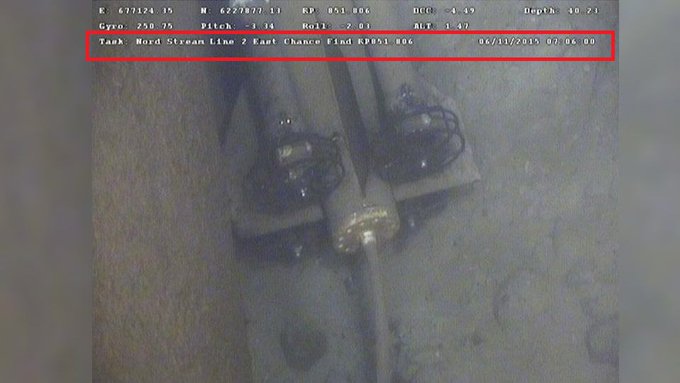
The US-led NATO alliance has been very active in waters around Nord Stream and once even managed to “lose” an armed underwater drone right under the pipeline, a Gazprom spokesman has said.
“On November 6, 2015, a NATO underwater mine destroyer ‘Seafox’ was discovered during a scheduled visual inspection of the Nord Stream gas pipeline,” Sergey Kupriyanov told Rossiya 24 on Monday.
The device was found resting on the seabed at a depth of 40m between the Nord Stream pipelines, almost directly under one of them, Kupriyanov said. The incident, which received limited media coverage at the time, prompted a brief halt in gas deliveries, while the drone was ultimately recovered by the Swedish military.
Back then, the US-led bloc said it had “lost” the device during military drills, the spokesman claimed. The German-made drone carries a 1.4kg shaped-charge warhead, which is intended for destroying sunken unexploded munitions and mines, according to publicly available data.
“That’s NATO drills for you, when a military-grade explosive device ends up straight under our pipeline,” Kupriyanov concluded.
The remarks come in the aftermath of the apparent sabotage attacks on the Nord Stream pipeline system. The Nord Stream 1 and 2 pipelines both abruptly lost pressure on September 26, following a series of powerful underwater explosions off the Danish island of Bornholm. The ruptures caused massive gas leaks into the open sea and rendered the pipelines inoperable.
While Moscow has called for an international – with its own participation – probe into the incident, other parties appear to be reluctant to carry out such an investigation. Sweden, for instance, has already explicitly stated it will not share the results of its investigation into the explosion with Moscow.
“In Sweden, our preliminary investigations are confidential, and that, of course, also applies in this case,” Swedish Prime Minister Magdalena Andersson told reporters on Monday.
Russian President Vladimir Putin has already blamed the “the Anglo-Saxons,” a Russian colloquialism for the US-UK alliance, of being behind the blasts, which Moscow described as an “act of international terrorism.” Speaking during a meeting of the Russian Security Council on Monday, Putin said that “we all know well who the ultimate beneficiary of this crime is.”
US moving another Strike Group to Europe
Free West Media | October 11, 2022
This is not a sign of de-escalation: the US is sending one of its most modern aircraft carriers, the USS Gerald R Ford, to Europe. It is the US Navy’s newest class of nuclear-powered aircraft carrier (CVN 78), departing on its first major deployment.
The 13 billion euro carrier was only put into service in 2017, is 337 meters long and has a crew of 4 500, 90 fighter jets and, presumably, nuclear weapons on board. The Strike Group includes 17 ships and one submarine.
The USS Gerald R Ford, accompanied by several guided missile cruisers, submarines and supply ships, should be operating in the North Sea in just a few days, joining the Wasp-class amphibious assault ship USS Kearsage. This would give the US Navy a massive concentration of troops in northern Europe – and the air support of the most modern stealth fighter jets.
The Strike Group will be deployed alongside NATO forces. The US aircraft carrier USS Harry S Truman is still stationed in the Mediterranean.
Lavrov Says Russia Received No Serious Proposals From US on Talks, Calls US Remarks Lies

Samizdat – 11.10.2022
MOSCOW – Russian Foreign Minister Sergey Lavrov slammed on Tuesday US statements that Russia left unanswered Washington’s proposals on negotiations on Ukraine as lies, noting that Moscow received no serious proposals.
“This is a lie [that Russia refuses to negotiate]. We did not receive any serious proposals to enter into contact. There were some not very serious calls, to which we also did not respond negatively, but offered to formulate specific proposals, with which some people want to contact us through indirect contacts. And in this case, we did not receive more specific explanations from anyone,” Lavrov told the Rossiya 1 broadcaster.
US National Security Council spokesman John Kirby said on Monday that a way out of the situation around Ukraine should be sought through diplomacy. At the same time, he noted that Washington did not see Russia’s serious intentions to negotiate with Kiev.
Moscow is not aware of details of Ankara’s new initiative to organize talks between Russia and several Western states on the situation in Ukraine, Sergey Lavrov said.
“It is obvious to me that if the Turkish colleagues have thought about this, then they will have a great opportunity this week during the meeting of presidents [Recep Tayyip] Erdogan and [Vladimir] Putin, who will be together at the events in Astana, to raise such issues. We haven’t heard anything other than public announcements,” Lavrov said.
Ukrainian President Volodymyr Zelensky’s decision not to engage in dialogue with Russia may change depending on his mood and the West’s position, Lavrov said.
“I do not rule out that he, as he forbade himself [to talk with Russia], will then forget about it, depending on his mood when he gets up in the morning and what he does. Well, or he will receive an order from Washington, from London – he will say ‘Yes’ and figure out how to explain all this so as not to lose face,” Lavrov stressed.
On October 10, Russian President Vladimir Putin, at a meeting with the Russian Security Council, said Moscow has made precision strikes on infrastructure facilities across Ukraine in the morning. Putin called the recent blast on Russia’s Crimean Bridge a Ukrainian terrorist attack aimed at destroying Russian civilian infrastructure. According to him, Kiev has put itself on a par with the most odious terrorist groups, and it is impossible to leave the crimes of the Kiev regime unanswered any longer.
Russia launched its special military operation in Ukraine on February 24, after the Donetsk and Lugansk people’s republics appealed for help in defending themselves against Ukrainian provocations. In response to Russia’s operation, Western countries have rolled out a comprehensive sanctions campaign against Moscow and have been supplying weapons to Ukraine.
Featured Video

Matt Bracken: US Plans Massive MOAB Strike on Iran?
or go to
Aletho News Archives – Video-Images
From the Archives
Confronting the Threat of Ethnic Bioweapons
By Tony Cartalucci – New Eastern Outlook – 29.11.2017
The United States Air Force’s 59th Medical Wing’s molecular biology branch recently was revealed to have been collecting specifically Russian RNA and synovial (connective) tissue samples, prompting fears in Russia of a possible US directed ethnic-specific bioweapons program. … continue
Blog Roll
 Aletho News
- Matt Bracken: US Plans Massive MOAB Strike on Iran?
- Russia accuses France of ‘piracy’ over tanker seizure
- Why Yemen Is Bombing Saudi Arabia’s Airports: The War Behind the Headlines
- Sally Rooney’s books pulled from UK over support for Palestine Action
- Bombs for Tel Aviv, Promises for Riyadh
- Israeli ad agency conducted vast global espionage campaign using online ads: Report
- Oct. 7 Forever Marks The Big Reveal: ‘We See You, Israel, We Revile You, We Reject You!’
- Meet the US generals and admirals advancing Israeli policy
- Israel’s Straw Widow Protocol: The Kill Zones Where Civilians Were Labelled ‘Terrorists’
- Leading Israeli Think Tank Publishes Psychotic Israeli ‘National Security’ Doctrine
- If Americans Knew
- Israeli firm used online ads to run vast spy operation, researchers say
- No, the world zionist movement is not an antisemitic conspiracy theory
- Hundreds of IDF investigations into killings still have no public outcome, BBC Verify finds
- After Ashley Moody Epstein Probe, Donors Linked to Him Poured Money Into her Senate Campaign
- Worried about Russian meddling in UK politics? Wait till you see what Israel is up to
- Israeli settlers attack West Bank center for disabled children, church leader calls for int’l action
- Pulling Out Teeth Just to Live: How Israel Has Devastated Dental Care in Gaza
- Gaza’s “ceasefire” death toll passes 1,500 – Daily Update
- Activists Abused By Israel Return to New Freedom Flotilla Mission
- 60 Minutes won’t tell the full truth about Israeli settler violence
- No Tricks Zone
- New Study Suggests Large Regions Of The Pacific Ocean Have Been Cooling For The Last 80 Years
- Germany’s Green Energy Debacle: High Energy Costs Force Kahla Porzellan to Close After 182 Years!
- New Study: 50 Years Of The Most Aggressive ‘Net Zero’ Policies Can Only Affect The Global Climate By 0.03°C
- US September “Heat” Was No Record…Many Records Set Decades Ago
- Latest European Green Energy Debacle; Portugal’s Largest Flagship Solar Park Insolvent!
- Green Energy Debacle: German Expert Professor Fritz Vahrenholt Warns Of Severe Economic And Social Consequences
- Two More Paleo Reconstructions Affirm Meters-Higher Sea Levels Across Ireland, Brazil 7000-6000 Years Ago
- New Study: Earth And Venus Surface Warmth Largely Explained By Convection And Lapse Rate, Not CO2 Or Radiation
- 2025 Nature Paper Claiming Worsening Global Drought Gets RETRACTED …Heavily Flawed
- New Study: ‘Global Drought Shows No Detectable Recent Acceleration Under Climate Warming’

