Nord Stream explosions are a ‘tremendous opportunity’ – US

Samizdat | October 1, 2022
The US views the sabotage of the Nord Stream gas pipelines as a “tremendous opportunity” to wean the continent off of Russian energy, Secretary of State Antony Blinken told reporters on Friday. With winter approaching, Blinken said that the US wants Europe to decrease its fuel use.
Speaking to reporters in Washington, Blinken boasted that the US is now “the leading supplier of [liquefied natural gas] to Europe.” In addition to shipping its own fuel to Europe, Blinken said that the US is working with European leaders to find ways to “decrease demand” and “speed up the transition to renewables.”
“It’s a tremendous opportunity to once and for all remove the dependence on Russian energy and thus to take away from [Russian President] Vladimir Putin the weaponization of energy as a means of advancing his imperial designs,” Blinken declared.
The US likely stands to gain the most from the destruction of the Nord Stream 1 and Nord Stream 2 gas pipelines, which were damaged by a series of explosions off the Danish island of Bornholm earlier this week. Washington has for years been trying to convince European leaders to swap Russian gas for its LNG, and the severity of the damage to the undersea conduits now means that Europe is “indefinitely deprived” of Russian gas via this route, Russian energy operator Gazprom stated on Friday.
In a speech on Friday, President Vladimir Putin blamed the explosions on “the Anglo-Saxons,” a Russian colloquialism for the US-UK transatlantic alliance.
“It’s obvious to everyone who benefits from it,” Putin explained. “Those who benefit are the ones who have done it.”
While the way is now open for the US to sell its more expensive LNG to Europe, the shortfall cannot be covered overnight. US exporters warned throughout the summer that they will not be able to ship enough gas to meet demand on the continent, and many of Europe’s import terminals are still under construction or in planning.
Meanwhile, energy bills are skyrocketing across Europe. In Germany, which faces the prospect of rapid “deindustrialization,” protesters took to the streets to demand the re-opening of Nord Stream 2, just days before the explosions. Food shortages have been predicted in Germany and firewood is in hot demand across the continent as citizens struggle to heat their homes.
“There’s a lot of hard work to do to make sure that countries and partners get through the winter,” Blinken said, suggesting, as EU leaders have also done, that Europe work to “reduce demand” for gas.
Repressive Legislation in The New Abnormal
Doctors To Be Silenced
By Aaron Kheriaty, MD | Human Flourishing | September 30, 2022
Kim Iverson, a TV journalist formerly at The Hill and now streaming her own show on YouTube, has been one of the most honest and courageous voices during the pandemic. She is the rare journalist today who is willing to follow the evidence wherever it may lead. I sat down with her this morning for an interview about California’s latest attempt to suppress the free speech of physicians and undermine the doctor patient relationship. Assembly Bill 2098, which I have posted about previously—see Punishing Dissident Physicians and The Censorship of Medicine—is set to become law unless the governor vetoes it today.
I also had a wide-ranging two-part conversation with Dr. Drew Pinsky on his podcast recently, where we discussed my new book, The New Abnormal: The Rise of the Biomedical Security State. It’s available on the Apple Podcasts (link to Part 1 and Part 2), or your other favorite podcast app.
You can pre-order the book here and it will ship in one month…

The Democratic Party, Now the Leading Party of War
By John V. Walsh | The Greanville Post | September 27, 2022
Last May a remarkable column by Stephen Kinzer appeared in the Boston Globe. It was headlined: “Republicans Return To Their Roots As The Antiwar Party.”
More significantly, the subheading ran: “Since the Vietnam era, Americans have come to expect antiwar rhetoric from liberal Democrats. Cancel that.” It began:
“With Americans now engulfed in passion for Ukraine, it wasn’t surprising that President Biden proposed sending $33 billion worth of weaponry and other aid to Ukraine’s beleaguered military. Nor was it surprising that Congress raised the number to $40 billion, or that both the Senate and House of Representatives voted overwhelmingly in favor. Hidden within that lopsided vote, though, was a shocker: Every single “no” vote – 11 in the Senate and 57 in the House – came from a Republican.
“Since the Vietnam era, Americans have come to expect antiwar rhetoric from liberal Democrats. Cancel that. This month’s votes in Washington signal a dramatic role reversal. Suddenly it is conservative Republicans who oppose US involvement in foreign wars.”
Strikingly not only did the “conservative” Democrats vote for the $40 billion that included more weapons of death and destruction for Joe Biden’s cruel proxy war against Russia to the last Ukrainian. All the “progressives” did so, including AOC and The Squad, Bernie Sanders, Ro Khanna, Barbara Lee and all the rest. It was a clean sweep.
Second, this was not a one-off event. There is another vote coming up in the next few weeks for another $13.7 billion for Ukraine with over $7 billion for weapons. What is the response of the 100 Democrats to this request by Biden? The answer came during the September 11 Week Of Action called for by Code Pink and the progressive Peace In Ukraine Coalition reported here as follows:
“In the nation’s capital CODEPINK co-founders Medea Benjamin and Jodie Evans, together with Colonel Ann Wright and other activists, kicked off the Week of Action, going door to door to the offices of the House Congressional Progressive Caucus (CPC), …. While some members of the caucus call for much-needed diplomacy and raise concerns about the risk of nuclear war – either through a miscalculation or an intentional first strike – not one member of the nearly 100-member CPC will commit to voting against more weapons for Ukraine.” (Emphasis, jw)
This was also acknowledged in a very dispiriting interview by The GrayZone with prominent activists after the lobbying effort.
The pro-war mentality among the “progressive” Dem pols is not limited to Biden’s cruel proxy war to the last Ukrainian. It extends to a second proxy war now being ginned up in Taiwan. When Nancy Pelosi recently visited the island to stir up secessionist sentiment, not a single progressive Democrat in Congress made so much as a peep of protest. In fact Rep. Ro Khanna, Co-chair of Bernie Sanders’s 2020 Presidential campaign boosted it in rants on CNN and Twitter.
Both of these proxy wars bring the US into conflict with two other major global nuclear powers. If the progressive pols cannot be against military escalation in cases like this, it is hard to see that they have any claim to be for peace. And yet all too many activists in the progressive antiwar movement are loyal to them. In fact some peace organizations have gone so far as to endorse them for election in 2022, even after their vote for the $40 billion to Ukraine for example here!
Moreover this support for the proxy war in Ukraine shows up among rank and file Democrats as well. By every measure in a recent Ipsos poll taken after 6 months of war, support for intervention in Ukraine was higher among Democrats than among Republicans or Independents. IF the roots of this are partisan in nature, that is deeply disturbing because it means that Democrats will follow warhawks simply because they are Dems. Biden may be a case in point for such misplaced loyalty.
Let me end on a personal note. Working in peace organizations and coalitions, I find many activists who labor mightily for the cause of peace also maintain loyalty to the Democratic Party. And that loyalty extends especially to the “progressive” Democratic politicians. This is most disturbing because on the most important issues of war and peace, these peace activists get nothing in return. And since there is no price to pay for their hawkish votes, these politicians will simply ignore such activists. This is an abusive relationship and ought to be terminated forthwith.
The minimal policy of those who work for peace should be quite simple: no votes for politicians who vote to fund war in Ukraine – no matter the Party. Otherwise those who support war and US unipolarity will continue to ignore those who work for peace.
Putin names orchestrator of Nord Stream blasts
Samizdat | September 30, 2022
The US orchestrated the blasts on the Nord Stream 1 and 2 gas pipelines in the Baltic Sea, which delivered Russian natural gas to Germany, because they “obviously” benefit from it, President Vladimir Putin said on Friday.
Putin accused Washington of trying to pressure the EU into banning Russian supplies to “completely get their hands on the European market.”
“But the sanctions are no longer enough for the Anglo-Saxons,” he said, using Russian shorthand for the US-UK transatlantic alliance. “They have turned to sabotage – it’s unbelievable, but it’s a fact – by organizing the explosions on the Nord Stream international gas pipelines,” the president stated.
“They de facto began the destruction of the common European energy infrastructure. It’s obvious to everyone who benefits from it. Those who benefit are the ones who have done it.”
US Secretary of State Antony Blinken denounced Putin’s statement as part of “outrageous misinformation and disinformation campaigns” coming from Moscow.
“I really have nothing to say to the absurd allegation from President Putin that we are or other partners or allies are somehow responsible for this,” Blinken said, according to AFP.
Putin was speaking at the Kremlin ahead of signing treaties on the inclusion of the two Donbass republics, as well as Kherson and Zaporozhye Regions, which declared independence from Ukraine, into the Russian Federation.
Omerta in the Gangster War
By Diana Johnstone | Consortium News | September 28, 2022
Imperialist wars are waged to conquer lands, peoples, territories. Gangster wars are waged to remove competitors. In gangster wars you issue an obscure warning, then you smash the windows or burn the place down.
Gangster war is what you wage when you already are the boss and won’t let any outsider muscle in on your territory. For the dons in Washington, the territory can be just about everywhere, but its core is occupied Europe.
By an uncanny coincidence, Joe Biden just happens to look like a mafia boss, to talk like a mafia boss, to wear a little lopsided half smile like a mafia boss. Just watch the now famous video:
Pres. Biden: “If Russia invades… then there will be no longer a Nord Stream 2. We will bring an end to it.”
Reporter: “But how will you do that, exactly, since…the project is in Germany’s control?”
Biden: “I promise you, we will be able to do that.”
Able for sure.
It cost billions of dollars to lay the Nord Stream 2 pipeline across the Baltic Sea, from near Saint Petersburg to the port of Greifsfeld in Germany. The idea was to ensure safe natural gas supplies to Germany and other European partners by going around troublesome Ukraine, known for readiness to use its transit rights to siphon off gas for itself or blackmail clients.
Of course, Ukraine was always vehemently hostile to the project. So was the United States. And so were Poland, the three Baltic States, Finland and Sweden, all attentive to what went on in their sea.
The Baltic Sea is a nearly closed body of water, with narrow access to the Atlantic through Danish and Swedish straits. The waters near the Danish island of Bornholm where the Nord Stream pipelines were sabotaged by massive underwater explosions is under constant military surveillance by these neighbors.
“It seems completely impossible that a state actor could carry out a major naval operation in the middle of this densely monitored area without being noticed by the countless active and passive sensors of the littoral states; certainly not directly off the island of Bornholm, where Danes, Swedes and Germans have a rendezvous in monitoring the surface and undersea activities,” writes Jens Berger in the excellent German website Nachdenkseiten.
Last June, Berger reports,
“the annual NATO maneuver Baltops took place in the Baltic Sea. Under the command of the U.S. 6th Fleet, 47 warships participated in the exercise this year, including the U.S. fleet force around the helicopter carrier USS Kearsarge. Of particular significance is one particular maneuver conducted by the 6th Fleet’s Task Force 68 — a special unit for explosive ordnance disposal and underwater operations of the U.S. Marines, the very unit that would be the first address for an act of sabotage on an undersea pipeline.”
In June this year this very unit was engaged in a maneuver off the island of Bornholm, operating with unmanned underwater vehicles.
Berger considers that a major sabotage operation “could not have been carried out directly under the noses of several littoral states without anyone noticing.” But he adds this clever observation: “if you want to hide something, it is best to do so in public.”
In order to be able to attach explosive devices to a gas pipeline halfway unnoticed, one would need a plausible distraction — a reason for diving near Bornholm without immediately being suspected of committing an act of sabotage. It doesn’t even have to be directly related in time to the attacks. Modern explosive devices can, of course, be detonated remotely. So, who has been conducting such operations in the maritime area in recent weeks? As luck would have it, exactly the same task force around the USS Kearsarge was again in the sea area around Bornholm last week.
In short, during NATO maneuvers, some participant could have laid the explosives, to be blown up at a later chosen moment.
By an odd coincidence, only a few hours after the sabotage of Nord Stream 1 and 2, ceremonies began opening the new Baltic Pipe carrying gas from Norway to Denmark and Poland.
The Political Significance of the Sabotage
Due to Western sanctions against Russia, gas was not being delivered through the destroyed pipelines. However, gas inside the pipelines is leaking dangerously. The pipelines remained ready for use whenever an agreement could be reached. And the first, dramatic significance of the sabotage is that henceforth, no agreement can be reached. Nord Stream 2 would have been the key to some sort of settlement between Russia and the Europeans. The sabotage has virtually announced that the war can only intensify with no end in sight.
In Germany, the Czech Republic and some other countries, movements were beginning to grow calling for an end to the sanctions, specifically to solve the energy crisis by putting Nord Stream 2 into operation for the first time. The sabotage has thus invalidated the leading demand of potential peace movements in Germany and Europe.
This act of sabotage is above all a deliberate sabotage of any prospect of a negotiated peace in Europe. The next move from the West has been for NATO governments to call on all their citizens to leave Russia immediately. In preparation of what?
The Russians Did It
In this catastrophic situation, Western mainstream media are all wondering who could be the guilty party, and suspicion automatically fixes on… Russia. Motive? “To raise the price of gas” or “to destabilize Europe” — things that were happening anyway. Any far-fetched notion will do.
European opinion-makers are showing the result of 70 years of Americanization. Especially in Germany, but also in France and elsewhere, for decades the United States has systematically spotted up-and-coming young people, invited them to become “young leaders,” invited them to the United States, indoctrinated them in “our values” and made them feel like members of the great trans-Atlantic family. They are networked into top positions in politics and media. In recent years, great alarm is raised about alleged Russian efforts to exert “influence” in European countries, while Europeans bathe in perpetual American influence: movies, Netflix, pop culture, influence in universities, media, everywhere.
When disaster strikes Europe, it can’t be blamed on America (except for former President Donald Trump, because the American establishment despised and rejected him, so Europeans must do the same). It has to be the bad guy in the movie, Putin.
The fanatically anti-Russian former Polish Foreign Minister Radek Sikorsky couldn’t restrain himself and joyously greeted the massive natural-gas leaks from the destroyed pipeline with a cheerful tweet, “Thank you, USA.” But Poland was certainly also willing, and perhaps even able. So perhaps were some others in NATO-land. But they all prefer to publicly “suspect” Russia.
Officially, so far, no NATO government knows who dunnit. Or maybe they all know. Maybe this is like the famous Agatha Christie mystery on the Orient Express train, where suspicion falls on all the passengers, and are all guilty. And all united in Omerta.
Diana Johnstone is the author of Fools’ Crusade: Yugoslavia, NATO, and Western Delusions. Her latest book is Circle in the Darkness: Memoirs of a World Watcher (Clarity Press). The memoirs of Diana Johnstone’s father Paul H. Johnstone, From MAD to Madness, was published by Clarity Press, with her commentary. She can be reached at diana.johnstone@wanadoo.fr .
Russian security chief names ‘obvious’ beneficiary of pipeline rupture
Samizdat | September 30, 2022
The US stands to benefit economically from the attack on the Nord Stream gas pipelines and has a record of targeting energy infrastructure with sabotage operations, the head of Russia’s Security Council said.
“Pretty much from the first minutes after the news of the explosions broke … the West launched an active campaign for assigning blame. But it is obvious that the primary beneficiary, first of all in the economic sense, was the US,” Nikolay Patrushev said on Friday.
He compared this week’s incident with the attack on Nicaragua’s oil infrastructure in Puerto Sandino in 1983. Back then CIA officers, based on a ship moored in international waters, coordinated a raid by commandos they had trained to fight against the Sandinista government, US press reported at the time. The US spy agency also provided speed boats for the raid, a CIA source explained, according to Associated Press.
The operation was part of the Reagan administration’s “dirty war” on Nicaragua, which later led to the Iran-Contras scandal. The CIA’s secret sale of weapons to Iran to fund Latin American militants was exposed in 1986.
Patrushev made the remarks at a meeting with fellow security officials from former Soviet nations.
“It appears to be necessary to coordinate our effort to expose the masterminds and executors of this crime, setting a good example for effective cooperation,” he told his counterparts.
He noted that the US goal was “ensuring strategic and economic superiority over alternative centers of power” even though Washington’s ally the EU has been suffering from its policies. The US is replacing Russian natural gas with its more expensive liquified natural gas, as the bloc moves to decouple its economy from Russian energy sources.
The leaks in the two Nord Stream pipelines were first detected on Monday, when pressure in the undersea links connecting Russia directly to Germany drastically dropped. The pipelines were apparently breached with explosives, with the blasts detected by earthquake sensors in Sweden.
Moscow called the incident an international terrorist attack against civilian infrastructure, while some Western officials described it as an act of sabotage.
Some critics of Russia speculated that Moscow decided to blow up its own gas links with Germany to put pressure on the EU.
Polish MEP and former Foreign Minister Radoslaw Sikorski thanked the US for the incident, but later deleted the tweet, calling his implied assertion of Washington’s involvement a personal working theory.
Western economic warfare backfired, new depression likely to come
What awaits Europe with Nord Stream pipelines possibly gone forever?
By Uriel Araujo | September 30, 2022
Now that the Nord Stream pipeline might have been sabotaged by Washington, as promised by US President Joe Biden on January 7, and is possibly gone forever (according to German authorities), it is time to consider the possible impacts.
The energy crisis in the EU has always been pushed by American interests. Moreover, the US has been engaging in economic warfare and even weaponizing the dollar for too long, but it has been clear for months now that its current economic and financial war against Russia has backfired – and once again, mostly upon Europe. Such economic wars in fact may dangerously spiral out of control, and are considered to be one of the causes of the 1929 crisis in the post-Versailles world.
Philip Pilkington, an Irish economist who works in investment finance, famous for his contributions on the empirical estimate of general equilibrium and other fields, has made quite interesting observations about the possible deindustrialization of Europe as a consequence of economic warfare. He remarks on how in the post-pandemic world debts in the West have been accumulating and, on top of that, the current conflict in Ukraine has brought extra energy costs.
After the conflict ends – or becomes a “frozen conflict” – or after good diplomacy is reestablished, Russia could start to once again supply gas to Europe as usual – this is how many analysts reasoned. However, now that the pipelines are gone, the price of energy in the continent is to remain tremendously high for years to come. With permanent high energy prices making manufacturing not economically viable anymore (thus decreasing European purchasing power), one should expect to see the bloc shutting out exports to revive an uncompetitive industry while increasing energy investments. These are Pilkington’s main points and it might be worth delving into them.
Pilkington argues that high energy costs will make the European industry largely uncompetitive because manufacturers will have no choice but to also raise the price of goods, which in turn, will not be able to compete with cheaper foreign goods. The economist goes on to argue that, in this scenario, with many manufacturers out of business, the result will be the loss of key jobs, with less employed people spending money and a new economic depression.
Thus, Pilkington reasons, the United States will not be able to “reshore” European manufacturing for too long because there simply won’t be anyone in the continent to buy the products the US ships to European shores. This crisis will thus affect Americans too, because as exports to Europe fall, US workers also lose their jobs. What could EU states do in such a scenario? The Irish economist writes quite convincingly that a tariff solution would be the most obvious one: by raising tariffs, these countries will be able to “render international products as expensive as the domestic products suffering from energy cost inflation.”
The result of that can only be more economic chaos for the West, while Europe “shuts itself off” and becomes a kind of a “black hole”, in a repetition of the 1920 events which resulted in the Great Depression, writes Philip Pilkington.
However, the global situation today has changed much, with the BRICS+ alliance, apparently aimed at “decoupling from the Western economy.” For a while, the rise in commodity prices has been perceived as a result of Western sanction policies, and this has forced the global south to look for parallel mechanisms and alternatives. Therefore, these emerging powers have the potential to build a “separate economic bloc”, which means the West would suffer the most from the economic chaos, as BRICS+ “has a relatively clean bill of economic health”.
All of this is a quite likely scenario and one should also consider the political implications. The economic crisis will in all likelihood bring back protectionism, and it might come accompanied by a 1930-like political climate. This in turn can only strengthen the populist camp in Europe. Populist and so-called “far-right” tendencies have been growing in the continent for years and the time seems to be just right for speeding up this phenomenon.
One remembers defeated French Presidential candidate Marine Le Pen promised to pull France out of NATO during this years’ elections. Meanwhile, in August, Hungary had once again the lowest energy prices in the EU. Over 8,700 sanctions have been imposed on Moscow, and yet they have hurt Europe more than Russia as Hungary’s Prime Minister Viktor Orban has been a strong critic of such sanctions. In fact, whether one likes the man or not, he has oftentimes been the voice of reason in the bloc. Now, the German eurosceptic Alternative für Deutschland (AfD) political party is heavily focusing on attacking European elites and opposing the German government’s sanctions against Russia. This trend is everywhere across the EU.
It is about time Europe assert its sovereignty, however such a political stance is largely marginalized in the continent. Thus, although a European populist wave should increase skepticism about NATO and the EU itself, it will also increase political instability and turmoil. To sum it up, in the worst post-Nord Stream scenario, one can then expect a deindustrialized and isolated Europe going through a serious political and economic crisis.
Uriel Araujo is a researcher with a focus on international and ethnic conflicts.
Should Europeans ‘Thank’ the Americans for Destroying Nord Stream?
By Robert Bridge | Strategic Culture Foundation | September 29, 2022
With an investigation continuing into the destruction of the Nord Stream gas pipeline that provided energy supplies to Europe from Russia, there appears to be just one prime suspect, and that should surprise nobody.
Following the sabotage of the Nord Stream 1 and 2 gas pipelines, former Polish Foreign Minister Radoslaw Sikorski already seemed to know the identity of the perpetrator when he tweeted out: “Thank you, USA.”
At first glance, it seemed that Sikorski was speaking sarcastically, berating Washington for carrying out an attack that will have severe repercussions for the people of Europe. After all, how could anyone see any good coming from the termination of Europe’s primary source of gas reserves with winter just around the corner? It was Sikorski’s homeland of Poland, after all, that urged its citizens to collect firewood in the face of dwindling gas reserves.
In fact, the Polish diplomat was speaking one-hundred percent literally, thanking the United States for plunging the continent deeper into the abyss. This has been the attitude of European leaders from the start of Russia’s special military operation in Ukraine: ‘we will accept our self-destruction as scripted by Washington policymakers so long as the baddies in Moscow hear our virtue-signaling whimpers and screams.’ European capitals are about to learn the hard way that virtue signaling does not put food on the table or heat homes.
Judging by the rising temperature in Europe, however, last seen in Italy where a far-right leader has come to power on the wave of voters fed up with high electricity bills and loose immigration, the phrase ‘Thank you, USA’ may eventually be chiseled into Europe’s tombstone.
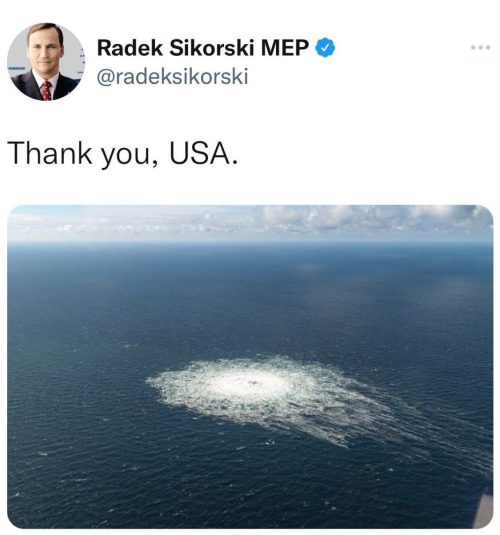
But first, the big question: was the United States really responsible for the destruction of Nord Stream, as Sikorski seems to believe? Well, if we were are to take bumbling Joe Biden at his word, then the answer would seem to be yes.
“If Russia invades, that means tanks or troops crossing the border of Ukraine, again, then there will be — there will be no longer a Nord Stream 2,” the U.S. leader told reporters two weeks before Russia began its Ukrainian mission. “We will bring an end to it.”
When asked to specify, Biden responded, “I promise you, we’ll be able to do it.”
There are other clues that point to American complicity.
On September 2, an American helicopter with the call sign FFAB123 was observed maneuvering in the area of the Nord Stream pipelines. According to the site ads-b.nl, six aircraft used this call sign that day, of which the tail numbers of three were established. All of them were Sikorsky MH-60S. By overlaying the FFAB123 route on the scheme marking the areas of the explosions, it is observable that the helicopter either flew along the Nord Stream-2 route, or exactly between the points where the ‘accident’ occurred.
Meanwhile, on Twitter, there are screenshots of other American aircraft flights as of September 13th in exactly the same area. In June there was an article in Sea Power magazine where the Americans boast of experiments in the field of underwater drones that they set up at the BALTOPS 22 exercises – in the area of Bornholm Island, the Danish island where the explosions were reported to have occurred.
“Experimentation was conducted off the coast of Bornholm, Denmark, with participants from Naval Information Warfare Center Pacific, Naval Undersea Warfare Center Newport, and Mine Warfare Readiness and Effectiveness Measuring all under the direction of U.S. 6th Fleet Task Force 68,” Sea Power reports.
Such an “experiment” would have required the deep-sea equipment needed for reaching the depths where the Nord Stream pipelines are located.
Finally, here’s one last tantalizing piece of information for all of the ‘coincidence theorists’ out there. On the day after Nord Stream 1 and 2 went offline, Poland, Norway and Denmark’s leaders attended the opening ceremony of the new Baltic Pipe, which will transport natural gas from Norway via Denmark and through the Baltic Sea to, yes, Sikorski’s ferociously Russophobic homeland of Poland. Yes, just a coincidence.
However, the main motivating factor for Washington having a hand in destroying Nord Stream is the awesome powers – both financial and political – that it will reap. The economic crisis in Europe is already forcing companies and corporations to consider relocating to the U.S., which is providing a better business environment and more or less affordable electricity bills.
And after the destruction of Nord Stream, the economic situation on the continent will deteriorate significantly. Even though the NS-II was not launched, there was the chance of its launch, and this “chance” had a considerable effect on the market. Now, without its main energy supplier, Europe is doomed while America will soar.
The economic destruction of Europe makes it totally dependent on the U.S. economically, politically, and militarily, turning it into a toothless tiger with no political will and independence. At the same time, Europe will become almost completely dependent on the U.S. for its (prohibitive) gas. The United States plans to supply at least 15 billion cubic metres (bcm) of liquefied natural gas (LNG) to European Union markets this year as Europe seeks to wean itself off Russian gas supplies.
In other words, the transformation of the EU into a banana republic – albeit it one in the northern hemisphere with winter quickly approaching – has already begun.
Europe, you really should have heeded the advice of Henry Kissinger, who understands the nature of the U.S. better than anyone: “To be an enemy of the U.S. is dangerous, but to be a friend is fatal.”
Who wins from demolishing the EU’s gas lifelines?
By Rachel Marsden | Samizdat | September 29, 2022
Speculation abounds since both Nord Stream 1 and 2 pipelines, designed to carry cheap Russian gas to Europe, were damaged this week in what officials widely describe as deliberate acts of sabotage. Who could be responsible? Incidents buried in the past may provide a clue.
Speculation abounds, and typically in a direction colored by the preexisting biases of the person speculating – which is hardly helpful.
Let’s start with the end result and work backwards. The outcome ultimately means that Europe’s economic impetus for ever seeking peace with Russia has been seriously undermined, if not literally destroyed. Someone has taken it upon themselves to demolish the remaining bridges between the two. Until now, there was always a chance of reconciliation. Russian President Vladimir Putin said himself recently that all the EU needed to do to pull itself out of its self-imposed energy crisis was to push the button on its gas supply from Russia and drop the anti-Russian sanctions that prevent it from doing so.
People in the streets of German cities protesting against Berlin’s blind following of Brussels’ anti-Russia sanctions also knew that was the answer. But now that option has been taken off the table. The EU is now adrift amid a deepening energy crisis and someone burned its last sails. It’s clear that Europe itself wouldn’t benefit from that. Nor does it benefit at all from any of its own anti-Russian sanctions. But who gave Brussels that idea, to harm its own economy in the first place?
At the onset of the Ukrainian conflict, it was Washington that egged on the EU to mirror measures that Washington itself had adopted in an effort to deprive Moscow of revenues to fuel its interests and objectives in Ukraine. The problem is that the EU’s economy was far more entwined with Russia’s than America’s. Any sense that US President Joe Biden and his administration may have given EU leaders, that they’d be there to help the bloc soften the blow of its self-sacrificial sanctions, has since been replaced by a harsh, pragmatic reality. US shale executives have explained to Western media that they simply lack the capacity to ramp up production for Europe’s winter crunch, even amid the growing rationing, deindustrialization, and risk of blackouts.
So, pressure has recently been increasing on EU member states to achieve a rapid diplomatic, peaceful resolution. But any reconnection of Nord Stream gas would have been a blow to US economic ambitions, which eventually include turning the EU into a dependent liquefied natural gas client. To that end, US officials have even tried to market their natural gas in the past as “freedom molecules,” in contrast to the “authoritarian” Russian gas.
Biden himself said of Nord Stream 2 during a press conference on February 7, before the Ukraine conflict had even popped off, that “we will bring an end to it,” despite it being out of American control. But even long before that, the US was sanctioning and bullying European companies into halting construction on Nord Stream 2 under the pretext of saving Europe from Russia. It’s worth noting that Europe didn’t really have problems with Russia this century until the US decided to make Ukraine an outpost for the State Department.
Not only did Gazprom, Russia’s state-owned operator of the pipeline, persist against all odds to finish it, but it’s really the only leverage that Moscow has in Europe. Attributing to Moscow the recent sabotage of their own economic interests in Europe seems absurd. The damage done to the pipelines now means that to prevent them from being completely filled with sea water and destroyed, Russia is forced to keep pumping gas through them and into the sea at their own expense. What exactly does Moscow gain from any of this? Conversely, what does Washington gain? Nothing less than Brussels’ full dependence, which proved elusive when Europe could split its interests between the east and west.
As for who possesses the technical ability to execute underwater pipeline sabotage, both Russia and the US do. Much has been made in the past of the potential for cutting undersea cables – defined as an act of war by UK defense chief Admiral Sir Tony Radakin. The US actually has a history in such operations, having tapped into undersea cables to spy on the Soviet Union in the 1970s Operation Ivy Bells, according to public records about Operation Ivy Bells. Washington also has sabotaged Soviet gas pipelines before, albeit indirectly – according to Thomas C. Reed, a former Air Force secretary who served on the National Security Council in 1982, when then-US President Ronald Reagan allegedly approved a plan for the CIA to sabotage components of a pipeline operated by the Soviet Union. The objective was to prevent Western Europe from importing natural gas from the Soviets. Sound familiar?
Time and inquiry will uncover the culprit eventually – if we’re lucky. EU officials are vowing to get to the bottom of it. “All available information indicates leaks are the result of a deliberate act. Deliberate disruption of European energy infrastructure is utterly unacceptable and will be met with a robust and united response,” Tweeted the bloc’s chief diplomat, Josep Borrell. Perhaps investigators could pay a visit to Radoslaw Sikorski, European Parliament member and former Polish foreign minister, who tweeted a photo of the disaster aftermath along with the note, “Thank you, USA.”
But if it indeed turns out that Washington committed what some consider to be an act of war against Europe’s economy, will Brussels have the heart to really confront it? Or will Brussels continue to find justifications to remain complicit in its own demise?
Rachel Marsden is a columnist, political strategist, and host of independently produced talk-shows in French and English. rachelmarsden.com
Kamala Harris’ visit to Tokyo aims to destroy Sino-Japanese relations
By Ahmed Adel | September 29, 2022
US Vice President Kamala Harris is on a trip to Japan and South Korea, her first visit to Japan and her second to Asia since taking office early last year. Ahead of the US midterm elections in November, Harris has increased her attacks on China, something she has not stopped doing since arriving in Japan on September 26 for the state funeral of assassinated former leader Shinzo Abe.
During a meeting in Tokyo on September 26, the American Vice President and Japanese Prime Minister Fumio Kishida condemned China’s actions in the Taiwan Strait. A White House statement described Beijing’s actions in the Taiwan Strait as “aggressive and irresponsible provocations.”
Meanwhile, a series of visits to Taiwan by senior US officials and the increased US supply of weapons to the island have heightened tension in the region. It is evident that China’s actions are only a response against US-instigated provocations.
With these statements, the US has increased propaganda and support for actions against China. There is growing Western desire to erode the “One China” principle and Japan is increasingly participating in these actions. For Beijing, it is not just a matter of military exercises, warships passing through the Taiwan Strait and arms shipments to Taiwan, but an intensification of Western propaganda to put psychological pressure on China and normalise the idea of an independent Taiwan.
The gradual erosion of the “One China” principle is evident. Most of Asia is well aware of the American falsehoods, but this is influencing its partners in the West and Japan to the idea of an independent Taiwan.
At the meeting with the Japanese Prime Minister, Kamala Harris reaffirmed the US commitment to Japan’s security, but in return, Washington wants Tokyo to be more active in containing China. Washington’s main aim is to disrupt the process of improving Sino-Japanese relations. The US is counting on Japan’s help to incite tensions with China.
It is recalled that the provocative actions against China by former US Secretary of State Mike Pompeo, who visited Taiwan for the second time this year on September 26, also failed to bring the desired results, according to Chinese Foreign Ministry spokesman Wang Wenbin. On his first trip in early March, Pompeo was awarded Taiwan’s highest award for his contributions in promoting Taiwan-US relations. To express his “deep gratitude”, the American politician described Taiwan as a “great nation” with a developed democracy.
However, his second visit was even more provocative as he announced that Taiwan “doesn’t need to declare independence because it already is an independent country.” This statement prompted the Chinese Foreign Ministry to say in a statement that Pompeo’s calculations will not materialise, describing him as “a former politician of diminished credibility who staged these stunts for personal political gains.”
Adding to insult, Pompeo said in Taiwan: “China’s aggressive conduct, diplomatically, militarily, economically … have changed this region. And it brought those who prefer peace and commerce even more closely together. If we want a free 21st century, and not the Chinese century, the century which Xi Jinping dreams of, the old paradigm of blind engagement must end.”
It has not been unnoticed that the 50th anniversary of Sino-Japanese relations, marked on September 29, has been darkened due to differences over Taiwan. Beijing is becoming increasingly wary of Tokyo as it forges closer ties with Taiwan amid growing tensions, which Harris’ visit only provokes further.
According to Japan Times, an official from a Chinese group for bilateral friendship, who was also involved in commemorative events in 2012 for the 40th anniversary of bilateral relations, pointed to the absence of momentum in celebrating the 50th anniversary. The official said that Chinese people feel betrayed by Japan over Taiwan.
When Beijing and Tokyo normalised ties in 1972, Japan said that it understood and respected the notion that Taiwan is an integral part of Chinese territory. The Global Times, the English mouthpiece of the Chinese government, said this month that Japan “tends to turn its back” on the promise it made 50 years ago.
Japan will be “able to create favourable conditions for the bilateral relations” only by keeping its promise, the Global Times also said.
However, there is little indication that Tokyo wants to deescalate tense relations with Beijing, and rather, it is more likely that things will become worse before they become better, especially following Harris’ visit to Japan and Pompeo emboldening Taiwan towards independence rather than unification with mainland China.
Ahmed Adel is a Cairo-based geopolitics and political economy researcher.
Featured Video

Matt Bracken: US Plans Massive MOAB Strike on Iran?
or go to
Aletho News Archives – Video-Images
From the Archives
Confronting the Threat of Ethnic Bioweapons
By Tony Cartalucci – New Eastern Outlook – 29.11.2017
The United States Air Force’s 59th Medical Wing’s molecular biology branch recently was revealed to have been collecting specifically Russian RNA and synovial (connective) tissue samples, prompting fears in Russia of a possible US directed ethnic-specific bioweapons program. … continue
Blog Roll
 Aletho News
- Matt Bracken: US Plans Massive MOAB Strike on Iran?
- Russia accuses France of ‘piracy’ over tanker seizure
- Why Yemen Is Bombing Saudi Arabia’s Airports: The War Behind the Headlines
- Sally Rooney’s books pulled from UK over support for Palestine Action
- Bombs for Tel Aviv, Promises for Riyadh
- Israeli ad agency conducted vast global espionage campaign using online ads: Report
- Oct. 7 Forever Marks The Big Reveal: ‘We See You, Israel, We Revile You, We Reject You!’
- Meet the US generals and admirals advancing Israeli policy
- Israel’s Straw Widow Protocol: The Kill Zones Where Civilians Were Labelled ‘Terrorists’
- Leading Israeli Think Tank Publishes Psychotic Israeli ‘National Security’ Doctrine
- If Americans Knew
- Israeli firm used online ads to run vast spy operation, researchers say
- No, the world zionist movement is not an antisemitic conspiracy theory
- Hundreds of IDF investigations into killings still have no public outcome, BBC Verify finds
- After Ashley Moody Epstein Probe, Donors Linked to Him Poured Money Into her Senate Campaign
- Worried about Russian meddling in UK politics? Wait till you see what Israel is up to
- Israeli settlers attack West Bank center for disabled children, church leader calls for int’l action
- Pulling Out Teeth Just to Live: How Israel Has Devastated Dental Care in Gaza
- Gaza’s “ceasefire” death toll passes 1,500 – Daily Update
- Activists Abused By Israel Return to New Freedom Flotilla Mission
- 60 Minutes won’t tell the full truth about Israeli settler violence
- No Tricks Zone
- New Study Suggests Large Regions Of The Pacific Ocean Have Been Cooling For The Last 80 Years
- Germany’s Green Energy Debacle: High Energy Costs Force Kahla Porzellan to Close After 182 Years!
- New Study: 50 Years Of The Most Aggressive ‘Net Zero’ Policies Can Only Affect The Global Climate By 0.03°C
- US September “Heat” Was No Record…Many Records Set Decades Ago
- Latest European Green Energy Debacle; Portugal’s Largest Flagship Solar Park Insolvent!
- Green Energy Debacle: German Expert Professor Fritz Vahrenholt Warns Of Severe Economic And Social Consequences
- Two More Paleo Reconstructions Affirm Meters-Higher Sea Levels Across Ireland, Brazil 7000-6000 Years Ago
- New Study: Earth And Venus Surface Warmth Largely Explained By Convection And Lapse Rate, Not CO2 Or Radiation
- 2025 Nature Paper Claiming Worsening Global Drought Gets RETRACTED …Heavily Flawed
- New Study: ‘Global Drought Shows No Detectable Recent Acceleration Under Climate Warming’

