Tech platforms contemplate how to deal with Texas’ anti-censorship law
By Dan Frieth | Reclaim The Net | October 3, 2022
Tech companies are considering several options in response to the Texas social media law that prohibits them from political viewpoint-based censorship. The law was recently upheld by the US Court of Appeals for the Fifth Circuit.
According to a report by The Washington Post, one of the options that has been suggested is a pop-up that says: “The content you are about to see contains graphic violence, white supremacist imagery and other objectionable material. If you don’t want to be exposed, click here.”
Another option, which is highly unlikely, is for the tech companies to shut down their services in Texas.
There is also the option of complying with the law and stopping all political censorship and go back to where the platforms were a decade ago – something the platforms are going to be reluctant to do.
Shutting down their services in Texas would be costly because Texas has the second largest population in the country. Also, it would be difficult for the tech companies to detect if a Texas resident is accessing their services from another state.
The pop-up option warning users they are about to view sensitive content would also not be legal because Texas officials could argue that the pop-ups are a form of censorship.
Assuming that the Supreme Court will strike down the law on First Amendment grounds is also considered risky.
The law applies to all platforms with more than 50 million users, meaning it will apply to smaller platforms like Yelp, Etsy, and Pinterest.
Some argue that the law will be tougher on smaller companies because they do not have the resources of large companies, yet they could be the subject of lawsuits that could be financially crippling.
Only 1 out of 573 People Took “Bivalent Boosters” — In a State Without Vaccine Mandates
Bivalent Boosters Available, but NOT mandated in Florida
By Igor Chudov | October 2, 2022
A very uplifting post to end the weekend.
In terrible news for Covid vaccine enthusiasts, only 1 out of 573 residents of Florida took the new safe and effective bivalent booster, extensively tested on 8 mice and fully approved by “science”.
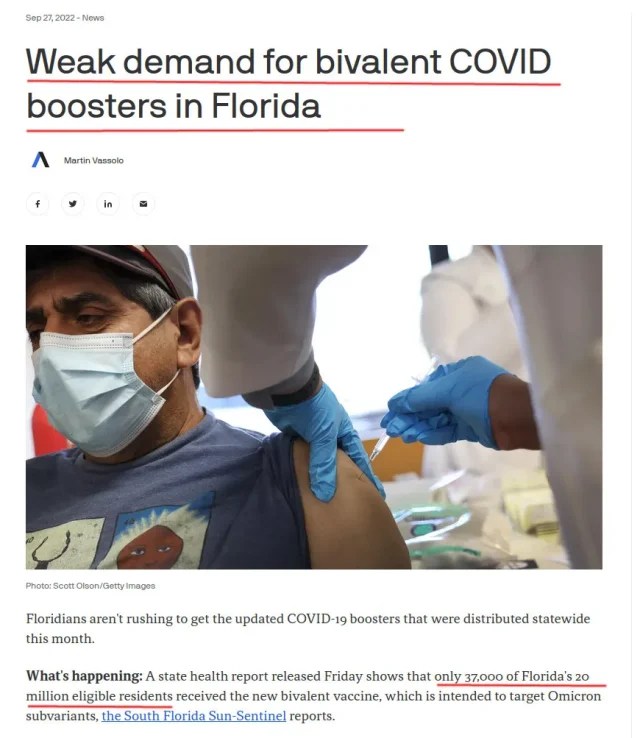
Considering that Florida’s population is 21,220,000 people, this works out to one out of 573 Floridians taking the new and improved science juice. The rest decided to pass for now.
Bivalent Covid vaccine uptake is moribund everywhere. Only 4.4 million doses were administered in the entire USA. This works out to 1.3% of Americans (one person out of 76) taking the bivalent boosters. Reminder, our Federal government purchased, and printed money to pay for, 171 million doses.
Why is the uptake of the bivalent booster, per 1,000 persons, greater in the USA as a whole than in Florida? The boosters are surely available to any Florida resident, right? The reason is that in other places, some holdouts keep vaccine mandates, demanding hapless young people to take Covid vaccines, and in Florida, such mandates are banned.
Go to at www.nocollegemandates.com to fight these stupid, and deadly, mandates.
So, just running the math, had there not been remaining mandates to take the boosters, instead of one out of 76 Americans taking the bivalent, only one of 573 would take it — of SEVEN TIMES FEWER. The same is happening in Germany, by the way.
Such is the time that we live in — only one out of 573 Americans still believes in science.
Is that good or bad? And is that even science?
US is recalibrating the power dynamic in East Mediterranean. Can South Asia be far behind?

File Photo
BY M. K. BHADRAKUMAR | INDIAN PUNCHLINE | OCTOBER 2, 2022
A mild flutter ensued after External Affairs Minister S Jaishankar’s recent meeting with his Turkiye counterpart Mevlut Cavusoglu on the sidelines of the UN General Assembly session in New York on September 21 when it came to be known that Cyprus figured in their discussion. Jaishankar highlighted it in a tweet.
The Indian media instinctively related this to Turkish President Recep Erdogan making a one-line reference to the Kashmir issue earlier that day in his address to the UN GA. But Jaishankar being a scholar-diplomat, would know that Cyprus issue is in the news cycle and the new cold war conditions breathe fresh life into it, as tensions mount in the Turkish-Greek rivalry, which often draws comparison with the India-Pakistan animosity, stemming from another historical “Partition” — under the Treaty of Lausanne (1923) that ended the Ottoman Empire.
The beauty about peace treaties is that they have no ‘expiration date’ but the Treaty of Lausanne was signed for a period of a hundred years between Turkiye on one side and Britain, France, Italy, Greece, and their allies on the other. The approaching date heightens the existential predicament at the heart of Turkiye’s foreign policy.
The stunning reality is that by 24th July 2023, Turkey’s modern borders become “obsolete”. The secret articles of the 1923 Treaty, signed by Turkish and British diplomats, provide for a chain of strange happenings — British troops will reoccupy the forts overlooking the Bosphorus; the Greek Orthodox Patriarch will resurrect a Byzantine mini state within Istanbul’s city walls; and Turkey will finally be able to tap the forbidden vast energy resources of the East Mediterranean (and, perhaps, regain Western Thrace, a province of Greece.)
Of course, none of that can happen and they remain conspiracy theories. Nonetheless, the “end-of-Lausanne” syndrome remains a foundational myth and weaves neatly into the historical revisionism that Ataturk should have got a much better deal from the Western powers.
All this goes to underline the magnitude of the current massively underestimated drama, of which Cyprus is at the epicentre. Suffice to say, Turkey’s geometrically growing rift with Greece and Cyprus over the offshore hydrocarbon reserves and naval borders must be properly understood in terms of the big picture.
Turkiye’s ruling elite believe that Turkey was forced to sign the Treaty of Sevres in 1920 and the “Treaty of Lausanne” in 1923 and thereby concede vast tracts of land under its domain. Erdogan rejects any understanding of history that takes 1919 as the start of the 1,000-year history of his great nation and civilisation. “Whoever leaves out our last 200 years, even 600 years together with its victories and defeats, and jumps directly from old Turkish history to the Republic, is an enemy of our nation and state,” he once stated.
The international community has begun to pay attention as Turkiye celebrates its centenary next year, which also happens to be an election year for Erdogan. In a typical first shot, the US State Department announced on September 16 — just five days before Jaishankar met Cavusoglu — that Washington is lifting defence trade restrictions on the Greek Cypriot administration for the 2023 fiscal year.
Spokesman Ned Price said, “Secretary of State Antony J. Blinken determined and certified to Congress that the Republic of Cyprus has met the necessary conditions under relevant legislation to allow the approval of exports, re-exports, and transfers of defence articles.”
The US move comes against the backdrop of a spate of recent arms deals by Cyprus and Greece, including a deal to purchase attack helicopters from France and efforts to procure missile and long-range radar systems. Turkiye called on the US “to reconsider this decision and to pursue a balanced policy towards the two sides on the Island.” It has since announced a beefing up of its military presence in Northern Cyprus.
To be sure, the unilateral US move also means indirect support for the maritime claims by Greece and the Greek Cypriot administration, which Turkiye, with the longest continental coastline in the Eastern Mediterranean, rejects as excessive and violates its sovereign rights and that of Turkish Cypriots.
Whether these developments figured in Jaishankar’s discussion with Cavusoglu is unclear, but curiously, India too is currently grappling with a similar US decision to offer a $450 million military package to Pakistan to upgrade its nuclear-capable F-16 aircraft.
Indeed, the US-Turkey-Cyprus triangle has some striking similarities with the US-India-Pakistan triangle. In both cases, the Biden administration is dealing with friendly pro-US governments in Nicosia and Islamabad but is discernibly unhappy with the nationalist credo of the leaderships in Ankara and New Delhi.
Washington is annoyed that the governments in Ankara and New Delhi preserve their strategic autonomy. Most important, the US’ attempt to isolate Russia weakening due to the refusal by Turkiye and India to impose sanctions against Moscow.
The US is worried that India and Turkiye, two influential regional powers, pursue foreign policies promoting multipolarity in the international system, which undermines US’ global hegemony. Above all, it is an eyesore for Washington that Erdogan and Prime Minister Modi enjoy warm trustful personal interaction with Russian President Vladimir Putin.
The photo beamed from Samarkand during the recent SCO summit showing Erdogan arm in arm with Putin must have infuriated President Biden. Modi too displayed a rare moment of surging emotions when he told Putin at Samarkand on September 16,
“The relationship between India and Russia has deepened manifold. We also value this relationship because we have been such friends who have been with each other every moment for the last several decades and the whole world also knows how Russia’s relationship with India has been and how India’s relationship with Russia has been and therefore the world also knows that it is an unbreakable friendship. Personally speaking, in a way, the journey for both of us started at the same time. I first met you in 2001, when you were working as the head of the government and I had started working as head of the state government. Today, it has been 22 years, our friendship is constantly growing, we are constantly working together for the betterment of this region, for the well-being of the people. Today, at the SCO Summit, I am very grateful to you for all the feelings that you have expressed for India.”
Amazingly, the western media censored this stirring passage in its reports on the Modi-Putin meeting!
Notably, following the meeting between Modi and Erdogan in Samarkand on Sept. 16, a commentary by the state-owned TRT titled Turkiye-India ties have a bright future ahead signalled the Erdogan government’s interest to move forward in relations with India.
India’s ties with Turkiye deserve to be prioritised, as that country is inching toward BRICS and the SCO and is destined to be a serious player in the emerging multipolar world order. Symptomatic of the shift in tectonic plates is the recent report that Russia might launch direct flights between Moscow and the Turkish Republic of Northern Cyprus, a state supported and recognised only by Ankara. (Incidentally, one “pre-condition” set by the Biden administration to resume military aid to Cyprus was that Nicosia should roll back its relations with Moscow!)
Without doubt, the US and the EU are recalibrating the power dynamics in the Eastern Mediterranean by building up the Cyprus-Greece axis and sending a warning to Turkiye to know its place. In geopolitical terms, this is another way of welcoming Cyprus into NATO. Thus, it becomes part of the new cold war.
Can South Asia’s future be any different? Turkiye has so many advantages over India, having been a longstanding cold-war era ally of the US. It hosts Incirlik Air Base, one of the US’ major strategically located military bases. Kurecik Radar Station partners with the US Air Force and Navy in a mission related to missile interception and defence. Turkey is a NATO power which is irreplaceable in the alliance’s southern tier. Turkey controls the Bosphorus Straits under the Montreux Convention (1936).
Yet, the US is unwilling to have a relationship of mutual interest and mutual respect with Turkiye. Pentagon is openly aligned with the Kurdish separatists. The Obama administration made a failed coup attempt to overthrow Erdogan.
Nord Stream pipelines can be restored – Moscow
Samizdat | October 2, 2022
Russia may be able to fix the Nord Stream 1 and 2 pipelines, which were damaged earlier this week, Deputy Prime Minister Aleksandr Novak said on Sunday.
“There are technical possibilities to restore the infrastructure, it requires time and appropriate funds. I am sure that appropriate opportunities will be found,” Novak told Russia 1 TV.
According to the official, however, the first step should be to determine who is behind the incident.
“As of today, we proceed from the fact that it is necessary, first of all, to figure out who did it, and we are sure that certain countries, which had expressed their positions before, were interested in it. Both the US and Ukraine, as well as Poland at one time said that this infrastructure is not going to work, that they will do everything to make sure of it, so, of course, it is necessary to seriously look into it,” Novak stated.
Citing German security services, Der Tagesspiegel newspaper earlier reported that the damaged routes could be permanently out of use if they are not repaired quickly, as salt water could cause corrosion.
The Danish authorities reported leaks on both the Nord Stream 1 and 2 pipelines on Monday after a local pipeline operator noted a loss of pressure following a series of undersea explosions in the area. The Danish Energy Agency reported earlier on Sunday that the pressure on the Nord Stream 1 is stable and the gas leakage is over, while on Saturday, it said the Nord Stream 2 also stopped leaking gas.
The incident is widely considered to be the result of sabotage. Russia has called it a terrorist attack. While those behind it have not yet been identified, Moscow has blamed the US.
Gavin Newsom Sics California’s Medical Boards on Doctors who Challenge the Coronavirus Party Line
By Adam Dick | Ron Paul Institute | October 1, 2022
On September 8, I wrote about California Governor Gavin Newsom having AB 2098 — legislation that “tells the state’s medical boards to punish doctors who challenge the coronavirus orthodoxy” — on his desk for him to either veto or sign into law. The punishment the state medical boards could impose under the legislation includes revoking doctors’ medical licenses.
Here is an update. On Friday, Newsom signed into law this bill directing the prosecution of an attack on free speech, medical freedom, and the pursuit of better health.
The coronavirus orthodoxy, or party line, the legislation seeks to protect has repeatedly been wrong — from promoting “social distancing” and mask wearing that have not been shown to provide a net benefit in countering coronavirus to advocating that everyone take the “safe and effective” coronavirus “vaccine” shots that turned out to be both exceedingly dangerous and ineffective. The coronavirus orthodoxy also demanded that much of the economy and social interactions be shut down for an extended period of time in a supposed effort to reduce the spread of the not-very-threatening-to-most-people coronavirus. In short, the coronavirus orthodoxy is an enemy of wellbeing.
Newsom’s decision to sign AB 2098 into law is not surprising given that he has been one of the governors most adamant in imposing a coronavirus crackdown.
Decoding the Pentagon’s online war against Iran

Photo Credit: The Cradle
By Kit Klarenberg | The Cradle | October 1, 2022
The civil unrest in Iran in response to the recent death of 22-year-old Mahsa Amini while she was waiting at a Tehran police station, although rooted in legitimate grievances, also bears the hallmark of a western-sponsored covert war, covering multiple fronts.
Mere days after the protests erupted on 16 September, the Washington Post revealed that the Pentagon had initiated a wide-ranging audit of all its online psyops efforts, after a number of bot and troll accounts operated by its Central Command (CENTCOM) division – which covers all US military actions in West Asia, North Africa and South and Central Asia – were exposed, and subsequently banned by major social networks and online spaces.
The accounts were busted in a joint investigation carried out by social media research firm Graphika, and the Stanford Internet Observatory, which evaluated “five years of pro-Western covert influence operations.”
Published in late August, it attracted minimal English-language press coverage at the time, but evidently was noticed, raising concerns at the highest levels of the US government, prompting the audit.
While the Washington Post ludicrously suggested the government’s umbrage stemmed from CENTCOM’s egregious, manipulative activities which could compromise US “values” and its “moral high ground,” it is abundantly clear that the real problem was CENTCOM being exposed.
#OpIran
CENTCOM’s geographical purview includes Iran, and given the Islamic Republic’s longstanding status as a key US enemy state, it’s perhaps unsurprising that a significant proportion of the unit’s online disinformation and psychological warfare efforts were directed there.
A key strategy employed by US military psyops specialists is the creation of multiple sham media outlets publishing content in Farsi. Numerous online channels were maintained for these platforms, spanning Twitter, Facebook, Instagram, YouTube and even Telegram.
In some cases too, fake journalists and pundits, with numerous “followers” on those platforms emerged, along with profile photos created via artificial intelligence.
For example, Fahim News claimed to provide “accurate news and information” on events in Iran, prominently publishing posts declaring “the regime uses all of its efforts to censor and filter the internet,” and encouraging readers to stick to online sources as a result.
Meanwhile, Dariche News claimed to be an “independent website unaffiliated with any group or organization,” committed to providing “uncensored and unbiased news” to Iranians within and without the country, in particular information on “the destructive role of the Islamic Revolutionary Guard Corps in all the affairs and issues of Iran and the region.”
Their respective YouTube channels pumped out numerous short-form videos, presumably in the hope they would be mistaken for organic content, and go viral on other social networks. The researchers identified one instance in which media outlets elsewhere had embedded Dariche News content into articles.
An army of bots and trolls
Some of the fake news organizations published original material, but much of their output was recycled content from US government-funded propaganda outfits such as Radio Farda and Voice of America Farsi.
They also repurposed and shared articles from the British-based Iran International, which appears to receive arm’s length funding from Saudi Arabia, as did several fake personas attached to these outlets.
These personas frequently posted non-political content, including Iranian poetry and photos of Persian food, in order to increase their authenticity. They also engaged with real Iranians on Twitter, often joking with them about internet memes.
Pentagon bots and trolls used different narrative techniques and approaches in an attempt to influence perceptions and engender engagement. A handful promoted “hardliner” views, criticizing the Iranian government for insufficiently hawkish foreign policy while being excessively reformist and liberal domestically.
One such bogus user, a purported “political science expert,” accrued thousands of followers on Twitter and Telegram by posting content praising Shia Islam’s growing power in West Asia, while other “hardliner” accounts praised the late General Qassem Soleimani of the Islamic Revolutionary Guard Corps (IRGC), slain in an illegal US drone strike in January 2020, as a martyr, and encouraged the wearing of hijabs.
The researchers state the purpose of these efforts was unclear, although an obvious explanation is the Pentagon sought to foster anti-government discontent among conservative Iranians, while creating lists of local “extremists” to monitor online.
Orchestrated opposition
Overwhelmingly though, Pentagon-linked accounts were viciously critical of the Iranian government, and the IRGC. Numerous Pentagon bots and trolls sought to blame food and medicine shortages on the latter, which was likened to ISIS, and posting videos of Iranians protesting and looting supermarkets captioned in Pashto, English, and Urdu.
More sober posts criticized Tehran for redistributing much-needed food to give to Lebanon’s Hezbollah movement, while others highlighted embarrassing incidents, such as a reported power outage that caused the country’s chess team to lose an international online tournament.
Furthermore, multiple fake users claimed to seek “justice for the victims of #Flight752”, referring to the Ukraine International Airlines flight accidentally shot down by the IRGC in January 2020.
Using hashtags such as #PS752 and #PS752justice hundreds of times, they blamed Iranian Supreme Leader Ali Khamenei personally for the incident.
Following the outbreak of war in Ukraine in February, these accounts used Persian versions of widely-trending hashtags #No_To_Putin and #No_To_War – themselves overwhelmingly disseminated on Twitter by pro-Ukraine bot and troll accounts, according to separate research.
The users condemned Khamenei’s verbal support of Putin and accused Iran of supplying drones to Moscow, which it was claimed were used to kill civilians.
They also pushed the narrative that Iran’s collusion with Russia would result in adverse political and economic repercussions for Tehran, while making unflattering comparisons between Khamenei and Ukrainian President Volodymyr Zelensky.
“One has sold Iran to Russia and ordered their peoples’ murder,” one account tweeted. “The other is wearing a combat uniform alongside his people and has stopped the colonization of Ukraine by Russia with all his might.”
Scattershot fury
There were also cloak-and-dagger initiatives intended to damage Iran’s standing in neighboring countries, and undermine its regional influence. Much of this work seems to have been concerned with spreading panic and alarm, and creating a hostile environment for Iranians abroad.
For instance, accounts targeting audiences in Afghanistan claimed that Quds Force personnel were infiltrating Kabul posing as journalists in order to crush opposition to the Taliban. They also published articles from a US military-linked website that claimed on the basis of zero evidence that the bodies of dead refugees who’d fled to Iran were being returned to their families back home with missing organs.
Yet another damaging false narrative perpetuated by this cluster in late 2021 and early 2022 was that the IRGC was forcing Afghan refugees to join militias fighting in Syria and Yemen, and that those who refused were being deported.
Iraq was a country of particular interest to the Pentagon’s cyber warriors, with memes widely shared throughout Baghdad and beyond depicting IRGC influence in the country as a destructive disease, and content claiming Iraqi militias, and elements of the government, were effective tools of Tehran, fighting to further Iran’s imperial designs over the wider West Asia.
Militias were also accused of killing Iraqis in rocket strikes, engineering droughts by damaging water supply infrastructure, smuggling weapons and fuel out of Iraq and into Syria, and fuelling the country’s crystal meth epidemic.
Another cluster of Pentagon accounts focused on Iran’s involvement in Yemen, publishing content on major social networks critical of the Ansarallah-led de-facto government in Sanaa, accusing it of deliberately blocking humanitarian aid deliveries, acting as an unquestioning proxy of Tehran and Hezbollah, and closing bookstores, radio stations, and other cultural institutions.
Several of their posts blamed Iran for the deaths of civilians via landmine, on the basis Tehran may have supplied them.
Laying the ground
Other CENTCOM psychological warfare (psywar) narratives have direct relevance to the protests that have engulfed Iran.
There was a particular focus among one group of bots and trolls on women’s rights. Dozens of posts compared Iranian women’s opportunities abroad with those in Iran – one meme on this theme contrasted photos of an astronaut with a victim of violent spousal abuse – while others promoted protests against the hijab.
Alleged government corruption and rising living costs were also recurrently emphasized, particularly in respect of food and medicine – production of which in Iran is controlled by the IRGC, a fact CENTCOM’s online operatives repeatedly drew attention to.
Women’s rights, corruption, and the cost of living – the latter of which directly results from suffocating US sanctions – are all key stated motivating factors for the protesters.
Despite the rioters’ widespread acts of violence and vandalism, targeted at civilians and authorities alike, such as the destruction of an ambulance ferrying police officers away from the scene of a riot, they also claim to be motivated by human rights concerns.
Establishment and fringe journalists and pundits have dismissed as conspiracy theories, any suggestions that protests in Iran and beyond are anything other than organic and grassroots in nature.
Yet, clear proof of foreign direction and sponsorship abounds, not least in the very public face of the anti-hijab movement, Masih Alinejad, who for many years has encouraged Iranian women to ceremonially burn their headscarves from the confines of an FBI safehouse in New York City, then publicizes the images online, which travel round the world and back via social media and mainstream news outlets.
A regime-change war by other means
Alinejad’s activities have generated a vast amount of fawning and credulous media coverage, without a single journalist or outlet questioning whether her prominent role in the supposedly grassroots, locally-initiated protest movement is affiliated with foreign hostile interference.
This is despite Alinejad posing for photos with former CIA director Mike Pompeo, and receiving a staggering $628,000 in US federal government contracts since 2015.
Much of these funds flowed from the Broadcasting Board of Governors, the US government agency that oversees propaganda platforms such as Radio Free Europe, and Voice of America, the latter of which has produced a Farsi-language show fronted by Alinejad for seven years.
These clusters of social media posts may appear innocuous and authentic in an age of click-bait and viral fake news, yet when aggregated and analysed, they form a potent and potentially dangerous weapon which it turns out is one of many in the Pentagon’s regime-change arsenal.
US lawmakers call for sanctions against Algeria
Ties between Moscow and Algiers have been stronger lately, with Algeria gearing up to join the BRICS group in the near future
The Cradle | October 1, 2022
Twenty-seven members of Congress sent a letter addressed to US Secretary of State Anthony Blinken on 30 September calling for sanctions to be imposed against Algeria over its arms deals with Russia.
In the letter, the 27 US lawmakers, led by Republican Congresswoman Lisa McClain, showed concern over what they referred to as a growing relationship between Moscow and Algiers.
The arms agreements in question, which were signed last year, were reportedly worth around $7 billion and included the sale of Russia’s Su-57 warplanes to Algeria, which Moscow has not provided to any other state.
According to the concerns highlighted in the letter, the deal makes Algeria the third largest recipient of Russian weapons in the world.
The lawmakers have called for the sanctions to be imposed under the Countering America’s Adversaries Through Sanctions Act (CAATSA), passed by Congress in 2017.
Under this act, sanctions are imposed on any country to engage in transactions with either the intelligence or defense departments of the Russian government.
“This recent Algeria-Russia arms purchase would clearly be categorized as “a significant transaction” under CAATSA. Yet, no sanctions available to you have been crafted by the State Department,” the letter to Blinken states.
“Therefore, we ask that you immediately begin implementing sanctions against those in the Algerian government who are involved in the purchase of Russian weapons,” it concludes.
Some have speculated that Israel may be behind this targeting of Algeria from within the US Congress, for the reason that Tel Aviv would not want a bolstered Algerian military south of the Mediterranean, especially given the North African country’s stance against the occupation and support for the Palestinians.
Algeria and Russia have historically enjoyed a smooth relationship. The Soviet Union was the first country to establish diplomatic relations with Algeria following its independence from French colonial occupation in 1962.
Relations have been stronger between the two countries recently, with both working for Algeria to eventually become a member of the Brazil, Russia, India, China, and South Africa (BRICS) group of emerging economies.
The BRICS group of emerging economies represents a beneficial alternative to the dominant US and western-led economic system, especially for countries negatively affected by western sanctions.
Nasrallah Charges US With ‘Satanic’ Meddling, Use of Troll Armies Against Iran Amid Protests
Samizdat – 01.10.2022
Iran has faced two weeks of civil unrest following the death of a 22-year-old woman named Mahsa Amini in religious police custody under suspicious circumstances. Tehran released CCTV footage debunking protesters’ claims that the woman was beaten into a coma, and accused the US and others of trying to foment a color revolution.
Hezbollah secretary general Sayyed Hassan Nasrallah has ripped Washington for engaging in a “satanic” campaign to try to bring down the Iranian government and divide the Islamic world.
“The constant incitement against Iran and the painting of its people as an ‘enemy’ is a satanic deed aimed at ripping the nation apart,” Nasrallah said in a televised address Saturday.
“The United States exploits any incident in Iran in order to provoke the nation against the Islamic establishment, the latest of which is the protests that have broken out following Ms. Amini’s tragic death,” Nasrallah said. “US-backed vandals took advantage of the unclear circumstances surrounding her death to challenge the Islamic Republic after America’s campaign of so-called ‘maximum pressure’ failed dismally,” he added.
Saying that the Islamic Republic was “stronger and braver” than ever, Nasrallah suggested that successive US administrations have recognized their inability to defeat Iran militarily, and have instead “bet on disputes at home” to try to divide and destabilize the country.
“Western and Persian Gulf media outlets are working to incite people against [the Iranian government]. US administrations have established troll armies across social media platforms to undermine Iran, but all to no avail,” he said.
Cities across Iran have been rocked by more than two weeks of protests following Amini’s death. The young woman died in a hospital in Tehran on September 16, three days after being detained by Iran’s Guidance Patrol, better known as the ‘morality police’, for breaking hijab rules. Demonstrations began a day after her death, with demonstrators and provocateurs on social media accusing police of causing her death by severely beating her.
Iranian authorities tried to defuse the situation by releasing security cam footage appearing to show that Amini was not subjected to any form of physical abuse while in Guidance Patrol custody. Iranian President Ebrahim Raisi ordered a special investigation into the case and expressed condolences to Amini’s family.
However, the violence has not subsided, and scores of people, both protesters and police, have been wounded or killed in violent street clashes in the past two weeks.
US media have made no secret of America’s role in fomenting the violence. Last week, Iranian-American journalist Masih Alinejad boasted in an interview with the New Yorker magazine that she was “leading this movement,” and expressed confidence that “the Iranian regime will be brought down by women.” Alinejad works for Voice of America Persia and Radio Farda, the US government-funded branch of Radio Free Europe/Radio Liberty. The journalist has spent years calling on Washington to slap more sanctions against her birth country, and pro-Iranian media have accused her of ties to the CIA.
The protests in Iran began just one day after Iran was formally admitted into the Shanghai Cooperation Organization, a nine-member Eurasian economic and security bloc of nations which also includes China, Russia and India, among others.
Last week, the information portal of the BRICS group of nations charged the West with seeking to foment a color revolution in the Islamic Republic.
On Monday, Iranian Foreign Ministry spokesman Nasser Kanani accused Western powers and media of openly supporting the violent unrest.
“In the recent riots, political leaders of America and, sometimes, Europe, as well as their media and hostile Persian-language outlets backed by the West abused a sad event that is being investigated, and went the extra mile in support of rioters and disruptors of national security under the pretext of support for human rights,” Kanani wrote in an Instagram post.
US helicopters circled over Nordstream for weeks
Free West Media | October 1, 2022
More and more disturbing details are coming to light in connection with the bombing of the Nordstream pipeline in the Baltic Sea.
The Arabic news channel Al Mayadeen reported that weeks before the attack, US helicopters were circling over the sea area where the fatal explosions took place on September 26 with a striking frequency.
This can be reconstructed using the flight data from the online service “Flightradar24”. According to this, at the beginning of September, just under a month before the attack, a US Navy Sikorsky MH-60R “Seahawk” helicopter was circling for hours on several consecutive days – especially on September 1, 2 and 3 later over the area of the damaged natural gas pipelines not far from the island of Bornholm.
According to the aircraft tracking portal, the US helicopter flew from Gdansk to the area where the Nordstream pipelines were several times.
On September 10 and 19, US helicopters also flew over Nordstream 1, and on the nights between September 22 and 25, several helicopters stayed for hours over the site of later explosions. The helicopters that were in the air on the night of September 22 to 23 and 25 to 26 left particularly confusing flight tracks.
On the latter night, a multi-purpose MH-60R “Strike Hawk” helicopter circled for nine hours over a sea area about 250 kilometers from Bornholm, from about 5:30 p.m. to 2:30 a.m. Central European Time. Among other things, the “Strike Hawk” can fight underwater targets.
No repair work possible
No repair work will be taking place on Nordstream Pipelines 1 and 2. Such tasks would have to be commissioned and paid for by Russia, because Russia owns the pipelines. And the EU would have to lift its sanctions against Russia to carry out the work. This is not to be expected in the foreseeable future.
The time window for a possible repair closes in October. Because the tubes are currently full of salt water. Without immediate action, this salt water will corrode the tubes, which are protected against its effects only on the outside, but not on the inside. This information is also available to the federal government, which appears to have written off the entire Nordstream project.
With the demise of Nordstream, the German economy lost billions in value.
The German Bild newspaper summarized the Western dilemma in a quote from an alleged “Russia expert” as follows: “The question is not of a technical, but of a political and legal nature. A number of sanctions against Russian gas supplies will have to be lifted for repairs. The ships that can carry out the construction work must obtain permission for such work. Gazprom needs to be able to pay for the repairs. The necessary technological solutions must also be made available.”
These problems will never be overcome in time – that is, in a few weeks.
So far, more than half of the natural gas in the pipeline has leaked. It stands to reason that the rest will escape as well. And then Nordstream would be history.
US ‘Probably Responsible’ for Blasts Targeting Nord Stream Pipelines, Ex-Swiss Intel Officer Claims
Samizdat – 01.10.2022
There are “more and more signs” that the United States is “responsible” for the sabotage on the Nord Stream 1 and Nord Stream 2 gas pipelines, believes ex-Swiss intelligence officer Jacques Baud.
Poland and Ukraine may be the culprits as well, as countries that vehemently lobbied for the transit of gas through their territories and opposed the pipeline to begin with, the former NATO adviser said on French radio station Courtoisie’s program, Ligne Droite.
However, the United States also made no secret of its vested interest in rupturing all ties between Russia and European countries, Baud added.
Jacques Baud, who was a Colonel in the Swiss Army and formerly worked for the Swiss Strategic Intelligence Service, earlier stated that since the Second World War, it had always been US policy to prevent Germany and Russia or the USSR from working more closely together.
Baud, who formerly was head of “Policy and Doctrine” in the UN Department of Peacekeeping Operations in New York, underscored in a spate of interviews that “nobody cares about Ukraine” in the West, and NATO, the EU and its allies have “instrumentalized Ukraine for the purpose of US. strategic interests.”
Secretary of State Antony Blinken insisted on Friday that the United States had nothing to do with the recent attacks on the Nord Stream 1 and 2 pipelines. During a joint press conference with his Canadian counterpart, Melanie Joly, he stated:
“I really have nothing to say to the absurd allegation from President Putin that we are, or other partners or allies are somehow responsible for this, but we will get to the bottom of what happened, and we’ll share that information as soon we have it, but I don’t want to get ahead of the investigation.”
Blasts rocked the Nord Stream 1 and 2 natural gas pipelines on September 26, with the Kremlin calling the incident an act of terrorism, while Russian intelligence has pointed to a Western trace.
Operator Nord Stream AG called the destruction on the offshore gas pipelines “unprecedented”, adding that it was “impossible” to calculate the amount of time needed to rectify it.
The Russian Prosecutor General’s Office said on Wednesday it was investigating the pipeline blasts as an act of international terrorism. On September 30, Russian President Vladimir Putin said that the US and its allies are no longer satisfied with sanctions targeting Moscow and had begun to destroy the pan-European energy infrastructure. Putin spoke as he expressed his full support for the incorporation of the Donbass and the Kherson and Zaporozhye regions into Russia, and signed a decree to that effect.
Boasting a capacity of 55 billion cubic meters of natural gas a year, the 1,224-kilometer (760 miles) main gas supply route to Europe, Nord Stream 1, had earlier been suspended since the end of August. Problems with the repair of turbines had plagued the pipeline as fallout from western sanctions on Russia in response to its ongoing special military operation in Ukraine.
The construction of the Nord Stream 2 gas pipeline, stretching from the coast of Russia under the Baltic Sea to Germany, was completed in September 2021, however the German government stopped its certification in February. After Russia recognized the sovereignty of the People’s Republics of Donetsk and Lugansk (DPR and LPR), German Foreign Minister Annalena Baerbock stated that “the project is actually frozen.”
Featured Video

Matt Bracken: US Plans Massive MOAB Strike on Iran?
or go to
Aletho News Archives – Video-Images
From the Archives
Confronting the Threat of Ethnic Bioweapons
By Tony Cartalucci – New Eastern Outlook – 29.11.2017
The United States Air Force’s 59th Medical Wing’s molecular biology branch recently was revealed to have been collecting specifically Russian RNA and synovial (connective) tissue samples, prompting fears in Russia of a possible US directed ethnic-specific bioweapons program. … continue
Blog Roll
 Aletho News
- Matt Bracken: US Plans Massive MOAB Strike on Iran?
- Russia accuses France of ‘piracy’ over tanker seizure
- Why Yemen Is Bombing Saudi Arabia’s Airports: The War Behind the Headlines
- Sally Rooney’s books pulled from UK over support for Palestine Action
- Bombs for Tel Aviv, Promises for Riyadh
- Israeli ad agency conducted vast global espionage campaign using online ads: Report
- Oct. 7 Forever Marks The Big Reveal: ‘We See You, Israel, We Revile You, We Reject You!’
- Meet the US generals and admirals advancing Israeli policy
- Israel’s Straw Widow Protocol: The Kill Zones Where Civilians Were Labelled ‘Terrorists’
- Leading Israeli Think Tank Publishes Psychotic Israeli ‘National Security’ Doctrine
- If Americans Knew
- Israeli firm used online ads to run vast spy operation, researchers say
- No, the world zionist movement is not an antisemitic conspiracy theory
- Hundreds of IDF investigations into killings still have no public outcome, BBC Verify finds
- After Ashley Moody Epstein Probe, Donors Linked to Him Poured Money Into her Senate Campaign
- Worried about Russian meddling in UK politics? Wait till you see what Israel is up to
- Israeli settlers attack West Bank center for disabled children, church leader calls for int’l action
- Pulling Out Teeth Just to Live: How Israel Has Devastated Dental Care in Gaza
- Gaza’s “ceasefire” death toll passes 1,500 – Daily Update
- Activists Abused By Israel Return to New Freedom Flotilla Mission
- 60 Minutes won’t tell the full truth about Israeli settler violence
- No Tricks Zone
- New Study Suggests Large Regions Of The Pacific Ocean Have Been Cooling For The Last 80 Years
- Germany’s Green Energy Debacle: High Energy Costs Force Kahla Porzellan to Close After 182 Years!
- New Study: 50 Years Of The Most Aggressive ‘Net Zero’ Policies Can Only Affect The Global Climate By 0.03°C
- US September “Heat” Was No Record…Many Records Set Decades Ago
- Latest European Green Energy Debacle; Portugal’s Largest Flagship Solar Park Insolvent!
- Green Energy Debacle: German Expert Professor Fritz Vahrenholt Warns Of Severe Economic And Social Consequences
- Two More Paleo Reconstructions Affirm Meters-Higher Sea Levels Across Ireland, Brazil 7000-6000 Years Ago
- New Study: Earth And Venus Surface Warmth Largely Explained By Convection And Lapse Rate, Not CO2 Or Radiation
- 2025 Nature Paper Claiming Worsening Global Drought Gets RETRACTED …Heavily Flawed
- New Study: ‘Global Drought Shows No Detectable Recent Acceleration Under Climate Warming’

