Biden: Americans will endure higher fuel prices
Samizdat | June 30, 2022
The US will bear high gasoline prices for as long as needed, President Joe Biden said on Thursday during a news conference at the NATO summit in Madrid.
When asked how long American motorists should expect to deal with high fuel prices, Biden told reporters “As long as it takes, so Russia cannot in fact defeat Ukraine and move beyond Ukraine.” He stressed that “this is a critical, critical position for the world.”
US gasoline prices, a key driver of the highest inflation seen in the country in 40 years, hit a record $5-a-gallon this month. The prices have been on the rise since the start of the year, reflecting significant consumer demand outstripping the supply of oil, as well as the ongoing turmoil in energy markets. Biden had earlier reassured the public that the US government was doing everything it can “to reduce this pain at the pump.”
The White House has repeatedly blamed Russian President Vladimir Putin for causing inflation in the US, with Biden describing it as “Putin’s price hike.”
However, the US Federal Reserve has recently rejected the assertion that soaring inflation in the country was mostly being driven by the crisis in Ukraine, pointing out that prices had been rising well before that.
US Supreme Court Limits Use of Clean Air Act in Major Blow to WH’s Climate Change Policy
Samizdat – 30.06.2022
The reduction of emissions, decrease in the use of fossil fuels and development of effective green energy sources are among the top priorities of Biden’s declared Build Back Better agenda. The latter already suffered a major blow last year when part of the legislation that was supposed to fund climate policies failed to pass Congress.
The US Supreme Court has ruled that the Environmental Protection Agency interpreted the Clean Air Act – the country’s main anti-air pollution law that allows the regulation of greenhouse gas emissions – too broadly, and ordered to limit its use. Six justices deemed “conservative” supported the decision, while three “liberal” justices opposed it.
The court specifically ruled that the EPA does not have the authority to limit emissions from power plants using the Clean Air Act.
The decision comes as a response to an appeal by 19 states, coal companies and power plants to prevent the EPA from abusing broad authority to regulate emissions. They asked the US Supreme Court to allow them greater flexibility in phasing out emissions-intensive plants, namely coal ones so that they could provide services reliably.
The ruling might undermine Joe Biden’s planned efforts to propose mandatory emission reductions at power plants in the US by the end of the year. It is supposed to be the first step in the POTUS’ broader plan to have the country’s power generation emissions-free in 13 years.
The idea of regulating power plant emissions dates back to the Obama administration and its plans to pass the Clean Power Plan that would have explicitly given the government the tools to retire emissions-intensive coal plans. The act was effectively blocked by a 5-4 US Supreme Court decision in 2016 and shelved for good under the Donald Trump administration.
Regardless of the Democrats’ efforts, the US power plant emissions have actually already sunk below the levels that should have been achieved only by 2030 under Obama’s original plan. They were achieved thanks to closures of the very same coal plants driven by market mechanisms [fracked gas].
Trudeau government extends ban on unvaccinated foreigners
By Thomas Lambert | The Counter Signal | June 29, 2022
The Trudeau government just announced they would be extending the ban on unvaccinated foreigners until September 30 (the start of flu season).
“Today, the Government of Canada announced it is extending current border measures for travellers entering Canada. Requirements for travellers arriving to Canada are expected to remain in effect until at least September 30, 2022,” a Public Health Agency of Canada news release reads.
It should be noted that while unvaccinated Canadians can (at least in the short term) board a plane to travel abroad, the ban on the unvaccinated remains on both sides of the Canada-US border, an apparent unspoken agreement by both countries to not budge on the unvaccinated travel ban until the other does.
Moreover, the latest announcement states that unvaccinated Canadians will still be forced to quarantine for 14 days upon their return to Canada.
Additionally, the government says that the ArriveCan app — which has led to delays so bad it has become an international embarrassment — will remain in place.
As for good news, mandatory random COVID tests at airports are now paused — but only for the vaccinated. This is Transport Minister Omar Alghabra’s half-hearted attempt to keep Canada’s airports “strong, efficient, and resilient” after being disgraced by former NHL player Ryan Whitney.
“In addition, the pause of mandatory random testing will continue at all airports until mid-July for travellers who qualify as fully vaccinated… Mandatory random testing continues at land border points of entry, with no changes. Travellers who do not qualify as fully vaccinated, unless exempt, will continue to test on Day 1 and Day 8 of their 14-day quarantine,” the news release reads.
Biden’s Ukraine Policies, Democratic Party’s Intolerance Help Drive Voter Exodus
Samizdat – 29.06.2022
President Joe Biden’s approach to the conflict in Ukraine, concerns over his mental stability, and liberal intolerance could be among the reasons why over one million Democrats switched allegiances and joined the Republican Party in the past year, some analysts believe.
According to data collected by AP, more than one million Democrats have registered as Republicans during the course of the past twelve months, most notably in highly-populated suburbs, where presidential and national congressional elections are usually decided. AP in its report published on Monday said the switch also encompassed agricultural regions, poor inner cities, and small towns.
The Democratic voter mass defections coincide with Biden’s approval ratings sinking to historical lows as inflation runs at all-time highs with mid-term elections looming in November.
Meanwhile, the White House’s policies toward the conflict in Ukraine are also becoming less popular. A poll released on Tuesday by Morning Consult Global shows American support for sanctions against Russia is steadily declining – largely because of rising energy costs.
“Workers and seniors are ravaged by an inflationary curse sparked by an inept war against the fossil fuel industry,” political analyst and former hedge fund manager, Charles Ortel, said when asked about the Democratic voter exodus.
The Democratic voter defections and low approval ratings, he added, could indicate Biden administration efforts to rally patriotism around his “tough” policies against Russia over Ukraine have failed.
Political commentator and historian Dan Lazare believes the fact voters are switching parties is less an endorsement of the Republican Party than a loss of confidence in Democrats, especially in their handling of the Ukraine crisis and the related rise in gas prices.
“Skyrocketing gas prices are the gift that keeps on giving – for the Republicans, that is. The war in Ukraine is turning into a Democratic nightmare as Russia continues to reap real battlefield gains,” Lazare said. “So, what Democrat wouldn’t lose faith given a record like that?”
Ortel said history suggests that citizens reluctantly support foreign conflicts even when leaders provide compelling evidence that the causes are justified. Not to mention, US efforts that started under the Clinton administration to push NATO eastward have never been explained nor have potential costs and complaints by the Russian side, Ortel said.
“No sane actor wants perpetual conflict,” Ortel explained. “And no American would tolerate parallel expansion into Mexico or Canada by Russia.”
Other Drivers of Discontent
Ortel also attributed the voter surge away from the Democrats to the party’s “intolerant” attitude, including toward those who oppose the administration’s Ukraine policies. The Democratic Party used to be a group that embraced cooperation and was tolerant of perspectives that competed with liberal or progressive views. However, in recent years that has changed, Ortel said.
“Particularly under the Obama-Biden Administration, tolerance for other viewpoints was replaced with a ‘take-no-prisoners’ approach towards any challengers,” Ortel said.
To make matters worse, the analyst added, Biden administration officials propagate theories and slogans claiming they are succeeding “when even unschooled citizens see clearly that Biden and his team are rapidly wrecking the American economy and what remains of America’s standing abroad.”
Other drivers of voters fleeing the Democratic Party are the questions surrounding the commander-in-chief’s mental stability in light of nonstop gaffes and concerns over Vice President Kamala Harris’s capabilities, Ortel said.
“Joe Biden is clearly not playing with mental faculties intact nor is Kamala Harris fit to replace him,” Ortel said.
Lazare has pointed to Biden’s dismal domestic policy record as another culprit.
“Joe Biden is The Incredible Shrinking President: His one significant success, the $1.9-trillion COVID-19 relief bill that passed in February 2021, has roundly backfired by giving inflation a significant boost. Everything else has meanwhile flopped,” he said.
Meanwhile, Lazare added, voting reform is dead in the water, student debt relief is stalled, and there is a dispiriting deadlock over gun control in the wake of mass shootings.
Although the midterm congressional elections were still four months away, all signs already pointed to a historic catastrophe for the Democrats, Lazare warned.
“Predicting an election that’s still four months away is risky business. But given that Biden’s poll numbers are still sinking – the last is just 36%! – and given that inflation is accelerating, I don’t see how the midterms can be anything less than a Democratic debacle,” Lazare said.
Tehran rejects G7’s anti-Iranian statement as baseless, one-sided, unfair

Iran’s Foreign Ministry spokesman Nasser Kan’ani
Press TV – June 29, 2022
Tehran has vehemently denounced as “baseless, one-sided, and unjust” an anti-Iranian statement by the Group of Seven industrialized states.
The statement was issued during a meeting of the group’s sevenfold members—Canada, France, Germany, Italy, Japan, the United Kingdom, and the United States—in Germany on Tuesday.
It urged “restriction of Iran’s nuclear program,” faulted Iran’s “ballistic missile activities,” and accused it of “human rights violations.”
Later during the day, Iranian Foreign Ministry spokesman Nasser Kan’ani said the country “strongly condemns” the passages of the statement.
The statement, he said, “deliberately ignores” the United States’ departure from a 2015 nuclear deal with Iran and others as well as Washington’s subsequent re-imposition of illegal sanctions against the Iranian people.
The Iranian official reprimanded the countries that had issued the statement for their cooperation with the US in imposing sanctions and their refusal to confront the coercive economic measures.
He also spurned any accusations directed towards Iran’s peaceful nuclear energy program, saying the statement “deliberately” ignores the Islamic Republic’s ban on all nuclear weapons.
Kan’ani reminded that the G7 countries were facing Iran with “factitious accusations,” while they, themselves, were in possession of the world’s “biggest nuclear arsenal.”
The spokesman, meanwhile, blasted the statement for trying to portray Iran’s comprehensive cooperation with the International Atomic Energy Agency, the United Nations’ nuclear body, in a bad light.
The official further rejected all allegations against Iran’s “legitimate and defensive missile program,” reminding that the country’s missile work can never be subject to any negotiation or compromise.
“It is necessary that the parties that have issued the statement rather be accountable for their sales of billions of dollars of advanced weapons, which is one of the most important factors of instability in our region,” Kan’ani asserted.
Addressing the human rights accusations made through the statement, the official said the countries throwing the allegations were the very same states that have closed their eyes to the “flagrant violation” of the Iranian nation’s rights as a result of the sanctions.
Biden announces new troop deployments in Europe

Samizdat | June 29, 2022
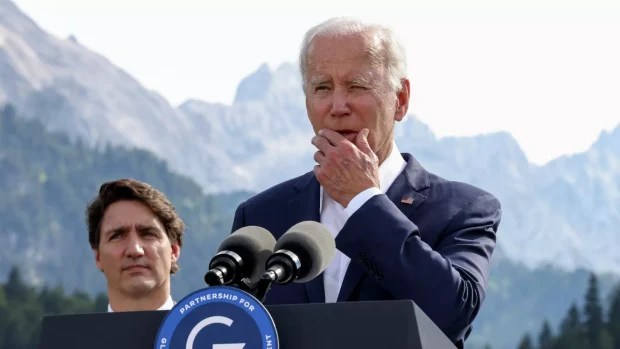
Washington will significantly increase its military presence in Europe to “defend every inch of allied territory,” US President Joe Biden said on Wednesday after arriving in Madrid, Spain for the annual NATO summit.
The US 5th Army Corps will set up a headquarters in Poland, while 5,000 additional troops will be deployed to Romania.
The Pentagon will also boost rotational deployments in the Baltic states, dispatch two additional squadrons of F-35 fighter planes to Britain, and station additional air defenses in Germany and Italy. The US Navy will increase the number of destroyers stationed in Spain from four to six.
There are already around 100,000 US troops stationed in Europe. “We’re stepping up, proving that NATO is more needed now than it ever has been and it’s as important as it ever has been,” Biden said.
NATO has been boosting its military presence on its eastern flank after Russia sent troops to Ukraine in late February. The military bloc’s chief, Jens Stoltenberg, said on Monday that the alliance will increase its rapid-response force from 40,000 to 300,000 troops.
Russian President Vladimir Putin cited NATO’s attempts to establish “a foothold” in Ukraine as one of the causes of the conflict.
Bobbie Anne Flower-Cox | Session 108: fiat iustitia
ATTORNEY AT LAW BOBBIE ANNE FLOWER-COX INTERVIEWED BY REINER FUELLMICH AND VIVIANE FISCHER (June 10, 2022)
Guest:
Bobbie Anne Flower-Cox – Attorney at Law, New York with focus on representing New Yorkers on
matters pertaining to over-reaching government agencies or departments.
About:
As an attorney in NY and during this year she has been in a lawsuit against Governor Kathy Hochul and the NY Dept of
Health over their illegal “isolation and quarantine camp” regulation.
This regulation allows the government to take someone out of their home, quarantine them just because they assume
they have been exposed to a disease, and they don’t even have to prove that the person really has a disease.
They can even remove just one person from a family unit!
The Corona Committee was founded on the initiative of attorney and economist Viviane Fischer and attorney Dr. Reiner Fuellmich. It is conducting a review of evidence on the Corona crisis and measures.
Learn more about the committee:
https://corona-investigative-committee.com
Anonymous tips to the Corona Committee:
https://securewhistleblower.com
Dr. Reiner Fuellmichs english Telegram channel:
https://t.me/s/ReinerFuellmichEnglish
Tor:
http://2hfjtvg32qm6kjo2esoqu3djhc6xctn2wofnkrpc4vjez47a5wei44qd.onion
Only through your donation the work of the Committee is possible:
https://corona-investigative-committee.com/donate/
California bill 2273 would require websites and apps to verify visitors’ ID
By Didi Rankovic | Reclaim The Net | June 28, 2022
California’s bill CA AB 2273, designed to enact the Age-Appropriate Design Code (AADC) is just one among the bills raising concerns in terms of how they might negatively affect the web going forward.
Like their counterparts in the EU, legislators in California, according to their critics, present online child safety as their only goal – and a stated desire to improve this is hard to argue with, even when arguments are valid – such as that the proposed bills may in fact do nothing to better protect children, while eroding the rights of every internet user.
Among other things, AB 2273 aims to require sites and apps to authenticate the age of all their users before allowing access. Attempts to introduce mandatory age authentication have also cropped up in other jurisdictions before, but have proven controversial, technically difficult to implement, with a high potential to compromise user data collected in this way, and intrusive to people’s privacy.
In California, the situation doesn’t look much different as critics of this bill say that authentication will require site operators and businesses to deal with personal data collection from every user, and worry about using and storing it securely.
We obtained a copy of the bill for you here.
In addition, some kind of government-issued ID – or surrendering biometric data such as that collected through facial recognition – is necessary to prove one’s age in the first place; and this is where forcing sites and services to require this information would effectively mean the end of anonymity online.
As ever, this is a threat that is disproportionately felt by vulnerable categories of internet users such as various dissidents, contrarians, minorities, as well as whistleblowers and activists. And, the right to remain anonymous online also ties in with First Amendment protections in the US.
Anonymity is under threat considering that age authentication would be imposed on all internet users, and it also means that the way people use the internet today would change for good from the user experience point of view, with “age authentication walls” raised by websites. On top of that, the verification would have to be persistent (or require users to repeat the process each time they access a site or service), further aggravating privacy and data security concerns.
2022 is the year of US (midterm) elections, so focusing on this type of “feelgood” legislation, such as making children safe, is a way politicians are expected to pander to their constituencies, regardless of all the “unintended consequences” or even the low likelihood that the scheme could be efficiently implemented, purely from the technical point of view.
In other words, these proposals are not properly thought through or debated, and aren’t even based on particularly successful attempts to square the same circle elsewhere in the world. The AADC is said to be inspired by UK’s Children’s Code, aka, Age Appropriate Design Code, which is a set of standards.
With the California proposal, the scope of issues covered by the bill is of particular concern to its critics. Privacy and safety of children are only one direct component, with others reaching as far as content moderation and consumer protection in general.
This raises fears among those critical of the bill that broad regulation of the internet could be introduced thanks to a seemingly innocuous act, in effect giving California Privacy Protection Agency (CPPA) new powers that would allow it to start acting as the state’s overall internet regulator.
And the CPPA is seen as an agency that is neither interested nor competent enough to strike the right balance between a number of sensitive issues that would be covered by the new law, while at the same time getting the chance to usher in more censorship.
US federal legislation that deals with the same issue, Children’s Online Privacy Protection Rule (COPPA) kicks in when online services are aware that their users are younger than 13; with the CPPA, these services are expected to assess when it is “reasonable to expect” a child – under 18- might be accessing them.
The plan is currently for the act to become law and be enforced to enact the AADC starting July 1, 2024, but the current wording of the draft leaves it unclear who exactly, and how it would be enforced.
Critics warn that among those considered in California this year, AB 2273 is a bill of particular concern, given the possible consequences.
Why G7’s Program for Developing Countries is Still No Match for China’s Belt & Road
Samizdat – 28.06.2022
The G7 on 26 June re-launched its previous Build Back Better World program to provide infrastructure funds to poor and developing nations under a new name, the Global Investment and Infrastructure Partnership. The project aims to compete with China’s Belt and Road Initiative kicked off by Beijing in 2013.
The Build Back Better World (B3W) program was pompously announced by the club of seven developed nations to counter China’s Belt and Road at the G7 Summit in Cornwall in July 2021. However, little had been heard of the G7’s endeavor since then. In June 2022, the Group of Seven decided to breathe new life into the project.
“So far, America has failed to build momentum on its plan to Build Back a Better World,” says Francesco Sisci, a Beijing-based China expert, author, and columnist. “However, with this new G7 plan, which includes other countries, this momentum could start to be built. It is a question mark. Nobody is sure until things are realized. But you cannot just underestimate and dismiss this plan, because there is a large commitment of many countries with a large economy and this plan could make big sense.”
The G7’s grand design envisages laying a secure sub-sea telecommunications cable that will connect Singapore to France through Egypt and the Horn of Africa; creating a COVID-19 vaccine plant in Senegal; expanding solar projects in Angola, including solar mini-grids and home power grids; and establishing an innovative modular nuclear reactor plant in Romania, among other issues.
The US president pledged to mobilize $200 billion in investments in global infrastructure projects over the next five years. The overall investment, including G7 member states and private capital, is expected to reach $600 billion.
“With two competing plans – size matters, at the end of the day,” says Sisci. “That is, China may be able to immediately finalize a lot of money in a short time in a number of projects. The G7 countries could be slower, but eventually they could build up momentum and they could channel much more money much more effectively, perhaps, in a much larger number of projects which could stifle Chinese projects.”
Sisci suggests that the club of developed capitalist countries “may end up being more effective in many ways [than China], a smaller non-capitalist country.”
“China, but also Russia, by far, don’t have the size, the gravitas to oppose even a divided G7, which is coming together because of this opposition to China or Russia-driven projects,” he notes.
G7 Economic & Geopolitical Hurdles
However, some other observers express skepticism over the ability of the US and G7 to implement the project given record-high inflation and cost of living crisis currently engulfing the states. The US, British and European central banks are struggling to tame skyrocketing inflation by raising interest rates to reduce demand, which is prompting recession fears.
“Washington claims they are going to be sending over $200 billion. But where’s the money coming from and how is it going to be really used?” asks Thomas W. Pauken II, the author of “US vs China: From Trade War to Reciprocal Deal,” a consultant on Asia-Pacific affairs and a geopolitical commentator.
He notes that previously the US Senate voted Biden’s landmark Build Back Better initiative down, and for good reason, as Republican congressmen feared that the Democratic administration’s spending spree would fan inflation and increase an already bloated national debt.
Pauken also expresses bewilderment over the G7’s apparent readiness to embark on the bold international project at a time when the group is involved in the Ukraine crisis with the UK trying to keep the military conflict dragging on. “I mean, it’s laughable that they have to think about [competing with] China at this time when they’re on the brink of a major war in Europe,” the commentator remarks.
Meanwhile, the G7’s Global Investment and Infrastructure Partnership cannot be regarded so far as a viable alternative to the Beijing-led Belt and Road Initiative that has been implemented for slightly less than a decade, according to Pauken.
“First of all, [the G7] actually need[s] to make these projects work,” says the geopolitical commentator. “Other than that solar plant in Angola, I don’t see any of these initiatives really working.”
In particular, China invested almost $59.5 billion in its comprehensive infrastructure project in 2021 alone. When it comes to crucial elements of the project, the West appears to be lagging behind. While the G7 is still considering building a subsea cable linking Europe and Southeast Asia, China kicked off its Digital Silk Road (DSR) almost seven years ago. The DSR’s backbone is the Pakistan and East Africa Connecting Europe (PEACE), a 9,300 mile long subsea cable network meant to tie Asia, Africa, and Europe together. The network is designed to transmit over 16Tbps per fibre pair with its Mediterranean section going from Egypt to France having already been laid.
Are Emerging Economies Interested in the G7 Agenda?
There is yet another problem as to how to make these Western projects attractive for Global South nations, the Asia Pacific expert continues. In particular, the G7 has been pushing ahead with a climate change agenda and the plan to cut carbon emissions, which is not relevant for the majority of third-world states which are still reliant on cheaper and more reliable fossil fuels and coal plants, he notes.
“You also have to deal with auditing issues as well as the so-called climate change consultants who go on the ground and on site,” he says. “You have to prove that those infrastructure projects are not causing much of a carbon footprint. But most of the major infrastructure does require a big carbon footprint, especially in the emerging markets, because they don’t have the same equipment or they don’t have the same standards or labor laws as they would have in Western Europe or the US.”
Many emerging economies, including African countries, are beginning to have a growing frustration with the US and Europe, according to Pauken. The reality is that Africans and many of the emerging markets want to focus on economic stuff, he notes. However, when the US officials come in, they’re talking about climate change or gender equity, and this is not as interesting to developing nations, the commentator emphasizes.
“[Developing nations] want help on improving their agricultural production levels and boosting their energy capacity, which the Russians and the Chinese have been doing,” Pauken notes.
Given all of the above, it is unlikely that the G7’s Global Investment and Infrastructure Partnership initiative is going to actually happen, argues the geopolitical commentator.
“They’re rebranding a failed policy, thinking it might work by using new names and new mergers. Last time it was separate between the EU and separate between the US and they somehow think that if you combine the two failed projects into one, that this will somehow succeed. That’s not going to work in the real world,” Pauken concludes.
Zionist Regime Unable to Defend Itself: IRGC Chief
Al-Manar | June 28, 2022
The commander of the Islamic Revolution Guards Corps cautioned Islamic countries’ governments to avoid relying upon the Zionist regime, which is unable to even protect itself.
In a meeting with Chairman of the Joint Chiefs of Staff Committee of Pakistan General Nadeem Raza in Tehran, Major General Hossein Salami slammed the Zionist regime as the enemy of the Islamic world and humanity.
The IRGC commander also warned regional rulers of the bitter consequences of normalization of ties with the “child murdering Zionists”, saying the US, the main supporter of the Israeli regime, is basically the enemy of Islam.
“The question is that while the Zionist regime cannot even defend itself and is a regime absolutely without any policy, how would certain Islamic countries rely on it to ensure their security or safeguard their economy? There is no logic behind it,” Major General Salami added.
He further pointed to the awful results of the presence of American forces in the Islamic world, including the great seditions, long civil wars, destruction of houses, displacement of people, insecurity, poverty and underdevelopment.
“When we look at Afghanistan, we notice the harmful and irreparable effects of American interference,” the general added, noting that the neighboring countries, including Pakistan, suffer from the consequences of destructive US interference in Afghanistan.
He also highlighted the integrated security of Iran and Pakistan, stressing the need for closer cooperation between Tehran and Islamabad in all fields, especially in protecting the security of the common border and fighting against terrorism.
For his part, the Pakistani general pointed to the commonalities between the Pakistani and Iranian nations, decried divisions within the Muslim world as a result of the US and Western plots, and noted that Americans withdrew from Afghanistan after twenty years without managing to establish security in that country.
General Nadeem Raza also emphasized the necessity of intelligence and operational cooperation with Iran in protecting the security of the joint border.
Featured Video

John Mearsheimer Talking Iran with Iran
or go to
Aletho News Archives – Video-Images
New Book
The silver that medicine dropped — four thousand years of clinical use, four decades to erase.
Colloidal Silver — First Edition, 2026, Paperback
Lies are Unbekoming | October 16, 2026
Silver was medicine. Not alternative medicine. Not folk medicine. Medicine. In surgery. In obstetrics. In the burn ward. In water treatment. In the household medicine chest. Every physician before 1938 knew this.
By the 1870s, silver nitrate was standard in surgical wound care across the leading hospitals of Britain, Germany, and the United States. Colloidal silver preparations — Collargol, Argyrol, Protargol — entered European and American practice through the 1890s and early 1900s and became standard antiseptics in military field medicine. By the time Fleming grew his first penicillin mould in 1928, silver was the first-line antimicrobial of the Western pharmacopoeia. The Lancet and the British Medical Journal carried the clinical reports in volume. The practice ran continuously through the Victorian era, the Edwardian era, the First World War, the interwar period. By 1980, almost all of it was gone.
What has not been treated at book length, until now, is how a four-thousand-year clinical record disappeared from mainstream medicine within four decades of the Flexner Report — and what the honest account of silver looks like once that record is reassembled.
Colloidal Silver reconstructs the pre-1938 record from The Lancet, the British Medical Journal, and the primary literature of the era; recovers Robert Becker’s bioelectric framework from the regeneration research the pharmaceutical model buried; and places silver inside a practical terrain-paradigm guide to its current place — in water, on the body, inside the body, and in the chronic conditions where antibiotics have failed. … continue
Blog Roll
 Aletho News
- Pharma- and Gates-Funded GAVI Seeks to Assure Parents
- John Mearsheimer Talking Iran with Iran
- Inside Bill C-22, Canada’s Patriot Act.
- China’s FM: Palestinian cause is ‘greatest injustice of the century’
- US sympathy for Palestinians surpasses support for Israelis
- Israeli rabbi permits occupiers to steal Palestinian olive harvest in West Bank
- Spanish firm sells Latvia vehicles equipped with Israeli tech despite arms embargo
- Saudi Arabia under fire… Yemen is burning down the House of Saud
- Israeli Spy Pollard stole the files, today’s it’s delivered through official channels
- Why Iran Didn’t Walk Away
- If Americans Knew
- NPR investigation finds evidence of widespread fraud at mall kiosks tied to Israeli skincare brand
- Tucker Carlson exposes Israeli Lies about the Oct 7th attack, Charlie Kirk, and the U.S.
- Israel has detained thousands of Palestinian children since Oct 7th – over half spent time in solitary, many uncharged
- Israeli Analysis: Is Netanyahu Planning an ‘October Surprise’ Attack Before Israel’s Election?
- Israeli settlers brutally attack Palestinians and Washington Post female photographer, 65
- Words Have Changed, Occupation Continues: The Reality of the Gaza Ceasefire
- Gaza’s child amputees are growing faster than their prosthetics allow
- Israel keeps Palestinians struggling just to survive–Daily Update
- Israeli firm used online ads to run vast spy operation, researchers say
- No, the world zionist movement is not an antisemitic conspiracy theory
- No Tricks Zone
- New Study Suggests Large Regions Of The Pacific Ocean Have Been Cooling For The Last 80 Years
- Germany’s Green Energy Debacle: High Energy Costs Force Kahla Porzellan to Close After 182 Years!
- New Study: 50 Years Of The Most Aggressive ‘Net Zero’ Policies Can Only Affect The Global Climate By 0.03°C
- US September “Heat” Was No Record…Many Records Set Decades Ago
- Latest European Green Energy Debacle; Portugal’s Largest Flagship Solar Park Insolvent!
- Green Energy Debacle: German Expert Professor Fritz Vahrenholt Warns Of Severe Economic And Social Consequences
- Two More Paleo Reconstructions Affirm Meters-Higher Sea Levels Across Ireland, Brazil 7000-6000 Years Ago
- New Study: Earth And Venus Surface Warmth Largely Explained By Convection And Lapse Rate, Not CO2 Or Radiation
- 2025 Nature Paper Claiming Worsening Global Drought Gets RETRACTED …Heavily Flawed
- New Study: ‘Global Drought Shows No Detectable Recent Acceleration Under Climate Warming’

