Connecticut to hire “misinformation” expert who will urge social media sites to censor “false” posts
By Tom Parker | Reclaim The Net | May 31, 2022
Connecticut plans to pay a “misinformation” expert $150,000 per year to scour the internet for election content that they deem to be “false” and then urge social media platforms to flag or remove posts containing this information.
According to The New York Times, this misinformation expert will flag information that’s going viral, memes, and “emerging narratives.” They will also be instructed to look for this information on alt-tech platforms such as GETTR and Rumble.
Connecticut officials said they would prefer candidates that are fluent in English and Spanish so that they can target misinformation in both languages.
Connecticut is one of several Democrat-controlled states that are launching efforts to flag and censor misinformation in the run-up to the 2022 US midterm elections.
Colorado is redeploying a “Rapid Response Election Security Cyber Unit” that it created for the 2020 election. This unit is made up of three election security experts who will surveil the internet for election misinformation and report it to federal law enforcement.
And California’s office of the Secretary of State is working with the Department of Homeland Security (DHS) and academics to search for “patterns of misinformation across the internet.”
In addition to these flagging and censorship efforts, Colorado, Oregon, Idaho, and Arizona will also be spending millions of dollars on ad campaigns that push “accurate” election information.
Colorado’s Democratic Secretary of State, Jena Griswold, will head the Rapid Response Election Security Cyber Unit. She justified her team’s flagging of misinformation to federal law enforcement by claiming that “lies are being used to chip away at our fundamental freedoms.”
Connecticut’s Deputy Secretary of the State, Scott Bates, justified his state’s misinformation censorship program by insisting that the state needs to have “situational awareness by looking into all the incoming threats to the integrity of elections.”
Bates added: “Misinformation can erode people’s confidence in elections, and we view that as a critical threat to the democratic process.”
While representatives of these states are framing these programs as a way to boost confidence in elections and protect the democratic process, Tom Fitton, founder of the conservative, non-partisan educational foundation Judicial Watch, argued that these states are “setting up ‘Ministries of Truth’ to censor Americans.”
These programs are the latest of many online censorship initiatives pushed by politicians that raise First Amendment flags. Some other examples include the recently paused DHS “Disinformation Governance Board” which was launched with the intention of fighting “disinformation,” the Biden administration’s admission that it flags content for Facebook to censor, and Democrats working with Twitter to get tweets taken down.
Critics have argued that programs that involve public officials flagging speech for Big Tech platforms to censor violate the First Amendment because the government is coercing these private companies to censor on its behalf. However, courts have so far dismissed lawsuits that allege these public-private censorship initiatives violate the First Amendment.
A lawsuit that was filed in March and alleged that several of the Biden administration’s actions, including its admission that it flags content for Facebook to censor, violated the First Amendment was dismissed in May.
Journalist Alex Berenson’s December 2021 lawsuit, which accused Twitter of violating several laws when banning his account and alleged that the federal government coerced Twitter to deprive Berenson of his right to speak, was recently allowed to proceed but the First Amendment claim was dismissed.
Duque forces MNNA status on Colombia despite unpopularity of NATO
By Paul Antonopoulos | May 31, 2022
Colombian president Iván Duque announced on his social media that his country is officially a non-NATO strategic ally. With less than two months to go until the end of his government, the Colombian president will seemingly be replaced with a centre-left candidate, the first in the country’s history.
“We welcome the memorandum sent by US President Joe Biden and the Secretary of State, which formalizes the designation of Colombia as a strategic non-member ally of NATO. A decision that reaffirms the good ties in our bilateral relations,” Duque wrote on Twitter on May 23.
The South American country will now have privileges when it comes to accessing the US military industry and extensive financing for procurements. However, this action by Duque has not been welcomed by the Colombian opposition, who showed their rejection of the announcement and reiterated that it is just one more move by the current administration to try and bolster the presidential elections that will have its second round on June 19.
Sandra Ramírez, a senator for the opposition Commons Party, said: “Colombia as an extra ally of NATO does not benefit us at all. On the contrary, we join their interventionist and war policies. In addition, it goes against sovereignty, which in the end is the voice of the majority of Colombians, and which is anchored to the self-determination of the peoples.”
Ramírez highlights that it is a simple lobby on the part of Duque, who has always put his personal interests above Colombia. “Surely that’s what his advisers told him and that’s why he spent so much time lobbying and not governing. NATO represents a policy of war and here we want a policy of peace and social inclusion to prevail. With this agreement we will continue to be at the mercy of US interests, which we reject.”
With Gustavo Petro, founder of the centre-left Humane Colombia, leading the polls and expected to be the next president of the Latin American country, Ramírez says he must reverse Duque’s decision and leave the NATO program immediately to focus his energies on solving local problems instead.
Another Commons Party Senator, Carlos Antonio Lozada, says that according to his sources, “Petro will get out of any military agreement that ties us to the geopolitical interests of the United States, which would be aimed against strengthening regional integration.”
A Major Non-NATO Ally (MNNA) does not mean that in the event that Colombia suffers external aggression, the US will intercede to protect the country, as is the case with actual members states. In this way, Colombia’s only advantage is that it can gain access to American weapons – at a time when much of South America is moving towards the just as effective but far cheaper Russian and Chinese weaponry.
The process for Colombia’s MNNA status began on March 10 during the meeting between Duque and Biden at the White House. Colombia thus joined the list of 17 MNNA countries, being the third in Latin America after Brazil and Argentina. The other allies are Australia, Egypt, Israel, Japan, South Korea, Jordan, New Zealand, Thailand, Kuwait, Morocco, Pakistan, Bahrain, the Philippines, Afghanistan and Tunisia.
Colombia having MNNA status certainly makes the June 19 election all the more interesting, especially when considering this could be the country’s most historic election as for the first time a progressive candidate could be president of the country.
As Colombia has a central place for US policy in Latin America, the second round vote then holds an even greater importance for Washington, which closely observes events in the world’s leading cocaine-producing country.
For the South American country, a progressive government could mean more favorable conditions for the strengthening of Latin American integration. Colombia, with its first potential progressive president, could leave behind a foreign policy that looks exclusively at the US and be an active part of continental integration. But until then, the question remains whether Petro would engage in the task of reversing Colombia’s MNNA status.
Paul Antonopoulos is an independent geopolitical analyst.
Kremlin Responds to Claims Putin is Terminally Ill
By Paul Joseph Watson | Summit News | May 31, 2022
Russia has responded to claims that keep appearing in western media outlets, including those made by ‘peegate’ dossier author Christopher Steele, that Vladimir Putin is dying of a terminal illness.
Lurid assertions about Putin’s health appear to be part of a black propaganda campaign to deflate the ‘masculine’ image Putin tries to portray, given that they appear to be backed by no actual evidence whatsoever.
Indeed, the much vaunted ‘fact-checkers’ seem to be AWOL on this one.
The claims, which are almost always made by anonymous intelligence officials, include;
– Putin has Parkinson’s disease.
– Putin has dementia.
– Putin has blood cancer.
– Putin is suffering from “chemo brain”, a cognitive impairment caused by cancer treatment.
– Putin recently underwent major surgery.
– Putin is taking steroids to hide his symptoms.
– Putin is “constantly” being followed around by doctors.
– Putin is fooling the word by using “pre-recorded appearances.”
– Putin is using “body doubles” and “actors” to fulfil his public appearances.
– Putin’s health woes have weakened his grip on power, which is now tenuous.
– Putin may even be dead already but that it won’t be admitted for “months” to avoid a Kremlin coup.
Of course, no one knows the true state of Putin’s health because NATO-aligned spies and corporate media outlets will always seek to play up the most dire speculation in an effort to undermine the Russian president.
One insight into the veracity of such reports is that the claims are being amplified by British spy Christopher Steele, who infamously authored the dubious Trump dossier which has been roundly debunked.
The report, which was funded by Hillary Clinton’s campaign in an effort to get dirt on Trump, ludicrously claimed that Trump had visited Moscow to have women urinate on him.
“It was later revealed that Trump did not go to Russia when Steele claimed he did, and that Steele’s primary source for the document was based in the United States, not Russia. That source later personally debunked the “pee tape” allegation while speaking to the FBI,” writes Tom Pappert.
Even the New York Times was forced to acknowledge that Steele’s work has been “discredited,” so his claims on Putin’s health should be taken with a grain of salt.
Russia has now officially responded to the claims in the form of a statement made by Foreign Minister Sergei Lavrov, who stressed that Putin makes daily appearances in public.
“You can see him on TV screens, read, and listen to his speeches. I don’t think that a sane person can suspect any signs of an illness or ailment in this man,” said Lavrov.
“I’ll leave it on the conscience of those who disseminate such rumors despite daily opportunities for everyone to see how he and others look like,” he added.
Greek Opposition Demands Legal Clarification for Confiscation of Iranian Oil at US Behest
Samizdat | May 31, 2022
ATHENS – Greek largest opposition party, Coalition of the Radical Left – Progressive Alliance (SYRIZA), on Tuesday asked the Greek government to clarify the legal grounds for the confiscation of Iranian oil from a former Russian-flagged tanker at the request of the United States.
“What was the legal basis for the US request for legal assistance in confiscating oil from the tanker? Was the proposal of the [Greek] anti-money laundering authority to continue the detention of the Russian ship contrary [to the US request]? On what legal basis did the ship remain detained during the time between the cancellation of the original decision about its arrest by the anti-money laundering authority and the decision of the one-judge trial court of Chalcis to grant the US request?” the party said in a statement.
The party added that initially, the anti-money laundering authority decided not to confiscate Iranian oil or detain the tanker. US sanctions against Iran are not considered legal by the EU and Greece, the party noted.
The party also asked what actions had been taken for the immediate release of the crew, and why Greece did not receive significant support from the US, which initiated the process of confiscation.
Last Friday, Iran’s armed forces captured two Greek-flagged oil tankers — the Delta Poseidon and the Prudent Warrior — in Persian Gulf waters, reportedly in response to the seizure of the Iranian-flagged tanker Lana in Greek waters in mid-April on suspicion that it was avoiding EU sanctions. The US claimed that the vessel was carrying Iranian crude, subject to US sanctions, and requested that the cargo be handed over to it, despite later reports that it was a Russian-flagged tanker Pegas that had changed its ownership before entering Greek waters.
A World at War?
Biden lashes out against “enemies” as our country declines
BY PHILIP GIRALDI • UNZ REVIEW • MAY 31, 2022
One recalls that when war fever surged demanding intervention by Imperial Britain in the Russo-Turkish War of 1877, a song became popular in the music halls which included “We don’t want to fight, But by Jingo if we do, We’ve got the ships, we’ve got the men, we’ve got the money too.” If the refrain sounds familiar, it should as the United States has been experiencing extreme “jingoism” since 2001. Any rejection of the “rules based international order” established and policed by “leader of the free world” Washington has resulted in immediate punishment by sanctions followed by threats of military intervention. In some cases, as in Afghanistan, Iraq, Libya and Syria, the actual armed intervention seeking regime change has been the end result. And it is all done to spread “freedom” and “democracy,” a claim that might be disputed by the millions of dead mostly Muslims who have had to suffer the consequences.
So the United States of America has been a country, like its best friend Israel, that seems to be perpetually at war… so what else is new? What’s new is that under President Joe Biden there has been zero diplomacy and almost reflexive reliance on wielding the “big stick.” To quote another bon mot from one of my favorite authors Raymond Chandler, creator of private eye Philip Marlowe, “… when in doubt, have two guys come through the door with guns.”
Don’t worry, Chandler’s two guys and many more like them are now in Ukraine under cover and in mufti training Ukrainians to use all the nifty Raytheon and Lockheed toys Uncle Joe has sent them. They are working together with the largely neocon advisers coaching Ukrainian President Volodymyr Zelensky, who is guarded by British and US special forces, on what to say and do during his increasingly strident international calls to widen the war. If they are successful and manage to sink another Russian ship or two using harpoon missiles, which Zelensky is threatening to do, the proxy US war with Russia could quickly become for real. Zelensky’s family meanwhile is reportedly safely ensconced in an $8 million villa in Israel. He also has a multi-million dollar villa property near Miami and another in Tuscany. Who would have thought that being president of the poorest country in Europe could bring such material rewards?
Australian journalist Caitlin Johnstone, who has a huge worldwide audience, opines that Biden is possibly the worst US president ever, worse even that his consistently denigrated predecessor and media punching bag Donald Trump. Her recent article succinctly addresses what makes Biden’s egregious failure both different and incredibly dangerous. She writes “Preventing nuclear war is a US president’s single most important job. It’s so important you shouldn’t even really have to talk about it, because it’s so self-evidently the number one priority. And this administration is just rolling the dice on nuclear conflict with increasing frequency every day. Even if humanity survives this standoff (and the one with China that’s next in line), Biden will still have been an unforgivably depraved president for allowing it to get this close. There’s no excuse whatsoever for just casually rolling the dice on all terrestrial life like this.”
Indeed, Joe Biden’s latest tricks include declaring that the US will go to war with China to protect Taiwan if Beijing should prove so bold as to want to take control of its wayward province. But the US established policy is to maintain “strategic ambiguity” about China/Taiwan, a diplomatic solution crafted in 1979 to help prevent any provocations by either party that would lead to the situation developing into a shooting war. Joe seems to have missed that point, if he ever understood it in the first place, and certainly his advisers appear to be no more savvy than he is, though the White House quickly issued a correction on the apparent gaffe in the form of a statement that automatic defense of Taiwan is not official policy. Yet.
But my favorite move by the Biden Administration, if one might be so bold as to suggest that it is actually capable of administering anything more kinetic than a hot dog stand, is the latest pander to Israel. The recent murder by military sharpshooter of Palestinian/American journalist Shireen Abu Akleh followed by a humiliating spectacle of police violence at the funeral as well as subsequently at a second Palestinian funeral, actually found some administration flunkies and congress critters calling for a full investigation by Israel. The Israeli government and army refused to do so and the White House has pretended that there is no longer anything to see or consider. Israeli Defense (sic) Minister Benny Gantz recently visited Washington but the issue of a murdered American was not even raised as top officials tried to outdo each other in expressing both their love for and fealty to the Jewish state, which Biden will soon be visiting. The US president will ignore the fact that Israel is celebrating his visit with its greatest eviction of Palestinian residents in twenty years.
That the United States has been a major source of money, weapons and political cover for Israel since 1967 if not before is indisputable, the result of corruption of America’s government at all levels by the groups and billionaires euphemistically described as the “Israel Lobby.” War criminal Israeli leaders like Ariel Sharon and Benjamin Netanyahu have boasted about their control over Congress and the White House as well as the media and every time Israel does something atrocious the only US response has been to give it more money. Israel would sorely love to have the United States fights its wars, most prominently by attacking Iran, but somehow that military intervention and regime change, apart from a number of assassinations, has not yet taken place.
But now all of that might be changing due to a combination of the Biden regime’s recklessness and Israel’s genuine contempt for the American people, who they have been parasitically feeding off of since their settler state was founded. The US has, for the first time, participated in a large-scale military exercise with Israel on May 18th which was designed to simulate an attack on Iran using American Air Force refueling planes to enhance the ability of Israel to keep its jets flying to maintain air superiority over the Persians. It was a war game in the most literal sense even though the tanker aircraft did not actually refuel any Israeli planes and it basically commits the United States to be a dedicated participant if the Israelis should throw the dice and chance on a military attack on Iran’s presumed nuclear and air defense sites.
I also smell a possible false flag if the exercise is repeated, as it surely will be. What if one of the US planes taking part in a future exercise were to be shot down in an incident staged by Israel that might plausibly be attributed to Iran? As the exercises will presumably take place over the Mediterranean Sea in the coastal waters part of which Israel has inter alia stolen from Gaza and controls, bringing Iran into the equation would be difficult but possible to manage with enough cleverness combined with hubris, which the Israelis have in plentiful supply. That Israel would without hesitation shed American blood if it were to advance its own perceived interests should not be doubted by anyone. Look only at the two Israel false flag attacks against the US, the Lavon bombing incident in 1954 and the bloody assault on the USS Liberty in 1967, which killed 34 American sailors and injured more than a hundred others in an attempt to sink the ship and kill all its crew. That is the Israel America has grown to love and nourish, a viper in one’s bosom, always willing to strike the body that feeds it.
But to return to Caitlin Johnstone’s observation, America is in deep trouble. Its economy is visibly sinking while standards of living are dropping and will decline further as military spending grows while both the increasingly “woke” educational system and industrial base are no longer competitive. We have a plausibly psychopathic government that is bringing us to the brink of war with several nuclear powers. What we Americans need is not another war, but rather an end to war, particular those wars that can somehow kill most or even all of us. Instead, help build pressure to wind down the Ukraine war through negotiations, stop feeding Zelensky with weapons and money. Leave China alone and stop being Israel’s patsy against Iran and inside Syria. Try to get along with competitors. It would indeed be a Brave New World, wouldn’t it? A country at peace with itself and working to benefit the American people – something that we have rarely seen since 1945.
Philip M. Giraldi, Ph.D., is Executive Director of the Council for the National Interest, a 501(c)3 tax deductible educational foundation (Federal ID Number #52-1739023) that seeks a more interests-based U.S. foreign policy in the Middle East. Website is councilforthenationalinterest.org, address is P.O. Box 2157, Purcellville VA 20134 and its email is inform@cnionline.org.
Finland to Build New Air Base in Lapland for Its F-35 Fighters
By Igor Kuznetsov | Samizdat | May 31, 2022
The first of the 64 US-made F-35 fighter jets that will arrive in Finland in 2026 will be placed at a new air base in Lapland, its northernmost county. Its construction will begin this year and will cost the Nordic country 150 million euros ($161 million), the national broadcaster Yle reported.
According to the commander of the Lapland air base, Colonel Tuukka Karjalainen, the location was chosen based on its proximity to Norway, a NATO member which already uses F-35s. As of now, Finland’s northernmost air force base, in Rovaniemi, stages regular training missions with the Swedish and Norwegian air forces. To begin with, the new base will receive two to six new aircraft.
“The hope is that this will create opportunities for cooperation and facilitate the implementation of the technology,” Tuukka Karjalainen told Yle. “We are very pleased. We are proud to be adopting new equipment. The jobs at the Lapland air base will certainly attract many,” he added.
According to Karjalainen, auxiliary buildings, fences and roads will be built by the end of this year. The main construction will begin in the first half of 2023. Over the past two years, the cost estimate has soared by tens of millions of euros, with Karjalainen blaming stricter technical requirements and increased prices.
Pilots, mechanics and maintenance personnel will be trained in the US. According to Karjalainen, 18 pilots and about 50 technicians will go to the US for training in 2025. Later, they themselves will train specialists in Finland.
The Finnish Air Forces announced the purchase of 64 Lockheed Martin F-35 multi-role fighters back in February in an 8.4 billion euro ($9 billion) deal with the US defence contractor. The new fighters will replace Finland’s ageing fleet of F-18 Hornets, which is planned to be phased out by 2030.
Previously, Finland’s neighbours Norway and Denmark opted to make the F-35 the backbone of their air forces, procuring 52 and 27 fighter jets respectively.
Spill from transfer of seized Iran oil alarms Greek environmentalists
Press TV – May 30, 2022
Local sources in Greece are reporting a growing spill from the country’s transfer of oil from an Iranian tanker seized recently off the Greek coast.
They have published images of the pollution in the Greek port of Karistos, blaming it for “non-standard” transfer without observing environmental principles.
The spill has already drawn protests from local environmentalists, the report said.
“Even if only one-thousandth of a shipment leaks during the transfer process at sea, the environmental damage will be incalculable,” the Greek Environmental Protection Association Karistos said in a statement.
“We have a legitimate interest in requesting that the tanker be removed immediately from the Gulf of Karistos and relocated to a safe transfer area,” it said.
The statement said the Karistos environment should not pay “another heavy price for the government’s political choices, and the Russian tanker should leave the port”.
The tanker, carrying Iranian oil, was seized in Greek waters under the pretext of violating sanctions and its cargo was ordered by the US to be moved to another vessel.
Iran condemned the seizure “an example of international piracy”, the responsibility of which “lies with the Greek government and the illegal occupants”. The charge d’affaires of the Greek embassy in Tehran was summoned to Iran’s ministry of foreign affairs and notified of the Islamic Republic strong indignation.
The Ports and Maritime Organization of the Islamic Republic of Iran also issued a statement calling on the Greek government to fulfill its international obligations in this regard.
Earlier, Reuters quoted unnamed sources as saying that the US Department of Justice had confiscated 700,000 barrels of Iranian oil cargo off the southern Greek island of Evia on board a Russian-operated ship.
On Friday, Iran’s Islamic Revolution Guards Corps (IRGC) seized two Greek oil tankers in the Persian Gulf over violations.
“The IRGC Navy today seized two Greek oil tankers for violations they have carried in the azure waters of the Persian Gulf,” the IRGC said in a statement.
Earlier that day, Iran’s Nour News reported that the country was going to take “punitive action” against Greece over the Iranian tanker’s seizure.
Tasnim news agency said a total of 17 Greek ships were sailing in the Persian Gulf, warning of further confiscations if Greece continued to take orders from the United States.
At least nine crew members on board the vessels are currently in the IRGC custody. Officials have said they are not detained and are in good health.
Senior political commentator Mohammad Marandi told Press TV that by seizing the Greek-flagged tankers, Tehran intends to send a message to Washington and its allies, “warning them against harming Iran’s oil trade.”
Disquiet at Davos and the Unsaid Fear of Failure – The First Shoots of a U.S. Ukraine Shift

By Alastair Crooke | Strategic Culture Foundation | May 30, 2022
Klaus Schwab, passionate for Ukraine, essentially configured the World Economic Forum (WEF) to showcase Zelensky and to leverage the argument that Russia should be kicked out of the civilised world. Schwab’s target was the assembled crème de la crème of the world’s business leaders assembled there. Zelensky pitched big: “We want more sanctions and more weapons”; “All trade with the aggressor should be stopped”; “All foreign business should leave Russia so that your brands are not associated with war crimes”, he said. Sanctions must be all encompassing; values must matter.
Disquiet ran through the Davos set: The WEF is high-octane globalist, right? Yet this Schwab line suggests a de-coupling ‘on stilts’. It precisely reverses interconnectedness. Plus, the western generals in charge are saying that this conflict may last not just years, but decades. What will this signify for their markets in parts of the world that refuse action against Russia, the moneymen were wondering?
It is unlikely that this whiff of disorientation is what Schwab had intended. Perhaps the latter was more aligned with Soros’ later intervention that a quick victory over Russia was needed to save the ‘Open Society’ and civilisation itself – and that this was intended as the WEF 2022 message.
The Davos ‘greater disquiet’ emerged however, from an unexpected quarter. Just before the WEF began, the NY Times had run a piece from the editorial team urging Zelensky to negotiate with Russia. It argued that such engagement implied making painful territorial sacrifices. The piece attracted indignant and angry push-back in Europe and the West, possibly because – albeit couched as advice to Kiev – its target was evidently Washington and London (the arch belligerents).
Eric Cantor, a former whip in the U.S. House of Representatives (a legislator well versed on Iran sanctions), also at Davos, questioned whether the West would be able to maintain a united front in pursuit of such maximalist aims as Zelensky and his Military Intelligence Chief have demanded. “We may not get the next vote”, Cantor opined (in wake of the $40 bn vote ostensibly earmarked for Ukraine).
Cantor said excluding Russia entirely would require secondary sanctions against other countries. This would place the West into a head on clash with China, India, and the almost 60 states which had refused to back a UN resolution denouncing Russia’s invasion. He warned that the U.S. may be in danger of overplaying its hand.
Then spoke the redoubtable Henry Kissinger, also at Davos. He warned the West to stop trying to inflict a crushing defeat on Russian forces in Ukraine, saying that such would have disastrous consequences for the long-term stability of Europe. He said it would be fatal for the West to get swept along in the mood of the moment and forget the proper place of Russia in the European balance of power.
Dr Kissinger said the war must not be allowed to drag on and came close to calling on the West to instruct Ukraine to accept terms that fall very far short of its current war aims: “Negotiations need to begin in the next two months, before it creates upheavals and tensions that will not be easily overcome”.
What is going on here? In a nutshell, we are seeing the first inklings of fractures appearing in the U.S. stance on Ukraine. The fissures in Europe are already very plain, both on sanctions and mission aims. But Cantor’s comment that “we may not get the next vote” needs further unpacking.
In an earlier piece, I argued that Senator JD Vance’s win in the Ohio primaries for a Senate seat could be telling. His candidature was backed by Trump, who later issued an ‘End the war’ call. Now the key tell-tale is Republican Senator Josh Hawley – ambitious and known to have leadership aspirations.
Early in the Ukraine war, Senator Hawley was calling Zelensky, lauding him highly and egging him on. But then he pivoted. Hawley subsequently blasted the $40 billion in proposed aid to Ukraine, after voting ‘no’ on the procedural vote to move forward with the aid package “as not being in America’s interests”.
At first, as some may recall, there were 6 House votes against the bill – then 60. And in the Senate, first there were zero then there were 11 votes. The Bill was rushed through as vote managers were concerned that the vote could crumble further.
What is going on? Well, the Republican ‘populist’ current, never enamoured at foreign aid, was shocked at the $ 40 billion for Ukraine when the U.S. lacked baby milk, (and itself had to rely on foreign baby milk aid). This political current is becoming more significant and having more impact as a result of a structural shift. Political candidates, and now even some U.S. think-tanks are turning to crowd-funding as a principal source of finance – moving away from the ‘established’ donors. Thus, the broad ‘anti-foreign entanglement’ sentiment is gaining heft.
Of course, the $40 billion is not all going to Ukraine. Not at all. According to the details of the Bill, the bulk will go to the Pentagon (for equipment already supplied by the U.S. and its allies). And a big chunk will go to the State Department, to fund all sorts of ‘helpful’ non-state actors and NGOs – i.e. it is a deep state budget with Ukraine packaging. The six billion allocated directly for new arms to Ukraine in fact comprises both training and weapons, so much of that will end in the pockets of states such as UK and Germany, giving ‘out of theatre’ training to Ukrainians in their own, or in neighbouring countries’ territory.
Eric Cantor, and other Americans at WEF may frame their disquiet over western objectives in ‘polite company’ as simply articulating their uncertainties over America’s grand strategy – whether the U.S. is trying to punish Russia for its aggression, or whether the goal is a subtler use of policy that gives the Kremlin a ‘route out of sanctions’, were it to changes course. But behind the narrative lies a darker fear. The unsaid fear of failure.
What does this mean? It means that the West’s ultimate war aims in Ukraine have so far been able to stay opaque and undefined, the details swept aside in the mood of the moment.
Paradoxically, this opacity has been preserved despite the public failure of the West’s first statement of aims – which was that the seizure of Russia’ offshore foreign reserves; the Russian bank expulsions from SWIFT; the sanctioning of the Central Bank; and the broadside of sanctions would, in and of itself alone, turn the rouble to rubble; cause a run on the domestic banking system; collapse the Russian economy; and provoke a political crisis that Putin might not survive.
In short, ‘victory’ would be quick – if not immediate. We know this, because U.S. officials and the French Finance Minister, Bruno Le Maire bragged about it publicly.
So confident in a quick financial-war success were these western officials that there seemed little need to invest deep strategic reflection on the aims or the course of the secondary Ukrainian military thrust. After all, a Russia already economically collapsed, with its currency ruined and its morale broken, would likely put up little or no fight as the Ukrainian army swept across Donbas and into Crimea.
Well, the sanctions have proved a bust and Russia’s currency and oil revenues are bountiful.
And now, western politicians are being warned in the media, and by their own military, that Russia is ‘close to a major victory’ in Donbas.
This is the unspoken fear disquieting Davos attendees – fear of another débacle, following that of Afghanistan. One made all the worse as the ‘war’ on Russia boomerangs into an economic collapse in Europe, and with NATO’s eight-year investment in building-up a successful proxy-army to NATO standards turning to dust.
This is what Kissinger’s comments – decoded – urge: ‘Don’t procrastinate’; get a quick deal (even an unfavourable one), but one that can be dressed up, and somehow spun as a ‘win’. But don’t wait, and let events lead the U.S. into yet another unmistakeable, undeniable débacle.
This is still ‘under the kitchen table talk’ in the U.S. for now, as the power of a narrative, invested with so much emotion, and bolstered by unprecedented info-war peer-pressure has masked such thoughts from public expression. Fractures nonetheless are beginning to be apparent. Something stirs – and Europe inevitably will follow wherever America leads. But for now, the hawks remain firmly in ‘the chair’ (in the U.S., in London, Poland, the EU Commission and in Kiev).
The big question, however, is why Moscow would take such a ‘way out’ (even if it was offered it). A compromise deal would be seen there as simply Kiev given the chance to regroup, and to try again.
Five killed by Ukrainian shelling of schools and residential buildings – Donetsk authorities
Samizdat | May 30, 2022
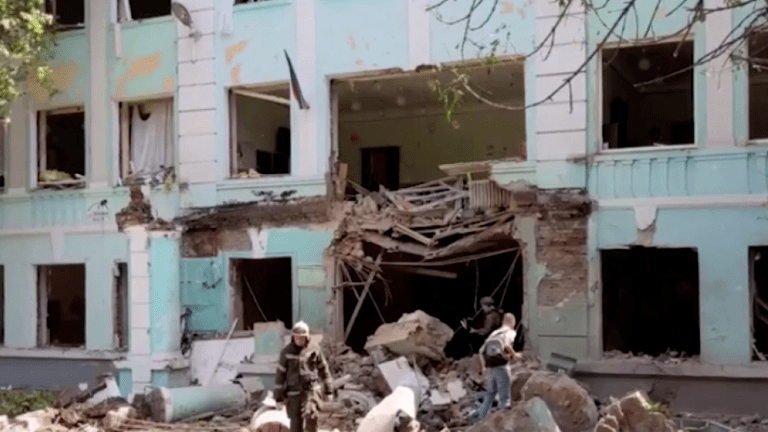
Ukrainian shelling of Donetsk has left at least five people dead, and 18 others injured, local authorities of the Donetsk People’s Republic (DPR) said on Monday. According to local officials, a teenage girl is among the fatalities. The strikes damaged several civilian facilities in the city, including schools and residential buildings.
Preliminary reports allege that US-supplied artillery may have been used in the attacks. In one home, two 14-year-old girls were hurt, Mayor Aleksey Kulemzin said. One of them died while the other one was taken to hospital.
Three civilians were killed, and a dozen others injured at two schools, the mayor claimed. Two people were in serious condition, he added.
The headmistress of one of the schools, Olga Rachinskaya, told the media that many of the teachers “were lacerated with shrapnel”. She said the two workers who were killed were elderly.
“This is just an ordinary school. There is nothing military here, nothing,” she said. Luckily, Donetsk schools teach remotely, so students were not in the classrooms when the shells hit, according to the educator.
The DPR defense HQ said Ukrainian troops fired at least two Smerch rockets armed with cluster munitions and also used 155mm artillery in the shelling.
On Monday, Mayor Kulemzin speculated that the Ukrainian troops may have used US-supplied 155mm M777 howitzers in the assault. “This is heavy weaponry, most likely the American delivery,” he told Russian television when describing the attacks. He claimed some of the shell fragments discovered on the ground had markings in English.
The US and its allies have reportedly supplied about 100 towed artillery guns to Ukraine, ramping up their military aid with heavier kinds of weapons. Kiev may soon receive US-made multiple launch rocket systems too, adding them to the weapons from Soviet stockpiles that it currently possesses, according to media reports.
Commenting on the news coming from Donetsk on Monday, Kremlin spokesman Dmitry Peskov said Ukrainian attacks on civilian infrastructure in DPR were “outrageous.”
“This is exactly what our warriors are fighting against. To make such things stop,” he said, branding the perpetrators “neo-Nazis”.
Russia attacked Ukraine state in late February, following its failure to implement the terms of the Minsk agreements, first signed in 2014, and Moscow’s eventual recognition of the Donbass republics of Donetsk and Lugansk. The German- and French-brokered protocols were designed to give the breakaway regions special status within the Ukrainian state.
The Kremlin has since demanded that Ukraine officially declare itself a neutral country that will never join the US-led NATO military bloc. Kiev insists the Russian offensive was completely unprovoked and has denied claims it was planning to retake the two republics by force.
Lavrov: Recent Sanctions Unlikely to Be Lifted, This Is What US Is Telling Allies Behind Closed Doors
Samizdat | May 29, 2022
Russian Foreign Minister Sergey Lavrov says that the latest Western sanctions against Russia were prepared long ago and are unlikely to be lifted.
“The speed with which they were introduced and their volume indicate that they were not created overnight, they were being prepared for quite a while. It is unlikely that these sanctions will be lifted,” Lavrov said in an interview with French broadcaster TF1.
“At least, the US, not publicly but during contacts with its allies, says that when all this [the crisis in Ukraine] is over the sanctions will remain anyway,” Lavrov added.
Lavrov noted that in the wake of these revelations, it’s clear the West’s main priority isn’t defending the Ukrainian regime, which he described as a mere “bargaining chip,” but about curbing Russia’s development. According to the diplomat, the US considers Russia an obstacle to its goal of establishing a unipolar world – a vision “which Washington proclaimed with the submissive consent of Europe.”
According to him, the West was also indifferent to the fact that Ukraine publicly refused to comply with the UN Security Council resolution urging the implementation of the Minsk Accords signed by France and Germany.
At the same time, Lavrov noted that liberating Donbass remains a top priority.
Russia launched a military operation last month with the stated goal of putting an end to war crimes committed by Ukrainian troops against civilians during an eight-year offensive against Donbass. President Vladimir Putin said that for eight years, people in Donbass have been subjected to what he called a “genocide” by the Kiev regime.
CDC study purporting to find substantial protective effects for school mask mandates fails to replicate
eugyppius – May 29, 2022
Last year, the CDC published a paper comparing Pediatric COVID-19 Cases in Counties With and Without School Mask Requirements. The authors looked at data from 520 United States counties, concluding that “Counties without school mask requirements experienced larger increases in … case rates … compared with counties that had school mask requirements.” Corona astrologers and face diaper fetishists everywhere have used the findings to argue for forcing healthy children who are at no risk to wear fasks masks for multiple hours each school day.
More county-level data on American infection rates and mask mandates has since become available, and two Toronto scientists have taken the opportunity to replicate the study, looking now at 1,832 counties. In a turn of events that will surprise nobody, they find that the larger dataset shows that mask mandates actually do zero, and that prior findings were almost surely an illusion.
Here are masked vs. unmasked case rates, using a smaller data pool similar to that from the CDC study:

Week 0 is the week of school reopening after the summer holidays.
Yes, the maskless counties seem to do worse! Yet the Toronto authors point out that the original CDC study only considered infection rates through the second week after schools reopened, which turned out to be “exactly the peak of school case numbers for [their] sample of counties.” This obscured the fact “that cases quickly declined in later weeks and did so faster in counties without mask mandates.” Even the smaller sample used by the CDC study, in other words, showed no difference in masked vs. unmasked counties by the six-week mark.
The replication, with a much bigger dataset, meanwhile, showed that maskless counties never led infections at all:
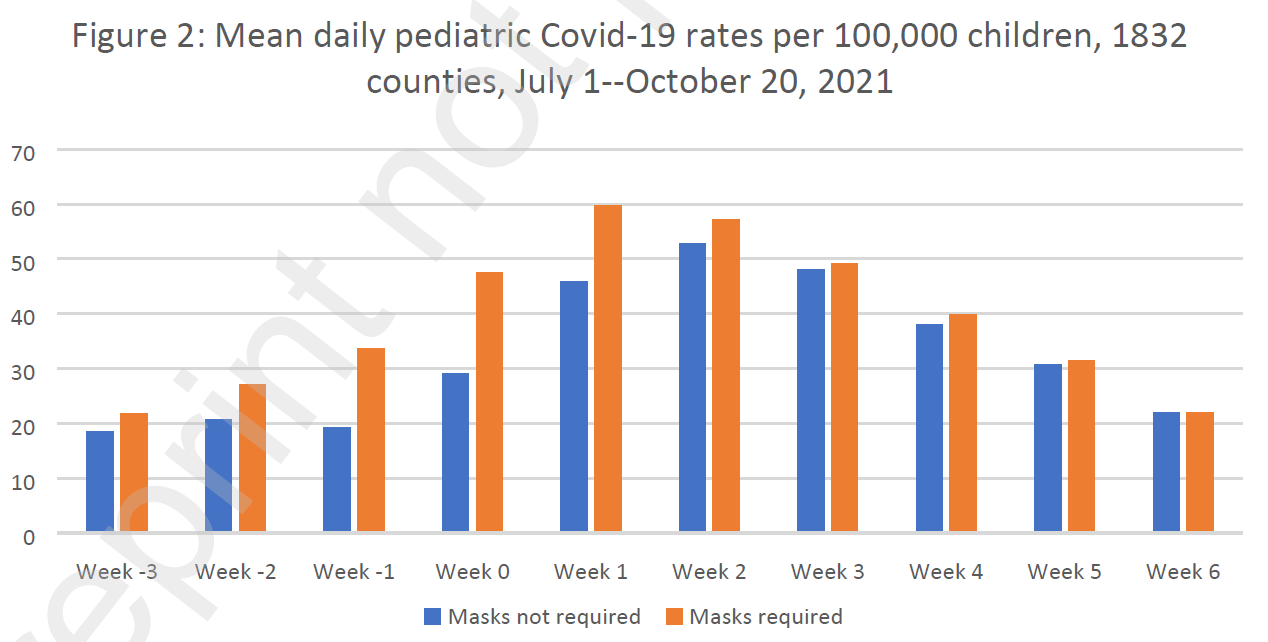
Note that, in the larger sample, the maskless start out with lower rates of infections and catch up; in the smaller sample, they started out with higher rates which collapsed more quickly.
The authors note that the CDC study, by ending their analysis on 4 September 2021, effectively excluded counties with a school-start date after 14 August, which entailed an oversampling of southern states. I’ll fill in the blanks here: Counties in the American south tend to have fewer school mask requirements, and also to experience late summer infection spikes related to high temperatures and extensive reliance on climatisation.
Although masks have become the most clearly discredited measure deployed against SARS-2 (which is saying something), they just won’t go away. Even in places that have lifted all Corona restrictions, a great many people continue to mask in public, and it seems likely that many countries – Germany among them – will retain vestigial mask requirements indefinitely, probably for years. Masking is a totally unsupported superstitious practice that does nothing against viral infection, and yet for precisely this reason, no amount of evidence will ever convince the maskers to stop.
Featured Video

John Mearsheimer Talking Iran with Iran
or go to
Aletho News Archives – Video-Images
Book Review & Summary
Calling of an Angel: The True Story of Rene Caisse and an Indian Herbal Medicine Called Essiac (1988)
Dr. Gary L. Glum – 30 Q&As – Book Review & Summary
Lies are Unbekoming | October 17, 2026
On June 10, 1975, Dr. Chester Stock, a vice president at Memorial Sloan-Kettering Institute for Cancer Research, wrote to a Canadian nurse named Rene Caisse: “Enclosed are test data in two experiments indicating some regressions in sarcoma 180 of mice treated with Essiac.” The sentence sat in a letter from one of the world’s largest private cancer research centers, concerning an herbal tea an elderly English woman had learned from an Ojibwa medicine man at a northern Ontario mining camp in the 1890s. The tests were terminated the following year after Sloan-Kettering admitted, in sworn affidavit three years later, that they had prepared the injectable solution improperly from the dried material supplied — freezing and thawing the herb rather than boiling it as Rene had instructed. By the time Calling of an Angel was published in 1988, Rene Caisse had been dead for a decade, having treated thousands of cancer patients across fifty-six years in her Bracebridge, Ontario kitchen, never charging a fee, and refusing every offer — from Memorial Sloan-Kettering, the National Cancer Institute, Merck, Parke Davis, and private corporations dangling contracts up to $1 million — to release her formula before the medical establishment admitted her remedy had merit. … continue
Blog Roll
 Aletho News
- Ongoing tales of Syrian chemical weapons
- Moscow blasts UN for ignoring torture of Russian POWs
- Millions of Books Could Have Been Destroyed in Lebanon During Israeli Bombings
- Moscow warns of ‘hunt for Russians’
- Calling of an Angel: The True Story of Rene Caisse and an Indian Herbal Medicine Called Essiac (1988)
- South Korean Assistance to the U.S. in the War with Iran: Between Allied Duty and National Interests
- Pharma- and Gates-Funded GAVI Seeks to Assure Parents
- John Mearsheimer Talking Iran with Iran
- Inside Bill C-22, Canada’s Patriot Act.
- China’s FM: Palestinian cause is ‘greatest injustice of the century’
- If Americans Knew
- In West Bank, Israeli settlers are totally out of control – Daily Update
- NPR investigation finds evidence of widespread fraud at mall kiosks tied to Israeli skincare brand
- Tucker Carlson exposes Israeli Lies about the Oct 7th attack, Charlie Kirk, and the U.S.
- Israel has detained thousands of Palestinian children since Oct 7th – over half spent time in solitary, many uncharged
- Israeli Analysis: Is Netanyahu Planning an ‘October Surprise’ Attack Before Israel’s Election?
- Israeli settlers brutally attack Palestinians and Washington Post female photographer, 65
- Words Have Changed, Occupation Continues: The Reality of the Gaza Ceasefire
- Gaza’s child amputees are growing faster than their prosthetics allow
- Israel keeps Palestinians struggling just to survive–Daily Update
- Israeli firm used online ads to run vast spy operation, researchers say
- No Tricks Zone
- New Study Suggests Large Regions Of The Pacific Ocean Have Been Cooling For The Last 80 Years
- Germany’s Green Energy Debacle: High Energy Costs Force Kahla Porzellan to Close After 182 Years!
- New Study: 50 Years Of The Most Aggressive ‘Net Zero’ Policies Can Only Affect The Global Climate By 0.03°C
- US September “Heat” Was No Record…Many Records Set Decades Ago
- Latest European Green Energy Debacle; Portugal’s Largest Flagship Solar Park Insolvent!
- Green Energy Debacle: German Expert Professor Fritz Vahrenholt Warns Of Severe Economic And Social Consequences
- Two More Paleo Reconstructions Affirm Meters-Higher Sea Levels Across Ireland, Brazil 7000-6000 Years Ago
- New Study: Earth And Venus Surface Warmth Largely Explained By Convection And Lapse Rate, Not CO2 Or Radiation
- 2025 Nature Paper Claiming Worsening Global Drought Gets RETRACTED …Heavily Flawed
- New Study: ‘Global Drought Shows No Detectable Recent Acceleration Under Climate Warming’

