Biden’s ‘cognitive decline’ is a ‘national security risk,’ says Republican senator
Samizdat | March 29, 2022
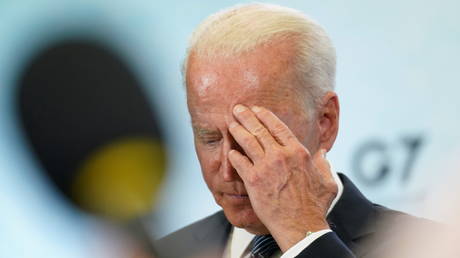
Senator Rand Paul (R-Kentucky) said on Monday that President Joe Biden’s apparently declining mental faculties present a “national security risk” that could see the US dragged into a war with Russia. Biden earlier appeared to call for Russian President Vladimir Putin’s removal from power, before walking back the statement, then making it again.
“A lot of times when you’re around somebody who’s in cognitive decline, you find yourself trying to help them with a sentence, trying to help them complete it,” Paul told Fox News host Jesse Watters on Monday evening, adding that “we shouldn’t have to do that for the commander-in-chief.”
Earlier on Monday, Biden told reporters that he “was not articulating a change in policy” when he called Putin a “butcher” who “cannot remain in power” during a visit to Poland over the weekend. Despite assuring the press that he wasn’t demanding regime change in Moscow, Biden then said again that Putin “shouldn’t be in power.”
Biden read from pre-prepared cue cards during the press conference.
“It is actually a national security risk because he’s sending signals that no one in their right mind would want to send to Russia at this point,” Paul continued. “We aren’t trying to replace Putin in Russia. We aren’t trying to have regime change. We’re not sending troops into Ukraine, and we’re not going to respond in kind with chemical weapons,” he stated, referring to two other statements that Biden made and the White House walked back.
These statements involved Biden seemingly telling US soldiers that they would be deployed to Ukraine, and that the US would “respond in kind” to a hypothetical Russian use of chemical weapons on the battlefield. Both actions would result in open war between the US and Russia, something that Biden has repeatedly said he wished to avoid.
“So I do think that it is a real problem, and there’s a humorous angle to this,” Paul said. “But it’s really not funny because we’re worried about what he’s saying, precipitating or escalating the conflict in Ukraine into a world war. That’s very serious.”
While Paul has condemned Russia’s military offensive in Ukraine, the Kentucky Republican opposes any US involvement in the conflict. Prior to Russia’s attack, Paul insisted that Ukraine “should not and cannot be our problem to solve,” and that the country’s accession into the NATO alliance – which the US and her allies insist is its right – would be “a recipe for war and disaster.”
Sanctioning Russia could topple the West
A new Cold War would cripple the American empire
BY THOMAS FAZI | UnHerd | March 22, 2022
The West, following the lead of the United States, has reacted to Russia’s invasion of Ukraine by introducing a “crippling” regime of sanctions. It is a “total economic and financial war” aimed at “caus[ing] the collapse of the Russian economy”, the French finance minister Bruno Le Maire candidly admitted. And yet many of the current sanctions appear to be run-of-the-mill restrictions used against several countries in the past. A number of them — including export bans and the freezing of certain assets — have been imposed on Russia since its annexation of Crimea in 2014. Even the much-discussed exclusion of a number of Russian banks from the main international banking message system, SWIFT, is not new, having already been used against Iran, with mixed results.
The most controversial aspect of the new sanctions regime is without a doubt the freezing of Russia’s offshore gold and foreign-exchange reserves — about half of its overall reserves — but even this is not unprecedented: last year, the US froze foreign reserves held by Afghanistan’s central bank in order to prevent the Taliban from accessing its funds; the US has also previously frozen the foreign-exchange reserves of Iran, Syria, and Venezuela.
So, taken individually, these measures are not as exceptional as they’ve been portrayed. However, never before have so many sanctions been deployed at once: there are already 6,000 various Western sanctions imposed on Russia, which is more than those in existence against Iran, Syria and North Korea put together. Even more importantly, none of the previous targets of sanctions were remotely as powerful as Russia — a member of the G20, and the world’s largest nuclear power.
Likewise, none of the 63 central banks that are members of the Bank for International Settlements (BIS) in Basel — known as the central bank of central banks — has ever been the target of financial sanctions. The BIS itself has even joined in on the sanctions in order to prevent Russia’s access to its offshore reserves. This really is unprecedented: since its establishment in 1931, the BIS had never taken such a measure, not even during World War II.
So what should we expect from the sanctions? Western pundits and commentators have little doubt: the sanctions will hamstring the Russian economy, sow discontent among the Russian people and elites alike, and possibly even cause the downfall of the Putin regime. At the very least, we’re told, they will hinder Russia’s war efforts. But history suggests otherwise: see Iraq, or more recently Iran. Far more likely is that this turns out to be the latest Western strategic miscalculation in a long list of strategic blunders, of which the United States’ inglorious withdrawal from Afghanistan is just the most recent example.
After all, Russia has been preparing for this moment for quite some time. Following the first wave of Western sanctions, in 2014, and partly in retaliation against them, Putin embarked on what analysts have dubbed a “Fortress Russia” strategy, building up the country’s international reserves and diversifying them away from US dollars and British pounds, reducing its foreign exposure, boosting its economic cooperation with China, and pursuing import substitution strategies in several industries, including food, medicine and technology, in an effort to insulate Russia as much as possible from external shocks.
True, Putin made the mistake of leaving around half of those reserves parked in foreign central banks, resulting in these now being confiscated. But nonetheless Russia still has access to more than $300 billion in gold and foreign-exchange reserves — more than most countries in the world and more than enough to cushion any short-term fall in exports, or prop up the rouble (for a while).
Moreover, the Russian central bank reacted to the sanctions by stopping capital flows out of Russia and nationalising the foreign exchange earnings of major exporters, requiring Russian firms to convert 80% of their dollar and euro earnings into roubles. It also raised interest rates to 20% in an effort to attract foreign capital. These measures are aimed at bolstering the rouble’s value and providing a flow of foreign exchange into the country. They appear to be working: while the rouble is around 40% of its value since the start of the conflict, the Russian currency’s free-fall seems to have come to a halt for now, even registering an uptick over the past two weeks. For the time being, Russia’s financial account — the difference between the money flowing in and out of the country — is far from disastrous.
Let’s not forget that the main source of Russia’s foreign-exchange reserves — oil and gas exports — has been excluded from the sanctions, for obvious reasons: for most European countries, Russia accounts for a huge part of their oil and gas imports (and other staple commodities), and there’s simply no way of replacing those energy sources from one day to the next.
In short, Russia runs no risk, in the short term, of running out of reserves and not being able to pay for its imports. But even assuming that the West decided to put a stop to all its imports from Russia overnight, there’s no reason to believe that this would bring the Russian military machine to a halt. The notion that “we are financing Russia’s war by purchasing gas and oil”, as the Finnish prime minister recently stated, is fundamentally misplaced.
As the economist Dirk Ehnts has observed, the Russian military machine, for the most part, doesn’t rely on imports (if anything, Russia is an arms exporter). It is sourced domestically and, like the salaries of its soldiers, is paid for in roubles, which the Russian central bank can create in an unlimited quantity, just as the Bank of England does when it comes to pounds.
Equally unfounded are rumours of an impending Russian default. In recent years, the Russian government has taken steps to reduce its foreign liabilities: its foreign currency-denominated debt amounts today to about $40 billion — a tiny amount compared with the size of Russia’s yearly exports of more than $200 billion in oil and gas. Any decision to default would be entirely political. We mustn’t forget that the very creditors expecting to be paid back in dollars are the same that have just confiscated a good part of Russia’s dollars — if the latter were to default on their payments, it would be an even bigger problem for their Western creditors. As with Russia’s oil exports, hurting Russia inevitably means hurting ourselves as well.
Moreover, thanks to the Russian government’s successful efforts at boosting domestic agricultural production, domestic food production now accounts for more than 80% of retail sales, up from 60% in 2014. This means Russia is largely self-sufficient food-wise. So even if its export revenues were to plummet (which is unlikely), the country wouldn’t go hungry — unlike the rest of the world — and would most likely be able to continue to finance its war efforts.
Might a selective ban on exports of specific high-tech Western components, some of which are bound to be used in Russia’s defence industry, prove more effective? Possibly. But Russia has been reducing the dependence of its military-industrial apparatus on foreign components and technologies for years. More importantly, both hypotheses — that Russia’s economy and military can be brought to their knees through export and/or import bans — rest on the flawed assumption that the whole world is on board with the sanctions. But that is far from the case.
While most of the world’s nations — 143 out of 193 — voted for a resolution in the UN’s General Assembly condemning Russia, the 35 countries that abstained include China, India, Pakistan and South Africa, as well as several African and Latin American states. These and many more countries — including several that voted in favour of the resolution, such as Brazil — have strongly criticised the sanctions against Russia and can be expected to continue trading with Putin. It’s frankly very hard to call Russia isolated when some of the world’s largest economies have refused to support the West’s sanctions regime.
China, in particular, has been very vocal in its support of Russia. Beijing is already the Kremlin’s main trading partner, and it alone can absorb huge quantities of Russian energy and commodities, as well as provide Russia with basically any industrial and consumer goods that the latter currently imports from the West. China also operates an alternative to the Western-managed SWIFT system called CIPS to manage cross-border transactions in yuan, which could allow Russia to partially circumvent the West’s financial blockade. Even though the yuan still makes up a small percentage of international transactions, its role is bound to grow rapidly in the coming years (consider the news that Saudi Arabia may start pricing its oil sales to China in the latter’s currency). All this helps explain why even Western financial analysts, such as Goldman Sachs and JP Morgan, predict a year-on-year contraction for the Russian economy of about 7% — bad, but hardly catastrophic (Covid caused a much larger drop in GDP for most countries).
However, much will depend on the policy response of the Russian government. Obviously, the withdrawal of many foreign firms and decline in foreign investments will increase unemployment. But the Russian government can cushion the blow by resorting to a “Keynesian” expansionary fiscal policy aimed at boosting domestic investment and supporting incomes. If ever there were a time for Russia to abandon its historically ultra-tight fiscal policy, as several Russian economists have been arguing for some time, it is now.
Two weeks ago, I suggested that, in the short term at least, the US will benefit from the conflict in Ukraine. In the long term, however, it is slowly becoming clear that US-led global Western order will suffer. The West’s imposition of sanctions — involving not only governments, but also private companies and even allegedly apolitical organisations such as central banks — has sent a clear message to the countries of the world: the West will stop at nothing to punish countries that step out of line. If this can happen to Russia, a major power, it can happen to anyone. “We will [never again] be under the slightest illusion that the West could be a reliable partner,” the Russian foreign minister Sergey Lavrov has said. “We will do everything so as never, in any way, to be dependent on the West in those areas of our life which have a decisive significance for our people.”
Those words are bound to reverberate across the world, with dramatic implications for the West. As Wolfgang Münchau has warned: “For a central bank to freeze the accounts of another central bank is a really big deal… As a direct result of these decisions, we have turned the dollar and the euro, and everything that is denominated in those currencies, into de facto risky assets”. At the very least, it will inevitably push countries to diversify their reserves and increase their yuan holdings, in order to loosen the West’s grip on their economies and bolster their economic resilience and self-sufficiency. Even if it doesn’t push countries straight into Beijing’s arms, as is already happening with Russia, it will likely lead to the emergence of two increasingly insulated blocs: a US-dominated Western bloc and a China-dominated East-Eurasian one.
In this new pseudo-Cold War, “non-aligned” countries could find that they are in a better position to assert their sovereignty than they were under the American global empire. Forget “the collapse of the Russian economy” — this could be the result of the West’s new economic war.
Israel to send military attache to Bahrain soon, says envoy after Negev summit with Arab states
Press TV – March 29, 2022
Israel will “soon” appoint a military attache to the US Navy’s Fifth Fleet headquarters in Bahrain, says the Israeli ambassador to Manama, as diplomats from the Persian Gulf country and three other Arab states attend a meeting in the Negev desert in occupied Palestine.
“This will happen soon – an attache to the fleet,” Eitan Naeh told Israel’s Army Radio. “It is in the midst of various bureaucratic processes. I reckon that, by the summer, we will have a fuller staff, along with other officials who will join the embassy.”
Last month, the Israeli minister of military affairs, Benny Gantz, visited the US fleet in Bahrain and met with its commander, Vice Admiral Brad Cooper, and Bahraini naval commanders.
Bahrain, a tiny island in the Persian Gulf and a former Iranian province, is some 300 kilometers to the south of the coastal Iranian province of Bushehr, which hosts a key nuclear power plant.
In Tehran, an Israeli presence so close to the Bushehr nuclear site is deemed a threat to the country’s national security, as the regime in Tel Aviv has in the past covertly carried out acts of sabotage against Iran’s nuclear facilities and assassinated Iranian scientists while overtly threatening to launch attacks on Iran’s nuclear program.
On Sunday, top diplomats from the United Arab Emirates (UAE), Morocco, Bahrain, Egypt, the United States, and Israel met in the Negev desert to press ahead with a US-brokered normalization of relations between the Arab states and the Israeli regime.
Egypt was the first Arab country to have diplomatic ties with Tel Aviv, while the UAE and Bahrain reached normalization agreements with Israel in 2020 through the mediation of former US President Donald Trump’s administration.
Morocco and Sudan later reached similar US-brokered deals, which have been roundly condemned by Palestinians as a brazen betrayal of their cause.
US, Israel launch naval exercise
Also on Sunday, the US Navy’s Fifth Fleet and the Israeli Navy launched a 10-day maritime exercise in the Red Sea.
The drill, dubbed Intrinsic Defender, focuses on maritime security operations, explosive ordnance disposal, health topics, and unmanned systems integration.
Over 300 American personnel as well as US Navy guided-missile destroyer USS Cole (DDG 67), dry cargo ship USNS Wally Schirra (T-AKE 8), and various unmanned vessels are also scheduled to participate in the exercise.
The drill comes amid Washington’s diminishing role in the region, including its withdrawal from Afghanistan and a change in its role in Iraq from military to advisory under the pressure of Iraqi resistance groups.
The US military is also expected to be expelled from Syria, where it has retained an illegal military presence throughout a foreign-sponsored conflict that began in 2011.
Observers believe Washington is scaling down its presence in the Middle East to focus on a large-scale confrontation with China, which is poised to soon overtake the US economically.
The ‘Ukrainian Resistance’ and the Houthis – A contrast in media coverage
By Gavin O’Reilly | Ron Paul Institute | March 28, 2022
In the now month-long mainstream media coverage of the Russian military intervention in Ukraine, much attention has been paid to the actions of the ‘Ukrainian Resistance’.
In a manner not dissimilar to its coverage of the ‘Syrian rebels’ a decade ago, a romanticised image of ‘Ukrainian freedom fighters’ fighting bravely against a militarily superior Russian foe has been widespread amongst corporate outlets, alongside their fawning over Ukrainian President Volodymyr Zelenskyy in his calls for the implementation of a No Fly Zone – a move that would undoubtedly trigger nuclear war.
This Hollywood-style PR makeover of the Ukrainian military by the corporate media, including the notorious neo-Nazi Azov Battalion, also shares a strong similarity with the aforementioned ‘Syrian rebels’ in that it highlights the strong presence of CIA involvement in the background.
Indeed, the training of Ukrainian military personnel by the CIA to engage in guerrilla warfare against Russia was recently outlined in a Western corporate media report, indicating that a plan was in place to draw Moscow into an Iraq-war style military quagmire in Ukraine – the second largest country in Europe.
Such a tactic has historical usage against the Kremlin, when in 1979, then-US President Jimmy Carter would launch Operation Cyclone, a CIA programme which would see the arming, funding and training of Wahhabi insurgents known as the Mujahideen, who would go onto wage war on the USSR-aligned government of the Democratic Republic of Afghanistan – with Kabul, previously Western-friendly, having come under Soviet influence following the 1978 Saur Revolution.
This romanticised image of ‘Ukrainian freedom fighters’ by the corporate media however, lies in stark contrast to their coverage of Ansar Allah, more commonly known as the Houthis, currently waging an armed resistance campaign against Western-allied Saudi Arabia’s seven year long war and blockade on neighbouring Yemen – leading to mass-starvation in what is already the most impoverished country on the Arabian Peninsula.
Indeed, this was evidenced as such on Friday, when the Yemeni armed forces launched air strikes against a key oil refinery in the Saudi city of Jeddah, to a noticeable absence of articles by the Western media celebrating the actions of the Yemeni resistance against the Western-backed might of Riyadh, unlike their coverage of Ukraine and Russia.
To understand this contrasting approach to both Yemen and Ukraine by the corporate media, one must look further into the wider geopolitical and historical context in the West’s relationship with both countries.
In 1979, the same year as the Soviet intervention in Afghanistan, the Islamic Revolution in Iran saw the anti-Western and anti-Zionist Ayatollah Khomeini come to power in Iran following the overthrow of the US and UK-aligned Shah Pahlavi – who had himself come to power following 1953’s Operation Ajax, an MI6 and CIA-orchestrated regime change operation launched in response to then-Prime Minister Mohammad Mossadegh’s decision to nationalise Iran’s vast oil reserves.
In order to counter the influence of Khomeini’s newly-established anti-Imperialist state and to maintain hegemony in the Middle East, the United States adopted the strategy of using Saudi Arabia – separated from the Islamic Republic by the Persian Gulf – as a political and military bulwark against Iran.
This is where the media coverage of the Yemen conflict comes into play, with Tehran long being accused of backing the Houthis, whose seizure of the capital Sana’a in March 2015 led to Riyadh launching its current air campaign – involving US and British-supplied bombs – in a bid to restore its favoured Presidential candidate, Abdrabbuh Mansur Hadi, to power.
Therefore, with the aims of Ansar Allah consequently being opposed to the aims of the US-NATO hegemony, this explains why no heroic descriptions such as ‘Yemeni resistance’ or ‘freedom fighters’ are ascribed to the Houthis by the Western media, in stark contrast to their coverage of the Armed Forces of Ukraine – supported by the West since the 2014 Euromaidan colour revolution and their subsequent war on the breakaway Republics of Donetsk and Luhansk, a situation that has escalated to the point where nuclear war has now become a distinct possibility.
Copyright © 2022 by RonPaul Institute
Pakistan PM Imran Khan accuses US of funding ‘conspiracy’ to topple his government
Press TV – March 28, 2022
Pakistan’s Prime Minister Imran Khan accused an unnamed “foreign power” – in a clear reference to the United States – of funding a “conspiracy” to topple his democratically elected government.
Addressing a large rally in the capital Islamabad on Sunday, Khan said the “foreign power” sent millions of dollars to opposition parties to launch a no-confidence vote against him in the parliament.
Khan, who had formed a coalition government after winning the election in 2018, said he was the subject of a “foreign conspiracy” aimed at dislodging his government and that “funding was being channeled into Pakistan from abroad.”
A no-confidence motion has been tabled in Pakistan’s National Assembly, with days of debates expected to start next week before the vote. The opposition needs a simple majority to oust Khan, after which a new prime minister would be chosen by the parliament.
“We have been threatened in writing but we will not compromise on national interests,” said Khan, who met with Vladimir Putin in Moscow on February 24, the same day the Russian leader ordered a military operation in neighboring Ukraine.
Before that, Khan visited Beijing in January, defying US President Joe Biden’s call for a diplomatic boycott of the Winter Olympics.
“The money is from abroad and the people that are being used are ours (Pakistan’s). Some of them unknowingly, and some knowingly, are using this money against us,” the prime minister said.
“Attempts are being made to influence our foreign policy from abroad. We have been aware of this conspiracy for months. We also know about those who have assembled these people (the opposition parties) but the time has changed. This is not the era of Zulfikar Ali Bhutto,” he said, referring to the former prime minister of Pakistan who was allegedly threatened by former US Secretary of State Henry Kissinger over the country’s nuclear program.
Bhutto’s government was toppled and he was hanged by the military in 1979.
“This is the era of social media. Nothing can be hidden. We will not accept anyone’s dictation. We will have friendships with everyone but we will not submit ourselves to anyone,” Khan said.
“Attempts are being made through foreign money to change the government in Pakistan. Our people are being used. Mostly inadvertently, but some people are using money against us. We know from what places attempts are being to pressure us. We have been threatened in writing but we will not compromise on national interest,” the Dawn newspaper reported.
Khan then splashed a letter and said it would prove his point. “I am placing the case of Pakistan’s independence before you. The letter I have is proof and I want to dare anyone who doubts this letter. I will invite them off the record. We have to decide for how long we will have to live like this. We are getting threats. There are many things about the foreign conspiracy which will be shared very soon.”
“The nation wants to know who the man sitting in London is meeting with and whose directions the characters based in Pakistan are following? I am revealing the proofs we have. I cannot talk more in detail because I have to protect the interest of my country. I cannot talk about anything that harms my country. I could have told you about it. I do not fear anyone but I care about Pakistan’s interest,” he stated.
Biden’s Disastrous European Tour
By Ron Paul | March 28, 2022
Previewing President Biden’s trip to Europe last week, US National Security Advisor Jake Sullivan said that, “the president is traveling to Europe to make sure we stay united.”
That sure didn’t go as planned. This may have been the most disastrous – and dangerous – Presidential overseas trip ever.
The US and its NATO allies have repeatedly proclaimed that “protecting Ukraine’s democracy” has never been about threatening Russia. Holding out NATO membership and sending billions of dollars in military equipment to Ukraine, starting under Trump, was not threatening Russia. CIA training camps in eastern Ukraine, where paramilitaries were trained on US weapons systems, was not about threatening Russia.
But at every stop, President Biden seemed to undermine the narrative his own Administration had carefully crafted. First up, warning that Russia might use chemical weapons in Ukraine, Biden promised it would “trigger a response in kind,” meaning the US would use chemical weapons as well. That would be a serious war crime.
National Security Advisor Sullivan had to be brought to explain that the US has “no intention” of using chemical weapons.
Later, speaking to the 82nd Airborne in Poland, President Biden told them that US troops would soon be in Ukraine. He said to the troops, “you’re going to see — you’re going to see women, young people standing — standing the middle of — in front of a … tank, just saying, ‘I’m not leaving. I’m holding my ground.’”
A White House spokesman had to clarify that, “the president has been clear we are not sending US troops to Ukraine and there is no change in that position.”
Clear? Well, not really. He had just said the opposite to our own troops!
Then, at the end of Biden’s final speech in Poland, the President inadvertently told the truth: the US involvement in Ukraine is all about “regime change” for Russia. Speaking of Russian President Putin, he told the audience, near the border of Ukraine, “for God‘s sake, this man cannot remain in power.”
The President’s disaster control team immediately mobilized in the person of Secretary of State Antony Blinken, who offered this pained interpretation of Biden’s clear statement, “I think the president, the White House, made the point last night that, quite simply, President Putin cannot be empowered to wage war or engage in aggression against Ukraine or anyone else.”
No, that’s not what he said. The president has a leading Constitutional role in the formation of US foreign policy, and he said in a public speech that “regime change” in Russia is US policy. Any attempt by his staffers to try to explain it away looks terrible: either the President has no idea what he’s saying so we should not take seriously what is essentially a declaration of war on Russia, or the President took the opportunity on the border with Ukraine to essentially declare war on Russia.
Presidents Reagan, Ford, and Bush Jr. were all known for their gaffes. Some were funny and some were serious. But none of them declared war on a nuclear-armed adversary in that adversary’s own backyard and then afterward had to send out staff to explain that the president didn’t mean what he just said.
Interestingly, Biden saved his most hawkish and bombastic statements for this final speech in Poland, at which none of the more cautious NATO partners like Germany and France were present. So much for “unity” being the prime purpose of the trip.
There is a real problem in the Biden Administration and the sooner we face it the better.
Copyright © 2022 by RonPaul Institute
Russia states position on West’s mediation in Ukraine talks
Samizdat | March 28, 2022
Moscow is eager for a diplomatic solution to the conflict in Ukraine, but it won’t be needing any Western mediation during its talks with Kiev, Russian Foreign Minister Sergey Lavrov has said.
“We’re ready to give diplomacy a chance. That’s why we agreed to the talks, which are resuming in Istanbul,” Lavrov said during a video conference on Monday with the Serbian media. The discussions are scheduled to continue on Tuesday.
The Turkish government, which has good ties with both Russia and Ukraine, has been putting a great deal of effort into getting the two sides around the negotiating table. But there’s no need to include the EU or the US – which support Kiev in the conflict – in the peace process, according to the minister.
“There are many examples of times when the achievements of diplomacy were shattered by Western colleagues. They can’t be trusted anymore,” Lavrov opined.
“I wouldn’t want to see any shuttle diplomacy from our Western partners, because they’ve already done their ‘shuttling’ – in February 2014 in Ukraine and in February 2015 in Minsk,” he added.
In February 2014, the EU became the guarantor of the agreements between Ukraine’s then-president Viktor Yanukovych and the Maidan protesters in Kiev, Lavrov reminded viewers. “It was a pinnacle of diplomacy. But, the next morning, the opposition spat on that diplomacy, and the EU had to swallow it.”
Yanukovich ended up being deposed after violent clashes and fleeing the country, and the new Ukrainian authorities soon sent its military to the eastern regions of Donetsk and Lugansk, where most of the population refused to recognize the coup in the capital.
In September of the same year, the Minsk I agreement between the breakaway republics and the government in Kiev was achieved in the Belarusian capital of that name, having been negotiated by Ukraine, Russia, Germany, and France in the so-called Normandy Format. The deal called on the two sides to stop fighting, organize prisoner exchanges, allow deliveries of humanitarian aid, and withdraw heavy weaponry.
“The diplomacy then reached new heights in February 2015, when the agreements that were signed in Minsk ended the war in eastern Ukraine and opened the way to restoring Ukraine’s territorial integrity by granting a special status to the Donbass,” the minister continued.
The second agreement, Minsk II, introduced another ceasefire and paved the way for administrative and political reform in Ukraine as well as for autonomy and local elections in the Donbass republics. However, Kiev’s Western backers were subsequently unable to persuade the Ukrainian government to fulfil its promises.
“The European Union has proven its incompetence as an organization that is capable of fulfilling the agreements being reached,” Lavrov said.
Russia sent its troops into Ukraine over a month ago, following a seven-year standoff over Kiev’s failure to implement the terms of the Minsk agreements, and Russia’s eventual recognition of the Donbass republics of Donetsk and Lugansk.
Moscow has now demanded that Ukraine officially declare itself a neutral country that will never join the US-led NATO military bloc. Kiev insists the Russian offensive was completely unprovoked and has denied claims it had been planning to retake the two republics by force.
RAND Report Prescribed US Provocations Against Russia and Predicted Russia Might Retaliate in Ukraine
By Rick Sterling | Global Research | March 28, 2022
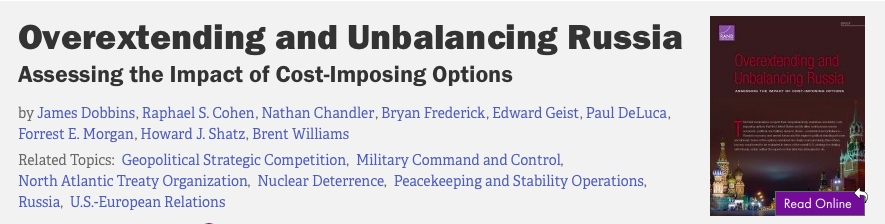
According to a 2019 Rand report titled “Overextending and Unbalancing Russia”, the US goal is to undermine Russia just as it did the Soviet Union in the cold war. Rather than “trying to stay ahead” or trying to improve the US domestically or in international relations, the emphasis is on efforts and actions to undermine the designated adversary Russia. Rand is a quasi-US governmental think tank that receives three-quarters of its funding from the US military.
The report lists anti-Russia measures divided into the following areas: economic, geopolitical, ideological/informational, and military. They are assessed according to the perceived risks, benefits and “likelihood of success”.
Screenshot from RAND
The report notes that Russia has “deep seated” anxieties about western interference and potential military attack. These anxieties are deemed to be a vulnerability to exploit. There is no mention of the cause of the Russian anxieties: they have have been invaded multiple times and had 27 million deaths in WW2.
Significance of Ukraine
Ukraine is important to Russia. The two countries share much common heritage and a long common border. One of the most important leaders of the Soviet Union, Nikita Khrushchev, was Ukrainian. During WW2, Ukraine was one of Hitler’s invasion routes and there was a small but active number of Ukrainian collaborators with Nazi Germany. The distance from the capital of Ukraine, Kiev, to Moscow is less than 500 miles.
For these same reasons of geography and history, Ukraine is a major component of a US/NATO effort to undermine Russia. Current Under Secretary for Political Affairs, Victoria Nuland, said that over 20 years the US invested $5 billion in the project to turn Ukraine. The culmination was a violent coup in February 2014. Since 2015, the US has been training ultra nationalist and Neo-Nazi militias. This has been documented in articles such as “U.S. House admits Nazi role in Ukraine” (Robert Parry, 2015), “The US is arming and assisting neo-nazis in Ukraine while the House debates prohibition”(Max Blumenthal, 2018), “Neo Nazis and the far right are on the march in Ukraine” (Lev Golinken in 2019) and “The CIA may be breeding Nazi terror in Ukraine” (Branko Marcetic Jan. 2022).
Rand suggested provocations
Prior to 2018, the US only provided “defensive” military weaponry to Ukraine. The Rand report assesses that providing lethal (offensive) military aid to Ukraine will have a high risk but also a high benefit. Accordingly, US lethal weaponry skyrocketed from near zero to $250M in 2019, to $303M in 2020, to $350M in 2021. Total military aid is much higher. A few weeks ago, The Hill reported, “The U.S. has contributed more than $1 billion to help Ukraine’s military over the past year”.
The Rand report lists many techniques and “measures” to provoke and threaten Russia. Some of the steps include:
- Repositioning bombers within easy striking range of key Russian strategic targets
- Deploying additional tactical nuclear weapons to locations in Europe and Asia
- Increasing US and allied naval force posture and presence in Russia’s operating areas (Black Sea)
- Holding NATO war exercises on Russia’s borders
- Withdrawing from the Intermediate Nuclear Forces (INF) Treaty
These and many other provocations suggested by Rand have, in fact, been implemented. For example, NATO conducted massive war exercises dubbed “Defender 2021” right up to Russia’s border. NATO has started “patrolling” the Black Sea and engaging in provocative intrusions into Crimean waters. The US has withdrawn from the INF Treaty.
Since 2008, when NATO “welcomed” the membership aspirations of Ukraine and Georgia, Russia has said this would cross a red line and threaten its security. In recent years NATO has provided advisers, training and ever increasing amounts of military hardware. While Ukraine is not a formal member of NATO, it has increasingly been treated like one. The full Rand report says “While NATO’s requirement for unanimity makes it unlikely that Ukraine could gain membership in the foreseeable future, Washington’s pushing this possibility could boost Ukrainian resolve while leading Russia to redouble its efforts to forestall such a development.”
The alternative, which could have prevented or at least forestalled the current Russian intervention in Ukraine, would have been to declare Ukraine ineligible for NATO. But this would have been contrary to the US intention of deliberately stressing, provoking and threatening Russia.
Ukraine as US client
In November 2021, the US and Ukraine signed a Charter on Strategic Partnership. This agreement confirmed Ukrainian aspirations to join NATO and rejection of the Crimean peoples decision to re-unify with Russia following the 2014 Kiev coup. The agreement signaled a consolidation of Washington’s economic, political and military influence.
December 2021 Russia red lines followed by military action
In December 2021, Russia proposed a treaty with the US and NATO. The central Russian proposal was a written agreement that Ukraine would not join the NATO military alliance.
When the proposed treaty was rebuffed by Washington, it seems the die was cast. On February 21, Putin delivered a speech detailing their grievances. On February 24, Putin delivered another speech announcing the justification and objectives of the military intervention to “demilitarize” and “denazify” Ukraine.
As Russian Foreign Minister Lavrov later said, “This is not about Ukraine. This is the end result of a policy that the West has carried out since the early 1990’s.”
Afghanistan again?
As earlier indicated, the Rand report assesses the costs and benefits of various US actions. It is considered a “benefit” if increased US assistance to Ukraine results in the loss of Russian blood and resources. Speculating on the possibility of Russian troop presence in Ukraine, the report suggests that it could become “quite controversial at home, as it did when the Soviets invaded Afghanistan.” (p 99 of full report)
That historical reference is significant. Beginning in 1979, the US and Saudi Arabia funded and trained sectarian foreign fighters to invade and destabilize the progressive Afghan government. The goals were to overthrow the socialist inclined government and lure the Soviet Union into supporting the destabilized government. It achieved these Machiavellian goals at the cost of millions of Afghan citizens whose country has never been the same.
It appears that Ukrainian citizens are similarly being manipulated to serve US goals.
A “disadvantageous peace settlement”
The Rand report says, “Increasing U.S. military aid would certainly drive up the Russian costs, but doing so could also increase the loss of Ukrainian lives and territory or result in a disadvantageous peace settlement.”
But who would a peace settlement be “disadvantageous” for? Ukrainian lives and territory are currently being lost. Over fourteen thousand Ukrainian lives have been lost in the eastern Donbass region since the 2014 coup.
A peace settlement that guaranteed basic rights for all Ukrainians and state neutrality in the rivalry of big powers, would be advantageous to most Ukrainians. It is only the US foreign policy establishment including the US military media industrial complex and Ukrainian ultra-nationalists who would be “disadvantaged”.
Since Ukraine is a multi-ethnic state, it would seem best to accept that reality and find a compromise national solution which facilitates all Ukrainians. Being a client of a distant foreign power is not in Ukraine’s national best interest.
The Rand report shows how US policy focuses on actions to hurt Russia and manipulates third party countries (Ukraine) toward that task.
*
Rick Sterling is an independent journalist based in the San Francisco Bay Area. He can be contacted at rsterling1@protonmail.com.
US resets the containment of Iran
BY M. K. BHADRAKUMAR | INDIAN PUNCHLINE | MARCH 28, 2022
The summit of Arab diplomats on March 27-28 hosted by Israeli Foreign Minister Yair Lapid in the southern Negev Desert is doubtless a landmark event. The UAE’s Abdullah bin Zayed Al Nahyan, Bahrain’s Abdullatif bin Rashid Al-Zayani, Morocco’s Nasser Bourita, and Egypt’s Sameh Shoukry are the Arab participants, while the visiting US Secretary of State Antony Blinken becomes the sole “extra-regional” participant.
The expectation that more West Asian countries would join the Abraham Accords failed to materialise, but the security and military ties between Israel, UAE, Bahrain — and Saudi Arabia behind the curtain — have deepened. Egypt also joins the nascent partnership.
There is much symbolism surrounding the venue of the Arab-Israeli summit: Israel’s first prime minister, David Ben-Gurion, lived at Sde Boker and he is buried there, overlooking the Zin wilderness. Lapid hopes to take his guests to visit the gravesite.
To be sure, wherever Blinken goes, the agenda would include Ukraine conflict and he is sure to make a pitch for isolating Russia and urge his Arab interlocutors to join Western efforts in support of Ukraine, but it has had limited success even with his Israeli hosts, much less so with the US’ Arab allies.
For a variety of reasons, Israel is wary of antagonising Russia (although under US pressure it set up a field hospital inside Ukrainian territory to treat those injured by Russian forces and has also sent several shipments of humanitarian supplies to the war zone.) Israel has refused repeated requests from Kiev for weapons.
Israel also opted out of imposing sanctions against Russian oligarchs. This rankles the Biden administration. The acerbic tongue of US Under Secretary of State for Political Affairs Victoria Nuland lashed out during a Channel 12 interview, “You (Israel) don’t want to become the last haven for dirty money that’s fuelling Putin’s wars.”
Israel ignored her barb. Israel sought a mediatory role in the conflict initially but lately stepped back, and, at any rate , Russia does not really need mediators to bring this conflict to an end once its special operation is successfully concluded. On the whole, Israel tries to walk a tightrope to maintain good relations with both Ukraine and Russia.
As for Gulf states, they do not even pretend to take a neutral stance. None of them has rallied to the western call to impose sanctions against Russia. The foreign ministers of Qatar and the UAE visited Moscow recently to discuss expansion of bilateral relations.
The crux of the matter is that the major oil producing countries of the Gulf would have congruence of interests with Russia to preserve OPEC+ not only to maintain their present income level, but also are in anticipation of the lifting of US sanctions against Iran leading to full flow of Iranian crude back into the global oil markets.
The point is, Iran remains a great oil power, with an estimated 157 billion barrels of proven crude oil reserves, nearly 10 percent of the world’s total and 13 percent of those held by the OPEC. Its habitation within the OPEC+ is an absolute must for all oil producing countries. Now, Russia has a major role to play to leverage both short-term and longer-term bearish effects of Iran’s entry on global oil prices.
Experts estimate that Iran could see an 80 percent recovery of full oil production within six months and a 100 percent recovery within 12 months, and in the immediate terms, once sanctions are lifted, its overnight impact may already manifest as a 5-10 percent fall in the oil prices.
Nonetheless, Ukraine conflict aside, the real significance of the Israel-Arab diplomatic summit in the Negev Desert should be sought somewhere else. Prima facie, it is a diplomatic coup for Israel, as its efforts to integrate into the Arab family are making progress. What lends enchantment to the view is that this bucks the overall trend of the US’ regional influence in West Asia.
Prime Minister Naftali Bennett’s accent on diplomacy to win friends and influence neighbours is proving productive and Israel is no longer depending on the US to cut new paths for it to navigate as a regional state. This is a paradigm shift.
Principally, Israel taps into the angst in the Arab world that Iran is poised to surge as a regional power very shortly and the future trajectory of Iranian policies remain unclear. In fact, this is the leitmotif of the diplomatic event in the Negev Desert.
In immediate terms, Israel and the Arab states believe that the intensifying drone attacks by the Houthis lately is only possible with the help and even participation by Iran’s Islamic Revolutionary Guard Corps, which provides missiles, rockets, drones, intelligence equipment and training. They apprehend that Iran’s resistance politics are signalling a new cutting edge, as the recent missile strike on alleged Israeli assets in Erbil in northern Iraq showed.
Saudi Arabia, Bahrain and the UAE have been depending on US-made anti-missile defences, mainly the Patriot systems, but their performance so far has been less than satisfactory. Thus, a stunning idea has taken shape lately in the nature of building an architecture of “joint air defences” between Israel, the UAE, Bahrain and Saudi Arabia.
After all, Israel has the expertise in developing a multi-layered air defence system devolving upon the famous Iron Dome, David’s Sling systems (which can intercept missiles up to 200km away) and Arrow batteries, which are capable of intercepting and destroying long-range missiles at ranges of up to 2,000km, including ballistic missiles. The three layers of Israeli systems are integrated and assisted by advanced radars and other early warnings equipment.
Interestingly, coincidence or not, the Israeli air defences are also linked to a powerful American radar, stationed in the Negev Desert which is where the Arab diplomats from Egypt, Bahrain and the UAE have gathered for the 2-day event.
Blinken’s mission at the summit is principally to get the regional allies accustomed to the imminent conclusion of the negotiations at Vienna leading to the removal of US sanctions against Iran. The Biden administration is yet to take the plunge on lifting the designation of the IRGC as a “Foreign Terrorist Organisation”. The US’s regional allies, especially Israel, have opposed such a move tooth and nail.
But the US has a sense of urgency about Iran’s increased oil output entering the world market. That said, however, Washington’s containment policy against Iran is not going to be mothballed. Rather, it will continue in a newer form. In fact, the lifting of sanctions without any reciprocal assurances from Tehran as regards its regional policies necessitates that the containment strategy will have to remain as the US’ geopolitical tool for the foreseeable future.
The Arab-Israeli summit with Blinken’s participation underscores that the US-Iran entanglement is being reset. There is no question that the JCPOA is of vital importance to check Iran’s nuclear programme. Israel also tends to go along with that thinking lately. The Abraham Accords is providing the foundation for a new US-backed security architecture in West Asia to counter Iran.
Featured Video

Trump asks Iran not to retaliate after he strikes Pickaxe Mountain
or go to
Aletho News Archives – Video-Images
Book Review & Summary
Calling of an Angel: The True Story of Rene Caisse and an Indian Herbal Medicine Called Essiac (1988)
Dr. Gary L. Glum – 30 Q&As – Book Review & Summary
Lies are Unbekoming | October 17, 2026
On June 10, 1975, Dr. Chester Stock, a vice president at Memorial Sloan-Kettering Institute for Cancer Research, wrote to a Canadian nurse named Rene Caisse: “Enclosed are test data in two experiments indicating some regressions in sarcoma 180 of mice treated with Essiac.” The sentence sat in a letter from one of the world’s largest private cancer research centers, concerning an herbal tea an elderly English woman had learned from an Ojibwa medicine man at a northern Ontario mining camp in the 1890s. The tests were terminated the following year after Sloan-Kettering admitted, in sworn affidavit three years later, that they had prepared the injectable solution improperly from the dried material supplied — freezing and thawing the herb rather than boiling it as Rene had instructed. By the time Calling of an Angel was published in 1988, Rene Caisse had been dead for a decade, having treated thousands of cancer patients across fifty-six years in her Bracebridge, Ontario kitchen, never charging a fee, and refusing every offer — from Memorial Sloan-Kettering, the National Cancer Institute, Merck, Parke Davis, and private corporations dangling contracts up to $1 million — to release her formula before the medical establishment admitted her remedy had merit. … continue
Blog Roll
 Aletho News
- Trump asks Iran not to retaliate after he strikes Pickaxe Mountain – w/ Prof. Marandi
- Vice President J.D. Vance’s Deceptive ‘Antiwar’ Campaign Speech
- Iran: Palestinians’ rights must not be compromised in Gaza’s future; US, Israel to blame for Hormuz situation
- Ongoing tales of Syrian chemical weapons
- Moscow blasts UN for ignoring torture of Russian POWs
- Millions of Books Could Have Been Destroyed in Lebanon During Israeli Bombings
- Moscow warns of ‘hunt for Russians’
- Calling of an Angel: The True Story of Rene Caisse and an Indian Herbal Medicine Called Essiac (1988)
- South Korean Assistance to the U.S. in the War with Iran: Between Allied Duty and National Interests
- Pharma- and Gates-Funded GAVI Seeks to Assure Parents
- If Americans Knew
- Israeli soldiers debunk Israel’s talking points
- In West Bank, Israeli settlers are totally out of control – Daily Update
- NPR investigation finds evidence of widespread fraud at mall kiosks tied to Israeli skincare brand
- Tucker Carlson exposes Israeli Lies about the Oct 7th attack, Charlie Kirk, and the U.S.
- Israel has detained thousands of Palestinian children since Oct 7th – over half spent time in solitary, many uncharged
- Israeli Analysis: Is Netanyahu Planning an ‘October Surprise’ Attack Before Israel’s Election?
- Israeli settlers brutally attack Palestinians and Washington Post female photographer, 65
- Words Have Changed, Occupation Continues: The Reality of the Gaza Ceasefire
- Gaza’s child amputees are growing faster than their prosthetics allow
- Israel keeps Palestinians struggling just to survive–Daily Update
- No Tricks Zone
- New Study Suggests Large Regions Of The Pacific Ocean Have Been Cooling For The Last 80 Years
- Germany’s Green Energy Debacle: High Energy Costs Force Kahla Porzellan to Close After 182 Years!
- New Study: 50 Years Of The Most Aggressive ‘Net Zero’ Policies Can Only Affect The Global Climate By 0.03°C
- US September “Heat” Was No Record…Many Records Set Decades Ago
- Latest European Green Energy Debacle; Portugal’s Largest Flagship Solar Park Insolvent!
- Green Energy Debacle: German Expert Professor Fritz Vahrenholt Warns Of Severe Economic And Social Consequences
- Two More Paleo Reconstructions Affirm Meters-Higher Sea Levels Across Ireland, Brazil 7000-6000 Years Ago
- New Study: Earth And Venus Surface Warmth Largely Explained By Convection And Lapse Rate, Not CO2 Or Radiation
- 2025 Nature Paper Claiming Worsening Global Drought Gets RETRACTED …Heavily Flawed
- New Study: ‘Global Drought Shows No Detectable Recent Acceleration Under Climate Warming’