SHOCKING NEW COVID VACCINE SIDE EFFECTS
Welcome to the next generation of possible vaccine harms. From mouth blisters to debilitating nervous system disorders, scientists are reporting troubling side effects from COVID-19 vaccines.
By Megan Redshaw | The Defender | March 25, 2022
The Centers for Disease Control and Prevention (CDC) today released new data showing a total of 1,195,396 reports of adverse events following COVID-19 vaccines were submitted between Dec. 14, 2020, and March 18, 2022, to the Vaccine Adverse Event Reporting System (VAERS). VAERS is the primary government-funded system for reporting adverse vaccine reactions in the U.S.
The data included a total of 26,059 reports of deaths — an increase of 418 over the previous week — and 211,584 reports of serious injuries, including deaths, during the same time period — up 3,375 compared with the previous week.
Excluding “foreign reports” to VAERS, 795,783 adverse events, including 11,943 deaths and 77,404 serious injuries, were reported in the U.S. between Dec. 14, 2020, and March 18, 2022.
Foreign reports are reports foreign subsidiaries send to U.S. vaccine manufacturers. Under U.S. Food and Drug Administration (FDA) regulations, if a manufacturer is notified of a foreign case report that describes an event that is both serious and does not appear on the product’s labeling, the manufacturer is required to submit the report to VAERS.
Of the 11,943 U.S. deaths reported as of March 18, 17% occurred within 24 hours of vaccination, 21% occurred within 48 hours of vaccination and 59% occurred in people who experienced an onset of symptoms within 48 hours of being vaccinated.
In the U.S., 558 million COVID vaccine doses had been administered as of March 18, including 329 million doses of Pfizer, 210 million doses of Moderna and 19 million doses of Johnson & Johnson (J&J).
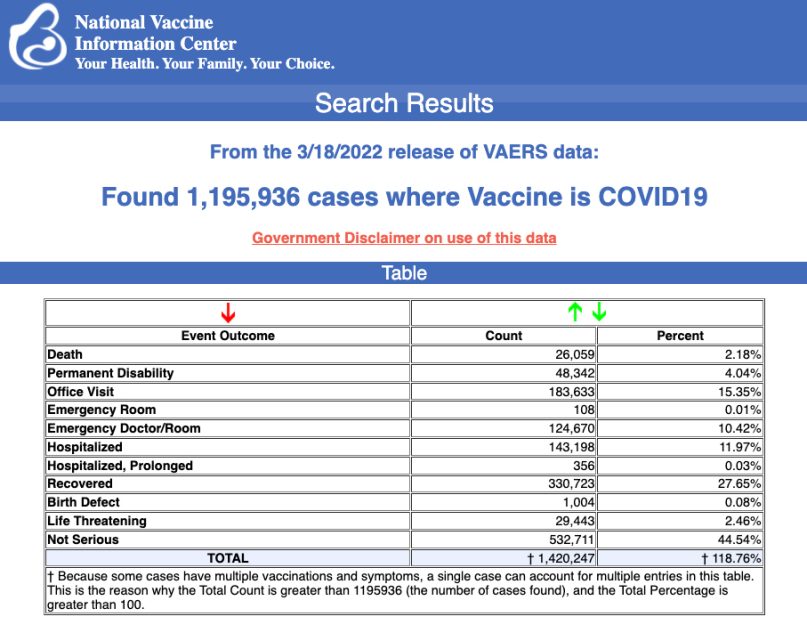
Every Friday, VAERS publishes vaccine injury reports received as of a specified date. Reports submitted to VAERS require further investigation before a causal relationship can be confirmed.
Historically, VAERS has been shown to report only 1% of actual vaccine adverse events.
U.S. VAERS data from Dec. 14, 2020, to March 18, 2022, for 5- to 11-year-olds show:
U.S. VAERS data from Dec. 14, 2020, to March 18, 2022, for 12- to 17-year-olds show:
“Sudden suicide one week after the vaccine. Patient was a perfectly happy child. After the vaccine, he became much more tired and achy and lost interest in doing his sports. One week later, without any warning, he hung himself.”
U.S. VAERS data from Dec. 14, 2020, to March 18, 2022, for all age groups combined, show:
Mother calls for more vaccine studies after 12-year-old experiences severe pericarditis
An Australian mother is calling for long-term studies on mRNA COVID vaccines and better advice for parents after her 12-year-old son was hospitalized for pericarditis just hours after getting the Moderna shot.
The mother, referred to in the media only as “Nat,” vaccinated her son despite being hesitant about the long-term health risks because she believed she was doing the right thing. But within seven hours of being vaccinated, her son was unable to sit or lie down without severe chest pain and complained of breathing difficulties.
ER doctors confirmed Nat’s son had pericarditis, a condition characterized by inflammation of the membrane around the heart.
Nat said she was angry because she was hesitant about giving him the vaccine, but still chose to vaccinate him anyway. Now, she wants the federal government to present better information to parents on the risks of COVID vaccines to help them make a more informed choice on whether to immunize their children.
CDC removes tens of thousands of deaths ‘accidentally’ attributed to COVID
The CDC on March 15 removed from its data tracker website tens of thousands of deaths attributed to COVID, including nearly a quarter of the deaths attributed to children. The CDC said it made adjustments to the mortality data because its website’s algorithm was “accidentally counting deaths that were not COVID-19-related.”
Prior to the adjustment on March 15, the CDC reported 851,000 COVID deaths, including 1,755 pediatric deaths. After the change, COVID-related deaths dropped to 780,000.
The change resulted in the removal of 72,277 deaths previously reported across 26 states, including 416 pediatric deaths — a reduction of 24% to 1,341, the agency said.
According to The Guardian, the error arose from two questions the CDC asks states when they report COVID fatalities. One data field asks if a person died “from illness/complications of illness,” and the field next to it asks for the date of death.
When the answer is “yes,” then the date of death has to be provided. But if a respondent included the date of death but put “no” or “unknown” in the other field, the CDC’s system assumed the answer was an error and switched the answer to “yes.” This resulted in an overcount of COVID deaths in the demographic breakdown.
The agency said once it discovered the problem, it corrected it, but it is unknown how long inaccurate COVID deaths were reported.
The CDC’s COVID statistics, used to justify which age groups should receive vaccines, were used by U.S. health agencies to support the authorization of Pfizer’s COVID vaccine for children 5 to 11 years old.
Moderna to request authorization of COVID vaccine for kids 5 to 11
Moderna on March 23 announced plans to request Emergency Use Authorization (EUA) for its pediatric COVID vaccine, citing preliminary data showing the two-dose regimen was safe for children under age 6, but may not be effective at reducing severe COVID.
The company released partial results from its two pediatric clinical trials in 6,900 children showing the mRNA shots were only about 44% effective at preventing symptomatic infection in children 6 months to 2 years old, and only 37% effective in children aged 2 to 5.
FDA guidelines for EUA products stipulate the product must show 50% efficacy.
The company said the majority of COVID cases observed were mild and no severe disease, hospitalizations or deaths were reported among any of the children who participated in the trial, making it impossible to detect the vaccine’s protective effect against the worst outcomes.
Moderna did not report details on types of side effects except for data on children who experienced fevers. The company said about 15% of children had fevers higher than 100.4 degrees, and 1 in 500 experienced a fever higher than 104 degrees.
However, data show the vaccine may not be effective at reducing severe COVID in children, who make up only a small percentage of SARS-CoV-2 infections — most of which are asymptomatic and mild.
4th COVID shot offers little protection against infection
A small study conducted by Researchers at Sheba Medical Center in Israel found efficacy of a fourth dose of Pfizer and Moderna COVID vaccines resulted in only marginal protection from SARS-CoV-2 infection.
According to the study, published in the New England Journal of Medicine, a fourth Pfizer dose showed 30% efficacy in preventing infection and Moderna’s fourth dose showed only 11%.
The study’s authors said a fourth dose provided “moderate protection against symptomatic infection” (Pfizer = 43%; Moderna = 31%), with symptomatic infection defined as a fever lasting either more or less than 48 hours. Other systemic symptoms included fatigue, myalgia, and headache.
However, these efficacy numbers fall short of the required 50% threshold required by the FDA for EUA products in the U.S.
About 25.2% of fourth dose recipients experienced moderate-to-severe local reactions and 6.5% had moderate-to-severe systemic reactions to a second booster, while the majority of all COVID cases in participants were asymptomatic or had negligible symptoms.
Children’s Health Defense asks anyone who has experienced an adverse reaction, to any vaccine, to file a report following these three steps.
Megan Redshaw is a freelance reporter for The Defender. She has a background in political science, a law degree and extensive training in natural health.
© 2022 Children’s Health Defense, Inc. This work is reproduced and distributed with the permission of Children’s Health Defense, Inc. Want to learn more from Children’s Health Defense? Sign up for free news and updates from Robert F. Kennedy, Jr. and the Children’s Health Defense. Your donation will help to support us in our efforts.
By Glenn Greenwald | March 27, 2022
As grave of a threat as deliberate war is, unintended escalation from miscommunication and misperception can be as bad. Biden is the perfect vessel for such risks.
The central question for Americans from the start of the war in Ukraine was what role, if any, should the U.S. government play in that war? A necessarily related question: if the U.S. is going to involve itself in this war, what objectives should drive that involvement?
Prior to the U.S.’s jumping directly into this war, those questions were never meaningfully considered. Instead, the emotions deliberately stoked by the relentless media attention to the horrors of this war — horrors which, contrary to the West’s media propaganda, are common to all wars, including its own — left little to no space for public discussion of those questions. The only acceptable modes of expression in U.S. discourse were to pronounce that the Russian invasion was unjustified, and, using parlance which the 2011 version of Chris Hayes correctly dismissed as adolescent, that Putin is a “bad guy.” Those denunciation rituals, no matter how cathartic and applause-inducing, supplied no useful information about what actions the U.S. should or should not take when it came to this increasingly dangerous conflict.
That was the purpose of so severely restricting discourse to those simple moral claims: to allow policymakers in Washington free rein to do whatever they wanted in the name of stopping Putin without being questioned. Indeed, as so often happens when war breaks out, anyone questioning U.S. political leaders instantly had their patriotism and loyalty impugned (unless one was complaining that the U.S. should become more involved in the conflict than it already was, a form of pro-war “dissent” that is always permissible in American discourse).
With these discourse rules firmly implanted, those who attempted to invoke former President Obama’s own arguments about a conflict between Russia and Ukraine — namely, that “Ukraine is a core Russian interest but not an American one” and therefore the U.S. should not risk confrontation with Moscow over it — were widely maligned as Kremlin assets if not agents. Others who urged the U.S. to try to avert war through diplomacy — by, for instance, formally vowing that NATO membership would not be offered to Ukraine and that Kyiv would remain neutral in the new Cold War pursued by the West with Moscow — faced the same set of accusations about their loyalty and patriotism.
Most taboo of all was any discussion of the heavy involvement of the U.S. in Ukraine beginning in 2014 up to the invasion: from micro-managing Ukrainian politics, to arming its military, to placing military advisers and intelligence officers on the ground to train its soldiers how to fight (something Biden announced he was considering last November) — all of which amounted to a form of de facto NATO expansion without the formal membership. And that leaves to the side the still-unanswered yet supremely repressed question of what Undersecretary of State Victoria Nuland referred to as the Ukrainians’ “biological research facilities” so dangerous and beyond current Russian bio-research capabilities that she gravely feared they would “fall into Russian hands.”
As a result of the media’s embracing of moral righteousness in lieu of debating these crucial geopolitical questions, the U.S. government has consistently and aggressively escalated its participation in this war with barely any questioning let alone opposition. U.S. officials are boastfully leading the effort to collapse the Russian economy. Along with its NATO allies, the U.S. has flooded Ukraine with billions of dollars of sophisticated weaponry, with at least some of those arms ending up in the hands of actual neo-Nazi battalions integrated into the Ukrainian government and military. It is providing surveillance technology in the form of drones and its own intelligence to enable Ukrainian targeting of Russian forces. President Biden threatened Russia with a response “in kind” if Russia were to use chemical weapons. Meanwhile, reports The New York Times, “C.I.A. officers are helping to ensure that crates of weapons are delivered into the hands of vetted Ukrainian military units.”
The U.S. is, by definition, waging a proxy war against Russia, using Ukrainians as their instrument, with the goal of not ending the war but prolonging it. So obvious is this fact about U.S. objectives that even The New York Times last Sunday explicitly reported that the the Biden administration “seeks to help Ukraine lock Russia in a quagmire” (albeit with care not to escalate into a nuclear exchange). Indeed, even “some American officials assert that as a matter of international law, the provision of weaponry and intelligence to the Ukrainian Army has made the United States a cobelligerent,” though this is “an argument that some legal experts dispute.” Surveying all this evidence as well as discussions with his own U.S. and British sources, Niall Ferguson, writing in Bloomberg, proclaimed: “I conclude that the U.S. intends to keep this war going.” UK officials similarly told him that “the U.K.’s No. 1 option is for the conflict to be extended and thereby bleed Putin.”
In sum, the Biden administration is doing exactly that which former President Obama warned in 2016 should never be done: risking war between the world’s two largest nuclear powers over Ukraine. Yet if any pathology defines the last five years of U.S. mainstream discourse, it is that any claim that undercuts the interests of U.S. liberal elites — no matter how true — is dismissed as “Russian disinformation.”
As we witnessed most vividly in the run-up to the 2020 election — when that label was unquestioningly yet falsely applied by the union of the CIA, corporate media and Big Tech to the laptop archive revealing Joe Biden’s political and financial activities in Ukraine and China — any facts which establishment power centers want to demonize or suppress are reflexively labelled “Russian disinformation.” Hence, the DNC propaganda arm Media Matters now lists as “pro-Russian propaganda” the indisputable fact that the U.S. is not defending Ukraine but rather exploiting and sacrificing it to fight a proxy war with Moscow. The more true a claim is, the more likely it is to receive this designation in U.S. establishment discourse.
That there are few if any risks graver or more reckless than a direct U.S./Russia military confrontation should be too obvious to require explanation. Yet that seems to have been completely forgotten in the zeal, arousal, purpose and excitement which war always triggers. It takes little to no effort to recognize the current emergence of the dynamic about which Adam Smith so fervently warned 244 years ago in Wealth of Nations:
In great empires the people who live in the capital, and in the provinces remote from the scene of action, feel, many of them scarce any inconveniency from the war; but enjoy, at their ease, the amusement of reading in the newspapers the exploits of their own fleets and armies. To them this amusement compensates the small difference between the taxes which they pay on account of the war, and those which they had been accustomed to pay in time of peace. They are commonly dissatisfied with the return of peace, which puts an end to their amusement, and to a thousand visionary hopes of conquest and national glory, from a longer continuance of the war.
The grave dangers of the world’s two largest nuclear-armed powers acting on opposite sides of a hot war extend far beyond any intention by the U.S. to deliberately engage Russia directly. Such a war, even with the U.S. waging it “only” through its proxies, severely escalates tensions, distrust, hostilities, and a climate of paranoia. That is particularly true given that — ever since Democrats decided to blame Putin for Hillary’s 2016 loss — at least half of Americans have been feeding on a non-stop, toxic diet of anti-Russian hatred under the guise of “Russiagate.” As recently as 2018, 2/3 of Democrats believed that Russia hacked into voting machines and altered the 2016 vote count to help Trump win. This cultivation of extreme anti-Russian animus in Washington has been made even more dangerous by the virtual prohibition on dialogue with Russian officials, which during Russiagate was deemed inherently suspect if not criminal.
And all of those preexisting dangers are, in turn, severely exacerbated by an American president who so often is too age-addled to speak clearly or predictably. That condition is inherently dangerous, made all the more so by the fact that it leaves him vulnerable to manipulation by the Democratic Party’s national security advisers who will never forget 2016 and seem more intent than ever on finally attaining vengeance against Putin, no matter the risks. Speaking to U.S. troops in Poland on Friday, a visibly exhausted and rambling President Biden — after extensive travel, time-zone hopping, protracted meetings and speeches — appeared to tell U.S. troops that they were on their way to see first-hand the resistance of Ukrainians, meaning they were headed into Ukraine:
It seems clear that this was not some planned decision to have the U.S. president casually announce his intention to send U.S. troops to fight Russians in Ukraine. This was, instead, an old man, more tired, unpredictable and incoherent than usual due to intense overseas travel, accidentally mumbling out various phrases that could be and almost certainly were highly alarming to Moscow and other countries.
But accidental or unintentional escalation — from misperception or miscommunication — is always at least as serious a danger for war as the deliberate intention to directly engage militarily. In January of this year, the Bulletin of Atomic Scientists announced that its so-called “doomsday clock” was set to 100 seconds before midnight, the metaphorical time they used to signify an extinction-level event for humanity. They warned that the prospect of a cataclysmic nuclear exchange among the U.S., Russia and/or China was dangerously possible, and specifically warned: “Ukraine remains a potential flashpoint, and Russian troop deployments to the Ukrainian border heighten day-to-day tensions.”
In 2018, when the clock was “only” at two minutes before midnight, they emphasized tensions between Russia and the U.S. as one of the primary causes: “The United States and Russia remained at odds, continuing military exercises along the borders of NATO, undermining the Intermediate-Range Nuclear Forces Treaty (INF), upgrading their nuclear arsenals, and eschewing arms control negotiations.” They urged recognition of this specific danger: “Major nuclear actors are on the cusp of a new arms race, one that will be very expensive and will increase the likelihood of accidents and misperceptions.”
That Biden’s “gaffe” about U.S. troops headed into Ukraine could generate exactly this sort of “misperception” seems self-evident. So do the grave dangers from Biden’s sudden yet emphatic declaration on Saturday that Putin “cannot remain in power” — the classic language of declared U.S. policy of regime change:
That clear declaration of regime change as the U.S. goal for Putin was quickly walked back by Biden’s aides, who absurdly claimed he only meant that Putin cannot remain in power in Ukraine and other parts of Eastern Europe, not that he can no longer govern Russia. But this episode marked at least the third time in the past couple weeks that White House officials had to walk back Biden’s comments, following his clear decree that U.S. troops would soon be back in Ukraine and his prior warning that the U.S. would use chemical weapons against Russia if they used them first.
That Biden seems to be stumbling and bumbling rather than following scripted recklessness seems likely in some of these cases but not all. The White House’s vehement denial, in the wake of Biden’s speech, that regime change in Russia is its goal was contradicted by Ferguson’s reporting in Bloomberg last week:
Reading this carefully, I conclude that the U.S. intends to keep this war going… I have evidence from other sources to corroborate this. “The only end game now,” a senior administration official was heard to say at a private event earlier this month, “is the end of Putin regime”… I gather that senior British figures are talking in similar terms. There is a belief that “the U.K.’s No. 1 option is for the conflict to be extended and thereby bleed Putin.” Again and again, I hear such language. It helps explain, among other things, the lack of any diplomatic effort by the U.S. to secure a cease-fire. It also explains the readiness of President Joe Biden to call Putin a war criminal.
Whether deliberate or unintentional, these escalatory statements — particularly when combined with the U.S.’s escalatory actions — are dangerous beyond what can be described. As an Australian news outlet reported on Sunday, “Russia has launched a missile strike near Poland in what appears to be a deadly warning to the United States.” The accompanying video shows at least three long-range cruise missiles, launched from a Russian submarine in the Black Sea, precisely striking targets in western Ukraine, near to where Biden was in Poland. That missile launch, the outlet reasonably concluded, “appears to be a deadly warning to the United States.”
Whatever else is true, the U.S. and Russia are now in waters uncharted since the Cuban missile crisis. Even the savage US/USSR proxy wars of the 1980s in Latin America and Afghanistan did not entail these sorts of rapidly escalating threats. A Russian president who, validly or not, feels threatened by NATO expansion in the region and driven by questions of his legacy, on the other side of a U.S. president with a long record of hawkishness and war fever which is now hobbled by the carelessness and infirmities of old age, is a remarkably volatile combination. As former Greek finance minister Yanis Varoufakis put it on Saturday: “A U.S. President who, during an atrocious war, does not mean what he says on matters of War and Peace, and must be corrected by his hyperventilating staff, is a clear and present danger to all.”
Hovering above all of these grave dangers is the question of why? What interests does the U.S. have in Ukraine that are sufficiently vital or substantial to justify trifling with risks of this magnitude? Why did the U.S. not do more to try to diplomatically avert this horrific war, instead seemingly opting for the opposite: namely, discouraging Ukrainian President Zelensky from pursuing such talks on the alleged grounds of futility and rewarding Russian aggression, and not even exploring whether a vow of non-NATO-membership for Ukraine would suffice? How does growing U.S. involvement in this war benefit the people of the United States, particularly as they were already — before this war — weighed down by the dual burdens of pandemic-based economic depravations and rapidly escalating inflation?
These are precisely the questions that a healthy nation discusses and examines before jumping head-first into a major war. But these were precisely the questions declared to be unpatriotic, proof of one’s status as a traitor or pro-Russia propagandist, as the hallmark of being pro-Putin. These are the standard tactics used to squash dissent or questioning when war breaks out. That neocons, who perfected these smear tactics, are back in the saddle as discourse and policy leaders — due to their six-year project of ingratiating themselves back into American liberalism with performative anti-Trump agitprop — makes it inevitable that such sleazy attacks will prevail.
As a result, the U.S. now finds itself more deeply enmeshed than ever in the most dangerous war it has fought in years if not decades. It may be too late for those questions to be meaningfully examined. But given the stakes, this is as clear a case of better late than never as one will ever encounter.
By Dr. Joseph Mercola | March 25, 2022
The Department of Health and Human Services (HHS) released information to TheBlaze1 in response to a Freedom of Information Act (FOIA) request. The information showed that the federal government had purchased advertising to the tune of $1 billion taxpayer dollars as part of a media campaign to build vaccine confidence.
HHS2 has billed the campaign as a “national initiative to increase public confidence in, and uptake of, COVID-19 vaccines while reinforcing basic prevention measures such as mask-wearing and social distancing.” Data don’t support these measures, but the media campaign was likely hiding something more sinister.
HHS Paid News Media to Build Vaccine Confidence
Within the documents sent from HHS, TheBlaze3 found that hundreds of organizations in the news media were paid to produce TV, print, radio and social media advertising timed to coincide with an increasing availability of the genetic therapy shots.
The government also collaborated with social media influencers whose audience included “communities hit hard by COVID-19” and also engaged “experts” to be interviewed and promote the mass vaccination campaign in the news.4 One of those experts was the director of NIAID and chief medical adviser to the White House, Dr. Anthony Fauci.
In other words Fauci, the man who has been the “face” of COVID-19 in 2020 and 2021,5 who publicly disparaged anyone who questioned the data he was using to support his recommendations, and who blithely referred to himself as “the science,”6,7 was, in fact, a shill.
Virtually every one of the news organizations paid by HHS, including ABC, NBC, CBS, CNN, MSNBC, The Washington Post, Los Angeles Times and the New York Post, covered stories about the vaccines and did not disclose they had accepted taxpayer dollars to support the vaccine effort. It is common practice for the editorial teams to function separately from the advertising departments, so it appears the organizations felt there was no need to disclose their funding.
The advertising took several forms, including an amusing social media campaign featuring Elton John and Michael Caine, fear-based ads that featured survivor stories and straightforward informational ads promoting the safety and efficacy of the current mRNA shot for COVID-19.
Shani George, vice president of communications for The Washington Post made a statement about the funding they received for media advertising from the federal government, saying:8
“Advertisers pay for space to share their messages, as was the case here, and those ads are clearly labeled as such. The newsroom is completely independent from the advertising department.”
A spokesperson for the Los Angeles Times also responded to TheBlaze and gave a similar response. Other publications either did not respond or declined to comment. However, it is important to note that the reporters and editorial staff responsible for news also likely read their own publication or watch the online videos.
It’s not hard to imagine that a large news organization promoting vaccinations through their advertising department would not look kindly on editorial staff who choose to report facts that do not align with large sums of money spent by advertisers. You can guess what the editorial staff may be told to write. TheBlaze offered several examples of thinly disguised advertising published as “news,” including:
Journalistic Objectivity Likely Impossible
The U.S. government is not the only entity to recognize the power behind controlling the news media. Bill Gates is another. Using more than 30,000 grants, Gates has contributed at least $319 million to the media, which senior staff writer for MintPress News Alan McLeod revealed.13
Recipients included CNN, NPR, BBC, The Atlantic and PBS. Gates has also sponsored foreign organizations that included The Daily Telegraph, the Financial Times, and Al Jazeera. More than $38 million has also been funneled into investigative journalism centers.
Gates’ influence within the press is far-reaching, from journalism to journalistic training. This ultimately makes true objective reporting about Gates or his initiatives virtually impossible. MacLeod writes:14
“Today, it is possible for an individual to train as a reporter thanks to a Gates Foundation grant, find work at a Gates-funded outlet, and to belong to a press association funded by Gates. This is especially true of journalists working in the fields of health, education and global development, the ones Gates himself is most active in and where scrutiny of the billionaire’s actions and motives are most necessary.”
It is important to note that Gates has an intense interest in health, and specifically vaccinations.15 And with this power to control the media and his strong connections with health organizations such as Johns Hopkins, with whom he collaborated for Event 201,16 it’s not hard to imagine that his influence can be seen in many of the stories you read or watch each day.
This government overreach into the Fourth Estate is not unique to the U.S. Leaked documents17 have demonstrated that the BBC News and Reuters have also been involved in a covert operation in which the U.K. sought to infiltrate Russian media and promote a U.K. narrative using a network of Russian journalists.
Multimillion-dollar contracts were used to advance these aims, which included 15,000 journalists and staff. The campaign closely follows a U.S. clandestine CIA media infiltration campaign launched in 1948 called Operation Mockingbird.18,19 About one-third of the CIA budget, or $1 billion each year, was spent on bribes to hundreds of American journalists, who then published fake stories at the CIA’s request.
While it may sound like ancient history, there’s evidence to suggest it continues today. Although the messages have changed with the times, the basic modus operandi of dissemination remains the same. Other reports20,21,22 have also highlighted the role of intelligence agencies in the global effort to eliminate “anti-vaccine propaganda” from public discussion, and the fact that they’re using sophisticated cyberwarfare tools to do so.
Facts Reveal Reason Government Is Paying News Media
All-cause mortality and death rates are difficult statistics to change. People are either dead or they’re not. There is only one reason a person is included in the National Death Index Database: They have died regardless of the cause. Evidence is mounting that all-cause mortality is rising to levels greater than were seen during 2020 at the height of the COVID-19 pandemic.
OneAmerica,23 a mutual insurance holding company, announced the death rate in working-age Americans from 18 to 64 years in the third quarter of 2021 was 40% higher than prepandemic levels. Other insurance companies are also finding similar results and citing higher mortality rates.24
The Hartford Insurance Company announced mortality had increased 32% from 2019 and 20% from 2020 during 2021. Lincoln National also reported claims increased by 13.7% year-over-year and were 54% higher in the fourth quarter compared to 2019. Funeral homes are posting an increase in burials and cremations in 2021 over 2020.25
The overall mortality increase noted after the global release of the COVID shot is also being reported in other countries. A large German health insurance company reported their data26,27 were nearly 14 times greater than the number of deaths reported by the German government. The health insurance company gathered the data directly from doctors who were applying for payment from a sample of 10.9 million people.
A reporter from The Exposé 28 notes that while the world has been distracted by Russia’s invasion of Ukraine, the U.K. government quietly released a report29 that confirmed 9 in every 10 deaths from COVID-19 in England were in people who were fully vaccinated.
Each week the U.K. Health Security Agency publishes a surveillance report. The February 24, 2022, report shows 85% to 91% of adults who are infected, hospitalized or died from COVID-19 were fully vaccinated.
Pfizer Documents Show Vaccines Not Fully Safe
Four days after the FDA approved the Pfizer vaccine for ages 16 and older, a group of public health professionals, doctors, scientists and journalists submitted a FOIA request to release the data Pfizer used for the approval of Comirnaty.30 The nonprofit group of professionals is called the Public Health and Medical Professionals for Transparency (PHMPT).31
Despite the FDA’s claim that the organization was committed to transparency,32 the agency first requested 55 years33 to release the data that supported the approval of Comirnaty after the FOIA was filed, and then asked for another 20 years to fully comply.34 All told, the FDA wanted 75 years to release documentation that supported their approval of a genetic therapy being promoted for mass vaccination.
When the FDA did not release the data, the PHMPT sued the FDA since it is the FDA’s statutory obligation35 to publish the documentation within 30 days of approving a drug. Although they asked for 75 years, January 6, 2022, the court ordered the FDA to release 55,000 pages of the documents each month so they would be completed within 8 months.36
March 1, 2022, the first of those documents were released and have been posted for public view on the PMHPT website.37 What’s included in these documents may answer the question of why the government felt $1 billion was required to boost vaccine confidence.
An initial review of some of the papers by one Trial Site News reporter revealed many errors and anomalies. In an interview with Stephen Bannon, mRNA technology inventor Dr. Robert Malone talked about the documentation and the need to develop a team to comb through the information and catalog it for reference. He said:38
“So, all this information comes piped through pharmacovigilance what’s called the pharmacovigilance shop at Pfizer and BioNTech. I presume Pfizer. And then that’s been summarized and submitted to the FDA as a series of documents. So this is a window into what FDA actually knows, which is by inference what CDC knows.
When they tell us there’s no risks and we should go ahead and start mandating or forcing vaccination on our children, what we have for instance, in that section you’re referring to of the listed adverse events is a huge list of what is considered to be adverse events of interest, which means that they’re not just one-offs.
It happens multiple times throughout the world and what we’re finding is embedded throughout this huge volume of documents that the judge has forced Pfizer and the FDA … remember our government tried really hard to keep this information from us and fortunately the courts have called their bluff and forced them to disclose it. Now it’s up to us to comb through it.”
Malone went on to describe the trouble that will likely arise in the coming weeks and months for Pfizer and the FDA from the information that is now freely available to the public when Bannon asked, why is it so important that the courts demanded the information be released now?
“The courts have forced Pfizer and the FDA to comply with the law which is that after licensure is granted these documents must be made available. Previously they’re considered confidential.
And remember that as Naomi’s [Naomi Wolfe] about to discuss, and the truckers are so upset about, we have been forced to take these vaccines and we have been told that they’re fully safe and effective. What this documents is the government has been well aware that they are not fully safe and has hidden this information from us.
What that really matters for Pfizer is that the indemnification clauses require Pfizer disclose known adverse events and this documentation demonstrates they didn’t do so. A lot of the lawyers are licking their chops over this because it seems to indicate a break in the veil that may allow legal action basically due to fraud and concealment of these risks from the general public.
This is why you have not been able to have full informed consent, is they’ve hidden all this information from you and they’ve used all the propaganda and censorship tools — which you’re about to cover — and paid media, to keep all this information from you and spin it, so that you think the left is right and the down is the up and the moon is made of green cheese.”
Sources and References
By Vladimir Platov – New Eastern Outlook – 26.03.2022
While the exact number of US weapons, vehicles, aircraft and military equipment seized by the Taliban after the US and its allies had fled Afghanistan is unknown, the preliminary value of this lethal commodity is estimated by various experts at around $85 billion. In Kunduz, Afghanistan, regular Taliban military displays and military parades show, for example, US-made M1117 armored personnel carriers and other weapons that the Taliban have inherited from the US and have not yet been sold to Pakistan or other countries. Of course, the US military and intelligence agencies will work to assess what ended up in Taliban hands, as US decision-makers have already indicated their desire for more information on the weapons seized, but this will take time. In late 2021, experts at the Center for International Policy in Washington published a study, “US Weapons Stockpiles in Afghanistan”, which noted that over two decades of war, the US had moved weapons, equipment and other materiel worth many tens of billions of dollars into the country. With Afghanistan’s bank accounts blocked and the dire humanitarian and economic situation in the country, the funds that could be raised by the Taliban from the sale of these arsenals are significant.
According to information from Afghanistan and neighboring countries, as well as from the Calibre Obscura blog, which specializes in black market arms analysis, the Taliban are willing to exchange some NATO military equipment for other weapons needed to fight in the difficult geographical conditions of their country. The Taliban plan to use the proceeds from the sale of “surplus” arms to buy food as the country is likely to face starvation after a long crisis.
The sale of US army and allied assets left behind by the hasty withdrawal of the NATO contingent has already begun in the markets of Afghanistan. In particular, body armor, military uniforms, boots, tents, dishes and much more have long been on sale. Most of the trophies are taken from warehouses that NATO has handed over to the Afghan army. It is noted that the Taliban are not asking more than $100 for a body armor, and about $50 or less for a helmet. New S&W Sigma SV9VE pistols are being sold for a third of the market price in Kandahar. In Herat, one can easily buy carbines and assault rifles at the market. Some of the weapons are sold by the Taliban themselves, some by locals who have looted US army bases and barracks.
Grey Dynamics website reports that the Taliban have begun selling off their weapons stockpiles to various groups in neighboring countries. According to their information, the weapons have ended up in the hands of the Balochistan Liberation Front (based in Iran), the Tehrik-e-Taliban-Pakistan and other extremist groups banned in the Russian Federation. Experts suggest that the weapons could resurface in neighboring states, particularly in the Central Asian republics.
It is estimated that Afghanistan could soon become the world’s largest arms seller, causing a spike in crime in the region. Previously, Iraq and, in part, Syria served as this type of arms market. Before them, it was Albania. But Afghanistan can give everyone a head start. After all, just by the most conservative estimate, the US has left about a hundred thousand pieces of small arms alone there. As can be seen from the data published in open sources, there are among the Afghan trophies the blast-resistant US-made wheeled armored vehicles to transport troops; more than two dozen light turboprop attack aircraft A29 Super Tucano (manufactured by Embraer, Brazil); more than 30 Mi-17 transport helicopters, which previously the US purchased from the Russian Federation for the Afghan government forces, as well as no less number of UH-60 Blackhawk transport helicopters and many other state-of-the-art military equipment.
According to separate media reports, the Taliban may decide to sell some of the wheeled armored vehicles to interested countries – the PRC, Turkey and all other states intending to explore US weapons. In particular, according to regional media reports, Chinese defense industries will be able to buy several UH-60 Blakchawk helicopters from the Taliban through Pakistani intermediaries to disassemble and study engine designs. Some of the A-29 Super Tucano strike aircraft may be sold off piecemeal to countries that have established close military and political contacts with the movement’s leadership (in particular, Saudi Arabia, the UAE, Qatar).
The Taliban’s determination to sell off seized military arsenals has only intensified in the absence of news of a possible unlocking of Afghanistan’s foreign exchange reserves by the US.
The Taliban themselves continue to have at their disposal attack aircraft and helicopters that are effective for combat operations in the region, including American, Russian and Brazilian-made aircraft. The Taliban are now offering large sums of money to pilots and airmen who have joined the group, and according to some reports the sums on offer are higher than those previously paid by the government in Kabul. It is known that a number of Kunduz Airbase personnel have already joined the Taliban, and there is a possibility that in the near future the Taliban will have their own air force, albeit on a limited scale.
However, even if the Taliban can obtain serviceable aircraft, they will inevitably face a maintenance problem. But the benefit to the Taliban from their presence remains so far limited by weak logistical and maintenance capabilities. The Taliban may well be able to put pilots in aircraft to make a few sorties, as they have already done, such as at a celebratory parade after the final withdrawal of US troops. But they will almost certainly need outside help to keep the aviation they have received in good working order. And the very number of qualified military pilots the Taliban have is clearly small. Moreover, Afghans are excluded from the global supply chain needed to access spare parts. And while they might be able to dismantle a few aircraft to service others, this model of combat aviation maintenance is highly unsustainable. However, it is quite possible that some external partners – Pakistan, Qatar or others – could provide the necessary assistance to the Taliban.
Furthermore, it should not be forgotten that, thanks to modern information technology and social media, the Taliban can find training programs on the use of even highly sophisticated NATO left-over military equipment and train the number of “operators” they need. Meanwhile, it is quite possible that there could be a strengthening of their “cooperation” in the near future, including in the form of the sale of their existing military equipment at quite reasonable prices or as part of “brotherly aid” to Muslims “fighting for freedom”.
BY JEFFREY A. TUCKER | BROWNSTONE INSTITUTE | MARCH 25, 2022
Yes, Fauci has never worried about consistency or even contradicting himself one day to the next, often without explanation. Too often his doling out “the science” has felt like performance art. Still, the record is that Fauci and all his compatriots either downplayed or denied natural immunity for two years. That has been the source of vast confusion.
In fact, this might have been the most egregious science error of the entire pandemic. It amounted to giving the silent treatment to the most well-established point of cell biology that we have. It was taught to every generation from the 1920s until sometime in the new century when people stopped paying attention in 9th-grade biology class.
After the pandemic broke, Fauci said nothing on this topic for a year and a half. The John Snow Memorandum, written to counter the Great Barrington Declaration, claimed “there is no evidence for lasting protective immunity to SARS-CoV-2 following natural infection.” Mandates and passports have excluded it. Academic, medical, and corporate enforcers have generally refused to recognize it.
When CNN’s Dr. Sanjay Gupta asked him specifically, September 13, 2021, Fauci quickly demurred.
“I don’t have a really firm answer for you on that. That’s something that we’re going to have to discuss regarding the durability of the response,” Fauci said. “I think that is something that we need to sit down and discuss seriously.”
In other words, no one knows!
The HHS head refused to say either way, even when grilled by Rand Paul.
Earlier, the WHO even backed up this denialism, going so far as to change their own definition of immunity in the middle of a pandemic. They eliminated the old sentence on natural immunity and replaced it with a claim that immunity comes from “protecting people from the virus” and not “exposing them to it.” That’s some clever rhetoric right there!
There’s no question that this effort to deny natural immunity was systematic and pushed from the top.
How has this changed? In February 2022, the CDC finally published on the topic that they could not forever deny. And now, Fauci himself let the following slip in an interview on March 23, 2022:
“When you look at the cases they do not appear to be any more severe [than Omicron] and they do not appear to evade immune responses either from vaccine or prior infection.”
What’s critical here is not his debatable claim about vaccines but rather his offhand remark about prior infection. It was tossed off as if: “Everyone knows this.” If so, it is no thanks to him, the CDC, or WHO.
To be sure, everything we’ve known since two years ago – if not 2.5 thousand years – is that immunity from prior Covid infection is real. Vaccines have traditionally been a substitute version of exactly that. Brownstone has assembled fully 150 studies that demonstrate that immunity through infection is effective, broad, and lasting.
Had that messaging been around during lockdowns, the attitude toward the virus would have been very different. We would have clearly seen the present reality from the beginning, namely that endemicity generally arrives in the case of a new virus of this sort due to exposure-induced population immunity. This is how humankind evolved to live in the presence of pathogens.
If we had widespread public awareness of this, the public-health priority would not have been locking down people who can manage exposure but rather alerting those who cannot to be careful until herd immunity in one’s own circle of contacts has been realized via meeting the virus and recovering.
To those who say that is dangerous, consider that mass exposure is precisely what happened in any case, stretched out over two years rather than occurring in a single season. This delaying of the inevitable might be what allowed for variants to emerge and take hold in successive rounds, each new one hitting naive immune systems in ways that were difficult to predict. Flatten the curve amounted to “prolonging the pain,” exactly as Knut Wittkowski predicted in March 2020.
A widespread understanding of natural immunity would have changed the entire calculus of public perception of how to manage one’s life in the face of a new virus. Instead of just running and hiding, people might have considered tradeoffs, as they had always done in the past. What is my risk of infection and under what conditions? If I do get the thing, what happens then? It might also have changed the priorities from disease avoidance and vaccine subsidies and mandates to thinking about the crucial thing: what should people do if they get sick? What should doctors recommend and prescribe?
The neglect of therapeutics figures into this very highly. If people believe that locking down, staying away, masking up, stopping travel, and generally giving up all choices in life were the right way to make a pathogen magically disappear, plus they are under the impression that the risk of severe outcomes is equally distributed across the whole population, plus they believe that 3-4% of the population is going to die from Covid (as was suggested in the early days), you end up with a much more compliant people.
If natural immunity had been rightly seen as the most robust and broad form of immunity from the beginning, and we instead followed the idea of focused protection, the vaccine mandates would have been out of the question.
In other words, the silence of this topic was critical to scaring people all over the world into going along with an unprecedented attack on rights and liberties, thus losing up to two years of childhood education, closing millions of small businesses, and denying people basic religious liberties, in addition to the collapse of public health that resulted in record-breaking alcohol and opioid-related deaths, not to mention lost cancer screenings, childhood vaccinations, and general ill-health both physical and mental.
This stuff is not without consequence. One might expect some contrition. Instead we get a passing comment and nothing more. After all, frank talk about this subject might be risky: it would imply that their entire mitigation strategy was wrong from the beginning and should never be attempted again.
By Du Qiongfang | Global Times | March 24, 2022
Chinese Foreign Ministry spokesperson Wang Wenbin said on Thursday that time will prove China stands on the right side of history and groundless accusations will collapse, refuting an allegation from NATO Secretary General Jens Stoltenberg that “China has provided Russia with political support by spreading lies and misinformation.”
When asked about Stoltenberg’s allegation at Thursday’s press briefing, Wang said the accusation against China itself is spreading disinformation.
With an objective and fair attitude, China has made active efforts to realize an immediate ceasefire, to avoid a humanitarian crisis and to restore peace and stability, Wang said, adding that Ukraine should be a bridge between the East and the West, not an outpost in major power rivalry.
“We need calm and rationality to defuse a crisis rather than ignite the fire and add more fuel to the fire; we need dialogue and communications to resume peace instead of using pressure and coercion; to achieve lasting peace and stability, we need to accommodate the legitimate security concerns of all parties, rather than promote collective confrontation and seek absolute security,” Wang said.
He added that China’s stance is in line with the wishes of most countries and it stands on the right side of history as time will tell. Any groundless accusations and suspicions against China are indefensible and will simply collapse.
The West thinks the war is about defending democracy and freedom but in reality it’s about security in the European geopolitical landscape, so the Ukraine crisis is not about differences in social systems or ideology, Yang Xiyu, a senior research fellow at the China Institute of International Studies, told the Global Times on Thursday.
Wang said that European countries should uphold the principle of strategic autonomy and work with Russia and Ukraine and other relevant countries to build a balanced, effective and sustainable European security architecture through dialogue and negotiations. The US and NATO should also engage in dialogue with Russia to address the root cause of the Ukraine crisis.
Wang also said that there are many loopholes in the US’ responses to the international community, including China’s questions surrounding the US biological laboratories in Ukraine which Russian experts claimed to have revealed new facts pointing to the direct involvement of the US Department of Defense in the development of biological weapons components in Ukraine.
The best way for the US to prove its innocence is to open its doors and accept the test of the international community, Wang said.
The Russian special operation may after all be inching toward successful conclusion
BY M. K. BHADRAKUMAR | INDIAN PUNCHLINE | MARCH 24, 2022
By a queer coincidence, former US Secretary of State Madeline Albright passed away while President Joe Biden was travelling in Air Force 1 en route to Europe on what is probably the most crucial diplomatic mission of his presidency.
The general expectation is that 80-year old Biden is personally undertaking a mission to persuade the US’ European allies that the North Atlantic Treaty Organisation (NATO) should intervene in the Ukraine crisis in some way. And, ironically, Albright was the choreographer of the idea that in the post-cold war era, the NATO should reinvent itself and transform as a global security organisation.
Albright, like most American diplomats of East European descent, was passionately devoted to the NATO. She supported the alliance’s brutal military intervention in Yugoslavia in 1999 and would have supported an intervention in Ukraine.
The White House spin is that Biden will discuss additional sanctions against Russia. But the possibility of new restrictions has waned following the EU foreign and defence ministers’ meeting on Monday where a decision was taken to put off further sanctions.
The EU meeting instead assessed that the ongoing Ukraine-Russian talks should proceed further and even if upbeat predictions may not be entirely correct, since the talks are challenging, the good part is that neither party has complained of any deadlock in the negotiations so far.
Conceivably, Biden is travelling to Europe not to discuss tougher sanctions (something which he could as well have handled in a videoconference) but to explore NATO’s potential engagement in the Russian-Ukrainian conflict for which his participation becomes absolutely essential.
As things stand, there is every possibility of a prolonged conflict in Ukraine and Russia eventually prevailing. Such a scenario is extremely damaging for Biden politically in the US. Biden is facing domestic criticism both for his failure to prevent the conflict as well as for being ineffectual in blocking the Russian advance.
While the US rhetoric pillories Russia for “war crimes” and the humanitarian crisis in Ukraine, et al, the world capitals view this as a geopolitical confrontation between America and Russia. Outside of the western camp, the world community refuses to impose sanctions against Russia or even to demonise that country.
The world community steers clear of taking sides between the US and Russia. The Islamabad Declaration issued on Wednesday after the 45th meeting of the foreign ministers of the fifty-seven member Organisation of Islamic Conference refused to endorse sanctions against Russia and instead counselled cessation of hostilities in Ukraine, avoidance of loss of lives, enhancement of humanitarian assistance and a “surge in diplomacy” — almost ditto China and India’s stance.
Not a single country in the African continent and West Asian, Central Asia, South and Southeast Asian region has imposed sanctions against Russia. Following a visit to Hanoi, Malaysian PM Ismail Sabri Yaakob said, “We discussed the Russian-Ukrainian conflict and agreed that Malaysia and Vietnam will remain neutral on this issue. As for sanctions against Russia, we do not support them. The sides do not support unilateral sanctions; we recognise only restrictions that could be imposed by the UN Security Council.” This is the consensus within ASEAN too.
Interestingly, Chinese Councillor and Foreign Minister Wang Yi was the chief guest at the OIC meeting in Islamabad. In his remarks, Wang Yi said, “China supports Russia and Ukraine in continuing their peace talks, and hopes that the talks will lead to ceasefire, end the fighting, and bring about peace. Humanitarian disasters should be avoided, and spillover of the Ukrainian crisis should be prevented so as not to affect and harm the legitimate rights and interests of other regions and countries.”
The Chinese foreign ministry press release on Wang Yi’s meeting with the Saudi Arabian Foreign Minister Faisal bin Farhan Al Saud said, “As to the Ukraine issue, the two sides agreed that all countries’ sovereignty and territorial integrity should be respected and their reasonable security concerns should be taken seriously. It is imperative to prevent any humanitarian crisis, maintain the peace talk process and resolve conflicts through dialogue and negotiation. Both sides emphasised that all countries have the right to make independent judgements, withstand external pressure, and disagree with the simple logic of “black or white” and “friend or foe”.
Again, the Chinese press release on Wang Yi’s meeting with his Egyptian counterpart Sameh Shoukry said, inter alia, “The two sides exchanged views on the Ukraine issue, and agreed to respect the sovereignty and territorial integrity of all countries and stay committed to a comprehensive solution to the current crisis. Shoukry said, Egypt opposes some countries exerting pressure on China and stands for strengthening cooperation rather than escalating confrontation.”
Curiously, four foreign ministers from West Asia travelled to Moscow last week to discuss the bilateral cooperation — from Qatar, Iran, Turkey and the UAE.
Nonetheless, the outcome of Biden’s visit to Europe will have significant bearing on the conflict in Ukraine. If Biden succeeds in getting European backing for his proposal for a NATO intervention in Ukraine, the conflict may escalate dramatically into a world war involving nuclear weapons.
Will Biden push the envelope? It seems he’s unwilling to risk. Biden seems to have a Plan B as well. He has scheduled a separate visit to Warsaw. Poland indeed has its fair share of Russophbes and has been straining at the leash for some form of involvement in Ukraine.
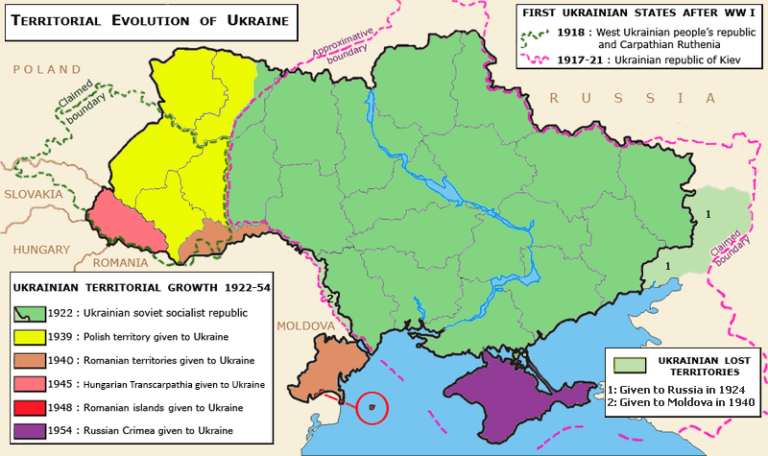
The heart of the matter is that Poland also has an axe to grind. Parts of Poland comprise today’s ethnically mixed western borderlands of Ukraine — oblasts of Zhytomyr, Khmelnytskyi and Lviv. If Ukraine fragments or collapses in defeat, Poland will most certainly seize the opportunity to reclaim its lost territories. Poland’s hyper-activism over Ukraine is self-evident.
Incidentally, in recent days, former Polish Foreign Minister Radoslaw Sikorski and Ukrainian Deputy Prime Minister Iryna Vereshchuk have both accused Budapest of trying to lay its hands on Ukraine’s largely Hungarian-populated Transcarpathian region. On Tuesday, Sikorski alleged in a tweet that Hungarian PM Viktor Orbán and President Vladimir Putin reached a secret agreement on the partition of Ukraine!
On the same day, Iryna Vereshchuk complained in a Facebook post: “The way the Hungarian leadership has been treating Ukraine lately is even worse than some of the Russian satellite states of the former Soviet Union. Hungary does not support the sanctions. They don’t provide weapons. They don’t allow transit of weapon supplies from other countries. They say ‘no’ to virtually everything.”
Biden cannot but be exploring with the Polish leadership possibilities that fall short of an outright NATO intervention in Ukraine. The spectre that haunts the Biden administration, despite the swagger of its media bluster, is that the Russian special operation may after all be inching toward successful conclusion, creating a large buffer of regions on the eastern side of the Dnieper river, and gaining control of Black Sea coastline that denies access to NATO ships.
Poland becomes a key stakeholder in such an outcome and Washington surely regards Warsaw as its number one interlocutor in the developing situation, as the fate of Ukraine hangs in the balance.

or go to
Aletho News Archives – Video-Images
Dr. Gary L. Glum – 30 Q&As – Book Review & Summary
Lies are Unbekoming | October 17, 2026
On June 10, 1975, Dr. Chester Stock, a vice president at Memorial Sloan-Kettering Institute for Cancer Research, wrote to a Canadian nurse named Rene Caisse: “Enclosed are test data in two experiments indicating some regressions in sarcoma 180 of mice treated with Essiac.” The sentence sat in a letter from one of the world’s largest private cancer research centers, concerning an herbal tea an elderly English woman had learned from an Ojibwa medicine man at a northern Ontario mining camp in the 1890s. The tests were terminated the following year after Sloan-Kettering admitted, in sworn affidavit three years later, that they had prepared the injectable solution improperly from the dried material supplied — freezing and thawing the herb rather than boiling it as Rene had instructed. By the time Calling of an Angel was published in 1988, Rene Caisse had been dead for a decade, having treated thousands of cancer patients across fifty-six years in her Bracebridge, Ontario kitchen, never charging a fee, and refusing every offer — from Memorial Sloan-Kettering, the National Cancer Institute, Merck, Parke Davis, and private corporations dangling contracts up to $1 million — to release her formula before the medical establishment admitted her remedy had merit. … continue
 Aletho News If Americans Knew No Tricks Zone
