For pro-lockdown campaigners, all roads lead to the Kochs
By Martin Kulldoff and Jay Bhattacharya | Unherd | March 29, 2022
During the Covid-19 pandemic, tribal politics have pushed scientific discourse into the back seat. Scientists who provide their honest assessment of medical and public health data have often been subject to ad hominem attacks and slander.
When Left-leaning journalists defend the government’s pandemic strategies by falsely classifying opponents as Right-wing, it hurts the Left while boosting the Right. The latest example is an article in the New Republic with one of the most far-fetched personal attacks we have seen since March 2020 — a true accomplishment during a pandemic filled with logical somersaults.
The target is Urgency of Normal, a group of physicians and medical scientists arguing against the masking of toddlers and children. The group includes Dr Vinay Prasad, a physician, epidemiologist, and associate professor at the University of California in San Francisco. With colleagues at Harvard and the University of Colorado, he wrote the most thorough scientific review of the efficacy of masks against Covid. They concluded that “data to support masking kids was absolutely absent.”
The New Republic article is called ‘Why Is This Group of Doctors So Intent on Unmasking Kids?’ The straightforward answer is that the doctors concluded that there is no reliable scientific evidence that masks on children reduce disease spread alongside a strong presumption that they may harm some children. The New Republic dismisses this possibility, claiming that “the science is strong” that masks help to “quell the pandemic”, and that there is “‘little scientific disagreement”. The last point is self-evidently untrue given the participation by many eminent scientists in the Urgency of Normal itself.
The essay then goes full ad hominem, attempting to link Dr. Prasad to “libertarian” efforts by the Koch family to unmask children via a convoluted chain of supposed associations, each of which is weak and the combined effect of which is simply conspiracy (see below). It appears that the New Republic, once a fierce critic of Sen. Joe McCarthy, has now embraced McCarthy’s guilt-by-association techniques.
Dr. Prasad is an excellent epidemiologist, but to paraphrase the New Republic, it seems “that the days of listening to the epidemiologists are over”. They are not alone. The Daily Poster/Lever and Jacobin magazine have used similar ad hominem arguments to falsely “connect” lockdown opponents with the Koch network, falsely claiming that the two of us are “connected to Right-wing dark money”. Our closest and only financial “connection” to the Koch Network is to have worked for universities, Stanford and Harvard, which have received millions of dollars from Koch foundations, although unrelated to any of our own work.
In the summer of 2020, Jacobin magazine interviewed one of us about lockdowns and their devastating effects on children and the working class. Their reader’s reactions were illuminating. The public criticism from high-profile individuals was harsh, calling us Trumpian, among other things. But, we also received many private letters from Jacobin readers, thanking us for saying what they were thinking but did not dare to say in public.
Views on pandemic strategies do not map onto a simple Left/Right binary. In the United States, Dr Anthony Fauci’s lockdowns were implemented by both Republicans and Democrats, generating enormous collateral damage to education, cancer, cardiovascular disease, vaccination rates, mental health, and hunger, to name a few malign outcomes. More often than not, members of the working class were the hardest hit. In Europe, the social democrats in Sweden chose not to copy Fauci’s response to the pandemic. One contributing factor may have been that its prime minister came from the working class, having started his career as a welder.
Classifying those like Dr Prasad as “Right-wing” for taking different views on pandemic restrictions is only damaging to the Left. Instead of permitting the Right to claim full credit for opposing misguided Covid policies, the Left should rightly claim some of that credit — Dr Prasad is, after all, on the Left himself. Instead, publications like the New Republic seem intent, not merely on smearing scientists instead of learning from them, but on driving reasonable men and women to the Right.
The New Republic’s convoluted attempt to associate Dr Prasad with the Koch family, in full:
- Prasad ‘writes for the Brownstone Institute for Social and Economic Research.’ (The Brownstone Institute, with no Koch connections, has republished Dr. Prasad’s Substack articles without payments.)
- The Brownstone Institute’ advocates for a more libertarian approach to the pandemic’. (Brownstone is not a libertarian organisation. It advocates for a more scientific approach to the pandemic based on basic principles of public health. It has attracted writers from across the political spectrum.)
- The Brownstone founder ‘consults for the American Institute for Economic Research’ (AIER). (He is a former employee without current ties.)
- AIER ‘receives funding from the Charles Koch Foundation.’ (One grant only, which paid <1% of AIER expenses in 2018.) AIER ‘receives funding’ from the ‘Koch-funded public relations firm Emergent Order and Emergent Order which also aided the Great Barrington Declaration.’ (Neither is true.)
- ‘One Koch-backed group has been linked to school unmasking efforts.’ (A mother’s anti-mask letter was circulated by a women’s group with some Koch funding. In contrast, a Koch-backed group have funded the pro-lockdown Covid work of Prof. Neil Ferguson at Imperial College.)
Martin Kulldoff, Ph.D., is an epidemiologist, biostatistician, and a former professor of medicine at Harvard University. Jay Bhattacharya, M.D., Ph.D., is an epidemiologist, health economist, and professor at the Stanford University School of Medicine. Both are senior scholars at the Brownstone Institute and founding fellows at the Academy for Science and Freedom.
Surgeon General, HHS Violated First Amendment by Directing Twitter to Censor COVID ‘Misinformation’: Lawsuit
By Michael Nevradakis, Ph.D. | The Defender | March 29, 2022
A civil rights group is suing the U.S. surgeon general and the secretary of the U.S. Department of Health and Human Services (HHS) on behalf of three men who allege the government violated the First Amendment by directing Twitter to censor them for spreading COVID “misinformation.”
The New Civil Liberties Alliance (NCLA) on March 24 filed a complaint against Surgeon General Dr. Vivek Murthy and HHS Secretary Xavier Becerra in the U.S. District Court for the Southern District of Ohio, Columbus Division.
NCLA describes itself as “a nonpartisan, nonprofit civil rights group founded by prominent legal scholar Philip Hamburger to protect constitutional freedoms from violations by the Administrative State.”
According to the complaint, between May 2021 and December 2021, Twitter temporarily or permanently suspended the accounts of the three plaintiffs — Mark Changizi, Daniel Kotzin and Michael P. Senger.
The lawsuit states:
“Mark Changizi, Daniel Kotzin, and Michael Senger each had or have Twitter accounts with tens of thousands of followers or more.
“Their Twitter platforms provided them with a social network, and an outlet to express their views, to hear the views of others, and to engage with detractors and fans alike.”
Twitter permanently suspended Senger’s account. Senger is a San Francisco-based attorney who was openly critical of COVID-related policies and of what he called “pro-lockdown propaganda” from China.
Twitter only temporarily suspended the accounts of Changizi and Kotzin. Visitors to the Twitter account belonging to Changizi, a well-known theoretical cognitive scientist, now see a warning stating “Caution: This profile may include potentially sensitive content.”
Kotzin’s Twitter account is active as of this writing, despite prior suspensions. A stay-at-home father, Kotzin is married to Jennifer Sey, the former president of Levi’s who recently stepped down from her position, alleging Levi’s executives bullied her after she spoke out against some COVID-related policies.
The lawsuit alleges the suspensions of the three men’s accounts are a result of the policies against “misinformation” announced by the surgeon general and HHS.
The lawsuit states:
“Outrageously, the U.S. surgeon general and the Department of Health and Human Services (HHS) have directed social media platforms including Twitter to censor alleged ‘misinformation’ about Covid-19.
“The speech ban has included information the Government later conceded was true but that conflicted with the Government’s messaging on Covid-19 at the time.”
As reported earlier this month by The Defender, the Biden administration and Dr. Rochelle Walensky, director of the Centers for Disease Control and Prevention, recently made statements contradicting earlier official statements and public pronouncements regarding COVID policies.
The lawsuit provides a timeline of federal government “intimidation tactics” aimed at stifling so-called “misinformation” about COVID on social media:
“On March 3, the surgeon general demanded that the tech companies turn over information about individuals who spread such ‘misinformation,’ a clear intimidation tactic that HHS has labeled a ‘Request for Information’ (RFI).
“Adding insult to injury, on March 3, the surgeon general issued his RFI, demanding that technology platforms turn over ‘information about sources of Covid-19 misinformation’ to the Government by May 2, 2022.
“In response to Government pressure, Twitter has permanently banned Mr. Senger, and temporarily suspended Mr. Changizi and Mr. Kotzin.”
According to the RFI, social media companies must submit such information posted on their platforms dating back to January 2020.
The complaint alleges Murthy and Becerra lack the statutory authority to issue such a request to private social media platforms.
The Defender previously reported on attempts by the federal government to combat alleged “misinformation.”
As stated in the RFI:
“Health misinformation — health information that is false, inaccurate, or misleading according to the best available evidence at the time — has been a challenge during public health emergencies before, including persistent rumors about HIV/AIDS that have undermined efforts to reduce infection rates in the U.S. and during the Ebola epidemic.
“But the speed, scale, and sophistication with which misinformation has been spread during the COVID-19 pandemic has been unprecedented.
“Recent research shows that most Americans believe or are unsure of at least one COVID-19 vaccine falsehood.”
The RFI outlines social media’s purported contribution to the spread of such “misinformation,” and the role such platforms can play in future pandemics:
“The digital information environment is a phenomenon that requires further research and study to better prepare for future public health emergencies. This RFI seeks to understand both the impact of health misinformation during the COVID-19 pandemic and the unique role that technology and social media platforms play in the dissemination of critical health information during a public health emergency.
“The inputs from stakeholders will help inform future pandemic response in the context of an evolving digital information environment.”
According to the lawsuit, this RFI comes as part of a broader White House effort to stop the spread of “health misinformation” dating back to spring 2021, threatening Big Tech with antitrust proceedings over their enormous market share if companies did not provide the requested information to the government:
“In May 2021, the White House began a coordinated and escalating public campaign to stop the flow of purported “health misinformation” related to Covid-19.
“In a May 5, 2021 press briefing, White House Press Secretary Jen Psaki stated that the President believed social media platforms have a responsibility to censor health ‘misinformation’ related to Covid-19 vaccinations, that by not doing so they were responsible for American deaths, and that the President believed ‘antitrust’ programs were in order to effectuate this end.
“In other words, if tech companies refused to censor, they would face antitrust investigations—or worse.”
The surgeon general and HHS later joined these efforts, according to the lawsuit:
“By July, the surgeon general and HHS ratcheted up the pressure by issuing an advisory on the subject, commanding technology platforms to collect data on the ‘spread and impact of misinformation’ and ‘prioritize early detection of misinformation ‘super-spreaders’ and repeat offenders” by ‘impos[ing] clear consequences for accounts that repeatedly violate platform policies’.”
It was during this period that Twitter banned or suspended the three plaintiffs.
Commenting on the lawsuit, Senger said:
“It’s difficult to overstate the federal government’s cynicism in pretending to respect the First Amendment rights of American citizens while explicitly working with a company whose CEO says it ‘is not to be bound by the First Amendment’ in silencing American citizens on the most widely-used platform for political discourse.”
According to the NCLA, the censorship advocated by Murthy and HHS strikes at the heart of what the First Amendment to the U.S. Constitution was designed to protect — free speech, especially political speech, much of which has since been vindicated and proven accurate.
“[B]y instrumentalizing tech companies, including Twitter — through pressure, coercion, and threats — to censor viewpoints that the federal executive has deemed ‘misinformation,’ the surgeon general has turned Twitter’s censorship into state action,” the NCLA said.
The nonprofit said the government’s policy of “pressuring Twitter and other tech companies to censor the Plaintiffs” should be halted immediately, adding:
“The surgeon general does not have the authority to issue this demand. The statute only gives him the authority to implement measures to stem spread of communicable disease. The statute cannot reasonably be interpreted to allow him to order tech companies to censor individuals with whom he disagrees on COVID policy, or to demand that Twitter hand over information about such account holders without a warrant based on probable cause.
“Demanding social media platforms, including Twitter, to turn over information about users that the Government deems problematic constitutes a warrantless search in violation of the Fourth Amendment to the U.S. Constitution.”
Civil rights attorney, writer and activist Jenin Younes, litigation counsel for this case, said, “The surgeon general apparently believes he can do whatever he wishes, even going so far as to commandeer technology companies to stifle the perspectives of those who differ from the government on COVID policies.”
Younes said Congress did not give Murthy the authority to “coerce social media platforms into censoring the voices of those with whom he disagrees,” and in fact, it could not have given him this power.
“The surgeon general’s demand has turned Twitter’s censorship into government action,” Younes said. “Thus, this viewpoint-based suppression of speech violates our clients’ First Amendment rights to free speech.”
Mark Chenoweth, NCLA executive director and general counsel, said:
“Surgeon General Murthy’s RFI is really a Request for Intimidation. HHS is a serial violator when it comes to abusing its statutory power.
“Incredibly, HHS is relying on the exact same statute to issue the RFI here that it relied on the past two years to justify its unlawful nationwide eviction moratorium.
“The Supreme Court finally shot down the illegal moratorium. NCLA hopes lower courts are quicker to act on this latest unconstitutional outrage.”
Incidents of social media censorship stemming from purported COVID-related “misinformation” have been plentiful over the past two years.
For instance, last year, Twitter banned former New York Times reporter Alex Berenson for publishing “COVID misinformation,” leading him to file a federal lawsuit against the platform.
The NCLA lawsuit does not directly target Twitter, instead, it goes after HHS and the surgeon general for strongly encouraging — or indirectly mandating — censorship policies on the part of social media platforms.
Michael Nevradakis, Ph.D., is an independent journalist and researcher based in Athens, Greece.
© 2022 Children’s Health Defense, Inc. This work is reproduced and distributed with the permission of Children’s Health Defense, Inc. Want to learn more from Children’s Health Defense? Sign up for free news and updates from Robert F. Kennedy, Jr. and the Children’s Health Defense. Your donation will help to support us in our efforts.
Red Alert: What seeing the war in Syria taught me about US/Western government and media propaganda
By Janice Kortkamp | Ron Paul Institute | March 29, 2022
The Syrian war was the first fully observed conflict on social-media and the ability to connect directly with Syrians real time as they were experiencing the crisis was unprecedented. This created a unique opportunity to get unfiltered information directly from all sides of the conflict to gain insights and understanding. The results have helped shake off the control by conventional news media over foreign events reporting and analysis. While this has created some chaos, valuable lessons have been (or should have been) learned.
I began researching Syria and the war there in late 2012, and have made seven extended journeys traveling around during the war from 2016 through 2019, meeting with hundreds of Syrians from different backgrounds, walks of life, and opinions as a 100 percent non-affiliated, unpaid, and self/crowd-funded, independent citizen-journalist.
It became clear that what’s been happening in Syria was not a spontaneous, organic, popular uprising against a tyrant, but a proxy regime-change attempt war in the works since the mid 2000’s against the quite popular Assad. This effort was spearheaded by the US, UK, France, and Israel, using Sunni violent fundamentalists and extremists (unpopular with the majority of Syria’s Sunni population as well as minority groups) armed and funded by the West and regional allies of Saudi Arabia, Turkey, and Qatar to start the violence and do the dirty work. The basic character of the rebel groups was apparent from the beginning: Syrian and non-Syrian fighters most Westerners would call terrorists and be screaming for their government to crush if the same heavily armed groups had taken over their cities, towns, and suburbs by massacring, beheading, torturing, kidnapping, and raping.
Syrians often remarked to me that before the war their country was “almost a paradise.” The middle class was the largest economic sector and growing. Religious harmony was the norm and Christians there were doing well. International investment was increasing as were the tourists. Women were equal or outnumbering men in the universities and present in leadership roles in nearly all aspects of society. Syria had made the “Top 5” list of the world’s most personally safe countries. President Assad had brought the Internet into the country and kept it open throughout the war and the people there knew all that was being said in the West about the crisis.
This doesn’t mean Syria was perfect and Assad beloved by all Syrians. There were and are many problems there which are directly attributed to the government with corruption always being number one on the list of grievances. These internal issues have been exacerbated by the war.
Now, after 11 years of war, 90 percent of Syrians are poor, many are starving; the economy is shattered. Between the fighting, US/Western sanctions, loss of production capability (though an impressive number of factories have been rebuilt), shortages of electricity and fuel, the black market and smuggling, dearth of employment opportunities, Covid-19, and the economic meltdown in Lebanon, the situation seems destined to remain desperate for the foreseeable future. The pressure by the US and most allies continues including increased sanctions, and three on-going illegal occupations: US has seized control over 1/3 of the country (the part with the richest oil fields); Turkey holds much of the north; and Israel is still occupying the Golan while making routine air strikes in Syria with no condemnation. There are numerous terrorist groups including ISIS cells and Hay’at Tahrir al-Sham (HTS, formerly Jabhat al-Nusra, the al Qaeda affiliate) to get rid of in the northeast and Idlib.
As for Russia’s role in Syria, I’ve watched it closely – including observing some Russian military operations personally in Deir Ezzor, Homs, and Palmyra. Russia and Iran are in Syria legally, asked to join in the fight against ISIS and al Nusra by the Syrian government.
From 2011 through 2015 the situation was dire. In 2012 the US resolution at the UN called for President Assad to step down and both Russia and China vetoed it. The US and UK responded with “fury” according to The Guardian, while Syrians were out in the streets cheering. When Russian troops came in September of 2015, the priority was to put a stop to ISIS operations in the northeast. Massive ISIS oil convoys were taking the stolen oil up to Turkey, bringing the terrorist army equally massive amounts of money to use for their rampages while, according to a leaked, verified audio tape of John Kerry speaking with the Syrian opposition, the US was “watching ISIS grow” hoping the pressure would get Assad to negotiate. Instead, an appeal was made to Putin and answered. Within a few months, the ISIS oil convoys had been reduced significantly, cutting that cash flow.
By the end of 2016 total chaos had been replaced with more established battle lines and though violence was still occurring everywhere, there was some order. Palmyra was liberated from ISIS in the spring of 2016, after which the Russians and Syrians put on an orchestra concert to rededicate the spectacular archaeological site to culture; Western governments and media were not enthusiastic. It fell again to ISIS and many of the most important buildings were destroyed by the terrorists. The battles for Palmyra would have been the perfect opportunity to actually use chemical weapons – to protect that prized site and with ISIS forces isolated in the desert, however the fighting raged with conventional weapons and casualties were very high. In December 2016, Aleppo was freed from the terrorist groups that had been holding the eastern half of the city for years by the Syrian Army and its allies – with the ones fighting the terrorists being treated as though they were worse than ISIS in western media. The terrorist groups backed by the US and allies included the likes of Nour al din al Zenki that grabbed the young boy, Abdullah Issa, out of hospital with the IV still in his arm and beheaded him in the back of a truck on video while laughing. Al Zenki had received advanced weapons and other support by the US.
By October of 2017 when I was in Palmyra, Deir Ezzor and al Mayadeen, most of that area was freshly liberated from ISIS by the combined Syrian, Russian, Iranian, Iraqi, and Hezbollah forces. ISIS was still all around but its backbone of cities down the Euphrates had been severed. In Homs, I observed the transportation of armed groups twice from the Al-Waer suburb, overseen by the Russians. In addition, Russian de-mining efforts have insured relative safety for civilians returning to their homes after areas have been liberated.
To summarize, in my experience the Russians have indeed been effective in the fight against ISIS and al Qaeda while displaying professionalism, precision, and minimizing civilian casualties. The US has been using ISIS as a pretext for its own completely illegal occupation of the entire northeast third of Syrian lands, and has often been helping or working directly on behalf of the al Qaeda affiliate and similar terrorist groups.
However, the US/Western media is still saying the same things they’ve said since 2012, if anything entrenching deeper in the assertions of the US and other western governments. All major articles and stories are still about “the tyrant Assad killing his own people”; and the great majority of the Syrian people who supported their leader and army were made invisible. That support ranged from total devotion to begrudging acceptance because the alternative, Syria falling to the terrorists promoted by the West, was unthinkable. Anyone offering evidence and opinion different from that of the accepted narratives isn’t just ignored – they’re treated as enemies and attacked by the media.
The Russian invasion of Ukraine is still in the early stages and although I’ve been tracking the situation since 2014, I certainly don’t to know all of what’s happening or will happen. To sort fact from fiction from all sides will be a painstakingly long process yet there is great urgency to avoid as much devastation as possible. War is painful, the most painful thing. It truly does hollow out souls as it lays waste to lands and lives and I hate it all, but I’ve seen the wall go up already which prohibits looking at the other side, hearing what their grievances and concerns are. That wall protects the easy to memorize, constantly repeated, approved talking points: “pre-meditated”, “unprovoked”, “unjustified” and that wall is already considerably taller, deeper, and wider than it’s been about Syria. For me, this is when the red light starts flashing, the alarm begins sounding, and I’m on full alert for more gross oversimplifications, exaggerations, unproven allegations, and outright falsehoods.
Copyright © 2022 by Ron Paul Institute
Biden’s ‘cognitive decline’ is a ‘national security risk,’ says Republican senator
Samizdat | March 29, 2022
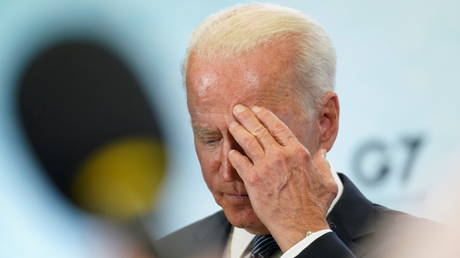
Senator Rand Paul (R-Kentucky) said on Monday that President Joe Biden’s apparently declining mental faculties present a “national security risk” that could see the US dragged into a war with Russia. Biden earlier appeared to call for Russian President Vladimir Putin’s removal from power, before walking back the statement, then making it again.
“A lot of times when you’re around somebody who’s in cognitive decline, you find yourself trying to help them with a sentence, trying to help them complete it,” Paul told Fox News host Jesse Watters on Monday evening, adding that “we shouldn’t have to do that for the commander-in-chief.”
Earlier on Monday, Biden told reporters that he “was not articulating a change in policy” when he called Putin a “butcher” who “cannot remain in power” during a visit to Poland over the weekend. Despite assuring the press that he wasn’t demanding regime change in Moscow, Biden then said again that Putin “shouldn’t be in power.”
Biden read from pre-prepared cue cards during the press conference.
“It is actually a national security risk because he’s sending signals that no one in their right mind would want to send to Russia at this point,” Paul continued. “We aren’t trying to replace Putin in Russia. We aren’t trying to have regime change. We’re not sending troops into Ukraine, and we’re not going to respond in kind with chemical weapons,” he stated, referring to two other statements that Biden made and the White House walked back.
These statements involved Biden seemingly telling US soldiers that they would be deployed to Ukraine, and that the US would “respond in kind” to a hypothetical Russian use of chemical weapons on the battlefield. Both actions would result in open war between the US and Russia, something that Biden has repeatedly said he wished to avoid.
“So I do think that it is a real problem, and there’s a humorous angle to this,” Paul said. “But it’s really not funny because we’re worried about what he’s saying, precipitating or escalating the conflict in Ukraine into a world war. That’s very serious.”
While Paul has condemned Russia’s military offensive in Ukraine, the Kentucky Republican opposes any US involvement in the conflict. Prior to Russia’s attack, Paul insisted that Ukraine “should not and cannot be our problem to solve,” and that the country’s accession into the NATO alliance – which the US and her allies insist is its right – would be “a recipe for war and disaster.”
Sanctioning Russia could topple the West
A new Cold War would cripple the American empire
BY THOMAS FAZI | UnHerd | March 22, 2022
The West, following the lead of the United States, has reacted to Russia’s invasion of Ukraine by introducing a “crippling” regime of sanctions. It is a “total economic and financial war” aimed at “caus[ing] the collapse of the Russian economy”, the French finance minister Bruno Le Maire candidly admitted. And yet many of the current sanctions appear to be run-of-the-mill restrictions used against several countries in the past. A number of them — including export bans and the freezing of certain assets — have been imposed on Russia since its annexation of Crimea in 2014. Even the much-discussed exclusion of a number of Russian banks from the main international banking message system, SWIFT, is not new, having already been used against Iran, with mixed results.
The most controversial aspect of the new sanctions regime is without a doubt the freezing of Russia’s offshore gold and foreign-exchange reserves — about half of its overall reserves — but even this is not unprecedented: last year, the US froze foreign reserves held by Afghanistan’s central bank in order to prevent the Taliban from accessing its funds; the US has also previously frozen the foreign-exchange reserves of Iran, Syria, and Venezuela.
So, taken individually, these measures are not as exceptional as they’ve been portrayed. However, never before have so many sanctions been deployed at once: there are already 6,000 various Western sanctions imposed on Russia, which is more than those in existence against Iran, Syria and North Korea put together. Even more importantly, none of the previous targets of sanctions were remotely as powerful as Russia — a member of the G20, and the world’s largest nuclear power.
Likewise, none of the 63 central banks that are members of the Bank for International Settlements (BIS) in Basel — known as the central bank of central banks — has ever been the target of financial sanctions. The BIS itself has even joined in on the sanctions in order to prevent Russia’s access to its offshore reserves. This really is unprecedented: since its establishment in 1931, the BIS had never taken such a measure, not even during World War II.
So what should we expect from the sanctions? Western pundits and commentators have little doubt: the sanctions will hamstring the Russian economy, sow discontent among the Russian people and elites alike, and possibly even cause the downfall of the Putin regime. At the very least, we’re told, they will hinder Russia’s war efforts. But history suggests otherwise: see Iraq, or more recently Iran. Far more likely is that this turns out to be the latest Western strategic miscalculation in a long list of strategic blunders, of which the United States’ inglorious withdrawal from Afghanistan is just the most recent example.
After all, Russia has been preparing for this moment for quite some time. Following the first wave of Western sanctions, in 2014, and partly in retaliation against them, Putin embarked on what analysts have dubbed a “Fortress Russia” strategy, building up the country’s international reserves and diversifying them away from US dollars and British pounds, reducing its foreign exposure, boosting its economic cooperation with China, and pursuing import substitution strategies in several industries, including food, medicine and technology, in an effort to insulate Russia as much as possible from external shocks.
True, Putin made the mistake of leaving around half of those reserves parked in foreign central banks, resulting in these now being confiscated. But nonetheless Russia still has access to more than $300 billion in gold and foreign-exchange reserves — more than most countries in the world and more than enough to cushion any short-term fall in exports, or prop up the rouble (for a while).
Moreover, the Russian central bank reacted to the sanctions by stopping capital flows out of Russia and nationalising the foreign exchange earnings of major exporters, requiring Russian firms to convert 80% of their dollar and euro earnings into roubles. It also raised interest rates to 20% in an effort to attract foreign capital. These measures are aimed at bolstering the rouble’s value and providing a flow of foreign exchange into the country. They appear to be working: while the rouble is around 40% of its value since the start of the conflict, the Russian currency’s free-fall seems to have come to a halt for now, even registering an uptick over the past two weeks. For the time being, Russia’s financial account — the difference between the money flowing in and out of the country — is far from disastrous.
Let’s not forget that the main source of Russia’s foreign-exchange reserves — oil and gas exports — has been excluded from the sanctions, for obvious reasons: for most European countries, Russia accounts for a huge part of their oil and gas imports (and other staple commodities), and there’s simply no way of replacing those energy sources from one day to the next.
In short, Russia runs no risk, in the short term, of running out of reserves and not being able to pay for its imports. But even assuming that the West decided to put a stop to all its imports from Russia overnight, there’s no reason to believe that this would bring the Russian military machine to a halt. The notion that “we are financing Russia’s war by purchasing gas and oil”, as the Finnish prime minister recently stated, is fundamentally misplaced.
As the economist Dirk Ehnts has observed, the Russian military machine, for the most part, doesn’t rely on imports (if anything, Russia is an arms exporter). It is sourced domestically and, like the salaries of its soldiers, is paid for in roubles, which the Russian central bank can create in an unlimited quantity, just as the Bank of England does when it comes to pounds.
Equally unfounded are rumours of an impending Russian default. In recent years, the Russian government has taken steps to reduce its foreign liabilities: its foreign currency-denominated debt amounts today to about $40 billion — a tiny amount compared with the size of Russia’s yearly exports of more than $200 billion in oil and gas. Any decision to default would be entirely political. We mustn’t forget that the very creditors expecting to be paid back in dollars are the same that have just confiscated a good part of Russia’s dollars — if the latter were to default on their payments, it would be an even bigger problem for their Western creditors. As with Russia’s oil exports, hurting Russia inevitably means hurting ourselves as well.
Moreover, thanks to the Russian government’s successful efforts at boosting domestic agricultural production, domestic food production now accounts for more than 80% of retail sales, up from 60% in 2014. This means Russia is largely self-sufficient food-wise. So even if its export revenues were to plummet (which is unlikely), the country wouldn’t go hungry — unlike the rest of the world — and would most likely be able to continue to finance its war efforts.
Might a selective ban on exports of specific high-tech Western components, some of which are bound to be used in Russia’s defence industry, prove more effective? Possibly. But Russia has been reducing the dependence of its military-industrial apparatus on foreign components and technologies for years. More importantly, both hypotheses — that Russia’s economy and military can be brought to their knees through export and/or import bans — rest on the flawed assumption that the whole world is on board with the sanctions. But that is far from the case.
While most of the world’s nations — 143 out of 193 — voted for a resolution in the UN’s General Assembly condemning Russia, the 35 countries that abstained include China, India, Pakistan and South Africa, as well as several African and Latin American states. These and many more countries — including several that voted in favour of the resolution, such as Brazil — have strongly criticised the sanctions against Russia and can be expected to continue trading with Putin. It’s frankly very hard to call Russia isolated when some of the world’s largest economies have refused to support the West’s sanctions regime.
China, in particular, has been very vocal in its support of Russia. Beijing is already the Kremlin’s main trading partner, and it alone can absorb huge quantities of Russian energy and commodities, as well as provide Russia with basically any industrial and consumer goods that the latter currently imports from the West. China also operates an alternative to the Western-managed SWIFT system called CIPS to manage cross-border transactions in yuan, which could allow Russia to partially circumvent the West’s financial blockade. Even though the yuan still makes up a small percentage of international transactions, its role is bound to grow rapidly in the coming years (consider the news that Saudi Arabia may start pricing its oil sales to China in the latter’s currency). All this helps explain why even Western financial analysts, such as Goldman Sachs and JP Morgan, predict a year-on-year contraction for the Russian economy of about 7% — bad, but hardly catastrophic (Covid caused a much larger drop in GDP for most countries).
However, much will depend on the policy response of the Russian government. Obviously, the withdrawal of many foreign firms and decline in foreign investments will increase unemployment. But the Russian government can cushion the blow by resorting to a “Keynesian” expansionary fiscal policy aimed at boosting domestic investment and supporting incomes. If ever there were a time for Russia to abandon its historically ultra-tight fiscal policy, as several Russian economists have been arguing for some time, it is now.
Two weeks ago, I suggested that, in the short term at least, the US will benefit from the conflict in Ukraine. In the long term, however, it is slowly becoming clear that US-led global Western order will suffer. The West’s imposition of sanctions — involving not only governments, but also private companies and even allegedly apolitical organisations such as central banks — has sent a clear message to the countries of the world: the West will stop at nothing to punish countries that step out of line. If this can happen to Russia, a major power, it can happen to anyone. “We will [never again] be under the slightest illusion that the West could be a reliable partner,” the Russian foreign minister Sergey Lavrov has said. “We will do everything so as never, in any way, to be dependent on the West in those areas of our life which have a decisive significance for our people.”
Those words are bound to reverberate across the world, with dramatic implications for the West. As Wolfgang Münchau has warned: “For a central bank to freeze the accounts of another central bank is a really big deal… As a direct result of these decisions, we have turned the dollar and the euro, and everything that is denominated in those currencies, into de facto risky assets”. At the very least, it will inevitably push countries to diversify their reserves and increase their yuan holdings, in order to loosen the West’s grip on their economies and bolster their economic resilience and self-sufficiency. Even if it doesn’t push countries straight into Beijing’s arms, as is already happening with Russia, it will likely lead to the emergence of two increasingly insulated blocs: a US-dominated Western bloc and a China-dominated East-Eurasian one.
In this new pseudo-Cold War, “non-aligned” countries could find that they are in a better position to assert their sovereignty than they were under the American global empire. Forget “the collapse of the Russian economy” — this could be the result of the West’s new economic war.
Israel to send military attache to Bahrain soon, says envoy after Negev summit with Arab states
Press TV – March 29, 2022
Israel will “soon” appoint a military attache to the US Navy’s Fifth Fleet headquarters in Bahrain, says the Israeli ambassador to Manama, as diplomats from the Persian Gulf country and three other Arab states attend a meeting in the Negev desert in occupied Palestine.
“This will happen soon – an attache to the fleet,” Eitan Naeh told Israel’s Army Radio. “It is in the midst of various bureaucratic processes. I reckon that, by the summer, we will have a fuller staff, along with other officials who will join the embassy.”
Last month, the Israeli minister of military affairs, Benny Gantz, visited the US fleet in Bahrain and met with its commander, Vice Admiral Brad Cooper, and Bahraini naval commanders.
Bahrain, a tiny island in the Persian Gulf and a former Iranian province, is some 300 kilometers to the south of the coastal Iranian province of Bushehr, which hosts a key nuclear power plant.
In Tehran, an Israeli presence so close to the Bushehr nuclear site is deemed a threat to the country’s national security, as the regime in Tel Aviv has in the past covertly carried out acts of sabotage against Iran’s nuclear facilities and assassinated Iranian scientists while overtly threatening to launch attacks on Iran’s nuclear program.
On Sunday, top diplomats from the United Arab Emirates (UAE), Morocco, Bahrain, Egypt, the United States, and Israel met in the Negev desert to press ahead with a US-brokered normalization of relations between the Arab states and the Israeli regime.
Egypt was the first Arab country to have diplomatic ties with Tel Aviv, while the UAE and Bahrain reached normalization agreements with Israel in 2020 through the mediation of former US President Donald Trump’s administration.
Morocco and Sudan later reached similar US-brokered deals, which have been roundly condemned by Palestinians as a brazen betrayal of their cause.
US, Israel launch naval exercise
Also on Sunday, the US Navy’s Fifth Fleet and the Israeli Navy launched a 10-day maritime exercise in the Red Sea.
The drill, dubbed Intrinsic Defender, focuses on maritime security operations, explosive ordnance disposal, health topics, and unmanned systems integration.
Over 300 American personnel as well as US Navy guided-missile destroyer USS Cole (DDG 67), dry cargo ship USNS Wally Schirra (T-AKE 8), and various unmanned vessels are also scheduled to participate in the exercise.
The drill comes amid Washington’s diminishing role in the region, including its withdrawal from Afghanistan and a change in its role in Iraq from military to advisory under the pressure of Iraqi resistance groups.
The US military is also expected to be expelled from Syria, where it has retained an illegal military presence throughout a foreign-sponsored conflict that began in 2011.
Observers believe Washington is scaling down its presence in the Middle East to focus on a large-scale confrontation with China, which is poised to soon overtake the US economically.
The ‘Ukrainian Resistance’ and the Houthis – A contrast in media coverage
By Gavin O’Reilly | Ron Paul Institute | March 28, 2022
In the now month-long mainstream media coverage of the Russian military intervention in Ukraine, much attention has been paid to the actions of the ‘Ukrainian Resistance’.
In a manner not dissimilar to its coverage of the ‘Syrian rebels’ a decade ago, a romanticised image of ‘Ukrainian freedom fighters’ fighting bravely against a militarily superior Russian foe has been widespread amongst corporate outlets, alongside their fawning over Ukrainian President Volodymyr Zelenskyy in his calls for the implementation of a No Fly Zone – a move that would undoubtedly trigger nuclear war.
This Hollywood-style PR makeover of the Ukrainian military by the corporate media, including the notorious neo-Nazi Azov Battalion, also shares a strong similarity with the aforementioned ‘Syrian rebels’ in that it highlights the strong presence of CIA involvement in the background.
Indeed, the training of Ukrainian military personnel by the CIA to engage in guerrilla warfare against Russia was recently outlined in a Western corporate media report, indicating that a plan was in place to draw Moscow into an Iraq-war style military quagmire in Ukraine – the second largest country in Europe.
Such a tactic has historical usage against the Kremlin, when in 1979, then-US President Jimmy Carter would launch Operation Cyclone, a CIA programme which would see the arming, funding and training of Wahhabi insurgents known as the Mujahideen, who would go onto wage war on the USSR-aligned government of the Democratic Republic of Afghanistan – with Kabul, previously Western-friendly, having come under Soviet influence following the 1978 Saur Revolution.
This romanticised image of ‘Ukrainian freedom fighters’ by the corporate media however, lies in stark contrast to their coverage of Ansar Allah, more commonly known as the Houthis, currently waging an armed resistance campaign against Western-allied Saudi Arabia’s seven year long war and blockade on neighbouring Yemen – leading to mass-starvation in what is already the most impoverished country on the Arabian Peninsula.
Indeed, this was evidenced as such on Friday, when the Yemeni armed forces launched air strikes against a key oil refinery in the Saudi city of Jeddah, to a noticeable absence of articles by the Western media celebrating the actions of the Yemeni resistance against the Western-backed might of Riyadh, unlike their coverage of Ukraine and Russia.
To understand this contrasting approach to both Yemen and Ukraine by the corporate media, one must look further into the wider geopolitical and historical context in the West’s relationship with both countries.
In 1979, the same year as the Soviet intervention in Afghanistan, the Islamic Revolution in Iran saw the anti-Western and anti-Zionist Ayatollah Khomeini come to power in Iran following the overthrow of the US and UK-aligned Shah Pahlavi – who had himself come to power following 1953’s Operation Ajax, an MI6 and CIA-orchestrated regime change operation launched in response to then-Prime Minister Mohammad Mossadegh’s decision to nationalise Iran’s vast oil reserves.
In order to counter the influence of Khomeini’s newly-established anti-Imperialist state and to maintain hegemony in the Middle East, the United States adopted the strategy of using Saudi Arabia – separated from the Islamic Republic by the Persian Gulf – as a political and military bulwark against Iran.
This is where the media coverage of the Yemen conflict comes into play, with Tehran long being accused of backing the Houthis, whose seizure of the capital Sana’a in March 2015 led to Riyadh launching its current air campaign – involving US and British-supplied bombs – in a bid to restore its favoured Presidential candidate, Abdrabbuh Mansur Hadi, to power.
Therefore, with the aims of Ansar Allah consequently being opposed to the aims of the US-NATO hegemony, this explains why no heroic descriptions such as ‘Yemeni resistance’ or ‘freedom fighters’ are ascribed to the Houthis by the Western media, in stark contrast to their coverage of the Armed Forces of Ukraine – supported by the West since the 2014 Euromaidan colour revolution and their subsequent war on the breakaway Republics of Donetsk and Luhansk, a situation that has escalated to the point where nuclear war has now become a distinct possibility.
Copyright © 2022 by RonPaul Institute
Pakistan PM Imran Khan accuses US of funding ‘conspiracy’ to topple his government
Press TV – March 28, 2022
Pakistan’s Prime Minister Imran Khan accused an unnamed “foreign power” – in a clear reference to the United States – of funding a “conspiracy” to topple his democratically elected government.
Addressing a large rally in the capital Islamabad on Sunday, Khan said the “foreign power” sent millions of dollars to opposition parties to launch a no-confidence vote against him in the parliament.
Khan, who had formed a coalition government after winning the election in 2018, said he was the subject of a “foreign conspiracy” aimed at dislodging his government and that “funding was being channeled into Pakistan from abroad.”
A no-confidence motion has been tabled in Pakistan’s National Assembly, with days of debates expected to start next week before the vote. The opposition needs a simple majority to oust Khan, after which a new prime minister would be chosen by the parliament.
“We have been threatened in writing but we will not compromise on national interests,” said Khan, who met with Vladimir Putin in Moscow on February 24, the same day the Russian leader ordered a military operation in neighboring Ukraine.
Before that, Khan visited Beijing in January, defying US President Joe Biden’s call for a diplomatic boycott of the Winter Olympics.
“The money is from abroad and the people that are being used are ours (Pakistan’s). Some of them unknowingly, and some knowingly, are using this money against us,” the prime minister said.
“Attempts are being made to influence our foreign policy from abroad. We have been aware of this conspiracy for months. We also know about those who have assembled these people (the opposition parties) but the time has changed. This is not the era of Zulfikar Ali Bhutto,” he said, referring to the former prime minister of Pakistan who was allegedly threatened by former US Secretary of State Henry Kissinger over the country’s nuclear program.
Bhutto’s government was toppled and he was hanged by the military in 1979.
“This is the era of social media. Nothing can be hidden. We will not accept anyone’s dictation. We will have friendships with everyone but we will not submit ourselves to anyone,” Khan said.
“Attempts are being made through foreign money to change the government in Pakistan. Our people are being used. Mostly inadvertently, but some people are using money against us. We know from what places attempts are being to pressure us. We have been threatened in writing but we will not compromise on national interest,” the Dawn newspaper reported.
Khan then splashed a letter and said it would prove his point. “I am placing the case of Pakistan’s independence before you. The letter I have is proof and I want to dare anyone who doubts this letter. I will invite them off the record. We have to decide for how long we will have to live like this. We are getting threats. There are many things about the foreign conspiracy which will be shared very soon.”
“The nation wants to know who the man sitting in London is meeting with and whose directions the characters based in Pakistan are following? I am revealing the proofs we have. I cannot talk more in detail because I have to protect the interest of my country. I cannot talk about anything that harms my country. I could have told you about it. I do not fear anyone but I care about Pakistan’s interest,” he stated.
Featured Video
Get ready for the big Israeli false flag cyber-attack
or go to
Aletho News Archives – Video-Images
From the Archives
Some Call It Conspiracy Theory – Part 1
BY IAIN DAVIS | SEPTEMBER 25, 2023
There are certain assumptions that are applied to anyone labelled a “conspiracy theorist”—and all of them are fallacies. Indeed, the term “conspiracy theory” is nothing more than a propaganda construct designed to silence debate and censor opinion on a range of subjects. Most particularly, it is used as a pejorative to marginalise and discredit whoever challenge the pronouncements and edicts of the State and of the Establishment—that is, the public and private entities that control the State and that profit from the State.
Those of us who have legitimate criticisms of government and its institutions and representatives, who are therefore labelled “conspiracy theorists,” face a dilemma. We can embrace the term and attempt to redefine it or we can reject it outright. Either way, it is evident that the people who weaponise the “conspiracy theory” label will continue to use it as long as it serves their propaganda purposes.
One of the most insidious aspects of the “conspiracy theory” fabrication is that the falsehoods associated with the term have been successfully seeded into the public’s consciousness. Often, propagandists need do no more than slap this label on the targeted opinion and the audience will immediately dismiss that viewpoint as a “lunatic conspiracy theory.” Sadly, this knee-jerk reaction is usually made absent any consideration or even familiarity with the evidence presented by that so-called “lunatic conspiracy theorist.”
This was the reason why “conspiracy theorist” label was created. The State and its propagandists do not want the public to even be aware of inconvenient evidence, let alone to examine it. The challenging evidence is buried under the “wild conspiracy theory” label, thereby signalling to the unsuspecting public that they should automatically reject all of the offered facts and evidence.
There are a number of components that collectively form the conspiracy theory canard. Let’s break them down. … continue
Blog Roll
 Aletho News
- JFK’s Forgotten Confrontation with Israel
- Trump’s Cyber Director Pick Has Deep Ties To Israeli Intelligence
- Get ready for the big Israeli false flag cyber-attack
- The Ukrainian Reset experiment: A war and surveillance state blueprint for the EU
- Pentagon fails ninth financial audit in a row, unable to account for trillions in assets
- Russia rejects Danish plot claims, vows response to expulsion
- Study of 14,000 Children Links Vaccination to Higher Rates of Chronic Illness
- Strike Iran Again, Open Pandora’s Box | Brian McGlinchey
- ‘Revenge of Big Pharma’: 12 States Could Lose Religious Exemptions to Vaccination in 2027
- Brazil targeted by Western biopower
- If Americans Knew
- An error has occurred; the feed is probably down. Try again later.
- No Tricks Zone
- Germany’s Renewable Energies Lead to 1.4 Billion Euro Electric Power Trade Deficit
- Argentina’s Perito Moreno Glacier Joins Antarctica and Arctic In Defying Doomsday Melt Claims
- New Study: Barents Sea Temperatures Were Warmer And Sea Ice Less Extensive In The 1700s Than Today
- German Authorities Start Initiative To Evaluate Public Register For Climate “Disinformation” Spreaders!
- Zonal Asymmetry of Temperature Change in the Antarctic Circumpolar Current
- New Study: The Net Fossil Fuel Contribution To Rising Atmospheric CO2 Has Been Zero For 500 Years
- Germany’s Green Energy Transition Becoming Increasingly Expensive…Another 6 Trillion Euros!
- Sudden Stratospheric Warming, Powerful El Niño Combination May Lead To Extreme Europe Cold, Energy Crisis!
- Two New Studies Find Thwaites Glacier Melt Cannot Be Driven By Human Activity Or A Warming Ocean
- E-Cars Reduce CO2 Emissions By Only 41% Compared To Internal Combustion Engine Vehicles