CA STUDENTS WALK OUT OVER VACCINE MANDATE
The Highwire with Del Bigtree | October 22, 2021
Thousands of California Parents pulled their children from schools across the state Monday, as part of a massive protest against Covid vaccine mandates.
Taxi driver freed from Guantanamo Bay after 17 years of brutal torture with no charges
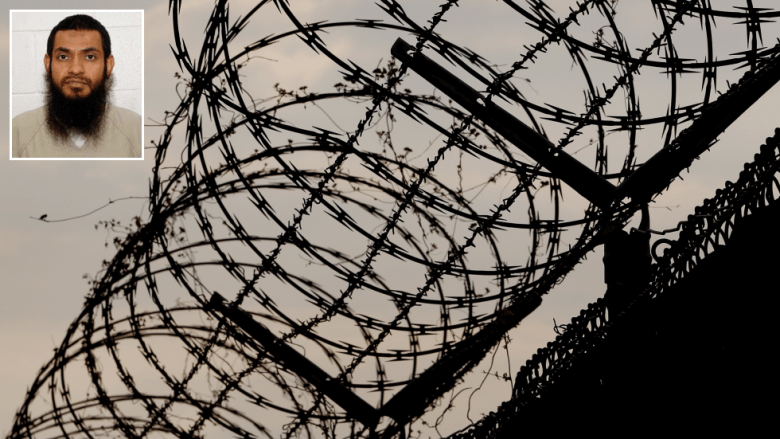
FILE PHOTO. © Reuters / Lucas Jackson; (inset) An official Guantanamo Bay photograph of Ahmed Rabbani. © US Department of Defense
RT | October 24, 2021
A Pakistani taxi driver will leave US detention at Guantanamo Bay after 17 years behind bars. Mistaken for a wanted terrorist, the man suffered horrific torture in American custody, despite never being charged with any crime.
Ahmed Rabbani’s release was announced on Friday by Reprieve, a human rights NGO. Rabbani had been unanimously cleared for release by the prison’s Periodic Review Board, made up of senior officials from six US agencies, including the State Department and Department of Homeland Security.
Rabbani’s journey through the underbelly of the US’ post-9/11 security infrastructure began in Karachi, Pakistan, in 2002. Mistaken for wanted terrorist Hassan Ghul, the taxi driver was arrested by Pakistani authorities outside Ghul’s apartment complex and sold to American personnel in the country.
Information gleaned from an associate of Rabbani arrested on the same day was used to arrest several suspected Al-Qaeda operatives, including a supposed member of Osama Bin Laden’s security detail. However, Rabbani was never charged with any crime, and is not believed to be involved in terrorism.
Nevertheless, he spent more than 545 days after his arrest being tortured in a CIA ‘black site’ in Afghanistan. The torture inflicted there on Rabbani was detailed in the US Senate’s 2014 torture report, and included long periods of being shackled with his hands outstretched over his head, an agonizing position that led Rabbani to try to cut off his own hand to end the pain.
Testimony from multiple detainees held in the same CIA prison describes permanent darkness, cells flooded with excrement and infested with vermin, beatings, sleep deprivation, being buried in simulated graves, being stripped naked and doused with cold water, and being denied bathing facilities for months on end.
According to Reprieve, Rabbani’s interrogators knew that “they had the wrong man,” but tortured him anyway. After more than a year in the CIA facility, Rabbani was transferred to the Guantanamo Bay detention camp on US territory in Cuba. He would spend the next 17 years there, without a charge or trial date.
His case attracted international attention, and in 2018, Rabbani wrote an op-ed published in the Los Angeles Times describing physical and sexual abuse by guards, force-feeding, and repeated hunger strikes to protest the conditions of his imprisonment. At the time of the op-ed, Rabbani said that he was suffering from “stomach problems so acute that I cannot consume hard food without vomiting blood,” and was being denied digestible food.
Conditions in Guantanamo chipped away at Rabbani’s mental health. “There is no morning and no evening,” he wrote. “There is only despair.”
“Ahmed’s clearance is long overdue,” said Reprieve attorney Mark Maher. “For those of us who have supported him, the feeling is one of relief, tempered with sadness for all he has lost… but we won’t celebrate until he is back with his family in Pakistan and able to hug his 19-year-old son for the first time.”
Of the 780 people detained in Guantanamo Bay since the facility opened in 2002, 732 have been transferred elsewhere or released, 38 remain there, and nine have died in custody. President Joe Biden has promised to close the notorious prison before he leaves office, a promise that was made, but not kept, by his former boss Barack Obama.
Biden has pledged that ‘America is back.’ But as peace shatters in the Balkans, does that mean yet more US misadventures?
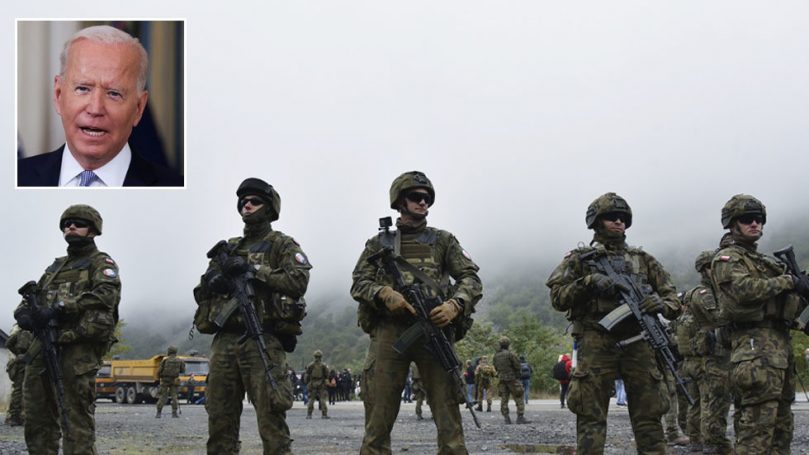
KFOR forces patrol near the border crossing between Kosovo and Serbia in Jarinje, Kosovo, October 2, 2021. © REUTERS / Laura Hasani; Inset © REUTERS / Evelyn Hockstein
By Julian Fisher | RT | October 24, 2021
With warnings that fresh tensions between Serbia and Kosovo could unravel the decades-old peace deal that put an end to bloody fighting in the Balkans after the breakup of Yugoslavia, the US is increasingly split on what to do.
Earlier this month, the SOHO forum in New York City hosted a debate between Scott Horton, long-time libertarian and anti-war radio host, and Bill Kristol, the neoconservative thinker and one of the ideological architects of America’s post-9/11 world order. The subject of the debate was US interventionism, its merits and historical record.
Predictably, Kristol offered vague niceties that attempt to recast America’s legacy as that of the “benevolent global hegemony”, a term which he himself coined in 1996 when describing the country’s role in the world. Reflecting on the wars in Iraq, Kristol simultaneously said that America “didn’t push democracy enough” and also “may have been too ambitious.” In short, he acknowledged mistakes were made, which is an admission that would have been unthinkable only a few years ago, and yet still falls short of accountability.
However, whereas American actions in the Middle East leave a lot to be desired for Kristol, he insists that the US intervention in the Yugoslav Wars during the 1990s was a success. As he put it, the Balkans was “one case of a war that was worth it and that I think had pretty good consequences.” As if on cue, the Balkan pot is beginning to boil once again.
An unresolved conflict
Kosovo has been a potential tinderbox in Southern Europe ever since the end of the war of 1998/1999. A recent row with Serbia, from which it unilaterally declared independence, has led to a new escalation in tensions.
Beginning in September 2021, Serbs living in Kosovo launched protests against authorities hassling travelers who enter the territory with Serbian-issued license plates, prompting a mobilization of armed Kosovo police forces, roadblocks, and traffic jams near the border. Two vehicle registration offices were vandalized.
The EU mediated a temporary fix in September that involves covering up national insignia on license plates with stickers, until a special working group in Brussels determines a more permanent solution sometime within the next six months. Whether this will be sufficient in bringing about immediate calm remains to be seen, however. Since then, further clashes have erupted between police and protesters near Mitrovica.
Russia’s Foreign Ministry has condemned the use of violence by Kosovo police against ethnic Serbs. Foreign Minister Sergey Lavrov met with Serbian President Aleksandar Vucic in mid-October, calling for talks between Pristina and Belgrade and a diplomatic solution to be respected by all sides.
As the situation heated up, NATO quickly ramped up patrols throughout Kosovo, including the North. “KFOR [Kosovo Force] will maintain a temporary robust and agile presence in the area,” the US-led military bloc said in an official statement earlier this month, intended to support the implementation of the EU-brokered solution. Last week, Kosovo’s minister of defense, Armend Mehaj, flew to Washington to meet with Under Secretary of Defense for Policy Dr. Colin Kahl at the Pentagon. The subject of the discussions was “bilateral security cooperation priorities”.
These moves are only the latest instance of US-led posturing in Kosovo. It was with American support that Kosovo launched its campaign for international recognition in 2008. Many major countries, representing most of the world’s population — including Russia, China, and India — have not recognized it as a sovereign state. Kosovo’s persistent claim to independence is what makes an issue as seemingly benign as license plates a question of war and peace.
In the background is still the 1999 Kosovo War, which was the site of NATO’s infamous bombing campaign against Serbia that led to the deaths of at least 489 civilians, according to Human Rights Watch. In April of 1999, NATO deliberately targeted Serbia’s Radio Television station, killing 16 civilians, according to Amnesty International. At one point, the US “mistakenly” bombed the Chinese embassy in Belgrade, killing three and wounding some 20 more, in what turned out to be the only target picked by the CIA over the course of the war.
To this day, the US maintains a military base, Camp Bondsteel, near Urosevac, Kosovo, as part of the international Kosovo Force (KFOR).
Two states in one
To the west, Bosnia and Herzegovina (BiH) has also reappeared in international news coverage. Against the backdrop of the EU’s Western Balkan Summit in early October, the Bosnian Serb leader Milorad Dodik said last week that the parliament of the Serb Republic, one of two entities that together make up BiH, would soon vote to undo some of BiH’s state institutions. He included the military, the High Judicial and Prosecutorial Council (HJPC) and the tax administration. These and others were established after the signing of the 1995 Dayton Peace accords and are not enshrined in the constitution.
Dodik wants an independent Serb Republic without compromising the territorial integrity of BiH, and he claims he has the support of seven EU member states, though he has not said which ones.
The genesis of Bosnia and Herzegovina’s recent headache is an amendment to the Criminal Code that makes various forms of inflammatory speech a punishable offense. The law was enacted in July of this year by the Office of the High Representative, an international “viceroy” with the power to impose binding decisions and remove public officials.
Russia has maintained that this appointed position is outdated, with a statement from the Foreign Ministry saying it was high time to “scale down the institute of foreign oversight over Bosnia-Herzegovina, which only creates problems and undermines peace and stability in that country.” Moscow also remains critical of attempts to integrate the country into NATO, insisting there is no consensus among the people of Bosnia and Herzegovina when it comes to joining the US-led bloc.
Playing to a different tune, already last month Washington tried to reprimand Dodik for his “secessionist rhetoric”. In a meeting just a few weeks ago, US Deputy Assistant Secretary of State Gabriel Escobar warned of “nothing but isolation and economic despair” for the people of the Serb Republic. According to a transcript that Dodik shared with the press, he told Escobar that he doesn’t “give a damn about sanctions,” adding, “I’ve known that before. If you want to talk to me, don’t threaten me.”
In the US, various Balkan-American organizations have released a joint statement calling on Congress and the Biden administration “to immediately initiate steps to rebuff the attempts by the government of Serbia to unravel the region’s peace and security”. Citing both aforementioned developments in Kosovo and the Serb Republic of Bosnia and Herzegovina, the statement demands a reinvigoration of “NATO enlargement as a priority for the region.” It suggests that what’s at stake in the Balkans is America’s legacy: “America invested too much of its own resources into this region to allow revanchist actors to decimate nearly a quarter century of progress.”
However, what does America investing its resources actually look like? In early 1992, before the war that scarred Bosnia and Herzegovina, all parties involved had already come to an agreement, the Carrington–Cutileiro plan, to divide Bosnia and Herzegovina into cantons along Serb, Croat, and Bosniak lines.
At the last minute, however, the then-US ambassador to Yugoslavia, Warren Zimmermann, met with the leader of the Bosniak majority, Alija Izetbegovic, in Sarajevo, reportedly promising him full recognition of a single Bosnia and Herzegovina. Izetbegovic promptly withdrew his signature from the partition agreement, and shortly thereafter the US and its European allies recognized Izetbegovic’s state. War ensued a month later, in April 1992. The US eventually worked its way back to new partition negotiations that echoed the talks held prior.
As the New York Times reported in 1993, “tens of thousands of deaths later, the United States is urging the leaders of the three Bosnian factions to accept a partition agreement similar to the one Washington opposed in 1992.”
Zimmermann is quoted as saying at the time that “Our hope was the Serbs would hold off if it was clear Bosnia had the recognition of Western countries. It turned out we were wrong.”
Returning to the Horton-Kristol debate from earlier, Horton cited America’s underhanded opposition to the Carrington-Cutileiro plan, and the devastating consequences, as a case in point of US interventions impeding, rather than promoting, peace and stability.
President Joe Biden declared at the start of his administration that “America is back.” Taking a look at the history of US interventions, this could spell trouble for the Balkans.
Julian Fisher is a policy analyst at the Russian Public Affairs Committee (Ru-PAC). He writes about Russia-U.S. relations, American foreign policy, and national security
University receives $750k of federal funds to stop reporters from creating “negative unintended outcomes”
The government continues to get involved with shaping journalism
By Christina Maas | Reclaim The Net | October 24, 2021
Researchers at Temple University received $750,000 from the National Science Foundation (NSF) to develop a tool that warns journalists that they are about to publish polarizing content. The NSF is a federal government agency focused on supporting research and education in non-medical fields of engineering and science.
The initiative is part of NSF’s “Trust & Authenticity in Communication Systems.” It is called the “America’s Fourth Estate at Risk: A System for Mapping the (local) Journalism Life Cycle to Rebuild the Nation’s News Trust.”
The focus of the project, according to a report on Campus Reform, is creating a system that alerts journalists that the content they are about to publish might have “negative unintended outcomes” such as “the triggering of uncivil, polarizing discourse, audience misinterpretation, the production of misinformation, and the perpetuation of false narratives.”
The researchers hope that the system will help journalists measure the long-term impact of their stories, that go beyond existing metrics such as likes, comments, and shares.
One of the researchers involved in the project, Temple University’s professor Eduard Dragut, said that the system will “use natural language processing algorithms along with social networking tools to mine the communities where [misinformation] may happen.”
“You can imagine that each news article is usually, or actually almost all the time, accompanied by user comments and reactions on Twitter. One goal of the project is to retrieve those and then use natural language processing tools or algorithms to mine and recommend to some users [that] this space of talking, this set of tweets, which may lead to a set of people, like a sub-community, where this article is used for wrong reasons,” he added.
Journalists and other players in the news industry will be involved with the project, which already includes researchers from other universities including Boston University and the University of Illinois-Chicago.
“We want journalists to be part of the process, not just the mere users of the product itself,” Dragut said. “So you can imagine sort of an analytics tool that informs the journalists and editors and other people involved in this business how their products or how their creative act is used or misused in social media.”
He added that the project is attempting to “create a collaborative environment with both social media platform[s] and other organizations like Google” because of their expertise.
“We have some preliminary conversation with Bloomberg, for instance, and we will have to define exactly how they are going to help us. Google has an initiative to help local news, and we are working to create a relationship with them, and there are others,” Dragut told Campus Reform. “This product will not work unless we are successful in bringing some of these high tech companies into the game.”
Another researcher involved in the project, professor Lance Holbert, said that, for now, the misinformation the project is focusing on is that of the spread on local media.
“Certainly some topics over time will become more versus less interesting, but also we’re focused here initially on local media as well, so each locality may have different topics or particular points of interest that come up in the news,” he said. “We’re trying to keep this generalizable across topics.”
Holbert noted that misinformation is not “happening in the political spectrum” alone.
“[It’s happening] in sports, it’s happening in economics,” he said. “Like a few years back, I know, an example from Starbucks where there was a sort of a campaign on Twitter [saying] that Starbucks is targeting, in the wrong way, African Americans, which was wrong.”
The NSF is expected to further fund the project when its first phase becomes successful.
17,000+ deaths reported after COVID vaccines, including new report of 12-year-old who died after Pfizer vaccine
By Megan Redshaw | The Defender | October 23, 2021
Data released Friday by the Centers for Disease Control and Prevention (CDC) showed that between Dec. 14, 2020, and Oct. 15, 2021, a total of 818,044 adverse events following COVID vaccines were reported to the Vaccine Adverse Event Reporting System (VAERS).
The data included a total of 17,128 reports of deaths — an increase of 362 over the previous week, and a new report of a 12-year-old who died after getting the Pfizer vaccine.
There were 117,399 reports of serious injuries, including deaths, during the same time period — up 5,434 compared with the previous week.
Excluding “foreign reports” to VAERS, 612,125 adverse events, including 7,848 deaths and 50,225 serious injuries, were reported in the U.S. between Dec. 14, 2020, and Oct. 15, 2021.
Of the 7,848 U.S. deaths reported as of Oct. 15, 11% occurred within 24 hours of vaccination, 15% occurred within 48 hours of vaccination and 28% occurred in people who experienced an onset of symptoms within 48 hours of being vaccinated.
In the U.S., 406.1 million COVID vaccine doses had been administered as of Oct. 15. This includes: 237 million doses of Pfizer, 154 million doses of Moderna and 15 million doses of Johnson & Johnson (J&J).

The data come directly from reports submitted to VAERS, the primary government-funded system for reporting adverse vaccine reactions in the U.S.
Every Friday, VAERS makes public all vaccine injury reports received as of a specified date, usually about a week prior to the release date. Reports submitted to VAERS require further investigation before a causal relationship can be confirmed.
Historically, VAERS has been shown to report only 1% of actual vaccine adverse events.
This week’s U.S. data for 12- to 17-year-olds show:
- 21,921 total adverse events, including 1,325 rated as serious and 25 reported deaths. Two of the 25 deaths were suicides.
The most recent death involves a 12-year-old girl (VAERS I.D. 1784945) who died from a respiratory tract hemorrhage 22 days after receiving her first dose of Pfizer’s vaccine.
Another recent death includes a 15-year-old male who died six days after receiving his first dose of Pfizer’s COVID vaccine. According to his VAERS report (VAERS I.D. 1764974), the previously healthy teen complained of brief unilateral shoulder pain five days after receiving his COVID vaccine.
The next day he played with two friends at a community pond, swung on a rope swing, flipped into the air, and landed in the water feet first. He surfaced, laughed and told his friends “Wow, that hurt!” He then swam toward shore underwater, as was his usual routine, but did not re-emerge.
An autopsy showed no external indication of a head injury, but there was a small subgaleal hemorrhage — a rare, but lethal bleeding disorder — over the left occiput. In addition, the boy had a mildly elevated cardiac mass, increased left ventricular wall thickness and small foci of myocardial inflammation of the lateral wall of the left ventricle with myocyte necrosis consistent with myocardial infarction.
- 57 reports of anaphylaxis among 12- to 17-year-olds where the reaction was life-threatening, required treatment or resulted in death — with 96% of cases attributed to Pfizer’s vaccine.
- 535 reports of myocarditis and pericarditis (heart inflammation) with 527 cases attributed to Pfizer’s vaccine.
- 119 reports of blood clotting disorders, with all cases attributed to Pfizer.
This week’s U.S. VAERS data, from Dec. 14, 2020, to Oct. 15, 2021, for all age groups combined, show:
- 19% of deaths were related to cardiac disorders.
- 54% of those who died were male, 42% were female and the remaining death reports did not include gender of the deceased.
- The average age of death was 72.7.
- Of the 3,014 cases of Bell’s Palsy reported, 51% were attributed to Pfizer vaccinations, 41% to Moderna and 8% to J&J.
- 666 reports of Guillain-Barré syndrome, with 40% of cases attributed to Pfizer, 31% to Moderna and 28% to J&J.
- 2,010 reports of anaphylaxis where the reaction was life-threatening, required treatment or resulted in death.
- 10,290 reports of blood clotting disorders. Of those, 4,488 reports were attributed to Pfizer, 3,709 reports to Moderna and 2,040 reports to J&J.
- 2,878 cases of myocarditis and pericarditis with 1,815 cases attributed to Pfizer, 939 cases to Moderna and 114 cases to J&J’s COVID vaccine.
NATO, Not Russia, Perpetuates Cold War Logic… It is a Relic Best Ignored
Strategic Culture Foundation | October 22, 2021
It was the end of an era this week when Russia announced that it was severing diplomatic links with the North Atlantic Treaty Organization. For the past 30 years since the dissolution of the Soviet Union, the Russian Federation has engaged with the US-led military bloc in a bid to establish partnership and secure peace.
The incipient detente culminated in the NATO-Russia Founding Act in 1997 which demarcated certain boundaries for peaceful coexistence. Those boundaries were subsequently flouted as NATO doubled its members over the ensuing years to stand at the current membership of 30 countries, including states that share a border with Russia.
There was also established in 2002 a NATO-Russia Council which in principle provided a forum for dialogue between delegations hosted in the Belgian capital Brussels where NATO has its headquarters.
But the truth is initial promises of partnership have waned. For several years now, at least since the 2014 Ukraine crisis, NATO’s relations with Russia have been characterized more and more with an imperious attitude of lecturing Moscow over a litany of alleged transgressions. These allegations are more accurately described as slanders because they are never substantiated beyond bald accusation.
Russia is routinely accused of posing a threat to Europe and plotting to sabotage Western democracies. This week the NATO defense ministers held a summit in which it was breathlessly claimed that Russia is becoming an even greater threat to the transatlantic alliance. On the back of that hysterical claim, NATO has now moved to implement a “master plan” to “defend” Europe from a “potential Russian attack on multiple fronts”.
Reality check. Moscow has repeatedly stated that it has no intent of aggression towards the United States, NATO, Europe or anyone else for that matter. Despite this categorical assurance, the Western bloc has persisted in talking up tensions with Russia.
It is the United States that has abrogated several arms-control treaties and introduced new missile systems into Europe. It is NATO that is encroaching on Russia’s territory. Reality is turned on its head by Western accusations.
Indeed there have been conflicts over Georgia in 2008 and ongoing in Ukraine. But in each case, there are substantial grounds for laying the blame of these conflicts on NATO. How did the coup d’état in Kiev happen in 2014, who supported it? And why did the people of Crimea vote in a constitutional referendum to secede from Ukraine to join the Russian Federation with which they have centuries of shared history and culture?
In any case, if there were proper partnership and dialogue between NATO and Russia then such concerns and disputes could have been appropriately aired and discussed in the assigned forum. But the fact is there was never any genuine attempt at dialogue by NATO. Russia has become an object of harangue and hostility. The supposed partnership envisaged some three decades ago became a travesty. Instead of dialogue and debate there was simply disdain. Instead of equality there was vilification, opprobrium, and sensationalized smears without the slightest due process afforded to Russia (the Skripals, Navalny, Novichok, electoral interference, cyberattacks, shooting down a Malaysian airliner, and so on and so on, like an old skipping vinyl record incapable of moving on.)
The supposed diplomatic channels were nothing but echo chambers for NATO propaganda talking points, rather than being used as a means to resolve misapprehensions through mutual dialogue and presentation of evidence.
As the Russian foreign ministry noted this week in explaining the severance of diplomatic ties, it is NATO that systematically destroyed relations and “chose the Cold War logic”.
Alexander Grushko, Russia’s deputy foreign minister, commented that normal relations were not possible amid unfriendly steps taken by NATO “sliding into Cold War schemes”.
The last straw was the expulsion earlier this month by NATO of Russian diplomats from the NATO forum in Brussels. The Russian staff were accused of being “undeclared spies” allegedly working for military intelligence. No evidence was provided, as usual, by the accusers. It was the familiar high-handed approach of fait accompli and Russia “guilty until proven innocent”.
Everyone recognizes that relations between the Western states and Russia are at their lowest since the end of the former Cold War. Thus it may be put to Moscow that it is being reckless to close down channels of communication at this precarious time.
Russia has not ruled out pursuing a more productive relationship in the future. It has said, however, that it is up to NATO to make the first move towards improving relations. Until then, henceforth, any communications can be submitted through Russia’s ambassador to Belgium.
It is our view that Russia has made the correct call to drop diplomatic channels with NATO. Russia will pursue bilateral relations with individual nations as it does already, for example, with the United States on the vital issues of arms control and cybersecurity. NATO has proven to be incapable of progressive negotiations owing to an organizational “groupthink” that is encumbered with Russophobia and Cold War ideology.
By engaging directly with individual nations, it may be more productive for mutual understanding to be advanced because the noise of “groupthink” and of competing group negativity is removed.
Unfortunately, it has to be noted that the original purpose of NATO when it was formed in 1949 was rooted in Cold War hostility towards the Soviet Union. Such animosity has not abated even though the Soviet Union no longer exists.
Fundamentally, NATO is an organization in search of enemies in order to justify the militarism that is essential for the functioning of Western capitalism. There is a pivotal contradiction between NATO and today’s emerging world of multipolar cooperation and peaceful development. Its disgraceful, diabolical destruction of Afghanistan alone debars that organization from having any progressive role in today’s world.
Russia is right to disabuse the illusion of “partnership” with NATO. It is a relic of Cold War hostility that belongs in a war museum not in a modern forum for diplomacy.
Illinois Sheriffs Reject Mayor Lightfoot’s Urgent Plea To Cover Police Shortage In Crime-Hit Chicago
By Tyler Durden | Zero Hedge | October 22, 2021
As hundreds of Chicago police are being put on “no-pay leave” over their refusal to submit their personal Covid vaccination status with the city, Chicago Mayor Lori Lightfoot appears to have fewer and fewer allies as she desperately tries to fill the gap of officer shortages due to the vax order. Area county sheriffs are refusing to send additional manpower that’s she requesting to urgently cover the gaps, telling her that’s it’s a problem of the mayor’s own making.
“Chicago Mayor Lori Lightfoot received a rude awakening after multiple sheriffs in nearby jurisdictions refused her request to fill the gap in police manpower after she threatened to fire 3,000 local officers for not complying with the city’s COVID-19 vaccine mandate,” The Washington Examiner reports on the latest developments. “DuPage County Sheriff James Mendrick and Kane County Sheriff Ron Hain said they’ve helped Lightfoot in the past, but her latest request is a self-inflicted wound that could have been avoided. They said they would only step in and help the Chicago Police Department if city officers were in distress or under duress.”
Sheriff Hain had this to say, echoing recent criticisms of the Chicago police union which has cited terrible communication and heavy-handedness in place of requests for dialogue on the issue: “[The Illinois Law Enforcement Alarm System] typically responds to emergency situations where there is no opportunity for planning,” Hain said. “This situation to me is much different.”
Despite sheriff’s offices shutting the door on the mayor’s request to cover Chicago PD officer shortages, police continue to reportedly be summoned to headquarters where they are given one last on the spot ultimatum: submit to last week’s vaccine status order or be relieved from duty without pay.
So far the city says it’s not yet going after street patrol officers, which is obviously on fears of a coming crime wave that will hit an already understaffed notoriously high-crime city.
BBC has compiled recent statistics as the standoff over the vax mandate continues:
Chicago, a city of nearly three million people, has seen more than 1,600 sexual assaults, nearly 3,000 shootings and 649 murders this year – a 14% increase over last.
Just as violent crimes have risen, though, thousands of the city’s police force may not show up to work.
… Nearly one-third of Chicago’s almost 13,000-member police department have so far refused to register their vaccination status, putting them on track for dismissal. Twenty-one have been officially removed from active duty so far, but some officials have warned that the mandate could leave Chicago’s police force dangerously depleted.
Adding fuel to the fire of the crisis, President Joe Biden during his CNN Town Hall remarks Thursday night continued pushing his view that emergency responders should be fired for defying local vaccine mandates.
The president even appeared to mock those rejecting vaccine mandates on the basis of “freedom”…
“I have the freedom to kill you with my COVID,” Biden said, mocking what he sees as the attitude of mandate opponents. “No, I mean, come on, freedom.”
Meanwhile the head of Chicago’s largest police union, John Catanzara, is still urging officers to hold the line, despite a weekend gag order imposed on him by the city.
“It is the city’s clear attempt to force officers to ‘Chicken Little, the sky is falling’ into compliance,” he’s recently urged the union’s 11,000 members. “Do not fall for it. Hold the line.”
Millions Of Americans Are Getting Fired For Not Taking A Jab That’s Now 3% Effective
By Chris Menahan | InformationLiberation | October 19, 2021
CNN is reporting that a new study involving over 600,000 veterans has found that Johnson & Johnson’s covid vaccine’s protection “fell from 88% in March to 3% in August.”
“A study published Thursday reported a steep decline in vaccine effectiveness against infection by August of this year, especially for people who received the J&J vaccine,” CNN reported over the weekend. “The researchers found that among more than 600,000 veterans, J&J’s vaccine’s protection fell from 88% in March to 3% in August.”
As there are no requirements (yet) that people be triple-jabbed — or double-jabbed in the case of J&J’s shot — this means millions of Americans are getting fired for not having taken a shot that’s now 3% effective.
On the flip side, we know from another Israeli study that “vaccinated individuals had 27 times higher risk of symptomatic COVID infection compared to those with natural immunity from prior COVID disease,” as epidemiologist Martin Kulldorff noted.
That Israeli study, which was done between June 1 and August 14, involved only Pfizer recipients.
The new study of vets in America showed that Pfizer’s effectiveness declined to 50% in August from 91% and Moderna’s fell to 64% from 92%. That suggests natural immunity is now more than a hundred times more effective than J&J’s vaccine, yet the federal government and most companies do not even recognize natural immunity as a justification not to get vaxxed.
They insist you take some experimental jab — any jab at all now that the FDA has endorsed mixing and matching vaccines for “boosters” — or get fired from your job.
Meanwhile, the FDA is approving the rollout of boosters despite little to no data showing their effectiveness based off “gut feeling” rather than data.


CDC Director: We may need to update our definition of ‘fully vaccinated’
By Kit Knightly | OffGuardian | October 23, 2021
Yesterday, in a press conference, the director of the CDC warned that they may have to “update” the definition of “fully vaccinated”.
At the virtual presser accompanying the approval of “mix-and-match” booster jabs, Dr Rochelle Walensky told reporters that:
We will continue to look at this. We may need to update our definition of ‘fully vaccinated’ in the future,
The “updated” definition would potentially mean only people who have had the third “booster” shot would be considered “fully vaccinated”, while people who have had the two original shots are no longer “fully vaccinated”.
Whilst the warning might just be a ploy to scare people into getting their “booster” without forcing them to, it should be noted a revised definition of “fully vaccinated” has already been adopted in other countries.
For example, it is already policy in Israel where, in early September they “updated what it means to be vaccinated,”. You now need a third shot, or else you are no longer considered vaccinated.
We wrote about it at the time, and predicted it would likely spread to the rest of the world.
In fact, figures in the alternate media have been predicting this for a while. See this clip from YouTuber WhatsHerFace back in August:
As for the potential purpose of any “updated definition”, well it would be twofold.
Firstly, it would allow them to maintain control. Forcing people to jump through hoops just to “get back” rights they once took for granted creates an atmosphere that normalises state tyranny.
Secondly, and more cynically, it would allow them to artificially manipulate statistics to flatter the vaccines’ effectiveness whilst hiding any damage they might do.
We already know that, in the US and others, you’re not considered “vaccinated” if you’re only single-jabbed, or double-jabbed for less than two weeks. So any patient infected with “Covid” in that time is considered “unvaccinated”, NOT a “breakthrough infection”.
By redefining “fully vaccinated”, they can turn millions of double-jabbed people back into “unvaccinated” people and stop them from becoming potential “breakthrough infections” and hurting the vaccine effectiveness stats.
This will, in turn, camouflage any excess mortality in those who have had the vaccine, for example due to antibody-dependent enhancement, because all those who die will officially be “not fully vaccinated”.
They’ll likely push it through soon, before this winter’s flu season hits, so any flu deaths can be “unvaccinated covid deaths”.
And for anybody out there who got double-jabbed thinking they were buying their life back, we’re sorry, but we did warn you this would happen.
The Moment Biden Casually Committed To WW3 Over Taiwan At Last Night’s Town Hall
By Tyler Durden | Zero Hedge | October 22, 2021
Apparently the commander-in-chief thinks that the United States has some kind of treaty or “commitment” to defend Taiwan in the scenario of an attack from China.
There is absolutely no commitment to do such a thing, but the casualness with which Joe Biden at last night’s 90-minute CNN town hall pledged that he’s ready to send young American men and women to die over an island in the Western Pacific is staggering and hugely alarming.
A Loyola student asked what President Biden would do to “keep up with China militarily” after reports of testing a hypersonic missile, and “what can you do to protect Taiwan?”
“Yes and Yes,” the president answered.
“I don’t want a Cold War with China, I just wanna make China understand – that we are not gonna step back, we are not gonna change any of our views…” – and that’s when Anderson Cooper cut in:
Cooper: “Are you saying that the United States would come to Taiwan’s defense if China attacked?”
Biden: “Yes. Yes, we have a commitment to do that.”
Though after this surprise emphasis on having a “commitment” to go to war on behalf of the tiny self-ruled island which lies over 7,000 miles away from the US mainland, Cooper didn’t follow up and simply moved on.
As the South China Morning Post noted in follow-up to the exchange, Biden’s words sparked immediate confusion over longstanding US policy:
Though Washington does not have official diplomatic relations with Taipei, US law requires it support the island’s efforts to defend itself, including through the sales of weapons. But the Taiwan Relations Act does not include an explicit commitment to intervene militarily in the event of an invasion of or attack on Taiwan by the mainland.
… The US has long maintained a policy of strategic ambiguity on Taiwan, opting not to state whether it would take military action if the island came under attack. The strategy is designed to discourage Taiwan from taking any unilateral action to declare full independence, while also dissuading Beijing from unilaterally seeking to annex the island.
“RIP strategic ambiguity,” Derek Grossman, a senior defense analyst at the Rand Corporation, wrote in a tweet soon after Biden’s remarks.
It goes without saying that a direct military confrontation with China in the Western Pacific and South China Sea would make the 20-year Afghan fiasco and nightmare pale in comparison, not to mention the inevitable collapse of the economy and global trade while two military superpowers duke it out using advanced weapons on each other like hypersonics.
Billionaire Pierre Omidyar’s secret backing of Facebook ‘whistleblower’ raises new questions about her agenda

(L) Frances Haugen © REUTERS / Matt McClain; (R) Pierre Omidyar © REUTERS / Tim Shaffer
By Kit Klarenberg | RT | October 21, 2021
The plot has thickened further in the case of Frances Haugen, with the revelation she is being funded by Pierre Omidyar. Given his history of backing of US-friendly organisations abroad, it’s hard not to question her motives.
It’s been revealed by Politico that Haugen, the Facebook ‘whistleblower’ who has generated such intense mainstream attention in recent weeks, receives “behind the scenes” financial assistance from controversial US billionaire Omidyar.
The backing is extensive. Omidyar’s Luminate is handling all her press and government relations in Europe, her top public relations representative in the US is a former Obama White House spokesperson who runs public affairs for a non-profit funded by Omidyar, and last year the tech guru gifted $150,000 to Whistleblower Aid, another organization supporting Haugen.
Politico asserts that this enormous wellspring offers her “a potentially crucial boost” in her crusade against the social network giant, granting Haugen “an edge that many corporate whistleblowers lack” – but then again, she’s a far from typical whistleblower.
A Silicon Valley veteran, Haugen’s stint at Facebook’s Threat Intelligence put her in extremely close quarters with former high-ranking US intelligence officials, who occupy senior divisions in the unit. An ad for an analyst vacancy in the division, posted just days before Haugen’s well-publicized Senate testimony, cites “5+ years of experience working in intelligence [in] international geopolitical, cybersecurity, or human rights functions” as an absolute “minimum qualification” for anyone wishing to apply.
There’s no indication Haugen herself has such a background, but it’s hard to imagine two-and-a-half-years spent rubbing shoulders with CIA, NSA, and Pentagon journeymen didn’t leave an impression on her.
As such, one needn’t be a cynic to suggest her public claims that the purported exploitation of Facebook by Western state-mandated “enemy” countries, against which her former colleagues have a clear and demonstrable bias, represents a threat to US national security may have been insidiously influenced to some degree. This would, of course, necessitate greater governmental censorship and surveillance powers in respect of social media, which White House and Pentagon officials have demanded for a decade or more.
Whatever the truth of the matter, given Haugen’s public positions, it’s hardly surprising Omidyar has taken such an interest in her. The eBay founder has for many years used his vast personal fortune to sponsor anti-government media operations, activist groups and NGOs in countries targeted for regime change by Washington, often in quiet concert with CIA-front organizations the National Endowment for Democracy and USAID.
Luminate’s ‘Strategic Plan’ for 2018–2022 spells this out in not so many words. It claims that “counter forces to liberalism have gained strength,” due to “Russia’s disruptive tactics” and “China’s state-centric alternative model,” and in response, the organization pledges to “to engage in ‘Countries in Transition’ where a potential inflection point and evidence of reform leads us to believe our support could catalyse significant change in an accelerated timeframe.”
“Our goal for this work is to provide critical support to courageous individuals and organisations seeking democratic gains in settings where civil society has been suppressed and where media has been circumscribed,” it ominously states. “We also work with government reformers post-transition to achieve positive policy outcomes which benefit large populations.”
Just two examples of “critical support” doled out by Omidyar over the past decade include bankrolling groups and news platforms at the forefront of Ukraine’s 2014 Maidan coup, and financing a welter of youth radicalization initiatives in Zimbabwe via the Harare-based Magamba Cultural Activist Network. A 2016 Omidyar Network-funded report on “People-Powered Media Innovation in West Africa” made clear the destabilizing intention behind such initiatives.
In a section discussing the “challenge” of “converting passive readers to active citizens,” the report recommended sponsoring the publication of “politically opportunistic” content “tied to unfulfilled promises” in order to “motivate citizens and government to act in the public interest.” It cited “recent, major successes of citizen and media efforts” in Nigeria that demonstrated “how public energy and conversation can be further harnessed and directed.”
In one case, a local radio station partnered with an NGO to “[develop] a radio program dedicated to education issues,” which “quickly gained popularity, and a highly engaged listenership.” Within a year, the government had “implemented several overdue policy reforms,” and the radio station was said to have since “applied this strategy to other negligent government bodies.”
“With the spectre of potential citizen mobilization looming in politicians’ minds, media outlets also have the potential to elicit government response directly,” the report boasted. “In some cases… government was motivated to act in order to prevent citizen action, instead of in response to it.”
Not coincidentally, Omidyar finances several media organizations in Lagos, including the radical Sahara Reporters, which focuses on corruption in the public sector – its founder allegedly has to sneak in and out of the country as his work has made him an enemy of the state. The Nigerian government evidently has much reason to fear Omidyar, which is perhaps why there has been no high-level opposition to his effective takeover of the country’s tech sector.
Clearly, the man well understands what can be achieved when citizens are stirred to action, and how they can be. In light of this, the help afforded to Haugen by Whistleblower Aid gains a rather sinister resonance. While widely reported that this assistance is strictly legal in nature, the organization’s founder Mark Zaid has made an intriguing disclosure.
“[We] prep clients in order to be focused on how to answer questions properly,” he told Gizmodo on October 6. “We have media experts that we work with to guide folks with something as simple as, you know, where do you look when you’re talking to a camera or a host? How do you best fluidly answer a question to come across in a positive way? Everything that might be connected to ensuring the individual’s image and substance are at their best.”
This direction surely explains why Haugen’s interviews with major media outlets have been so universally slick, and her Senate testimony was so extensively peppered with attention-grabbing quotes seemingly custom-made for repetition in headlines and news reports. At the very least, her involvement with Zaid casts even more doubt on how genuine she is.
Despite his organization’s name and stated aims, Zaid has a history of maligning individuals who have actually spoken out in the public interest, including Julian Assange, Edward Snowden and Reality Winner.
What’s more, he’s been accused in open court by an FBI agent of specifically approaching the CIA and informing it his client Jeffrey Sterling, an Agency operative, had “voiced his concerns about an operation that was nuclear in nature, and he threatened to go to the media.” Sterling was subsequently sentenced to three-and-a-half years in prison for leaking that very information to a journalist.
It can only be considered a shocking indictment of the Western media that the revelation of Omidyar’s secret support for Haugen has not prompted a single mainstream journalist to question whether she is ultimately serving a wider, darker agenda, and what that agenda might be. After all, her public intervention surely represents an “inflection point”, Omidyar’s support of which “could catalyse significant change in an accelerated timeframe.”
Kit Klarenberg is an investigative journalist exploring the role of intelligence services in shaping politics and perceptions.
Featured Video

Why the U.S. Should Pull Back From the First Island Chain
or go to
Aletho News Archives – Video-Images
From the Archives
Only 19.7% of Americans agree with US State Dept on Israeli settlements
… Most American adults of voting age don’t appear willing to reject the applicability of international law to Israel’s ongoing colonization of occupied territories in East Jerusalem, the West Bank and Golan Heights. … Full article
Blog Roll
 Aletho News
- British Government Employees Were Fact-Checking the News at the BBC. Nobody Told You.
- Albania on fire: who’s behind the riots?
- Egypt’s Civil Democratic Movement rejects involvement in regional war
- Egypt collaborates with Israel to build ‘Green Rafah’ project over erased Palestinian city
- Rising fuel prices and shortages have helped drive ongoing protests and rioting in France
- Tokyo protests demand Takaichi’s resignation over support for ‘Israel’
- Jennifer Kavanagh: Why the U.S. Should Pull Back From the First Island Chain
- Yemen denounces international community’s silence on Saudi aggression, siege
- UAE and Saudi Arabia move toward renewed coordination against Sanaa
- How Iran’s two-week retaliatory strikes exposed cracks in US military architecture in Persian Gulf
- If Americans Knew
- More on how Bari Weiss is using CBS on behalf of Israel
- What the UK Is Doing to Pro-Palestine Novelist Sally Rooney Is an Act of Orwellian Villainy
- ‘We will build palaces for Jews in Gaza’: Right-wing activists establish new outpost near border
- ‘You see us burning, you stay silent’: Family’s agony over mother and sons burned to death in Gaza tent
- Israel keeps Palestinian journalist Bushra al-Tawil in isolation for 46 days
- US-Israel integration plan puts US military tech in Israel’s hands
- Israeli Strike Burns Gaza Mother Alive in Front of Toddler, ‘Without Generating Any Headlines’
- ‘The Israel Experience with Mike Huckabee’: The Ambassador’s Family Sells Trips to Israel
- As Gazans carry out mass burial, food insecurity is getting worse – Daily Update
- Israeli rabbi permits occupiers to steal Palestinian olive harvest in West Bank
- No Tricks Zone
- Predictions Made By Renowned Climate Proifessor Over Past Decades Have Been Proven To Be Poor
- New Study Suggests Large Regions Of The Pacific Ocean Have Been Cooling For The Last 80 Years
- Germany’s Green Energy Debacle: High Energy Costs Force Kahla Porzellan to Close After 182 Years!
- New Study: 50 Years Of The Most Aggressive ‘Net Zero’ Policies Can Only Affect The Global Climate By 0.03°C
- US September “Heat” Was No Record…Many Records Set Decades Ago
- Latest European Green Energy Debacle; Portugal’s Largest Flagship Solar Park Insolvent!
- Green Energy Debacle: German Expert Professor Fritz Vahrenholt Warns Of Severe Economic And Social Consequences
- Two More Paleo Reconstructions Affirm Meters-Higher Sea Levels Across Ireland, Brazil 7000-6000 Years Ago
- New Study: Earth And Venus Surface Warmth Largely Explained By Convection And Lapse Rate, Not CO2 Or Radiation
- 2025 Nature Paper Claiming Worsening Global Drought Gets RETRACTED …Heavily Flawed

