Russia Reminds US Its Presence in Syria is Illegal After Washington Charges Moscow With ‘Violations’
By Ilya Tsukanov – Sputnik – 06.05.2021
The Russian Embassy in Washington has reminded the US that its troops have no legal mandate to be in Syria.
The reminder comes following the publication of the quarterly report to Congress by the Pentagon, the State Department and the US Agency for International Development on the state of the US-led coalition’s operations in the Syrian Arab Republic.
“We would like to remind: The US military presence in Syria is illegal in the first place. So the US does not have any right to criticise the legitimate actions of the Russian Armed Forces, which operate in Syria at the invitation of the Syrian Government,” the Embassy tweeted, accompanying its post with a screenshot of part of the report.
In its report to Congress, US officials accused Russia of “continu[ing] to violate the de-confliction processes that the Coalition and Russia established in northeastern Syria to prevent inadvertent escalations”, citing a “slight” increase in incidents such as “the addition of an extra vehicle to pre-arranged patrols and not providing proper notification of military transport and fighter aircraft moving from Russia to Syria”.
The report admitted that Russian actions “did not pose a threat to Coalition forces”, and went on to indicate that Russian forces had increased their numbers and were operating in “closer proximity to Coalition forces” in Syria’s northeast following the 2019 Turkish invasion of the country’s north. The report cited information by the US Defence Intelligence Agency accusing Russia of seeking to “harass and constrain US forces, with the ultimate goal of compelling US forces to withdraw from northeastern Syria”.
US Occupation of Syria
The United States and its European and Gulf State allies began a military operation in Syria in 2014, flying thousands of sorties ostensibly aimed at destroying Daesh (ISIS)* and other terrorist groups in the country’s east. By 2017, the ‘caliphate’ was crushed, and US forces occupied large swathes of territory in Syria’s south and northeast, including the at-Tanf border region near Jordan and Iraq, as well as oil, gas and agriculturally-rich territories east of the Euphrates River.
Damascus and its allies have accused Washington of using its presence at at-Tanf to train ‘former’ terrorists to fight the Syrian government, and have charged the US and Turkish-backed forces with illegally occupying the country’s northeastern territories and pillaging its energy and food resources. Washington has rejected these claims, and formally continues to assert that its presence in Syria is aimed strictly at preventing Daesh’s resurgence and supporting local self-governance initiatives.
However, in a series of candid statements in recent months, Jim Jeffrey, former US special representative for Syria, revealed that he and members of his staff had deliberately misled President Trump about the true size of the US military footprint in the country, and stopped him from withdrawing from the country. Jeffrey also admitted that the US mission in Syria was about preventing the Syrian government from regaining its territories, not stopping Daesh. Last month, Jeffrey even suggested that al-Nusra,* the al-Qaeda* spinoff in Syria which now goes by the name Hayat Tahrir al-Sham*, was “an asset” to the US strategy in Syria. Jeffrey encouraged President Biden to continue Trump’s policy on Syria and the Middle East in general.
Will Biden Have Blood on His Hands in Afghanistan?
By Jacob G. Hornberger | FFF | May 6, 2021
President Biden has announced that America’s forever war in Afghanistan is finally coming to an end. He says that U.S. forces will exit the country by next September 11.
That’s a good thing. And it is long overdue.
But there is one big problem with Biden’s timetable: It violates an agreement that the U.S. government entered into with the Taliban to exit the country by May 1 of this year.
Under that agreement, the Taliban agreed not to attack U.S. troops prior to their scheduled departure on May 1. With Biden’s decision to deliberately violate the agreement by unilaterally extending the withdrawal to September 11, he is knowingly placing the lives of the 3,500 American servicemen still in Afghanistan at risk.
In fact, the Taliban has implied as much. According to the Washington Post, a Taliban spokesman declared back in April, “If the agreement is breached and foreign forces fail to exit the country on the specified date, problems will certainly be compounded and those whom failed to comply with the agreement will be held liable.”
 What’s the point of extending the departure? Is an extension to September so important that it’s worth risking the lives of American servicemen still in Afghanistan? If some soldiers are killed or maimed because Biden cavalierly decided to violate the agreement, will their sacrifice have been worth it? What about the lives of innocent Afghan civilians caught in a crossfire or in a bomb explosion designed to kill U.S. troops?
Take a look at this article in USA Today. It’s by a quadruple amputee who lost his arms and legs in Afghanistan. He says it’s time to leave. He says, “I don’t need any soldier to honor me by doing the same thing.”
But that’s exactly what Biden is risking by intentionally, knowingly, and deliberately violating an agreement that the U.S. government willingly entered into.
Moreover, as Elliot Ackerman, a former Marine and intelligence officer who served five tours in Iraq and Afghanistan, pointed out in an article in the New York Times,
[R]emoving the 3,500 American troops from Afghanistan is, in military terms, what’s called a “fighting withdrawal,” in which an army leaves the field while still in contact with the enemy. Of all the maneuvers an army can perform (advance, flank, defend, etc.), it is widely accepted that a fighting withdrawal is the most complex and difficult because you are neither attacking nor defending, and so are exceedingly vulnerable.
Unlike the withdrawal from Iraq, in which U.S. troops could drive through the desert into Kuwait as they did in 2011, and unlike the Soviet withdrawal in 1989, in which they could drive across a then-shared border, U.S. troops are currently marooned in Afghanistan, reliant on three principal U.S.-controlled airstrips (Bagram, Jalalabad, Kandahar), making their journey home all the more perilous.
If the Taliban decide to attack U.S. troops from now until September, Biden will have their blood on his hands. He should never have breached the agreement that U.S. officials willingly entered into with their enemy.
The internet once offered a promise of free speech for everyone; Big Tech has since turned it into a prison
By Nebojsa Malic | RT | May 5, 2021
I once thought the internet would have the same effect on corporate media gatekeepers as the AK-47 had on colonial empires in Africa. That was before Big Tech turned that promise of freedom into the second coming of feudalism.
Wednesday’s decision by Facebook’s “oversight board” – a transparent attempt to outsource responsibility for censorship to an international committee – to extend the ban on 45th US President Donald Trump is just the latest example, but by no means the most egregious. Earlier this week, the banhammer descended on RT’s digital project Redfish over posts criticizing… Italian fascist leader Benito Mussolini and the Holocaust, of all things.
How did it come to this? Years ago, in an argument over media censorship, I had brought up the internet as the modern version of the AK-47. While the European colonial armies were able to conquer Africa in the 19th century, using machine guns and repeating rifles, they became unable to hold it once the Kalashnikov automatic rifle put the peasants in places like Congo, Angola and Vietnam on equal footing with Western armies seeking to keep them down.
Or, if you want a more peaceful metaphor, it was the promise of open pasture extended to people who had previously been treated like cattle, penned up in factory barns and fed slop from a trough.
That was in March 2011. Facebook, YouTube and Twitter were already around, but they were challenging the gatekeepers and offering their platforms to the common people like myself. In 2016, everything changed. That was the year Trump was able to bypass the corporate gatekeepers, using those platforms to speak to the American people directly.
Having consolidated the internet between them, and under pressure from politicians they already supported, the corporations running these platforms began censoring content and users – first gradually, then suddenly. The pretext for this was “Russiagate,” the conspiracy theory pushed by Democrats and their corporate media allies to explain Hillary Clinton’s 2016 fiasco, delegitimize Trump’s presidency, and – as it turns out – justify censorship.
As demonstrated by the recent example of Twitter’s clash with Russia over illegal content, or Facebook’s standoff with Australia over paying for news, these mega-corporations aren’t opposed to censorship or committed to property on principle. Rather, their only “principle” is the Who-Whom reductionism, a world in which they and those they agree with can do no wrong, while anyone else can do no right.
The long march from banning Alex Jones in 2018 to banning the sitting president of the United States in 2021 was completed with surprising alacrity. The collusion within Silicon Valley to ban Trump on the blatantly false pretext of “inciting insurrection” on January 6 may have been the political Rubicon, but Big Tech had begun putting their finger, fist and even elbow on the political scales long before.
Does banning the New York Post over Hunter Biden ring any bells? How about the “pre-bunking” of the 2020 election outcome, arranged by Democrat activists more than a year prior? It’s in the infamous February TIME article, the one about the heroic “fortifiers” of the “proper” election outcome, buried among other bombshells and easy to miss. There was also Facebook CEO Mark Zuckerberg literally donating millions to Democrats in certain key cities and counties, to help collect and count mail-in ballots. The list goes on.
“But my private company!” facetiously proclaims the brigade that literally cheered Barack Obama’s “you didn’t build that” speech just a few short years before. Corporations shouldn’t be people, no one is above the law, Citizens United is bad – except when it helps us get into power, in which case it’s just fine, carry on.
These are the same “experts” on the US Constitution who believe the Second Amendment applies only to muskets, the First only to the government, the Fourth is optional, the Fourteenth trumps all of them, and the Tenth is vestigial and doesn’t apply to anything.
Believing that “American values” ought to apply to businesses incorporated in the US, under protection of US laws – Section 230, looking at you here – and benefiting from US power when muscling governments abroad is downright quaint, considering these companies don’t actually care about that constitutional republic, but back Our Democracy that has replaced it instead.
I still think I was correct in 2011, arguing that the internet had broken the information monopoly of cable channels and newspapers. The plummeting ratings and newspaper revenues have borne that out. Unfortunately, Big Tech figured it out as well – and succumbed to the temptation to turn the promise of open pastures into the very factory farms it was supposed to replace.
Now we’re not just back to eating slop from the corporate trough, but everything we’ve said while believing in freedom has been harvested and can and will be weaponized to “cancel” us at any time. One might call this called techno-feudalism, except the overlords have no obligations and the serfs have no rights.
Way back in 2019, Trump had tweeted a meme: “In reality, they’re not after me, they’re after you. I’m just in the way.” Can you honestly say now that he was wrong?
Hillary wants a ‘global reckoning’ with social media ‘disinformation’ as apparently just banning conservatives isn’t enough

By Zachary Leeman | RT | May 6, 2021
Hillary Clinton continues to act as if she is an authority on ‘disinformation’ and is calling for governments to globally decide “a standard” for social media platforms… in the same week Donald Trump’s Facebook ban was upheld.
In a new interview with The Guardian, Clinton had two targets in her sights: conservatives and Big Tech.
Clinton called for a “global reckoning” over “the disinformation, with the monopolistic power and control, with the lack of accountability that the platforms currently enjoy.”
The former secretary of state takes particular issue with Facebook, which she says “has the worst track record for enabling mistruths, misinformation, extremism, conspiracy.”
It’s not difficult to tell who Clinton thinks is behind this “disinformation” being pushed through social media platforms, as she points her finger to the other side of the political aisle, pretending truth is somehow exclusive to her tribe.
“They’ve got to rid themselves of both-sidesism,” Clinton said when dismissing a middle-of-the-road approach to some on the Right. “It is not the same to say something critical of somebody on the other side of the aisle and to instigate an attack on the Capitol and to vote against certifying the election. Those are not comparable, and it goes back to the problem of the press actually coming to grips with how out of bounds and dangerous the new political philosophy on the right happens to be.”
If Clinton’s problem with social media is that a dangerous “new political philosophy on the right” is being pushed through disinformation, she should probably read a headline or two. They might make her happy. Just before this interview was published, former President Donald Trump had his ban from Facebook upheld after an investigation by the company’s Oversight Board, and a new Twitter account featuring tweets from his “desk” – a bit of a loophole around his ban there – was kicked to the curb.
Trump is often put up as the shining example of a disinformation spreader by Clinton and others, and he can’t seem to find a social media platform that will tolerate him since the Capitol riot on January 6.
News of Trump’s practical expulsion from social media platforms should make Clinton feel like all her wishes are coming true, as she specifically targets Trump for instigating this supposed issue she has with social media.
“Once an American president said that the press was the enemy of the people, that gave permission to all kinds of autocrats to make the same claim,” she said, adding that the former president “did do damage inside our own country, because it fed paranoia, conspiracy theories, partisan differences in our own political system that led many people to claim that the press was the enemy of the people, or at least the enemy of what they believed in.”
 It’s difficult to understand what Clinton’s problem is beyond the fact that she appears to just want more control. From her perspective, it is only one side that is pushing disinformation that is apparently so serious and so impactful beyond fringe groups that the government needs to get involved. That side, however, has faced the brunt of censorship from Big Tech as these companies on one hand claim no responsibility for what’s posted to their platforms, and on the other hand act as key modes of communication, picking and choosing what gets published.
From Alex Jones’ mass ban in 2018 to the “insurrection” toppling Trump’s social media presence earlier this year, Clinton’s “reckoning” has in reality been underway for years now. It’s how a New York Post explosive story on Hunter Biden can get suppressed in the heat of a presidential election. It’s how numerous conservatives have found themselves flagged, suspended, or even banned from social media with little to no explanation.
When Trump releases a statement attacking Big Tech, it’s easy to see why the man’s upset. He communicated directly with supporters through Twitter on a daily basis and was able to be as unhinged as he wanted to be in his messages. He’s suddenly banned from the platform after the “insurrection,” which he also condemned numerous times through social media.
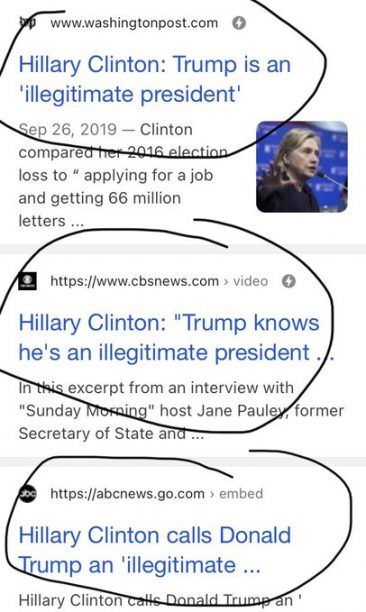
Clinton, meanwhile, has said or insinuated multiple times through social media that the 2016 presidential election was “stolen” from her and Trump was an “illegitimate” president – clear falsehoods that get a free pass because, remember, she’s one of the good guys… despite a laundry list of questionable statements herself (unproven Russian collusion claims being among them) and a past that includes being a key vote for the Iraq War – talk about a disinformation campaign.
Clinton’s “global reckoning” call is little more than gloating at the power Big Tech already seems to have over free speech. The suppression of stories, policing of speech, and outright banning of voices on the Right is somehow not enough for people like Clinton. Things don’t seem to be moving towards full censorship quite fast enough for her leftist taste, but social media platforms already appear to be hard at work on her end goal.
Clinton would rather speed things up and have the government step in to decide what’s disinformation and what’s not in some major “reckoning” event. If the powers that be go by her definition in such a scenario, the only satisfactory ending is a world where dissenting and right-leaning voices are silenced at an even more alarming rate than they are now – all in the name of the ‘righteous’ goal of stopping “disinformation.”
Zachary Leeman is the author of the novel Nigh and journalist who covers art and culture.
Pfizer Ducks Criminal Prosecution Using Shell Companies
Principia Scientific | May 6, 2021
You first heard of ‘too big to fail’ banks in 2008 when the global economic collapse destroyed lives and businesses and few, if any fraudster bankers went to jail.
Don’t be surprised to learn that ‘too big to fail‘ also applies to those Big Pharma entities in cahoots with corrupt politicians. This short video explains how Pfizer, conspiring with bent regulators, uses shell companies to get away with their vaccine crimes.
Why Is There No Correlation Between Masks, Lockdowns, and Covid Suppression?
In the past couple of months, our esteemed public health experts have had a rough go of defending the supposedly settled science behind lockdowns and mask mandates.
White House covid-19 advisor Andy Slavitt was first on the chopping block back in mid-February, when he was reduced to parroting empty platitudes about social distancing after failing to explain why a completely open Florida had numbers no worse than a strictly locked-down California. Then comes media darling Dr. Anthony Fauci, who has had a particularly embarrassing series of public appearances of late. During a recent MSNBC interview Fauci expressed confusion and wasn’t “quite sure” as to why Texas was experiencing falling cases and deaths an entire month after lifting its mask mandates and capacity restrictions. Moreover, during a hearing with Representative Jim Jordan, Fauci completely dodged Jordan’s question of why Texas has lower case rates than some of the most notable lockdown states. Fauci, refusing to answer the question, simply responded that having a lockdown is not the same thing as obeying lockdowns. Fauci was correct here, but he indirectly claimed that citizens of New York and New Jersey, two notorious lockdown states, were complying less with mitigation measures than a state that had, and still has, practically none. A quick check of Google’s covid-19 mobility reports lays this counterintuitive claim to rest.
The American Media’s Agenda
When governments and media outlets around the world have successfully captured audiences by stoking fear of covid-19, the data that should so easily assuage this fear become irrelevant, and interviews like those mentioned above are simply brushed aside in favor of a fear-born allegiance to the “morally superior” government-mandated lockdowns, curfews, mask mandates, and more. This “scared straight” approach, as Bill Maher correctly described it, is the state’s bludgeon of compliance.
As far as scaring citizens straight, Project Veritas has released footage showing CNN employees explaining how the network plays up the covid-19 death toll to drive numbers. Especially disgraceful was CNN technical director Charlie Chester’s admission that the network doesn’t like to report recovery rates because “[t]hat’s not scary…. If it bleeds it leads.”
CNN isn’t alone in the fearmongering business. Thanks to the surplus of United States media outlets willing to churn up a disproportionate amount of negative covid-19 headlines—roughly 90 percent of covid-19 news in the United States is negative compared to 51 percent internationally—is it any surprise that nearly 70 percent of Democrats, 51 percent of Republicans, and almost 50 percent of independents think the chances of being hospitalized with covid-19 range anywhere from 20 percent to over 50 percent?
Where’s the Correlation?
Government- and media-induced panic have blinded us to the data, which for the past thirteen months have consistently shown zero correlation between the timing, strength, and duration of mitigation measures and covid-19 incidence. Nowhere could this lack of correlation be more prevalent than among lockdowns and mask usage.
Leaving aside the disastrous and deadly consequences of government lockdowns—see here, here, and here—the evidence for lockdowns’ ability to mitigate covid-19 mortality remains scant.
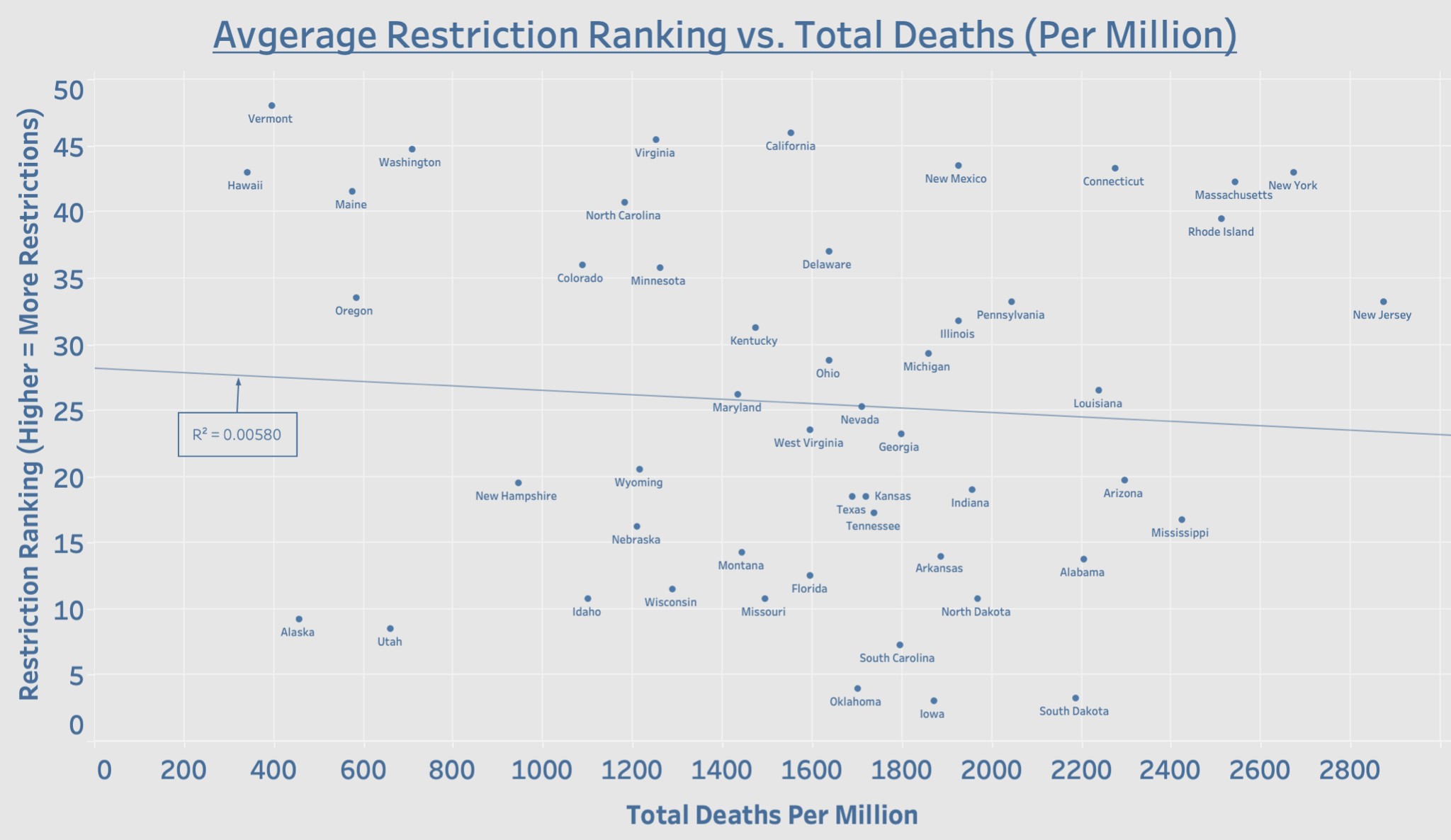
Looking at the United States, we can address the widely believed notion that states with more intense lockdowns will see fewer covid-19 deaths by plotting each state’s average restriction ranking over the past thirteen months against the total number of covid-19 deaths for each state. To get the average ranking, the author averaged data from Oxford University’s Blavatnik School of Government—this source ranked each state by the average time spent at a stringency index measure greater than sixty up until mid-December 2020—and WalletHub, which also ranked each state by stringency using a weighted average of various measures from January 2021 onward. Now, if the past year’s worth of sanctimonious lectures from public health experts have any scientific weight behind them, we should see a very strong negative correlation between the intensity of states’ restrictions and total covid-19 deaths.
Source: Data on deaths (as of Apr. 28, 2021) from the NYTimes Covid-19 Data Bot. Data on restriction rankings from the NYTimes Covid-19 Data Bot (through December 2020); Adam McCann, “States with the Fewest Coronavirus Restrictions,” WalletHub, Apr. 6, 2021 (since January 2021); and Laura Hallas, Ariq Hatibie, Saptarshi Majumdar, Monika Pyarali, and Thomas Hale, “Variation in US States’ Responses to COVID-19” (Blavatnik School of Government Working Paper No. BSG-WP-2020/034, December 2020).
Contrary to what the public health experts have been telling us for more than a year, there is no correlation between the strength of a state’s lockdown measures and total covid-19 deaths. In fact, notorious lockdown states such as New York and New Jersey have some of the worst mortality numbers to date. To blame noncompliance for these poor numbers is ridiculous on its face considering that states with no restrictions, such as Texas and Florida, have far fewer deaths than New York and New Jersey. In fact, you’ll find that every state that has either removed its mask mandate or all covid-19 restrictions entirely is outperforming New York and New Jersey in terms of deaths.
The same lack of correlation can be seen when comparing average lockdown stringency with the total number of patients hospitalized who have suspected or confirmed covid-19. As a point of clarification, the author summed the current number of patients hospitalized each day to arrive at the total number of patients hospitalized. This will result in slightly inflated total numbers, since patients may spend more than one day in the hospital, but having applied the same aggregation method across all states, the total hospitalization metric still provides an accurate assessment of covid-19 hospitalizations in each state.

Source: Data on hospitalizations (as of Apr. 24, 2021) from the US Department of Health and Human Services. Data on restriction rankings from the NYTimes Covid-19 Data Bot (through December 2020); Adam McCann, “States with the Fewest Coronavirus Restrictions,” WalletHub, Apr. 6, 2021 (since January 2021); and Laura Hallas, Ariq Hatibie, Saptarshi Majumdar, Monika Pyarali, and Thomas Hale, “Variation in US States’ Responses to COVID-19” (Blavatnik School of Government Working Paper No. BSG-WP-2020/034, December 2020).
Internationally speaking, the data continue to expose lockdowns as the single greatest public health failure in human history. Plotting lockdown stringency against total covid-19 death toll reveals, yet again, zero correlation between the two variables.

Source: Data on deaths (as of Apr. 28, 2021) and lockdown stringency (as of Apr. 28, 2021) from Our World in Data.
In light of a year’s worth of data showing wildly different mortality and hospitalization outcomes for fifty states with fifty very different lockdown stringencies, as well as drastically different mortality outcomes for 166 countries with 166 different lockdown stringencies, one can only marvel that such a deadly and ineffective policy can be recommended by public health experts.
If the lockdowns failed to mitigate the spread of covid-19 in the United States just as in dozens of countries around the world—remember, the lockdowns fail without even taking their costs into account—it’s possible that mask usage is the missing piece of the mitigation puzzle.
It wouldn’t be fair to the reader to post quite literally hundreds of charts that show the exact opposite outcomes the media would have one expect after regions remove or institute mask mandates—Ian Miller has done more work in this area than anybody else. It also wouldn’t be fair to claim that mask mandates and mask usage are synonymous. However, based on reactions to states lifting their mask mandates, I don’t think any proponent of mask wearing would seriously expect the same level of mask usage should mandates be lifted. Nevertheless, the claim that mask usage negatively correlates with cases and deaths is easily refuted with a quick look at the data. Given the data available, we’ll again only be looking at the fifty states.

Source: Data for cases and deaths (as of Apr. 28, 2021) from the NYTimes Covid-19 Data Bot. Mask usage data from the Delphi Group’s COVIDcast.
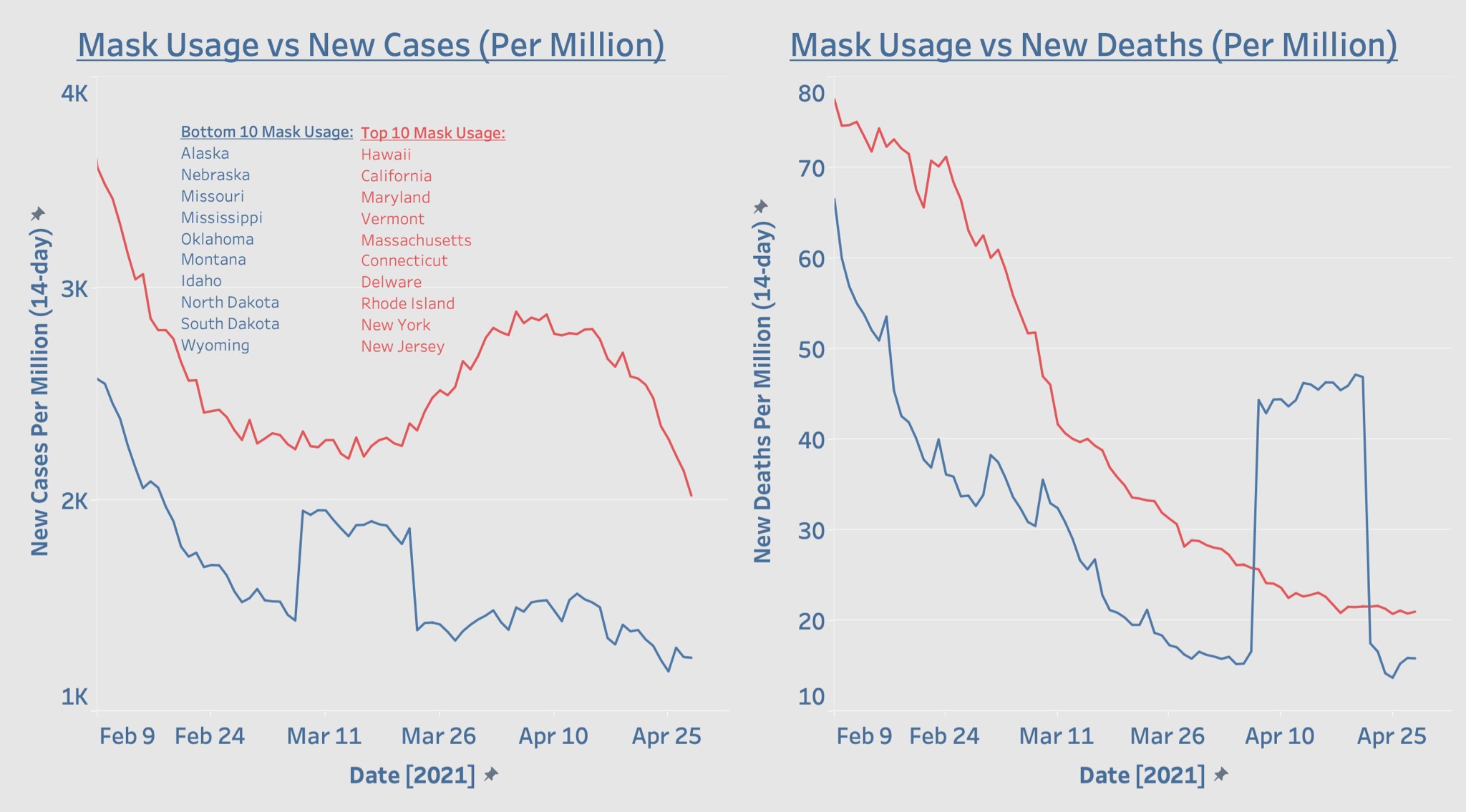
Even though the trend lines travel in the exact opposite direction of what our public health experts would have us expect, the correlations are statistically meaningless. Note that the above chart only covers the 2.5-month period starting February 9, 2021, which is when COVIDcast began reporting mask usage numbers for each state. Therefore, the author included only the cases and deaths that occurred during this 2.5-month period. Despite this truncated time period, 2.5 months should have been more than enough to have exposed any sort of meaningful correlation between mask usage and both cases and deaths.
It is worth noting that Rhode Island and New York, each with some of the highest mask usage rates and lockdown stringencies in the country, are leading the pack with some of the largest case increases since early February. What is more, in the 2.5 months since early February the ten states with the highest rate of mask usage have been doing worse in both cases and deaths than the ten states with the lowest rate of mask usage.
Source: Data for cases and deaths (as of Apr. 28, 2021) from the NYTimes Covid-19 Data Bot. Mask usage data from the Delphi Group’s COVIDcast.
Remember, we aren’t measuring the amount of rules that simply say you have to wear a mask. What’s being measured is the percentage of people actually wearing masks in public in each state. It’s quite difficult to look at the trends depicted above and make the case not only for continuing mask mandates, but wearing masks at all.
Some may have an issue with the fact that the trends above only cover the couple of months since February. Let’s assume, for the sake of a more complete picture, that mask usage trends were consistent for each state since the start of the pandemic. We can also expand our filter to the top and bottom fifteen states to account for some states’ movement in and out of the top and bottom ten states.

Source: Data for cases and deaths (as of Apr. 28, 2021) from the NYTimes Covid-19 Data Bot. Mask usage data from the Delphi Group’s COVIDcast.
In terms of cases, from April to around mid-June, states with the lowest rates of mask usage were outperforming states with the highest rates of mask usage. This trend reversed from mid-June through mid-January and then reversed again in favor of states with the lowest rate of mask usage.
In terms of deaths, states with the lowest rates of mask usage outperformed states with the highest rates of mask usage from April until mid-July. From mid-July to mid-February, death trends were more favorable to states with the highest rates of mask usage, but after mid-February death trends again became more favorable to states with the lowest rates of mask usage. Again, if we are assuming fairly consistent rates of mask usage across the entire duration of the pandemic while also assuming that the science behind masks is truly settled, it’s quite difficult to explain away any period of time in which states with the lowest rates of mask usage were outperforming states with the highest rates.
The supposedly settled science behind both lockdowns and mask mandates has always been in serious trouble but is even more so now. Completely leaving aside the incredible death toll of the lockdowns, their numerous social and psychological costs, the totalitarian denial of our most basic liberties, and the decimation of tens of thousands of small businesses, they would still be a miserable failure by nearly every covid-19 metric we have available. Though, to be fair, the lockdowns did make our cities quieter. But aside from that, the data continue to deny that either lockdowns or mask mandates are effective tools for mitigating the spread of covid-19.
This Biden Proposal Could Make the US a “Digital Dictatorship”

BY WHITNEY WEBB |
UNLIMITED HANGOUT| MAY 5, 2021
Last Wednesday, President Biden was widely praised in mainstream and health-care–focused media for his call to create a “new biomedical research agency” modeled after the US military’s “high-risk, high-reward” Defense Advanced Research Projects Agency, or DARPA. As touted by the president, the agency would seek to develop “innovative” and “breakthrough” treatments for cancer, Alzheimer’s disease, and diabetes, with a call to “end cancer as we know it.”
Far from “ending cancer” in the way most Americans might envision it, the proposed agency would merge “national security” with “health security” in such as way as to use both physical and mental health “warning signs” to prevent outbreaks of disease or violence before they occur. Such a system is a recipe for a technocratic “pre-crime” organization with the potential to criminalize both mental and physical illness as well as “wrongthink.”
The Biden administration has asked Congress for $6.5 billion to fund the agency, which would be largely guided by Biden’s recently confirmed top science adviser, Eric Lander. Lander, formerly the head of the Silicon Valley–dominated Broad Institute, has been controversial for his ties to eugenicist and child sex trafficker Jeffrey Epstein and his relatively recent praise for James Watson, an overtly racist eugenicist. Despite that, Lander is set to be confirmed by the Senate and Congress and is reportedly significantly enthusiastic about the proposed new “health DARPA.”
This new agency, set to be called ARPA-H or HARPA, would be housed within the National Institutes of Health (NIH) and would raise the NIH budget to over $51 billion. Unlike other agencies at NIH, ARPA-H would differ in that the projects it funds would not be peer reviewed prior to approval; instead hand-picked program managers would make all funding decisions. Funding would also take the form of milestone-driven payments instead of the more traditional multiyear grants.
ARPA-H will likely heavily fund and promote mRNA vaccines as one of the “breakthroughs” that will cure cancer. Some of the mRNA vaccine manufacturers that have produced some of the most widely used COVID-19 vaccines, such as the Pfizer/BioNTech vaccine, stated just last month that “cancer is the next problem to tackle with mRNA tech” post-COVID. BioNTech has been developing mRNA gene therapies for cancer for years and is collaborating with the Bill & Melinda Gates Foundation to create mRNA-based treatments for tuberculosis and HIV.
Other “innovative” technologies that will be a focus of this agency are less well known to the public and arguably more concerning.
The Long Road to ARPA-H
ARPA-H is not a new and exclusive Biden administration idea; there was a previous attempt to create a “health DARPA” during the Trump administration in late 2019. Biden began to promote the idea during his presidential campaign as early as June 2019, albeit using a very different justification for the agency than what had been pitched by its advocates to Trump. In 2019, the same foundation and individuals currently backing Biden’s ARPA-H had urged then president Trump to create “HARPA,” not for the main purpose of researching treatments for cancer and Alzheimer’s, but to stop mass shootings before they happen through the monitoring of Americans for “neuropsychiatric” warning signs.
For the last few years, one man has been the driving force behind HARPA—former vice chair of General Electric and former president of NBCUniversal, Robert Wright. Through the Suzanne Wright Foundation (named for his late wife), Wright has spent years lobbying for an agency that “would develop biomedical capabilities—detection tools, treatments, medical devices, cures, etc.—for the millions of Americans who are not benefitting from the current system.” While he, like Biden, has cloaked the agency’s actual purpose by claiming it will be mainly focused on treating cancer, Wright’s 2019 proposal to his personal friend Donald Trump revealed its underlying ambitions.
As first proposed by Wright in 2019, the flagship program of HARPA would be SAFE HOME, short for Stopping Aberrant Fatal Events by Helping Overcome Mental Extremes. SAFE HOME would suck up masses of private data from “Apple Watches, Fitbits, Amazon Echo, and Google Home” and other consumer electronic devices, as well as information from health-care providers to determine if an individual might be likely to commit a crime. The data would be analyzed by artificial intelligence (AI) algorithms “for early diagnosis of neuropsychiatric violence.”
The Department of Justice’s pre-crime approach known as DEEP was activated just months before Trump left office; it was also justified as a way to “stop mass shootings before they happen.” Soon after Biden’s inauguration, the new administration began using information from social media to make pre-crime arrests as part of its approach toward combatting “domestic terror.” Given the history of Silicon Valley companies collaborating with the government on matters of warrantless surveillance, it appears that aspects of SAFE HOME may already be covertly active under Biden, only waiting for the formalization of ARPA-H/HARPA to be legitimized as public policy.
The national-security applications of Robert Wright’s HARPA are also illustrated by the man who was its lead scientific adviser—former head of DARPA’s Biological Technologies Office Geoffrey Ling. Not only is Ling the main scientific adviser of HARPA, but the original proposal by Wright would have Ling both personally design HARPA and lead it once it was established. Ling’s work at DARPA can be summarized by BTO’s stated mission, which is to work toward merging “biology, engineering, and computer science to harness the power of natural systems for national security.” BTO-favored technologies are also poised to be the mainstays of HARPA, which plans to specifically use “advancements in biotechnology, supercomputing, big data, and artificial intelligence” to accomplish its goals.
The direct DARPA connection to HARPA underscores that the agenda behind this coming agency dates back to the failed Bio-Surveillance project of DARPA’s Total Information Awareness program, which was launched after the events of September 11, 2001. TIA’s Bio-Surveillance project sought to develop the “necessary information technologies and resulting prototype capable of detecting the covert release of a biological pathogen automatically, and significantly earlier than traditional approaches,” accomplishing this “by monitoring non-traditional data sources” including “pre-diagnostic medical data” and “behavioral indicators.”
While nominally focused on “bioterrorist attacks,” TIA’s Bio-Surveillance project also sought to acquire early detection capabilities for “normal” disease outbreaks. Bio-Surveillance and related DARPA projects at the time, such as LifeLog, sought to harvest data through the mass use of some sort of wearable or handheld technology. These DARPA programs were ultimately shut down due to the controversy over claims they would be used to profile domestic dissidents and eliminate privacy for all Americans in the US.
That DARPA’s past total surveillance dragnet is coming back to life under a supposedly separate health-focused agency, and one that emulates its organizational model no less, confirms that many TIA-related programs were merely distanced from the Department of Defense when officially shut down. By separating the military from the public image of such technologies and programs, it made them more palatable to the masses, despite the military remaining heavily involved behind the scenes. As Unlimited Hangout has recently reported, major aspects of TIA were merely privatized, giving rise to companies such as Facebook and Palantir, which resulted in such DARPA projects being widely used and accepted. Now, under the guise of the proposed ARPA-H, DARPA’s original TIA would essentially be making a comeback for all intents and purposes as its own spin-off.
Silicon Valley, the Military and the Wearable “Revolution”
This most recent effort to create ARPA-H/HARPA combines well with the coordinated push of Silicon Valley companies into the field of health care, specifically Silicon Valley companies that double as contractors to US intelligence and/or the military (e.g., Microsoft, Google, and Amazon). During the COVID-19 crisis, this trend toward Silicon Valley dominance of the health-care sector has accelerated considerably due to a top-down push toward digitalization with telemedicine, remote monitoring, and the like.
One interesting example is Amazon, which launched a wearable last year that purports to not only use biometrics to monitor people’s physical health and fitness but to track their emotional state as well. The previous year, Amazon acquired the online pharmacy PillPack, and it is not hard to imagine a scenario in which data from Amazon’s Halo wellness band is used to offer treatment recommendations that are then supplied by Amazon-owned PillPack.
Companies such as Amazon, Palantir, and Google are set to be intimately involved in ARPA-H’s activities. In particular, Google, which launched numerous health-tech initiatives in 2020, is set to have a major role in this new agency due to its long-standing ties to the Obama administration when Biden was vice president and to President Biden’s top science adviser, Eric Lander.
As mentioned, Lander is poised to play a major role in ARPA-H/HARPA if and when it materializes. Before becoming the top scientist in the country, Lander was president and founding director of the Broad Institute. While advertised as a partnership between MIT and Harvard, the Broad Institute is heavily influenced by Silicon Valley, with two former Google executives on its board, a partner of Silicon Valley venture capital firm Greylock Partners, and the former CEO of IBM, as well as some of its top endowments coming from prominent tech executives.
Former Google CEO Eric Schmidt, who was intimately involved with Obama’s 2012 reelection campaign and who is close to the Democratic Party in general, chairs the Broad Institute as of this April. In March, Schmidt gave the institute $150 million to “connect biology and machine learning for understanding programs of life.” During his time on the Broad Institute board, Schmidt also chaired the National Security Commission on Artificial Intelligence, a group of mostly Silicon Valley, intelligence, and military operatives who have now charted the direction of the US government’s policies on emerging tech and AI. Schmidt was also pitched as potential head of a tech-industry task force by the Biden administration.
Earlier, in January, the Broad Institute announced that its health-research platform, Terra, which was built with Google subsidiary Verily, would partner with Microsoft. As a result, Terra now allows Google and Microsoft to access a vast trove of genomic data that is poured into the platform by academics and research institutions from around the world.
In addition, last September, Google teamed up with the Department of Defense as part of a new AI-driven “predictive health” program that also has links to the US intelligence community. While initially focused on predicting cancer cases, this initiative clearly plans to expand to predicting the onset of other diseases before symptoms appear, including COVID-19. As noted by Unlimited Hangout at the time, one of the ulterior motives for the program, from Google’s perspective, was for Google to gain access to “the largest repository of disease- and cancer-related medical data in the world,” which is held by the Defense Health Agency. Having exclusive access to this data is a huge boon for Google in its effort to develop and expand its growing suite of AI health-care products.
The military is currently being used to pilot COVID-19–related biometric wearables for “returning to work safely.” Last December, it was announced that Hill Air Force Base in Utah would make biometric wearables a mandatory part of the uniform for some squadrons. For example, the airmen of the Air Force’s 649th Munitions Squadron must now wear a smart watch made by Garmin and a smart ring made by Oura as part of their uniform.
According to the Air Force, these devices detect biometric indicators that are then analyzed for 165 different biomarkers by the Defense Threat Reduction Agency/Philips Healthcare AI algorithm that “attempts to recognize an infection or virus around 48 hours before the onset of symptoms.” The development of that algorithm began well before the COVID-19 crisis and is a recent iteration of a series of military research projects that appear to have begun under the 2007 DARPA Predicting Health and Disease (PHD) project.
While of interest to the military, these wearables are primarily intended for mass use—a big step toward the infrastructure needed for the resurrection of a bio-surveillance program to be run by the national-security state. Starting first with the military makes sense from the national-security apparatus’s perspective, as the ability to monitor biometric data, including emotions, has obvious appeal for those managing the recently expanded “insider threat” programs in the military and the Department of Homeland Security.
One indicator of the push for mass use is that the same Oura smart ring being used by the Air Force was also recently utilized by the NBA to prevent COVID-19 outbreaks among basketball players. Prior to COVID-19, it was promoted for consumer use by members of the British Royal family and Twitter CEO Jack Dorsey for improving sleep. As recently as last Monday, Oura’s CEO, Harpeet Rai, said that the entire future of wearable health tech will soon be “proactive rather than reactive” because it will focus on predicting disease based on biometric data obtained from wearables in real time.
Another wearable tied to the military that is creeping into mass use is the BioButton and its predecessor the BioSticker. Produced by the company BioIntelliSense, the sleek new BioButton is advertised as a wearable system that is “a scalable and cost-effective solution for COVID-19 symptom monitoring at school, home and work.” BioIntelliSense received $2.8 million from the Pentagon last December to develop the BioButton and BioSticker wearables for COVID-19.
BioIntelliSense, cofounded and led by former Microsoft HealthVault developer James Mault, now has its wearable sensors being rolled out for widespread use on some college campuses and at some US hospitals. In some of those instances, the company’s wearables are being used to specifically monitor the side effects of the COVID-19 vaccine as opposed to symptoms of COVID-19 itself. BioIntelliSense is currently running a study, partnered with Philips Healthcare and the University of Colorado, on the use of its wearables for early COVID-19 detection, which is entirely funded by the US military.
While the use of these wearables is currently “encouraged but optional” at these pilot locations, could there come a time when they are mandated in a workplace or by a government? It would not be unheard of, as several countries have already required foreign arrivals to be monitored through use of a wearable during a mandatory quarantine period. Saint Lucia is currently using BioButton for this purpose. Singapore, which seeks to be among the first “smart nations” in the world, has given every single one of its residents a wearable called a “TraceTogether token” for its contact-tracing program. Either the wearable token or the TraceTogether smartphone app is mandatory for all workplaces, shopping malls, hotels, schools, health-care facilities, grocery stores, and hair salons. Those without access to a smartphone are expected to use the “free” government-issued wearable token.
The Era of Digital Dictatorships Is Nearly Here
Making mandatory wearables the new normal not just for COVID-19 prevention but for monitoring health in general would institutionalize quarantining people who have no symptoms of an illness but only an opaque algorithm’s determination that vital signs indicate “abnormal” activity.
Given that no AI is 100 percent accurate and that AI is only as good as the data it is trained on, such a system would be guaranteed to make regular errors: the question is how many. One AI algorithm being used to “predict COVID-19 outbreaks” in Israel and some US states is marketed by Diagnostic Robotics; the (likely inflated) accuracy rate the company provides for its product is only 73 percent. That means, by the company’s own admission, their AI is wrong 27 percent of the time. Probably, it is even less accurate, as the 73 percent figure has never been independently verified.
Adoption of these technologies has benefitted from the COVID-19 crisis, as supporters are seizing the opportunity to accelerate their introduction. As a result, their use will soon become ubiquitous if this advancing agenda continues unimpeded.
Though this push for wearables is obvious now, signs of this agenda were visible several years ago. In 2018, for instance, insurer John Hancock announced that it would replace its life insurance offerings with “interactive policies” that involve individuals having their health monitored by commercial health wearables. Prior to that announcement, John Hancock and other insurers such as Aetna, Cigna, and UnitedHealthcare offered various rewards for policyholders who wore a fitness wearable and shared that data with their insurance company.
In another pre-COVID example, the Journal of the American Medical Association published an article in August 2019 that claimed that wearables “encourage healthy behaviors and empower individuals to participate in their health.” The authors of the article, who are affiliated with Harvard, further claimed that “incentivizing use of these devices [wearables] by integrating them in insurance policies” may be an “attractive” policy approach. The use of wearables for policyholders has since been heavily promoted by the insurance industry, both prior to and after COVID-19, and some speculate that health insurers could soon mandate their use in certain cases or as a broader policy.
These biometric “fitness” devices—such as Amazon’s Halo—can monitor more than your physical vital signs, however, as they can also monitor your emotional state. ARPA-H/HARPA’s flagship SAFE HOME program reveals that the ability to monitor thoughts and feelings is an already existing goal of those seeking to establish this new agency.
According to World Economic Forum luminary and historian Yuval Noah Harari, the transition to “digital dictatorships” will have a “big watershed” moment once governments “start monitoring and surveying what is happening inside your body and inside your brain.” He says that the mass adoption of such technology would make human beings “hackable animals,” while those who abstain from having this technology on or in their bodies would become part of a new “useless” class. Harari has also asserted that biometric wearables will someday be used by governments to target individuals who have the “wrong” emotional reactions to government leaders.
Unsurprisingly, one of Harari’s biggest fans, Facebook’s Mark Zuckerberg, has recently led his company into the development of a comprehensive biometric and “neural” wearable based on technology from a “neural interface” start-up that Facebook acquired in 2019. Per Facebook, the wearable “will integrate with AR [augmented reality], VR [virtual reality], and human neural signals” and is set to become commercially available soon. Facebook also notably owns the VR company Oculus Rift, whose founder, Palmer Luckey, now runs the US military AI contractor Anduril.
As recently reported, Facebook was shaped in its early days to be a private-sector replacement for DARPA’s controversial LifeLog program, which sought to both “humanize” AI and build profiles on domestic dissidents and terror suspects. LifeLog was also promoted by DARPA as “supporting medical research and the early detection of an emerging pandemic.”
It appears that current trends and events show that DARPA’s decades-long effort to merge “health security” and “national security” have now advanced further than ever before. This may partially be because Bill Gates, who has wielded significant influence over health policy globally in the last year, is a long-time advocate of fusing health security and national security to thwart both pandemics and “bioterrorists” before they can strike, as can be heard in his 2017 speech delivered at that year’s Munich Security Conference. That same year, Gates also publicly urged the US military to “focus more training on preparing to fight a global pandemic or bioterror attack.”
In the merging of “national security” and “health security,” any decision or mandate promulgated as a public health measure could be justified as necessary for “national security,” much in the same way that the mass abuses and war crimes that occurred during the post-9/11 “war on terror” were similarly justified by “national security” with little to no oversight. Yet, in this case, instead of only losing our civil liberties and control over our external lives, we stand to lose sovereignty over our individual bodies.
The NIH, which would house this new ARPA-H/HARPA, has spent hundreds of millions of dollars experimenting with the use of wearables since 2015, not only for detecting disease symptoms but also for monitoring individuals’ diets and illegal drug consumption. Biden played a key part in that project, known as the Precision Medicine initiative, and separately highlighted the use of wearables in cancer patients as part of the Obama administration’s related Cancer Moonshot program. The third Obama-era health-research project was the NIH’s BRAIN initiative, which was launched, among other things, to “develop tools to record, mark, and manipulate precisely defined neurons in the living brain” that are determined to be linked to an “abnormal” function or a neurological disease. These initiatives took place at a time when Eric Lander was the cochair of Obama’s Council of Advisors on Science and Technology while still leading the Broad Institute. It is hardly a coincidence that Eric Lander is now Biden’s top science adviser, elevated to a new cabinet-level position and set to guide the course of ARPA-H/HARPA.
Thus, Biden’s newly announced agency, if approved by Congress, would integrate those past Obama-era initiatives with Orwellian applications under one roof, but with even less oversight than before. It would also seek to expand and mainstream the uses of these technologies and potentially move toward developing policies that would mandate their use.
If ARPA-H/HARPA is approved by Congress and ultimately established, it will be used to resurrect dangerous and long-standing agendas of the national-security state and its Silicon Valley contractors, creating a “digital dictatorship” that threatens human freedom, human society, and potentially the very definition of what it means to be human.
Silicon Valley Algorithm Manipulation Is The Only Thing Keeping Mainstream Media Alive
By Caitlin Johnstone | May 3, 2021
The emergence of the internet was met with hope and enthusiasm by people who understood that the plutocrat-controlled mainstream media were manipulating public opinion to manufacture consent for the status quo. The democratization of information-sharing was going to give rise to a public consciousness that is emancipated from the domination of plutocratic narrative control, thereby opening up the possibility of revolutionary change to our society’s corrupt systems.
But it never happened. Internet use has become commonplace around the world and humanity is able to network and share information like never before, yet we remain firmly under the thumb of the same power structures we’ve been ruled by for generations, both politically and psychologically. Even the dominant media institutions are somehow still the same.
So what went wrong? Nobody’s buying newspapers anymore, and the audiences for television and radio are dwindling. How is it possible that those same imperialist oligarchic institutions are still controlling the way most people think about their world?
The answer is algorithm manipulation.
Last month a very informative interview saw the CEO of YouTube, which is owned by Google, candidly discussing the way the platform uses algorithms to elevate mainstream news outlets and suppress independent content.
At the World Economic Forum’s 2021 Global Technology Governance Summit, YouTube CEO Susan Wojcicki told Atlantic CEO Nicholas Thompson that while the platform still allows arts and entertainment videos an equal shot at going viral and getting lots of views and subscribers, on important areas like news media it artificially elevates “authoritative sources”.
“What we’ve done is really fine-tune our algorithms to be able to make sure that we are still giving the new creators the ability to be found when it comes to music or humor or something funny,” Wojcicki said. “But when we’re dealing with sensitive areas, we really need to take a different approach.”
Wojcicki said in addition to banning content deemed harmful, YouTube has also created a category labeled “borderline content” which it algorithmically de-boosts so that it won’t show up as a recommended video to viewers who are interested in that topic:
“When we deal with information, we want to make sure that the sources that we’re recommending are authoritative news, medical science, et cetera. And we also have created a category of more borderline content where sometimes we’ll see people looking at content that’s lower quality and borderline. And so we want to be careful about not over-recommending that. So that’s a content that stays on the platform but is not something that we’re going to recommend. And so our algorithms have definitely evolved in terms of handling all these different content types.”
Progressive commentator Kyle Kulinski has a good video out reacting to Wojcicki’s comments, saying he believes his (entirely harmless) channel has been grouped in the “borderline” category because his views and new subscribers suddenly took a dramatic and inexplicable plunge. Kulinski reports that overnight he went from getting tens of thousands of new subscriptions per month to maybe a thousand.
“People went to YouTube to escape the mainstream nonsense that they see on cable news and on TV, and now YouTube just wants to become cable news and TV,” Kulinski says. “People are coming here to escape that and you’re gonna force-feed them the stuff they’re escaping like CNN and MSNBC and Fox News.”
It is not terribly surprising to hear Susan Wojcicki admit to elevating the media of the oligarchic empire to the CEO of a neoconservative publication at the World Economic Forum. She comes from the same elite empire management background as all the empire managers who’ve been placed in charge of mainstream media outlets by their plutocratic owners, having gone to Harvard after being literally raised on the campus of Stanford University as a child. Her sister Anne is the founder of the genetic-testing company 23andMe and was married to Google co-founder Sergey Brin.
Google itself also uses algorithms to artificially boost empire media in its searches. In 2017 World Socialist Website (WSWS) began documenting the fact that it, along with other leftist and antiwar outlets, had suddenly experienced a dramatic drop in traffic from Google searches. In 2019 the Wall Street Journal confirmed WSWS claims, reporting that “Despite publicly denying doing so, Google keeps blacklists to remove certain sites or prevent others from surfacing in certain types of results.” In 2020 the CEO of Google’s parent company Alphabet admitted to censoring WSWS at a Senate hearing in response to one senator’s suggestion that Google only censors right wing content.
Google, for the record, has been financially intertwined with US intelligence agencies since its very inception when it received research grants from the CIA and NSA. It pours massive amounts of money into federal lobbying and DC think tanks, has a cozy relationship with the NSA, and has been a military-intelligence contractor from the beginning.
Then you’ve got Facebook, where a third of Americans regularly get their news. Facebook is a bit less evasive about its status quo-enforcing censorship practices, openly enlisting the government-and-plutocrat-funded imperialist narrative management firm The Atlantic Council to help it determine what content to censor and what to boost. Facebook has stated that if its “fact checkers” like The Atlantic Council deem a page or domain guilty of spreading false information, it will “dramatically reduce the distribution of all of their Page-level or domain-level content on Facebook.”
All the algorithm stacking by the dominant news distribution giants Google and Facebook also ensures that mainstream platforms and reporters will have far more followers than indie media on platforms like Twitter, since an article that has been artificially amplified will receive far more views and therefore far more clicks on their social media information. Mass media employees tend to clique up and amplify each other on Twitter, further exacerbating the divide. Meanwhile left and antiwar voices, including myself, have been complaining for years that Twitter artificially throttles their follower count.
If not for these deliberate acts of sabotage and manipulation by Silicon Valley megacorporations, the mainstream media which have deceived us into war after war and which manufacture consent for an oppressive status quo would have been replaced by independent media years ago. These tech giants are the life support system of corporate media propaganda.
Iran to leave Vienna by end of month if Biden doesn’t lift all sanctions
By Elijah J Magnier | Press TV | May 4, 2021
Iranian and Western delegations returned to their capitals after the third Vienna round, with optimism emanating from the statements of the gathered officials. Iran’s Deputy Foreign Minister Abbas Araqchi issued positive information about the US lifting sanctions on energy, economic sectors, shipping, freedom of transportation, banks, and on many Iranian personalities. The negotiations have reached a stage where the elaboration of complex texts is on the table. Also, there were talks about the US releasing more than 90 billion dollars withheld from Iranian funds and another 20 billion frozen in Iraq, South Korea and China from oil revenues. No details have been discussed so far about the interest on these funds held for many years due to US sanctions.
There was also talk of the possibility of exchanging Iranian prisoners held in America, who number 18, including 7 in critical health condition, and others of Iranian–Western double nationality holders (American and British) detained in Iran on charges of espionage. This is an old Iranian demand that Iran insists on ending everything in one single exchange.
However, after lifting sanctions against individuals and accepting all demands, the biggest problem lies in Iran’s request to ensure that the lifting of sanctions will be applied in a specific time frame. According to a particular pre-agreed timetable, Iran wants to ensure that all frozen funds will return to the Central Bank. Countries around the world will be allowed to deal with Iran in all sectors without intimidation.
Iran has never requested the return of diplomatic relations with the US, but rather the lifting of the sanctions that were imposed on it since 2015 and that President Barack Obama agreed to cancel. Moreover, Iran wants to lift all additional sanctions added by Donald Trump when the nuclear deal was torn apart in 2018.
Negotiations have reached a reasonable level, although Iran still refuses to communicate with the US directly because the US is no longer a partner in the JCPOA and that talks could blow up any time. The US flag was removed from the negotiating room at the request of Iran. The Iranian delegation stressed the need for the US delegates not to be present at the same hotel where the negotiations are taking place until the White House announces the end of all sanctions. This is when the US will become a JCPOA partner again.
An Iranian decision-maker in Iran said that “the Leader of the [Islamic] Revolution, [Ayatollah] Seyyed Ali Khamenei, will not give an unlimited time-space to negotiate in Vienna. This is the last month before the announcement of the clinical death of the JCPOA agreement if all Iranian conditions are not met.” The source asserts that “Iran will not accept the American evasiveness that called for easing the sanctions by lifting those related to the nuclear file and placing other sanctions related to Iran’s missile capability, the Revolutionary Guards (Islamic Revolution Guards Corps) and other sectors until a future negotiation to be established later. Either all sanctions are lifted, or no deal is reached because mid-solutions are not accepted.”
Many indications lead to the US intention to conclude the deal with Iran and honor its previous commitment signed in 2015. Israel is prepared for this move following Mossad director Yossi Cohen, National security advisor Meir Ben-Shabbat and other military and security high-ranking officers meeting with US officials. The Israelis failed to persuade the US to abandon the agreement with Iran.
The Biden administration considers the nuclear deal necessary to protect Israel by preventing Iran from reaching enrichment uranium to 90-percent purity level, which makes possessing an atomic bomb easy. Israel wishes to keep the harsh sanctions on Iran and strike its nuclear reactor.
Iran possesses the ballistic and precision missiles that enable it to strike back with a decisive blow to the US bases deployed in the Middle East in case of war. Furthermore, Iran can count on the strength of its allies deployed in Gaza, Lebanon, Syria, Iraq and Yemen, who can join the battlefield if needed. Therefore, waging war on Iran is not feasibly possible. That leaves the US with slim options: the best could be to honor its deal, lift the sanctions and make sure that Iran does not obtain military nuclear grade capability. This is Biden’s logic and approach to assure the security of Israel and the interests of the US. Iran has shown that it imposes its conditions on the US and treats it as an equal from strength because it has strong cards to play.
However, Israel cannot go to war with Iran alone and wants to drag in the US. Iran has shown that its strategic patience has been replaced by strategic deterrence. Multiple strikes manifested that, and missile messages exchanged in the Strait of Hormuz and the Red Sea. There were powerful indications that Iran will not be silent on any Israeli transgression. Furthermore, when Israeli Prime Minister Benjamin Netanyahu presented himself as an alternative power to the US in the Middle East and became a superpower, a missile landed close to the Dimona nuclear reactor. Therefore, there is no doubt that Israel can harass Iran in Syria by cyber warfare and assassinations. It is also accurate to say that Iran has the power to direct similar annoyance to Israel.
It is a crucial month to indicate in which direction the ship of negotiations between Iran and America will sail. It is in the interest of both parties to reach an agreement, but all indications indicate that Iran will not budge from its place and will hold its ground firmly before accepting the US back as a partner in the nuclear agreement. The ball is in Biden’s court now, and time is not on his side.
Elijah J Magnier is a veteran war correspondent and a Senior Political Risk Analyst with decades of experience covering the West Asian region.
Continuing the Story of the Hijacked Tanker and Frozen Funds
By Konstantin Asmolov – New Eastern Outlook – 04.05.2021
In early 2021, we wrote about the Iranian seizure of a South Korean tanker and how this precedent actually demonstrates a number of unresolved problems, most notably the problem of Iranian assets in South Korean banks intended to pay for Iranian crude oil imports and frozen because of US sanctions.
Recall: Iran has repeatedly urged Seoul to address the $7 billion frozen in two South Korean banks as part of US sanctions after the Donald Trump administration pulled out of the landmark nuclear deal with Iran in 2018 and tightened sanctions against the Islamic Republic. On January 4, 2021, the Iranian Islamic Revolutionary Guard Corps seized the South Korean-flagged tanker MT Hankuk Chemi under the pretext of environmental pollution.
On January 10, 2021, a government delegation led by First Deputy Foreign Minister Choi Jong-gon arrived in Tehran. However, the parties were unable to reach any agreements. In fact, Choi called for the release of the tanker and demanded evidence of oil pollution in the waters of the Persian Gulf, which formally caused the tanker to be seized. In response, his interlocutor Abbas Araghchi said that the tanker was in the hands of an Iranian court, and that the development of bilateral relations can make sense only when the issue of frozen funds is resolved.
Araghchi openly stated that “the freezing of Iran’s foreign currency resources in Korea is more due to a lack of political will on the part of the Korean government than to US sanctions,” and called on Choi to work out a mechanism to resolve the issue. However, the Iranian side noted that the crew members were safe and in good shape.
Choi’s talks with Iran’s Central Bank Governor Abdel Nasser Hemmati and Foreign Minister Javad Zarif also proved fruitless. The minister reiterated the thesis that the executive branch does not interfere in matters that fall within the jurisdiction of the judiciary; and the bank recalled that the South Korean government had promised to resolve the issue a year and a half ago, but had done nothing.
Kamal Kharrazi, head of Iran’s Strategic Council on Foreign Relations, was even more blunt: “The two countries had good relations, but now, unfortunately, because the Korean government yielded to US pressure, Iranian assets worth $7 billion have been frozen in Korean banks, and it cannot even withdraw money to buy medicine“.
On January 12, during a briefing, Saeed Khatibzadeh of the Iranian Foreign Ministry expressed dissatisfaction with the measures taken by the ROK to solve the problem: the solution is delayed and Tehran is not satisfied. The Iranian side has indicated its position that the problem of frozen funds should be solved first, and the issue of the arrested tanker will be resolved in accordance with legal procedures.
As a result of Choi’s visit, the parties agreed on nothing but further negotiations, and Choi went to Qatar, where he appealed for assistance in freeing the South Korean tanker and its crew.
In mid-January it emerged that in order to “create a positive mood before negotiations with Iran,” South Korea withdrew its anti-piracy naval unit Cheonghae from the Strait of Hormuz. Iranian Ambassador Saeed Badamchi Shabestari allegedly once expressed displeasure to Seoul over the presence of South Korean troops in the Straits because they were actually part of an international contingent assembled by the United States to contain Iran, even though formally the unit is meant to fight regional piracy. It is a typical trick of South Korean foreign policy when US orders are de facto carried out, but de jure these actions are anything but the direct order. However, the Foreign Ministry of the ROK refused to confirm this movement of troops.
At the same time, there was a rumor that the Iranian party offered to use part of the frozen funds to pay off its outstanding UN membership dues. Although the amount is only $16,200,000, experts decided that the only the first step would be particularly difficult, and on January 19, the head of the Central Bank of Iran, in an interview with Bloomberg agency again noted that this is not the first time the authorities of the Republic of Korea promise to do everything possible, but in fact they continue to follow the US policy and rules.
The Korean party, on the other hand, has made certain hints that a change of power in the US could unblock the problem.
On January 21, Hemmati reported that some of the funds belonging to Iran, which are in foreign banks, have been unfrozen and are being used by the government.
On February 2, 2021, Iran agreed to release the entire crew of the hijacked tanker except for the captain. Seoul welcomed this decision, and “the parties agreed to continue mutual communication”. By this time everyone finally remembered that at the time of the seizure the ship was carrying not petroleum products, but ethyl alcohol, so it is unclear how the fact of pollution that became the reason for the arrest of the ship occurred at that time.
The next day, the ROK media reported that South Korea was finalizing negotiations with the US to use some of the frozen money to pay Iran’s outstanding US dues. Otherwise, South Korean experts believed that the decision was still related to the change of power in the US, because, first, Biden was going to deal with the restoration of alliances in general, and second, the Iranian issue, according to Southerners, will be solved differently than under Trump. Iran has been called upon to return to the Joint Comprehensive Plan of Action in order to restore the 2015 nuclear agreement.
In addition, it was reported that South Korea increased the export of medicine to Iran for two months, which also contributed to the release of detainees.
On February 11, the first Korean sailor returned home, but some of the crew remained on the ship to provide management.
On February 23, in a statement issued by South Korean Foreign Ministry in response to the Iranian Foreign Ministry’s statement on reaching an agreement with the South, it was stated that Iranian assets could be unblocked after consultations with the United States. According to a report posted on the Iranian government’s website, the agreement was reached during the February 22 meeting between Hemmati, Governor of the Central Bank of Iran, and Yoo Jong-hyun, the ROK ambassador to Iran. The parties agreed on directions for the transfer of money, and the Central Bank of Iran has informed Seoul of the amount it wants to receive. Then, according to Bloomberg, Iranian government spokesman Ali Rabiei told a news conference that South Korea would release $1 billion in frozen money as a first step toward resolving the issue, without giving further details on how it would be used.
However, on the same day, Feb. 23, State Department spokesman Ned Price noted that the US and the ROK could discuss the supposed release of Iranian funds, but the money had not yet been transferred. The ROK Foreign Ministry also stressed that American pressure was needed to unfreeze Iranian assets. Thus, Tehran’s claim of an agreement has been refuted.
On February 24, the foreign ministers of the ROK and Islamic Republic of Iran discussed the situation, and Jong Eui-young said that South Korea “is making sincere efforts to release frozen assets,” but recalled that the issue must be resolved in close cooperation with the United States. In response, the Governor of the Central Bank of Iran said that South Korea must pay Iran $1 billion, otherwise Tehran will initiate proceedings in international courts.
On February 25, a US Treasury Department official said that Washington agreed in principle to a partial transfer of Iranian assets to Switzerland, from where they can be sent to Iran under the so-called Swiss Agreement on Humanitarian Trade, the essence of which is that Swiss food, pharmaceutical and medical companies must have a reliable channel of payment to ensure payment for their exports to Iran. Actually, the aforementioned billion was going to be transferred to the purchase of drugs against coronavirus
The conservative media in the ROK accused Iran of diplomatic impoliteness and wishful thinking. However, the commonplace conclusion was that it was all Moon’s fault for failing everything: the government is only engaged in improving relations with the DPRK and cannot conduct skillful diplomacy with other countries.
On March 2, Ned Price said that the US would be willing to discuss with Iran the unblocking of its money in the ROK “to achieve the main goal of Iran’s denuclearization.” He was silent about where, when, and how this issue would be discussed.
On March 10, US Secretary of State Antony Blinken took an even tougher stance: until Iran meets its obligations under the nuclear deal, the US will not ease any sanctions, including the release of Iranian funds in South Korean banks. When asked whether it was true that some of the funds could be transferred, however, Blinken replied that “the report you referred to is simply wrong“. Korean conservative media and experts immediately noted that “Secretary Blinken’s principled approach to frozen Iranian funds is good news for Korean national interests. This allows Seoul to resist extortion, even while making every reasonable effort to cooperate with Tehran. It also sends a signal to North Korea that international sanctions will be strictly enforced, but may be eased if denuclearization agreements are respected.”
On March 16, the ROK and Iran held a video conference that formally focused on expanding bilateral humanitarian trade, and on March 17, Deputy Prime Minister and Treasury Secretary Hong Nam-gi spoke by phone with new US Treasury Secretary Janet Yellen, where the parties agreed to cooperate closely, including on the Iranian issue.
On April 2, 2021, a diplomatic source reported that the tanker would soon be released, and on April 5, Said Khatibzadeh of the Iranian Foreign Ministry added that the case was ending and the court decision would most likely be in favor of the South Korean side.
According to experts, this was related both to the upcoming visit to Iran of Prime Minister Jong Se-kyung and to the fact that 700,000 doses of AstraZeneca vaccine produced in Kazakhstan were delivered to Iran.
On the morning of April 9, Iran released the tanker and it left the port. On board were the captain and 12 crew members who had been released earlier but remained on the ship for maintenance purposes.
On April 11, Jeong Se-kyung left for Iran on a three-day visit. This visit was the first trip of a South Korean prime minister to Iran in 44 years, but it should be remembered that by this time it was already known that at the end of the visit Chong was resigning due to a set of domestic political problems. Therefore, despite the high status of the visit, its real significance was somewhat less than expected, and the visit did not end with anything serious. The sides agreed to expand humanitarian exchanges, including medical cooperation, and to create a special consultative body responsible for preparing economic cooperation projects after the possible resumption of the nuclear deal. The Iranian side again urged Seoul to unblock the money as soon as possible, which was responded to with further assurances that everything possible was being done and a call to prevent Iran from detaining foreign vessels in the future: “The freedom of navigation must be guaranteed.”
In general, during his stay in Iran, Jeong Se-kyung himself was particularly active trying to please Iran and even talked about the importance and profound spiritual significance of Ramadan. It turns out that he has said before that “this money is Iranian money and should be returned to the rightful owner. We have to find a way to return it quickly.” However, the author’s attempt to search for statements by the South Korean prime minister on this topic was unsuccessful. Jeong met with a number of dignitaries, including the speaker of parliament, but was unable to meet with President Rouhani “for various reasons, including the situation with Covid-19.”
And Iran’s First Vice President Jahangiri openly said, “We call on the Korean government to release Iran’s financial resources as soon as possible and solve the problems of recent years through practical compensatory measures.” The vice president regretted that the $1 billion transfer to Swiss banks for the purchase of a coronavirus vaccine did not materialize despite promises by Korean officials: the Korean banks’ actions severely damaged bilateral relations, as it deprived Iran of major foreign exchange resources to purchase medicines and medical equipment in a pandemic. As a result, the image of the ROK has been seriously damaged. There is hope that the situation will improve after Jeong Se-kyung’s visit.
Nevertheless, on April 12, a US State Department official, speaking on condition of anonymity, repeated in an interview with the Ryonhap news agency that the US position on sanctions against Iran remains unchanged. Until Iran goes back on the JCPOA, it won’t get its money back.
Thus, on the one hand, the story of the tanker hijack ended well enough, and the notion that the action had not an environmental but a political purpose was safely confirmed. On the other, Iran’s attempt to push for the return of the blocked funds in this way did not end with anything. Iran received some vaccines and other medical resources, but it was more of a handout than a victory. Finally, this situation shows well the level of independence of South Korean foreign policy on certain issues. Despite the fact that the South Korean leadership did not seem to mind solving the problem, at the first shout from the US in Seoul they stood at attention, not even trying to show displeasure about it. For the author, this is a rather important story that explains both why some countries periodically claim a “lack of sovereignty” in South Korea and the difference in South Korean foreign policy between the populist statements of Moon Jae-in and Co. and Seoul’s actual actions.
Konstantin Asmolov, PhD in History, is a leading research fellow at the Center for Korean Studies of the Institute of the Far East at the Russian Academy of Sciences.
Featured Video

“Historic Russia”: The Land Putin Will Not Give Back
or go to
Aletho News Archives – Video-Images
Book Review
Why the War on Conspiracy Theories Is Bad Public Policy
By Kevin Barrett • Unz Review • February 1, 2019
 A Review of Conspiracy Theories and Other Dangerous Ideas by Cass Sunstein (based on an earlier paper co-authored with Adrian Vermeule); In Defense of Troublemakers: The Power of Dissent in Life and Business by Charlan Nemeth; and Conspiracy Theories and the People Who Believe Them, edited by Joseph E. Uscinski
On January 25 2018 YouTube unleashed the latest salvo in the war on conspiracy theories, saying “we’ll begin reducing recommendations of borderline content and content that could misinform users in harmful ways—such as videos promoting a phony miracle cure for a serious illness, claiming the earth is flat, or making blatantly false claims about historic events like 9/11.”
At first glance that sounds reasonable. Nobody wants YouTube or anyone else to recommend bad information. And almost everyone agrees that phony miracle cures, flat earthism, and blatantly false claims about 9/11 and other historical events are undesirable.
But if we stop and seriously consider those words, we notice a couple of problems. First, the word “recommend” is not just misleading but mendacious. YouTube obviously doesn’t really recommend anything. When it says it does, it is lying. … continue
Blog Roll
 Aletho News
- BRITAIN’S WARNING: PREPARE FOR WAR
- “Historic Russia”: The Land Putin Will Not Give Back
- How the Cambridge Analytica scandal still haunts Mark Zuckerberg
- The Ongoing Cancellation Campaign Against a Dissenting Academic in Norway
- Yemen and ‘the Houthis’: Challenging Sami Hamdi’s Narrative
- No, Christians did not invent Zionism
- AIPAC-led lobbying network opens branches in Cypriot, Greek parliaments
- Araghchi blasts ‘parasitic’ alliance as US taxpayers pay for Israel’s war on Iran
- Easy fix for Europe’s chaos? Stop fueling war against Russia
- Putin’s key remarks on peace talks and Europe’s ‘schizophrenia’
- If Americans Knew
- An error has occurred; the feed is probably down. Try again later.
- No Tricks Zone
- Two New Studies Find Thwaites Glacier Melt Cannot Be Driven By Human Activity Or A Warming Ocean
- E-Cars Reduce CO2 Emissions By Only 41% Compared To Internal Combustion Engine Vehicles
- Predictions Made By Renowned Climate Professor Over Past Decades Have Been Proven To Be Poor
- New Study Suggests Large Regions Of The Pacific Ocean Have Been Cooling For The Last 80 Years
- Germany’s Green Energy Debacle: High Energy Costs Force Kahla Porzellan to Close After 182 Years!
- New Study: 50 Years Of The Most Aggressive ‘Net Zero’ Policies Can Only Affect The Global Climate By 0.03°C
- US September “Heat” Was No Record…Many Records Set Decades Ago
- Latest European Green Energy Debacle; Portugal’s Largest Flagship Solar Park Insolvent!
- Green Energy Debacle: German Expert Professor Fritz Vahrenholt Warns Of Severe Economic And Social Consequences
- Two More Paleo Reconstructions Affirm Meters-Higher Sea Levels Across Ireland, Brazil 7000-6000 Years Ago

