In a Washington Post opinion piece, U.S. Secretary of State Antony Blinken and Defense Secretary Lloyd Austin spelled out their objectives in visiting Japan, South Korea, and India. “The United States is now making a big push to revitalize our ties with friends and partners,” they wrote. The nature of those relationships, as perceived by Washington, is the subordination of Asian nations as junior partners in an anti-China coalition. “Our alliances are what our military calls ‘force multipliers,’ Blinken and Austin explain. “Our combined power makes us stronger when we must push back against China’s aggression and threats.” [1]
That approach found a receptive audience in meetings with Japanese officials, who recognize it as offering a path to remilitarization. Results in South Korea were more ambiguous. By a substantial margin, China is South Korea’s primary trading partner, and relations between the two nations are generally solid. South Korea has no rational reason to join Washington’s fanatical anti-China campaign, no matter how much pressure the United States applies. A difference of opinion between Washington’s envoys and South Korean officials can be inferred by comparing the joint U.S.-Japan statement with South Korea’s, as only the latter lacked China-bashing verbiage.
Blinken and Austin appear to have been more successful in reminding South Korean officials that no independent action should be taken to improve inter-Korean relations and in making it understood that Washington calls the shots. The two sides agreed to establish a “working-level diplomatic dialogue” process to align policy regarding North Korea and other matters. [2]In their joint statement, Korean and American officials affirmed that their two nations “are closely coordinating on all issues related to the Korean Peninsula” and that “these issues should be addressed through a fully-coordinated strategy toward North Korea.” [3]
Not that Blinken and Austin found their position on North Korea a hard sell. Although peace and improved inter-Korean relations matter deeply to South Korean President Moon Jae-in, he attaches more importance to the military alliance with the United States. In an article published at the end of 2019, Moon argued, “No matter how desperately peace is desired, Korea cannot afford to race ahead on its own. It has counterparts and must move within the international order.” Support from the “international community” is needed, Moon claims, while using the standard term signifying the several thousand people at the top rungs of power in the United States and excluding the nearly eight billion people in the rest of the world’s population. [4] Moon’s statement is consistent with other comments he has made, such as in his New Year’s address, where he stated, “If we can draw support from the international community in the process,” then the door to peace will “open wide.” [5] No role there for South Korea, other than as supplicant.
Joint U.S.-South Korean military exercises were well underway during Bliken’s and Austin’s time in Seoul. Due to COVID-19 restrictions, war games were conducted via computer simulation. Concurrently, the U.S. deployed F-22 Raptor stealth fighters to participate in joint exercises with the Japanese military. [6] According to a South Korean military official, “The deployment is significant as an alert to North Korea as well as deterrence to China, given F-22s’ operational radius and performance.” [7]
None of this went unnoticed in Pyongyang. Kim Yo Jong, Vice Department Director of the Central Committee of the Workers’ Party of Korea, dismissed South Korean claims that the military exercises are defensive. While no details of the drilled scenarios have been publicly released, past war games customarily practiced the bombing and invasion of North Korea as well as sending commando teams into the north to assassinate government officials. There is no reason to suppose that the latest exercises pose a unique exception. Kim called the “launching of a war game against” her nation “a serious challenge” and pointed out that the “essence and nature of the drills” never changes, regardless of what form they take. [8]
It was not the first time that Pyongyang has expressed frustration over the discrepancy between Moon’s rhetoric on inter-Korean relations and his actions. Similar complaints were raised last June. By hitching its wagon to the U.S. military, the Moon administration is seriously straining ties with the north. “War drill and hostility can never go with dialogue and cooperation,” Kim stated. If South Korean authorities “persist in hostile acts” that deny dialogue and “destroy the foundation of trust through ceaseless war games,” then Pyongyang may abrogate some of the inter-Korean agreements it had signed. [9]
Some aspects of the Panmunjom Declaration, signed on April 27, 2018 by Moon Jae-in and Kim Jong Un, are already a dead letter. Certainly, the affirmation of “the principle of determining the destiny of the Korean nation on their own accord” has never been put into practice, as the Moon administration is unwilling to act without U.S. permission. Nor have any “practical steps” been adopted to connect and modernize rail and road connections or steps been taken to “actively implement” inter-Korean economic agreements signed in 2004. [10] After all, Washington would not approve.
“Pyongyang is pressing Seoul not to talk nonsense in the upcoming meeting with Blinken and Austin,” observed Kim Il-gi, a senior researcher at South Korea’s Institute for National Security Strategy. “And the message goes to the U.S., as well.” [11] A message, one cannot help noting, that inevitably fell on deaf ears.
The United States, too, is hoping for a change in South Korea’s approach, albeit in a decidedly different direction than that sought by North Korea. A recent report by the Atlantic Council’s Scowcroft Center for Strategy and Security is typical of the recommendations being churned out by Washington think tanks. “The Republic of Korea and the United States should broaden their military alliance into a national security alliance in order to more effectively deal with the challenges and opportunities of this new era,” it states. Predictably, the Center lists China as the top challenge and argues that the U.S.-South Korea alliance “must be prepared to continue to deter and dissuade” China from “considering any further aggression.” South Korea ought to “prioritize security cooperation” with Southeast Asian nations “on behalf of the alliance,” the Center argues. Furthermore, “as NATO goes global in its approach in response to the challenges posed by China…NATO’s partnership with the Republic of Korea will increase in importance.” [12]
The Scowcroft Center recognizes that reliance on Chinese trade presents a roadblock in persuading South Korea to join Washington’s anti-China campaign. What South Koreans may happen to want is not a question the Center ever troubles itself with, other than to bemoan that it is necessary to “avoid forcing the Republic of Korea to make explicit, public choices in disputes between the United States and China.”
But less overtly, South Korea can be slowly moved into that position. The Center expects South Korea to join U.S. “efforts to reform international rules and institutions,” a euphemism for American plans to cut China off from much of its international trade. Several measures are recommended that South Korea “should” adopt to align its economy with U.S. regional goals. In addition, to chip away at Chinese-Korean trade, “The Republic of Korea should join the US efforts to diversify its supply chains” and avoid “over-reliance on a single country.” [13] The essential task for South Korea, the Center insists, is that “much more must be done to reduce dependence on Chinese supply chains and protect key industries from” what it laughably calls “predatory Chinese practices.” Washington expects nations it regards as subordinates, such as South Korea, to act as pawns in maintaining American hegemony against challengers such as China.
Despite North Korea’s concerns, it appears that a resumption of full-scale military exercises on the Korean Peninsula may be on the horizon. Currently, the United States holds operational control (OPCON) over South Korean military forces in wartime. The Moon administration hopes to regain OPCON before the expiration of its term in office. Still, the key condition for doing so is completing full-scale live-action military drills to evaluate the concept. [14] According to a South Korean military source, Seoul wants to test Full Operational Capability (FOC) with a full-scale exercise in the second half of this year. [15] A successful assessment would leave only one official step, Full Mission Capability (FMC), to be completed before OPCON transfer could proceed.
Transfer of OPCON is long overdue, but predicating progress toward that decision on a resumption of live-action drills can be counted on to place a further strain on inter-Korean relations, which no doubt Washington regards as a bonus. Indeed, roiling inter-Korean waters may be the only result produced by full-scale military exercises. Robert Abrams, U.S. Forces Korea (USFK) commander, maintains that it is not enough for Seoul to pass the three official assessment stages; it would have to meet an additional 26 requirements. [16] It is a formula perfectly calculated to compel South Korea to resume live military drills while imposing endless conditions that will continually postpone OPCON transfer so that it may never take place.
Currently, relations between South Korea and Japan are at a low point over the unresolved issue of Imperial Japan’s “comfort women” system of sexual slavery, as well as Japanese trade restrictions on South Korea. The rift in relations is problematic for Washington, as it wishes to assign both nations the key role among junior partners in confronting China. As a U.S. State Department fact sheet explains, in “working to strengthen America’s relationships with our allies…[n]o relationship is more important than that between Japan and the Republic of Korea.” [17] Moon promised Blinken he would continue to reach out and try to resolve disputes with Japan. [18] However, previous conciliatory messages sent from South Korea to Japan since the Yoshihide Suga administration’s inauguration have gone unanswered. [19]
The Biden administration is currently undertaking a review to determine details of its North Korea policy, and it has attempted to contact North Korean officials through various channels. The content of the messages is not publicly known, but the Biden administration has indicated in general an intention to add other demands along with that of denuclearization. Piling on demands is not a promising approach for initiating dialogue.
North Korea chose not to respond to the Biden administration’s attempts at contact. In a statement issued during Blinken’s and Austin’s stay in Seoul, North Korean Vice Minister of Foreign Affairs Choe Son Hui explained that no communication or dialogue “of any kind can be possible unless the U.S. rolls back its hostile policy.” She took due note of the Biden administration’s harsh rhetoric and military activities aimed against North Korea. What North Korea is asking for is a change of tone, one that would be conducive for establishing dialogue “on an equal basis.” [20]
A more diplomatic attitude would seem not to be a tall order, but it is constitutionally foreign to the Washington establishment’s nature. It can be anticipated that President Moon may urge Biden to soften the administration’s public comments to encourage a resumption of dialogue. Whether anyone in Washington will be listening is another matter. When U.S. policymakers talk about South Korea and the United States needing to closely coordinate North Korea policy, what they have in mind is a one-way process in which the U.S. decides, and South Korea follows. On China, Seoul can expect to be subjected to mounting pressure to reduce trade, thereby providing Washington with more leverage in attempting to bully it into joining the belligerent U.S.-led anti-China alliance. The one certainty is that respect for South Korean sovereignty is not in the cards.
Notes.
[1] Antony J. Blinken and Lloyd J. Austin III, “America’s Partnerships Are ‘Force Multipliers’ in the World,” Washington Post, March 14, 2021.
[2] “S. Korea, U.S. to Launch New Working-level Policy Dialogue Aimed at Cementing Alliance,” Yonhap, March 18, 2021.
[3] “Full Text of Joint Statement of 2021 S. Korea-U.S. foreign and Defense Ministerial Meeting,” Yonhap, March 18, 2021.
[18] Lee4 Chi-dong, “Moon Vows Efforts to Improve Japan Ties in Talks with Biden Aides,” Yonhap, March 18, 2021.
[19] Sarah Kim, “U.S. Working as Middleman to Help Korea-Japan Relations,” JoongAng Ilbo, March 15, 2021.
[20] “Statement of First Vice Foreign Minister of DPRK,” KCNA, March 18, 2021.
Gregory Elich is a Korea Policy Institute associate and on the Board of Directors of the Jasenovac Research Institute. He is a member of the Solidarity Committee for Democracy and Peace in Korea, a columnist for Voice of the People, and one of the co-authors of Killing Democracy: CIA and Pentagon Operations in the Post-Soviet Period, published in the Russian language. He is also a member of the Task Force to Stop THAAD in Korea and Militarism in Asia and the Pacific. His website is https://gregoryelich.org
The gloves are off? The hostile exchanges at the China-US meeting in Alaska last week had striking similarities with the combative recent meeting between the EU’s foreign policy chief and the Russian foreign minister in Moscow.
Both disastrous encounters have demonstrated that after years of animosity it is not possible to return to the previous format for cooperation. Rudyard Kipling famously once wrote “east is east, and west is west, and never the twain shall meet.” That doesn’t have to be true, but it’s a fair summation of where we are now.
Returning to a bygone era?
If you believe the preliminary messaging, the new US government sought a more pragmatic relationship with China as its diplomats went to Alaska, while the EU endeavoured to improve relations with Russia on the trip to Moscow. What was on the agenda to restore more friendly relations?
US Secretary of State Antony Blinken announced before the talks that the US would “discuss our deep concerns with actions by China, including in Xinjian, Hong Kong, Taiwan, cyber attacks on the United States, economic coercion of our allies.” In Moscow, the EU foreign policy chief Josep Borrell similarly sought to lecture Russia about its domestic affairs and various perceived bad behaviours in international affairs.
As both the meetings predictably ended in spectacular failure, China was accused of having “arrived intent on grandstanding” and Russia was charged with having prepared the “humiliation” of the EU.
But why did Washington and Brussels believe it was appropriate to set an agenda that interfered in the domestic affairs of the other and focusing solely on transgressions by one side? The West also has mounting domestic challenges and is hardly innocent in military adventurism, cyber attacks or economic coercion. However, the meetings were not intended to be between equals and cooperation was not meant to establish common rules for mutual constraints.
A liberal international system becomes synonymous with liberal hegemony, and relations are organised between a political subject and a political object, between a teacher and a student, between police and a suspect. Cooperation is defined in pedagogic terms as the one side correcting the “bad behaviour” of the other side.
Liberal hegemony or a rules-based order?
From the Western perspective, a rules-based order requires the West to uphold liberal values and thus become a “force for good”. Blinken cautioned that “the alternative to a rules-based order is a world in which might makes right and winners take all”. For China and Russia, the unipolar era has been one where might makes right and liberal values has merely legitimised unilateralism. For example, witness how Moscow’s concerns about Western military adventures in Iraq, Syria and Libya, all of questionable legality under international law, to various degrees, were ignored.
Liberal hegemony as a value-based international order contradicts the concept of a rules-based order. A rules-based system infers the consistent application of international law, while a values-based system endows the liberal hegemon with the prerogative of selective and inconsistent application of international laws and rules.
The system of liberal hegemony demonstrates that values and power cannot be decoupled. Western states, like all other nations, formulate and pursue foreign policies based on national interests, and values are adjusted accordingly. In Kosovo it was decided that self-determination was more important than territorial integrity, and in Crimea it was decided that territorial integrity was more important than self-determination.
The same rules don’t apply to everybody, equally. It’s “asymmetrical,” not symmetrical. So, when Russia intervened in Syria at Damascus’ request and the US entered Syria, without Syrian or UN permission, Moscow was judged to have broken the rules.
While democracy and human rights should ideally have a place in international relations, the application of these values are always aligned with power interests. Russian opposition figure Alexey Navalny is nominated for the Nobel peace price, while Julian Assange rots away in a British cell without such accolades. Washington’s abandonment of a four-decade long One-China Policy in terms of Taiwan, claims of “genocide” in Xinjian and support for the Hong Kong riots are also evidently motivated by geoeconomic rivalry. A rules-based system does not entail mutual constraints, but a system where the West as the political subject will police China and Russia as political objects.
Accommodated or contained?
Were Russia and China accommodated in the post-Cold War international order? This question is rarely asked, yet it should be considered the most important question in contemporary international relations.
Since Richard Nixon and Henry Kissinger “opened China” in the 1970s, every American administration believed that China has been accommodated in the international political and economic order. Likewise, both the EU and the US believe that they have sought to include Russia in Europe since it emerged as an independent state in 1991.
Yet, both Russia and China consider themselves to have consistently been contained. Answering the aforementioned question should be of the greatest importance. When the Cold War ended, the West enjoyed abundant political legitimacy and the leading foreign policy objective of both Moscow and Beijing was to cultivate friendly relations with Washington – two and a half decades later the two Eurasian giants formed a strategic partnership to construct a Greater Eurasia to reduce reliance on the US.
After the Cold War, both Russia and China were confronted with the dilemma of accepting the role as political objects and perpetual students in the Western-led order, or be contained as enemies of the liberal international order.
In the absence of a common European security architecture, an expansionist NATO and EU filled the vacuum. But Russia’s reaction to Western expansionism and unilateralism subsequently returned Moscow from the role as a compliant, civilising object to an enemy of the liberal international system that had to be contained.
China was in a much more favourable position as it did not face the same revisionism along its borders. China thus implicitly accepted temporarily foregoing a significant role in the international system. Deng Xiaoping famously defined China’s “peaceful rise” as entailing “[to] bide our time and hide our capabilities” by focusing on internal development whilst avoiding provoking the great powers. This approach was always temporary, as China would one day outgrow the US-dominated system. In 2010, China had become too powerful and Barack Obama announced its “pivot to Asia” to contain China, which escalated to an economic war under Donald Trump.
Between unipolarity and multipolarity
The current international disorder is caused by an interregnum – the world is currently stuck between a unipolar and a multipolar format. The West is pushing for a return to the unipolar era that existed before sanctions on Russia and the economic war against China. However, the two Eurasian giants, Russia and China, have spent the past years adjusting to a multipolar system.
The West will insist that on maintaining liberal hegemony due to a commitment and belief in liberal values, among elites (although that is no longer uniform), while Russia and China will reject a value-based system that is instrumental to impose an untenable unipolar order. There is no going back as the world has moved on, although the West is not yet ready to move forward.
Glenn Diesen is a Professor at the University of South-Eastern Norway, and an editor at the Russia in Global Affairs journal.
The old expression that “lightning never strikes the same place twice” is frequently used in the aftermath of a truly awful experience, meaning that the odds are that something exactly like that will never occur again. Unfortunately, however, we Americans will now have to endure lightning striking twice due to the emergence of President Joe Biden and whoever is telling him what to say. I am referring specifically to Russiagate, which is possibly the single most discredited bit of politically motivated chicanery that this country has seen in the past twenty years. Joe is relying on the “evidence” provided by a conveniently timed new declassified “Intelligence Community Assessment” entitled “Foreign Threats to the 2020 US Federal Election.” The document was dated March 10th but released by Director Avril Haines of the Office of National Intelligence (ONI) on March 16th.
The new report consists of eleven pages of text and charts. It specifically discounts any direct evidence to alter votes electronically, but asserts that Russian President Vladimir Putin personally directed his spies and proxies to turn the US election in favor of Donald Trump. Based in part on the report, Joe Biden subsequently labeled Putin a “killer” and vowed that both Russia and its president would “pay a price” which we will be “seeing shortly” for their claimed meddling in American politics. The Bidenesque grotesque overreach has led to the Kremlin recalling its ambassador in Washington home for “consultations” and will at a minimum put US forces in the Middle East at risk.
Does it sound more than a bit like the Democratic Party is still looking for revenge for 2016? You bet, and the name calling that took place during the 2020 campaign made it predictable that they would turn on Russia as soon as an opportunity presented itself, if only because it is always convenient to have a foreign enemy to blame one’s own failings on. And there is also payoff personally for Joe and his sons in the report, which strongly suggests that the claims and evidence of Biden family corruption were actually just disinformation put out by the Kremlin’s spy agencies.
Anyone who reads the report and tries to assess its credibility from the viewpoint of the evidence that it presents to make its case will notice that there is very little solid to back up the conclusions, which themselves are weasel worded. The report in fact concludes with the disclaimer “Judgments are not intended to imply that we have proof that shows something to be a fact.” There is, to be sure, no evidence that even a single vote was changed or that anyone succeeded in influencing any persons or policies that emerged from the election. And, as a former CIA field officer, I found that whoever drafted the final report in the Office of the Director of National Intelligence (ODNI) really doesn’t have a clue regarding how and why nations spy on each other, much less still how one runs what it is referred to as “covert action.”
The most important key judgement of the report, number two, reads as follows: “We assess that Russian President Putin authorized, and a range of Russian government organizations conducted, influence operations aimed at denigrating President Biden’s candidacy and the Democratic Party, supporting former President Trump, undermining public confidence in the electoral process, and exacerbating socio-political divisions in the US.”
Every foreign government with an external intelligence capability, including that of the United States, does exactly what Russia is being accused of. If there is another country that is either seen as an adversary or even a threat, the intelligence agencies will attempt to influence opinion of the public and elites in that country to avoid their doing things that do damage to one’s own interests. That is accomplished through placements in the media and direct contact with influential politicians in the country being targeted. As the Russians correctly saw a Democratic victory as detrimental to their interests, it is inevitably that they should use their own media resources to surface alternative views that might help the other candidate, in this case Donald Trump.
Lying is, after all, a traditional role for intelligence services. The Romans had a spy service run out of the imperial palace that provided military and political intelligence all across their vast empire. It included what might be called deception operations carried out to confuse enemies about intentions and capabilities. In more recent centuries, the British became masters of both spying and deception. Major influencing intelligence operations run against the United States can be credited with having led to American involvement in both world wars.
Currently, the world’s preeminent spy agency in terms of manpower, resources and global reach is undoubtedly the Central Intelligence Agency (CIA). That is not to suggest that it is necessarily the best intelligence agency, as smaller, more nimble, focused organizations can outperform the spies from the large countries in the niche areas that they consider important.
America’s federal government’s various intelligence agencies are in fact into deception big time, so much so that they have a number of euphemisms that permit them to lie about lying. The CIA regards spreading false information as part of its “covert action” activity while the military prefers variations on “perception management.” Both occasionally refer to “influence” or “influencing” operations. Either way, it is in reality a form of “information warfare” in which words and ideas are used to shape a perspective favorable to the country engaging in the practice and damaging to one’s adversaries.
The United States Department of Defense defines “perception management” as “Actions to convey and/or deny selected information and indicators to foreign audiences to influence their emotions, motives, and objective reasoning as well as to intelligence systems and leaders at all levels to influence official estimates, ultimately resulting in foreign behaviors and official actions favorable to the originator’s objectives. In various ways, perception management combines truth projection, operations security, cover and deception, and psychological operations.” In other words, perception management is a multi-tasked mechanism designed to get an adversary to think or believe what one wishes, no matter what the truth actually is.
The CIA has historically disseminated disinformation primarily through press placements, using agents and collaborators worldwide to circulate stories that were presumed to be supportive of presumed U.S. interests. When possible, local politicians or journalists might be recruited and paid to support the effort, but the ODNI report does not accuse the Russians of doing that. In fact, given the U.S. disinformation efforts vis-à-vis Venezuela, Iran, China and regarding Russia itself, it would be wise to consider that the largest portion of disinformation circulating on the internet is produced by the United States government itself. And when all of that doesn’t work, the U.S. is more than willing to directly interfere in foreign elections. In fact, it has played an active role in elections worldwide, up and including regime change in places like Ukraine, at least 81 times according to its own publicly available data.
The ODNI report also mentions other countries that “interfered” or attempted to do so in 2020, naming Iran as a Biden supporter in Key Judgment Three: “We assess that Iran carried out a multi-pronged covert influence campaign intended to undercut former President Trump’s reelection prospects— though without directly promoting his rivals— undermine public confidence in the electoral process and US institutions, and sow division and exacerbate societal tensions in the US.” China was let off this time around, with the assessment even conceding that there was no evidence that it had been involved in the election, but reports from Washington suggest that it will be sanctioned anyway, along with Iran and Russia as a consequence of being out of favor with the White House and Congress.
One suspects that in drafting up the report the neoconnish Avril Haines saw what she wanted to see because there is scant evidence to condemn the behavior of either Russia or Iran acting in their own interests without breaking into voting machines or suborning officials. Even the New York Times in its own reporting on the “Assessment” included a judgement taken directly from the document, that “Russian state and proxy actors who all serve the Kremlin’s interests worked to affect U.S. public perceptions” before admitting that “The declassified report did not explain how the intelligence community had reached its conclusions about Russian operations during the 2020 election. But the officials said they had high confidence in their conclusions about Mr. Putin’s involvement, suggesting that the intelligence agencies have developed new ways of gathering information after the extraction of one of their best Kremlin sources in 2017.” In other words, the Times is taking the assertions in the report as an act of faith as it has no idea what evidence actually supports the claims that are being made.
To be sure the release of the report was welcomed by the usual players in Congress, including Adam Schiff, Chairman of the House Intelligence Committee, who enthused that “The American people deserve to know the full truth when a foreign government seeks to interfere in our elections, and today’s release of the Intelligence Community’s Assessment is an important step.” Schiff predictably does not know what “interfere” means, for which there is no evidence, and he exhibits no curiosity about the report’s omission of the one country that does regularly interfere in American elections down to the local level. That country is, of course, Israel, which Noam Chomsky has referred to, observing that “Israeli intervention in U.S. elections ‘vastly overwhelms’ anything Russia has done.” It seems that Biden, Haines and Schiff all missed that little detail.
So here we go again. New president, new national security team, same old nonsense. Russiagate one more time around will not render the entire argument being made about a vast conspiracy to destroy democracy any more credible. Yeah, nations spy on each other and try to influence things their way but get over it. If the whole world is out to “get” the United States it just might be because the whole world has finally realized that Washington is neither exceptional nor a force for good. Leave everyone else alone and they will leave you alone. That’s a law of nature.
Philip M. Giraldi, Ph.D., is Executive Director of the Council for the National Interest, a 501(c)3 tax deductible educational foundation (Federal ID Number #52-1739023) that seeks a more interests-based U.S. foreign policy in the Middle East. Website is https://councilforthenationalinterest.orgaddress is P.O. Box 2157, Purcellville VA 20134 and its email is inform@cnionline.org
Soon after American combat troops arrived in Vietnam, a strategy debate began. One faction wanted American combat forces to only protect large cities and dispatch units to rural areas only when enemy forces converged to battle local forces. American aid would focus on improving the economic infrastructure and local militia forces. Another faction favored securing all of southern Vietnam with hundreds of American bases. This “search and destroy” strategy was selected because most American Generals favored offensive operations. Yet each base required clean water, electricity, security, and frequent resupply, which required guarding bridges, road mine clearing, weekly convoys and helicopter runs. This was expensive, required much manpower, left forces dispersed, provided ample targets for the enemy, and alienated the population with frequent combat operations that caused much death and destruction. Small bases with artillery covered their area and supported adjacent bases to rain heavy firepower upon the enemy within minutes. These firebases were effective and hundreds of attacks were repelled. However, bases were vulnerable to surprise attacks so constant patrolling was required around each base. This allowed enemy forces inflict casualties with mines and ambushes. In several cases, the enemy quickly amassed forces who overran American bases.
New documents show the makers of the film – the highest-grossing in history and now re-released – secretly liaised on its plot and dialogue with the Corps. The subsequent attack on it was all about military control over Hollywood.
The 3-D sci-fi epic Avatar was recently re-released in China, and revenues from the People’s Republic have seen the movie overtake Avengers: Endgame and reclaim its position as the highest-grossing film of all time.
This tidbit about box office statistics has resulted in a flurry of news coverage, but hidden behind the endless reports from journalists with dollar signs in their eyes is a tale of covert military propaganda, and how the DOD pressures filmmakers to produce more pro-war content.
Flashback: When the Marine Corps slated Avatar
Shortly after its original release in 2009, Avatar met with a wave of criticism, despite its enormous popularity with moviegoers. A Vatican newspaper commented that the picture “gets bogged down by a spiritualism linked to the worship of nature,” while a review on Vatican Radio said it “cleverly winks at all those pseudo-doctrines that turn ecology into the religion of the millennium.”
American conservatives accused Avatar of being anti-American and anti-capitalist, while liberals skewered the film for its supposed racism, for the storyline of blue-skinned natives being saved by a noble white man – Jake, a paralysed former Marine.
Likewise, the semi-official Marine Corps Timesreported how “Avatar has been the target of anger and backlash from some who see it as an affront to the Marine Corps and a negative allegory for the wars in Iraq and Afghanistan.”
They also published a letter from the then-director of Marine Corps public affairs, Bryan Salas, which said that Avatar “Takes sophomoric shots at our military culture and uses the lore of the Marine Corps and over-the-top stereotyping of Marine warriors to set the context for the screenplay.”
James Cameron apologises to the military for the movie
Salas’ public criticisms were widely reported and led James Cameron – the producer of Avatar – to reach out to the public affairs chief to discuss his concerns. Cameron then gave an extended interview to Marine Corps Times where he effectively apologised for the movie, and denied that it was anti-military.
Cameron told the Times, “I am also concerned that some people are simplistically saying that Avatar is ‘anti-military’. The highly sympathetic main character of the film, through whom the audience experiences almost every moment of the story, is a former Marine. His courage in the face of overwhelming odds makes him a hero of mythic proportions by the end of the story.”
He continued, “While the enemy force in the film are mercenary troops, who are clearly stated to be acting as corporate security contractors, it is not a goal of the film to criticize legitimate military forces, especially the courageous men and women who defend this country.”
The producer, who worked closely with the Marine Corps on his action blockbuster True Lies, went on to explain that his youngest brother John David Cameron joined the Marines in 1985 and fought in Operation Desert Storm. Cameron added, “After that conflict, Dave has worked for me, along with several of his fellow Marines, until the present. And I still have several former Marines working directly for me who have become like family.”
Cameron explained that his brother worked on Avatar as a technical advisor to Sam Worthington, who plays Jake in the film. He concluded, “So even though the US Marines are not mentioned specifically in dialogue, I felt it was important to make this association as a tribute to the calibre of people created by the Marine Corps’ training, spirit and values.”
Documents reveal the truth about the military and Avatar
Years later, in response to Freedom of Information requests, the Marine Corps released nearly 1,700 pages of activities reports from the Corps’ entertainment media liaison office. The documents tell a radically different story to the media storm that followed the release of Avatar, and reveal a close relationship between the Corps and Cameron during the film’s development.
A report from April 2009 lists Avatar as a supported project, and details how Hollywood liaison officers “Met with director/writer James Cameron on 28 March for a sci-fi feature that finds a Marine paraplegic war veteran on another planet. In the project, the main character encounters a humanoid race with their own language and culture, which later comes to odds with humans.”
The reports goes on to say they offered “support for verbiage in the script dialogue” and that they “expected to meet with Mr. Cameron again to continue with script changes.” Another document from two weeks later records how they met with the producer on set to continue providing support.
Exactly what script changes were made as a result of these meetings is not recorded in the documents, but a draft script treatment by Cameron offers a glimpse into what disappeared.
In the draft version, Jake was paralysed when he “fell out a window, drunk, at a base party.” This detail went missing from the final film, replaced by Jake getting wounded in combat, and dialogue such as “I became a Marine for the hardship. To be hammered on the anvil of life. I told myself I can pass any test a man can pass.”
In December 2009, officers from the Marine Corps media liaison office attended the Avatar premiere, and later reports noted how the film had passed the $1 billion mark at the box office. The liaison office got back in touch with Cameron to arrange screenings on CENTCOM military bases, as well to have the actors and producers take part in a “Navy Entertainment Program visit to 11th MEU [Marine Expeditionary Unit] and other units in the AOR.”
The updates on Avatar continued for months after the Salas letter and Cameron’s interview responding to it. Emphasising how the military actually saw the film as a propaganda success, an Army report from 2011 refers to a military panel at Comic Con featuring entertainment liaison officers. It lists several officials who appeared on the panel along with some of the projects they worked on – including Avatar.
How the Pentagon gets Hollywood to make more pro-war movies
In light of these documents, we need to take a more nuanced view of the military’s relationship with Avatar, and the public criticisms made by Salas. It was around this time that the DOD embarked on a more proactive approach in Hollywood, seeking greater influence in Tinseltown. The DOD-Hollywood chief at the time, Phil Strub, began giving more public interviews, liaison officers started having meetings with studio heads to discuss projects before they had even asked for support, and all the different military branches stepped up their outreach efforts.
By publicly criticising an apparently left-wing, anti-military film, Salas’ letter played into the narrative that Hollywood is full of peaceniks who hate the military, and thus pressured filmmakers to make more pro-military, pro-war films.
This same narrative, that Hollywood makes too many anti-military films, was repeated by several participants at an online conference hosted by the US Naval Institute last October. The conference featured several current and former military-Hollywood officials as well as retired military officers who work as technical advisors to the entertainment industry, and was likely a part of the same efforts to increase the Pentagon’s influence on the movie business.
However, there is no evidence to support the narrative that Hollywood is anti-military – seven of the top ten highest-grossing film franchises of all time have benefited from DOD and other government support, including the Marvel Cinematic Universe, James Bond and The Fast and the Furious. Other major franchises supported by the Pentagon and/or CIA include Transformers, Pirates of the Caribbean and Mission: Impossible.
Indeed, the only $200 million dollar tentpole movie that deviates from the norm and could possibly be seen as anti-military or anti-war is Avatar, and it was publicly criticised by the Marine Corps even though they had a hand in rewriting the script. Thus, the Avatar episode only serves to highlight how the Pentagon won’t tolerate major movies having even a marginally anti-military vibe, and are seeking full-spectrum dominance of Hollywood.
Tom Secker, a British-based investigative journalist, author and podcaster. You can follow his work via his Spy Culture site and his podcast ClandesTime.
Like nearly all US states, Georgia imposed a stay-at-home order in March 2020 in response to demands from public health officials claiming a stay-at-home order would lessen total deaths from covid-19.
But unlike most states, Georgia ended its stay-at-home order after only five weeks, and proceeded to lower other restrictions quickly.
The legacy media responded with furious opposition. For example, an article in the Atlantic declared the end of Georgia’s lockdown to be an “experiment in human sacrifice.” The Guardian approvingly quoted one Georgian who insisted the end of the stay-at-home order was “reckless, premature and dangerous.”
A few weeks later, other states began to end their stay-at-home orders and to end other restrictions as well. Florida was the largest among these states.
Shortly thereafter the Daily Beast declared that the scaling back of restrictions in Georgia and Florida was “terrifyingly premature,” and quoted one expert who insisted, “If you lift the restriction too soon, a second wave will come, and the damage will be substantial both medically and economically. We don’t want to throw away the sacrifices we have made for weeks now.”
All this hyperbole about human sacrifice and recklessness leads us to conclude that states which ended lockdowns quickly must have experienced far worse numbers of deaths from covid than states which maintained lockdowns longer. Indeed, when it came to lockdowns, we were told, the longer the better. Ideally, lockdowns shouldn’t be loosened up at all until everyone can be vaccinated.
But things didn’t turn out that way. Experts have scrambled to come up with explanations for why this is the case, but the fact remains some of the most strict states (i.e., New York and Massachusetts) have covid deaths at far worse rates than the “reckless” states like Georgia and Florida.
Moreover, with little to show for their lockdowns in terms of “public health,” these states with extreme lockdowns also have some of the worst unemployment rates. This occurred in spite of the fact that experts insisted that a failure to impose lockdowns would doom a state’s economy to later economic disaster.
State-to-State Comparisons Aren’t Helping the Prolockdown Narrative
A year after stay-at-home orders began, even the usual media outlets are being forced to recognize the outcomes aren’t what was predicted. The Associated Pressreported earlier this week:
California and Florida both have a COVID-19 case rate of around 8,900 per 100,000 residents since the pandemic began, according to the federal Centers for Disease Control and Prevention. And both rank in the middle among states for COVID-19 death rates—Florida was 27th as of Friday; California was 28th.
Connecticut and South Dakota are another example. Both rank among the 10 worst states for COVID-19 death rates. Yet Connecticut Gov. Ned Lamont, a Democrat, imposed numerous statewide restrictions over the past year after an early surge in deaths, while South Dakota Gov. Kristi Noem, a Republican, issued no mandates as virus deaths soared in the fall….
Like Florida, Missouri had no statewide mask mandate, ended business restrictions last June and has a cumulative COVID-19 death rate similar to California’s.
Even the LA Times was forced to admit this reality, although they insisted that when you consider the higher levels of poverty and “overcrowding” in California—translation: California is a filthy breeding ground for disease—California should have had far worse rates than Florida for covid deaths. Thus, the LA Times concludes, “California better controlled the virus.”
The LA Times goes on to point to the fact Florida’s covid death rate, while similar, is nonetheless 6 percent higher than California’s, and this translates to three thousand deaths that presumably wouldn’t have happened if Florida had adopted lockdown rules similar to California.
But the numbers don’t stack up so well in favor of lockdowns if we use the LA Times‘s method to make other comparisons. For example, New York’s total deaths-per-million rate is 67 percent higher than Florida’s. Translated into raw numbers, that means if Florida were like New York, Florida would have experienced 54,000 deaths instead of the 33,000 that the CDC now attributes to covid in Florida. (New Jersey’s outcomes are even worse than New York’s.)
Similarly, if Florida were like Massachusetts in its outcomes, Florida would have experienced 54 percent more deaths.
If the LA Times is going to claim overcrowding should translate into more death in California, it should also note that Florida fares worse than California in terms of median age and incidence of obesity. Since advanced age and obesity are major factors in covid hospitalizations and deaths, we might conclude it is Florida, and not California, that is primed for especially bad covid numbers.
(According to the CDC, Florida and New York are evenly matched in terms of obesity, Florida has more obesity than Massachusetts, and Florida has the highest median age of them all.)
And what about Georgia, that experiment in human sacrifice? Well, the CDC reports Georgia’s total deaths-per-million rate at 1,720. That’s worse than California’s rate of 1,400, but Georgia is still far and away better than New York, New Jersey, and Massachusetts, which have rates of 2,530, 2,690, and 2,400, respectively.
What about Economic Performance?
Meanwhile, it is likely that the economies of Florida and Georgia have suffered less. Although the Daily Beast assured us that the “damage will be substantial both medically and economically” if a state ends lockdowns “too soon,” we now find that the unemployment rates in Florida and Georgia are 4.8 and 5.1, respectively.
In California, the picture is quite different, where the unemployment rate now sits at 9 percent. New York doesn’t fare much better, with an unemployment rate of 8.8 percent. New Jersey clocks in at 7.9 percent.
In other words, the dire predictions surrounding states that first canceled stay-at-home orders have been spectacularly wrong. Many lockdown enthusiasts will now do what the LA Times did: quibble over small differences between Florida and California to show that California did a little bit better. New York, of course, will just be completely ignored.
As one doctor at UC San Francisco admitted: “One might’ve expected that the Floridas of the world would’ve done tremendously worse than the Californias of the world … ” Places like Florida and Georgia were supposed to be overwhelmed by an absolute tsunami of death if they were “reckless” in ending covid restrictions. That didn’t happen.
Biden’s denigration of Vladimir Putin, calling him a soulless “killer,” threatening to make him “pay a price” for nonexistent Russian US election meddling, nonexistent poisoning of Navalny, and other invented reasons, imposing multiple rounds of lawless sanctions on Moscow with more to come along with other dirty tricks, demands sharp retaliation well beyond words alone.
Washington considers Russia a mortal enemy — for its sovereign independence, for smashing US supported ISIS and its other jihadist foot soldiers, for turning the tide of battle in Syria, for defeating Washington’s imperial project in the country.
No prospect exists for improved bilateral relations. Good faith diplomatic outreach to the US is a waste of time.
Promises when made by its ruling authorities are hollow, betrayal virtually always following.
Moscow should cut ties to the US. They exist in name only.
A state of undeclared US war on Russia by other means exists — chances for turning a page for normalized relations rejected by its dominant hardliners.
Both right wings of its war party go all out to undermine Russia and other independent countries politically, economically, and militarily.
So far, it’s short of preemptive war against Russia, China, and Iran, nations able to hit back hard if attacked.
Yet what’s unthinkable is possible by accident or design.
The Pentagon has war plans drawn and updated against all invented US adversaries.
For dominant hardliners in Washington, normalization of relations with nations free from their control is off the table, why pursuing them by Russia, China and other independent countries assures failure when tried.
US ruling authorities demand subservience from the world community of nations.
Ones unwilling to bend to their will are targeted for regime change — by whatever it takes in trying to achieve their diabolical aims.
On Thursday, Russian Foreign Ministry spokeswoman Maria Zakharova accompanied tough talk condemnation of Biden’s denigration of Putin with customary Russian softness in separate remarks — viewed as weakness by dominant US hardliners.
Zakharova: “The current US (regime) never ceases to surprise us with its absurd public statements.”
“It’s not just about the unseemly attacks against Russia’s top officials, but also the absurd accusations of Russia’s interference in last year’s presidential election in the United States, in which, as you are aware, Joe Biden was the winner.”
Corrections: Unacceptable Biden regime accusations of Russian US election interference, poisoning Navalny, and other phony claims are bald-faced Big Lies.
Calling them “absurd” isn’t strong enough.
Trump defeated Biden as Russia and everyone paying attention knows, not the other way around.
Zakharova got tougher about fake accusations of Russian US election interference, saying:
“We consider this yet another fabrication which is built entirely on the groundless belief that ‘Russian influencers, including Donald Trump’s support base if you follow this line of thinking, were behind the massive online criticism of the (Dem) candidate.”
“Meanwhile, if there was anyone who tried to ‘influence’ the voting, it was the pro-(Dem) internet juggernauts that blocked the social media accounts of the incumbent president and hundreds of thousands of his supporters.”
Indeed and she added:
“There is no evidence of Russian government agencies’ interference in US domestic affairs, something you can’t say about the US officials’ endless attempts to control political processes in other countries, including Russia, and to issue direct orders to marginal opposition groups in order to sow instability, discord and strife.”
“We clearly saw this in their response to the unauthorized demonstrations in Moscow in January, in which their organizers tried to involve even minors.”
“(T)he US is held captive by illusions as it strives to unleash a senseless campaign of Russophobic attacks.”
“This only leads to further degradation of bilateral relations, which contradicts the fundamental interests of the peoples of Russia and the United States.”
“It appears that Washington is not ready to understand the ensuing risks to peace and security.”
The above tough talk is long overdue and welcome, even though not as tough as what’s needed — accompanied by bold actions.
No longer should Russia refer to US officials as “colleagues” and “partners.” They’re mortal enemies.
When tough talk like the above occurs, time and again it’s followed by softness, diplomatic outreach for improved relations.
It’s obvious to everyone paying attention that US authorities have no intention normalizing ties with governments unwilling to bend to their will, no intention to pursue peace and cooperative relations with other nations on a level playing field, according to the rule of law.
Dominant US hardliners demand obedience, submission to their will.
Hardball targets outliers, countries wanting their sovereign rights and territorial integrity respected.
Washington plays by other rules, its own — demanding everything, offering nothing in return but broken promises and toughness.
The only effective response is by giving its ruling authorities a taste of their own medicine, short of war.
Nothing else gets their attention.
Treating the US like a normal country assures failure every time tried and self-inflicts harm.
Russia, China and other nations free from its imperial control need to assert their sovereign rights through strength, not weakness.
It’s the only language hardliners in Washington understand.
Einstein is said to have observed that insanity is doing the same thing, over and over again, and expecting a different result. What a perfect description for U.S. foreign policy since the end of the Cold War. Two decades in Iraq and Afghanistan is not enough: keep doing it. Sanctions on Russia haven’t made any difference, keep doing them. Beijing is not the least deterred by “freedom of navigation” cruises, keep doing them. Iran won’t bend to Washington’s will, keep doing the same thing.
What should that role be? Benevolent global hegemony. Having defeated the “evil empire,” the United States enjoys strategic and ideological predominance. The first objective of U.S. foreign policy should be to preserve and enhance that predominance by strengthening America’s security, supporting its friends, advancing its interests, and standing up for its principles around the world.
The enormous web of the global economic system, with the United States at the center, combined with the pervasive influence of American ideas and culture, allowed Americans to wield influence in many other ways of which they were entirely unconscious.
Kagan’s piece this year – no doubt penned to celebrate the departure of Trump and the return of his wife to power – was titled A Superpower, Like It or Not. The title itself gives a hint of doubt – no longer a proud assertion, it’s a defiance.
The only hope for preserving liberalism at home and abroad is the maintenance of a world order conducive to liberalism, and the only power capable of upholding such an order is the United States.
Two decades earlier it was the promise of a better world, now it’s the fear of a worse. Obviously so – not that Kagan sees it this way – but obviously nonetheless: the past two decades have not been successful for the project. Kagan’s unacknowledged fear of the worse is hammered home again and again:
The time has come to tell Americans that there is no escape from global responsibility… the task of maintaining a world order is unending and fraught with costs but preferable to the alternative.
The U.S. is sitting on a dragon and it daren’t get off or the dragon will kill it. But because it can’t kill the dragon, it must sit on it forever: no escape. And dragon’s eggs are hatching out all around: think how much bigger the Russian, Chinese and Iranian dragons are today than they were a quarter-century ago when Kagan & Co so confidently started PNAC; think how bigger they’ll be in another.
A dispiriting state of affairs – not that Kagan is capable of perceiving it. Past failures – like the Iraq war – are brushed off as “relatively low cost” because their failure cannot be admitted: the wars must trudge on. And what’s Kagan’s advice to his fellow Americans? They must get used to shipping their children off to the forever wars because the alternative is worse. No “benevolent global hegemony” now, just sitting on dragons forever. A very gloomy outlook indeed. Doing the same thing over and over again hoping for a different outcome.
Take Russia, for example. I’ve written elsewhere about the American obsession with Putin, its complete ignorance of what’s happening in Russia. Russia and China are listed routinely as Washington greatest enemies/opponents and Russia has been on that list for a long time. NATO has expanded, Russia has been accused, Russia has been sanctioned. But Russia is still there and more powerful than ever – quite a large dragon now. To say nothing of China, a mighty dragon indeed. Here’s their latest piece of wishful thinking – separate Moscow and Beijing, maybe they can bribe Moscow by letting it have Ukraine. Andrei Martyanov eviscerates this bird-brained attempt to emulate Kissinger and Nixon.
Can one venture the thought that the Kagan/PNAC strategy of hegemonic aspirations based on military power isn’t working very well and that U.S. auctoritas is receding? From another ur-neocon source, the Atlantic Council, two writers dare to suggest that Washington should change the way it deals with Moscow: “a reality check” they call it. A minor change; well hardly any change, really. No attempt to use their supposed better vision to ascertain Moscow’s view of things, or try to envision what Moscow might want, no discussion of what Moscow regards as its grievances; no, none of that:
Instead, the Biden administration should seek to build a less aspirational policy toward Russia, minimize the use of sanctions, and look for incentives that might induce Moscow to take steps in line with U.S. interests.
Different means, same ends. Russia is still bad, “human rights” are something from the U.S. Patent Office. (Obviously the authors haven’t seen the video about police violence that Moscow is passing around.) Again the tedious assumption of superiority – indispensability – only a dim realisation that lecturing all the time isn’t working and an occasional carrot should be added to the mix. But Moscow still has to be pushed into line.
But even this milquetoast suggestion outraged twenty-two of their colleagues who issued a rebuff: “misses the mark… premised on a false assumption … disagree with its arguments and values and we disassociate ourselves from the report”. Absolutely no reason to change anything, keep doing the same thing; bound to be a different result this time. Let’s try sanctions again on the latest excuse; didn’t work before, maybe they will this time. But the more sanctions, the stronger Russia gets: as an analogy, think of sanctions on Russia as similar to the over-use of antibiotics – Russia is becoming immune.
Has there ever been a subject on which people have been so wrong for so long as Russia? How many times have they said Putin’s finished? Remember when cheese was going to bring him down? Always a terminal economic crisis. A year ago they were sure COVID would do it. A U.S. general is in Ukraine and Kiev’s heavy weapons are moving east but, no, it’s Putin who, for ego reasons – and his “failing” economy – wants the war. Why do they keep doing it? Well, it’s easy money – Putin (did we tell you he was in the KGB?) wants to expand Russia and rule forever; therefore, he’s about to invade somebody. He doesn’t, no problem, our timely warning scared him off; we’ll change the date and regurgitate it next year. In the meantime his despotic rule trembles because of some-triviality-of-the-moment. These pieces write themselves: the anti-Russia business is the easiest scam ever. And there’s the difficulty of admitting you’re wrong: how can somebody like Kagan, such a triumphantasiser back then, admit that it’s all turned to dust and worse, turned to dust because they took his advice? Much better to press on – it’s not as if anybody in the lügenpresse will call him out or deny him space. Finally, these people are locked in psychological projection: because they can only envisage military expansion, they assume the other guy is equally obsessed and so they must expand to counter his expansion. They suspect everybody of suspecting them. Their hostility sees hostility everywhere. Their belligerence finds belligerence. The hyperpower is forever compelled to respond to lesser powers. They look outside, see themselves and fear; in their mental universe the USA is arrogantly strong and fearfully weak at the same time.
Their learning curve is absolutely flat – the USA must expand into the South China Sea to stop Chinese expansion, expand up to the borders of Russia to stop Russian expansion, expand into the Gulf to stop Iranian expansion, expand into Africa because someone else might want to expand there. All of it wrapped in sickening protestations of innocence – read any State Department briefing on Venezuela – like this one from 25 February:
international champions standing up for democracy… human rights… calling for a return to democracy… accountability for these human rights abuses… millions of Venezuelans are suffering.. support the democratic aspirations of the Venezuelan people.
In their minds the USA has to move far away from its borders to defend itself; they cannot comprehend that other powers see Americans at their borders as aggression. The mighty USA is the blameless victim of other countries’ suspicions. Anyone who dares suggest trying something else is de-platformed, scorned and calumniated – we must keep failing because we cannot succeed. It’s repeated by all the West’s rulers: the walking dead.
There’s a historical curiosity here. Five hundred years ago Columbus had an idea that you could sail west to China, and he hawked it around the capitals of Europe looking for someone to bankroll him. He was wrong, as all educated people knew: China was to the west all right, but any ship would have run out of food and water and all the crew died of scurvy long before it travelled 180 degrees of latitude. Finally he found a backer, discovered the Americas (going to his death certain it was China) and all else followed. About fifty years earlier, the Chinese sailor Zheng He made enormous voyages of discovery. But the new Emperor wasn’t interested and that was that. One of the strengths of Europe in those days was its diversity – Columbus failed to sell his idea to Portugal, Genoa, Venice, England but, finally, Spain took the bet. Of the many fish in the European pond, he needed to catch only one. China, centrally ruled, had only one and his no was final.
In the West, and especially the USA, today, we observe an inability to imagine, understand, come to terms with or tolerate difference. The “diversity” being pushed today all over the West is the pseudo-diversity of different faces with the same approved thought. Today it’s the West that insists on the uniformity of the so-called Rules-Based International Order (the West makes the rules and gives the orders) while it’s China that calls for “seeking harmony without uniformity“.
The Kagans dimly perceive that things haven’t gone quite the way they were supposed to but they have no idea of what to do except more of the same. Zombies.
FBI crime statistics debunk the media’s narrative that white people represent the biggest violent crime threat to Asians, with figures showing whites significantly underrepresented in crime stats compared to their per capita population.
Since the killing of six Asian women who worked in massage parlors in Atlanta, the media has amplified the false narrative that “white supremacy” is to blame.
They hyped this explanation despite the fact that the attack had nothing whatsoever to do with race and despite two white women also being killed during the shooting.
Despite admitting the attack had no racial motive, CNN still blamed it on “white nationalism and domestic extremism” in an article titled ‘White supremacy and hate are haunting Asian Americans’.
However, official crime stats show that white people are significantly underrepresented in terms of the violent crime threat they pose to Asians.
As the Washington Examiner highlights, citing FBI statistics, whereas whites comprise 62% of the population, they committed 24% of crimes against Asians in 2018.
In comparison, blacks, who comprise 13% of the population, committed 27.5% of all violent crimes against Asian Americans in 2018.
So clearly, white people do not represent the biggest crime threat to Asian Americans.
The figures once again underscore how the media has contrived another hysterical moral panic in order to bolster what can no longer be seen as anything other than institutional racism and hatred towards white people.
The Washington Post has published a long piece calling for NATO to take on a new official enemy — China. The piece is written by Sara Bjerg Moller, an assistant professor in the School of Diplomacy and International Relations at Seton Hall University. She argues that after 30 years since losing the Soviet Union as its official enemy and struggling to find a replacement to justify its continued existence, a perfect replacement would be China.
I’ve got a better idea. Let’s just put NATO out of its misery and terminate it.
After all, let’s not forget NATO’s original mission: to defend Europe from the possibility of an invasion by the Soviet Union, which had been America’s and Britain’s World War II partner and ally but which had been converted to their official enemy at the end of the war.
But the likelihood of a Soviet invasion of Europe was always nil. The Soviet Union had been decimated by World War II, especially as a result of the German invasion of the country. Even though the invasion was ultimately repelled and Germany was defeated, the Soviet Union’s industrial capacity had been destroyed, not to mention the millions of Russian citizens who had been killed. The last thing the Soviet Union wanted was another war, especially given that the United States possessed nuclear weapons and had shown a willingness to employ them against large cities.
The advocates of a national-security state in the United States, however, needed a new official enemy to replace Nazi Germany, especially to justify the conversion of the U.S. government from a limited-government republic to a national-security state, a type of governmental structure with omnipotent, non-reviewable powers. The Soviet Union and “godless communism” fit the bill perfectly. The American people were then inculcated with the notion that there was an international communist conspiracy to take over the United States and the rest of the world that was based in Moscow, Russia.
To convince Americans and western Europeans that the Soviet Union posed a grave threat to them, U.S. officials pointed to the postwar Soviet occupations of Eastern Europe and East Germany as examples of communist aggression. They apparently forgot that President Franklin Roosevelt had delivered such lands into the hands of Soviet leader Joseph Stalin, who FDR affectionately referred to as his “Uncle Joe,” at their wartime summit in Yalta. Was it really too surprising that Stalin accepted FDR’s gift, especially given that Eastern Europe and East Germany would serve as a buffer against another German invasion of the Soviet Union?
It was within this fervent anti-communist environment that NATO was formed. But in 1989, the Cold War suddenly and unexpectedly came to an end, which, needless to say, put the U.S. national-security establishment and NATO into a panic. After all, the Cold War was the justification for both of these institutions. With no Cold War, they could both be dismantled.
Instead, the national-security establishment simply went into the Middle East and began poking hornets’ nest, which ultimately brought terrorist retaliation, which in turn brought the “war on terrorism,” another racket that has kept the national-security establishment in high cotton.
Meanwhile, unwilling to let Russia go as an official enemy, NATO began gobbling up former members of the Warsaw Pact, with the aim of placing U.S. troops and missiles ever closer to Russia’s borders and with the hope of provoking a reaction, which ultimately came about in Ukraine.
As Moller argues, however, Russia poses no real threat to Europe and, therefore, cannot be seriously considered to be a justification for NATO. Instead, she argues, it’s time to replace Russia with China, owing to China’s rise as an international powerhouse. The reasoning is classic empire-think: If a nation starts to prosper and rise, it’s best to put it down before it gets too large and powerful.
How about just leaving China and Russia alone? What’s wrong with that? What’s wrong with other nations becoming prosperous? The fact is that NATO should never have been established in the first place. Moreover, the biggest mistake in U.S. history was to convert the federal government to a national-security state. The best thing American could do now is terminate NATO and restore a limited-government republic to our land.
One year ago this week the world embraced a lockdown strategy premised on the epidemiology modeling of Imperial College-London (ICL). In a March 16, 2020 report by physicist and computer modeler Neil Ferguson, the ICL team predicted catastrophic death tolls in the United Kingdom and United States unless both countries adopted an aggressive policy response of mandating social distancing, school and business closures, and ultimately sheltering in place.
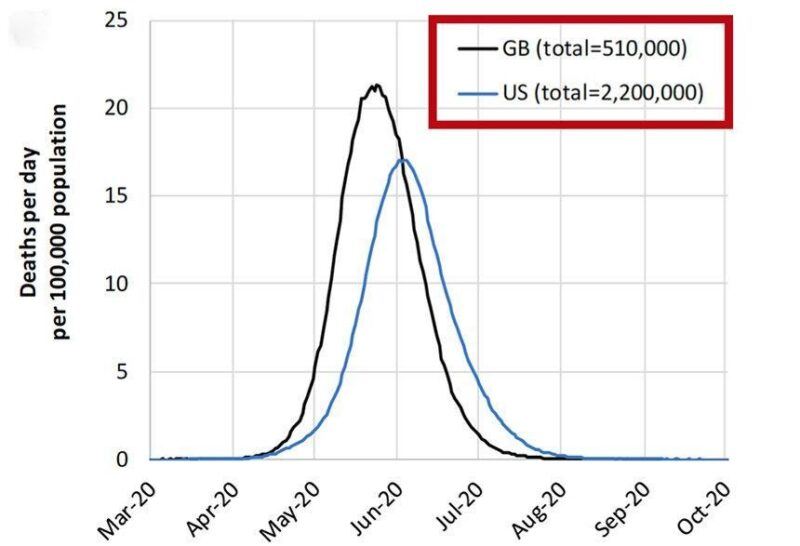
Ferguson’s model presented a range of scenarios under increasingly restrictive nonpharmaceutical interventions (NPIs). Under its “worst case” or “do nothing” model 2.2 million Americans would die, as would 510,000 people in Great Britain, with the peak daily death rate hitting somewhere around late May or June. At the same time, the ICL team promised salvation from the coronavirus if only governments would listen to and adopt its technocratic recommendations. Time was of the essence to act, so President Donald Trump and UK Prime Minister Boris Johnson both listened. And so began the first year of “two weeks to flatten the curve.”
It took a little over a month before we saw conclusive evidence that something was greatly amiss with the ICL model’s underlying assumptions. A team of researchers from Uppsala University in Sweden adapted Ferguson’s work to their country and ran the projections, getting similarly catastrophic results. Over 90,000 people would die by summer from Covid-19 if Sweden did not enter immediate lockdown. Sweden never locked down though. By May it was clear that the Uppsala adaptation of ICL’s model was off by an order of magnitude. A year later, Sweden has fared no worse than the average European lockdown country, and significantly better than the UK, which acted on Ferguson’s advice.
Pressed on this unexpected result, ICL tried to distance itself from the Swedish adaptation of its model in May. The records from the March 21st supercomputer run of the Uppsala team’s projections belie that assertion, linking directly to Ferguson’s March 16th report as the framework for its modeling design. But no matter – the ICL team’s own publications would soon succumb to a real-time testing against actual data.
A second ICL report, attempting to model the reopening of the United States from lockdowns, wildly exaggerated the death tolls that were expected to follow. By July, this model too had failed to even minimally correspond to observed reality. ICL attempted to save face by publishing an absurd exercise in circular reasoning in the journal Nature where they invoked the unrealized projections of their own model to supposedly “prove” multiple millions of lives had been saved by the lockdowns. That study soon failed basic robustness checks when the ICL team’s suite of models were applied to different geographies.
Another team of Swedish researchers then noticed oddities in the ICL team’s coding, suggesting they had modified a key line to bring data from their own comparative analysis of Sweden into sync with other European countries under lockdown after the models did not align. A published derivative of this discovery showed that ICL’s own attempts to validate the effectiveness of its lockdown strategies does not withstand empirical scrutiny.
Finally, in November, another team of researchers from the United States compared a related ICL team model for a broader swath of countries against five other international models of the pandemic, examining the performance of each against observed deaths. Their results contain a stunning indictment: “The Imperial model had larger errors, about 5-fold higher than other models by six weeks. This appears to be largely driven by the aforementioned tendency to overestimate mortality.”
The verdict is in. Imperial College’s Covid-19 modeling has an abysmal track record – a characteristic it unfortunately shares with Ferguson’s prior attempts to model mad cow disease, swine flu, avian flu, and countless other pathogens.
After a year of model-driven lockdowns, we may also look back to the original March 16, 2020 report to see yet another failure of its predictive ability. Recall that this is the model that fueled the alarmist rush to shut everything down last March, all to avert a 2.2 million death toll that would presumably peak around June.
(Source: Imperial College Report #9, March 16, 2020)
As noted above, the 2.2 million figure for the US (and corresponding 510,000 figure in Britain) were “worst case” scenarios in which the pandemic ran its course. According to the underlying theory of the ICL model, these catastrophic totals could be reduced by the adoption of NPIs – the escalating suite of social distancing measures, business and school closures, and ultimately full lockdowns that we observed in practice over the last year.
Aside from its 2.2 million worst case scenario, ICL offered no specific projections for how its proposed mitigation measures would work in the United States. Ferguson did however tell the New York Times on March 20, 2020 that a “best case” American scenario would still yield “about 1.1 million deaths,” giving us a glimpse of what he believed to be possible under NPI mitigation. The March 16th report similarly “predict[ed] there would still be in the order of…1.1-1.2 million in the US” under the most optimistic mitigation strategy, barring a large increase in hospital ICU bed capacity.
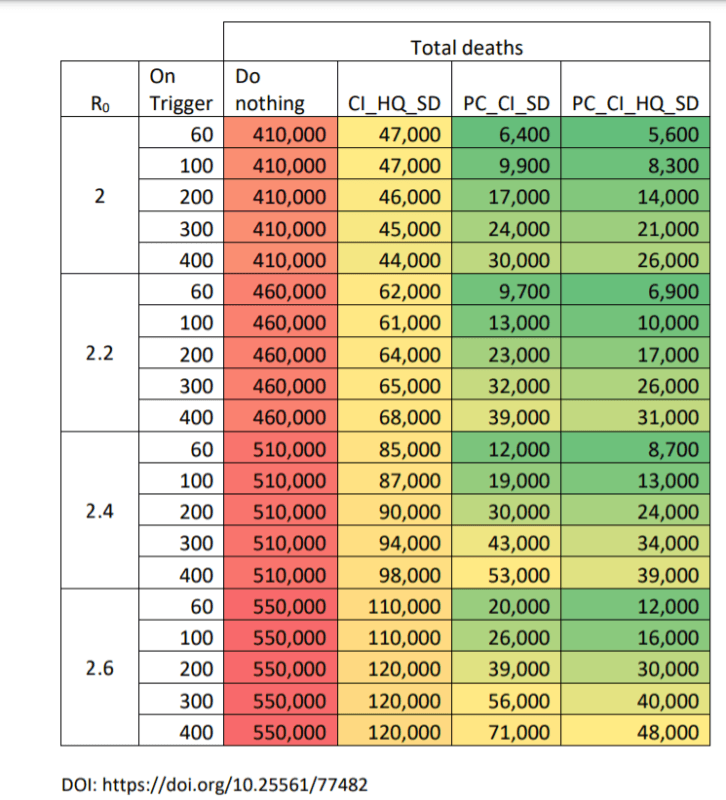
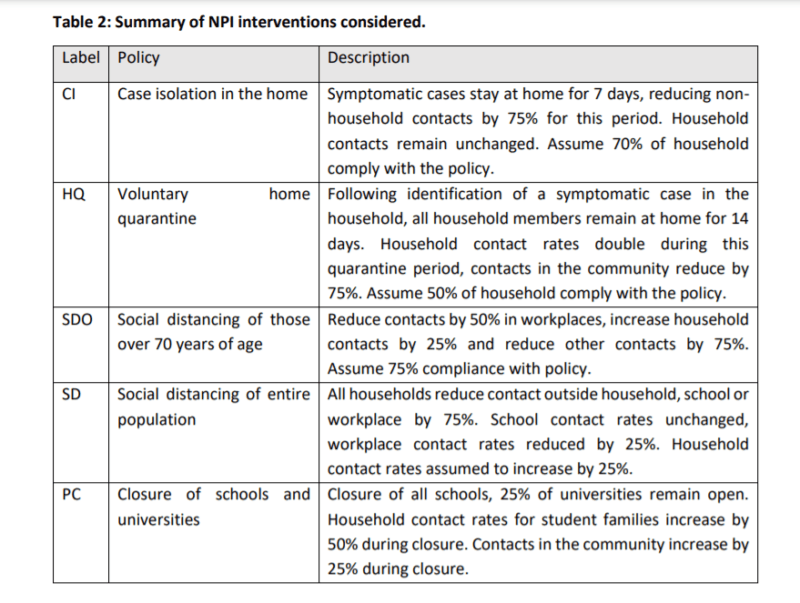
By contrast, ICL did publish an extensive table showing the results of its model run for Britain over a group of four increasingly stringent NPI scenarios. These range from the “worst case” projection with half a million deaths (the figures vary depending on assumptions about the virus’s reproduction rate) to a more stringent model where four NPIs (public school closures, case isolation, home quarantine, and social distancing) are simultaneously enacted. The results are depicted below.
(Source: Imperial College Report #9, March 16, 2020)
Note that the UK enacted policies based on all four measures recommended by the March 16th report, as well as an even more stringently enforced general lockdown on three separate occasions. After one year of following and expanding upon the Imperial College strategy, an unusual result appears in the data: not only have the UK’s numbers come up far short of Ferguson’s most alarmist scenario (depicted in the first column), but the UK has actually done much worse than the other NPI mitigation models in the ICL report.
As of the 1-year anniversary, the UK had a little over 125,000 confirmed Covid-19 deaths. By implication, the UK death toll has exceeded the mildest of the other three NPI scenarios from the ICL model (column 2) and blown past its heavier NPI recommendations (columns 3 and 4), even while operating under a more stringent set of lockdowns than ICL originally contemplated.
The implications are clear. While Ferguson wildly exaggerated the “worst case” scenario for the UK, he also severely overestimated the effectiveness of NPIs at controlling the pandemic.
By building its policy response around the Imperial College model, the UK government delivered the worst of both worlds. It imposed some of the most severe and long-lasting lockdowns in the world based on the premise that NPIs would work as Ferguson’s team predicted, and that such actions were needed to avert a catastrophe. Except the lockdowns did not work as intended, and the UK also ended up with an abnormally high death count compared to other countries – including locales that did not lock down, or that reopened earlier and for longer periods than the UK.
Why were the Ferguson/ICL predictions so far off base on both ends? The answer likely derives from two central flaws in their model design.
First, Ferguson adapted the model directly from a 2006 influenza pandemic model that he published in the journal Nature. As with the March 16th Covid report, this study aimed to predict the spread of a virus across the general population, subject to a suite of increasingly stringent NPI countermeasures. As the second-to-last paragraph of the study reveals though, it only modeled general population spread. In doing so, the authors acknowledged that “Lack of data prevent us from reliably modelling transmission in the important contexts of residential institutions (for example, care homes, prisons) and health care settings.”
With Covid-19 however, nursing homes have emerged as one of the greatest vulnerabilities in the pandemic. In many locales, nursing home deaths alone account for almost half of all Covid-19 fatalities despite housing only a tiny fraction of the population. While the latest nursing home figures for the UK are as of yet hard to come by, reports from last year suggest they are not only a large share of the country’s Covid-19 deaths but also severely undercounted in official records. Using a preliminary count from last year, the UK had one of the worst nursing home shielding ratios in Europe – a measure that compares a country’s death toll in its care facilities to the general population. The ICL projections likely missed this problem entirely due to a defect in the 2006 model it was built upon.
Second, Ferguson’s model severely overstated the effectiveness of NPIs at mitigating general population spread. Part of the appeal of the ICL report from last March came from its succinct portrayal of the available policy options and their claimed effects. The modelers presented political leaders with a menu of escalating measures to adopt with mathematical precision, each linked to an associated projection of its effectiveness at staving off the pandemic. All the politicians had to do was select from the menu and implement the prescribed course.
Except it wasn’t that simple in practice. ICL’s recommended NPI measures baked assumptions about their own effectiveness into the model. In reality, most of these assumptions had never been tested or even minimally quantified. As a key chart from the March 16th report illustrates, the supposed effect of each NPI was little more than a guesstimate – a set of nice, round numbers that purported to show the change in social interactions after its adoption.
A 2019 report by the World Health Organization (WHO) warned of the flimsy empirical basis for epidemiology models such as the one developed by ICL. “Simulation models provide a weak level of evidence,” the report noted, and lacked randomized controlled trials to test their assumptions. The same report designated mass quarantine measures – what we now know of as lockdowns – as “Not Recommended” due to lack of evidence for their effectiveness. Summarizing this literature, which included the same 2006 influenza model that Ferguson adapted to Covid-19, the WHO concluded: “Most of the currently available evidence on the effectiveness of quarantine on influenza control was drawn from simulation studies, which have a low strength of evidence.”
The UK’s experience under the ICL model therefore demonstrates not only Ferguson’s propensity toward wildly alarmist disease forecasting – it also illustrates the abject failure of lockdowns and related NPI measures to mitigate the pandemic. As a revealing point of comparison, the UK’s population-adjusted daily death toll under lockdowns has been consistently higher than no-lockdown Sweden for most of the pandemic, despite both countries following a nearly identical pattern of timing in both the first and second waves.
The repeated failures of the Ferguson/ICL model point to a scientific error at the heart of the theory behind lockdowns and similar NPIs. They assume, without evidence, that their prescriptive approach is correct, and that it may be implemented by sheer will as one might achieve by clicking a check-box in a Sim City-style video game. After a year of real-time testing, it is now abundantly clear that this video game approach to pandemic management ranks among the most catastrophic public health policy failures in the last century.
Phil Magness is a Senior Research Fellow at the American Institute for Economic Research. He is the author of numerous works on economic history, taxation, economic inequality, the history of slavery, and education policy in the United States.
The National Institute of Justice, the RAND Corporation and the Police Executive Research Forum want to give law enforcement real-time access to autonomous vehicles.
Last month, this so-called expert panel identified 17 high-priority law enforcement needs for autonomous vehicles. And as you can imagine some of them are very disturbing.
Cybersecurity and Vehicle Communication Needs:
Research on systems to enable law enforcement to identify a vehicle’s authorization to run in automated mode.
Research on technology that enables law enforcement to communicate with vehicles in automated mode.
Allowing law enforcement access to a vehicle’s authorization is just a fancy way of saying they want backdoor access to an owners personal information.
If you thought license plate readers were invasive before, just wait until a year or two from now, when they send officers all kinds of personal information related to the vehicle’s owner[s].
Stakeholder Communication Needs:
Surveys to identify the most useful data the autonomous vehicle industry can make available to law enforcement for investigations of crashes and other incidents.
Police working with auto manufacturers to help them identify which embedded telematic surveillance devices they should have access to is not about public safety: it’s about money.
As writer Eduardo Alvarez de Toledo Pinart explains, the real reason police want to be able to pull driverless vehicles over is so they can cite the owner[s] for any number of infractions.
“Operators could face fines to the extent the car is not being operated in fully autonomous mode. For instance, the operator of a SAI L4/L5 car could be to blame if the systems had been inappropriately overridden (speeding due to fabricated medical emergency).”
Back to law enforcement’s 17 high-priority needs.
Standardization Needs:
Model training and guidelines for interacting with autonomous vehicles running in automated mode.
Development of descriptions of standard behaviors (such as pulling off the road in a safe spot) that law enforcement will expect autonomous vehicles to perform across the United States.
Police pull over driverless Tesla Model 3 that was using Smart Summon feature
To reinforce the need to ticket autonomous vehicle owners, these so-called experts want to collaborate with vehicle manufacturers to establish backdoor access to the vehicle’s data.
“The panelists stressed the need for proactive problem solving with law enforcement, autonomous vehicle manufacturers and operators, and communities all working together. Law enforcement would benefit from having a better understanding of autonomous vehicle capabilities, and manufacturers would benefit from insights on the law enforcement implications of autonomous vehicles operating in communities, they said.”
Police view autonomous vehicles as “evidence sources”
Law enforcement’s desire to have backdoor access to autonomous vehicle’s data could not be any clearer.
“Participants also saw opportunities to use data generated by autonomous vehicles — for example, videos from an autonomous vehicle passing an active crime scene — to support public safety and crime investigations.”
As the “Panel Purpose and Process” section explains, law enforcement looks at autonomous vehicles as “evidence sources.”
“Tangential interactions (such as use of autonomous vehicles as evidence sources in investigations or exclusion of autonomous vehicles from zones where traffic is prohibited)”
As the expert panel so eloquently stated, police need to have the ability to securely communicate in real-time with these “evidence sources.”
To law enforcement, autonomous vehicles means lost revenues and that is why they want access to a cars’ windows, cameras and microphones.
“Waymo’s cars are designed to pullover if they detect a police or emergency vehicle flashing from up to 100 feet away. After stopping, the car is unlocked and the windows roll down automatically, allowing Waymo’s support team to interact with law enforcement representatives via an intercom system.”
Giving law enforcement the ability to roll down a motorist’s windows, unlock their car doors and speak to the occupants via an intercom system gives privacy-minded people like myself nightmares.
A detailed report published by the Guardian newspaper has shown how Britain is massively contributing to Saudi Arabia’s devastating war on Yemen as it suggests that London is not only supplying the bombs that fall on Yemenis, but it provides the personnel and expertise that keep the war going.
The comprehensive report by Arron Merat published on Tuesday showed that Britain was doing much of the killing in Yemen as the country continues to provide Saudi Arabia with everything it needs to turn its southern impoverished neighbor into a graveyard.
“Every day Yemen is hit by British bombs – dropped by British planes that are flown by British-trained pilots and maintained and prepared inside Saudi Arabia by thousands of British contractors,” said Merat in the report. … continue
This site is provided as a research and reference tool. Although we make every reasonable effort to ensure that the information and data provided at this site are useful, accurate, and current, we cannot guarantee that the information and data provided here will be error-free. By using this site, you assume all responsibility for and risk arising from your use of and reliance upon the contents of this site.
This site and the information available through it do not, and are not intended to constitute legal advice. Should you require legal advice, you should consult your own attorney.
Nothing within this site or linked to by this site constitutes investment advice or medical advice.
Materials accessible from or added to this site by third parties, such as comments posted, are strictly the responsibility of the third party who added such materials or made them accessible and we neither endorse nor undertake to control, monitor, edit or assume responsibility for any such third-party material.
The posting of stories, commentaries, reports, documents and links (embedded or otherwise) on this site does not in any way, shape or form, implied or otherwise, necessarily express or suggest endorsement or support of any of such posted material or parts therein.
The word “alleged” is deemed to occur before the word “fraud.” Since the rule of law still applies. To peasants, at least.
Fair Use
This site contains copyrighted material the use of which has not always been specifically authorized by the copyright owner. We are making such material available in our efforts to advance understanding of environmental, political, human rights, economic, democracy, scientific, and social justice issues, etc. We believe this constitutes a ‘fair use’ of any such copyrighted material as provided for in section 107 of the US Copyright Law. In accordance with Title 17 U.S.C. Section 107, the material on this site is distributed without profit to those who have expressed a prior interest in receiving the included information for research and educational purposes. For more info go to: http://www.law.cornell.edu/uscode/17/107.shtml. If you wish to use copyrighted material from this site for purposes of your own that go beyond ‘fair use’, you must obtain permission from the copyright owner.
DMCA Contact
This is information for anyone that wishes to challenge our “fair use” of copyrighted material.
If you are a legal copyright holder or a designated agent for such and you believe that content residing on or accessible through our website infringes a copyright and falls outside the boundaries of “Fair Use”, please send a notice of infringement by contacting atheonews@gmail.com.
We will respond and take necessary action immediately.
If notice is given of an alleged copyright violation we will act expeditiously to remove or disable access to the material(s) in question.
All 3rd party material posted on this website is copyright the respective owners / authors. Aletho News makes no claim of copyright on such material.