After Russia, the U.S. is the second largest arms exporter to India. As a major Washington defense partner, New Delhi signed two $3.5 billion arms purchase agreements earlier this year. However, U.S. Deputy Secretary of State Clarke Cooper reiterated Washington’s supposed dismay over India’s military purchases from Russia. Issuing a warning, he said that significant purchases of Russian weapons, such as anti-aircraft systems or advanced fighter jets, “risk future opportunities that may be impeded by significant Russian defense articles.”
Although he said that Washington recognizes “the historic legacy sustainment line that New Delhi had with Moscow and that, to use a metaphor, it’s not a light switch to turn on or off,” and that they do not want “to put at risk India’s sovereignty or India’s national defense as there’s a maturation toward future modernization of their systems,” he said “there is a risk when significant Russian systems are brought forth that put at risk interoperability with not only the United States, but with other partners that India may be seeking to work with that are either of NATO status or NATO-aligned. And then there’s also the risk of potential exploitation of technology when we’re looking at significant Russian platforms.”
Despite U.S. threats, India last month approved the purchase of 21 MiG-29 and 12 Su-30MKI fighters for a total value of more than $2.5 billion from Russia, with Indian Defense Minister Rajnath Singh urging for the delivery of the S-400 anti-aircraft defense systems as soon as possible.
However, it is unlikely that Washington will choose to sanction India for purchasing Russian weapons. Former financial adviser to the Indian Ministry of Defense, Amit Cowshish highlights that imposing sanctions on New Delhi will only hurt Washington’s own interests since the South Asian country is one of the largest markets in the world. Cowshish stressed that if the Trump administration moves ahead with sanctions, India will say it cannot buy U.S. equipment, which will hurt its own military industry as it loses a major market.
According to a Stimson Center working paper by Sameer Lalwani, India’s defense equipment is overwhelmingly Russian – 90% of the Army, 41% of the Navy and two-thirds of the Air Force.
“India’s share of Russian systems has grown, not decreased, because of Indian Army acquisitions. While India’s naval and air forces are decreasing their quantitative reliance on Russian arms, their most advanced or offensive capabilities still originate from Russia,” Lalwani wrote. “While the United States treats Russia as an equally revisionist threat to the global order as China, India sees Russia as a partner to ensure a multipolar balance of power, and a hedge against a potential Sino-Russian bloc.”
As India is the key player in the Indo-Pacific Strategy (IPS), it is unlikely Washington is willing to antagonize New Delhi so quickly. The administration of U.S. President Donald Trump unveiled the IPS report in June 2019. It demanded that India, Japan, South Korea, Australia, the Philippines and Thailand serve Washington’s interests in Asia-Pacific because “these alliances are indispensable to peace and security in the region and our investments in them will continue to pay dividends for the United States and the world, far into the future.” Effectively, the IPS is the U.S.’ strategy to attempt to maintain its unilateral hegemony in Asia-Pacific, and India has a key role in this vision.
The IPS is directly aimed against China, and not Russia, and it is for this reason that although New Delhi may be willing to oppose Beijing within limits, it is highly unlikely that India will want to sever its long relationship with Moscow on Washington’s demand. It is likely that the comments by Cooper, despite being a high official, do not reflect on Washington’s real demands and expectations of New Delhi. Although Washington would want India to stop its relations with Moscow, the Americans know this is not possible and recognize that for now Russia has very limited influence in the Indo-Pacific region. It is for this reason that New Delhi’s relations with Moscow can for now be tolerated by Washington so long as they remain in opposition to China. It is also for this reason that it is unlikely Washington will sanction India over its procurement of Russian-made weapons.
Paul Antonopoulos is an independent geopolitical analyst.
Maj. Gen. Andrew Croft, the commander of 12th Air Force, wrote on 22 August: “I have seen an increasingly contested strategic space where Beijing and Moscow are aggressively investing time and resources in Latin America to support their authoritarian models of governance. The Air Force must reinforce the strength of our longstanding commitment to the Western Hemisphere. We lose ground when we are unable to commit to spending the time and resources to fly our aircraft south and train alongside our partners.”
Croft’s statement reflects the growing American hysteria against the presence of any extra-regional actors in the Latin American continent. For US policy-makers, Latin America is not an aggregation of sovereign nations but a large lump of subordinated states constituting “America’s backyard”. Consequently, this conceptualization of Latin America as a natural extension of the American empire has led to viewing the engagement of any South American country with China, Russia and Iran as a “threat” to peace and security.
On February 7, 2019, Admiral Craig S. Faller – the commander of the United States Southern Command – told the Congress that the Western Hemisphere is facing “a troubling array of challenges and threats”. These threats included alarmist assertions about the growing dominance of China, Russia and Iran and a general demonization of the socialist governments of Cuba, Venezuela and Nicaragua:
“China has accelerated expansion of its Belt and Road Initiative at a pace that may one day overshadow its expansion in Southeast Asia and Africa. Russia supports multiple information outlets spreading its false narrative of world events and U.S. intentions. Iran has deepened its anti-U.S. Spanish language media coverage and has exported its state support for terrorism into our hemisphere. Russia and China also support the autocratic regimes in Venezuela, Cuba, and Nicaragua, which are counter to democracy and U.S. interests. We are monitoring the latest events in Venezuela and look forward to welcoming that country back into the hemisphere’s community of democracies.”
In response to the perceived threats posed by the China-Russia-Iran nexus, the Secretary of Defense has decided to conduct an assessment of the sufficiency of resources available to the U.S. Southern Command, the U.S. Northern Command, the Department of State, and the U.S. Agency for International Development (USAID) to carry out their respective missions in the Western Hemisphere. This assessment is required to include “a list of investments, programs, or partnerships in the Western Hemisphere by China, Iran, Russia, or other adversarial groups or countries that threaten the national security of the United States.”
In addition to warlike preparations, USA has also pursued a policy of increased militarization wherein it has tried to ensure “technological superiority” with regard to “anti-US actors”. In March, 2020, USA decided to send additional ships, aircraft and forces to South America and Central America in order to combat the influence of Russia and China. According to Navy Adm. Craig Faller, commander of Southern Command, “This really was born out of a recognition of the threats in the region,”. Along with the mobilization of the Southern Command, USA has substantially enlarged its security aid to Latin America: From $527,706,000 in 2019, US security aid to Latin America has increased by 10% to $581,270,000.
Chinese Footprint
The present-day US militarization of Latin America is rhetorically driven by an imperialist discourse framing the continent as a possession of the American empire which China, Russia and Iran are trying to appropriate. To take an example, R. Evan Ellis, a Latin America Research Professor at the US Army War College, stated before the US-China Economic and Security Review Commission that China’s engagement with Latin America “threatens the position of the United States, our security and prosperity, and the democratic values, rights, institutions and laws on which we depend.” To substantiate his statements, Ellis enunciated various strategies through which China is undermining USA’s dominance:
“Trade with, loans to, investment in, and other forms of economic and other support to anti-US regimes, indirectly enabling their criminal activities and contributions to regional instability”.
“Through providing an alternative to commerce, loans and investment from the West, making governments of the region less inclined to support the US on political, commercial, or security issues, or to stand up for rule of law, democracy or human rights, particularly where it might offend the PRC;”
In both these points, one can observe the imperialistic high-handedness with which Ellis is declaiming his pro-US rhetoric. While Beijing’s efforts to engage with sovereign nations and construct an alternative to the global American empire are regarded as enabling “regional instability”, no questions are asked about USA’s expansionist quest to imperialize the entire world through militaristic tactics.
In order to vilify China and smear its non-aggressive foreign policy, hawkish security experts have framed the country’s diplomatic involvement with various Latin American nations as a type of authoritarian tactic. Using this line of reasoning, the National Endowment for Democracy (NED) writes: “Beijing has now officially established its own version of soft power… which emanates from its undemocratic system and rests on its ability to shape the viewpoints of others through co-optation and persuasion.” Not having any empirical evidence to prove its unconvincing statements, NED talks vaguely about the “hypnotic effects” exercised by “Chinese-style warm welcome”: “The Chinese-style warm welcome, the carefully selected tours that include visits to sites with symbolic historical and cultural significance, and ad hoc friendly discourse delivered by the Chinese hosts can have hypnotic effects on their foreign guests.” This is an indication of the extent to which America hysteria against China can reach.
In the same way as NED, the Brookings Institution has also tried to slander China’s diplomatic initiatives in Latin America to preserve the coercive dominance of USA in the continent. As per the think tank, “it would be fair to assume that China’s growing economic power and ambitions of global leadership, coupled with its inherently closed and repressive model of political control, will hurt the region’s prospects for strengthening its liberal democratic systems and respect for human rights.” While saying this, the Brooking Institution conveniently forgets that it the US, with its Western-styled liberal democracy, that has hurt the region most in the form of coups, violence and overt brutality against social movements. Most recently, a US-backed coup in Bolivia has resulted in two massacres and massive repression of social movements.
The Iranian Connection
Like China, Iran, too, experiences American hostility towards its engagement with Latin American countries. Lieutenant Andrew Kramer of the U.S. Navy terms Iranian support for the “economically backward governments” of Cuba, Nicaragua and Venezuela as efforts “to maintain pockets of instability and hostility close to U.S. borders.” Echoing this perspective, William Preston McLaughlin, a Colonel (Ret.) of U.S. Marine Corps and Magdalena Defort, an Intern Analyst at the Foundation of Defense of Democracies, argue that “Iran’s presence in Latin America is an imminent threat to peace and political stability in the Western Hemisphere because its forces interact with Latin America’s deeply rooted revolutionary ideology and various well-intentioned but flawed “liberation theology” social movements.” Here, both of the analysts are merely parroting the imperialist “Monroe Doctrine” that subverted the sovereignty of Latin American nations and tethered the people of the continent to the whims of the American empire. Through the Monroe Doctrine, USA relegated the entire Latin American continent to the status of the empire’s handmaiden and constantly used its military muscles to overpower any regional initiatives challenging the dynamics of subjugation. Now, when Iran is lending support to the anti-imperialist administrations of Venezuela, Nicaragua and Cuba, it has come under the radar of USA for ostensibly destroying peace and political stability in the Western Hemisphere. In August 2020, for instance, USA confiscated four Iranian fuel shipments that had been bound for Venezuela, making it clear that it would not tolerate anti-imperialist opposition in Latin America.
In addition to portraying Iran as a threat to global peace, both the analysts also used a shrill, scaremongering rhetoric to over-exaggerate the strength of the country. According to the analysts, “Iran has used every agency within its borders to help extend Iranian tentacles into the political, cultural, economic, and military life of Latin America.” This bears striking resemblance to the traditional war-mongering US narrative that frames Hezbollah as a menace to justify the militarizary raising funds, seeking recruits, probing for our weaknesses and challenging our defenses,”. Through these discourses, USA seeks to unleash a new war against the anti-imperialist axis of Latin America which is standing up to militaristic predatoriness of the global hegemon.
Russian Presence
Besides Iran and China, Russia is another nation perceived as a “threat” to US security. General John Kelly, commander of the U.S. Southern Command (SOUTHCOM) noted in his Congressional testimony, “it has been over three decades since we last saw this type of high-profile Russian presence” in Latin America. In his command’s 2015 Posture Statement, Kelly added:
“Periodically since 2008, Russia has pursued an increased presence in Latin America through propaganda, military arms and equipment sales, counterdrug agreements, and trade. Under President Putin, however, we have seen a clear return to Cold War tactics. As part of its global strategy, Russia is using power projection in an attempt to erode U.S. leadership and challenge U.S. influence in the Western Hemisphere.”
John Kelly’s representation of Russia as a military threat has been repeated by the Commander of US Southern Command, Admiral Kurt W. Tidd who said in his February 2018 Posture Statement to the US Senate Armed Services Committee that:
“Russia’s increased role in our hemisphere is particularly concerning, given its intelligence and cyber capabilities, intent to upend international stability and order, and discredit democratic institutions… Left unchecked, Russian access and placement could eventually transition from a regional spoiler to a critical threat to the U.S. homeland.”
With the help this narrative, USA has aggressively pushed forward the agenda of greater militarism in Latin America as it strives to maintain “technological superiority” in relation to Russia and expand its already large military expenditure.
On top of depicting Russia as a military threat, US analysts have additionally portrayed the country’s support of socialist governments in Latin America as a danger to the economically empty liberal democracies of the West. According to IBI Consultants, a National Security consulting company specializing in Latin America, Russia’s growing presence in Latin America “is now an integral part of an alliance of state and nonstate actors that have shown their hostility toward the United States in their ideology, criminalized behavior, and anti-democratic nature.” Reiterating this point, on July 9, 2019, Admiral Faller declared before the Congress that “Russia seeks to sow disunity and distrust, propping up autocratic regimes in Cuba, Bolivia, Venezuela, and Nicaragua, which are counter to democracy and U.S. interests.” For Faller, those nations which don’t doggedly toe America’s imperialist line automatically become “threats” to democracy and if Russia shows solidarity with these anti-imperialist nations, it, too, classifies as a threat to US interests.
As the USA continues to militarize Latin America, it is increasingly becoming clear that it wants to protect its old, imperial structures from being challenged by anyone. It has been explicitly acknowledged even by pro-US analysts such as Ellis that US military assistance in Latin America “potentially serves U.S. strategic interests by helping to inoculate receiving states against radical or anti-democratic [read “socialist”] solutions which find receptivity when populations lose faith in the ability of a democratic political system and a free market economy to effectively address the corruption, inequality, injustice, and other dysfunctionalities plaguing their country [Emphasis mine].” US military assistance, therefore, is not apolitical and is ideologically tarnished with the objectives of stabilizing free market economies-bourgeoisie democracies and subverting socialist countries.
The United States Intelligence Community’s assessment of threats to US national security had stated in 2019 that “anti-US autocrats [in the Western Hemisphere]will present continuing challenges to US interests, as US adversaries and strategic competitors seek greater influence in the region.” Here, “anti-US autocrats” refers to the socialist administrations of three Latin American countries: Cuba, Venezuela and Nicaragua. These three countries have been facing strong US belligerence for their anti-imperialist stance. US sanctions against Cuba have tightened during the pandemic; USA’s hybrid war against Venezuela has intensified as Trump has decided to use frozen funds to topple Nicolas Maduro and USAID (United States Agency for International Development) has strengthened its regime change operations against the Sandinista government of Daniel Ortega in Nicaragua. Due to the support lent by China, Russia and Iran to the socialist governments of Latin America, USA has decided to eradicate these extra-regional actors from its “own” backyard and re-proclaim a complete American dominance in the region. In times like these, the international community needs to oppose the militarism of USA against new regional alliances in Latin America.
Yanis Iqbal is a student and freelance writer based in Aligarh, India.
The alliance between Venezuela and Iran seems to be taking new directions. The ties between the two countries began to strengthen in an economic sphere when, in the first half of 2020, Tehran started sending oil ships to Venezuela, circumventing the international trade rules imposed by Washington with the aim of blocking Caracas economically. Earlier this year, Tehran sent several cargoes of gasoline to Venezuela to help the South American country overcome fuel shortages, as well as equipment to help state oil company PDVSA overcome production and export difficulties during the crisis.
The presence of Iranian ships on the Venezuelan coast has been a real affront to the United States, which has always played a role of naval hegemony in the Caribbean. Recently, the United States claimed to have seized four ships carrying Iranian gasoline en route to Venezuela, prompting Washington to tighten sanctions on both countries. But the US was unable to contain the Iranian advance and now the alliance between Caracas and Tehran has advanced into a military step.
Recently, Venezuelan President Nicolás Maduro thanked Iran for helping the South American country overcome US sanctions on its oil industry. At the time, he said that Iran is helping to maintain all Venezuelan national governance but did not elaborate on how this cooperation was taking place. He said it was important to maintain secrecy on the topic because of the economic boycott imposed by the US – which he called a “brutal war”. However, Colombian President Iván Duque said last week that Maduro was interested in buying missiles from Iran, which Venezuelan officials denied, but later Maduro responded that Duke’s statement was a “good idea” and that he had not yet considered it .
Shortly thereafter, Maduro confirmed his interest in buying Iranian weapons. According to the Venezuelan president, Iran, possessing advanced military technology, can be a great partner of the South American country in case of possible attacks by the US. According to Maduro, buying Iranian missiles was not in his plans until the moment that Iván Duque gave him this idea by accusing him in a condemning tone of being acquiring such equipment.
“With Iran having tremendous military technology, buying short, medium and long-range rockets and missiles from Iran to defend against imperialist threats seemed like a good idea, [so] I gave the order to Defense Minister Vladimir Padrino to evaluate all potentialities and possibilities, and if it is possible and convenient, we will buy these missiles at the right time”, said Maduro in an interview with the state television channel” Venezolana de Televisión”. According to the Venezuelan president, the Duke’s pronouncement was intended to attack Venezuela to take international attention away from Colombia’s national problems, such as the massacres and murders perpetrated by drug trafficking militias and the great social crisis generated by the new coronavirus, however, it ended up arousing the Venezuelan government’s interest in buying such Iranian missiles.
Now, it seems that the possibility of buying Iranian missiles is being evaluated by Vladimir Padrino, leader of the Venezuelan Defense, and there is a great likelihood for the negotiations to be concluded, considering that there is a willingness on both sides for international cooperation since they have a common enemy. Looking at the case from a realistic point of view, it is very unlikely that negotiations between Iran and Venezuela started due to Iván Duque’s pronouncement. Both countries were probably already discreetly maintaining this dialogue and the accusatory and condemnatory pronouncement served only as an opportunity to make the news public. In fact, it seems that Duque’s words were a flawed blow: Venezuela was expected to deny the accusations and thus create a scenario of tensions and uncertainties, but, contrary to what was predicted by the Colombia-US coalition, Venezuela has made public its intention to acquire the missiles and now the alliance is almost official.
If the missiles are bought by Caracas, this will be a major blow to the American presence in South America and, at the same time, a major milestone for Iranian international projections. The most important thing to note is that this agreement has a much deeper dimension than mere military trade: everything indicates that it will only be the first step in a major military alliance. Venezuela will have its defense system strengthened and will guarantee greater security against possible attacks by both Americans and Colombians. Likewise, in a possible war against Washington, Iran will have the definitive support of Venezuela – a strategically well located ally, with its coastline pointing to the Caribbean Sea, an important area of American influence.
Lucas Leiroz is a research fellow in international law at the Federal University of Rio de Janeiro.
US citizens may “unwittingly” become Russian agents and spread “disinformation” about Joe Biden, Senator Mark Warner has warned, urging the intelligence community to be more vocal and tell the public what to do.
According to the top Democrat on the Senate Intelligence Committee, one should be particularly vigilant about the Russian trolls, lurking around the social media feeds, as Kremlin is allegedly once again seeking to prop up President Donald Trump and help him secure re-election in November.
Speaking to NBC News’ “Meet the Press” on Sunday, the Senator warned that if one is not careful enough, he can accidentally become a Russian “agent” partaking in the alleged smear campaign against Biden.
“My fear is there may be Americans that are unwittingly promoting that Russian disinformation campaign, and I think they need to be briefed so they don’t become, frankly, agents in effect of this disinformation campaign.”
Moreover, the Senator said that the intelligence community should be more vocal and, basically, instruct the public on how to handle information.
“It’s incumbent on the intelligence community to lay out more of the facts of what we know about that disinformation campaign,” he said.
The Russiagate saga has been marred with controversies throughout the whole presidential term of Donald Trump, and after years of taxpayer-funded probes, failed to prove the thing it was originally designed to investigate – the Trump-Russia collusion. Severe lack of facts, however, did not interfere with the drive to frequently roll out new sanctions against Russia, as well as to produce more baseless accusations.
The latest batch of them arrived earlier in August, when the Senate Intelligence Committee released its fifth and final report on Russia’s supposed interference. In the 1000-page report, word “likely” appeared nearly 140 times, while “almost certainly” – 21 times. In nearly every case, those words were used to make assumptions in place of actual evidence. Senator Warner has urged Americans to read the lengthy report for themselves.
For forty years I carefully read the New York Times in hard copy each and every morning, eager to discover what had transpired since the previous day. But just in the last few months, my commitment has begun to flag, and my eyes often only lightly glance at half or more of the articles and their columnar headlines.
I’d never thought much of Donald Trump, but can’t seem to work up the enthusiasm to read yet another article headlining the “lies” of our Great Satan or his coterie of lesser Satans. The endless villainies of his Luciferian ally Vladimir Putin have grown dull to my mental tongue. The diabolical wickedness of China, whom Trump had supposedly so recently courted, elicits little interest. Closer to home, my eyes skip over another “social distancing” advice column about Covid-19, or further explanations of how “peaceful protesters” had recently set a government building on fire in Portland, Oregon, or destroyed Chicago’s wealthiest downtown shopping district.
The Business Section reports that the worst disease outbreak in a century, the worst unemployment since the Great Depression, and the worst national rioting in two generations has produced unprecedented gains in share prices on Wall Street, but the staff writers have apparently forgotten the word “bubble.” Many days the Arts Section seems to have become almost monochromatically black. So my daily regular morning ritual now takes much less time than it did in the past.
I can’t exactly plot the trajectory of this sharp drop in my recent interest. But I certainly noticed the change not longer after a Twitter-mob forced the Times to summarily purge for insufficient “wokeness” its highly-regarded Editorial Page Editor, widely considered a leading contender to run the paper, perhaps suggesting that the journalists changed their coverage and writing style to avoid a similar fate. I had always read my morning newspapers at a local coffee-shop, but the Coronavirus outbreak ended that possibility, thereby disrupting my routine. And my years of denouncing the dishonesty of “Our American Pravda” in my own articles may have finally begun to register in my own mind.
There are occasional exceptions to this pattern. Earlier this month the Times carefully tabulated our national mortality figures and determined that our “excess deaths” from early March to the end of July had already exceeded 200,000, indicating that the American body-count from our Covid-19 epidemic was considerably larger than generally assumed, and might even reach the half million mark by the end of the year. But examples of such solid reporting seem few and far between these days.
The obvious decline of the Times is especially apparent to me each morning when I compare it with the rival Wall Street Journal, which I read immediately afterward. After Rupert Murdoch acquired the Journal in 2007, most observers predicted a sad fate at the hands of the proprietor whose early Fleet Street media empire had been built upon on the frontal nudity of the Page Three Girls of his tabloid Sun. But Murdoch totally confounded those skeptics, providing his new flagship broadsheet with huge financial backing and a hands-off editorial policy, thereby elevating it from a business-focused publication to a near-peer rival to the Gray Lady at a time when so many other papers were about to begin shriveling from massive loss of advertising. Within a couple of years, even such inveterate Murdoch-haters as The Nationacknowledged this surprising reality.
Superb journalist resources unshackled by extreme “political correctness” allow an outstanding product, and this has certainly been demonstrated by the Journal‘s regular front-page investigative reports. A few days ago, our continuing Covid-19 disaster prompted yet another of these, which I think lacked only a few crucial elements to be worthy of a Pulitzer Prize.
Numerous publications have documented America’s severe mistakes in combating the disease, but this 4,500 word WSJ report focused upon the serious mishandling of the original outbreak by Chinese authorities.
The article revealed that top public health officials at China’s Center for Disease Control only became aware of the situation on December 30th, when they learned that at least 25 suspected cases of a mysterious illness had already occurred in Wuhan during that month. But as the writers noted, the outbreak had certainly begun somewhat earlier:
Even a fully empowered China CDC would likely have missed the very first cases of the coronavirus, which probably began spreading around Wuhan in October or November, most likely in people who never showed symptoms, or did but never saw a doctor, researchers say.
All of this new information seems quite consistent with what had previously been discovered by America’s leading media outlets. But the Journal writers seem to have missed one additional fact that could have elevated this important story from a mundane investigation to a sensational expose. Although they documented that the Chinese government only learned of the Wuhan outbreak at the end of December, they seemed unaware that more than a month earlier American intelligence officials had distributed a secret report to our military allies describing the “cataclysmic” disease outbreak then underway in Wuhan.
A few months ago, I had noted the clear implications of this bizarre discrepancy in timing:
For obvious reasons, the Trump Administration has become very eager to emphasize the early missteps and delays in the Chinese reaction to the viral outbreak in Wuhan, and has presumably encouraged our media outlets to direct their focus in that direction.
As an example of this, the Associated Press Investigative Unit recently published a rather detailed analysis of those early events purportedly based upon confidential Chinese documents. Provocatively entitled “China Didn’t Warn Public of Likely Pandemic for 6 Key Days”, the piece was widely distributed, running in abridged form in the NYT and elsewhere. According to this reconstruction, the Chinese government first became aware of the seriousness of this public health crisis on Jan. 14th, but delayed taking any major action until Jan. 20th, a period of time during which the number of infections greatly multiplied.
Last month, a team of five WSJ reporters produced a very detailed and thorough 4,400 word analysis of the same period, and the NYT has published a helpful timeline of those early events as well. Although there may be some differences of emphasis or minor disagreements, all these American media sources agree that Chinese officials first became aware of the serious viral outbreak in Wuhan in early to mid-January, with the first known death occurring on Jan. 11th, and finally implemented major new public health measures later that same month. No one has apparently disputed these basic facts.
But with the horrific consequences of our own later governmental inaction being obvious, elements within our intelligence agencies have sought to demonstrate that they were not the ones asleep at the switch. Earlier this month, an ABC News story cited four separate government sources to reveal that as far back as late November, a special medical intelligence unit within our Defense Intelligence Agency had produced a report warning that an out-of-control disease epidemic was occurring in the Wuhan area of China, and widely distributed that document throughout the top ranks of our government, warning that steps should be taken to protect US forces based in Asia. After the story aired, a Pentagon spokesman officially denied the existence of that November report, while various other top level government and intelligence officials refused to comment. But a few days later, Israeli television mentioned that in November American intelligence had indeed shared such a report on the Wuhan disease outbreak with its NATO and Israeli allies, thus seeming to independently confirm the complete accuracy of the original ABC News story and its several government sources.
It therefore appears that elements of the Defense Intelligence Agency were aware of the deadly viral outbreak in Wuhan more than a month before any officials in the Chinese government itself. Unless our intelligence agencies have pioneered the technology of precognition, I think this may have happened for the same reason that arsonists have the earliest knowledge of future fires.
An entirely new disease that spreads in silent, asymptomatic fashion can easily escape initial detection, and we should not be surprised that no one in China noticed the Wuhan outbreak when it first began in October or November. But America’s intelligence operatives were entirely aware of what was happening from the very beginning, and began informing all our allies. This seems about as close to a “smoking gun” as we can ever likely to encounter in the annals of the murky world of intelligence operations.
Moreover, I have also noted the very unusual international pattern the deadly disease immediately began to follow:
As the coronavirus gradually began to spread beyond China’s own borders, another development occurred that greatly multiplied my suspicions. Most of these early cases had occurred exactly where one might expect, among the East Asian countries bordering China. But by late February Iran had become the second epicenter of the global outbreak. Even more surprisingly, its political elites had been especially hard-hit, with a full 10% of the entire Iranian parliament soon infected and at least a dozen of its officials and politicians dying of the disease, including some who were quite senior. Indeed, Neocon activists on Twitter began gleefully noting that their hatred Iranian enemies were now dropping like flies.
Let us consider the implications of these facts. Across the entire world the only political elites that have yet suffered any significant human losses have been those of Iran, and they died at a very early stage, before significant outbreaks had even occurred almost anywhere else in the world outside China. Thus, we have America assassinating Iran’s top military commander on Jan. 2nd and then just a few weeks later large portions of the Iranian ruling elites became infected by a mysterious and deadly new virus, with many of them soon dying as a consequence. Could any rational individual possibly regard this as a mere coincidence?
So if the journalists at the WSJ had merely taken note of what had previously been reported by ABC News and confirmed by Israeli television, they would surely have earned themselves a Pulitzer Prize. But earning and receiving are two separate matters, and they might easily have instead been purged for treading upon such touchy national security matters. After all, our own webzine was banned by both Facebook and Google just days after we raised these same matters.
Such retaliation helps explain why our American mainstream media has long since concluded that discretion is the better part of valor.
Iraq’s parliament ordered US forces to withdraw from the country in January, following the drone strike assassination of a senior Iranian commander in Baghdad. On Thursday, in a meeting with Iraqi Prime Minister Mustafa al-Kadhimi, US President Donald Trump promised that US forces would be leaving the country “shortly.”
US forces in Iraq have formally handed the Coalition-occupied area of Camp Taji, central Iraq back to Iraqi security forces, with the handover ceremony signed Sunday, the Coalition has said in a statement.
Describing the withdrawal from the facility as a move which allows the anti-Daesh Coalition to “shift its focus and role,” the Coalition said that “the movement of… military personnel is part of a long-range plan coordinated with the Government of Iraq.”
“This is truly a historic day,” Combined Joint Task Force-Operation Inherent Resolve deputy commander Maj. Gen. Kenneth Ekman said of the move. “For the past six years, Camp Taji has served as a primary installation for Coalition partners to train the Iraqi Army, Iraqi Air Force, and the Qwat al-Khasah. The Coalition’s efforts have enabled the Iraqis to train themselves. From this day forward, [the Iraqi Security Forces] will take full responsibilities for the facilities and programs at Taji and continue to use the site to lead and conduct training as part of the mission to defeat Daesh remnants.”
The withdrawal includes the exit of 300 US troops and contractors, and the handover of $347 million in structures and equipment to the Iraqi side, including over 90 million rounds of ammunition.
Sunday’s ceremony follows a string of rocket attacks against the Taji base in recent months, with projectiles repeatedly fired into the facility by Baghdad government-allied Shia militia forces in the wake of the January 3, 2020 assassination of Iranian Quds Force Commander Qasem Soleimani at Baghdad’s international airport.
This week, several militias within Iraq’s Popular Mobilization Units (PMU) threatened to attack US positions throughout Iraq should Baghdad fail to negotiate a withdrawal of the foreign forces. “If an agreement on the expulsion of US forces from Iraq is not concluded in Washington, we reserve the right to target America’s interests in Iraq,” the militias warned.
Roughly 47,000 Iraqi Security Forces personnel have been trained at the Taji base, with the facility situated about 30 km outside Baghdad. At one point, the base contained as many as 2,000 Coalition troops. The Camp Taji facility is the eighth Coalition base to be handed back to the Iraqi side in recent months.
On Thursday, in a meeting with the Iraqi Prime Minister, President Trump reiterated to reporters that the US would be leaving Iraq “shortly.”
“We have been taking our troops out of Iraq fairly rapidly, and we look forward to the day when we don’t have to be there,” Trump said, without giving an exact timetable on withdrawal.
An estimated 5,200 US troops remain in Iraq. The US invaded Iraq 2003 and briefly left in 2011 before returning in 2014 to help Baghdad fight Daesh. Tensions between Coalition forces and the PMU escalated dramatically after the assassination of Soleimani, who was responsible for coordinating Iranian assistance to the militias for their fight against the terrorists. Soon after the Iranian commander’s death, the Iraqi parliament ordered US forces to withdraw from the country.
In Colombia, a terrible wave of violence affects the people and especially traditional indigenous communities. According to United Nations data, more than 40 murders of social leaders have occurred this year alone.
Last Tuesday, August 18, three Indians of the Awá people were murdered in the municipality of Ricaurte, department of Nariño, while two young men were tortured and murdered in El Patía, department of Cauca, and a social leader, Jaime Monge, was also murdered in Villacarmelo, a rural area of Cali. These deaths made newspapers’ headlines a few days after others that shocked the country. On Saturday, 15, eight young men were shot in the municipality of Samaniego; on the 11th, five teenagers were murdered in Llano Verde and an Afro-Colombian social leader was murdered in Chocó; and on the 8th, in the municipality of Leiva, Nariño, two students who were attending school were murdered.
Contrary to what was common in other times, there is no public claim of responsibility for the murders. The main reason for this is that currently there is no longer a monopoly on the attacks by the major illegal factions, but the simultaneous action of a wide variety of militias involved in drug trafficking networks. However, the Colombian State denies the existence of widespread paramilitarism in the country. Whenever a massacre occurs in the country, the official versions generally point to drug trafficking as the culprit, without further investigation, which is why the attacks remain unpunished.
Despite the denials of the authorities, the existence of multiple groups is evident and the phenomenon of paramilitarism can no longer be associated strictly with groups such as the FARC (Revolutionary Armed Forces of Colombia) and the ELN (National Liberation Army), being, currently, an extremely multifaceted and widespread phenomenon. For example, in three recent massacres in the Santander region, a paramilitary group known as “Los Rastrojos” was denounced as the perpetrator. According to local sources, this group has between 150 and 200 members and is advancing across the country.
This same armed group – “Los Rastrojos” – has an interesting history of links with drug trafficking in the neighboring country, Venezuela. The group was expelled from Venezuela due to the constant and incisive actions of Venezuelan security forces, which forced the migration of militia members to Colombia, where they are now spreading with great speed. However, “los Rastrojos” act not only in drug trafficking, but also in politics, apparently. It was this group that, in February 2019, accompanied Juan Guaidó’s flight to Colombia. Guaidó, moreover, has several records in photos and videos with members of the militia, which raises suspicions of links between the Venezuelan opposition and Colombian drug trafficking.
In fact, the peace agreement signed between the Colombian government and the FARC in 2016 did not end civil conflicts, but it did generate a reconfiguration of the actors in the fighting. Now legalized, the FARC is no longer the main belligerent group and new, lesser-known militias are taking on a greater role in drug trafficking. In practice, the power of these militias far outweighs the ability of state security forces to control and combat them, which spurs the creation of secret networks of cooperation between the state and organized crime to keep illegal activities “restricted” and avoid the liquidation of the social order. In this way, rises what we can call a narco-state – a phenomenon in which people and criminal organizations involved in drug trafficking start to occupy positions of relevance in the government and to influence state policies.
The existence of a Colombian Narco-State is almost undeniable and explains the inertia of state forces to investigate crimes committed by criminal organizations. Massacres occur freely across the country as social movements and communities of traditional peoples become an obstacle to the advancement of trafficking. The State remains silent and even collaborates with the actions of the militias and thus the interests of crime are realized without any impediment.
The situation in Colombia, however, is old and the country has been referred to as a Narco-State on several other occasions. What is really surprising is not the Colombian government’s attitude towards organized crime, but the inertia of international organizations and foreign powers in the case. Still, the role of the US in South America is curious. A few months ago, US President Donald Trump accused Venezuelan President Nicolás Maduro of being involved in drug trafficking and offered a millionaire reward for his “capture”. However, the main center of US operations against Venezuela is precisely Colombia, from where, on more than one occasion, mercenaries left and crossed the border into Venezuela trying to overthrow Maduro. In addition, Washington-backed Venezuelan opposition leader Guaidó has already demonstrated links to at least one criminal organization active in Colombia and involved in the murders of social leaders.
Why do Washington, the United Nations and all the Western powers that condemn Maduro remain silent in the face of these cases? Why is Colombia not being punished with international sanctions for its inertia in preventing the massacre of its own people? Perhaps drug trafficking is not really an enemy for Washington.
Lucas Leiroz is a research fellow in international law at the Federal University of Rio de Janeiro.
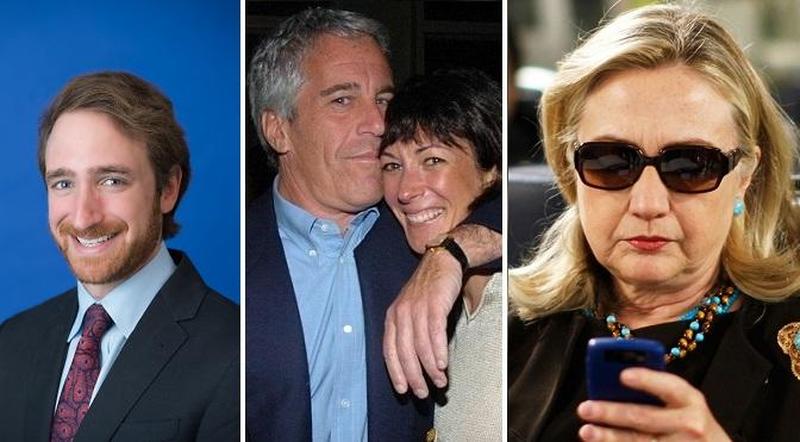
Hillary Clinton “gifted” a prestigious job in the Obama State Department to the nephew of accused pedophile and sex trafficker Ghislaine Maxwell, according to OK!Magazine – and whose employment was confirmed by the Daily Beast.
Alexander Djerassi, the son of Maxwell’s sister Isabel, went from working on Hillary Clinton’s 2008 Presidential campaign, to a “very powerful and prestigious position” within the state department, working under Clinton in charge of the Bureau of Near Eastern Affairs. He returned to Clinton’s 2016 campaign, according to the Beast.
“Secretary Clinton gave Alex a job in one of the most sensitive areas of Obama’s executive apparatus,” an anonymous source told OK!. “The fact Alex Djerassi, fresh out of college, was put in charge of the State Department’s Bureau of Near Eastern Affairs, covering the Middle East, was an interesting move.”
“He worked directly on the Arab Spring, and Hillary sent Alex as the US representative to the expatriate rebel groups Friends of Libya and Friends of the Syrian People,” the source continued, adding that Djerassi was given “special treatment.”
A State Department spokesperson confirmed Djerassi’s employment with The Daily Beast, though could not comment on whether the job was in fact “gifted” by Clinton.
A year before Mr. Djerassi’s appointment, his aunt’s ex-boyfriend, Epstein, pleaded guilty to a state charge (one of two) of procuring for prostitution a girl below age 18 and was sentenced to 18 months in prison.
Epstein served almost 13 months before being released for a year of probation on house arrest until August 2010.
According to Djerassi’s LinkedIn profile, “He worked on matters relating to democratization and civil society in the Arab world, the Arab uprisings, and Israeli-Palestinian peace. Djerassi has served as a U.S. representative to the Friends of Libya conferences, Friends of the Syrian People conferences, U.S.-GCC Strategic Coordination Forum, and several UN General Assemblies.”
According to the Beast, Derjassi’s name appears in a ‘collection of Clinton’s emails’ published by WikiLeaks – with Assistant Secretary of State Jeffrey Feltman referring to his “special assistant, Alex Djerassi” in November of 2011 and January 2012.
Meanwhile, the Beast also notes his employment on Clinton’s campaign.
From September 2007 to June 2008, Djerassi was a policy associate for Hillary Clinton’s presidential campaign. He listed his job duties as such: “Researched and drafted memos, briefings, and policy papers for candidate, senior staff, and news media on wide range of domestic and foreign policy issues. Prepared for more than 20 debates.” (In late 2007, Epstein was under investigation for trafficking girls in Palm Beach and working on a secret plea deal with federal prosecutors. Maxwell is believed to be one accomplice who was protected under the controversial agreement.)
The Yale and Princeton alum—the son of Maxwell’s sister Isabel—apparently returned for Clinton’s 2016 presidential run. –Daily Beast
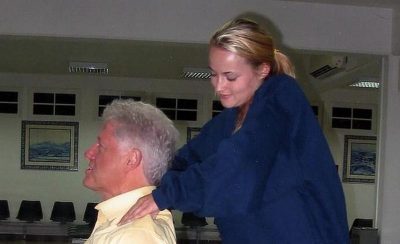
Bill Clinton notably flew 26 timeson the infamous “Lolita Express” belonging to Maxwell associate and convicted pedophile Jeffrey Epstein. The former US President was notably fingered as having been seen on Epstein’s “pedo island” according to court documents released three weeks ago.
More recently, photos of Clinton receiving a neck rub from one of Epstein’s accusers (who said he was a perfect gentleman) surfaced in the Daily Mail.
The end of the Cold war brought peace to Europe and armies began to demobilize. The American empire exploited this trust and ignored promises made to the Russians to expand NATO and absorb former Warsaw Pact nations and even former Soviet Republics. Efforts then focused on conquering the large former Soviet Republic of Ukraine. The Russians had found Ukraine unproductive, corrupt, and troublesome so granted it independence in 1991. The American empire plotted to absorb Ukraine into NATO and sent military units to Ukraine to bolster the Ukrainian army with plans for building American military bases. An American instigated coup in Ukraine led to bloody fighting and major economic disruptions.
“The Independent Ukraine’s Painful Journey Through the Five Stages of Grief”; explains Ukraine’s current status; The Saker; Unz.com; https://www.unz.com/tsaker/the-indepe…
The US Army’s huge effort to secure Ukraine can be seen in the 349 articles posted at its website just over the past five years: https://search.usa.gov/search/news?af…
The United States provided Ukraine with $1.5 billion in military aid since 2014, to include $250 million in 2019. The purpose of these weapons is to kill Russians. https://www.defense.gov/Newsroom/Rele…
The intriguing twists and turns following the catastrophic explosion at Beirut’s Sea Port have thus far had international repercussions, beginning with the visit of French President Marcon to Beirut just three days after the disaster; a visit that could hardly be classified as a visit of a foreign head of state to another country.
Marcon did not go to Lebanon just to meet with Lebanese President Aoun, even though the two did meet.
Macron met with the political leaders of Lebanon; aka the traditional power brokers, including the heads of militia who have steered Lebanon into the 1975-1989 civil war, destroyed the state that was once called the Switzerland of the East, and continued to rule Lebanon thereafter, leading to its almost total demise.
Macron’s visit left behind major pointers:
With the arrogance of a returning colonial head, he literally told the Mafia leaders that he does not trust them. He announced that foreign aid will not be handed to Lebanese authorities and that they all benefited from the collapse of the Central Bank and that they know that he knows that.
He shunned the Lebanese President Aoun at his news conference that followed his meeting with him and had him literally pushed away. This humiliation is forever etched on film.
He promised to return to Lebanon on the 1st of September, the centennial anniversary of Lebanon in its current political and geographical form. He gave the leaders until that date to resolve the endemic problem of corruption otherwise he would bring in a new pact.
What was least reported about his visit was his insistence that Hezbollah was represented in his meeting with Lebanon’s political leaders.
According to international law, French President Macron has no business interfering with Lebanese politics. Reality stipulates otherwise. What Marcon said to Lebanese leaders on the August 7 visit is tantamount to saying that France created Lebanon a hundred years ago, then left it later in Lebanese hands, but the Lebanese failed, and that the leaders have until the 1st of September 2020 (the centenary of the State) to fix it. Either way, Marcon will be back on the 1st of September to recreate Lebanon with or without them.
A few days after his departure, Western frigates steamed into Beirut’s devastated Sea Port and without any coordination with what is left of the Lebanese authorities.
With the military vessels came aid, medical aid in the form of field hospitals, medicines, as well as food and fuel aid, all of which are most welcome and needed by Lebanon. Of note was the ‘miraculous’ international attention and focus on a country and people who have been robbed by their own leaders and punished by the West for having Hezbollah involved in the political process of administering the country.
It would be foolhardy to assume that the Beirut Sea Port disaster and the decision for the UAE and Israel to formally establish a diplomatic relationship a few days later were events that were connected and deliberately planned and timed. Such initiatives take much time to develop. That said, the Beirut disaster might have lubricated some rusty deadlocks and facilitated some movements, decisions, and possibly generated some unforeseeable domino effects.
Whichever way seen, the situation in Lebanon reached a breaking point, perhaps only salvageable by way of radical measures including steps to save its people from certain famine.
As a secular Syrian/Lebanese Levantine who is patriotic and endeavours to see the Levant united, strong and in a position of self-determination, I cannot see a more important political objective to pursue other than achieving the ability of self-determination. After all, this is what all self-respecting people demand and expect.
In the following few paragraphs, I am stating historical facts that do not necessarily reflect my point of view.
Egypt took upon itself the slogan of ‘total liberation of Palestine’ during the era of Egyptian President Nasser from 1952 to 1970. But his successor, Sadat, was the first to sign a peace treaty with Israel in 1978. Nearly a decade earlier however, Jordan expelled the PLO from its territory, inadvertently sending its fighters to Lebanon. In 1969, and after a number of clashes between the Lebanese Army and the PLO, a deal was brokered by Egyptian President Nasser between the Lebanese Government and the PLO and which allowed the PLO to use Lebanese soil to launch attacks on Israel. That was known as the Cairo Accord.
For better or for worse, the Cairo Accord marked the end of Lebanon as a neutral state and put it in the forefront of confrontation with Israel.
If we apply the above to the politics and political positions within Lebanon, please allow me to put on the hat of the devil’s advocate and speak on behalf of the anti-Axis of Resistance sector.
As other Arab states have walked away from their roles in being defendants of the Palestinian cause and sold out to the Western Road Map one way or another, many Lebanese who have lived and were brought up with the concept that Lebanon was/is the Switzerland of East, neither accept nor understand why it suddenly became the spearhead of resistance against the Israeli/American/NATO-based influence of hegemony.
If we add to this predicament the modus operandi of Israel and its Western backers, where adversaries and potential ones are given ultimatums to comply to their agendas or face decimation, then Lebanon has been placed in a very dangerous position, and in reality, it was.
Prior to this, after two decades of Arab-Israeli wars, Lebanon remained neutral. Even during the 1967 so-called Six-Days-War, Lebanon maintained its neutral stance and did not partake. With Egypt signing a peace treaty with Israel, and Jordan following, the Axis-of-Resistance was transformed and reduced to the North-East borders of Israel; ie the Syrian/Lebanese-Israeli borders.
Many Syria haters condemn Syria for not opening its borders for direct confrontation with Israel since 1967. What those critics fail to understand is that Syria was not equipped sufficiently to fight a conventional war with Israel; especially after the dismantling of the USSR. Syria however did everything within her power to provide the Axis-of-Resistance forces in Lebanon with all support possible to engage in asymmetric wars with Israel, and the investment paid dividends; the most impressive of which was the liberation of South Lebanon from Israeli forces in May 2000.
Many Lebanese will disagree with the above and proclaim that Lebanon was left alone. In more ways than one, they are right given that, notwithstanding Syria’s support, all of the military confrontations actually took place on Lebanese soil. This ultimately meant that the entire onus of the Arab cause of confrontation with Israel has been thrown on the shoulders of the little state of Lebanon.
Many Lebanese are supportive of this view, including pro Axis-Of-Resistance Lebanese who feel that they have been sold out by Arab complacency and treachery.
In reality, Arabs have to make up their minds and do this collectively. They must either decide to resist the American/Israeli Road Map or agree to endorse it. Neither stand is being taken where instead they stand on a half-way mark; a mark that does not hurt them, but is devastating Lebanon.
Recently, the Arabian Gulf states publicly made direct and indirect indications of desiring peace with Israel. However, they lacked the fortitude to sign peace agreements despite often working together covertly and at times overtly. In the last few days, the United Arab Emirates decided to break the mould and establish reciprocal diplomatic relationships with Israel. This came as no surprise.
Of interest is that Lebanese President Aoun appears to be capitalizing on this event in order to extract himself out of the corner he painted himself in.
Beaten, abandoned and shunned, in a recent address, Aoun hinted to the possibility of negotiating peace with Israel.
Aoun has a long history of a revolving door when it comes to changing allies and enemies. As Army Chief in the early 1980’s, he was an ally of the Christian Militia (Lebanese Forces) and jointly fought the Syrian Army presence in Lebanon. Later that decade, he turned against the ‘Lebanese Forces’ and, in the midst of a sectarian civil war, engaged himself in a bitter Lebanese Christian Maronite versus Christian Maronite battle, causing much devastation to an already shattered Beirut and neighbouring areas. This was just before he was forced into exile in France by the Syrian Army, only to return to Lebanon fifteen years later as an ally of Syria and Hezbollah in 2005.
In his ascendance to the Presidency in 2016, an achievement finally reached at the age of 80, unlike others who virtually inherited the position from their elders, Aoun displayed, at least publicly, a spark which many interpreted as coming from the fact that he, independently, built his own political career.
Senile as he may appear, and under the influence of his highly corrupt son-in-law, Gebran Bassil, he is possibly still capable of finding alternative ways to survive, at least for the continuation of his legacy that could see his son-in-law at the presidential helm.
According to a private political source from a friend who is well connected, away from the public eye, some negotiations are underway between France and Hezbollah. The insistence of France to have Hezbollah represented in the wider meeting of Lebanese leaders with Marcon was only meant to be an introduction for further talks, and specifically to more bilateral talks that involve France and Hezbollah. According to the friend, Macron is trying to push for a French initiative that breaks the deadlock between Hezbollah and the West. The details of such talks are not clear yet, but all parties to be involved will be asked to accept certain concessions.
As a matter of fact, it has been reported recently that Macron has told Trump that the American sanctions on Lebanon are counterproductive. This makes one wonder if this is an attempt on the part of Macron to bolster his initiative with credibility and support from Hezbollah. With this said, Macron will have to take a very long shot to be trusted by Hezbollah, if this is achievable at all.
In the meantime, President Aoun is quite aware of this and is feeling excluded and abandoned, even by Lebanon’s traditional ‘mother’; ie France. He is in desperate need to resurrect his position.
In touting peace talks with Israel, Aoun seems to be making three pertinent statements. He is signaling to Hezbollah that he is prepared to sever his political alliance with them, but more importantly, he is signaling to the whole West, primarily to the USA, that he is a viable negotiation partner, desirous to sign a peace treaty with Israel. He knows how such words resonate to American foreign policy architects. Most importantly perhaps, Aoun is signaling to Macron that it is pay-back time. He is showing Marcon the finger and reciprocating his ‘undiplomatic’ demeanour, presenting to him that he is prepared to marginalize Marcon and France as a whole by directly talking to America, leaving France out of a new historic Middle East peace deal.
Such a desperate attempt may lure America to sit at the negotiating table with Aoun, but it will not resolve the anger and agitation against the leadership regarding the numerous domestic problems leading up to the Sea Port disaster and what followed.
Will the USA swallow Aoun’s bait and go out of its way to save his hide? No one knows. What seems inevitable is that, with or without any warming up of relations between France and Hezbollah, Hezbollah is undertaking much restructuring and reinvention. Hezbollah leadership is quite aware that the time of its political alliance with Aoun is over one way or another, and is currently considering the implementation of many changes, albeit their details remain unclear.
The events of the next few weeks, especially following the upcoming second visit of Macron on the 1st of September, will be pivotal in deciding the fate and roles of all stakeholders and entities that have held the fate of Lebanon in their hands.
Without prior notice, YouTube Thursday removed three Venezuelan channels and two Cuban channels from its platform.
“We were loading to the platform not only live transmissions but also our complete programs. There is no clear explanation for this action,” said Barry Cartaya, a presenter of Venezolana de Television (VTV), a state-run television station based in Caracas.
“This page isn’t available. Sorry about that. Try searching for something else,” is the message popping up when the people try to access VTV channels.YouTube eliminated over 68,000 videos that the Venezuelan media stored in this platform since2011.
The VTV channels affected by the U.S. company are Multimedio VTV (314,000 subscribers), VTV Programs (87,000 subscribers), and VTV Signal Live, which allowed journalists and correspondents to directly post their productions to inform the public.
In Cuba, outlet Cubadebate also denounced the closure of two Youtube channels, namely, Mesa Redonda (19,700 subscribers) and Cubavision Internacional (8,200 subscribers).
Local analysts consider YouTube’s decisions might be related to the sanctions President Donald Trump is applying against individuals, companies, and institutions of both countries.
According to YouTube’s own rules, a channel can be closed when it has committed three serious offenses during a certain period. In the cases of the Venezuelan and Cuban channels, however, these offenses did not exist.
More than two years ago, in May 2018, the Trump administration unilaterally walked away from the international nuclear accord with Iran signed by the five permanent members of the UN Security Council plus Germany. President Trump derided the deal as the “worst ever” and proceeded to re-impose crippling U.S. sanctions on Iran.
This week the United States announced it intends broadening sanctions to those previously imposed by the United Nations. Those UN sanctions were lifted after the nuclear deal was signed in July 2015 and subsequently endorsed by the UN Security Council under Resolution 2231. Washington wants to reimpose the UN sanctions by claiming that Iran is in “non-compliance” of the nuclear accord, formally known as the Joint Comprehensive Plan of Action (JCPOA). Washington’s claims of Iran’s “non-compliance” are baseless.
The U.S. is asserting that it is entitled to trigger the reimposition of UN sanctions by invoking a “snapback” mechanism incorporated into the JCPOA, which permits signatories to lodge a complaint if they register credible, non-compliance by another party.
Washington’s double-think is astounding. It unilaterally repudiated an international accord, and by doing so was in breach of a UNSC resolution, yet Washington now wants to use this same accord to enforce multilateral sanctions against Iran. The American position is preposterous, yet it is proposing to proceed in absurd mental gymnastics with an apparently straight face. The seeming lack of awareness of its own glaring illogicality is an illustration of the consummate conceit that defines Washington’s policy.
To accuse Iran of “non-compliance” in a treaty that Washington has trashed is the height of hubris. Furthermore, the wielding of extra-territorial sanctions against any nation that defies U.S. sanctions against Iran is tantamount to aggression. Nations that are trying to uphold the JCPOA are threatened with American sanctions under the diktat from Washington to abandon an international treaty.
The Trump administration’s policy of “maximum pressure” against Iran is really a policy of “maximum aggression”. The callousness of Washington’s criminality is testified by its refusal to shelve its sanctions against Iran at a time of global pandemic. Appeals from the UN chief Antonio Guterres have been coldly rebuffed.
Washington’s conduct is that of a rogue state which has no shame nor legal semblance. And yet as its maximum aggression policy fails in its objectives to destroy the JCPOA and incite regime change in Iran, Washington is now turning to the multilateral forum of the UN in order to pursue its felonious aims. That’s a measure of the moral torpor that characterizes the regime in Washington.
Nevertheless, one consolation is that the U.S. is finding itself more and more isolated from its irrational and insatiable tyranny.
Last week, a U.S. draft resolution to extend an arms embargo on Iran was dealt a humiliating defeat at the UN Security Council. That embargo is due to expire as a result of the JCPOA which Iran has been in full compliance with, as verified by multiple UN inspections of its nuclear program for solely civilian purposes. Infuriated by the embarrassing snub to its presumed global power, the Trump administration doubled down this week by demanding the re-imposition of UN sanctions as part of a snapback mechanism, a mechanism that the Americans forfeited when their president crashed out of the deal in 2018.
U.S. Secretary of State Mike Pompeo – whose brain size seems to have an inverse relationship to his expanding waist measurement – this week served notice of 30 days on the international community for the reimposition of UN sanctions on Iran. It is unfathomable how the U.S. intends to proceed with such a process given its void of legal competence from no longer being a participant in the JCPOA. In double-think wonderland fashion, the U.S. somehow maintains that it still is a participant.
In any case, the American posturing this week was roundly rejected by all signatories to the JCPOA, including significantly Washington’s allies among the so-called E3 of Britain, France and Germany.
Russia and China denounced the U.S. proposal as “illegitimate”. Moscow lambasted Washington’s “reckless actions” and noted that the U.S. side has been “blatantly violating UNSC Resolution 2231 since May 2018” with “its policy course aimed at destroying the JCPOA.”
Unabashed, the intemperate and pugnacious Pompeo lashed out at European allies for “siding with the ayatollahs” and warned Russia and China of more sanctions, accusing them of “disinformation”.
The fiasco over the nuclear deal and Washington’s arrant delinquency is but one facet of a much bigger picture. Namely, the flagrant disregard for international laws and norms by the United States which views itself as “exceptional” and above the law, unlike all other nations. There has always been a distinctive element of double-think and hypocrisy in the historic conduct of the United States, especially when it comes to its presumed right to wage genocidal wars and subversions against other nations with impunity.
However, what the fiasco over U.S. demands for sanctions on Iran shows is the extreme culmination of its arrogance and increasingly the isolation that inevitably goes with such deviancy. Washington’s rampant and deranged arrogance is now rightly seen as a global danger to peace and security.
Recycling was introduced, worldwide, as a tool to teach citizens to become compliant.
Forcing citizens to sort their rubbish into up to nine separate bags or boxes every week had absolutely nothing to do with ‘saving the planet’ and everything to do with teaching citizens (through a mixture of fines and shame) to behave ‘responsibly’ i.e. to do as they were told without looking too closely at the rationale of what they were being told to do.
The recycling never had anything to do with protecting the planet, of course. Most of the rubbish sorted, washed and collected in the UK was taken abroad, by lorry or ship or train, and burnt or dumped. It was, quite simply, impractical and not cost effective to recycle the material that had been collected. And, of course, collecting the sorted rubbish involved massive costs in terms of cash and pollution.
Today, the recycling business has reached an apogee of lunacy. Councils introduce ever more complex rules and fees. They refuse to take away much of the waste that is collected. And those wanting to take their rubbish to a ‘recycling’ centre will probably have to make an appointment and answer a host of questions.
It is no surprise that fly-tipping has become a major problem. The biggest causes of plastic in the sea are dumped fishing gear and plastic waste (much of it officially designated as recycled) which has been dumped by ships.
The good news, however, is that in Britain, recycling rates are falling. More and more people have become aware that the whole recycling movement was just another piece of manipulative trickery.
This site is provided as a research and reference tool. Although we make every reasonable effort to ensure that the information and data provided at this site are useful, accurate, and current, we cannot guarantee that the information and data provided here will be error-free. By using this site, you assume all responsibility for and risk arising from your use of and reliance upon the contents of this site.
This site and the information available through it do not, and are not intended to constitute legal advice. Should you require legal advice, you should consult your own attorney.
Nothing within this site or linked to by this site constitutes investment advice or medical advice.
Materials accessible from or added to this site by third parties, such as comments posted, are strictly the responsibility of the third party who added such materials or made them accessible and we neither endorse nor undertake to control, monitor, edit or assume responsibility for any such third-party material.
The posting of stories, commentaries, reports, documents and links (embedded or otherwise) on this site does not in any way, shape or form, implied or otherwise, necessarily express or suggest endorsement or support of any of such posted material or parts therein.
The word “alleged” is deemed to occur before the word “fraud.” Since the rule of law still applies. To peasants, at least.
Fair Use
This site contains copyrighted material the use of which has not always been specifically authorized by the copyright owner. We are making such material available in our efforts to advance understanding of environmental, political, human rights, economic, democracy, scientific, and social justice issues, etc. We believe this constitutes a ‘fair use’ of any such copyrighted material as provided for in section 107 of the US Copyright Law. In accordance with Title 17 U.S.C. Section 107, the material on this site is distributed without profit to those who have expressed a prior interest in receiving the included information for research and educational purposes. For more info go to: http://www.law.cornell.edu/uscode/17/107.shtml. If you wish to use copyrighted material from this site for purposes of your own that go beyond ‘fair use’, you must obtain permission from the copyright owner.
DMCA Contact
This is information for anyone that wishes to challenge our “fair use” of copyrighted material.
If you are a legal copyright holder or a designated agent for such and you believe that content residing on or accessible through our website infringes a copyright and falls outside the boundaries of “Fair Use”, please send a notice of infringement by contacting atheonews@gmail.com.
We will respond and take necessary action immediately.
If notice is given of an alleged copyright violation we will act expeditiously to remove or disable access to the material(s) in question.
All 3rd party material posted on this website is copyright the respective owners / authors. Aletho News makes no claim of copyright on such material.