Russia vetoes anti-Iran UNSC resolution
Press TV – February 26, 2018
A UK-drafted resolution aimed at pressuring Iran over alleged weapons supplies to Yemeni fighters has failed at the UN Security Council.
On Monday, the resolution gained 11 favorable votes at the 15-member Security Council but was halted by Russia’s veto.
“We cannot concur with uncorroborated conclusions and evidence which requires verification and discussions within the sanctions committee,” Russian Ambassador Vassily Nebenzia told the council.
Earlier in the month, Britain circulated a draft resolution that would renew sanctions on Yemen for another year and also “condemns” Iran for allegedly breaching the 2015 arms embargo on the country by “failing to take the necessary measures to prevent the direct or indirect supply, sale or transfer” of short-range ballistic missiles, UAVs and other military equipment to Yemen’s Houthi Ansarullah movement.
The Houthi movement has been defending Yemen against a bloody Saudi-led military campaign, which was launched in 2015 with the help of the US and the UK to reinstall the country’s former Riyadh-friendly government.
The draft resolution, backed by France and the US, called for unspecified measures in response to the UN report about Iran’s alleged role in Yemen, stressing that the UNSC will take “additional measures to address these violations,” and that “any activity related to the use of ballistic missiles in Yemen” is a criteria for sanctions.
A group of UN experts monitoring the sanctions on Yemen reported to the Security Council in January that it had “identified missile remnants, related military equipment and military unmanned aerial vehicles that are of Iranian origin and were brought into Yemen after the imposition of the targeted arms embargo.”
The UN experts, however, said they were unable to identify the supplier.
Both Tehran and Sana’a have repeatedly rejected the allegations as a fabricated scenario, and said the armed forces of Yemen have strengthened their missile power on their own.
After the veto, the UNSC unanimously adopted a Russian-drafted measure to extend for one year the sanctions regime against Yemen.
‘Token Gestures’: International Rescue Committee Slams Saudi Yemen Relief Plan
Sputnik | February 23, 2108
This week, the International Rescue Committee issued a statement condemning Saudi Arabia’s Yemen Comprehensive Humanitarian Operations (YCHO), stating that the program is “neither comprehensive, nor reflective of clear, shared humanitarian priorities.”
Last month, the Coalition to Restore Legitimacy announced the launch of YCHO, a relief program that allegedly aims to improve the humanitarian situation in Yemen by committing billions of dollars in aid and support.
The three-year civil conflict In Yemen, which intensified when a Saudi-led, US-backed coalition launched massive airstrikes against the Houthi political opposition faction in 2015, has killed about 10,000 people and injured thousands more, placing more than 28 million Yemenis in dire need of humanitarian assistance. The number of suspected cholera cases in the war-torn country also hit 1 million by the end of December.
YHCO’s stated goals are to increase capacities of Yemeni ports so they can receive humanitarian and commercial imports, open an air bridge from Riyadh, Saudi Arabia, to Ma’rib in Yemen with daily cargo planes equipped with humanitarian aid, as well as establish 17 safe-passage corridors from six entry points in order secure safe transportation of aid to NGOs inside Yemen.
However, according to senior policy and advocacy director at the International Rescue Committee Amanda Catanzano, “The name [of YHCO] in itself is misleading: it is neither comprehensive, nor particularly humanitarian. The Saudi-led coalition is offering to fund a response to address the impact of a crisis it helped to create. The acute crisis in Yemen needs more than what appears to be a logistical operations plan, with token gestures of humanitarian aid.” In fact, the International Rescue Committee argues that the Saudi plan is more about gaining control over Yemen than about human rights.
In November, Saudi Arabia announced that it would temporarily close all ports in Yemen, the gateways through which some 70 percent of the country’s population receive food, medical aid and other supplies delivered.
According to the International Rescue Committee, the YHCO does not end the de-facto blockade. Given the severity of the Yemen humanitarian crisis, all ports should be permanently open, especially key ones like Hodeidah and Saleef. The YCHO only allows Hodeidah to remain open for 30 days, which will not make much difference on the ground, the International Rescue Committee claims in their statement. Although the development of more Yemeni ports could be helpful, it does not replace opening access to Red Sea northern ports like Hodeidah and Saleef, especially since the southern ports lack the necessary infrastructure and capacity. By controlling the flow of aid in the country, the Saudis are limiting aid to regions they control, particularly to “loyal” ports in the country’s south.
In addition, the YHCO does not address Yemen’s collapsed economy. Although the YCHO claims to aim to economically stabilize the country, it does not mention restoring basic public services including basic government services.
“A meaningful response to the world’s largest humanitarian crisis requires more access — not less. At best, this plan would shrink access and introduce new inefficiencies that would slow the response and keep aid from the neediest Yemenis, including the over 8 million on the brink of starvation,” said Catanzano. “At worst, it would dangerously politicize humanitarian aid by placing far too much control over the response in the hands of an active party to the conflict.”
Is Sweden complicit in Saudi war on Yemen?
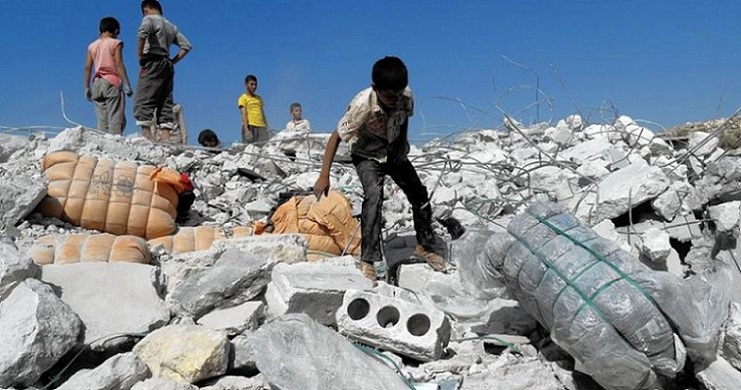
Press TV – February 21, 2018
Last year, Swedish Foreign Minister Margot Wallström told a conference that the unfolding humanitarian crisis in Yemen was one that “has far too long been neglected and forgotten by the global community” and what Yemeni people were going through was “difficult to imagine.”
It is such statements that, besides leading various international peace efforts to help resolve major conflicts across the globe, including Saudi Arabia’s deadly war on Yemen, have helped Sweden establish the image of a peace-loving country that cares for others.
However, a steady rise in the Scandinavian country’s weapons business over the past years, including its major dealings with repressive Arab regimes in the Persian Gulf region, has cast doubt on Stockholm’s true intentions.
In fact the rise has been so fast that according to official data by the US government, Sweden is now the world’s third largest weapons producer per capita, closely following Russia and Switzerland while overtaking France, Britain and the US.
At the heart of Sweden’s weapons industry is Saab, a company that sold over $2.7 billion worth of weapons in 2016 alone, making its way into the world’s top 30 arms producing companies according to the Stockholm International Peace Research Institute (SIPRI).
Over the recent years, Saudi Arabia and the United Arab Emirates (UAE) have become some of the main customers for Swedish-made weapons.
Svenska Freds, a 135-years-old Swedish anti-militarization group, charges that Stockholm has been providing Riyadh with weapons since 1998, with a brief suspension in 2015 following a diplomatic row between the two countries.
The larger chunk of the trade has taken over in the past eight years. According to Svenska Freds, the arms sales to Saudi Arabia reportedly approached six billion Swedish kronor ($741mn) between 2010 and 2016.
That means the arms deals between the two sides have continued throughout Saudi Arabia’s deadly war on Yemen, which began in March 2015 and has killed nearly 14,000 Yemeni civilians.
The UAE, another Saudi ally in the bloody war, was able to secure a larger deal in 2016, when the Swedish administrative authority, the National Inspectorate of Strategic Products, authorized 11 billion Swedish kronor ($1.3bn) in arms sales to the Arab country.
Before that, the country had sold 2.1 billion kronor ($272mn) in weapons sales to the UAE.
In a move that further proved Sweden’s desire to expand military ties with repressive Arab regimes, Saab opened a new office in the UAE capital Abu Dhabi in late 2017.
Lawmakers in the Swedish parliament have time and again criticized the government’s arms deals with the Saudi-led coalition.
While Foreign Minister Margot Walltröm has pledged to introduce measures that would limit the exports later this year, there are no signs that Stockholm is willing to end the profitable business anytime soon.
Iran strongly rejects claims of delivery of missiles to Yemen
Press TV – February 20, 2018
Iran has once again rejected the allegations about the Islamic Republic’s provision of missiles to Yemeni forces, saying such claims are lies and a foolish scenario.
“Iran’s missile program is for defensive and deterrent [purposes] and claims about the dispatch of missiles to Yemen despite the all-out blockade on this country are lies and a foolish scenario designed to exonerate the aggressors,” Iranian Foreign Ministry Spokesman Bahram Qassemi said on Tuesday.
He added that Britain and France have expressed their concern over Iran’s defensive missile program without providing any reason or wise justification.
A group of so-called independent United Nations experts monitoring the sanctions on Yemen reported to the Security Council in January that it had “identified missile remnants, related military equipment and military unmanned aerial vehicles that are of Iranian origin and were brought into Yemen after the imposition of the targeted arms embargo.”
British Foreign Secretary Boris Johnson in a statement on Monday called on Iran to stop taking actions which could lead to further escalation of the Yemeni conflict.
“I call on Iran to cease activity which risks escalating the conflict and to support a political solution to the conflict in Yemen,” Johnson said.
His remarks came on the same day that the French foreign ministry also said in a statement that Paris was concerned about Iran’s ballistic missiles program and its activities in the region, mentioning its support for the Houthis in Yemen.
In reaction to the allegations, Qassemi said the Islamic Republic has designed its defensive missile program based on its military doctrine and valuable experience it obtained during the eight-year war imposed on it by Iraq backed by major global powers in the 1980s.
He added that Iran’s missile program aims to deter any aggression by extremist powers against the country.
“In this clear path that is completely in conformity with international principles, we will never accept other countries’ intervention and regard as irresponsible and suspicious the adoption of such unprincipled stance and strongly reject them,” Qassemi said.
He emphasized that the Yemeni army and people have no need for foreign countries’ weapons, saying the Yemenis’ defense of their country’s dignity with minimum facilities has led to the defeat of aggressors.
The chief commander of Iran’s Islamic Revolution Guards Corps (IRGC) in January dismissed the allegations leveled by the US and its allies about the Islamic Republic’s provision of missiles to Yemeni forces.
“Missiles fired at Saudi Arabia belong to Yemen which have been overhauled and their range have been increased,” Major General Mohammad Ali Jafari said.
Iran’s Parliament Speaker Ali Larijani also said in December that the Islamic Republic is not providing military assistance to Yemen and all claims to this effect are false.
“We are not a country that would deny providing military assistance to anybody,” Larijani said.
Qassemi further called for an immediate end to the sale of European and US arms to Saudi Arabia and other aggressors and warmongers who are killing innocent Yemeni people on a daily basis.
A Saudi Arabian-led coalition launched a war against Yemen in 2015 and has ever since been indiscriminately hitting targets in the country. Yemeni Houthi fighters have been firing missiles in retaliatory attacks against Saudi targets every now and then.
The US State Department in January approved a possible $500-million sale of missile system support services to Saudi Arabia in defiance of global calls for Washington to stop providing Riyadh with military support due to the regime’s war crimes in Yemen.
The potential sale follows a request by Saudi Arabia for continued technical assistance for Patriot Legacy Field Surveillance Program (FSP), the Patriot Advanced Capability 3 (PAC-3) and the Patriot Engineering Services Program (ESP).
During his first trip to Saudi Arabia last year, US President Donald Trump signed a $110 billion arms deal with the Saudis, with options to sell up to $350 billion over a decade.
Iranian Foreign Minister Mohammad Javad Zarif said in December the United States is complicit in Saudi war crimes in Yemen amid Washington’s baseless claim that Tehran is providing supply of ballistic missiles to Yemen’s Houthi Ansarullah movement.
“No amount of alternative facts or alternative evidence covers up US complicity in war crimes,” Zarif said in a post on his official Twitter account.
He added that the US has sold weapons to its allies enabling them to “kill civilians and impose famine,” in reference to Washington’s arms deal with Riyadh in its aggression against Yemen.
Saudi cluster bombs continue to endanger Yemeni kids’ lives

Press TV – February 13, 2018
Thousands of innocent children continue to fall victim to Saudi Arabia’s use of cluster bombs in aerial attacks on residential areas across the Yemen, corroborating assertions of violation of international law in the impoverished Arab country.
Derhim al-Tuheiti was playing in a farming field in an area in Yemen’s western coastal province of Hudaydah, located 150 kilometers southwest of the capital Sana’a, less than a week ago when he found an unexploded cluster bomb.
He took it home, believing it was a toy or a piece of scrap metal. All at once, like deafening firecrackers, explosions ripped through the building, seriously injuring Derhim, his mother and siblings.
“I was working outside my house to earn money and feed my family. I was in shock when I returned home. People told me all my family members, including my wife, had been transferred to hospital. Now my wife has a back injury, and has gone insane due to the shock,” Ahmed, father of the family, told Press TV.
Derhim was taken to the intensive care unit at al-Thawra Hospital, and had to undergo numerous surgeries. He had both lower legs amputated after the horrific incident.
“Doctors amputated his legs as they had grave shrapnel wounds. The cluster bomb had also seriously injured his head, and paralyzed the right side of his body,” Doctor Khlowd M Doublah stated.
Cluster munitions, which are banned by more than 100 countries, present an enormous danger to civilians.
Dropped from the air or fired from the ground, they are designed to break open in mid-air, releasing the sub-munitions over a wide area in a way that cannot discriminate between civilians and military targets.
Many of the sub-munitions fail to explode on impact and effectively become anti-personnel mines. Unexploded sub-munitions have the potential to remain lethal for years, posing a high risk to the civilian population, both during and after the conflict.
Cluster bombs are banned under the Convention on Cluster Munitions (CCM), an international treaty that addresses the humanitarian consequences and unacceptable harm caused to civilians by cluster munitions through a categorical prohibition and a framework for action.
At least 13,600 people have been killed since the onset of Saudi Arabia’s military campaign against Yemen in 2015. Much of the country’s infrastructure, including hospitals, schools and factories, has been reduced to rubble due to the war.
The Saudi-led war has also triggered a deadly cholera epidemic across Yemen.
A picture taken on February 5, 2018, shows a man standing next to the Yemeni criminal investigations unit in the capital Sana’a, a day after it was hit in a Saudi air raid. (Photo by AFP)
According to the World Health Organization’s latest tally, the cholera outbreak has killed 2,167 people since the end of April 2017 and is suspected to have infected 841,906.
In November 2017, the United Nations children’s agency, UNICEF, said more than 11 million children in Yemen were in acute need of aid, stressing that it was estimated that every 10 minutes a child died of a preventable disease there.
Additionally, the UN has described the current level of hunger in Yemen as “unprecedented,” emphasizing that 17 million people were food insecure in the country.
The world body says that 6.8 million, meaning almost one in four people, do not have enough food and rely entirely on external assistance.
British court acquits campaigners against arms trade

MEMO | February 7, 2018
A British court today threw out charges against campaigners protesting against a London arms fair.
In the fourth in a series of trials at Stratford Magistrates Court involving demonstrations against Defence & Security Equipment International (DSEI) arms fair in London last year, the judge threw out the charges, describing the protestors’ actions as “reasonable”.
In a decision that is seen as a boost to the right to peaceful protest against the arms fair, District Judge Hamilton acquitted all four defendants of charges of obstructing the highway.
The decision marks a significant u-turn from last month’s decision by judges at the Stratford Magistrates Court who sentenced five protesters from the same group for demonstrating against the 2017 arms fair.
Following their victory, Hodge Jones & Allen solicitors said in their press release that all of the defendants had accepted that they had “locked on” in the middle of the road that leads to the arms fair. Describing the moment prior to their arrest, the solicitors said that the protest was “symbolic” and the group, who were all “committed Christians wanted to turn a road that was carrying weapons of destruction into a safe space for prayer for a short time. However, all were arrested after a matter of minutes by the police”.
Hodge Jones & Allen solicitors confirmed that more than 100 people were arrested in September 2017 outside the Excel Centre in east London during the DSEI arms fair which takes place every two years. It’s thought to be the largest event in the world attracting international arms dealers from countries including Bahrain, Oman, Saudi Arabia, Pakistan and the UAE.
Charges against most of the protestors were dropped but the remaining 46 activists have faced trial throughout January and February.
In further defence of their clients, the solicitors mentioned that opponents to the arms fair have accused the exhibitors of promoting unlawful weapons, specifically in 2007 and 2011. These breaches were discovered by external bodies such as Amnesty International and other NGOs. Since 2015, DSEI has banned such organisations from the fair.
Denouncing the arms fair, the solicitors said: “[The] world’s most repressive regimes buy weapons at DSEI. Saudi Arabia, for example, is accused of committing breaches of international humanitarian law and crimes against humanity in Yemen, with the aid of weapons purchased from UK companies. Arms sales to Saudi Arabia have increased by nearly 500 per cent since the start of the war in Yemen, with more than £4.6bn worth of arms sold within the first two years of bombings.”
Read also:
Do British courts really need to protect the world’s most corrupt industry?
A National Defense Strategy of Sowing Global Chaos
By Nicolas J.S. Davies | Consortium News | January 23, 2018
Presenting the 2018 National Defense Strategy of the United States on Friday at the Johns Hopkins University, Secretary of Defense James Mattis painted a picture of a dangerous world in which U.S. power – and all of the supposed “good” that it does around the world – is on the decline.
“Our competitive edge has eroded in every domain of warfare – air, land, sea, space, and cyberspace,” he said. “And it is continually eroding.”
What he could have said instead is that the United States military is overextended in every domain, and that much of the chaos seen around the world is the direct result of past and current military adventurism. Further, he could have acknowledged, perhaps, that the erosion of U.S. influence has been the result of a series of self-inflicted blows to American credibility through foreign policy disasters such as 2003 invasion of Iraq.
There were also two important words hidden between the lines, but never mentioned by name, in the new U.S. National Defense Strategy: “empire” and “imperialism.”
It has long been taboo for U.S. officials and corporate media to speak of U.S. foreign policy as “imperialism,” or of the U.S.’s global military occupations and network of hundreds of military bases as an “empire.” These words are on a long-standing blacklist of “banned topics” that U.S. official statements and mainstream U.S. media reports must never mention.
The streams of Orwellian euphemisms with which U.S. officials and media instead discuss U.S. foreign policy do more to obscure the reality of the U.S. role in the world than to describe or explain it, “hiding imperial interests behind ever more elaborate fig leaves,” as British historian A.J.P. Taylor described European imperialists doing the same a century ago.
As topics like empire, imperialism, and even war and peace, are censored and excised from political debate, U.S. officials, subservient media and the rest of the U.S. political class conjure up an illusion of peace for domestic consumption by simply not mentioning our country’s 291,000 occupation troops in 183 other countries or the 39,000 bombs and missiles dropped on our neighbors in Iraq, Syria and Afghanistan since Trump took office.
The 100,000 bombs and missiles dropped on these and other countries by Obama and the 70,000 dropped on them by Bush II have likewise been swept down a kind of real time “memory hole,” leaving America’s collective conscience untroubled by what the public was never told in the first place.
But in reality, it’s been a long time since U.S. leaders of either party resisted the temptation to threaten anyone anywhere, or to follow through on their threats with “fire and fury” bombing campaigns, coups and invasions. This is how empires maintain a “credible threat” to undergird their power and discourage other countries from challenging them.
But far from establishing the “Pax Americana” promised by policymakers and military strategists in the 1990s, from Paul Wolfowitz and Dick Cheney to Madeleine Albright and Hillary Clinton, the results have been consistently catastrophic, producing what the new National Defense Strategy calls, “increased global disorder, characterized by decline in the long-standing, rules-based international order.”
Of course the drafters of this U.S. strategy document dare not admit that U.S. policy is almost single-handedly responsible for this global chaos, after successive U.S. administrations have worked to marginalize the institutions and rules of international law and to establish illegal U.S. threats and uses of force that international law defines as crimes of aggression as the ultimate arbiter of international affairs.
Nor do they dare acknowledge that the CIA’s politicized intelligence and covert operations, which generate a steady stream of political pretexts for U.S. military intervention, are designed to create and exacerbate international crises, not to solve them. For U.S. officials to admit such hard truths would shake the very foundations of U.S. imperialism.
Opposition to the Joint Comprehensive Plan of Action with Iran – the so-called nuclear deal – from Republicans and Democratic hawks alike seems to stem from the fear that it might validate the use of diplomacy over sanctions, coups and war, and set a dangerous precedent for resolving other crises – from Afghanistan and Korea to future crises in Africa and Latin America. Iran’s success at bringing the U.S. to the negotiating table, instead of falling victim to the endless violence and chaos of U.S.-backed regime change, may already be encouraging North Korea and other targets of U.S. aggression to try to pull off the same trick.
But how will the U.S. justify its global military occupation, illegal threats and uses of force, and trillion-dollar war budget once serious diplomacy is seen to be more effective at resolving international crises than the endless violence and chaos of U.S. sanctions, coups, wars and occupations?
From Bhurtpoor to Baghdad
Major Danny Sjursen, who has fought in Iraq and Afghanistan and taught history at West Point, is a rare voice of sanity from within the U.S. military. In a poignant article in Truthdig, Major Sjursen eloquently described the horrors he has witnessed and the sadness he expects to live with for the rest of his life. “The truth is,” he wrote, “I fought for next to nothing, for a country that, in recent conflicts, has made the world a deadlier, more chaotic place.”
Danny Sjursen’s life as a soldier of the U.S. Empire reminds me of another soldier of Empire, my great-great-great grandfather, Samuel Goddard. Samuel was born in Norfolk in England in 1793, and joined the 14th Regiment of Foot as a teenager. He was a Sergeant at the Battle of Waterloo in 1815. During 14 years in India, his battalion led the assault on the fortress of Bhurtpoor in 1826, which ended the last resistance of the Maratha dynasty to British rule. He spent 3 years in the Caribbean, 6 years in Canada, and retired as Commandant of Dublin Castle in 1853 after a lifetime of service to Empire.
Danny’s and Samuel’s lives have much in common. They would probably have a lot to talk about if they could ever meet. But there are critical differences. At Bhurtpoor, the two British regiments who led the attack were followed through the breech in the walls by 15 regiments of Indian “Native Infantry.” After Bhurtpoor, Britain ruled India (including Pakistan and Bangladesh) for 120 years, with only a thousand British officials in the Indian Civil Service and a few thousand British officers in command of up to 2.5 million Indian troops.
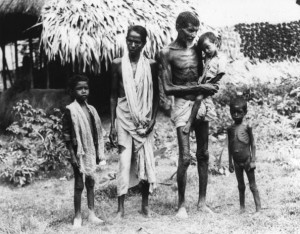 The British brutally put down the Indian Mutiny in 1857-8 with massacres in Delhi, Allahabad, Kanpur and Lucknow. Then, as up to 30 million Indians died in famines in 1876-9 and 1896-1902, the British government of India explicitly prohibited relief efforts or actions that might reduce exports from India to the U.K. or interfere with the operation of the “free market.”
As Mike Davis wrote in his 2001 book, Late Victorian Holocausts, “What seemed from a metropolitan perspective the nineteenth century’s final blaze of imperial glory was, from an Asian or African viewpoint, only the hideous light of a giant funeral pyre.”
And yet Britain kept control of India by commanding such loyalty and subservience from millions of Indians that, in every crisis, Indian troops obeyed orders from British officers to massacre their own people.
Danny Sjursen and U.S. troops in Afghanistan, Iraq and other post-Cold War U.S. war zones are having a very different experience. In Afghanistan, as the Taliban and its allies have taken control of more of the country than at any time since the U.S. invasion, the U.S.-backed Afghan National Army has 25,000 fewer troops under its command than it did five years ago, while ten years of training by U.S. special operations forces has produced only 21,000 trained Afghan Commandos, the elite troops who do 70-80% of the killing and dying for the corrupt U.S.-backed Afghan government.
But the U.S. has not completely failed to win the loyalty of its imperial subjects. The first U.S. soldier killed in action in Afghanistan in 2018 was Sergeant 1st Class Mihail Golin, originally from Latvia. Mihail arrived in the U.S. in November 2004, enlisted in the U.S. Army three months later and has now given his life for the U.S. Empire and for whatever his service to it meant to him. At least 127 other Eastern Europeans have died in occupied Afghanistan, along with 455 British troops, 158 Canadians and 396 soldiers from 17 other countries. But 2,402 – or 68%, over two-thirds – of the occupation troops who have died in Afghanistan since 2001, were Americans.
In Iraq, an American war that always had even less international support or legitimacy, 93% of the occupation troops who have died were Americans, 4,530 out of a total of 4,852 “coalition” deaths.
When Ben Griffin, who later founded the U.K. branch of Veterans for Peace, told his superiors in the U.K.’s elite SAS (Special Air Service) that he could no longer take part in murderous house raids in Baghdad with U.S. special operations forces, he was surprised to find that his entire chain of command understood and accepted his decision. The only officer who tried to change his mind was the chaplain.
The Future of Empire
The U.S. Joint Chiefs of Staff have explicitly told Congress that war with North Korea would require a ground invasion, and the same would likely be true of a U.S. war on Iran. South Korea wants to avoid war at all costs, but may be unavoidably drawn into a U.S.-led Second Korean War.
But besides South Korea, the level of support the U.S. could expect from its allies in a Second Korean War or other wars of aggression in the future would probably be more like Iraq than Afghanistan, with significant international opposition, even from traditional U.S. allies. U.S. troops would therefore make up nearly all of the invasion and occupation forces – and take nearly all of the casualties.
Compared to past empires, the cost in blood and treasure of policing the U.S. Empire and the blame for its catastrophic failures fall disproportionately – and rightly – on Americans. Even Donald Trump recognizes this problem, but his demands for allied countries to spend more on their militaries and buy more U.S. weapons will not change their people’s unwillingness to die in America’s wars.
This reality has created political pressure on U.S. leaders to wage war in ways that cost fewer American lives but inevitably kill many more people in countries being punished for resistance to U.S. imperialism, using air strikes and locally recruited death squads instead of U.S. “boots on the ground” wherever possible.
The U.S. conducts a sophisticated propaganda campaign to pretend that U.S. air-launched weapons are so accurate that they can be used safely without killing large numbers of civilians. Actual miss rates and blast radii are on the “banned topics” blacklist, along with realistic estimates of civilian deaths.
When former Iraqi foreign minister Hoshyar Zebari told Patrick Cockburn of the U.K.’s Independent newspaper that he had seen Iraqi Kurdish intelligence reports which estimated that the U.S.- and Iraqi-led destruction of Mosul had killed 40,000 civilians, the only remotely realistic estimate so far from an official source, no other mainstream Western media followed up on the story.
But America’s wars are killing millions of innocent people: people defending themselves, their families, their communities and countries against U.S. imperialism and aggression; and many more who were simply in the wrong place at the wrong time under the onslaught of over 210,000 American bombs and missiles dropped on at least 7 countries since 2001.
According to a growing body of research (for example, see the UN Development Program study, Journey to Extremism in Africa: Drivers, Incentives and the Tipping-Point for Recruitment), most people who join armed resistance or “terrorist” groups do so mainly to protect themselves and their families from the dangers of wars that others have inflicted on them. The UNDP survey found that the final “tipping point” that pushes over 70% of them to take the fateful step of joining an armed group is the killing or detention of a close friend or family member by foreign or local security forces.
So the reliance on airstrikes and locally recruited death squads, the very strategies that make U.S. imperialism palatable to the American public, are in fact the main “drivers” spreading armed resistance and terrorism to country after country, placing the U.S. Empire on a collision course with itself.
The U.S. effort to delegate war in the Middle East to Saudi Arabia is turning it into a target of global condemnation as it tries to mimic the U.S. model of warfare by bombing and starving millions of innocent people in Yemen while blaming the victims for their plight. The slaughter by poorly trained and undisciplined Saudi and Emirati pilots is even more indiscriminate than U.S. bombing campaigns, and the Saudis lack the full protection of the Western propaganda system to minimize international outrage at tens of thousands of civilian casualties and an ever-worsening humanitarian crisis.
The need to win the loyalty of imperial subjects by some combination of fear and respect is a basic requirement of Empire. But it appears to be unattainable in the 21st century, certainly by the kind of murderous policies the U.S. has embraced since the end of the Cold War. As Richard Barnet already observed 45 years ago, at the end of the American War in Vietnam, “At the very moment the number one nation has perfected the science of killing, it has become an impractical instrument of political domination.”
Obama’s sugar-coated charm offensive won U.S. imperialism a reprieve from global public opinion and provided political cover for allied leaders to actively rejoin U.S.-led alliances. But it was dishonest. Under cover of Obama’s iconic image, the U.S. spread the violence and chaos of its wars and regime changes and the armed resistance and terrorism they provoke farther and wider, affecting tens of millions more people from Syria and Libya to Nigeria and Ukraine.
Now Trump has taken the mask off and the world is once again confronting the unvarnished, brutal reality of U.S. imperialism and aggression.
China’s approach to the world based on trade and infrastructure development has been more successful than U.S. imperialism. The U.S. share of the global economy has declined from 40% to 22% since the 1960s, while China is expected to overtake the U.S. as the world’s largest economy in the next decade or two – by some measures, it already has.
While China has become the manufacturing and trading hub of the global economy, the U.S. economy has been financialized and hollowed out, hardly a solid basis for future growth. The neoliberal model of politics and economics that the U.S. adopted a generation ago has created even greater wealth for people who already owned disproportionate shares of everything, but it has left working people in the U.S. and across the U.S. Empire worse off than before.
Like the “next to nothing” that Danny Sjursen came to realize he was fighting for in Iraq and Afghanistan, the prospects for the U.S. economy seem ephemeral and highly vulnerable to the changing tides of economic history.
The Rise and Fall of the Great Powers
In his 1987 book, The Rise and Fall of the Great Powers: Economic Change and Military Conflict from 1500 to 2000, historian Paul Kennedy examined the relationship between economic and military power in the histories of the Western empires who colonized the world in the past 500 years. He described how rising powers enjoy significant competitive advantages over established ones, and how every once-dominant power sooner or later has to adjust to the tides of economic history and find a new place in a world it can no longer dominate.
Kennedy explained that military power is only a secondary form of power that wealthy nations develop to protect and support their expanding economic interests. An economically dominant power can quickly convert some of its resources into military power, as the U.S. did during the Second World War or as China is doing today. But once formerly dominant powers have lost ground to new, rising powers, using military power more aggressively has never been a successful way to restore their economic dominance. On the contrary, it has typically been a way to squander the critical years and scarce resources they could otherwise have used to manage a peaceful transition to a prosperous future.
As the U.K. found in the 1950s, using military force to try to hold on to its empire proved counter-productive, as Kennedy described, and peaceful transitions to independence proved to be a more profitable basis for future relations with its former colonies. The drawdown of its global military commitments was an essential part of its transition to a viable post-imperial future.
The transition from hegemony to coexistence has never been easy for any great power, and there is nothing exceptional about the temptation to use military force to try to preserve and prolong the old order. This has often led to catastrophic wars and it has always failed.
It is difficult for any political or military leader to preside over a diminution of his or her country’s power in the world. Military leaders are rewarded for military strategies that win wars and expand their country’s power, not for dismantling it. Mid-level staff officers who tell their superiors that their weapons and armies cannot solve their country’s problems do not win promotion to decision-making positions.
As Gabriel Kolko noted in Century of War in 1994, this marginalization of critical voices leads to an “inherent, even unavoidable institutional myopia,” under which, “options and decisions that are intrinsically dangerous and irrational become not merely plausible but the only form of reasoning about war and diplomacy that is possible in official circles.”
After two world wars and the independence of India, the Suez crisis of 1956 was the final nail in the coffin of the British Empire, and the Eisenhower administration burnished its own anti-colonial credentials by refusing to support the British-French-Israeli invasion of Egypt. British Prime Minister Anthony Eden was forced to resign, and he was replaced by Harold Macmillan, who had been a close aide to Eisenhower during the Second World War.
Macmillan dismantled the remains of the British Empire behind the backs of his Conservative Party’s supporters, winning reelection in 1959 on the slogan, “You’ve never had it so good,” while the U.S. supported a relatively peaceful transition that preserved Western international business interests and military power.
As the U.S. faces a similar transition from empire to a post-imperial future, its leaders have been seduced by the chimera of the post-Cold War “power dividend” to try to use military force to preserve and expand the U.S. Empire, even as the relative economic position of the U.S. declines.
In 1987, Paul Kennedy ended The Rise and Fall of the Great Powers with a prescient analysis of the U.S. position in the world. He concluded,
“In all of the discussions about the erosion of American leadership, it needs to be repeated again and again that the decline referred to is relative not absolute, and is therefore perfectly natural; and that the only serious threat to the real interests of the United States can come from a failure to adjust sensibly to the newer world order.”
But after Kennedy wrote that in 1987, instead of accepting the future of peace and disarmament that the whole world hoped for at the end of the Cold War, a generation of American leaders made a fateful bid for “superpower.” Their delusions were exactly the kind of failure to adjust to a changing world that Kennedy warned against.
The results have been catastrophic for millions of victims of U.S. wars, but they have also been corrosive and debilitating for American society, as the perverted priorities of militarism and Empire squander our country’s resources and leave working Americans poorer, sicker, less educated and more isolated from the rest of the world.
When I began writing Blood On Our Hands: the American Invasion and Destruction of Iraq in 2008, I hoped that the catastrophes in Afghanistan and Iraq might bring U.S. leaders to their senses, as the Suez crisis did to British leaders in 1956.
Instead, eight more years of carefully disguised savagery under Obama have squandered more precious time and good will and spread the violence and chaos of U.S. war-making even farther and wider. The new National Defense Strategy’s implicit threats against Russia and China reveal that 20 years of disastrous imperial wars have done nothing to disabuse U.S. leaders of their delusions of “superpower status” or to restore any kind of sanity to U.S. foreign policy.
Trump is not even pretending to respect diplomacy or international law, as he escalates Bush’s and Obama’s wars and threatens new ones of his own. But maybe Trump’s nakedly aggressive policies will force the world to finally confront the dangers of U.S. imperialism. A coming together of the international community to stop further U.S. aggression may be the only way to prevent an even greater catastrophe than the ones that have already befallen the people of Afghanistan, Iraq, Somalia, Honduras, Libya, Syria, Ukraine and Yemen.
Or will it actually take a new and even more catastrophic war in Korea, Iran or somewhere else to finally force the United States to “adjust sensibly to the new world order,” as Paul Kennedy put it in 1987? The world has already paid a terrible price for our leaders’ failure to take his sound advice a generation ago. But what will be the final cost if they keep ignoring it even now?
Nicolas J.S. Davies is the author of Blood On Our Hands: the American Invasion and Destruction of Iraq.
Germany stops arms sales to Saudi Arabia
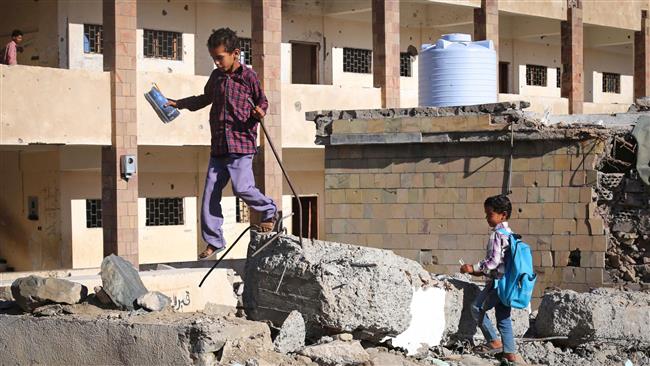
Yemeni children walk outside a school that was damaged in a Saudi air strike in the southern Yemeni city of Ta’izz. (By AFP)
Press TV – January 20, 2018
Germany has stopped selling weapons to Saudi Arabia and almost all of its allies waging war on Yemen, in a decision likely to have both an impact on the Riyadh regime and a domino effect on other Western and non-Western countries exporting arms to Saudi Arabia.
German government spokesman Steffen Seibert said on Friday that the Federal Security Council was no longer issuing export licenses that “are not in accordance with the conclusion of the exploratory talks,” Germany’s official DPA news agency reported.
The official was referring to ongoing negotiations among the German political factions of the Christian Democratic Union, the Christian Social Union, and Social Democrats on the formation of a new coalition government.
A draft paper on arms exports that came out of those talks said “the federal government, with immediate effect, will no longer export arms to countries as long as they are involved in the Yemeni war.”
Around 13,600 people have died since Saudi Arabia started leading a number of its vassal states in an invasion of Yemen in March 2015.
The war, which enlists the participation among others of the United Arab Emirates, Jordan, Egypt, Bahrain, Kuwait, Morocco, Sudan, and Senegal, has been reinforced by weapon supplies and logistical support from the United States and the United Kingdom.
Washington signed a $110-billion arms deal with Riyadh last year.
By stopping its own arms sales to Saudi Arabia, European heavyweight Germany may become a model for other Western and non-Western powers already under pressure to end their arms sales to the Riyadh regime. Rights groups have long called for an arms embargo on Saudi Arabia over potential war crimes in Yemen.
A United Nations panel recently compiled a detailed report of civilian casualties caused by the Saudi military and its allies during the war, saying the Riyadh-led coalition has used precision-guided munitions in its raids on civilian targets.
“The attacks were carried out by precision-guided munitions, so it is likely these were the intended targets,” the panel’s report said, according to Al Jazeera.
Saudi Arabia and the UAE were among the top recipients of German-made weaponry in 2016.
The DPA report said, “The German public is traditionally wary of arms deals and [Chancellor Angela] Merkel has been pressured to end sales to countries with precarious human rights records.”
The only exception to the German freeze is Jordan, which will be receiving 130 million euros’ (158 million dollars’) worth of military equipment. Jordan hosts a squadron of German Tornado fighter planes and other hardware used by German Armed Forces.
US administration approves $500mn missile system deal with Saudi Arabia
Press TV – January 18, 2018
The US State Department has approved a possible $500-million sale of missile system support services to Saudi Arabia in defiance of global calls for Washington to stop providing Riyadh with military support due to the regime’s war crimes in Yemen.
The Defense Security Cooperation Agency made the announcement in a statement on Wednesday, saying Congress had been notified of the decision.
Congress now has 30 days to review the proposed sale, but it is not required to take any action.
The potential sale follows a request by Saudi Arabia for continued technical assistance for Patriot Legacy Field Surveillance Program (FSP), the Patriot Advanced Capability 3 (PAC-3) and the Patriot Engineering Services Program (ESP).
The package also includes spare parts and logistical support for Patriot and Hawk missile systems.
Last week, the US Army awarded Sikorsky, a leading American aircraft manufacturer, a contract worth nearly $200 million to supply 17 Black Hawk helicopters to Saudi Arabia.
The deals come as the US is under pressure to suspend its arms sales to the Saudi regime, which has been waging a deadly military aggression against Yemen since 2015.
At least 13,600 people have been killed since the start of the war.
During his first trip to Saudi Arabia last year, President Donald Trump signed a $110 billion arms deal with the Saudis, with options to sell up to $350 billion over a decade.
Facilitated by Trump’s son-in-law and senior adviser Jared Kushner, the massive package includes missiles, bombs, armored personnel carriers, combat ships, terminal high altitude area defense (THAAD) missile systems and munitions.
The announcement generated backlash in Congress, with Republican Senator Rand Paul promising to work to block at least parts of the package.
The Trump administration is looking to loosen restrictions on American arms sales to boost the country’s weapons industry.
The move seeks to ease export rules for military equipment “from fighter jets and drones to warships and artillery,” according to officials familiar with the plan.
Yemen says Saudi war has killed, wounded 35,000 people

Press TV – January 2, 2018
The Yemeni Ministry of Health says the Saudi-led military coalition has either killed or wounded some 35,000 people of Yemen during the ongoing war Riyadh imposed on the impoverished nation almost three years ago.
In a report read out in a press conference in the Yemeni capital of Sana’a on Tuesday, the ministry said that the appalling number of casualties occurred in just 1,000 days since the Saudi regime began its military aggression against the Yemeni people in March 2015.
The report added that nearly all of Yemen’s provinces sustained losses in the war with the northwestern province of Sa’ada, the west-central province of Sana’a and the western province of Hajjah suffering the most in a descending order.
The ministry also said that 415 health facilities were destroyed, either completely or partially, as a result of direct Saudi airstrikes, pointing out that more than 55 percent of the health facilities did not function due to the ceaseless aggression, and that the remaining 45 percent operated with a minimum capacity.
The report also revealed figures showing that more than 95,000 Yemeni patients needed to travel abroad for proper treatment, stressing that the closure of airports, due to a total blockade of the country by the Saudi-led coalition, led to the death of 32 patients every day in all provinces.
The ministry further said that, according to figures provided by the World Food Programme, more than 21 million Yemenis needed humanitarian assistance, and that more than 9 million others were expected to enter the stage of starvation.
According to the ministry’s figures, some 2 million Yemeni children suffer from some form of malnutrition, of which half a million are dying of severe malnutrition and 52,000 children died in 2016 for preventable causes.
The report also said that 2,236 people had so far lost their lives due to a cholera outbreak triggered by the Saudi war.
The international committee of the Red Cross says more than one million people have contracted cholera in Yemen amid Saudi Arabia’s war.
Saudi Arabia has been leading a deadly campaign against Yemen from the air, land, and sea since March 2015 in an attempt to reinstate former President Abd Rabbuh Mansur Hadi, a staunch ally of Riyadh, and to undermine the Houthi Ansarullah movement. Over the past two years, the Houthis have been running state affairs and defending Yemeni people against the Saudi aggression.
The campaign has also taken a heavy toll on the country’s facilities and infrastructure, destroying many hospitals, schools, and factories. The offensive has, however, achieved neither of its goals despite the spending of billions of petrodollars and the enlisting of the cooperation of Saudi Arabia’s regional and Western allies.
Featured Video
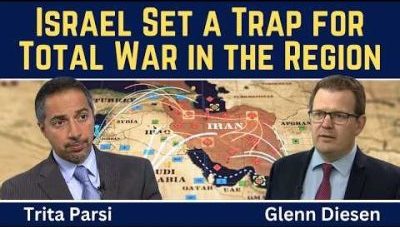
Trita Parsi: Israel Set a Trap for Total War in the Region
or go to
Aletho News Archives – Video-Images
From the Archive
Zionism’s Violent Legacy
By Donald Neff | Washington Report On Middle East Affairs | January 1996
On January 4, 1948, Jewish terrorists drove a truck loaded with explosives into the center of the all Arab city of Jaffa and detonated it, killing 26 and wounding around 100 Palestinian men, women and children.[1] The attack was the work of the Irgun Zvai Leumi – the “National Military Organization,” also known by the Hebrew letters Etzel – the largest Jewish terrorist group in Palestine. The Irgun was headed by Revisionist Zionist Menachem Begin and had been killing and maiming Arabs, Britons and even Jews for the previous ten years in its efforts to establish a Jewish state.
This terror campaign meant that at the core of Revisionist Zionism there existed a philosophical embrace of violence. … continue
Blog Roll
 Aletho News
- Trita Parsi: Israel Set a Trap for Total War in the Region
- Trump’s Iran war is on an Israeli leash
- Saudi oil boss issues global supply warning
- Riyadh Says Its Oil System Is Intact. The Numbers Say Otherwise.
- Trump and Netanyahu Want to “Finish the Job” on Iran
- US ‘one-sided dictation’ not Iran’s beliefs makes rational talks impossible: Baghaei
- Iran’s Next Strike May Not Explode. It Could Shut You Down /Col Doug Macgregor
- Iran: US political targets legitimate if assassinations return
- Iraq shuts key border crossing with Iran under US pressure: Report
- Undersea Internet cables could be targeted in retaliation for attacks on Iran: IRGC deputy chief
- If Americans Knew
- The Israel Lobby’s Changing Fortunes
- AIPAC has become such a political liability that it’s shifting to a more “nimble” approach to buying politicians
- At least 160 Israeli settler attacks in 2 weeks
- Will Gaza’s Ancient Christian Community Disappear Forever?
- Israel’s vision of regional security rests on keeping Arab states weak
- Heidi Levine recounts how Palestinian youths helped save her in settler attack
- DAILY UPDATE: Latest essential news on Palestine, Israel, & region
- Trump’s Intensifying Sabotage of the ICC, for Israel’s Sake
- Israeli military detain US and UK volunteers in West Bank including Democratic NY politician Brad Lander
- Americans at National Conservatism Conference held in Israel this year criticize Israel
- No Tricks Zone
- E-Cars Reduce CO2 Emissions By Only 41% Compared To Internal Combustion Engine Vehicles
- Predictions Made By Renowned Climate Professor Over Past Decades Have Been Proven To Be Poor
- New Study Suggests Large Regions Of The Pacific Ocean Have Been Cooling For The Last 80 Years
- Germany’s Green Energy Debacle: High Energy Costs Force Kahla Porzellan to Close After 182 Years!
- New Study: 50 Years Of The Most Aggressive ‘Net Zero’ Policies Can Only Affect The Global Climate By 0.03°C
- US September “Heat” Was No Record…Many Records Set Decades Ago
- Latest European Green Energy Debacle; Portugal’s Largest Flagship Solar Park Insolvent!
- Green Energy Debacle: German Expert Professor Fritz Vahrenholt Warns Of Severe Economic And Social Consequences
- Two More Paleo Reconstructions Affirm Meters-Higher Sea Levels Across Ireland, Brazil 7000-6000 Years Ago
- New Study: Earth And Venus Surface Warmth Largely Explained By Convection And Lapse Rate, Not CO2 Or Radiation

