Houthi leader sets conditions to end Yemeni crisis
MEMO | January 21, 2015
The Houthis have outlined four conditions to end Yemen’s political crisis, the Anadolu Agency reported the group’s leader as saying.
In a televised speech broadcasted by Yemen’s Al-Maseera satellite channel yesterday, Abdul-Malik Al-Houthi called for a speedy reformation of the National Supervisory Authority which was tasked with overseeing the results of the National Dialogue Conference and which ceased to be active in January 2014.
He also called for amendments to the country’s draft constitution to be expedited, the implementation of the peace and partnership agreement and to conduct comprehensive security reform.
Al-Houthi accused Yemeni President Abd Rabbuh Mansour Hadi of “protecting corruption and lack of seriousness in implementing the peace and partnership agreement, which brought the country to the current situation”.
He also accused him of supporting Al-Qaeda and supplying it with weapons. “President Hadi refused to allow the army to fight Al-Qaeda and gave the group the opportunity to rob banks,” he said.
The Yemeni capital Sanaa was been rocked by violent clashes for the second consecutive day on yesterday between presidential guards and Al-Houthi militants who are said to have seized the presidential palace with Prime Minister Khaled Bahah inside.
Al-Houthi said: “There is a conspiracy against Yemen and its people that is led by forces targeting the entire region. Yemen in on the verge of political, security and economic collapse. The Yemeni leadership is mired in corruption” he said.”
The Houthis seized control of Sanaa in September.
Civilians killed in US drone attacks: Rights group
Press TV – November 28, 2014
A rights group says many civilians have been targeted and killed in US drone attacks in Pakistan and other countries where such raids are carried out, Press TV reports.
The UK-based rights group Reprieve revealed that civilians have been killed in Pakistan and other places before militants were targeted by US assassination drones.
Reprieve has presented several cases on how ruthlessly the US Central Intelligence Agency (CIA) has killed civilians but declared them militants through dubious reports in the media, which regularly cite anonymous Pakistani and US officials.
In one such case, the CIA killed 221 people, including over 100 children, in Pakistan in search of just four militants. This is while three of the militants are reportedly still alive and the fourth one has died of natural causes.
In another example, the report pointed out that on average each militant was targeted and reported killed more than three times before they were actually killed.
To kill one militant, sometimes “more than 300 people have been killed,” said Mirza Shazad Akbar, Reprieve’s representative in Pakistan.
“A former US drone operator said that by looking at the monitor and looking at people’s movement, he could actually tell who is a bad person and who is a good person… This is the extent of… the [US] flawed intelligence,” Akbar added.
But this is just the tip of the iceberg of the scale of tragedy in Pakistan’s tribal areas, where more than 3,800 people have been killed with the same pattern of the so-called precise surgical drone strikes.
The US carries out targeted killings through drone strikes in several Muslim countries, such as Afghanistan, Yemen, Pakistan and Somalia. Washington claims the targets of the drone attacks are militants, but local officials and witnesses maintain that civilians have been the main victims of such raids over the past few years.
The United Nations and several human rights organizations have identified the US as the world’s number-one user of “targeted killings,” largely due to its drone attacks in Pakistan and Afghanistan.
Evidence that US secretly pays off civilian Yemeni drone strike victims
Reprieve | November 11, 2014
The US government has apparently made secret payments of $100,000 to the families of two Yemeni men who were mistakenly killed in a covert drone strike, an investigation by international non-profit Reprieve has found.
Faisal bin Ali Jaber, a Yemeni man who lost his brother-in-law and nephew in a 2013 drone strike, was offered a bag containing US dollar bills at a meeting with the Yemeni National Security Bureau (NSB). The NSB official who had requested the meeting told a family representative that the money came from the US and that he had been asked to pass it along.
Since the deaths of his relatives, Mr bin Ali Jaber – who is represented by lawyers at Reprieve – has travelled to Washington, DC and met with Congressmen and members of the National Security Council, as well as telling his story to a number of journalists. The Yemeni NSB official reportedly cited this activity as part of the reason the family was offered the $100k payment.
The payment came after Mr bin Ali Jaber’s family had already gone through a formal compensation process, during which the Yemeni government confirmed in writing that the US carried out the drone strike and that the deaths of their civilian relatives were “a mistake”. During this formal compensation procedure the family also received a payment of 11m Yemeni Rials plus damages.
Despite the private admissions and payments to Mr bin Ali Jaber and his family, given via the Yemeni security services, the US has never publicly admitted that the strike in which Waleed bin Ali Jaber and Salim bin Ali Jaber were killed was a mistake and that the two men were innocent civilians. The deaths have never been investigated and the US has never apologised to the families.
Waleed bin Ali Jaber was a local policeman and his father was an imam who had preached against al Qaeda in the local mosque just days before he was killed.
Faisal bin Ali Jaber said: “My family received money from the US government as an admission of their guilt for ‘mistakenly’ killing our relatives in a drone strike. But this is not justice. There are many other families in Yemen who have lost innocent relatives in US drone strikes but do not receive hush money for speaking out. If the US can admit their ‘mistake’ in a back room of the Yemeni security services, they can surely admit it publicly and apologise for what they have done to my family, and many others in Yemen.”
Cori Crider, Reprieve’s Strategic Director and attorney for Mr bin Ali Jaber, said: “President Obama is as reluctant as ever to admit the full extent of the US drone program in Yemen – but money talks, even if the White House won’t. Cash payments without full accountability won’t quell the outrage about civilian drone deaths, and continued US strikes will only bring further instability to Yemen. The victims’ families want and deserve an explanation, while the American people need to hear the truth about what is being done in their name.”
Yemen´s Houthis and Government Sign Final Peace-deal
teleSUR | September 28, 2014
Yemen’s Houthi movement signed a final peace deal with the government on Saturday, agreeing to disarm and pull back from areas they took in the past months.
The accord, which comes days after the Houthis gained the upper-hand in the capital Sanaa, is part of a comprehensive UN-brokered deal with the pro-government Islah Party, the political wing of the Muslim Brotherhood in Yemen.
Thousands of armed Houthis are stationed in the capital, where they have disarmed government security forces. On Saturday, rebels attacked the Sanaa residency of the national security chief Ali al-Ahmadi.
The deal may put an end to weeks of violence and tension between the Houthis on the one hand and government troops and pro-government factions on the other. According to official estimations, the violence may have killed hundreds.
Last month thousands of Houthis flooded the streets of Sanaa, staging civil disobedience actions and demanding the government step down and fuel subsidies restored.
Earlier this month, in what the Houthis considered a victory, the government and the movement signed an agreement on the formation of a new cabinet of technocrats and the reinstatement of fuel subsidies, whose absence had been a blow to the poor.
Houthis have played a key role in ousting former U.S.-backed dictator Ali Abdullah Saleh during the mass-uprisings of the Arab Spring.
Mideast crises West bid to protect Israel interests: Jaafari
Press TV – June 19, 2014
Syria’s Permanent Representative to the United Nations Bashar Ja’afari says the current tumult in the Middle East, including the crisis in his country, is a scheme by the West to safeguard Israel’s interests, Press TV reports.
“This is a geopolitical plan that is not only targeting Syria exclusively, although Syria is very important for either the success or failure of this plan, but it is targeting the whole area,” said Ja’afari Wednesday in an exclusive interview with Press TV in New York.
He said the main goal of the Western plot “is to secure for a long time the interests of Israel and preventing the establishment of Palestinian state in Palestine.”
“So they need to open up a new front, a kind of deviation, from the focus on the Arab-Israeli conflict and the Palestinian question to another focus which might be a war between Muslims and Muslims,” he added.
He further underlined that the West intends to incite divisions among Muslims under the false notion of a Sunni-Shia conflict to provoke wars between Muslim countries in the region.
The Syrian envoy went on to reiterate that the huge participation of Syrian voters in the country’s presidential election served as big “NO” message to foreign interference in their country’s internal affairs.
“Our message would be a friendly message… [that] we want to have friends and we want to have normal, bilateral relationship with everybody. We do not interfere into the American domestic affairs. Please don’t interfere into our own domestic affairs.”
According to official figures, President Bashar al-Assad won nearly 90 percent of the votes cast in Syria’s presidential race. Syria’s Supreme Constitutional Court announced that over 73 percent of the 15.8 million eligible voters had taken part in the election.
Hillary Clinton and the Weaponization of the State Department
By JP Sottile | News Vandal | June 5, 2014
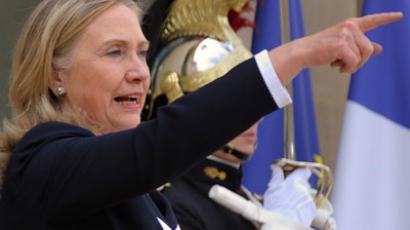
On May 23, 2012, then-Secretary of State Hillary Clinton went to the Special Operations Forces Industry Conference (SOFIC) trade show in Tampa, Florida to share her vision of “smart power” and to explain the State Department’s crucial role in extending the reach and efficacy of America’s growing “international counterterrorism network.”
First, there is such a thing as a “Special Operations Forces Industry Conference trade show.” Without some keen reporting by David Axe of Wired, that peculiar get-together might’ve flown completely under the radar—much like the shadowy “industry” it both supports and feeds off of like a sleek, camouflaged lamprey attached to a taxpayer-fattened shark.
Second, “special operations” have officially metastasized into a full-fledged industry. United States Special Operations Command (USSOCOM) is located at MacDill Air Force Base in Tampa and, therefore, conveniently located near the special operations trade show, which happened again this year at the Tampa Convention Center. The theme was “Strengthening the Global SOF Network” and the 600,000-square-foot facility was filled with targets of opportunity for well-connected and well-heeled defense contractors.
According to the SOFIC website, this year’s conference afforded attendees “the opportunity to engage with USSOCOM Program Executive Officers, Science and Technology Managers, Office of Small Business Programs and Technology & Industry Liaison Office representatives, and other acquisition experts who will identify top priorities, business opportunities, and interests as they relate to USSOCOM acquisition programs.”
Third, Hillary’s widely-ignored speech marked a radical departure from the widely-held perception that the State Department’s diplomatic mission endures as an institutional alternative to the Pentagon’s military planning. Instead, Secretary Clinton celebrated the transformation of Foggy Bottom into a full partner with the Pentagon’s ever-widening efforts around the globe, touting both the role of diplomats in paving the way for shadowy special ops in so-called “hot spots” and the State Department’s “hand-in-glove” coordination with Special Forces in places like Pakistan and Yemen.
Finally, with little fanfare or coverage, America’s lead diplomat stood before the shadow war industry and itemized the integration of the State Department’s planning and personnel with the Pentagon’s global counter-terrorism campaign which, she told the special operations industry, happen “in one form or another in more than 100 countries around the world.”
If this isn’t entirely unexpected, consider the fact that under then-Secretaries of State Colin Powell and Condoleezza Rice, the State Department fought attempts by the Pentagon to trump its authority around the globe and, as reported by the Washington Post, “repeatedly blocked Pentagon efforts to send Special Operations forces into countries surreptitiously and without ambassadors’ formal approval.”
But that was before Hillary brought her “fast and flexible” doctrine of “smart power” to Foggy Bottom and, according to her remarks, before she applied lessons learned from her time on the Senate Armed Services Committee to launch the first-ever Quadrennial Diplomacy and Development Review, which she modeled on the Pentagon’s Quadrennial Defense Review. That Pentagon-style review spurred the creation of the Bureau of Conflict and Stabilization Operations to “advance the U.S. government’s foreign policy goals in conflict areas.”
According to a Congressional Research Service analysis, the initial intent of the Conflict Bureau was to replace the ineffectual Office of the Coordinator of Reconstruction and Stabilization, which was created in 2004 to help manage “stabilization” efforts in two nations the U.S. was actively destabilizing—Afghanistan and Iraq.
But the new, improved bureau does more than just react to messes made by unlawful invasions or direct costly remediation efforts in war zones—it also collaborates with “relevant partners” in the Department of Defense and NATO “to harmonize civilian and military plans and operations pertaining to conflict prevention, crisis response, and stabilization.”
This integrated relationship between State and Defense was confirmed by U.S. Special Operations chief Admiral William McRaven shortly after Hillary’s speech. When asked about the “unlikely partnership,” McRaven assured DefenseNews that SOCOM has “an absolutely magnificent relationship with the State Department” and that SOCOM doesn’t “do anything that isn’t absolutely fully coordinated and approved by the U.S. ambassador and the geographic combatant commander.”
As David Axe aptly described it in Wired, “Together, Special Operations Forces and State’s new Conflict Bureau are the twin arms of an expanding institution for waging small, low-intensity shadow wars all over the world.”
In fact, during Hillary’s time as America’s chief diplomat, the State Department embraced the shadowy edge of U.S. foreign policy where decision-makers engage in activities that look like war, sound like war and, if you were to ask civilians in places like Yemen and Pakistan, feel a lot like war, but never quite have to meet the Constitutional requirement of being officially declared as war.
The Whole-of-Government Shift
Once upon a time, “low-intensity shadow wars” were the Congressionally-regulated bailiwick of the Central Intelligence Agency. But 9/11 changed everything. However, the excesses of the Bush Administration led many to hope that Obama could and would change everything back or, at least, relax America’s tense embrace of “the dark side.”
Although the new administration did officially re-brand “The War on Terror” as “Overseas Contingency Operations,” Team Obama employed an increasingly elastic interpretation of the 9/11-inspired Authorization for Use of Military Force and expanded covert ops, special ops, drone strikes and regime change to peoples and places well-beyond the law’s original intent, and certainly beyond the limited scope of CIA covert action.
Obama’s growing counter-terrorism campaign—involving, as Secretary Clinton said, “more than 100 countries”—took flight with a new, ecumenical approach called the “Whole-of-Government” strategy. Advanced by then-Secretary of Defense Bill Gates and quickly adopted by the new administration in early 2009, this strategy catalyzed an institutional shift toward inter-agency cooperation, particularly in the case of “state-building” (a.k.a. “nation building”).
During remarks to the Brookings Institution in 2010, Secretary Clinton explained the shift: “One of our goals coming into the administration was… to begin to make the case that defense, diplomacy and development were not separate entities, either in substance or process, but that indeed they had to be viewed as part of an integrated whole and that the whole of government then had to be enlisted in their pursuit.”
Essentially, the Whole-of-Government approach is a re-branded and expanded version of Pentagon’s doctrine of “Full-Spectrum Dominance.” Coincidentally, that strategy was featured in the Clinton Administration’s final Annual Report to the President and Congress in 2001. It defined “Full-Spectrum Dominance” as “an ability to conduct prompt, sustained, and synchronized operations with forces tailored to specific situations and possessing freedom to operate in all domains—space, sea, land, air, and information.”
In 2001, Full-Spectrum Dominance referred specifically to 20th Century notions of battlefield-style conflicts. But the “dark side” of the War on Terror stretched the idea of the battlefield well-beyond symmetrical military engagements. “Irregular warfare” became the catchphrase du jour, particularly as grinding campaigns in Afghanistan and Iraq exposed the reality that the full spectrum still wasn’t enough.
An assessment by the Congressional Research Service identified the primary impetus for the Whole-of-Government “reforms” embraced by Team Obama as the “perceived deficiencies of previous inter-agency missions” during the military campaigns in Afghanistan and Iraq. Those missions failed to address a myriad of problems created—culturally, economically and politically—by the wholesale bombing and occupation of those countries. The Full-Spectrum was half-baked. Lesson learned.
But the lesson wasn’t that the U.S. should avoid intervention, regime change or unleashing nascent civil, ethnic or religious conflicts. Instead, the lesson was that the “Whole-of-Government” must be marshaled to fight a worldwide array of Overseas Contingency Operations in “more than 100 countries.”
This Whole-of-Government shift signaled a renewed willingness to engage on variety of new fronts—particularly in Africa—but in a “fast and flexible” way. With other agencies—like the State Department—integrated and, in effect, fronting the counter-terrorism campaign, the military footprint becomes smaller and, therefore, easier to manage locally, domestically and internationally.
In some ways, the Whole-of-Government national security strategy is plausible deniability writ-large through the cover of interagency integration. By merging harder-to-justify military and covert actions into a larger, civilian-themed command structure, the impact of the national security policy overseas is hidden—or at least obfuscated—by the diplomatic “stabilization” efforts run through the State Department—whether it’s the Conflict Bureau working against Joseph Kony’s Lord’s Resistance Army in Central Africa, “stabilizing” post-Gaddafi Libya or spending $27 million to organize the opposition to Bashar al-Assad’s Syrian regime.
The Pass Key
The cover of diplomacy has traditionally been an effective way to slip covert operators into countries and the State Department’s vast network of embassies and consulates still offers an unparalleled “pass-key” into sovereign nations, emerging hot spots and potential targets for regime change. In 2001, the Annual Report to the President and Congress foresaw the need for more access: “Given the global nature of our interests and obligations, the United States must maintain the ability to rapidly project power worldwide in order to achieve full-spectrum dominance.”
Having the way “pre-paved” is, based on Hillary’s doctrinal shift at State, a key part of the new, fuller-spectrum, Whole-of-Government, mission-integrated version of diplomacy. At the SOFIC’s Special Operations Gala Dinner in 2012, Hillary celebrated the integration of diplomatic personnel and Special Operations military units at the State Department’s recently created Center for Strategic Counterterrorism Communications—a “nerve center in Washington” that coordinates “military and civilian teams around the world” and serves “as a force multiplier for our embassies’ communications efforts.”
As with most doors in Washington, that relationship swings both ways and mission-integrated embassies have served as an effective force multiplier for the Pentagon’s full spectrum of activities, particularly around Africa.
In his 2011 testimony before the House Foreign Affairs Committee Subcommittee on Africa, Deputy Assistant Secretary of State for African Affairs Don Yamamoto noted that State had “significantly expanded the number of DoD personnel who are integrated into embassies across the continent over the past three years,” and read a surprisingly long laundry list of collaborative efforts between State and the United States Africa Command (AFRICOM), including: “reduction of excess and poorly secured man-portable air defense systems (MANPADS); Defense Sector Reform in Liberia, DRC, and South Sudan; counterpiracy activities off the Somali coast; maritime safety and security capacity building; and civil-military cooperation.”
It seems that “civil-military cooperation” is a primary focus of the State Department in Africa. Most notably, Yamamoto told Congress that “embassies implement Department of State-funded Foreign Military Financing (FMF) and International Military Education and Training (IMET) programs, which further U.S. interests in Africa by helping to professionalize African militaries, while also assisting our African partners to be more equipped and trained to work toward common security goals.”
As the ever-vigilant Nick Turse recently reported, U.S. presence on the continent has only grown since that testimony was given in 2011. On TomDispatch.com, Turse identified the infamous attack on Benghazi on September 11, 2012 as the catalyst for “Operation New Normal”—the continent-wide response to, quite ironically, the political potboiler still simmering around Secretary Clinton. Whether or not Congressional Republicans find anything more than incompetence at the root of Benghazi, the U.S. military certainly finds itself in a “new normal” of increased activity in response to the forces—and the weaponry—unleashed by U.S.-led regime change in Libya. According to Turse, the U.S. is “now conducting operations alongside almost every African military in almost every African country and averaging more than a mission a day.”
Those missions are, of course, integrated with and augmented by the State Department’s Conflict Bureau which has used a variety of state-building programs and its diplomatic “pass key” in places like Libya, Nigeria, Kenya, South Sudan, Somalia, Democratic Republic of the Congo and six other African nations, all to develop a growing roster of “host country partners.”
Establishing “host country partners” is the nexus where the State Department, its Conflict Bureau and the AFRICOM meet—implementing the Whole-of-Government strategy in emerging or current conflict zones to fuse a mounting counter-terrorism campaign with stabilization, modernization and state-building initiatives, particularly in oil and resource-rich areas like the Niger River Delta, Central Africa and around AFRICOM’s military foothold on the Horn of Africa.
As Richard J. Wilhelm, a Senior Vice President with defense and intelligence contracting giant Booz Allen Hamilton, pointed out in a video talk about “mission integration,” AFRICOM’s coordination with the Departments of State and Commerce, USAID is the “most striking example of the Whole-of-Government approach.”
And this is exactly the type of “hand-in-glove” relationship Secretary Clinton fostered throughout her tenure at State, leveraging the resources of the department in a growing list of conflict areas where insurgents, terrorists, al-Qaeda affiliates, suspected militants or uncooperative regimes threaten to run afoul of so-called “U.S. interests”.
Ultimately, it became a hand-in-pocket relationship when Clinton and Defense Secretary Gates developed the Global Security Contingency Fund (GSCF) to “incentivize joint planning and to pool the resources of the Departments of State and Defense, along with the expertise of other departments, to provide security sector assistance for partner countries so they can address emergent challenges and opportunities important to U.S. national security.”
Although he’s been criticized as feckless and deemed less hawkish than Secretary Clinton, President Obama’s newly-proposed Counterterrorism Partnership Fund (CTPF) is the logical extension of the Clinton-Gates Global Security Contingency Fund and epitomizes the Whole-of-Government shift.
The $5 billion Obama wants will dwarf the $250 million pooled into the GSCF and will, the President said at West Point, “give us flexibility to fulfill different missions including training security forces in Yemen who have gone on the offensive against al Qaeda; supporting a multinational force to keep the peace in Somalia; working with European allies to train a functioning security force and border patrol in Libya; and facilitating French operations in Mali.”
That “flexibility” is exactly what Hillary Clinton instituted at State and touted at the SOFIC conference in 2012. It also portends a long-term shift to less invasive forms of regime change like those in Yemen, Libya, Syria and Ukraine, and an increased mission flexibility that will make the Authorization for the Use of Military Force functionally irrelevant.
Normalizing the War on Terror
The ultimate outcome of this shift is, to borrow from Nick Turse, yet another “new normal”—the new normalization of the War on Terror. What the adoption of the Whole-of-Government/mission integration approach has done is to normalize the implementation of the re-branded War on Terror (a.k.a. Overseas Contingency Operations) across key agencies of the government and masked it, for lack of the better term, under the rubric of stabilization, development and democracy building.
It is, in effect, the return of a key Cold War policy of “regime support” for clients and “regime change” for non-client states, particularly in strategically-located areas and resource-rich regions. Regimes—whether or not they actually “reflect American values”—can count on U.S. financial, military and mission-integrated diplomatic support so long as they can claim to be endangered… not by communists, but by terrorists.
And because terrorism is a tactic—not a political system or a regime—the shadowy, State Department-assisted Special Ops industry that fights them will, unlike the sullen enthusiasts of the Cold War, never be bereft of an enemy.
Bring Back Our Girls!

By Gary Corseri | Dissident Voice | May 25, 2014
From the droned villages of Pakistan and Afghanistan–
Bring back our girls!
From Nigeria, and the brothels of the Philippines–
Bring back our girls!
From the ruined cities of Detroit and Newark
And the ravished American Dream–
Bring back our girls!
From “Disaster Capitalism” and twerking jerks–
Bring back our girls!
From the “Occupied Territories” of Palestine
And from Israeli Porn Kings–
Bring back our girls!
From the “royal” slave-holders of Arabia,
And the crapulous monarchs of Britain–
Bring back our girls!
From our culture of destitution and prostitution–
Bring back our girls!
From “entrepreneurs” and exploiters
Of sex and violence and from those who confound and abuse–
Bring back our girls!
Restore them to their birthright dignity:
Co-creators; mothers; sisters; daughters; friends.
Bring back our girls
From the wars that have butchered them
(Restore them!);
From the silence that has answered their prayers
(Answer now…);
From the callous hypocrisy
Of scoffed-at dreams and snuffed-out hopes–
Bring back our girls!
Legal Analysis Requested By Members Of Parliament Says GCHQ Surveillance Is Illegal Too
By Mike Masnick | Techdirt | January 29, 2014
We’ve seen a few times now how legal analysis suggests that the NSA’s surveillance activities are clearly illegal. However, over in the UK, the government has appeared to be even more protective of the surveillance by GCHQ, and even more insistent that the activities have been legal. While there’s a thriving debate going on in the US, many UK officials seem to have pushed back on even the possibility of a similar debate — and there has been little suggestion of reform. While it’s still unclear how much reform there will be of the NSA, the UK government hasn’t indicated even an openness to the idea.
But now, similar to the recent PCLOB report in the US, a legal analysis of the GCHQ, written at the request of a bunch of Members of Parliament, has argued that much of what GCHQ is doing is illegal under UK law:
In a 32-page opinion, the leading public law barrister Jemima Stratford QC raises a series of concerns about the legality and proportionality of GCHQ’s work, and the lack of safeguards for protecting privacy.
It makes clear the Regulation of Investigatory Powers Act 2000 (Ripa), the British law used to sanction much of GCHQ’s activity, has been left behind by advances in technology. The advice warns:
- Ripa does not allow mass interception of contents of communications between two people in the UK, even if messages are routed via a transatlantic cable.
- The interception of bulk metadata – such as phone numbers and email addresses – is a “disproportionate interference” with Article 8 of the ECHR.
- The current framework for the retention, use and destruction of metadata is inadequate and likely to be unlawful.
- If the government knows it is transferring data that may be used for drone strikes against non-combatants in countries such as Yemen and Pakistan, that is probably unlawful.
- The power given to ministers to sanction GCHQ’s interception of messages abroad “is very probably unlawful”.
There’s a lot more in the report, described at that Guardian link above, which is well worth reading. It makes you wonder how much longer the UK government can pretend that everything is perfectly fine with the GCHQ’s activities.
Related articles


Yemeni parliament bans US terror drone strikes
Press TV – December 15, 2013
Yemeni MPs have strongly condemned US assassination drone strikes inside the Arab country and the parliament passed a law banning the drone attacks.
“Lawmakers have voted to ban drone strikes in Yemen,” the official Saba news agency reported after the parliament held a session on Sunday.
The legislators stressed “the importance of protecting all citizens from any aggression” and “the importance of preserving the sovereignty of Yemeni air space,” Saba said.
On Thursday, a US drone fired several missiles into a convoy of vehicles traveling to a wedding party in central Yemen, killing at least 17 people.
The strike triggered protests across Yemen. Relatives of the people killed in the attack blocked roads to protest against the deadly incident, calling on the government to adopt measures to halt the drone strikes. They also demanded an official apology as well as compensation.
“If the government fails to stop American planes from… bombing the people of Yemen, then it has no rule over us,” Yemeni tribal chief Ahmad al-Salmani said on Saturday.
Washington has stepped up its assassination drone operations in Yemen over the past few years.
According to the Washington-based think tank the New America Foundation, US drone attacks in the Arab country almost tripled last year, surging from 18 to 53.
US officials claim that the attacks target militants, but local sources say civilians have been the main victims of the non-UN-sanctioned airstrikes — which have also been launched against locations in Afghanistan, Pakistan, and Somalia.
The US has come under fire for increasing its drone attacks in Yemen, where the people have held many demonstrations to condemn the violation of their national sovereignty.
Featured Video
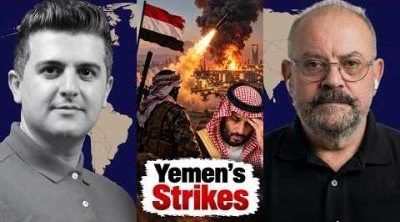
Elijah Magnier: Yemen’s strikes are shattering Saudi Arabia’s long-term strategy
or go to
Aletho News Archives – Video-Images
From the Archives
British weapons and personnel doing much of the killing in Yemen
Press TV – June 18, 2019
A detailed report published by the Guardian newspaper has shown how Britain is massively contributing to Saudi Arabia’s devastating war on Yemen as it suggests that London is not only supplying the bombs that fall on Yemenis, but it provides the personnel and expertise that keep the war going.
The comprehensive report by Arron Merat published on Tuesday showed that Britain was doing much of the killing in Yemen as the country continues to provide Saudi Arabia with everything it needs to turn its southern impoverished neighbor into a graveyard.
“Every day Yemen is hit by British bombs – dropped by British planes that are flown by British-trained pilots and maintained and prepared inside Saudi Arabia by thousands of British contractors,” said Merat in the report. … continue
Blog Roll
 Aletho News
- Netizens condemn Japanese drama for projecting Japan’s wartime atrocities onto Chinese characters
- Racist Seinfeld Dances for Joy as Bibi Unveils His New Map
- A West Bank War for Netanyahu’s Election Campaign, Could It Backfire?
- Yemen denounces European Parliament’s ‘hypocritical’ push to blacklist Ansarullah
- Qalibaf: UAE’s UN bid aims to ‘clear the runway’ for ‘Greater Israel’, whitewash genocide
- Pakistan reopens Iran border after boosting security: Report
- Why are so many Brazilians voting for Flávio Bolsonaro?
- Democrats Put Anti-Russia Agenda Ahead of American Workers
- Elijah Magnier: Yemen’s Strikes Are Shattering Saudi Arabia’s Long-Term Strategy
- Pentagon designates Chinese cultural centers national security threat
- If Americans Knew
- An error has occurred; the feed is probably down. Try again later.
- No Tricks Zone
- Sudden Stratospheric Warming, Powerful El Niño Combination May Lead To Extreme Europe Cold, Energy Crisis!
- Two New Studies Find Thwaites Glacier Melt Cannot Be Driven By Human Activity Or A Warming Ocean
- E-Cars Reduce CO2 Emissions By Only 41% Compared To Internal Combustion Engine Vehicles
- Predictions Made By Renowned Climate Professor Over Past Decades Have Been Proven To Be Poor
- New Study Suggests Large Regions Of The Pacific Ocean Have Been Cooling For The Last 80 Years
- Germany’s Green Energy Debacle: High Energy Costs Force Kahla Porzellan to Close After 182 Years!
- New Study: 50 Years Of The Most Aggressive ‘Net Zero’ Policies Can Only Affect The Global Climate By 0.03°C
- US September “Heat” Was No Record…Many Records Set Decades Ago
- Latest European Green Energy Debacle; Portugal’s Largest Flagship Solar Park Insolvent!
- Green Energy Debacle: German Expert Professor Fritz Vahrenholt Warns Of Severe Economic And Social Consequences

