Diplomat Once Again Denies Claims about Iranian Arms Shipment to Yemen
Fars News Agency | February 15, 2013
TEHRAN – A senior Iranian diplomat once again categorically denied the recent accusations about Iran’s arms shipment to Yemen as “baseless”.
In a letter to President of the United Nations Security Council (UNSC), Zhang Yesui on Thursday, Iran’s Permanent Representative to the UN Mohammad Khazayee said initial investigations showed that the ship intercepted by the Yemeni government does not belong to the Islamic Republic.
The ship had been registered in a European country and sailed under the flag of Panama, Khazayee said, adding that none of the vessel’s personnel were Iranian.
Referring to similar accusations leveled against Iran by Yemen, a number of which were later rejected by Yemeni officials, Khazayee said no proof about the latest allegation has yet been presented.
Iranian Foreign Ministry Spokesman Ramin Mehman-Parast categorically denied the accusations about arms shipment to Yemen as baseless, and reiterated that Tehran respects the regional stability and security.
Mehman-Parast’s remarks came after several Yemeni officials, including the country’s Interior Minister Abdel-Qader Kahtan, and the Saudi-led Yemeni media claimed that an Iranian ship seized by the Yemeni military contained weapons destined for Yemen’s Houthi Community in the North of the country or as other Yemeni officials claimed for rebels in Somalia fighting the central government.
“We have announced several times that we prioritize the region’s stability and security, and underline the rights and national sovereignty of (other) countries,” the Iranian diplomat said.
Last week, Yemen’s President Abd-Rabbu Mansour Hadi accused Iran of smuggling arms into the Arab country. The Yemeni government asked the United Nations to probe a seized ship it claims contained Iran-made weapons.
Iranian officials on different occasions have strongly refuted Yemeni officials’ allegations, saying that Iran attaches importance to maintaining security and stability of regional countries, specially Yemen.
How the Media First Reported Abdulrahman Al-awlaki’s Assassination
By David Kretzmann | July 22nd, 2012
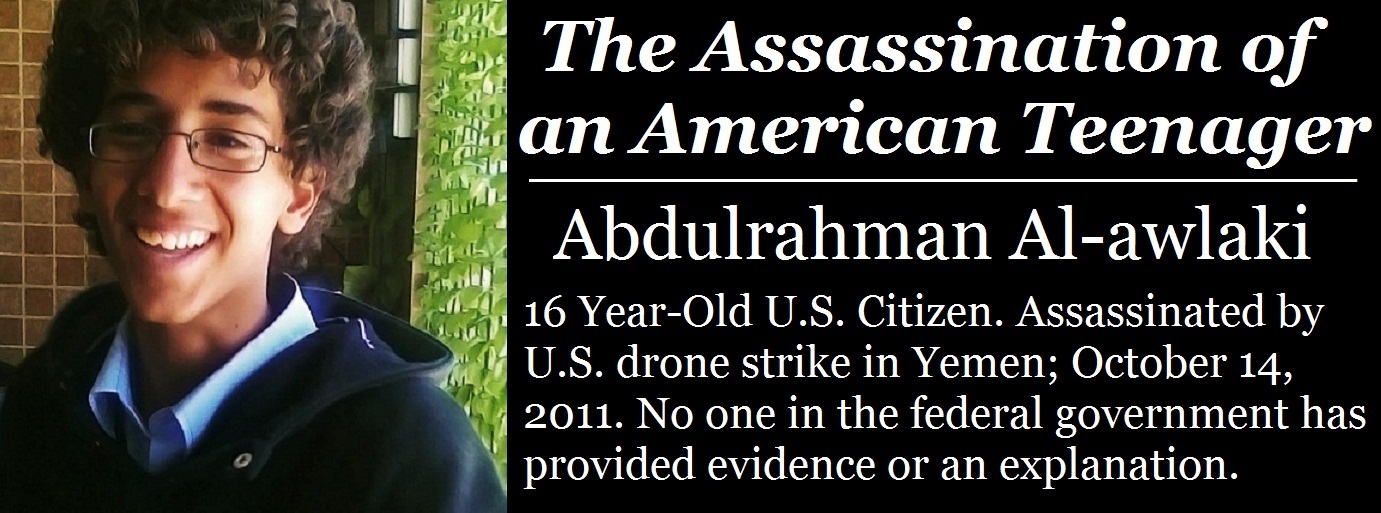
How was Abdulrahman’s targeted assassination initially reported in the media? Some quotes that sound very familiar with the usual semantics of all media coverage on drones and suspects:
“Yemeni officials told reporters that nine members of Al Qaeda in the Arabian Peninsula were killed in the strike near the town of Azzan in southeastern Yemen, including Awlaki’s 21-year-old son…” – LA Times, October 15, 2011
“Report: Al-Awlaki’s son among dead in U.S. airstrike on Yemen al-Qaida militants” – headline from Haaretz, October 15, 2011
“Official: Drone attack kills Al-Awlaki’s son in Yemen… The attacks, carried out in the Shabwa district, killed seven suspected militants, the defense ministry said.” – CNN, October 15, 2011
“Awlaki’s son is also among the 24 militants killed in air strikes targeting al-Qaeda in Yemen, local officials said.” – Al Arabiya News, October 15, 2011
“Three drone attacks in Yemen Friday night killed seven suspected militants including Anwar Al-Awlaki’s son, a security official said. Carried out in the Shabwa district, where the younger Awlaki had been holed up for more than eight months” – Business Insider, October 15, 2011
“U.S. drone strike in Yemen kills nine jihadis, including Awlaki’s son” – Hot Air, October 15, 2011
Lie #1: Abdulrahman is a 16 year old American teenager, not a 21 year old militant.
Lie #2: U.S. claimed al-Banna was the actual target. The problem with that excuse is that al-Banna is alive and well, and was never at that site. Since that revelation, the Obama Admin. simply states there is no official record of the death of Abdulrahman, and sweeps the story under the carpet so it doesn’t even have to take accountability that the crime even happened.
Lie #3: The media says Abdulrahman was hiding in the mountains for months. Actually, he left his home a couple weeks before to find out about his father, and even during that time he was living and moving around in the open, far from hiding.
It seems that being a suspected militant is enough to make you a viable target. And the criteria for determining what makes you a suspect is easily adjustable to their convenience it seems.
Barack Obama: the first U.S. president to use targeted assassination against a child.
Taken from: Abdulrahman Anwar Alawlaki – A crime we’ll never forget
Yemenis condemn presence of US Marines in Sana’a
Press TV – January 9, 2013
Yemeni citizens, rights groups and lawmakers have vehemently condemned the presence of US Marine troops on Yemeni soil and the transformation of a five-star hotel in the capital, Sana’a, into a US military base, Press TV reports.
In interviews with Press TV, the legislators and human rights activists harshly criticized the conversion of the capital’s Sheraton Hotel into a military building and said they considered the presence of American forces as an occupation of their country.
The Yemenis argued that the US move to bring in the Marines for the protection of its diplomatic mission is merely a pretext for US domination on the ground.
“American Marines entered the country before the revolution and their numbers have increased… it’s similar to what happened when Britain occupied southern Yemen decades ago. The presence of Marine forces in the large number can only be described as an occupation,” political activist Abdu Ahmed said.
The US embassy in Sana’a reportedly booked all the rooms in the Sheraton Hotel, firing 200 members of the hotel’s staff after paying them a severance payment equal to six months of salary.
“We feel insecure. Anyone who goes up on the rooftop of his building will be targeted with a red light pointed to his chest. So if we can’t feel safe in our own country where can we find security and peace of mind?” said a Yemeni citizen.
The growing US domination has sparked numerous mass demonstrations, particularly in the Sada’a governorate to the north of the capital Sana’a.
The protesters in these demonstrations expressed the peoples’ total rejection of foreign intervention in their country’s affairs.
The increasing number of US assassination drone attacks, which mostly target innocent civilians, were also lambasted by the human rights groups.
The activists said the growing US interference in Yemen’s affairs is considered a flagrant violation of the Middle Eastern country’s sovereignty.
“Giving [approval to] US Marines to violate the country’s sovereignty is treason and those giving approval must be prosecuted. The assassinations are carried out right after the US intelligence apparatus received names of people suspected of being involved in al-Qaeda. There are a number of normal people on these lists, who can be easily arrested and brought to justice if found guilty,” human rights activist Abdulrahaman Barman noted.
Washington uses its assassination drones in Yemen, Pakistan, Afghanistan, and Somalia, claiming that they target the terrorists. The attacks, however, have mostly led to massive civilian casualties.
Related articles
- Thousands of Yemenis hold anti-US, anti-Israeli Protest in Sana’a (jafrianews.com)
Yemeni regime conceals US assassination drone strikes: Report
Press TV – December 27, 2012
US officials have finally acknowledged responsibility for a September assassination drone attack in Yemen that killed civilians, including women and children, after futile attempts by the Yemeni government to falsely claim blame in a bid to cover-up the American involvement.
The Yemeni government initially announced that “its Soviet-era jets” had carried out the September 2nd attack, killing alleged al-Qaeda militants, but the country’s tribal leaders and officials later admitted that it was an American assassination drone strike that caused the killing and that “all the victims were civilians who lived in a village near Radda, in central Yemen,” The Washington Post reported on Tuesday.
US officials, the daily notes, acknowledged last week “for the first time that it was an American strike.”
According to the report, over three months after the deadly US terror drone strike, the incident sheds light into “the Yemeni government’s efforts to conceal Washington’s mistakes and the unintended consequences of civilian deaths in American air assaults.”
Three weeks after the Radda strike, US-sponsored Yemeni President Abdu Rabu Mansour Hadi visited Washington and “praised the accuracy of US [assassination] drone strikes” in an interview with Washington Post editors and reporters, as well as publicly,” the daily notes.
“They pinpoint the target and have zero margin of error, if you know what target you’re aiming at,” Hadi reportedly said to an audience at the US think tank, the Woodrow Wilson International Center for Scholars.
Washington played a key role in ousting Yemen’s former President Saleh and installing his ex-defense minister Hadi, the daily further adds, noting that the United States provides the Yemeni regime with “hundreds of millions of dollars” in military and “counterterrorism assistance.”
“US officials regard Hadi as an even stauncher counterterrorism ally than [former US-sponsored ruler Ali Abdullah] Saleh.”
US assassination aerial strikes have murdered numerous civilians in Afghanistan, Pakistan and other parts of the world, the daily confirms, adding that “those governments have spoken against the [drone] attacks.”
“But in Yemen, the weak government has often tried to hide civilian casualties from the public, fearing repercussions in a nation where hostility toward US policies is widespread. It continues to insist in local media reports that its own aging jets attacked the truck.”
The US daily also refers to another US terror drone strike in 2009 which the Yemeni regime claimed responsibility for. “We’ll continue saying the bombs are ours, not yours,” said a US Embassy e-mail leaked by the whistleblower Web site WikiLeaks, quoting then Yemeni ruler Saleh as telling the head of US Central Command at the time, General David Petraeus.
This is while the Obama administration has publicly remained silent about the deadly strike, “neither confirming nor denying any involvement, a standard practice with most US airstrikes in its clandestine counterterrorism fight in this strategic Middle Eastern country,” the Post underlines.
The daily further quotes unnamed US officials, who spoke on condition of anonymity, as confirming that “it was a Defense Department aircraft, either a drone or a fixed-wing warplane, that fired on the truck [in the Radda attack].” It notes that the Pentagon, as well as “senior US officials in Yemen and senior counterterrorism officials in Washington,” have declined to comment on the incident.
Meanwhile, the reports reiterated, public outrage is growing in Yemen as demands “for accountability, transparency and compensation go unanswered amid allegations by human rights activists and lawmakers that the government is trying to cover up the attack to protect its relationship with Washington.”
Related articles
- Thousands of Yemenis hold anti-US, anti-Israeli Protest in Sana’a (jafrianews.com)
- 1000s of Yemenis hold anti-US, anti-Israeli demo (realisticbird.wordpress.com)
US ‘suicide’ label for dead of Yemeni Gitmo inmate discounted
Press TV – November 29, 2012
US military’s claim that a Yemeni inmate found dead in September at Guantanamo Prison camp had committed suicide by medication drug overdose has been discounted by American and Yemeni officials.
The circumstances surrounding the death of Adnan Farhan Abdul Latif, one of the first men taken captive by American forces after their invasion of Afghanistan, have raised suspicions since the military announced over two months ago that a guard at the notorious prison and torture camp had found him “unconscious and unresponsive” in his cell, The New York Times reported Thursday.
While a US military medical examiner labeled Latif’s death as “suicide,” how he gained access to additional drugs is reportedly still under probe.
Yemeni officials have refused to accept the remains of the inmate until they get answers about the exact cause of his death. This is while a Pentagon official delivered an autopsy report to the Yemeni ambassador in Washington earlier this month, describing Latif’s death as ‘suicide,’ the daily adds, citing a report this week by the Web site, Truth-out.org.
However, Latif’s former lawyer, David Remes, expressed skepticism about how Latif could have saved his daily medications for an overdose without detection considering that he was under “intense scrutiny” by guards and prison cameras.
Remes further suggested that authorities at the military prison may have deliberately given Latif access to too much medication “hoping he would kill himself,” the report adds.
Moreover, Remes reiterated that shortly before Latif’s death, other Guantanamo detainees said guards had told Latif that they were taking him to a disciplinary cellblock, which he resisted. He was then placed in a specific cell which “he hated because of droning noise from an adjacent electric generator,” the report notes.
“Adnan (Latif) was a thorn in their sides,” Remes said. “The guards would ask other prisoners how to handle him. He refused to submit. He wouldn’t allow them to set the terms of his imprisonment. He was a constant problem.”
Latif, was seriously injured in an auto accident in his native Yemen and was in Afghanistan, seeking free or charity medical treatment when he was taken captive by US-led occupation forces.
He had been cleared for transfer back to his homeland before by both the Bush and Obama administrations; however he wasn’t sent home.
In 2010, a federal judge ordered Obama administration to free Latif, arguing that the evidence against him was too weak. However, an appeals court panel reversed that ruling in 2011.
According to the report, executive branch panels under the Bush and Obama administrations had repeatedly cleared the Yemeni inmate for repatriation, but he was still kept at Guantanamo “because both administrations were reluctant to send detainees to Yemen amid an Islamist insurgency.”
US expands drone base in Djibouti to hit Somalia, Yemen
Press TV – October 27, 2012
The US government is expanding its drone base in the East African nation of Djibouti to escalate its assassination strikes in Somalia and Yemen.
The US military has been flying armed drones over both countries from a base in Djibouti and is planning to build a second base in Ethiopia, a report by the Washington Post says.
The report added that the drones on missions over Somalia and Yemen take off or land at the base an average of 16 times per day.
The Lemonnier base has also become home to a squadron of US F-15 fighter jets, which it reports are flying combat missions over Yemen.
The US is also known to operate drones from two other East African countries — Ethiopia and the Seychelles islands.
The base in the Seychelles that was previously used to fly surveillance drones will now host armed drones capable of flying their lethal payloads the more than 1,500 kms that separate the Indian Ocean island chain from Somalia and the African mainland and back.
However, drone operations from Ethiopia and Seychelles are nothing compared to the one at Camp Lemonnier. According to the report Lemonnier is the centerpiece of an expanding US network of drone and surveillance bases in Africa.
Washington has also been carrying out assassination attacks using the unmanned aircraft in other countries including Afghanistan, Libya and Pakistan.
The United States claims the CIA-run strikes are aimed at militants. But witness reports and figures offered by local authorities indicate the attacks have led to massive civilian deaths.
Yemen’s Revolution Far From Accomplished
By Noon Arabia | Al Akhbar | September 10, 2012
Most Western headlines about Yemen lately have focused on the “al-Qaeda threat” and “US drone strikes on suspected militants.” Unfortunately, neither give much credence to the real challenges facing Yemenis since former President Ali Abdullah Saleh transferred his powers to his Vice President Abd-Rabbu Mansour Hadi on 27 February 2012 through a Gulf-brokered transitional plan.
The Gulf initiative was widely rejected among Yemenis as it did not fulfill the democratic demands of the revolution. The deal was more of an attempt to salvage the regime, yet some argue that it was the only option available. Sam Waddah, a Yemeni blogger, points out that “Yemenis in their revolution were not just up against Saleh and his regime, but also against the international community where major regional and international powers including the United States and Saudi Arabia backed Saleh up to the last minute.”
The initiative was viewed as an attempt by Saudi Arabia to subvert Yemen’s revolution and stop it from spilling across the border. The US worked behind the scenes and strongly backed the initiative after finding in President Hadi a suitable successor who would support their drone campaign in Yemen. US drone strikes have only intensified since Hadi assumed power and are causing popular outrage towards both the US and the Yemeni government as civilian death tolls mount.
Yemen’s 2011 revolution demanded an overall change in the economic, political, social and military spheres. Among the main demands of the 10-month revolution were the change of the regime, an end to Saleh’s corrupt family rule and the reconstruction of the army. According to the Gulf transitional plan, begrudgingly signed by Saleh on 23 November 2011, President Hadi will serve for an interim two-year period in which his main tasks will be the reconstruction of the military, conducting a national dialogue, drafting a new constitution and preparing for the 2014 elections.
Six months on, Hadi and his interim government are still facing many challenges impeding the achievement of these goals. Among these challenges are the weekly, if not daily, suicide attacks and car bombs allegedly by al-Qaeda, the assassinations and assassination attempts of military and political figures, the continuous attacks on the power grids and gas pipelines allegedly by tribes in Mareb, the Hirak separatist movement in the South, the Houthi rebels in the North, the deteriorating humanitarian conditions, and catastrophic food and refugee crises gripping the country. However, thwarting Hadi’s attempts to advance on any of these fronts is former president Saleh himself.
Those who are not following Yemen closely might be amazed to know that Saleh still lives in Yemen’s capital Sanaa and has awarded himself the title of “leader” to replace the lost title of “president.” He still heads the General People’s Congress (GPC), the former ruling party that is a 50 percent partner in the current National Unity Government, and is thus constantly disturbing the transitional process through loyalist supporters. His family members still hold key military positions. Ahmed Saleh, the son of the former dictator, remains the leader of the Republican Guards and Yahya, Saleh’s nephew is still the head of the Central Security Force. Yemen is paying dearly for the Gulf plan, which did not ban Saleh or his family from participating in the country’s political and military spheres.
The Saleh family still plays a prominent role despite some efforts by Hadi to remove some members and loyalists from the military and governmental posts. Some argue that Hadi lacks the power or the will to remove the two men close to Saleh entirely from their posts. “The fact that these two forces [Republican Guards and Central Security] were the reason behind almost all the blood spilt in the revolution and yet their leaders are still reigning is beyond me,” says Luai Ahmed, an 18-year-old Yemeni student and activist.
In a blatant sign of defiance to Hadi’s decision to reconstruct the military, the pro-Saleh Republican Guards troops besieged the Ministry of Defense on 14 August, while the president was out of the country, killing five people and wounding nine others. In late July a group of policemen and tribesmen loyal to Saleh occupied the Ministry of the Interior and looted its contents, killing 15 people. According to a local report, Hadi himself has already survived six assassination attempts in only seven months in office.
Yemen is often touted as an Arab Spring success story that has deposed its dictator, but reality is Yemenis are still suffering from political instability, violence, electricity and water cuts, inflation, unemployment, and food shortages, all of which have only intensified in the aftermath of the revolution.
“The fact that people are more aware of their rights and the corrupt deals the previous government made, forces them to escalate their demands and put pressure on the government,” said Shatha al-Harazi, a political and human rights journalist.
Many Yemenis do not feel that substantial change has been achieved since the ouster of Saleh. The state has lost control over some areas of Yemen, and the military is divided and on constant standby for any possible confrontation. They feel the intense power struggle between the old regime and the current one. A Yemeni journalist who asked not to be named describes the situation in Yemen as dire and chaotic. “The likelihood of a successful transition is up in the air and similarly the possibility of a potential civil war or armed conflict is also there.”
UN Envoy to Yemen Jamal Bin Omar stated that non-military sanctions under Chapter VII of the UN Security Council Charter will be imposed against any official who attempts to hinder the political settlement, including the freezing of assets and a travel ban. However, the empty threats by Hadi and the UN, repeated ad nauseum, have not deterred Saleh and his loyalists from seeking to undermine Hadi’s power and hinder the implementation of the Gulf plan which ousted him from power.
Unless Saleh’s family is truly dismissed from positions of power and international sanctions are immediately imposed on them, Yemen will continue to suffer from political instability and insecurity.
Noon Arabia is a Yemeni blogger, wishing to write under a pseudonym for personal and security reasons
Related articles
- US dispatches troops, military hardware to Yemen (alethonews.wordpress.com)
- Yemen: Patronage stalls Yemen’s transition (ionglobaltrends.com)
US dispatches troops, military hardware to Yemen
Press TV – September 10, 2012
The United States has reportedly dispatched a large number of troops and military hardware to a military base in southern Yemen.
According to some Yemeni media, about 4,000 American troops, a number of F-16 jet fighters, Lockheed C-5 Galaxy military transport aircraft and Apache helicopters have been stationed in al-Anad Air Base in Lahij province.
The deployment of the American forces and military hardware to Yemen has changed the Arab country to one of the biggest US military bases in the Middle East, the reports say.
In July, Yemeni military sources unveiled that about 150 American troops equipped with high-tech military and communication tools have arrived in Yemen.
The US soldiers arrived in the al-Anad Air Base on a military plane on July 1, the Ansarullah website quoted Yemen’s military sources as saying.
The deployments came after Yemeni Foreign Minister Abu Bakr al-Kurbi revealed that Sana’a had requested Washington to send assassination drones “in some cases against fleeing al-Qaeda leaders.”
In May, US Defense Secretary Leon Panetta for the first time admitted to the use of drones in Yemen.
The United States has launched frequent assassination drone attacks not just in Yemen but in Pakistan, Afghanistan, and Somalia. The attacks have left thousands of people dead over the past few years.
Related articles
- The War in Yemen; 100+ Drone Strikes Since May 2011 (reason.com)
US assassination drone attack kills five in eastern Yemen
Press TV – September 5, 2012
At least five people have been killed in a fresh US assassination drone attack in the eastern Yemeni province of Hadramawt, a security official says.
Three others were also wounded after a US drone fired two missiles at a house in the village of al-Ain on Wednesday.
The house was completely flattened in the air strike. It was the third US drone attack in Hadramawt Province in the past two weeks.
The latest attack comes a day after Yemeni President Abdrabuh Mansur Hadi ordered a probe into a recent US assassination drone strike in the central city of Radaa that killed more than a dozen civilians.
On September 2 at least 13 civilians, including two women and a child, were killed and three others injured in the US drone attack in Radaa, just days after similar attacks claimed the lives of dozens of Yemenis in the south and east of the country.
Shortly after the attack Radaa residents blocked main roads in the city to protest the deadly strike attack and demanded an end to US drone attacks.
Washington has been using its assassination drones in Pakistan, Afghanistan, Yemen and Somalia and claims that it is targeting terrorists, but the attacks have mostly led to massive civilian deaths.
The UN has slammed the US terror drone attacks as targeted killings and says they pose a challenge to international law.
Reports, however, say that the CIA is seeking to expand its covert drone attacks in Yemen, despite the fact that the airstrikes mostly result in civilian casualties.
Related articles
- US drone attacks leave 21 dead in NW Pakistan in 48 hours (sott.net)
- Yemen probes civilian deaths in apparent US drone strike (altahrir.wordpress.com)
US War on Yemen: Invisible Casualties

(Photo: Atiaf Alwazir)

By Atiaf Alwazir | Al Akhbar | August 20, 2012
The life of fourteen-year-old Ali Alkhadr from Abyan was changed forever on 9 May 2011. Returning from a family visit in al-Mihrab village, Ali was hit by shrapnel from an air-strike that tore his jaw wide open. Air-strikes in the South that target al-Qaeda in the Arabian Peninsula (AQAP) often indiscriminately kill or wound anyone in the surrounding area, including civilians, without a warning.
According to Ali’s father, Alkhadr Ali Hassan, Doctors without Borders/Medecins sans Frontieres (MSF) generously conducted 1 million Yemeni Riyal ($4,660) worth of reconstructive surgery. Yet Ali still needs a lot more. The once studious teenager dropped out of school due to depression.
“He refuses to see his classmates because he is disfigured. It’s been eight months and there is nothing I can do to help my son,” said the boy’s father. “He does not want to go to school and one time I hospitalized him because he overdosed on drugs. I believe he wanted to end his life, and it pains me to see that. I don’t know what to do,” he added.
Ali Alkhadr is not alone in a country were civilians are often caught in the middle between militants and the government. These civilians are often ignored in the mainstream media and their deaths denied by governments.
For a decade, US policy in Yemen has centered on counter-terrorism cooperation with Yemeni security forces through the training and funding of counter-terrorism units, targeted assassinations including US citizens, small on-the-ground operation units, and drone attacks.
Terrorism is of grave concern in Yemen, and its consequences are far reaching. On Saturday 4 August 2012, locals in Jaar were the targets of a bombing by militants that killed at least 40 people. The Yemeni and US government’s response to these attacks in Yemen has included arbitrary arrests, homes being demolished, death and injuries, and displacement of civilians.
Since January 2012, there have been over 60 US air-strikes in Yemen, according to the Bureau of Investigative Journalism (TBIJ), killing approximately hundreds of civilians.
On 15 May 2012, an air-strike, believed to be a US drone, hit a civilian home. People nearby ran to see what had happened and to help the injured inside.
“About 15 minutes later, another plane suddenly struck the same building killing 15 people, including my brother,” said 19-year old Hassan Ahmed Abdullah recounting the incident. “He was wounded by shrapnel in his chest, liver, and neck. He also had burns on 50 percent of his body.”
From scarred people to destroyed buildings, Abyan carries many testaments to the war on terror.
Most of the civilian homes in the impoverished area of al-Kod were destroyed by air-strikes and heavy artillery. This area houses some of the poorest people in Yemen.
Bombs did not only hit homes but also struck schools and even the largest hospital in Abyan, al-Razi hospital.
“The bombing of al-Razi hospital was a tragedy, and I believe we will suffer from it for years to come, especially in light of Yemen’s economic social and political deterioration,” said psychologist and Jaar resident, Wahib Saad who also stressed the psychological trauma of such attacks.
“Today, when I hear a plane I immediately run to the house” said seven-year-old Ahmed. Ahmed’s drawings and the other children’s show images of darkness, death, and destruction, indicating that the generations to come will need much more than financial compensation to recover.
While many residents of Abyan believe that US strikes are more accurate in hitting their desired targets than Yemeni ones, the majority believes that the implications of US bombing are disastrous.
This is seen from the fact that US strikes are seen as an invasion, an occupation and a breach of sovereignty. A citizen journalist who preferred to remain anonymous said to me, “Let’s be honest, I am against US intervention. The Yemeni government has the right to rely on the US for help but not when the US is using Yemenis against their own brothers. As a southern separatist, I believe that we are already under two occupations, by the North and the militants, and I don’t want a third occupation by the Americans,” he said. … Full article
Featured Video

Elijah Magnier: Yemen’s strikes are shattering Saudi Arabia’s long-term strategy
or go to
Aletho News Archives – Video-Images
From the Archives
British weapons and personnel doing much of the killing in Yemen
Press TV – June 18, 2019
A detailed report published by the Guardian newspaper has shown how Britain is massively contributing to Saudi Arabia’s devastating war on Yemen as it suggests that London is not only supplying the bombs that fall on Yemenis, but it provides the personnel and expertise that keep the war going.
The comprehensive report by Arron Merat published on Tuesday showed that Britain was doing much of the killing in Yemen as the country continues to provide Saudi Arabia with everything it needs to turn its southern impoverished neighbor into a graveyard.
“Every day Yemen is hit by British bombs – dropped by British planes that are flown by British-trained pilots and maintained and prepared inside Saudi Arabia by thousands of British contractors,” said Merat in the report. … continue
Blog Roll
 Aletho News
- Netizens condemn Japanese drama for projecting Japan’s wartime atrocities onto Chinese characters
- Racist Seinfeld Dances for Joy as Bibi Unveils His New Map
- A West Bank War for Netanyahu’s Election Campaign, Could It Backfire?
- Yemen denounces European Parliament’s ‘hypocritical’ push to blacklist Ansarullah
- Qalibaf: UAE’s UN bid aims to ‘clear the runway’ for ‘Greater Israel’, whitewash genocide
- Pakistan reopens Iran border after boosting security: Report
- Why are so many Brazilians voting for Flávio Bolsonaro?
- Democrats Put Anti-Russia Agenda Ahead of American Workers
- Elijah Magnier: Yemen’s Strikes Are Shattering Saudi Arabia’s Long-Term Strategy
- Pentagon designates Chinese cultural centers national security threat
- If Americans Knew
- An error has occurred; the feed is probably down. Try again later.
- No Tricks Zone
- Sudden Stratospheric Warming, Powerful El Niño Combination May Lead To Extreme Europe Cold, Energy Crisis!
- Two New Studies Find Thwaites Glacier Melt Cannot Be Driven By Human Activity Or A Warming Ocean
- E-Cars Reduce CO2 Emissions By Only 41% Compared To Internal Combustion Engine Vehicles
- Predictions Made By Renowned Climate Professor Over Past Decades Have Been Proven To Be Poor
- New Study Suggests Large Regions Of The Pacific Ocean Have Been Cooling For The Last 80 Years
- Germany’s Green Energy Debacle: High Energy Costs Force Kahla Porzellan to Close After 182 Years!
- New Study: 50 Years Of The Most Aggressive ‘Net Zero’ Policies Can Only Affect The Global Climate By 0.03°C
- US September “Heat” Was No Record…Many Records Set Decades Ago
- Latest European Green Energy Debacle; Portugal’s Largest Flagship Solar Park Insolvent!
- Green Energy Debacle: German Expert Professor Fritz Vahrenholt Warns Of Severe Economic And Social Consequences

