The Bush administration detained and tortured suspected militants; the Obama administration assassinates them. Both practices not only visit more hatred upon the United States; they are also illegal. Our laws and treaties prohibit torture. The Constitution forbids the government from depriving any person of life without due process of law; that is, arrest and fair trial. Yet President Obama has approved the killing of people, many of whom were not even identified before the kill order was given.
Jo Becker and Scott Shane reported in the New York Times that Obama maintains a “kill list.” After consulting with his counterterrorism adviser John O. Brennan, Obama personally makes the decision to have individuals executed. Brennan was closely identified with torture, secret prisons, and extraordinary rendition during the Bush administration. The Times story, based on interviews with three dozen current and former Obama advisers, reports that “Mr. Obama has avoided the complications of detention by deciding, in effect, to take no prisoners alive. While scores of suspects have been killed under Mr. Obama, only one has been taken into U.S. custody” because he doesn’t want to add new prisoners to Guantanamo.
The leak of the kill list angered Republicans, evidently because they believe it demonstrates Obama’s “strength” in foreign policy. Some progressives who do not fully understand the profound illegality of drone attacks find them preferable to the United States’ all out invasions of more countries. We all need to understand that the unlawful precedent the United States is setting with its use of killer drones not only undermines the rule of law; it also will prevent the United States from reasonably objecting when other countries that obtain drone technology develop “kill lists” of persons those countries believe represent threats to them.
On June 15, for the first time, Obama publicly acknowledged that his administration is engaging in “direct action” in Yemen and Somalia. Although the United States is not at war with either country, George W. Bush’s “War on Terror” has morphed into Obama’s “War on Al Qaeda.” Obama’s “war” has been used as an excuse to assassinate anyone anywhere in the world whenever the President gives the order.
But “there is not a distinct entity called Al Qaeda that provides a sound basis for defining and delimiting an authorized use of force,” according to Paul P. Pillar, deputy director of the CIA’s Counterterrorist Center from 1997 to 1999. The United States is not at war with Yemen and Somalia. Even if Obama identifies certain people living in Yemen or Somalia as members of Al-Qaeda who are desirous of committing acts of terror against the people of the United States, there is no basis in law for our government to declare war on individuals it considers a threat. The United States has legal means to indict and extradite, both under U.S. and international law.
Since 2004, some 300 drone strikes have been launched in Pakistan. Twenty percent of the resulting deaths are believed to have been civilians. The Pakistan Human Rights Commission says U.S. drone strikes were responsible for at least 957 deaths in Pakistan in 2010.
In the three and one-half years since Obama took office, between 282 and 585 civilians have been killed, including more than 60 children. “The CIA’s drone campaign has killed dozens of civilians who had gone to rescue victims or who were attending funerals,” a new report by the London-based Bureau of Investigative Journalism found.
But, according to the Times article, Obama has developed a creative way to count civilian casualties. All military-age men killed in a drone strike zone are considered to be combatants, “unless there is explicit intelligence posthumously proving them innocent.” As a result, Brennan reported last year that not one civilian had been killed during one year of strikes. An administration official recently claimed that the number of civilians killed by drone strikes in Pakistan was in the “single digits.” Three former senior intelligence officials told the Times that they couldn’t believe the number could be so low.
Obama, who has been targeting “suspected militants” (called “personality strikes”) in Pakistan, Yemen and Somalia, even killing U.S. citizens, has authorized expanded drone attacks – whenever there are suspicious “patterns of behavior” at sites controlled by a terrorist group. These are known as “signature strikes.” That means bombs are being dropped on un-identified people who are in an area where suspicious activity has taken place. This goes beyond the illegal practice of “targeted killing.” People are being killed without even being an identified target.
The administration justifies its use of armed drones with reference to the Authorization for the Use of Military Force that Congress passed just days after the September 11 attacks. In the AUMF, Congress authorized force against groups and countries that had supported the terrorist strikes. But Congress rejected the Bush administration’s request for open-ended military authority “to deter and preempt any future acts of terrorism or aggression against the United States.” Deterrence and preemption are exactly what Obama is trying to accomplish by sending robots to kill “suspected militants” or those who happen to be present in an area where suspicious activity has taken place.
Moreover, in the National Defense Authorization Act of 2012, Congress specifically declared, “Nothing in this section is intended to . . . expand the authority of the President or the scope of the Authorization for the Use of Military Force [of September 2001].”
Drone attacks also violate well-established principles of international law. A targeted killing is defined as the “intentional, premeditated, and deliberate use of lethal force . . . against a specific individual who is not in the physical custody of the perpetrator,” according to Philip Alston, former UN Special Rapporteur on Extrajudicial, Summary, or Arbitrary Executions. Targeted or political assassinations – sometimes known as extra-judicial executions – run afoul of the Geneva Conventions, which include willful killing as a grave breach. Grave breaches of Geneva are punishable as war crimes under the U.S. War Crimes Act.
Christof Heyns, the current UN Special Rapporteur on Extrajudicial, Summary, or Arbitrary Executions, expressed grave concern about the targeted killings, saying they may constitute war crimes. He called on the Obama administration to explain how its drone strikes comport with international law, specify the bases for decisions to kill rather than capture particular individuals, and whether the State in which the killing takes place has given consent. Heyns further asked for specification of the procedural safeguards in place, if any, to ensure in advance of drone killings that they comply with international law. He also wanted to know what measures the U.S. government takes after any such killing to ensure that its legal and factual analysis was accurate and, if not, the remedial measures it would take, including justice and reparations for victims and their families. Although Heyns’ predecessor made similar requests, Heyns said the United States has not provided a satisfactory response.
Heyns also called on the U.S. government to make public the number of civilians collaterally killed as a result of drone attacks, and the measures in place to prevent such casualties. Once again, Heyns said the United States has not satisfactorily responded to a prior query for such information.
Likewise, UN High Commissioner for Human Rights Navi Pillay recently declared that U.S. drone attacks in Pakistan violate the international law principles of proportionality and distinction. Proportionality means that an attack cannot be excessive in relation to the anticipated military advantage sought. Distinction requires that the attack be directed only at a legitimate military target.
The United States has ratified the International Covenant on Civil and Political Rights. The ICCPR states: “Every human being has the inherent right to life. This right shall be protected by law. No one shall be arbitrarily deprived of his life.” The Covenant also guarantees those accused of a crime the right to be presumed innocent and to a fair trial by an impartial tribunal. Targeted killings abrogate these rights.
Self defense under Article 51 of the United Nations Charter is a narrow exception to the Charter’s prohibition of the use of force or the threat of force to settle international disputes. Countries may engage in individual or collective self-defense only in the face of an armed attack. To the extent the United States claims the right to kill suspected terrorists or their allies before they act, there must exist “a necessity of self-defence, instant, overwhelming, leaving no choice of means, and no moment for deliberation,” under the well-established Caroline Case. Obama’s drone attacks do not meet this standard.
The United States’ resort to ever increasing targeted killings is a direct result of the “War on Terror” the Bush administration declared after 9/11. Bush declared a perpetual war on a tactic and claimed all Al-Qaeda and Taliban are terrorists who may be preemptively killed as a form of self defense, rather than being arrested and tried for criminal acts. Although he does not use the phrase “War on Terror,” Obama has continued and even extended this policy. It is the product of a powerful military industrial complex in the United States which sees the use of force as the first step to resolving disputes rather than a last resort, notwithstanding the strictures of the UN Charter.
This practice sets a dangerous precedent. Heyns opined that “any Government could, under the cover of counter-terrorism imperatives, decide to target and kill an individual on the territory of any State if it considers that said individual constitutes a threat.” Heyns also cited information that indicates “the attacks increasingly fuel protests among the population.” Heyns said the “lack of transparency” and “dangerous precedent” that drone attacks represent “remain of grave concern.”
Drone strikes are also counterproductive. They breed increased resentment against the United States and lead to the recruitment of more terrorists. “Drones have replaced Guantanamo as the recruiting tool of choice for militants,” Becker and Shane wrote in the Times article. They quoted Faisal Shahzad, who, while pleading guilty to trying to detonate a bomb in Times Square, told the judge, “When the drones hit, they don’t see children.” Pakistani ambassador Zamir Akram told the Geneva Forum last week that the drone attacks are illegal and violate the sovereignty of Pakistan, “not to mention being counter-productive.” He added, “thousands of innocent people, including women and children, have been murdered in these indiscriminate attacks.”
Becker and Shane noted, “[Obama’s] focus on strikes has made it impossible to forge, for now, the new relationship with the Muslim world that he had envisioned. Both Pakistan and Yemen are arguably less stable and more hostile to the United States than when Mr. Obama became president. Justly or not, drones have become a provocative symbol of American power, running roughshod over national sovereignty and killing innocents.”
Ibrahim Mothana, who wrote an op-ed in the Times titled “How Drones Help Al Qaeda,” agrees. “Drone strikes are causing more and more Yemenis to hate America and join radical militants; they are not driven by ideology but rather by a sense of revenge and despair,” Mothana observed.
It is time to halt this dangerous and illegal practice.
Marjorie Cohn is a professor at Thomas Jefferson School of Law and past president of the National Lawyers Guild. Her most recent book is The United States and Torture: Interrogation, Incarceration, and Abuse.
June 25, 2012
Posted by aletho |
Civil Liberties, Militarism, Progressive Hypocrite, Timeless or most popular, War Crimes | Christof Heyns, George W. Bush, John O. Brennan, Obama, Pakistan, United States, Yemen |
Leave a comment
When President Barack Obama was campaigning for president in 2008 he condemned the assaults on constitutional rights and military operations that marked the George W. Bush administration’s “war on terror.” On his second day in office, Obama issued several executive orders as a symbol of the new administration’s break with the past and pledged to “restore the standards of due process and … core constitutional values.”
But over the last three and a half years Obama has in fact deepened the assault, strengthening the executive powers of his office and establishing new legal precedents to legitimatize major aspects of it—from indefinite detentions and military tribunals to presidential-ordered assassinations of U.S. citizens. Unlike his predecessor, Obama has intimately involved himself in directing hunter-killer operations carried out by aerial drone pilots and commando hit squads from Pakistan to Yemen to Somalia—which have mushroomed under his watch.
Among Obama’s inaugural executive decrees was a pledge to close the Pentagon’s notorious military prison camp at Guantánamo Bay, Cuba, within a year. Today it’s still open with 169 prisoners. The administration’s policy has been to send no new prisoners there, but instead to expand its prison at the U.S. airbase in Bagram, Afghanistan, where some 2,000 languish further from public attention and without a pretense of any rights.
The order’s fine print made clear the president was not challenging the indefinite detention of detainees without charges. Inmates “not approved for release or transfer,” the order said, “shall be evaluated to determine … whether it is feasible to prosecute” them.
Two months later the administration was filing its first court brief defending indefinite military detention for Guantánamo detainees under executive wartime powers. In May of that year Obama defended his prerogative to indefinitely hold those “who cannot be prosecuted yet who pose a clear danger.” His administration has designated 46 prisoners for detention without trial.
Another executive order signed on Obama’s second day announced the closure of secret CIA “detention facilities,” commonly referred to as “black sites.” The order included a clause stating that “detention facilities … do not refer to facilities used only to hold people on a short term, transitory basis.”
The undefined “short term” and “transitory basis” allowed the CIA to continue its practice of “extraordinary renditions” to other countries for “enhanced interrogation,” with a new air of legitimacy. In September 2010, a U.S. appeals court ruled in favor of the Obama administration, dismissing a suit by five victims of torture under the CIA’s renditions program based on the government’s “state secrets” privilege.
In his first week in office President Obama suspended military commissions at Guantánamo. In March 2011 Obama issued an executive order resuming them with some minor tweaks. Some three dozen have been designated by the current administration to face military “justice” in which the Pentagon assigns military officers to serve as judge and jury and the use of secret evidence and hearsay is permitted.
Another presidential order in March 2011 further validated indefinite detention by establishing a periodic government review of Guantánamo prisoners slated for military prosecution or considered neither fit for trial nor release.
Since assuming office the Obama administration has conducted nearly 300 drone strikes—255 of which have taken place in Pakistan, according to the Long War Journal website. This is roughly six times more than were carried out during the entire Bush administration.
The current president has taken a peculiar interest in the remote assassination campaign. “Obama has placed himself at the helm of a top secret ‘nominations’ process to designate terrorists for kill or capture, of which the capture part has become largely theoretical,” said a May 29 article in the New York Times titled “Secret ‘Kill List’ Proves a Test of Obama’s Principles and Will.”
The president approves every name on the kill list and every strike in Yemen and Somalia, as well as many of the “more complex and risky strikes in Pakistan,” the Times said. “Every week or so, more than 100 members of the government’s sprawling national security apparatus gather, by secure video teleconference, to pore over terrorist suspects’ biographies and recommend to the president who should be the next to die,” reported the paper. The president’s strikes have included some that were certain to result in what the administration counts as civilian casualties. The official civilian body count is kept low by recording all men in a strike zone as combatants, unnamed officials told the Times.
Obama’s first strike in Yemen in December 2009 killed more than 40 civilians, including women and children, and left behind a number of deadly cluster bombs to kill more. More recently a May 6 airstrike reportedly killed Fahd al-Quso, an alleged al-Qaeda leader, and 19-year-old Nasser Salim, who was tending to his farm when al-Quso drove into the area.
The latest U.S. drone assault June 4 in Pakistan’s tribal agency of North Waziristan killed 15 “suspected militants,” according to the Long War Journal. It was the eighth strike in Pakistan in 12 days. Since April, Washington has conducted 14 airstrikes in Yemen.
The Obama administration has established a protocol in Pakistan and Yemen that targets unidentified people based on “patterns of behavior” and “gathering places,” according to numerous press reports.
Last September a U.S. drone strike killed U.S.-born citizen Anwar al-Awlaki in Yemen after Obama publicly announced he put him on the hit list. That decision was “an easy one” Obama told associates, according to the Times.
Following the killing, the administration declared the president’s authority to assassinate citizens who pose an “imminent threat” if “capture is not feasible,” as Attorney General Eric Holder put it in a speech March 5 at Northwestern University School of Law. Referring to the Fifth Constitutional Amendment’s prohibition on taking life without due process, Holder said “‘due process’ and ‘judicial process’ are not one and the same.” In other words, as long as the administration has really mulled it over and Congress is not complaining, don’t worry, it’s all good.
June 10, 2012
Posted by aletho |
Civil Liberties, Militarism, Progressive Hypocrite, Timeless or most popular, War Crimes | Guantánamo Bay, Obama, Obama administration, Pakistan, Yemen |
Leave a comment
The Human Cost of the War on Terror
In the early days of the ‘War on Terror,’ US General Tommy Franks declared, “We don’t do body counts.” He was referring, of course, to the dead of Afghanistan. That the names of 9/11 victims have been appropriately written in stone, only makes it doubly striking that the war waged in their names generates little interest on non-US or NATO civilian deaths. In fact, a war now in its 11th year, comprising the invasion and occupation of two countries, as well as the ongoing bombing of at least three more, has not produced any holistic studies on its direct and indirect casualties.
That a global war can rage so long with no official will to ascertain the number of ‘others’ killed is indicative of the manner in which the cost of war is calculated by those states prosecuting it. Non-US and NATO dead, maimed, disappeared or displaced can’t be part of the equation if official policy is not to count. That there appears to be little public will to change that policy speaks of a more broadly worrying attitude toward ‘others,’ particularly Muslims. The UN and some NGO’s are attempting to count, however, mostly in the variety of local contexts engulfed in the conflict. Despite the hurdles of official obfuscation and public indifference, a catalogue of deadly consequences has begun to emerge.
Beginning in Afghanistan, most commonly cited studies on the 2001 invasion find that approximately 4,000 to 8,000 Afghani civilians died as a direct result of military operations. There are no figures for 2003-05, but in 2006 Human Rights Watch recorded just under 1,000 civilians killed in fighting. From 2007 to July 2011, the UN Assistance Mission in Afghanistan (UNAMA) tallies at least 10,292 non-combatants killed. These figures, it should be emphasized, do include indirect deaths or injuries. Some thing of the scope of indirect deaths can be gleaned from a Guardian article – the most thorough journalistic report on the subject – which calculated that at least 20,000 more died as a result of displacement and famine due to the disruption in food supplies in the first year of the war alone. As well, according to Amnesty International, approximately 250,000 people fled to other countries in 2001 and at least 500,000 more have been internally displaced since.
Moving to Iraq, the Iraq Body Count project records approximately 115,000 civilians killed in the cross-fire from 2003 to August 2011. However, the World Health Organization’s Iraq Family Health Survey reports a figure of approximately 150,000 in just the first three years of the occupation. With indirect deaths added, The Lancet Study placed the estimate at approximately 600,000 in the same period. Moreover, an Opinion Research Business study estimated 1,000,000 violent deaths to have occurred by mid-2007. In addition, the UN High Commissioner for Refugees reported approximately 2,000,000 Iraqis displaced to other countries and 2,000,000 more internally displaced as of 2007. There is no solid information on indirect death or injury rates, but the documented collapse of the Iraqi healthcare system and infrastructure more generally (foremost in the region before 1991) does not suggest anything less than another atrocity.
Beyond the two states under occupation, the ‘War on Terror’ spills into a number of neighboring countries including Pakistan, Yemen and Somalia. Prime weapons deployed in these theatres have been US ‘drones,’ special operations groups, intelligence agents and the governments/armed forces of the countries involved. Given the often extra-judicial and covert nature of this theatre, calculating casualties is hampered by the virtual absence of independent data. Indeed, this is also a problem in Afghanistan and Iraq, but even so, considering only ‘drones’ thought to have been used in Pakistan, Yemen and Somalia, the numbers of strikes is agreed to be on the rise. To date, the Bureau of Investigative Journalism reports that at least 357 strikes have occurred in Pakistan between 2004 and June 2012 (more than 300 under the Obama administration). At least 2,464 people have been killed, including a minimum of 484 civilians (168 children). The Washington Post adds 38 strikes resulting in 241 deaths (56 civilian) in Yemen. There are no figures for Somalia, but the New York Times confirms that operations have been ongoing since at least 2007.
Proponents of the war, official and public, will rush to retort that many of the citations in this article list most civilian deaths as the work of enemy combatants. But how can anyone confirm this when dependent on such a dearth of study? And as best highlighted by the ‘drone’ campaign, how can anyone transparently distinguish between civilians and combatants, when the latter’s assassins are also their judges? Indeed, even if accepted at face value, these attacks make the US government one of the most prolific, self-professed ‘target killers’ in history. Moreover, as a representative from UMANA commented on his study, “if the non-combatant status of one or more victim(s) remains under significant doubt, such deaths are not included in the overall number of civilian casualties. Thus, there is a significant possibility that UNAMA is under-reporting civilian casualties.” In fact, such problems are admitted by the authors of every study.
Pasting this patchy set of statistics together, the bottom end of the total non-US and NATO civilian deaths exceeds 140,000. The top end easily reaches 1,100,000. That’s 14,000 to 110,000 per year. To put these figures in some context, it is worth recalling that 40,000 civilians were killed by the Nazi ‘Blitz’ on Britain during WWII. As well, it should be recalled that in both low and high scenarios, figures for direct deaths in Afghanistan for 2003-5, and indirect deaths from 2003 to the present, are not available. Furthermore, civilian deaths caused by means other than drones, such as renditions and disappearances, are not counted from any arena, and casualties stemming from the military campaigns of proxies (e.g., the governments of Pakistan or Yemen) have not been tallied. The number alive, but injured, orphaned or otherwise disenfranchised, let alone those tortured in public and private prisons across the world, is also not tolled. And finally, the suffering of millions of displaced persons from Afghanistan, Iraq, Pakistan and elsewhere remains incalculable.
What has been counted here, even though tragically incomplete, illumines the reason US and NATO officials are reticent to publically do the same. To consider the staggering human cost of the ‘War on Terror’ would mean admitting that ‘terrorism’ is a two-way street and states, not militias, drive the heaviest weapons. General Franks’ preference not to count bodies is egregious, but unsurprising. That his lack of interest is echoed in the public spheres of the US and NATO countries, exposes the more astonishing consent (manufactured or not) of general populations, at least in the case of these Muslim victims. Nothing less than this official and public indifference explains the absence of any holistic study on civilian casualties, particularly while mourning the nearly 3,000 civilians killed on 9/11 and in whose name the ‘War on Terror’ is still waged.
M. Reza Pirbhai is an Assistant Professor of South Asian History at Louisiana State University. He can be reached at: rpirbhai@lsu.edu
June 8, 2012
Posted by aletho |
Militarism, Timeless or most popular, War Crimes | Afghanistan, Bureau of Investigative Journalism, Iraq, NATO, Pakistan, Somalia, United States, Yemen |
Leave a comment
The rule of law is rapidly breaking down at the top levels of our government. As officers of the court, we have sworn to “support the Constitution,” which clearly implies an affirmative commitment on our part.
Take the administrations of George W. Bush and Barack Obama. The conservative American Bar Association sent three white papers to President Bush describing his continual unconstitutional policies. Then and now civil liberties groups and a few law professors, such as the stalwart David Cole of Georgetown University and Jonathan Turley of George Washington University, have distinguished themselves in calling out both presidents for such violations and the necessity for enforcing the rule of law.
Sadly, the bulk of our profession, as individuals and through their bar associations, has remained quietly on the sidelines. They have turned away from their role as “first-responders” to protect the Constitution from its official violators.
As a youngster in Hawaii, basketball player Barack Obama was nicknamed by his schoolboy chums as “Barry O’Bomber,” according to the Washington Post. Tuesday’s (May 29) New York Times published a massive page-one feature article by Jo Becker and Scott Shane, that demonstrated just how inadvertently prescient was this moniker. This was not an adversarial, leaked newspaper scoop. The article had all the signs of cooperation by the three dozen, interviewed current and former advisers to President Obama and his administration. The reporters wrote that a weekly role of the president is to personally select and order a “kill list” of suspected terrorists or militants via drone strikes or other means. The reporters wrote that this personal role of Obama’s is “without precedent in presidential history.” Adversaries are pulling him into more and more countries – Pakistan, Yemen, Somalia and other territories.
The drones have killed civilians, families with small children, and even allied soldiers in this undeclared war based on secret “facts” and grudges (getting even). These attacks are justified by secret legal memos claiming that the president, without any Congressional authorization, can without any limitations other that his say-so, target far and wide assassinations of any “suspected terrorist,” including American citizens.
The bombings by Mr. Obama, as secret prosecutor, judge, jury and executioner, trample proper constitutional authority, separation of powers, and checks and balances and constitute repeated impeachable offenses. That is, if a pathetic Congress ever decided to uphold its constitutional responsibility, including and beyond Article I, section 8’s war-declaring powers.
As if lawyers needed any reminding, the Constitution is the foundation of our legal system and is based on declared, open boundaries of permissible government actions. That is what a government of law, not of men, means. Further our system is clearly demarked by independent review of executive branch decisions – by our courts and Congress.
What happens if Congress becomes, in constitutional lawyer Bruce Fein’s words, “an ink blot,” and the courts beg off with their wholesale dismissals of Constitutional matters based on claims and issue involves a “political question” or that parties have “no-standing-to-sue.” What happens is what is happening. The situation worsens every year, deepening dictatorial secretive decisions by the White House, and not just regarding foreign and military policies.
The value of The New York Times article is that it added ascribed commentary on what was reported. Here is a sample:
– The U.S. Ambassador to Pakistan, Cameron P. Munter, quoted by a colleague as complaining about the CIA’s strikes driving American policy commenting that he: “didn’t realize his main job was to kill people.” Imagine what the sidelined Foreign Service is thinking about greater longer-range risks to our national security.
– Dennis Blair, former Director of National Intelligence, calls the strike campaign “dangerously seductive.” He said that Obama’s obsession with targeted killings is “the politically advantageous thing to do — low cost, no US casualties, gives the appearance of toughness. It plays well domestically, and it is unpopular only in other countries. Any damage it does to the national interest only shows up over the long term.” Blair, a retired admiral, has often noted that intense focus on strikes sidelines any long-term strategy against al-Qaeda which spreads wider with each drone that vaporizes civilians.
– Former CIA director Michael Hayden decries the secrecy: “This program rests on the personal legitimacy of the president and that’s not sustainable,” he told the Times. “Democracies do not make war on the basis of legal memos locked in a D.O.J. [Department of Justice] safe.”
Consider this: an allegedly liberal former constitutional law lecturer is being cautioned about blowback, the erosion of democracy and the national security by former heads of super-secret spy agencies!
Secrecy-driven violence in government breeds fear and surrender of conscience. When Mr. Obama was campaigning for president in 2007, he was reviled by Hillary Clinton, Joseph Biden Jr. and Mitt Romney – then presidential candidates – for declaring that even if Pakistan leaders objected, he would go after terrorist bases in Pakistan. Romney said he had “become Dr. Strangelove,” according to the Times. Today all three of candidate Obama’s critics have decided to go along with egregious violations of our Constitution.
The Times made the telling point that Obama’s orders now “can target suspects in Yemen whose names they do not know.” Such is the drift to one-man rule, consuming so much of his time in this way at the expense of addressing hundreds of thousands of preventable fatalities yearly here in the U.S. from occupational disease, environmental pollution, hospital infections and other documented dangerous conditions.
Based on deep reporting, Becker and Shane allowed that “both Pakistan and Yemen are arguably less stable and more hostile to the United States than when Obama became president.”
In a world of lawlessness, force will beget force, which is what the CIA means by “blowback.” Our country has the most to lose when we abandon the rule of law and embrace lawless violence that is banking future revenge throughout the world.
The people in the countries we target know what we must remember. We are their occupiers, their invaders, the powerful supporters for decades of their own brutal tyrants. We’re in their backyard.
So lawyers of America, apart from a few stalwarts among you, what is your breaking point? When will you uphold your oath of office and work to restore constitutional authorities and boundaries?
Someday, people will ask – where were the lawyers?
May 31, 2012
Posted by aletho |
Civil Liberties, Progressive Hypocrite, War Crimes | George W. Bush, Obama, Pakistan, United States, Yemen |
Leave a comment
Will Americans Speak Out?
On May 29, The New York Times published an extraordinarily in-depth look at the intimate role President Obama has played in authorizing US drone attacks overseas, particularly in Pakistan, Yemen and Somalia. It is chilling to read the cold, macabre ease with which the President and his staff decide who will live or die. The fate of people living thousands of miles away is decided by a group of Americans, elected and unelected, who don’t speak their language, don’t know their culture, don’t understand their motives or values. While purporting to represent the world’s greatest democracy, US leaders are putting people on a hit list who are as young as 17, people who are given no chance to surrender, and certainly no chance to be tried in a court of law.
Who is furnishing the President and his aides with this list of terrorist suspects to choose from, like baseball cards? The kind of intelligence used to put people on drone hit lists is the same kind of intelligence that put people in Guantanamo. Remember how the American public was assured that the prisoners locked up in Guantanamo were the “worst of the worst,” only to find out that hundreds were innocent people who had been sold to the US military by bounty hunters?
Why should the public believe what the Obama administration says about the people being assassinated by drones? Especially since, as we learn in the New York Times, the administration came up with a semantic solution to keep the civilian death toll to a minimum: simply count all military-age males in a strike zone as combatants. The rationale, reminiscent of George Zimmerman’s justification for shooting Trayvon Martin, is that “people in an area of known terrorist activity, or found with a top Qaeda operative, are probably up to no good.” Talk about profiling! At least when George Bush threw suspected militants into Guantanamo their lives were spared.
Referring to the killing of Anwar al-Awlaki, the article reveals that for Obama, even ordering an American citizen to be assassinated by drone was “easy.” Not so easy was twisting the Constitution to assert that while the Fifth Amendment’s guarantees American citizens due process, this can simply consist of “internal deliberations in the executive branch.” No need for the irksome interference of checks and balances.
Al-Awlaki might have been guilty of defecting to the enemy, but the Constitution requires that even traitors be convicted on the “testimony of two witnesses” or a “confession in open court,” not the say-so of the executive branch.
In addition to hit lists, Obama has granted the CIA the authority to kill with even greater ease using “signature strikes,” i.e. strikes based solely on suspicious behavior. The article reports State Department officials complained that the CIA’s criteria for identifying a terrorist “signature” were too lax. “The joke was that when the C.I.A. sees ‘three guys doing jumping jacks,’ the agency thinks it is a terrorist training camp, said one senior official. Men loading a truck with fertilizer could be bombmakers — but they might also be farmers, skeptics argued.”
Obama’s top legal adviser Harold Koh insists that this killing spree is legal under international law because the US has the inherent right to self-defense. It’s true that all nations possess the right to defend themselves, but the defense must be against an imminent attack that is overwhelming and leaves no moment of deliberation. When a nation is not in an armed conflict, the rules are even stricter. The killing must be necessary to protect life and there must be no other means, such as capture or nonlethal incapacitation, to prevent that threat to life. Outside of an active war zone, then, it is illegal to use weaponized drones, which are weapons of war incapable of taking a suspect alive.
Just think of the precedent the US is setting with its kill-don’t-capture doctrine. Were the US rationale to be applied by other countries, China might declare an ethnic Uighur activist living in New York City as an “enemy combatant” and send a missile into Manhattan; Russia could assert that it was legal to launch a drone attack against someone living in London whom they claim is linked to Chechen militants. Or consider the case of Luis Posada Carrilles, a Cuban-American living in Miami who is a known terrorist convicted of masterminding a 1976 bombing of a Cuban airliner that killed 73 people. Given the failure of the US legal system to bring Posada to justice, the Cuban government could claim that it has the right to send a drone into downtown Miami to kill an admitted terrorist and sworn enemy.
Dennis Blair, former director of national intelligence, called the drone strike campaign “dangerously seductive” because it was low cost, entailed no casualties and gives the appearance of toughness. “It plays well domestically,” he said, “and it is unpopular only in other countries. Any damage it does to the national interest only shows up over the long term.”
But an article in the Washington Post the following day, May 30, entitled “Drone strikes spur backlash in Yemen”, shows that the damage is not just long term but immediate. After interviewing more than 20 tribal leaders, victims’ relatives, human rights activists and officials from southern Yemen, journalist Sudarsan Raghavan concluded that the escalating U.S. strikes are radicalizing the local population and stirring increasing sympathy for al-Qaeda-linked militants. “The drones are killing al-Qaeda leaders,” said legal coordinator of a local human rights group Mohammed al-Ahmadi, “but they are also turning them into heroes.”
Even the New York Times article acknowledges that Pakistan and Yemen are less stable and more hostile to the United States since Mr. Obama became president, that drones have become a provocative symbol of American power running roughshod over national sovereignty and killing innocents.
One frightening aspect of the Times piece is what it says about the American public. After all, this is an election-time piece about Obama’s leadership style, told from the point of view of mostly Obama insiders bragging about how the president is no shrinking violent when it comes to killing. Implicit is the notion that Americans like tough leaders who don’t agonize over civilian deaths—over there, of course.
Shahzad Akbar, a Pakistani lawyer suing the CIA on behalf of drone victims, thinks its time for the American people to speak out. “Can you trust a program that has existed for eight years, picks its targets in secret, faces zero accountability and has killed almost 3,000 people in Pakistan alone whose identities are not known to their killers?,” he asks. “When women and children in Waziristan are killed with Hellfire missiles, Pakistanis believe this is what the American people want. I would like to ask Americans, ‘Do you?’”
May 31, 2012
Posted by aletho |
Progressive Hypocrite, Subjugation - Torture, Timeless or most popular, War Crimes | Anwar al-Awlaki, Obama, Pakistan, United States, Yemen |
Leave a comment
Two apparent US drone attacks killed at least 10 people in Yemen on Saturday, while Yemeni government forces killed 15 others in a new offensive against insurgents, local and military officials said.
Two air strikes destroyed three vehicles and killed 10 people in the eastern oil-producing Maarib province and near the border of the southeastern Shabwa province, the Defence Ministry website said, without elaborating.
Yemen and Washington do not acknowledge US drone attacks as they undermine the idea of Yemeni sovereignty.
The government claimed those killed were militants but provided no evidence for this.
Local officials told Reuters the strikes were believed to have been carried out by US drones and up to 12 people were killed, including an Egyptian and two Saudis.
It was the latest in a series of reported drone attacks on militants in the south of the impoverished Arab country who exploited mass protests last year against then-President Ali Abdallah Saleh to seize large swathes of territory, including Zinjibar, the capital of restive Abyan province.
Last week, the US Defense Department said Washington had resumed training Yemeni armed forces, after a suspension during the political upheaval that ousted Saleh.
In a sign of growing lawlessness after more than a year of unrest, Bulgaria’s ambassador to Yemen escaped with minor injuries on Saturday after masked gunmen opened fire on his car in the capital and tried to kidnap him, a Western diplomat said.
US officials said this week they had thwarted a plot by the Yemen-based Al-Qaeda in the Arabian Peninsula (AQAP) to arm a suicide bomber with a non-metallic device, an upgraded version of the “underwear bomb” carried onto an airliner on Christmas Day 2009.
(Reuters, Al-Akhbar)
May 13, 2012
Posted by aletho |
Illegal Occupation, Militarism, Subjugation - Torture | al-Akhbar, Ali Abdullah Saleh, Shabwah Governorate, United States, Yemen, Zinjibar |
Leave a comment
About two dozen people have been killed in attacks by the Yemeni army and US assassination drones in southern and eastern Yemen.
The Yemeni Defense Ministry said on Monday that the army shelled suspected militants in the southern province of Abyan.
The attack occurred near the city of Loder late on Sunday, killing 13 people.
At least three others were killed in an airstrike on several vehicles in a remote desert region in the eastern province of Marib, the Yemeni Defense Ministry said.
Also on Sunday, a strike by a US assassination drone killed three people in the southern province of Shabwa.
Local sources said that four more people lost their lives when a Yemeni jet attacked their vehicles in Loder.
About 275 people have been killed in fighting and airstrikes in southern Yemen over the past two weeks.
The government says the goal of the attacks is to foil potential threats by al-Qaeda — a claim that has not been independently confirmed.
Ali Abdullah Saleh, who ruled Yemen for 33 years, stepped down in February under a US-backed power transfer deal in return for immunity after nearly a year of mass street demonstrations demanding his ouster.
His vice president, UK-trained Field Marshal Abdrabuh Mansur Hadi, replaced him on February 25 following a single-candidate presidential election backed by the United States and Saudi Arabia. Hadi will serve for an interim two-year period as stipulated by the power transfer deal.
On April 6, Hadi dismissed nearly 20 high-ranking officers, including the commander of the country’s air force, Saleh’s half-brother Mohammed Saleh al-Ahmar, but did not replace Saleh’s son, nephew, and other allies, who head important military units.
So far, Al-Ahmar has refused to step down from his post.
Currently, Saleh’s eldest son Ahmed commands the elite Republican Guard, his nephew Yehya heads the central security services, and another nephew, Tariq, controls the Presidential Guard.
Yemenis have repeatedly staged demonstrations across the country to demand the political restructuring of the country and the dismissal of members of Saleh’s regime from their government posts.
April 23, 2012
Posted by aletho |
Militarism, War Crimes | al-Qaeda, Ali Abdullah Saleh, Saudi Arabia, United States, Yemen |
Leave a comment
As secret and unaccountable US and British drone strikes continue in remote corners of the globe, closer to home (but firmly behind closed doors), the drone industry continues to research and develop a drone-filled future.
Over the past couple of weeks, protesters in the UK and the US have gathered to turn the spotlight on the increasingly secret use and development of armed drones. In Bristol, at the beginning of April, the great and good of the drone industry came together at the Annual International UAV Conference to be met with a good-natured, noisy protest. Meanwhile, across the Atlantic at the Creech Air Force base, members of the faith-based group Nevada Desert Experience delivered an ‘Indictment for the Violation of Human Rights’ to the commander of the base. At each demonstration protesters were arrested and jailed.
But it’s not just protesting against the drone wars, that can bring serious trouble. Pakistani human rights lawyer Shahzad Akbar, who represent victims of US drone strikes in Pakistan is being denied a travel visa to enter the US to speak at a conference organised by Code Pink and others. Speaking from Pakistan by telephone, Akbar told the Guardian:
“Denying a visa to people like me is denying Americans their right to know what the US government and its intelligence community are doing to children, women and other civilians in this part of the world. The CIA, which operated the drones in Pakistan, does not want anyone challenging their killing spree. But the American people should have a right to know.”
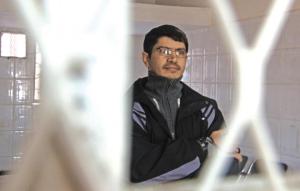
Abdulelah Haider Shaye in court detention cell
However it is Yemeni journalist Abdulelah Haider Shaye who is suffering the most for exposing the drone wars.
In 2010 Shaye revealed that an airstrike that took place in al Majala, Yemen in December 2009 killing 14 women and 21 children was launched by US drones, not the Yemeni air force, thus embarrassing both the Yemeni and US authorities. Later, Shaye also interviewed AQAP leaders including Anwar Al-Awlaki challenging them about their methods.
In August 2010, Shaye was kidnapped from his house by Yemeni security forces and disappeared for a month. He turned up in detention after being beaten and was sentenced to five years imprisonment for associating with terrorists. Amnesty International and other human rights groups have campaigned for his release, and it looked as though in February 2012 he was about to be freed. However a few days before Ali Abdullah Saleh, was forced to step down as President, Obama called him to “express concern” at the news that Shaye was about to be pardoned. Shaye release was immediately halted and he remains in prison.
April 17, 2012
Posted by aletho |
Full Spectrum Dominance, Progressive Hypocrite, Timeless or most popular, War Crimes | Ali Abdullah Saleh, Anwar al-Awlaki, Nevada Desert Experience, Shaye, United States, Yemen |
Leave a comment
In 2010, the UN special representative on extrajudicial executions Philip Alston released a 29 page report on the growing use of deadly drone, or unmanned, aircraft by the United States. In a statement that accompanied the report, Alston described the political problem for the US, “I’m particularly concerned that the United States seems oblivious to this fact when it asserts an ever-expanding entitlement for itself to target individuals across the globe. But this strongly asserted but ill-defined license to kill without accountability is not an entitlement which the United States or other states can have without doing grave damage to the rules designed to protect the right to life and prevent extrajudicial executions.”
In the sedate chambers of the UN, such language is rare: it asserted that the continual US use of drones is not only a violation of current norms, but it is a threat to the architecture of conflict resolution and the rules of war. Alston wanted to convene a conference of the “key military powers” to consider new rules for the drones. No-one was interested.
The US response was unsurprising: it was at war, and in war, such attacks are legal. Since the US has claims that its War on Terror has no identifiable battlefield, it feels emboldened to use its drones to attack targets in regions where it is not directly at war, such as Pakistan, Yemen, Somalia and so on. It is this inflation that worried the UN. In March 2012, Attorney General Eric Holder dismissed Alston’s commitment to legality. He decreed it constitutional (in US terms) for his government to even kill its own citizens without judicial review in very specific circumstances (in mind was the New Mexico-born Anwar al-Awlaki, killed in the deserts of Yemen, in 2011). President Obama signed a law on February 14, 2012 to extend drone use in the United States for commercial purposes (crop dusting, monitoring oil spills) and eventually for law enforcement. More, not less, drones are on the horizon.
The $5.9 billion drone industry looks to double its size. There is a Congressional Unmanned Systems Caucus (co-chaired by Henry Cuellar and Buck McKeon). The US used to have fifty drones in the arsenal before 9/11, but the airforce now has 7,500 in use. Northwestern Michigan College has pioneered drone studies to prepare “pilots” for a lucrative career. A recently released Air Force Unmanned Aircraft Systems Flight Plan, 2009-2047 notes, the drones are essential “to increasing effects while potentially reducing cost, forward footprint and risk.” To reduce the risk to nothing, the Air Force has developed the X-47B which is not only unmanned but is also unpiloted. It is a robot, which will determine on its own where to go and what to strike. The Northwestern Michigan College graduates might face redundancy before they finish their degrees.
Since 2005, the US drones have killed 2175 people in Pakistan. Those killed are always characterized as “suspected militants.” There is little verification about their real identities. Court cases by civilian victims of the drone attacks, helped along by the campaigner Reprieve, have not been able to make much of a dent. In a rare case of flexing its sovereignty, the Pakistani parliament in late March called for an end to drone strikes, with a parliamentary committee asking the US to respect the “sovereignty, independence and territorial integrity” of Pakistan. Pakistani noise has little impact on US policy. The drone attacks continue.
The Bureau of Investigative Journalism (BIJ) has recent reported that the US has increased its use of drones in Yemen, despite the change of its president (from Saleh to his deputy Hadi). The US has consistently denied that its cruise missile killed forty-four civilians on December 17, 2009 in southern Yemen (eight families were wiped out by the attack). A Wikileaks-released cable tells us otherwise. General David Petraeus rushed to Sanaa, where he met Saleh who told him, “We’ll continue saying the bombs are ours, not yours.”
Subsequent to Saleh’s removal, the Yemeni parliament formed a commission to study that attack. A spokesperson for Sheikh Himir Al-Ahmar, the commission’s chairman and now Yemen’s deputy speaker, told the BIJ, “The families of the victims were indeed paid appropriate compensation by the Yemeni Government (according to the standard of compensations given out to victims in Yemen). The American authorities did not get involved in this process in any way.” The Americans like the “can’t confirm or deny” stance regarding what is taking place in plain sight. This is the reason that the Obama administration has blocked the requests by the ACLU to gain information on the CIA’s use of drones for targeted assassinations.
The US media is forced to report massacres when these are conducted by troops on the ground. The most recent story concerns the killing of sixteen Afghan civilians by Army Staff Sgt Robert Bales. Even here the story was followed with limited depth. As Alexander Cockburn reported this weekend, it was Australia SBS’s Yalda Hakim who went beneath the surface and produced a remarkable report that suggested that Bales likely did not act alone in the villages of Alkozai and Najiban (a view supported by the investigation conducted by General Karimi for the Afghan president). At least reports of these massacres come to the press. Nothing of the kind happens when drones kill civilians. There is little consideration of drone strikes, and little anger at the murder of ordinary people by drones.
Drones create little global outrage. The drones have no names like Bales (and his confreres). Their pilots are faceless young people who sit in Nevada or upstate New York. They drink a Coke, play with their computers which send kill messages to their drones. They will have nightmares. With drones there are no stories. No narratives to create outrage. Just bodies of dead people. They have no history.
Last week, a US drone killed four people in Miranshah in northern Pakistan. The Pakistani authorities claim that these are Uzbek militants. There is no confirmation. They might have been anyone.
In the 1920s, Miranshah, the main town of North Waziristan, had a British base, from where RAF planes went out on frequent bombing raids against the Afghans and the Waziris. It was from Miranshah that Arthur “Bomber” Harris ran some of his most vicious sorties. A rather miserable T. E. Lawrence (of Arabia) sat in his room on the base bemoaning his fate while Harris went on his celebrated runs. Lawrence had his own views on the bombings. “I have a bird,” he wrote. “It looks like a sparrow. It nests over my shelf of files. A dirty bird: I have brought in varnished fabric cover to shield the files from its droppings. A misanthropic bird; a solitary bird; a silent bird. It comes in at sunset & departs at dawn. Plop, plop. Our bombing machines can only drop six bombs, at full war load. This my sparrow puts the RAF to shame. Since sunset it has made eleven hits.” Lawrence had his eyes on the bird, and on the horizon. “Miranshah is busy,” he wrote as the bombers returned. “A moral operation is being carried out in the hills to the SW.”
April 2, 2012
Posted by aletho |
Civil Liberties, Militarism, Progressive Hypocrite, Timeless or most popular, War Crimes | Anwar al-Awlaki, Bureau of Investigative Journalism, David Petraeus, Miranshah, Northwestern Michigan College, Pakistan, United States, Yemen |
Leave a comment
The Pentagon has for the first time confirmed that US forces are operating inside Yemen, after a group of American officers came under attack in south of the Arab country.
Yemeni militia claimed on Friday that they had killed a CIA officer in an exchange of fire in the southern city of Aden “after tracking him and determining he was cooperating with the Sana’a government.”
A pentagon spokesman in Washington denied the report of the death but confirmed that a US security team in Aden had been attacked, claiming the team members suffered no injuries.
A Yemeni security official had also confirmed that a gunman had fired several shots at a vehicle carrying US security officers without injuring anyone.
The admission by the US Department of Defense came following numerous previous claims by the US government which denied the deployment of ground troops to Yemen.
The US had for decades propped up the regime of Yemen’s Ali Abdullah Saleh who recently handed presidency to his deputy Abdrabbuh Mansur al-Hadi after a single-candidate election shored up by Washington and Riyadh. Hadi is a UK-trained field marshal.
Protesters in Yemen continue to demand the removal of the regime which abounds with officials from the Ali Abdullah Saleh-era.
March 4, 2012
Posted by aletho |
Militarism | Ali Abdullah Saleh, Central Intelligence Agency, United States, Yemen |
Leave a comment
A bomb explosion has hit an anti-US protest rally in northern Yemen, injuring at least 22 people, Houthi fighters reported.
The resistance group, which controls much of the north of the country, said the explosion occurred in Sa’ada Province on Friday without providing further details.
Yemen has been the scene of anti-US rallies since a Washington-backed power transfer deal granted the country’s long-time dictator Ali Abdullah Saleh immunity from prosecution in return for stepping down.
Yemenis say Saleh and his aides must stand trial and face justice over the deadly crackdown on protests over the past year which killed nearly 2,000 anti-government demonstrators.
Yemenis also accuse the US and its ally Saudi Arabia of derailing their revolution by brokering a deal that transferred power from Saleh to his deputy, the UK-trained army Field Marshal Abd Rabbuh Mansour Hadi, in a single-candidate election.
On Tuesday, thousands of Yemenis gathered outside the US Embassy in the capital, Sana’a, demanding the expulsion of Washington’s ambassador to Yemen over his intervention in the country’s internal affairs and the desecration of the Holy Qur’an in a US-run military base in Afghanistan.
Angry protesters burned the US flag and an effigy of US Ambassador Gerald Michael Feierstein.
Feierstein is accused of having a role in holding the recent single-candidate presidential election in Yemen and returning Saleh home from a ”medical visit” to the US.
March 2, 2012
Posted by aletho |
Aletho News | Gerald M. Feierstein, Houthi, Saleh, Saudi Arabia, Yemen |
Leave a comment
Ali Abdallah Saleh has not tired of playing the al-Qaeda card to retain any toehold of power in Yemen well after he was ostensibly reduced to an honorary president by the Gulf Initiative.
Sanaa – “Either me, or al-Qaeda” has long been the message Saleh has sought to press home.
He did that last May in the southern governorate of Abyan, when he ordered security forces in Zinjibar to keep the town gates open and mount no resistance against an invasion by hundreds of armed men. The regime later said they belonged to al-Qaeda.
Saleh was at it again last month, shortly before his departure to the US for medical treatment, though the stage-management this time was dire.
A tribal sheikh named Tareq al-Dahab, who wields considerable clout within his heavily-armed and famously fierce clan, descended on the town of Radaa, 170 km southeast of Sanaa in the governorate of al-Bayda. Units of the Central Security Forces and Republican Guards deployed in the vicinity but put up no resistance.
With nothing standing in their way, Dahab and his men moved into the town as though on a picnic or hunting trip. They went on to occupy it completely and proclaim an Islamic Emirate.
The group proceeded to the main al-Ameriyah Mosque, where in between performing sunset and evening prayers, Dahab delivered a sermon. It featured a pledge of allegiance to Nasser al-Wuhayshi and Ayman Al-Zawahiri, respectively the leaders of al-Qaeda in the Arabian Peninsula and al-Qaeda in Afghanistan.
Dahab also announced a number of administrative decrees. In a bid to curry favor with local people, he ordered gasoline station owners to slash fuel prices to what they had been before the outbreak of Yemen’s youth-led popular revolution last year.
The gunmen then made for al-Ameriyah Castle, an ancient fort overlooking the town. But they did not stop there. Over the course of the next two days, Dahab and his fighters took over the rest of the town, including the central prison, where they released all the inmates.
According to Yemen’s Deputy Information Minister, Abdu al-Jundi, the jailbreak was intended to recruit more members for the group. Weapons were given to any convicts who were willing to join. That was denied by Dahab, however, who issued a statement claiming he had only freed two of his own followers from the prison.
Dahab later released a video recording of himself proclaiming that “the Islamic Caliphate is coming, even if we must sacrifice our souls and our skulls for its sake!” He pledged to liberate the entire Arabian Peninsula, after first “bringing about the rule of Islamic sharia in Yemen in line with the wishes of the people.”
Meanwhile in Sanaa, the military commission set up in accordance with the Gulf Initiative to oversee ending “armed manifestations” in urban areas convened. It reviewed efforts to get barricades dismantled and armored vehicles taken off the streets of the capital and of Yemen’s third-largest city, Taiz. The Commission issued a statement applauding the progress made in this regard and announced that a fact-finding mission would be formed to look into the developments in Radaa.
But local tribal leaders had other ideas about what needed to be done.
Conditions in the town had deteriorated sharply, the security forces having disappeared after allowing Dahab and his fighters to take over. People were out on the streets guarding their homes and shops with whatever weapons they had at hand.
Particularly alarming was the presence of all those freed convicts among the gunmen. Many of the released prison inmates had committed revenge-killings, or been convicted of serious crimes such as rape, murder, and armed robbery. They included 165 men who had been formally sentenced to death.
Local sources said that Dahab’s men did not enter the town en masse, as media reports suggested, but collected there over a period of time. Local sheikhs repeatedly approached the authorities about the growing numbers of armed strangers appearing in the town, but their complaints went unheeded.
The sheikhs met to consider the situation and decided to issue an ultimatum. Dahab and his followers were given three days to leave Radaa, or be expelled by force. Dahab requested an extension to allow for negotiations with the sheikhs on a mutually-acceptable solution without having to resort to arms. Eventually, under tribal pressure, he agreed to pull out his men, in exchange for the authorities acceding to a number of demands he put forward – notably the release of his youngest brother Nabil from the Political Security Prison in Sanaa.
A bigger surprise was sprung by another brother, Khaled al-Dahab, when he revealed in remarks to the press that Tareq al-Dahab had long worked closely with Saleh’s national security apparatus and his former interior minister. The question was immediately raised whether Dahab was truly affiliated to al-Qaeda or had been acting at the behest a security agency.
Al-Dahab has never been outside Yemen and his name has never been linked to al-Qaeda or its operations. His only connection to the group is that his sister used to be married to Anwar al-Awlaqi, the radical preacher believed to be a leading light of al-Qaeda in the Arabian Peninsula, who was killed in an American drone strike last year.
Hilal conceded that the group does operate in nearby areas and in other parts of Yemen – unlike many opposition supporters, who deny that al-Qaeda exists at all in the country and claim it is a fiction invented by Saleh to serve his purposes. But it was clear from the way Radaa was taken over that the group involved was connected to Saleh’s regime, he said.
“He wants to cause renewed confusion in the country and take it back to square one,” Hilal charged.
Another journalist, Khaled Abd al-Hadi of the opposition Yemeni Socialist Party newspaper al-Thawri, agreed that it was unreasonable to deny that al-Qaeda had established a permanent presence in Yemen.
But he said that the regime was playing a major role in developments, and al-Qaeda was seeking to exploit the breakdown of security in the country to extend its control to new areas.
This could have grave consequences, he warned. The group could try to move on Dhamar to the northwest of Radaa, a town inhabited mainly by members of the Zaydi sect and home to a Zaydi religious center. That would be seen as launching “a clearly sectarian war,” he said.
“There are armed Zaydi tribes in Dhamar province, fierce fighters. They are will not stand back in the face of any attack on them,” he said.
The suspicion that Saleh has a hand in such schemes is widely shared. Even an official of Saleh’s General People’s Congress (GPC) party, speaking to Al-Akhbar on condition of anonymity, charged that prior to departing Yemen, Saleh had taken a number of measures “as part of an attempt to plunge the country into chaos.”
This despite the immunity he received from prosecution for anything he may have done during his 33 years in office.
Meanwhile, the alarm has been raised about the reported arming of GPC members, especially in Taiz and the city of al-Dalei south of the capital.
Informed sources say the main immediate objective is to foil the early presidential elections scheduled for February 21, in a bid to take Yemen, as Hilal put it, ”back to square one.”
February 6, 2012
Posted by aletho |
Deception, False Flag Terrorism, Timeless or most popular | al-Qaeda, Al-Qaeda in the Arabian Peninsula, Ali Abdullah Saleh, Ayman Al-Zawahiri, Dahab, Yemen, Zinjibar |
Leave a comment
 Aletho News

