Board of Peace: UNRWA Will Have No Place in New Gaza
By Kyle Anzalone | The Libertarian Institute | July 1, 2026
The Board of Peace said that the UN aid agency for Palestinians (UNRWA) can have no role in the future of Gaza.
“UNRWA has no place in the new Gaza,” the Board of Peace posted to X on Wednesday. “We are turning the page on the complex of perpetual aid dependency & conflict. The people of Gaza deserve better.”
UNRWA serves as the most crucial aid agency for Palestinians who live as refugees or as second-class citizens in Israeli-occupied territory. Since the start of the Israeli onslaught in Gaza, UNRWA has provided a crucial lifeline to people living in deplorable conditions caused by the Israeli siege of the Strip.
Israel has waged a propaganda war against UNRWA and worked to dismantle the agency’s ability to provide aid to Palestinians. Tel Aviv has attempted to portray UNRWA as a wing of Hamas, claiming its members helped to conduct the October 7 attack. However, multiple investigations have found that Tel Aviv has not produced evidence to substantiate the allegation.
The lack of evidence has not prevented Israel from restricting UNRWA’s operations. Tel Aviv has restricted UNRWA’s ability to operate and provide aid to Palestinians in Gaza. Additionally, the Knesset has passed a series of laws that target the UN agency.
Earlier this year, Israel passed legislation barring water and electricity companies from providing services to the UNRWA building, and a UNRWA facility in East Jerusalem was demolished.
Iran Issues Stern Warning to Israel After Top Official Threatens Assassination of Supreme Leader
By Kyle Anzalone | The Libertarian Institute | July 1, 2026
The Iranian Foreign Minister warned Israel of an immediate response if officials continue to call for the death of the Supreme Leader.
On Monday, Israeli Defense Minister Israel Katz said that Iran’s Supreme Leader Ayatollah Mojtaba Khamenei was “marked for death.” At the onset of the current war, the US and Israel assassinated Khamenei’s father, Grand Ayatollah Ali Khamenei, in a strike that killed several other members of his family.
On Wednesday, Iranian Foreign Minister Seyed Abbas Araghchi wrote on X that future threats would receive an “immediate powerful response” from Tehran. He also directed President Donald Trump to rein in the rhetoric coming from Tel Aviv.
“POTUS has committed the U.S. to muzzling its pets in Tel Aviv. If they ignore their master, Iran will school them,” he added.
Last month, the US and Iran signed a Memorandum of Understanding that provided the framework for negotiations to finalize a peace agreement. However, Israel has violated the MOU and undermined negotiations.
The first point of the MOU calls for a ceasefire in Lebanon. Over the past two weeks, Israel has continued to bomb and occupy Lebanon. Additionally, Israeli officials say they will not end the war in Lebanon until Hezbollah is disarmed.
Leaked Israeli report shows Iran strikes’ true cost
Mehr News | July 1, 2026
Leaked official Israeli documents reveal that Iranian missile attacks on the Bazan refinery in Haifa destroyed critical infrastructure, including a storage tank.
Quds News Network reported on Tuesday that an official draft document published by the Israeli regime’s Interior Ministry reveals significantly broader damage than previously disclosed following the Iranian missile strikes.
The document, which was published as part of procedures to approve reconstruction work at the Bazan refinery complex in Haifa Bay, reportedly details damage to gas turbines, steam boilers, electrical rooms and other auxiliary systems that had not previously been publicly reported.
It also states that an oil derivatives storage tank struck during the March attack is beyond repair and must be replaced with a new tank with a capacity of up to 12,700 cubic meters.
The June strike on the complex severely damaged its power plant, disrupted refinery operations and killed three workers. At the time, Bazan estimated the losses at $150-200 million, while Israeli officials maintained that fuel supplies would not be affected.
According to the Interior Ministry document cited by QNN, the damage extends beyond physical infrastructure and has affected the refinery’s operational capacity.
The document states that the destruction of the storage tank has “directly affected the ability to produce gasoline that meets the specifications required by the market and to supply it to consumers.”
This contradicts previous statements by then-Israeli Energy Minister Eli Cohen, who said the strikes had not damaged production facilities and would not affect fuel supplies.
The document further reveals that the area approved for reconstruction is almost double that authorized after the June attack, indicating that the scale of the destruction was considerably greater than previously acknowledged.
According to the Interior Ministry document cited by QNN, the complete restoration of the Bazan complex is not expected before 2028, only about three years before the Israeli cabinet’s planned evacuation of the Haifa Bay petrochemical industries in 2031.
The document concludes that the damage affects “essential operational and storage components” within one of the Israeli regime’s most important energy facilities, requiring years of reconstruction while maintaining production and fuel supplies.
Why Iran believes Israel will attack again before October
By Trita Parsi | July 1, 2026
Will Israel restart the war with Iran before the October elections? This is the consensus view emerging within Iran’s internal national security debate over the past week.
Several factors are driving Tehran to this conclusion. Beyond its deep—and not entirely unwarranted—suspicion of President Donald Trump’s intentions, heightened by Vice President JD Vance’s recent remark that Trump wants to use the MOU to replenish global oil reserves and then “see where the hand is,” two developments stand out: the recent Israeli-Lebanese agreement and its impact on Hezbollah’s military posture over the coming months.
From Tehran’s perspective, the agreement hands Israel a significant advantage in any renewed war with Iran—one it lacked in February. By allowing Israeli forces to remain in parts of southern Lebanon, the deal appears to contravene the MOU while fundamentally reshaping the military balance. Israel’s continued presence in these strategic positions would make it far more difficult for Hezbollah to mount the kind of offensive operations that proved critical during the previous round of fighting.
That matters because, in February and March, the Iranians say they used only about 40 percent of their offensive capabilities against Israel, because Hezbollah carried much of the remaining burden. At the time, pundits in the West were debating why Tehran hit the UAE harder than it did Israel.
Part of it was because of Israel’s much higher pain tolerance compared to the GCC states. Tehran was aiming to reach the most accessible pain threshold to pressure the US to end the war. But part of it was the critical role Hezbollah played in the war, contrary to much of the press coverage at the time. It played a critical role in stretching Israel’s defenses, complicating its targeting decisions, and forcing it to divide resources across multiple fronts.
That role, however, was poorly understood because Israel imposed near-total military censorship during the war—far stricter than the censorship regime in June 2025—which sharply limited public visibility into Hezbollah’s operations and their impact. As a result, the degree to which Hezbollah shaped the course of the war has been significantly underestimated.
Unlike the MOU, the current Israeli-Lebanese agreement does not require Israel to withdraw from Lebanese territory until Hezbollah has been disarmed. Since that outcome is highly unlikely in the foreseeable future, Israel is poised to retain its positions inside Lebanon, enabling it to renew the war with Iran without facing the same pressure from its northern front that constrained it during the previous conflict.
Netanyahu’s motivations are clear. Beyond his long-standing desire to use American force to subjugate Iran to Israeli domination and achieve a regional balance favourable to Israel, he now also has stark political and personal reasons to restart the war.
The MOU has come at a steep political cost for Netanyahu. His prospects for reelection in October are weaker than they have been in months. Once seen as the Israeli leader uniquely capable of delivering President Trump, he now confronts the prospect that both the war and the ensuing diplomacy will leave Israel in a strategically weaker position—undermining the very case he has made for his leadership.
And of course, if he loses the elections, he will likely spend the next few years in jail, as he will lose his immunity as Prime Minister and face trial over corruption charges.
Whether the Trump administration is coordinating with Israel on such a strategy remains unclear to Tehran. But suspicions surrounding Secretary of State Marco Rubio run particularly deep, given his role in brokering the Israeli-Lebanese agreement, his support for the war, and his perceived opposition to the MOU.
From Tehran’s perspective, there are three plausible scenarios. The first is that the White House is aware of Israel’s plans and helped broker the Lebanese agreement in part to facilitate them. The second is that Washington is unaware of Netanyahu’s intentions but would nonetheless come to Israel’s defense—and perhaps even join the offensive—once Netanyahu resumes the war. The third is that the administration is caught by surprise, chooses not to restrain Israel, but also refrains from direct military involvement in the conflict.
Tehran does not believe Israel’s advantage in Lebanon will prove decisive. Iranian officials remain confident they can impose severe costs on Israel and deny it its broader strategic objectives. But a renewed war could still achieve Netanyahu’s most immediate aim: killing the MOU. Given his mounting political and legal pressures, Netanyahu may be desperate enough to be willing to challenge Trump directly to ensure precisely that outcome.
The question is, once again, not how Trump will react, but if Trump will prevent Netanyahu from deliberately shaping and limiting Trump’s options. This is the test Trump has repeatedly failed.
Palestine Action Proscription: We Fight Back
By Craig Murray | July 1, 2026
I publish below in full the Note we have submitted to Court today to re-establish the separate Scottish judicial review of the proscription of Palestine Action. Not only is the state doubling down on prosecution of pro-Palestine activists, a new National Security State Threats Bill is being fast tracked through parliament to extend the attack on free speech.
Under this bill receiving a benefit including “information” from a state entity designated as “hostile” by the Home Secretary will be a crime bringing up to 14 years in prison. So publishing casualty figures from Iranian sources, for example, will be terrorism. Publishing information about Ukrainian attacks on Russia will be illegal.
This is the relevant clause of the Bill. My emphasis:
17C Obtaining etc material benefits from a designated body
(1) A person commits an offence if—
(a) the person—
(i) obtains, accepts or retains a material benefit which is not an excluded benefit, or
(ii) obtains or accepts the provision of such a benefit to another person,
(b) the benefit is or was provided by or on behalf of a designated body, and
(c) the person knows, or having regard to other matters known to them ought reasonably to know, that the benefit is or was provided by or on behalf of a designated body.
(2) A person commits an offence if—
(a) the person agrees to accept—
(i) a material benefit which is not an excluded benefit, or
(ii) the provision of such a benefit to another person,
(b) the benefit is to be provided by or on behalf of a designated body, and
(c) the person knows, or having regard to other matters known to them ought reasonably to know, that the benefit is to be provided by or on behalf of a designated body.
(3) Material benefits may include financial benefits, anything which has the potential to result in a financial benefit, and information…
Please note there is specifically no public interest defence, no journalism defence and it is to be illegal to receive true information. It is not about the spread of disinformation, it is about the spread of information contrary to the British state narrative. Receiving information from a designated enemy of the UK is the offence, whether you publish it or not.
There in no modern precedent for this in peacetime. It is being forced through all its parliamentary stages – three readings, amendments and two Lords sittings – in a single day. I have repeatedly said that liberal democracy has collapsed. I do not need further proof.
Under the current legislation, yesterday prominent international lawyer Dan Kovalik was detained in Liverpool, his phone and laptop seized and he was questioned about his support for Palestine. Dan is a lawyer. He is entitled to lawyer/client confidentiality. His clients include the President of Colombia and other international figures. The UK is a rogue state.
The UK state is currently attempting to gaslight us with a concerted campaign of messaging about a few millions in aid to Gaza – much of which is concentrated on assisting ethnic cleansing by various medical and educational routes for people to leave Gaza. But with Labour Friends of Israel member Andy Burnham to take over as PM with former Chair of Labour Friends of Israel James Purnell as his Chief of Staff, support for the Genocide will continue unabated.
The absurd National Security (State Threats) Bill shows that attack on dissidents and free speech will continue at home too. The debanking by Lloyds of The Canary is another prong of the extraordinary destruction of civil liberty under New Labour.
So I am determined not to bow to the sisting of the Scottish judicial review and we have lodged a motion to “reclaim” or restart proceedings.
We have not yet reached the actual Scottish judicial review or had any chance to give the arguments we will use there. It is my intention that we will attack the proscription in the most fundamental way, making these points among others:
- There is an active obligation on states to do everything possible to stop a Genocide. By contrast, the UK has done everything in its power to facilitate Genocide, including protecting its supply chain.
- It is patently absurd to call a non violent direct action group a terrorist organisation
- The state should not be treated as neutral or infallible by the courts. The false narrative on Iraqi WMD, and the terrible deaths and destruction to which that narrative led, should be a warning the state can get it very wrong.
- As a former senior civil servant who was in the FCO during that period, I can testify to the pressures on civil servants and agencies to produce the evidence and policy recommendation that Ministers wish to hear
- The evidence base produced by JTAC to support the proscription recommendation was fundamentally untrue. The Filton jury proved that the Met Police and JTAC assertions of escalating violence, carrying weapons with intent to harm, did not happen as a matter of fact. The jury rejected the aggravated burglary and violent disorder.
- Only one Palestine Action activist has ever been convicted of an offence of violence, and there the jury specifically found no intent
- Lady Justice Carr in the Appeal Court judgement both relied on Sheriff McCormick’s sentencing remarks in the Thales case. But there were no convictions of violence in the Thales case. Sheriff McCormick misrepresented the evidence. Last week he the Sheriff Appeal Court in Scotland overturned his finding of anti-Israeli racism against Mick Napier of Scottish Palestine Solidarity Committee. The inaccurate and frothing remarks of one zionist Sheriff are not a basis for proscription.
- Lady Justice Carr ruled that the Home Secretary must be given “appropriate latitude” and a “wide margin of appreciation” in security cases. But the Home Secretary should not be idealised. They are a politician, and in this case a politician who is parti pris. Yvette Cooper is massively financed by the Zionist lobby. The courts should operate in the real world not in an idealised and unrealistic one.
Lady Carr’s judgement is entirely and directly predicated on the notion that in any conflict in law between the state and the citizen, special deference should always be given to the state as more noble and trustworthy. That reasoning is fundamentally flawed.
To get heard at all we have to roll back Lord Young’s extraordinary ruling that the English Court of Appeal judgement should be accepted as law in Scotland in the interests of “comity”. This overturns centuries of doctrine on the separate jurisdiction of Scotland going back to the Treaty of Union itself – though it does reflect what had in truth been the unchallenged though illegal practice of deference to England in such matters. … continue
UK ‘Counter Terrorism Police’ Detain American Lawyer And Human Rights Activist For Criticism Of Israel
By Justin K.P. | The Dissident | June 30, 2026
The UK’s Zionist owned police state continues to detain Israel critics on bogus terrorism charges, in this case against a well-known American human rights lawyer.
Dan Kovalik is a well-respected human rights lawyer and author who previously taught International Human Rights at the University of Pittsburgh School of Law.
Kovalik is currently representing Gustavo Petro, the president of Colombia.
He is a critic of Zionism and U.S. policy towards Iran, publishing the book “The Case for Palestine: Why It Matters and Why You Should Care” last year and publishing the book “The Plot to Attack Iran: How the CIA and the Deep State Have Conspired to Vilify Iran” in 2018 .
For this, Kovalik was detained “at John Lennon International Airport in Liverpool, England” by counterterrorism police who seized his “phone, computer, fingerprints and DNA sample” over his “opposition to the Genocide on Gaza and the war on Iran.”
Kovalik wrote on X, “In the height of irony, I was detained at John Lennon International Airport in Liverpool, England by anti-terrorism police concerned about my opposition to the Genocide on Gaza and the war on Iran. They seized my phone, computer, fingerprints and DNA sample.”
Writer Nalia reported that Kovalik “was detained for approximately two and a half hours and interrogated extensively on his political views about Israel’s genocide in Palestine, Lebanese resistance organisation Hezbollah and on the war against Iran”.
She also reported that “Kovalik’s phone and laptop were seized along with his DNA, fingerprints, photos from multiple angles and copies of his bank and credit cards. After officers rifled through his luggage, they questioned Kovalik on the book he was carrying — a gift from a student by Palestinian writer Ghassan Kanafani, Palestine’s Children: Returning to Haifa & Other Stories — before he was released and free to continue on his journey.”
She also noted that “Despite informing officers that he is a practising lawyer and that his phone and laptop contain documents protected by legal professional privilege — including attorney-client privilege — Kovalik objected to their seizure, which a supervising police sergeant confirmed to Kovalik that he had properly raised privilege objections. Regardless of his objections, his electronic devices were retained ‘with intention to copy,’ raising serious questions about the protection of legally privileged material, client confidentiality and compliance with the safeguards governing legal privilege under Schedule 3 and its accompanying Code of Practice.”
Commenting on the detention of Kovalik, former MP George Galloway, who himself was previously detained at Gatwick Airport for his support of Palestine, said: “The Political Police in Britain are out of control.”
Slovenia president seeks probe into Israeli interference in elections
Al Mayadeen | June 30, 2026
Slovenian President Nataša Pirc Musar has called for an international investigation into Israeli interference in Slovenia’s parliamentary elections, escalating a diplomatic row that has also exposed deep internal political divisions over the country’s stance on the Middle East, VINnews reported.
President Musar, who previously accused “Israel” of committing genocide in Gaza, appealed for the release of intelligence findings that reportedly point to a coordinated disinformation campaign targeting the then-ruling liberal party during the March 2026 elections.
According to Slovenian intelligence investigations, the operation involved an electronic disinformation network that leveraged deepfake technology and artificial intelligence to undermine the liberal camp. The probe allegedly attributed the campaign to a private Israeli intelligence firm operating in coordination with elements of Slovenia’s right-wing opposition.
Right-wing takes over Slovenia, strives to repair ties with the occupation
While the liberal party ultimately won the highest share of the vote, it failed to secure a governing coalition. That deadlock paved the way for right-wing leader Janez Janša, who successfully formed a government and took office as Prime Minister in May 2026.
In a sharp reversal of his predecessor’s foreign policy, Prime Minister Janša has announced plans to repair bilateral ties with “Israel”. In an exclusive interview for the Israeli daily Israel Hayom over the weekend, Janša confirmed his intention to relocate the Slovenian embassy from Tel Aviv to al-Quds, a move that aligns with the policies of several right-wing Israeli governments but has drawn international criticism in the past.
Janša also pledged to revoke the previous administration’s formal recognition of a Palestinian state, a decision he characterized as a violation of Slovenian domestic law.
Board of Peace says first ‘tactical vehicles’ arrive at multinational force base in Gaza
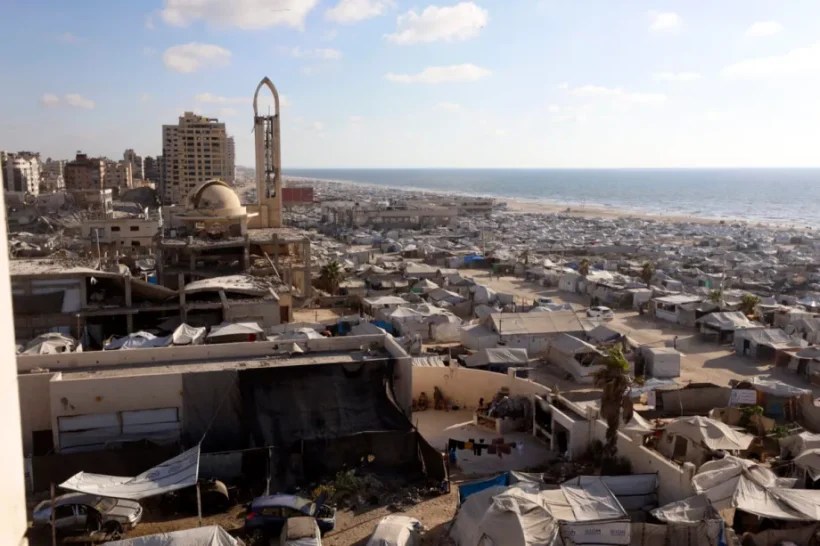
Displaced Palestinian families inside an overcrowded makeshift tent camp alongside Gaza City, Gaza, Palestine on June 22, 2026. [Ahmed Jihad Ibrahim Al-arini – Anadolu Agency]
MEMO | June 30, 2026
The Board of Peace announced on Tuesday the arrival of the first “tactical vehicles” at the base of the International Security Force (ISF) in the Gaza Strip, as logistical preparations continue for the deployment of a multinational force in the enclave, Anadolu reports.
“Tactical vehicles arrive at Logistics Support Area: Endurance,” it said on the US social media company X.
The announcement was accompanied by photographs documenting the arrival of the vehicles.
A Hamas delegation arrived in Cairo on Tuesday for talks with Egyptian officials and mediators on implementing the Gaza ceasefire agreement.
The Board of Peace was established in January on the initiative of US President Donald Trump as part of efforts to reach a peaceful settlement in Gaza.
The first Board of Peace meeting on Gaza was held on Feb. 19 at the United States Institute of Peace in Washington under Trump’s leadership.
The initiative formed part of phase two of Trump’s 20-point plan aimed at ending the war in Gaza, backed by a UN Security Council Resolution from last November.
The first phase of the ceasefire agreement included a truce and prisoner exchange between Israel and Palestinian factions, a permanent ceasefire, as well as a gradual Israeli withdrawal from the enclave. Israel, however, has continued to violate the agreement on a near-daily basis.
Under the second phase, Israel is expected to carry out further withdrawals from the territory, while an international stabilization force would assume security responsibilities, including facilitating the delivery of humanitarian aid and reconstruction materials.
With US support, Israel launched a genocidal war in Gaza in October 2023, killing more than 73,000 Palestinians and injuring over 173,000 others, most of them women and children, according to Palestinian figures.
Gaza Reconstruction Plan Sent by US to ‘Israel’ Leaves Out Hamas Disarmament: Report
Al-Manar | June 30, 2026
The United States has reportedly delivered a document to ‘Israel’ outlining a framework to move forward with the reconstruction of the Gaza Strip even if Hamas does not surrender its weapons, according to Israeli Public Broadcasting Corporation.
The report said Washington is seeking written approval from ‘Israel’ for the proposal, which reportedly reflects US pressure to advance President Donald Trump’s post-war Gaza plan while avoiding a renewed war in the enclave.
Neither the United States nor ‘Israel’ had officially commented on the reported document as of Tuesday.
According to the report, the framework would require ‘Israel’ to allow major infrastructure projects across the Gaza Strip, including work on water, electricity, and other essential services in areas that have yet to be specified.
The proposal also reportedly calls for relocating residents from areas “controlled by Hamas” to zones administered by the Peace Council by the end of 2026.
It further includes establishing the headquarters of a technocratic government, permitting the construction of bases for an international stabilization force, and rebuilding the European Hospital. The plan would also allow the entry of construction materials and medical equipment, along with the creation of an access corridor to the hospital through Hamas-controlled areas.
According to the reported document, ‘Israel’ would transfer Palestinian Authority tax revenues related to Gaza to the Peace Council while gradually recognizing the technocratic government as the governing authority in the territory.
The proposal would also grant the technocratic administration freedom of movement inside and outside the Gaza Strip for official purposes, allow digital payments, expand fuel distribution, and introduce fourth-generation (4G) mobile services, which are currently unavailable in Gaza.
The report said these measures are intended to “reduce Hamas’ ability to collect taxes and administrative fees.”
The framework also includes conditional amnesty for individuals who “surrender their weapons and commit to maintaining peace.”
The reported proposal envisions security being overseen by an international stabilization force supported by an unarmed Palestinian civil guard.
At the same time, it would preserve “Israeli right to take what it considers necessary security measures if Hamas does not comply with calls to disarm.”
According to the broadcaster, the overall message of the document suggests Washington no longer sees resuming the war in Gaza as a preferred option and instead wants to accelerate efforts to establish an alternative governing authority, even if Hamas refuses to relinquish its weapons.
US base in Jordan served as outpost for attacks on Iran
Al Mayadeen | June 30, 2026
A United States military base in Jordan served as a regional outpost for US attacks on Iran during the final stages of the recent US-Israeli war on Iran, a source told RIA Novosti on Monday.
According to the source, the Muwaffaq Salti Airbase in Jordan played a central role during the closing phase of the war on Iran.
“During the final stages of the so-called 60-day war, it was Muwaffaq Salti [base] that served as a kind of regional outpost for American operations against Iran,” the source said.
The source added that the United States relied on the Jordanian facility because it had limited regional alternatives for conducting its operations.
“After all, the US’s closest allies in the Persian Gulf – Saudi Arabia and the UAE – did not allow the Americans to use their airspace,” the source claimed.
Iran says use of Jordanian bases clear and undeniable
Amidst the war in March, Iran’s Permanent Representative to the United Nations, Amir Saeid Iravani, has flatly rejected the “baseless and misleading accusations” in a letter submitted by Jordan’s UN mission, which denied that Amman had placed its territory at the disposal of the United States to launch attacks against the Islamic Republic.
In a letter addressed to UN Secretary-General Antonio Guterres and the President of the Security Council, Iravani affirmed that attacks on Iran had been carried out repeatedly from Jordanian territory and airspace, stating that this was “clear and undeniable” and that it entails direct international responsibility for Amman.
Iravani detailed that fighter jets stationed at Jordan’s Muwaffaq Salti Air Base, including F-15, F-16, and F-35 aircraft, launched strikes on Iran’s southern provinces after being refuelled mid-air over Jordanian airspace, he said.
More so, US aerial refuelling aircraft, including KC-46 and KC-135 tankers, conducted those operations while transiting through Jordanian airspace.
Iran further warned that the use of regional countries’ territory and airspace to target the Islamic Republic exposes US military bases in those countries to Iranian operations.
The Muwaffaq Salti base
The scale of the US military presence at Muwaffaq Salti left little ambiguity about the base’s intended function. Satellite imagery and flight-tracking data published by The New York Times and analyzed by Airbus in mid-February 2026, weeks before the war began, showed a threefold increase in the number of US warplanes at the base.
Between 60 and 70 fighter aircraft were ultimately deployed, including F-35A Lightning IIs, F-15E Strike Eagles, and electronic warfare aircraft. More than 68 military cargo flights delivered munitions and support equipment in a matter of days.
Iran targeted the base repeatedly. A US THAAD radar system at Muwaffaq Salti, valued at approximately $300 million, was destroyed in early March, with satellite imagery confirming the strike.
Congress blocks Massie-Khanna effort to kill US-Israel integration
By Ben Freeman | Responsible Statecraft | June 29, 2026
Congress has refused to even allow a full House vote on a provision that would pave the way for an unprecedented integration of the U.S. and Israeli military industrial complexes.
The move came through the House’s Rules process for the National Defense Authorization Act (NDAA), which determines which of the more than one-thousand proposed amendments to the defense policy bill will be publicly debated and voted upon by the full House. Unfortunately, after no debate on Monday, the Rules Committee chose to reject a bipartisan amendment introduced by Reps. Ro Khanna (D-Calif.) and Thomas Massie (R-Ky.) that would have stripped the “United States-Israel Defense Technology Cooperation Initiative” from the bill.
The committee released a list of amendments that were ruled “in order” for a vote on Monday night, and theirs was not on it.
This provision they wanted to squelch, previously known as Section 224, creates an executive agent within the Department of Defense whose sole responsibility is furthering U.S. and Israeli military tech integration across nearly every facet of the defense process, from co-producing weapons to “data fusion.” Israeli Prime Minister Benjamin Netanyahu has described this shift in the U.S.-Israel relationship as “my plan.”
Top-ranking former national security officials have lambasted the proposal and raised serious alarms about what its passage would mean for U.S. national security. Joe Kent, the former Director of the National Counterterrorism Center explained that, “The dangers of allowing any other nation to access our sensitive military technologies are obvious, including the fact that back doors and spyware can be installed that will most certainly be used by the Israelis to influence U.S. policy.”
Paul Pillar, who spent more than a quarter century working at the Central Intelligence Agency, has raised serious concerns about Section 224 and a related measure that would effectively force the U.S. to share intelligence with Israel. “In intelligence, Israel is more of an adversary than an ally. Being an adversary in intelligence means indulging in the hostile act of espionage. Israel has a long record of conducting that type of hostile act against the United States,” Pillar wrote in Responsible Statecraft.
To Pillar’s point, Defense Intelligence Agency (DIA) officials recently revealed that Israeli espionage efforts in the U.S. have been deemed “critical,” the highest threat level in the DIA system.
By rejecting the Khanna and Massie amendment, the Rules Committee on Monday ensured the American public would not even get to see how their representatives would vote on this pivotal issue. This is despite unprecedented levels of public distrust in the Israeli government and widespread public outrage directed at these proposals.
Constituents from across the country have let their representatives know, in every way possible, that they do not support any further military industrial integration with Israel. The story went viral on social media, with commenters flagging the issue for their representatives. Letters to the editor opposing Section 224 have appeared in papers all over the nation, and, critically, Republican and Democratic staffers who have spoken to Quincy Institute colleagues have reported being inundated with calls from constituents about this issue.
While the Rules Committees decision is undoubtedly a setback for those worried about this unprecedented U.S.-Israel military industrial integration, the Senate is considering its own version of the Section 224 proposal, and ultimately the two versions of the NDAA will have to be negotiated in a Conference Committee.
All of these points are opportunities to strip this dangerous provision from the defense policy bill. If they fail and this provision is enacted, the U.S. will find itself inexorably tied to the Israeli military. As my Quincy Institute colleague Steve Simon has written, “The measure risks tethering the US military to its Israeli counterpart technologically and making it difficult to uproot should conditions change.” In short, there may be no turning back if this provision becomes law, so the next few months may very well decide the U.S.-Israel relationship for decades to come.
Ben Freeman is Director of the Democratizing Foreign Policy program at the Quincy Institute and the author of “The Trillion Dollar War Machine: How Runaway Military Spending Drives America into Foreign Wars and Bankrupts Us at Home” (2025)
Israeli forces open fire on civilians in southern Syrian village

Israeli military camp with armored vehicles along strategic road connecting the villages of Jamla and Saysoun in Daraa Governorate, Syria on June 28, 2026. [Enver Asfur – Anadolu Agency]
MEMO | June 29, 2026
Israeli forces opened fire on Syrian civilians on Sunday evening as they began withdrawing from the village of Abidin in Daraa province, southern Syria.
The Syrian Arab News Agency (SANA) reported that “Israeli occupation forces opened fire towards residents while withdrawing from the village of Abidin in the western Daraa countryside.”
There were no immediate reports of injuries, and the Syrian authorities have not commented on the incident.
Earlier on Sunday, the Israeli army set up tents on Tal al-Maghar, west of Abidin village, and in the Yarmouk Basin area in the Daraa countryside.
Syrian media reported that Israeli forces fired live ammunition and illumination flares, targeting farmers near El-Tallah after a force of four armoured personnel carriers moved from al-Jazira barracks towards the area.
Israeli military activity in Syria has escalated in recent months, including raids on civilian homes, searches, the establishment of checkpoints, and the detention of civilians, including shepherds and children.
After the fall of the Bashar al-Assad regime on 8 December 2024, Israel declared the 1974 Disengagement Agreement had collapsed and took control of the UN-monitored buffer zone.
Featured Video
Trita Parsi: Israel Set a Trap for Total War in the Region
or go to
Aletho News Archives – Video-Images
From the Archive
Zionism’s Violent Legacy
By Donald Neff | Washington Report On Middle East Affairs | January 1996
On January 4, 1948, Jewish terrorists drove a truck loaded with explosives into the center of the all Arab city of Jaffa and detonated it, killing 26 and wounding around 100 Palestinian men, women and children.[1] The attack was the work of the Irgun Zvai Leumi – the “National Military Organization,” also known by the Hebrew letters Etzel – the largest Jewish terrorist group in Palestine. The Irgun was headed by Revisionist Zionist Menachem Begin and had been killing and maiming Arabs, Britons and even Jews for the previous ten years in its efforts to establish a Jewish state.
This terror campaign meant that at the core of Revisionist Zionism there existed a philosophical embrace of violence. … continue
Blog Roll
 Aletho News
- Trita Parsi: Israel Set a Trap for Total War in the Region
- Trump’s Iran war is on an Israeli leash
- Saudi oil boss issues global supply warning
- Riyadh Says Its Oil System Is Intact. The Numbers Say Otherwise.
- Trump and Netanyahu Want to “Finish the Job” on Iran
- US ‘one-sided dictation’ not Iran’s beliefs makes rational talks impossible: Baghaei
- Iran’s Next Strike May Not Explode. It Could Shut You Down /Col Doug Macgregor
- Iran: US political targets legitimate if assassinations return
- Iraq shuts key border crossing with Iran under US pressure: Report
- Undersea Internet cables could be targeted in retaliation for attacks on Iran: IRGC deputy chief
- If Americans Knew
- The Israel Lobby’s Changing Fortunes
- AIPAC has become such a political liability that it’s shifting to a more “nimble” approach to buying politicians
- At least 160 Israeli settler attacks in 2 weeks
- Will Gaza’s Ancient Christian Community Disappear Forever?
- Israel’s vision of regional security rests on keeping Arab states weak
- Heidi Levine recounts how Palestinian youths helped save her in settler attack
- DAILY UPDATE: Latest essential news on Palestine, Israel, & region
- Trump’s Intensifying Sabotage of the ICC, for Israel’s Sake
- Israeli military detain US and UK volunteers in West Bank including Democratic NY politician Brad Lander
- Americans at National Conservatism Conference held in Israel this year criticize Israel
- No Tricks Zone
- E-Cars Reduce CO2 Emissions By Only 41% Compared To Internal Combustion Engine Vehicles
- Predictions Made By Renowned Climate Professor Over Past Decades Have Been Proven To Be Poor
- New Study Suggests Large Regions Of The Pacific Ocean Have Been Cooling For The Last 80 Years
- Germany’s Green Energy Debacle: High Energy Costs Force Kahla Porzellan to Close After 182 Years!
- New Study: 50 Years Of The Most Aggressive ‘Net Zero’ Policies Can Only Affect The Global Climate By 0.03°C
- US September “Heat” Was No Record…Many Records Set Decades Ago
- Latest European Green Energy Debacle; Portugal’s Largest Flagship Solar Park Insolvent!
- Green Energy Debacle: German Expert Professor Fritz Vahrenholt Warns Of Severe Economic And Social Consequences
- Two More Paleo Reconstructions Affirm Meters-Higher Sea Levels Across Ireland, Brazil 7000-6000 Years Ago
- New Study: Earth And Venus Surface Warmth Largely Explained By Convection And Lapse Rate, Not CO2 Or Radiation

