Syrian air defense units intercept Israeli missiles near Damascus, thwarting THIRD raid in a week – Russian MoD
RT | July 26, 2021
The Syrian military has intercepted two missiles fired by Israeli fighter jets at Damascus suburb of Sayyidah Zaynab over the weekend, successfully thwarting the third such airstrike in a week, using Russian-made air defense systems.
The airstrike was carried out from outside the Syrian airspace, around 5:40am Sunday morning, when two Israeli F-16 jets fired two guided missiles, targeting unspecified facilities in the town of Set (Sayyidah) Zaynab some 10km south of Damascus.
Syrian air defense units – equipped with Russian-made Buk-M2E systems – successfully intercepted both of them, the head of the Russian Reconciliation Center for Syria, Rear Admiral Vadim Kulit, said in a daily briefing.
On Wednesday night, two Israeli F-16 jets fired four guided missiles from Lebanese airspace at Syria’s Homs province. All of them were shot down, also using Russian-made Buk-M2Es.
On Monday night, four Israeli jets penetrated Syrian airspace through the area of At-Tanf on the Jordanian border, controlled by the US military, and fired eight missiles into Aleppo province. Seven of them were reportedly shot down by Buk-M2 and Pantsir-S systems, but the remaining one struck a scientific research facility in the town of Safira.
While Israeli officials rarely acknowledge such raids, Israel Defense Forces (IDF) warplanes routinely rained down missiles on Syrian territory over the past years, under the pretext of self-defense against the “Iranian threat.”
Damascus has always protested the repeated attacks as blatant acts of aggression, while Russia, Turkey and Iran recently jointly condemned Israeli raids as violations of sovereignty and international humanitarian laws.
Israel’s Entryism and the Campaign to Create a Binational Security State

Graphic by Antonio Cabrera
Lowkey is joined by Whitney Webb to examine the IDF’s military intelligence Unit 8200, which gave birth to the NSO group responsible for Pegasus Spyware, and how Israel’s national security state is merging with that of the United States to target free speech and dissent:
MintPress News | July 22, 2021
The new MintPress podcast, “The Watchdog,” hosted by British-Iraqi hip hop artist Lowkey closely examines organizations that are in the public interest to know about including intelligence, lobby, and special interest groups influencing policies that infringe on free speech and target dissent. The Watchdog goes against the grain by casting a light on stories largely ignored by the mainstream, corporate media.
For the launch of “The Watchdog,” we examine the idea that Israel, through well-camouflaged proxies, has been making efforts to merge with the U.S.national security state. The podcast delves deep into two organizations we deemed essential to this process of entryism. For this task, we enlisted the help of the prolific writer, researcher into intelligence, surveillance, civil liberties, and big tech on the macro and the micro-level, Whitney Webb.
The first part of the podcast focuses on the IDF Unit 8200, a military intelligence unit in the Israeli Army known for monitoring Palestinian communication and using that information to blackmail them. The unit has also carried out cyber attacks on other states. Unit 8200 gave birth to the NSO Group, the supposedly private company responsible for the Pegasus Spyware which has recently been used around the world to target dissidents, journalists, activists, and more. The lesson which must come from this global scandal is that companies with any Unit 8200 involvement must be seriously examined.
The NSO group is far from the only way in which Unit 8200 actors have been able to insinuate themselves into the business of other governments. Following a 2012 policy set by the Benjamin Netanyahu government, Israel set about siphoning the functions of its military intelligence into private companies. Former Unit 8200 members set up staff and numerous important cybersecurity companies across the world, tasked with guarding swathes of very sensitive data.
Whitney Webb explores her research by looking at Unit 8200 founded and-or staffed organizations like Cybereason, National Start-up Central, and Cyber Threat Intelligence League which between them have access to masses of information in both the U.S. and UK. Lowkey draws a connection between Cybereason, their partner Leidos and the 2012 British census. He also delves into the recently widely referenced cybersecurity company Proofpoint, identifying for the first time the connection between this company and Unit 8200.
This information being visible to both former and current employees of the Israeli government leads to a power imbalance which is allowing Israel to not only prevent any possibility of Boycott Divestment and Sanctions being practiced in the most vital sectors but also helps to create a binational security state entrenched with its interests.
The second organization discussed as a key part of Israel’s entryism into the U.S. security state is the Anti-Defamation League. Webb reveals some of the context around the founding of the organization over a century ago and details of its trajectory to today. Lowkey pointed out that an internal FBI memo in 1969 had questioned whether the ADL violated U.S. law by failing to register a foreign agent and asserted that it would be “incredible” to assume it was not being furnished by the Israeli government in its infiltration activities targeting Arab-American student groups.
Webb defined the ADL as “an intelligence agency posing as a civil rights organization.” She also added to Lowkey’s point that it had not only spied on Arab-American student groups but also groups like Greenpeace and those that were working to end apartheid in South Africa, they were sending information they got from these infiltrations to Mossad and the Apartheid regime.
Today, the ADL is not only designated as a “trusted-flagger” by Youtube but it also has been seen to use social media posts to report people to the FBI. The ADL’s collaboration with the FBI started small in the civil rights era and has now developed to the point that the ADL is now the largest nongovernmental trainer of law enforcement in the U.S. It has been made clear that in Biden’s new Domestic Homeland Security policy arrangement, individuals are being flagged by the ADL, who are then directing the FBI to investigate them.
The reasons for investigation as potential domestic terrorists can be as simple as an individual’s social media history. Lowkey points to the ADL campaigns against Ilhan Omar, Marc Lamont Hill, and Linda Sarsour and Webb describes the organization “as an arm of the Israel Lobby.”
These two organizations must be studied critically if we are to understand the way Israel projects its power into other places, particularly in the United States of America.
Lowkey is a British-Iraqi hip hop artist, academic, political campaigner, and a MintPress video and podcast host.
Jews enlist US govt to intervene in Chile as Palestinian-descendant rises to presidential election frontrunner
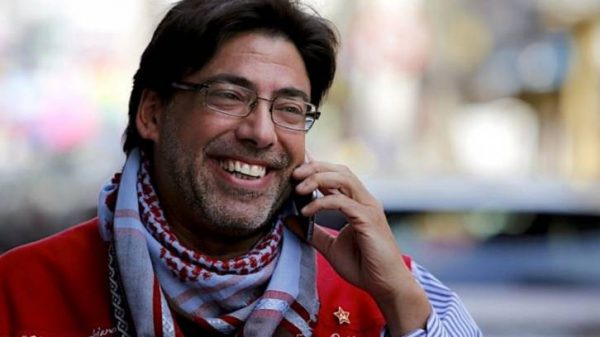
By Eric Striker | National Justice | July 15, 2021
Jews in America are demanding the United States intervene in Chile’s internal politics in the run up to their presidential election next November.
Daniel Jadue, a descendant of Palestinian refugees and member of the Chilean Communist Party, is currently the frontrunner in polls. Jadue is an unapologetic anti-Zionist who has in the past directly confronted the Jewish power structure of his country.
Gerardo Gorodischer, president of Chilean Jewish lobby, has successfully recruited Democrats and Republicans in the US Congress to call on Secretary of State Antony Blinken — a Jew himself — to meddle in Chile’s internal affairs and prevent Jadue from becoming president.
Jadue has in the past called attention to Jewish control of the media in his country. Last year, he was listed as one of the top 10 anti-Semites in the world by the Simon Wiesenthal Center after he passed a strict Boycott, Divestment and Sanctions (BDS) law as mayor of the city of Recoleta. He is currently supporting a law in the parliament that would make Chile the first nation in the world to officially institute a total boycott of Israel.
With 400,000 descendants, Chile is home to the world’s largest Palestinian diaspora outside of the Middle East. Chilean-Palestinians are overwhelmingly Christians who were forced to flee their homeland after being ethnically cleansed by Israel. Chile’s Jewish population is much smaller, currently estimated at 150,000 people. Jews in the country have started immigrating to Israel in larger than usual numbers out of fear of Jadue potentially becoming the nation’s next leader.
So far, Jewish attempts at “Corbyning” Jadue have failed. Complaints from Zionist organizations in Latin America and the US to stop Jadue have largely been ignored by the local population. Their trump card appears to be using the United States to intimidate the Chilean government with threats of economic retaliation or more.
In her letter to Blinken, Democratic congresswoman Debbie Wasserman-Schultz made a collective racial attack on the entire Chilean Palestinian community for protesting against Israel’s attacks on Arabs last May:
“Militant leaders of the 400,000-strong Chilean Palestinian community, and their partners, from a variety of political parties, were quite aggressive during and after the Gaza crisis, burning Israeli and U.S. flags, brandishing Nazi symbols and accusing Israel of apartheid and Chilean Jews of controlling the media. This dangerous climate has been intensifying for many years and has already affected Chile’s social fabric despite alarms sounded by the local Jewish community and U.S. Jewish organizations like the American Jewish Committee.”
The billionaire neo-conservative president of Chile, Sebastián Piñera, also received the letter. His allies in the parliament have started grilling Jadue over his 1983 high school yearbook entry, where he declared himself an “anti-Semite” and vowed revenge against Jews for what they did to his family. Jadue, a 54-years-old man, responded by making fun of Chilean conservatives asking him to “clarify” comments he made as a teenager as the country suffers through an economic crisis.
Jews have been encountering resistance from all across the political spectrum and diverse countries in recent months. Earlier this month, Belarusian leader Alexander Lukashenko gave a speech suggesting that Jews use the “Holocaust” to intimidate and control people. Yesterday in Poland, local nationalists crashed a Jewish ceremony racially defaming Poles as genocidal killers.
Joseph P. Kennedy, the Cursed Peacemaker
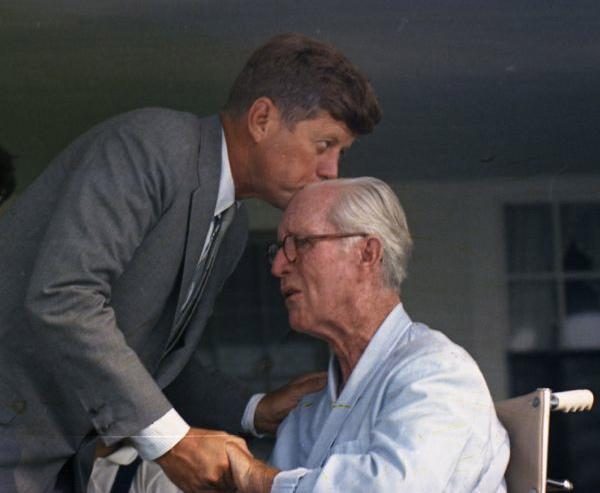
BY LAURENT GUYÉNOT • UNZ REVIEW • JULY 10, 2021
There can be no complete understanding of John Kennedy without some understanding of his father, Joseph Patrick Kennedy, for this is where he came from, not only in his own eyes and those of his friends, but in the eyes of his enemies too. The same is true for his brother Robert, of course.
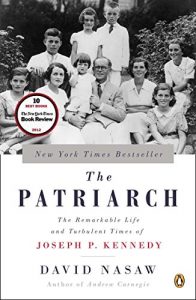
I have emphasized before that, although very different in character, John and Robert Kennedy may be seen, from the point of view of their historical significance, as one person killed twice. But it should be stressed that their unity was grounded in their filial piety. I learned from David Nasaw’s biography, The Patriarch: The Remarkable Life and Turbulent Times of Joseph P. Kennedy (2012), that it was their father Joe who insisted that Jack name Bobby Attorney General, because “Jack needed someone in the cabinet in whom he had complete and absolute trust.” Robert didn’t like the idea, arguing that “nepotism was a problem,” and John was reluctant to pressure Bobby.
He decided to offer Bobby the number two position at the Defense Department and asked Clark Clifford, who was running his transition team, to go to New York to explain to [Joe] Kennedy, who had flown there after visiting Jackie and his new grandson in the hospital, why Bobby should not be named attorney general. Clifford agreed, though he thought it rather odd that the president-elect had asked “a third party to try to talk to his father about his brother.” Clifford met Kennedy at Kennedy’s apartment and presented his carefully rehearsed case against the appointment. “I was pleased with my presentation; it was, I thought, persuasive. When I had finished, Kennedy said, ‘Thank you very much, Clark. I am so glad to have heard your views.’ Then, pausing a moment, he said, ‘I do want to leave you with one thought, however — one firm thought.’ He paused again, and looked me straight in the eye. ‘Bobby is going to be Attorney General. All of us have worked our tails off for Jack, and now that we have succeeded I am going to see to it that Bobby gets the same chance that we gave to Jack.’ I would always,” Clifford recalled years later, “remember the intense but matter-of-fact tone with which he had spoken — there was no rancor, no anger, no challenge.” The father had spoken, and his sons, on this issue at least, were expected to obey.[1]
Although there is no recorded statement to that effect, Joe probably envisioned that Robert could succeed Jack as president in 1968. And it is easy to imagine that, had John survived and been reelected in 1964, Robert, with John’s support and under his watch, could have inherited the White House. We may ponder what the world would be like today had there been Kennedys in the White House until 1976.
John and Robert shared a common horror of modern war, and that, too, was their father’s legacy. John was a genuine war hero decorated with the Navy and Marine Medal for “extremely heroic conduct.” Yet on Victory in Europe Day, May 8, 1945, as a young journalist covering the founding conference of the United Nations in San Francisco, he wrote in the Herald-American: “Any man who had risked his life for his country and seen his friends killed around him must inevitably wonder why this has happened to him and most important what good will it do. . . . it is not surprising that they should question the worth of their sacrifice and feel somewhat betrayed.”[2] When announcing his candidacy for Congress on April 22, 1946, JFK declared: “Above all, day and night, with every ounce of ingenuity and industry we possess, we must work for peace. We must not have another war.”[3] Hugh Sidey, one of his journalist friends, wrote about him: “If I had to single out one element in Kennedy’s life that more than anything else influenced his later leadership it would be a horror of war, a total revulsion over the terrible toll that modern war had taken on individuals, nations, and societies, and the even worse prospects in the nuclear age. . . . It ran even deeper than his considerable public rhetoric on the issue.”[4] John once said to his friend Ben Bradlee that he believed that “the primary function of the president of the United States [was] to keep the country out of war.”[5]
That was the conviction that had guided his father throughout his political life in Franklin Roosevelt’s government, until his resignation in December 1940. As U.S. ambassador to London, Joe Kennedy wholeheartedly supported Neville Chamberlain’s policy of “appeasement” in 1938-39. He wanted peace as passionately as Churchill wanted war. “I am pro-peace, I pray, hope, and work for peace,” Joe declared on his first return from London to the U.S. in December 1938.[6] For this, he ended in the wrong side of history, which Churchill took care to write himself.
Like his father, President Kennedy was a determined peacemaker, and those in the Pentagon who wanted to push the U.S. into a third world war tried to destabilize him with insinuations that he was an appeaser like his father. On October 19, 1962, in the heat of the Cuban Missile Crisis, as Kennedy resolved to blockade Soviet shipments rather than bomb and invade Cuba, General Curtis LeMay scornfully told him, “This is almost as bad as the appeasement at Munich . . . I just don’t see any other solution except direct military intervention right now.”[7]
The stain of his father’s record as a Hitler-appeaser had followed John like a shadow. Although the press had not published it, it was no secret in the Pentagon and the CIA that the U.S. army had discovered in 1946, in Berlin’s Foreign Office, reports about Joe’s meetings with German ambassador von Ribbentrop and his successor von Dirksen, that said that Joe was Germany’s “best friend” in London and “understood our Jewish policy completely.”[8]
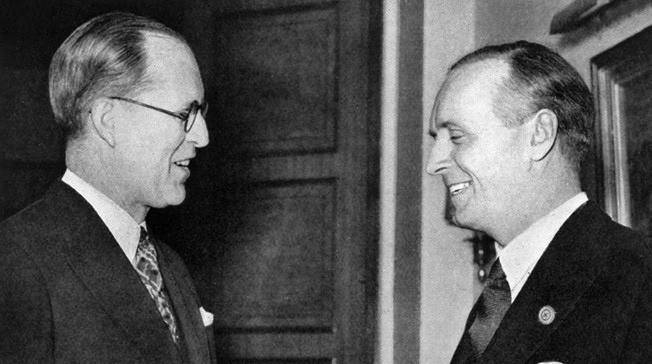
Ambassadors Joseph P. Kennedy and Joachim von Ribbentrop
In a joint debate during the 1960 Democratic convention, Johnson had attacked John as being the son of a “Chamberlain umbrella man” who “thought Hitler was right.”[9] During Kennedy’s presidential campaign, the Israeli press worried that Kennedy’s father “never loved the Jews and therefore there is a question about whether the father did not inject some poisonous drops of anti-Semitism in the minds of his children, including his son John’s.”[10] Abraham Feinberg recalls that when he invited Kennedy to his apartment to discuss his campaign funding with “all the leading Jews,” one of them set the tone with this remark: “Jack, everybody knows the reputation of your father concerning Jews and Hitler. And everybody knows that the apple doesn’t fall far from the tree.” Kennedy came back outraged from that meeting (but with the promise of $500,000).[11] When meeting the new president on May 30, 1961 in New York, Ben-Gurion could not help but see in him the son of a Hitler-appeaser. Feinberg (who arranged the meeting) recalls that “Ben-Gurion could be vicious, and he had such a hatred of the old man [Joe Kennedy].”[12]
 Is Joe’s bad reputation among Jews relevant to the assassination of his two sons? Many Jewish authors think it is. In his book The Kennedy Curse, purporting to explain “why tragedy has haunted America’s first family for 150 years”, Edward Klein links the “Kennedy curse” to Joe’s anti-Semitism, citing a story “told in mystical Jewish circles” (perhaps made up by Klein) according to which, in “retaliation” to some remark Joe made to “Israel Jacobson, a poor Lubavitcher rabbi and six of his yeshiva students, who were fleeing the Nazis,” “Rabbi Jacobson put a curse on Kennedy, damning him and all his male offspring to tragic fates.”[13] Ronald Kessler, for his part, wrote a book titled, The Sins of the Father — a not so subtle allusion to Exodus 20:5: “I, Yahweh, am a jealous God, punishing the children for the sin of the parents to the third and fourth generation of those who hate me.” Naturally, for Kessler, Joe Kennedy’s worst sin was that “he was a documented anti-Semite and an appeaser of Adolf Hitler” who “admired the Nazis.”[14]
The “Kennedy curse” did run into the third generation and possibly the fourth, when John’s only son died in a suspicious plane accident on July 16, 1999, with his wife, possibly pregnant. Five days later, John Podhoretz, son of neoconservative luminary Norman Podhoretz, published in the New York Post an opinion piece titled “A Conversation in Hell” in which he imagined Satan speaking to Joe Kennedy in Hell. The devil rejoices at the idea of eternally torturing Joe for “saying all those nice things about Hitler,” and brags of having caused the death of his grandson because, he says: “When I make a deal for a soul like yours, I need to season it before I’m ready to put it in the infernal oven.” This hateful fantasy, which is reminding of the Talmud’s depiction of Jesus in Hell, illustrates the devouring hatred of some Jewish intellectuals toward the Kennedys, and the root of that hatred in Joe Kennedy’s effort to prevent the Second World War.[15]
Interestingly, Podhoretz’s devil (or is it Yahweh?) accuses Kennedy of having done “everything you could to prevent Jewish emigration from Nazi Germany. Thousands of Jews died because of you.” The truth is exactly the opposite. In 1938, the “Kennedy Plan”, as the press called it, was to rescue German Jews. Since the U.S. government refused to open its borders to Jewish refugees, and since Great Britain strictly limited Jewish immigration to Palestine, Joe was urging the British government to open up its African colonies for temporary resettlement. “To facilitate the resettlement process,” Nasaw writes, “Kennedy volunteered to Halifax that he ‘thought that private sources in America might well contribute $100 or $200 million if any large scheme of land settlement could be proposed.’”[16] The plan was presented to Chamberlain just days after Kristallnacht (9-10 November 1938), and was supported by Jewish financier Bernard Baruch. But it angered the Zionists, who didn’t want to hear about any Jewish emigration except to Palestine, because, Ben-Gurion said, it “will endanger the existence of Zionism.”[17] Therefore, today, the “Kennedy Plan” is reviled as a kind of “final solution to the Jewish question,” and further proof that Joe was Israel’s mortal enemy.[18]
If Jewish hatred of Joe Kennedy could still inspire Podhoretz’s nasty column in 1999, imagine how deep it ran in the 1960s. At the height of his showdown with JFK over Dimona, 25 April 1963, Ben-Gurion wrote him a seven-page letter explaining that his people was threatened with extermination by a newly formed Arab Federation, just like when “six million Jews in all the countries under Nazi occupations (except Bulgaria), men and women, old and young, infants and babies, were burnt, strangled, buried alive.” “Imbued with the lessons of the Holocaust,” Avner Cohen comments, “Ben Gurion was consumed by fears for Israel’s security.”[19] He was enraged by what he saw as Kennedy’s obvious lack of concern for his people’s security, and at this point, he must have decided that Kennedy was indeed his father’s son, a modern-day Haman.
Before we get to the main piece of evidence of a direct relationship between Joe Kennedy’s appeasement policy and John Kennedy’s assassination, let us get an overview of Joe’s public career, using mainly David Nasaw’s biography and on Michael Beschloss’s Kennedy and Roosevelt: The Uneasy Alliance (1979).
Joe Kennedy entered national politics as a supporter of Roosevelt in his first presidential campaign in 1932. In July 1934, Roosevelt asked him to chair the newly created Securities and Exchange Commission, charged with bringing the New Deal to Wall Street by regulating and disciplining the Stock Exchange market. Kennedy announced: “the days of stock manipulation are over. Things that seemed all right a few years ago find no place in our present-day philosophy.” According to Beschloss, Kennedy “won almost universal praise for his salesmanship, political acumen, and ability to moderate conflicting sides that encouraged capital investment and economic recovery.” “Few were more impressed by Kennedy’s accomplishment than the man who hired him,” and “Joseph Kennedy increasingly became a familiar figure at the White House.”[20]
In 1936, Joe supported Roosevelt’s second campaign with a book titled I’m for Roosevelt (mostly ghost-written by Arthur Krock). He was hoping to be named Secretary of the Treasury, but Henry Morgenthau Jr. also wanted the job, and got it. Instead, Roosevelt named Joe chairman of the Maritime Commission, and one year later made him ambassador to London. As war was brooding in Europe, this was an important position, and Joe made it more important by often overstepping his Secretary of State Cordell Hull’s instructions.
He supported Chamberlain’s position that the territorial integrity of Czechoslovakia was not worth a war, declaring in September 2, 1938, “for the life of me I cannot see anything involved which could be remotely considered worth shedding blood for,” a statement for which he was reprimanded by Hull and Roosevelt.[21] On October 19, Joe began another speech by jokingly listing the topics he had decided not to talk about, including “a theory of mine that it is unproductive for both democratic and dictator countries to widen the division now existing between them by emphasizing their differences, which are self-apparent.”[22] Hull held a press conference the next morning to clarify that Kennedy had been speaking for himself, not the government, and Roosevelt delivered his own display of belligerence: “There can be no peace if national policy adopts as a deliberate instrument the threat of war.”[23]
In the meantime, without informing Hull, Kennedy had summoned Charles Lindbergh to London and asked him to write a letter, to be forwarded to Washington and to Whitehall, summarizing his view regarding the strength of the Luftwaffe. Lindbergh had just visited German airfields (and been presented the Service Cross of the German Eagle by Goering), and concluded that the Luftwaffe would be unassailable in a war of the skies. Kennedy then arranged a meeting between Lindbergh and an official of the British air ministry.[24] His diplomatic strategy consisted in trying to convince the British that Germany was unbeatable and that the U.S. wouldn’t join the fight, so that the British had better come to terms with Germany, whose territorial claims were justified anyway.
In the same period, Joe made plans to meet in Paris with Dr. Helmuth Wohlthat, Goering’s chief economic adviser, with whom he had made contact through James Mooney, the president of General Motors Overseas. As Nasaw explains, “Kennedy was in effect laying the groundwork for a new appeasement strategy, one that would buy Hitler off by providing him with the means to convert his war economy to a peace economy.”[25] Hull forbade him to go to Paris, so Joe met Wohlthat in London without informing Hull.
 In August 23, 1939, a week before Hitler invaded Poland, Kennedy urged Roosevelt, in vain, to pressure the Polish government to cede territory to Germany.[26] After Hitler’s invasion, Kennedy, like Chamberlain, was heartbroken: “It’s the end of the world . . . the end of everything,” he told Roosevelt on the phone.[27] But a week later, he was still urging him to save peace, writing him: “It seems to me that this situation may crystallize to a point where the President can be the savior of the world. The British government as such certainly cannot accept any agreement with Hitler, but there may be a point when the President himself may work out plans for world peace.”[28] He got his response from Hull: “The people of the United States would not support any move for peace initiated by this Government that would consolidate or make possible a survival of a regime of force and of aggression.”
Simultaneously, Roosevelt was initiating direct contact with Churchill, now First Lord of the Admiralty and soon to be Prime Minister. From Roosevelt’s letters, Churchill got enough confidence that the U.S. would ultimately join the war if it broke out, and he bet everything on it. Joe was infuriated when learning about this most irregular channel of communication, at a time when the President was bound by neutrality laws and the American people overwhelmingly opposed to U.S. engagement. Joe was particularly distressed by Roosevelt’s trust in Churchill, whom Joe considered “an actor and a politician. He always impressed me that he’d blow up the American Embassy and say it was the Germans if it would get the U.S. in.”[29] In early December 1939, Kennedy confided to Jay Pierrepont Moffat of the State Department that Churchill “is ruthless and scheming. He is also in touch with groups in America which have the same idea, notably, certain strong Jewish leaders.”[30]
 After the defeat of France, Kennedy saw a new opportunity for peace. He cabled Washington on May 27, 1940, recommending that the President push Britain and France to negotiate an end to the crisis, as Lord Halifax, still Foreign Secretary, was actually proposing. “I suspect that the Germans would be willing to make peace with both the French and British now — of course on their own terms, but on terms that would be a great deal better than they would be if the war continues.”[31]
Although aware that Roosevelt was now ignoring him, Joe remained at his post until October 1940. Before leaving, he wrote a note to Chamberlain, then a broken and dying man: “For me to have been any service to you in your struggle is the real worthwhile epoch in my career. You have retired but mark my words the world will yet see that your struggle was never in vain. My job from now on is to tell the world of your hopes. Now and forever, Your devoted friend, Joe Kennedy.”[32] Joe Kennedy was still a convinced appeaser, determined to give peace every chance.
David Irving mentions that, before boarding a ship from Lisbon to New York, Kennedy “pleaded with the State Department to announce that, even if this vessel mysteriously blew up in mid-Atlantic with an American ambassador on board, Washington would not consider it a cause for war. ‘I thought,’ wrote Kennedy in his scurrilous unpublished memoirs, ‘that would give me some protection against Churchill’s placing a bomb on the ship.’”[33]
Kennedy arrived in New York October 27, a week before election day. He knew enough of Roosevelt’s secret contacts with Churchill to endanger his reelection. He was seriously considering speaking out to the press. In a wire to his lover and admirer Clare Booth Luce, he promised a bombshell that would “put twenty-five million Catholic voters behind [Republican candidate] Wendell Willkie to throw Roosevelt out.”[34]
But Joe had a strong sense of loyalty, and his wife reminded him of a political truth instinctive to them both: “The President sent you, a Roman Catholic, as Ambassador to London, which probably no other President would have done. . . . You would write yourself down as an ingrate in the view of many people if you resign now.”[35] After a long conversation with Roosevelt on the day of his arrival, of which nothing has transpired, Kennedy gave a radio address over CBS on October 29 to endorse Roosevelt, but not without reasserting his “conviction that this country must and will stay out of war.” A few days later, with Joe Kennedy by his side, Roosevelt made his own pledge: “I have said this before, but I shall say it again and again and again: Your boys are not going to be sent into any foreign wars!”[36] Roosevelt was elected. On December 1, 1940, Kennedy delivered his resignation letter, and told reporters: “My plan is . . . to devote my efforts to what seems to me to be the greatest cause in the world today . . . That cause is to help the President keep the United States out of war.”[37]
On December 17, Roosevelt revealed at a press conference his plans to provide billions of dollars in war supplies to Great Britain in the form of Lend-Lease (eventually, the U.S. would supply England with $13 billion). Joe expressed privately his feeling of having been exploited by the President. But he stayed in relatively good terms with Roosevelt, although he refused to support his nomination for a fourth term, when he visited him on October 26, 1944 in the White House. Kennedy recorded in his notes telling the President — a very sick man — that the Catholic voters were hesitant to vote for him because “they felt that Roosevelt was Jew controlled.” He added that he agreed “with the group who felt that the Hopkins, Rosenmans, and Frankfurters, and the rest of the incompetents would rob Roosevelt of the place in history that he hoped, I am sure, to have. . . . Roosevelt went on to say ‘Why, I don’t see Frankfurter twice a year.’ And I said to him, ‘You see him twenty times a day but you don’t know it because he works through all these other groups of people without your knowing it.’”[38]
After his resignation in 1941, Joe had envisioned writing a memoir of his London years, and told his friend and former president Herbert Hoover that the book would “put an entirely different color on the process of how America got into the war and would prove the betrayal of the American people by Franklin D. Roosevelt.” But, Beschloss comments, “the necessities of wartime unity and, later, his sons’ political careers kept Joseph Kennedy’s diplomatic memoir out of print, where it remained.”[39]
Here, there is an interesting parallel with James Forrestal, another American patriot of Irish Catholic stock and a friend of Joe Kennedy. As David Martin shows in his book The Assassination of James Forrestal (summarized here), when Forrestal was pushed out of the Defense Department by Truman in March 1949, he planned to write a book and to start a magazine. As Navy Secretary, he had gained inside knowledge of Roosevelt’s scheme to provoke the Japanese into attacking Pearl Harbor. In 1945, he had worked behind the scene to achieve a negotiated surrender from the Japanese, and was very bitter about Roosevelt’s demand for “unconditional surrender” and the unnecessary suffering imposed on the Japanese. Forrestal had also much to say about the way the Zionists obtained the Partition Plan at the U.N. General Assembly, or about the way Truman was bought into supporting the recognition of Israel. On April 2, 1949, Forrestal was interned against his will and forcibly confined in the 16th floor of the Navy hospital of Bethesda, and on May 22 was declared to have fallen from a window while trying to hang himself from it with a dressing-gown sash. No criminal investigation was conducted, but the evidence obtained by David Martin through a Freedom of Information Act leaves no doubt that he was assassinated by the Zionist mafia.
It is easy to imagine that, had Joe Kennedy decided to expose Roosevelt’s betrayal of the American people and the Jewish intrigues to push him into the war, he might have suffered the same fate as Forrestal. Instead, he retired from public life and devoted his remaining influence to his sons’ political future. Despite the death of his eldest son Joe Jr. in a high-risk mission in 1944, he achieved his presidential ambition through his second son. The “Kennedy curse,” however, would ultimately catch up with his lineage.
John Kennedy’s Intellectual Filiation
John has always been loyal to his father’s memory, and there is enough evidence that he shared his most fundamental principles and his views of World War II. In 1956, in his book Profiles in Courage, John praised Senator Robert Taft for having, at tremendous personal cost, denounced in 1946 the hanging of eleven Nazi officials as “a blot on the American record which we shall long regret.”[40] One symbolic hint of President Kennedy’s intellectual and political filiation with his father was his invitation of Charles Lindbergh on May 11, 1962, for a grand reception at the White House. Lindbergh and his wife caused a sensation when they dined at the presidential table and stayed overnight at the White House.[41] Let’s recall that, in September 1940, Lindbergh had been a founding member of the America First Committee and the staunchest critic of Roosevelt’s ploys to drag the U.S. into the war.[42] His reputation had suffered tremendously from his criticism of Jewish influence, and he had been living as a recluse ever since.
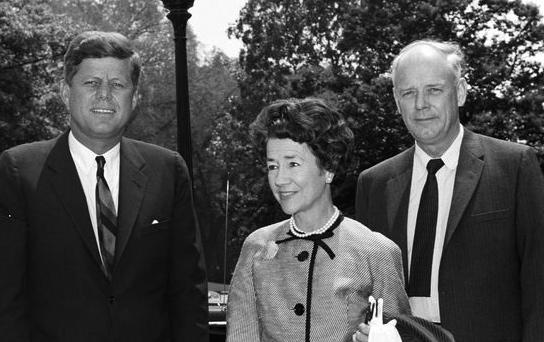
Kennedy had nothing to gain politically from inviting Lindbergh very publicly to the White House. The significance of this gesture should not be underestimated. It probably demonstrates a wish to vindicate the vilified appeasers of 1938-40. Lindbergh at the White House may have been a sign that the wheel was turning, and that history would soon be written in a more balanced way. John’s assassination halted and reversed this movement. Half a decade later, along with the expansion of Israel, the dark cult of the Holocaust would start swamping over the U.S. and the world. Arguably, if Kennedy had lived, there would be no compulsory Holocaust religion today.
For those like David Ben-Gurion whose self-image and worldview revolved around the Holocaust, the Kennedy brothers were essentially sons of a Hitler-appeaser and Nazi-supporter, and their leadership of the United-States was an existential threat as well as an intolerable insult. Although, for obvious reasons, this murderous hatred is seldom expressed publicly (John Podhoretz’s “A Conversation in Hell” is a remarkable exception), it is a critical fact to take into account in our quest to solve the mystery of the “Kennedy curse.” And it sheds a bright light on one of the most bizarre aspects of JFK’s assassination.
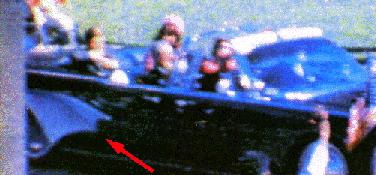
In his 1967 book titled Six Seconds in Dallas: a micro-study of the Kennedy assassination proving that three gunmen murdered the President, Josiah Thompson first drew attention to a character who can be seen on the Zapruder film and on other photographs taken in Dealey Plaza at the moment of JFK’s assassination. Here is how Thompson presents him in a short video recorded by Errol Morris for the New York Times in 2011:
On November 22nd, it rained the night before. But everything cleared by about 9 or 9:30 in the morning. So if you were looking at various photographs of the motorcade route, in the crowd gathered there, you will have noticed: nobody is wearing a raincoat, nobody has an open umbrella. Why? Because it’s a beautiful day. And then I noticed: in all of Dallas, there appears to be exactly one person standing under and open black umbrella. And that person is standing where the shots began to rain into the limousine. Let us call him “the umbrella man”. . . . You can see him in certain frames from the Zapruder film, standing right there by the Stemmons Freeway sign. There are other still photographs taken from other locations in Dealey Plaza, which shows the whole man standing under an open black umbrella — the only person under any umbrella in all of Dallas, standing right at the location where all the shots come into the limousine. Can any one come up with a non-sinister explanation for this? So I published this in Six Seconds, but didn’t speculate about what it meant . . . Well, I asked that the Umbrella Man to come forward and explain this. So he did. He came forward and he went to Washington with his umbrella, and he testified in 1978 before the House Select Committee on Assassinations. He explained then why he had opened the umbrella and was standing there that day. The open umbrella was a kind of protest, a visual protest. It wasn’t a protest of any of John Kennedy’s policies as president. It was a protest at the appeasement policy of Joseph P. Kennedy, John Kennedy’s father when he was ambassador to the court of Saint James in 1938 and 39. It was a reference to Neville Chamberlain’s umbrella.[43]
The black umbrella had been Chamberlain’s iconic trademark, and, after his return from Munich, a symbol of “appeasement”, both for those who supported it (some old ladies “suggested that Chamberlain’s umbrella be broken up and pieces sold as sacred relics”)[44] and for those who opposed it (“Wherever Chamberlain traveled, the opposition party in Britain protested his appeasement at Munich by displaying umbrellas,” according to Edward Miller).
The Umbrella Man was Louie Steven Witt, and had been identified by local newsmen before he came forward to the HSCA. Josiah Thompson assumes that his “visual protest” and JFK’s assassination are unrelated, and that they happened at the exact same time and place by some kind of quantum-physics coincidence. He cannot bring himself to see the connection, even though the Umbrella Man himself made it clear to the HSCA that he wanted to “heckle” JFK about his father’s appeasement of Hitler in 1938. Knowing what we know about Jewish perception of the “Kennedy curse” as linked to the “sins of the father”, we cannot but find Thompson’s refusal to see anything conspiratorial as very typical of Gentile self-induced blindness.
Was Louie Steven Witt a Zionist agent, a sayan? Not necessarily. He might have been instructed to do what he did without knowing that Kennedy would be killed right in front of him. On the other hand, the explanation he gave for his “bad joke” sounds disingenuous: “In a coffee break conversation,” he said, “someone had mentioned that the umbrella was a sore spot with the Kennedy family. . . . I was just going to kind of do a little heckling.” Witt carefully avoided mentioning why the umbrella was “a sore spot with the Kennedy family.” He also avoided naming Joe Kennedy when he said that he had heard that “some members of the Kennedy family” had once been offended in an airport by people brandishing umbrellas. The “airport” sounds like an allusive reference to Chamberlain’s widely publicized return at the Heston Aerodrome on 30 September 1938. There is clearly a cryptic undertone in Witt’s explanation. For those Unz Review readers who have ears to hear and eyes to see, executing JFK while “heckling” him about his father’s appeasement policy should be an unmistakable signature. Chamberlain’s umbrella is Kennedy’s cross.
Laurent Guyénot, Ph.D., is the author of The Unspoken Kennedy Truth(2021), Essays on Jewish Power(2020), and From Yahweh to Zion (2018).
Notes
[1] David Nasaw, The Patriarch: The Remarkable Life and Turbulent Times of Joseph P. Kennedy, Penguin Books, 2012, pp. 818-819.
[2] Christ Matthews, Jack Kennedy, Elusive Hero, Simon & Schuster, 2011, pp. 71-72.
[3] James Douglass, JFK and the Unspeakable: Why He Died and Why It Matters, Touchstone, 2008, p. 5.
[4] Quoted in Robert Kennedy, Jr., American Values: Lessons I Learned from My Family, HarperCollins, 2018, p. 101.
[5] Quoted in Robert Kennedy, Jr., American Values, p. 101.
[6] Michael R. Beschloss, Kennedy and Roosevelt: The Uneasy Alliance, Open Road, 1979, p.187.
[7] Douglass, JFK and the Unspeakable, p. 21.
[8] Nasaw, The Patriarch, p. 349.
[9] Robert Caro, The Years of Lyndon Johnson, vol. IV: The Passage of Power, Alfred Knopf, 2012, p. 104. Also in Arthur Krock, Memoirs: Sixty Years on the Firing Line, Funk & Wagnalls, 1968, p. 362.
[10] In the journal of the Herut, Menachem Begin’s political party, quoted in Alan Hart, Zionism: The Real Enemy of the Jews, vol. 2: David Becomes Goliath, Clarity Press, 2013, p. 252.
[11] Seymour Hersh, The Samson Option: Israel’s Nuclear Arsenal and American Foreign Policy, Random House, 1991, p. 96.
[12] Hersh, The Samson Option, p. 103.
[13] Edward Klein, The Kennedy Curse: Why Tragedy Has Haunted America’s First Family for 150 Years, Saint Martin’s Press, 2004.
[14] Ronald Kessler, The Sins of the Father: Joseph P. Kennedy and the Dynasty He Founded, Coronet Books, 1997, quotes from the publisher’s presentation and the back cover.
[15] John Podhoretz, “A Conversation in Hell,” New York Post, July 21, 1999, on nypost.com
[16] Nasaw, The Patriarch, pp. 403-406.
[17] Alan Hart, Zionism: The Real Enemy of the Jews, vol. 1: The False Messiah, Clarity Press, 2009, p. 164.
[18] Clive Irving, “Joe Kennedy’s answer to the Jewish question: ship them to Africa,” Apr. 14, 2017, on www.thedailybeast.com
[19] Avner Cohen, Israel and the Bomb, Columbia UP, 1998, pp. 10, 119.
[20] Beschloss, Kennedy and Roosevelt, pp. 105-109.
[21] Nasaw, The Patriarch, p. 373; also Beschloff, Kennedy and Roosevelt, p. 180.
[22] Nasaw, The Patriarch, p. 396.
[23] Beschloss, Kennedy and Roosevelt, pp. 185-186.
[24] Beschloss, Kennedy and Roosevelt, p. 182.
[25] Nasaw, The Patriarch, p. 425.
[26] Nasaw, The Patriarch, p. 445.
[27] Beschloss, Kennedy and Roosevelt, p. 199.
[28] Beschloss, Kennedy and Roosevelt, p. 201.
[29] Nasaw, The Patriarch, pp. 460-461. The quote is from Joe Kennedy’s diary, according to David Irving, who renders it slightly differently in Churchill’s war, vol. 1: The Struggle for Power, Focal Point, 2003, p. 207.
[30] Nasaw, The Patriarch, p. 476.
[31] Nasaw, The Patriarch, p. 496.
[32] Nasaw, The Patriarch, p. 534.
[33] David Irving, Churchill’s war, vol. 1: The Struggle for Power, Focal Point, 2003, p. 207.
[34] Beschloss, Kennedy and Roosevelt, pp. 15-16.
[35] Beschloss, Kennedy and Roosevelt, pp. 43 and 230.
[36] Beschloss, Kennedy and Roosevelt, pp. 235-237.
[37] Beschloss, Kennedy and Roosevelt, p. 247.
[38] Nasaw, The Patriarch, p. 625; Beschloss, Kennedy and Roosevelt, p. 279.
[39] Beschloss, Kennedy and Roosevelt, p. 273.
[40] Robert Taft, October 6, 1946, quoted in John F. Kennedy, Profiles in Courage, 1956, Harper Perennial, 2003 , p. 199.
[41] “Visit of Charles A. Lindbergh”, on www.jfklibrary.org
[42] Lynne Olson, Those Angry Days: Roosevelt, Lindbergh, and America’s Fight Over World War II, 1939-1941, Random House, 2013.
[43] “The Umbrella Man”, on Vimeo.com or YouTube
[44] Patrick J. Buchanan, Churchill, Hitler, and “The Unnecessary War”: How Britain Lost Its Empire and the West Lost the World, Crown Forum, 2008, p. 208.
House committees pass $20 mill per day on behalf of Israel
By Alison Weir | Israel-Palestine News | July 12, 2021
Congressional committees recently passed two bills that contain provisions to disburse a total of over $7 billion on behalf of Israel in the year 2022. This works out to almost $20 million per day.
These provisions were included in the bills despite the fact that Israel just committed another onslaught against Gazan men, women, and children; despite Israel’s many actions that harm Americans; despite the fact that most Americans think the U.S. already gives Israel too much money; and despite the fact that aid to Israel is illegal under U.S. laws.
On June 30th, the House Appropriations Subcommittee on Defense approved a bill that gives Israel half a billion dollars, and on July 1st the House Appropriations Committee advanced a bill that disburses nearly $6.4 billion on behalf of Israel.
APPROPRIATIONS COMMITTEE BILL
The latter bill, currently called the “2022 State, Foreign Operations and Related Programs Appropriations” bill, includes a measure that would give Israel $3.3 billion in military aid. The Committee’s press release on the bill, however, does not mention the funding for Israel.
In addition to this $3.3 billion, the bill includes the following funding that benefits Israel:
• An additional $58 million on related programs for Israel, which AIPAC points out in a series of proud tweets that list them.
• The bill provides $1.65 billion to Jordan and $1.4 billion to Egypt stemming from previous agreements with their governments to desist from advocating for Palestinian rights.
• It also contains a section to provide $225 million for alleged assistance to Palestinians. In reality, such funding is largely intended to benefit Israel, and is often proposed and/or receives support from Israel partisans such as Nita Lowey.
Rationales given in the bill for this funding are that it would “advance Middle East peace” (i.e. lead Palestinians to accede to Israeli demands); “improve security in the region” (be used by the Palestinian Authority to continue to round up resistance fighters – the Palestinian Authority is known as Israel’s “day-to-day partner in governing the West Bank”); and to “address urgent humanitarian needs” (but doesn’t mention that these needs are caused by Israel’s ongoing military attacks and financial policies against Palestinians).
Portions of the aid are used as a combination threat and bribe; the money will not be provided if “the Palestinians obtain the same standing as member states or full membership as a state in the United Nations or any specialized agency thereof” or if “the Palestinians initiate an International Criminal Court (ICC) judicially authorized investigation, or actively support such an investigation, that subjects Israeli nationals to an investigation for alleged crimes against Palestinians.”
Such ‘humanitarian’ funding for Palestinians is considered important for Israel, as two prominent Israel advocates explain:
“Funding for Palestinian assistance programs has always flowed with bipartisan support because it was determined to reinforce Israel’s security and provide a measure of U.S. leverage and influence.
This logic was ratified by the support of the Israeli government for these programs. Israeli authorities understood that a breakdown in security, an economic collapse or a humanitarian crisis in the West Bank would place an enormous burden on Israel.”
These additional provisions bring the total amount of Americans’ tax money to be disbursed on behalf of Israel in the Appropriations Committee bill to at least $6.7 billion.
Added to that is the half billion in the defense subcommittee bill passed on June 30th, making the total amount of money to be disbursed on behalf of Israel approximately $7.2 billion.
These provisions were passed despite the fact that most voters would likely oppose them, since, as mentioned above, surveys indicate that the majority of Americans don’t support such large funding to Israel. However, very few Americans know about the proposed funding, since mainstream U.S. news companies almost never report on such legislation (unlike Israeli and Israel-focused U.S. media).
EVEN MORE MONEY FOR ISRAEL…
And there are numerous additional expenditures on behalf of Israel throughout the bill that are not included in the above tabulation.
Among these are funding for operations to dismantle the Arab League boycott of Israel; millions of dollars provided for Jews resettling in Israel; portions of the $20 billion to “Democracy Programs” and the $4.5 billion to the U.S. Commission on International Religious Freedom that are used to oppose support for Palestinian rights as allegedly ‘antisemitism’; funding to countries such as Bahrain, UAE, Morocco, and others resulting from enticements to procure their ‘normalization‘ policies with Israel, etc. A thorough examination of such additional programs could quite possibly add another billion dollars to be disbursed for Israel.
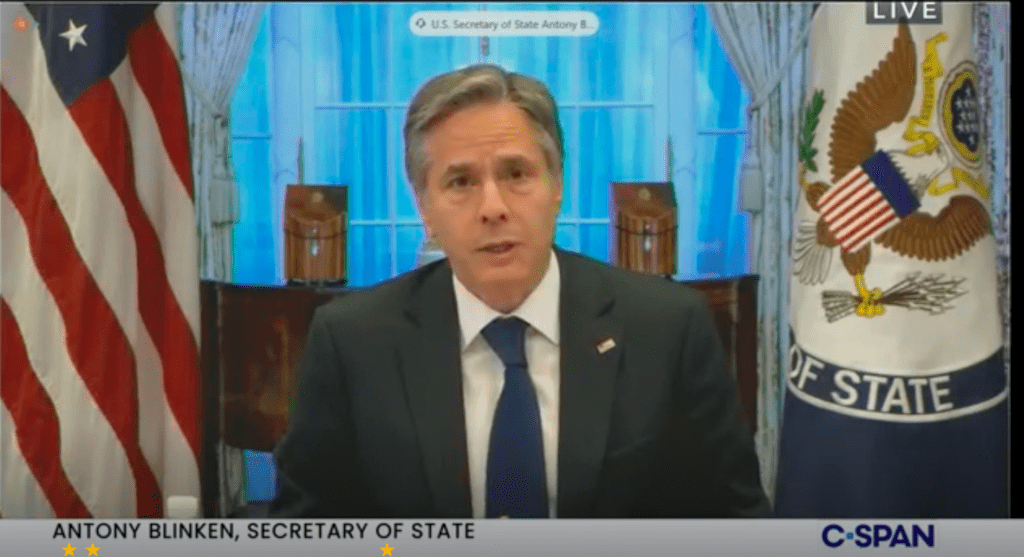
Secretary of State Antony Blinken testifies before House Appropriation Subcommittee hearing on 2022 State, Foreign Operations and Related Programs Appropriations bill on June 7, 2021. (Blinken had helped give Israel millions of additional dollars during its 2014 massacre of Gazans.) (C-Span)
AIPAC IS PLEASED
The American Israel Public Affairs Committee (AIPAC) – possibly the most famous of the hundreds of pro-Israel groups in the U.S. – applauded Congressional leaders for their action in passing the measures:

This money to and for Israel is not new. Over the years, Israel has received far more U.S. tax money than any other country on earth: on average over 7,000 times more per capita than anyone else.
And in addition to all of this are the lives destroyed and the multi-trillion dollar cost of the Iraq war, a tragic and disastrous quagmire promoted by Israel and its American partisans.
And on top of this are the costs, in both lives and treasure, of Israel-influenced policies regarding Syria, Iran, and others.
It’s time to end Israel’s strangle hold over American politicians. To tell your Congress members to vote against this massive funding for Israel, go here.
(And to tell them to enact legislation that protects Palestinian children, go here.)
Alison Weir is executive director of If Americans Knew, president of the Council for the National Interest, and author of Against Our Better Judgment: The Hidden History of How the U.S. Was Used to Create Israel.
The Fight to Save Lifta, the Last Remaining Palestinian Village
By Jessica Buxbaum | MintPress News | July 9, 2021
Yacoub Odeh is 81 years old but he can still remember his childhood in the Palestinian village of Lifta as if it were yesterday. Children playing together in the gardens, swimming in the pools and laying in the grass.
Today, Lifta remains as a frozen time capsule. While the residents were expelled during Israel’s 1948 ethnic cleansing campaign (Nakba), the ruins of their homes still stand. These ruins carved into the lush hillside are perceived as a symbol of the Palestinians’ right of return. This is the only town Israel did not demolish after the Nakba, but a government plan may soon change that.
In May, the Israel Lands Authority (ILA), the government agency in charge of managing public lands, issued a new tender for construction in Lifta. The development scheme, known as Plan 6036, seeks to build 259 housing units along with a commercial and business space and a luxury hotel on top of and around the existing houses. Daphna Golan-Agnon, a law professor at the Hebrew University of Jerusalem and part of the Save Lifta Coalition’s board, explained that while the homes may not be demolished, “the village will disappear behind walls of concrete needed to hold new construction.”
The bid was supposed to be held on July 4, but significant public opposition delayed it to July 29.

The ruins in Lifta, a Palestinian village ethnically cleased in 1948. Liebe Blekh | MintPress News
Attempts to demolish Lifta have been ongoing for years. The ILA first published a tender for Plan 6036 in 2010 after the Israeli state approved the construction plan for Lifta in 2006. A 2012 Jerusalem District Court ruling found Plan 6036 insufficient and requested amending it in accordance with a conservation survey on Lifta from the Israel Antiquities Authority (IAA).
The IAA survey was completed in 2017 and found that Plan 6036 could not be executed without making significant adjustments in order to preserve the ancient village. Plan 270b was drawn up to fit the survey’s findings but in 2017 the Local Planning and Building Committee of Jerusalem temporarily halted the initiative for further examination.
The recent ILA announcement was met with hundreds of letters to Jerusalem’s mayor rejecting the sale. When reached for comment, the Municipality of Jerusalem told MintPress News that it “wasn’t informed about the publication of this tender and didn’t approve it. The mayor of Jerusalem asked all the relevant authorities to reconsider the construction plan.” The Israel Lands Council, which operates the ILA, did not respond to a request for comment.
‘In one hour, we became refugees’
Lifta’s strategic location at the edge of Jerusalem has made it a prime target for land grabs. Acting as a suburb of Jerusalem, Lifta’s placement next to the Jerusalem-Jaffa Highway makes for an easy trip to the Mediterranean while still being tied to the city of Jerusalem.
Lifta, often referred to as the entrance to Jerusalem, was a wealthy, agricultural community supported by olive presses and flour mills and situated atop the Wadi al-Shami spring. Homes made of limestone were cut into the hillside and Lifta’s roads wended through the valley.
Prior to the 1948 Nakba, Zionist militias like the Haganah saw seizing Lifta as necessary to cement Jewish control over all of Palestine. According to the Haganah Historical Archives, “[s]ecuring the western exit of the city [of Jerusalem] entailed the eviction of Arabs.” Israeli historian Benny Morris said the Haganah fired the first shots in 1947, setting off the mass expulsion of Lifta’s 2,960 residents.
In December 1947, the Haganah killed a Palestinian business owner in Lifta. Later that month, one of Lifta’s two coffeehouses was ambushed with gunfire and grenades. The attack killed six and wounded seven. Two months into 1948, the Jewish Agency chairman and future first prime minister of Israel, David Ben-Gurion, boasted of the ethnic cleansing’s success, telling his political party members: “From your entry into Jerusalem through Lifta — Romema, through Mahane Yehuda, King George Street and Mea She’arim — there are no strangers. One hundred percent Jews.“
Odeh, head of the Lifta Cultural Heritage Protection Commission, was 8-years-old when Lifta came under siege by Zionist forces.
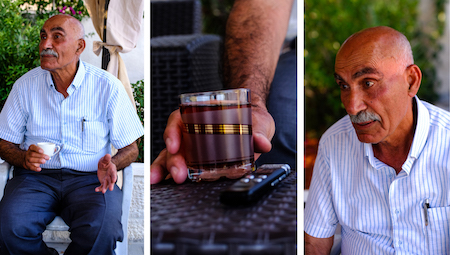
Yacoub Odeh, Nakba survivor and head of the Lifta Cultural Heritage Protection Commission. Liebe Blekh | MintPress News
“I remember one day my mother was preparing the fire to heat our room, and then [the Zionist miltiias] began to shoot. My brothers began to cry, ‘Mama, mama! They’re shooting us!’ My mom took us inside the room in the corner and under a table to protect us,” Odeh said, recalling two stories of Lifta — the town’s beauty and charm and then its tragic fall.
“There is the beautiful life and then began the miserable life because of the occupation.”
Toward the end of February 1948, Odeh’s father put him, his siblings and his mother into a truck heading to Ramallah to escape the violence in Lifta. Odeh’s father stayed behind to defend the village from the Zionist gangs.
“We were only wearing the clothing we had on because we are coming back tomorrow. We are coming back. Now we just want to be far from the shooting.” Odeh took a deep sigh and said, “In one hour, we became refugees.”
Today, 55 buildings out of approximately 450 remain in Lifta, including a club, mosque, cemetery and school, which now operates as a school for Israeli Jews. Liftawi refugees are estimated at around 30,000 and live in Jerusalem, the Occupied West Bank and the Diaspora. Most of the homes are empty, but a few are occupied by Israeli settlers. According to Zochrot, the Israeli nonprofit seeking to raise awareness of the Nakba, the “settlements of Mey Niftoach and Giv’at Sha’ul were built on village lands and now have become parts of the suburbs of Jerusalem.”
Saving Lifta
The Save Lifta Coalition orchestrated the campaign to the mayor and has been organizing since 2010 against Plan 6036. The organization spent five years working with scholars, activists, conservation specialists and higher education professionals to develop an alternative to 6036.
Their proposal aims to “expand the area of the national park and turn the village into a natural urban space for the adjacent neighborhoods,” while preserving Lifta’s cultural landscape.
The World Monuments Fund added Lifta to its list of endangered sites in 2018 and UNESCO added the village to its tentative list of world heritage sites.
‘Not something we can discuss now’
When asked about the plan’s responsibility regarding the right of return for Palestinians, Golan-Agnon said, “our plan is a plan to save Lifta as it is for the future generations to decide upon its fate.” She explained:
Many of us [in the coalition] do think there should be a right of return for Palestinians but we know it’s not something we can discuss now. So we say, it’s beautiful, keep it open, and then one day there can be a decision about what happens and who’s coming.
Dana Amawi’s grandmother grew up in Lifta and was expelled from the village in 1948. Now the family lives in Amman, Jordan. The 20-year-old said she was shaken to her core upon hearing the news of the sale. “Lifta symbolized a tiny, very small bit of hope that maybe we will be able to return to it,” Amawi told MintPress. “And now to think that other people might live in the house that I have the right to be in, it’s very sad.”

A Palestinian woman holds a partially eaten fig picked from a tree in Lifta. Liebe Blekh | MintPress News
Amawi said that her grandmother fell ill after learning of the auction. “She got sick. She had a fever and she was really, really sad because to her, this is where she grew up. This is where her earliest memories are and this is where she has the right to be,” Amawi said.
Stone houses like the one Odeh spent his early childhood in now crumble from neglect. The walls are sprayed with graffiti and piles of trash line the floors. On Shabbat (the Jewish sabbath), you’ll often find Israelis bathing in the spring’s waters.
Aseel AlBajeh, advocacy officer and legal researcher at the Palestinian human rights organization Al-Haq, visited Lifta in 2018. Her grandmother, who lives in Ramallah, is from Lifta. “It was a painful experience,” AlBajeh said of her time in Lifta. “I wasn’t sure if I wanted to come back to Lifta in this situation.”
‘You are here as a visitor’
During her visit, AlBajeh tried recalling her grandmother’s memories of a flourishing Lifta, but she said those stories were disrupted by the fact that she’s only in Lifta because of a permit she received from the Israeli government to enter 1948-occupied Palestine or modern-day Israel from the West Bank. “You are here as a visitor. It’s like it’s not a place where you belong, or this is what [the Israeli government] intends for refugees to feel like,” AlBajeh said. “Settlers were swimming in the spring of the village and they were blasting loud music, and it also disrupted my ability to even imagine Lifta as Palestinian.”

Israeli settlers in Lifta hold a middle finger to a group of Palestinian children. Blekh | MintPress News
To help her reclaim Lifta, AlBajeh took a small piece of the village’s remains during her visit. She collected a broken tile painted with traditional designs from one of the house’s floors, knowing this might be the last physical object she can have of Lifta.
“Lifta is a witness of what happened during the Nakba,” AlBajeh said, explaining:
We have this connection as Palestinians, and when we see the cactus plants, we connect this as evidence that displacement happened here. And if you go to Lifta, you’ll see the huge amount of cactus. So even if the houses remain and [Israel] tries to remove the cactus, it’s still painful… It’s not about the stones or about the trees. It’s about the whole identity of Lifta and the Palestinian history, which we still connect to. “
‘We were kings in our village’
Odeh’s memories paint Lifta as an idyllic place, an oasis carved into the steep slopes of Jerusalem where life was carefree and bountiful. “We were kings in our village,” Odeh said. “Everything we need, we had — a life so simple. We didn’t need cinema or computers, no, everything we needed came from our land.”
But the minute Odeh and his family became refugees, their resources became scarce. “At that time there were no charitable associations or agencies ready to help,” Odeh recalled. “You know what Nakba means? Nakba does not mean to destroy homes. No, Nakba means to destroy the life — economic life, social life, educational life, political life. They destroyed our life.”
Upon reminiscing about Lifta, Odeh said his dream is to go back home:
I miss my childhood. Palestinian children have lost their childhood life to play like children, to go to the theater, to concerts, to football. No, until now we have house demolitions, we have arrests, we have land confiscation and killings. Every day we have events like these — if not my family, my neighborhood.”
Documents reveal US pressure on ex-Yemeni regime to agree on normalizing ties with Israel
Press TV – July 12, 2021
The interior ministry of Yemen’s National Salvation Government has released a series of confidential documents detailing the United States pressure on the administration of former Yemeni dictator, Ali Abdullah Saleh, to normalize relations with Israel and lift the blockade on products made in the Israeli occupied territories.
According to the documents, the US embassy in Sana’a had asked then-Yemeni authorities to end the economic embargo on Israeli goods, and not to participate in any activities deemed harmful to the Tel Aviv regime, the official Yemeni news agency Saba reported.
The papers expose the level of Washington’s and Tel Aviv’s discontent and frustration with the blockade, and how US officials left no stone unturned to force former Yemeni officials into opening the Arab country’s market to Israeli businesses and their products.
The former US ambassador to Yemen, Thomas C. Krajeski, called on Saleh’s regime to lift sanctions on companies with first-, second- or third-degree ties to Israel, which was not turned down by the Yemeni side.
Then-Yemeni foreign minister, Abu Bakr al-Qirbi, later told the US ambassador that the so-called embargo on US and Israeli goods was not actually being enforced.
The documents go on to reveal that the US embassy urged the Yemeni foreign ministry not to dispatch representatives to an anti-Israel event at the University of Damascus in Syria.
Moreover, the American diplomat described Yemen’s removal of boycott of Israeli products as the fundamental prerequisite for the Arab state’s membership in the World Trade Organization, and its access to free trade and international investment.
Last month, Spokesman for Yemen’s Armed Forces Brigadier General Yahya Saree announced that Yemeni security forces had arrested a man involved in espionage activities on behalf of Israel’s Mossad intelligence agency.
Saree said in a tweet at the time that more details on the matter will be provided in a documentary entitled “The Spy of Mossad in Yemen.”
The documentary will shed light on part of Israel’s intervention in the country and “the plan to target Yemen militarily, and other secrets revealed for the first time,” the senior Yemeni military figure pointed out.
The developments come as earlier reports said that Israel and the United Arab Emirates have been working to establish a spy base on Yemen’s strategically-located island of Socotra.
The UAE has also been accused of constructing an air base on the Mayyun Island, situated off the Yemeni coast in the Bab el-Mandeb.
Both activities have drawn strong condemnation from the Yemeni government, which has described them as violation of Yemen’s sovereignty and international law, especially following the illegally-run tours to Socotra from Abu Dhabi, some of which included Israeli tourists.
“The transfer of tourists to the Socotra Island reveals the plans and programs of the occupying UAE, which are in line with the Zionist schemes to dominate Yemeni islands as well as the steps towards normalization with the regime,” a statement read back then.
Yemen’s popular Ansaullah resistance movement has previously threatened to attack Israel if it was “involved in any action against Yemeni people.”
The Israeli regime took the threats seriously, and deployed its Iron Dome and Patriot missile systems around the southern city of Eilat early this year.
Israeli forces demolish water pond in northern Jordan Valley
WAFA – July 12, 2021
JORDAN VALLEY – Israeli forces today demolished a water pond near Bardala village in the northern Jordan Valley, according to sources.
Moataz Bsharat, an activist, told WAFA that the Israeli forces escorted a bulldozer to the village, where the heavy machinery tore down the 250-cubic-meter pond, which was used for agricultural purposes and belonged to Samer Sawaftah. The pool was a donation from the Ministry of Agriculture.
Meanwhile, Israeli forces seized a caravan, east of Yatta, south of Hebron.
Coordinator of the Popular Anti-Wall and Settlement Committees, Rateb Al-Jabour, stated that the Israeli forces seized a caravan used to serve as a physical and mental health clinic in Zweidin area, east of Yatta.
The clinic used to provide medical support and treatment to more than 1,200 residents of the area.
Under international law, driving residents of an occupied territory from their homes is considered forcible transfer of protected persons, which constitutes a war crime. But residents of Palestinian communities in the Jordan Valley are no strangers to such disruptive Israeli policies.
The valley, which is a fertile strip of land running west along the Jordan River, is home to about 65,000 Palestinians and makes up approximately 30% of the West Bank.
Since 1967, when the Israeli army occupied the West Bank, Israel has transferred at least 11,000 of its Jewish citizens to the Jordan Valley. Some of the settlements in which they live were built almost entirely on private Palestinian land.
The Israel military has also designated about 46 percent of the Jordan Valley as a closed military zone since the beginning of the occupation in June 1967, and has been utilizing the pretext of military drills to forcefully displace Palestinian families living there as part of a policy of ethnic cleansing and stifling Palestinian development in the area.
Approximately 6,200 Palestinians live in 38 communities in places earmarked for military use and have had to obtain permission from the Israeli authorities to enter and live in their communities.
In violation of international law, the Israeli military not only temporarily displaces the communities on a regular basis, but also confiscates their farmlands, demolishes their homes and infrastructure from time to time.
Besides undergoing temporary displacement, the Palestinian families living there face a myriad restrictions on access to resources and services. Meanwhile, Israel exploits the resources of the area and generates profit by allocating generous tracts of land and water resources for the benefit of settlers.
Israeli politicians have made it clear on several occasions that the highly strategic Jordan Valley would remain under their control in any eventuality.
Top UN expert: “Israeli settlements do amount to a war crime”
Palestine Information Center – July 10, 2021
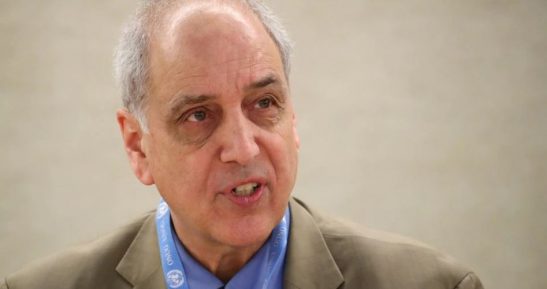
GENEVA – A high-level UN human rights expert has called for Jewish settlements to be classified as a war crime, urging the international community to hold Israel accountable for a practice it has long considered illegal.
Presenting his latest report to the UN Human Rights Council in Geneva, Michael Lynk, the UN special rapporteur on the rights situation in the occupied Palestinian territories, said he examined whether the Israeli settlements were in violation of the absolute prohibition against “settler implantation” in the 1998 Rome Statute of the International Criminal Court and concluded that “the Israeli settlements do amount to a war crime.”
Talking about the human rights situation in Palestine recently, he said that in east Jerusalem, Jewish settler groups sought to evict Palestinian families from their homes, pointing out that under the Fourth Geneva Convention, forcible transfer of a protected population was prohibited, and the occupying power is forbidden from applying its own laws to the occupied territory.
“I submit to you that this finding compels the international community … to make it clear to Israel that its illegal occupation, and its defiance of international law and international opinion, can and will no longer be cost-free,” Lynk told the Geneva rights council.
Lynk said Israel’s demolition of Bedouin tent dwellings in a village in the West Bank on Wednesday left residents without food or water in the heat of the Jordan Valley, calling it “both unlawful and heartless”.
“Progressive seizure of Palestinian lands together with the protection of the settlements is a further consolidation of Israel’s de facto annexation of the West Bank,” he said.
There are nearly 300 settlements in east Jerusalem and the West Bank, with more than 680,000 Jewish settlers, Lynk noted.
The settlements have become “the engine of Israel’s 54-year-old occupation, the longest in the modern world”, he added.
He stressed the need for international action, not just words, in order to resolve the situation in Palestine.
“As long as the international community criticizes Israel without seeking consequences and accountability, it is magical thinking to believe that the 54-year-old occupation will end and the Palestinians will finally realize their right to self-determination,” he said.
A few days ago, the Israeli occupation army blocked the delivery of aid to Palestinians whose homes were demolished in the northern Jordan Valley and asked a UN aid team to leave the area, UN humanitarians said on Thursday.
The razing of 27 residential and animal structures and water tanks on Wednesday in the Palestinian herding community of Humsa al-Bqai’a was the first of its kind since February, the UN Office for the Coordination of Humanitarian Affairs (OCHA) said.
The Israeli army’s civil administration and forces also confiscated, among other things, food, milk for children, clothes, hygiene materials and toys during the demolition campaign.
The action involved 11 homes for about 70 people, including 36 children, the office said. Animals had no fodder and water as well.
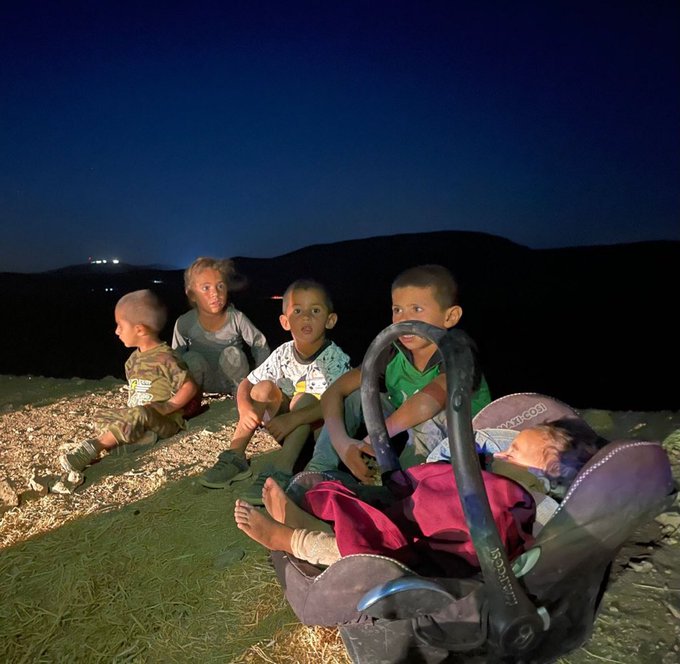
Representatives of OCHA and humanitarian partners visited the community Wednesday evening, but the army on Thursday asked them to leave.
The community rejected a proposal from the Israeli army to move it to a different location, OCHA said, adding that the army moved the residents’ belongings to the proposed site.
Humanitarians said 11 structures donated as humanitarian aid in February following similar demolitions were destroyed or seized by the army during Wednesday’s raid.
“The repeated destruction of their homes and property, including assistance provided by the humanitarian community is having a devastating economic, social and traumatic impact on the community, particularly children,” OCHA warned.
UN secretary-general Antonio Guterres voiced his deep concern over the demolition of property in the herding community, Stephane Dujarric, the chief spokesman for Guterres, stated.
“He reiterates his call on the Israeli authorities to cease demolitions and seizures of Palestinian property in the occupied West Bank,” Dujarric added in a regular briefing.
“Such actions are contrary to international law and could undermine the chances for the establishment of a viable, contiguous Palestinian state,” he read a statement issued by Guterres.
Featured Video

Houthis Don’t Have to Conquer Saudi Arabia to Make It Pay
or go to
Aletho News Archives – Video-Images
From the Archives
A Lesser “Grade” of Human
By Michael Hoffman | Revelation of the Method | January 3, 2024
Will the more than 100 Iranians killed by terrorist bombs today be mourned in the West as victims of terrorism? Certainly not. Allied doctrine has it that the killing of Israeli or American civilians is a crime of cosmic proportions, while shedding the blood of “enemy” women and children is perfectly acceptable; indeed commendable.
The West does not memorialize the hundreds of thousands of civilians bombed by the U.S. in Serbia, Iraq, Afghanistan and every major German city 1943-1945. America’s fire-bombing of the city of Tokyo by General Curtis LeMay in March 1945 was followed by Harry Truman’s atomic incineration of Hiroshima and Nagasaki in August of that year. Truman never had a moment of doubt or regret over the murder of more than a 100,000 Asian children, mothers and non-combatant boys and men. It was business as usual for the “noble” Allies during the “Good War.”
In the West human rights signifies passionate concern only for civilians designated as truly human: Israelis first, then Americans and British, followed by their satraps.
This inhumanity is the legacy of Talmudic ideology, beginning with tractate Sanhedrin 57a from 400 A.D., concerning liability for capital punishment: “If a Jew murders a gentile, he is exempt.”
This teaching of contempt was reiterated in the dogma of Chabad Lubavitch founder Rabbi Shneur Zalman in the 18th century. … continue
Blog Roll
 Aletho News
- Houthis Don’t Have to Conquer Saudi Arabia to Make It Pay
- MOE: Nearly 22,000 Students and Education Workers Killed
- Guterres in Islamabad: Genocide, cowardice, and the cage of Imran Khan
- Johnson, Marandi say Yemen holds upper hand over Saudi Arabia
- False flags won’t save aggressors, Iran FM spokesman says
- The Makkah Pact Enters Into Force: The End of American Dominance or Its New Form?
- NATO’s top generals gather in Kiev
- EU’s continuing expansion – greater threat to Russia
- US Senator Murphy says Pentagon denied him entry to US base in Qatar
- Israel expands “incitement” charge to target Palestinian education and memory
- If Americans Knew
- Three Years of Genocide: How America’s Israel-First Media Filtered Out the Truth
- Israeli war chief briefs ministers on potential war against Palestinian Authority
- New Report: Israel Killed nearly 21,000 Palestinian Students and Education Workers in Past Three Years
- Israel’s flailing chatbot army
- Five Palestinians Killed, Others Injured by Israeli Fire in Gaza
- Israel is rewriting the Palestinian curriculum in East Jerusalem to erase Palestinian identity
- Three years of genocide: Israel turned prisons into killing grounds and torture sites
- Three years of genocide. Words fail. Daily Update
- ‘I’d rather die than go back’: A Palestinian teen’s 10-month nightmare in Israeli jail
- How Jared Kushner’s firm’s investment in an Israeli company could be a major conflict of interest
- No Tricks Zone
- New Study: 50 Years Of The Most Aggressive ‘Net Zero’ Policies Can Only Affect The Global Climate By 0.03°C
- US September “Heat” Was No Record…Many Records Set Decades Ago
- Latest European Green Energy Debacle; Portugal’s Largest Flagship Solar Park Insolvent!
- Green Energy Debacle: German Expert Professor Fritz Vahrenholt Warns Of Severe Economic And Social Consequences
- Two More Paleo Reconstructions Affirm Meters-Higher Sea Levels Across Ireland, Brazil 7000-6000 Years Ago
- New Study: Earth And Venus Surface Warmth Largely Explained By Convection And Lapse Rate, Not CO2 Or Radiation
- 2025 Nature Paper Claiming Worsening Global Drought Gets RETRACTED …Heavily Flawed
- New Study: ‘Global Drought Shows No Detectable Recent Acceleration Under Climate Warming’
- Economic Masterminds: German Socialists Suggest Taxing Productivity Gains Stemming From Using AI
- The South China Sea Has Not Been Cooperating With The Climate Change Narrative

