Hypocrisy Thy Name Is Zion
Jewish groups support BLM while ignoring Palestinian genocide

By Philip Giraldi • Unz Review • September 8, 2020
There is a tendency on the part of major Jewish groups in the United States and in Europe to discover what they describe as anti-Semitism wherever one turns. Last month, a statue of the well-known and highly respected 18th century French writer and political philosopher Voltaire was removed from outside the Académie Française in Paris. Voltaire was a major figure in the “Enlightenment,” during which what we now call science and applied rationalism challenged the authority of the church and the King.
The statue had recently been vandalized by the French version of Black Lives Matter (BLM) because Voltaire had reportedly invested in the French East India Company, which engaged in the triangular trade between Europe, Africa and the New World. The commodities included Africans who were destined to become slaves in the European colonies. Beyond that Voltaire, a man of his times, believed blacks to have “little or no intelligence” and also considered Jews to be born “with raging fanaticism in their hearts.”
Voltaire was reportedly much admired by Hitler, so perhaps it would not be off base to suggest that in France, where the Jewish community is extremely powerful while Africans are not, it was Voltaire cast as the anti-Semite that consigned his statue to a government warehouse never to be seen again. By that reasoning, one expects that the world will soon have a ban on the music of Richard Wagner and Ludwig van Beethoven as they too were admired by Hitler.
The idea that someone can change history by ignoring aspects of it means that school textbooks are being rewritten at a furious pace to make sure that there is overwhelming coverage of the holocaust and black achievement. Also, the erasing of monuments is being pursued with singular intensity in the United States, where the Founding Fathers and other dead white males are being one by one consigned to the trash heap. Doing so, unfortunately, also destroys the learning experience that can be derived from using the monuments as visual mechanisms for confronting and understanding the mistakes made in the past. A commission set up by the mayor of the District of Columbia has, for example, compiled a hit list of monuments and commemorations that must be either removed, renamed or placed into “context.” It includes the Jefferson Memorial and the Washington Monument. The name “Columbia” is, of course, certain to be changed.
Interestingly, Jewish groups in the United States have been in the forefront in supporting BLM’s apparent mission to upend what used to pass for America’s European-derived culture. Ironically, that culture includes free speech, democracy and mercantilism, all of which have greatly benefited Jews. The narrative is, of course, being wrapped around the common cause of blacks and Jews together fighting against the alleged white nationalists who are being blamed by the media for much of the violence taking place even when videos taken at the scenes of the rioting definitely show nearly all black mobs doing the arson and looting.
And blacks who are skeptical of the Jewish role are quickly put in their place, as was Rodney Muhammad of Philadelphia, who was removed from his executive position with the NAACP after expressing skepticism about all the Jewish friends that blacks suddenly appeared to be acquiring, quoting an observation often attributed to the now disgraced Voltaire on a Facebook entry, “To learn who rules over you, simply find out who you are not allowed to criticize.”
The lead organization in shaping the acceptable narrative is the Anti-Defamation League (ADL), which promotes itself as “Fighting Hate for Good.” In other words, anyone on the other side of the narrative is by definition a “hater.” ADL apparently advertised an online discussion topic for August 28th, shortly after the shooting incident in Kenosha Wisconsin that killed two white men and injured a third. The headline reads “Why all white American middle schoolers must publicly condemn the Anti-Semitic murders by white supremacist Kyle Rittenhouse.”
If the ad is indeed genuine, one notes immediately that the killings are being framed as anti-Semitism without any actual evidence to suggest that anything like that was involved or that the shooter knew the religion of those who were confronting him. All three of the “victims” are described as BLM supporters, which they apparently were, but it ignores the fact that they were also Antifa activists and all three had criminal records involving violence. One of them, Joseph Rosenbaum, is, to be sure Jewish, and also a pedophile, and the other two might also be Jews if ADL is correct, but that does not seem to have been material in what took place. Credible accounts of the shooting suggest that Rittenhouse was attacked by the three, one of whom, Grosskreutz, had a gun, and was being beaten on his head with Huber’s sidewalk surfboard. He responded in self-defense.
And ADL is not alone in its defense of BLM. More than six hundred Jewish groups have signed on to a full page newspaper ad supporting the movement. The ad says “We speak with one voice when we say, unequivocally: Black Lives Matter” and then goes on to assert “There are politicians and political movements in this country who build power by deliberately manufacturing fear to divide us against each other. All too often, anti-Semitism is at the center of these manufactured divisions.”
So, once again, it is all about the perpetual victimhood of Jews. That Jews constitute the wealthiest and best educated demographic in the United States would seem to suggest that they are especially favored, which they are, rather than targeted by raging mobs of hillbillies. More than 90% of discretionary Department of Homeland Security funds goes to protect Jewish facilities and the Department of Education and Congress are always prepared to create new rules protecting Jews from feeling “uncomfortable” in their occasional interactions with critics of Israel.
Jews largely think and vote progressive, which is part of the reason for aligning with blacks even though rioting and looting is likely to affect them more than other demographics as many of them might still have businesses in the cities that are most likely to be hit. But there is also a much bigger reason to do so. Many blacks in BLM as well as progressive white supporters were beginning to suggest that the movement should broaden its agenda and recognize inter alia the suffering of others, to include the Palestinian people. A strong show of support from Jewish groups, backed up by what one might presume to be a flow of contributions to the cause, would presumably be a way of nipping that sentiment in the bud just as Jewish donors to the Democratic Party were able to block any language in the party platform sympathetic to the Palestinians.
It is of course the ultimate irony that Jewish groups are very sensitive to the suffering of blacks in the United State while at the same time largely ignoring the war crimes and other devastation going on in Israel and Palestine at the hands of their co-religionists. The beating and shooting of unarmed and non-resisting Palestinians, to include children, the destruction of the livelihoods of farmers, and the demolition of homes to make way for Jewish settlers is beyond belief and is largely invisible as the Jewish influenced U.S. media does not report it. It is, simply put, genocide. And on top of that, Israel has been bombing defenseless civilians in Gaza nearly daily of late, attacking and destabilizing Lebanon and Syria, and also conniving with American Secretary of State Mike Pompeo to go to war with Iran.
It should not be surprising if black groups would be suspicious of the motives of the Jewish organizations that suddenly seem to want to be friendly. When Rodney Muhammad was removed from his position with the NAACP in Philadelphia, Jonathan Greenblatt, the head of ADL, tweeted “Credit to Executive Committee of Philly NAACP & National NAACP for taking action here. We hope this will enable new opportunities for collaboration as the local Black & Jewish communities can do more to fight against hate & push for dignity of all people.”
Greenblatt has been a leader in the fight to criminalize both criticism of Israel and also the free speech being exercised by supporters of the non-violent Boycott, Divestment and Sanctions movement (BDS). For him, “dignity of all people” clearly does not include Palestinians or even anyone who peacefully supports their cause.
Philip M. Giraldi, Ph.D., is Executive Director of the Council for the National Interest, a 501(c)3 tax deductible educational foundation (Federal ID Number #52-1739023) that seeks a more interests-based U.S. foreign policy in the Middle East. Website is https://councilforthenationalinterest.org, address is P.O. Box 2157, Purcellville VA 20134 and its email is inform@cnionline.org.
Sudan: US conditioning removal from terror list on normalisation with Israel
MEMO | September 7, 2020
The United States (US) has conditioned Sudan’s removal from a list of states sponsors of terrorism on its normalisation of diplomatic ties with Israel, Sudanese Foreign Minister, Omer Ismail, announced yesterday.
“US Secretary of State Mike Pompeo combined, during his visit to Khartoum in late August, the two files of the normalisation and the removal of Sudan from the terror list,” Ismail told local Al-Tayyar newspaper, adding that it was “important to fulfil defined conditions for normalisation, even if it is the will of Sudan.”
He stressed that his country’s transitional government did not have the “authority to make such a decision [to normalise ties with Israel],” referring to remarks made by the Sudanese Prime Minister Abdullah Hamdok during Pompeo’s recent visit to Khartoum.
Sudan has been widely tipped to be the next Arab country that would normalise ties with Israel after the United Arab Emirates (UAE) agreed to do so as part of a US-brokered agreement in mid-August.
Israel’s Friends at the RNC: ‘Christian Zionists’ Dictate the Agenda of the Republican Party
By Ramzy Baroud | Palestine Chronicle | September 2, 2020
It is difficult – and futile – to argue which American president has historically been more pro-Israel. While former President Barack Obama, for example, has pledged more money to Israel than any other US administration in history, Donald Trump has provided Israel with a blank check of seemingly endless political concessions.
Certainly, the unconditional backing and love declared for Israel is common among all US administrations. What they may differ on, however, is their overall motive, primarily their target audience during election time.
Both Republicans and Democrats head to the November elections with strong pro-Israel sentiments and outright support, completely ignoring the plight of occupied and oppressed Palestinians.
To win the support of the pro-Israeli constituencies, but especially the favor of the Israel lobby in Washington DC, Democratic presidential nominee, Joe Biden, and his running mate, Kamala Harris, have deviated even further from the low standards set by the Democratic Obama administration. Despite his generous financial support for Israel and full political backing, especially during Israel’s wars on the Gaza Strip, Obama dared, at times, to censure Israel over the expansion of its illegal Jewish settlements.
The Biden-Harris ticket, however, is offering Israel unconditional support.
“Joe Biden has made it clear,” Harris was quoted as saying in a telephone call on August 26, “he will not tie US security assistance to Israel to political decisions Israel makes, and I couldn’t agree more.” The call was made to what the Israeli newspaper, Haaretz, termed as “Jewish supporters.” The Jerusalem Post and the Times of Israel referred to this crucial constituency as “Jewish donors.”
The references above are sufficient to delineate the nature of the Democratic Party establishment’s current support for Israel. Although the view of the party’s rank and file has significantly shifted against Israel in recent years, the Democratic upper echelon still caters to the Israel lobby and their rich backers, even if this means molding US foreign policy in the entire Middle East region to serve Israeli interests.
For Republicans, however, it is a different story. The party’s establishment and the rank and file are united in their love and support for Israel. Though the Israel lobby plays an important role in harnessing and channeling this support, Republicans are not entirely motivated by pleasing the pro-Israel lobbyists in Washington DC.
The speeches made by Republican leaders at the Republican National Convention (RNC), held in Charlotte, North Carolina, between August 24-27 were all aimed at reassuring Christian Evangelicals – often referred to as ‘Christian Zionists’- who represent the most powerful pro-Israel constituency in the United States.
The once relatively marginal impact of Christian Zionists in directly shaping US foreign policy, has morphed over the years – particularly during the Trump presidency – to define the core values of the Republican Party.
“This is apocalyptic foreign policy in a nutshell,” tweeted Israeli commentator, Gershom Gorenberg, on August 24. In Republican thinking, “Israel is not as a real country but a fantasyland, backdrop for Christian myth.”
Gorenberg’s comments were tweeted hours before the controversial speech made by US Secretary of State, Mike Pompeo, America’s top diplomat, who delivered his brief notes from “beautiful Jerusalem, looking out over the old city.” The location, and the reference to it, were clear messages regarding the religious centrality of Israel to US foreign policy, and the unmistakable target audience.
Trump was even more obvious during an August 17 speech in Oshkosh, Wisconsin. “We moved the capital of Israel to Jerusalem,” Trump announced to a cheering crowd, “and so the Evangelicals – you know, it’s amazing with that – the Evangelicals are more excited about that than Jewish people … It’s really, it’s incredible.”
Unsurprisingly, 22 percent of Wisconsin residents identify as “Evangelical Protestants.”
This was not the first time that Trump has derided US Jews for not being as supportive of him as they are of his Democrat rivals. A year ago, Trump called Jewish Democrats “disloyal” to Israel. “I think any Jewish people that vote for a Democrat, I think it shows either a total lack of knowledge or great disloyalty,” he said in August 2019.
This was not a simple case of Trump’s typical political insensitivity but, rather, the cognizance that the real Republican prize in the coming elections is not the Jewish vote but the Christian Zionists.
In his speech before the RNC on August 27, Trump recounted to this same audience his pro-Israeli accomplishments, including the relocation of the US embassy from Tel Aviv to Jerusalem in May 2018. “Unlike many presidents before me, I kept my promise, recognized Israel’s true capital and moved our embassy to Jerusalem,” Trump proclaimed.
The moving of the embassy, always a great opportunity to repeat the word “Jerusalem” before a jubilant crowd, was the buzzword at the RNC, repeated by all top Republicans, including former US Ambassador to the UN, Nikki Haley. “President Trump moved our embassy to Jerusalem — and when the UN tried to condemn us, I was proud to cast the American veto,” Haley announced proudly, which generated an approving cheer.
In all of their references to Israel at the RNC, Republican leaders adhered to specific talking points: Iran, the US embassy move, the recognition of the Occupied Golan Heights as Israeli territories, the fight against anti-Semitism (silencing any criticism of Israel), and so on.
However, the Republican discourse seems to be detached from the traditional US foreign policy view that US support for Israel serves the geopolitical and geostrategic interests of Washington. This view, predominant among Democrats, seems to be almost entirely forsaken by Republicans, whose love for Israel is now dedicated to a purely religious mission.
In June 2015, when he was still a Congressman from Kansas, Secretary Pompeo once declared before a packed megachurch in Wichita, that the “battles” against evil are a “never-ending struggle,” one that will continue “until the Rapture,” a reference to what some Christians believe to be a sign of the end of times.
Addressing the RNC from Jerusalem on August 25, Pompeo must have felt that part of his spiritual mission has already been fulfilled.
Ramzy Baroud is a journalist and the Editor of The Palestine Chronicle. He is the author of five books. His latest is “These Chains Will Be Broken: Palestinian Stories of Struggle and Defiance in Israeli Prisons” (Clarity Press, Atlanta). Dr. Baroud is a Non-resident Senior Research Fellow at the Center for Islam and Global Affairs (CIGA), Istanbul Zaim University (IZU). His website is www.ramzybaroud.net.
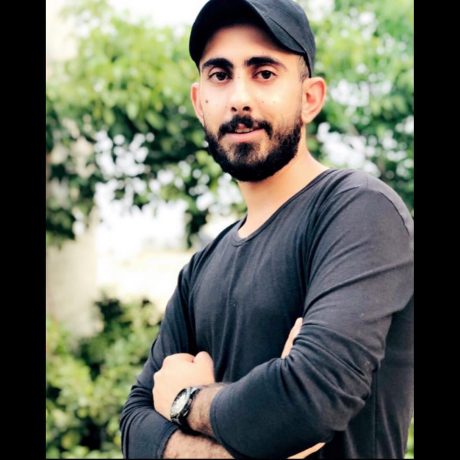
Palestinian student Nizar Issa Qaddoumi forcibly kidnapped by Israeli occupation forces
Samidoun Palestinian Prisoner Solidarity Network | August 31, 2020
Israeli occupation forces abducted Nizar Issa Qaddoumi, 26, on the evening of Monday, 31 August, 2020, as he worked at the Al-Natour gas station in Tulkarem. Nizar, a student at Kadoorie – Palestine Technical University, is the latest Palestinian student to be seized by occupation forces in a violent kidnapping.
In the video below, Israeli occupation forces, driving a civilian van and wearing civilian clothes, drive into the gas station. When Nizar approaches them for service, they spring out of the van, attacking, grabbing and beating him over the head while brandishing handguns, presumably threatening Nizar’s Palestinian coworkers. They force Nizar into the back of the van and drive off toward an unknown location – another example of the daily injustices and violence imposed on Palestinian life by Israeli colonialism.
There are currently over 200 Palestinian university students in Israeli prisons, and Israeli occupation forces routinely invade Palestinian university campuses and students’ homes, interrogating them and imprisoning them – either in administrative detention without charge or trial, or by dragging these civilian students before military courts for participating in student activities like campaigns, book fairs and demonstrations on campus.
Samidoun Palestinian Prisoner Solidarity Network urges student organizations and people of conscience around the world to organize for the freedom of Palestinian student prisoners – and all Palestinian political prisoners held in Israeli jails by putting pressure on governments to end their support for the Israeli occupation regime and escalating the boycott of Israel and the corporations that profit from colonialism, such as HP and G4S.
Hezbollah vs Israel 2006: Who has upper hand 14 years on?
Middle East Observer | August 14, 2020
Senior Lebanese political analyst Nasser Qandil explores what has changed between Hezbollah and Israel over the last 14 years since the ‘July War’ or ‘The Second Lebanon War’ in 2006.
After tracing the major changes and transformations in the military balance of power between the two sides over the last 14 years, Qandil then explores the current challenges facing Hezbollah inside Lebanon, particularly regarding the deepening economic and political crises in the country.
Note: we have added our own sub-headings in the below transcript to make for easier reading
Source: Al Mayadeen News
Date: July 12, 2020
Transcript:
Hezbollah 14 years on from the July War
Nasser Qandil:
Actually, regarding (Hezbollah’s) achievement of liberation (in the year 2000) free from any conditions or negotiations, any analyst can figure out that after the year 2000, the region was involved in a race between the Resistance and (Israeli) Army of occupation in which both (sides) tried to reinforce the reality that they wanted to reflect on May 24, 2000 (i.e. just before the liberation).
Israel wanted to say that it has positioned itself on the borders with the purpose of protecting the interior (of Israel); that the era of (the war of) attrition has ended; and that it is moving into a stage where it is able to direct (its) deterrent capacity at will. In contrast, the Resistance wanted to say that Israel has humiliatingly and forcefully withdrawn (from Lebanon); and that this withdrawal is not only the beginning of a countdown of the (Israeli) entity’s capacity to hold onto (occupied) land, but also (its capacity) to go to any (new) war again as well.
Israel’s withdrawal from Gaza in 2005 and the Al Aqsa Uprising (“Al Aqsa Intifada”) certified what the Resistance was saying. (Israel’s) 2006 war on Lebanon was the contest that had to settle the previous contests and the (side) who wins this round, cements what it has said. Israel has worked on a plan, theory, mechanisms and appraisals, that is, it didn’t go haphazardly to war (in 2006). In short, Israel counted on “air warfare” theory and put it into practice in the (2006) war. However, the Resistance was aware of that, so it opted to strengthen its power on land, in order to cancel out the theory of air warfare, and to bring the enemy to the land to fight, engage in (battles) of attrition, and (ultimately) defeat it.
The Resistance was the victor. This was the outcome (of the war), because when we talk about ‘victory’ we are not referring to the historic and final defeat. Rather, we are just discussing this war (in 2006) in which the Resistance achieved victory and Israel was defeated again. As in the Lebanon war of the year 2000, or (more accurately) as reflected by the liberation in the (year) 2000, Israel lost its first pillar, that is, its ability to occupy (Lebanon) and remain in it. It also lost its second pillar in the 2006 war, which is its ability to wage war and achieve the goals (that it sets) as it wills.
After the 2006 war, the issue (between both sides) persisted. They entered a totally new and different race. The entity of the (Israeli) occupation is fighting to restore its honor and rehabilitate its image, whereas the Resistance is fighting the battle of becoming a regional power able to make the deterrence weapon (itself as) the policymaker. Since the year 2006, America put its weight behind (Israel’s goals) since Israel is not able to survive any longer without American protection and support. America went to Iraq after realizing that Israel superiority is (gradually) being eroded, and that it is important to rehabilitate its power and control through the American military presence to compensate for the deficiency in Israel’s ability that came about after Lebanon’s liberation in the year 2000 and the Al Aqsa intifada.
Host:
We all remember Condoleezza Rice and the ‘New Middle East Project’.
Nasser Qandil:
Exactly, and this was at the heart of the 2006 war. However, before this (war), America went to Iraq in order to redress the imbalance occurred after Lebanon’s liberation in 2000 and the Al Aqsa intifada, but they failed. The “July War” (2006) came as a second rehabilitation supported by American pressure, calculations and backing. It was a new failure that was added to the accumulated record of failures.
The only available alternative (choice) then was going to a great war, i.e. to topple Syria. This was like Armageddon. Nevertheless, other different battles, the Yemen war and the battle over the future of Iraq, occurred alongside the war (in Syria). They were no less important than the (war in Syria). Today, 14 years after the July War (in 2006), we can talk about facts and not about general trends only. The resistance (movements) transformed from being a resistance force into an Axis of Resistance. This becomes a fact; it is not just words. Today, when his eminence Sayyed (Hassan Nasrallah) speaks and says “I will kill you” – we’ll discuss this later – this (statement) reflects the (powerful reality) of the Axis of Resistance, from Beirut, to Palestine, to Iraq, to Yemen, to Iran and to Syria. This is the first major transformation that occurred between the years 2006 to 2020 during the heat of the several wars that raged over the map of the region.
The second (major transformation during these years): the ‘missile belt’ is now able to strike – from any point (within the Axis of Resistance) – any target in occupied Palestine (i.e. Israel). This means that as the resistance in Palestine is able to target all (areas of Israel) north of Gaza, the resistance in south Lebanon can target the entire (area of Israel) south (of Lebanon); the resistance from Iraq is even able to reach the (Mediterranean) sea; the resistance in Yemen can cover the whole territory of Palestine; and that’s besides (the missiles capabilities of) Syria and Iran.
The Host:
The entire Israeli intelligence efforts have lately been centered on the missile capabilities of the resistance.
Nasser Qandil:
This ‘(missile) belt’ has been completed; it is not a subject of discussion anymore.
The third (major) development is the entrance of the drones (UAVs). The use of this weapon is not restricted to the Lebanese front line. Israel has evidence that confirms that. How many times were drones sent by the resistance from Lebanon? How many times were the Israelis lost because they failed to track the drones sent from Gaza? (Further evidence lies in) the drones in Yemen, and the achievement of the Aramco attack (in Saudi Arabia) that the godfather of the Dimona (Israeli nuclear program) and Thomas Friedman wrote about it an important article in the New York Times. The article states that what happened in Aramco (can be) repeated on all American military bases in the Middle East, and can be repeated (in a strike) on Dimona. Moreover, one of the Israeli generals quoted by Thomas Friedman during a telephone conversation says that it seems that we must now relinquish the status of being the number one technicians in the Middle East, (and cede that status) to Hezbollah and its allies, and (we ought to) call upon our people to carry hand rifles in any coming wars in which drones are used. Henceforth, the third factor is the drones.
The fourth (major) new factor is the precision-guided missiles which formed the center of the struggle during the last two or three years of the Syrian war. The Israeli (air) raids which initially aimed at stopping the supply of weapons to the resistance (from Syria to Lebanon) turned into a specific goal (during these years) which became ‘preventing the resistance from the possibility of transforming their missiles into precision-guided ones’. Today, the Israelis speak about precision-guided missile factories and this signifies that they have surrendered to this fact.
The last issue we are ignorant of was revealed by the video published (recently) by (Hezbollah’s) military media which says “Mission accomplished”. Certainly, it is not referring to the precision-guided missiles because his eminence Sayyed (Hassan Nasrallah) has already announced clearly and publicly that ‘yes, we have enough precision-guided missiles to hit any vital Israeli military installation in occupied Palestine’. But we still don’t know what is meant by “Mission accomplished”. This will stay one of the resistance’s surprises in the coming wars.
Israel 14 years on from the July War
Nasser Qandil:
What have Israel and America achieved in return? Their situation now is similar to that in the July War (2006); they go to war today on one foot only. It was the air force in (the) July (War) that they relied upon, and it is the financial sanctions (that they rely upon) today. Did the Resistance succeed in breaking this foot? I say “Yes, and we will expand on this discussion later.
Host:
We will continue discussing why the resistance succeeded…
Nasser Qandil:
In the first section we talked about the progress achieved by the resistance (Hezbollah) from 2006 to 2020. Israel also worked (on building its power) during these 14 years. Let us see what it did.
Host: … and of course (Israel) was given a green light by the US.
Nasser Qandil:
First of all, Israel focused on the home front. Its main aim was not to draw up a plan to seize the initiative, but to face the fallout of the July War. The resistance (Hezbollah) has risen higher and higher in its level of readiness, its networking capabilities (i.e. greater integration of the Resistance Axis across the region), and its ability to wage war. Meanwhile, what did the (Israeli) entity do?
(First), the Iron Dome that (Israel) was preparing (in order to intercept) Katyusha missiles is now threatened by precision-guided missiles and drones. (The Israelis) went back to saying that they will shoot down missiles with hunting rifles!
(Second), the (Israeli) home front has further collapsed, and now in the time of Corona, it is even worse.
Third, political fragmentation, which is one of the repercussions of the July War. Since the July War, the (Israeli) entity has been mired in its inability to reestablish a historical (political) bloc capable of leading the entity politically. This fragmentation reached its peak with three (consecutive) repeats of the election.
The last point that (Israel) has discovered (over the last 14 years) is that there is no solution to is broken spirit, because we are not only talking about equipment, armies, weapons and logistical plans, we are talking about human beings, about their mental condition. The resistance (Hezbollah) is now becoming more and more confident that it can bring down the (Israeli) entity. When his eminence Sayyed (Nasrallah) comes out and says in one of his recent appearances that there is a real possibility that the (Israeli) entity will collapse without war, and that this generation is going to witness the liberation of Jerusalem… On the other hand, we find the (Israeli) entity in a state of frustration. No matter how many (Israeli) generals say “We will win. Victory is ours in the coming war. We are waiting for the right opportunity to wage war”… what are you (Israelis) waiting for? You and the Americans said: “Time is not in our favor. Yesterday’s war is better than a war today, and a war today is better than a war tomorrow.”
Host:
Who is going to achieve Israel’s goals today? Who is the principal agent? The US? Because, as you said in one of your articles, Sayyed Nasrallah’s recent speech on 7/7/2020, presents the most vivid example of the (resistance’s) ability to defeat the Israeli occupation and American hegemony. But how is he (Nasrallah) able today to combine this (military) resistance with economic resistance?
Nasser Qandil:
What I want to get to is that in one of his appearances, his eminence Sayyed Nasrallah cut to the chase and said: “The resistance (Hezbollah) has already overtaken Israel. Israel is still standing thanks to US protection.” In 1996, the Resistance discovered – and this was the secret behind the liberation in the year 2000 – that the Israelis remained (in Lebanon) because they were under the illusion that the border buffer zone (that Israel established within Lebanese territory) protects the (Israeli) entity from the missiles of the resistance. So if (Israel) realizes that the border (buffer zone) is pointless and that the entity will be targeted no matter what, it will withdraw. And this is what happened (in the year 2000).
Today, his eminence Sayyed (Nasrallah) tells us that the resistance is certain that the (Israeli) entity continues to survive only because of the American presence (in the region), and that the decisive battle with the entity is a battle to expel the Americans from the region.
Whoever analyses the (American) sanctions and the logic behind them will discover that they are not aimed at escalating the situation such that it provokes a full-scale confrontation. This is nothing but propaganda. In fact, these sanctions have direct political goals. I mean, (Lebanese) parties affiliated to the US (in Lebanon) are proposing (very high demands such as) the disarmament (of Hezbollah) and the implementation of Resolution 1559 because this is the American approach. Just as they (Americans) did in 1983 with (Lebanese) President Amine Gemayel when they told him that they were (about to attack) Syria at the same time in which they were engaged in negotiations with (Syria). Two months later, McFarlane) the special US envoy to the Middle East) was asked: “why did you back out (of the attack)? You would have put (Gemayel) in big trouble.” McFarlane answered: “if we told (Gemayel) that we were (negotiating) with Damascus, he would have beat us to it. We trick our allies to make them think that we are escalating for the sake of imposing stronger terms in the negotiations.”
What do Americans want from the Caesar Act? Why are the Americans putting pressure on Lebanon, blocking access to US dollars in the (Lebanese) market, preventing the transfer of dollars to the country, and closing lines of credit – via the Central Bank of Lebanon’s accounts -for the purchase of fuel? What do they want? The Americans are not hiding (their intentions). They told us what they want. James Jeffrey (US Special Representative for Syria Engagement) told us. Why the Caesar Act? He said in the live appearance he made in which he spoke about the Act. He said ‘we wish to go back to (the balance of power) that existed before 2011. What does he mean by “before 2011”? He means the time when “we (Americans) will acknowledge the victory of President Assad. We were not present (in Syria before 2011), but Hezbollah and Iran were not there either. We leave (Syria), but (Hezbollah and Iran must) leave too.”
So he (Jeffrey) wants to ensure the security of the (Israeli) occupying entity in southern Syria by hinting at sanctions against Russia as the main target of the Caesar Act. Syria will be hit by sanctions anyway and Iran is drowning in a sea of sanctions. Therefore, these sanctions are actually against Russia. The Caesar Act was introduced originally at the beginning of 2016 in order to reach a compromise with Russia in relation to the battle in Aleppo. However, (the Caesar Act) now aims at reaching an agreement with Russia over the terms of the withdrawal of US forces from Syria and is not aimed at (prolonging) their stay.
Second, regarding Lebanon, David Schenker (US Assistant Secretary of State for Near Eastern Affairs) publicly appeared on TV and said that Hezbollah is involved in ‘corruption, smuggling, money laundering, causing devastation, and that it is the cause of the crisis (in Lebanon)’ etc. Give it to me directly (Schenker), what do you want? He (Schenker) told us directly that “you are suffering greatly (due to the economic crisis). You have promising gas reserves in the (Mediterranean) sea, but they are in a region that is the subject of a dispute with Israel. We (the US) presented you with a plan, so accept it! So the US wants an exit strategy that provides the (Israeli) occupying entity with a security belt on the Syrian and the Lebanese fronts, and (the US seeks to achieve this) by exerting “maximum pressure on the resistance”.
———
Nasser Qandil:
This is the third pillar of the power of the Resistance. The first pillar is military capability. The second pillar is the political front, meaning the Axis of Resistance. The third pillar is economic reconstruction. Without a resistance economy, the resistance cannot speak of an ability to maintain a level of cohesion within its support base and environment. What I want to say here is that the measures and steps taken by the resistance are not new. It is not true that the resistance, being under pressure at the moment, is now discovering or searching (for solutions). This was in fact its original program. Its original program was and is ‘Openness to the East’, that (Lebanon) have multiple sources (for economic, financial, and political relations). Its original program is aimed at breaking the borders (created by) Sykes-Picot between the countries of the region to form a single (economic) market. Its original program is aimed at relying on industry, agriculture and the national currency for exchange with neighboring countries and where possible. This is the original plan of the resistance. But this plan is now being put into action. It is not a negotiating weapon to lure Americans into easing conditions. If the Americans want to cooperate they are welcome, but if they don’t we will proceed (with this plan). Either way, this plan is not subject to review. Industry and agriculture are objective needs (of Lebanon).
In terms of industry and agriculture, Lebanon … Lebanon, by the way – in the year 1960, the Iraqi market was running 60% of the Port of Beirut and 30% of Lebanese industrial production. Today, Lebanon, which used to export milk, cheese, juice, clothing and shoes to the Gulf, imports 200 million dollars worth of milk and cheese only! Thus, the revival of the agricultural and manufacturing sectors, which were destroyed by the rentier economy, was and is the original plan. We are not talking about a knee-jerk reaction.
Host:
Has the goal (behind the sanctions) become counter-productive? Because the Lebanese internal consensus over the economic resistance that Sayyed Nasrallah called for was remarkable. I want you to comment briefly because we exceeded the time allocated for this file. The Patriarch (Bechara Boutros) al-Rahi said today: “The Lebanese people today do not want any majority (group in Lebanon) to tamper with the constitution and to keep them away from (Lebanon’s) brothers and friends.” This is noteworthy as well Mr. Nasser, is it not?
Nasser Qandil:
The truth is, the speech of his Beatitude (al- Rahi), at certain points, was vague and unclear. It seemed like he was targeting the resistance by talking about neutrality and keeping Lebanon out of conflicts. However, today there may be another direction. I think the Lebanese people know that when we talk about buying oil products in Lebanese pounds… if you don’t want to buy them from Iran, then buy them from Saudi Arabia. Aren’t you friends with Saudi Arabia and the UAE? Let these countries sell us oil products in Lebanese pounds. Half of the demand for dollars in the Lebanese market is because of oil imports. We are depleting the reserves of the Central Bank of Lebanon. They will last us for five years instead of ten if we keep using them for oil imports.
His eminence Sayyed Nasrallah announced that Iran is ready to help, and since oil imports are consuming half of the budget, the resistance is proposing to remove half of the pressure on the US dollar, meaning (that the exchange rate) would return to 3000 or 4000 (Lebanese pounds per dollar) if we buy these oil products in Lebanese pounds. We are not bound to (importing) from Iran exclusively. Bring any offer from any other country.
Host:
True… for the Americans, the (economic) war was aimed at Hezbollah. However, the entirety of Lebanon is suffering the consequences of this war.
Nasser Qandil:
Here, I want to say something so we can put things in the right perspective. When the uprising began in October (2019), Pompeo and his team went beyond warnings. (Jeffery) Feltman (Former Assistant Secretary of State for Near Eastern Affairs) said before the American Congress: “Do not overestimate the influence of this uprising. Let’s not allow Lebanon to become prey for China and Russia.” He said frankly that China wants Lebanon to be a base for its 5G (technology) in the Middle East.
The Americans are backtracking from this (maximum economic pressure) approach not only because of economic (considerations). Do not be mistaken. This is because a highly powerful security message was delivered to the Americans about what the resistance might do if the situation (in Lebanon) deteriorated further.
—————
Nasser Qandil:
When someone with the great prominence, status, and figure of Sayyed Nasrallah comes out and says: “I will kill you, I will kill you, I will kill you” … These words were written down (on paper). He did not say them out of anger during his speech. He was establishing a (new) equation. He said: “You are making me choose between hunger or death. My answer is: I will kill you, I will kill you, I will kill you.” Mediators received questions asking them “what is going on? (what does Nasrallah mean here by ‘I will kill you’)” Then they got the answer. The answer might be – I do not know the answer, only the resistance knows it – but it might be in the form of strong military strike that the US and Israel would never expect. Is it the announcement of the zero hour for the expulsion of US forces from Iraq and Syria? Maybe. Is it a precision guided missile attack on the Dimona (nuclear reactor in Israel), for example? Maybe. Is it a (codeword) for opening up the (military) front in the south of Lebanon, and the Golan Heights front (from Syria) under the title of liberating the Shebaa Farms and the Golan Heights in one go? Maybe. This is the level and size (of the warning that Nasrallah directed).
The resistance will not stand idly by while its people suffer (from the deteriorating economic crisis). It will fight hunger by establishing the foundations of economic reconstruction because this is its project. This (economic reconstruction) has nothing to do with merely fighting (US) sanctions. (The resistance) found an opportunity to launch this project. Other (Lebanese parties) did not accept these proposals (before). Now it is the chance (to put them forward).
Do we want to change Lebanon’s identity by (economically) cooperating with China and giving rise eastern totalitarianism and who knows what, as some (in Lebanon) claimed? No. But does it make sense that the NATO (member) Turkey dares to go to Russia and buy S400 (missile systems), while we (Lebanese) don’t dare to buy Kalashnikov bullets that former Prime Minister Saad Hariri pledged to buy but did not dare to allocate funds for? We have 10 billion dollars’ worth of offers from China to build power plants, factories and tunnels under BOT (Build–operate–transfer) contracts, but we don’t have the courage to accept these offers because we are afraid that the US might be upset with us!
Host:
Saudi Arabia itself is now negotiating with China over avenues of cooperation…
Nasser Qandil:
Everyone is turning to China. (Check) the Boston Harbor now, all the equipment for loading, operating, and unloading are Chinese!
Host:
This all goes back to the American-Israeli concerns, Mr. Nasser.
Nasser Qandil:
This is the economic vision of the resistance. The (military) dimension (of this whole picture) is something else. The (military) dimension is the following: when they raise the bar of the financial threat, we raise the bar of the military-security threat.
Please help us keep producing independent translations for you by contributing as little as $1/month here
Pro-Israel Kamala Harris pledges not to condition US aid to Israel on human rights
MEMO | August 27, 2020
Senator Kamala Harris, the Democratic nominee for vice president, has eased the concerns of pro-Israel Jewish donors to her party, by pledging not to condition aid to Israel on its human rights record if Joe Biden is elected President.
“Joe has made it clear he will not tie security assistance to any political decisions that Israel makes, and I couldn’t agree more,” Harris is reported saying in a virtual event held with Jewish donors by the Jerusalem Post.
“As vice president, Joe Biden helped ensure unwavering support for Israel’s security,” she continued. “During the Obama-Biden administration, he was a key advocate in securing support for life-saving technologies, which I have seen.”
Vowing to put Israel first, Harris added: “I pledge to you the Biden-Harris administration will sustain our unbreakable commitment to Israel’s security, including the unprecedented military and intelligence cooperation pioneered during the Obama-Biden administration and the guarantee that Israel will always maintain its qualitative military edge.”
The threat of conditioning aid to Israel was suggested by a number of Democrat lawmakers. In July the likes of Alexandria Ocasio-Cortez and Bernie Sanders signed a letter calling for the $3.8 billion annual aid given to Israel to be made conditional on the Zionist state ending its violation of Palestinian human rights.
Let’s Talk U.S. Foreign Policy: It Is the Root Cause of Many Evils
By Philip Giraldi | Strategic Culture Foundation | August 27, 2020
As the United States sinks deeper into a multi-faceted global crisis that no politician seems able or even willing to address, one hears more and more often demands for radical change in who runs the country and to what end. Of course, Donald J. Trump offered such a dramatic shift in priorities four years ago, but he has been unable to deliver due to his own inability to execute and the ill-conceived machinations of those whom he has chosen as advisers. The Democrats for their part are offering little beyond a repeat of their 2016 pander to grievance groups in an effort to cobble together an unassailable majority based on buying off the party’s various constituencies.
But there is one area where change could come dramatically if either party were actually motivated to do something that would truly benefit the American people, and that is in the area of foreign and national security policy where the president has considerable power to set priorities and redirect both the State and Defense Departments. Unfortunately, foreign and national security policy is almost never discussed during the presidential campaigns and this time would already appear to be no exception. That means that the one thing that is a constant amidst all the smoke and mirrors is the continued bellicosity of both parties on the world stage.
The Republicans are apparently eager to “democratize” Latin America while the Democrats in particular are wedded to the “foreign interference” angle to explain their loss in 2016, with Hillary Clinton predictably advising in her Democratic National Convention speech that the public should “Vote to make sure we — not a foreign adversary — choose our president.” Indeed, the tendency to create and then demonize “foreign conspiracies” is generally supported by the establishment and its parasitical media, since it enables the billionaire oligarchs who really run the country to grow fatter while also avoiding any blame for the declining fortunes of most of the American people.
The Democrats are currently taking pains to recall the so-called “Russian interference” in 2016, and are expecting or possibly even hoping for more of the same this year. Tying Trump to Russian President Vladimir Putin is obviously perceived as a game winner, even though the just-completed investigations into the events of 2016 are at best ambiguous. Early prognostications by journalist-pundits in the foreign interference sweepstakes indicate that both China and Iran will be supporting Joe Biden while Russia wants to continue with Trump. No one bothers to explain how those countries will express their preferences or what kind of impact they could possibly have.
One thing that is certain is that both parties will continue their deference to Israel which in turn means hostility towards Iran and its few friends worldwide. The U.S. media has not reported the almost daily bombings of Syria and Gaza by Israel and even largely failed to cover how two weeks ago the United States Navy seized four Greek flagged oil tankers transporting more than a million gallons of fuel to economic basket case Venezuela, a country which is in its sad condition due to sanctions and other “maximum pressure” at the hands of Washington. The fuel was seized based on unilaterally imposed U.S. sanctions on Iranian sale or export of its own petroleum products, a move intended to strangle the Iranian economy and bring about an uprising of the Iranian people. Such a move used to be called piracy.
To be sure, the Democrats have indicated that they will rejoin the Joint Comprehensive Plan of Action (JCPOA), which Trump withdrew from under orders from top donor Sheldon Adelson in 2017, one of his first acts in office. The JCPOA is intended to monitor and restrain any possible efforts by Iran to enrich uranium to develop a nuclear weapon, which one might assume is in the U.S. interest, but one should make no mistake in thinking that re-entering the agreement signifies any softening towards Iran. Joe Biden and Kamala Harris are owned lock, stock and barrel by the Israel Lobby, which is pretty much true of most politicians from both major parties in Washington. Iran is Israel’s target and even lacking any threat to the U.S. so it will remain the American enemy of choice.
America’s efforts to demonize and punish Iran, ineptly stage managed by Secretary of State Mike Pompeo, frequently lead into the Twilight Zone. On August 17th, the United States suffered what has to be described as a humiliating defeat in the United Nations Security Council. As the Washington Post reported it, “The United States asked the council to approve an extension of the 13-year-old embargo on arms trade with Iran — something that matters greatly to Israel and U.S. Arab allies, and which most of the democratic world favors. Yet only one member of the 15-member council, the Dominican Republic, sided with Washington. Russia and China opposed the motion, while 11 countries — including Britain, France and Germany — abstained. The vote could open the way for Iran to obtain Chinese and Russian arms — for example, missiles it could employ against Israel, the UAE or U.S. ships in the Persian Gulf.”
Note particularly the reliably Zionist Post’s “newspeak” version in describing both the issue and the vote. It states that “most of the democratic world favors” an embargo on selling arms to Iran but then describes how “11 countries – including Britain, France and Germany – abstained.” And, of course, the potential threat to Israel is front and center as the reason for the embargo, an apartheid state that has nuclear weapons developed in secret after stealing both the uranium and triggers from the United States. One might also note that Iran is a signatory to the Nuclear Non-Proliferation Treaty (NPT), which Israel is not, and its nuclear related research facilities are fully open to inspection by the International Atomic Energy Agency (IAEA).
After the rebuff, Trump subsequently moved on to phase two in its attack on Iran by invoking a so-called “snap-back” provision of the JCPOA that empowers any of the signatories to the agreement to unilaterally call for renewal of the international sanctions that isolated Iran prior to 2015, when the plan of action was signed by the U.S., Britain, China, France, Germany and Russia, along with the European Union. The U.S. claimed that Iran has been cheating on its enrichment program and also that the accord’s authority is rooted in an accompanying Security Council resolution, which means that Washington can at will address the issue before that body.
Bear in mind that the U.S., though an original signatory, withdrew from the agreement, and any attempt to restore U.N. sanctions through an admittedly sleazy maneuver would be resisted by nearly all the other members of the Security Council, which is precisely what did take place last Thursday, with the Europeans producing a joint letter emphasizing that Washington has no standing on the issue as it is no longer party to the arrangement. Pompeo responded by saying that the Europeans “chose to side with the ayatollahs.”
Secretary of State Mike Pompeo, presumably supported by the president, has been angered by the Security Council’s failure to support him on either extending the arms embargo or re-imposing general sanctions, though he is probably eternally grateful for the fortitude demonstrated by the plucky little Dominican Republic. On both meetings with the Security Council Pompeo complained, using his standard line, saying that “We can’t allow the world’s biggest state sponsor of terrorism to buy and sell weapons. I mean, that’s just nuts.”
The next step by the White House was a unilateral proposal submitted in writing by the U.S. to reimpose a full range of economic sanctions on Iran in thirty days. That can only be blocked by a Security Council resolution which Washington can veto, meaning that America will again be going it alone in its not-so-secret war against Iran, further isolating the U.S. in world fora and again demonstrating that the Trump Administration has few friends anywhere in this fight but Israel and its newfound Arab associates in the Gulf. It also means that the re-imposed sanctions are unlikely to be actively enforced by anyone that matters, further suggesting that the U.S. might resort to secondary sanctions, as it has done in the past, on those who do not comply, a formula for chaos.
Well, it should seem obvious that we Americans can’t afford a foreign and national security policy that pits the United States against the rest of the world in situations where the U.S. is not actually directly threatened and does not even have a vital interest. Over the next two months, perhaps we will see some serious discussion of America’s place in the world or perhaps not. If 2016 is anything to go by, we are more likely to see a number of bromides tossed out without any real meaning behind them. We are still waiting for troops reductions and the ending of useless wars promised by Trump. We are still waiting for Hillary to concede that Russia didn’t defeat her. She did it all by herself.
Turkey reboots Arab Spring with Palestinian resistance
By M. K. BHADRAKUMAR | Indian Punchline | August 26, 2020
Turkey has made its first move on the regional chessboard after the recent deal between the UAE and Israel, when on August 22, President Recep Erdogan received in Istanbul a high-level delegation of the Palestinian resistance group Hamas, including its leader Ismail Haniyeh and deputy leader Saleh al-Arouri.
Also present at the meeting held behind closed doors at Istanbul’s Vahdettin Palace were the head of Turkey’s intelligence service, Hakan Fidan and two key aides of Erdogan — the communications director Fahrettin Altun and the presidential spokesman, Ibrahim Kalin.
The symbolism of the event is profound. The US state department has designated Ismail Haniyeh and Saleh al-Arouri as terrorists and has placed a $5 million bounty on their heads. And, of course, Turkey’s links with Hamas has been a sore point with Israel and it strained the traditionally close relations between the two countries to near breaking point in the recent decade.
Meanwhile, Hamas is an offshoot of the Muslim Brotherhood with which Turkey’s ruling Islamist party has ideological affinity but which the Emirati regime regards as existential enemy.
To be sure, Erdogan has made a calculated move after reading the tea leaves that one of the objectives behind the US-sponsored deal between the UAE and Israel is the creation of a new regional order even as American retrenchment from the region may have already begun in the Middle East.
Erdogan estimates that the main target of the UAE-Israel deal is Turkey. He had spotted the UAE as an active participant in the US-led failed coup attempt in 2016 aimed at overthrowing his government. He is also acutely conscious that the US, Israel and the UAE are aligned with the separatist Kurdish groups.
Turkey and the UAE are promoting opposite sides in the Libyan conflict and recently, the UAE has begun cozying up to Greece against the backdrop of rising tensions between Greece and Turkey in the Eastern Mediterranean. (UAE fighter jets are currently participating in a training exercise in Greece.)
The US State Department has lashed out at Erdogan for his meeting with Hamas leaders. But within hours, Ankara hit back. In a furious rejoinder, the Turkish Foreign Ministry rebuked Washington for questioning the legitimacy of Hamas, “which has come to power in Gaza through democratic elections and which constitutes an important reality of the region.”
Alluding to the US policies, the Turkish statement went on to say, “Moreover, a country which openly supports the PKK, that features on their list of terrorist organisations and hosts the ringleader of the FETO (group led by Islamist preacher Fetullah Gulen) has no right whatsoever to say anything to third countries on this subject.”
Lamenting that the US “has isolated itself from the realities of our region,” the Turkish statement urged the US to change course and “sincerely work towards the resolution of the Israeli-Palestinian conflict on the basis of international law, justice and equity by pursuing balanced policies, instead of using its power and influence in the region to serve the interests of Israel rather exclusively.”
To be sure, Erdogan has a game plan in defiantly flaunting his relationship with Hamas at this juncture. In the Turkish reckoning, the UAE-Israel agreement, with US backing, aims to create new facts on the ground in the Middle East, which takes the form of unimpeded telecoms, travel and recognition between Israel and its richest Gulf neighbours, but completely bypassing the Palestinian problem and blithely assuming that it is a matter of time before the Palestinian leadership would wave the white flag of surrender.
On the contrary, Turkey shares the assessment of most independent regional observers (and perceptive western analysts) that the Palestinians who have held out for seven decades are in no mood to surrender abandoning their political rights. Indeed, the Palestinian popular resistance is showing no signs of fatigue. The Palestinian leaders have used very strong language to condemn the UAE regime. The wave of anger is fuelled by a deep sense of betrayal by prince Mohammed bin Zayed.
This anger is prompting Fatah and Hamas, who have been bitter rivals since the 2007 civil war in Gaza, to close ranks and discuss the need for joint political action. Mahmud Abbas who was unwilling to accept any partners in the governance of Palestine is today open to working with Hamas. Last week, Jibril Rajoub, general secretary of Fatah, shared a platform with Saleh Arouri, deputy head of Hamas, signalling that the rapprochement is gaining momentum.
If the Emirati calculation was to promote exiled Palestinian leader Mohammed Dahlan (who lives in Abu Dhabi) as the next Palestinian President in a near future with the backing of Arab states and Israel, that project has crash-landed. Dahlan can no longer exploit the rivalry between Fatah and Hamas. The effigies of Dahlan and Emirati crown prince bin Zayed were burned side by side in Ramallah last week.
Turkey senses a potential breakthrough in regional politics insofar as the Arab population at large shares the anger and resentment of the Palestinian people at the betrayal by bin Zayed. According to the Arab Opinion Index conducted by the Arab Center for Research and Policy Studies in Doha, if 84 percent of Arab opinion had opposed any diplomatic recognition of Israel in 2011, that has since increased to 87 percent by 2018.
In this turbulent regional milieu, Erdogan hopes to bring about a fusion between the Arab world’s sympathy and support for the demands of the Palestinians for sovereignty and their own search for democracy and liberation from their autocratic rulers. This has been his dream project all along — creation of a New Middle East that gets rid of the medieval oligarchies and replaces them with representative rule based on democratic principles and empowerment of the people.
In the downstream of the Emirati ruler’s deal with Israel, Erdogan strides like a Colossus on the Arab street and his meeting with the leadership of Hamas in Istanbul proclaims a common struggle against the despots and oligarchs who suppress democracy and have exercised cruel tyranny over their people across the region. In Erdogan’s calculus, bin Zayed’s contempt for Arab democracy and Netanyahu’s trampling of Palestinian rights are two sides of the same coin.
Erdogan visualises that the UAE-Israel agreement is built on sand and it is bound to crumble under the weight of the latent contradictions that are bound to surge in the wake of the expected decline in the US’ regional influence and prestige and amidst the birth pangs of the new-post-oil economy in the regional states.
Has Israel bitten off more than it could chew? David Hearst, editor-in-chief of the Middle East Eye wrote last week, “Whereas before, Israeli leaders could pretend to be bystanders to the turmoil of dictatorship in the Arab world, this (accord with UAE) now ties the Jewish state to maintaining the autocracy and repression around it. They cannot pretend to be the victims of a “tough neighbourhood”. They are its main pillar. This accord is virtual reality. It will be blown away by a new popular revolt not just in Palestine but across the Arab world. This revolt may already have started.”
Israel military plants booby trap explosives near Palestinian village
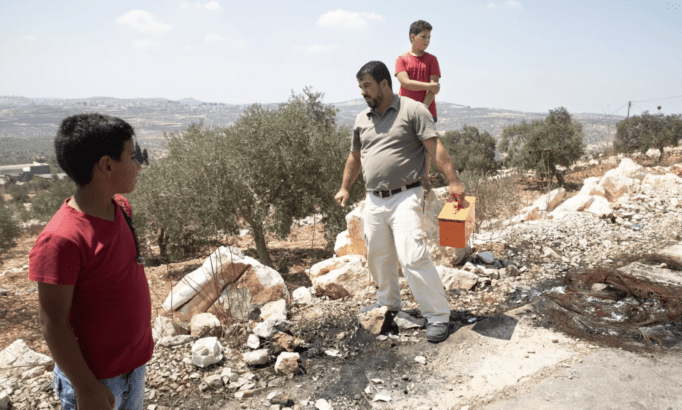
Mamoun Shtaiwi with a crate of stun grenades (C) with the child who found an explosive device (L) in Qaddum, August 25, 2020.
By Kathryn Shihadah | If Americans Knew | August 26, 2020
Ha’aretz reports that a Palestinian child discovered a box full of explosives near his home last week. It was one of at least three such boxes placed there by Israeli soldiers as a “deterrent.”
Last Wednesday night, Israeli soldiers entered the West Bank village of Qaddum around midnight to plant the explosives in the area, which sees a large amount of foot traffic. They were set to explode when touched, and camouflaged with stones and scraps of cloth.
The next day, a seven-year-old boy saw one of the boxes. He explained later, “I wanted to pick it up and play with it.” But his mother and other relatives were suspicious. They picked it up and shook it; it exploded, wounding one of them.
They found another similar box nearby and detonated it from a distance.
Another village resident reports finding a sign nearby, in Hebrew, reading, “Keep away or die; danger of death.”
The Israel Defense Forces (IDF) admitted to placing the stun grenades, adding that they were planted as a deterrent in an area where “violent riots have regularly occurred for years.”
The military spokesman maintained that, “after it was discovered that this could lead to injuries, forces worked to remove them from the area.” An investigation has been opened.
It is against international law to place armed explosives in a civilian area.
Residents of the village also noticed that a Palestinian flag in the area had been removed.
Qaddum’s claim to fame
 In recent months, videos have recorded an Israeli military bulldozer facing off against protesters; Israeli soldiers slashing tires of cars owned by Palestinians, and throwing tear gas canisters into a Palestinian home; they have also intentionally shot holes in water tanks (water is scarce for many Palestinians in the West Bank). Residents of Qaddum have been holding weekly demonstrations for nine years, protesting the closure of a main road, which had been closed to accommodate the expansion of a nearby settlement. The village has frequently made the news.
Reports of Israeli forces injuring Palestinian protesters are also numerous.
Most alarming of all is the story of nine-year-old Abdul Rahman Yasser Shteiwi, who was shot in the head during a protest last year. The bullet shattered into at least 100 pieces. The IDF at first denied using live ammunition, but it was later proven that they did, and were responsible for Abdul Rahman’s injury.
Another boy, age fifteen, was shot in the head by an Israeli soldier in January on a Thursday, when there was no protest. Experts say the shooter was only a few yards away. The IDF delayed the car taking him to the hospital for 25 minutes.
Kathryn Shihadah is staff writer for If Americans Knew. She also writes for MintPress News and blogs at Palestine Home.
Sudan PM to Pompeo: Government has no mandate to normalize with Israel
Press TV – August 26, 2020
Sudan’s Prime Minister Abdalla Hamdok has dashed America’s hopes for quick normalization with Israel, saying his government has no mandate to establish ties with Tel Aviv and any such a decision should wait until after the transitional period ends in the African country.
During talks in the capital Khartoum on Tuesday, Hamdok “clarified” to US Secretary of State Mike Pompeo that the country’s transitional period “is being led by a wide alliance with a specific agenda — to complete the transition, achieve peace and stability in the country and hold free elections,” Sudanese government spokesman Faisal Saleh said in a statement.
It “does not have a mandate beyond these tasks or to decide on normalization with Israel,” Hamdok was quoted as saying.
The Sudanese prime minister also reaffirmed the importance of separating normalization of ties from a US decision to remove Sudan’s designation as a state sponsor of terrorism, Saleh pointed out.
Sudan’s interim government took power last year after longtime leader Omar al-Bashir was overthrown by the army following mass popular protests. It is set to remain in office until elections in 2022.
Pompeo arrived in Khartoum on Tuesday to push for Sudan’s normalization with Israel, two weeks after the US brokered a highly contentious peace deal between the regime and the United Arab Emirates (UAE).
Following the talks, the US State Department said in a statement that Pompeo and Hamdok discussed “positive developments in the Sudan-Israel relationship.”
Sudan which has no formal relations with Israel has been cozying up to the regime over the past year.
In February, Sudan’s leader, General Abdel Fattah al-Burhan, the chairman of the ruling council in the country, met with Israeli Prime Minister Netanyahu in Uganda, sparking anger among politicians and the public at home, where anti-Israel and pro-Palestine sentiments run high.
After the US announced the UAE-Israel deal, Sudanese Foreign Ministry spokesperson Haidar Badawi Sadiq said in an interview with Sky News Arabic that “there is no reason for the hostility to continue between Sudan and Israel,” in comments that drew Netanyahu’s praise and raised speculation that Khartoum may be the next in line to normalize with Tel Aviv.
The Sudanese official was, however, sacked shortly afterwards over “unauthorized” comments, with Sudanese Foreign Minister Omer Ismail saying that his ministry “didn’t discuss the possibility of relations with Israel in any way.”
Palestinians have derided the UAE’s decision to normalize with Israel as “backstabbing,” with President Mahmoud Abbas warning other Arab countries against following Abu Dhabi’s lead.
Pompeo in Bahrain to talk normalization
Pompeo visited the Israeli-occupied territories before arrival in Sudan.
Later on Tuesday, Pompeo left Sudan for Bahrain as part of a tour aimed at getting more Arab countries to follow in the UAE’s footsteps.
Palestinians have denounced the agreement as a “betrayal” of their cause.
Meanwhile, there are reports that an Israeli delegation and top aides to US President Donald Trump will fly together on board an Israeli airliner directly from Tel Aviv to Abu Dhabi on Monday for talks on cementing UAE-Israel normalization deal.
Netanyahu said in a video statement that White House senior adviser Jared Kushner, national security adviser Robert O’Brien, US Middle East envoy Avi Berkowitz and other US officials will escort the Israeli delegation led by national security adviser Meir Ben-Shabbat.
A high-ranking US administration official confirmed the participation of Kushner, O’Brien and Berkowitz, and said former US Special Representative for Iran Brian Hook would also be on the flight.
Talks will focus on ways to promote Israeli-UAE cooperation in various sectors, Netanyahu added.
Featured Video

Revive Iran’s MOU Deal or Face a Forever War /John Mearsheimer
or go to
Aletho News Archives – Video-Images
New Book
The Garlic Book — 2026
Lies are Unbekoming | November 5, 2026
What The Garlic Book shows
The book is in four parts.
 Part One, The Record, treats the history of garlic as evidence. From the clay garlic bulb placed in an Egyptian grave nearly six thousand years ago, through the Ebers Papyrus, through Hippocrates, Dioscorides, Pliny and Galen, the Arab physicians under Avicenna, the medieval herbals, Culpeper, and the plague years, to the last era in which Western physicians prescribed garlic as a matter of course, which ran from 1850 to 1945. It closes with the living traditions that never stopped using it, and with the folklore of charms, vampires and the evil eye.
Part Two, The Chemistry and the Evidence, sets out what is known about why a clove has no smell until it is cut, and why the order of crush, rest and heat changes the medicine. It then reads the clinical evidence against the historical record — bacteria, blood and vessels, cancer epidemiology, metals and fatigue — and names the trials that went against garlic as directly as the trials that went for it, including the 2007 Stanford trial funded by the US National Institutes of Health which found that raw garlic, garlic powder and aged garlic extract moved LDL cholesterol no more than placebo did. It then turns to onion, garlic’s closest relative, and reads the newer evidence published since 2015, before closing with the whole of the record through the terrain lens.
Part Three, Why Medicine Set It Aside, asks the question directly. One chapter contrasts the pharmaceutical model of isolating a single active compound with the folk model of combining whole plants, and reports what the garlic evidence says about which model works better. One chapter examines the economics of research on a plant that cannot be patented. One chapter — Fire Cider — tells the story of a folk preparation whose name was taken into a United States trademark by a Massachusetts company in 2012, and won back by three herbalists in 2014 who documented forty years of prior use through Rosemary Gladstar and her students into the older tradition.
Part Four, Garlic in Practice, is the working manual — the kitchen pharmacy, traditional uses by body system, a full chapter on safety and interactions, and a complaint-by-complaint practical guide. The book closes with The Trial That Was Never Run — a one-chapter reading of the whole evidential architecture.
At the back: two appendices (a traditional list of uses, and a preparation quick-reference), a full bibliography, and a live index.
Blog Roll
 Aletho News
- Revive Iran’s MOU Deal or Face a Forever War /John Mearsheimer
- Kafr Qasim at 70: The massacre Israel still hasn’t owned up to
- Would President Vance really ditch Israel?
- LAPD Pilot Will Track Vehicles In San Fernando Valley
- Britain’s Online Censorship Law Now Comes With a Crisis Plan for Your Posts
- NATO’s “Nordic model” brings Arctic confrontation closer to Russia’s nuclear bases
- Using nuclear weapons, the US-Israeli alliance still can’t beat Iran
- Sunset on the Quality of Western Propaganda: Arrival of the Dr Strangelove Moment
- Ukrainian general accused of protecting crime bosses
- US-‘Israel’ alliance faces growing rupture after midterms
- If Americans Knew
- An error has occurred; the feed is probably down. Try again later.
- No Tricks Zone
- New Study: The Net Fossil Fuel Contribution To Rising Atmospheric CO2 Has Been Zero For 500 Years
- Germany’s Green Energy Transition Becoming Increasingly Expensive…Another 6 Trillion Euros!
- Sudden Stratospheric Warming, Powerful El Niño Combination May Lead To Extreme Europe Cold, Energy Crisis!
- Two New Studies Find Thwaites Glacier Melt Cannot Be Driven By Human Activity Or A Warming Ocean
- E-Cars Reduce CO2 Emissions By Only 41% Compared To Internal Combustion Engine Vehicles
- Predictions Made By Renowned Climate Professor Over Past Decades Have Been Proven To Be Poor
- New Study Suggests Large Regions Of The Pacific Ocean Have Been Cooling For The Last 80 Years
- Germany’s Green Energy Debacle: High Energy Costs Force Kahla Porzellan to Close After 182 Years!
- New Study: 50 Years Of The Most Aggressive ‘Net Zero’ Policies Can Only Affect The Global Climate By 0.03°C
- US September “Heat” Was No Record…Many Records Set Decades Ago

