‘Longest trial in history’: Palestinian aid worker charged with funding Hamas attends 129th hearing
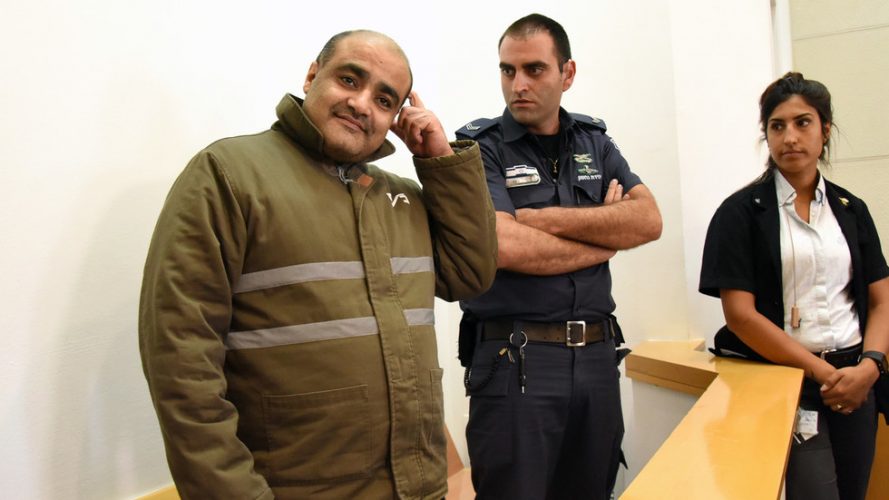
Former World Vision employee Muhammed al-Halabi (L) at a district court in Beersheva, Israel. © AFP / Dudu Grunshpan
RT | October 23, 2019
A former charity manager in the Gaza Strip accused of funding Hamas has attended court for the 129th time in what has become the longest trial of its kind in Israel’s history, dragging on as witnesses are blocked from testifying.
The 41-year-old aid worker, Muhammed al-Halabi, was arrested in June 2016 while working for World Vision, a Christian humanitarian group, charged with funnelling kickbacks to Hamas and its armed wing. For nearly four years, however, Halabi has been denied his proper day in court, instead forced to endure an endless series of stop-go proceedings in which key witnesses are barred from testifying.
His most recent hearing on Wednesday was no different, quickly hitting a dead end soon after it began.
“Today’s hearing was cancelled shortly after it started because the witnesses were not present,” Halabi’s brother, Hamed, told Middle East Eye. “The prosecution then threatened that any witnesses who come from Gaza to give their testimony will be detained.”
“They do not want anyone to prove them wrong. All the eyewitnesses and even the officials at World Vision gave proof that he was innocent. But this is not what the prosecution is looking for.”
The Israeli government has denied travel permits to crucial witnesses in the former charity worker’s case, preventing them from leaving Gaza to give testimony in Israeli courts. Halabi’s lawyer, Maher Hanna, says that guarantees he cannot receive a fair trial.
One of those witnesses – the owner of a company implicated in the alleged money transfer scheme – “could totally undermine the accusations they made against Muhammed,” Hanna told the Times of Israel. “He has begged Israel to allow him to go to the court and testify, but they have not permitted him to do so.”
A father of five from Gaza’s Jabalya refugee camp, Halabi has maintained his innocence since his 2016 arrest and refused to confess to the charges, according to his family, despite facing pressure and even threats from judges. His father said that at one his hearings, a judge promised “long term imprisonment” if Halabi did not admit to collaborating with terrorist groups.
“[The judge] threatened him and tried to force him to confirm the accusations in front of everyone,” Halabi’s father told Middle East Eye.
Halabi’s family also says he has suffered “horrific torture” at the hands of Israeli authorities during several interrogations, including beatings, humiliation and forced sleep deprivation.
A former employee at World Vision said Halabi’s case was part of an ongoing attack on the charity’s aid work in the Gaza Strip and other Palestinian territories.
“There was a political attack on the organisation given that one of its main offices is in the United States,” the employee, who wished to remain anonymous, told Middle East Eye. “The Israeli lobby in the US must have played a major role in impeding the work of the organisation.”
Halabi’s father seconded that take, adding “They know very well that he is innocent, but they cannot release him after four years of interrogation and torture and prove themselves wrong.”
Also on rt.com:
1,700 Gazans shot by IDF face amputation due to funding crisis, UN warns
Palestinians love living under occupation, ex-IDF chief declares, recycling apartheid talking point
More on the Quincy Institute: Don’t Mention Israel
By Philip Giraldi | American Herald Tribune | October 21, 2019
I have written frequently about how the overwhelming deference to Israeli perceptions not only distorts U.S. foreign policy, it also corrupts discourse regarding genuine national interests at all levels. The mainstream media, where Zionist journalists and editors exist in grossly disproportionate numbers, has long been a source of fake news about the Middle East, successfully obscuring Israel’s abominable record of war crimes and ethnic cleansing. The media lies overlap and often become self-propagating, with one lie from the likes of Rachel Maddow on MSNBC being employed to confirm the veracity of another similar lie being floated by someone like Jake Tapper on CNN.
So, the media, which is part of the Establishment and has a vested interest in promoting the status quo, is part of the “intellectual” underpinning of the government policies that it prefers. And it is joined by a more powerful and secretive ally in the form of the numerous think tanks that have sprung up in Washington like diseased mushrooms over the past twenty years. It is the think tanks that send ideologically driven “experts” to testify in front of congressional committees regarding policy, that draft legislation for lazy legislators, and that host well-funded panel discussions in which they air their biased views on the state of the nation.
I have written several times about the new think tank kid on the block the Quincy Institute, which is currently planning on “launching” during the month of November. Quincy, which claims to represent “Responsible Statecraft,” is largely funded by George Soros and the Charles Koch, both of whom have considerable negative baggage, and one is scarcely ever wrong when positing that compromising one’s views in exchange for money and celebrity is what Washington is all about.
My most recent rant on Quincy involved an article by the organization’s president, Professor Andrew Bacevich, whose books I have previously admired. His piece was entitled “President Trump, Please End the American Era in the Middle East.” The article appeared as one of Bacevich’s regular weekly contributions to The American Conservative (TAC) website under the rubric “Realism and Restraint.” I cited it as a good example of how self-censorship by authors works.
The article particularly focused on the foreign policy pronouncements of Bret Stephens, the resident neocon who writes for The New York Times. Stephens, per Bacevich, has been urging constant war in the Middle East and worrying lest “we may be witnessing the beginning of the end of the American era in the Middle East.”
Bacevich wrote the article without once mentioning Israel in spite of the fact that Stephens is an arch-propagandist for the Jewish state, a clearly deliberate omission that was noted not only by me but also by a number of comments from other readers. As the TAC site where the article appeared is heavily moderated, one suspects that additional, more vitriolic comments were not allowed to appear.
Bacevich is clearly on a roll. He followed up the piece on TAC with a stunningly ridiculous propaganda piece entitled “Foreign governments are messing with our elections the old-fashioned way” that appeared last week in the Boston Globe.
The article begins: “President Trump’s record as a unifier is spotty at best. Yet on at least one issue, he has helped forge a solid consensus: Americans are not going to tolerate further outside meddling in their politics. In discussing next year’s elections, Senate majority leader Mitch McConnell recently put it this way: ‘Any foreign country that messes with us is going to have a serious problem in return.’ The integrity of our electoral system is sacrosanct. Consider yourself warned, Mr. Putin. The Mueller report showed conclusively that in the run-up to the 2016 presidential election Russian hackers had done plenty of messing. Republicans and Democrats alike (if not President Trump himself) are now intent on preventing any recurrence of such interference, whether by Russia or other mischief-making interlopers such as Iran or China. Patriotic citizens must hope that those efforts will succeed.”
Let’s pause right there. Any article that pretends to be a serious discussion of America’s relationship with foreign powers should avoid quoting Mitch McConnell, who is possibly one of the slimiest politicians currently on display in the Senate. All his judgments are conditioned not by the national interest but rather by political considerations that relate to advancing his own personal agenda as well as the agenda of establishment Republicans. If the “integrity” of the U.S. electoral system is truly threatened, nearly all of the damage comes from inside the system, where corruption is rampant at all levels.
And, one might also note that the Mueller report may have demonstrated that in 2016 there were certain intrusions and manipulations by entities that may or may not have been connected to the Russian government, but it never revealed any plan by the Kremlin to influence voters in any serious way or change the results. It has not even been conclusively demonstrated that the Russians hacked anyone as the FBI has never been able to examine the Democratic National Committee computers. In fact, it is widely recognized that the Russian click-bait efforts on social media were insignificant and had no influence on the outcome. Overturning election results is called “regime change” and it is something that the United States does regularly, not the Russians.
Bacevich continues, “Yet those same citizens would do well to consider the other ways in which foreign governments, many of them ostensible friends, have habitually interfered in our politics. To do so, those governments do not employ the latest innovations in information warfare, waged via social media. No, they mess with our politics the old-fashioned way, distributing vast sums of money to buy influence.”
The professor makes a good point, that money in politics can create access and buy influence, but he then goes on to cite Saudi Arabia as a prime example of that specific form of corruption. He claims that the Saudis spent in 2018 alone “$33 million in their attempts to influence US policy” and wonders “… why the pervasive use of Saudi money to influence U.S. policy is any more tolerable than Moscow’s campaign to tilt the outcome of a presidential election in favor of its preferred candidate.”
Bacevich concludes with “Interested in salvaging the remnants of integrity that survive in American democracy? Well, it won’t be enough to stop the hackers employed by Moscow or Beijing or Tehran (even assuming that it’s possible to do so). To prevent foreign governments from mucking around where they are not wanted will require a concerted effort to get outside money out of American politics altogether. The moneychangers need to be ousted from the temple.”
With this recent series of somewhat related articles Professor Bacevich, unfortunately, defines himself as just another run-of-the-mill American hack propagandist. The enemies list includes Russia, China, Iran and Saudi Arabia but it deliberately avoids mentioning that country the more than any other interferes in U.S. politics. That country is, of course, Israel.
The $33 million that the Saudis allegedly spend on lobbying the U.S. is little more than chump change for the Israel Lobby, which is awash with money donated by Jewish oligarchs like casino magnate Sheldon Adelson, who came up with three times that much and more in 2016 to insure that America would have a solidly pro-Israel foreign policy. The Lobby plays with hundreds of millions of dollars annually, costs the U.S. taxpayer billions in various free rides for the Jewish state and has hundreds of full-time employees in groups like the American Israel Public Affairs Committee (AIPAC) and the Foundation for Defense of Democracies (FDD).
Andrew Bacevich is a smart man and he knows well that what I have written about above is correct. He knows first-hand that Israel’s interference in U.S. politics is highly organized, generously funded and ongoing at every level of government to obscure what Israel actually represents while also inter alia making it illegal to criticize the Jewish state in any way. Professor Bacevich fully well knows those things even as he pontificates about Americans not tolerating foreign influence in our politics, so why doesn’t he tell the truth for a change? Is it all about the Quincy Institute’s Benjamins?
UK protestors face jail for campaigning against Israel owned arms factory
MEMO | October 23, 2019
Seven people are facing the prospect of three months in prison for protesting against an Israeli-owned arms factory based in the UK.
The case against the seven activists will be heard in a Folkestone Magistrates Court Kent today. They are expected to plead not guilty of the charge of Aggravated Trespass, an offence which carries a maximum sentence of three months in prison. A number of the activists are locally connected to Kent.
The activists were arrested in August following a two-day occupation at the Elbit-Instro arms factory, which is newly situated in Discovery Park business park in Sandwich, Kent. Its parent company Elbit Systems supplies military equipment to Israel and activists claim that its products are the “backbone” of Israel’s drone fleet.
Elbit Systems also supplies weapons to a number of other countries accused of committing war crimes including Saudi Arabia. The weapons manufacturer is Israel’s largest privately-owned arms company. Campaign groups say that it provides 85 per cent of Israel’s drones which were used to attack Gaza’s civilian population repeatedly. Drones were used during Israel’s Operation Protective Edge which killed over 2,300 civilians, including over 500 children.
A statement released by the Stop Elbit-Instro Defendants Solidarity Campaign said: “The skilled engineers of Elbit-Instro could be working to make the world a better place, yet instead they are employed to build machines that incinerate children.” It added: “Shame on them all.”
According to the campaign group locals resent the arms manufacturer and relations between Elbit-Instro and Kent residents soured following its attempted take-over of an airport site.
A spokesperson for East Kent Campaign Against the Arms Trade said: “There are urgent questions about whether Instro’s specialist targeting technology is employed by Israel for targeting Gazan civilians every Friday during the Great Return March civil rights demonstrations, or in maintaining the surveillance of Palestinians along its illegal separation barrier, enabling the occupation’s apartheid infrastructure.”
Foreign agents torturing Palestinian prisoners in Saudi jails
MEMO | October 22, 2019
Palestinian prisoners inside Saudi jails are being interrogated and tortured by foreign agents, senior Hamas official Sami Abu Zuhri said yesterday.
Speaking to the Shehab News Agency, Abu Zuhri said: “Sadly, the prisoners are being interrogated and severely tortured by foreign interrogators of different nationalities.”
“There are about 60 Palestinian prisoners inside the Saudi jails, including some pro-Hamas or Hamas members,” Abu Zuhri said, noting that some of them have spent more than three decades in Saudi Arabia and contributed to building the country.
“Their detention shocked us and them because it is not justified and not understood.”
Abu Zuhri said that his movement has exerted many efforts, including contacting Saudi and non-Saudi officials through direct and indirect means but has been unable to arrange the release of the prisoners.
He stressed that his movement has not given up working to end the crisis, stating “this is not justified because Saudi has been and is still a supporter of the Palestinians and their cause.”
Last month, rights groups and Hamas revealed that Saudi Arabia has arrested around 60 Palestinians over claims of links to the Palestinian resistance movement, stating that they had disappeared for months without their families knowing anything about their whereabouts. The NGO Euro-Med Observer reported one of the freed detainees as saying that he and the others were subject to verbal and physical torture.
Hamas also revealed that its main official in the kingdom, Mohammed Al-Khodari, 81, has also been arrested.
How Russia’s Vision for the Middle East Is Rigged against Iran
By Agha Hussain | American Herald Tribune | October 22, 2019
Stanislav Ivanov writing for the prestigious Russian state-run Valdai Club recently described ‘Israel and most of the Arab countries’ as viewing Turkey’s military presence in Syria as a counterweight to that of Iran. He also added that Iran and Turkey both waged a ‘fierce struggle’ to install a ‘puppet government’ in Damascus.
The Russian perspective is usually channeled, directly or indirectly, by its assorted major think tanks and media outlets and a very clear cut yet under-noticed aspect of Russia’s views on Iran has been made clear as daylight here.
That ‘Most of the Arab countries’ consider Iran’s presence in Syria as something that requires a ‘counterweight’ is a fallacious notion for a number of reasons. Iran’s key allies in the region are Arabs, such as Hezbollah, the Syrian Arab Army and much of the Iraqi government, clerical establishment and de facto military in the form of the Popular Mobilization Units. The same goes for Hamas, Islamic Jihad and other groups in Gaza.
To describe the Gulf Arabs (GCC) and their consensus on Iran’s ‘need’ to exit Syria as the consensus of ‘most of the Arabs’ is thus disingenuous. Notwithstanding the weakness of that consensus itself, given how the UAE quickly distanced itself from the fiasco in the Persian Gulf through assuring signals to Iran as things heated up there, it is not likely that the author is unaware of these issues with the ‘Arabs’ tag.
Nor is it likely that Russian policymakers are unaware of the illogical, dishonest basis of this classification of ‘most of the Arabs’. It remains, regardless of this vital reality, a key cornerstone of Russia’s current geopolitical approach to the Middle East. This can be seen from the Russian outreach to the GCC it began – together with other extremely important yet under-discussed strategic adjustments – in what can be described the ‘post-ISIS’ scenario in Syria.
The Russian-GCC ‘rapprochement’ was lightning fast, with Russia offering to Saudi Arabia and the UAE what it never did to its Iranian or Syrian ‘allies’ constantly attacked by the Israeli airforce: its much-vaunted S-400 anti-air defense system. As one of the earlier examples of Russian preference for the GCC over their Iranian rival, the clarity of the message Russia was sending was illustrated by the fact that it even pitched the system to the small, militarily-insignificant Bahrain.
Russia has taken clear steps to prop up the brittle GCC whenever it has suffered major setbacks, demonstrating its ties with them are not just cordial but strategic. Saudi Arabia, having last month suffered a deadly missile attack on its Aramco oil processing facilities at Abqaiq, received a boost on 11 October as Russia announced plans to invest $1 billion for a petrochemical facility there.
More than 20 deals were signed between Russia and Saudi Arabia during Putin’s state visit days later, including the purchase of a 30.76% in one of Russia’s leading companies, Novomet, by the two countries’ sovereign investment funds and Aramco.
The economic honeymoon, however, started after Saudi King Salman’s historic visit to Russia in 2017. Its progress since then compares starkly to Russia, contrary to expectations of its ‘Eurasianist’ supporters, having adhered to US sanctions against Iran when they were re-imposed last year.
The strategic element which drove Russo-GCC economic ties did influence the decisions of Russian giants such as Rosneft and LUKoil regarding their Iran investments, but to Iran’s detriment as they withdrew from Iran with Russo-GCC ties being a factor as well.
A team from Russia’s MGIMO university at the Abu Dhabi Strategic Debate in November 2018 days after re-imposition of US sanctions on Iran declared in no unclear terms that Russia was not aligned with Iran. The prestigious institution, famed for having top Russian diplomats such as current Foreign Minister Sergei Lavrov among its alumni, declared political Islam problematic and Iran to be an expansionist power.
But what are these soft spots Russia tries to hit at in Iran’s geopolitical ‘Resistance Axis’ infrastructure, and is it the GCC’s subsequent empowerment [over] Iran that makes Russia’s ‘contain Iran’ policy dangerous?
The answer lies in Israel and the regional socio-political and military network Iran has forged and sustained since 1979 pivoted around the correct recognition of Israel and Israel Lobby-induced US foreign policy as the premier driver of Middle East wars.
It [Iran] has, thus, through the chaos of Middle East geopolitics since 1979 performed an important task in countering forces of destabilization. Vital to Iran has been its deep involvement in foreign affairs and disingenuously portraying this as ‘Iranian expansionism’ has been a cornerstone of Israeli and GCC propaganda against Iran.
Nobody knows the ‘start the story from the middle’ game better than the Israelis, be it claiming Israel was ‘attacked’ by ‘the Arabs’ in 1948 whilst ignoring the entire pre-planned ethnic cleansing campaign of the 1940s by the Zionists or claiming self-defense in Gaza. The GCC in recent times have latched onto this narrative as well, but with their own crude ‘Iran seeks to dominate the Arab world’ spin.
Had Iran not intervened, the Shia-dominated Lebanese resistance against Israel’s occupation would have lacked a material supporter against the modern Zionist army and Israel would have consolidated Lebanon for both its Jewish colonies scheme and seized its vital water resources. Such had been Zionist ambition as far back as 1919.
Gaza, where the armed resistance born following the First Intifada in the vacuum left by Yasser Arafat’s inept leadership (and subsequent sell-out during the Oslo ‘peace’ hoax) receives arms from Iran, would have by now been fully swallowed by Jewish colonies. It would have shared the fate of the ‘Iran-free’ West Bank, where Mahmoud Abbas carries on the legacy of Arafat’s surrender.
Instead, Lebanon today is far more stable than at any other time in its history and the bridges Hezbollah has built with other religious parties have helped augment internal cohesion. Gaza has shown in recent times increased capability to deal with Israeli military aggression, with its Iran-backed Sunni Islamist groups possessing improved weaponry and exhibiting greater unity.
It was not international mediation and ‘conflict-resolution’ attempts that stabilized – or, given the capacity of Israel’s cohorts to rig such attempts every step along the way, ever truly even could stabilize – the parts of the Arab world worst hit by war. It was Iran’s support to these states and state-less victims of Israeli expansionism that enabled them to weather the storm inflicted upon them and mount a thus-far successful resistance.
Few pundits would, retrospectively, describe past ‘peace deals’ be they Camp David 1978 or the Oslo process of the 90s as anything other than smokescreens for unhinged Israeli warmongering.
For containing Israel, Iranian forward-presence in countries near to Israel has always been a necessity. Iran’s elaborate supply chains, part covert and part overt in nature, going to allies such as Hamas and Hezbollah are transnational and involve supporters on the ground zealously committed to Iran or even just zealously committed to opposing Israel.
Syria is one such vital node. Without Syria, Iran could not supply Hezbollah. Russia is not unaware of this when it constantly pushes for Iranian withdrawal from Syria whilst passing this off as its ‘principled’ position that all foreign forces must leave the country. This most salient stance of Russia is deceptive, given that Russia has consistently implicitly excused Israel completely from adhering to this principle.
The Russian Defence Ministry right after Israel got a Russian aircraft downed in September last year reminded everyone of how Russia at Tel Aviv’s request had pushed for ‘Iran-backed groups’ to withdraw 140 km away from the Israeli-occupied Golan Heights. Israel’s behavior since then remained the same, but Russian attempts at Tel Aviv’s request to distance Syria from its Iranian ally only intensified, even including lobbying for the removal of heavily pro-Iran officials from the Syrian military and incorporation of ‘ex-rebels’ into its ranks.
The façade is crystal clear: Israel gets to continue its attacks but Iran – who along with Hezbollah contributed to the defeat of terrorism in Syria even before Russia intervened in 2015 – must depart Syria. The constant Russian favors to Israel are here are even more see-through than were the fraudulent regional ‘peace-processes’ of the past which leveraged almost no obligations upon Israel to cease its warmongering yet comprehensively de-fanged and neutralized whatever stood in its way.
Propping up the GCC, working to weaken Iran and looking the other way when Israel attacks its ‘allies’ (or even publicly fawn over the Zionist state at events hosted by financial benefactors of Israel’s military) are all part and parcel of Russia’s geopolitical bigger-picture.
Validating the notion that the GCC – the normalization with whom of Israel’s ties Jared Kushner has fast-tracked since 2016 as an anti-Iran front and plan B following al Assad’s survival in Syria – represents ‘most of the Arabs’ has a specific purpose.
That purpose is to rig the selection of stakeholders for any potential region-wide ‘peace initiatives’ against Iran, sidelining it and declaring the pro-Israel GCC the representatives of ‘the Arabs’. Israel would be the benefactor of any ‘peace deal’ to end the ‘Arab-Israeli conflict’ since both sides would have long ago accepted the need to eradicate longstanding barriers to Israeli hegemony.
What follows next is obvious and has been seen repeatedly in the Middle East ‘peace processes’ in the past: no actual reigning in of Israel, but a thorough neutralization of its foes. For resistance-oriented states like Iran, there is no place in Russia’s vision for the Middle East.
Agha Hussain is a Research Analyst at the Institute of Regional Studies, Islamabad, Pakistan, as well as an editorial contributor to the websites Eurasia Future and Regional Rapport. His writings have a particular focus on Middle Eastern affairs and history and Pakistan’s foreign policy.
Can Trump Survive Ending Project Syria?
By Tom Luongo | Strategic Culture Foundation | October 21, 2019
From the moment that Speaker Nancy Pelosi (D-Davos) announced reluctantly that impeachment proceedings would begin against President Trump I knew this was about his shift in Middle East policy.
It happened on Terrible Tuesday where both Trump and UK Prime Minister Boris Johnson were handed smackdowns by their respective Deep States over their plans to unwind multiple decades of aggressive foreign policy on the one hand and subjugation to the growing European Union on the other.
Now that Trump has fully embraced ending some of the US’s involvement in Syria the knives have come out in full. There have been nothing but howls of pain from every corner of neoconservatism and liberal interventionism on both sides of the domestic political aisle, about how Trump is unfit for office because he abandoned the heroic Kurds to genocide by the Turks after fighting for freedom against the brutal Bashar al-Assad.
Even the impressive Tulsi Gabbard (D-HI) promoted this narrative at the recent Democratic debate.
This narrative is so wrong on so many levels that it amazes me anyone still promulgating it can do so without their brain seizing up from the cognitive dissonance.
The Kurds were mercenaries in a cynical multi-country operation to atomize Syria into a failed state, a la the Libya model which John Bolton threatened North Korea with (and led to the public reason for his firing). This atomization would have seen Turkey take Idlib and the north eastern Arab lands its moving into now, the Kurds get a country comprised of Southeastern Syria and Northern Iraq with the eventual annexation of Kurdish territory in Iran.
This operation was paid for by the US, Saudi Arabia, Israel, the UK as well as sanctioned by EU leadership in Paris and Berlin. Russia’s intervention put the kibosh on all of it and the alliance formed in Syria’s defense between it, China, Hezbollah and Iran not only won back most of the country over the past four years but also defeated the Iraqi Kurds at Erbil after a failed rebellion by Mamoud Barzani and his Peshmerga forces.
Once Aleppo was retaken, Raqqa demolished, and the Peshmerga defeated the Kurds’ fate was sealed. The past two and a half years have been nothing more than delaying actions against the day that Trump finally gained control over the White House insurrections amongst his staff and ordered the operation ended.
Trump ordering US troops out of the region put the Kurds on notice that they either make a deal with Russia and the Syrian government or get slaughtered by the Turks. That took all of a day.
It also, as the great Pat Buchanan points out in his latest article, put the Saudis on notice that they no longer set US foreign policy objectives because they sell their oil in dollars and splash some money around D.C. and the media.
Their bloodthirst for war with Iran can be done on their dime or not at all.
The most shocking part in all of this is Trump just made the same statement to, of all people, Israel.
And that’s where the highest concentration of anguish is coming from in the media and elsewhere.
Finally, a Republican president had the stones to call AIPAC’s bluff and stop kowtowing to them over their highly sought-after election funds. Trump doesn’t need AIPAC’s money anymore. He raised $125 million in Q3 and with these moves will likely raise more in Q4.
His firing John Bolton was the clue you needed that AIPAC and Sheldon Adelson were no longer important voices in Trump’s White House. He doesn’t need favorable media coverage from a media dominated by Saudi and Israeli money.
It’s not like he’s gotten good press from them on any consistent basis since 2015. He only gets that when he’s willing to bomb people in the name of their agendas and call it ‘freedom.’
But at the same time, he made powerful enemies doing so.
This was finally the right move made by a US president standing firm in front of oppressive political and media opposition. Trump is showing a strength we haven’t seen since Ronald Reagan pulled troops out of Beirut after the massacre of more than 200 marines in 1983.
That he didn’t immediately cave to the pressure like he did in December is noteworthy. I’ve given Trump no end of grief over his lack of moral courage on this very issue, but now that he’s been unleashed by the move to impeach him, he has little left to lose.
It proves that changing personnel can change policy. John Bolton is out and he’s running his mouth about how terrible Trump is trying to become the Hero of the Resistance in the process.
He and former Trump adviser on Russia, Fiona Hill, dominated the news cycle in the wake of the Kurds making a deal with Syria and Russia, to paint Trump with the Nixon brush of spying on his political enemies.
Meanwhile, his replacement Robert O’Brien is gutting the National Security bureaucracy, reportedly cutting the staff in half. Good. That’s more than a hundred people no longer employed to feed the president false information to suit an agenda that contravenes US security.
These moves by Trump have upset the status quo in a fundamental way. It has blown up the narrative that we were in Syria to defeat ISIS. That was the cover story. And Trump has neatly called it out for exactly that.
The real story is that partitioning Syria has been the long-held goal of Israel, the neoconservatives, PNAC and so many others. And that goal is now looking to be out of reach lest they can convict Trump for doing his job for the first time since he became President.
With the rapid changes happening across the region and the collapse of so many narratives concurrently, Trump is in an excellent position to make good on many of his long-delayed promises.
What’s also clear is that Putin has played everyone in the region perfectly, balancing his relationships with Turkey, Saudi Arabia and Israel so that once Trump made his move to pull back the curtain in Syria, they would all turn to him to broker their terms.
What’s also clear is that any move he makes now will be interpreted through the impeachment lens as proof he’s trying to save himself or that he really is a Putin puppet or whatever random anti-Trump thought flits through the tiny openings in the minds of his opponents.
Trump has stepped on sacred ground here, US interventionist foreign policy. And, right now, only he has the platform and the ability to separate fact from fiction about its efficacy and who it really serves.
Because it doesn’t serve the American people, nor does it serve the people our continued presence is supposed to protect. Trump won’t come out and say that he’s turned his back on Israel’s goals in the Middle East. But with his Deal of the Century dead, its proponents on their last legs politically (Netanyahu and Kushner) it seems likely that he’s cutting bait and changing course.
And even if he doesn’t survive this politically, the vacuum he’s creating right now is big enough that it won’t matter. With Putin signing major deals with Saudi Arabia and the UAE, China welcoming Iraq into the Belt and Road family and Turkey all but leaving NATO, what are a bunch of feckless and politically spent neocons going to do?
Not much from where I’m sitting.
The War on Truth: How Israel’s social media trolls conquered Facebook
By Ramzy Baroud | MEMO | October 20, 2019
On October 9, the social media platform, Facebook, deleted the page of the popular Palestinian news website, the Palestinian Information Center (PIC). This act, which was carried out without even contacting the page administrators, confirms that Facebook’s war on pro-Palestine voices is continuing unabated.
PIC had nearly five million followers on Facebook, a testament to its popularity and credibility among a large cross section of Palestinians and their supporters internationally. For Israel’s trolls on social media, PIC was simply too effective to be allowed to spread its message. As usual, Facebook obliged.
This oft-repeated scenario – where pro-Israeli social media trolls zoom in on a Palestinian media platform while working closely with Facebook management to censor content, bar individuals, or delete whole pages – is now the norm. Palestinian views on Facebook are simply unwanted, and the margin of what is allowed is rapidly shrinking.
Sue, a Facebook user, told me that she had been warned by the platform for alleged “hate speech/bullying” for claiming that “Israelis are militarized in their psychology”, and that the “perceived threat of and real hatred for the Palestinians (are) kept alive by the (Israeli) government.”
‘Sue’ is, of course, correct in her assessment, a claim that has been made numerous times even by the Israeli president himself. On October 14, 2014, President Reuven Rivlin, said that “the time has come to admit that Israel is a sick society, with an illness that demands treatment.” Moreover, the fact that Israeli Prime Minister, Benjamin Netanyahu, has been stoking the fire of fear, hatred and racism to win a few votes in the Israeli elections has made headlines around the world.
It is unclear where exactly ‘Sue’ had gone wrong, and what portion of her comment constituted “hate speech” and “bullying”.
I asked others to share their experiences with Facebook as a result of their pro-Palestinian speech. The responses I received indicated the unmistakable pattern that Facebook is indeed targeting, not hate speech, but criticism of Israeli war, siege, racism and apartheid.
For example, ‘José’ was censored for writing, in Spanish, that “there is nothing more cowardly than attacking or killing a child.”
“Damned coward army, assassins of Palestinian children, this is not a war, this is a genocide,” he commented.
Meanwhile, ‘Derek’ has been suspended from using Facebook for 30 days, “many times” in the past on “various charges.” He told me that “all it takes is a certain number of reports by trolls who have secret groups on who to target.”
The same pattern was repeated with ‘Anissa’, ‘Debbie’, Erika’, ‘Layla’, ‘Olivia’, ‘Rich’, ‘Eddy’ and countless others.
But who are these “trolls” and what are the roots of Facebook’s unrelenting targeting for Palestinians and their supporters?
The Trolls
According to a document obtained by the Electronic Intifada, the Israeli government has funded a “global influence campaign” with a massive budget with the sole aim of influencing foreign publics and combating the Palestinian Boycott, Divestment and Sanctions movement (BDS).
Writing in EI, Asa Winstanley, reported on a “troll army of thousands” that is “partly funded by the Israeli Ministry of Strategic Affairs”.
“To conceal its involvement, the ministry has admitted to working through front groups that ‘do not want to expose their connection with the state,’” Winstanley wrote.
One such troll group estimated to include 15,000 active members, is Act.IL.
Writing in Jacobin Magazine website, Michael Bueckert describes the main function of Act.IL app users:
“With the mobile application and online platform Act.IL, Israel aims to recruit a mob of slacktivists and trolls to join their war against the most insidious forms of violence: pro-Palestinian tweets and Facebook posts.”
Act.IL is only the tip of the iceberg of a massive, centralized effort led by the Israeli government and involving legions of supporters around the world. However, Israel would never have achieved its objectives were it not for the fact that Facebook has officially joined the Israeli government in its social media “war” on Palestinians.
In 2014, Sohaib Zahda was reportedly the first Palestinian to be arrested by the Israeli army for his social media post, in a new strategy of cracking down on what Israel sees as “incitement”. The arrest campaign since then has expanded to include hundreds of Palestinians – mostly young artists, poets, and student activists.
But Israel only started monitoring Facebook in earnest in 2015, according to the Intercept.
“The arrests of Palestinians for Facebook posts open(ed) a window into the practices of Israel’s surveillance state and reveal social media’s darker side,” Alex Kane wrote. “What was once seen as a weapon of the weak has turned into the perfect place to ferret out potential resistance.”
Israel quickly manufactured a legal basis for the arrests (155 cases were opened in 2015 alone), thus providing a legal cover that was used in its subsequent agreement with Facebook. The Israeli Penal Code of 1977, art. 144 D.2 was repeatedly unleashed to counter a social media phenomenon that was established much more recently, all in the name of cracking down on “incitement to violence and terror”.
The Israeli strategy began with a massive hasbara (propaganda) campaign aimed at creating public and media pressure on Facebook. The Israeli government activated its then-nascent troll army to build a global narrative centered on the purported notion that Facebook has become a platform for violent ideas, which Palestinians are utilising on the ground.
The Facebook-Israel Team
When, in September 2016, the Israeli government announced its willingness to work with Facebook to “tackle incitement”, the social media giant was ready to reach an understanding, even if that meant violating the very basic freedom of expression it has repeatedly vowed to respect.
During that period, the Israeli government and Facebook agreed to “determine how to tackle incitement on the social media network,” according to the Associated Press citing top Israeli officials.
The agreement was the outcome of two days of discussions involving the Israeli interior minister, Gilad Erdan, and justice minister, Ayelet Shaked, among others.
Erdan’s office said in a statement that, “they agreed with Facebook representatives to create teams that would figure out how best to monitor and remove inflammatory content.”
In essence, this meant that any content related to Palestine and Israel is now filtered, not only by Facebook’s own editors, but by Israeli officials as well.
For Palestinians, the outcome has been devastating as numerous pages, like that of PIC, have been deleted and countless users have been banned, temporarily or indefinitely.
Quite often, the process of targeting Palestinians and their supporters follows the same logic:
- Pro-Israel trolls fan out, monitoring and commenting on Palestinian posts.
- The trolls report allegedly offensive individuals and content to the Facebook/Israeli “team”.
- Facebook carries out recommendations regarding accounts that have been flagged for censorship.
- The accounts of Palestinian and pro-Palestinian pages and individuals are deleted or banned.
While PIC did not receive any warning before their popular account was axed, chances are the decision followed the same pattern as above.
When social media was first introduced, many saw in it an opportunity to present ideas and advocate causes that have been, for one reason or another, shunned by mainstream media.
Palestine suddenly found a new, welcoming media platform; one that is not influenced by wealthy owners and paid advertisers, but by ordinary individuals – millions of them.
Israel, however, may have found a way to circumvent the influence of Facebook on the discussions pertaining to Palestinian rights and the Israeli occupation.
When exposing apartheid, condemning child killers and discussing the fear-mentality pervading in Israel become “hate speech” and “bullying”, one should then ponder what has become of social media’s promise of freedom and popular democracy.
While Facebook has done much more to discredit itself in recent years, no other act is as sinister as censoring the voices of those who dare challenge state-sponsored violence, racism and apartheid, anywhere, with Palestine remaining the prime example thereof.
Romana Rubeo, an Italian writer and editor, contributed to this article.
Watch: Campaign launched to end Facebook’s attack on Palestinian content
‘Iranian threat’ gives Israel ‘fundamental right, even obligation’ to bomb Syria, Iraq or whomever it wants – Pompeo
RT | October 20, 2019
Israel should not be constrained by international borders or laws if it feels under threat – and can always rely on US support – US State Secretary Mike Pompeo said following his meeting with Israeli PM and the chief of Mossad.
The US administration has always been “very clear” that is gives Israel a free rein in hunting down any sprouts of purported ‘Iranian threat’ across the region, using the national security threat as an ultimate excuse, Pompeo said in an interview with Jerusalem Post.
“Israel has the fundamental right to engage in activity that ensures the security of its people. It’s at the very core of what nation-states not only have the right to do, but an obligation to do.”
The withdrawal of American troops from Syria raised some concerns in Tel Aviv, but Pompeo rushed to emphasize that the US remains committed to “continuing that activity that the US has been engaged in now for a couple of years.”
“We know this is a corner where Iran has attempted to move weapon systems across into Syria, into Lebanon, that threatens Israel, and we are going to do everything we can to make sure we have the capacity to identify those so that we can, collectively, respond appropriately.”
Pompeo visited Israel following his urgent trip to Turkey, where he convinced President Recep Tayyip Erdogan to temporarily halt the cross-border operation in Syria, somewhat allowing the Trump administration to save its face after the ‘betrayal’ of its Kurdish allies.
In Tel Aviv, Pompeo held a meeting with the Israeli PM Benjamin Netanyahu and Mossad chief Yossi Cohen, apparently reassuring them that the US withdrawal wasn’t a sign of weakness or intentions to reduce its pressure on Tehran.
US stokes the fires of Turkish revanchism
By M. K. BHADRAKUMAR | Indian Punchline | October 19, 2019
The extraordinary US overture to Turkey regarding northern Syria resulted in a joint statement on Thursday, whose ramifications can be rated only in the fulness of time, as several intersecting tracks are running.
The US objectives range from Trump’s compulsions in domestic politics to the future trajectory of the US policies toward Syria and the impact of any US-Turkish rapprochement on the geopolitics of the Syrian conflict.
Meanwhile, the US-Turkish joint statement creates new uncertainties. The two countries have agreed on a set of principles — Turkey’s crucial status as a NATO power; security of Christian minorities in Syria; prevention of an ISIS surge; creation of a “safe zone” on Turkish-Syrian border; a 120-hour ceasefire (“pause”) in Turkish military operations leading to a permanent halt, hopefully.
The devil lies in the details. Principally, there is no transparency regarding the future US role in Syria. The Kurds and the US military will withdraw from the 30-kilometre broad buffer zone. What thereafter? In the words of the US Vice-President Mike Pence at the press conference in Ankara on Thursday,
“Kurdish population in Syria, with which we have a strong relationship, will continue to endure. The United States will always be grateful for our partnership with SDF in defeating ISIS, but we recognise the importance and the value of a safe zone to create a buffer between Syria proper and the Kurdish population and — and the Turkish border. And we’re going to be working very closely.”
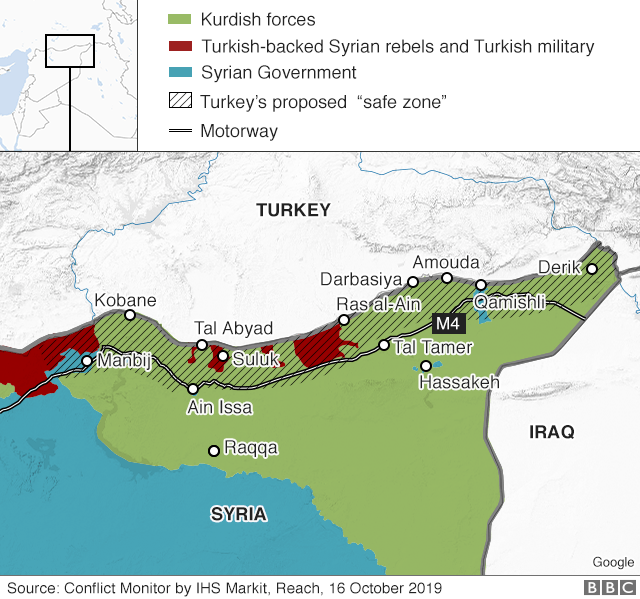
To be sure, everything devolves upon the creation of the safe zone. Turkey envisages a zone stretching across the entire 440 kilometre border with Syria up to the Iraqi border, while the US special envoy James Jeffrey remains non-committal, saying it is up to the “Russians and the Syrians in other areas of the northeast and in Manbij to the west of the Euphrates” to agree to Turkey’s maximalist stance.
Herein lies the rub. Jeffrey would know Ankara will never get its way with Moscow and Damascus. In fact, President Bashar al-Assad told, in unequivocal terms, a high-level Russian delegation visiting Damascus on Friday, “At the current phase it is necessary to focus on putting an end to aggression and on the pullout of all Turkish, US and other forces illegally present in Syrian territories.”
Is there daylight between Moscow and Damascus on this highly sensitive issue? Turkish President Recep Erdogan’s forthcoming meeting with Russian President Vladimir Putin in Sochi on October 22 may provide an answer.
Clearly, the US hopes wrench Turkey from the Russian embrace. Moscow’s studied indifference toward the US-Turkish cogitations betrays its uneasiness. Conceivably, Erdogan will expect Putin to take a holistic view, considering Russia’s flourishing and highly lucrative economic and military ties with Turkey and the imperative to preserve the momentum of the Russia-Turkey relationship.
But Trump has accommodated Erdogan’s top priority to create a safe zone and run it under Turkish supervision, which implies an open-ended Turkish military presence in a swathe of Syrian territory as big as Greece or Nepal. Erdogan’s tone has already changed in regard to his expectations from Putin.
In a meaningful remark on Saturday, he said, “In the area of the operation are forces of the (Syrian) regime under Russia’s protection. We will be tackling the issue with Mr. Putin.” Erdogan then added that in case he fails to “reach agreements on that issue (with Putin), Turkey will be implementing its own plans.”
If the US policy in Syria in recent years promoted the Kurdish identity, it has now swung to the other extreme of stoking the fires of Turkish revanchism. This is potentially catastrophic for regional stability. The heart of the matter is that while Turkey’s concerns over terrorism and the refugee problem are legitimate, Operation Peace Spring has deeper moorings: Turkey’s ambitions as regional power and its will to correct the perceived injustice of territorial losses incurred during the disintegration of the Ottoman Empire. The ultra-nationalistic Turkish commentator (and staunch supporter of Erdogan) wrote this week in the pro-government daily Yeni Safak :
“Turkey once again revived the millennium-old political history on Anatolian territory. It took action with a mission that will carry the legacy of the Seljuks, the Ottomans, the Republic of Turkey to the next stage… It is not possible to set an equation in this region by excluding Turkey – it will not happen. A map cannot be drawn that excludes Turkey – it will not happen. A power cannot be established without Turkey – it will not happen. Throughout history, both the rise and fall of this country has altered the region… the mind in Turkey is now a regional mind, a regional conscience, a regional identity. President Erdoğan is the pioneer, the bearer of that political legacy from the Seljuks, the Ottomans, and the Turkish Republic to the future.”
Trump is unlikely to pay attention to the irredentist instincts in Turkish regional policies. Trump’s immediate concerns are to please the evangelical Christian constituency in the US and silence his critics who allege that he threw the Kurds under the bus or that an ISIS resurgence is imminent. But there is no way the US can deliver on the tall promises made in the joint statement. The Kurds have influential friends in the Pentagon. (See the article by Gen. Joseph Votel, former chief of the US Central Command, titled The Danger of Abandoning our Partners.) Nonetheless, the main outcome will be that Turkey feels it has western support for its long-term occupation of Syrian territory.
All in all, it’s a “win-win” for Erdogan insofar as he got what he wanted — US’ political and diplomatic support for “the kind of long-term buffer zone that will ensure peace and stability in the region”, to borrow the words of Vice President Pence. A Turkish withdrawal from Syrian territory can now be virtually ruled out. State secretary Mike Pompeo added at the press conference in Ankara on Thursday that there is “a great deal of work to do in the region. There’s lots of challenges that remain.”
Pompeo said Erdogan’s “decision to work alongside President Trump… will be one that I think will benefit Turkey a great deal.” Arguably, the US expects Turkey’s cooperation to strengthen its strategy in Syria (and Iraq) where it seeks to contain Iran’s influence. From Ankara, Pompeo travelled to Jerusalem to brief Israeli PM Benjamin Netanyahu.
Europe’s oldest political prisoner, Georges Abdallah, has served 35 years
By Ramin Mazaheri – Press TV – October 19, 2019
Georges Ibrahim Abdallah, known as the “Nelson Mandela of the Arab World”, has now marked 35 years in a French prison. The pro-Palestinian resistance leader remains Europe’s longest-held political prisoner.
In 1982, during Israel’s invasion of Lebanon, Abdallah headed a group which accepted responsibility for the death of Israeli and American agents in Paris. Abdallah has refused to express regret or remorse for defending his country, which was under military occupation.
Abdallah has become an immense inspiration to leftists and anti-imperialists worldwide, despite a Western media blackout on his case.
Abdallah has been eligible for release since 1999, but Washington and Tel Aviv put pressure on France to deny him parole. His own lawyer has admitted to working for French intelligence, and his trial and parole process has been marked by obvious political manipulation.
Abdallah, described as a model prisoner, reads daily in four different languages. He writes letters of support for just causes, and he remains in regular contact with the outside.
Despite his unjust incarceration Abdallah continues to fight for Palestine and against imperialism, and many activists around the world will continue to fight for his release.
Featured Video

Seyed M. Marandi: US-Iran War Inevitable: Kuwait and Bahrain May Fall
or go to
Aletho News Archives – Video-Images
From the Archives
USS Liberty Massacre: A Pivotal Moment in the Hostile Takeover of America
By Kevin Barrett | Crescent | Dhu al-Qa’dah 24, 1445
In corporate America, hostile takeovers are commonplace. They occur when an aggressor—a larger corporation or rich individuals—seizes control of a smaller corporation without asking permission.
What few recognize is that the United States itself has been subjected to a hostile takeover. Since the aggressor, the illegitimate settler colony known as “Israel,” is much smaller than the US, the takeover has necessarily been surreptitious.
As of June, 2024, Israel’s gradual takeover of the US has become obvious and undeniable—a proverbial “elephant in the living room.” … continue
Blog Roll
 Aletho News
- Seyed M. Marandi: US-Iran War Inevitable: Kuwait and Bahrain May Fall
- Leaders Condemn Ansarallah Attack on Saudi Arabia While Ignoring Illegal War Against Yemen
- Leaked: Britain’s Covert Iraqi Psyops Network
- Yemeni Armed Forces Warn Airlines Against Using Saudi Airports, Exempt Mecca and Medina
- Iran security chief says powers greater than US tried to conquer Iran but ended in ‘dustbin of history’
- Europe’s mounting social chaos… chickens coming home to roost for proxy war against Russia
- US-Russia Diesel Deal Becomes Massive Defeat for Ukraine
- Hormuz and the Looming Economic Catastrophe
- Dhubab offensive, media blitz and the rapid unraveling of Saudi-backed coalition’s new gambit
- Putin Conveys to Trump Iran’s Vision on Possible Conflict Resolution – Kremlin
- If Americans Knew
- Gaza: Ceasefire Anniversary Marks Year of Failed Promises
- The American Conservative: Mike Huckabee Should Resign
- A C-Section in Shackles: A Palestinian Woman’s Harrowing Birth in Israeli Detention
- ‘He’s Desperate’: AIPAC Begins Spending Against Abdul El-Sayed to Boost Mike Rogers:
- Trump, Hormuz, and the Looming Economic Catastrophe
- For three years, Israel has killed a child in Gaza every 71 minutes – Daily Update
- Israeli forces kill another child in Gaza – Daily Update
- Gaza ceasefire exists in name only, say more than 100 organizations
- Nearly 2 Million in Gaza Need Urgent Shelter Assistance as Winter Looms: IOM Chief Warns
- Suppressing Palestinian resistance: US charity under fire for AI monitoring of Gaza classrooms
- No Tricks Zone
- Germany’s Green Energy Debacle: High Energy Costs Force Kahla Porzellan to Close After 182 Years!
- New Study: 50 Years Of The Most Aggressive ‘Net Zero’ Policies Can Only Affect The Global Climate By 0.03°C
- US September “Heat” Was No Record…Many Records Set Decades Ago
- Latest European Green Energy Debacle; Portugal’s Largest Flagship Solar Park Insolvent!
- Green Energy Debacle: German Expert Professor Fritz Vahrenholt Warns Of Severe Economic And Social Consequences
- Two More Paleo Reconstructions Affirm Meters-Higher Sea Levels Across Ireland, Brazil 7000-6000 Years Ago
- New Study: Earth And Venus Surface Warmth Largely Explained By Convection And Lapse Rate, Not CO2 Or Radiation
- 2025 Nature Paper Claiming Worsening Global Drought Gets RETRACTED …Heavily Flawed
- New Study: ‘Global Drought Shows No Detectable Recent Acceleration Under Climate Warming’
- Economic Masterminds: German Socialists Suggest Taxing Productivity Gains Stemming From Using AI

