Bedouin Mass Eviction is Part of Israel’s Efforts to Drive Palestinians off their Historic Lands
Tens of thousands are to be driven out of their homes because their numbers pose a major demographic threat to a Jewish state
By Jonathan Cook | The National | October 16, 2019
The decades-long struggle by tens of thousands of Israelis against being uprooted from their homes – some for the second or third time – should be proof enough that Israel is not the western-style liberal democracy it claims to be.
Last week 36,000 Bedouin – all of them Israeli citizens – discovered that their state is about to make them refugees in their own country, driving them into holding camps. These Israelis, it seems, are the wrong kind.
Their treatment has painful echoes of the past. In 1948, 750,000 Palestinians were expelled by the Israeli army outside the borders of the newly declared Jewish state established on their homeland – what the Palestinians call their Nakba, or catastrophe.
Israel is regularly criticised for its belligerent occupation, its relentless expansion of illegal settlements on Palestinian land and its repeated and savage military attacks, especially on Gaza.
On rare occasions, analysts also notice Israel’s systematic discrimination against the 1.8 million Palestinians whose ancestors survived the Nakba and live inside Israel, ostensibly as citizens.
But each of these abuses is dealt with in isolation, as though unrelated, rather than as different facets of an overarching project. A pattern is discernible, one driven by an ideology that dehumanises Palestinians everywhere Israel encounters them.
That ideology has a name. Zionism provides the thread that connects the past – the Nakba – with Israel’s current ethnic cleansing of Palestinians from their homes in the occupied West Bank and East Jerusalem, the destruction of Gaza, and the state’s concerted efforts to drive Palestinian citizens of Israel out of what is left of their historic lands and into ghettos.
The logic of Zionism, even if its more naive supporters fail to grasp it, is to replace Palestinians with Jews – what Israel officially terms Judaisation.
The Palestinians’ suffering is not some unfortunate side effect of conflict. It is the very aim of Zionism: to incentivise Palestinians still in place to leave “voluntarily”, to escape further suffocation and misery.
The starkest example of this people replacement strategy is Israel’s long-standing treatment of 250,000 Bedouin who formally have citizenship.
The Bedouin are the poorest group in Israel, living in isolated communities mainly in the vast, semi-arid area of the Negev, the country’s south. Largely out of view, Israel has had a relatively free hand in its efforts to “replace” them.
That was why, for a decade after it had supposedly finished its 1948 ethnic cleansing operations and won recognition in western capitals, Israel continued secretly expelling thousands of Bedouin outside its borders, despite their claim on citizenship.
Meanwhile, other Bedouin in Israel were forced off their ancestral lands to be driven either into confined holding areas or state-planned townships that became the most deprived communities in Israel.
It is hard to cast the Bedouin, simple farmers and pastoralists, as a security threat, as was done with the Palestinians under occupation.
But Israel has a much broader definition of security than simple physical safety. Its security is premised on the maintenance of an absolute demographic dominance by Jews.
The Bedouin may be peaceable but their numbers pose a major demographic threat and their pastoral way of life obstructs the fate intended for them – penning them up tightly inside ghettos.
Most of the Bedouin have title deeds to their lands that long predate Israel’s creation. But Israel has refused to honour these claims and many tens of thousands have been criminalised by the state, their villages denied legal recognition.
For decades they have been forced to live in tin shacks or tents because the authorities refuse to approve proper homes and they are denied public services like schools, water and electricity.
The Bedouin have one option if they wish to live within the law: they must abandon their ancestral lands and their way of life to relocate to one of the poor townships.
Many of the Bedouin have resisted, clinging on to their historic lands despite the dire conditions imposed on them.
One such unrecognised village, Al Araqib, has been used to set an example. Israeli forces have demolished the makeshift homes there more than 160 times in less than a decade. In August, an Israeli court approved the state billing six of the villagers $370,000 (Dh1.6 million) for the repeated evictions.
Al Araqib’s 70-year-old leader, Sheikh Sayah Abu Madhim, recently spent months in jail after his conviction for trespassing, even though his tent is a stone’s throw from the cemetery where his ancestors are buried.
Now the Israel authorities are losing patience with the Bedouin.
Last January, plans were unveiled for the urgent and forcible eviction of nearly 40,000 Bedouin from their homes in unrecognised villages under the guise of “economic development” projects. It will be the largest expulsion in decades.
“Development”, like “security”, has a different connotation in Israel. It really means Jewish development, or Judaisation – not development for Palestinians.
The projects include a new highway, a high-voltage power line, a weapons testing facility, a military live-fire zone and a phosphate mine.
It was revealed last week that the families would be forced into displacement centres in the townships, living in temporary accommodation for years as their ultimate fate is decided. Already these sites are being compared to the refugee camps established for Palestinians in the wake of the Nakba.
The barely concealed aim is to impose on the Bedouin such awful conditions that they will eventually agree to be confined for good in the townships on Israel’s terms.
Six leading United Nations human rights experts sent a letter to Israel in the summer protesting the grave violations of the Bedouin families’ rights in international law and arguing that alternative approaches were possible.
Adalah, a legal group for Palestinians in Israel, notes that Israel has been forcibly evicting the Bedouin over seven decades, treating them not as human beings but as pawns in its never-ending battle to replace them with Jewish settlers.
The Bedouin’s living space has endlessly shrunk and their way of life has been crushed.
This contrasts starkly with the rapid expansion of Jewish towns and single-family farming ranches on the land from which the Bedouin are being evicted.
It is hard not to conclude that what is taking place is an administrative version of the ethnic cleansing Israeli officials conduct more flagrantly in the occupied territories on so-called security grounds.
These interminable expulsions look less like a necessary, considered policy and more like an ugly, ideological nervous tic.
House of Representatives votes 354-60 against Trump’s withdrawal of US troops from Syria
RT | October 16, 2019
Democrats and 129 of the Republicans in the House of Representatives voted to pass a non-binding resolution disapproving of President Donald Trump’s pullout of US troops from Syria – never authorized by Congress to be there.
The House Joint Resolution 77 describes the presence of US troops in northeastern Syria as “certain… efforts to prevent Turkish military operations against Syrian Kurdish forces,” and formally voices opposition to their withdrawal, but does not offer an alternative. Instead, it demands the White House present a “clear and specific plan for the enduring defeat” of Islamic State (IS, formerly ISIS).
The IS “capital” of Raqqa was liberated by US-allied Kurdish militias in October 2017, and the last IS enclave was declared secured in December 2018, but traces of the presence of the self-declared “caliphate” remain in both Syria and Iraq, weakened by years of war and sanctions.
The House resolution asks the White House to continue providing “humanitarian support” to the Kurds and ensure that Turkey “acts with restraint,” while also demanding of Ankara to stop its “unilateral military action” in Syria.
Trump has maintained he never gave the “green light” to Turkey to invade Syria, and defended the withdrawal as protecting the lives of American soldiers in a region where they had no business being anymore. He has also threatened to “destroy” Turkey’s economy with sanctions and tariffs over the invasion.
Congress has never voted to authorize the US troop presence in Syria, which is not sanctioned under international law and is based only tenuously on old resolutions allowing military action against Al-Qaeda terrorists following the 9/11 attacks. Damascus considers the US presence a violation of its sovereignty, unlike the Russian force that was invited back in 2015.
While the resolution does little to change the situation in Syria, the fact that so many Republicans chose to back Democrats against the sitting president from their party is being held up as a possible barometer for the Democrat-led impeachment process, even though House Speaker Nancy Pelosi has repeatedly refused to hold an actual floor vote on the matter.
And now, a message from our wannabe masters about Syria
The Saker | October 16, 2019
this just came to my inbox:
Dear The Saker,
The American Jewish Congress opposes the U.S. decision to withdraw troops from Syria and strongly condemns Turkey’s actions in Syria against the Kurds. In addition to endangering a U.S. ally, the Kurds, it also poses a great threat to Israel and to the region’s stability overall. Israel shares a border with Syria and is affected by what happens within Syria.
Syria has become a hotbed of Hezbollah and Iranian activity, which poses a direct threat to Israel; as a result of this decision, Turkey, Iran and Hezbollah win while Israel loses. Ultimately, the impact of this decision may come to outweigh President Trump’s historic actions in support of Israel. Regional stability and the security of our allies must be paramount for U.S. policy in the Middle East.
Jack Rosen
President
American Jewish Congress

American Jewish Congress
745 5th Ave., 30th Floor
New York NY 10151 United States
Jewish terrorist involved in Duma operation prepares to join Israel army
MEMO | October 11, 2019
Yedioth Ahronoth reported on Thursday that a Jewish terrorist who participated in the killing of members of the Dawabsheh family in the village of Duma, in the occupied West Bank, is currently located in an Israeli military establishment in preparation to join the Israeli army. Thus, Israel follows a policy of integrating terrorists who kill Palestinians in cold blood, as in the case of the killer and soldier to be, Elor Azaria.
The terrorist is in a preparatory institution for military service in the centre of the country. He was not identified at the time of his arrest, claiming that when the terrorist attack took place, he was 16 years old. He was referred to by the letter “A.”
Lawyers of terrorist “A” reached a plea bargain with the Public Prosecution, following which he was as acquitted of having a direct connection with the planning of the terrorist attack. They also claimed that he had never entered the Dawabshah family home; instead, the defence required the plaintiff to confess to conspiracy.
According to the prosecutors’ deal, “A” must remain in prison for five years, despite the brutality of the crime committed in July 2015. Back then, the Dawabsheh family home was burned down, leading to the death of the father, Saad, his wife, Reham, and their child, Ali, in addition to seriously wounding their other child, Ahmed.
According to the same deal, “A” confessed to burning a warehouse in the village of Aqraba, vandalising property and setting fire to a car in the village of Jubb Yusuf on racially motivated grounds, in addition to deflating tires in Beit Safafa. The Prosecution removed charges, including setting fire to the Abbey of the Dormition in occupied Jerusalem, as well as committing several crimes as part of the “price paying” movement. The deal also stipulated that prosecutors should not seek five and a half years sentence.
The District Court approved the deal in Lod on 12 May. In July last year, the same court ordered “A” to be placed under house arrest after spending two years in prison. Although the Prosecution objected to his release, the court decided to issue such decision upon the recommendation of the Department of Juvenile Justice.
This was preceded by another court decision, in April last year, abolishing the confessions of “A” and the terrorist Amiram Ben-Uliel, who was convicted of carrying out the terrorist attack, claiming that the confessions were obtained under torture.
The court claimed at the time that the boy was a minor and the period he spent in prison justifies a review of the sentence. The Department of Juvenile Justice also maintained that “A” changed his attitudes and expressed regret for his actions. However, the Prosecution confirmed that this was to mislead the court.
Israeli security officials, including former Shin Bet chiefs, have warned against the tolerant treatment of Jewish terrorists who commit crimes as part of the “price-paying” movement, particularly by refusing to treat them as terrorists.
READ ALSO:
Israel court sentences Palestinian to 18 years, $142,000 fine
Israeli concern over the Turkish military operation against the Kurds
By Dr Adnan Abu Amer | MEMO | October 11, 2019
It was significant that the Israeli media presented extensive press and analytical coverage immediately after the start of the Turkish military operation in northern Syria against the Kurdish sites. It seems as if it were a purely internal Israeli affair, and not a regional or international issue. This opens the door to many sensitive questions regarding the reason for Israel’s concern over this operation and why Israel appears as if it were affected by the operation even though it is about 800 kilometres away from its borders.
The Israeli reactions, especially the official ones, reflect the magnitude of their concern and unease towards the Turkish military behaviour in the region. Most described it as a show of military power that was once unique to Israel alone. This current Turkish operation showed that there is a military force in the region that has influence, impact, and behaviour on the ground comparable to Israel’s and perhaps even superior to it.
We can talk about two kinds of Israeli reactions to the Turkish military operation in northern Syria against the Kurdish sites. The first are the official positions issued by the Israeli government and opposition leaders, which, agreed that Turkey should be attacked, despite their differences in most other issues.
Gilad Erdan, the Israeli Minister of Public Security, Strategic Affairs, commented the Turkish military operation in northern Syria by saying Erdogan is an “anti-Semitic racist who supports terrorism – slaughter the Kurds without us making a moral voice heard and calling on the world to stop it. We can’t stay indifferent on this.”
MK Zvi Hauser of the Blue and White party said, “As a nation-state of an ethnic minority in the Middle East, Israel cannot close its eyes to the suffering of the Kurds in the region. Fresh and deported Kurds will bring a wave of refugees, changing demographics, intensify instability and weep for generations, even from Israel’s point of view. Israel must internalise the new rules of the game concerning all challenges.”
Gideon Sa’ar, one of Netanyahu’s rivals in the Likud party, announced that Israel is must take a clear position on what he described as “Erdogan’s attack” on the Kurds and provide them with help. Former financial minister Yair Lapid said that given Turkey’s actions against the Turks, Lapid said “The time has come for Israel to officially recognize the genocide of the Armenian people and stop giving in to Turkish pressure.”
Ayelet Shaked, leader of the Yamina party and justice minister, said, “The Kurds are the world’s largest nation without a country, with a population of about 35 million people. They are an ancient people that share a special historical connection to the Jewish people,” adding, “They are the main force that fought against ISIS and endured thousands of deaths, under a special joint leadership of men and women. The Western world should stand with them.” Meanwhile, Netanyahu’s son, Yair, expressed his support for the Kurds by tweeting about Kurdistan under the hashtag #freekurdistan, indicating his separate support for the establishment of a Kurdish entity.
The second part of the Israeli positions involves the Israeli political and military analysis that gave itself a larger margin to criticise the American behaviour, thus “betraying” the Kurds, disappoint them, and delivering them to their inevitable fate before the lethal Turkish force. This requires Israeli decision-making circles to think hard about the American policy that has consistently let down its allies.
Haaretz newspaper’s military expert, Amos Harel, said: “Israel was surprised by U.S. President Donald Trump’s decision to withdraw American forces from Syria and allow Turkey to begin a military operation in the area.” He added, “Several sources also said that the American decision was also not seriously discussed, and possibly even wasn’t discussed at all, during Sunday’s security cabinet meeting, which focused on Iran and the Palestinian arena.”
Meanwhile, Ben-Dror Yemini, a political analyst for Yedioth Aharonoth, said that Washington leaving the Kurds to face their fate against the Turks raises red flags in Israel, as Trump has been exposed, one time after another, as a leader who is not well-versed, and instead acts arbitrarily. He does not know what is expected of a leader of a global superpower, and the result is Trump has become an unreliable ally for Israel because his current behaviour is a knife in the back of both the Kurds and Israel.
However, Arab affairs expert at Channel 12, Ehud Yaari said that Israel was wrong from the beginning to embrace Trump, and it must stay away from him before it loses the American public, because his chatter will not benefit them. He no longer has anything to give Israel.
Before the start of the Turkish military operation in northern Syria against Kurdish sites, senior Israeli officials expressed serious concern regarding US President Donald Trump’s decision to withdraw US troops from northern Syria, leaving its Kurdish allies as prey for Turkey, according to Israel.
More importantly, Israel was surprised by the American decision and saw it as an abandonment of the Kurdish forces that fought and contributed to the defeat of Daesh. Moreover, American action encourages Turkish-Iranian activity in Syria. All of this means that Israel cannot depend on Trump with regards to Syria, except for the political support for the Israeli attacks that target Iranian forces is well.
The US decision to withdraw from northern Syria suddenly spelled bad news for US allies in the region, specifically Israel. It is the second time that Trump surprises Israel after he decided to withdraw troops from Syria last December. All of the combined events create a new strategic reality in the region requiring Israeli readiness, because removing US troops in northeastern Syria, and letting Kurdish allies face their inevitable fate before the Turks, should be a serious, not artificial, source of concern in Tel Aviv.
The Turkish military operation in northern Syria, and the preceding and accompanying revelations, reveal the fear expressed by the Israelis and their desire not to reach a situation or scenario in which they are like the Kurds or Saudi Arabia, who did not receive American support or aid. This is because the Kurds’ disappointment from the Americans is a new indicator that he [Trump] will not fight anyone on behalf of Israel. It is worth noting that Israel lived some time under the assumption that the Americans will fight on behalf of it, but it has become clear that this assumption is completely mistaken and should not be built upon in light of the Turkish developments.
On the direct Israeli-Kurdish level, the Israeli concern over the Turkish military operation in northern Syria stems from Israel’s loss of its Kurdish allies and losing the great opportunity to establish a Kurdish entity or autonomy, which could result in forming a Kurdish-Israeli alliance that would serve both sides brought together by mutual strategic forces.
Israel and the Kurds are tied together by old historical alliances since the “minority alliance” theory emerged with the establishment of Israel over seventy years ago. Israel trained and armed Kurdish fighters who played a central role in helping Israel displace the Iraqi Jews in late 1969, moving Jews from their homes towards the border with Iran and then transferring them to Israel.
Israel’s interest in Kurdistan, which consists of parts of four countries, i.e. Iraq, Iran, Turkey, and Syria, manifested in a number of reasons that prompted Israel to strengthen ties between the two sides. Israel is almost the only country in the world to declare support for the establishment of a Kurdish state.
Israel seeks to keep the Kurds as a regional force in the area in order to prevent the revival of the “eastern front” threat, which poses a threat of a potential attack from that direction. The establishment of a Kurdish state or at least an advanced autonomy for the Kurds would solidify the division of Iraq on the one hand and surround Turkey and Iran on the other. It has been revealed that Israel has used the Kurdish region as a base to launch operations against Iranian facilities, which reveals the common ground for military and security relations between the Israelis and Kurds.
On an economic level, 75 per cent of Israel’s oil imports come from Iraqi Kurdistan, as well as significant economic cooperation, through the acquisition of a lot of investments by Israeli companies in Kurdistan, especially in the field of energy, construction, communications and security consulting.
Israel is assessing the Turkish-Kurdish developments around the clock because of its sensitivity. Perhaps the most important conclusion we can reach is that Israel joins the moderate Arab states and the Kurds are constantly and jointly assessing a position that is gradually becoming clearer. This position is that they are facing an American president that is unreliable because the US is living a phase completely separate to them all, even though they are supposed to be its most important and trusted allies in the region.
To conclude, the Turkish military operations in northern Syria, and the previous American withdrawal and abandonment of Saudi Arabia after the Iranian attacks [sic] on the country, all confirm to Israel that Trump is personally willing to sell it weapons and combat methods without military assistance. Therefore, in recent weeks, Israel has begun witnessing a state of agitation and disappointment that prevails in moderate countries, especially Saudi Arabia and the UAE.
From the Israeli point of view, this is a new cause for concern, because of the decline in confidence in Trump and the US as a trusted ally, as evidenced by his recent behaviour. The most recent of this behaviour is allowing the Turkish forces to attack the Kurds in northern Syria, this, which, in turn, would increase the Iranians’ interest in carrying out more attacks in the Middle East to establish their existence and control. It will be Israel’s turn sooner or later.
READ ALSO:
Kurdish-led SDF’s political arm in US repeats call for Syria no-fly zone
Hunger striker reveals details of her horrific torture in Israeli prisons
![Palestinian prisoner, Heba Al-Labadi is on the eighth day of hunger strike after being sentenced to administrative detention for five months without charge or trial on 20 August 2019 [Twitter]](https://i0.wp.com/www.middleeastmonitor.com/wp-content/uploads/2019/10/ECYxESYWkAAW0NB-e1569940375372.jpg?resize=1024%2C683&quality=75&strip=all&ssl=1)
Palestinian prisoner, Heba Al-Labadi was sentenced to administrative detention for five months without charge or trial on 20 August 2019 [Twitter]
MEMO | October 8, 2019
A Palestinian-Jordanian who has been on hunger strike for 15 days in Israeli prisons has revealed the details of her horrific interrogation and torture, the PLO Prisoners’ Committee reported on Monday. Heba Al-Labadi, 24, was arrested on 20 August by Israeli soldiers as she crossed the Allenby Bridge from Jordan to attend a wedding in the occupied West Bank with her mother.
According to her lawyer, Al-Labadi has been subjected to inhumane treatment in detention. She was apparently stripped of all of her clothes as soon as she was arrested, handcuffed, blindfolded and leg-chained before being moved to the Bitah-Tikva investigation centre. She told her lawyer that she was embarrassed when she saw the female Israeli soldiers looking at her private parts when she entered and left the toilet.
Al-Labadi also explained that she was interrogated for 20 consecutive hours during the first 16 days of her detention and said that she was given only two breaks for meals every day. She was then moved to rooms full of collaborators, who started to interrogate her; this lasted for up to 35 days, during which she was subjected to verbal, physical and psychological abuse and torture. The Israeli interrogators, she insisted, got close to her body intentionally and used the dirtiest words to insult her.
“They also insulted Islam and Christianity,” she said, “and said that I am an extremist and told me that they had arrested my mother and sister and they would put me under renewable administrative detention for seven and a half years and then release me to the West Bank and put me under 24-hour surveillance.”
A large number of investigators are said to have interrogated Al-Labadi and kept her in a very dirty cell with insects and spiders. The cell had rough walls and a bright light which prevented her from sleeping. The “very thin” mattress had no cover or clean sheets. The interrogators told her that she would “rot” in prison.
On 25 September, Heba Al-Labadi was issued with a 5-month administrative detention order with neither charges made against her nor a trial. That was why she started her hunger strike.
Two days later, she was moved to a cell monitored by four cameras. The toilet in her cell has a see-through door, so her every move is monitored by the prison guards.
Despite being ordered to end her hunger strike, she insisted that the “tragedy” of the administrative detention must end first. “I will continue until the end or I shall die.”
Israel to build camps as preparation for displacing Arab citizens
MEMO | October 8, 2019
Israel’s District Planning and Building Committee considered a plan on Sunday submitted by the Bedouin Settlement Authority in the Negev which aims to build camps as preparation for the displacement of 36,000 Arab citizens, Arab48.com has reported. The plan targets Palestinian-Arab residents within Israel who live in Bedouin villages “unrecognised” by the Israeli occupation government.
Such villages have often been in place for hundreds of years before the creation of the Israeli occupation state. Nevertheless, it is insisting on displacing their residents and replacing the villages with housing projects for Jewish Israeli settlers.
A letter has been sent to the head of the District Planning and Building Committee asking them not to accept the plan. It was sent on behalf of Adalah Centre, an Israeli rights group seeking justice for Arab residents, along with the Regional Council for the Unrecognised Villages in the Negev, the Peaceful Coexistence Club and Shatil Association.
Submitted by lawyer Suha Bsharah from Adalah, the letter stressed the importance of rejecting the plan, which is simply a tool to displace Arabs from their homes and villages within Israel. It also reiterated that such an action amounts to a “flagrant violation of the basic rights of the Arab citizens on top of which is the right to respect, dignity and equality.”
The letter noted that this plan reinforces the suffering inflicted on the Arab residents of the unrecognised villages as Israel is planning to displace them under the pretext of carrying out government projects. “It is unreasonable that the authorities displace tens of thousands of residents from their homes and lands,” wrote the signatories. “[The plan] will destroy a complete generation of Arab children, women and youths.”
According to Bsharah, “The Israeli authorities are seriously looking for a legal cover for the displacement of Arabs by getting the approval of the District Planning and Building Committee. They are not looking for a just and appropriate solution that would maintain the right to live with respect, dignity and safety for the Arabs who have been living here for decades, if not hundreds of years.”
The head of the Council of the Unrecognised Villages, Atiyyeh Al-Asam said: “The Council rejects this plan because its implicit and explicit goal is to forcibly displace the residents of the unrecognised villages. We believe that this plan is materialising the spirit of the [withdrawn] Prawer Plan which was based on displacing tens of thousands of Arabs.”
On Racism and ‘Wild Beasts’: Why Israel besieges Palestinians
![A segment of the Israeli Seperation Wall sean near Abu Dis, in the occupied West Bank on 15th April 2016 [file photo]](https://i0.wp.com/www.middleeastmonitor.com/wp-content/uploads/images/article_images/middle-east/israel-apartheid-seperation-wall-dome-of-the-rock-background-abu-dis.jpg?resize=600%2C350&quality=75&strip=all&ssl=1)
A segment of the Israeli Seperation Wall near Abu Dis, in the occupied West Bank on 15th April 2016.
By Ramzy Baroud | MEMO | October 7, 2019
The Israeli Apartheid Wall, which is being built largely on occupied Palestinian land in the West Bank and East Jerusalem, once more underscores the ugliness of military occupation. As such, it truly epitomises the nature of Israeli apartheid and also delineates the siege-driven, isolationist mentality that dominates the ruling-class thinking in Israel.
Even years before the establishment of the state of Israel over the ruins of the Palestinian homeland in May 1948, Zionist communities in Palestine perfected the stratagem of besiegement, isolating themselves behind massive walls while blockading Palestinians, the native inhabitants of the land, in every way possible.
Throughout the Nakba – the catastrophic ethnic cleansing and destruction of Palestine in 1947-48 – Israel used this military theory in abundance. Neighbourhoods, villages and entire towns would be besieged for days, weeks or months, while being bombarded from all directions before their residents were finally pushed out. None of these ethnically-cleansed Palestinian communities, which numbered in the hundreds of thousands, were ever allowed to return to their homes.
In fact, besiegement and isolation remain at the core of the Israeli military strategy to date.
No other place, however endured the brutality of the seemingly never-ending siege like the Gaza Strip. Gaza, that small region of 365 square kilometres, has been under various stages of besiegement and blockade since 1948.
The most hermetic stages of this perpetual siege began some time in 2006 and intensified in the summer of the following year. Three factors make the latest siege on Gaza particularly horrific: its long duration, the lack of any serious respite for besieged Gazans and, most importantly, the fact that it has been interrupted by massive Israeli wars that killed and wounded thousands of Palestinians. With much of Gaza’s infrastructure destroyed or dilapidated, the Israeli blockade on the Strip has proved to be the most savage and deadliest of all sieges.
On 30 September, Israel’s Channel 12 reported that nearly 70 per cent of an underground barrier east of Gaza is now complete. An estimated 1,400 Israeli and foreign workers are reportedly taking part in building the barrier, which when finished, will extend to reach 60 kilometres in length.
Considering the layers of walls, fences, trenches and no-go military zones, the additional underground wall around Gaza seems frivolous. Is it possible that Israeli leaders truly believe that Gaza is not isolated enough?
In actuality, the latest wall will likely satisfy a psychological, not a practical objective, as it gives the Israeli army and southern settlements a temporary sense of safety, while once more hailing Israeli leaders as the protectors of a defenceless and exposed nation.
Oddly, while scores of young Gazans continue to be killed at the fence separating Gaza from Israel while protesting the Israeli siege on the Strip, it is the Israelis who claim to be targeted, unsafe and victimised.
The newest wall, once it is officially launched with massive fanfare, will still make no difference. It will not upgrade the status of the Gaza siege in any way, nor will it alter the collective fear that has been thoroughly instilled in ordinary Israelis.
For Gazans, wall or no wall, the siege will remain intact.
Israeli wall architects may argue that the latest wall will deter Palestinians from digging tunnels as well as preventing resistance fighters from circumventing the siege via the sea – since part of this underground barrier will also extend into the Mediterranean Sea.
However, there is no proof that walls or fences, over ground or underground barriers have prevented Palestinians from retaliating against Israeli attacks. If the Israeli logic holds any truth, Palestinian resistance would have dissipated or folded decades ago as the Israeli siege mentality was put into practice from the very start of the Israeli war on the Palestinian people.
Israel receives $3.8 billion in US funding every year, in addition to hundreds of millions in loans and other financial giveaways which are mostly used to fortify Israel’s so-called security. To no avail. Palestinians, impoverished and incarcerated in Bantustan-like structures and open-air prisons, continue with their resistance unhindered.
It is clear that the Israeli security model has failed. In fact, that model never had a chance of success in the first place. The additional Israeli wall around Gaza and the hundreds of other walls and fences that are yet to be built are only meant to feed the collective illusion among Israelis and their leaders that the answer to their problem does not lie in ending the apartheid regime, military occupation and siege, but in adding more layers of “security”.
“At the end of the day as I see it, there will be a fence like this one surrounding Israel in its entirety. We will surround the entire state of Israel with a fence, a barrier,” Israeli Prime Minister, Benjamin Netanyahu, said on 9 February 2016 during a visit of the construction site of the barrier around Gaza.
Netanyahu added: “In our neighborhood, we need to protect ourselves from wild beasts.”
While such language and behaviour reflect the deeply-rooted racist mentality at work in Israel, they also underscore the dehumanized way in which Israel sees Palestinians. Since “wild beasts” are not human, they can be killed en masse, besieged and ethnically cleansed in their millions without an iota of regret or remorse.
The problem then is not that of “security” or so-called “terrorism”. Not that of Hamas, or any other group, secular or Islamist. It is not that of Gaza’s March of Return or of children approaching the fences around Gaza. The problem is the entrenched Israeli racist mentality that perceives Palestinian natives as sub-humans and as “wild beasts” to be exterminated or forever besieged.
Iraq says all evidence points to ‘malicious hands’ in protests
Press TV – October 7, 2019
Iraqi officials say there are “malicious hands” behind the killing of both protesters and security forces during the recent spate of unrest in Baghdad and some other cities.
Interior Ministry spokesman Saad Maan confirmed for the first time on Sunday that 104 people had been killed, including eight security officers, and more than 6,000 wounded in the protests.
Maan said the ministry was working with other government institutions to find out who was behind the killings. According to medical sources, the majority of protesters killed were struck by bullets.
The protests began last Tuesday, with demonstrators calling for better living conditions. The rallies soon turned into riots as some protesters started vandalizing public properties and attempted to enter the Green Zone in the capital Baghdad — which houses government offices and foreign diplomatic missions.
On Saturday night, armed elements and violent rioters attempted to take over local TV stations in Baghdad after the government removed a days-long curfew.
Maan said protesters burned 51 public buildings and eight political party headquarters but Iraqi security forces did not confront them.
According to the spokesman, most of those killed on Friday had been shot in the head or heart, a sign that skilled snipers had carried out the killings.
Officials say there are attempts at “sedition” from “unidentified snipers” who shot police and protesters indiscriminately.
“We can’t accept the continuation of the situation like this,” Prime Minister Adil Abdul-Mahdi told his Cabinet late Saturday. “We hear of snipers, firebombs, burning a policeman, a citizen.”
Parliament speaker Mohamed al-Halbousi echoed the premier’s remarks, saying that “infiltrators” were wreaking havoc. He said the parliament had formed a committee to investigate the matter.
Iraqi security officials have made it clear that their forces would not use lethal force against protesters unless their lives were in danger.
On Sunday night, at least 13 people were killed in clashes with security forces in a district of capital, where the military admitted some forces had violated the rules of engagement.
“Excessive force outside the rules of engagement was used and we have begun to hold accountable those commanding officers who carried out these wrong acts,” the military said in a statement.
There are unconfirmed reports that some foreign diplomatic missions are trying to keep the flames of the unrest alive by sending mercenaries into the ranks of protesters to cause more violence.
Lebanese newspaper Al Akhbar reported Saturday that Saudi Arabia’s Embassy in Baghdad had been hiring paid snipers to take out people and guards alike. The report made similar allegations against the US Embassy staff.
There were no immediate official reactions to the claims.
On Sunday, the Iraqi government announced a series of reforms after an “extraordinary” session overnight in response to the sweeping unrest.
The governor of the province of Baghdad, Fallah al-Jazairi, also stepped down and members of the provincial council accepted his resignation.
Confronted by its biggest challenge since coming to power just under a year ago, Abdul-Mahdi’s cabinet issued a decree including 17 planned reforms, such as land distributions and increased welfare stipends for needy families.
Authorities have asked protesters to give them time to implement reform. Grand Ayatollah Ali al-Sistani, the top Shia cleric of Iraq, on Friday urged security forces and protesters to avoid violence.
Iraq declared victory over the Daesh terrorist group at the end of 2017 — after nearly four years of conflict.
The violence comes as millions of Shia pilgrims are preparing to travel to the Iraqi holy cities of Najaf and Karbala to attend Arba’een ceremonies, marking the fortieth day after the martyrdom anniversary of their third Imam, Hussein ibn Ali (AS).
Iraq recently reopened its al-Qa’im border crossing with Syria and accused the occupying regime of Israel of orchestrating a string of recent drone strikes on Iraqi popular mobilization forces.
Tehran-based political analyst Hussein Sheikholeslam said Saturday the unrest is a product of US efforts to weaken “the resistance axis,” which is the key pillar of rising opposition to American and Israeli plans in the Middle East.
Hashd ready protect government, punish saboteurs
Iraqi Popular Mobilization Units (PMU), or Hashd al-Sha’abi, announced Monday that it is ready to help prevent “a coup d’etat or a rebellion” in the wake of the violence.
Faleh al-Fayyad, the PMU head and Iraq’s national security Adviser, told reporters that he wanted to see “the fall of corruption, not the fall of the government.”
He was referring to demands by some protesters for Abdul-Mahdi to step down in order to perform a complete overhaul of the country’s political system.
“We tell the enemies and the conspirators that their efforts have failed,” he said in a press conference. “We will defend the constitution and the government that we have established with our blood and our lives.”
Fayyad said eradicating corruption and achieving economic prosperity is only possible if the government stays in office.
“The government and on top of it the prime minister do their best to complete the transition,” Fayyad said. “In the absence of government security is lost and it is only within this framework that a solution can be reached.”
He also pledged a crushing response to those who perpetrated violence and killed and injured people.
“We know who is behind letting some saboteurs infiltrate the demonstrations,” he said, adding “we have footage and intelligence that we will present when time is appropriate.”
Iraqi PM discusses situation with Pompeo
Abdul-Mahdi’s office issued a statement on Monday, saying the prime minister had discussed the situation with US Secretary of State Mike Pompeo.
According to the statement, Abdul-Mahdi told the US top diplomat that the government was in full control and planning to continue taking practical steps to meet people’s demands.
Later, Russian Foreign Minister Sergei Lavrov arrived in Baghdad on what Moscow said was a two-day working trip.
Amazon, Israel, and the Occupation of Palestine
International Solidarity Movement | October 2, 2019
On September 22nd, Amazon quietly launched its operations in Israel, offering local delivery from a number of Israeli brands, with a Hebrew-language version of its Israel platform coming soon. Consumers in Israel now have faster and broader access to the world’s largest e-commerce marketplace, yet questions remained unanswered about Amazon’s ties with Israeli military, financial, and technology companies involved in the Occupation of Palestine as well as accusations of anti-Palestinian bias against the platform and its founder Jeff Bezos.
Though Amazon Israel was launched barely two weeks ago, Amazon’s business operations with Israel go back much further. As early as 2015, Israel Aerospace Industries (IAI) began servicing Amazon’s fleet of cargo planes, and now services 80% of Amazon’s aircraft. IAI is a wholly Israeli state owned aerospace and weapons manufacturer which supplies the Israeli army with aircraft, drones, missiles, armored vehicles, spy satellites and more. Its weapons have been used in assassinations and military invasions of Gaza. In the 1970s, IAI sold weapons to the Shah of Iran, and more recently, a UN report in August this year found IAI had sold weapons to Myanmar’s military after it began its genocide and ethnic cleansing of the Rohingya minority. IAI subsidiary Elta North America was recently commissioned to build a prototype of Donald Trump’s wall on the US-Mexico border. Amazon also works with Israeli technology firm NSLComm, which receives funding from the Israeli government, and builds network satellites “that will be used for… military applications”, according to Haaretz.
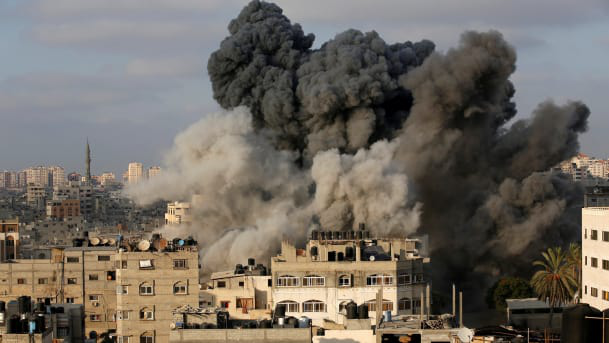
IAI, which services 80% of Amazon’s cargo planes, also provides aircraft, missiles, and other weapons to the Israeli government. Credit: MOHAMMED SALEM/ REUTERS
While Amazon’s ties with IAI and NSLComm are rarely reported in the media, its multi-million dollar contracts with another security firm has attracted widespread condemnation and protest. Amazon makes millions off providing web servers and database storage for Palantir, a private US data analysis firm which aids Immigration and Customs Enforcement (ICE) in identifying and deporting migrants. A petition this summer for Amazon to cut ties with Palantir and ICE gained over 270,000 signatures. Palantir also provides the Israeli government with so-called “predictive systems”, which analyze social media posts to identify Palestinians deemed a “threat”. The result of Palantir’s racially profiled analytics systems is that Palestinians are arrested and face long prison sentences for simply posting photos of family members killed by Israeli forces or in prison, citing Quranic verses, or calling for protests.
In the financial sector, Amazon signed agreements this year with Bank Hapoalim and Bank Leumi, two major Israeli banking institutions, to provide discounts to Amazon customers using Leumi and Hapoalim bank accounts. A 2018 report by Human Rights Watch found both banks guilty of financing construction and expansion of illegal settlements in the West Bank, while Bank Leumi also funds academic institutions in illegal settlements and programs for IDF recruits, even sponsoring gift packages and additional vacation days for Israeli soldiers during the 2014 invasion of Gaza, in which over 2,200 Palestinians, including more than 550 children, were killed. Pension funds and banks in Norway, Denmark, the Netherlands, and the UK have divested from Bank Leumi and Hapoalim due to their human rights violations, while Amazon signs new cooperation agreements with them.
Amazon’s dealings with Israeli companies supporting and profiting from the Occupation aside, many more questions remain. The most troubling of these questions surround how Amazon Israel will deal with realities on the ground in its operations. Will Amazon deliver to customers in illegal settlements? Will Amazon sell products manufactured or grown on Palestinian land seized by armed settlers and considered illegal by the UN and the international community? Will Amazon give Palestinian and Israeli sellers equal access to its platform?
A quick look at Amazon’s policies on its global site, amazon.com, give some indication as to how it might run its Israeli site. Last year, Amazon removed a top-selling T-shirt that reads “Make Israel Palestine Again”, on the grounds that it did not fulfill Amazon’s content policy. Amazon’s content policy prohibits the sale of “products that promote or glorify hatred, violence, racial, sexual, or religious intolerance or promote organizations with such views.” Amazon seems to have no problem, however, with selling “IDF” merchandise; at the time of writing this article, IDF T shirts, dresses, Halloween costumes, and even baby clothes were available on its global site. The occupation army has been accused of racism, sexism, religious intolerance, and countless acts of violence, torture, and human rights violations, not only by Palestinians but also by Israeli soldiers.
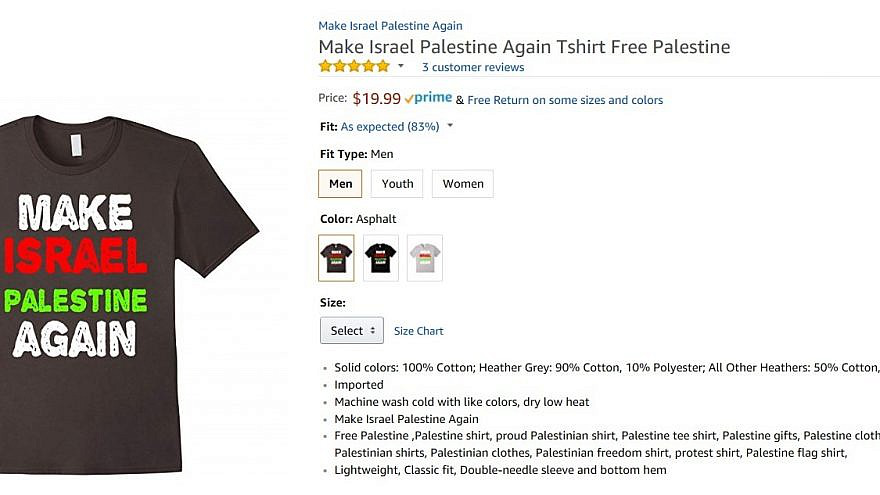
A screenshot of the “Make Israel Palestine Again” T-shirt removed by Amazon.
Amazon president, CEO, and largest shareholder Jeff Bezos, the richest man in the world since 2017 (and according to Forbes, the richest man in history) has yet to speak publicly about Palestine or Israel; he rarely gives public comments on any political issues. But indications of the Amazon founder’s political stances can be seen in the Washington Post. Jeff Bezos purchased the US paper for $250 million USD and has been its sole owner since October 2013.
The Washington Post has published a wide range of articles on Israel and Palestine, and a quick look at their articles and editorials since Bezo’s takeover in October 2013 shows where its editorial staff and leadership stand. It describes the shooting of unarmed Palestinian protesters in Gaza by Israeli snipers as “clashes”, and Netanyahu as a “prudent, even cautious, statesman” who “quietly restrained the building of Jewish settlements”, even though during his last 10 years in office over 20,000 settlement units were built in the Occupied West Bank. One Washington Post article, titled “Palestinians Kill 3 Israelis as Violence Mounts in ‘Day of Rage’”, acknowledges only in the 6th paragraph that “28 Palestinians have been killed by Israelis.” Israelis are routinely described as “killed”, but Palestinians merely “die”. Another article on electricity cuts in Gaza makes sure to inform the readers in the headline that “it’s not all Israel’s fault”. Last year, the Washington Post ran a full page advert calling New Zealand artist Lorde a “bigot” for canceling a concert in Israel.
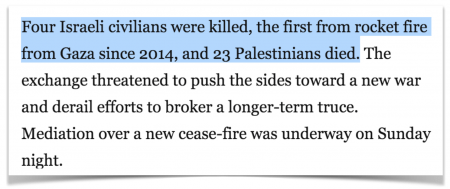
From the Washington Post (of which Amazon founder Jeff Bezos is the sole owner) on May 6, 2019. Israelis are killed, but Palestinians just “die”
Jennifer Rubin, a journalist for the Washington post, once retweeted an article describing Palestinians as “death-worshiping, innocent-butchering, child-sacrificing savages”, “devils spawn”, and “unmanned animals” who should be thrown “into the sea, to float there, food for sharks”. Her writing in the Washington Post declared that endorsements of the one-state solution “amount to calls for genocide”, and called then–Secretary of State John Kerry “intentionally obtuse”–or a liar–for not denouncing the Palestinian right of return. The Washington Post has rejected calls to remove Rubin for promoting racism and Islamophobia.
Given Amazon’s record of involvement with corporations deeply entrenched in the Israeli Occupation of Palestine, there is a high possibility of Amazon Israel failing to comply with international and human rights law in its Israeli operations. Should it fail to respect international law and engage in operations directly normalizing, supporting, and profiting from violations of Palestinian rights, Amazon may face boycott calls similar to those taken by BDS against companies like HSBC, SodaStream, Airbnb, Caterpillar, and Hewlett Packard. It remains to be seen what kind of corporate values Amazon Israel will deliver.
Israel Has Murdered 500 Palestinians Since Trump Declared Jerusalem The Capital Of Israel

By Robert Inlakesh – 21rst Century Wire – October 4, 2019
Since December 2017, when Trump announced his recognition that “Jerusalem is Israel’s eternal capital”, at least 481 Palestinians have been murdered by Israeli forces according to a new report.
The Centre for Jerusalem Studies, based in the old city of Jerusalem, provided documentation showing that of the 481 murders, 102 were children and 18 were women, 6 of those killed have been described having special needs.
Since the start of the Gaza’s Great Return March, on the 30th of March 2018, over 330 Palestinians have been murdered by Israeli forces. No Israelis have been killed or sustained significant injuries, beyond scratches, from the demonstrators. Israel however, still insists that the protests have been non-stop riots which have been going on for nearly a year and a half straight.
Israel is now in the process of figuring out whether Benjamin Netanyahu, currently battling a corruption and bribery scandal, or Benny Gantz, who was summoned to the Hague during his election campaign for involvement in the execution of a family in Gaza, will be their next Prime Minister. But regardless of whom it is, Trump’s alleged ‘Deal of the Century’ seem to be looming on the horizon.
If the Trump administration goes ahead and attempts to implement his plan, which has been alleged to include the possible swallowing of sections of the West Bank by Jordan, as well as the “resettlement” of Gazans to the Egyptian Sinai, the violence will inevitably grow.
Right now, the mainstream Western press is fixated on the Hong Kong protests. They are providing coverage to the anti-China demonstrators in an attempt to lionize groups, many of which have engaged in real violence and vandalism. Yet the demonstrations in Gaza are not only largely ignored, but are perpetually portrayed as violent and the narrative of the Israeli government is sometimes quoted almost word for word.
So a valid question, given the hypocrisy of mainstream media outlets coverage on Hong Kong when paralleled with Gaza, would be, why are they also still pretending to oppose US President Donald Trump? Clearly the agenda behind backing the Hong Kong protests, works hand in hand with President Trump’s plans for China and even more evident is it that channels such as the BBC, CNN, MSNBC etc., clearly are helping Trump get away with allowing the violence against Palestinians to continue.
The reason Palestinians can be executed in such large-scale attacks and massacres, is the fault of the media and international community. This includes the United Nations (UN), International Criminal Court (ICC), Human Rights Organizations and all the self-proclaimed “objective” media outlets. If there is no direct action against Israel for its crimes, we should expect another surge in constantly escalating cycle of violence, perpetuated upon the Palestinian people by the Israelis.
***
Author Robert Inlakesh is a special contributor to 21WIRE and European correspondent for Press TV. He has reported from on the ground in occupied Palestine
Featured Video

Seyed M. Marandi: US-Iran War Inevitable: Kuwait and Bahrain May Fall
or go to
Aletho News Archives – Video-Images
From the Archives
USS Liberty Massacre: A Pivotal Moment in the Hostile Takeover of America
By Kevin Barrett | Crescent | Dhu al-Qa’dah 24, 1445
In corporate America, hostile takeovers are commonplace. They occur when an aggressor—a larger corporation or rich individuals—seizes control of a smaller corporation without asking permission.
What few recognize is that the United States itself has been subjected to a hostile takeover. Since the aggressor, the illegitimate settler colony known as “Israel,” is much smaller than the US, the takeover has necessarily been surreptitious.
As of June, 2024, Israel’s gradual takeover of the US has become obvious and undeniable—a proverbial “elephant in the living room.” … continue
Blog Roll
 Aletho News
- Seyed M. Marandi: US-Iran War Inevitable: Kuwait and Bahrain May Fall
- Leaders Condemn Ansarallah Attack on Saudi Arabia While Ignoring Illegal War Against Yemen
- Leaked: Britain’s Covert Iraqi Psyops Network
- Yemeni Armed Forces Warn Airlines Against Using Saudi Airports, Exempt Mecca and Medina
- Iran security chief says powers greater than US tried to conquer Iran but ended in ‘dustbin of history’
- Europe’s mounting social chaos… chickens coming home to roost for proxy war against Russia
- US-Russia Diesel Deal Becomes Massive Defeat for Ukraine
- Hormuz and the Looming Economic Catastrophe
- Dhubab offensive, media blitz and the rapid unraveling of Saudi-backed coalition’s new gambit
- Putin Conveys to Trump Iran’s Vision on Possible Conflict Resolution – Kremlin
- If Americans Knew
- Gaza: Ceasefire Anniversary Marks Year of Failed Promises
- The American Conservative: Mike Huckabee Should Resign
- A C-Section in Shackles: A Palestinian Woman’s Harrowing Birth in Israeli Detention
- ‘He’s Desperate’: AIPAC Begins Spending Against Abdul El-Sayed to Boost Mike Rogers:
- Trump, Hormuz, and the Looming Economic Catastrophe
- For three years, Israel has killed a child in Gaza every 71 minutes – Daily Update
- Israeli forces kill another child in Gaza – Daily Update
- Gaza ceasefire exists in name only, say more than 100 organizations
- Nearly 2 Million in Gaza Need Urgent Shelter Assistance as Winter Looms: IOM Chief Warns
- Suppressing Palestinian resistance: US charity under fire for AI monitoring of Gaza classrooms
- No Tricks Zone
- Germany’s Green Energy Debacle: High Energy Costs Force Kahla Porzellan to Close After 182 Years!
- New Study: 50 Years Of The Most Aggressive ‘Net Zero’ Policies Can Only Affect The Global Climate By 0.03°C
- US September “Heat” Was No Record…Many Records Set Decades Ago
- Latest European Green Energy Debacle; Portugal’s Largest Flagship Solar Park Insolvent!
- Green Energy Debacle: German Expert Professor Fritz Vahrenholt Warns Of Severe Economic And Social Consequences
- Two More Paleo Reconstructions Affirm Meters-Higher Sea Levels Across Ireland, Brazil 7000-6000 Years Ago
- New Study: Earth And Venus Surface Warmth Largely Explained By Convection And Lapse Rate, Not CO2 Or Radiation
- 2025 Nature Paper Claiming Worsening Global Drought Gets RETRACTED …Heavily Flawed
- New Study: ‘Global Drought Shows No Detectable Recent Acceleration Under Climate Warming’
- Economic Masterminds: German Socialists Suggest Taxing Productivity Gains Stemming From Using AI

