China discovers 225 large, medium-sized crude oil, natural gas fields from 2021 to 2025: Ministry of Natural Resources
Global Times | April 29, 2026
China’s Ministry of Natural Resources said on Wednesday that during the 14th Five-Year Plan (2021-25) period, 225 large and medium-sized crude oil and natural gas fields were discovered, including 13 oil fields with reserves exceeding 100 million tons and 26 gas fields with reserves exceeding 100 billion cubic meters.
The ministry said that, during period, in collaboration with relevant departments, it made oil and gas the top priority of the new round of strategic mineral exploration breakthroughs, with a cumulative investment of nearly 450 billion yuan ($65.81 billion), and vowed to resolutely ensure that China’s energy supply remains firmly within its own control.
The remarks were made at the regular press briefing held by the ministry, which introduces the achievements of China’s new round of strategic mineral exploration breakthroughs, including the oil and gas resources.
The ministry said the newly proven geological reserves of petroleum and hydrocarbon natural gas rose by 51.7 percent and 44.2 percent, respectively, compared to the last year of the 13th Five-Year Plan (2016-20) period.
Newly proven geological reserves of deep coal-bed methane exceeded 1 trillion cubic meters, surpassing the total cumulative proven reserves of shallow coal-bed methane in history.
In 2025, there reported shale oil proven geological reserves scatter across five major basins and eight oil fields, accounting for 38 percent of the year’s new proven crude oil reserves. Unconventional oil and natural gas exploration has become a new engine driving high-growth increases, according to the ministry.
In 2025, China’s crude oil production hit a record high of 216 million tons. Natural gas output exceeded 260 billion cubic meters, rising by over 10 billion cubic meters annually for nine straight years. Shale oil output topped 8.5 million tons, and shale gas remained above 27 billion cubic meters, providing key support for increasing reserves and production.
Total oil and gas production reached 420 million tons of oil equivalent, making a vital contribution to national energy security, the ministry said.
In the deep-sea sector, the ultra-deep-water gas field, Deep Sea No. 1 was successfully brought into production, positioning China among the world’s leaders in deep-water oil and gas exploration and development. Total offshore oil and gas output surpassed 90 million tons of oil equivalent, representing a major substantive breakthrough in the strategic expansion of exploration from shallow to deep strata and from land to sea.
The significance of the oil and gas exploration breakthroughs achieved during the 14th Five-Year Plan period goes beyond mere numerical growth in reserves and production, Niu Li, an official from the ministry, said.
More importantly, “we have extended our exploration reach into deeper and more challenging frontiers, expanding the space for exploration and development, and firmly placing the initiative for energy security in our own hands,” Niu added.
Moving forward, “we will continue to advance oil and gas exploration and development, consolidate the positive trend of stable oil and increased gas,” and resolutely ensure that China’s energy supply remains firmly within its own control, Niu said.
No More Bombs for Iran, Economic War Instead?
By Larry C. Johnson | SONAR21 | April 29, 2026
Trump assembled his national security team in Washington on Monday afternoon to figure out how to respond to Iran’s latest missive delivered via Pakistan — i.e., end the blockade and then we’ll talk about other issues. The Wall Street Journal reports that Trump opted for economic warfare against Iran as it carried less risk, instead of resuming bombing or trying to exit the conflict. That’s the good news. However, President Trump also instructed White House aides to prepare for an extended blockade on Iran.
Before I explain why that is a foolish, unworkable policy that will fail, let’s look at what Secretary of the Treasury Scott Bessent had to say:
“The Treasury Department, through Economic Fury, has targeted Iran’s international shadow banking infrastructure, access to crypto, shadow fleet, weapons procurement networks, funding for terrorist proxies in the region, and independent Chinese “teapot” refineries that support Iran’s oil trade. These actions have disrupted tens of billions of dollars in revenue that would be used to fund terrorism.
Under President Trump’s’ maximum pressure campaign, Tehran’s inflation has doubled and its currency has rapidly depreciated.
Kharg Island, Iran’s primary oil export terminal, is soon nearing storage capacity, which will force the regime to reduce oil production, resulting in an additional approximately $170 million per day in lost revenue, and causing permanent damage to Iran’s oil infrastructure. Treasury will continue to exert maximum pressure and any person, vessel, or entity facilitating illicit flows to Tehran risks exposure to U.S. sanctions.”
Notwithstanding the US blockade, Iran continues to fill oil tankers that are sailing out of the Persian Gulf. Iran has continued loading oil onto tankers even as the US blocks their route out. With no large volumes clearly circumventing the blockade, the loaded crude is largely filling up tankers Iran has available in the region. At least two fully laden Iranian tankers — the Hero II and Hedy — sailed out of the Persian Gulf and past the US blockade on April 20, part of a flotilla that has ferried roughly 9 million barrels of oil to market. Most tankers hauling Iranian barrels routinely sail with their automatic position signals disabled.
Since the start of the conflict, at least 52 “ghost fleet” tankers laden with Iranian oil have left the Persian Gulf, some broadcasting their signals and others operating clandestinely. These tankers are en route to Malaysia to conduct ship-to-ship transfers with other vessels bound for China.
Here is the problem the US faces in trying to impose a blockade: If the US stops an Iranian vessel and takes control of it, then the US Navy must assign one ship to accompany it to a location the US controls. The US does not have enough US Navy ships to carry out such a mission on a broad scale. All Iran needs to do is load up 20 tankers and send them to sea simultaneously. The US may be able to stop two or three, but the rest will penetrate the blockade and arrive at their respective destinations.
What about imports for Iran? According to the Fars News Agency, Pakistan has opened six corridors with Iran to bypass the US blockade. More than 3,000 containers bound for Iran are being transited over land.
Ironically, even though it is Iran that effectively closed the Strait of Hormuz, the US bragging about its blockade of the Strait takes the onus off of Iran as the rest of the world begins to suffer a massive economic contraction from the Strait being closed.
Instead of suffering the wrath of nations deprived of oil and LNG from the Persian Gulf, Iran will buy itself some much needed support as it allows ships heading toward friendly nations to pass through the Strait in numbers that will make it impossible for the US Navy to stop them.
If my friend — Alex at Reporterfy — is correct, the global economy is going to face major headwinds that will be more damaging than the economic crisis of 2008. At that point the US will face major pressure to end the blockade, which is more symbolic than substantive, and renew negotiations with Iran. Iran for its part is not going to beg for relief… Iran has the full backing, including economic support, from Russia and China. Scott Bessent is deluding himself and misleading Trump by insisting that his version of economic warfare will force Iran, Russia and China to bend the knee to Washington. Ain’t going to happen. … videos
Featured Video
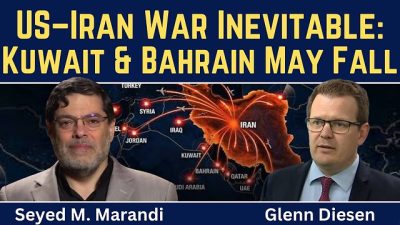
Seyed M. Marandi: US-Iran War Inevitable: Kuwait and Bahrain May Fall
or go to
Aletho News Archives – Video-Images
From the Archives
Oil and the Israel Lobby
Reknowned economist M. Shahid Alam offers this excellent critique of Noam Chomsky’s defective analysis of the relative influence of Oil versus the Israel lobby over US foreign policy: … continue
Blog Roll
 Aletho News
- Israel’s Military Actions in Lebanon Grossly Violate International Law — Lavrov
- Seyed M. Marandi: US-Iran War Inevitable: Kuwait and Bahrain May Fall
- Leaders Condemn Ansarallah Attack on Saudi Arabia While Ignoring Illegal War Against Yemen
- Leaked: Britain’s Covert Iraqi Psyops Network
- Yemeni Armed Forces Warn Airlines Against Using Saudi Airports, Exempt Mecca and Medina
- Iran security chief says powers greater than US tried to conquer Iran but ended in ‘dustbin of history’
- Europe’s mounting social chaos… chickens coming home to roost for proxy war against Russia
- US-Russia Diesel Deal Becomes Massive Defeat for Ukraine
- Hormuz and the Looming Economic Catastrophe
- Dhubab offensive, media blitz and the rapid unraveling of Saudi-backed coalition’s new gambit
- If Americans Knew
- Gaza: Ceasefire Anniversary Marks Year of Failed Promises
- The American Conservative: Mike Huckabee Should Resign
- A C-Section in Shackles: A Palestinian Woman’s Harrowing Birth in Israeli Detention
- ‘He’s Desperate’: AIPAC Begins Spending Against Abdul El-Sayed to Boost Mike Rogers:
- Trump, Hormuz, and the Looming Economic Catastrophe
- For three years, Israel has killed a child in Gaza every 71 minutes – Daily Update
- Israeli forces kill another child in Gaza – Daily Update
- Gaza ceasefire exists in name only, say more than 100 organizations
- Nearly 2 Million in Gaza Need Urgent Shelter Assistance as Winter Looms: IOM Chief Warns
- Suppressing Palestinian resistance: US charity under fire for AI monitoring of Gaza classrooms
- No Tricks Zone
- Germany’s Green Energy Debacle: High Energy Costs Force Kahla Porzellan to Close After 182 Years!
- New Study: 50 Years Of The Most Aggressive ‘Net Zero’ Policies Can Only Affect The Global Climate By 0.03°C
- US September “Heat” Was No Record…Many Records Set Decades Ago
- Latest European Green Energy Debacle; Portugal’s Largest Flagship Solar Park Insolvent!
- Green Energy Debacle: German Expert Professor Fritz Vahrenholt Warns Of Severe Economic And Social Consequences
- Two More Paleo Reconstructions Affirm Meters-Higher Sea Levels Across Ireland, Brazil 7000-6000 Years Ago
- New Study: Earth And Venus Surface Warmth Largely Explained By Convection And Lapse Rate, Not CO2 Or Radiation
- 2025 Nature Paper Claiming Worsening Global Drought Gets RETRACTED …Heavily Flawed
- New Study: ‘Global Drought Shows No Detectable Recent Acceleration Under Climate Warming’
- Economic Masterminds: German Socialists Suggest Taxing Productivity Gains Stemming From Using AI

