Fact-Checking the “Placebo Control” Fact Checkers

By Aaron Siri | Injecting Freedom | April 13, 2026
The fact is, not a single routine injected childhood vaccine on the CDC schedule was licensed based on a placebo-controlled trial, nor was any vaccine used as a control to license any such vaccine.
I was recently sent the following two links which claim that placebo-control groups were used to license routine childhood vaccines:
- Children’s Hospital of Philadelphia – Technically Speaking: 75 Years of Placebo-Controlled Vaccine Testing in the U.S.
- American Academy of Pediatrics – Fact Checked: Childhood Vaccines Are Carefully Studied—Including with Placebos—to Ensure They’re Safe and Effective
If you read these two articles, you will notice they contain no actual evidence and no link to any clinical trial. That is because the reality is that not a single routine injected childhood vaccine on the CDC schedule was licensed based on a placebo-controlled trial. Nor, when another vaccine was used as the control, was that vaccine licensed based on a placebo-controlled trial. And so on and so forth down the chain.
Unlike these two nonsense articles, which claim to be “fact checks,” below are the actual facts with the actual evidence from the FDA showing exactly what the control was when licensing each routine childhood vaccine. (You can also read a more fulsome, fun, narrated version of this list in Chapter 10 of Vaccines, Amen.)
One last thing, as for the definition of what is a “placebo,” per the FDA, in its guidance regarding placebo-controlled trials: “Placebos, defined as inert substances with no pharmacologic activity.” Also see this FDA source: “placebo control … group that receives an inert treatment…” And per the CDC, “A substance or treatment that has no effect on living beings.” With that, here is the list:
- HepB vaccine (Birth 1M 6M)
- Recombivax HB (Merck) licensed for babies based on trials with no placebo control & 5 days of safety monitoring after injection. See Package insert § 6.1.
- Engerix B (GSK) licensed for babies based on trials with no placebo control & 4 days of safety monitoring after injection. See Package insert § 6.1.
- DTaP vaccine (2M 4M 6M 15M 4Y)
- Infanrix (GSK) licensed for babies based on trials with no placebo control (DTP vaccine used as a control) & up to 30 days of safety review after injection. See Package insert § 6.1. (Note that DTP was not licensed in a placebo-controlled trial and increases mortality.)
- Daptacel (Sanofi) licensed for babies based on trials with no placebo control (DT or DTP vaccine used as control) & 2 months of safety review after injection except one trial which was 6 months with no control, 1,454 children, and “[w]ithin 30 days following any dose of DAPTACEL, 3.9% subjects reported at least one serious adverse event.” See Package insert § 6.1. (See note regarding DTP under Infanrix, above.)
- PCV vaccine (2M 4M 6M 12M)
- Prevnar 13, PCV-13 (Wyeth, part of Pfizer) licensed for babies based on trials with no placebo control (Prevnar 7 used as a control, and Prevnar 7 was licensed based on trial in which the control was another experimental vaccine) & 6 months of safety review after injection which found, “Serious adverse events reported following vaccination in infants and toddlers occurred in 8.2% among Prevnar 13 recipients and 7.2% among Prevnar 7 recipients.” See Package insert § 6.1. (Note the package insert for Prevnar 7 states the control in its licensing trial was an “Investigational meningococcal group C conjugate vaccine.”)
- Vaxneuvance PCV-15 (Merck) licensed for babies based on trials with no placebo control (Prevnar 13 used as the control) & up to 6 months of safety review after injection, finding that, “Among children who received VAXNEUVANCE (N=3,349) or Prevnar 13 (N=1,814) … serious adverse events up to 6 months following vaccination with the 4-dose series were reported by 9.6% of VAXNEUVANCE recipients and by 8.9% of Prevnar 13 recipients.” Deemed “safe” because, “[t]here were no notable patterns or numerical imbalances between vaccination groups.” See Package insert § 6.1.
- Prevnar 20, PCV-20 (Pfizer) licensed for babies based on trials with no placebo control (Prevnar 13 was used as the control) & up to 6 months of safety review after injection that again showed high rates of serious events (this time broken up into two categories – “serious adverse events (SAEs)” and “newly diagnosed chronic medical conditions (NDCMCs)”) in both vaccine groups but deemed “safe” because “no notable patterns or imbalances between vaccine groups.” See Package insert § 6.1; Clinical Review.
- Polio vaccine (2M 4M 6M 4Y)
- IPOL (Sanofi) licensed in 1990 for babies based on trials with no placebo control & 3 days of safety review after injection. Sanofi reports that, “Although no causal relationship has been established, deaths have occurred in temporal association after vaccination of infants with IPV.” See Package insert at 14-17. (Note that IPOL is an injected polio vaccine and is the only polio vaccine used in the U.S. for over two decades. It is a very different product than the polio vaccine developed by Salk in the 1950s—and, as noted above, ceased being used in the U.S. in the 1960s—and hence the trials of Salk’s vaccine from the early 1950s were not relied upon to license IPOL.)
- Hib vaccine (2M 4M 6M 12M)
- ActHIB (Sanofi) licensed for babies based on trials with no placebo control (Hepatitis B vaccine used as control) & 30 days of safety review after injection during which 3.4% experienced a serious adverse event but “[n]one was assessed by the investigators [Sanofi] as related to the study of vaccines.” See Package insert § 6.1; Basis of Approval at 8.
- Hiberix (GSK) licensed for babies based on trials with no placebo control (ActHIB used as the control) & 31 days of safety review after injection. See Package insert § 6.1; Clinical review at 20-21.
- Liquid PedvaxHIB (Merck) licensed for babies based on trials with no placebo control (Lyophilized PedvaxHIB used a control) & 3 days of safety review after injection. See Package insert at 6-8. (Note that Lyophilized PedvaxHIB was tested in a trial in which controls were given lactose, aluminum adjuvant, and thimerosal and there is no indication Lyophilized PedvaxHIB was ever licensed.)
- Rotavirus vaccine (2M 4M 6M) (Note that every vaccine on the CDC childhood schedule is given via injection, except for one flu vaccine given by nasal spray and the rotavirus vaccines, which are given by oral drops .)
- Rotarix (GSK) licensed for babies based on trials without a placebo control (the control group received an oral drop that included Dextran, Sorbitol, Amino Acids, Dulbecco’s Modified Eagle Medium, and Xanthan) & 31 days of safety review after oral dose and up to a year in some trials for cases of intussusception. There were more deaths in the group receiving Rotarix than the purported placebo. As disclosed by the FDA and GSK: “During the entire course of 8 clinical studies (Studies 1 to 8), there were 68 (0.19%) deaths following administration of ROTARIX (n = 36,755) and 50 (0.15%) deaths following placebo administration (n = 34,454). The most commonly reported cause of death following vaccination was pneumonia, which was observed in 19 (0.05%) recipients of ROTARIX and 10 (0.03%) placebo recipients (RR: 1.74, 95% CI: 0.76, 4.23).” See Package insert § 6.1 (claims used a placebo); Clinical review at 23-24 (admits the purported “placebo” included all the foregoing ingredients).
- RotaTeq (Merck) licensed for babies based on trials without a placebo control (the control group received an oral drop that included Polysorbate-80, Tissue Culture Medium, Fetal Bovine Serum, and Sodium Phosphate) & 42 days of safety review after each oral dose and up to a year for cases of intussusception. See Package insert § 6.1 (claims used placebo); Clinical reports at 445 etc. (admits the purported “placebo” included all the foregoing ingredients).
- Covid-19 vaccine (6M 8M and then Annually)
- Comirnaty (Pfizer) authorized for emergency use in babies based on trial with a placebo control (finally!) & 6 months of safety review after injection. See Package insert § 6.1. (Note that Pfizer’s EUA was revoked and it is not currently licensed for children under age 5.) Also, while Comirnaty’s trial had a placebo control group, that group was unblinded and most were vaccinated during the 6-month safety review period. The 16- and 17-year-old data is not separated from the adult data, but the 12- to 15-year-old data is separated and included only 1,131 children who received a vaccine, and the case of one participant reflects how this trial was conducted.)
- Spikevax (Moderna) authorized for emergency use in babies based on trial with placebo control. Depending on the age group, the median duration of blinded safety follow-up was 51 to 71 days. Placebo controls were unblinded and mostly vaccinated during the trial. See Package insert at § 6.1; FDA Briefing at 10.
- Flu vaccine (6M 7M and then Annually)
- The formulation for each influenza vaccine changes annually and there is no clinical trial carried out for each new formulation. (In any event, none of the clinical trials for the original formulation of any injected influenza vaccine for children had a placebo control group, see letter pp.13-14, even though some adult trials did, showing it could have been done. See FDA documentation and compare child and adult portions of Section 6.1 of each flu vaccine package insert. The one inhaled influenza vaccine’s original trial had a placebo but, again, its formulation changes every year and is not safety tested in any trial.)
- MMR vaccine (12M 4Y)
- M-M-R-II (Merck) licensed based on a trial with no placebo control & 42 days of safety review after injection in a trial with a total of only 834 children of which a third developed gastrointestinal issues and a third respiratory issues. See Clinical reports. (This patently deficient, underpowered, unblinded, and non-randomized trial is unsurprisingly not even listed in the safety section of M-M-R-II’s package insert. Also note that the original MMR’s clinical trial was similarly deficient and also showed a high and concerning rate of gastrointestinal, respiratory and other issues, as compared to the small untreated control group—see pages 12 and 13. In any event, the original MMR was a different product that did not include millions of pieces of human DNA and cellular debris, as does M-M-R-II, which is likely why it was not used as a control in the trial for M-M-R-II).
- Priorix (GSK) licensed based on trials with no placebo control (M-M-R-II used as the control) & 6 months of safety review after injection in which both vaccine groups had a high rate of serious adverse events, emergency room visits, and new onset of chronic diseases (e.g., autoimmune disorders, asthma, type I diabetes, vasculitis, celiac disease, thrombocytopenia, and allergies). See Package insert § 6.1; Sup materials at 12.
- Varicella (chicken pox) vaccine (12M 4Y)
- Varivax (Merck) licensed based on trials with no placebo control & 70 days of safety review after injection. In the one controlled trial of 956 children, around half received Varivax and half received the “placebo” injection of 45 mg of neomycin per milliliter. There was one trial in which 32 children received Varivax and 29 children received nothing and then received Varivax eight weeks later; during this eight-week period, the Varivax group had double the rate of ear infection and a 50% increase in respiratory infection. As for serious adverse events, Merck did not consider any related to Varivax. See Package insert § 6.1; Merck study at 2; Clinical reports.
- HepA vaccine (12M 18M)
- Havrix (GSK) licensed based on trials with no placebo control (Engerix-B was used as a control) & 31 days of safety review after injection with a phone call follow-up at 6 months. See Package insert § 6.1.
- Vaqta (Merck) licensed based on trials with no placebo control (an injection of AAHS, an aluminum adjuvant, and thimerosal, a form of mercury, were used as a control) & up to 42 days of safety review after injection. See Package insert § 6.1 (using term “placebo”); Merck study at 454 (admits the purported “placebo” included all the foregoing ingredients). (Note that trials for Havrix and Vaqta occurred at roughly the same time and, because there was no licensed Hepatitis A vaccine at that time, there was no excuse for not using a placebo control in these trials. It is also startling that Engerix-B, which had 4 days of safety monitoring in its trial, was used as the control for Havrix, and that an injection of known cyto-and-neuro toxic substances, AAHS and thimerosal, were used as a control for Vaqta instead of just a saline injection.)
- Tdap vaccine (11Y)
- Adacel (Sanofi) licensed based on trials with no placebo control (Td, for adult use, was used as a control) & up to 6 months of safety review after injection. See Package insert § 6.1.
- Boostrix (GSK) licensed based on trials with no placebo control (DECAVAC or Adacel was used as a control) & up to 6 months of safety review after injection. See Package insert § 6.1.
- HPV vaccine (9Y 9 ½Y)
- Gardasil 9 (Merck) was licensed based on trials in which safety was reviewed after injection for 1 month in five of the clinical trials, 6 months in a lot consistency trial, and 4 years in one trial of women aged 16 to 26 years (reflecting that a safety trial of a more appropriate duration is possible). These Gardasil 9 trials were either not controlled or used Gardasil 4 as the control, except for one trial in which 306 participants received a placebo but only after receiving the full series of Gardasil 4 injections. See Clinical review at 17-19. (Note that in Gardasil 4’s clinical trial, controls received an aluminum adjuvant, AAHS, except 320 people labeled “Saline Placebo” that actually received all vaccine ingredients except antigens and AAHS. Also, across all these trials, 2-3% of participants receiving vaccine or aluminum adjuvant—used to induce autoimmunity—had a suspected autoimmune disorder.)
- MenACYW vaccine (11Y 16Y)
- Menactra (Sanofi) licensed based on trials with no placebo control (Menomune used as the control, and amazingly the safety section of the package insert for Menomune lists this same trial in which it is being used as a control) & up to 6 months of safety review after injection. See Package insert § 6.1.
- Menveo (GSK) licensed based on trials with no placebo control (Menactra, Boostrix, or other vaccines used as a control) & up to 6 months of safety review after injection. See Package insert § 6.1.
- MenQuadfi (Sanofi) licensed based on trials with no placebo control (Menveo or other vaccines used as a control) & up to 6 months of safety review after injection. See Package insert § 6.1. (The three Men4 vaccines provide another good example of the vaccine safety pyramid scheme because Menomune was licensed without a placebo-controlled trial and then used as the control to license Menactra; Menactra is then used as the control to license Menveo; and then Menveo is used as the control to license MenQuadfi. The actual safety profile, putting aside the limited 6-month safety period, is unknown since Menomune’s safety baseline was never established in a placebo-controlled trial.)
- NON-ROUTINE VACCINE: MenB vaccine (16Y 16 ½Y + if indicated)
- Bexsero (GSK) licensed based on trials with no placebo control group (either uncontrolled or control group was given an injection of aluminum hydroxide and, in one trial involving 120 adolescents, a saline injection followed by an injection of Menveo and hence FDA labels this an “active control” and not a “placebo control” trial) & 30 days of safety review after injection. See Summary basis at 14-15; Clinical review at 40.
- Trumenba (Pfizer) licensed based on trials with no placebo control group other than 12 people in a dose ranging phase II study (otherwise the controls were injection of Gardasil+placebo, dTaP-IPV+placebo, HepA+placebo, or Menactra+Adacel+placebo) & 30 days of safety review after injection for one of the three trials and up to 11 months in the other two trials. See Summary basis at 4; Clinical review at 9-10.
- NON-ROUTINE VACCINE: PPSV23 vaccine (2Y+ if indicated)
- Pneumovax 23 (Merck) is licensed for children 2 years and older but there is no indication that there was any clinical trial involving anyone younger than 16 years of age that the FDA relied upon to license this vaccine. See FDA documentation.
- NON-ROUTINE VACCINE: Dengue vaccine (6Y+ if previously had dengue and live in area dengue is endemic)
- Dengvaxia (Sanofi) licensed based on a trial with 11,474 children receiving a placebo control (saline injection) & 5 years of safety review after injection. Meaning, the 17th and last vaccine on the CDC’s childhood vaccine schedule, is apparently the first vaccine that underwent a longer-term placebo-controlled trial prior to licensure! This trial stands as the proof that a longer-term placebo-controlled trial of a childhood vaccine is possible! See Statistical review at 10; Package insert at 4. (Note for this vaccine, it was learned that children under 6 years old had an increased risk of severe harm and death from this vaccine—harm that would likely never have been uncovered by the trials performed for any of the other 16 vaccines. It was also found that children older than 6 who had never had dengue and received this vaccine likewise had a seriously increased risk of severe harm and death. Hence, this vaccine is only to be given to older children who have previously had dengue. As disclosed by the FDA and Sanofi: “Those not previously infected are at increased risk for severe dengue disease when vaccinated and subsequently infected with dengue virus.” This vaccine is only recommended for children in endemic dengue areas and dengue is not endemic in the United States.)
An Open Letter To President Donald Trump (My Response) | Candace
Candace Owens – April 10, 2026
My response to Trump’s latest unhinged rant on Truth Social name dropping me.
Arms industry given direct influence over university courses
By Martin WILLIAMS | Declassified UK | April 8, 2026
Arms industry executives have been given direct influence over British university courses, Declassified can reveal.
BAE Systems, Leonardo, Thales and Rolls-Royce are among the firms who have been invited to sit on at least 53 university advisory committees across the country.
They are usually asked to provide “strategic direction” for academic departments – and sometimes also review the progress of research projects.
Using the Freedom of Information Act, Declassified found that at least 21 universities had asked arms companies to sit on their committees. They include the universities of Southampton, Edinburgh, Glasgow, Leicester, Cardiff, York and Queens University Belfast.
Some institutions boast that the setup allows them to “respond to the needs of employers”. The minutes of one committee meeting show that arms executives – along with officials from other companies – were thanked for “ensuring that our programmes fit industry requirements and demand”.
During a meeting at the University of Hull, an official from BAE Systems said they would “welcome applications” from students for “industrial placements”, adding that they would “like to develop the relationship”.
And a committee at the University of Cardiff discussed whether “industry” could “teach material to students,” noting that this would be “an appealing prospect for the School but would also offer good exposure for industry”.
They also agreed to meet with Rolls-Royce to discuss “research challenges”.
‘Disturbing’
The finding comes two years after it was revealed how British universities had taken almost £100m from defence companies – including many that are arming Israel.
In one case, BAE Systems gave almost £50,000 in sponsorship to University College London (UCL) to fund its Centre for Ethics and Law – despite the company being accused of being party to alleged war crimes in Yemen in 2019.
Universities including Oxford, Cambridge and Sheffield were all found to have taken huge sums from arms firms – accepting £17m, £10m, and £42m respectively.
Sam Perlo-Freeman, of the Campaign Against the Arms Trade (CAAT), said: “Declassified’s disturbing findings add to CAAT’s growing concern about deepening ties between UK universities and the military-industrial complex.
“As purveyors of a deeply corrupt and immoral trade that blights human life and the planet like no other, arms company executives should be nowhere near institutions of learning and intellectual freedom.”
He added: “Universities should be treating arms trade representatives as pariahs. Instead, and thanks to Declassified, we now know that they sit on at least 53 different advisory committees across 21 universities.
“We have little doubt that this will have impacted academic freedom and the integrity of higher education research. The question is exactly how. We need answers.”
Responding to our investigation, the co-founder of Demiliterise Education, Jinsella Kennaway, said: “Academic freedom is undermined while arms companies hold such influence over what gets researched, funded, and legitimised on campus”.
“Students deserve pathways into work that make the world safer and more humane, not careers that contribute to mass killing and deepening global insecurity,” they said.
“University leaders have a responsibility to ensure Britain’s knowledge centres contribute to saving lives, rather than allowing education to become a pipeline into the war economy.”
Another Trump Flip Flop: From ‘Kill FISA’ to ‘Clean Renewal’
By Alan Mosley | The Libertarian Institute | April 15, 2026
With its April 20 deadline for congressional renewal looming, Section 702 of the Foreign Intelligence Surveillance Act (FISA) is back in the spotlight. The provision, first adopted in 2008 as a part of the FISA Amendments Act as an update to the original 1978 Act, allows U.S. intelligence agencies to target “non-US persons located outside the United States to acquire foreign intelligence information” as a response to perceived technology gaps exposed in the years after 9/11. It achieves this by compelling American telecom companies to collect intelligence on foreign targets and turning over data to federal officials.
Many aspects of Section 702 are concerning to civil libertarians. The provision includes a “backdoor search” loophole that allows agencies like the Federal Bureau of Investigation to search the database for communications belonging to U.S. citizens without a warrant. On the topic of warrants, individual warrants for each target are not required by Section 702. Instead, the government gets annual approval via the Foreign Intelligence Surveillance Court (FISC) to conduct broad spying operations with little to no oversight, with no requirement that the government proves to the court that a specific target is even suspected of being an agent of a foreign power.
Recently, President Donald Trump asked Republicans to unify to extend the program with no changes in oversight or accountability. Trump posted on Truth Social, “When used properly, FISA is an effective tool to keep Americans safe. For these reasons, I have called for a clean 18-month extension.” The adjective “clean” is not politically neutral: it implies that attempts to reform the program are partisan clutter, and that re-evaluating the practical or constitutional application of such a tool is a waste of time.
But this isn’t the position shared by those who have been wrongly targeted by the intelligence community, including President Trump himself. In May 2020, Trump urged Republicans to vote “NO” on FISA, explicitly tying the law to fears of abuse, including against his own re-election campaign. Four years later, he told lawmakers to “KILL FISA,” claiming it had been “illegally used” against him and that officials had “spied on my campaign.” On Monday, Rep. Lauren Boebert (R-CO) wrote to National Security Agency Director Joshua Rudd to address “deeply troubling abuses of power” by NSA analysts, alleging the agency has used Section 702 to search the private communications of individuals ranging from dating apps to rental agreements. In his latest departure with the administration, Rep. Thomas Massie (R-KY) said, “I vote with GOP 91% of the time, but that’s about to go to 90%. I won’t vote to let feds spy on you without a warrant. FISA 702 allows the government to search for your information in vast databases compiled with targeting foreigners.”
That charge of “vast databases” of Americans’ private data is precisely the overreach that Edward Snowden blew the whistle on in 2013 when he revealed that the NSA was using its authority to collect telephone records in bulk. But the Fourth Amendment’s logic does not dissolve in the presence of large databases. According to the Supreme Court, a search that intrudes on a reasonable expectation of privacy requires a warrant supported by probate cause. In Carpenter v. United States, SCOTUS held that the government’s acquisition of historical cell-site location information was a Fourth Amendment search, emphasizing how modern technology can transform ordinary records into comprehensive tracking. Intelligence gathering at such a sheer scale, while politically attractive to those who crave power, is constitutionally dubious for all the ways it could be used to target individuals, even if the initial data collection is impersonal.
The secrecy and structure of the reviewing court compound the problem. Inspector General Michael E. Horowitz described FISA proceedings as “ex parte,” with only the government appearing, which deprives the process of “adversarial testing.” In ordinary constitutional practice, laws that burden speech, association, and privacy are tested by said adversarial litigation to force factual development, limiting principles, and public reasoning. This leaves the FISC’s decisions and operations shrouded in secrecy. Annual statistics help to explain why civil liberty advocates criticize the FISC as a compliance venue rather than a constitutional barrier. The Administrative Office of the U.S. Courts reports that in 2024 the FISC granted or modified the overwhelming majority of items before it, with no applications denied in full. In 2025, it only denied four applications in full while continuing to grant or modify most of the remainder. While these numbers do not necessarily prove bad faith by the judges involved, they do underscore the institutional asymmetry: a secret court hearing only one party (the state) is predisposed to side with it without due courtesy to the target of the government’s ire.
A surveillance state that cannot be meaningfully challenged in court is not merely powerful, it is structurally insulated. In another SCOTUS ruling, Clapper v. Amnesty International, the court ruled that the plaintiffs, including lawyers, journalists, and human-rights advocates, lacked the standing to challenge FISA Section 702 because they could not prove their alleged injuries. In other words, since potential government surveillance of their activities is done in secret, they can’t be sure that such surveillance took place, even if possible or even likely. The practical result is a legal regime in which the people most likely to become targets of the surveillance state are told, in effect, that they must wait until the government admits to its own wrongdoing, if it ever does. Such doctrine rewards opacity, discourages accountability, and converts constitutional limits into after-the-fact internal policy debates. A free society does not need to prove it is being watched before it can object to the creation of institutions engineered to snoop first and justify later.
Another perspective to judge such unconstitutional surveillance is the imposed cost, even when not aimed at a particular citizen. In Clapper, the plaintiffs described costly precautions taken to protect confidential communications, precautions the Court treated as self-inflicted for standing purposes. Yet those precautions are better understood as the rational price of uncertainty: when citizens cannot know whether their interactions with foreign sources, clients, colleagues, or family are subject to state capture, prudence demands self-censorship, detours, and silence. This burden falls especially hard on professions that depend on confidentiality, such as investigative journalists, advocacy groups, and legal counsel. The effect is fewer inquiries, fewer candid conversations, and fewer whistleblowers that might be identified by an algorithm or an analyst. As a result, the same surveillance state that should be met with a multitude of challenges from civil rights advocates chills its opposition into less resistance.
Americans should oppose Section 702 because it builds a durable exception to the Fourth Amendment. It vests immense surveillance discretion in the executive branch and invites political abuse, as the president knows from personal experience. It conscripts private companies as unwilling deputies to the intelligence community and treats the public like criminals-in-waiting. Predictably, citizens trim speech and associations when they suspect the state can catalog their correspondence. “If you have nothing to hide, you have nothing to fear” has never been an acceptable argument for the curtailment of privacy. A free people should not live by such a gross exception to liberty.
AIPAC ‘slimeball’ Eric Swalwell leaves the stage
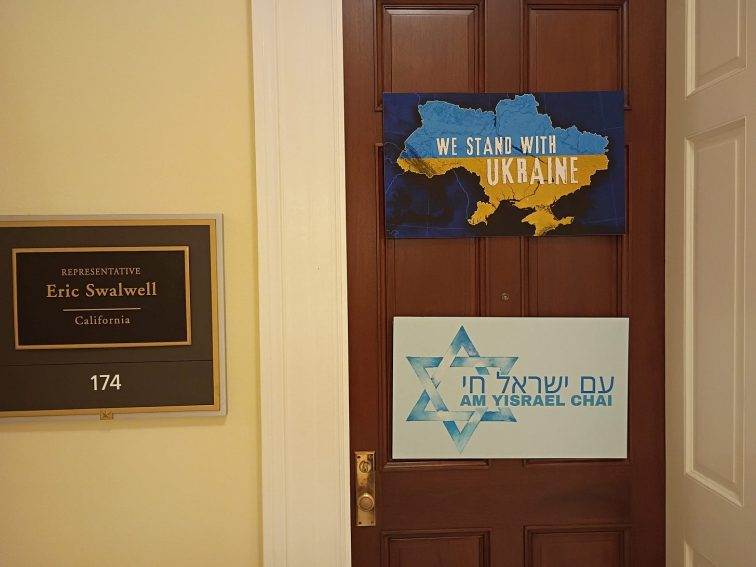
Eric Swalwell’s office door highlights his utility to the forces that propelled his career.
By Max Blumenthal | The Grayzone | April 15, 2026
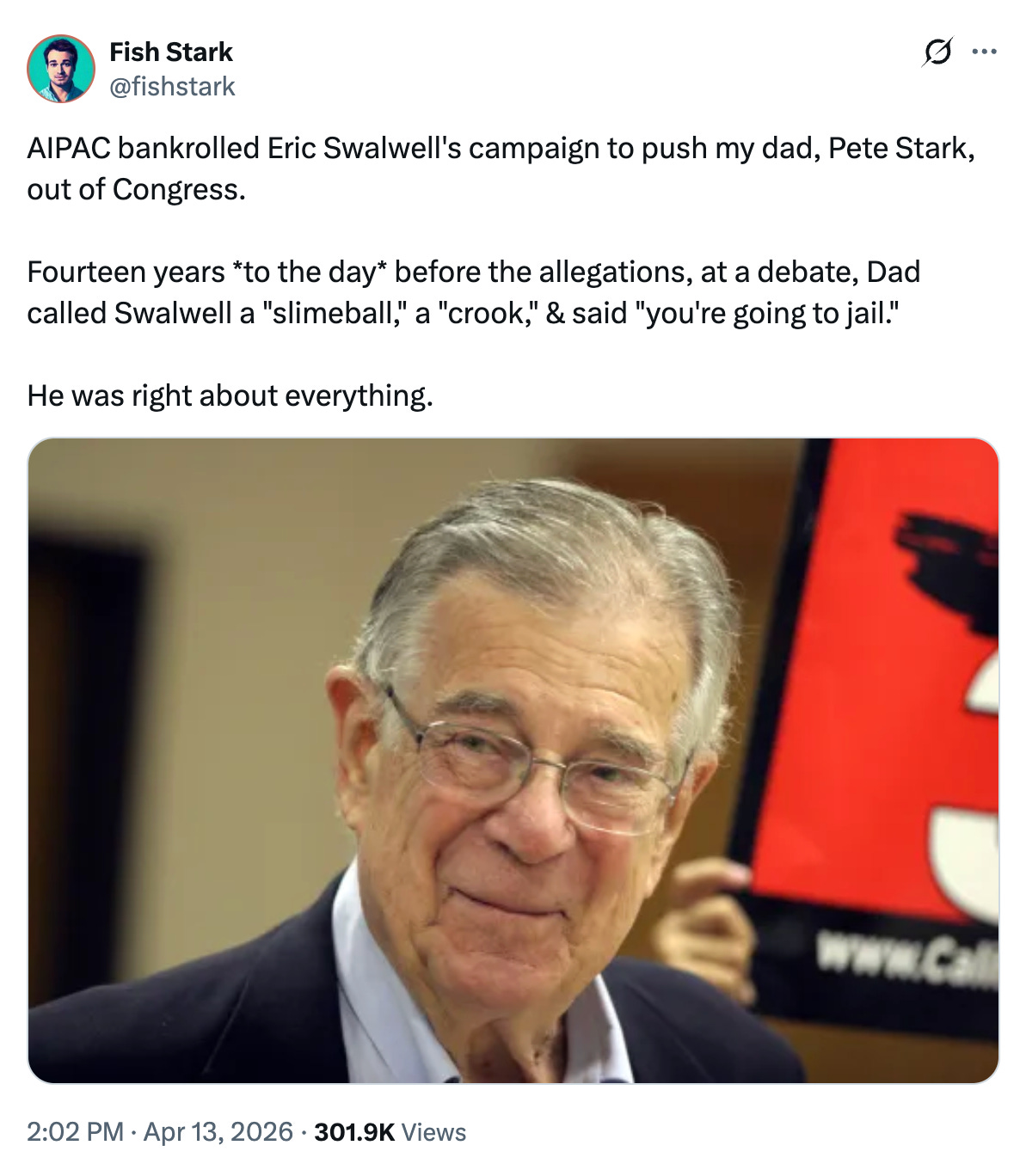
When he staged his first run for Congress in 2012, Eric Swalwell’s seemingly underdog campaign was aggressively propelled by AIPAC, Big Pharma, and corrupt land developers. Their target was Rep. Pete Stark, a legendary reformer and antiwar stalwart who had infuriated the Israel lobby with his consistent opposition to wars on Iraq and Lebanon.
At the end of their only debate, Stark called Swalwell a “slimeball,” a “fucking crook,” accused him of bribery, and predicted, “you’re going to jail.” Mainstream media condemned Stark as a bully in the throes of cognitive decline, while Swalwell became their darling. After the centrist 31-year-old prosecutor eked out a victory, The New Republic hailed him as a “costume-donning, prop-loving thirty something who ousted Pete Stark.” No mention was made of the bathrobe he donned in his now-notorious role as a liquor-sodden lothario.
In Congress, Swalwell provided a reliable rubber stamp for military aid to Israel while distinguishing himself as the most cartoonish promoters of the Russiagate hoax. When he ran for president in 2019 – polling around 0% throughout his campaign – he branded himself the “Guns and Russia” candidate, meaning he would restrict guns for Americans while forking over billions in military aid to Ukraine.
With Swalwell’s demise, Pete Stark may have gotten the last laugh. But in a Democratic Party that is hostile to class politics, overrun by corporate lobbyists and occupied by Israel, Swalwell was a prototype. In his wake, new slimeballs will rise to the surface.
UAE to close its flagship Burj Al Arab hotel for 1.5 years after Iranian strikes
Press TV – April 15, 2026
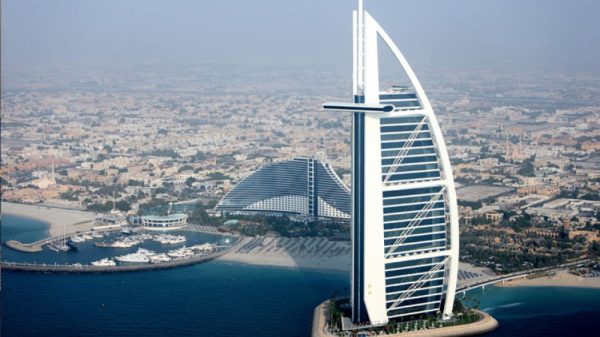
The United Arab Emirates is to close its flagship Burj Al Arab hotel for one and a half years amid a sharp drop in tourist visits to the Persian Gulf country, caused by Iran’s retaliatory attacks against US bases in the region, a report says.
The Wednesday report by Middle East Eye said that Burj Al Arab’s owner company said in a statement a day earlier that it would begin a lengthy refurbishment operation amid a drop-off in tourism activity in the UAE and the wider region as a result of Iranian operations.
The Reuters news agency also quoted a staff member of the hotel as saying that guests with prior bookings will be accommodated in alternative nearby hotels during the closure period.
The famous sail-shaped hotel which is located in the city of Dubai, suffered damage from the unsuccessful interception of an Iranian drone in March, when Iran was carrying out attacks on US bases and interests in regional countries.
The attacks came after the US and Israel launched an aggression on Iran, bombing civilian targets across the country.
Iran swiftly responded by targeting US bases and companies across the region, including in the UAE, a key US ally in the region that allowed its soil to be used for attacks against the Islamic Republic.
Burj Al Arab’s owner company admitted in its statement that Iranian attacks on the UAE and other countries in the Persian Gulf had caused an exodus of foreign expats and tourists from the region.
Reports say that Iranian reprisal attacks have caused stock markets in Dubai and Abu Dhabi to lose more than $120 billion since the start of the US-Israeli aggression on Iran in late February.
The UAE has also been forced to cancel some 18,400 flights over the period.
Iran carried out nearly 1,500 attacks on targets in the UAE, reports suggest, making the country the second most notable target of such attacks after the Israeli regime over March and early April.
US-Israeli Mideast war damage to energy infrastructure may cost $58bln
Al Mayadeen | April 15, 2026
The cost of repairing energy-linked infrastructure damaged during the recent US-led escalation in the Middle East could reach as high as $58 billion, underscoring the scale of destruction inflicted across the region, Rystad Energy reported.
Rystad Energy estimates that oil and gas facilities alone could account for up to $50 billion of that total, reflecting extensive damage to some of the region’s most critical assets. The figure marks a sharp increase from $25 billion just weeks earlier, with the firm noting that “the scope of damage has expanded materially” as strikes intensified before a temporary ceasefire was reached between Washington and Tehran.
The bulk of the damage is concentrated in oil and gas infrastructure, the backbone of regional economies, with repair costs in this sector alone reaching up to $50 billion. Rystad noted that downstream refining and petrochemical assets account for the largest share of losses due to their technical complexity and the extent to which they were targeted in later stages of the war. However, the impact has extended further, affecting essential civilian and industrial facilities, including desalination plants, steel factories, and aluminum production sites, adding another $3 billion to $8 billion in losses.
Global fallout
Rystad stressed that the consequences extend far beyond the region, warning that rebuilding damaged infrastructure does not generate new energy capacity but instead diverts global resources, leading to project delays and inflationary pressure worldwide. The firm described the situation as “a stress test for the global energy supply chain,” noting that the same contractors, equipment, and engineering capacity required for repairs are already committed to major LNG and offshore projects launched in recent years.
This overlap is expected to slow the execution of new energy developments, as operators prioritize restoring existing production over advancing expansion projects.
As a result, recovery is increasingly shaped not by capital availability but by competition for access to constrained supply chains, logistics, and specialized labor.
‘Normalization Talks’: Lebanon No Longer Has A Government
By Robert Inlakesh | Palestine Chronicle | April 15, 2026
The Lebanese state no longer has even the semblance of sovereignty, stooping lower than any previous administration. Immediately after Israel committed one of the most violent civilian massacres in Beirut’s history, the government’s top officials begged to normalize ties with the killers and implement a plan that could drag their country to civil war.
Former Lebanese President, Bachir Gemayel, once sought to achieve a silent agreement with Israel, while many speculated that a full normalization agreement was his end goal. In the end, he only lasted 21 days in office before a fellow Maronite Christian assassinated him with a remotely detonated bomb.
Despite Gemayel clearly maintaining close ties to the Israelis and having been a leader of the fascist Kataeb militia, upon taking office, he adopted a “no vassal” policy to at least make it appear as if he wasn’t working on behalf of Tel Aviv. Conscious of the fact that in 1982 the Israelis were launching a war of aggression against Lebanon and were on their way to slaughtering 20,000 people, he understood the need to try and present the image of independence, not that of a traitor as many were accusing him of being.
Fast forward to 2026, the Lebanese Prime Minister Nawaf Salam and President Joseph Aoun are openly begging for direct government meetings with Israel. At a time when Israel has murdered over 2,100 people in Lebanon – targeting journalists, hospitals, emergency workers, and countless other civilian targets – the government is entering normalization talks.
While protesters quickly took to the streets, in opposition to the scheduled talks, labeling the government as traitors and stressing the need to reject normalization, the administration attempted to mislead the people into believing that a ceasefire was set to be discussed. Then came a bombshell article from Axios News, followed by a series of statements from Israeli officials, confirming the suspicions of the Lebanese population.
Israel has explicitly stated that it will not even discuss a ceasefire, but is entering into talks to reach a “peace deal”, while Axios reported that, during a phone call last Friday, the Lebanese government requested “that the Israelis go back to the understandings of the Nov. 2024 ceasefire and conduct strikes only against imminent threats from Hezbollah.”
This means that the Lebanese government has desperately pleaded for direct talks, without even setting a demand that Israel stop bombing their country first or even sit down to discuss that possibility. The maximum request was that Tel Aviv agree to return to the “ceasefire” predicament prior to the current war, where it committed 15,400 violations and concentrated most of its firepower on the south.
Prime Minister Nawaf Salam even summoned the commander of the Lebanese Army, Rudolphe Heikal, during the war, because he was not willing to stand against Hezbollah and implement the US-Israeli demand to disarm the one group protecting the country.
President Aoun gave a speech earlier this month, in which he told the people that he was waiting for Israeli approval so that the State would be able to repair a water pipe in the south of the country, almost as if he was willingly participating in a humiliation ritual.
Last Friday, scenes were filmed as protesters in Beirut stood across from disarmed members of the Lebanese Armed Forces, who were deployed with riot shields to the area. A man screamed at the soldiers, urging them to join the resistance in the south and asking them how they could continue to serve an army that doesn’t even pay their salaries. One of the soldiers even broke down in tears, sobbing uncontrollably as the demonstrator spoke.
Israel has killed dozens of Lebanese security force members and army personnel, yet the government in Beirut refuses to allow them to fire a single bullet back. Instead, they flee any area Israel orders them to, as if they are receiving their commands from Tel Aviv and not their own Capital city.
Meanwhile, the Lebanese Hezbollah fighters are waging fierce ground battles to defend the country from invading Israeli soldiers, who are attempting to place south Lebanon under an illegal occupation, returning the situation to the pre-2000 predicament.
Israel Katz, Tel Aviv’s defense minister, openly asserts that the displaced civilians from southern Lebanon will not be allowed to return and that the land will be seized by the Israeli military. Meanwhile, the Israeli government demands that Lebanon order the violent disarmament of Hezbollah, a move that would lead to certain civil war.
Not even a week after Israel launched over 100 attacks in only 10 minutes, killing around 300 people and demolishing entire high-rise buildings in the Lebanese Capital, Nawaf Salam and Joseph Aoun are seeking normalization. A move that breaks from the Lebanese government’s long-held position of requiring a Palestinian State prior to engaging in such negotiations.
Although the Lebanese government has a long history of abandoning the people of south Lebanon, pretending as if a whole segment of their country doesn’t even belong to them, this is perhaps the most shameful chapter yet.
Neither the President nor the Prime Minister was actually directly elected by the Lebanese people. Instead, they seized their positions with US backing, riding on the political predicament that Israel’s war against the country in 2024 had created to obtain power. Now they take a position that not only breaks from the Arab Peace Initiative, but they also seek to talk “peace” with an Israeli government that won’t even consider pausing dropping bombs on their country.
All of this begs the question: What legitimacy does such an administration have with its people? And if little to none, then how is it even considered a Lebanese government? The behavior of its officials appears more in line with that of the Lahad Army than of a Lebanese national administration.
– Robert Inlakesh is a journalist, writer, and documentary filmmaker. He focuses on the Middle East, specializing in Palestine.
US Navy Confirms ‘mishap’ to $250 million spy drone downed by Iran
Press TV – April 15, 2026
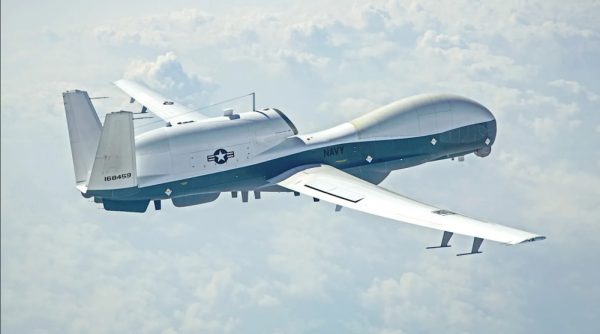
The US Navy has confirmed that an MQ-4C Triton unmanned surveillance aircraft crashed in the Persian Gulf region on April 9, with the incident now described as a mishap, although little was revealed regarding the circumstance under which it was lost.
After the aircraft had vanished unexpectedly from online flight tracking sites while flying over the Persian Gulf, multiple sources reported that it had been shot down by Iranian air defenses.
The MQ-4C is a significantly rarer and higher value aircraft than the F-15E strike fighter, MQ-9 drone, and other aircraft that have been shot down by Iranian forces, with only the US Air Force E-3 Sentry AWACS destroyed on the ground in Saudi Arabia being more valuable.
Where the E-3 is an ageing aircraft that was scheduled for retirement within the next 15 years, the MQ-4C is a cutting edge platform that is still being produced for the Navy.
Each MQ-4C is estimated to have a value of $235-250 million, with its extreme cost meaning only 20 have been brought into service.
The destruction of one of the aircraft by Iranian air defenses would not be wholly unprecedented, with the closely related RQ-4A Global Hawk developed for the US Air Force having been shot down by the Islamic Revolution Guards Corps on June 20, 2019.
Iran’s ambassador to the United Nations Majid Takht Ravanchi reported at the time that the aircraft “conducted an overflight through the Strait of Hormuz to Chabahar port in a full stealth mode as it had turned off its identification equipment and engaged in a clear spying operation.. When the [US] aircraft was returning towards the western parts of the region near the Strait of Hormuz, despite repeated radio warnings, it entered into the Iranian airspace.”
Iranian forces have more recently from late February shot down an estimated 17 MQ-9 drones, and multiple drones of other types such as the Israeli Heron.
The Triton is a derivative of the MQ-4 Global Hawk, and is specialized in maritime surveillance. The aircraft have ranges of over 13,000 kilometers, which are necessary for persistent wide-area surveillance, and have reinforced airframes for harsh ocean weather allowing them to stay on station over oceans in all conditions.
Each integrates the AN/ZPY-3 Multi-Function Active Sensor radar, which was designed for 360° maritime surveillance and can track ships over vast areas. They also integrate electro-optical / infrared sensors, as well as electronic support measures for signals detection.
Real-time data links via satellite communications allow them to serve as nodes in wider surveillance networks, sharing data with naval, air and ground assets. The aircraft are particularly heavily relied on in the Pacific theatre, although their survivability has repeatedly been questioned.
Before its sudden disappearance from flight tracking systems, the Iranian-downed MQ-4C Triton reportedly exhibited a dramatic loss of altitude, plunging from its typical cruising height of around 50,000 feet to below 10,000 feet.
At the time, the drone appeared to be returning to its base at Naval Air Station Sigonella in Italy after completing a surveillance mission in the Persian Gulf and the Strait of Hormuz, the US Navy said.
At the time of its descent, the drone’s transponder was broadcasting a distress signal, commonly known as “squawking.” Initially, it transmitted the code 7400, indicating a loss of communication with ground controllers, and later switched to the emergency code 7700.
While the latter is a general declaration of an in-flight emergency, it does not divulge the specifics of the situation.
In 2019, Iran successfully shot down a Navy RQ-4 Broad Area Maritime Surveillance-Demonstrator (BAMS-D) drone over the Sea of Oman and showcased the remains of the uncrewed aircraft.
Another MQ-4C was detected conducting a routine mission over the Persian Gulf on Wednesday.
Last week, defense publication TWZ noted that Tritons are likely to be crucial for monitoring the Persian Gulf and the Strait of Hormuz, especially during the fragile ceasefire between the United States and Iran.
Students, professors martyred in US-Israeli war of terror targeting universities and research institutes
Press TV – April 15, 2026
Iran’s Minister of Science, Research, and Technology Hossein Simaei has confirmed that over 60 university students and 10 professors have been martyred in the recent US-Israeli aggression.
During a visit to the Aerospace Research Institute of Iran (IARI) on Wednesday, Simaei expressed hope that the academic community would continue the work of those lost in the attacks.
“The students and professors martyred during the illegal aggression have been identified,” Simaei said. “We hope that other members of Iran’s academia continue the work of the martyred students and professors.”
Simaei described the strikes as part of a broader campaign of “scientific crimes” by the US and the Israeli regime. He said the IARI, a facility focused on non-military research in fields such as biology, agriculture, and surveying, was specifically targeted twice despite its peaceful academic objectives.
“This is another of the scientific crimes committed by the sinister US-Israeli alliance. This is a place where researchers in civilian fields like biology, agriculture, and surveying worked, and unfortunately, it has fallen victim to the barbaric attacks of the enemy,” Simaei stated.
Simaei reflected on the loss of Dr. Saeed Shamghadri, an associate professor at Iran University of Science and Technology, who was martyred in the attack alongside his two children.
He described this loss as particularly tragic, underlining the personal cost of the aggression beyond the destruction of academic institutions.
In his remarks, Simaei provided details about the broader damage to Iran’s educational and scientific infrastructure.
More than 20 state universities, as well as several research institutes, have been directly targeted by the attacks, resulting in both significant physical destruction and the loss of critical human resources.
Meanwhile, Dr. Bijan Ranjbar, the president of the Islamic Azad University, confirmed that 110 students from his institution have been martyred, and 21 university branches of his institution have sustained damage.
In addition, four faculty members and two employees, as well as two students from the SAMA schools, were martyred.
On April 6, Sharif University of Technology, one of Iran’s most prestigious engineering universities known as the MIT of Iran, was struck. The High-Performance Computing (HPC) Center, which supports over 3,000 researchers in fields such as artificial intelligence (AI) and computer science, was severely damaged.
The attack, which Simaei described as part of a broader strategy to cripple Iran’s scientific and technological progress, was not limited to the HPC center. Several laboratories and educational buildings were also hit, alongside a nearby mosque and other academic facilities.
The Sharif University attack followed a pattern of similar assaults on prominent Iranian institutions, including the Laser and Plasma Research Institute at Shahid Beheshti University, the Pasteur Institute, and a satellite development laboratory at Science and Technology University.
The attacks, according to Iranian officials, were deliberate efforts to target strategic research and technological infrastructure.
“The world is governed by international, legal, and ethical order, but we are facing an enemy that adheres to none of these principles,” Simaei said.
The minister highlighted that Iran is meticulously documenting all damage inflicted on its academic and research institutions, preparing to take legal action in international courts.
“We are documenting all the damages based on internationally accepted standards,” Simaei noted.
“Because claiming damages and filing legal suits have their own specific standards, we are conducting precise evaluations according to these criteria. The extent of the damages will be announced in the future.”
Simaei also commented on the plight of Iranian students who have been expelled from universities in the US amid the war.
“Given that the United States, contrary to legal and ethical principles, has expelled some Iranian students who were legally studying there, we announce that all these expelled students and professors can continue their studies at equivalent universities in Iran,” he said.
“We welcome them with open arms, and there is no need for them to be concerned.”
We Are the Barbarians
The president’s threat to annihilate Iranian civilization took America to a dark place
By Harrison Berger | The American Conservative | April 10, 2026
On Tuesday morning, President Donald Trump took to Truth Social to declare that “a civilization will die tonight.” By 8 p.m., the U.S. announced a two-week ceasefire with Iran had begun. Whether the ceasefire holds (or even takes hold) is already in question—Iran and the U.S. appear to be offering contradictory accounts of what the 10-point plan they allegedly agreed to actually says. The best hope that it might stick comes from Israel, where TV presenters who spent Monday salivating over a clock counting down the minutes and hours until Trump’s planned genocide of Iranians were left confused and outraged when the president backed down shortly before the deadline.
But whether or not Trump ultimately goes as far as the Israelis would like him to, Americans must now reckon with the destruction already carried out in our name, the civilization-destroying actions Trump has threatened, and the barbarians we have become in the process.
As Tucker Carlson, the most prominent critic of the war with Iran, pointed out in his viral monologue Monday, there was very little that was American or Western about Trump’s threat to destroy an entire civilization. That is not to say the U.S. government hasn’t committed serious crimes before, including wars of aggression. As a study published in The Lancet, a scientific journal, found, U.S. and European sanctions have killed 38 million people since 1971. But those shameful actions were at least concealed behind a pretext, not declared outright as the objective itself. Though it may seem like a distinction without a difference, Carlson convincingly argues it matters significantly. By abandoning even the aspiration of higher laws, we have embraced the “law of the jungle,” which is “a brutal and unforgiving law” that will not stop at Iran’s borders. “We know from history that the things you do will be done unto you,” Carlson said. “Once you set a standard, you will have to live by that standard.”
Indeed, Trump’s threat to destroy Iranian civilization was not an expression of American values but the purest expression, and logical endpoint, of an ideology the United States has attached itself to under both Joe Biden and now Trump: Zionism and the Greater Israel project, first through U.S. support for Israel’s genocide in Gaza and ethnic cleansing of the West Bank, and most recently through the joint war of aggression against Iran.
And while the American taxpayers forced to fund those wars are told they are fought on our behalf to save “civilization,” it is now impossible to think of any force in recent history more destructive and threatening to civilization than the Greater Israel project—which wages an ISIS-style campaign to destroy every artifact, center of knowledge, and source of beauty in the region, and does so with American weapons, American servicemembers, and American money.
The record of what has already been destroyed provides evidence that the U.S. and Israel wish to do exactly to Iran what ISIS and its various backers did to Syria. According to Iran’s minister of cultural heritage, U.S. and Israeli strikes have damaged more than 131 historical sites across the country including museums, palaces, and UNESCO-listed landmarks, with the heaviest losses in Tehran. Among the centuries-old structures destroyed by U.S.–Israeli bombs is Iran’s Golestan Palace, a UNESCO World Heritage site; the Chehel Sotoun pavilion in Isfahan, a 17th-century monument from the Safavid period; the Sheikh Lotfollah Mosque, one of the architectural jewels of the Islamic world; and the Fin Garden in Kashan, one of Iran’s oldest surviving gardens which dates to the late 16th century. Dozens of universities and research centers have been struck, including the Iran University of Science and Technology, Isfahan University of Technology, and Sharif University of Technology, “Iran’s MIT,” whose computer science center was reduced to rubble. A Tehran synagogue was also struck on Passover.
Our descent into barbarism has long been in the making, and the fingerprints all over that transformation are recognizably Israeli. One of the earliest signs of our transition came when the “War Department” began posting drone strike footage, often as memes, on social media. Where the government once prosecuted WikiLeaks and scrambled to conceal its war footage out of embarrassment, Defense Secretary Pete Hegseth’s Pentagon now shamelessly publishes such imagery on its own initiative, a direct import from Israel, which pioneered the model of broadcasting its own war crimes during the assault on Gaza. More recently, Israel-firsters like Laura Loomer and Mark Levin were the loudest voices pushing Trump toward escalation and cheering him on as he threatened civilizational annihilation. Loomer, whom Trump reportedly solicits for advice, called on him to channel Curtis LeMay, the general whose fanatical bloodlust inspired Dr. Strangelove and who came within a hair of igniting nuclear war. Levin, for his part, arguably insinuated on his Fox News television show that dropping a nuclear bomb on Iran would be justified.
Whether or not the ceasefire holds, Americans will have to reckon with what has already been done in our name, and with the fact that the Israel-firsters who cheered every escalation have not been removed from their positions of influence. They remain right in the president’s ear, defining not just his second term but the international symbol of destruction and barbarism we are in the process of becoming.
The Iranian knot needs to be untangled, not cut – Lavrov
Israel’s erroneous belief that it can destroy Iran should not be supported by the US, the Russian foreign minister has said
RT | April 15, 2026
There is no quick fix to the crisis surrounding Iran, Russian Foreign Minister Sergey Lavrov has said. The US must recognize its underlying causes, including Israel’s goal of destroying the country, he added.
Speaking to reporters during a visit to China on Wednesday, Lavrov described the situation as “a crisis knot that will be extremely difficult to untangle.” He explained that “some parties are trying to cut it now – I don’t believe that would produce a [favorable] result.”
According to Lavrov, the current crisis stems directly from the US-Israeli attack on Iran in late February. The resulting disruption to global markets and the Iranian damage to Arab states hosting US military facilities were foreseeable consequences, he stressed.
“Israel appears totally convinced that Iran must be destroyed. I cannot understand how such a belief is possible,” Lavrov said, adding that remarks by US President Donald Trump about wiping out Iran’s civilization had sparked strong international backlash.
In addition to backing Israeli ideological motives, Washington is also pursuing dominance over global energy markets, as confirmed by Trump’s own messaging, Lavrov stated.
US and Israel hurting the Middle East
Commenting on recent US-Iran peace talks in Pakistan, Lavrov expressed hope that Washington would be “realistic, take the region’s interests into account and suspend its unprovoked aggression.”
He expressed solidarity with Gulf nations damaged in the conflict, but stressed that “those who started the war also have intentions not to allow normalization between the Arabs and Iran.”
Lavrov pointed to China’s quiet role in facilitating the 2023 agreement between Saudi Arabia and Tehran, which restored diplomatic ties after seven years and led to the reopening of embassies between the regional rivals.
Iran’s nuclear rights must be respected
Lavrov dismissed claims by the US and Israel that Iran is pursuing nuclear weapons, citing reports from international inspectors that found no evidence of such activities.
Concerns over Iran’s nuclear program were addressed under the 2019 multilateral agreement known as the JCPOA, Lavrov said, adding that “the United States destroying this initiative as Israel always wanted is a sad fact of modern history.”
He also criticized the European Union for acceding to Trump’s withdrawal from the agreement and playing “the most malicious role” in pushing snapback UN sanctions targeting Iran.
Russia, he said, remains ready to assist in finding a solution, provided that Iran’s right to develop a peaceful nuclear program is upheld.
Featured Video
Racist Seinfeld Dances for Joy as Bibi Unveils His New Map
or go to
Aletho News Archives – Video-Images
TV Drama Review
Japanese drama projects Japan’s wartime atrocities onto Chinese characters

Global Times | October 25, 2026
By portraying Chinese characters as perpetrators of ruthless violence while casting Japanese Self-Defense Forces (SDF) intelligence operatives as defenders, the season 2 of the Japanese drama Vivant has recently drawn criticism from Chinese netizens, who argue that its depiction turns historical reality on its head while ignoring Japan’s wartime atrocities.
The TBS drama series – a spy suspense story in which an alleged unofficial intelligence unit of the SDF operates across the globe — has attracted a passionate fanbase. Its currently airing season 2 opened with a household rating of 18.8 percent, the highest for a TV drama this year, according toa commentary article by Japanese media Toyo Keizai.
What draws attention is the portrayal of the enemies in the series, the article noted. Scenes in which the Chinese organization subjects kidnapped members of the SDF unit to brutal torture are repeated with unrelenting intensity.
It is rare for Japanese TV dramas to explicitly portray a real-life country as the enemy, the article noted.
Japanese Prime Minister Sanae Takaichi also made a reference to the drama, saying that she has been recording Vivant and hopes to binge-watch it over the year-end and New Year holidays, according to Japanese media outlets.
China’s CCTV News report on Sunday revealed that the drama features scenes in which Chinese personnel cut off the fingers of and stab Japanese intelligence operatives in the abdomen. Such acts bear striking similarities to the torture inflicted on Chinese nationals by invading Japanese troops during the World War II.
The drama distorts the truth by attributing these atrocities to modern Chinese characters. Beneath the surface, it subtly glorifies Japan’s cross-border overseas operations, blurs the functional boundaries of the SDF and implicitly promotes an expansionist narrative, per CCTV News. … continue
Blog Roll
 Aletho News
- Up in arms… Koreans reject U.S. empire’s plan to make South Korea the next Ukraine
- Iran, Turkey, Pakistan, Saudi Arabia could advance region-led security framework in Tehran: FM spox
- Netizens condemn Japanese drama for projecting Japan’s wartime atrocities onto Chinese characters
- Racist Seinfeld Dances for Joy as Bibi Unveils His New Map
- A West Bank War for Netanyahu’s Election Campaign, Could It Backfire?
- Yemen denounces European Parliament’s ‘hypocritical’ push to blacklist Ansarullah
- Qalibaf: UAE’s UN bid aims to ‘clear the runway’ for ‘Greater Israel’, whitewash genocide
- Pakistan reopens Iran border after boosting security: Report
- Why are so many Brazilians voting for Flávio Bolsonaro?
- Democrats Put Anti-Russia Agenda Ahead of American Workers
- If Americans Knew
- An error has occurred; the feed is probably down. Try again later.
- No Tricks Zone
- Sudden Stratospheric Warming, Powerful El Niño Combination May Lead To Extreme Europe Cold, Energy Crisis!
- Two New Studies Find Thwaites Glacier Melt Cannot Be Driven By Human Activity Or A Warming Ocean
- E-Cars Reduce CO2 Emissions By Only 41% Compared To Internal Combustion Engine Vehicles
- Predictions Made By Renowned Climate Professor Over Past Decades Have Been Proven To Be Poor
- New Study Suggests Large Regions Of The Pacific Ocean Have Been Cooling For The Last 80 Years
- Germany’s Green Energy Debacle: High Energy Costs Force Kahla Porzellan to Close After 182 Years!
- New Study: 50 Years Of The Most Aggressive ‘Net Zero’ Policies Can Only Affect The Global Climate By 0.03°C
- US September “Heat” Was No Record…Many Records Set Decades Ago
- Latest European Green Energy Debacle; Portugal’s Largest Flagship Solar Park Insolvent!
- Green Energy Debacle: German Expert Professor Fritz Vahrenholt Warns Of Severe Economic And Social Consequences

