Villains of Judea: Charles Bronfman
A deep dive into how Charles Bronfman and his family shaped a century of shadow politics
José Niño Unfiltered | April 14, 2026
The Jeffrey Epstein files continue to spill their secrets. With each new document release, each newly unsealed court record, the spotlight inches closer to a network of Jewish billionaires who operated in the shadows long before the convicted sex trafficker became a household name. The names in Epstein’s black book read like a roster of Jewish power. But behind those individual names lies something even more intriguing, a structure, an architecture of influence that Epstein exploited with devastating effectiveness.
At the center of that architecture stands a mysterious organization that most Americans have never heard of. It was founded in 1991 by two men, one of whom would become Epstein’s most consequential patron, granting him sweeping power of attorney over his billion-dollar fortune. The other was a Canadian-American billionaire whose family name once adorned the world’s largest liquor company and whose philanthropic fingerprints can be found on nearly every major Jewish institution in North America.
His name is Charles Bronfman.
The Bronfman Empire
Charles Rosner Bronfman was born on June 27, 1931, into a Jewish family in Montreal, the youngest of four children born to Samuel Bronfman, the founder of Distillers Corporation Limited and later the Seagram Company. The Bronfman family’s origins trace to Bessarabia in the Russian Empire, from which they fled from ethnic tensions in 1889 to settle in the Canadian prairies.
Samuel Bronfman, known simply as “Mr. Sam,” built the Seagram empire partly through the shrewd exploitation of American Prohibition-era demand for Canadian whiskey. A 1927 Canadian inquiry found the family had gone years without paying income taxes. A brother-in-law was murdered at a family liquor warehouse in 1922. In 1934, Samuel and his brothers were charged with evading duties on over $5 million, though the case collapsed when investigators could not obtain the family’s account books. From these controversial origins, the family built what would become the world’s largest distilling firm.
Charles grew up as the self-described quiet one. In his 2017 memoir Distilled: A Memoir of Family, Seagram, Baseball, and Philanthropy, he described himself as less dominated by ego than his brother Edgar. He was educated at elite anglophone institutions before attending McGill University. His family kept a kosher home and provided the children with Jewish religious schooling. He began his philanthropic activity at the age of 17.
In 1951, his father gave him a 33% ownership stake in Cemp Investments, a holding company for him and his three siblings that controlled the family’s corporate empire. After Samuel Bronfman’s death in 1971, Charles and Edgar inherited and co-chaired the Seagram Company Ltd., which at its peak was one of the largest spirits companies in the world.
The family’s fortunes were severely damaged in the late 1990s when Edgar Bronfman Jr., Charles’s nephew, led a disastrous pivot into entertainment, culminating in the 2000 sale of Seagram to the French media conglomerate Vivendi. Charles had strongly opposed this move, calling it “a disaster, it is a disaster, it will be a disaster” and “a family tragedy.” The family’s paper losses on the deal exceeded $3 billion as Vivendi’s stock plummeted.
The Founding of the Mega Group
In 1991, Charles Bronfman and Leslie Wexner, founder of The Limited and Victoria’s Secret, co-founded what they called the “Study Group.” The innocuous name concealed something far more significant. This was an invitation-only club of approximately 20 of the wealthiest and most influential Jewish businesspeople in America, a number that would eventually swell to nearly 50 by 2001.
The group became publicly known as the Mega Group after a Wall Street Journal investigative report in May 1998, headlined “Titans of Industry Join Forces To Work for Jewish Philanthropy,” pulled back the curtain on its existence. Annual dues reportedly ran approximately $30,000. Members met twice a year for two-day seminars on philanthropy and Jewish identity. But the guest list alone suggested this was no ordinary study circle.
Members included Les Wexner, Charles Bronfman, Edgar Bronfman Sr., Max Fisher, Michael Steinhardt, Leonard Abramson, Harvey Meyerhoff, Laurence Tisch, Charles Schusterman, Lester Crown, Ronald Lauder, Marvin Lender, and Hollywood director Steven Spielberg. These were men who controlled billions in personal wealth and sat on the boards of the most powerful Jewish organizations in America.
Bronfman’s 1998 Wall Street Journal comment, “From the beginning, we didn’t want to be seen as a threat to anybody… We don’t want to be seen as the Sanhedrin,” functioned as a classic tactical admission. By explicitly citing the ancient Jewish governing body as the image he sought to avoid, he inadvertently confirmed that such a structure of Jewish influence was indeed the functional reality he managed.
Yet critics and investigative journalists described the Mega Group as something far more consequential than a philanthropic book club. It was an informal political machine, a network through which billions in charitable funds could be directed to shape U.S. policy on Israel. Executive Intelligence Review and other outlets reported that the group had contacts with Israeli intelligence and served as a base for influence operations in the United States.
The Wexner Affair
The connection between the Mega Group and Jeffrey Epstein runs directly through Leslie Wexner, Charles Bronfman’s partner in founding the organization. Wexner was Epstein’s most consequential patron. He granted Epstein power of attorney over his personal finances in July 1991, giving Epstein, in Wexner’s own words, “wide latitude to act on my behalf” — effectively making Epstein his personal money manager for years. Epstein exploited Wexner’s network to establish relationships with influential political, business, and philanthropic figures across the globe.
Epstein also used his status as a purported model scout for Wexner’s Victoria’s Secret brand to lure young women into his sex trafficking enterprise. Because Bronfman co-founded the Mega Group with Wexner, and owing to how the group’s membership overlapped extensively with Epstein’s social and financial network, Bronfman’s name appears regularly in analyses of the Epstein web. The connection has raised uncomfortable questions about what the members of this secretive group knew, when they knew it, and what they chose not to see.
A more direct Bronfman family connection runs through Edgar Bronfman Jr., Charles’s nephew, whose name and contact details appear in Epstein’s notorious “little black book,” the private directory of contacts that became public through court disclosures. Edgar Bronfman Sr., Charles’s older brother, is identified in some accounts as one of Epstein’s clients during his years at Bear Stearns in the late 1970s and early 1980s, when Epstein advised wealthy clients on tax mitigation strategies.
Epstein victim Maria Farmer has publicly connected Epstein’s network to the Mega Group and to Leslie Wexner specifically. In a phone interview with journalist Whitney Webb, Farmer described the group as connected through Wexner, whom she called “the head of the snake.”
Perhaps most striking is an observation made by Jeffrey Solomon, the longtime president of the Andrea and Charles Bronfman Philanthropies. In a 2019 interview with Inside Philanthropy, Solomon noted that “successful people don’t want to be the ones who have to deal with uncomfortable situations” and drew an explicit parallel between his own role at ACBP and Epstein’s role with Wexner — both served as the person who absorbs uncomfortable decisions so the principal does not have to. “It was very much part of our job to say no so that they don’t have to,” Solomon told Inside Philanthropy.
The Philanthropic Empire
Charles Bronfman extended his influence far beyond business into the institutional architecture of global Jewry. In December 1986, he founded the CRB Foundation, whose twin founding principles were “to enhance Canadianism” and to promote “unity of the Jewish people whose soul is in Jerusalem.” The CRB Foundation was the cornerstone of what became the Andrea and Charles Bronfman Philanthropies. Over its 30-year life, ACBP distributed more than $340 million to approximately 1,820 grantees.
The signature achievement of Bronfman’s philanthropic career is Taglit-Birthright Israel, which he co-founded in 1999 alongside Michael Steinhardt, another Mega Group member, in partnership with the Israeli government. The program offers free 10-day educational trips to Israel for young Jewish adults, explicitly designed to strengthen their Jewish identity and connection to the Jewish state. Since its founding, it has sent more than 900,000 young Jews to Israel, making it the world’s largest educational tourism organization.
From 1999 to 2001, Bronfman served as the first chairman of the United Jewish Communities, the merged organization comprising the United Jewish Appeal, the Council of Jewish Federations, and United Israel Appeal. According to Executive Intelligence Review, when his term expired, he was succeeded by a son of Laurence Tisch, another Mega Group charter member.
The philanthropic initiatives born from the Mega Group are substantial. The Partnership for Excellence in Jewish Education, Birthright Israel, and the renewal of Hillel International all emerged from the group’s deliberations. In 2003, the Mega Group hired Republican political consultant Frank Luntz to help members mobilize public support for Israel.
In early 2001, Mega Group members Leonard Abramson, Edgar Bronfman Sr., and Michael Steinhardt launched “Emet,” Hebrew for “truth,” described by its founders as a pro-Israel think tank aimed at improving Israeli public relations in North America. The $7 million initiative — with an additional $1 million pledged from Israel’s Foreign Ministry — drew scrutiny both from Israeli diplomats who felt American Jews were encroaching on their turf and from commentators who questioned whether it would promote a hard-line approach to the peace process.
The Scandals
Bronfman’s career has not been without direct controversy. The most serious and well-documented centers on illegal campaign financing in Israel. In the 1999 Israeli election, Bronfman, along with Jonathan Kolber, the CEO of Koor Industries, allegedly channeled funds through an Israeli non-profit organization called ROVAD to support the campaign of Labor candidate Ehud Barak. A special investigation by Israel’s Registrar of Non-Profit Organizations found that ROVAD was used as a financial pipeline for Barak’s election campaign rather than fulfilling its stated social purpose.
In September 2001, Israeli police opened a formal investigation against Bronfman and Kolber under the Party Financing Law and Non-Profit Organizations Law. Barak’s One Israel party was ultimately fined more than $3 million after the revelation that large amounts of foreign money had been funneled through nonprofits.
This was not an isolated incident. ABC News reported that as early as the 1988 Israeli election, Bronfman had given $1.6 million to Shimon Peres’s campaign, donations that were legal at the time but contributed to the policy environment that eventually led Israel to reform its campaign finance laws to ban foreign contributions to Israeli parties.
Bronfman’s chairmanship of Koor Industries, one of Israel’s largest investment holding companies, ended in significant financial loss. His approximately $500 million investment lost around 70% of its value as the company’s aggressive tech pivot was devastated by the global tech bust. In 1989, Bronfman also joined British press magnate Robert Maxwell in a joint bid to buy a controlling stake in The Jerusalem Post from Koor, which was selling its shares. Maxwell, who would later be widely reported as having ties to Israeli intelligence, described the venture with Bronfman as aimed at “developing The Jerusalem Post and expanding its influence among world Jewry.”
In 2017, the Paradise Papers implicated Stephen Bronfman, Charles’s son and chief Liberal Party fundraiser for Canadian Prime Minister Justin Trudeau. Documents showed that Stephen’s investment firm Claridge had close business ties to a Cayman Islands trust linked to the Kolber family, raising questions about unpaid taxes. Stephen Bronfman denied any impropriety, stating he and his family “have always conducted themselves in accordance with the highest legal and ethical standards.”
The extended Bronfman family faced its own scandal when Charles’s nieces Clare and Sara Bronfman, daughters of his brother Edgar Sr., became deeply enmeshed in NXIVM. Founded in 1998 by Keith Raniere and Nancy Salzman, NXIVM operated as an ostensible self-improvement organization that prosecutors proved was in reality a criminal enterprise involving sex trafficking, racketeering, and a secret society in which women were branded with Raniere’s initials. Clare spent more than $100 million funding the organization and was sentenced to six years and nine months in federal prison in September 2020 for conspiracy to conceal illegal immigrants and fraudulent use of identification.
The Last Known Meeting
The Mega Group held what is believed to be its last documented meeting on May 3 and 4, 2001, at Edgar Bronfman’s Manhattan mansion. The group operated entirely behind closed doors and received minimal mainstream press attention until its connection to Wexner, and through Wexner to Jeffrey Epstein, brought renewed scrutiny beginning in 2019.
Investigative journalist Whitney Webb and others have reported that Epstein’s connections to suspected Mossad asset Robert Maxwell, former Israeli Prime Minister Ehud Barak, and the Mega Group network have raised persistent questions about whether Epstein was working for Israeli intelligence. These questions remain unanswered, and the full truth may never be known.
What is known is that Charles Bronfman, now in his 90s with an estimated net worth of $2.5 billion, remains one of the most consequential figures in the institutional architecture of global Jewry.
In the final accounting, Charles Bronfman is not merely a man of wealth, but a pillar of a shadow-governance structure that has rendered the traditional legislative bodies obsolete. Our elected officials have been reduced to mere stage actors, reciting lines written by an unelected inner circle of organized Jewish interests that treat sovereign nations like proprietary assets. As the Epstein files continue to strip away the veneer of legitimacy from the elite, we are forced to confront an undeniable reality: the levers of state have been seized by a cohesive Jewish network whose loyalties reside solely within their tribe. Recognizing this hostile architecture is the prerequisite for the struggle ahead—a definitive political confrontation, Gentile versus Jew, that is the only path to reclaiming our country.
Seyed M. Marandi: US Blockade on Iran Just Triggered Iran’s HARSHEST Response Yet
Dialogue Works | April 13, 2026
Substack: https://substack.com/@dialogueworks?u…
X (Twitter): https://x.com/Dialogue_NRA
Patreon: https://patreon.com/Dialogueworks?utm…
Support Me:
The new assault of the Zionist lobby in Brazil
By Raphael Machado | Strategic Culture Foundation | April 14, 2026
The role of the Zionist lobby in the U.S. is so notorious that it has practically become contemporary folklore. Some European authors also emphasize the great influence that the Zionist lobby enjoys, primarily in France, and secondarily in the United Kingdom and Germany. Nowadays, there is also increasing talk of its influence over Argentina, especially in the context of the Andinia Plan.
But Brazil is almost always left out of this equation. To some extent, it is as if the image of a tropical “paradise” in perfect balance between Catholic faith and Dionysian spirit does not quite align with Zionist manipulations. But this perception is misleading.
In the past, we have commented on the overwhelming neo-Pentecostal growth in Brazil. Today, they make up approximately 30% of the Brazilian population, and with their theological specificities, they bring with them an obsession with the State of Israel. Moreover, there are plenty of theses claiming that neo-Pentecostal penetration in Latin America was a successful operation orchestrated by the CIA to subvert hegemonic Catholic spirituality and pave the way for Zionism.
In parallel, however, the Brazilian Jewish community itself has gradually built a modestly influential lobby, well-connected in politics, the media, and the judiciary, though far less aggressive than the Zionist lobby in other countries.
The test to verify, however, the degree of Zionist influence in Brazil and how much neo-Pentecostal expansion will serve to guarantee Zionist designs is unfolding now.
After the Gaza War, in which the State of Israel clearly attempted to carry out a Palestinian genocide, Israel’s reputation was completely shattered. All the credit accumulated because of the Holocaust was entirely exhausted by the scenes of mass extermination of innocent women and children. The lies and hypocrisy were so great that many people even began to question more easily whether Israel might have been behind 9/11 and the Kennedy assassination.
In recent years, Israel’s influence schemes became famous, including paying virtual activists to make pro-Israel comments in online discussions. This has been given the name “Hasbara.” It is nothing other than propaganda.
We could say, therefore, that Gaza made decades of “Hasbara” disappear.
Naturally, however, Israel could not give up such an important asset. As much as Israel seems to disdain international opinion, this opinion plays an important role in pressuring governments to maintain friendly relations with Israel despite its atrocities.
Hence, it was predictable since the Gaza ceasefire that Israel would seek to react; but since it is impossible to regain the goodwill of world public opinion, the Zionist lobby would simply set out to try to censor anti-Zionist opinions, without worrying about winning over that public opinion.
Recently, we came across something that proves this.
At the end of March 2026, a bill (PL 1424/26) was introduced in Brazil aimed at criminalizing antisemitism. Antisemitism is already a crime in Brazil, as a form of racism, but it is not defined, so the interpretation of what constitutes antisemitism is left to the judge.
The bill in question, however, aims to define antisemitism according to the definition of the International Holocaust Remembrance Alliance (IHRA). Among the various conduct categorized as antisemitism, the IHRA includes, nonetheless, advocating for the end of the State of Israel as a specifically Jewish state. In other words, even advocating for the transformation of the State of Israel into a free, open Palestinian state where Jews can live is considered antisemitism.
This bill is authored by Tábata Amaral, a federal deputy for the PSB, and it received a total of 44 signatures upon its introduction, from federal deputies belonging to the governing Workers’ Party (PT), the Bolsonarist opposition PL, and various centrist parties.
But where did this bill come from, and who is behind it?
Starting with the purported author of the bill, Deputy Tabata Amaral — known for promoting every globalist agenda in Brazil — belongs to that category of “prodigy students” who are awarded scholarships to Western universities, in her case Harvard. Her stay there was funded mainly by the Lemann Foundation, created by Swiss-Brazilian billionaire Jorge Paulo Lemann.
Lemann, one of the richest men in Brazil, is a friend of George Soros and recently hired the Rothschild Bank to represent him before his creditors in the bankruptcy case of “Americanas,” a company he owns. But unlike Soros, who has a different focus, Lemann in his “philanthropic” activities has the more specific goal of renewing the Brazilian political class. Deputy Tabata Amaral is an example of what Lemann intends.
Furthermore, in the last elections, Amaral’s campaigns received funding from various figures in the Brazilian financial market — such as bankers Armínio Fraga and Cândido Bracher — and from the Zionist lobby — such as speculators Marcos Lederman and Luís Stuhlberger. Lederman, Stuhlberger, and Bracher, along with other oligarchs who fund Tabata Amaral’s electoral campaigns, such as Nizan Guanaes and Elie Horn, are figures who frequently appear at events and initiatives promoted by CONIB (the Israeli Confederation of Brazil), the Brazil-Israel Institute, and FIERJ (the Jewish Federation of Rio de Janeiro), important institutions of the Brazilian Zionist lobby.
And as for the bill itself, who convinced Tabata Amaral to promote it?
According to exclusive information from sources in Brasília, the bill was drafted within the NGO Stand With Us Brazil, a Zionist institution with extensive and notorious links to the Mossad, chaired by André Lajst, with Argentine Bruno Bimbi as its strategy and policy manager. Bimbi is said to have been the main architect of the bill and went door to door in Congress to pressure parliamentarians into putting their signatures on it.
Bimbi is a notorious activist for LGBT causes and was one of the main organizers of the pressure campaign for the legalization of same-sex marriage in Argentina and Brazil. Now, however, his focus is more on Zionist activism.
To show that this is a broad-spectrum coordinated initiative, aimed at involving the right, left, and center simultaneously with this bill, the Lula government itself, through its Ministry of Human Rights and Citizenship, will hold an event on “antisemitism” this April, coordinated by Clara Ant.
The event will put on its agenda the definition of antisemitism, relying precisely on the same International Holocaust Remembrance Alliance that defines criticism of the State of Israel as a possible expression of antisemitism. Among the speakers at the event will also be the presidents of the aforementioned CONIB, Claudio and Fernando Lottenberg.
And who is Clara Ant, the event coordinator? Born in Bolivia but raised in Israel, she has been Lula’s right-hand woman since the 1970s and was one of the founders of the CUT, the main trade union institution of the Workers’ Party. Ant is also a constant presence at CONIB events.
Another link between the PT and the Zionist lobby is Senator Jaques Wagner, who in his youth was an activist in the Labor Zionist movement Habonim Dror, where he received his intellectual formation. Both as governor and as senator, Wagner — who was one of those who signed in support of Tabata Amaral’s bill — worked specifically to bring Brazil and Israel closer, especially in the areas of security and intelligence, even serving as rapporteur for an agreement that ceded confidential Brazilian intelligence information to the Mossad.
It does not seem likely that, at the present moment, given all the controversy the case has generated, this bill will be approved in Brazil. Nevertheless, the case serves to exemplify the tentacular and multifaceted character of the Zionist lobby’s activities in Brazil.
Italy suspends defense deal with ‘Israel’ over war on Iran, Lebanon
Al Mayadeen | April 14, 2026
Italy has decided to suspend the automatic renewal of its defence cooperation agreement with “Israel”, Prime Minister Giorgia Meloni said on Tuesday, citing the ongoing wars in the Middle East.
Meloni’s right-wing government, which has been among “Israel’s” closest allies in Europe, has in recent weeks grown increasingly critical of Israeli military actions during the wars, particularly strikes affecting Lebanon. Italian troops deployed there under a United Nations mandate have also been impacted.
Speaking in Verona, northern Italy, Meloni said the government had opted to suspend the agreement’s renewal “in light of the current situation,” according to Italian news agencies. A Defense Ministry source added that the move would end military training cooperation between Italy and “Israel”.
The decision was taken on Monday during a meeting involving Foreign Minister Antonio Tajani, Defense Minister Guido Crosetto, and Deputy Prime Minister Matteo Salvini, the source said.
The agreement at hand
The defense cooperation framework between Italy and “Israel” is based on a Memorandum of Understanding (MoU) signed on June 16, 2003, establishing formal collaboration in the military and defense sectors.
The agreement entered into force after ratification by the Italian parliament on April 13 2016, providing a legal basis for structured bilateral defence cooperation between the two.
The June 16, 2003, defense cooperation agreement between Italy and “Israel” outlines collaboration across military training, joint exercises, and defense industry partnerships, including research and development projects.
It allows exchanges of military personnel, sharing of technical expertise, and coordinated programs between the two sides’ armed forces and the Italian Defense Ministry and the Israeli War Ministry. The framework also supports procurement cooperation, enabling each side to acquire military systems and services from the other.
Examples of its implementation include Italy’s purchase of Israeli unmanned aerial vehicles such as the IAI Heron and IAI Eitan, while “Israel” acquired Italian training aircraft like the Alenia Aermacchi M-346 Master.
The agreement further enabled joint pilot training programs, reciprocal use of military facilities, and industrial offsets involving Italian defense firms participating in Israeli-linked projects under agreed confidentiality and regulatory provisions.
The agreement includes a clause for automatic renewal every five years unless one party formally notifies termination before the end of a cycle. One such renewal was scheduled for June 8, 2025, under this mechanism.
Additional provisions have been reported to include confidentiality requirements, limiting public disclosure of joint military activities conducted under the framework of the agreement.
Indonesia Agrees to Receive Oil, Gas Supplies From Russia – Indonesian Energy Ministry
Sputnik – 14.04.2026
JAKARTA – Indonesia has secured agreements on the supply of crude oil, fuel and liquefied petroleum gas from Russia, Indonesian Minister of Energy and Mineral Resources Bahlil Lahadalia said on Tuesday.
“We will be able to increase our crude oil reserves. In addition, we will have the opportunity to receive liquefied petroleum gas… The Russian side declared its readiness to support Indonesia’s energy security, including oil and gas supplies, as well as the development of storage systems,” the minister said following talks in Moscow.
The results of the negotiations send a positive signal to strengthen Indonesia’s energy sustainability “against the backdrop of an unstable global situation,” the minister said, noting that the partnership with Russia could “become an important option, given the scale of its energy production and experience in the oil and gas industry.”
Saudi Arabia Urges US Back to Iran Talks as Other Oil Routes Face Risk
Sputnik – 14.04.2026
Saudi Arabian officials are warning the US that its move to impose a blockade on Iranian ports following failed negotiations could backfire, triggering even wider global energy disruption, according to media reports.
Trump aims to pressure Iran into loosening its grip over the Strait of Hormuz, but Saudi officials are reportedly actively urging the US to return to negotiations with Iran over fears that the Bab al-Mandeb — which handles about 10% of global crude and liquefied natural gas shipments — may also be threatened.
The kingdom has managed to maintain oil exports near pre-conflict levels [Tanker-tracking data and market reports show Saudi crude oil exports averaged about 3.3 million barrels per day in March 2026, about half of previous exports] by rerouting crude across its territory to Red Sea ports, bypassing the Strait of Hormuz.
But that alternative route would become vulnerable, putting a large share of Saudi exports at risk, since Iran has signaled that if its own oil flows are restricted, it could retaliate by disrupting other key shipping lanes.
Iran’s potential leverage lies in its regional alliances, especially with Houthi forces in Yemen, who control territory near the Bab al-Mandeb. These groups have previously demonstrated their ability to disrupt maritime traffic through missile and drone attacks and are widely seen as a strategic reserve that Iran could activate if tensions escalate further.
Besides physical disruption, the ripple effects on global markets would potentially drive up insurance costs, force ships to reroute, and create supply delays — all of which could push energy prices higher.
Iran demands reparations from Arab states
RT | April 14, 2026
Iran has demanded that five Arab states hosting US bases pay reparations for American and Israeli airstrikes on its territory.
In a letter to the UN Secretary General Antonio Guterres on Monday, Iranian envoy Amir Saeid Iravani argued that Saudi Arabia, Bahrain, Qatar, the UAE, and Jordan had allowed the US to use their territory to attack Iran and, in some cases, were directly involved in “unlawful armed attacks targeting civilian objects.”
Iravani added that the Arab states “should make full reparation to the Islamic Republic of Iran, including compensation for all material and moral damage sustained as a result of their internationally wrongful acts.”
The Gulf states had previously demanded that Iran be held liable for war damage, a claim Iravani rejected as “legally untenable and fundamentally divorced from the factual and legal realities.”
The US and Israel launched strikes on Iran on February 28, stating that the goal was to dismantle Iran’s nuclear and ballistic missile programs. The attacks killed dozens of senior officials, including Iran’s longtime supreme leader, Ali Khamenei, as well as more than 1,300 civilians. In addition to military sites, the US and Israel targeted energy infrastructure, bridges, universities, and schools.
Iran responded by striking US bases in the region and civilian infrastructure in Gulf states, including oil and gas facilities, airports, and seaports. Tehran said the strikes were an exercise of its right to self-defense.
Tankers transit Strait of Hormuz amid US attempt to impose blockade, data shows
Press TV – April 14, 2026
Shipping data indicates that three Iran-linked tankers entered the Persian Gulf through the Strait of Hormuz on Tuesday, the first day of a US attempt to impose blockade targeting vessels that call at Iranian ports.
The blockade was announced by US President Donald Trump on Sunday after peace talks between Washington and Tehran in Islamabad ended without an agreement.
According to LSEG data, the Panama-flagged medium range tanker Peace Gulf is sailing to Hamriyah port in the United Arab Emirates. Kpler data shows the ship is typically involved in transporting Iranian naphtha—a petrochemical feedstock—to non-Iranian ports in West Asia for onward shipment to Asia.
Earlier, two US-sanctioned vessels also passed through the critical waterway.
The Handy size tanker Murlikishan is heading toward Iraq to load fuel oil on April 16, according to Kpler. Formerly named MKA, the vessel has previously carried both Russian and Iranian crude.
Another sanctioned tanker, Rich Starry, is expected to be the first to leave the Persian Gulf via the Strait of Hormuz since the blockade purportedly took effect, based on LSEG and Kpler data.
The ship and its owner, Shanghai Xuanrun Shipping Co. Ltd., have been sanctioned by the United States for dealings with Iran.
LSEG data shows Rich Starry, a medium range tanker, is carrying roughly 250,000 barrels of methanol loaded at its most recent port of call, Hamriyah in the UAE. The vessel is Chinese-owned and crewed by Chinese nationals.
China’s foreign ministry on Tuesday criticized the US attempt to impose blockade on Iranian ports as “dangerous and irresponsible,” saying the move would increase regional tensions. It did not specify whether any Chinese vessels were transiting the strait.
US Strikes Kill Five in Alleged Pacific Anti-drug Campaign
teleSUR – April 13, 2026
United States military forces killed five men after striking two boats in the Pacific Ocean suspected of links to drug trafficking, according to the US Southern Command (Southcom).
Southcom said the vessels were intercepted along known routes in the Eastern Pacific and targeted on the grounds that they were associated with organizations designated as terrorist groups. In the first boat, three crew members were onboard; two were killed and one survived. Authorities notified the US Coast Guard to initiate search and rescue protocols for the survivor. In the second vessel, all three occupants died in the strike.
The command released a 34-second video showing explosions on both boats while at sea, describing the actions as part of a strategy of “applying total systemic friction on the cartels.” The strikes are part of Operation Southern Spear, launched in September across Central America, South America, and the Caribbean.
Despite having the operational capacity to intercept vessels, seize alleged illicit cargo, and detain those onboard, US forces have continued to carry out bombardments in similar scenarios.
Since the start of the campaign, U.S forces have killed at least 168 people and destroyed 50 vessels, according to official records and analyses of search and rescue data. Reports indicate that at least 15 individuals have survived such operations, with two briefly detained by the US Navy before being repatriated. Another 11 people are presumed dead after not being located during rescue efforts.
Washington has framed the campaign as part of its efforts to curb drug trafficking flows in the region.
EU Defense Agency head says compulsory military service could be necessary
RT | April 13, 2026
Compulsory military service could be reinstated in the EU, Andre Denk, the head of the European Defense Agency (EDA), has said, citing a lack of volunteers.
Several EU countries have reintroduced the draft since the escalation of the Ukraine conflict in 2022, citing the perceived ‘Russian threat’.
President Vladimir Putin has dismissed claims that Russia harbors aggressive intentions against its Western neighbors.
In an interview with Spain’s El Pais published on Monday, Denk said, “we have a human resources problem, and one of the ways to solve it will be through mandatory military service” – adding that his home country of Germany will likely go down this path eventually.
Denk also urged EU nations to invest more in domestic arms production, with a particular focus on drones and anti-drone systems.
Last year, Finland announced plans to raise the upper age limit for rank-and-file military reservists by 15 years, from 50 to 65, starting in 2026.
The country, which shares a 1,340-km (830-mile) land border with Russia, abandoned its long-standing policy of military neutrality and joined NATO in April 2023.
Around the same time, Lithuania unveiled an expanded conscription plan that would run year-round from 2026 on. It reinstated compulsory military service in 2015 after a seven-year suspension.
In neighboring Latvia, Defense Minister Andris Spruds stated last September that his party, the Progressives, would seek mandatory military service not only for men, but also for women, starting from 2028.
Several months earlier, Denmark announced that it would begin drafting women this year.
In Germany, a new law that took effect on January 1 and introduces a voluntary model has sparked protests, with critics warning that it could open the door to reinstating conscription, which was suspended in 2011.
France To Vote On Bill That Would Criminalize Criticism Of Israel
France Is About To Outlaw Criticism Of Israel
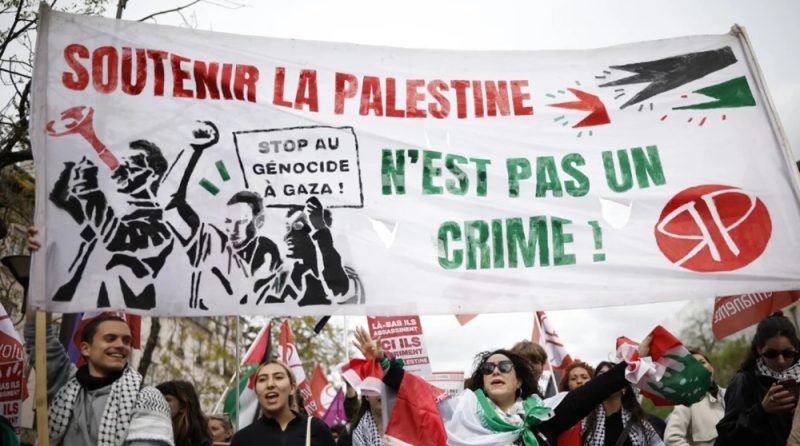
Protesters hold a banner reading “Supporting Palestine is not a crime” and “Stop genocide in Gaza” at a rally against the Yadan bill, in Paris on 12 April 2026.
The Dissident | April 13, 2026
A bill that the French National Assembly will vote on, on April 16th and 17th, effectively outlaws criticism of Israel, making it a criminal offence to question Israel’s “right” to exist as a Jewish supremacist apartheid state on occupied Palestinian land, compare Israel’s conduct to the Nazis, or support armed resistance against Israeli occupation and aggression.
The bill writes, “Today, anti-Jew hatred in our country feeds on obsessive hatred towards Israel, regularly delegitimized in its existence and criminalized. This phenomenon is exacerbated by extreme spirits who, under the pretext of expressing their hatred towards a State, are the instigators of a reinvented anti-Semitism, which could be described as ‘geopolitics’.”
The bill seeks to criminalize critics of Israel and paint them as terrorists, writing that the “call for the destruction of Israel and its comparison to a Nazi regime – are rooted in consciences with impunity, taking up the rhetoric of movements recognized as terrorist such as Hamas or Hezbollah.”
The bill seeks to criminalize:
- “Public remarks presenting acts of terrorism as legitimate resistance” (ie support for armed resistance against the Israeli genocide in Gaza or occupation of Lebanon).
- “Causing the destruction or denial of a State or publicly advocating its destruction or denial” (i.e., questioning Israel as a Jewish apartheid state, including calls for a single democratic state in historic Palestine with equal rights).
- “to clarify and extend the crime of challenging the Shoah, by enshrining several essential contributions of case law” adding “the comparison of the State of Israel to the Nazi regime would therefore be sanctioned as an outrageous trivialization of the Shoah” (i.e. factually pointing out that the state of Israel is behaving like the Nazis, including by committing Genocide in Gaza, as the UN independent international commission found in September of last year, and by calling for an expansionist greater Israel and ethnic cleansing to establish Jewish settlements ,similar to the Nazi concept of Lebensraum, an idea that has been openly endorsed by Benjamin Netanyahu and his main political opponent Yair Lapid).
Analyst Arnaud Bertrand documented that the bill attempts to make the criminalization of speech as broad as possible.
He noted that “Article 1 introduces the concept of ‘implicit’ provocation to terrorism and punishes it with five years imprisonment and a fine of €75,000,” adding, “What does ‘implicit provocation to terrorism’ mean? Nobody knows. And that’s the point. It means whatever a prosecutor wants it to mean: a perfectly good case could be made that, for instance, quoting international law on the right of occupied peoples to resist with respect to Hamas is, in fact, ‘implicit provocation to terrorism.’”
He added that “The same article also expands the terrorism apology offense to include ‘minimizing or trivializing acts of terrorism in an outrageous manner’” adding that “a judge could decide that providing context, explaining root causes, or insufficiently condemning an act amounts to ‘trivializing’ terrorism”, “for instance, a history teacher explaining the origins of Hamas or Hezbollah is providing context – but a prosecutor could argue that contextualization is trivialization. The same reasoning could apply to a journalist, a researcher, or anyone on social media who says ‘yes, it was terrible, but here’s why it happened.’ The ‘but’ becomes a crime, as it is trivialization.”
He also noted that, “ if you advocate for a one-state solution where Israelis and Palestinians live as equals, you are de-facto calling for the ‘destruction’ of the state of Israel. Well, that would now be punishable by 5 years in prison”.
The bill is called “the Yadan Law” because its creation was headed by National Assembly deputy Caroline Yadan, who represents the “French legislative constituency for citizens abroad” where “Israel has the largest number of voters in the constituency, with over 50,000 registered French voters”.
JNS noted that, “Yadan was elected to parliament as a representative of Renaissance but downgraded her ties to the party, switching to an independent affiliated lawmaker in September following the Macron administration’s decision to recognize a Palestinian state.”
In other words, the bill was brought by a Zionist French politician whose main constituency are Israelis.
Arnaud Bertrand noted, “The U.S. has congressmen paid by AIPAC: France has cut out the middleman entirely, we have MPs whose constituency is literally in Israel.”
Caroline Yadan is a genocide denier who has written, “The term genocide corresponds neither to the rights nor to the facts, nor to the intentions of the war in Gaza.”
Referring to the bill, the former French anti-terrorism judge Marc Trevidic said, “I’d never seen anything like it, the notion of implicit incitement to terrorism. Can you imagine what that means? A censor of other people’s thoughts, trying to figure out what a person meant”.
There is no doubt that this bill is designed to silence criticism of Israel, and that the lawmaker behind it is pushing it forward on behalf of her Israeli constituents.
There are No Ceasefires with Israel, Only Opportunities for Later Attacks
By Robert Inlakesh | Palestine Chronicle | April 12, 2026
“The war is not over,” stated Israeli Prime Minister Benjamin Netanyahu, less than twenty-four hours after a two-week cessation of hostilities with Iran was declared by the US. A clear sign of what is to come, from an emboldened Israeli leadership that has failed to achieve their goals of “total victory” in a “seven-front war” that has been ongoing since October of 2023.
With all the talk about ceasefire agreements to end regional hostilities in the Arab and English media, the Israeli Hebrew media is looking at things quite differently. Instead of an end to a war that the majority of the international community has worked to close, Tel Aviv eyes the next escalation.
In Lebanon, if a ceasefire is reached, the Israeli government will seek to do so in a way that inflicts a major political blow against Hezbollah, after having failed to achieve actual military accomplishments. Almost immediately following US President Donald Trump’s Truth Social post declaring a two-week ceasefire, Israel jumped to use the opportunity it had gained through the ceasefire in order to focus all of its airpower on Lebanon.
The results were truly devastating; around 300 Lebanese civilians were murdered in a series of strikes that lasted only ten minutes, which followed mass strikes across the country, including the targeting of an ambulance. After this, a series of other attacks took place, including a targeted strike which killed 19 Lebanese in Nabatieh, including at least 12 Security Force members.
Meanwhile, the US picked Lebanese Prime Minister Nawaf Salam and President Joseph Aoun, who have publicly begged their way to direct negotiations with Israel, while their civilians suffer through successive massacres. The way this is all being orchestrated was laid out well by a presenter on Israel’s Channel 13 News, who openly said that the Israelis are trying to orchestrate civil war inside Lebanon, using the government to order a crackdown on Hezbollah that will trigger it.
There are also Lebanese Forces militiamen who are suspected of helping drag the nation into such a bloody conflict.
Just as on November 27, 2024, when the Lebanon ceasefire was declared, the Israelis don’t see it as an agreement designed to stop aggression mutually. Over the course of 15 months, the Israelis committed 15,400 violations of the Lebanon ceasefire, setting a world record for the most violated ceasefire in recorded human history. While the US-backed Lebanese government pretended as if a new war had started in March, the Israelis had been waging war on the Lebanese south for 15 months.
In the Gaza Strip, the so-called ceasefire was also an opportunity for the Israelis; they got a break from the fighting while continuing to arm and build up their ISIS-linked militia allies. They violated the ceasefire around 3,000 times, killing over 700 Palestinians, all as a Civi-Military Coordination Center (CMCC), composed of over 20 countries, watched on in silence.
All the way back to 1948, the Israelis used ceasefires and temporary truces in the same exact way. For example, they launched ‘Operation Danny’, in July of 1948, during a temporary pause to secure territory in Lydd and Ramla; then ‘Operation Yoav’ in October 1948, breaking the second truce to launch an attack in the Naqab region; followed by ‘Operation Hiram’, also in October 1948 that was initiated shortly after the second truce ended, flooding their forces into the Galilee.
All of the Gaza ceasefire agreements were violated continuously by the Israelis, each used to Tel Aviv’s advantage. More recently, we can turn to Syria, where the Israelis tore up the 1974 disengagement agreement, using the fall of Bashar al-Assad to occupy even more southern Syrian territory, including seven key water assets. They had a well-oiled plan prepared, sitting there waiting for the day that regime change occurred in Damascus.
There is only one example of where the Israelis were forced to abide by a ceasefire, but were still violating Lebanese sovereignty thousands upon thousands of times throughout, and that was following the 2006 Lebanon war, when a costly equation was imposed by force. Yet, the post-October 7 predicament has destroyed all previous understandings and ushered in an expansionist era for the Israeli government. Both Benjamin Netanyahu and opposition leader Yair Lapid have both publicly stated their interest in expanding Israel’s undeclared borders and achieving the “Greater Israel Project”.
Tel Aviv’s defence minister, Israel Katz, has made it clear Israel’s intention to expand its borders up to the Litani River in Lebanon, while Finance Minister Smotrich has openly asserted that the objective of settling the area is a goal.
Israel is currently fighting what it sees as an existential battle to achieve the rebirth of “Eretz Israel”, a regional war that will not end until the project is secured. This means that even if a ceasefire is reached with Iran and Lebanon, it is not actually a ceasefire; it is simply another opportunity to implement new schemes and head back to the drawing board, only to escalate once again in the future.
Both history and the statements coming from the Israeli leadership clearly demonstrate that there is no such thing as a sustainable ceasefire with Israel.
– Robert Inlakesh is a journalist, writer, and documentary filmmaker. He focuses on the Middle East, specializing in Palestine.
Featured Video
Racist Seinfeld Dances for Joy as Bibi Unveils His New Map
or go to
Aletho News Archives – Video-Images
TV Drama Review
Japanese drama projects Japan’s wartime atrocities onto Chinese characters

Global Times | October 25, 2026
By portraying Chinese characters as perpetrators of ruthless violence while casting Japanese Self-Defense Forces (SDF) intelligence operatives as defenders, the season 2 of the Japanese drama Vivant has recently drawn criticism from Chinese netizens, who argue that its depiction turns historical reality on its head while ignoring Japan’s wartime atrocities.
The TBS drama series – a spy suspense story in which an alleged unofficial intelligence unit of the SDF operates across the globe — has attracted a passionate fanbase. Its currently airing season 2 opened with a household rating of 18.8 percent, the highest for a TV drama this year, according toa commentary article by Japanese media Toyo Keizai.
What draws attention is the portrayal of the enemies in the series, the article noted. Scenes in which the Chinese organization subjects kidnapped members of the SDF unit to brutal torture are repeated with unrelenting intensity.
It is rare for Japanese TV dramas to explicitly portray a real-life country as the enemy, the article noted.
Japanese Prime Minister Sanae Takaichi also made a reference to the drama, saying that she has been recording Vivant and hopes to binge-watch it over the year-end and New Year holidays, according to Japanese media outlets.
China’s CCTV News report on Sunday revealed that the drama features scenes in which Chinese personnel cut off the fingers of and stab Japanese intelligence operatives in the abdomen. Such acts bear striking similarities to the torture inflicted on Chinese nationals by invading Japanese troops during the World War II.
The drama distorts the truth by attributing these atrocities to modern Chinese characters. Beneath the surface, it subtly glorifies Japan’s cross-border overseas operations, blurs the functional boundaries of the SDF and implicitly promotes an expansionist narrative, per CCTV News. … continue
Blog Roll
 Aletho News
- Up in arms… Koreans reject U.S. empire’s plan to make South Korea the next Ukraine
- Iran, Turkey, Pakistan, Saudi Arabia could advance region-led security framework in Tehran: FM spox
- Netizens condemn Japanese drama for projecting Japan’s wartime atrocities onto Chinese characters
- Racist Seinfeld Dances for Joy as Bibi Unveils His New Map
- A West Bank War for Netanyahu’s Election Campaign, Could It Backfire?
- Yemen denounces European Parliament’s ‘hypocritical’ push to blacklist Ansarullah
- Qalibaf: UAE’s UN bid aims to ‘clear the runway’ for ‘Greater Israel’, whitewash genocide
- Pakistan reopens Iran border after boosting security: Report
- Why are so many Brazilians voting for Flávio Bolsonaro?
- Democrats Put Anti-Russia Agenda Ahead of American Workers
- If Americans Knew
- An error has occurred; the feed is probably down. Try again later.
- No Tricks Zone
- Sudden Stratospheric Warming, Powerful El Niño Combination May Lead To Extreme Europe Cold, Energy Crisis!
- Two New Studies Find Thwaites Glacier Melt Cannot Be Driven By Human Activity Or A Warming Ocean
- E-Cars Reduce CO2 Emissions By Only 41% Compared To Internal Combustion Engine Vehicles
- Predictions Made By Renowned Climate Professor Over Past Decades Have Been Proven To Be Poor
- New Study Suggests Large Regions Of The Pacific Ocean Have Been Cooling For The Last 80 Years
- Germany’s Green Energy Debacle: High Energy Costs Force Kahla Porzellan to Close After 182 Years!
- New Study: 50 Years Of The Most Aggressive ‘Net Zero’ Policies Can Only Affect The Global Climate By 0.03°C
- US September “Heat” Was No Record…Many Records Set Decades Ago
- Latest European Green Energy Debacle; Portugal’s Largest Flagship Solar Park Insolvent!
- Green Energy Debacle: German Expert Professor Fritz Vahrenholt Warns Of Severe Economic And Social Consequences

