“Satan has blinded the minds” of those against the Iran war, said U.S. Israel Ambassador Mike Huckabee in a late October interview. The devil “has captured their thinking,” he claimed. “I see it as spiritual darkness, spiritual blindness.”
“I know it sounds a little funny for an ambassador to be talking like this,” he said.
Yes, it does.
“Israel is not a political issue,” Huckabee also insisted (it’s not?) “It is a biblical issue. It’s a moral issue.” He was referring to the importance of the Jewish state to many of Donald Trump’s American evangelical Christian supporters.
Huckabee said this right before the American midterm elections, in which the Iran war and U.S-Israel relations turned out to be significant issues helping to deliver big losses to Republicans.
Vice President JD Vance even lamented after the election that the war was in part the “the reason we lost is the war.”
But Huckabee rejected Vance’s conclusion. “I don’t agree with that because I don’t think that’s where voters are,” Huckabee said in an interview with Israel’s Channel 12 News. “In fact, if you look at the polls, the only group of people in America that really think that that’s an important issue are the Democrats on the far left.”
But that’s just not true. In fact, 74% of voters said the Iran war was a crucial or major factor in their vote according to exit polls. Gallup reported the week before the election that 77 % of registered voters considered the war “extremely” or “very important” to their vote.
Polling before the elections reflected an American public across the board — even Republicans — frustrated with the war and wanting an end to it.
Furthermore, because of Prime Minister Benjamin Netanyahu’s role in convincing President Donald Trump to attack Iran, American opinion of Israel has plummeted, too. Exit polls indicate that some 50% of Americans think Washington supports the Israeli government “too much.”
That’s not just “the far left.”
But instead of engaging in self-reflection, Ambassador Huckabee is worried that American pastors aren’t having the right kind of influence over their flocks.
“Too many pastors in America are fearful that if they speak about Israel it might be divisive in their own church,” Huckabee said last week in Jerusalem to an international group of pastors, as reported by U.S.-based Jerusalem News Syndicate. “Well, if we are going to divide people, let’s at least divide them over something worth the division.”
“Go home and challenge something that is killing America and killing the faith in America and that is biblical illiteracy,” Huckabee told them. “Go home, be bold, be brave but most of all be biblical.”
What does this mean, exactly, “at least divide them over something worth the division”?
We know Huckabee is a Zionist because he called himself “an unapologetic one, because I believe the Bible,” in a Yeshiva University graduation address in May. There is nothing wrong with pastor-to-pastor advice. But there is something wrong with an American ambassador who is supposed to be representing the foreign policy of the United States, spending so much time on the taxpayer dime ostensibly advocating for fealty to another nation.
Huckabee doesn’t have the diplomatic post and all of the status, authority, residence, office and staff that comes with it to “be biblical.” That’s not his job.
“The Chief of Mission — with the title of Ambassador… and the Deputy Chief of Mission head the mission’s ‘country team’ of U.S. Government personnel,” reads the U.S. government embassy site on “The Role of an Ambassador.”
According to the job description, ambassadors’ responsibilities include, “speaking with one voice to others on U.S. policy – and ensuring mission staff do likewise – while providing to the President and Secretary of State expert guidance and frank counsel.”
Huckabee is supposed to report to Secretary of State Marco Rubio. What does Rubio think of his ambassador claiming that those American who opposed the Iran War have been “captured” or “blinded” by “satan”?
Moreover, does Huckabee think JD Vance has been blinded by Satan for repudiating the war? Is Pope Leo, the spiritual leader of 1.4 billion Catholics including 60 million Americans not “biblically literate” for condemning the U.S.-Israel war on Iran as unjust?
Such talk really does sound a little funny, ambassador, like the Church Lady on the 1980s-era “Saturday Night Live” asking “could it be… satan?” every time a guest said something she didn’t like.
But the war is deadly serious and so should be the role of US ambassador anywhere around the world. Public officials are entitled to their own religious views and liberty. But there is something wrong if pastor-official Huckabee is conflating the interests of the U.S. with his personal biblical imperatives — that is the kind of theocratic thinking we are supposed to revile Iran for.
Perhaps it’s time to interpret Huckabee’s comments as more than silly one-offs and ask whether Trump should put a more serious person — one who puts American foreign policy interests before his own biblical ministrations— into the job.
November 16, 2026
Posted by aletho |
Ethnic Cleansing, Racism, Zionism, Wars for Israel | Israel, Palestine, United States, Zionism |
Comments Off on Could it be satan? No, Huckabee, just the Americans you work for
AIPAC may have suffered electoral setbacks, but a wider network of pro-Israel groups continues to shape Washington
Even though U.S. President Donald Trump’s party lost the midterm elections, Jewish lobbies continue to maintain their grip on the country’s governance. Although many key candidates funded by the American Israel Public Affairs Committee (AIPAC), the most prominent of these lobbies, lost, winners emerged from other pro-Israel groups. While there are certain rifts among these lobbies, they stand united in protecting Israel.
The 28 regions considered “battlegrounds” for the House of Representatives came to the fore. Therefore, to understand the role played by Jewish lobbies, we will put the winning candidates in these districts under the microscope. We will also touch upon a few other victors who stand out despite being outside the districts in question.
Some clear defeats for AIPAC
The clearest example of AIPAC’s failure was the Senate race in Michigan. They spent a record amount of money, pouring millions of dollars, first into his rival Haley Stevens to prevent Abdul El-Sayed from becoming the Democratic nominee, and later into his Republican opponent Mike Rogers. Stevens even went so far as to betray her party and voters by announcing her endorsement for Rogers, but to no avail. However, it was also noteworthy that billionaire George Soros’s nephew, Jeffrey Soros, made a donation to El-Sayed, a fact that Rogers weaponized in his campaign.
In California’s 22nd House District, Republican David Valadao, an AIPAC-backed candidate, had won in both 2022 and 2024. Now, however, Randy Villegas, the candidate against whom AIPAC spent one of its largest sums of money to ensure his defeat, has beaten Valadao by a wide margin.
Tom Barrett, an AIPAC operative, held Michigan’s 7th Congressional District. However, William Lawrence, who rejected lobby money and argued that weapons shipments to Israel must be halted as it commits “genocide,” accomplished a significant feat by unseating him.
Other pro-Israel groups
Many of the Democrats who won the 28 battlegrounds not only appear to refuse money from AIPAC but also defeated AIPAC-backed candidates. However, examining it solely from this perspective would lead us into a delusion. This is because AIPAC is not the only pro-Israel lobby. Indeed, a detailed examination reveals that nearly all of these names are individuals supported by other pro-Israel groups or figures.
Among them, Amish Shah, who won Arizona House District 1, declared his support for Israel and the war it started after Oct. 7, and is known for receiving pro-Israel plaudits in 2024. Moreover, Representative Alma Hernandez, an “unapologetic” Zionist Jew, visited Shah after he won the election and wished him “best of luck.” He has the support of J Street, a pro-Israel lobby, and his rival didn’t have AIPAC’s support directly.
JoAnna Mendoza won Arizona House District 6. Her opponent, Juan Ciscomani, was also funded by AIPAC. Its support for Mendoza may not be known, but the support of other self-described pro-Israel lobbies, J Street and the Jewish Democratic Council of America (JDCA), for her is clear. The latter also supported Shah, praising “his ‘adamant’ support of U.S. funding for the Iron Dome,” while affirming Mendoza’s “commitment to Israel’s security.” Also, she drew donations from the son and daughter-in-law of George Soros, one of the world’s most prominent Jewish figures who, despite certain rifts with the Israeli right, heavily invests in the occupiers.
In Colorado House District 8, AIPAC-backed candidate Gabe Evans was defeated by Democrat Manny Rutinel. Rutinel, however, took J Street’s and JDCA’s support and held a position nearly identical to that of Evans regarding the continued provision of U.S. military aid to Israel.
The capturer of Iowa’s 3rd Congressional District, Democrat Sarah Trone Garriott, stands as another beneficiary of J Street funding. She was funded by James Murdoch, the son of media giant Rupert Murdoch – whose media empire backs Israel’s genocide – his wife Kathryn, and the Soros families. Far from ever stating that Israel is committing “genocide,” she went so far as to issue a message on Oct. 8 that turned a blind eye to Palestinian suffering, projecting sympathy exclusively toward Israel.
Another battleground was Michigan’s 10th Congressional District, where Christine Hines emerged victorious. Hines received backing from both the JDCA and the Democratic Majority for Israel (DMFI) PAC. Having also endorsed many Zionist puppets like Haley Stevens and Hakeem Jeffries, the DMFI is an organization whose main objective clearly seems to be ensuring that members of Congress support Israel.
Rebecca Bennett unseated AIPAC’s Republican Representative Tom Kean in New Jersey’s 7th Congressional District. But Bennett was endorsed by both J Street and JDCA. She sees Israel’s partnership with the U.S. as “vital.” Likewise, securing backing from both J Street and the JDCA, Bob Harvie successfully unseated his AIPAC-sponsored Republican rival to capture Pennsylvania’s 1st Congressional District.
Again in Pennsylvania, this time in the 7th District, another Bob (Brooks) unseated yet another AIPAC-servant Republican. However, this Bob, too, was funded by both J Street and the JDCA. Additionally, this Bob is also someone to whom both the Soros and Murdoch children made campaign contributions.
Paige Cognetti is a particularly attention-grabbing name. Having unseated AIPAC’s Republican operative in Pennsylvania’s 8th Congressional District, she was funded by DMFI, the JDCA, and J Street alike. Furthermore, she also received campaign contributions from both the Murdoch and Soros families.
Another of AIPAC’s Republicans in Pennsylvania (10th District) was unseated by another JDCA and DMFI Democrat, Janelle Stelson, who thinks America “must remain a staunch ally of Israel.” The Soros family made a donation to her as well.
Also, DMFI and JDCA’s Cait Conley defeated AIPAC Republican Representative Mike Lawler in New York’s 17th Congressional District. Murdoch’s son and daughter-in-law donated to her. She supported the war against Iran in June 2025. Despite this, even Al-Jazeera fell into the error of presenting Conley’s victory as a defeat for the pro-Israel side.
Yet another Republican servant of AIPAC was unseated in Virginia’s 2nd Congressional District by Elaine Luria, herself a proxy for DMFI and the JDCA. Luria, for her part, was bankrolled by the Soros family.
Marcy Kaptur, the victor in Ohio’s 9th Congressional District, is also noted to have received backing from the JDCA, J Street and the Soros family alike. In 2024, as Israeli Prime Minister Benjamin Netanyahu spoke before Congress, Kaptur was seated to the right of Rashida Tlaib, who was protesting alone, but instead of joining the protest, Kaptur stood up with the other toadies.
Brian Poindexter, who captured Ohio’s 7th Congressional District from the Republican incumbent Max Miller, enjoys the backing of both J Street and the JDCA. Additionally, George Soros’s son Jonathan and his wife Jennifer are featured among his list of donors. These four points also apply to Shannon Taylor, the winner in Virginia House District 1, and to Rebecca Cooke, the winner in Wisconsin House District 3.
Those who ‘appear’ unfunded
While certain winners seem to have steered clear of lobby cash, donations were nevertheless funneled to them by high-profile figures.
One of them is Sean McCann, who won Michigan’s 4th House District. He does not appear to have received any money from pro-Israel lobbies. However, there are no statements from him against Israel’s “genocide” either. On the contrary, he expressed sympathy toward them on the Oct. 7 anniversary. Furthermore, his opponent in the Democratic primary, Diop Harris, whom McCann sidelined, was someone who demanded a weapons embargo against Israel, while McCann remained silent. Also, the Soros family funded him.
Similarly, Denise Powell, the victor in Nebraska’s 2nd Congressional District, is noted as another candidate steering clear of openly pro-Israel lobby cash. Yet, a curious point remains: upon Powell securing the Democratic nomination, AIPAC issued a congratulatory message to Powell, hailing the outcome precisely because she had defeated “anti-Israel State Sen. John Cavanaugh.” Furthermore, the Murdoch family and Nancy Adelson, who is seen among those funding staunch supporters of Israel, appear to be among her donors. Additionally, while her backer Bold America presents itself as an organization for Hispanic Democrats, it’s notorious for endorsing numerous pro-Israel figures who also receive cash from AIPAC, DMFI and JDCA, including some mapped out in this piece, a reality that understandably raises eyebrows.
Another one is Jamie Ager, the winner of North Carolina’s 11th Congressional District. While it is noted that he did not take cash from pro-Israel lobbies, a striking detail invites scrutiny: Among his campaign donors are the Murdoch and Soros families. Among the donors to Ager are also employees of Jane Street, one of the world’s largest trading firms, which has a Jewish co-founder and executive named Robert Granieri.
Support from AIPAC and others
Hakeem “Israel forever” Jeffries, who was elected from New York and is set to become the first Black speaker of the House, is a well-known AIPAC slave. He is also DMFI’s, J Street’s and many other pro-Israel groups’ guy.
In addition to being Jewish, Democrat Jared Moskowitz, who won in Florida’s 25th House District, is one of AIPAC’s most heavily backed figures, receiving $1.8 million in support. Lauding himself as “the most pro-Israel Jewish Democrat in Congress,” Moskowitz was furthermore appointed as the ranking member on the Subcommittee on the Middle East and North Africa and thanked Jeffries for the assignment. The JDCA also endorsed him.
Christina Bohannan, who flipped Iowa’s 1st Congressional District by defeating Republican incumbent Mariannette Miller-Meeks, is another figure receiving hundreds of thousands of dollars from AIPAC. Moreover, the JDCA and J Street have also announced their financial backing for her. Although J Street often markets itself as an opponent of AIPAC-backed candidates, cases like Jeffries, Bohannan and Shah expose its true colors. On the other hand, Bohannan stands out simply because candidates who secure simultaneous backing from all three of these organizations are rare. She, too, was funded by the Soros family.
Don Davis, who secured victory in North Carolina’s 1st House District, was an interesting candidate supported by AIPAC, the JDCA, the DMFI and the Soros family. He is one of 33 Democrats who voted with the Republican majority to pass a bill to cut federal funding for colleges and universities that engage in boycotts against Israel.
Marie Gluesenkamp Perez, who won reelection in Washington state’s 3rd Congressional District, is one of the most intriguing figures. She was funded simultaneously by AIPAC, DMFI, the JDCA, the Soros family, Murdoch’s son James and Nancy Adelson all at once. When she was first elected in 2022, she was hailed as “the future of Democratic politics” and was even called the “next Bill Clinton.” However, upon taking office, she began to betray her constituents and became an absolute servant to Israel. She is among the 33 Democrats.
Henry Cuellar, who won in Texas’s 28th Congressional District, and Vicente Gonzalez, the victor in the 34th District, are both candidates of AIPAC and DMFI. Plus, Gonzalez was funded by the Soros family and is among the 33 Democrats.
In sum
So, if we look at the overall picture by including non-battleground districts, how many AIPAC candidates actually won? As of Nov. 6, AIPAC announced that 245 of its candidates emerged victorious, and only 10% of those they backed suffered losses. Furthermore, calculations arguably indicate that 521 out of Congress’s 533 members operate as assets for Israeli lobbies. What we have detailed in this article runs perfectly parallel to these data points. Therefore, it is glaringly obvious that Israeli lobbies maintain their hegemony over America.
However, in 2022 and 2024, AIPAC had proudly declared that 98% of its endorsed candidates won, which translated to a figure around or above 330. This drop is by no means negligible.
Among candidates backed by certain other lobbies, one can occasionally observe criticisms or minor opposition toward some of Israel’s demands. In truth, this is something Zionists would normally never want to tolerate. Yet, they likely use these types of alternative lobbies as a valve to release public pressure; their goal is to prevent the rising hatred against Israel from empowering genuine anti-genocide movements, keeping the backlash managed under pro-Israel groups through seemingly moderate figures. While they can implement this tactical maneuver in the short term, we can reasonably hope that after a 25-year timeline, when the younger generation becomes the majority, AIPAC and its mindset will face a much steeper decline.
November 16, 2026
Posted by aletho |
Corruption, Ethnic Cleansing, Racism, Zionism, Wars for Israel | AIPAC, Israel, Palestine, United States |
Comments Off on AIPAC and more: Network of pro-Israel influence in US Congress
Moscow has not given the green light for a proposed European delegation to join trilateral talks with Ukraine and the US in Abu Dhabi, Russian presidential aide Yury Ushakov has said.
Ushakov was commenting on last week’s announcement in Dublin that Western European leaders had agreed on a negotiating team after weeks of speculation that exposed divisions within the Western bloc.
“When we receive a clear signal from the Europeans about what they actually want and what constructive and substantive proposals they can offer to help bring about a settlement in Ukraine, only then will we raise the question of their participation,” Ushakov said on Monday.
Several more rounds of trilateral talks between Russia, Ukraine, and the US could take place before European representatives are considered for participation, he added.
“The talks resumed in Abu Dhabi, and it was agreed that they would continue. The date has not yet been set,” he said, adding that while some had suggested expanding the format, “this has not been agreed with us.”
European Council President Antonio Costa announced on Friday that representatives of EU institutions and five countries – Britain, France, Germany, Italy, and Poland – would take part in the next round of Ukraine peace talks.
The announcement followed weeks of disagreements over who should represent Europe, with EU foreign policy chief Kaja Kallas, an outspoken Russia hawk, among those seeking a leading role. Rather than appointing a single envoy, European leaders opted for a multi-country delegation.
Divisions surfaced when Finnish President Alexander Stubb and Norwegian Prime Minister Jonas Gahr Store held a rare phone call with Russian President Vladimir Putin on October 27, sparking criticism from other European leaders.
Danish Prime Minister Mette Frederiksen criticized the move, saying it was not coordinated with European partners. Stubb and Store maintained that they had consulted Ukraine and were speaking on behalf of their own countries, rather than Europe as a whole.
Most Western European leaders have avoided direct contact with Moscow since the escalation of the Ukraine conflict in 2022, seeking to isolate Russia diplomatically. In recent weeks, however, they have stepped up efforts to secure a seat at the negotiating table as Moscow and Washington intensify diplomacy.
Moscow has repeatedly questioned Europe’s credibility because it continues to supply weapons and funds to Ukraine and talks of the need to inflict a strategic defeat on Russia. The Kremlin also rejects calls by Brussels for an unconditional ceasefire, arguing it would only serve to win time for Kiev to reconstitute its forces.
The Dublin announcement followed last week’s talks in Abu Dhabi, where European representatives attended separate discussions but were excluded from the main Russia-Ukraine-US negotiations.
Following subsequent meetings with Putin in Moscow and Ukraine’s Vladimir Zelensky in Dublin, US envoys Steve Witkoff and Jared Kushner said both sides had agreed to include the Europeans in the next round. Kushner said the expanded format would allow discussions on broader European security arrangements alongside Russia-Ukraine territorial disputes.
November 16, 2026
Posted by aletho |
Militarism | European Union, Russia, Ukraine, United States |
Comments Off on Putin aide reveals Moscow’s stance on Europe at peace talks

Former Pakistani Prime Minister Imran Khan has warned the top judges in the country that he may die in prison because of inadequate medical facilities and poor jail conditions.
In a letter written from his prison cell and addressed to the chief justices of Pakistan’s Supreme Court, Federal Constitutional Court and Islamabad High Court, Khan said doctors had warned that he was at risk of suffering a brain hemorrhage or heart attack in prison.
“At seventy-four, this unrelenting state is taking me to a place from which I may not return alive,” said the cricketer-politician in the letter, which was drafted by his barrister on his behalf.
Khan, who chairs the Pakistan Tehreek-e-Insaf (PTI), has been in prison since he was ousted from power in a no-confidence vote in 2022 and subsequently faced several charges related to corruption.
Reports say courts have suspended or overturned all but one of his convictions, with the remaining case still pending appeal. He has consistently denied the charges, describing them as politically motivated.
Doctors say Khan’s blood pressure had reached 193. This comes a week after he was taken to hospital over blood pressure problems before being returned to prison following treatment.
In his letter to the senior judges, Khan said recent court announcements concerning his acquittal in some cases have given him renewed faith in Pakistan’s justice system.
“I will prove my innocence if I remain alive… I do not write as a former prime minister, nor as the head of a political party,” Khan said.
However, experts believe the former prime minister’s chances of securing release from prison have significantly diminished following recent amendments to Pakistan’s constitution, which curtail the judiciary’s powers and narrow the scope for legal relief available to him.
November 16, 2026
Posted by aletho |
Civil Liberties, Full Spectrum Dominance, Subjugation - Torture | Human rights, Pakistan |
Comments Off on Imran Khan warns Pakistani judges he may die in prison
The Israeli occupation army uploaded 3.5 million photographs to Amazon’s cloud platform to use the US company’s facial recognition technology to analyze images of Palestinians, leaked documents obtained by The Guardian have revealed.
The images were transferred to Amazon Web Services (AWS) in early 2024, during the first months of the Israeli aggression on Gaza, as the occupation forces expanded their reliance on the company’s cloud infrastructure to support their surveillance operations and process large volumes of Palestinian personal data.
In an investigation published by The Guardian, the documents and interviews with military sources expose the extent of the Israeli occupation army’s dependence on Amazon’s technology, including its use of the company’s Rekognition facial recognition platform and the migration of sensitive intelligence material and information on Palestinians into AWS data centers.
The photographs were uploaded by a military department commonly known as Rolling Stone, which operates within an Israeli military software unit and maintains extensive databases on Palestinians in Gaza and the occupied West Bank. The department informed Amazon in early 2024 that it intended to use Rekognition for a facial recognition project.
The Guardian said the documents do not establish whether the 3.5 million photographs were captured at Israeli military checkpoints in Gaza. However, a military source familiar with the facial recognition operations at those locations told the newspaper that Amazon’s cloud infrastructure was used because of the “very large scale” of the images collected there.
Guardian investigation exposes deepening Amazon-Israeli ties
The investigation also documents the presence of a small group of Israeli soldiers at AWS’s offices in Tel Aviv in early 2024. The soldiers were exploring ways to use Amazon’s cloud infrastructure to operate a facial recognition program in Gaza more effectively, according to several military sources interviewed by The Guardian.
It remains unclear whether their work became operational or whether it was connected to the 3.5 million images uploaded to Rekognition. The newspaper said their presence nevertheless highlighted the close relationship between the Israeli occupation army and the cloud provider.
An AWS spokesperson said customers “regularly visit our offices for briefings and meetings,” adding, “Any suggestion that these visits are anything other than routine customer engagement is wrong and unsubstantiated.”
The report traces the relationship to Project Nimbus, a multibillion-dollar contract signed in 2021 under which Amazon and Google provide cloud services to Israeli government and military clients.
Mass surveillance again and again
The Guardian has previously revealed that the contract contains unusual provisions preventing the US companies from restricting or suspending Israeli government and military use of their cloud services, even in cases where such use violates their terms of service.
According to the newspaper, those provisions would prevent the companies from taking unilateral action similar to Microsoft’s decision last year to disable the Israeli occupation army’s access to technology used to operate a mass surveillance system, which The Guardian and +972 Magazine have previously exposed.
As part of Project Nimbus, AWS opened new data centers in the occupied Palestinian territories in early 2023, allowing government and military clients to migrate data from their own servers. Documents cited by The Guardian also indicate that substantial amounts of data were transferred from AWS data centers in Ireland.
A central component of the agreement was an obligation on AWS to provide the Israeli military with access to a segregated area inside its Tel Aviv data centers, equipped with enhanced digital and physical security measures. The company and its client described the isolated cloud environment, which stores sensitive material related to military operations and intelligence gathering, as a “walled garden”.
Rolling Stone department moved Palestinian data into Amazon cloud
The Guardian identified the Rolling Stone department as one of AWS’ most significant Israeli military clients. Documents show that it transferred substantial volumes of information into the company’s protected cloud environment throughout 2023, before uploading the 3.5 million photographs to Rekognition in early 2024.
A military source involved in the migration told the newspaper, “The plan [at Rolling Stone] was to migrate pictures, videos, all the confidential intelligence information – everything.”
The department oversees several extensive databases containing information on Palestinians. Its central system, also known as Rolling Stone, has been used by the Israeli occupation forces for decades and is continually updated with personal and family details, property records, checkpoint crossings, work permits, and information on criminal activity.
A soldier who testified to the Israeli NGO Breaking the Silence in 2016 described the system as “a computerised system where all the information relevant to the control of the Palestinian civilian population is centralised.”
The department has accumulated millions of photographs of Palestinians through its control over population registries in Gaza and the occupied West Bank. The images include photographs taken for identity cards issued to residents when they turn 16, according to sources familiar with its work.
The Guardian reported that these photographs are routinely used in facial recognition programs, including Blue Wolf, a smartphone application used by Israeli soldiers in the occupied West Bank to scan Palestinians’ faces and retrieve information about them, including whether they have been flagged as suspects for arrest.
Report links Amazon infrastructure to surveillance at Gaza checkpoints
The investigation also details how facial recognition technology was deployed at temporary Israeli military checkpoints established in Gaza following the ground invasion in October 2023.
According to sources cited by The Guardian, cameras were positioned to capture images of Palestinians approaching the checkpoints, after which facial recognition systems matched their faces against photographs stored in Rolling Stone’s databases.
The newspaper noted that it was unclear whether the 3.5 million images uploaded to Amazon’s Rekognition platform came from these checkpoints. However, military insiders said AWS infrastructure was used at times during 2024 to support checkpoint operations.
The sites became notorious as locations where Palestinians were pulled aside and detained. Many were subsequently taken into Israeli custody and held incommunicado, practices that several UN bodies and human rights organizations have described as enforced disappearances. Israeli soldiers reportedly referred to the checkpoints as “Nakaz”, a Hebrew word meaning drainage.
The Guardian also placed the findings within the broader history of Israeli facial recognition operations. The Israeli occupation army has long used face-scanning technology at checkpoints in the occupied West Bank, while soldiers have relied on custom-built smartphone applications to photograph Palestinians and access information about them.
At the beginning of the aggression on Gaza, Israeli occupation forces used Rekognition to identify captives taken during Operation Al-Aqsa Flood on October 7, 2023. It also deployed facial recognition technology to identify people it suspected of being militants.
The New York Times previously reported that the Israeli military experimented with commercially available technologies to detect faces in crowds and drone footage, with civilians sometimes incorrectly identified as militants.
November 16, 2026
Posted by aletho |
Ethnic Cleansing, Racism, Zionism, Full Spectrum Dominance, War Crimes | Human rights, Israel, Palestine, Zionism |
Comments Off on IOF used Amazon facial recognition to track millions of Palestinians

The European Union has continued its decent into full authoritarianism, sanctioning its own citizens explicitly for reporting that undermines the narrative used to fuel the proxy war in Ukraine.
In the most recent sanctions package on Russia, the EU placed sanctions on Chay Bowes, an Irish journalist living in Russia for “the spreading of anti-Western and anti-Ukraine disinformation”, claiming that he was “implementing, supporting and facilitating actions or policies attributable to the Government of the Russian Federation which undermine or threaten democracy, the rule of law, stability or security in the Union” by reporting contrary to the EU’s propaganda narrative on Ukraine.
The entire basis for these accusations, was an address Bowes, gave at the UN Security Council where he criticized the proxy war in Ukraine, which the EU labels as “disinformation”, without citing anything Bowes said that was false.
In reality, the term “disinformation” used in this context is a colloquialism for information that undermines the propaganda used to fuel the EU’s continuing proxy war.
Case in point, the EU previously placed sanctions on the former Swiss Army Colonel Jacques Baud, claiming, “He acts as a mouthpiece for pro-Russian propaganda and makes conspiracy theories, for example, accusing Ukraine of orchestrating its own invasion in order to join NATO”.
Baud, in reality, is a very credible and fact-based expert who cites Western and Ukrainian media and government statements to back up his criticism of the proxy war in Ukraine.
The one example the EU gave for Baud’s supposed conspiracy theory that got him sanctioned was the fact that he cited a 2019 interview where then Ukrainian presidential advisor Oleksiy Arestovych stated that the best outcome for Ukraine would be a “large-scale war with Russia and joining NATO as a result of defeat of Russia”.
In other words, his “conspiracy theory” was him quoting a Ukrainian government official.
The EU similarly placed sanctions on the German journalist Hüseyin Doğru, accusing him of aiding “Russia’s destabilising activities”.
Dogru obtained the “evidence package” the EU used to justify the sanctions against him and found it consisted of his reporting that was critical of EU foreign policy, including the Ukraine proxy war, as well as the EU complicity in the Gaza genocide.
Make no mistake about it: this is a coordinated campaign by the EU to sanction anyone giving a counter narrative to their propaganda on Ukraine into silence, and whether one agrees with or likes Bowes, Baud or Doğru is irrelevant to this central point.
This campaign from the EU mirrors what the EU proxy regime in Ukraine has done to its own citizens for criticizing the government and the West’s role in the proxy war.
High-profile Ukrainian political figures such as the political scientist Konstantin Bondarenko, the aforementioned Oleksiy Arestovych, and former press secretary Iuliia Mendel, among many others, have been sanctioned by the EU proxy regime in Ukraine for calling for an end to the war.
While the EU has its proxy regime sanctioning into silence the many Ukrainian voices – representing the majority of the country according to polls – who want to end the war, it uses the same tactic on its own citizens to similarly silence them from criticizing the EU’s never-ending proxy war in Ukraine.
November 16, 2026
Posted by aletho |
Civil Liberties, Full Spectrum Dominance, Russophobia | European Union, Human rights, Ukraine |
Comments Off on More EU Citizens Face Sanctions For Criticizing The Ukraine Proxy War
Covert operations south of the border threaten to spiral out of control
Last week, the New York Times shed new light on America’s covert activities in Mexico, including the recent deaths of two CIA agents in the border state of Chihuahua. The Times’ reporting shows how American intel officials built a relationship with a corrupt Mexican prosecutor, with the aim of establishing a base for counter-cartel operations. Because the Mexican government objects to U.S. spies operating in its territory, the CIA had to proceed with an extra degree of secrecy, working with state officials and other intermediaries to enable its presence south of the border.
The man at the center of the latest allegations is Guillermo Zuany Portillo, until May, Chihuahua’s anti-kidnapping prosecutor. In 2025, the State Department revoked Zuany’s U.S. visa over suspected cartel ties; four witnesses had previously accused the prosecutor of complicity in the 2022 murder of two police officers. Within months, however, Zuany’s visa was reinstated, as he took on the informal role of local pointman for the CIA.
Zuany, per the latest Times reporting, connected U.S. intel operatives with Chihuahua state police with the aim of developing a new special forces unit. Once embedded in the police force, CIA agents helped to plan enforcement operations and identify targets for raids. They routinely participated in these missions—even providing covering fire on at least one occasion—though they were careful to always conceal their identities by wearing Chihuahua state insignia.
In April, this unit conducted its largest operation: a raid on a methamphetamine lab in the remote Sierra Madre mountains, on the border with the narco-ridden state of Sinaloa. Four CIA officers participated; during their return back, the team’s convoy had to navigate winding roads through difficult terrain. One of the vehicles, carrying two CIA agents, encountered visibility issues, and plunged 300 feet into a ravine—killing all onboard.
The incident sparked a political firestorm between Mexico’s left-wing president, Claudia Sheinbaum, and Chihuahua’s conservative governor, Maru Campos. Sheinbaum has strongly resisted pressure from the Trump administration to allow U.S. security personnel to work in the country; moreover, Mexican law prohibits foreign agents from operating without express authorization from the federal government. And so far as can be ascertained, the roles of the deceased CIA agents were never cleared with Mexico City: one entered on a tourist visa, while the other came on a diplomatic passport.
Campos claims that she had no idea what the CIA was doing in her state, though Zuany stated otherwise in a text with the Times. In May, Campos also reportedly authorized a joint surveillance hub with five US agencies in Ciudad Juárez. While the governor has thus far avoided impeachment proceedings, her attorney general, César Jáuregui, has been arrested and charged with treason for the CIA breach. And after the latest story broke, federal and Chihuahua prosecutors issued warrants for Zuany’s arrest; Zuany has since fled to the U.S. where he now is reportedly under the protection of the American government.
There is, of course, reason to believe that Sheinbaum—who has deepened security cooperation with Washington in other areas—is more aware of CIA activities in her country than she has let on. A March car bombing of suspected cartel members outside Mexico City was later revealed by anonymous intelligence officials to have been the work of the Americans, who allegedly coordinated with Mexican authorities. There are two big questions worth asking here. First, which U.S. intel operations does Mexico City know about? And second, how far is the White House willing to go on this?
The record from Chihuahua suggests that the Trump administration is using a variety of tools to facilitate CIA throughout the country. To that end, the administration appears to be pursuing closer—and extralegal—ties with pliant opposition state governments.
Another is the revocation of visas and other potential punitive measures. Interestingly, visa revocations against elected officials have been deployed exclusively against politicians from Sheinbaum’s ruling Morena party, particularly those in areas along the U.S. border. Half of Mexico’s six border states are run by Morena, and half by opposition parties. Yet only Morena governors—Baja California’s Marina del Pilar, Sonora’s Alfonso Durazo, and Tamaulipas’ Américo Villarreal (although Villarreal has disputed the story)—have had their visas revoked, all over alleged cartel ties.
To be clear, none of the three Morena governors have been indicted, although the administration did take the unprecedented step of unsealing charges against the Morena governor of Sinaloa, Rubén Rocha Moya, earlier this year. And some opposition governors—Nuevo León’s Samuel García, for example, and Durango’s Estéban Villegas—are reportedly under investigation but can still travel freely to the U.S.
The pattern suggests that White House pressure on Mexican politicians is inversely related to the latter’s willingness to work with U.S. intelligence agencies for better or worse. Paradoxically, many of the CIA’s targets in Chihuahua often escaped, leading state officials to suspect that the now fugitive and U.S.-protected Zuany was tipping them off. Here, it’s worth asking whether the White House is ultimately more concerned with expanding agency access south of the border for its own sake.
Another possibility—not mutually exclusive with the theory outlined above—is that the Trump administration is most interested in weakening the governing party ahead of next year’s legislative and state elections (including in four border states). Polling suggests that Morena and its allies will once again dominate, though they may well lose their congressional supermajorities and some governorships.
Whatever the case, Trump is playing a dangerous game south of the border. If, as suspected, the CIA is acting unilaterally against traffickers throughout Mexico, the potential for further casualties and blowback is immense. Since the 1985 killing of DEA agent Enrique Camarena, Mexican cartels have avoided targeting U.S. citizens and especially officials for fear of overwhelming reprisals. This could change in the event of a broader U.S. intervention.
Many Republicans, including ostensible restrainers, believe it’s worthwhile to trade an open ended conflict with the IRGC for an open ended conflict with Mexican drug lords. This view is deeply mistaken. A military intervention in Mexico is quite likely to spiral out of control, bringing with it the potential for a new forever war—this time in our own neighborhood. Worsening disorder in Mexico would have grave economic consequences for America (it is, after all, our largest trading partner); perhaps most importantly, it could stoke a new migration crisis that undoes at a stroke the signature accomplishment of Trump’s second term.
Unglamorous as it may seem, Washington is better off leveraging the competent security partner it currently has in Mexico City. Fentanyl seizures south of the border have risen to record highs while seizures north of the border have plummeted to record lows; Mexico has also illegally extradited nearly 200 kingpins to the U.S. And contrary to her image as a progressive heroine, Sheinbaum has undertaken a surprisingly successful crackdown against the cartels in part thanks to a policy of mass incarceration.
Under Sheinbaum and Security Secretary Omar García Harfuch, monthly incarcerations have tripled relative to her Morena and opposition predecessors. If trends continue, Mexico’s prison population is set to rise to around 350,000 by the end of the president’s term, up from 220,000 in 2024. It is no coincidence that homicides have declined by roughly 50 percent since 2024. DEA Administrator Terry Cole has praised Harfuch for historic cooperation on security between both countries.
The Trump administration is currently reckoning with the disastrous costs of an aggressive military intervention conducted 7,000 miles away from the U.S. It would do well to avoid the risk of further adventurism on our very doorstep.
Juan David Rojas is a South Florida–based correspondent at The American Conservative. Before joining the magazine, he worked as both a private sector intelligence analyst and freelance journalist specializing in the Western Hemisphere. He is also a columnist at UnHerd.
November 16, 2026
Posted by aletho |
Militarism | CIA, Mexico, United States |
Comments Off on In Mexico, the CIA Is Playing a Dangerous Game
At first glance, Spain’s relatively symbolic single-day “General Strike” of November 11th, where some four million took to the streets, with the slogan “Salaries. Housing. Prices.”, fits a typical Western European narrative, much like what you might see in France, Italy, or Greece. Living costs are rising, wages are stagnating, and the major national trade union federations have endorsed a general strike. What’s strangely cynical this time around, besides the futility of striking for a single day, is that it was endorsed (and in effect organized) by the PSOE-led government itself, making it something more of a ‘state holiday’ combined with a pre-election stunt. The story becomes even more paradoxical when we examine the underlying drivers of the public discontent that led ordinary citizens to participate in what effectively functioned as a government-backed protest. What we find is bizarre, even though expected: the left is protesting a crisis it created, or rather legitimized, in service of globalization model capitalism. Events in Spain provide a teachable moment on how the City of London’s “EU” capitalist system works, manages discontent, gaslights mass publics, and controls the narrative. This means we have to dig into questions beyond polling and the questions of the day, and look for a deconstruction which challenges the broad assumptions of the Western globalist model of capitalism.
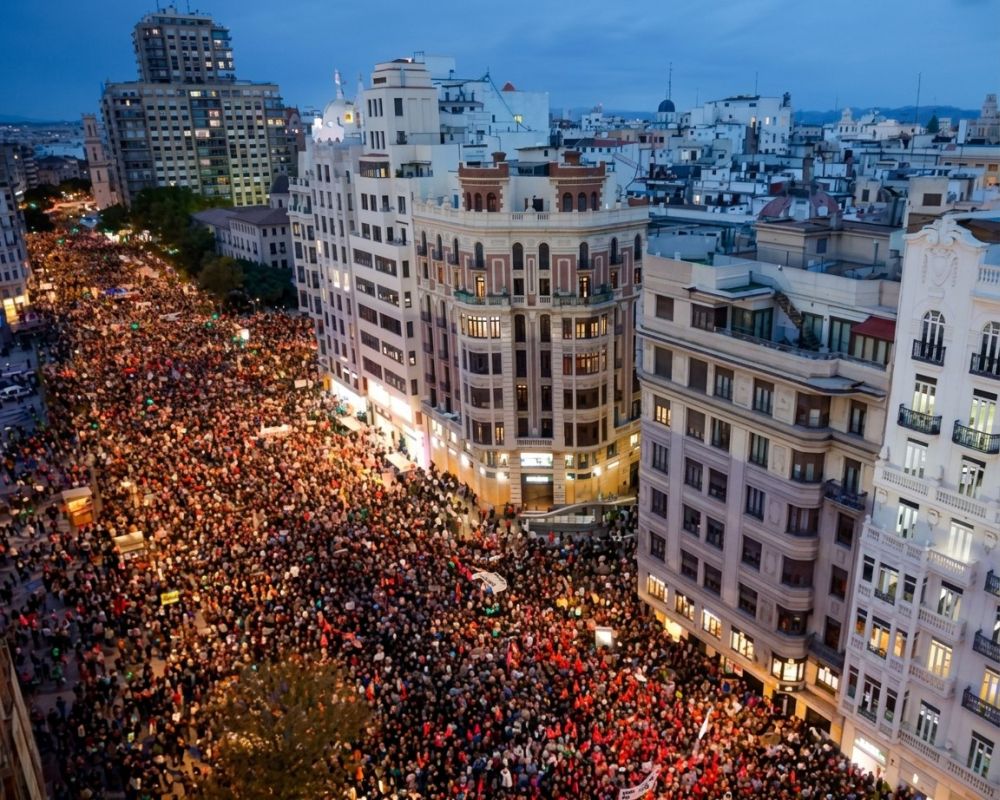
General Strike mobilization in Plaça de l’Ajuntament in Valencia, Spain, November 11, 2026
The General Strike Big Business Loved
What led to the so-called “General Strike”? General strikes, when they occur within EU politics, are normally called in opposition to conservative or center-liberal governments trying to push through austerity measures masked as “budgetary reforms.” Before this weak and non-committal age we live in now, these strikes would carry on for some time until the real, economic, material impact was felt by the ruling class and their governmental representatives. Workers would skip meals and huddle by dumpster fires to stay warm, picket the entrances of workplaces, and face the ferocity of the state’s brutality day after day. Scabs were confronted, and no politician could be trusted farther than they could be thrown or forced to submit. There was a more or less good understanding that the state itself was the organ of power of one class over another. But in this age of symbolic “power” (a symptom of moral decay), such strikes are staged by an elite-aligned labor bureaucracy for their marketing potential, and in this case, as a pre-election stunt. They are not, and have not been for several generations, anything approximating a threat to the power of capital or the ruling class in general, and are considered permissible, even safe.
From the perspective of the owning class, including major IBEX-35 firms and the employers’ confederation (CEOE), this maneuver posed minimal risk and offered huge advantages. The elites recognized Sánchez’s Royal decrees had no path to becoming permanent law as Parliament was sure to vote them down, while the ensuing legislative theater and union-led protests acted as a political pressure valve that channeled public anger over living costs into a predictable electoral cycle rather than unchecked social unrest, which in numerous ways are issues better fit for the populist right. Furthermore, while corporate leaders had benefited from steady macroeconomic growth, EU recovery funds, and an expanded labor supply during Sánchez’s years in office, many in the business community viewed the deliberate legislative collapse as a welcome acceleration toward a new election that polls suggested could bring a more deregulatory, market-friendly government to power and, by exploiting the business/populist division also on the Spanish right, do so without challenging the very “expanded labor supply issue” (mass immigration) which is really at the heart of this.
Problem, reaction, solution.
To be clear almost every single person mobilized out onto the streets did so in response to genuine, authentic grievances provoked by a rapacious oligarchy, soaring costs of living, and there is no-end in sight to the looming austerity should a liberal-right conservative party take power. But while respecting the strikes’ grassroots activists and participants, we simultaneously cannot restrict ourselves to applause when our aim is to critically deconstruct the complex underlying methods which post-modern power structures use to operationalize neo-movements of the post-new-left, and how these fit into a broader model of total real subsumption by globalized City of London capital of that contemporary left itself. What remains unsaid is how a left government in power now for three years has been unable or unwilling to mobilize the collective power of the working class until a train crash, corruption controversies, and failing polls personally hit Prime Minister Pedro Sánchez and threatened the PSOE as a political project.
What is left unsaid by the mainline Spanish left within the PSOE and its affiliates, is how this mobilization actually accomplishes two things: the strike is not enough to solve the crisis or rescue the PSOE come election day, but is enough to push the oligarchy in Spain, England, and Germany towards the path of now supporting a right-wing coalition. In turn, this right-wing party coalition will win because of the promises made by its communitarian populist wing who oppose immigration and speculators (in the second case, like the left), but will govern instead on the principles of a deregulation championed by their liberal business wing, which also includes open borders.
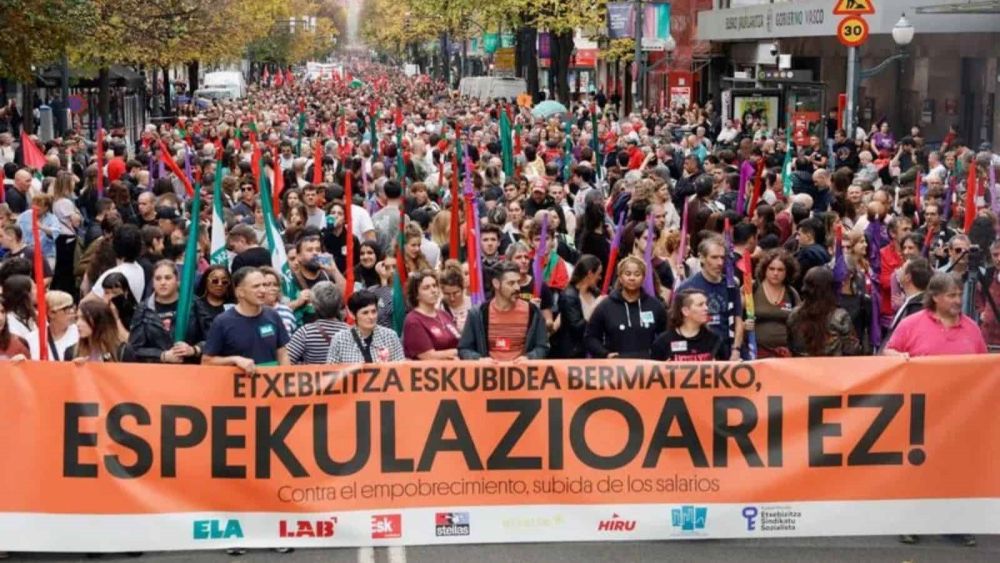
“Speculation No! Guarantee The Right To Housing” Basque language – Bilbao, Spain, Nov 11, 2026. (Photo: REUTERS/Vincent West)
And this deregulation will protect the financial interests of the large banks who own the mortgages of large-scale apartment complexes, whose landlords make interest payments based upon the inflated prices of rents caused by the immigration crisis. Therefore, Sánchez is doing his job, and will find future employment in the style of Tony Blair or Barak Obama, as a consultant for an austerity-mad globalist enterprise, or an advisor for peripheral European politicians.
Consequently, the general strike stunt serves the strategic, cultural, and electoral function of having the left define an affordability crisis which otherwise actually aligns with right-populist critiques, but steering it away from right-populist (communitarian) conclusions by focusing on the downstream effects in terms of the strain on the social budget and housing costs, and simultaneously making reference to “the capitalist system” as the larger overarching cause when speaking to radicalized elements of the working class or university enrolled youth activists (who trend towards communism or anarchism).
A preliminary conclusion
We can call this the macro-to-micro illusion. Yes, big capital is behind this crisis on the macro level, and also indeed, on the micro level, it is experienced as an affordability crisis. But to do this, the left must ignore meso-level analysis which explains the actual mechanics: mass migration as the tool of big business to lower labor costs while simultaneously enriching the landlord class.
This dynamic illustrates how the contemporary Western left has long since subordinated itself to the needs of capital while denying its logic: genuinely worker-centered measures, such as immigration controls, are revisioned as being entirely the politics of the far right, where they can be summarily dismissed by polite society, state and academic institutions, and the Brussels bureaucracy; all of which remain conveniently aligned on the issue. The communitarian right recognizes the logic of capital and opposes its globalized form there: open borders swing the labor market in favor of big business; culturally heterogeneous societies are more difficult to build solidarity in.
Plutocratic oligarchies which favour senatorial privilege, checks on executive power, and utilize instead the politics of divide and conquer, tend to favour culture war divisions which can reinforce but also mask class divisions; the erosion of executive or centralized power behind the mask of various negative freedoms, ignoring positive freedoms almost as a rule. In the evolution of post-modern neo-movements, what today we call the ‘left’ has become by and large a tool in the arsenal of plutocratic oligarchies in the West.
PSOE in Staged Collapse
Now, elections are scheduled for the end of November and these are early elections triggered by Prime Minister Pedro Sánchez’s failure to get through legislation on rent control, which was expected not to succeed in the first place.
Indeed, this sounds ridiculous, but such is the game. The failed legislation sparking the election consisted of two emergency housing measures; the Royal Decree-Laws 26/2026 and 27/2026, informally dubbed the “Maricarmen decrees”, which were predictably voted down by Spain’s Parliament on October 2, 2026. Together, they were designed to suspend evictions of vulnerable tenants until 2030, cap annual rent hikes at 2%, force automatic five-to-seven-year lease renewals with penalties for landlords who refused, restrict short-term tourist rentals, and ban corporate investment funds from buying discounted residential properties.
The defeat of Prime Minister Pedro Sánchez’s emergency housing was known to all before it happened, except for true believers of PSOE propaganda, given that his minority coalition previously relied on the center-right Catalan separatist party Junts to make a government, which represents property-owning interests and had already joined the conservative People’s Party (PP) and Vox earlier in the year to reject a similar eviction moratorium. Sánchez deliberately engineered this legislative showdown despite knowing the parliamentary outcome in advance. But facing investigations over the Koldo kickback scheme, a major Spanish political corruption scandal involving illegal commissions paid on emergency COVID-19 medical supply contracts, several deadly train crashes, growing discontent over rising living costs, and the invasion of almost 100,000 illegal immigrants who poured into Ceuta in the summer, all ahead of a scheduled 2027 vote, the right-wing opposition and Junts allowed the Socialists to trigger an early election on November 29, while framing the campaign around housing affordability and anti-eviction measures.
And all of this was starkly reflected in sliding poll numbers as Spain heads into the November 29 snap election, with major tracking averages showing Sánchez’s PSOE plunging 5 to 6 percentage points from its 2023 result down to roughly 26.7%. As the Socialists fall behind the conservative People’s Party (at 30.1%), polls indicate a combined PP and Vox right-wing bloc surging toward 50% of the vote, which would take them past the 176-seat parliamentary majority.
November 16, 2026
Posted by aletho |
Civil Liberties, Deception, Economics | European Union, Spain |
Comments Off on Spain’s Left Protested the Crisis It Legitimized: the General Strike as election stunt
There is a prescient passage in Orwell’s 1984 (one of many such, actually) where interrogator O’Brian explains to Winston why resistance is futile. He points out correctly that the Party controls all channels of communication (what today we would call the media) so that any expectation of moral satisfaction that Winston might harbour, of being canonised as a martyr, is therefore pointless.
The interrogator makes a serious point that perhaps we should all ponder. It is not just literary hyperbole. The woke threat of “cancellation” that each of us potentially faces today is a chilling reminder of Orwell’s amazing clairvoyance.
All of which bring us to some disturbing examples of the reality in which we live, at least those of us with the misfortune of living in that part of the world which vociferously boasts of its commitment to “rules” and “values.”
Who still remembers Călin Georgescu? Who still recalls that this man is the President presumptive of Romania, and that for that he has been relentlessly hounded and imprisoned by the very champions of those globally preached rules and values?
Georgescu has been successfully plunged into obscurity but it must be made clear that he is no Juan Guaidó. He is not a self-declared imposter of the ilk of Guaidó, without a constituency, whose fifteen-minute claim to fame was entirely by the grace and at the pleasure of foreign political cartels which Guaidó served loyally as a tool in their attempt to oust a legally and popularly elected uncooperative leader.
Călin Georgescu loyally served his own nation. He was committed to the cynically deceived people of Romania, who rewarded him with their trust and their votes in what they falsely expected was going to be a free and fair presidential election, conducted in accordance with “European standards,” whatever those naïve folk thought that meant, in which their votes counted and their preference carried weight.
We drew attention to the Georgescu story when it was breaking in early 2025, in what now appears to be a distant past. Since then, the winner in Romania’s Presidential election was subjected to a series of crude political manoeuvres which robbed him of his mandate, mired him in fabricated criminal proceeding apparently without any grounding in Romanian law just for the audacity of protesting the electoral disqualification, exposed his wife and children to endless intimidation and humiliation, and kept him in prison for months on spurious charges.
Călin Georgescu, whose name should be on the lips of everyone who treasures liberty and the genuine rule of law (as opposed to its arbitrary and tyrannical falsification, the “rules based order”) has effectively become a non-issue and a non-person, notwithstanding that the shameless abuse meted out to him cries to high heaven and should have shaken to the very foundations the mendacious system whose corrupt institutions failed this gallant Romanian patriot so unforgivably.
Just as the interrogator had put it to Winston, Călin Georgescu has been cancelled, but the monstrous system which thought it had sent him to oblivion failed to take into account his courageous and eloquent wife, Cristela, who is proving even more intractable. In a moving exposition of her husband’s case on a widely watched and influential podcast that is well worth watching, Mrs. Georgescu pulls no punches.
“We are not living in a democracy in Romania anymore,” she declares perhaps at some peril to herself. “It’s a tyranny growing stronger every day.”
“And why do I claim that it’s worse today?” she goes on to ask rhetorically. “The tyranny, the dictatorship today, it’s worse than it used to be. Before 1989, we knew it was a dictatorship. You knew you were not allowed to talk against it. You were in trouble if you would dare. And you knew the consequences.
“But today, we are told: ‘you’re free, present your case.’ And actually under this mask, a very severe persecution is happening. And not only to us. I’m not only his voice today, I’m the voice of millions of people who support him.”
Regrettably, there are other instances of the sort of morally annihilating repression exemplified by Călin Georgescu’s attempted excursion into his EU native country’s democratic politics. Another courageous man and outstanding public servant, Dr. Reiner Fuellmich, is presently rotting in a German dungeon on trumped up charges for using the tools of his profession to expose the colossal fraud and lethal danger posed by the Covid “vaccines” put out by greedy Western pharmaceutical conglomerates some, like Pfizer, with thick criminal dossiers and copious amounts of fines paid out to victims for past and present harm caused to millions afflicted by their hastily assembled and poorly tested products.
We have already written about the attempted discreditation and ultimate incarceration of this German-American trial lawyer of impeccable integrity (here and here). Quixotic naive, who thought that the legal system, which turned out to be as corrupt as everything else contaminated by the globalist pestilence, could where power and money were at stake be counted on to deliver and enforce a just verdict in the public interest. For that misplaced faith, Dr. Fuellmich is now rotting in a mouldy and damp prison cell in Lingen, Federal Republic of Germany, well into the third year of his incarceration as a prisoner of conscience in an allegedly denazified Germany who Amnesty International, which should have put him up as its poster boy, curiously seems not even to have heard of.
Nor may we overlook (much less forget) the retired Swiss colonel Jacques Baud, a man of intellect and honour whose distressing predicament is best encapsulated in the phrase made even more apposite when rendered in the harsh tones of one of his country’s official languages: bestraft ohne Gericht, or colloquially, punished without trial.
Readers might recall Jacques Baud’s frequent media appearances and expert commentary on the war in Ukraine and critical assessments of NATO’s eastward expansion. These interventions have now become notably rare and there is a troubling explanation for that. Col. Baud, although a Swiss citizen, whilst visiting in Brussels was in effect banned (the former apartheid South African practice fits his present circumstances perfectly) by European Union authorities, having been placed under EU sanctions. The EU version of South African apartheid sanctions, as applied to Col. Baud for publicly reiterated wrongthink concerning Ukraine and NATO, consists of a travel ban and asset freeze. The Swiss colonel, seemingly in perpetuity or until he repents and begs for forgiveness, is now stuck in Brussels, Belgium, where he was located when notice of EU sanctions was served on him. Since the entire space between the city of Brussels and the Swiss border obviously is comprised of EU territory within which, under the terms of the sanctions, he is banned from travelling, he remains involuntarily immobile under house arrest in Brussels. Note should be taken that no trial on the merits of Jacques Baud’s free speech case has been held and that consequently it is not a court that adjudicated these devastating personal sanctions. They were imposed administratively by bureaucrats of the European Commission. The Swiss Foreign Office has expanded no visible efforts toward extracting its entrapped citizen and so far no legal remedy has been thought of by the colonel’s legal team in Brussels to undo the extreme and arbitrary strictures placed upon their client’s personal liberty and public visibility by the Commission’s extra judicial decree.
The gentle reader is encouraged to ponder the fates of these three men against the backdrop of Orwell’s projections into the future which appear, by any reasonable standard, to describe flawlessly the key elements of the present, with which they are merging seamlessly. The unnoticed moral destruction and public erasure of bothersome individuals are no longer operations largely confined to the world of literary fiction. The next victim could be anyone.
Non-lethal oblivion is now a realistic and increasingly effective option for dealing with public figures whose existence and thinking are deemed annoying. Methodologies for its successful implementation are diverse and will become still more ingenious as inexorably the mass rejection of received narratives spreads.
November 16, 2026
Posted by aletho |
Civil Liberties, Full Spectrum Dominance, Timeless or most popular | European Union, Germany, Human rights, Romania |
Comments Off on The power of inflicting oblivion
An Essay on the Administrative Shifts That Turned Failure Into Success
In the decade after Jonas Salk’s inactivated polio vaccine was released in April 1955, the diagnostic threshold for declaring a polio epidemic was raised from 20 cases per 100,000 population to 35 per 100,000. A region now needed almost twice the historical case rate to register an outbreak at all. In the same period, the paralysis duration required for a diagnosis of paralytic poliomyelitis was extended from 24 hours to residual paralysis at 60 days, a criterion documented in the CDC’s own 1963 Poliomyelitis Surveillance Reports. A child paralyzed for forty days was, by administrative definition, no longer a polio case.
The third shift was the broadest. Cases that would previously have been classified as polio were redistributed across a growing list of adjacent neurological categories: aseptic meningitis, viral meningitis, enterovirus infection, coxsackievirus infection, transverse myelitis, and (later, in the era of oral vaccine campaigns in the global south) non-polio acute flaccid paralysis. The clinical picture in each category was, by the surveillance literature’s own description, indistinguishable from what had previously been called polio. Only the names changed. The vaccine appeared to work.¹
Half a century later, India performed the same label-dispersal maneuver in the modern context. The country had passed one year without a reported wild poliovirus case by 2012 and was declared “polio-free,” with formal WHO certification following in 2014. In the same window, cases of “non-polio acute flaccid paralysis” (NPAFP) surged in the states where oral polio vaccine coverage was highest. Writing in the Indian Journal of Medical Ethics in 2012, Dr. Neetu Vashisht and Dr. Jacob Puliyel documented an extra 47,500 cases of NPAFP in 2011 alone, “clinically indistinguishable from polio paralysis but twice as deadly,” with the incidence of NPAFP in each region directly proportional to doses of oral polio vaccine received.² A 2018 follow-up by Puliyel and colleagues in the International Journal of Environmental Research and Public Health traced the full arc: Indian NPAFP cases rose from 7,260 in 2000 to 59,462 in 2012 as pulse polio rounds intensified, and began to decline from 2012 as the number of rounds was reduced.³ The paralysis continued to occur and the children continued to die; the name was different, so the vaccine’s record remained intact.
Three shifts, one disease, spanning seven decades. Each permitted an injectable product to be reported as effective when its measurable biological outcome either stayed flat or worsened. What follows is a catalog of seven more. Each turned on a change in classification rather than a change in disease. The pattern spans more than a thousand years and arrives at its deepest expression in the WHO’s own official history of smallpox eradication.
The terrain-paradigm reading of what was actually happening alongside the US polio renaming is worth stating at the outset, because it recurs across the catalog. DDT was introduced into American agricultural and household use in 1943 as a neurotoxic chlorinated hydrocarbon pesticide. By 1945 it was already known to be stored in body fat and to appear in human and bovine milk. It was sprayed directly on children at swimming pools, impregnated into wallpaper in children’s bedrooms, and fogged through American suburbs by Shell oil trucks. Dairy cows were washed with it, and the pesticide passed through to the milk supply. In the UK town of Broadstairs in 1943, a polio outbreak was traced to a local dairy where cows had been washed down with DDT.
Between 1945 and 1952, as DDT application peaked across the United States, polio cases rose from roughly 25,000 to over 280,000, a more than tenfold increase in seven years. When DDT use declined around 1951-52 because of livestock deaths and farmer complaints, polio cases fell by two-thirds before Jonas Salk’s vaccine was introduced in 1955.
Dr. Morton Biskind, a Connecticut physician, published repeatedly from 1949 onward in peer-reviewed journals (including the American Journal of Digestive Diseases and the American Journal of Psychotherapy) documenting that his polio patients recovered when DDT exposure was removed, and that symptoms reappeared in the same patients each time on re-exposure. In 1950 he testified before Congress that pesticides, not a virus, were the major cause of polio epidemics. Ralph Scobey, MD, documented that children with polio symptoms kept in general wards never transmitted the illness to other patients, and that the clinical presentation matched known patterns of pesticide and heavy-metal poisoning.⁴
The clinical pictures Biskind and Scobey documented as pesticide poisoning (aseptic inflammation of neural tissue, flaccid paralysis of enteroviral appearance, and the acute paralytic events with variable recovery that Scobey described) correspond directly to the categories that absorbed the dispersed polio cases after 1955. Aseptic meningitis, enterovirus infection, coxsackievirus infection, and transverse myelitis each describe clinical patterns the pesticide-exposure literature had already documented without reference to any infectious agent. The dispersal was clinically available because there was no infectious agent to begin with. The symptoms could be redistributed freely across adjacent neurological labels without producing any clinical contradiction.
The Rockefeller Institute had succeeded in 1911 in having poliomyelitis classified in US Public Health Law as a reportable contagious viral disease, a classification that, as Scobey testified before Congress in 1952, “imposes only this type of investigation” and foreclosed toxicological inquiry at the legal level before any investigator could begin.
The declining polio curve the vaccine would soon claim credit for was already in progress; the three-shift renaming of the remaining cases finished the appearance. The pattern recurs across the ten shifts. The product fails on its original terms, the terms are moved, and the record is preserved.
In the early 1980s, a cluster of illnesses in young men in Los Angeles and New York was consolidated under a new name. Nancy Turner Banks, a Harvard Medical School graduate who practiced for over thirty years, described AIDS as “a collection of twenty-nine old diseases, clustered together, re-branded, and given a new scary label.”⁵ Peter Duesberg, elected to the National Academy of Sciences for his work on retroviruses, demonstrated the mechanism directly: tuberculosis without a positive HIV test was diagnosed as tuberculosis, treated with antibiotics, and expected to resolve. Tuberculosis with a positive HIV test was diagnosed as AIDS, treated with AZT (originally developed as a chemotherapy agent and shelved after it failed as a cancer treatment), and expected to kill the patient.⁶ The clinical picture, from the organism identified in the lungs to the patient’s presentation, was the same. The name decided the treatment, and the treatment decided the outcome.
The architecture transferred to twenty-nine conditions. Pneumonia in a person who tested negative was pneumonia. The same pneumonia in a person who tested positive was AIDS-defining pneumonia. Kaposi’s sarcoma, previously a rare condition in elderly men of Mediterranean descent, was reclassified as an AIDS-defining illness when it appeared in young homosexual men whose use of amyl nitrite “poppers” (then recognized in dermatology literature to produce vascular skin lesions) was redescribed as incidental. The rebranding generated a new patient category and a new treatment protocol. The historical conditions, with their established causes and effective treatments, were absorbed into a category whose cause was declared viral and whose treatment was declared cytotoxic. The old causes were no longer investigated. The new category required the new drugs.
AZT itself is the sharpest edge of the mechanism. The drug had been developed in the 1960s as a chemotherapy agent, found ineffective against the cancers it was designed for, and shelved. When it was revived for AIDS at doses of 1,500 mg per day (later reduced as the deaths mounted), it stopped cell division in all dividing cells, not only in the cells in which a putative retrovirus was alleged to replicate. The symptoms attributed to late-stage AIDS (wasting, anemia, collapse of what the establishment calls immune function) were also the known side effects of AZT. The renaming permitted a cell-killing drug to be prescribed to young men identified as HIV-positive, including asymptomatic men, and permitted the resulting deaths to be classified as deaths from AIDS rather than deaths from AZT. The drug sold and the category expanded; the cause was never seriously re-examined because the category was already named.
Between 1963 and 1967, approximately 18.9 million doses of a killed measles vaccine (inactivated with formaldehyde) were administered to American children. Within two years, physicians began reporting that children who had received the killed vaccine developed a severe, atypical presentation when subsequently exposed to measles. The illness included high fevers, atypical rashes, pneumonia, and liver involvement. The condition was named “atypical measles syndrome.”⁷ The 1970 Canadian Medical Association Journal and later the British Medical Journal published case series. A 2003 Nature Medicine paper reported, in primates, that the killed vaccine produced what the authors described as “nonprotective, complement-fixing antibodies with low avidity,” which the authors interpreted as driving immune complex deposition on subsequent exposure.⁸
The CDC’s current public position: anyone vaccinated between 1963 and 1967 with the killed version should be revaccinated. The condition remains in the medical literature today, still bearing its name. What the naming accomplished was to assign the illness to a new category rather than to the vaccine that produced it. “Atypical measles” is not described in the official literature as a failure of the measles vaccine; it is described as its own distinct syndrome. The renaming severed the direct line from product to injury.
Sudden Infant Death Syndrome had become a problem for the vaccine schedule by the early 2000s. The CDC’s own documentation acknowledged that “babies receive many vaccines when they are between 2 to 4 months old. This age range is also the peak age for sudden infant death syndrome (SIDS).”⁹ The temporal association was documented in reports to the Vaccine Adverse Event Reporting System (VAERS), in autopsy case series, and in the work of Viera Scheibner and others. The combined diphtheria-pertussis-tetanus shots (DPT, later DTaP) were implicated in a substantial proportion of SIDS cases occurring within the close post-administration window.
Beginning around 2009, the CDC introduced a broader umbrella classification: Sudden Unexpected Infant Death (SUID). The Shapiro-Mendoza classification system, formally published in Pediatrics in 2014, split what had previously been counted as SIDS into multiple sub-categories: SIDS proper, accidental suffocation and strangulation in bed, “ill-defined and unknown cause,” and “undetermined.” A CDC presentation described the result candidly: the “decline in SIDS is offset by increasing rates of: Cause unknown/unspecified, Other SUID (suffocation, wedging, overlaying, poisoning).”¹⁰ A Delaware public health document stated the mechanism in plainer language: “as the definition of SIDS has become narrower and more precise, more infant deaths are being classified as SUID cases rather than SIDS cases.”¹¹
The total number of sudden, unexplained infant deaths did not fall. The SIDS signal, which had become visibly correlated with the vaccine schedule, was dispersed across four less recognizable categories. The product that produced the pattern retained its clean record. The grieving parents went into four columns instead of one.
The 1976 swine flu vaccination campaign produced an episode the CDC could not immediately absorb. Within weeks of the mass vaccination drive, hundreds of cases of Guillain-Barré syndrome (an acute ascending paralysis presenting with respiratory involvement) appeared in vaccinated adults. By late December 1976, 172 Guillain-Barré cases had been reported across twenty-four states, with 99 of them in people recently vaccinated. The CDC Director halted the campaign. Independent reviews later confirmed that the vaccinated were approximately four times more likely to develop the condition than the unvaccinated, with roughly one additional case per 100,000 people vaccinated.¹²
The subsequent decades produced a different approach to the same phenomenon. The CDC established a “background rate” of 80 to 160 Guillain-Barré cases per week in the United States, “regardless of vaccination.” The regulatory frame became: cases following vaccination are compared against this background rate and classified as above it or within it. The language of coincidence replaced the language of causation. When Guillain-Barré appears in a flu vaccine recipient today, the question posed is not “did the injection trigger this?” but “does this case exceed the expected background?”¹³
The injection remained the same. The statistical architecture around it changed. The renaming here is subtler than the others in this catalog: not a new category, but a reframing of the injury as noise.
Whooping cough was supposed to have been eliminated by the pertussis vaccine. The 2024 UK figures made the failure impossible to ignore. UKHSA data confirmed 2,793 cases of pertussis across England in Q1 2024 alone, compared with 858 cases for the whole of 2023, a greater-than-threefold rise in a single quarter against a full prior year. Five infant deaths were reported in Q1 2024. Most adult cases occurred in a population with near-universal pertussis vaccination coverage. Mainstream UK media coverage, drawing on an older descriptor for the illness, began referring to the condition as the “100-day cough.” The term, used in headline after headline through 2024, began replacing “whooping cough” in much public discussion.¹⁴
The move here is softer than the others. “100-day cough” is not a new diagnostic category; it is an older vernacular descriptor revived in a particular rhetorical moment. What the revival accomplished was to shift the public frame from a disease that was supposed to have been eradicated (whooping cough) to a benign-sounding duration descriptor (a cough that lasts 100 days). The illness is still what the establishment calls pertussis. The vaccine still failed in the vaccinated population. The name shift absorbed some of the attention a 3,000-case cluster in a vaccinated population would otherwise have drawn. This is the weakest documented item in the catalog, included because the pattern across the other nine shifts permits it to be read for what it is: the softer end of the same spectrum.
The mechanism is not modern. George Bernard Shaw, who served on a London Borough Council Health Committee during a smallpox event at the turn of the twentieth century, described what he found: “I learned how the credit of vaccination is kept up statistically by diagnosing all the re-vaccinated cases of smallpox as pustular eczema, varioloid or what not, except smallpox.”¹⁵
Eleanor McBean, documenting the same period in The Poisoned Needle (1957), recorded corroborating practice. Hospital records were “worked on” before release. Mild smallpox in the vaccinated was recorded as chickenpox or measles. Serious smallpox in the vaccinated was recorded as syphilis or scrofula (an archaic term for tuberculosis of the lymph nodes). In the Salk polio trials of the 1950s, no case was counted as “immunized” unless it had received two shots; children developing polio after the first shot were automatically placed in the “uninoculated” class, invalidating any conclusion drawn from the trial figures.¹⁶ The administrative mechanism is at least one hundred and twenty years old, and its continuity is the significant observation. The particular shift that keeps the record clean varies with era and jurisdiction. The shift itself does not vary.
The oldest instance of the mechanism in this catalog ran for a thousand years and ended in the WHO’s own official history of its own eradication program. What the term “smallpox” designated varied by region, by century, and by the clinician applying it. A 1979 article in Medical History titled “Smallpox and the Evolution of Ideas on Acute Viral Infections” states that the identification of the illness from extant descriptions before AD 900 cannot be made with any degree of certainty, and that for several hundred years after the Latin terms variola and morbilli came into use, the illnesses they referred to could not be clearly distinguished on the basis of the available clinical descriptions.¹⁷ The same point appears elsewhere in the clinical literature: for centuries scarlet fever, rubella, measles, and what medicine would later call smallpox were considered a single category of febrile illness with rash.
The first formal attempt to split chickenpox off from smallpox as a distinct category was published by the English physician William Heberden in his paper “On the Chicken-pox,” read before the Royal College of Physicians on August 11, 1767 and printed in Volume 1 of the College’s Medical Transactions the following year. Heberden acknowledged in his own report that the pustules were the same size, that they contained a similar yellowish fluid, and that the preceding symptoms (chills, fatigue, cough, insomnia, migratory pains, loss of appetite, and fever) were shared. His primary evidence for separation was a difference in the timing of crust formation on the pustules. He stated plainly that his reason for proposing the split was “the small-pox, with which it may otherwise be confounded, and so deceive the persons, who may have had it.” The deception he feared was that a previous bout of what he was now calling chickenpox would be assumed to protect against smallpox, and smallpox inoculation would be refused as a result. The separation was proposed in defence of the inoculation practice.¹⁸
The proposal was not accepted for over a century. When it was eventually adopted in the early 1900s, the British Medical Journal carried extended correspondence on the difficulty of applying it. A letter published in the issue of October 27, 1923, from a physician working in Sudan, described epidemics that moved through three stages in the same population: indistinguishable from chickenpox in its early form, through alastrim (variola minor), and finally typical smallpox. Another physician in the same correspondence noted that “many so-called distinguishing characteristics are quoted in textbooks, but all of them may fail and leave one in perplexity.” The same period produced the diagnostic exchange at Johns Hopkins University in which several senior physicians diagnosed a patient as having a severe case of chickenpox, and William Osler, arriving on the ward, overruled them with “My God, Futcher, don’t you know smallpox when you see it?”¹⁹
The pattern of splitting off new labels continued through the twentieth century. The WHO launched its intensified global eradication campaign in 1967. Nine years earlier, in 1958, a pox-like illness had been observed in two shipments of cynomolgus monkeys arriving at the State Serum Institute in Copenhagen, Denmark; the monkeys had been imported from Singapore for use in polio vaccine research. The entity isolated from the lesions was named monkeypox virus. In August 1970, in the village of Bukenda in the Equatorial region of what was then Zaire, a case of smallpox-like illness in a child was investigated as a suspected smallpox outbreak nine months after smallpox had been declared eliminated from that country. When no variola virus could be recovered, the illness was reclassified as the first human case of monkeypox.²⁰ The WHO’s own 1988 publication acknowledges that monkeypox in humans is clinically indistinguishable from smallpox, with the primary distinguishing sign being enlarged lymph nodes, a feature that the same literature acknowledges is inconsistently present in monkeypox, occasionally present in smallpox, and also present in chickenpox. The distinguishing feature was not a distinguishing feature. The new label was simply a new label.
The 1976 India post-eradication surveillance is the mechanism’s clearest documented moment. A country-wide system for the surveillance of fever with rash was introduced across India in January 1976. During that year alone, 1,951,487 cases of fever with rash were entered in the registers, and 519,651 of the localities in which the cases occurred were visited by senior health workers. None of the cases was found to be smallpox. The WHO’s own 1988 publication documents the classification of what the surveillance did find: 862,155 were classified as chickenpox, 519,597 as measles, 146,855 as “other skin diseases,” and the remaining 422,880 as “miscellaneous.” Of the 102 cases investigated in 1976 by the senior epidemiologists of the smallpox eradication program as clinically suspected smallpox, 63 percent were classified as chickenpox and none as smallpox.²¹
The pattern was not unique to India. In Indonesia’s precertification surveillance, of 650 suspected smallpox cases investigated during 1970-1972, 629 (96.8 percent) were classified as chickenpox and none as smallpox. In the Afghanistan 1976 hospital searches, 223 suspected cases were investigated; 55 percent were classified as measles, 28 percent as chickenpox, and 17 percent as “a variety of skin diseases.” In Pakistan, 49,874 cases of fever with rash were detected and investigated between October 1974 and November 1976; 27,703 were classified as chickenpox. In Western Africa, 157 laboratory specimens from suspected cases were sent to the WHO collaborating centre in Atlanta between January 1972 and April 1976; none yielded variola virus, while 41 were found to contain herpesvirus particles. The same publication notes that the laboratory test used (virus isolation on the chorioallantoic membrane) did not grow chickenpox virus at all, so “hundreds of specimens from chickenpox viruses might be examined with consistently negative results.”²²
During the eradication program, ambiguous cases had been counted as smallpox. After the formal declaration of eradication in 1980, the same clinical presentations, in the same populations, were counted as chickenpox, measles, monkeypox, or “other skin diseases.” The institution’s own eight-hundred-page official history documents each step of the reclassification. The curious skeptic can download the publication from the WHO archive and read the pages.
The shift occurs after a product is introduced, or in the course of defending one. The product is almost always a vaccine. In the AIDS case it is a diagnostic test paired with a drug protocol. In the smallpox case it is the vaccine industry’s founding product, and the shift runs for a thousand years. The shift permits the product to be reported as effective when the measurable biological outcome either stays flat or worsens.
The structural prevention was described by Ralph Scobey, MD, in testimony to the United States House of Representatives in 1952. “For almost half a century,” he told Congress, “poliomyelitis investigations have been directed towards a supposed exogenous virus. The manner in which the Public Health Law is now stated imposes only this type of investigation. No intensive studies have been made to determine whether or not the so-called virus of poliomyelitis simply results from an exogenous factor, for example, a food poison.”²³ The law imposed the name. The name imposed the investigation. The investigation confirmed the name.
What the ten renamings reveal is the character of medical categories themselves. They are decisions made by institutions whose solvency depends on the outcome of the decision. The International Classification of Diseases, which the WHO describes as the body that “defines the universe of diseases,” expanded from roughly 13,000 codes in ICD-9 to approximately 70,000 codes in ICD-10. Human biology did not multiply fivefold. Billing granularity did. Each new code is a new product line. Each renamed condition is a maneuver on an existing line.
The financial architecture explains the direction of travel. A diagnosis that falls into a vaccine’s injury column creates liability. A diagnosis that falls into a different column generates revenue (a new ICD code, a new specialist referral, a new drug protocol, a new monitoring regimen). The administrative incentive runs in one direction only. A country has no office whose job is to re-examine old diagnoses and ask whether the renaming was wrong. It has many offices whose job is to add new codes and to classify ambiguous cases into them. Over decades, the gradient produces exactly what the catalog documents: a vaccinated population with the same injuries, differently labeled, absorbed quietly into categories that no longer point back at the product.
Specific beneficiaries can be named for each shift. The polio reclassification protected the pesticide industry (DDT was then manufactured by Monsanto, Ciba, and other chemical firms, and the broader organochlorine and organophosphate markets were implicated by Biskind’s and Scobey’s testimony) and secured the Rockefeller Institute’s control of the research field through its decades-long monopoly on virus-focused funding. The AIDS reclassification generated AZT’s revenue stream for Burroughs Wellcome (later Glaxo, now GSK), expanded the National Cancer Institute’s retrovirus research programs, and preserved the broader germ-theory framework for infectious disease classification. The atypical measles name protected Pfizer, which manufactured the “Pfizer-Vax Measles-K” killed vaccine implicated in the condition. The SIDS-to-SUID dispersal protected the childhood vaccine schedule as a whole, benefiting Merck, Sanofi, GSK, and Pfizer across their pediatric product lines. The GBS background-rate reframing protects every seasonal flu vaccine manufacturer against the signal that stopped the 1976 campaign. The pertussis 100-day cough rebrand protects GSK and Sanofi, the two companies that currently manufacture pertussis vaccines. The smallpox fragmentation across a thousand years protected the vaccine industry’s founding product, legitimized the WHO’s claim to eradication authority (a claim that funded the subsequent global vaccination infrastructure), and created the modern markets held by the manufacturers of chickenpox vaccines (Merck’s Varivax, licensed by the FDA in March 1995; GSK’s Varilrix), monkeypox vaccines (Bavarian Nordic’s Jynneos), and the measles-component vaccines whose markets were created by the splitting-off of measles as a distinct entity (Merck, GSK, and Sanofi). The autism spectrum expansion protects the entire childhood vaccine schedule and simultaneously generates revenue for genetic testing firms built around “genetic predisposition” as the declared cause of a condition whose rise has correlated instead with the expansion of the schedule itself.
A defender of the schedule might respond that the ten shifts above are examples of scientific refinement over time, that diagnostic categories improve as understanding grows, and that any reclassification system will produce some apparent movement in reported case counts. The claim is testable. Genuine diagnostic refinement would run in both directions. Some conditions would be newly recognized as vaccine-related; others previously thought vaccine-related would be reclassified as independent. A random-walk refinement process would produce roughly symmetric movement. The ten shifts documented here are not symmetric. Every single one runs in the same direction: toward removing a vaccine-adjacent injury signal from the column that would record it as such. In a century of diagnostic revision, no example appears of a shift that moved a condition into the vaccine-injury column. The asymmetry is the finding.
The restructured catalog makes a second pattern visible. The opening and closing items are the same maneuver executed at two radically different timescales. Polio’s label-dispersal across aseptic meningitis, viral meningitis, enterovirus infection, coxsackievirus infection, transverse myelitis, and non-polio acute flaccid paralysis unfolded across seven decades. Smallpox’s fragmentation across chickenpox, measles, scarlet fever, alastrim, varioloid, pustular eczema, monkeypox, and “other skin diseases” unfolded across a thousand years. Both began with a single diagnostic category that threatened an existing or forthcoming vaccination program. Both ended with that category broken into a dozen adjacent labels. Both culminated in formal institutional declarations of eradication or elimination. A pattern that appears once can be coincidence. A pattern that appears twice, separated by a century and executed on different continents by different institutions, is a mechanism.
A related mechanism, still unfolding, operates on the autism spectrum. The DSM has serially expanded the autism criteria across its editions: DSM-III in 1980 introduced “Infantile Autism” as a narrow category; DSM-III-R in 1987 broadened it; DSM-IV in 1994 added Asperger’s and PDD-NOS; DSM-5 in 2013 consolidated the spectrum. CDC-reported autism prevalence rose from roughly 1 in 150 children in 2000 to 1 in 36 by 2020. The expansion mechanism differs from the renamings above in form (an existing diagnosis is widened rather than substituted) but produces the same effect: a growing population of children with developmental signals whose causes, under earlier criteria, might have been investigated specifically. Within the expanded category, cause is declared largely genetic, and investigation of environmental and iatrogenic factors is foreclosed before it begins.
The mechanism is not only historical. It is actively operating today. Three contemporary movements are worth watching, each tracking directly onto one of the templates documented above.
The first is Sudden Adult Death Syndrome (SADS). The term dates to the 1990s as a narrow cardiology category for unexplained sudden deaths with normal postmortem findings. From 2022 onward, SADS has been pushed into public health prominence and formally registered. Melbourne’s Baker Heart and Diabetes Institute established Australia’s first national SADS registry in 2022, media coverage of sudden deaths in young, previously healthy adults has surged in parallel with the mRNA injection rollout, and the term now covers a visibly rising number of cases that would once have warranted individual investigation.²⁴ The classification is described in the clinical literature as “mechanistically neutral,” which is to say that it will not point back at any intervention. The structural function matches the SIDS-to-SUID move exactly: a visible correlation between an injection schedule and sudden deaths is absorbed into a named category whose cause is declared genetic, idiopathic, or unknown.
The second is myocarditis following mRNA injection. The CDC’s own VAERS received 1,626 reports meeting the myocarditis case definition after mRNA-based injection between December 2020 and August 2021, concentrated in males aged 18 to 24 at rates of 52.4 to 56.3 cases per million doses.²⁵ The regulatory response has borrowed directly from the 1976 Guillain-Barré playbook: cases following injection are compared against “expected baseline rates” and declared statistically expected or declared “likely associated” at rates mild enough to permit continued recommendation. The language of coincidence replaces the language of causation. The injection remains the same; the statistical architecture around it does the work the renaming did in the ten historical cases.
The third is Post-Treatment Lyme Disease Syndrome (PTLDS), introduced by the Infectious Diseases Society of America in 2006 as a diagnostic category for persistent symptoms following antibiotic treatment of Lyme disease. The CDC adopted the terminology and formally discourages the use of “chronic Lyme disease.”²⁶ The function is to absorb ongoing symptoms into a mechanistically-neutral category that does not point back at either the organism’s persistence or the inadequacy of the treatment protocol. The template is the same template used in the ten historical shifts, deployed in the present.
Vaccine efficacy, measured biologically, has rarely survived serious scrutiny. Measured administratively, it has survived everything.
The ten renamings in this catalog are the mechanism by which the administrative measure is kept intact. When a product fails on the terms by which failure was originally defined, the terms are quietly moved. The product retains its reputation. The children who were paralyzed, who died in their cots, who developed severe atypical illness after exposure, who presented in 1976 India with what the WHO’s own surveillance team then classified as chickenpox rather than smallpox, go into other columns.
The 1976 India post-eradication surveillance is the mechanism caught in the act and preserved in the institution’s own records. Two years after the WHO had declared India free of smallpox, 1,951,487 cases of fever with rash were recorded across the country, and more than half a million of the localities in which they occurred were investigated by senior health workers. Of the 102 cases senior epidemiologists investigated as clinically suspected smallpox, 63 percent were classified as chickenpox; none as smallpox. The eradication machinery found what it was supposed to not find, and reclassified what it did find so that the finding did not threaten the declaration.
The WHO’s own 1988 publication Smallpox and Its Eradication is the institutional record of exactly this maneuver. The 1976 India surveillance findings are on page 1184. The parallel findings in Indonesia (629 of 650 suspected cases reclassified as chickenpox), Afghanistan, Pakistan, and Western Africa are documented in the surrounding chapters. The publication is available for free download from the WHO’s digital archive. Whatever word one chooses for what the surveillance accomplished (reclassification, redefinition, administrative convenience, policy), the publication exists and says what it says. So do the other nine documents cited above.
Imagine you promised your mom that your room was clean. She came in to check, and she saw socks on the floor. So you decided, together with your friends, that socks on the floor don’t count as a messy room anymore. From now on, a messy room only means food on the floor.
Now you can honestly say your room is clean. The socks are still there. You didn’t pick them up. You just changed what counts.
The next week, there’s an apple core on the floor. So you decided apple cores don’t count either. A messy room now means pizza on the floor, and only pizza. The apple core and the socks are still there, but you can still honestly say your room is clean.
Grown-ups do this with medicines sometimes. They give a child a shot, and if the child gets sick anyway, they change the name of what the child has, so it doesn’t count as the shot not working. The child is still sick, and the parents are still worried, but in the big books that keep track of these things, the shot still worked.
The dictionary was the trick all along.
- The 60-day residual paralysis criterion is documented in the CDC’s own Poliomyelitis Surveillance Reports, including the 1963 and 1966 Annual Summary reports available in the CDC Stacks archive (CDC document numbers 609 and 43793), which define the measurement as “those cases with known residual paralysis at 60 days plus those cases reported dead.” The 20-to-35 per 100,000 epidemic threshold change is documented in William Trebing, Good-Bye Germ Theory: Ending a Century of Medical Fraud (AuthorHouse, 2006), and summarized in The Architecture of Deception, pp. 80–82. The redistribution of former polio cases across aseptic meningitis, viral meningitis, enterovirus infection, coxsackievirus infection, and transverse myelitis categories in the post-1955 US surveillance reports is documented in the CDC Poliomyelitis Surveillance Reports of the mid-to-late 1950s and 1960s, and summarized in Jim West, DDT/Polio: Virology vs Toxicology (2023).
- Vashisht, Neetu, and Jacob Puliyel, “Polio programme: let us declare victory and move on,” Indian Journal of Medical Ethics, Vol. 9, No. 2 (April–June 2012), pp. 114–117. DOI: 10.20529/IJME.2012.035.
- Dhiman, Rachana, Sandeep C. Prakash, V. Sreenivas, and Jacob Puliyel, “Correlation between Non-Polio Acute Flaccid Paralysis Rates with Pulse Polio Frequency in India,” International Journal of Environmental Research and Public Health, Vol. 15, No. 8 (August 2018), 1755. DOI: 10.3390/ijerph15081755.
- Scobey, Ralph R., MD, “The Poison Cause of Poliomyelitis and Obstructions to its Investigation,” Archives of Pediatrics, Vol. 69 (April 1952); see also Jim West, DDT/Polio: Virology vs Toxicology (2023), and the summary in Mark Gober, An End to Upside Down Medicine: Contagion, Viruses, and Vaccines (Waterside Productions, 2023). Biskind, Morton S., MD, and Irving Bieber, MD, “DDT Poisoning: A New Symptom With Neuropsychiatric Manifestations,” American Journal of Psychotherapy, Vol. 3, No. 2 (1949), pp. 261–270. Biskind, Morton S., MD, “Public Health Aspects of the New Insecticides,” American Journal of Digestive Diseases, Vol. 20, No. 11 (1953), pp. 331–341, and his 1950 testimony before the US House Select Committee to Investigate the Use of Chemicals in Food Products (Delaney Committee). The 1943 Broadstairs, Kent, dairy-DDT polio incident is documented in the UK historical literature and summarized in Jim West’s DDT/Polio. The Rockefeller Institute’s 1911 classification of poliomyelitis as a reportable contagious viral disease under US Public Health Law is discussed in The Architecture of Deception, pp. 70–72.
- Nancy Turner Banks, MD, AIDS, Opium, Diamonds and Empire: The Deadly Virus of International Greed (iUniverse, 2010).
- Peter Duesberg, PhD, Inventing the AIDS Virus (Regnery Publishing, 1996), as cited in Mark Gober, An End to Upside Down Medicine (Waterside Productions, 2023). See also Dawn Lester and David Parker, What Really Makes You Ill? Why Everything You Thought You Knew About Disease Is Wrong (Independently Published, 2019), Chapter 4. The 1,500 mg per day initial AZT dose is documented in Fischl, M. A., et al., “A randomized controlled trial of a reduced daily dose of zidovudine in patients with the Acquired Immunodeficiency Syndrome. The AIDS Clinical Trials Group,” New England Journal of Medicine, Vol. 323, No. 15 (October 11, 1990), pp. 1009–1014, which opens by stating: “The initially tested dose of zidovudine for the treatment of patients with advanced disease caused by the human immunodeficiency virus type 1 (HIV) was 1500 mg. Although this dose is effective, it is associated with substantial toxicity.” The original 1987 trial (Fischl, M. A., et al., “The efficacy of azidothymidine (AZT) in the treatment of patients with AIDS and AIDS-related complex,” NEJM, Vol. 317, No. 4, July 23, 1987, pp. 185–191) used 250 mg every 4 hours (1,500 mg daily).
- Fulginiti, V. A., et al., “Altered Reactivity to Measles Virus: Atypical Measles in Children Previously Immunized with Inactivated Measles Virus Vaccines,” JAMA, Vol. 202, No. 12 (1967), pp. 1075–1080. McLean, D. M., et al., “Atypical measles following immunization with killed measles vaccine,” Canadian Medical Association Journal, Vol. 103, No. 7 (October 10, 1970), pp. 743–744. “Pneumonia in Atypical Measles,” editorial, British Medical Journal, 1971.
- Polack, F. P., et al., “A role for nonprotective complement-fixing antibodies with low avidity for measles virus in atypical measles,” Nature Medicine, Vol. 9, No. 9 (September 2003), pp. 1209–1213.
- Centers for Disease Control and Prevention, “Sudden Infant Death Syndrome (SIDS)” public information page, as cited in Dawn Lester and David Parker, What Really Makes You Ill?, Chapter 7.
- Shapiro-Mendoza, Carrie K., et al., “Classification System for the Sudden Unexpected Infant Death Case Registry and its Application,” Pediatrics, Vol. 134, No. 1 (July 2014), e210–e219. CDC presentation on the SUID initiative, Shapiro-Mendoza, CDC National Center for Chronic Disease and Public Health Prevention.
- Delaware Division of Public Health, “Sudden Unexpected Infant Death (SUID) in Delaware,” public health briefing document.
- Garrett, Laurie, The Coming Plague: Newly Emerging Diseases in a World Out of Balance (Farrar, Straus and Giroux, 1994), p. 181, documenting the 1976 swine flu campaign and the CDC’s internal acknowledgment that Guillain-Barré rates among the vaccinated were approximately four times those of the unvaccinated. Institute of Medicine, Immunization Safety Review: Influenza Vaccines and Neurological Complications (National Academies Press, 2003).
- Centers for Disease Control and Prevention, “Guillain-Barré Syndrome (GBS): Questions & Answers,” public information page. CDC framing of the “background rate” of 80–160 GBS cases per week in the United States, “regardless of vaccination.”
- UK Health Security Agency, Briefing Note 2024/017, “Recent increase in cases of Bordetella pertussis (whooping cough),” issued 17 June 2024, which documents 4,793 laboratory-confirmed cases in England January through April 2024 and the Q1 2024 total of 2,793 cases. UKHSA, “Confirmed cases of pertussis in England by month,” published surveillance data at gov.uk/government/publications/pertussis-epidemiology-in-england-2024. The comparison to 858 cases for the whole of 2023 is reported in UKHSA press releases and corroborated in BBC and other UK national press coverage (May 2024). Media usage of the term “100-day cough” documented in multiple UK outlets (Yorkshire Post, The Scotsman, Bristol World, Yorkshire Evening Post, The Star, Wigan Today) during the 2024 cluster.
- George Bernard Shaw, as cited in Eleanor McBean, The Poisoned Needle: Suppressed Facts About Vaccination (Mokelumne Hill, CA: Health Research, 1957), and in The Architecture of Deception, p. 81. Shaw served on a London Borough Council Health Committee during a smallpox event at the turn of the twentieth century.
- McBean, Eleanor, The Poisoned Needle: Suppressed Facts About Vaccination (Mokelumne Hill, CA: Health Research, 1957); see particularly Items 11 and the discussion of Salk trial methodology.
- Razzell, P., “Smallpox and the Evolution of Ideas on Acute Viral Infections,” Medical History, Vol. 23, No. 1 (1979). The specific page range and the exact Razzell quotations regarding the inability to identify smallpox from extant descriptions before AD 900, and the inability to distinguish the illnesses referred to by variola and morbilli on the basis of early clinical descriptions, should be verified against the primary source before final publication.
- Heberden, William, “Of the Chicken-pox,” read before the Royal College of Physicians on August 11, 1767; published in Medical Transactions, Published by the College of Physicians in London, Vol. 1 (London: S. Baker and J. Dodsley, 1768), pp. 427–436. Heberden’s stated motivation (”the small-pox, with which it may otherwise be confounded, and so deceive the persons, who may have had it”) is quoted in Arvin, A. M., and Gershon, A. A., eds., Varicella-Zoster Virus: Virology and Clinical Management (Cambridge University Press, 2000), introduction. The citation detail is confirmed in multiple independent sources including Clinics in Dermatology (2023) and the Dictionary of National Biography entry on Heberden.
- Thorp, Eustace, “Diagnosis of Small-pox and Chicken-pox,” letter, British Medical Journal, Vol. 2, No. 3278 (October 27, 1923), p. 787, retrievable via PubMed Central (PMC2317564). The William Osler / Futcher diagnostic exchange at Johns Hopkins University is recounted in the correspondence on smallpox diagnosis in the same BMJ series in late 1923. The exact wording of the quotations attributed to the Sudan letter and to the “many so-called distinguishing characteristics” letter should be verified against the primary scanned pages before final publication; the existence and dating of the correspondence series is confirmed in PMC and in the BMJ archive.
- The 1958 identification of the entity named monkeypox virus at the State Serum Institute (Statens Serum Institut), Copenhagen, in two shipments of cynomolgus monkeys imported from Singapore for polio vaccine research, is documented in von Magnus, P., et al., “A pox-like disease in cynomolgus monkeys,” Acta Pathologica et Microbiologica Scandinavica, Vol. 46 (1959), pp. 156–176. The August 1970 first-human-case report in a child in the village of Bukenda, Equatorial Province, Zaire (now DRC), nine months after smallpox had been declared eliminated from that country, is documented in Ladnyi, I. D., Ziegler, P., and Kima, E., “A human infection caused by monkeypox virus in Basankusu Territory, Democratic Republic of the Congo,” Bulletin of the World Health Organization, Vol. 46, No. 5 (1972), pp. 593–597. The subsequent WHO documentation treating human monkeypox as clinically indistinguishable from smallpox except by inconsistently-present lymphadenopathy is presented in Fenner, F., et al., Smallpox and Its Eradication (WHO, 1988), Chapter 29.
- Fenner, F., Henderson, D.A., Arita, I., Ježek, Z., and Ladnyi, I.D., Smallpox and Its Eradication (Geneva: World Health Organization, 1988). ISBN 92 4 156110 6. Available for free download from the WHO Institutional Repository for Information Sharing (IRIS) at apps.who.int/iris/handle/10665/39485. The 1976 India country-wide fever-with-rash surveillance findings (1,951,487 cases recorded; 519,651 localities visited; 862,155 cases classified as chickenpox; 519,597 as measles; 146,855 as “other skin diseases”; 422,880 as “miscellaneous”; of 102 clinically-suspected smallpox cases investigated by senior epidemiologists, 63 percent classified as chickenpox and none as smallpox) are documented in Chapter 25 (”Certification by International Commissions: 1973–1977”), pp. 1181 (Table 25.22, Table 25.23) and 1184.
- Fenner et al., Smallpox and Its Eradication (1988), Chapter 25. The Indonesia 629/650 chickenpox reclassification figure is at p. 1157. The Afghanistan hospital-search figures (223 suspected cases: 55 percent measles, 28 percent chickenpox, 17 percent other skin diseases) are at p. 1173. The Pakistan 49,874 fever-with-rash cases and 27,703 chickenpox cases are at pp. 1176–1177 (Table 25.19). The Western Africa 157 laboratory specimens with 41 herpesvirus positives are at p. 1166 (Table 25.12). The acknowledgement that the chorioallantoic membrane isolation technique “did not grow” chickenpox virus and that “hundreds of specimens from chickenpox viruses might be examined with consistently negative results” is at p. 1159.
- Ralph R. Scobey, MD, Statement before the US House of Representatives Select Committee to Investigate the Use of Chemicals in Food Products (Delaney Committee), May 1952, as part of hearings on the toxicological causation of poliomyelitis. Quoted in The Architecture of Deception, p. 81, and in Jim West, DDT/Polio: Virology vs Toxicology (2023). Scobey’s related published work includes “The Poison Cause of Poliomyelitis and Obstructions to its Investigation,” Archives of Pediatrics, Vol. 69 (April 1952), pp. 172–193.
- Sudden Adult Death Syndrome (SADS) is documented in the medical literature from the 1990s onward: Behr, E. R., et al., “Sudden adult death syndrome and family history,” European Heart Journal, Vol. 29, No. 13 (2008), pp. 1670–1680. The Baker Heart and Diabetes Institute (Melbourne) SADS registry was announced in June 2022; see Royal Australian College of General Practitioners coverage, newsGP, June 2022, and Dr. Elizabeth Paratz’s work at the Baker Institute. The parallel rise in reported sudden deaths among previously healthy young adults from 2021 forward is documented in national press coverage across Australia, the UK, and the United States, and in independent databases including The Expose and OpenVAERS.
- Oster, M. E., et al., “Myocarditis Cases Reported After mRNA-Based COVID-19 Vaccination in the US From December 2020 to August 2021,” JAMA, Vol. 327, No. 4 (2022), pp. 331–340. Among 192,405,448 persons receiving 354,100,845 mRNA vaccine doses, 1,626 reports met the CDC myocarditis case definition, with reporting rates peaking at 52.4 (BNT162b2) and 56.3 (mRNA-1273) per million second doses in males aged 18–24. See also CDC Morbidity and Mortality Weekly Report, Vol. 70, No. 27 (July 9, 2021), and the VRBPAC presentations of Dr. Tom Shimabukuro (CDC COVID-19 Vaccine Coordination Unit) to the FDA on June 7, 2022.
- Wormser, G. P., et al., “The clinical assessment, treatment, and prevention of lyme disease, human granulocytic anaplasmosis, and babesiosis: clinical practice guidelines by the Infectious Diseases Society of America,” Clinical Infectious Diseases, Vol. 43, No. 9 (November 2006), pp. 1089–1134, which introduced the PTLDS case definition. See also Rebman, A. W., and Aucott, J. N., “Post-treatment Lyme Disease as a Model for Persistent Symptoms in Lyme Disease,” Frontiers in Medicine, Vol. 7:57 (February 25, 2020), and CDC public materials recommending the use of PTLDS and discouraging “chronic Lyme disease” terminology.
In Print
The Unbekoming library is available in paperback, printed to order through Lulu and shipped worldwide. The shelf begins with the paradigm question underneath everything else — No Virus, the isolation problem, the collapse of virology’s foundational claims, and a disease-by-disease reappraisal — and moves through the suppressed compounds mainstream medicine set aside: The DMSO Book, Chlorine Dioxide: The Forbidden Remedy, The Iodine Book, and The Hydrogen Peroxide Book. Two more recover what’s still on the kitchen shelf: Baking Soda and The Castor Oil Book. Two more recover the minerals modern soil, water, and processing quietly stripped from the diet: The Magnesium Handbook and The Boron Book. Sitting alongside these is No Contagion, co-authored with Jamie Andrews — the case against germ theory itself, catalogued through 258 failed contagion experiments.
The critique books cover what medicine, dentistry, psychiatry, and veterinary practice have become. The Unvaccinated treats the completely unvaccinated as a comparison group across twenty chapters and five appendices. Medicalized Motherhood follows a woman through 123 documented interventions from teenage pill to postpartum discharge. Drilling for Profit treats cavities, gum disease, and crooked teeth as the dietary problem they are. What Your Vet Can’t Tell You applies the same critique to pets. Escape from Psychiatry documents the fabrication of the DSM and the specific damage of every major psychiatric drug class. The Vitamin K Injection covers what happens in the first hours of a newborn’s life.
The full shelf is at lulu.com/spotlight/unbekoming. A physical book reaches the person a Substack post never will — the skeptical relative, the friend who won’t click a link but might open a book, the visitor whose eye lands on a coffee table. Buy one to keep, and one to give away.
November 15, 2026
Posted by aletho |
Deception, Science and Pseudo-Science, Timeless or most popular | COVID-19 Vaccine, HIV/AIDS, United States |
Comments Off on The 10 Disease Renamings That Rescued the Vaccine
The US-led military bloc will not hold a top-level meeting in Tirana in 2027, Albanian Prime Minister Edi Rama has said
NATO has dropped plans to hold a leaders’ summit in 2027, Albanian Prime Minister Edi Rama has said. The summit was supposed to be held in the Albanian capital of Tirana. The decision comes as tensions between Washington and its European NATO allies continue to mount.
US President Donald Trump has repeatedly criticized Washington’s European NATO allies over their defense spending and refusal to support the US military campaign against Iran.
Speaking on Thursday, Rama said that “there is not yet a common position on when the [NATO] summit will happen, for sure not in 2027.” He added that “in 2028, if it will be a summit, it will be in Tirana.”
NATO Secretary-General Mark Rutte, meanwhile, played down the change, telling the Associated Press that the military bloc is “flexible” with its summits and will convene one “when a necessity is there.”
The declaration adopted at NATO’s 2025 summit in The Hague stated that the leaders looked “forward to our next meeting in Türkiye in 2026 followed by a meeting in Albania.” However, any mention of the Balkan nation was conspicuously absent from a similar document issued after this year’s gathering in Ankara.
In April, Reuters reported, citing several officials speaking anonymously, that NATO members were considering holding fewer summits, breaking with the recent practice of annual gatherings. Some of the sources cited a desire to avoid confrontations with Trump.
Moreover, NATO has throttled back its ministerial meetings, canceling the customary October gathering of defense chiefs this year, with none scheduled for 2027 either. The number of foreign ministers’ get-togethers has likewise been reduced from two to one for next year.
US Defense Secretary Pete Hegseth and Secretary of State Marco Rubio have either not attended or left early during some of the previous meetings.
Earlier this year, US envoy to NATO Matthew Whitaker said that Europe only ranked fourth among Washington’s global security priorities, taking a back seat to the “defense of the homeland,” as well as the situation in the Western Hemisphere and the Pacific.
“For 77 years our NATO allies have taken advantage of the United States’ strength,” Whitaker told Newsmax in August.
Whitaker’s remarks followed a Bloomberg report claiming that Washington was intending to make continued military support for European NATO member states contingent on whether they had “been publicly supportive” of US foreign-policy initiatives, including those in the Middle East and Western Hemisphere.
Ahead of the July summit in Ankara, Trump told reporters that he was “very disappointed with NATO,” suggesting that Washington could further scale back its military footprint in Europe.
“I just want loyalty. You know, we’re so loyal to them. We are always fighting for them,” the US president said earlier.
Hegseth previously accused European NATO members of denying Washington predictable access to their bases and airspace during the US military campaign against Iran, an apparent reference to France, Spain, and Italy. He concluded that NATO had degenerated into a “paper tiger and a one-way street” following the end of the Cold War.
November 15, 2026
Posted by aletho |
Wars for Israel | NATO |
Comments Off on NATO cancels 2027 leaders’ summit
Russia’s Permanent Representative to International Organizations in Vienna, Mikhail Ulyanov, says the International Atomic Energy Agency (IAEA) is losing its status as an impartial organization, mainly because of its politicized approach to Iran’s nuclear program.
In an interview with Russian newspaper Kommersant, published on Sunday, Ulyanov said that despite being a relatively effective system, IAEA safeguards are increasingly being used by Western governments as a means of exerting pressure on other countries.
“The main problem is that Western countries actively use the safeguards system as a political instrument of pressure on states they dislike. This is precisely what erodes the technical basis of safeguards and undermines the principle of impartiality,” he said.
No information on nuclear activity near Kolang Mountain
Commenting on US allegations about Iran’s undeclared nuclear activities, Ulyanov said that Russia, like the IAEA, has no information about any such activities in the area of Kolang Mountain, also known as Pickaxe Mountain, in central Iran.
“The IAEA has never reported this site. As far as we know, the agency has no information confirming that any nuclear activity could be taking place there. We also have no information on the matter. The Americans, in their usual manner, have not bothered or have been unable to substantiate their accusations,” he said.
In July, US President Donald Trump identified Kolang Mountain as a new target for a “good big strike.” The US claims that a secret nuclear facility is being built or has already been constructed beneath the mountain.
There is no publicly available information about the facility’s exact purpose, but the United States has claimed that it could house a uranium enrichment plant. US authorities have provided no evidence to support this claim.
West, IAEA powers playing meaningless games over Iran
Ulyanov said that, through the efforts of Western-majority members of the UN Security Council and the IAEA Board of Governors, “meaningless political games continue instead of serious efforts to resolve the conflict” over Iran.
“In September, the Board of Governors adopted another resolution demanding that inspectors from the agency be granted access to all Iranian nuclear facilities. This is happening at a time when Washington and Tel Aviv are regularly threatening Tehran with missile strikes which, if international officials are allowed into the relevant facilities, could put their lives in direct danger,” he said.
He added that the United States and the E3 countries (France, Britain and Germany), using their numerical majority on the IAEA Board of Governors, had called for the September resolution to be referred to the UN Security Council.
“Strictly speaking, this does not mean that the Iranian dossier was formally referred to the council. However, Western countries and Greece, which held the rotating presidency of the UN Security Council, effectively used this move to stage meaningless discussions,” the senior diplomat said.
According to Ulyanov, these are “dangerous exercises leading to escalation” and “can produce no useful practical results by definition.”
November 15, 2026
Posted by aletho |
Wars for Israel | France, Germany, IAEA, Iran, Russia, UK, United States |
Comments Off on IAEA’s politicized use of safeguards undermines its impartiality: Russian envoy