Hezbollah denies activity in Syria amid persistent and false claims
Al Mayadeen | May 5, 2026
Hezbollah’s Media Relations categorically denied the false accusations issued by the Syrian Interior Ministry, which claimed to have dismantled a “Hezbollah-affiliated cell” that was planning to carry out security operations inside Syrian territory.
In a statement issued on Tuesday, Hezbollah noted the repeated accusations issued by the Syrian government despite the resistance’s consistent assertions that it maintains no activity in Syria.
It further said that the repetition of such allegations “raises serious questions and confirms that there are those seeking to ignite tension and discord between the Syrian and Lebanese peoples.”
Consequently, Hezbollah said it wishes only well for Syria and its people, and that any threat to Syria’s security would also constitute a threat to Lebanon’s security. It also reiterated that it never sought and would never seek to destabilize the security of any state, stressing that its confrontation remains against the Israeli entity and its expansionist project.
“Hezbollah has been and will remain in a defensive position in confronting the Zionist enemy and its expansionist projects, an enemy of Lebanon and Syria that occupies their lands and covets their resources and the wealth of their peoples,” the statement concluded.
Hezbollah urges vigilance
Several statements have been issued by Syria’s transitional leadership accusing Hezbollah of operating inside its territories, which have been consistently rejected. This is also a trend that stretches beyond Syria, with recent fabricated allegations coming out of Bahrain and Kuwait.
Hezbollah has warned against such narratives, urging the countries to remain vigilant in the face of what appears to be a foreign plot to ignite tensions between Arab nations and the Axis of Resistance.
Melkite bishops concerned over Israeli demolitions in South Lebanon
Al Mayadeen | May 5, 2026
The Council of Melkite Greek Catholic Bishops in Lebanon urged on Tuesday both the Lebanese government and the United Nations to take measures to protect civilian property and religious institutions.
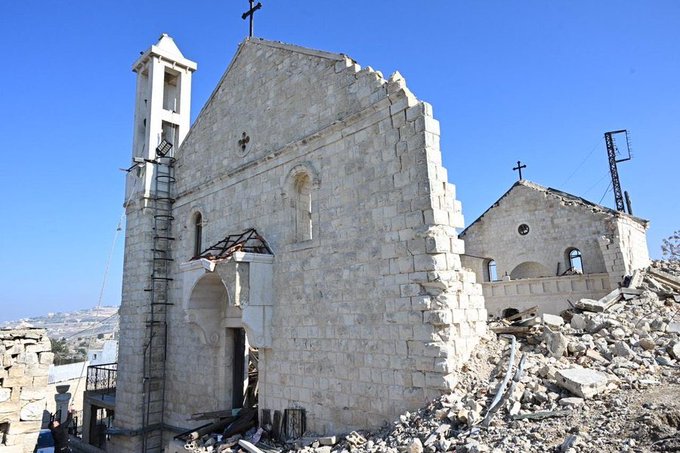
The bishops specifically cited Yaroun, where local officials and community representatives say a Melkite convent was destroyed earlier this month alongside other structures, describing the destruction of the buildings as “a deep wound in the national and human conscience”.
According to Christian community figures in Yaroun, the convent belonging to the Melkite tradition was bulldozed by Israeli occupation forces in southern Lebanon.
Adib Ajaka, a local Christian community leader, said the structure was part of a religious complex that also included nearby facilities. He disputed claims that the convent remained intact, stating that rubble near adjacent buildings indicated its destruction.
In turn, the French Catholic charity L’Oeuvre d’Orient condemned the “deliberate act of destruction of a place of worship and the systematic destruction of homes in southern Lebanon aimed at preventing the return of civilian populations”.
The organization called for the protection of religious heritage sites and civilian housing, warning of long-term consequences for displaced communities.
This isn’t an isolated case; the desecration of religious sanctities is a recurrent activity for Israeli forces. From Gaza to South Lebanon, numerous videos and photos were posted by Israeli soldiers themselves showing them shooting pointlessly at mosques, desecrating churches, and destroying statues of religious figures.
Last month, a photo circulating on social media showed an Israeli occupation soldier using a sledgehammer to strike the head of a statue of Jesus on a crucifix that had fallen from a cross.
Israel’s Obliteration Ecocide from Gaza to Lebanon and Beyond
By Dan Steinbock | Palestine Chronicle | May 3, 2026
Lebanon accuses Israel of committing ecocide in country since 2023. It is an extension of Israel’s destruction of Gaza – and its obliteration doctrine.
Israeli military aggression has “reshaped both the physical and ecological landscape” of southern Lebanon, according to the Lebanese report (which does not consider the impacts of Israel’s latest barrage of attacks this spring).
In her foreword, Lebanon’s minister for the environment, Tamara el Zein, notes: “The scale and intentionality of the damage to forests, agricultural lands, marine ecosystems, water resources, and atmospheric quality constitute what must be recognized as an act of ecocide, with consequences that extend far beyond immediate destruction.”
Obliteration ecocide in Lebanon
Released by the country’s National Council for Scientific Research and presented by the environment ministry, the report accuses Israel of “ecocide” during the 2023–2024 war and subsequent escalations. It frames environmental destruction not as incidental “collateral damage” but as a systematic transformation of ecosystems.
Key findings are damning. They include:
- 5,000 hectares of forest destroyed
- Massive agricultural losses ($118m direct infrastructure damage; much larger indirect losses)
- Soil contamination (including high phosphorus levels)
- Air pollution from repeated strike cycles
- Destruction of orchards and irrigation systems
Minister el Zein characterizes this as “intentional ecological destruction” affecting food systems, public health, and the long-term viability of southern Lebanon’s rural economy.
International reporting on the same dossier highlights an estimated total damage burden of over $25 billion when recovery costs and economic losses are included. The figure is a combined total from the assessments by the Lebanese report and the World Bank Rapid Damage and Needs Assessment (RDNA) 2025.
This framing aligns with a growing legal discourse around “ecocide” as a potential international crime, particularly where environmental damage is widespread, long-term, and strategically embedded in military operations.
It is also aligned with UN reporting on the broader Israel–Lebanon escalation, confirming extensive infrastructure destruction, civilian displacement, and strikes affecting residential areas.
As the ecocide of Gaza has gone effectively unpunished by the international community, the Netanyahu government is extending the environmental devastation into Lebanon and the proximate region.
Obliteration Doctrine in Gaza
In The Obliteration Doctrine (2025), related commentaries and excerpts, I define this doctrine as the lethal mix of scorched earth policy, collective punishment, and civilian victimization, coupled with massive indiscriminate bombardment and systematic use of artificial intelligence (AI).
The concept is vital because it connects the dots between military strategies, aerial bombardment, lethal deployment of artificial intelligence (AI) and international law, particularly the Geneva Conventions and the Genocide Convention. As Professor William Schabas, a leading scholar of genocide, notes, “the Obliteration Doctrine” “adds a new term to the lexicon on genocide, notably in the application of international law and its judicial mechanisms.”
Modern warfare in Gaza is no longer just counterinsurgency but systems-level destruction of the environmental and infrastructural substrate of life—water, soil, agriculture, energy, and urban continuity.
This interpretation overlaps with empirical reporting on Gaza’s environmental collapse:
- Satellite analysis shows 38–48% of tree cover and farmland destroyed
- Severe contamination of soil and groundwater
- Large-scale destruction of greenhouses and irrigation systems
- Air pollution from sustained bombardment and debris burning
These patterns are described in independent investigations as producing conditions of near-uninhabitability in many parts of Gaza.
Warfare is no longer bound by battlefield geography. It becomes the restructuring—or “obliteration”—of ecological systems that sustain civilian life.
Ecocide here is not merely the destruction of nature, but the destruction of life-support systems as a purposeful strategy. It is another word for cultural genocide.
Lebanon and the Gaza template
The Lebanese report and international commentary suggest strong structural parallels between Gaza and southern Lebanon operations:
- Destruction of orchards, especially olive groves (long-lived economic ecosystems)
- Targeting of water infrastructure and rural supply systems
- Repeated airstrikes generating soil and atmospheric contamination
- Displacement of civilian populations from ecologically productive zones, which can be seen as a form of ethnic cleansing
International media reports that Israel is applying a “Gaza playbook” in Lebanon: expulsion orders, infrastructure targeting, and village-level destruction patterns.
Lebanon is now an adjacent theatre where similar operational logics are extended across a different ecological terrain:
- Gaza: dense urban-agricultural mosaic under blockade conditions
- Southern Lebanon: dispersed agro-ecological rural system with forested and orchard economies
In both cases, ecological assets are not collateral but structurally embedded in livelihood and resistance capacity – and that makes them strategic targets under the high-intensity obliteration doctrine.
Consequences beyond Lebanon (and for Israel)
The environmental consequences of such conflict patterns are not geographically contained. Three spillover trajectories are particularly important.
First of all, regional ecological degradation. Soil contamination, wildfire damage, and agricultural collapse are not confined to strike zones. Windborne particulates, water contamination, and long-term soil chemistry changes affect broader cross-border ecosystems.
Second, economic fragility and food-system insecurity. Both Lebanon and Israel depend on regional agricultural stability and water systems. Repeated infrastructure destruction increases food import dependence, rural depopulation and long-term land degradation in border zones.
Third, internal Israeli environmental vulnerability. A less discussed but critical dimension is the simple reality that prolonged warfare conditions can feed back into Israel’s own ecological systems vis-à-vis air quality deterioration from sustained military operations, water system strain under security infrastructure expansion, fire ecology disruption in northern regions. long-term land-use militarization effects.
In this sense, “obliteration” generates mutual ecological degradation across interconnected landscapes. It is an ecological version of MAD – mutually assured destruction.
Diffusion of Doctrine
The key concern is not just localized destruction but doctrinal diffusion. Methods of high-intensity ecological disruption normalize across theaters. And let’s keep in mind that the first test of the obliteration doctrine occurred in Dahiya, the predominantly Shia enclave of Beirut.
US military legacy in Iraq and Syria already includes extensive infrastructure and ecosystem disruption under counterinsurgency and airpower doctrines. These features include water system destruction in Iraq, oil field fires, atmospheric contamination, and urban siege warfare effects in Raqqa and Mosul via coalition partners.
Such precedents create a shared operational vocabulary where environmental damage is treated as secondary to strategic objectives.
In a potential Israel–Iran escalation scenario, ecological infrastructure becomes strategically central through water scarcity systems in Iran’s arid regions, oil and petrochemical infrastructure vulnerability, and agricultural basins dependent on irrigation networks.
Under the obliteration logic, these become dual-use environments—civilian life-support systems that also acquire military significance.
Finally, there is the regional systemic risk. This implies a shift from territorial warfare to ecosystem-targeted coercion, where water, soil, energy, and agriculture become primary pressure points. Meanwhile, environmental degradation is exploited as a form of strategic leverage and recovery cycles extend beyond political timelines into generational horizons.
From Battlefield to Biosphere as a Target
The Lebanese charges, Gaza environmental destruction data, and the doctrine of obliteration converge on a structural transformation in modern conflict.
The object of war is increasingly not just territory or armed forces, but the ecological infrastructure that makes civilian life possible. In this way, destruction of that infrastructure is a prelude to ethnic cleansing and displacement.
For military doctrines, this may be framed as an incidental or operational necessity. But for Lebanon and environmental analysts, this constitutes potential ecocide under international law. In view of the obliteration doctrine, it represents a systemic shift in the practice of warfare itself, from the battlefield to the biosphere as a target.
What happens in Gaza won’t stay in Gaza. What happens in Lebanon won’t stay in Lebanon. The stage is being set for obliteration ecocides wherever they are seen as effective necessities.
Ecological systems are now central to both the conduct and consequences of war.
– The author of The Fall of Israel (2024) and The Obliteration Doctrine (2025), Dr Dan Steinbock is the founder of Difference Group and has served at the India, China and America Institute (US), Shanghai Institute for International Studies (China) and the EU Center (Singapore). For more, see https://www.differencegroup.net/
UAE deports tens of thousands of Pakistanis, seizes their savings amid war on Iran: Report
Press TV – May 5, 2026
Authorities in the UAE are conducting a sweeping deportation campaign targeting tens of thousands of Pakistani workers, freezing their bank accounts and stripping them of their life savings amid growing regional fallout from the US-Israeli aggression on Iran.
While initial reports from New Lines Magazine placed the number of expelled individuals at 15,000, Pakistani sources recently confirmed to Press TV that the deportations are continuing at a rapid pace and now affect tens of thousands of workers.
The expulsions target Shia Muslims or individuals who have publicly expressed solidarity with Tehran following the recent US-Israeli aggression against Iran.
Those targeted are being expelled without formal charges or legal recourse. The systematic removals involve sudden arrests, phone confiscations, and transfers between various detention facilities before the workers are forced onto flights back to Pakistan.
Crucially, deportees are being sent back “without being given the opportunity to withdraw their funds” from Emirati banks, according to a Shia cleric cited by New Lines Magazine.
This sudden seizure of assets has left many families in financial ruin, stripping workers—some of whom spent decades contributing to the Emirati economy—of their entire life savings.
Mohammad Amin Shaheedi, chief of Ummat-e-Wahida Pakistan, told the magazine that following the outbreak of the war, the UAE government launched “what appears to be an organized campaign to deport Shia individuals from the country.”
The US-Israeli aggression began on February 28 with airstrikes that assassinated senior Iranian officials and commanders, including Leader of the Islamic Revolution Ayatollah Seyyed Ali Khamenei. In response, Iranian armed forces launched daily missile and drone operations targeting locations in the Israeli-occupied territories and US military bases and assets, including those in the UAE.
The ensuing war sparked immense public solidarity with Iran across the region, particularly in Pakistan.
Sources indicate the UAE’s mass expulsions are deeply tied to Islamabad’s clear stance against the Israeli regime’s aggression on Iran and Lebanon, as well as Pakistan’s prominent role as a mediator.
On April 8, forty days into the war, a Pakistan-brokered temporary ceasefire between Iran and the US finally took effect. However, subsequent peace negotiations in Islamabad ultimately stalled amid Washington’s maximalist demands and insistence on unreasonable positions.
Wheels Down in Tbilisi: Was a Routine U.S. Military Stopover a Deliberate Signal to Iran?
By Seth Ferris – New Eastern Outlook – May 5, 2026
A brief and poorly explained landing of a U.S. military transport aircraft in Tbilisi at the end of March 2026 has become a subject of discussion and speculation about its real significance, fueling suspicions that more complex geopolitical signals may lie behind the official explanation of a “routine flight.”
Let’s pull apart the “routine flight” narrative and read between the lines, asking whether a fleeting stopover was less about logistics and more about sending a message — one that Georgia may end up paying for. If you think geopolitics is all press releases and polite diplomacy, think again. I would suggest that what is going on in the shadows, outside of mainstream coverage, is closer to theater — with Georgia cast in a role it never auditioned for.
Start with the headlines: last month, a US Air Force cargo aircraft made a brief stop in Tbilisi, purpose unknown – and just start reverse engineering, taking it apart, and you come up with what is between the lines as to the possible motivations for the US, a strategic ally of Georgia, to be willing to put Iran, its regional partner, in harm’s way. Moreover, it is interesting to know the news sites where this news first appeared, such as Georgian Today, and its history of paid hired gun articles supporting US policy in the region.
It is not as if Georgia and the US do not know that now is not the most opportune time to be perceived as supporting the illegal American-Israeli war against Iran. And let’s not forget C-130 Turkish Cargo Planes falling out of blue Georgian skies. Providing logistic support in a preempted war of aggression is still a recognized crime under the Nuremberg Codex. That puts the provider of such support in the crosshairs of the party being attacked, as has already been demonstrated by Iranian countermeasures, not to mention ‘protective reaction’ strikes in the Gulf States and Jordan.
What do we know?
A United States Air Force military transport aircraft made a short, unexplained landing in Tbilisi the last week of March, prompting questions and speculations but little official detail about its actual mission. However, multiple reports published on April 1, 2026, said a Boeing C-17 Globemaster III landed at Tbilisi International Airport in the afternoon after departing from the U.S. military hub at Ramstein Air Base in Germany.
It is interesting that the US Embassy provided a ‘most vague’ news release after the incident, telling of a phone call between Secretary of State Marco Rubio and Georgia Prime Minister Irakli Kobakhidze the very next day.
Also vague is the lack of coverage of planes without tail numbers landing at regional airports, such as the one named in honour of the Soviet-Georgian movie “Mimino” in Telavi, East Georgia, supposedly owned by the Aviation University of Georgia. It has operated since 2012 and serves as a training ground for students in the Faculty of Aviation and Engineering.
But it can serve other purposes, as the airport hosts an aircraft technical service enterprise, a navigation tower, a terminal building for passengers, and dormitories for pilot-instructors and engineering-technical staff.
Recent sightings, including of European-looking visitors to the facility, appear a bit too dodgy in terms of standard news release material about a local use and training facility after the landing of the military transport and drones spotted over Georgia – too short and sweet not to be subterfuge.
The U.S. Embassy characterized some flight movement as routine, stating that such flights are “regularly carried out in coordination with partners,” without providing details about cargo, passengers, or final destination.
Flight tracking platforms such as Flightradar24 confirm that C-17 aircraft frequently operate across Europe and the Middle East, typically transporting personnel, equipment, or humanitarian supplies, though specific mission details are not publicly disclosed.
But I am more interested in what was on board, delivering or taking out human cargo! This brings back memories of a Turkish military transport, a C-130. Dropping from the clear blue sky a few months ago, including its crew, all died, and the debris was scattered over a wide area of Georgian territory. The forensic findings of that crash investigation have never been publicly shared to the best of my knowledge.
Wheels Down!
Would the Georgian government, especially now, be so naive as to agree to this touchdown, an unexpected one at that—and of a US military transport plane out of the blue in the middle of a shooting war in the Middle East?
Already there is political blowback. Georgia political analyst Gia Khukhashvili reportedly said that Rubio’s phone call was a “threatening warning”.
Perhaps Rubio was checking how ready Georgia was, and in what form [to what degree] it was ready to help solve America’s logistical problems… I don’t think there have already been any concrete proposals at this stage. But this was logically followed by a threatening warning (for Georgia) from the Iranian ambassador: “Don’t do anything wrong, otherwise you will also become a target,” the Georgian News portal quotes the political scientist.
Gia Khukhashvili believes that there will be no Georgian-American agreements, because “Washington will understand who it is dealing with … and how the Georgian PM Kobakhidze will later say that Rubio threatened him on the phone and demanded to open a second front,” confirmed the Georgian political pundit.
Posting News to Provoke Iran!
Who knows the real motivations and how the news was reported? As one close, trusted Georgian source shared, … just that they post this news to make Iran angry! The UNM, United National Movement, former Saakashvili regime, wants it so VERY much!
Why didn’t they use Turkish or Armenian bases?
That is a good question, and I think you already know the answer. The US wanted to show Iran that Georgia and the US are cooperating, so it provoked Iran to send a drone or make some attack, as Israel has ordered the US to do.
It should be noted that Armenia has a Russian base, and the plane is claimed to have flown over some Armenian and Turkish territory, perhaps touching down in the Kurdish-controlled region of Northern Iraq. It would have been too dangerous to land in Armenia, as secrets could be revealed, and as for Turkey, it shares a similar position as Georgia, it does not want to get involved, or give the impression of being involved, especially since the Americans are openly arming regional Kurds. It can be expected that a substantial part of this ratline is flowing into and through Turkish territory.
I still can’t find any serious discussion on the plane and its real purpose for making a short stopover in Georgia. It appears that the US and Israel would love to put Georgia in the crosshairs of Iran just for the hell of it. It is also interesting that strikes have been carried out by Israel on joint Russian-Iranian port facilities on the Caspian, in the part on the Iranian side.
Possible Motivations for Wheels Down and Vague News Coverage
My first thought was delivering something to put in place for Iran. But if it went to Turkish airspace, it could also be headed to eastern Turkey or Iraq. Or one of the NATO bases in Turkey, although I’m pretty sure those are in the west, and we would not be in the flight path. In any case, if it is at all related to the war, then more EU countries are banning the use of the bases in their countries, so if a plane needs to stop somewhere or refuel, it could be done here. Georgia still wants to stay on good terms with the US, so if it is a brief stop, they would probably allow it. Not much will happen. If the use looks more like staging, it could be dangerous. Moreover, they could use Vaziani. I think NATO supported development of an air base there (which the government now wants to use for a new commercial mega-airport). But there isn’t much of an air force here, so maybe Vaziani lacks fuel in any quantity and other amenities. The motivation was perhaps to deliver some radar equipment, greenbacks, spyware equipment, or perhaps human resources, thinking that Iran will not attack Georgia since it needs it too much as its window to the world.
We’ll have to see; just a thought on it!
In the end, a half-hour touchdown, a vague press release statement, and a conveniently timed diplomatic call say more than any official briefing ever will. Whether it was cargo, coordination, or quiet signaling, the message landed louder than the aircraft itself: Georgia is being watched, tested, and potentially positioned in a conflict it has no desire to join.
And if this was meant as a signal to Iran, then it’s a risky one—because in today’s climate, even a brief stop can turn a bystander into a target. A fleeting military stopover can transform neutral ground into perceived staging areas, risking Iranian retaliation against a nation determined to remain on the sidelines. Sparse public facts and local sources reveal the shadowy interplay of great-power signaling, where a half-hour touchdown may speak louder than any formal briefing—placing Georgia uncomfortably in the crosshairs of a war it wants no part of.
Seth Ferris is an investigative journalist and political scientist, expert on Middle Eastern affairs.
Follow new articles on our Telegram channel
Trump’s second strike on Iran would be suicidal. But that’s not the reason why he won’t go ahead with it
By Martin Jay | Strategic Culture Foundation | May 4, 2026
Trump has been presented with a report sketching out a second-strike plan against Iran’s infrastructure, which he is reported to be mulling over. The media has latched onto terms like “short, powerful” strikes aimed at Iran’s infrastructure – which the author predicted in two previous articles and which, if it were to happen, would occur over the summer period when temperatures reach unbearable levels in the region. But is Trump really serious about it, and does he even understand the extent of Iran’s retaliation? The very fact that Trump has military advisors who are even presenting him with such plans shows, if nothing else, the level of their disconnect from reality and his exaggerated sense of self-importance.
The US already did this the first time round and went through its stocks of ordnance, breaking all records for the volume of missiles used in such a short space of time. It did very little to bring Iran to its knees, rather making it stronger than ever, with greater support. But what it did succeed in doing was giving Iran a dry run with such an attack and allowing it to learn a great deal about how to cope with one. Militarily, Iran has never been stronger, more focused and more technologically advanced. For Trump to believe he has a shot at a second go is not only unrealistic but sheer madness in terms of what the US – and to a lesser extent Israel – is going to have to deal with as a response. Iran will almost certainly reduce Saudi Arabia’s oil infrastructure to dust, which experts estimate would take ten years to rebuild.
If the US opts to go for a second strike, the retaliation against Saudi oil infrastructure and the US military ships themselves being used in the blockade will be unprecedented. Not only could oil easily reach 200 USD a barrel, but the striking of the US armada could be the end of America as we know it.
While the Iranian government presents Trump with their fourteen-point plan, its key officials understand how difficult it is for Trump to walk away. Both sides talk as though they’ve won the war, but in reality Trump is shackled to Netanyahu, who is insisting that the ridiculous blockade continues. What the US media are not reporting about it, though, is that it is only really working for the cameras and not choking Iran of revenues as reported. Many tankers from countries friendly with Iran travel towards the straits while keeping very close to the Iranian coastline – too far for the Americans to strike them, as US battleships would have to come closer.
Meanwhile Iran takes further steps to formalise its legal ownership, which would suggest there is an even stronger case for Tehran to strike the US battleships at some point. Iran is patient and prefers to keep a dialogue going, hoping for Trump to back down at some point while the markets increase pressure on him each day and EU countries drift farther away from Washington’s influence as their own economies face collapse if the situation isn’t resolved soon. Trump has his own way of dealing with the crisis, which, hilariously, is always to place himself first. His recent tantrum about NATO not supporting him, resulting in him pulling US troops out of Germany, is simply a distraction.
Yet the chances of this second strike happening are unlikely. But not for the reasons that seem obvious. In reality, China and Russia are playing an increasingly central role in supporting Iran, and Trump is beginning to understand what this means in practical terms. The low levels of missiles will restrict his options about what kind of strike this second one could be, which is why there’s so much talk about the US using its own hypersonic missiles. It’s not only that the US can’t replenish its stocks – THAAD and Patriot are very low – but the essential raw minerals needed to make them come from China, and Beijing has indicated that this supply is on pause. The other point is that Israel has almost nothing left to even throw into the air, let alone to present so-called journalists with video pictures of a country defending itself. Israel has nothing left. For Trump to go ahead with a second strike would really give Iran the excuse it needs to destroy Trump as a global leader, as hitting Saudi Arabia’s oil would be a wake-up call that Trump would have to take seriously. Iran sees such a strike just as the Americans considered the atomic bombs dropped on Japan at the end of the Second World War: a moment of clarity.
Trump is still confused. But such a strike would put such enormous pressure on him from around the world, from America’s allies, that the sheer noise would be deafening for him. He would have to listen to it and concede defeat. But for the moment, there is still time for distracting the media with utterly stupid statements that portray America as a winner in the war, and we should expect more of them – but some kind of defeat is coming. Creating a massive distraction will be inevitable, and that might come in the form of a new crisis around the world or from the US pulling out of NATO. Iran, right at the last moment, adding that it is now able to include the nuclear issue as part of the talks – that is now on the table. But will Trump seize the moment?
Palantir touts record expansion and ‘battlefield’ AI value
RT | May 4, 2026
Palantir Technologies reported a blowout first quarter, saying revenue rose 85% year on year to $1.63 billion as its US business more than doubled, driven by rapid growth across both commercial and government customers.
The company said in its Q1 report, published Monday, that US revenue jumped 104% to $1.28 billion, with commercial revenue up 133% to $595 million and government revenue up 84% to $687 million. The results beat Wall Street estimates, and the company also raised its full-year guidance, saying it now expects 2026 revenue of up to $7.66 billion, implying annual growth of about 71%.
CEO Alex Karp, who has increasingly framed Palantir’s AI tools as central to Western military and industrial power, said the “twin pistons of our US business are now firing in sync.”
“We believe it is not hyperbolic to say that nearly all AI workflows that actually create value – especially on the battlefield – are built on Palantir,” Karp wrote in an accompanying letter to shareholders, stating that the company “was founded to strengthen US national security, to protect Americans and their freedom.”
Palantir – named after the obsidian seeing-stones from Tolkien’s The Lord of the Rings, through which the dark lord Sauron keeps watch on his underlings – is a software firm primarily serving the defense and intelligence sectors.
Palantir’s flagship product is a system called Gotham, which pulls together and analyzes satellite footage, human intelligence from the CIA, signals intelligence from the NSA, and other data that might otherwise take days to sift through. Gotham and MOSAIC – another Palantir target-identification program that pulls digital data, including surveillance footage and IP addresses, from a target area – use AI to label the most effective targets for military strikes.
The US has acknowledged using these programs to select targets during its ongoing war on Iran, but insists that humans make the final decision to fire. Abroad, Palantir’s technology is used by the British Ministry of Defence, the Israel Defense Forces, and the Armed Forces of Ukraine.
The company’s earnings update came weeks after Palantir drew criticism for a 22-point manifesto summarizing themes from Karp’s book The Technological Republic. The manifesto argued that Silicon Valley has an “obligation” to participate in national defense, that “hard power” will be built on software, and that AI weapons are inevitable. Critics labeled it a blueprint for “technofascism.”
Israeli telecom networks used for mass surveillance across countries
Al Mayadeen | May 4, 2026
A probe by the digital research group Citizen Lab has uncovered that telecommunications infrastructure owned by Israeli companies has been weaponized to track citizens in more than 10 countries over the past three years, exploiting decades-old network protocols and modern 5G systems to transform them into sophisticated tracking devices.
According to a report published by the Israeli news outlet Haaretz, the investigation revealed that infrastructure ranging from legacy networks built in the 1970s to the latest 5G systems has been repurposed into surveillance tools using advanced spyware programs. Since November 2022, over 15,700 attempts to pinpoint phone locations have been detected across numerous countries, including Thailand, South Africa, Norway, Bangladesh and Malaysia, all routed through the networks of “Israel”-based telecommunications firms.
The findings raise serious questions about “Israel’s” role in the global surveillance industry, as the very infrastructure designed to connect people has been turned into a mechanism for tracking them without their knowledge or consent.
Internal documents cited by Haaretz revealed that Verint, the parent company of Cognyte, sold an SS7-based location tracking system called SkyLock to a government client in the Democratic Republic of Congo.
The SS7 protocol, originally developed to route calls and texts, support international roaming, and enable interoperability between mobile operators, has been systematically exploited for surveillance purposes.
The investigation also found that Fink, a Swiss telecommunications company, enabled Israeli surveillance firms such as Rayzone to impersonate legitimate cellular carriers and connect to older mobile networks. This allowed the firms to track users worldwide by abusing the SS7 signaling protocol.
The exploitation was not limited to legacy systems. Next-generation Diameter protocols, which manage 4G and 5G networks, were also compromised, according to the findings. One particularly notable method identified was SIMjacking, where a hidden text message sent to a target device forces the SIM card to reveal its location without the user ever seeing the message.
The phone-tracking operations were carried out through the networks of Israeli telecom companies 019Mobile and Partner Communications. 019Mobile responded by stating that it is a virtual operator and that its identity may have been impersonated, denying any involvement in tracking activities.
No immediate responses were received from Fink, Partner Communications, Exelera Telecom, Cognyte, or Verint.
The investigation exposes a disturbing reality: Israeli telecommunications technology, sold and deployed around the world, is not merely passive infrastructure but has been deliberately weaponized for mass surveillance.
The involvement of major Israeli firms in selling tracking systems to authoritarian governments, and the exploitation of global telecom networks by Israeli surveillance companies, points to a systematic pattern rather than isolated incidents.
As the US-Israeli war on Iran continues to dominate headlines, the international community has once again turned a blind eye to “Israel’s” role as a global leader in surveillance and cyber-weapons. From Pegasus spyware to SS7 exploits, Israeli technology has been used to track journalists, activists, and ordinary citizens across multiple continents.
US claim of sinking Iranian boats ‘a lie’, senior military official tells IRIB
Press TV – May 4, 2026
A senior Iranian military official has rejected a claim by the United States military that it has sunk several Iranian boats as part of an attempt to open the Strait of Hormuz, the IRIB News reports.
The statement by the unidentified commander was cited in a Monday report by the IRIB News, where the official reacted to comments by the US Central Command (CENTCOM) about an alleged confrontation between Iranian and US naval forces in regional waters earlier in the day.
“The US claim regarding the sinking of a number of Iranian combat boats is a lie,” said the commander.
Head of CENTCOM Admiral Brad Cooper said earlier on Monday that the US military had destroyed six Iranian small boats and intercepted missiles and drones fired at US warships, as he acknowledged that the Islamic Revolution Guards Corps (IRGC) had acted to stop Washington’s attempts to break Iran’s control over the Strait of Hormuz.
That came after US President Donald Trump announced he had ordered the US military to begin an operation to break Iran’s control over the Strait and allow commercial ships to pass through, after more than two months of being stranded in regional waters because of the US-Israeli aggression against Iran.
The IRGC warned in response that any attempt by US military or commercial vessels to pass through the Strait of Hormuz without coordination with Iranian authorities would be met with swift and decisive action.
Iran has controlled the Strait since the early days of the US-Israeli aggression that began in late February, allowing only ships that are deemed non-hostile and that observe security protocols announced by the Iranian military to transit the waterway.
The control has left nearly 3,000 ships and some 20,000 sailors stranded on both sides of the Strait, while causing a major surge in international oil prices.
The IRIB also quoted the Iranian military official as denying reports that Iran had attacked targets in the United Arab Emirates, saying Tehran had no such plans.
That came after UAE authorities said they had intercepted missiles fired at the Persian Gulf country while failing to stop drones exploding at an oil site.
New KC-46 Supertankers Promise Israel Conventional Samson Option Strike Сapability
Sputnik – 04.05.2026
The first of six customized, Boeing KC-46 ‘Gideon’ tankers has completed its maiden flight in the US, and will be delivered to Israel in about a month’s time, the Israeli Defense Ministry has announced.
The twin-engined ‘next-gen stealth tanker’ aircraft feature:
- standard 767 airframe married to new tech
- remote vision
- fly-by-wire refueling boom
- anti-jamming and secure datalinks
- the ability to refuel multiple jets (including F-35Is) simultaneously
- one tanker can support up to a dozen combat aircraft.
KC-46s can also be customized for refueler, cargo or passenger roles, and have a standard range of 11.8 k km and a 29.5k kg cargo or 96.3k kg fuel payload. They can also tap into their own fuel cargo, effectively giving them a global range.
Jpost says the planes will be a “game-changer in providing Israel much greater independence” to target Iran, Yemen, “and any other potential distant adversaries in the future, even if some later US administration may oppose such a strike.”
The planes could also provide Israel with something equivalent to a conventional Samson Option – a non-nuclear variant of a scary scenario where the IDF lashes out at enemies and allies alike if its home defenses are overrun.
Separately this week, Israel approved the purchase of additional F-35s and F-15s to double existing stockpiles from 50-100 and 25-50, respectively.
No, New York Times, We Don’t Need to Dam the Bering Strait
By Anthony Watts | Climate Realism | April 29, 2026
The New York Times (NYT) reports in “A New Idea to Save the Climate? Dam the Bering Strait.” that scientists have proposed building a 50-mile-long dam between Alaska and Russia to stabilize the Atlantic Meridional Overturning Circulation (AMOC) in order to prevent climate catastrophe. This is a seriously risky idea. The proposal is not an engineering plan grounded in observational need, but rather is computer-model thought experiment based on speculative tipping-point scenarios not justified by data concerning the AMOC or an understanding of what the possible future consequences might be for humans, the oceans, and sea life.
The author describes an article published in Science Advances where the idea of a cross continental dam across the Bering Strait is proposed as a “proof of concept,” noting that the dam could, under certain modeled conditions, prevent an AMOC collapse. It further explains that the findings come from a computer model of Earth’s climate, not from direct evidence that the AMOC is about to fail. That distinction is critical.
As Climate Realism has reported in dozens of articles, the AMOC has been the subject of repeated alarmist headlines over the past decade. Some studies have projected weakening. Others have suggested relative stability. Still others have found mechanisms, such as Southern Ocean wind-driven upwelling, which may be strengthening the AMOC. The scientific literature has moved in three directions: collapse, steady-state persistence, and even partial strengthening depending on assumptions.
What has not emerged is observational evidence of imminent shutdown.
The NYT acknowledges that “the uncertainty is very, very large,” quoting a climate scientist who says researchers do not know how close the AMOC is to collapse.
The proposed intervention outlined in the study would block the Bering Strait to alter freshwater flows between the Pacific, Arctic, and Atlantic Oceans. The model simulations suggest that if the AMOC is still strong, closing the strait might help maintain salinity and stabilize circulation. But if the AMOC is already weak, the same intervention could accelerate collapse.
In other words, the intervention could help, harm, or do nothing depending on timing and initial conditions.
That is not a control mechanism; it is a Las Vegas style gamble on a global scale.
The proposal relies on climate model outputs run under specific forcing assumptions. Models are useful tools, but they are not reality. Ocean circulation at the scale of the AMOC involves complex thermohaline processes, wind forcing, stratification, and deep-water formation, most of which aren’t well understood and, at best if accounted for at all in climate models, are only imperfectly represented even in state-of-the-art systems.
Moreover, the underlying modeling framework uses coarse resolution that does not fully resolve the Bering Strait’s dynamics, instead parameterizing throughflow behavior. From that abstraction comes a proposal to physically block a major ocean gateway. The AMOC is critical to coastal communities and the health and lifecycles of sea life. There is no evidence the models accounted for ancillary impacts on these communities or species – the only focus was keeping the AMOC from collapsing, though, it turns out, the proposed cure may, in fact, cause the collapse.
The scale of the proposal itself should give pause. An 80-kilometer barrier in Arctic conditions across an international boundary is not comparable to ordinary coastal infrastructure. The NYT notes that once built, such a structure “couldn’t easily be taken down.” Geoengineering does not come with an undo button.
The Bering Strait is also a biological choke point linking Pacific and Arctic ecosystems. Blocking it would alter nutrient transport, salinity gradients, and marine migration pathways. The ecological consequences are acknowledged only briefly in the NYT coverage, yet they could be profound.
There is also a glaring contradiction embedded in this narrative. For years, readers have been told that the AMOC is fragile, sensitive to freshwater perturbations, and prone to tipping points. If that is true, why would deliberately shutting off a major ocean exchange be considered a sane idea? If the system is robust enough to tolerate such intervention, then perhaps the entire AMOC collapse narrative deserves reconsideration.
The Intergovernmental Panel on Climate Change (IPCC) Sixth Assessment Report (AR6) states that while AMOC weakening is likely under high-emissions scenarios – scenarios which are not just improbable but likely impossible, there is low confidence in a collapse before 2100. That is a far cry from imminent shutdown requiring Arctic mega-dams. The NYT article concedes that scientists do not know how close the AMOC is to collapse.
What we are seeing is a pattern. As climate modeling grows more dramatic, proposed interventions grow more extreme: carbon capture and permanent storage; solar radiation blocking; and now ocean dams. Each rest on the assumption that models reliably predict nonlinear system behavior decades in advance.
Before entertaining planetary-scale geoengineering, a simpler question should be asked: where is the observational evidence of near-term failure? The RAPID array has been monitoring the AMOC since 2004 and shows variability but not collapse. Paleo records indicate multidecadal fluctuations long before industrial emissions.
Ocean circulation is complex. Uncertainty is high. Models disagree. And now, on that uncertain foundation, we are asked to consider blocking an ocean strait. This is mad scientists from the movies type stuff. The NYT shouldn’t have even given this proposal an audience.
This is not sober climate reporting by The New York Times. It amplifies a speculative modeling exercise as if it were visionary thinking. When the cure involves restructuring planetary oceanic circulation based on uncertain and likely flawed simulations, skepticism is not denial, it is prudence in the face of a crazy idea with unknown consequences. The evidence that humans actually control the climate is exceedingly weak, but this proposal, if enacted, would certainly cause unforetold and unpredictable climate disruptions that we haven’t even begun to consider.
Crazy plans don’t become reasonable just because some group of scientists propose them. And crazy plans, just because they are floated, don’t necessarily merit the attention of a major media outlet, promoting it as a reasonable idea.
Gates-Funded ‘Big Catch-Up’ Delivers 100 Million Vaccine Doses — Including High-Risk DTP Vaccine Not Used in U.S.
By Brenda Baletti, Ph.D. | The Defender | April 27, 2026
More than 18 million children in 36 countries across Africa and Asia were vaccinated as part of “The Big Catch-Up,” a global initiative launched in April 2023 and concluded last month.
The campaign delivered 100 million vaccine doses, and included these vaccines, according to a fact sheet: Pentavalent (DTP-Hep-Hib), measles or measles-rubella, IPV, bOPV, rotavirus, PCV, MenA, and yellow fever.
The campaign included “targeted follow up to ensure that children recieved [sic] not only a first dose, but ideally all doses needed in a series.”
The fact sheet did not specify how many vaccines could be administered during a single visit, or if the campaign included any monitoring of the children for side effects or injuries.
Of the 18.3 million children vaccinated, 12.3 million “zero-dose children” had not previously received any vaccines, and 15 million had not received a measles vaccine, according to the World Health Organization (WHO).
The initiative focused on children ages 1-5 who had missed routine vaccinations.
The WHO, UNICEF and Gavi, the Vaccine Alliance — backed by the Gates Foundation — launched the initiative “to address vaccination declines driven largely by the COVID-19 pandemic.”
Final figures are still being tallied, but the organizations said they were “on track” to exceed their goal of vaccinating 21 million children. They released their numbers on April 24 to kick off World Immunization Week.
Kennedy clashes with Sen. Shaheen over Gavi funding
During a U.S. Senate hearing last week, U.S. Health Secretary Robert F. Kennedy Jr. clashed with Sen. Jeanne Shaheen (D-N.H.) over Kennedy’s 2025 decision to block U.S. funding for Gavi.
In a June 2025 prerecorded video for Gavi officials, Kennedy said that the U.S. funding would be withheld until Gavi “re-earned the public trust,” citing concerns over vaccine safety.
“In its zeal to promote universal vaccination, it has neglected the key issue of vaccine safety,” Kennedy said. “When the science was inconvenient, Gavi ignored the science.”
The U.S. gave $300 million to Gavi in 2024, and the Biden administration, also in 2024, had pledged over $1.5 billion to the organization over five years — funding that Kennedy has since withheld.
Shaheen praised Gavi for vaccinating 1.2 billion children during its existence and for being the “world’s leading purchaser of U.S. produced vaccines.”
Shaheen said Gavi representatives warned her that “if this funding is not released, millions of children will die.” She asked Kennedy to commit to working with her and Gavi representatives to restore the funds.
Kennedy said concerns about Gavi’s use of funds must first be addressed. Gavi funnels money to the WHO, “which we got out of because it was doing such a miserable job,” he said.
DTP vaccine injury lawsuits led to legal immunity for vaccine makers
Kennedy also told Shaheen that Gavi is distributing a vaccine with known serious side effects to millions of children when a safer alternative exists.
“Their biggest vaccine is now a DTP vaccine … an old version that was discontinued in this country because it was causing brain injury,” he said. “We discontinued it. Europe discontinued it. They’re still giving it to 161 million African and Asian children a year.”
Kennedy said he asked Gavi why they didn’t use the safer version instead — the DTaP vaccine. “They said they didn’t want to do that.”
DTP vaccines distributed in Africa typically contain the “whole-cell” pertussis vaccine to protect against whooping cough. These vaccines contain an inactivated version of the entire B. pertussis organism, most containing aluminum salts as an adjuvant and thimerosal as a preservative.
In the U.S. and other high-income countries, the whole-cell vaccine was replaced with the acellular DTP vaccine in the 1990s because the vaccine was linked to both minor and serious side effects.
The controversy surrounding whole-cell DTP vaccines drives major U.S. vaccine legislation.
In the late 1970s and 1980s, serious and widespread concern grew about the safety of the DTP shot, after many children experienced seizures, serious brain injury or death following DTP vaccination.
Between 1980 and 1986, lawsuits seeking more than $3 billion in damages were filed against vaccine manufacturers, most for the DTP vaccines made by Wyeth (now Pfizer).
After the lawsuits revealed that Wyeth knew of the risks, juries began authorizing large payouts to families of children injured by the vaccine. As the lawsuits threatened to bankrupt the vaccine insurance industry, manufacturers began to exit the industry.
Congress responded by passing the National Childhood Vaccine Injury Act of 1986, which established the National Vaccine Injury Compensation Program — a no-fault system intended to give the pharmaceutical industry broad protection from liability while compensating children injured by compulsory vaccines.
In 1991, the Institute of Medicine concluded that evidence showed a causal relation between the DTP shot and acute encephalopathy, although scientists said there was not enough evidence to say that it causes long-term neurological damage.
DTP cheaper, possibly more effective — but linked to more serious injuries
In 1991, the U.S. Food and Drug Administration licensed the diphtheria-tetanus-acellular pertussis (DTaP) vaccine — which caused fewer side effects than its predecessor vaccine.
In 1997, the Centers for Disease Control and Prevention (CDC) recommended the DTaP vaccine over the whole-cell DTP vaccine for infants, replacing the older formulation entirely in the U.S.
At the time, the committee cited research suggesting that the whole-cell DTP vaccine was documented to commonly cause erythema, swelling and pain at the injection site, fever and other mild systemic events, as well as serious adverse events — including convulsions and hypotonic hyporesponsive episodes. The serious events occurred in 1 in 1,750 doses administered.
Acellular vaccines are not as effective against whooping cough, reportedly because immunity wanes more quickly and because the pathogen has adapted to the vaccines. They are also more expensive to produce.
Some experts argue that despite higher rates of adverse events, their higher efficacy rates make the whole-cell DTP shots better candidates for mass vaccination campaigns like “The Big Catch-Up.”
“Weighing the risk-benefit of different types of vaccines is often tricky,” said Karl Jablonowski, Ph.D., senior research scientist at Children’s Health Defense. “It involves the prevalence of the disease and access to medical care should the vaccine fail to protect, or adverse events manifest.”
Jablonowski said cost is also usually a factor, “as the least hazardous often cost the most. It is a sad state when the more vulnerable take on the greater hazard for diseases that are preventable or treatable by other means.”
This article was originally published by The Defender — Children’s Health Defense’s News & Views Website under Creative Commons license CC BY-NC-ND 4.0. Please consider subscribing to The Defender or donating to Children’s Health Defense.
Featured Video
Matt Bracken: Hezbollah Re-Arming With Massive Help From Iran
or go to
Aletho News Archives – Video-Images
From the Archives
Examples of hate speech by Israel against Palestine
1. “There is a huge gap between us (Jews) and our enemies, not just in ability but in morality, culture, sanctity of life, and conscience. They are our neighbors here, but it seems as if at a distance of a few hundred meters away, there are people who do not belong to our continent, to our world, but actually belong to a different galaxy.” Israeli president Moshe Katsav. The Jerusalem Post, May 10, 2001
2. “The Palestinians are like crocodiles, the more you give them meat, they want more”…. Ehud Barak, Prime Minister of Israel at the time – August 28, 2000. Reported in the Jerusalem Post, August 30, 2000
3. ” [The Palestinians are] beasts walking on two legs.” Menahim Begin, speech to the Knesset, quoted in Amnon Kapeliouk, “Begin and the Beasts”. New Statesman, 25 June 1982.
4. “The Palestinians” would be crushed like grasshoppers … heads smashed against the boulders and walls.” Isreali Prime Minister (at the time) in a speech to Jewish settlers New York Times April 1, 1988
5. “When we have settled the land, all the Arabs will be able to do about it will be to scurry around like drugged cockroaches in a bottle.” Raphael Eitan, Chief of Staff of the Israeli Defence Forces, New York Times, 14 April 1983.
6. “How can we return the occupied territories? There is nobody to return them to.” Golda Maier, March 8, 1969.
… Continue
Blog Roll
 Aletho News
- Voters Don’t Want the Old GOP
- Former US officials who resigned over Gaza urge 2028 presidential candidates to reject architects of Biden-era policy
- Wired for War Crimes: Israeli spy-tech firm targeted Starlink users – researchers
- There is cautious optimism about ending the Ukraine war
- Here are the Bills Pushing Forward Authoritarian Control in Canada
- The accession of Ukraine could signal the collapse of the EU
- Italy puts Ukraine weapons package on hold – media
- US kills 5 in Pacific as unproven drug smuggling claims persist
- Iran Respects International Law, US & Israel are Rogue States
- Russia Helping Build a New Middle East /Trita Parsi
- If Americans Knew
- An error has occurred; the feed is probably down. Try again later.
- No Tricks Zone
- Germany’s Green Energy Transition Becoming Increasingly Expensive…Another 6 Trillion Euros!
- Sudden Stratospheric Warming, Powerful El Niño Combination May Lead To Extreme Europe Cold, Energy Crisis!
- Two New Studies Find Thwaites Glacier Melt Cannot Be Driven By Human Activity Or A Warming Ocean
- E-Cars Reduce CO2 Emissions By Only 41% Compared To Internal Combustion Engine Vehicles
- Predictions Made By Renowned Climate Professor Over Past Decades Have Been Proven To Be Poor
- New Study Suggests Large Regions Of The Pacific Ocean Have Been Cooling For The Last 80 Years
- Germany’s Green Energy Debacle: High Energy Costs Force Kahla Porzellan to Close After 182 Years!
- New Study: 50 Years Of The Most Aggressive ‘Net Zero’ Policies Can Only Affect The Global Climate By 0.03°C
- US September “Heat” Was No Record…Many Records Set Decades Ago
- Latest European Green Energy Debacle; Portugal’s Largest Flagship Solar Park Insolvent!

