Journalists’ unions seek ICC probe into systematic targeting of Palestinian journalists

Israeli soldiers shoot tear gas near reporters as they disperse Palestinian protesters on July 31, 2021 [JAAFAR ASHTIYEH/AFP via Getty Images]
MEMO | November 3, 2021
There are “strong grounds” to conclude that Israel’s systematic targeting of journalists working in Palestine and its failure to properly investigate killings of media workers amount to war crimes, a complaint being submitted to the International Criminal Court (ICC) will say.
The International Federation of Journalists (IFJ), working with the Palestinian Journalists’ Syndicate (PJS) and the International Centre of Justice for Palestinians (ICJP), has asked Bindmans and Doughty Street Chambers to submit a complaint to the ICC detailing “the systematic targeting of Palestinian journalists on behalf of four named victims – Ahmed Abu Hussein, Yaser Murtaja, Muath Armaneh, and Nedal Eshtayet – who were killed or maimed by Israeli snipers while covering demonstrations in Gaza. All were wearing clearly marked PRESS vests at the time they were shot.”
“At least 46 journalists have been killed since 2000 and no one has been held to account,” the IFJ said in a statement on its website.
The complaint will also include the “bombing of the Al-Shorouk and Al-Jawhara Towers in Gaza City in May 2021″.
IFJ General Secretary Anthony Bellanger said: “The targeting of journalists and media organisations in Palestine violates the right to life and freedom of expression. These crimes must be fully investigated. This systematic targeting must stop. The journalists and their families deserve justice.”
America’s dramatic rise in ‘hate crimes’ has a surprisingly logical explanation
By Frank Furedi | RT | November 3, 2021
The gubernatorial election in Virginia saw another example of a ‘racism hoax’ that caused media outrage before the truth emerged. It’s little wonder these stunts are becoming more common in a country fixated on identity politics.
At a time when the mere hint of a badly worded sentence invites accusations of racism, many race entrepreneurs feel incentivised to fabricate claims of incidents that can provoke howls of outrage.
This week’s election for the post of governor of Virginia saw just how the phenomenon of a race hoax works. Supporters of the Lincoln Project – an anti-Trump advocacy group – dressed up as Neo-Nazi white supremacists and, clutching tiki torches, photographed themselves next to the campaign bus of the Republican candidate, Glenn Youngkin. Chanting “we’re all in for Glenn,” they sought to promote the impression that a vote for Youngkin was a vote for racial hatred.
The hoax provoked the intended reaction of outrage. “To my fellow Virginia residents,” tweeted NBC’s legal analyst, Glenn Kirschner, “please vote against this blatant display of racism, hatred and intolerance. Please vote FOR a kind, welcoming, diverse Virginia. Please vote @TerryMcAuliffe for governor. Because #JusticeMatters.” The tweet was subsequently deleted.
The Lincoln Project’s dirty trick soon got the Jewish Democratic Council of America on board. It published a tweet – also subsequently deleted – demanding that Youngkin condemn the tiki torchbearers or risk being denounced for endorsing anti-Semitism.
More broadly, Democrats were quick to exploit the performance of the Lincoln Project as an illustration that their opponents’ political base was steeped in white supremacy. America’s cultural fixation with race means that they are primed to perceive episodes of racism in the most innocuous of settings. The race hoax perpetrated by the Lincoln Project was designed to feed the American media’s voracious appetite for sensational incidents of hate crimes.
In recent times, the most widely reported alleged race hoax involved the black American actor Jussie Smollett, who claimed he was assaulted in the early hours of the morning in Chicago by two men wearing MAGA hats. He insisted that he was subjected to homophobic and racial slurs and that some unknown chemical substance was poured on him and a noose tied around his neck.
Smollett’s account of this ‘lynching’ provoked anger, and numerous well-known public figures – including the now-Vice President Kamala Harris – lined up to demonstrate their support. Once the police discovered that Smollett apparently made up the attack – he is facing a criminal case – an embarrassed media moved on to find other instances of hate crime.
As it happens, the manufacturing of a race hoax is far from a rare event. Inventing victimhood is not uncommon, particularly within higher education. For example, in September 2017, five black students at the US Air Force Academy Preparatory School discovered racial slurs written on their doors. An investigation later found that one of the students supposedly targeted was responsible for the vandalism.
In his book, ‘Hate Crime Hoax: How the Left is Selling a Fake Race War’, published in 2019, Wilfred Reilly examined over 100 high-profile incidents of so-called hate crimes that never actually occurred. He pointed out that he was “able to rather easily assemble a data set of 409 hate hoax cases,” concentrated heavily in the previous five years. According to Reilly, his data set has since swelled to become a list of 608 unique hate hoax case studies, containing more than 800 individual incidents of hoaxes.
The fake reporting of hate crimes is encouraged by the singular focus of criminal justice agencies on this issue. In effect, hate crime has turned into a political weapon used to promote the dogma of systemic racism. The eagerness with which claims of hate crime are publicised to prove a point has created an incentive to present oneself as its victim. The proliferation of the phenomenon of race hoax is the inexorable consequence of cultural attitudes that perceive the world through the prism of racism.
The constant obsession with white privilege, whiteness, and systemic racism has created a cultural terrain that is hospitable to the flourishing of race hoaxes.
So, next time you hear that racism is on the rise and society is facing an epidemic of hate crime, take a reality check – because it may turn out that what is at issue is an epidemic of fake news.
Frank Furedi is an author and social commentator. He is an emeritus professor of sociology at the University of Kent in Canterbury. Author of How Fear Works: The Culture of Fear in the 21st Century.
The News is being Nudged
A joint report from Sky and the UK government’s Nudge Unit reveals a startling collaboration
By Laura Dodsworth | November 2, 2021
propaganda, n
The systematic dissemination of information, esp. in a biased or misleading way, in order to promote a political cause or point of view.
– Oxford English Dictionary
Is the news still news when it is being nudged by the UK government’s behavioural scientists?
Sky announced this week that behaviour change on climate can be driven by TV. It released a video which opened with the lines, “We cannot understate the urgency. But faced with issues of such enormity, what role can we play?”
It’s not actually a question, they have already decided their role. Sky announced that it was collaborating with the “independent Behavioural Insights Team”. That sounds more palatable than collaborating with the government doesn’t it? But the Behavioural Insights Team (BIT) is one third owned by the Cabinet Office and appears to be on permanent tenure at Downing Street. Can a company which is one third owned by the government be fairly described as “independent”?
BIT’s report The Power of TV: Nudging Viewers to Decarbonise their Lifestyles makes a number of startling admissions.
“Behaviour change via broadcasting and traditional media has historically been aimed at improving public health, boosting gender equality, and reducing violence. Imagine the potential for emissions reductions if the same methods were used to encourage sustainable behaviours!”
The key word is “historical”. If you have ever suspected that social and political issues were being confected somewhat artificially in TV programming, you were right. This is an admission of social engineering.
According to a joint survey by Sky and BIT, 70% of people across Europe are willing to change their behaviour to address the climate crisis and 80% support TV broadcasters ‘nudging’ viewers to think about the environment, whether that’s through documentaries, advertising or increasing the coverage of environmental issues in the news.
Climate policy is a tricky nut to crack – persuading us to have under-performing and expensive boilers, asking us to switch insects for meat, stop taking foreign holidays and drive our cars less is going to be a hard sell. So the nudgers are going to use the telly box to persuade the recalcitrant masses.
The survey itself uses ‘social conformity’. Ah, you are supposed to think, if 80% of people think TV programming should be used to ‘nudge’ us, then that’s what I think too. Notoriously, however, there is a gap between what people say they want in surveys and what they actually want. The ultimate proof will be in behaviour and ratings.
The report states that broadcasters and content creators have a “unique opportunity to make a difference for the planet”. (I wonder what difference it would make if Sky’s CEO stopped commuting transatlantically by private jet?)
According to the report, the British public are unwilling to take supposedly “high impact” actions, such as eating less meat and dairy, switching to electric vehicles, using public transport, and switching to green pensions.
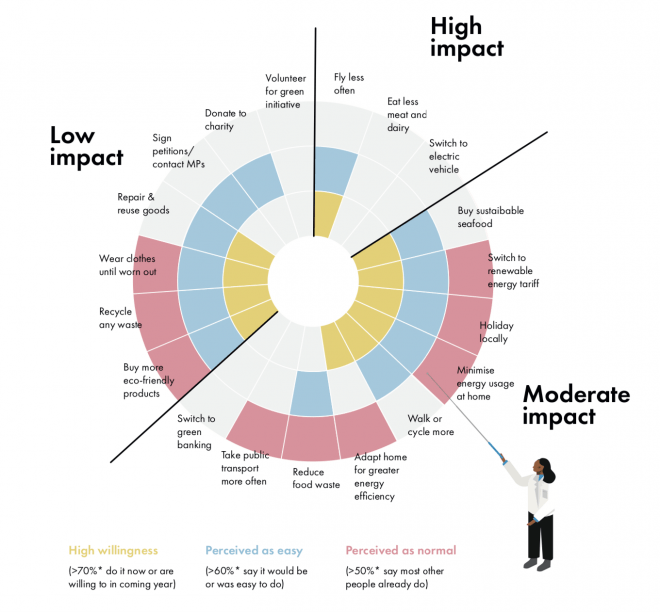
The Power of TV: Nudging Viewers to Decarbonise their Lifestyles
The report is audaciously bossy about how broadcasters and content creators should change the British public’s behaviour.
Advice such as “Frequency of exposure to green themes could be enhanced by building ecological beliefs and traits into core characters within a show so that green issues can fluently be raised time and time again,” sounds potentially tedious.
You will see fewer characters “carelessly drinking from a plastic bottle”. But you will see more kids programming centre on green issues to influence you as well as the kids to promote “intergenerational spillover”.
Suggestions continue with “a family could discuss reducing their waste” in a comedy show. Making that funny is quite the gauntlet throw. News segments could “explore barriers to acting green and share stories for overcoming them,” which doesn’t sound particularly newsworthy. An episode of a drama could include references to buying an electric vehicle and, of course, characters should order vegetarian options in restaurants.
Plump the cushions, grab a cuppa and get ready for the green themes in your favourite psyopera, I mean soap opera. During COP26, storylines are converging on the environment. Soap ratings have diminished over the years and is it any wonder? People don’t want to be preached to. Creativity cannot be programmed and storytelling is an art. It is naïve arrogance to believe this sort of technocratic tinkering will engage viewers. We gravitate to good stories.
Mercifully, BIT suggests that broadcasters “avoid a negative tone” and warns that “fear-mongering, guilt-tripping, blaming, or preaching can be counter-productive.” (I wonder if a certain book had an impact?)
In addition to Sky, another eleven major UK media brands, including the BBC, ITV, Channel 4, RTE, Britbox and Discovery, have pledged to increase the amount and “quality” of their climate coverage. So expect the airwaves to be flooded with the techniques suggested in the BIT report. At the same time, expect very little media scrutiny of this astonishing collaboration between nudgers and newscasters. And in print and online, the BBC, The Guardian, The Times and the Financial Times have added specific climate sections to their news.
A few months after the publication of A State of Fear, a government advisor told me that the behavioural scientists are “very pleased with themselves” and “Britain is seen as leading the way in how to manipulate people. There is skipping in Whitehall corridors. The public have been proved to be incredibly sheepish, so there’s more nudge coming.” And so there is.
My book concluded that the UK government’s use of behavioural science during the Covid epidemic lacked transparency and was anti-democratic. BIT’s report might appear to rebut both accusations. Don’t be fooled. It rests upon a survey which says people want to be nudged through the media. But research conducted by biased and vested parties is not a substitute for a democratic mandate. The British public never voted for or consented to the creation of a Nudge Unit to subliminally influence them and then set the news agenda. Furthermore, when behavioural scientists – and by extension the government – influence the news, it risks the inquiry, debate and balance that the media owes the public.
Whatever you believe about climate, or Covid-19, or any other agenda, can any mental contortions justify the news being nudged? We would criticise such blatant propaganda if it happened in any other country and we should not tolerate here. We should switch it off.
What is the Number Needed to Vaccinate to prevent a single COVID fatality in kids 5 to 11 based on Pfizer’s EUA application?
And what are the risks that go along with injecting that many kids?
By Toby Rogers | October 31, 2021
Number Needed to Vaccinate (NNTV), the standard policy tool that Pharma, the FDA, & CDC no longer want to talk about
A funny thing happened this afternoon. Not funny as in “haha”. More like funny as in, “ohhhhh that’s how the FDA rigs the process.”
I was reading the CDC’s “Guidance for Health Economics Studies Presented to the Advisory Committee on Immunization Practices (ACIP), 2019 Update” and I realized that the FDA’s woeful risk-benefit analysis in connection with Pfizer’s EUA application to jab children ages 5 to 11 violates many of the principles of the CDC’s Guidance document. The CDC “Guidance” document describes 21 things that every health economics study in connection with vaccines must do and the FDA risk-benefit analysis violated at least half of them.
Today I want to focus on a single factor: the Number Needed to Vaccinate (NNTV). In four separate places the CDC Guidance document mentions the importance of coming up with a Number Needed to Vaccinate (NNTV). I did not recall seeing an NNTV in the FDA risk-benefit document. So I checked the FDA’s risk-benefit analysis again and sure enough, there was no mention of an NNTV.
Because the FDA failed to provide an NNTV, I will attempt to provide it here.
First a little background. The Number Needed to Treat (NNT) in order to prevent a single case, hospitalization, ICU admission, or death, is a standard way to measure the effectiveness of any drug. It’s an important tool because it enables policymakers to evaluate tradeoffs between a new drug, a different existing drug, or doing nothing. In vaccine research the equivalent term is Number Needed to Vaccinate (NNTV, sometimes also written as NNV) in order to prevent a single case, hospitalization, ICU admission, or death (those are 4 different NNTVs that one could calculate).
Pharma HATES talking about NNTV and they hate talking about NNTV even more when it comes to COVID-19 vaccines because the NNTV is so ridiculously high that this vaccine could not pass any honest risk-benefit analysis.
Indeed about a year ago I innocently asked on Twitter what the NNTV is for coronavirus vaccines.
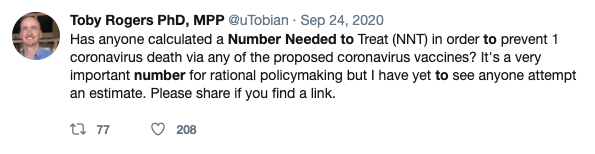
Pharma sent a swarm of trolls in to attack me and Pharma goons published hit pieces on me outside of Twitter to punish me for even asking the question. Of course none of the Pharma trolls provided an estimate of the NNTV for COVID-19 shots. That tells us that we are exactly over the target.
Various health economists have calculated a NNTV for COVID-19 vaccines.
- Ronald Brown, a health economist in Canada, estimated that the NNTV to prevent a single case of coronavirus is from 88 to 142.
- Others have calculated the NNTV to prevent a single case at 256.
- German and Dutch researchers, using a large (500k) data set from a field study in Israel calculated an NNTV between 200 and 700 to prevent one case of COVID-19 for the mRNA shot marketed by Pfizer. They went further and figured out that the “NNTV to prevent one death is between 9,000 and 100,000 (95% confidence interval), with 16,000 as a point estimate.”
You can see why Pharma hates this number so much (I can picture Pharma’s various PR firms sending out an “All hands on deck!” message right now to tell their trolls to attack this article). One would have to inject a lot of people to see any benefit and the more people who are injected the more the potential benefits are offset by the considerable side-effects from the shots.
Furthermore, the NNTV to prevent a single case is not a very meaningful measure because most people, particularly children, recover on their own (or even more quickly with ivermectin if treated early). The numbers that health policy makers should really want to know are the NNTV to prevent a single hospitalization, ICU admission, or death. But with the NNTV to prevent a single case already so high, and with significant adverse events from coronavirus vaccines averaging about 15% nationwide, Pharma and the FDA dare not calculate an NNTV for hospitalizations, ICU, and deaths, because then no one would ever take this product (bye bye $93 billion in annual revenue).
Increased all cause mortality in the Pfizer clinical trial of adults
As Bobby Kennedy noted in personal correspondence with me, Pfizer’s clinical trial in adults showed alarming increases in all cause mortality in the vaccinated :
In Pfizer’s 6 month clinical trial in adults — there was 1 covid death our of 22,000 in the vaccine (“treatment”) group and 2 Covid deaths out of 22,000 in the placebo group (see Table s4). So NNTV = 22,000. The catch is there were 5 heart attack deaths in the vaccine group and only 1 in placebo group. So for every 1 life saved from Covid, the Pfizer vaccine kills 4 from heart attacks. All cause mortality in the 6 month study was 20 in vaccine group and 14 in placebo group. So a 42% all cause mortality increase among the vaccinated. The vaccine loses practically all efficacy after 6 months so they had to curtail the study. They unblinded and offered the vaccine to the placebo group. At that point the rising harm line had long ago intersected the sinking efficacy line.
Former NY Times investigative reporter Alex Berenson also wrote about the bad outcomes for the vaccinated in the Pfizer clinical trial in adults (here). Berenson received a lifetime ban from Twitter for posting Pfizer’s own clinical trial data.
Pfizer learned their lesson with the adult trial and so when they conducted a trial of their mRNA vaccine in children ages 5 to 11 they intentionally made it too small (only 2,300 participants) and too short (only followed up for 2 months) in order to hide harms.
Estimating an NNTV in children ages 5 to 11 using Pfizer’s own clinical trial data
All of the NNTV estimates above are based on data from adults. In kids the NNTV will be even higher (the lower the risk, the higher the NNTV to prevent a single bad outcome). Children ages 5 to 11 are at extremely low risk of death from coronavirus. In a meta-analysis combining data from 5 studies, Stanford researchers Cathrine Axfors and John Ioannidis found a median infection fatality rate (IFR) of 0.0027% in children ages 0-19. In children ages 5 to 11 the IFR is even lower. Depending on the study one looks at, COVID-19 is slightly less dangerous or roughly equivalent to the flu in children.
So how many children would need to be injected with Pharma’s mRNA shot in order to prevent a single hospitalization, ICU admission, or death?
Let’s examine Pfizer’s EUA application and the FDA’s risk-benefit analysis. By Pfizer’s own admission, there were zero hospitalization, ICU admissions, or deaths, in the treatment or control group in their study of 2,300 children ages 5 to 11.
So the Number Needed to Vaccinate in order to prevent a single hospitalization, ICU admission, or death, according to Pfizer’s own data, is infinity. ∞. Not the good kind of infinity as in God or love or time or the universe. This is the bad kind of infinity as in you could vaccinate every child age 5 to 11 in the U.S. and not prevent a single hospitalization, ICU admission, or death from coronavirus according to Pfizer’s own clinical trial data as submitted to the FDA. Of course Pfizer likes this kind of infinity because it means infinite profits. [Technically speaking the result is “undefined” because mathematically one cannot divide by zero, but you get my point.]
Estimating an NNTV and risk-benefit model in children ages 5 to 11 using the limited data that are available
Everyone knows that Pfizer was not even trying to conduct a responsible clinical trial of their mRNA shot in kids ages 5 to 11. Pfizer could have submitted to the FDA a paper napkin with the words “Iz Gud!” written in crayon and the VRBPAC would have approved the shot. They are all in the cartel together and they are all looking forward to their massive payoff/payday.
But let’s not be like Pharma. Instead, let’s attempt to come up with a best guess estimate based on real world data. Over time, others will develop a much more sophisticated estimate (for example, Walach, Klement, & Aukema, 2021 estimated an NNTV for 3 different populations based on “days post dose”). But for our purposes here I think there is a much easier way to come up with a ballpark NNTV estimate for children ages 5 to 11.
Here’s the benefits model:
- As of October 30, 2021, the CDC stated that 170 children ages 5 to 11 have died of COVID-19-related illness since the start of the pandemic. (That represents less than 0.1% of all coronavirus-related deaths nationwide even though children that age make up 8.7% of the U.S. population).
- The Pfizer mRNA shot only “works” for about 6 months (it increases risk in the first month, provides moderate protection in months 2 through 4 and then effectiveness begins to wane, which is why all of the FDA modeling only used a 6 month time-frame). So any modeling would have to be based on vaccine effectiveness in connection with the 57 (170/3) children who might otherwise have died of COVID-related illness during a 6-month period.
- At best, the Pfizer mRNA shot might be 80% effective against hospitalizations and death. That number comes directly from the FDA modeling (p. 32). I am bending over backwards to give Pfizer the benefit of considerable doubt because again, the Pfizer clinical trial showed NO reduction in hospitalizations or death in this age group. So injecting all 28,384,878 children ages 5 to 11 with two doses of Pfizer (which is what the Biden administration wants to do) would save, at most, 45 lives (0.8 effectiveness x 57 fatalities that otherwise would have occurred during that time period = 45).
- So then the NNTV to prevent a single fatality in this age group is 630,775 (28,384,878 / 45). But it’s a two dose regimen so if one wants to calculate the NNTV per injection the number doubles to 1,261,550. It’s literally the worst NNTV in the history of vaccination.
If you inject that many children, you certainly will have lots and lots of serious side effects including disability and death. So let’s look at the risk side of the equation.
Here’s the risk model:
- Because the Pfizer clinical trial has no useable data, I have to immuno-bridge from the nearest age group.
- 31,761,099 people (so just about 10% more people than in the 5 to 11 age bracket) ages 12 to 24 have gotten at least one coronavirus shot.
- The COVID-19 vaccine program has only existed for 10 months and younger people have only had access more recently (children 12 to 15 have had access for five months; since May 10) — so we’re looking at roughly the same observational time period as modeled above.
- During that time, there are 128 reports of fatal side effects following coronavirus mRNA injections in people 12 to 24. (That’s through October 22, 2021. There is a reporting lag though so the actual number of reports that have been filed is surely higher).
- Kirsch, Rose, and Crawford (2021) estimate that VAERS undercounts fatal reactions by a factor of 41 which would put the total fatal side effects in this age-range at 5,248. (Kirsch et al. represents a conservative estimate because others have put the underreporting factor at 100.)
- With potentially deadly side effects including myo- and pericarditis disproportionately impacting youth it is reasonable to think that over time the rate of fatal side effects from mRNA shots in children ages 5 to 11 might be similar to those in ages 12 to 24.
So, to put it simply, the Biden administration plan would kill 5,248 children via Pfizer mRNA shots in order to save 45 children from dying of coronavirus.
For every one child saved by the shot, another 117 would be killed by the shot.
The Pfizer mRNA shot fails any honest risk-benefit analysis in children ages 5 to 11.
Even under the best circumstances, estimating NNTV and modeling risk vs. benefits is fraught. In the current situation, with a new and novel bioengineered virus, where Pfizer’s data are intentionally underpowered to hide harms, and the FDA, CDC, & Biden Administration are doing everything in their power to push dangerous drugs on kids, making good policy decisions is even more difficult.
If the FDA or CDC want to calculate a different NNTV (and explain how they arrived at that number) I’m all ears. But we all know that the FDA refused to calculate an NNTV not because they forgot, but because they knew the number was so high that it would destroy the case for mRNA vaccines in children this age. Your move CDC — your own Guidance document states that you must provide this number.
The Vaccines Cannot Do What Is Asked of Them
eugyppius | November 1, 2021
Increasingly, politicians and medical bureaucrats are entranced by a bizarre pandemic ideology. Like most ideologies, it remains oblivious to evidence and argument, holding that the risk of severe outcomes from Corona infection is far more evenly distributed across the population than it is; and allowing only universal solutions, such as quarantining and vaccinating entire populations. These obtuse views, which just won’t go away, are at the root of our failed and destructive policies. For 20 months now, this pandemic ideology has blinded everyone in charge to the possibility of shielding the vulnerable, leveraging seasonal patterns in infection, and leaving the kids alone. The stratified nature of Corona risk is the key to unravelling the pandemic, and it’s the one thing nobody will recognise.
Success in the pandemic has come to be defined by a series of vague, poorly differentiated statistics, including above all Corona infections, hospitalisations and deaths, and now vaccination rates. In their exclusive focus on these numbers, the press propagate constantly the myth that this is all there is to know about Corona. This impoverished discussion drives bureaucrats and politicians to seek solutions for one vague meaningless metric (Corona ICU admissions) in another vague meaningless metric (vaccination rates). In this way their policies are constructed in a rhetorical world that has very little to do with what is actually happening.
Every day our understanding of what the vaccines can do becomes clearer. It’s not nothing, but it’s much less than we were promised.
Some of our best evidence so far comes from this Swedish retrospective cohort study, which tracks outcomes in 1,684,958 individuals (matched vaccinated and unvaccinated pairs) from 12 January to 4 October 2021. It has been around the block, with an especially good analysis by El Gato Malo, so there’s no point in anything more than a brief review here.
Above all, they find that the vaccines provide temporary protection against infection:

Unfortunately, this protection likely falls below zero – into the zone of negative efficacy – after 7 to 9 months. This is one of multiple lines of evidence confirming that the vaccinated, sooner or later, achieve higher rates of infection than the unvaccinated. According to me, even early vaccine efficacy is likely overstated in studies like these. Probably the vaccinated are always highly vulnerable to infection, but they’re not tested as rigorously and at first their symptoms are so mild as to be nearly unnoticeable. SARS-2 nevertheless lurks among them, mostly undetected, until vaccine protection against overt disease dissipates.
This would explain what happened in Iceland over the summer: A bunch of freshly vaccinated Icelanders went on holiday in the UK, where they promptly picked up SARS-2 and brought the latest Delta update back home with them. In the following weeks, energetic Icelandic testing uncovered rates of infection almost as high in the vaccinated as in the unvaccinated – and this well before we would’ve expected the vaccines to have faded.
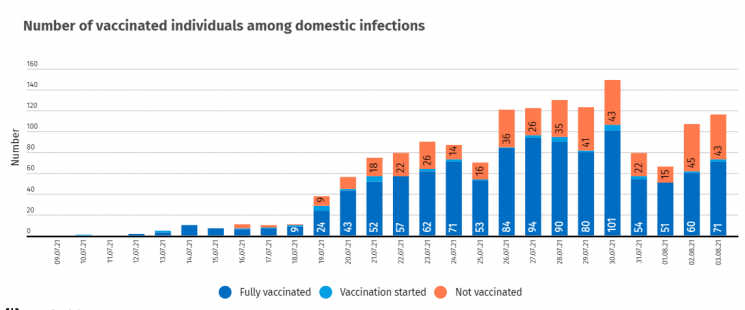
The Swedish study finds that efficacy against severe disease last longer, but also decays substantially in much the same way:
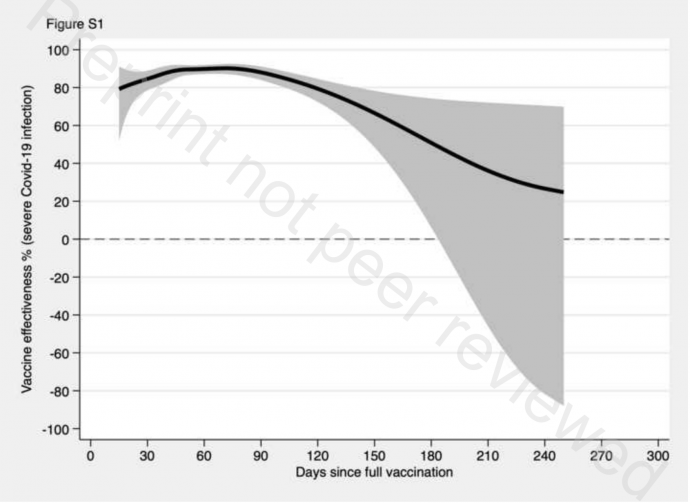
After the 240-day mark, protection against severe outcome is not even at 30%. The decay is most rapid among men, the old and frail, and those with comorbidities – precisely those subpopulations already at greatest risk of severe disease.
So those are the benefits, but as in everything there are also costs – and here they turn out to be substantial.
We’ve already touched on one: The vaccines appear to induce negative efficacy against infection. This probably arises from a combination of minimally symptomatic super-spreading among the vaccinated, the selective pressure that vaccine-elicited antibodies place upon the virus, and the narrow immunity against an obsolete arrangement of the spike protein that the vaccines confer. For a period of several weeks after dose 1 (and likely dose 3), they also make the vaccinated more susceptible to infection, and mass vaccination campaigns have induced case spikes across many countries.
By now it is also clear that the vaccines cause a range of adverse reactions. The best documented is myocarditis in young men, a side effect observed most frequently after dose 2 of the mRNA vaccines. We probably won’t know the true rate of vaccine-induced myocarditis for many years. From excess mortality in younger cohorts and many anecdotal media reports, we can surmise that it is much more common than anybody will admit.
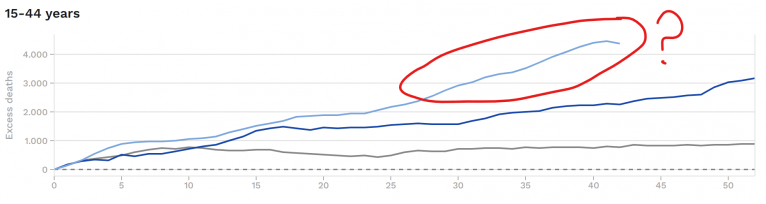
It does not take a Ph.D. in public health to extract a sensible vaccination policy from all this:
1. There is just no question that vaccinating low-risk cohorts (including the recovered) is not only pointless, but also dangerous. These aren’t the people who end up in the hospital dying of Corona anyway. And because the vaccinated sooner or later end up driving transmission, there is only downside and no upside here.
2. All the vaccines are good for, is reducing the likelihood of severe disease among the old and the vulnerable. It follows that only the old and the vulnerable should be vaccinated.
3. In these groups, carefully timed annual vaccinations, like flu shots, might well provide good protection at the height of the winter coronavirus season and limit mortality. Even here, though, you’d have to proceed carefully, to avoid causing case spikes in the newly vaccinated during that brief period where their vulnerability to infection is heightened.
Of course, this is the opposite of what our pandemic ideology permits. Instead, almost all of our governments deploy the vaccines in the most reckless and counterproductive ways possible.
The southern districts of Bavaria are quickly becoming the regions of highest infection in Germany, and Markus Söder, our governor, is demanding a renewed “vaccine push,” including a campaign for booster doses “independently of age,” even obliquely threatening lockdown if we can’t ensure the “safety and stability” of hospitals.
These are exactly the kinds of crackpot universalist solutions that have failed for the past twenty months, and that will do nothing to unburden our healthcare facilities, and very likely end up swamping them with unnecessary patients.
If booster doses are a good idea for anyone – and it’s far from clear they are – it’s frail nursing home residents, most of whose vaccinations are now well past their expiration date, and who are once again beginning to die of SARS-2 just as they did last fall. Vaccinating children and triple vaccinating low-risk adults won’t prevent nursing home deaths, and it will do very little to keep our hospitals “safe,” because the vaccines don’t reduce spread and these people rarely end up in hospital. What is worse, ever newer pushes to vaccinate all hospital personnel and nursing home staff threaten to introduce vaccinated super-spreaders into these sensitive environments. Söder will continue to pound the table demanding ever harsher restrictions for the unvaccinated and more vaccine doses for the already-vaccinated, all while deaths and hospitalisations continue to climb.
Ultimately, the great problem with our vaccine policies, as with our lockdowns, arises from the fact that they don’t work. Because lockdowns and vaccination campaigns are powerless to remove the conditions that brought them about, you can never stop locking down, and you can never stop vaccinating – even as your policies turn out to do worse than nothing.
Blood Clots Associated with Johnson & Johnson COVID Shot
By Dr. Joseph Mercola | November 2, 2021
Researchers at Mayo Clinic have published a study in JAMA showing that there is a 3.5 times higher risk of getting brain blood clots if you take the Astra Zeneca or Johnson & Johnson COVID-19 shots.
Reported incidents of cerebral venous sinus thrombosis (CVST) after the jabs were what instigated a temporary pause in their rollout in April 2021. The researchers used data from the CDC’s Vaccine Adverse Event Reporting System (VAERS) to compare to data compiled in a Minnesota county from 2001 to 2015.
Study authors said women appeared to be more affected than men, although they couldn’t ascertain why. “Most CVST events occurred within 15 days after vaccination, which is likely the highest at-risk period,” they added. ‘The postvaccination CVST rate among females was higher than the prepandemic rate among females. The highest risk was among women aged 30 to 49 years.”
Is it Really True, as Climate Change Activists Claim, That 97% of Scientists Agree With Them?
By Luke Perry • The Daily Sceptic • October 27, 2021
Our Government is imposing draconian limitations on our lifestyles, our economy and our finances in order to achieve net zero carbon emissions to supposedly save the planet from catastrophic anthropogenic global warming (CAGW), now renamed as climate change. Probably one of the most repeated arguments you’ll hear, over and over again, in support of the need to achieve net zero is that “97% of scientists agree CAGW is happening”.
Former President Barack Obama is just one of many who have made this claim: “97% percent of scientists agree: climate change is real, man-made and dangerous.”
So did President Joe Biden’s Special Presidential Envoy for Climate, John Kerry, when he warned of the “crippling consequences” of climate change and that: “97% percent of the world’s scientists tell us this is urgent.”
This claim is widely accepted. Yet, in spite of the damaging effects reaching net zero will have on Western economies, not a single politician or journalist seems to have made the effort to find out where this ‘97%’ figure came from and how accurate it actually is.
Statistical smoke and mirrors?
The main author of the paper which came up with the famous 97% figure was an Australian former web programmer and blogger who later gained a PhD in Philosophy at the School of Psychology, University of Western Australia and then founded what could be seen as a climate alarmist website.
He assembled a group of volunteers as part of a ‘citizen science’ project and tasked them with”‘examining 11,944 climate abstracts from 1991-2011 matching the topics ‘global climate change’ or ‘global warming’”. Note that the volunteers didn’t read the actual scientific papers, they just looked at the abstracts – a summary paragraph or two describing what was in the papers. The volunteers then classed the abstracts into one of seven categories according to their opinions of Anthropogenic Global Warming (AGW):
1. Explicit endorsement of AGW with quantification
2. Explicit endorsement of AGW without quantification
3. Implicit endorsement of AGW
4. No position or Uncertain
5. Implicit rejection of AGW
6. Explicit rejection of AGW without quantification
7. Explicit rejection of AGW with quantification
The reviewers then ‘simplified’ results into four main categories as follows:
Endorse AGW 3,896 32.6% of abstracts
No AGW position 7,930 66.4% of abstracts
Reject AGW 78 0.7% of abstracts
Uncertain on AGW 40 0.3% of abstracts
So, this gave only 32.6% who, the reviewers concluded, endorsed AGW. This was clearly not quite the stunning super-majority of 97% which the study claimed to have identified. Now comes the clever bit. Instead of admitting that just 32.6% of papers (actually just abstracts of papers) endorsed AGW, the group decided to remove all the 7,930 abstracts which didn’t take a position on AGW. Then, hey presto, magic happened. That left just 4,014 abstracts of which 3,896 (97%) supposedly ‘endorsed’ AGW.
But that’s not the end of the magic employed to reach that wondrous 97%. The reviewers decided to lump together three categories of abstracts – Explicit endorsement with quantification; Explicit endorsement without quantification and Implicit Endorsement. But in the paper claiming 97% support for AGW, the reviewers don’t tell us how many papers fitted into each of these three categories. An independent researcher managed to get hold of the original data file and claimed to have found that in 3,896 abstracts which supposedly ‘endorsed’ AGW, just 64 were in the Explicit endorsement with quantification category; 922 were in the Explicit endorsement without quantification; and the vast majority – 2,910 (out of 3,896) – were in the Implicit endorsement of AGW category. Deciding from an abstract of a scientific article that the article ‘implicitly’ supports AGW is a bit like walking down a high street and deciding you know how people will vote based purely on looking at the kind of clothes they wear. To propose this as a serious survey is beyond ludicrous.
Thus, if this independent researcher’s figures are accurate, when you dig down into how the ‘97% of scientists’ figure was actually conjured up, you find that only 986 of 11,944 – that’s just 8.2% – of abstracts actually explicitly said they agreed with the theory of man-made global warming. And that’s clearly not the kind of figure the apocalypse-threatening climate catastrophists would really want to publicise too widely.
So, this ‘97% of scientists’ claim is based on about 11 to 12 volunteers, whose scientific credentials have not (as far as I know) been released and all of whom were probably firm AGW believers, each having to look at around 1,000, often quite obtuse, scientific abstracts. During this review, they decided whether they thought the scientific papers (which they hadn’t read as they had only looked at the abstracts) explicitly or implicitly supported the AGW theory. To claim such an approach is statistically valid is beyond farcical. Given the damage reaching net zero will do to our economies and our lives, it is beyond incredible that not a single politician, mainstream-media journalist or editor seems to have had either the ability or the inclination to expose the more than dubious origins of the almost ubiquitous ‘97% of scientists endorse AGW’ claim.
Featured Video

Spain train disaster raises questions over Israeli-linked security contractors
or go to
Aletho News Archives – Video-Images
From the Archives
Are There 50,000 ‘Israeli-born’ Individuals Living in the UK?
By Professor David Miller | August 18, 2026
Recent disclosures by the Zionist regime show that some 2,069 British nationals were serving in the IDF as of March 2025, according to Freedom of Information (FoI) requests submitted to the occupation forces (1,686 dual British-Israeli, plus 383 multinational). We cannot tell from the figures how many of these were already settler colonists and intend to stay in the colony, and how many will return or have returned to the UK. Presumably, those returning to the UK will number far fewer than 2,000, since many are known to have become permanently residents of the colony.
Additionally, the IDF figures only provide a snapshot, and do not tell us how many have served in the Jewish supremacist military either before or after March 2025. One way into the question of how many genocidaires are living in Britain is to ask how many current British residents were born in the Zionist colony. There is data on that, as we shall see. … continue
Blog Roll
 Aletho News
- US-Israeli war on Iran cost Persian Gulf states nearly $1T in damage, lost growth: Report
- Congress probe could put ‘Israel’ in dock over Iran war: Israeli media
- Spanish public prosecutor backs US demand to extradite pro-Palestine philanthropist Fergie Chambers
- Zelensky spent over 740 days outside Ukraine while West serves as his real home
- Indian captain of Russian ‘shadow fleet’ tanker faces 10-year jail term in UK
- Europe, US face higher heating bills amid Iran war fallout
- The Leak That Arrived Right on Cue
- No, New York Times, California’s Climate Has Always Been a Land of Flood, Drought, and Fire
- Are There 50,000 ‘Israeli-born’ Individuals Living in the UK?
- German CDU MPs Seek Climate “Misinformation” List
- If Americans Knew
- An error has occurred; the feed is probably down. Try again later.
- No Tricks Zone
- German Authorities Start Initiative To Evaluate Public Register For Climate “Disinformation” Spreaders!
- Zonal Asymmetry of Temperature Change in the Antarctic Circumpolar Current
- New Study: The Net Fossil Fuel Contribution To Rising Atmospheric CO2 Has Been Zero For 500 Years
- Germany’s Green Energy Transition Becoming Increasingly Expensive…Another 6 Trillion Euros!
- Sudden Stratospheric Warming, Powerful El Niño Combination May Lead To Extreme Europe Cold, Energy Crisis!
- Two New Studies Find Thwaites Glacier Melt Cannot Be Driven By Human Activity Or A Warming Ocean
- E-Cars Reduce CO2 Emissions By Only 41% Compared To Internal Combustion Engine Vehicles
- Predictions Made By Renowned Climate Professor Over Past Decades Have Been Proven To Be Poor
- New Study Suggests Large Regions Of The Pacific Ocean Have Been Cooling For The Last 80 Years
- Germany’s Green Energy Debacle: High Energy Costs Force Kahla Porzellan to Close After 182 Years!

