Neria Leiter Was A Legitimate Military Target
By Justin K.P. | The Dissident | September 24, 2026
Israel and its stooges in mainstream media are claiming that Neria Leiter, the son of Yechiel Leiter, the current Israeli ambassador to the United States, was wounded in a supposed “terrorist attack”.
In reality, it was in no way a terrorist attack, but resistance against illegal occupation, a guaranteed right under international law.
Neria Leiter was hit by a car driven by 29-year-old Palestinian Mahmoud Muhammad Mahmoud Suleiman- who was killed at the scene- while he was carrying out service as an IDF reservist manning the checkpoint outside of the West Bank settlement of Beit Horon.
As Drop Site News noted, Beit Horon is an “illegal settlement” which “sits on land in the occupied West Bank, where Israeli settlements are illegal under international law.”
The International Court of Justice (ICJ) has ruled that Israel’s occupation of the West Bank is illegal under international law.
International law also guarantees the right to resist illegal occupation by military means.
Given that Neria Leiter was a combatant upholding an occupation illegal under international law, the “ attack” against him was not “terrorism” but a legitimate act of self-defence and resistance to criminal occupation supported by international law.
As journalist Glenn Greenwald noted in response to claims that this was a “terrorist” attack, “Don’t terrorist attacks require the targeting of civilians? This was an armed, on-duty soldier in a military considered to be an occupying force under international law. How does that remotely fit the definition of ‘terrorism’?”
As journalist Abubaker Abed noted, “It was a self-defence and resistance act. That’s the undeniable truth. He was a soldier illegally occupying parts of the West Bank. The Palestinian defended himself from his terror. Palestinians have a right to defend themselves.”
Neria Leiter was a combatant, sent to the West Bank to uphold an illegal military occupation under international law; he was in no way a victim of a terrorist attack, but a legitimate military target for Palestinians living under Israeli occupation.
‘We don’t seek permission to defend our country’: Snippets from President Pezeshkian’s UNGA address
Press TV – September 23, 2026
In a powerful speech to the 81st session of the United Nations General Assembly on Wednesday, Iranian President Masoud Pezeshkian held up photographs of victims of American and Israeli war crimes against Iran, firmly rejecting Washington’s terrorism accusations and declaring that the Islamic Republic can never be forced into submission through military aggression.
The address, delivered under the summit’s theme of “Rebuilding Trust,” came one day after US President Donald Trump delivered deeply provocative rhetoric against Iran in his own remarks from the same podium.
Pezeshkian systematically dismantled Western double standards, detailed the unprecedented crimes committed against Iran during the US-Israeli war of aggression, reaffirmed Iran’s nuclear rights, and issued a warning to the aggressors.
Below are snippets from his speech:
Response to US terrorism accusations
- Yesterday, the president of the United States said we are terrorists. We are the victims of terrorism.
- I come from an Iran where they assassinated our Leader, without any legal justification.
- I come from an Iran where they bombed a school. You can see these children. They bombed these children and killed them with weapons they used from America and Israel. They had committed no sin. They had committed no crime.
- Lamerd is one of Iran’s small cities. There is a sports hall there where children were exercising. America bombed it with cluster bombs that split into thousands of pieces. They martyred our scientists, our people, our women, and innocent children who had committed no sin.
- Those who are terrorists and breed terrorists call us terrorists. We only defend ourselves. We are not terrorists.
The US-Israeli assault on Iran
- Our innocent people are the target of the cowardly attacks they imposed on our country, and we defended ourselves with power. America and Israel attacked us with the latest technology and equipment, and our people stood firm. They struck, but we did not bow our heads before them. We struck back, but we did not strike civilians.
- From the territories they came from and were equipped in, they attacked our schools, our hospitals, our universities, our bridges, and our infrastructure. All of this is in violation of international law.
- When I took office, on the very first day, they assassinated [Hamas leader] Ismail Haniyeh in Tehran. Israel bombs and assassinates any government, any state, any region it wishes.
Gaza: 80,000 massacred
- In Gaza, they massacred over 80,000 innocent human beings. More than 100,000 people are displaced. They are committing genocide with the tools and technology at their disposal. Then they say others are terrorists, that they are the source of instability.
- Are we the source of instability? We who want to live independently, who refuse to bow our heads- are we the source of instability?
- If those who assassinate, kill, and commit crimes are the agents of security and peace, while they observe none of the rules of international law, this is the reality we face.
Iran’s 200-year record of non-aggression
- We want nothing. We have found our answer. We need power, because a nation that cannot defend itself will be crushed.
- In this world, the powerful, instead of thinking about people, humanity, justice, and democracy, are agents of ruin, destruction, and annihilation. Whoever they want to destroy, they label a terrorist.
- For 200 years, Iran has not attacked any country. Two hundred years. We have always defended ourselves. Yet now we must be accused of being terrorists and agents of insecurity in the region.
Power for defense, energy for development
- This has led us to choose our strategy: We want power to defend ourselves. We do not want power to launch aggression. We want energy for development, not for building bombs, destruction, or threatening society. And for security, we want to participate.
- Iran must be powerful enough so that its survival and progress are not threatened, responsible enough not to use its power for domination, and far-sighted enough not to seek its security in the insecurity of its neighbors.
The people’s seven-month vigil
- Over the past seven months, our people have been in the streets every night to defend our Iran and to prevent those whom America and Israel had incited and armed from entering the country and creating internal insecurity.
- For seven months, the people of Iran have been in the streets day and night. The people are our power, and we stand with the power of the people.
Iran’s defense doctrine
- Regarding Iran’s defense, we have built our defense system so that no one imagines that bombing Iranian cities will go unanswered.
- Iran’s military power is for defense. But we say clearly: we do not ask permission from anyone to defend our country.
Neither nuclear weapons nor deprivation
- For years, they have spoken about Iran’s peaceful nuclear program in the language of centrifuges, enrichment, sanctions, and bombs. But for our people, nuclear technology is part of the right to development.
- Nuclear energy means treatment for our patients, food security for agriculture, technology for industry, and sustainable electricity for the future.
- Iran does not accept that nuclear knowledge should be the exclusive privilege of a few countries. Iran does not consider nuclear weapons a factor of security, but it will not relinquish its right to science, industry, and peaceful energy.
- We say explicitly: neither nuclear weapons nor deprivation of nuclear knowledge.
- Iran’s nuclear position cannot be resolved on the battlefield. The solution is an agreement that provides the world with credible assurance of the peaceful nature of Iran’s program and provides the Iranian people with assurance that their rights will be preserved.
The Strait of Hormuz
- In the waterway of the Strait of Hormuz, we cannot be the historical guardian of a waterway that everyone benefits from, yet be deprived of the freedom of navigation even in our own waters due to unjust sanctions.
- They close the road to us, and then they transport weapons, explosives, missiles, and energy for the destruction of countries through the same waterway. This is not possible. They cannot do this, and we will not allow such a thing to happen in our country.
- The permanent deployment of hostile fleets and the expansion of war do not bring security. The security of shipping cannot be ensured by undermining the security of coastal states.
No peace without Palestine justice
- Palestine remains a wound on the conscience of the international community, and Gaza remains the symbol of the failure of international mechanisms to prevent civilian suffering. For decades, resolutions have been issued, but occupation and violence continue.
- We cannot speak of peace while ignoring Palestine. Lasting peace in West Asia will not last without justice for Palestine.
- As long as occupation, aggression, and injustice exist in the world, resistance will continue. If one form of it is harmed, it will emerge again in another form, perhaps even stronger.
- Gaza, despite relentless killing and widespread destruction, revealed the faith of the people that resistance cannot be forced into surrender by bombs and siege.
- This is the nature of humanity. If you drive a human being from their land, they resist. If you bomb a person’s home, they resist. What should they do if they do not resist? Accept bullying? Accept being driven from their homes and sit silently? And if they want to defend themselves, call them terrorists?
Regional solutions and strategic independence
- It is clear that the issues of our region, before becoming a pretext for the war of distant powers, can be solved within the region and by the countries of the region.
- Strategic independence means that relations with no foreign power become the possibility of war against a neighbor.
Message to the aggressors
- Now, a word to all those who were responsible for the decision-making, planning, and execution of the attack on our land: Our nation has experienced their military power and the consequences of their destructive decisions up close. They have tested Iran’s resilience, and now they know well that Iran cannot be forced to surrender through war.
- Iran has never initiated any war and has always demonstrated its commitment to the negotiating table. War was imposed on us, but we proved that we do not fear war to defend ourselves; we do not flee from negotiation for peace, and we stand to the last breath for the defense of dear Iran.
International double standards
- The theme of this summit is rebuilding trust. Trust is not built with words; it requires the avoidance of double standards.
- The atomic bomb and other weapons of mass destruction in this region are in the hands of the Israeli regime, yet inspections are demanded of Iran.
- Israel massacred 70,000 people in Gaza, yet Iran was bombed at the negotiating table.
- Israel has nuclear weapons, is not a member of the NPT, has never allowed a single inspector into its territory in its entire disgraceful existence, yet is rewarded with billions of dollars in free weapons and enjoys immunity to bomb any capital it chooses.
- I repeat: the nuclear bomb is in Israel, but the inspectors are in Iran. Israel kills, but Iran is sanctioned. This is a tragedy; if you tell this to anyone, they will laugh. It kills, and we are sanctioned. And sanctions target the poor, the sick, and innocent people.
- Human rights are not a tool for geopolitical competition. Iran does not seek special privileges; it demands equal rights and accepts its responsibilities.
A warning against the law of the jungle
- Iran has learned one truth clearly in its long history: the world without power is dangerous, but a world that only understands the language of power will not have sustainable security.
- If international law is only enforced when it aligns with the interests of the powerful, more countries will conclude that they must rely solely on their own power to ensure their security, and this will mark the beginning of a far more dangerous world for all of us.
- We must not allow the 21st century to become an era of returning to the politics of the strong and the rule of tyrants. We must not build a world in which military power replaces legitimacy, sanctions replace diplomacy, assassination replaces politics, and war replaces dialogue.
Iran’s call to the world
- Iran extends a hand of cooperation to the world. We call the world not to another war, but to peace and justice, not out of weakness, but out of confidence in our own power and the understanding that no one in this region will have security alone.
- Either we will build security together, or we will endure insecurity together.
- We think of building a future in which security, justice, and human dignity are inalienable and shared rights for all nations. A future in which no nation is marginalized, no voice is lost in the noise of power, and no power has the right to determine the future of others on their behalf.
- An order worthy of the international system must be based on equality of nations, justice, fairness, and the shared will of humanity. Because peace that is not for everyone is not peace, and justice that excludes everyone is not justice.
Final message to Trump
- And finally, the remarks of the US president yesterday, before world public opinion, thinkers, politicians, and jurists, are a clear sign of bullying, the logic of force, and contrary to the explicit text of the UN Charter.
- Let him know that threats make our nation more united and stronger, and increase the resistance of Iranians. They must know that the nation of Iran will not bow its head before force, and it will make the aggressors regret it. This is what Trump and those who want to bully must understand.
- We are ready for dialogue, but let them know that we will not accept the language of force.
NATO chief wants Europeans to fight American wars [for Israel]
Mark Rutte has justified the US-Israeli war on Iran and said European nations should “take care” of the Middle East in the future
RT | September 23, 2026
European NATO nations should take greater responsibility for security in the Middle East, NATO Secretary General Mark Rutte has said. He also defended the US-Israeli war on Iran and argued that European members should spend less on social programs and more on the military.
Rutte made the remarks at a Chicago Council on Global Affairs event in Iowa on Tuesday after being asked to “make the case” for NATO to Americans by explaining “what’s in it” for them.
He described the Middle East as “Europe’s backyard” and “not the United States’ backyard,” arguing that Washington’s war against Tehran was “necessary” but that the US had to launch it because “somehow the Europeans did not have enough capabilities to do it themselves.”
“In the future, what you get from a stronger NATO is that Europeans can take care of their own backyard,” Rutte said.
The US-Israeli war on Iran, launched in late February, caused major friction within NATO as several European members resisted supporting Washington’s belligerence. Spain refused to allow American warplanes to use its bases for the campaign, drawing US President Donald Trump’s ire. Germany and the UK described the conflict as “not our war,” while stopping short of condemning the US and Israel.
Trump has since repeatedly accused European allies of failing to meet their NATO commitments and claimed the bloc “was not there when we needed them.” In April, US War Secretary Pete Hegseth said NATO’s future was uncertain and Washington could not currently reaffirm its commitment to collective defense.
Rutte also argued on Tuesday that the burden within NATO was unfair because European members spend heavily “on pensions and welfare,” while Washington has to devote more resources to weapons but “would also like to spend more on all these other lofty, beautiful items, but they can’t because they have to spend so much on defense.”
He described raising NATO’s defense spending target from 2% to 5% of GDP as “the fairness element” and part of an “equalizing” process. The remarks come as Washington pushes for a reorganization dubbed NATO 3.0, under which European members would sharply increase military spending and production while assuming “primary responsibility for the conventional defense of Europe.”
Rutte also offered to help “protect the United States from threats of Russia” and China and prevent the Arctic “from becoming militarized by the Russians and the Chinese.”
Russian Foreign Minister Sergey Lavrov said last month that Moscow was primarily interested in “preserving the Arctic as an area of peace and cooperation” and accused NATO of “driving the region towards militarization.” His comments followed European Commission President Ursula von der Leyen’s proposal earlier this year to use increased EU military spending on “Arctic-ready equipment.”
German chemicals giant reveals details of downsizing
RT | September 23, 2026
German chemicals giant Evonik is overhauling its domestic operations amid what it has described as a “structural and economic crisis” in the industry.
The German and wider European chemical sector has been hit by plant closures, job losses and high energy costs following the loss of cheap Russian supplies; the US-Israeli war with Iran has added new pressure.
The measures, announced on Tuesday, include site closures, job cuts and a reshaping of Evonik’s six main German plants, even as the company considers increasing investment in Asia and the Americas, where it sees “good opportunities for growth.”
Evonik’s plans to eliminate 2,150 jobs in Germany through 2029 have drawn criticism from industrial policy spokesman for the opposition Left Party (Die Linke) Mirze Edis, who called the cuts “a damning indictment” of German Chancellor Friedrich Merz and Economy Minister Katharina Reiche.
“Their inaction regarding chemical industry sites has now become a nationwide economic risk,” Edis said.
Evonik produces chemicals and additives used in everything from car tires and plastics to cosmetics and medicines, making it a key supplier across the economy.
Germany’s chemical sector has been among the hardest hit by the country’s energy problems. Berlin moved to end its dependence on Russian energy following the escalation of the Ukraine conflict in 2022 and turned to alternative suppliers, leaving energy-intensive manufacturers facing substantially higher costs.
Evonik said at the time that it consumed around 15 terawatt-hours of natural gas annually, more than a third of it in Germany, and warned that losing Russian supplies could “seriously jeopardize chemical production” in the country.
The war with Iran and disruption to shipping through the Strait of Hormuz have added to the pressure this year. While Germany gets most of its LNG from the US rather than the Persian Gulf, the de facto closure of the strait disrupted flows accounting for almost 20% of the global LNG supply, tightening the market and driving up European prices.
The crisis extends beyond Germany. Permanent chemical plant closures across Europe have surged sixfold from pre-2022 levels amid high energy costs, weak demand and cheaper overseas competition, according to the European Chemical Industry Council (Cefic).
British chemicals giant INEOS said this week it would close its three acetyl plants in Hull, the last major facilities of their kind in Europe, blaming soaring energy costs and carbon taxes. It said natural gas in Europe now costs 12 times as much as it does in the US, making even highly efficient plants uncompetitive.
Refaat Al-Areer Was The Canary In The Coal Mine In Israel’s War On The Truth

By Justin K.P. | The Dissident | September 23, 2026
Three years ago today, Refaat Al-Areer, the well-respected Palestinian academic, poet, and commentator, was murdered, along with multiple members of his family, for telling the truth about Israel’s genocide in Gaza and atrocity propaganda used to manufacture consent for it.
The Zionists wanted Al-Areer silenced because he was one of the first media figures to expose the now well-documented fact that Israel issued the Hannibal Directive on October 7th and killed its own people, and because he was debunking Israeli atrocity propaganda used to justify the Gaza genocide, such as the mass rape hoax.
The Zionist propagandist Bari Weiss put a target on Al-Areer, taking a joke he made about the claim of Hamas “baking a baby in an oven”- a proven hoax– out of context to make it look like he supported it, when in reality he was mocking how absurd the hoax claim was.
Because of this smear campaign, Al-Areer was labeled as an “Amalekite” by IDF terrorists and murdered in a targeted strike “along with his brother Salah and one of his children (Mohammed); his sister Asmaa and three of her children (Alaa, Yahia, and Mohammed); and a neighbor.”
Later, his “daughter, grandson and son-in-law” were murdered in another targeted Israeli strike.
This was not an isolated incident; Refaat Al-Areer served as the canary in the coal mine for Israel’s ensuing war on the truth.
Following the targeted murder of Refaat Al-Areer, Israel murdered hundreds of Palestinian journalists, including high-profile ones including Anas Al Sharif, Hossam Shabat, and Ismail al-Ghoul.
Like in Al-Areer’s case, these targeted IDF murders often included targeting of journalists’ family members.
The Palestinian Journalists Syndicate documented that “the targeting of journalists’ families has become a systematic and repeated pattern during 2023, 2024 and 2025, killing about 706” family members “of journalists in the Gaza Strip” adding that “The effects of these crimes are not limited to human losses, but extend to deep psychological traumas among journalists who lost their children, wives or parents, the disintegration of families and the loss of a sense of security, the forcing of journalists to flee or temporarily stop working, the journalist with a harsh sense of guilt, within the framework of an organized psychological war, and the Freedoms Committee confirms that this psychological dimension is an integral part of the system of repression”.
These Israeli murders were not confined to only Gaza.
Israel targeted and killed multiple journalists exposing its ethnic cleansing campaign in South Lebanon, including the well-known reporter Amal Khalil, as well as attempting and failing to kill the British reporter, Steve Sweeney.
Israel also committed the largest single documented murder of journalists in recent history in Yemen, killing over 30 journalists and media workers after targeting the Sanaa-based newspapers Al-Yaman and 26 September.
And Israel’s war on the truth has extended past the direct targets of its genocidal wars.
Israel’s lobby has done everything it can to destroy freedom of speech in its Western sponsor countries, to ensure arms and funding will continue to flow to Israel.
This includes having an endless list of Israel-critical journalists and activists being arrested in the UK over bogus terrorism charges, as well as having the non-violent direct action group Palestine Action proscribed as a terrorist organization in league with ISIS.
It also includes having the U.S. sanction Francesca Albanese, the UN’s special rapporteur for Palestine, for her factual report exposing the Gaza genocide, and trying to deport legal residents who protested against Israel’s genocide.
Refaat Al-Areer was murdered for telling the truth about Israel and its genocidal propaganda, and was one of the first victims in Israel’s wide-scale war on the truth.
Israeli election committee bars candidate from Knesset race over Gaza war opposition
MEMO | September 23, 2026
Israel’s Central Elections Committee on Wednesday decided to disqualify Knesset member Ofer Cassif from running on the Joint List in the upcoming parliamentary elections, Anadolu reports.
Cassif is known for his opposition to the policies of Prime Minister Benjamin Netanyahu’s government toward the Palestinian people, particularly Israel’s ongoing war in the Gaza Strip since 2023.
Israeli Channel 13 reported that the committee is holding sessions Wednesday and Thursday to discuss requests to bar several political parties from the Knesset elections and has decided to disqualify Cassif from running.
It said the decision was made following a request submitted by Netanyahu’s Likud party against Cassif, with the case to be referred to the Supreme Court, the country’s highest judicial body, for a ruling.
The channel quoted Cassif as saying: “The committee seeks not only to exclude Arab voices, but also to silence and exclude from the Knesset any voice that attempts to offer a real alternative to the rhetoric of wars and revenge.”
“Presenting my opposition to the government’s policies and the actions of its agents as support for the enemy, breach of loyalty and harm to the state is a blatant distortion of reality and a complete perversion of the spirit of democracy,” he said, noting that “opposition to crimes committed in the name of the state does not contradict its interests and does not strengthen its enemies.”
Israeli elections will be held amid a fragmented political landscape.
Netanyahu has led the current government since December 2022.
He faces corruption charges, while the International Criminal Court has issued an arrest warrant for him over charges of war crimes and crimes against humanity in the Gaza Strip.
French-Lebanese man files war crimes complaint over Israeli attacks
Al Mayadeen | September 23, 2026
Lawyers representing a French-Lebanese citizen have filed a complaint with France’s National Anti-Terrorism Prosecutor’s Office over Israeli war crimes involving the destruction of his home and olive trees in southern Lebanon.
The complainant, who lives in France and whose identity has not been disclosed, says his property was destroyed as part of “Israel’s” hostilities against Lebanon. His lawyers, William Bourdon and Nicolas Busin of Bourdon & Associés, filed the complaint on Tuesday.
“This is a French citizen asking the justice system of his own country to establish the full truth and deliver justice for the war crimes committed against him, in line with a broader context in southern Lebanon that appears to amount to ethnic cleansing,” Busin said on Tuesday at a conference on corruption and accountability in Beirut.
Complaint seeks accountability for destruction in southern Lebanon
Busin argued against the Israeli allegation that the complainant’s home in the south was destroyed due to links to the Resistance, stating that his client has no ties to the group and questioned “the complete absence of any military objective” in what happened to the property.
He described the incident as potentially involving “an act of destruction, damage or even theft”, which he said could constitute a war crime.
The complaint seeks to establish the facts, identify those responsible and pursue prosecution.
Busin also claimed that more than 6,000 French citizens serve in the Israeli military, arguing that French nationals should not be involved in war crimes in southern Lebanon.
The new complaint comes after at least two other cases were filed in France this year over Israeli crimes in Lebanon. In April, French-Lebanese artist Ali Cherri filed a complaint over an Israeli strike in Beirut that killed his parents. In June, another French-Lebanese man filed proceedings after several members of his family were killed in an Israeli strike on a residential building in Sour.
French courts become avenue for Lebanese victims
French jurisdiction provides an avenue for French nationals and dual nationals seeking accountability for international crimes committed outside France. France has previously investigated war crimes and crimes against humanity committed abroad under universal-jurisdiction provisions.
The legal route has taken on greater significance amid the absence of a functioning international accountability mechanism for crimes committed in Lebanon. Lebanon is not a party to the Rome Statute and has not accepted the jurisdiction of the International Criminal Court.
The issue has also become more contentious following the Lebanon-“Israel” framework agreement signed in June.
Article 13 raises concerns over legal accountability
Article 13 of the agreement commits the two sides to take measures including the cessation of “all hostile or adverse actions in international political or legal forums.”
The provision has generated controversy in Lebanon, with legal experts and political figures warning that its wording could restrict efforts to pursue “Israel” through international courts and other legal mechanisms. The Lebanese government has disputed interpretations that the provision amounts to abandoning Lebanon’s legal rights.
The controversy remains particularly significant as Lebanese victims continue pursuing cases abroad.
Busin said proceedings in France and other jurisdictions could eventually strengthen accountability efforts inside Lebanon.
“Proceedings that are being pursued today in France and in other jurisdictions could tomorrow also have a positive impact in Lebanon, where the demand for accountability is also very strong,” he told The National.
A broader legal campaign linked to Lebanon
The complaint is also connected to the wider legal work of Bourdon, a prominent French human rights lawyer who has pursued several cases involving corruption and financial crimes linked to Lebanon.
Bourdon has represented victims and civil-society groups seeking accountability following Lebanon’s 2019 financial collapse. Proceedings involving former Central Bank governor Riad Salameh resulted in asset freezes in Europe and an international arrest warrant, while separate French investigations have involved former Prime Minister Najib Mikati and Lebanese banking groups.
Paris prosecutors have also investigated financial wrongdoing involving French subsidiaries of SGBL Group and Bank Audi, as well as allegations involving banker Antoun Sehnaoui. The banks have denied wrongdoing, while those accused have denied or disputed the allegations.
For the latest complainant, however, the immediate objective is more direct: to establish responsibility for the destruction of his property and seek judicial accountability in France at a time when avenues for pursuing Israeli crimes in Lebanon remain heavily contested.
Mahan Air Flight Lands in China Despite US Threat against Iranian Airlines
Al-Manar | September 23, 2026
A Mahan Air commercial flight from Tehran landed in southern China today, a tracking data website says, despite the US threatening to “shut down” Tehran’s carriers and punish anyone doing business with them starting today.
Flight IRM093 landed in Guangzhou at 4:39 pm local time on Wednesday, according to the tracking website FlightRadar24.
The flight was not listed on the official website of Guangzhou Baiyun airport, which was the location shown as the landing site of the Mahan plane.
US Treasury Secretary Scott Bessent said in a CNBC interview on Monday that on September 23 “all the Iranian airlines will be shut down around the world,” as the war launched by the United States and Israel nears the seven-month mark.
“If they land, you cannot provide them with fuel, you cannot provide them with landing services, you cannot sell them tickets or you will be knocked out of the dollar system,” he added.
Staff at the Mahan Air office in Shanghai say they received no notice about any flights canceled, and tickets for the upcoming week are being sold as normal.
For his part, Chinese Foreign Ministry spokesman Guo Jiakun reiterated Beijing’s opposition to illegal unilateral sanctions after the United States threatened to punish countries that allow Iranian flights to land in their territory starting on Wednesday.
“China’s position has always been consistent,” Guo said at a daily press briefing in Beijing.
“We firmly oppose illegal unilateral sanctions that have no basis in international law and have not been authorized by the United Nations Security Council,” he said.
US eyes $10bn fund to rebuild war-battered Gulf infrastructure
The Cradle | September 22, 2026
Washington is seeking to funnel $5 billion into a fund to rebuild Persian Gulf energy infrastructure damaged during the seven-month war on Iran and reduce its partners’ reliance on the Strait of Hormuz, the Wall Street Journal (WSJ) reported on 22 September.
The US would seek an equal $5 billion contribution from eight regional allies combined – Saudi Arabia, the UAE, Qatar, Bahrain, Kuwait, Oman, Iraq, and Jordan – bringing the total to $10 billion in a fund named the Partnership for Allied Trust and Construction, or Pact.
US officials said talks on the fund are ongoing and its terms could change. It remains unclear when, or even if, other countries will sign on.
According to WSJ, the proposal tacitly admits that the war has upended global energy markets and destroyed pipelines and refineries across the region that will be costly to rebuild.
Some regional officials said the initiative appeared to be a US attempt to cast the Strait of Hormuz as a less consequential energy route and to present Washington and its allies as united in confronting Iran.
They warned that creating a fund to rebuild destroyed energy sites without a peace deal with Tehran would be premature, as the Islamic Republic could strike any new infrastructure with drones and missiles.
“This strategy has risk written all over it,” said Bilal Saab, senior managing director of consulting firm TRENDS US, noting that Gulf states depend on the strait to differing degrees.
US President Donald Trump threatened to annihilate Iran in his address to the 81st UN General Assembly (UNGA) on 22 September, casting the choice before him as a deal with Tehran or the destruction of the country.
“Will a deal be made with Iran that lets them rebuild and create a far greater country than it ever was before? Or do I annihilate the Islamic Republic, and do it quickly, never giving them a chance to kill and destroy people and countries again?” Trump said.
He dismissed any link between the upcoming US midterm elections and his Iran policy, even as the war on the Islamic Republic and its cascading effects on the US economy drive his plummeting approval ratings, including among Republicans.
Trump meets Rodríguez near Maduro’s prison as Venezuela’s oil flows to US
Press TV – September 23, 2026
US President Donald Trump has met Venezuela’s interim president, Delcy Rodríguez, face-to-face for the first time at the Lotte New York Palace hotel, less than 15 kilometers from the Brooklyn prison where Nicolas Maduro has been held since US forces abducted him nearly nine months ago.
The closed-door meeting, on the sidelines of the UN General Assembly, was the first between US and Venezuelan heads of state in more than 11 years.
Rodríguez called it a “historic meeting,” saying the two sides discussed strengthening bilateral ties and cooperation in energy, mining, and security.
For critics of Venezuela’s interim government, the image of Rodríguez standing beside the man who ordered Maduro’s abduction amounted to a betrayal — the moment Caracas legitimized a kidnapping and opened the country’s resources to a foreign power.
The Lotte New York Palace sits in the heart of Manhattan. The Metropolitan Detention Center in Brooklyn, where Maduro is being held on what many Venezuelans call fabricated “narcoterrorism” charges, is a short drive away.
Rodríguez posted images of the meeting on Telegram and X, calling it a “historic meeting” and saying: “Venezuela and the United States have historical relations which, at this stage, we are called upon to guide through dialogue.”
She thanked Trump for US support after June earthquakes and for backing the country’s “return” to international forums.
Trump, in his UN address the same day, again called Maduro a “dictator” and a “criminal,” and framed the US military aggression that removed him as a financial victory. “The spoils belong to the victor,” Trump said.
The oil deal behind the handshake
The meeting followed an oil agreement announced in late August that handed Washington control over a vast share of Venezuela’s reserves.
Under the deal, North American Blue Energy Partners (NABEP) — a company founded in 2024 by Venezuelan businessman Alejandro Betancourt — received 100-year concessions covering 17 Venezuelan oil fields with roughly 65 billion barrels of proven reserves.
The US government secured a 35% stake in NABEP’s parent company, preferential access to 20% of production at cost, and veto power over board appointments, with the board’s majority required to be US citizens. The agreement is governed by US law.
Trump has claimed the US and Venezuela together now hold “more than 60% of the world’s oil.” Observers describe the deal as treating Venezuela not as a sovereign nation but as a vassal state whose resources exist for Washington’s benefit.
Rodríguez assumed the interim presidency after Maduro’s abduction, installed with Washington’s acquiescence.
Since then, she has replaced legal firms representing Venezuela and PDVSA in US lawsuits, moved to regain control of Citgo from opposition-appointed boards, signed a petroleum law reform opening the sector to foreign private investment, and refused to set an election date.
For these services, she received what Maduro never could: international legitimacy, a UN platform, and a photograph with the US president. The price was Venezuela’s resource sovereignty.
Her visit drew protests from Venezuelans in New York and Doral, Florida, who called on world leaders not to normalize relations with what they described as an illegitimate government installed by force.
Critics asked how Washington could sit at a table with Caracas while expanding deportation programs targeting Venezuelan migrants in Florida.
Maduro remains in a US prison, his trial scheduled for June 1, 2027. He has consistently denied the charges and described his detention as a kidnapping. “I am innocent,” he said at his arraignment. “I was kidnapped.”
For Venezuela, its president is in a US cell, its oil is under US control, and its interim leader has shaken the hand of the man who took both.
Trita Parsi: Middle East Unraveling — Are We on the Path to World War?
Glenn Diesen | September 22, 2026
Trita Parsi is the co-founder and Executive Vice President of the Quincy Institute for Responsible Statecraft. Follow his excellent Substack: https://tritaparsi.substack.com/
Follow Prof. Glenn Diesen:
- Substack: https://glenndiesen.substack.com/
- X/Twitter: https://x.com/Glenn_Diesen
- Patreon: https://www.patreon.com/glenndiesen
Support the research by Prof. Glenn Diesen:
- PayPal: https://www.paypal.com/paypalme/glenndiesen
- Buy me a Coffee: buymeacoffee.com/gdieseng
- Go Fund Me: https://gofund.me/09ea012f
- Buy Diesen merchandise: https://diesen-shop.fourthwall.com/en-nok
Featured Video
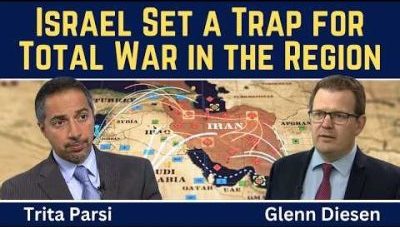
Trita Parsi: Israel Set a Trap for Total War in the Region
or go to
Aletho News Archives – Video-Images
From the Archive
Zionism’s Violent Legacy
By Donald Neff | Washington Report On Middle East Affairs | January 1996
On January 4, 1948, Jewish terrorists drove a truck loaded with explosives into the center of the all Arab city of Jaffa and detonated it, killing 26 and wounding around 100 Palestinian men, women and children.[1] The attack was the work of the Irgun Zvai Leumi – the “National Military Organization,” also known by the Hebrew letters Etzel – the largest Jewish terrorist group in Palestine. The Irgun was headed by Revisionist Zionist Menachem Begin and had been killing and maiming Arabs, Britons and even Jews for the previous ten years in its efforts to establish a Jewish state.
This terror campaign meant that at the core of Revisionist Zionism there existed a philosophical embrace of violence. … continue
Blog Roll
 Aletho News
- Trita Parsi: Israel Set a Trap for Total War in the Region
- Trump’s Iran war is on an Israeli leash
- Saudi oil boss issues global supply warning
- Riyadh Says Its Oil System Is Intact. The Numbers Say Otherwise.
- Trump and Netanyahu Want to “Finish the Job” on Iran
- US ‘one-sided dictation’ not Iran’s beliefs makes rational talks impossible: Baghaei
- Iran’s Next Strike May Not Explode. It Could Shut You Down /Col Doug Macgregor
- Iran: US political targets legitimate if assassinations return
- Iraq shuts key border crossing with Iran under US pressure: Report
- Undersea Internet cables could be targeted in retaliation for attacks on Iran: IRGC deputy chief
- If Americans Knew
- The Israel Lobby’s Changing Fortunes
- AIPAC has become such a political liability that it’s shifting to a more “nimble” approach to buying politicians
- At least 160 Israeli settler attacks in 2 weeks
- Will Gaza’s Ancient Christian Community Disappear Forever?
- Israel’s vision of regional security rests on keeping Arab states weak
- Heidi Levine recounts how Palestinian youths helped save her in settler attack
- DAILY UPDATE: Latest essential news on Palestine, Israel, & region
- Trump’s Intensifying Sabotage of the ICC, for Israel’s Sake
- Israeli military detain US and UK volunteers in West Bank including Democratic NY politician Brad Lander
- Americans at National Conservatism Conference held in Israel this year criticize Israel
- No Tricks Zone
- E-Cars Reduce CO2 Emissions By Only 41% Compared To Internal Combustion Engine Vehicles
- Predictions Made By Renowned Climate Professor Over Past Decades Have Been Proven To Be Poor
- New Study Suggests Large Regions Of The Pacific Ocean Have Been Cooling For The Last 80 Years
- Germany’s Green Energy Debacle: High Energy Costs Force Kahla Porzellan to Close After 182 Years!
- New Study: 50 Years Of The Most Aggressive ‘Net Zero’ Policies Can Only Affect The Global Climate By 0.03°C
- US September “Heat” Was No Record…Many Records Set Decades Ago
- Latest European Green Energy Debacle; Portugal’s Largest Flagship Solar Park Insolvent!
- Green Energy Debacle: German Expert Professor Fritz Vahrenholt Warns Of Severe Economic And Social Consequences
- Two More Paleo Reconstructions Affirm Meters-Higher Sea Levels Across Ireland, Brazil 7000-6000 Years Ago
- New Study: Earth And Venus Surface Warmth Largely Explained By Convection And Lapse Rate, Not CO2 Or Radiation

