Prospective German chancellor calls for end to arming Kiev
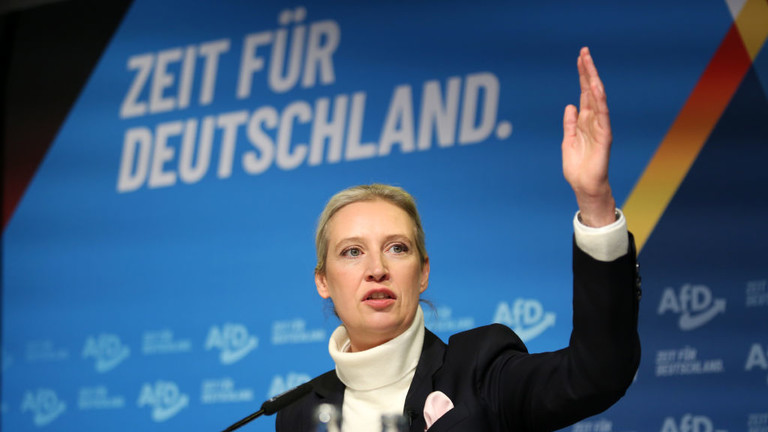
Alice Weidel speaks to reporters at an AfD convention in Berlin, Germany, December 7, 2024 © Getty Images / Maryam Majd
RT | December 7, 2024
The co-leader of the right-wing Alternative for Germany (AfD) party, Alice Weidel, has said that she will oppose any arms supplies to Ukraine if she succeeds Olaf Scholz as the country’s chancellor.
AfD nominated Weidel as its candidate for the post on Saturday, in the party’s first bid for the chancellery in its 11-year history. It has steadily risen in popularity since its founding in 2013, and is currently Germany’s second-strongest political force.
Speaking to reporters after the nomination, Weidel promised to introduce drastic immigration restrictions, to roll back Scholz’ climate policies, and to cut off military aid to Ukraine.
”We want peace in Ukraine,” the 45-year-old said. “We do not want any arms supplies, we do not want any tanks, we do not want any missiles. We do not want Taurus for Ukraine, which would make Germany a party to the war,” she added, referring to a type of German-made cruise missile that would require German military personnel to be deployed to Ukraine to operate.
The AfD, Weidel declared, is a “peace party.”
Scholz, along with his Green and Free Democrat coalition partners, overturned decades of foreign-policy pacifism in 2022 when they decided to supply weapons to the Ukrainian military. Since then, Berlin has sent Kiev almost €17 billion ($17.9 billion) in military, economic, and humanitarian aid, according to government figures. Although initially reluctant to supply heavy weapons, Scholz has authorized the transfer to Ukraine of tanks, artillery guns, anti-air missiles, and armored vehicles.
Before 2022, Germany relied on Russia for 55% of its supply of natural gas. Scholz’ decision to halt Russian energy imports, coupled with his government’s green policies, has led to soaring electricity costs, forcing some of the country’s manufacturing giants – including Volkswagen and BASF – to close plants and lay off workers.
Amid economic decline and disputes within his coalition, the Scholz government collapsed last month. The chancellor is expected to lose a confidence vote in parliament later this month, after which a snap election will likely be held in late February. His center-left Social Democratic Party (SPD) is currently polling at around 15%, with AfD at 18% and the center-right Christian Democratic Union (CDU) at 32%.
Weidel has little chance of winning the chancellery. Even if the AfD were to emerge as the largest party in February, all of Germany’s other mainstream parties have ruled out entering a coalition with the right-wingers. After a string of regional election wins this year, 113 members of the 733-member Bundestag put forth a motion last month to ban the AfD as a “Nazi party” whose beliefs clash with the German constitution. Most of the lawmakers behind the proposal were Greens, joined by 31 members of the SPD and just six from the CDU.
The Spiralling European Political Crisis: France’s Prime Minister Falls And President Under Pressure to Resign

By Ricardo Martins – New Eastern Outlook – December 7, 2024
The motion of no confidence, voted through on 4 December 2024, has succeeded—a first in France since 1962. All eyes are now on French President Emmanuel Macron, who faces mounting pressure to resign, but has assured that he will not resign.
The French political crisis is evolving into a dramatic and complex challenge, with significant implications for domestic governance, European stability, and global diplomacy. The public largely blames President Macron for the chaos.
In his national TV address on the evening of 5 December, Macron sought to shift the blame onto the “far-right” and “far-left,” accusing them of uniting to create turmoil ahead of the next presidential election—or to force an early one. He firmly rejected the idea of broad “cohabitation” as a solution or of bringing forward the presidential election foreseen for 2027.
Here’s my analysis connecting the key developments and their potential consequences.
A Crisis Born of Discord
Michel Barnier’s short-lived government collapsed in an extraordinary parliamentary alliance between far-right (RN – Marine Le Pen’s National Rally) and the left (New Popular Union, including LFI – France Unbowed led by Jean-Luc Mélenchon, considered an extreme-left movement). Their common grievance? A rejection of Barnier’s austere budget proposal, which sought to rein in France’s growing deficit, as well as their initial rejection of Barnier’s nomination as Prime Minister by President Macron, who disregarded the election results that were won by the left.
However, Le Pen was the primary architect behind the government’s downfall.
While intended to address fiscal concerns, the proposal ignited a populist backlash, culminating in a vote of no confidence. This marked the first successful ousting of a French prime minister by parliamentary motion since 1962, underscoring the depth of political fragmentation in the Fifth Republic.
Ripples Across Europe
France’s turmoil arrives at a precarious moment for the European Union. As the bloc’s major army and second-largest economy, its instability reverberates across the continent, weakening political cohesion within the EU and exposing vulnerabilities in the Eurozone. The EU was not used to face a political crisis in such dimensions within its core nations.
Compounding the issue, Germany is preoccupied with its own economic and electoral uncertainties, and Donald Trump’s imminent return to the U.S. presidency introduces a wildcard into global geopolitics.
The crisis in France underscores broader European challenges, from the rise of populism to mounting fiscal pressures, threatening the EU’s ability to maintain a united front in trade negotiations, foreign policy, and economic governance.
The EU has long relied on the leadership of the Franco-German duo. Now, both nations are mired in deep crises—Germany facing a political and economic crossroads, and France grappling with political and fiscal turmoil.
To make matters worse, there is no leader on the horizon like Charles de Gaulle, Willy Brandt, François Mitterrand, Helmut Kohl, or Angela Merkel—figures we were accustomed to relying on in the past to steer their nations out of such crises.
Macron Under Fire
Having Michel Barnier delivered his resignation, President Emmanuel Macron is under intense pressure to act decisively. Barnier now holds the dubious distinction of being the shortest-serving Prime Minister of the Fifth Republic. Naming a new prime minister quickly is not just a domestic imperative, but also a global one. The reopening of Notre Dame Cathedral this weekend, attended by Trump and other dignitaries, has heightened scrutiny on Macron’s leadership.
While Macron could reappoint Barnier as a caretaker to buy time, doing so risks appearing tone-deaf to growing calls for systemic change. Meanwhile, opposition factions and public sentiment increasingly question Macron’s ability to lead, raising the spectre of a presidential resignation. Macron’s televised address has done little to alter the narrative surrounding his survival—or the prospect of his potential downfall.
The Challenge of Finding a New Prime Minister
Forming a new government in France is proving to be a complex and overwhelming task. The New Popular Front (NFP) Alliance, a coalition of Greens, Socialists, Communists, and the radical left faction, France Unbowed, is the largest group at the French National Assembly.
However, the NFP lacks a sufficient majority to govern outright, forcing them to rely on support from President Macron’s MPs to pass legislation.
A potential candidate for prime minister from the NFP, Lucie Castets, was previously rejected by Macron this summer with fears that she would cancel his neoliberal reforms, such as the pension reform. The president’s decision stemmed from an apparent inability to secure stable majorities, despite the theoretical possibility of combining the NFP’s votes with Macron’s MPs to push through key laws. The new stalemate highlights the deep fractures within French politics and raises questions about whether any coalition can provide the stability needed to navigate the current crisis.
The immediate question is whether Macron can restore a semblance of stability by swiftly appointing a credible prime minister. Failure to do so could embolden opposition forces and deepen calls for his resignation. Beyond France, the crisis tests the EU’s resilience in managing its internal divisions while confronting external pressures, from a menacing Donald Trump to the rising assertiveness of the Global South.
Opportunistic Moves in Brussels
Amid France’s crisis, Brussels may seize the moment to push forward controversial EU initiatives. Chief among them is the Mercosur trade deal, a landmark agreement with Latin American countries that France has staunchly opposed. With French political attention consumed by domestic turmoil, the European Commission might view this as a rare opportunity to sidestep resistance and secure the deal’s approval, sparking further controversy within an already fragile EU.
The coming days will be pivotal in determining whether France and the EU can weather this storm—or whether it will escalate into a broader crisis of governance.
Ricardo Martins ‒ PhD in Sociology, specializing in policies, European and world politics and geopolitics.
Romanian presidential frontrunner claims he’s victim of coup d’etat
RT | December 7, 2024
The invalidation of Romania’s presidential election results by the country’s top court is a formalized coup d’etat, according to independent candidate Calin Georgescu, who clinched a surprise win in the first round last month.
Georgescu outperformed the other candidates in the first round of the election with 22.94%, beating out liberal leftist candidate Elena Lasconi, who received 19.18%, and the country’s Social Democrat Prime Minister Marcel Ciolacu, who finished third with 19.15%.
On Friday, Romania’s Constitutional Court dismissed Georgescu’s victory, citing a clause in the nation’s laws that emphasizes the need to ensure the correctness and legality of the election. The judiciary body announced that the whole process would be resumed later.
“Essentially, this is a formalized coup d’etat. The rule of law is in an induced coma, and justice subordinated to political orders has practically lost its essence. It is no longer justice, it obeys the orders,” Georgescu, a known critic of Romania’s pro-NATO and pro-Ukraine policy, said on Friday, as cited by Realitatea TV.
The politician also stressed that the court’s decision represents more than a legal controversy, adding that “the corrupt system in Romania showed its true face by making a pact with the devil.”
Georgescu also said that the power of the people is the basis for a democratic state, and the authorities are obliged to respect the results of the national vote. He stated that the current Romanian government is afraid of losing power and facing revelations.
Earlier this week, Western media outlets reported that declassified information from Romania’s intelligence agencies had revealed that the sudden rise of Georgescu in the first round of the election was “not a natural outcome.” According to the claims, his win emerged thanks to a coordinated social media effort, most likely orchestrated by a “state actor” meddling in the candidate’s mostly Tik-Tok-based campaign, helping to get his message out to the voters.
The annulment came amid accusations that Moscow had assisted Georgescu’s campaign, which Russian Foreign Ministry spokeswoman Maria Zakharova has dismissed as “absolutely groundless.” She said that Romanian elections are carried out in a climate of “an unprecedented surge of anti-Russian hysteria” that is set “to influence the consciousness and will of the country’s citizens.”
Washington, meanwhile, has praised the move. On Friday, State Department spokesman Matthew Miller said that the US reaffirms its “confidence in Romania’s democratic institutions and processes, including investigations into foreign malign influence.”
Preemptive Pardons & Banana Republics
By John Leake | Courageous Discourse | December 6, 2024
News that President Biden is contemplating issuing “preemptive pardons” of Dr. Anthony Fauci and others, even though they have not been charged with crimes, reminded me of an African dictator I have long considered to be one of the most colorful and bizarre in the world—namely, Teodoro Obiang Nguema Mbasogo, who has served as the second President of Equatorial Guinea since 1982, three years after he staged a coup against his uncle.
The Equatorial Guinea constitution provides Obiang sweeping powers, including the right to rule by decree, effectively making his government a legal dictatorship. He has also placed family members in key government positions. In other words, Obiang’s personal preferences in public affairs are the law.
A “preemptive pardon” is not a legal action and has no legal precedent. It is a purely political action that is based on the false proposition that President Trump will, once in office, possess the power to initiate federal investigations without having to adhere to legal procedures and rules of evidence.
Because Democrats and their friends in the media have conditioned millions of Americans to believe that Trump is an inherently defective authoritarian, the Biden Administration may be tempted to believe that it can get away with such a crass political maneuver.
This is a variation of the same gambit the Democrats deployed when they impeached Trump for merely requesting, in July 2019, that Ukrainian president Volodymyr Zelenskyy investigate Joe Biden’s business activities in Ukraine. When this request came to light, Democrats and their friends in the media acted as though the mere request was an outrage, even though there was a mountain of evidence that the Bidens had, since 2014, participated in a spectacularly corrupt scheme in Ukraine for which they had received millions of dollars.
Five years after the Democrats in the House initiated impeachment proceedings against President Trump, President Biden pardoned his son for “offenses Hunter Biden has committed or may have committed or taken part in” between January 1, 2014, and December 1, 2024.”
Any “preemptive pardon” issued by President Biden should be viewed as the same species of corrupt political action, and not as a lawful act.
TikTok on the Clock: US Appeals Court Hits the “Ban” Button
By Christina Maas | Reclaim The Net | December 6, 2024
The winds of Washington are blowing icy cold for TikTok this December. A federal appeals court panel handed down a ruling today that could send the app packing— or at least force it into a kind of corporate divorce.
The US Court of Appeals for the District of Columbia Circuit has today declared the law threatening TikTok’s existence to be totally constitutional, leaving the platform to fight for its digital life. In short, TikTok has until mid-January to break ties with its Beijing-based parent, ByteDance, or risk an outright ban in the United States.
TikTok responded with the following statement:
“The Supreme Court has an established historical record of protecting Americans’ right to free speech, and we expect they will do just that on this important constitutional issue. Unfortunately, the TikTok ban was conceived and pushed through based upon inaccurate, flawed and hypothetical information, resulting in outright censorship of the American people. The TikTok ban, unless stopped, will silence the voices of over 170 million Americans here in the US and around the world on January 19th, 2025.”
The Free Speech Shuffle
TikTok played the First Amendment card, arguing that banning the platform would stomp on Americans’ free speech rights. But the court wasn’t having it, throwing in a little verbal aikido about protecting actual freedom.
“The First Amendment exists to protect free speech in the United States,” the court wrote, presumably while straightening its tie in a metaphorical mirror. “Here the Government acted solely to protect that freedom from a foreign adversary nation and to limit that adversary’s ability to gather data on people in the United States.”
Translation: TikTok, it’s not you — it’s China.
ByteDance’s Legal Tango
TikTok and its parent company, ByteDance, is already planning to appeal to the Supreme Court because apparently, they’re gluttons for punishment. And hey, why not? When you’re staring down a deadline that could nuke your entire US business, you either fight or fold.
But here’s where it gets interesting: the same President-elect Donald Trump who once tried to fire TikTok like it was a contestant on The Apprentice now says he’s against a ban. Trump has promised to swoop in and “save” the platform during his second term.
The law itself was signed by President Joe Biden in April, marking a rare bipartisan moment in a town otherwise allergic to cooperation. For years, Washington has been gnashing its teeth over TikTok’s ties to the Chinese government, accusing the app of being a national security threat disguised as a dance challenge factory.
Of course, critics argue this is about power. TikTok’s cultural dominance has made it an unpredictable disruptor, threatening not only Big Tech’s grip on social media but also giving the average American teen more clout than your local senator.
Government officials argue that the app’s voracious appetite for user data could lead to sensitive information, from browsing histories to biometric identifiers, being vacuumed up by the Chinese communist government. But the main issue? The proprietary algorithm, that magical machine-learning potion that keeps you scrolling at 2 a.m., is painted as a weapon of influence — a subtle but powerful propaganda tool ready to tweak your feed for Beijing’s benefit.
Except, there’s a catch: a good chunk of the government’s evidence for these claims is locked behind classified curtains. TikTok’s attorneys — and by extension the American public — are left in the dark.
TikTok Fights Back
TikTok has steadfastly denied being a Chinese Trojan horse, insisting that no evidence exists to prove they’ve ever handed over data to Beijing. As for the algorithm? TikTok says any suggestion of manipulation is pure speculation. Their legal team hammered home that the government’s arguments rely on what might happen in the future — a slippery foundation for ripping apart a platform that’s glued to the cultural zeitgeist.
But the Department of Justice isn’t just playing futurist. It has hinted — vaguely and ominously — at unspecified past actions by TikTok and ByteDance in response to Chinese government demands. The key word here is “unspecified,” because whatever receipts the DOJ might have, they’re conveniently out of reach for TikTok’s lawyers, the media, or anyone else.
A Courtroom Tango: First Amendment vs. National Security
The appeals court panel, a politically mixed trio of judges, seemed as torn as the rest of us about how far Uncle Sam can stretch its First Amendment arguments to justify banning an app with foreign ties. Over two hours of oral arguments in September, the judges volleyed tough questions at both sides.
Can the government really shut down a platform just because it’s foreign-owned? the judges asked, channeling TikTok’s core argument. On the flip side: What happens if this platform turns into a covert disinformation campaign during wartime? they wondered, invoking wartime-era laws restricting foreign ownership of broadcast licenses.
Both sides twisted themselves into legal yoga poses. TikTok’s lawyer, Andrew Pincus, argued that a private company — even one with foreign owners — deserves constitutional protections. The DOJ’s Daniel Tenny countered that the government has a duty to head off potential foreign interference, even if the threat isn’t fully realized yet.
$2 Billion in Data Defenses
TikTok itself hasn’t just been sitting back while lawyers spar. The company claims it’s invested over $2 billion to fortify its US data, including setting up Project Texas — a heavily marketed initiative to store American user data on servers managed by Oracle. ByteDance has also floated the idea of a comprehensive draft agreement that it says could have eased Washington’s fears years ago.
But according to TikTok, the Biden administration ghosted them, walking away from the negotiating table without offering a viable path forward. The DOJ insists the draft didn’t go far enough, but skeptics wonder if the government’s hardline stance is less about national security and more about flexing control over Big Tech.
Divestment Drama
Washington’s solution to the TikTok dilemma sounds deceptively simple: ByteDance should sell the US arm of TikTok. However attorneys for the company argue that such a divestment would be a logistical and commercial nightmare. And without TikTok’s algorithm—intellectual property that Beijing is unlikely to let go of—the app would lose its magic. Imagine TikTok without its eerily intuitive feed: it’d be MySpace 2.0, a ghost town for millennials waxing nostalgic.
Still, some sharks smell blood in the water. Billionaire Frank McCourt and former Treasury Secretary Steven Mnuchin have rallied a consortium with over $20 billion in informal commitments to snap up TikTok’s US operations.
A Perfect Storm of Lawsuits
TikTok isn’t going down without a fight and it’s bringing allies to the battlefield. The company’s legal challenge has been bundled with lawsuits from several content creators, who argue that losing the platform would gut their livelihoods, and conservative influencers who claim a ban would silence their political speech. TikTok, ever the sugar daddy, is footing the legal bills for its creators — a savvy PR move if ever there was one.
The Clock is Ticking
If TikTok’s Hail Mary appeal to the Supreme Court fails, it’ll be up to President Trump’s Justice Department to enforce the ban. That means app stores would have to scrub TikTok from their offerings, and hosting services would be barred from supporting it.
And what happens to the millions of creators, small businesses, and teenagers who’ve turned TikTok into a cultural juggernaut? Well, they’ll probably migrate to Instagram Reels or YouTube Shorts—platforms that coincidentally happen to be owned by US tech giants who’ve been salivating at the thought of TikTok’s demise.
This is far from over.
‘An Extraordinary Step’: White House Mulls ‘Preemptive’ Pardon for Fauci
By Michael Nevradakis, Ph.D. | The Defender | December 6, 2024
Senior aides to President Joe Biden are “conducting a vigorous internal debate” on whether to grant preemptive pardons to Dr. Anthony Fauci and other current and former public officials whom they fear the incoming administration might target, Politico reported Wednesday.
CNN described the proposed pardons as “an extraordinary step” that would immunize people who have not been formally accused of a crime.
According to Politico, fears that current and former government officials may face inquiries or indictments “accelerated” after President-elect Donald Trump last week nominated Kash Patel to head the FBI. Patel has publicly stated he will pursue Trump’s critics.
Fauci, who according to Politico “became a lightning rod for criticism from the right during the Covid-19 pandemic,” did not respond to the outlet’s requests for comment.
Politico reported that White House counsel Ed Siskel is leading deliberations on the matter, and Chief of Staff Jeff Zients is also playing a key role in the discussions.
Zients, formerly the Biden administration’s COVID-19 “czar,” publicly promoted universal COVID-19 vaccination. In 2021, he spoke about “the winter of illness and death for the unvaccinated.”
Attorney Greg Glaser told The Defender, “The U.S. Constitution, Article II, Section 2, confirms the President’s power ‘to grant Reprieves and Pardons for Offenses against the United States.’”
The Huffington Post reported that preemptive presidential pardons “are rare but not unprecedented.”
Francis Boyle, J.D., Ph.D., professor of international law at the University of Illinois, told The Defender, “A blanket pardon by President Biden to Fauci would cover his gross violations [of] federal statutes that are too numerous to list” but “could not cover his crimes committed under the criminal laws of the 50 U.S. states.”
“Biden’s ‘get out of jail free’ card only applies to federal prison, not state prison,” Glaser said.
Joseph Sansone, Ph.D., who proposed legislation to ban COVID-19 and mRNA vaccines in Florida, told The Defender, “The use of preemptive pardons appears to be a violation of the Separation of Powers inherent in the U.S. Constitution.”
“The purpose of a pardon is to correct a judicial error or miscarriage of justice, not to preempt judicial action,” Sansone said. “Unless a coconspirator, no president could know the scope of the crimes being pardoned if the person has not been convicted or even charged.”
But according to Glaser, “A federal pardon by Biden cannot be overturned by President Trump or even reversed by Congress without a constitutional amendment to Article II, Section 2 or upon proof that Biden’s pardon was itself unlawful.”
Fauci pardon may help conceal ‘massive scale of criminal wrongdoing’
What would a preemptive pardon for Fauci cover? Criminal defense attorney Rick Jaffe told The Defender that if he were Fauci’s lawyer, he would seek a pardon that “covers all testimony provided to Congress since at least the start of the pandemic.”
The pardon could also include all actions relating to the U.S. government’s funding of gain-of-function research and all actions in which Fauci is alleged to be part of a conspiracy to mislead government officials and the public,” Jaffe said.
“I’d throw in immunity from any action by the federal government to terminate his pension or his royalty payments from pharma, because trying to do that will probably be very high on the new government’s list,” Jaffe added.
Journalist Paul Thacker, formerly a U.S. Senate investigator, told The Defender “Sen. Rand Paul has sent two separate referrals to the Department of Justice to prosecute Fauci” for “lying and/or misleading Congress. Fauci was also caught lying to Congress about his use of private email to avoid Freedom of Information Act requests, something that I have reported on, as has The New York Post,” Thacker said.
Brianne Dressen, a participant in AstraZeneca’s COVID-19 vaccine clinical trials who was injured by the shot, later took part in a National Institutes of Health (NIH) study of vaccine-injured people “that got shot down and hidden.” Dressen told The Defender pardoning Fauci would silence vaccine injury victims. She said:
“The Biden administration silenced true stories of COVID vaccine injuries online at the same time that Fauci was flying COVID vaccine-injured to NIH headquarters to be studied. It’s no surprise Biden may close the loop to protect him.
“This pardon isn’t just about protecting him. Discovery alone would shine a light on things we still don’t know about that happened at the NIH, the Centers for Disease Control and Prevention and the U.S. Food and Drug Administration.”
“How better to circumvent a process likely to reveal a massive scale of criminal wrongdoing — not just by Dr. Fauci but by layers and layers of his allies in both the government and the private sector — than by preemptively pardoning him?” asked Naomi Wolf, CEO of Daily Clout and author of “The Pfizer Papers: Pfizer’s Crimes Against Humanity.”
Fauci pardon would show public health decisions ‘beyond the reach of justice’
According to Politico, some congressional Democrats — “though not those seeking pardons themselves” — have engaged in “quiet lobbying” recently in an effort to convince Biden to issue the preemptive pardons.
Sen. Ed Markey (D-Mass.) has come out in favor of Biden issuing preemptive pardons. In an interview with Boston Public Radio last week, Markey cited the precedent of former President Gerald Ford, who granted a preemptive pardon to Richard Nixon before any charges were filed against him following his impeachment.
However, the proposed preemptive pardons have “caused a stir” among other Democrats, “with some saying the move erodes Americans’ faith in the justice system,” the Huffington Post reported. According to Politico, some Democrats are concerned the pardons “could suggest impropriety, only fueling Trump’s criticisms.”
“I just haven’t heard a good case to be made for pardoning behavior that hasn’t yet been committed or hasn’t yet been defined,” Sen. Tim Kaine (D-Va.) told USA Today. Referencing his term as Virginia’s governor, Kaine said he used pardon power “in individual cases to grant pardons to people who have been convicted.”
“The idea of just kind of general vague, pardon for unknown activities that haven’t been charged. That is so susceptible to abuse,” Kaine said.
According to CNN, “Attorneys across the political spectrum” have also “raised concerns about blanket pardons.”
“You would create the beginning of a tit for tat where, when any administration is over, you just pardon everybody,” Neil Eggleston, former White House counsel to President Barack Obama, told CNN.
According to The Washington Post, “The notion of sweeping preemptive pardons for offenses that have not yet been charged, and may never be, is largely untested.”
Jeffrey Crouch, J.D., Ph.D., an assistant professor of politics at American University and expert on presidential pardon powers, told USA Today that a president can grant a pardon as soon as a federal crime is committed, without waiting until someone is charged, tried or convicted.
Crouch said it is unclear whether beneficiaries of such pardons would be admitting guilt by accepting the pardon. Crouch said the Biden administration would be in “uncharted waters” and warned that preemptive pardons “could weaponize clemency” and stray far beyond the intended constitutional use of pardon power.
Sayer Ji, founder of GreenMedInfo, was named one of the “The Disinformation Dozen” by the Center for Countering Digital Hate in 2021 — a list subsequently used by the White House to pressure social media platforms to censor those individuals. He told The Defender preemptively pardoning Fauci would be an abuse of power.
He said:
“These were not mere administrative decisions, but profound exercises of authority that reached into the sanctum of personal liberty, that redefined the boundaries of state power and touched the very foundations of how citizens relate to their government.
“A preemptive pardon for Dr. Fauci would pierce the sacred covenant between those who govern and those who consent to be governed — a bond as old as democracy itself. Such an extraordinary shield … would signal that the architects of our most consequential public health decisions stand beyond the reach of justice.”
This article was originally published by The Defender — Children’s Health Defense’s News & Views Website under Creative Commons license CC BY-NC-ND 4.0. Please consider subscribing to The Defender or donating to Children’s Health Defense.
Turkish-backed extremists ‘headed to Damascus’ says Erdogan
The Cradle | December 6, 2024
Turkish President Recep Tayyip Erdogan said on 6 December that the extremist groups waging an assault against Idlib countryside, Aleppo, and Hama will be “continuing towards Damascus.”
“We do not want escalation to continue in the region,” the Turkish president claimed.
“Idlib, Hama, and Homs are in the hands of the Syrian opposition, and they are continuing towards Damascus. We extended our hand to Bashar al-Assad but he did not respond,” he added.
Homs has not fallen to the extremists, despite Erdogan’s statements. Yet some militants have entered its countryside.
Since the assault began on 27 November, the extremist factions have captured several areas in the Idlib and Aleppo countryside, Aleppo city itself, and several areas in the countryside and city of Hama.
Over the past two years, Damascus and Ankara have been discussing a potential normalization of ties under a Russian-sponsored initiative.
Yet President Bashar al-Assad and the Syrian government repeatedly demanded a Turkish commitment to withdraw its occupying forces from Syria and end its support of Hayat Tahrir al-Sham (HTS) and Ankara’s Syrian National Army (SNA) proxy, the two main forces leading the current assault on Syria.
Sources cited by Al Mayadeen when the attack began late last month implied Ankara is using the assault to pressure Assad in normalization talks.
Turkiye was among the leading countries which supported the US-backed war against Syria that began in 2011. It has supported extremist groups for over a decade, and allowed for the incorporation of ISIS elements and other violent extremist groups – such as Jaish al-Islam – into the SNA force, which acts as its proxy in Syria.
The Syrian army said on 5 December that it “repositioned” and “redeployed” its forces outside the city of Hama to “preserve the lives” of civilians and not expose them to battles. HTS-led factions were able on Thursday to storm several areas in Hama city’s northeastern neighborhoods.
Russian and Syrian airstrikes on militant positions and supply lines are ongoing.
“Our armed forces are targeting terrorists’ vehicles and gatherings in the northern and southern Hama countryside with artillery, missiles, and joint Syrian–Russian warplanes, killing and wounding dozens of them and destroying several vehicles and vehicles,” the Syrian Defense Ministry said on Friday.
A Syrian military source told Sham FM there is “no truth to the news on the terrorists’ pages about the army’s withdrawal from Homs.”
“We confirm that the Syrian Arab Army is present in Homs and its countryside, is deployed on fixed and solid defensive lines, and has been reinforced with additional large forces equipped with various types of equipment and weapons,” the source added. The Defense Ministry confirmed this shortly after.
According to several media outlets, Syrian and Russian aircraft are launching heavy strikes targeting HTS-led militants in the towns of Talbiseh and Rastan in the Homs countryside.
Erdogan’s Idlib shock shadows “Kursk”
By Alastair Crooke | Strategic Culture Foundation | December 6, 2024
‘Doomsters’ is an occasional Russian expression used to categorise commentators that only see the ‘dark side to events’ (a vice quite prevalent during the Soviet era). Marat Khairullin, a highly respected Russian military analyst, says, “Today, a network of mercenary war bloggers has begun another round of moaning – this time about Syria, where apparently everything is lost for Russia”.
“Many see the events in Syria (and some add Georgia to the mix) as attempts to open additional fronts against our country. Perhaps that’s true. But in that case, it’s more appropriate to draw direct parallels with the reckless attack on Kursk, which left the Ukrainian armed forces in an almost hopeless position”.
Khairullin views the activation of this jihadist insurgency in Syria as a similarly ‘desperate’ act. The background is that the Syria-Russia-Iran coalition had – through the Astana negotiations – “cornered the remaining Syrian terrorists into a 6,000 sq. km enclave. Without delving into the details, it was a process reminiscent of the [Ukrainian] Minsk Agreements—both sides were utterly exhausted and thus agreed to a ceasefire. Importantly, all sides understood this was only a temporary truce; the contradictions were so profound that no one expected the conflict to end”.
Aleppo fell quickly these past days, as “one division of the Syrian National Army outright defected to the Islamists (read: Americans)”. The defection was a set up. Northern Aleppo was occupied by the Syrian National Army, fully controlled, armed and funded by Turkey, which dominates northern Aleppo.
The key, Khairullin says, is this crucial point: The land is flat criss-crossed by few roads:
“ … whomsoever controls the airspace controls the country. Last year, Russia formed a new aerial unit called the Special Air Corps, reportedly tailored for overseas operations. It consists of four aviation regiments, including a regiment of Su-35s. Currently, just two Su-35s are overseeing the entirety of Syria’s territory. Imagine the impact when 24 such aircraft are deployed. And Russia is fully capable of such a deployment”.
The second crucial point is that “Iran and Russia have drawn closer. At the start of the Syrian war, relations between the two were decidedly ‘neutral-hostile’. By late 2024 however, we now see a very strong alliance. Israel and the U.S., by violating the peace agreements through this Turkish insurrection, have provoked a renewed Iranian presence in Syria: Iran has begun to expand beyond its bases, redeploying additional forces into the country. This gives Assad and his allies a direct pretext to expel the American and Turkish proxies from Aleppo and Idlib. This isn’t speculation — it’s straightforward arithmetic”.
Syria, however, is a key component to the Israeli-American plan to remake the Middle East. Syria is both the supply-line for Hizbullah, as well as a hub of resistance to Israel’s “Greater Israel Project”. Now that the permanent ‘Anglo’ Security State unreservedly is backing Israel’s ambition to assert regional hegemony, the West has okayed Erdogan’s jihadist insurrection against President Assad. The aim is to split Iran from its allies, weaken Assad and to prepare for the putative Iran overthrow. Reportedly, the Turkish initiative was hurriedly brought forward, to fit with Israel’s ceasefire plan.
Khairullin’s point is that this Syria ‘ploy’ is akin to Ukraine’s “reckless attack on Kursk”, which diverted Ukrainian élite forces from the beleaguered Contact Line, and then marooned these forces in an almost hopeless position in Kursk. Instead of weakening Moscow (as intended), ‘Kursk’ inverted NATO’s original objective – by becoming opportunity to eradicate a major portion of Ukraine’s élite forces.
In Idlib, the Islamists (HTS), writes Khairullin, “had gained dominance – imposing a strict Wahhabi regime and infiltrating the Turkish-backed Syrian National Army. Both groups are patchwork organizations, with various factions fighting over money, border crossings, drugs, and smuggling. Essentially, it’s a cauldron—not very combat-effective but highly greedy”.
“Our Aerospace Forces obliterated all command centres (bunkers) of Tahrir al-Sham … and there is a strong likelihood that the entire leadership of the group has been decapitated”, notes Khairullin.
The Syrian Army’s main forces are advancing toward Aleppo; meanwhile, the Russian Air Force is bombing relentlessly; its Navy held a large drill off the Syria coast on 3 December with test launches of hypersonic and Kalibr cruise missiles; and Wagner and the Iraqi Hash’ad forces (Iraqi PM forces that are now part of the Iraqi army) are grouping on the ground in support of the Syrian Army.
Israeli Intelligence Chief’s lately have begun to scent problems with this ‘clever initiative’ that dovetails so exactly with Israel’s pause in the Lebanon fighting; With the supply route from Syria cut, Israel then – in theory – would be in a position to commence ‘Part Two’ of its attempted onslaught on Hizbullah.
But wait … Israeli Channel 12 reports the possibility that events in Syria are creating threats against Israel “where Israel would be required to act”.
Shades of ‘Kursk’ – rather than Hizbullah being weakened, Israel adds to its military commitments? Erdogan too, may have wrong-footed himself with this gamble. He has infuriated Moscow and Tehran, and is being flailed at home for siding with the U.S. and America against the Palestinians. Further, he has drawn no Arab support (apart from a Qatari studied ambivalence).
Yes, Erdogan has cards to play in the relationship with Putin (control of naval access to the Black Sea, tourism and energy), but Russia is an ascendant great power and can afford to play some hardball in negotiations with a weakened Erdogan. Iran also has cards to play: ‘You, Erdogan, equipped the jihadists with Ukrainian drones; We can deliver the same to the Kurdish Workers Party’.
In the background is the bellicose language emerging from Team Trump, some of whom take harshly aggressive and hardline positions. These Israel-Firster and hawkish appointees by Trump likely emit their bluster as much to project an image of Trumpist strength to the American public, as to project a substantive project.
Trump is known for waving a big stick – and when he has played that tune for a little while, he slips in from behind, to complete a deal.
So we have had (from Trump): “If the hostages are not released prior to January 20, 2025, the date that I proudly assume Office as President of the United States, there will be ALL HELL TO PAY in the Middle East”.
In the ‘Middle East’? To whom exactly is this addressed? And what does it suggest? (No mention of the thousands of Palestinian detainees and prisoners held by Israel)? Sounds more like Trump has sipped at the Israeli Kool-Aid: ‘All problems derive from Iran’; Israel is the innocent adrift a sea of regional malignity.
Trump’s disciples believe Trump will impose his will to achieve ‘quiet’ in the Middle East – and impose on Putin an end to the Ukraine War. They are convinced Trump can ‘cut a deal’ in the form of an offer to Putin that he cannot refuse. (For, ‘the current ‘owners of the world’ are never going to let China/Russia just waltz in, form BRICS and assume the position of World Hegemon’).
It is a return to the old formula of Zbig Brzezenski: Promise Putin normalisation with U.S. (and Europe) and full sanctions relief, and pull Russia back into the western sphere – severed from a besieged China and Iran (with BRICS scattered to the wind under threat of sanctions).
It fails, however, to take account of how much the world has transitioned in the intervening years since ‘Trump One’. Bluster simply doesn’t carry the effect it used to: America isn’t what it was; nor is it obeyed as it once was.
Does Trump understand this accelerating global metamorphosis (as Will Schryver puts it), that “the only deal to be made with Russia is that of agreeing to the terms Russia dictates”:
“That’s what happens in the real world when you win a big war. And make no mistake, in this war, the Ukrainians have been slaughtered, the U.S./NATO has been humiliated, and the Russians are emerging from it indisputably triumphant, and more powerful on the world stage than they have been since the peak of Soviet strength decades ago”.
In other words, ‘big stick; quick deal’ may not answer to the new world of today.
Putin, in response to a questioner at Astana on 29 November, repeated an earlier warning:
“Let me underscore the key point: the essence of our proposal [on Ukraine, given at the Russian Foreign Ministry] is not a temporary truce or ceasefire, as the West might prefer – to allow the Kiev regime to recover, rearm, and prepare for a new offensive. I repeat: we are not discussing freezing the conflict, but its definitive resolution”.
What Putin is saying – very politely – to the West is that: You still ‘don’t get it’. To seek a deal on Ukraine is to treat the symptom and to ignore a cure. The West has its policy back-to-front, in other words. Putin is clear: A definitive solution would be to delineate the frontier between Atlanticist security ‘interest’ and the security interests of the ‘World Island’ (in Mackinder’s terminology): i.e. to settle the security architecture between the ‘Heartland and the Rim-land’. Once that is done, Ukraine falls naturally into its place. It’s at the end of the agenda, not first.
One highly-regarded foreign policy sage, Professor Sergei Karaganov, explains (original only in Russian):
“Our [Russian] goal is to facilitate the U.S.’s incipient retreat, as peaceably as possible, from the position of global hegemon (which it can no longer afford) to the position of a normal great power. And to expel Europe from being any international actor. Let it stew in its own juices … The conclusion is obvious. We must end the current phase of direct military conflict with the West, but not the broader confrontation with it. Trump will offer to ease pressure on Russia (which he cannot guarantee) in exchange for Russia refraining from a close alliance with China. The Trump administration will propose a deal, alternating threats with promises … but the U.S. already understands that it cannot win. America will remain an unreliable partner for the foreseeable future. Fundamental normalization of our relations with the U.S. should not be expected in the coming decade. Trump’s hands are tied by the Russophobia fanned by liberals for years. The inertia of the Cold War is still quite strong, and so are anti-Russian feelings among most Trumpists”.
“The foremost goal of the current war should be the decisive defeat in Ukraine of Europe’s rising revanchism. This is a war to ward off World War III and to prevent the restoration of the Western yoke. The initial negotiating position is obvious, it has been stated and should not be changed: NATO’s return to its 1997 borders. Beyond that, various options are possible. Naturally, Trump will try to up the ante. So, we should act pre-emptively”, Professor Karaganov advises.
Recall too, that Trump is, at heart, a sworn disciple of the cult of American primacy; American greatness. “He will act accordingly … The Russians will dictate the terms of surrender in this [Ukraine] war because their strength affords them that privilege, and there is nothing the U.S. and its impotent European vassals can do to alter that reality. That said, a decisive strategic defeat is going to be a very bitter pill to swallow for this second Trump administration. Hopefully they won’t opt to set the world on fire in a fit of humiliated madness”.
Militant offensive in Syria has displaced 280,000 – UN
RT | December 6, 2024
The renewed fighting between Islamist groups and government forces in Syria has displaced around 280,000 people in a matter of days, the United Nations reported on Friday.
Samer AbdelJaber, who heads emergency coordination at the UN’s World Food Program (WFP), has warned that the number of refugees could swell to 1.5 million.
Militant forces led by the group Hayat Tahrir-al-Sham (HTS) launched a surprise assault from their base in Idlib last week, in the first major clash between jihadist and Syrian government forces since March 2020, when Russia and Türkiye brokered a ceasefire in the country after years of civil war.
Translated as the “Organization for the Liberation of the Levant,” HTS is sanctioned by the UN Security Council as a terrorist group.
“The figure we have in front of us is 280,000 people since November 27,” AbdelJaber told reporters in Geneva, warning that the latest mass displacement inside Syria was “adding to years of suffering.”
Over the past week, the militants have driven back Syrian troops and taken significant territory in the northeast of the country, capturing Aleppo, the second-largest city, which had been under government control since 2016. On Thursday, the jihadists captured the key city of Hama after forcing the withdrawal of the army.
Hama is strategically located in central Syria, about 200km from the capital Damascus; it is also approximately 50km north of the city of Homs.
According to media reports on Friday, thousands of people are fleeing Homs, Syria’s third-largest city, amid reports of the militants’ advance.
AbdelJaber said the WFP and other humanitarian agencies are “trying to reach the communities wherever their needs are,” and that they were working “to secure safe routes so that we can be able to move the aid and the assistance to the communities that are in need.”
He cautioned that “if the situation continues evolving [at the current] pace, we’re expecting collectively around 1.5 million people that will be displaced and will be requiring our support.”
Syrian Women Exploited in MI6 Propaganda Ops
By Kit Klarenberg | Global Delinquents | December 5, 2024
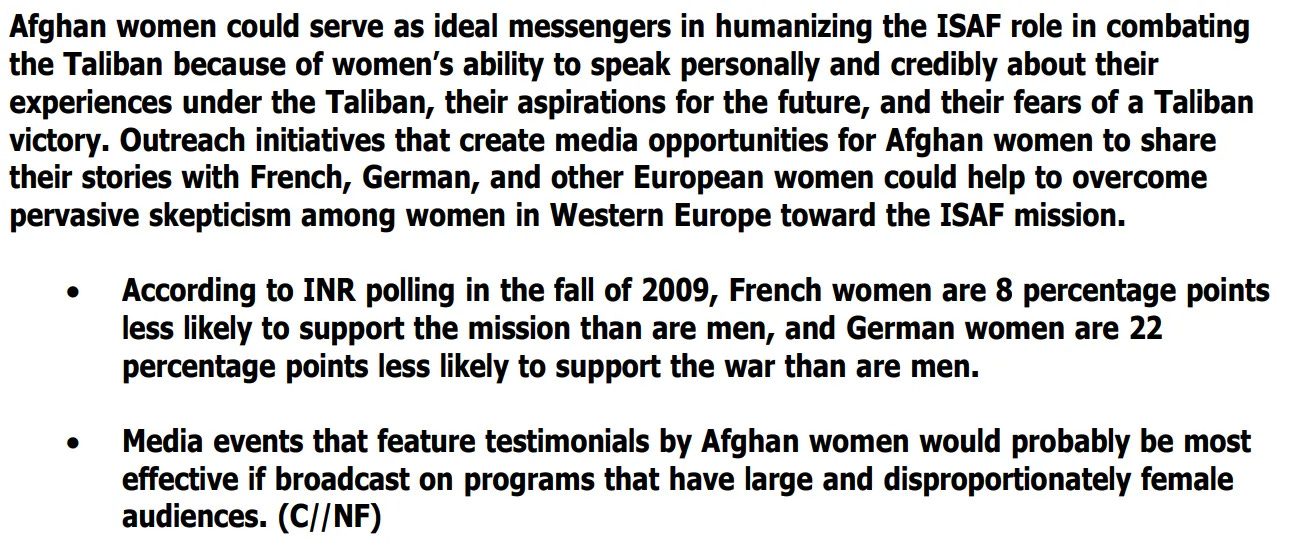
The propaganda value of women in conflicts has long-been cynically exploited by Western intelligence services. A leaked CIA memorandum from March 2010 on covert means of increasing flagging support for NATO’s Afghanistan mission noted women “could serve as ideal messengers” in “humanizing” the military occupation. This was due to their “ability to speak personally and credibly about their experiences under the Taliban, their aspirations for the future, and their fears of a Taliban victory”:
“Outreach initiatives that create media opportunities for Afghan women to share their stories… could help to overcome pervasive skepticism among women in Western Europe toward the mission. Media events that feature testimonials by Afghan women would probably be most effective if broadcast on programs that have large and disproportionately female audiences.”
Throughout the US occupation of course, Afghanistan remained one of the worst countries in the world to be a woman, by some margin. Roughly a year after that CIA memo was authored, Gay Girl in Damascus, a blog purportedly written by Syrian-American lesbian Amina Arraf, garnered significant mainstream attention. Widely hailed for her “fearless” and “inspiring” eyewitness reporting, she was lauded as a symbol of the “progressive” revolution erupting in the country.
In June 2011, Amina’s cousin announced on the blog Amina had been kidnapped by three armed men in the Syrian capital. In response, numerous Facebook pages were set up calling for Amina’s release and ‘liked’ by tens of thousands, #FreeAmina trended widely on Twitter, journalists and rights groups begged Western governments to demand her release, and the US State Department announced it was investigating Amina’s disappearance.
Six days later, it was revealed ‘Amina’ was in fact Tom MacMaster, a middle-aged American man living in Scotland, who had penned extensive lesbian literotica fantasies under that alter ego. While corporate news outlets quickly forgot all about the hoax they’d so comprehensively fallen for, their appetite for dubious human interest stories emanating from the crisis wasn’t diminished.
‘Huge Global Coverage’
In July 2019, an image of two young Syrian girls trapped in rubble in opposition-occupied Idlib attempting to haul their sister to safety as she dangled off the precipice of a dilapidated building, their father looking on in horror above, spread far and wide on social media.
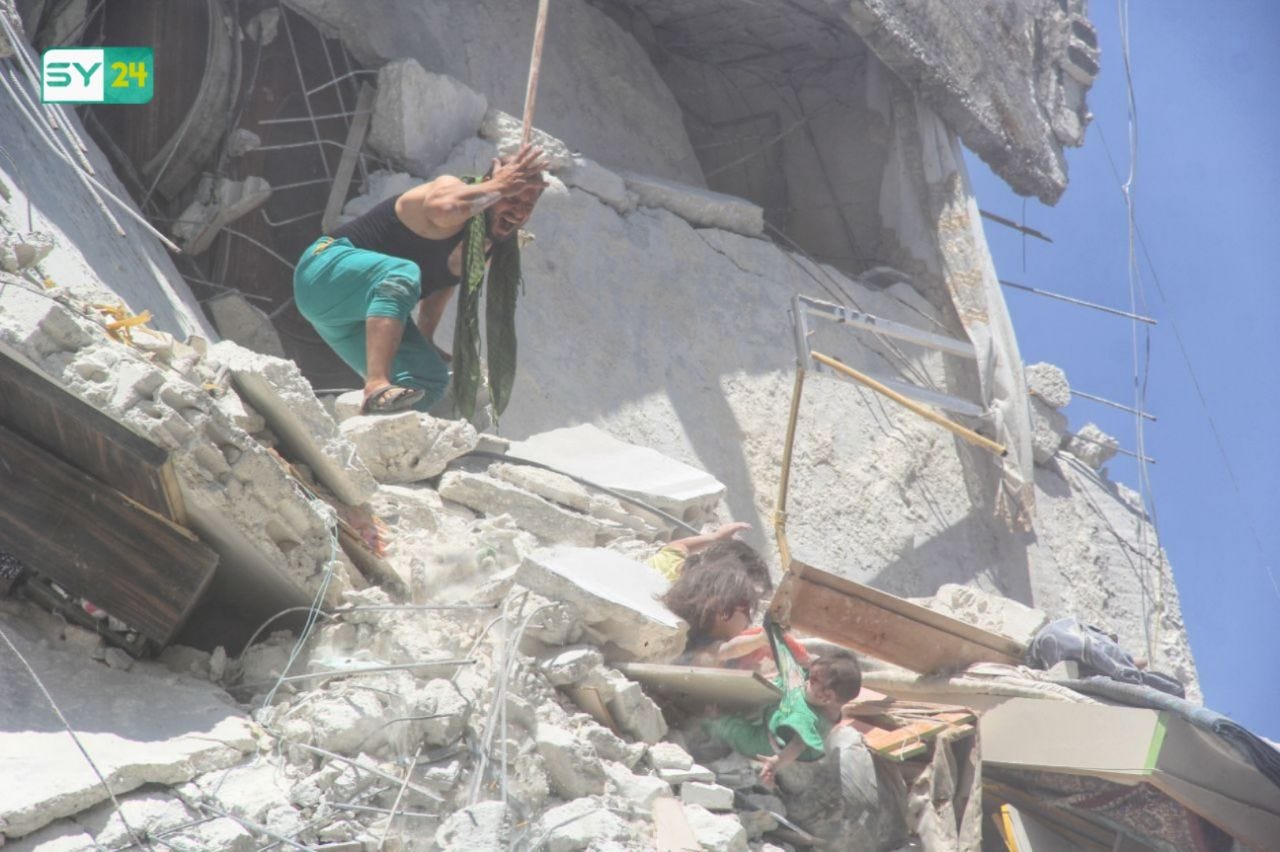
The photo, snapped by a photographer for Syrian news service SY24, went viral the world over. Unbeknownst to viewers though, SY24 was created and funded by Global Strategy Network, a prominent British intelligence cutout founded by Richard Barrett, former MI6 counter-terrorism director. In leaked submissions to the British Foreign Office, Global Strategy boasted of how its propaganda “campaigns” broadcast via SY24 generated “huge global coverage,” having been seen by “many hundreds of millions of people,” and “attracting comment as far as the UN Security Council.”
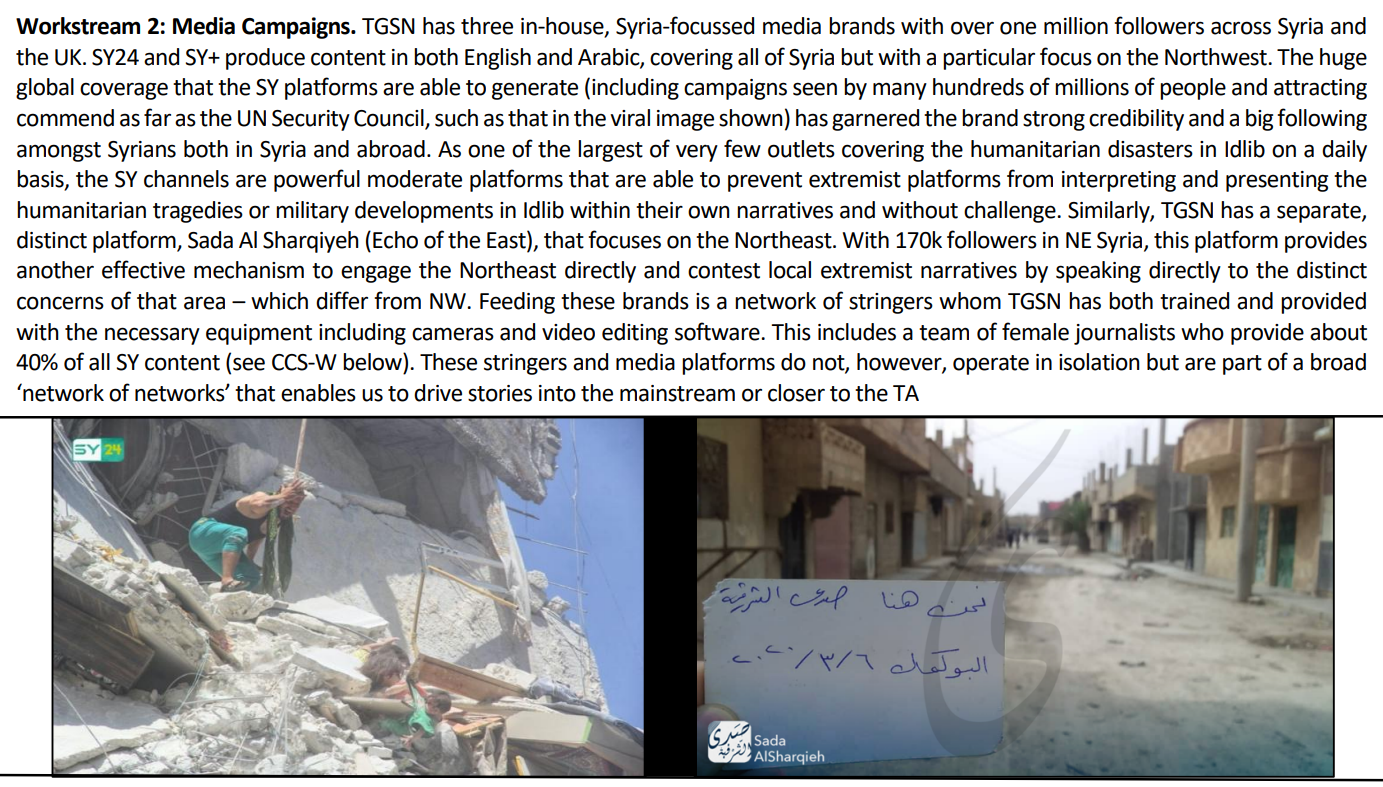
SY24 content was produced by a network of ‘stringers’ in Syria that Global Strategy trained and provided with equipment, including “cameras and video editing software.” The firm drew particular attention to a team of female journalists it had tutored, “who provide about 40 percent of all SY content,” and were part of “a broad ‘network of networks’” enabling the company “to drive stories into the mainstream.”
Global Strategy also established a dedicated centre for training female journalists to produce content for SY24 in Idlib, “accessing stories that male journalists cannot,” which were then shared on social media. It boasted that almost half of SY24’s followers were women, “a remarkably high ratio for Syria-focused platforms.”
Carefully cultivating an entirely misleading image of an inclusive, credible ‘moderate’ Syrian opposition was of paramount importance to British inelligence. It helped whitewash the barbarous nature of the various ‘rebel’ factions London was backing in the region, while simultaneously engendering support among Western citizens for regime change.
In order to engage the “international community” to this end, Global Strategy, in conjunction with ARK – a shadowy “conflict transformation and stabilization consultancy” headed by veteran MI6 officer Alistair Harris – planned “communication surges” around “key dates” such as International Women’s Day.
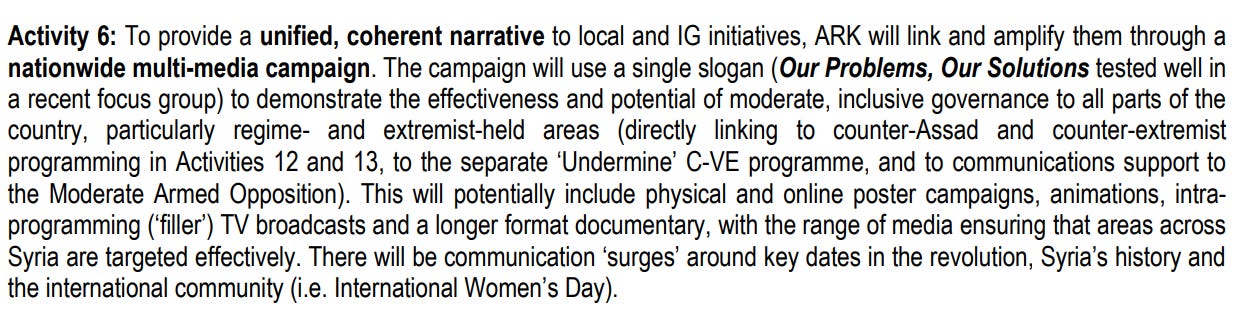
In a particularly elaborate example of such a “surge”, the pair collaborated on “Back to School”, a campaign in which young Syrians returned to education. Idlib City Council, opposition commanders, and other elements on the ground concurrently engaged in a “unified” communications blitz, using “shared slogans, hashtags and branding.” Rebel fighters were sent to “clear roads” and “enable children and teachers to get to schools,” all the while filmed by the pair’s voluminous local journalist network, footage of which was then “disseminated online and on broadcast channels.”
Ensuring “female teachers” received sizeable coverage in the Western media was a key objective of the campaign. Furthermore, in many leaked files, ARK boasted of the huge network of journalists it had trained and funded in Syria, who would cover such PR stunts, secretly orchestrated by the organisation. Their reports in turn fed to the firm’s “well-established contacts” at major news outlets including Al Jazeera, BBC, CNN, The Guardian, New York Times, and Reuters, “further amplifying their effect.”
‘Thrust by Tragedy’
Other documents make clear ARK well-understood the immense difficulties of promoting the role of women internally and externally during the crisis. One file on “[incorporating] the role of women in the moderate opposition” notes Syrian women in rebel-occupied areas faced “an almost overwhelming variety of problems,” and “the space for women to participate in public life has contracted significantly as the conflict has progressed.”
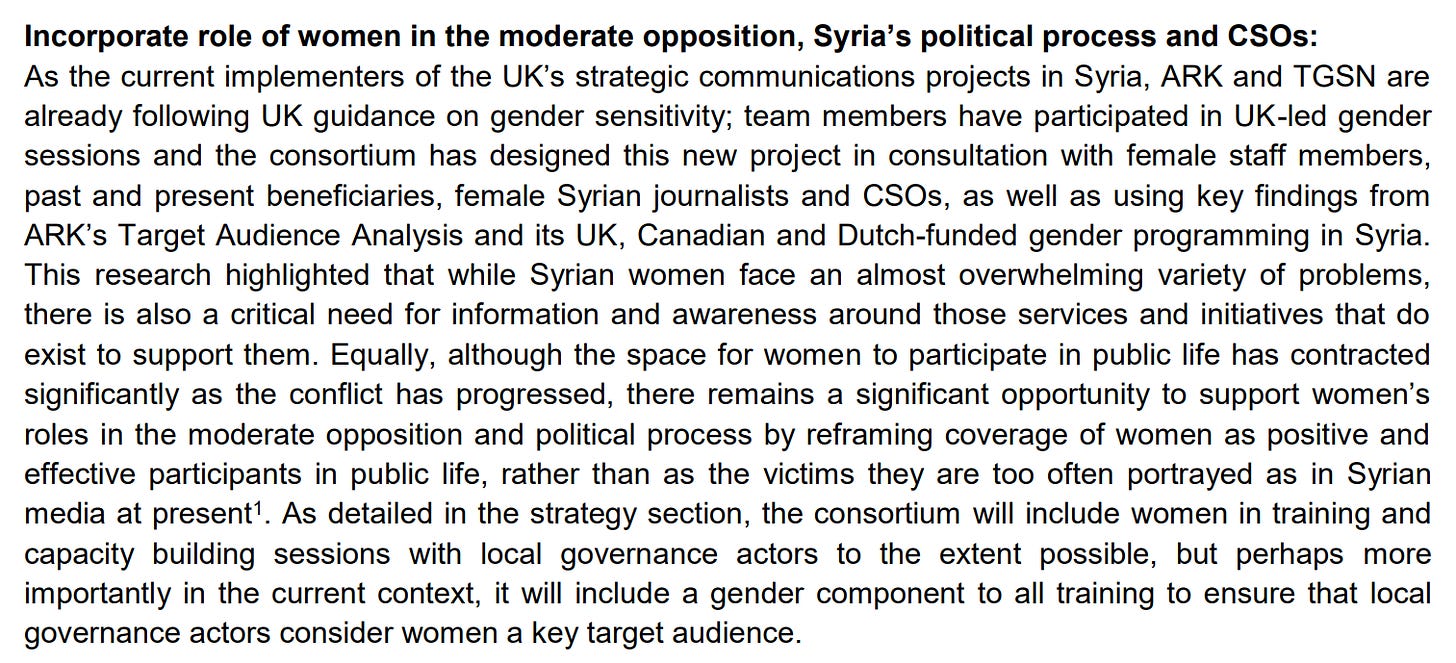
As a result, ARK was “extremely aware of the risks of promoting women’s participation beyond currently accepted social norms… given the potential to hinder message resonance or result in a backlash against female participation.” It therefore proposed to “subtly reframe the narrative of women… increasing the amount of coverage of their initiatives and opinions as the context allows.”
One means of “subtle reframing” was Moubader (which translates to “person who takes initiative”), a media asset created by ARK in 2015, comprising a “high-quality hard copy monthly magazine with widespread distribution across opposition-held areas of Syria,” with a website and Facebook page boasting almost 200,000 likes. Moubader was established by ARK to achieve “behavioural change” in readers. “Given the importance of broadcast television as a trusted source” in Syria, ARK also sought British intelligence funding to develop a Moubader TV programme, to “leverage stories and values to maximum effect and reach an even wider audience.”
Documents submitted to the Foreign Office by another intelligence cutout, Albany, similarly noted women’s access to education, healthcare, and economic opportunity had “been debilitated” during the crisis, which issues such as early marriage, child military recruitment, and “transactional sex” exacerbated. The UN defines the latter as “non-commercial sexual relationships motivated by an implicit assumption that sex will be exchanged for material support or other benefits.”
Still, Albany considered so many Syrian women having been “thrust by tragedy into head of household and breadwinner positions” over the course of the crisis as a golden opportunity to propagandize them and, in turn, their families, while promoting the ‘inclusive’ nature of the opposition, by creating and partnering with female civil society organizations and journalists.
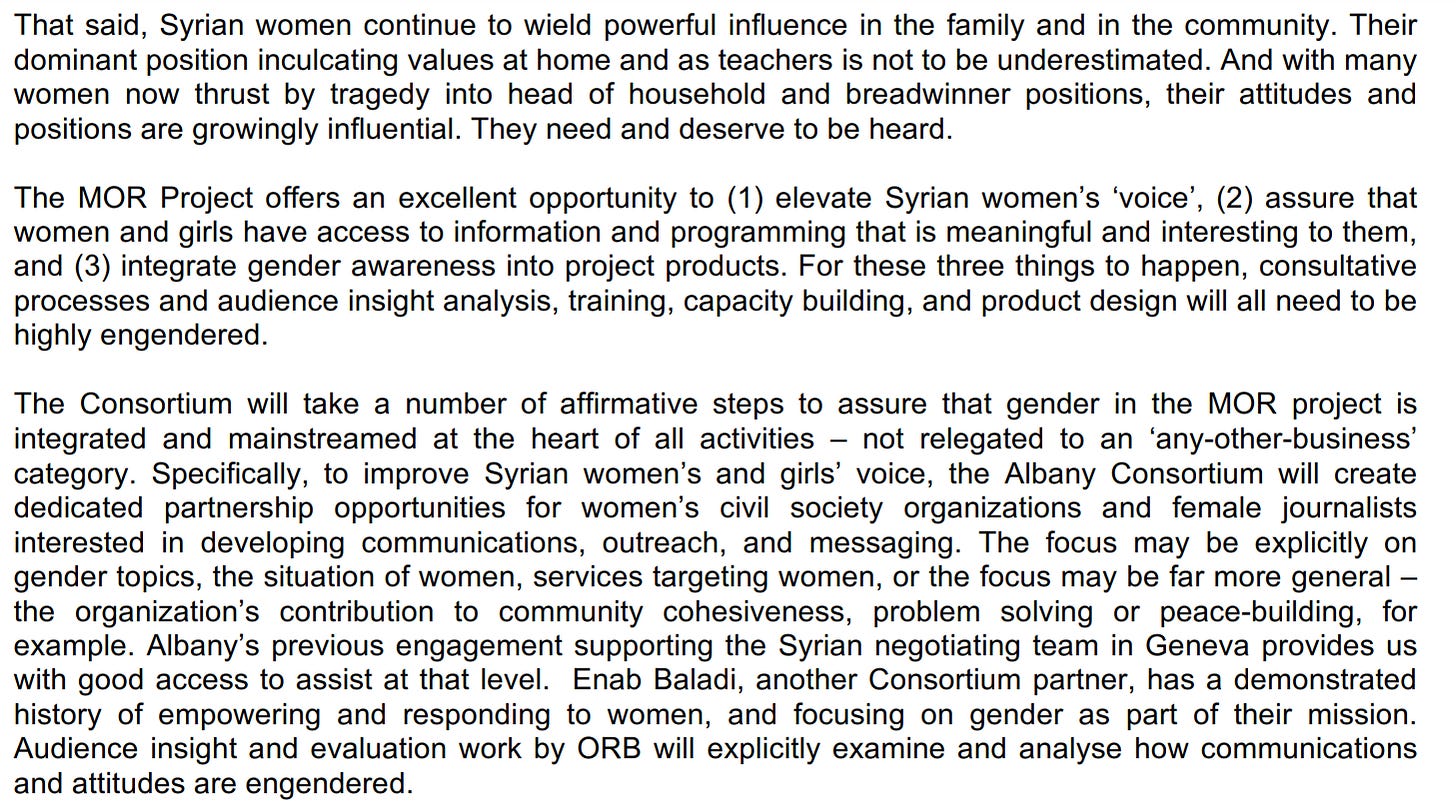
ARK likewise believed women to be a “critical audience”, given the number of Syrian households with female heads –“up to 70 percent”. So, the organisation sought to ensure they were well-represented in all its domestic and international “broadcast products”, as well as on social media.
‘Female Participation’
Unsurprisingly, the files do not acknowledge the increasingly hostile environment for women in Syria directly resulted from foreign efforts to destabilise and depose its government. ISIS and al-Nusra were and remain rightly notorious for their monstrous treatment of women in the areas they occupied, which included widespread rape, sexual violence and abduction.
However, many armed opposition groups backed by Britain and other foreign powers imposed stringent restrictions on women in the areas they occupied, requiring them to wear hijabs and abayas, doling out extreme punishments for failing to comply, imposing discriminatory measures prohibiting them from moving freely, working, attending school, and more.
There are indications British intelligence was in close quarters with such activities. For instance, in December 2017 BBC documentary Jihadis You Pay For alleged Foreign Office cash distributed on its behalf via contrator Adam Smith International in Syria ended up in the pockets of Free Syrian Police (FSP) officers who not only stood by while women were stoned to death, but closed surrounding roads to facilitate their murder.
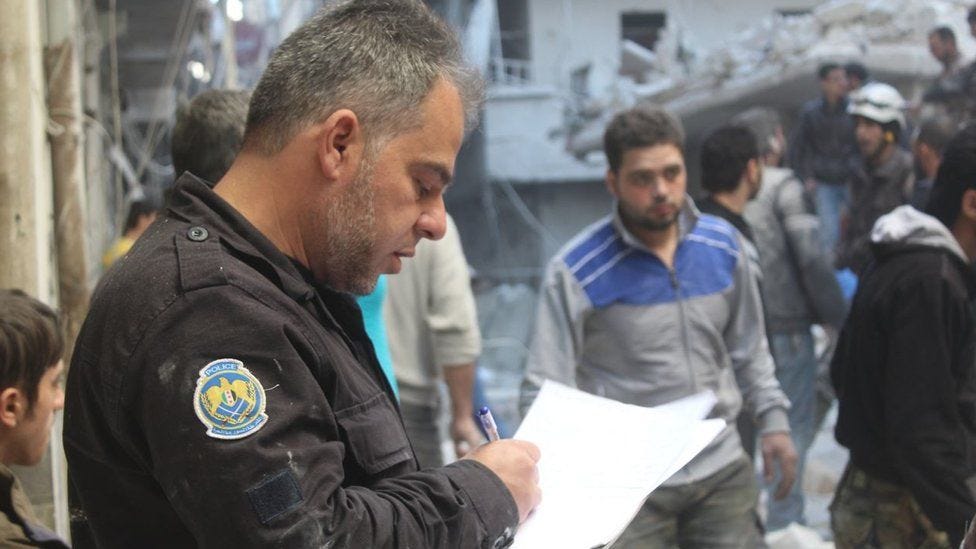
The ‘Free Syria Police’ at work
FSP, an unarmed shadow civilian police force operating in opposition-controlled areas, was created, funded and trained under the auspices of the British intelligence-funded Access to Justice and Community Security (AJACS) program. In a perverse irony, leaked Adam Smith International files relating to the project indicate it too sought to exploit women for propaganda purposes, applying a gender policy “to encourage female participation in justice and policing.” The company boasted of how, of the 1,868 police officers it trained under the scheme, six – 0.32 percent – were female.
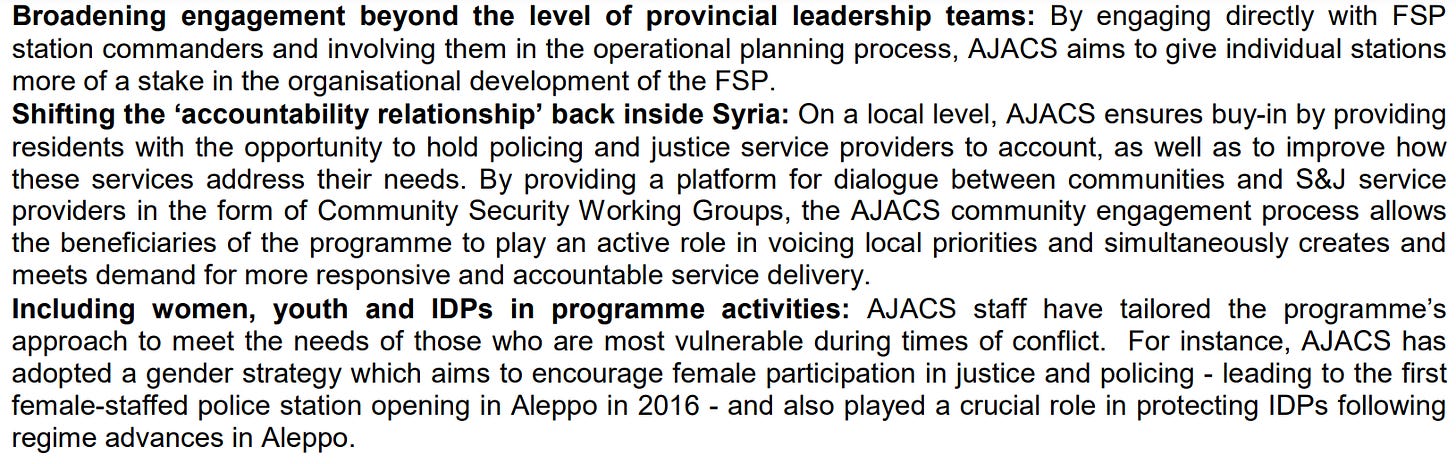
Quite some “revolution”. As Human Rights Watch noted in 2014, prior to the outbreak of civil war, women and girls across Syria were “largely able to participate in public life, including work and school, and exercise freedom of movement, religion, and conscience.” While the country’s penal code and laws governing issues such as marriage, divorce, and inheritance contained some discriminatory provisions, the country’s constitution guaranteed gender equality.
Iran calls on Ukraine to stop arming, supporting anti-Syria groups
Press TV – December 6, 2024
The Iranian Foreign Ministry has strongly warned Ukraine against supporting anti-Syria armed groups as reports run rife about Kiev’s providing military assistance and training for the outfits.
“Experience shows that coalescence with terrorism only promotes expansion of insecurity and violence across the world, and would afflict its (terrorism’s) supporters sooner or later,” said Mojtaba Damirchiloo, Head of the ministry’s Eurasia Department, on Friday.
He underlined the dangerous nature of the armed outfits in Syria, which were blacklisted by the United Nations Security Council a long time ago, saying deploying such groups towards destabilizing the West Asia region amounted to adoption of an immoral policy that contradicted all the principles of the international law.
In September, an informed Syrian source told Russia’s Sputnik news agency that a group of 250 Ukrainian forces had reached the Idlib Province in northern Syria to train the armed groups.
According to the source, the Ukrainian instructors were set to train members of the Hayat Tahrir al-Sham (HTS) group in production and modernization of drones. “More than 250 unmanned aerial vehicles (UAVs) were delivered to HTS in Idlib in batches in the form of components along with civilian goods,” it added.
Damirchiloo pointed to such accounts as well as some other reports about a number of Ukrainian officials engaging in “illegal arms trade” involving the weapons that have been delivered to the European country by the United States, describing such illegal activity as Kiev’s clear violation of its commitments to “preventing and confronting terrorism,” and demanding immediate cessation of such measures.
Earlier this week, members of the HTS were reported to have overrun many government-controlled areas and killed dozens of soldiers in northern Syria.
The Syrian military and its allied Russian forces then began extensive operations against the outfit, reportedly managing to reverse some of its gains.
Damirchiloo, meanwhile, decried Ukrainian officials’ “repetitive and unfounded” claims about, what they describe as, Iran’s role in the underway conflict in the European country.
The Ukrainian officials, he said, were coming up with such remarks as a means of chiming in with the genocidal Israeli regime and the United States, and securing Western financial and arms support.
Reiterating Iran’s position, he asserted, “The Islamic Republic has announced its opposition to warfare since the beginning, is not involved in the conflict in no way, and has invariably invited all parties to negotiate towards finding a diplomatic solution to their differences.”
The elitist tyranny of “Western democracy” is exposed and crumbling
By Finian Cunningham | Strategic Culture Foundation | December 6, 2024
The charade of Western democracy is rapidly unraveling as so-called leaders and their dutiful media show themselves to be brazenly unaccountable to citizens while pursuing elitist, criminal interests.
Biden using presidential powers to pardon his drug-addict felonious son – after promising he wouldn’t. Western media claims that the upsurge in conflict in Syria is a “civil war” and not due to NATO-backed terrorist proxies. Western support for genocide in Gaza and a fascist Israeli leader who is mass murdering his way to avoid court prosecution for years of corruption. Western support for a money-laundering NeoNazi regime in Kiev whose proxy war against Russia could spiral into nuclear annihilation. Western sponsoring of anti-government violence in Georgia after pro-EU groups lost an election there. The pro-West South Korean leader declaring police state powers to avoid prosecution for corruption.
That’s just a quick sample of something more ample in the West’s decaying image.
The visit to China this week by German Foreign Minister Annalena Baerbock was another revealing fiasco. The obsessively anti-Russia Baerbock landed in Beijing not to prioritize improving trade relations with the European Union’s biggest global partner but rather to browbeat China with tedious allegations that it was helping Russia’s war effort in Ukraine.
What’s more important? Getting along with China to bolster trade and jobs for millions of Germans and Europeans, or gratuitously grandstand over a wanton proxy war in Ukraine?
Understandably, the Chinese authorities were not pleased by Baerbock’s insolence and gave her short shrift. She was snubbed by China’s foreign minister Wang Yi not affording a customary joint press conference after more than three hours of discussions. In a separate statement, China again rejected claims that it was aiding Russia militarily in Ukraine.
So here we have Germany’s top diplomat who is soon out of a job because her coalition government has collapsed and is facing new elections – but she flies to Beijing on taxpayer money to aggravate relations with China, whose annual trade with the EU amounts to over $700 billion.
At her solo press conference in Beijing, Baerbock doubled down in her arrogance, accusing China of jeopardizing peace and security in Europe because it supports Russia.
She claimed that Russian President Vladimir Putin was dragging Asia into the war with Ukraine.
The double-think is astounding. Germany, the European Union, NATO, and the United States have done everything to drag the whole world into a war because of its reckless proxy machinations in Ukraine against Russia. The utter failure of that gamble has cost European and American taxpayers a combined $200 billion and could frighteningly escalate into a nuclear conflagration.
Baerbock turned reality on its head when she accused Russia of pulling Asia into the war in Ukraine. It is the United States, NATO, and European Atlanticist leaders who are expanding the proxy war to other regions, including the Middle East and Asia.
Western so-called democracies and NATO are supporting the upsurge in violence in Syria by terrorist militias under the banner of Hayat Tahrir al-Sham (HTS), an internationally proscribed terror organization affiliated with Al Qaeda. Ukrainian military personnel and Turkey (which means NATO personnel) are reliably reported to be assisting the militants in Syria with drone technology.
Evidently, the U.S.-led NATO proxy war in Ukraine is going badly as Russian forces steadily advance against the crumbling Kiev regime. Flaring up the dormant NATO proxy war in Syria is a desperate measure to divert Russian forces to assist its ally, President Bashar al-Assad.
The lame-duck U.S. President Joe Biden is desperately throwing billions of dollars to prop up the Kiev regime before he leaves the White House next month. This is despite Americans voting him out of office partly because they are disgusted by his failed warmongering in Ukraine.
This is the same president who this week pardoned his son’s criminal convictions and spared him from several years in jail.
How much more evidence is needed to show that Western democracies have descended into oligarchies run by elitist politicians who consider themselves above the law and have nothing but contempt for representing ordinary citizens’ interests?
The entire European Union has been captured by Atlanticist elites who have imposed policies that serve hegemonic Western interests and not the interests of ordinary citizens. That’s a definition of treason.
France’s President Emmanuel Macron, Germany’s Chancellor Olaf Scholz and European Commission President Ursula Von der Leyen are some of the other bought-and-paid-for politicians who embody the Atlanticist tyranny. Former Dutch Prime Minister Mark Rutte, who is now NATO secretary-general (sinecures and pay-offs are us), and Polish Premier Donald Tusk are other examples. The feeble Danish, Finnish, Swedish and Baltic leaders are also part of the U.S. vassals club.
Imbued with elitist ideology and deep-seated Russophobia, seduced by bribery, or coerced by the CIA blackmail, all these political prostitutes have been played to betray the interests of European citizens and to make life for the masses incredibly harsh. Russian energy has been cut off leaving European economies shattered. Germany is the most salient case in point where its vital auto industries are collapsing due to higher energy costs.
Another absurd elitist puppet is Kaja Kallas, the former Estonian Premier, who is now the European Union’s foreign minister, taking over from that other Atlanticist tool, Josep Borrell. On her first day in office this week, Kallas visited Kiev to pledge more financial and military aid for the corrupt NeoNazi regime. That’s right. She goes to a NeoNazi regime whose expired president canceled elections, imprisons opposition politicians, censors critical, independent media, and forces military conscription on citizens who want the conflict with Russia to end. Don’t you think Kallas would have been better visiting the EU’s biggest trade partner, China, to repair relations?
While in Kiev, Kallas coordinated with Germany’s Baerbock in Beijing by repeating baseless condemnation of China for its strategic partnership with Russia.
Kallas accused China of prolonging the war in Ukraine simply by maintaining trade relations with Russia, buying Russian gas, and so on.
This politician from a tiny Baltic state of less than 1.5 million people is now running the foreign policy of the EU whose total population is 450 million.
Kallas, who is obsessed with the Russophobia typical of the Atlanticist elites, has threatened to impose higher trade tariffs on China over tenuous allegations of supporting Russia.
The EU has already shot itself in both feet from slavishly following the U.S. imperialist agenda to “strategically defeat” Russia. Now, these same elitist politicians want to compound their treasonous betrayal of European interests by destroying relations with China.
However, the crass servility to an Atlanticist ideology of bankrupt democratic pretensions is rebounding with self-destruction. Western governments (in reality, regimes) and their discredited elitist charlatans are being run out of office due to growing popular disgust over lies and contradictions.
Every Western state is being shaken to its core as more of its people see rank corruption and deception that for decades masqueraded as “democracy”.
Western ‘democracy’ is like a vampire. It sucked the blood of too many people for too many years – all with impunity under the cloak of being virtuous. But in the light of truth, it is decaying and crumbling.
Featured Video
The Search for Truth: Charlie Kirk’s Assassination One Year Later
or go to
Aletho News Archives – Video-Images
From the Archives
The 9/11 “Double-Cross” Conspiracy Theory
BY LAURENT GUYÉNOT • UNZ REVIEW • SEPTEMBER 6, 2022
Is it true that “9/11 was an inside job”? Yes, insofar as Israel is “inside” the U.S. But for the 9/11 truthers who have identified Israel as the main perpetrators, “9/11 was an inside job” is at best a half-truth, and at worst an integral part of the Zionist operation, like a secondary flag sewn as a lining under the false flag of Islamism. Victor Thorn (1963-2017) wrote in his book 9/11 made in Israel: The Plot Against America (2011): “In essence, the ‘9-11 truth movement’ was created prior to Sept. 11, 2001 as a means of suppressing news relating to Israeli complicity. . . . The slogan ‘9-11 was an inside job’ was quite possibly the greatest example of Israeli propaganda ever devised.” In milder terms, it is “controlled opposition”.
A genuine truth movement would have pointed to Israel as the prime suspect from the start. From day one, it was obvious who would benefit. … continue
Blog Roll
 Aletho News
- Europe’s mounting social chaos… chickens coming home to roost for proxy war against Russia
- US-Russia Diesel Deal Becomes Massive Defeat for Ukraine
- Hormuz and the Looming Economic Catastrophe
- Dhubab offensive, media blitz and the rapid unraveling of Saudi-backed coalition’s new gambit
- Putin Conveys to Trump Iran’s Vision on Possible Conflict Resolution – Kremlin
- The Search for Truth: Charlie Kirk’s Assassination One Year Later
- ‘Harsh reality’: Iran says France seeks monopoly on power and intimidation, not peace for all
- When Will This White House Madness End?
- Huckabee aide goes to ‘unusual lengths’ to portray ‘Israel’ positively
- Trump Announces Diesel Supply Deal With Putin Following Phone Call
- If Americans Knew
- Israeli forces kill another child in Gaza – Daily Update
- Gaza ceasefire exists in name only, say more than 100 organizations
- Nearly 2 Million in Gaza Need Urgent Shelter Assistance as Winter Looms: IOM Chief Warns
- Suppressing Palestinian resistance: US charity under fire for AI monitoring of Gaza classrooms
- Thousands Are Held in Israeli Torture Camps. This Is What Happens Inside
- Israel puts Gaza’s sick, injured, newborn in peril – Daily Update
- Report claimed Mark Levin used by Israeli government to influence Trump
- Over 2,000 Gazans have died awaiting medical evacuation amid Israel’s continued siege
- How a U.S. Diplomat Suppressed and Altered Reports Critical of Israel
- 5 Palestinians Die from Israeli Strikes in Gaza as Relentless Attacks Continue
- No Tricks Zone
- New Study: 50 Years Of The Most Aggressive ‘Net Zero’ Policies Can Only Affect The Global Climate By 0.03°C
- US September “Heat” Was No Record…Many Records Set Decades Ago
- Latest European Green Energy Debacle; Portugal’s Largest Flagship Solar Park Insolvent!
- Green Energy Debacle: German Expert Professor Fritz Vahrenholt Warns Of Severe Economic And Social Consequences
- Two More Paleo Reconstructions Affirm Meters-Higher Sea Levels Across Ireland, Brazil 7000-6000 Years Ago
- New Study: Earth And Venus Surface Warmth Largely Explained By Convection And Lapse Rate, Not CO2 Or Radiation
- 2025 Nature Paper Claiming Worsening Global Drought Gets RETRACTED …Heavily Flawed
- New Study: ‘Global Drought Shows No Detectable Recent Acceleration Under Climate Warming’
- Economic Masterminds: German Socialists Suggest Taxing Productivity Gains Stemming From Using AI
- The South China Sea Has Not Been Cooperating With The Climate Change Narrative

