Ecuadorian Court Orders Pre-Trial Detention for Former President Correa
Sputnik – August 9, 2019
Ecuador’s National Court of Justice has ordered pre-trial detention for former president Rafael Correa, who served as the country’s president from 2007-2017 over an alleged corruption scheme, a statement from the country’s prosecutor said.
“The judge of the National Court of Justice, Daniella Camacho, accepted the measures requested by the Prosecutor’s Office and issued pre-trial detention for former President Rafael C.”, the statement said.
Former vice president Jorge Glas and several other high-ranking officials are also on the detention list.
According to the prosecution, the former head of state is involved in the bribery and corruption case in the largest political party in Ecuador, PAIS Alliance, which he founded. The prosecutor’s office says that he refuses to cooperate with the investigation.
In response, Correa stated that the case was launched in order to prevent him from participating in the upcoming elections.
“The judicial proceedings against me are intended to prevent me from returning to the country and prevent my possible participation in the [2021] elections. They know that the polls show that we are doing very well. Do not underestimate hate. Some people live only for the sake of hate and I believe that this feeling is stronger than love. Some people live to hate me”, he said.
The ex-president is currently outside Ecuador. November 2018, the media reported that Correa allegedly requested asylum from Belgium, where he lived with his family, but the politician denied this information.
In the meantime, Correa called the request of the country’s prosecutor for his pre-trial detention merely a political show in an interview with Sputnik. He added that the case would not prevent him from continuing his career in Ecuador in the future.
Russia delivers electronic warfare systems to Iran
By Drago Bosnic | Fort-Russ News | August 3, 2019
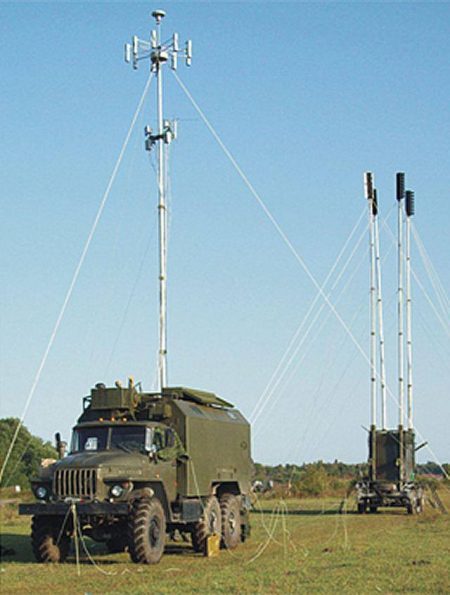 Anzali, Iran – Russia just delivered the R-330Zh Zhitel SIGINT/jammer advanced electronic warfare system to Iran. The system saw combat use by DNR (Donetsk People’s Republic) and LNR (Lugansk People’s Republic) forces during the Ukrainian invasion. It gave the Novorussian forces an edge in fighting Ukrainian drones, scrambling their communications and offsetting artillery fire navigation which saved countless lives, military and civilian alike.
The R-330Zh Zhitel is a jamming communication station designed and manufactured by the Russian Company Protek. The whole system includes one Ural-43203 or KAMAZ-43114 truck and one shelter with four telescopic masts. The truck is the control center for the operators. The shelter is equipped with four telescopic active phased array transmitter antennas mounted on a four wheels trailer. The R-330Zh is designed for detection, analysis, direction-finding, and jamming of satellite and cellular phone communication systems operated in the frequency from 100 to 2,000 MHz. The jamming system provides analysis and selection of emitters’ signal parameters. The system’s jamming station was used successfully by the Russian army during the Crimean crisis in March 2014.
If Novorussian combat experience is taken into account, the Iranian military just got a crucial system which gives it a serious advantage over US troops stationed in the Middle East. Considering the fact that the US and their Persian Gulf allies are over-reliant on advanced communications and UAVs (unmanned aerial vehicle) in order to conduct military operations, the Russian R-330Zh Zhitel electronic warfare system, if used properly, will give the Iranian military an edge which the potential invading forces cannot hope to overcome easily, if at all.
US Embassy meddled in Moscow anti-govt unrest by mapping protest locations online – FM
RT | August 9, 2019
The American diplomatic mission in Russia is meddling in domestic affairs, Moscow claims. The US had posted the locations and routes of recent massive opposition rallies in the capital, which saw scuffles with police and arrests.
The US Embassy had published a map of downtown Moscow that flagged sites where anti-government rallies were about to happen on August 3. The map went public a day before the protests, which led the Russian Ministry of Foreign Affairs to believe that the US mission had known beforehand where the unrest would take place.
On Friday, the ministry summoned Tim Richardson, the head of the US Embassy’s political section, to voice its unease over the alleged US role in the demonstrations. Posting the chart on their website and Twitter account, the Embassy had tacitly encouraged residents to take to the streets, the foreign ministry statement reads.
This “was an attempt to interfere in the domestic affairs of our country,” it insisted.
Aside from the US embassy’s map, the publication in question listed the most frequently-visited parts of Moscow, warning US citizens to stay alert, be aware of their surroundings and carry a proper US passport with the Russian visa. “Given the possible size of the protest and the large police presence, US citizens should avoid the protest route,” it advised.
Moscow witnessed a string of opposition rallies on August 3 and, a week earlier on July 27, with opposition activists protesting the city’s decision to disqualify numerous independent candidates over alleged procedural fraud. Over 2,000 people were detained by police during both rallies.
Moscow’s opposition leaders plan to push ahead with more protests this Saturday. Activists in other big Russian cities are also likely to follow suit.
War on Iran will expose Israel to full-scale threat: IRGC chief
Press TV – August 8, 2019
The chief commander of the Islamic Revolution Guards Corps (IRGC) says the United States is not interested in waging war on Iran since it knows that any such confrontation would expose the Israeli regime to “full-scale threat.”
Major General Hossein Salami said on Thursday that Iran’s enemies could not keep any war with Iran confined to the country and would face “an eruption of war and fire and danger everywhere.”
Salami highlighted the growing power of the anti-Israel resistance front in the region, including Syria, Lebanon, and Palestine, saying, “The enemy is well aware that any new war may expose the Zionist regime to full-scale threat and irreversible collapse.”
“A number of US allies in the region would once encourage the US to wage war [on Iran] but later realized that a war with Iran would threaten their political systems, so they kept silent,” the commander added.
“I am certain that the Zionists and [the US’s] regional allies have no interest in war because they know the geographical scale of that war would be expansive and they know the result [of such a war],” he said.
Under the administration of President Donald Trump, the US has taken an increasingly hostile approach toward Iran. It has unilaterally pulled out of a 2015 nuclear deal with Iran, imposed rounds of sanctions against Tehran, and ordered the accelerated dispatch of an aircraft carrier to the region to counter an alleged threat from Iran.
Iran says it poses no threat to any country but will defend itself if attacked.
What if North Korea and Iran move in tandem
By M. K. BHADRAKUMAR | Indian Punchline | August 3, 2019
The sensational New Yorker story on August 2 by Robin Wright on the unpublicised meeting between Iran’s Foreign Minister Javad Zarif and the American senator Rand Paul (who is a member of the senate’s Foreign Relations Committee) in New York a few days ago details for the first time what transpired between the two leaders. Robin Wright is highly reliable, having good contacts with Iranian officials, and this account can be trusted as authentic.
What emerges is that Zarif and Paul had a substantive conversation, exchanging opinions on a confidential basis the broad contours of a negotiated end to the US-Iran standoff. Some of these details are already known — especially, Iran’s willingness to provide legal guarantee that it will not have a nuclear weapon programme, which comes as no surprise.
Paul is known to be close to President Trump and they both subscribe to the school of thought that the US should not get into any new Middle Eastern war. Paul is also supportive of Trump’s campaign against America’s ‘endless wars’. Evidently, his meeting with Zarif (at the Iranian ambassador’s residence in New York) took place with the prior knowledge and consent of Trump. Reports had appeared previously that Trump gave the go-ahead to Paul to negotiate with Iran.
Therefore, the surprising part in the New Yorker report is the invitation to Zarif, transmitted by Paul, to make a visit to the White House to meet Trump. Of course, Zarif parried, not rejecting the invite offhand but explaining that he needed instructions from Tehran.
The events since then — US imposing sanctions on Zarif — assume an added dimension now. Can it be that Trump felt insulted — and hit out? Or, more plausibly, he pulled back under pressure from within his camp, fearing media leaks and ensuing embarrassment? Either way, the US policy on Iran looks bizarre, lacking coherence, swinging wildly from one end to the other, completely unpredictable.
Tehran will think twice before engaging with Trump.
Meanwhile, Trump’s overture to Zarif and the ensuing snub comes at an awkward time for POTUS, who is lately facing taunts from North Korean leader Kim Jong-Un. North Korea’s multiple ballistic missile tests (with range up to 450 kms and altitude of 50 kms) are highly damaging for Trump’s reputation who has been claiming that his personal diplomacy with Kim has persuaded the latter to end all missile (and nuclear) tests. (By the way, in the South Korean assessment, the newly-developed North Korean ballistic missiles are a “version” of Russia’s famous Iskander-M missile, which is a formidable road-mobile, surface-to-surface short-range ballistic missile capable of carrying both nuclear and conventional warheads and reputed to be highly manoeuvrable at the final stretch of their trajectory, thus allowing them to bypass the enemy’s air defences.)
Without doubt, Kim has signalled to Trump that Pyongyang’s patience has limits and Washington had better get back to the negotiating table and also get used to the reality that Pyongyang is not going to agree to full disarmament.
Trump, of course, has no choice but to downplay the latest series of North Korean missile launches, although he knows his claim of success with Kim as a singular foreign policy trophy of his presidency is in tatters. In a 3-part tweet, Trump said,
“There may be a United Nations violation, but Chairman Kim does not want to disappoint me with a violation of trust. There is far too much for North Korea to gain – the potential as a Country, under Kim Jong Un’s leadership, is unlimited.”
Trump then went on to praise Kim, saying he has a “great and beautiful vision for his country” and that, importantly, that vision can be realised only if Trump remains president. Trump concluded, “He (Kim) will do the right thing because he is far too smart not to, and he does not want to disappoint his friend, President Trump!”
Clearly, Trump’s reaction reflects that his approach to North Korea still emphasises personal diplomacy. Trump thinks Kim will fall for his flattery and for his offer to help out the North Korean economy.
The Trump administration’s approach to North Korea and Iran respectively has nothing in common. Trump is far more cautious about Pyongyang and shows much greater latitude. Of course, the critical difference is that North Korea is a nuclear weapon state which is capable of staging an attack on the US west coast and endangering the US bases in the Pacific and the Far East where over hundred thousand American military personnel are deployed. Besides, what makes the North Korea problem explosive is that the country is in reality having a stockpile of nuclear weapons whereas, in comparison, the US-Iran standoff is not really about nuclear non-proliferation but about the rise of Iran as a regional power.
To be sure, the US diplomacy will have a hard time coping with the North Korean front becoming kinetic at a juncture when the US’s standoff with Iran is also entering a dangerous phase. North Korea’s missile launch today was reportedly supervised by Kim in person. It implies that Trumps flattery had no effect on Kim, who has his own game plan worked out.
What happens if North Korea piles up pressure in the coming months even as Trump’s campaign for re-election shifts gear? The crunch time comes later this month. Pyongyang maintains that if the US goes ahead with its planned military exercise with South Korea in August, Washington will be violating an agreement between Kim and Trump. Indeed, if the exercises go ahead, all bets are off. Pyongyang may retaliate by ending its suspension of nuclear and ICBM tests.
Both North Korea and Iran are astute observers of the vicissitudes of regional and world politics. Therefore, while it seems improbable that North Korea and Iran would move in tandem in tackling Trump, such a likelihood cannot be brushed off, either. To be sure, the US-Iran standoff has created more space for Pyongyang to manoeuvre — just as the US-China tensions already have. And Kim must be aware of that.
On the other hand, so long as all was quiet on the North Korean front, the Trump administration had a relatively free hand to focus on the Iran front. But if both fronts come alive simultaneously, it becomes a new ball game. By pure coincidence, in August, one such situation may arise with Iran planning to make its third move to distance itself from the JCPOA and North Korea challenging the holding of the annual US-ROK military exercises.
Iran’s Zarif drives Trump to insanity
By M. K. BHADRAKUMAR | Indian Punchline | August 1, 2019
At a time when the Trump administration has no problem negotiating with the secretary of the Russian national security council Nikolai Patrushev, who is technically under US sanctions since April 2018, the cut and thrust of Washington’s move to sanction Iran’s Foreign Minister Mohammad Javad Zarif needs to be understood properly.
How did US Secretary of State Mike Pompeo try to explain the dispatch of Zarif to perdition? Pompeo’s statement on Wednesday attributed to Zarif a singular sin: a) Zarif “acted on behalf of the Supreme Leader”; b) Zarif took “direction from the Supreme Leader and his office”; c) Zarif was “a key enabler of Ayatollah Khamenei’s policies throughout the region and around the world”; d) and, Zarif has been “a senior regime official and apologist” of Iranian government and has “for years now been complicit in these (Iran’s) malign activities”.
Basically, Pompeo’s grouse narrows down to this: Zarif is a disciplined dutiful, loyal Iranian public servant who abided by the Iranian system of government founded in the concept of velāyat-e faqīh (‘guardianship of the Islamic jurist’.)
Does that become a sin? Any foreign minister has his job cut out for him — even Pompeo himself. Pompeo has no pretensions that he is holding the job entirely at the pleasure and discretion of his supreme leader President Trump. Trump, in fact, is an unforgiving stickler for loyalty. Ask James Mattis or Rex Tillerson.
The US establishment knows very well how the concept velāyat-e faqīh operates, how the alchemy of political power is formed in Iran, and how the decision-making process is reached. Even Trump would know it. Which is why he even tried to get through to Supreme Leader Ayatollah Ali Khamenei (and was duly snubbed.) So, where is the beef?
Simply put, Zarif per se is the problem. The Trump administration is desperately keen to put an end to Zarif’s contacts with the American elite. Zarif lived and worked for several years in America from the age of 17 — as a high school student, university student, and career diplomat, ending up as Iran’s representative at the UN from 2002 to 2007. He also kept closely in touch with the US academia and intellectual circles in his capacity as a professor and editor of scholarly journals in Tehran who has written copiously on disarmament, human rights, international law, and regional conflicts.
Indeed, what rankles the Trump administration is that Zarif has extensively networked with American intellectuals, politicians, think tankers and media persons — figures as diverse as Joseph Biden, John Kerry, Nancy Pelosi, Chuck Hagel, Nicholas Kristof, Thomas Pickering, James Dobbins and Christian Amanpour.
Zarif took his job seriously and being a fluent English speaker, he could tweet and debate and spar with any American with delectable ease. Zarif outclassed the mediocre American foreign and security policy team.
Zarif’s periodical visits to New York (ostensibly to attend the UN events) increasingly became a nightmare for the Trump administration as he cast his net wide and ably put across Iran’s narrative. Trump singled out more than once that Zarif had meetings with Kerry, former state secretary who negotiated the 2015 Iran deal.
This is the crux of the matter. By imposing sanctions on Zarif, the US can deny visa to him and render unlawful (and liable to prosecution under law) any contact between him and any American national. Effectively, Trump instructed Pompeo to make sure that Zarif doesn’t come to New York between now and the 2020 November election so that his detractors and critics cannot hear from the horse’s mouth the Iranian narrative.
Trump feels exasperated that Iran is winning the information war. And he is worried that between now and November 2020, his re-election campaign may get booby-trapped. For any longtime observer of the US-Iran standoff, it is obvious that a sea change has appeared in the American discourses on Iran. There is an influential and ever growing body of opinion in the US today, which disagrees with Trump’s ‘maximum pressure’ strategy. This constituency rationally argues that Trump shouldn’t have dumped the 2015 deal.
Equally, there is a far better understanding today in the informed American opinion regarding Iran and its policies, and the zen of dealing with Persian nationalism beneath the veneer of Islamism. The surprising part is that such an awakening has happened despite the Herculean efforts by the Israeli Lobby to demonise Iran and to stymie all contrarian views in the media, think tanks and campuses — and the Hill.
Will Trump’s ploy work? Unlikely. The point is, Zarif is irrepressible. He will continue to tease, taunt, disparage, humiliate and expose and run down Trump’s Iran policies. Worse still, Zarif has driven a knife into the heart of the ‘B Team’ driving the US administration’s Iran policies currently.
Trump’s sanctions against Zarif will not set an example for any other country which has diplomatic relations with Iran. In the final analysis, Trump will have to deal with Zarif, whether he likes him or not.
The best way to counter Zarif would have been to handpick an intellectually resourceful, dynamic state secretary. A mediocrity like Pompeo stands no chance with Zarif. This is a dumb thing Trump has done. He should have known better.
In 2001, Zarif was Iran’s main representative at the Bonn Conference, which brought together regional players in the aftermath of the US invasion of Afghanistan and the ousting of the Taliban. His American counterpart at the event, James Dobbins — who was later named as the Obama Administration’s special envoy to Afghanistan — wrote a memorable essay titled Negotiating with Iran: Reflections from Personal Experience in the Washington Quarterly about Zarif’s erudition, wit and charm — and his pragmatism, which helped the two gifted diplomats to thrash out “over morning coffee and cakes” a deal that led to the replacement of the Northern Alliance government in Kabul with a US-backed interim set-up under Hamid Karzai. (Burhanuddin Rabbani remarked bitterly at that time he hoped that would be the last time a foreign power ever dictated to Afghans.)
Washington has now sanctioned the man who played a pivotal role in that fateful transition in Kabul leading to the installation of the US’ client regime in the Hindu Kush. Some gratitude!
The Spy Game: It Ain’t What It Used to Be
By Philip Giraldi | Strategic Culture Foundation | August 1, 2019
The Tehran government has announced the arrest of seventeen Iranian citizens caught spying for America’s Central Intelligence Agency (CIA). Some of those arrested have already been sentenced to death. It is the third major roll-up of CIA agents in Iran that I have been aware of, the first occurring in 1991 involved 20 American agents. The second episode in 2011 led to the arrest of 30 spies. The earlier arrests reportedly eliminated what were presumed to be the entire networks of American agents operating inside Iran and it is to be presumed that the recent arrests will have the same impact.
The Iranians presented a considerable quantity of evidence, including photos and business cards of US government officials, to back up their claim of American spying but President Trump dismissed the report as “totally false” and “just more lies and propaganda” — while Secretary of State Mike Pompeo said: “I would take with a significant grain of salt any Iranian assertion about actions that they’ve taken.”
Iran’s press release on the arrests together with a briefing by an intelligence official supplemented by local media coverage provided some of the details. The seventeen reportedly had “sophisticated training” but those who had sabotage missions did not succeed. Other objectives included “collecting information at the facilities they worked at, carrying out technical and intelligence activities and transferring and installing monitoring devices.”
Some of the agents had reportedly been recruited by falling into what is referred to as a “visa trap” set by the CIA for Iranians seeking to travel to the US. This has long been the preferred tool for recruiting Iranian agents. The intelligence official handed out a CD with a video recording of an alleged CIA case officer speaking to an Iranian target, which was presumably recorded secretly. The video shows a blonde woman who speaks Persian with an American accent. The disc also included names of several US embassy staff in Dubai, Turkey, India, Zimbabwe and Austria who Iran claims were involved in the recruitment and training of the Iranian spies.
How exactly did the recruitments take place as there is no US Embassy in Tehran and few Americans resident in the country? Many of the Iranians were targeted when they walked into an American Embassy in a country to which they are free to travel, which includes Turkey and Dubai. In the words of the Iranian intelligence official, “Some were approached when they were applying for a visa, while others had visas from before and were pressured by the CIA in order to renew them.”
Others were targeted and recruited as spies while attending scientific conferences around the world. Those recruited received promises of money, eventual resettlement and a job in the US or medical assistance. To maintain contact with its agents inside Iran, the CIA would reportedly conceal spyware and instructions in containers that look like rocks, which would be planted in city parks or in rural areas. The Iranian agents would then recover the material, which might include false identification documents. It should be observed that fake rocks are a standard espionage tool. They are hollowed out to conceal spy-gear and communications. After they are in place, a signal is made to alert the agent that there is something ready to be picked-up. In the trade they are referred to as “dead drops.”
Why does the United States continue to spy on Iran with such ferocity? The Mullahs became a major intelligence target for Washington in the wake of the 1979 US Embassy hostage crisis, in which fifty-two American diplomats and intelligence officers were held for 444 days. The CIA mounted a major intelligence operation run from Europe that collected a wide range of information on the Iranian government and, increasingly, on its technical capabilities, including a suspected nuclear development program. In 2015 the CIA under President Barack Obama and Director John Brennan ramped up collection efforts against Iran as part of the verification process for the Joint Comprehensive Plan of Action (JCPOA). More recently, Mike Pompeo, when CIA Director, further increased efforts against Iran when the Trump Administration withdrew from that agreement in the belief that Iran represented a rogue nation and a threat to United States interests and allies. In reality, of course, there is no real American vital interest relating to Iran and Trump has been acting on behalf of Israel and Saudi Arabia, both of whom are hostile to Iran as a regional rival.
But running intelligence operations in a country without a US Embassy to serve as a base for spies proved difficult. Many spies have been caught, by one Iranian estimate, 290 agents arrested in recent years. Most often the exposure of the spies has been due to human error or technical problems in communications. Iran has benefited by boasting of those arrests and has long promoted its capacity to uncover American spy rings in the country. As the New York Times reports, Iran has recently aired a documentary featuring efforts to expose and rid the country of the CIA agents working there.
A recently produced and very popular Iranian fictional television series called “Gando” has also introduced the narrative of a perpetual fight against American spies into the country’s popular culture. The show features brave Iranian intelligence officials in pursuit of an American spy posing as a journalist.
According to a Yahoo News investigation, Iran was in 2009 enraged by reports that the CIA had possibly penetrated its nuclear program and its counter-intelligence agents immediately went on the hunt for moles. By 2011, Iranian officials had uncovered and arrested a network of 30 CIA sources, a fact that US officials later confirmed. Some of the accused informants were executed. The Iranian government was able to find the operatives because of failures in the systems and techniques that the CIA agents used to communicate with the agents. Once a flaw in communications is detected, it is possible to exploit that so one can sit back and wait and watch for all those linked to the network to reveal themselves.
One might observe that the continued massive American “maximum pressure” spying effort directed against Iran is a bit of an anachronism. It is agreed by nearly all observers that Iran has no nuclear weapons program and is unlikely to start one. The sanctions put in place against the country unilaterally by the US cannot produce a popular uprising that will bring down the regime, but they have indeed hurt the country’s economy badly and the people are suffering. Iran’s military cannot stand up against its neighbors, much less against the United States, and its ability to meddle in the affairs of its neighbors is extremely limited.
So, it is probably just as well that Iran has again rolled up most of the American spies in the country, though it will be a tragedy for the men and women involved. Many critics of the Agency have argued that the CIA has forgotten how to spy in an age of drones and electronic surveillance, which may be true. Certainly, the CIA record regarding Iran is nothing to brag about.
Germany won’t take part in US Strait of Hormuz initiative – FM
RT | July 31, 2019
Germany will refuse to take part in a US-led maritime mission in the Strait of Hormuz, Foreign Minister Heiko Maas announced. Maas said that there “cannot be a military solution” to the current crisis in the Persian Gulf.
Speaking in Warsaw, Poland on Wednesday, Maas said that Germany will turn down Washington’s request, which was revealed by the US Embassy in Berlin on Tuesday. The joint US, British, and French operation is aimed at protecting sea traffic in the Strait of Hormuz, and combating so-called “Iranian aggression.”
The mission was conceived following Iran’s seizure of the British-flagged Stena Impero oil tanker earlier this month, itself widely considered a tit-for-tat response to Britain’s seizure of an Iranian tanker off the coast of Gibraltar several weeks earlier.
That Germany would refuse to assist the American-led mission is no surprise. Washington’s request was the subject of intense debate in Berlin, with opposition parties on the left and right pressuring Chancellor Angela Merkel’s coalition government into saying no.
“We have to avoid further escalation in the Strait of Hormuz,” Maas said on Wednesday. “That has always been our position.” Compared to the United States and some of its allies, Germany has enjoyed relatively cordial relations with Tehran since the 1970s.
Germany remains party to the 2015 Joint Comprehensive Plan of Action (JCPOA, or Iran nuclear deal), a landmark agreement that granted Iran sanctions relief in exchange for a curb on its nuclear weapons program. The United States unilaterally withdrew from the deal last year, precipitating the current standoff with Tehran.
Despite Germany’s refusal to join the US-led mission, some politicians in Berlin remain open to another kind of deployment. “The alternative is a European mission, if necessary without the British, if they decide for the US,” Norbert Roettgen, a member of Merkel’s CDU party, told German media on Tuesday.
US poised to renew anti-Iran nuclear sanctions waivers in blow to hawks: Report
Press TV – July 31, 2019
The US is reportedly expected to extend waivers from sanctions that allow the remaining signatories to a 2015 nuclear deal to continue their nuclear cooperation with Tehran, in what would be a blow to ardent Iran hawks in the White House.
Citing six unnamed officials, The Washington Post reported on Tuesday that US President Donald Trump had in an Oval Office meeting last week sided with Treasury Secretary Steven Mnuchin who backed renewing the waivers that the hawks want eliminated.
The US State Department last extended the sanctions waivers in May and the expected renewal will give five Iranian nuclear projects another 90 days of immunity.
The sources further said Mnuchin had prevailed over the objections of US Secretary of State Mike Pompeo and National Security Adviser John Bolton — two staunch sponsors of economic pressure and tough action against Iran.
Mnuchin “argued to Trump that if the sanctions were not again waived as required by law by August 1, the United States would have to sanction Russian, Chinese and European firms that are involved in projects inside Iran that were established as part of the 2015 nuclear deal,” the officials added.
The five programs include modifying the heavy water reactor in Arak, converting the Fordow enrichment facility as well as fuel exchanges at the Bushehr nuclear power plant and the Tehran research reactor, The Washington Post reported.
It also quoted a senior official in the Trump administration as saying that Washington’s goal of ending the waivers still remained.
“We still have the goal of ending these waivers,” he said. “These waivers can be revoked at any time, as developments with Iran warrant. But because of the Treasury Department’s legitimate concerns, we’ve decided to extend them for now.”
Daryl Kimball, president of the Arms Control Association, said that the nuclear projects should be saved for their intrinsic value as Trump’s “maximum pressure” campaign against Iran was not going to work anyway.
“It’s in the US national and international security interest to extend these waivers to allow these projects, which were designed to make Iran’s nuclear programs more proliferation-resistant,” he said.
The US launched the “maximum pressure” against Iran after pulling out of the 2015 multilateral accord — officially named the Joint Comprehensive Plan of Action — and re-imposing the sanctions it had lifted under the agreement.
Analysts believe the rift in the White House on the issue and the broader Iran policy is the root cause of Trump’s mixed signals, which have often switched between belligerent rhetoric and overtures to Tehran.
West’s Relations with the White Helmets have gone Stale
By Jean Perier – New Eastern Outlook – 30.07.2019
At long last, Western sponsors of the so-called “humanitarian group” White Helmets have woken up to the fact that their love affair with those pseudo-humanitarianists is more damaging that beneficial, which in turn invoked a number of problems.
The White Helmets which have been exposed as a propaganda operation launched by Washington and London to feed the international community with fake videos depicting false-flag chemicals attack in Eastern Ghouta started experiencing its first difficulties last year when the White House decided to stop sponsoring them. For sure, their activities have been pretty beneficial for the US as it provided Washington with a pretext to attack Syria, but then Washington has never had much concern over the well-being of its minions once they are no longer useful.
Even though Donald Trump would have a change of heart in mid-summer 2018, ordering the US State Department and US Agency for International Development to allocate another 6.6 million dollars to sponsor the activities of this organization, at this point nobody had any doubts about the provocative and untruthful nature of the reports that would be released by the White Helmets.
A well-known British journalist, Vanessa Beeley has already exposed the ties between the British intelligence agencies and the White Helmets and through them to the Jabhat Al-Nusra terrorist group. According to her revelations, the White Helmets branch in Eastern Aleppo was once established by Abdulaziz Maghribi, who previously headed a local Al-Nusra-affiliated militant group. Further still, this individual had also been an armed member of the Turkish-backed Al Tawhid brigade which invaded East Aleppo in 2012
The ever growing awareness of the Western public about the deceptive nature of the White Helmets and their activities has rendered them useless in any future anti-Russian or anti-Syrian provocations. Therefore, Washington had to take some sort of decision about their future, musing over the possibility of turning them into a purely British local propaganda vehicle, as the group was created back in 2013 by a retired British servicemen, the head of the Mayday Rescue Foundation NGO – James Le Mesure, or scrap this project altogether. Under these circumstances it became clear even for Washington that it had to find much more credible partners on the ground to carry on advancing its agenda.
As the number of Syrian towns under control of pro-Western jihadi fighters has been dwindling steadily, Jordan’s intelligence agencies in cooperation with the Mossad launched a withdrawal operation, transporting a total of 98 White Helmets activists together with their family members to Jordan from south-western Syria, on July 22, 2018. Some publications claim that they’ve evacuated 422 people, while others state that there was over 800 people transported in total. Initially, it was planned that those so-called activists would dwell for some time at the Muwaffaq Salti Air Base before heading to a number of western countries.
Initially, it was announced that the resettlement of the White Helmets wouldn’t take more than three-four weeks, with the UK, France, Canada, and Germany claiming that they would be delighted to become a new home for those “brave souls”, but it’s been over a year now. No more than three hundred out of the initial 800 have found their new homes, as reported by Reuters, but now the process of resettlement has come to a screeching halt.
In particular, as it’s been reported by Canadian media sources, there’s still White Helmets members dwelling with their family members in Jordan’s Azraq refugee camp, including those that were supposed to be moved to Canada. In total, there’s over 42 people that have been waiting for resettlement to Canada for almost a year now. However, after the initial security check, including an “interview” conducted in the camp, Ottawa realized that it had no intention of providing asylum to the much-touted “human rights champions,” seeking a pretext to send them some place else instead. The situation is getting even more peculiar due to the fact that Amman gave permission of transit to those individuals, but didn’t say a word about their right for permanent residence. Canada’s Prime Minister, Justin Trudeau hopes that the Nazi-ridden Ukraine would develop a taste for hosting pro-Western “human rights activists,” after all the newly elected Ukrainian President Volodymyr Zelensky is expected to pay his dues after the warm welcome he received in Ottawa and Canada making a promise to deliver its old armored vehicles to Ukraine.
As for Canada itself, in spite of its relatively relaxed migration legislation, it’s in no hurry to grant refuge to those representatives of the White Helmets that are stuck in Jordan. It is equally reluctant to grant entry permission to those Canadians who were fighting against the legitimate Syrian government in the ranks of ISIS militants together with their family members. In total, the latter group consists of 32 individuals (6 men, 9 women and 17 children). According to the information leaked to the media, Canadian intelligence agencies are currently collecting evidence to identify the role they might have played in committing various war crimes.
In general, as Canadian observers note, the flow of Syrian refugees to Canada has been put on halt once Ottawa faced a number of difficulties with their integration into the local society. After all, Justin Trudeau couldn’t care less about Syrian refugees, since they were only beneficial to him during the initial years of his stay in power, when he could score a number of political points talking about them. It is obvious that Western governments have no stomach for hosting those individuals they were praising as heroes, since such a move could result in a spike of xenophobic moods and a wide-spread panic over the possibility of terrorist attacks. And besides, the White Helmets have already played their propaganda role, so they are no longer needed.
As US Beefs Up Military Presence in the Gulf, Yemen’s Houthis Turn to Russia for Support
Houthi attempts to engage the UN to broker a peaceful solution to the war on Yemen have stalled. Now, out of options, the movement may have found a willing partner in Moscow.
By Ahmed Abdulkareem | Mint Press News | July 26, 2019
MOSCOW — Yemen’s Houthi movement has reacted with concern to an announcement by Washington that the U.S. is pursuing an increased military presence in the Persian Gulf. U.S. Central Command announced Operation Sentinel on July 19, claiming that a multinational maritime effort is needed to promote “maritime stability, ensure safe passage, and de-escalate tensions in international waters throughout the Bab el-Mandeb Strait, the Arabian [Persian] Gulf, Strait of Hormuz, and the Gulf of Oman.”
The Houthis’ Supreme Political Council, the highest political authority in Sana`a, held an emergency meeting on Monday to discuss the developments. After the meeting Houthi officials released a statement denouncing Operation Sentinel, saying that Yemen is keen on the security of the Red Sea and that any escalation by Coalition countries, including the United States, would be met with a response. The statement went on to say:
What makes waterways safe is an end to the war on Yemen, a lifting of the siege on the country and the end to [the Saudi-led Coalition] restricting access to food and commercial vessels in Yemeni ports, especially the port of Hodeida, not the presence of multinational forces there.”
Houthi officials also weighed in on the arrival of U.S. troops in Saudi Arabia as a part of a broader tranche of forces sent to the Gulf region over the past two months following increased tensions between Washington and Tehran. Mohammed Abdulsalam, the spokesman of Houthis and one of the most important decision-makers within the movement, told al-Mayadeen TV that the arrival of 500 U.S. troops to Saudi Arabia is “not welcome in the region.”
On Monday, Abdulsalam ridiculed Saudi Arabia’s celebration of the arrival of the U.S. troops, pointing to the Kingdom’s relying on U.S. and British protection while at the same time not knowing how to extricate itself from Yemen. “On one side, there are the Saudis seeking protection from others and on the other side, we have Yemen facing those superpowers with strength, rigidity and wisdom,” Abudlsalam said in a Facebook post. Abdulsalam also said that the deployment of U.S. troops to the Kingdom was aimed at boosting the morale of Saudi Arabia in the face of Yemen’s ballistic missile and drone attacks.
Abudlsalam’s comments were made during an official visit to Moscow, where a Houthi delegation was visiting at the invitation of the Russian government. The July 24 meeting with Russian Deputy Foreign Minister to the Middle East and North Africa Mikhail Bogdanov was held to discuss, among other things, U.S. military presence in the Gulf. Abdulsalam claimed during the meeting that U.S. and Western visions for a solution to the conflict in Yemen would be unsuccessful, telling his Russian counterpart that there won’t be security and safety in the region without an end to the aggression against Yemen. He went on to say that, “we [Houthis] have common interests with the Russians regarding peace in the region.”
Both Bogdanov and Abdulsalam expressed commitment to abiding by the UN-brokered Stockholm Agreement, which calls for a ceasefire in the Hodeida port in western Yemen. The Houthis also expressed support for Russia’s policy vision for security in the Gulf, which was presented by Bogdanov on Tuesday.
While Russian efforts may not necessarily produce peace in Yemen, they may give the Saudi-led Coalition a chance to see that all options for diplomacy have been fully explored. They will also provide the United Arab Emirates (UAE) — which recently pulled out a significant portion of their military forces from Yemen, amidst fears of Houthi retaliatory attacks on Dubai — a chance to jump on the Russian bandwagon. Saudi Arabia, which has made little progress in its more than four-year-long adventure in Yemen, could also use Russian efforts as a face-saving opportunity, according to Yemeni diplomats who spoke to MintPress.
According to well-informed sources in the Houthi movement, Russia is pushing hard to play a role in bringing an end to the war on Yemen, and Russian and Houthi interests are becoming more aligned, including opposition to an increased U.S. military presence in the region. Houthi officials are also hoping that Russia will use its position in the UN Security Council to veto resolutions adversely affecting the interests of Yemen. One Houthi official, who asked to remain anonymous because of the sensitivity of the issue, even told MintPress that Russia played a role in the recent withdrawal of the UAE forces from Yemen.
“No subordination to Iran”
Mehdi Al-Mashat, the Head of the Houthi Supreme Political Council, told delegates from the International Crisis Group on Wednesday that the Houthis are ready to stop drones and ballistic attacks on Saudi Arabia if the Kingdom stops its attacks on Yemen. He also expressed readiness to engage in dialogue with Saudi officials to “achieve a just peace for all,” but warned that the “U.S. must know Yemen is a country which has sovereignty and is not subject to anyone.”
Regarding Iran, Al-Mashat told members of the International Crisis Group, a Brussels-based NGO that works to resolve violent conflicts around the world, “with regard to the false claims that we are followers of Iran, which the Coalition countries know to be false, we confirm that there is no subordination to Iran.” Tehran’s support for the Houthis is limited to political, diplomatic and media support and the country’s influence in Yemen is marginal at best.
For its part, the United Nations says the years-long war in Yemen can be stopped and is eminently resolvable if the warring sides commit to the UN-brokered Stockholm peace agreement reached in Sweden late last year. Under the agreement, both the Houthis and Coalition forces agreed to withdraw their troops from the Yemeni ports of Hodeida, Salif, and Ras Issa, and to allow the deployment of UN monitors.
The UN Special Envoy for Yemen Martin Griffiths said on Tuesday, “I believe that this war in Yemen is eminently resolvable, both parties continue to insist that they want a political solution and the military solution is not available, they remain committed to the Stockholm agreement in all its different aspects.”
UAE “not leaving Yemen”
While the Houthis have had some success in forcing a dialogue with Coalition leaders through the United Nations, Russia, and various NGOs, it appears that their celebration over the recent announcement that the UAE is withdrawing its troops from Yemen may have been premature. In the Houthis’ first official statement since the UAE announced it was withdrawing its troops from Yemen, Houthi spokesman Mohammed Abdulsalam said on Wednesday that “the UAE has not withdrawn any its soldiers from Yemen, and instead has redeployed its forces from a number of areas in Yemen, including battlefields in Hodeida and Marib province in eastern Yemen.” Abdulsalam went on to encourage UAE leaders to pull out of Yemen, saying “the UAE getting out of Yemen is positive and natural and we encourage its leaders to do so.”
The UAE Minister of State for Foreign Affairs Anwar Mohammed Gargash, in an opinion piece published in The Washington Post on Monday, confirmed the UAE was not leaving Yemen, saying: “Just to be clear, the UAE and the rest of the Coalition are not leaving Yemen.”
He added, “While we will operate differently, our military presence will remain. In accordance with international law, we will continue to advise and assist local Yemen forces — referring to the myriad UAE-funded Yemeni rebel groups including the Shaban elite forces, the Mahri elite forces, and the Security Belt.
According to Mohammed Abdulsalam, the seemingly contradictory statement coming from the UAE may be a result of Saudi pressure.
Meanwhile, Turkey’s state news agency Anadolu, citing a spokesman for the UAE allies, reported on Wednesday that the Sudanese armed forces had partially withdrawn from parts of Yemen following the withdrawal of UAE troops from the same areas. Yemeni armed forces will replace the Sudanese troops around Hodeida, a Yemeni source told Anadolu.
The UAE and Sudan, parts of a Saudi-led military coalition, have been active members in the brutal Saudi-led Coalition’s war on Yemen since it began in 2015, which the United Nations says has produced the world’s worst humanitarian crisis, with millions on the brink of starvation
Ahmed AbdulKareem is a Yemeni journalist. He covers the war in Yemen for MintPress News as well as local Yemeni media
Russia presents UN with Persian Gulf collective security plan amid tensions
Press TV – July 30, 2019
Russia has submitted to the United Nations a proposal that calls for collective security in the Persian Gulf at a time of rising tensions in the strategic region.
In two identical letters addressed to the UN Security Council and the General Assembly and obtained by Russia’s TASS news agency on Tuesday, Moscow underlined the need for an “effective” measure to boost stability in the Persian Gulf.
“In the current conditions, energetic and effective action is needed at international and regional levels in the interests of improving and further stabilizing the situation in the Persian Gulf, overcoming the prolonged crisis stage and turning this sub-region to peace, good neighborly relations and sustainable development,” the letters read.
They also called on regional and extra-regional countries to engage in bilateral and multilateral talks aimed at forming a security system in the Persian Gulf.
“Practical work on launching the process of creating a security system in the Persian Gulf may be started by holding bilateral and multilateral consultations between interested parties, including countries both within the region and outside of it, UN Security Council, LAS (League of Arab States), OIC (Organization of Islamic Cooperation), GCC (Persian Gulf Cooperation Council),” they added.
Moscow further expressed its readiness to cooperate with “all interested parties to implement this and other constructive proposals.”
The Russian Foreign Ministry unveiled last week its plan for collective security in the Persian Gulf, which envisages holding an international conference as well as establishing an organization on regional security and cooperation.
Recently, the US has taken a quasi-warlike posture against Iran and stepped up its provocative military moves in the Middle East, among them the June 20 incursion of an American spy drone into the Iranian borders.
The UK has also joined the US in fueling tensions with Iran by seizing an Iranian-owned supertanker in the Strait of Gibraltar on July 4 in an apparent act of “maritime piracy.”
Two weeks later, a British-flagged tanker failed to stop after hitting an Iranian fishing boat — as is required by international law — in the Strait of Hormuz. Iran’s Islamic Revolution Guards Corps (IRGC) impounded the ship after its unsafe maneuver.
Earlier this month, Marine General Joseph Dunford, chairman of the Joint Chiefs of Staff, said the US was working to form a military coalition to protect commercial shipping off the coast of Iran and Yemen.
Former British foreign secretary Jeremy Hunt also unveiled plans for a European-led naval mission, which he said would be aimed at ensuring safe shipping through the Strait of Hormuz.
Featured Video

The Truth About the Trump Shootings with Ken Silva
or go to
Aletho News Archives – Video-Images
From the Archives
The Geopolitics behind the War in Yemen (I)
By Mahdi Darius NAZEMROAYA | Strategic Culture Foundation | 30.03.2015
The United States and the Kingdom of Saudi Arabia became very uneasy when the Yemenese or Yemenite movement of the Houthi or Ansarallah (meaning the supporters of God in Arabic) gained control of Yemen’s capital, Sanaa/Sana, in September 2014. The US-supported Yemenite President Abd-Rabbuh Manṣour Al-Hadi was humiliatingly forced to share power with the Houthis and the coalition of northern Yemenese tribes that had helped them enter Sana. Al-Hadi declared that negotiations for a Yemeni national unity government would take place and his allies the US and Saudi Arabia tried to use a new national dialogue and mediated talks to co-opt and pacify the Houthis.
The truth has been turned on its head about the war in Yemen. The war and ousting of President Abd-Rabbuh Manṣour Al-Hadi in Yemen are not the results of «Houthi coup» in Yemen. It is the opposite. Al-Hadi was ousted, because with Saudi and US support he tried to backtrack on the power sharing agreements he had made and return Yemen to authoritarian rule. The ousting of President Al-Hadi by the Houthis and their political allies was an unexpected reaction to the takeover Al-Hadi was planning with Washington and the House of Saudi. … continue
Blog Roll
 Aletho News
- Pakistan-Iran talks secure LNG shipment to Islamabad through Hormuz
- Black Sea grain crisis puts global wheat supplies under pressure
- IRGC air defenses destroy another US MQ-1 drone over Strait of Hormuz
- Imran Khan’s entire immediate family detained in Pakistan ahead of mass protest demanding his release
- EU nation detains former presidential frontrunner
- Leaked: Britain’s Sham Conviction Of Hashim Thaci
- Seyed M. Marandi: U.S. Strike Imminent – Toward Total War in the Middle East
- Russia Voted Under Fire. Washington Is Loading the Tankers.
- 12 Things Your Oncologist Was Trained Not to Tell You
- Anthrax Attacks Paved Way for COVID-Era ‘Junk Drugs and Vaccines’
- If Americans Knew
- Trump’s militarization of Washington DC as he pursues Israel’s war against Iran
- Why Israel Fears This Searing New Documentary
- Huckabee aide solicited cash gifts from Israelis
- This isn’t sci-fi, AI is already killing people
- ‘The Most Brutal Thing’: Investigation Reveals Execution of Elderly Woman in Rafah
- Inside Israel’s ‘soft’ ethnic cleansing plan for Gaza through the eyes of its victims
- New online database tracks pro-Israel political donations in the United States
- Israeli president pardons soldier convicted for killing wounded Palestinian
- Singer Ed Sheeran says his ‘heart broken’ by Gaza devastation, addresses Macklemore controversy
- Israel Has Imprisoned Female Journalist Bushra Al-Tawil Without Trial Or Charge In Solitary Confinement For Past Month
- No Tricks Zone
- 2025 Nature Paper Claiming Worsening Global Drought Gets RETRACTED …Heavily Flawed
- New Study: ‘Global Drought Shows No Detectable Recent Acceleration Under Climate Warming’
- Economic Masterminds: German Socialists Suggest Taxing Productivity Gains Stemming From Using AI
- The South China Sea Has Not Been Cooperating With The Climate Change Narrative
- Energy Crisis: Germany Enters Heating Season With Historically Low Gas Reserve Fill Levels
- New Study: The Antarctic Ice Sheet Gained Mass From 2020-2024 Due To Staggering Snow And Ice Accumulation
- Study: Ocean Heating Rates From Thousands Of Years Ago ‘Dwarf’ Modern Ocean Heating Rates
- Climate Extremists Target, Attack Large-Scale Power Grid Infrastructure In Germany!
- New Study: Antarctic Ice Melt Has Contributed Less Than 1 Centimeter To Sea Level Rise In The Last 30 Years
- Fear Of Debate: Alarmist German Climate Scientist Calls On Mainstream Media To Discredit Skeptic Voices
 Aletho News