Al Jazeera & Politico Shed Light On The Real Reasons Why Nigeria Might Invade Niger
By ANDREW KORYBKO | AUGUST 1, 2023
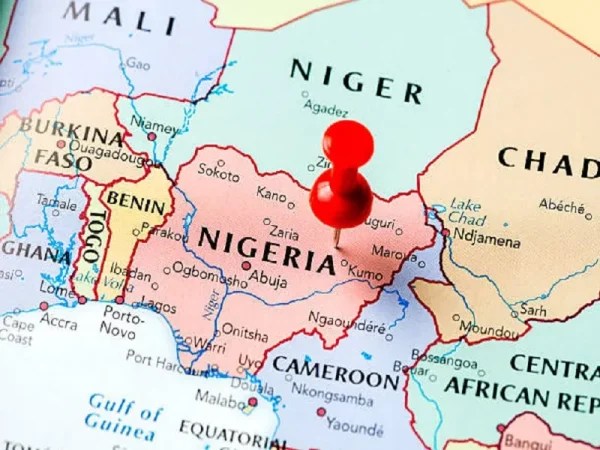
The fast-moving developments since last week’s patriotic military coup in Niger strongly suggest that “West Africa Is Gearing Up For A Regional War” between NATO-backed Nigerian-led ECOWAS and the Russian-backed de facto Burkinabe-Malian federation over that country’s future government. Those readers who aren’t aware of what’s been happening should reference the preceding hyperlinked analysis for background before proceeding with the rest of this piece, which assumes familiarity with the subject.
Al Jazeera and Politico likely didn’t intend to, but two of their articles on recent events shed light on the real reasons why Nigeria might invade Niger. Respectively titled “A test of wills: Can ECOWAS reverse Niger coup and establish a new order?” and “What Niger’s coup means for Nigeria”, they both suggest that ulterior motives are at play beyond restoring that country’s ousted leader just for the supposedly principled sake of defending democracy.
Beginning with Al Jazeera’s piece, it starts off by quoting the speech that newly inaugurated Nigerian President Bola Tinubu gave at ECOWAS early last month after he was elected chairman of this regional bloc. He said that “We must stand firm on democracy. There is no governance, freedom and rule of law without democracy.” This outlet noted that his words were soon put to the test two weeks later, hinting that he’s pressured to make good on rhetoric about something that he didn’t expect would happen.
They then cite the opinion of a former director of political affairs at the ECOWAS Commission who declared that “With Tinubu’s posture, we can see that Nigeria is back on stage.” This person’s position makes them biased towards that group and its regional role, but their particular quote inadvertently reveals that Tinubu is talking tough towards Niger for the sake of boosting his country’s prestige. To their credit, Al Jazeera seemed to have picked up on this as well as evidenced by what they later wrote:
“Within Nigeria, Tinubu’s assertiveness is being perceived as an intent to shore up popularity abroad while he is increasingly unpopular at home. His victory in the February presidential election is being contested by the two largest opposition parties who cite widespread electoral malpractice and claim he was ineligible to run. A string of early reforms – including the removal of a popular fuel subsidy – intended to overhaul Africa’s biggest economy has also led to spiralling costs of living.”
This is a damning explanation of the ulterior domestic motives behind the ultimatum that Tinubu gave Niger on behalf of the bloc that he now chairs. It’s basically a risky distraction from problems at home that’s being justified on the pretext of defending democracy, which uncoincidentally aligns with one of the mantras of the West’s so-called ‘rules-based order’. Al Jazeera also cited an Africa expert at Oxford Analytica who alleged that reversing the recent regime change could help thwart terrorist threats.
On the other hand, a Nigeria expert at the International Crisis Group told them that “Military interventions could also be unpopular in Nigeria and possibly lead to protests.” They also warned that this could “reduce pressure on jihadists and bandits in the Lake Chad area and create room for the expansion of their operation.” All things considered, Al Jazeera’s article on this subject was surprisingly critical of Nigeria’s potential invasion of Niger, thus making it a refreshing read.
The same can be said for Politico’s, which is much shorter but still contains some similarly damning explanations of what’s really driving events behind the scenes. They started off by quoting a senior fellow at the influential Council on Foreign Relations (CFR) who fearmongered that “Not only will failure to act send a signal that Tinubu and ECOWAS can only bark, but not bite, it will embolden military adventurers in other West African countries as well as the Russia-backed Wagner Group.”
The reality is corrupt Western puppets’ neglect of their countries’ objective national interests led to deteriorating economic and security situations that prompted the region’s spree of military coups, not anything else. Regarding Wagner, these juntas then tend to turn towards this group (whose post-mutiny ties with the Kremlin are clarified here) since it specializes in “Democratic Security”, or counter-Hybrid Warfare tactics and strategies that readers can learn about in the foregoing hyperlinked analyses.
Russia’s interest in securing their national models of democracy from (mostly Western-emanating) hybrid threats is twofold since it sincerely wants to empower them to become sovereign subjects in the Multipolar World Order but it also benefits by stopping the West from exploiting their resources. If the West treated African states as truly equal partners like Russia does, then it would stamp out terrorism and stop subjugating them as vassals so that they wouldn’t have a reason to consider switching partners.
With this fact-check in mind, it’s clear that Politico’s cited CFR expert explained the reasons why the West wants Nigeria to invade Niger instead of even attempting to put forth a reason why it would allegedly be in that country’s national interests to do so. This New Cold War bloc fears that the region’s newest junta will ally with Russia via Wagner and thus further accelerate the collapse of their influence across the continent, though this might be averted if Nigeria forcibly reinstalls the old regime.
Just like Al Jazeera, Politico also deserves credit for implying that Tinubu has ulterior domestic motives behind doing the West’s bidding when writing that “Nigeria’s influence has been slipping in recent years, as it grapples with economic malaise and security challenges that festered under the prior president, Muhammadu Buhari. Since succeeding Buhari, Tinubu has been trying to placate different religious and ethnic groups at home upset over the February election results, which the opposition has disputed.”
What these two outlets’ pieces on this subject show is that newly inaugurated Nigerian President Tinubu might invade Niger out of desperation to distract from economic and political problems at home despite telling the world that this is to defend democracy in that neighboring nation. The corrupt confluence of his domestic interests and the West’s geopolitical ones greatly raises the odds that this could soon happen, though it remains to be seen whether it’ll succeed and how strong the blowback might be.
One Pfizer jab, 20 months of battling to keep hope alive
By Brian Howard | TCW Defending Freedom | January 23, 2023
It has been a very long 20 months since my one and only Pfizer vaccine. I was hesitant but seeing friends and family seemingly OK I decided to ‘do the right thing’ as we were told. The regret still lives on, of course, although over time you do begin to forgive yourself and recognise the huge pressures we were all under.
Within ten days it started. Pins and needles in the hands at night. Then numbness down the whole right side of my body. Then the constant muscle twitches all over the legs. Within a month the tremors started. By this stage I’d already been fobbed off by my GP and a private neurologist. They didn’t want to know or simply didn’t have a clue how to help. I’ll never forget another neurologist suggesting I even take the second jab. Trust in the system had gone at that point. The symptoms continued. Random jolty movements of the body, intense dizziness, headaches and head pressure, brain-shaking sensations, adrenaline rushes, some elevated heart rate episodes. By the six-month point I was rapidly losing hope. You try to stay positive but it really can be a battle. I was fortunate enough to be self-employed and able to work from home but I had to let jobs go as it became far too much, and the money spent on finding alternative therapies and supplements to fix the problem wiped out any savings I had left.
Eventually I started to see some glimmers of improvement, finding certain things that seemed to at least provide relief. It was slow but bit by bit I could sense some progress. At the 20-month point many of the symptoms are still there and I still have a daily battle with them but generally they are at a far more manageable level. The relapses send you backwards, but you get used to them. It feels odd sometimes to say I’ve got used to any of this. I was perfectly healthy before. Never had any prior issues but when this happens you are forced to adapt pretty quickly. You start to forget what it felt like before all of this.
Beyond the physical, all of us have experienced the gaslighting from the medical profession, the online hatred of the vaccine-injured, the censorship by Big Tech. Whether you like it or not it forces you to see the world very differently.
There are positives. For me that comes from the amazing communities of vaccine-injured who have united to help each other, to listen to each other with an openness and compassion that gives me a great deal of hope for the future. To see what a group of people from all over the country and all over the world can do when they simply come together is quite something. The connections you make and communities you become a part of are like a beacon of light.
That’s why we must keep talking. We know there are more of us out there and they need to know that they are not alone.
Brian is a member of UK CV Family, a vaccine injured support group, that can be contacted here. https://www.ukcvfamily.org
Interpreting Russia’s Official Response To The Nigerien Coup
BY ANDREW KORYBKO | JULY 31, 2023
Last week’s patriotic military coup in Niger could be a game-changer in the New Cold War as was explained here, though this analysis here argues that it might be nipped in the bud if Nigeria ultimately does the West’s bidding by leading an ECOWAS invasion force aimed at reinstalling the ousted president. Those who aren’t already aware of the insight shared in those analyses should at least skim them in order to be brought up to speed and thus better understand Russia’s official response to this event.
Russian Foreign Minister Sergey Lavrov said on 27 July that “We believe the coup is an anti-constitutional act. We always occupy a clear position in such cases…We reaffirm our position that it is necessary to restore the constitutional order in Niger.” One day later on 28 July, his country joined its fellow permanent UNSC members in issuing a joint statement that “strongly condemned the efforts to unconstitutionally change the legitimate Government of the Republic of Niger on 26 July 2023.”
They also “expressed support for the efforts of the Economic Community of West African States (ECOWAS) and the African Union…(and) underscored the urgent need for the restoration of constitutional order in Niger in accordance with the ECOWAS Protocol on Democracy and Good Governance and expressed their support for regional and continental mediation efforts.” Two days later on 30 July, the AU and ECOWAS gave the junta a two-week and one-week ultimatum respectively.
If President Mohamed Bazoum isn’t reinstalled by then, they warned of “punitive measures” that could include the “use of force”. This sequence of events shows that the AU-ECOWAS duopoly is exploiting the UNSC joint statement as the pretext for invading Niger in order to secure their Western patrons’ interests there. None of this is surprising, however, which is why some might wonder why Russia agreed to the same statement that’s being taken advantage of to legitimize its rivals’ regional power play.
For starters, Russia always officially condemns anti-constitutional seizures of power, with this being more symbolically important than ever after Ukraine’s Western-backed and fascist-driven “EuroMaidan” coup in spring 2014. That said, this stance and its associated support of peaceful means for restoring the constitutional order in countries that experience these sorts of regime changes don’t automatically equate to it endorsing Western-encouraged invasions to this end.
It’s important to note that neither the AU nor its West African-Sahel ECOWAS enforcers put forth their ominous ultimatums by the time that Russia agreed to the UNSC joint statement on Niger. Even though it should have been foreseeable that these threats would follow, the fact that they hadn’t yet officially been made meant that there wasn’t any diplomatic pretext for Russia to break with precedent. For that reason, it supported the UNSC joint statement, which promoted mediation efforts.
The next point to make is that the West has been fearmongering that the Kremlin had a hidden hand in previous military coups in the West Africa-Sahel Region so it would have come off as very suspicious if Russia was reluctant to condemn this latest coup. That approach would have likely fueled an even more intense round of information warfare falsely alleging that Moscow was behind this regime change, thus justifying the planned Western-encouraged ECOWAS-led invasion on an urgent anti-Russian pretext.
And finally, since it can’t be taken for granted that the Nigerien junta will successfully repel this invasion in the likely scenario that it’s commenced sometime after the AU’s two-week ultimatum expires, it doesn’t make sense for Russia to signal support for what might very well be a doomed cause. Doing so would be detrimental to its soft power interests since the collapse of that junta could then be spun as a joint Western-African victory over Russia in the New Cold War.
None of this is to suggest that Russia is seriously opposed to the junta becoming an interim/transitional government, however, since precedent shows that it has no problem cultivating mutually beneficial relations with military rulers in the region like Mali’s and Burkina Faso’s. If the likely scenario of a French-backed ECOWAS-led invasion doesn’t materialize, yet without the coup leaders capitulating to pressure to reinstall Bazoum, then Niger will probably become Russia’s next strategic partner in the region.
UK Weighs In on What’s Slowing Ukraine’s Counteroffensive
By Oleg Burunov – Sputnik – 29.07.2023
The UK Defense Ministry admitted in its recent intelligence report that the Russian Ka-52M crews successfully launch LMUR missiles beyond the range of Ukrainian air defense systems.
Russia’s Ka-52M attack helicopters are equipped with a “new and highly effective” long-range missile that poses a serious threat to the Ukrainian Armed Forces (UAF), a US magazine has reported.
The missile is technically known as the Izdeliye (Product) 305 and is also referred to by its Russian acronym LMUR (light multi-purpose guided missile).
The magazine cited the UK Defense Ministry’s recent Intelligence Update as saying that one of the key improvements of the Ka-52M is the integration of the LMUR, a new anti-tank missile, which has a range of approximately 15 km.
“Ka-52 crews have been quick to exploit opportunities to launch these weapons beyond the range of Ukrainian air defenses,” according to the British Defense Ministry intelligence report.
The magazine in turn called the “notably deadly” LMUR a “real escalation in the helicopter capabilities” of the Russian army, recalling that a non-upgraded version of the Ka-52 is typically fitted with laser-guided Vikhr and ATAKA anti-tank guided missiles (ATGM), with ranges of around 10 km and 6 km, respectively.
“The LMUR is in a different league. […] Rather than relying on laser guidance, the LMUR uses a combination of thermal imaging and satellite navigation. In direct-fire mode, the operator locks the thermal seeker on to a target and fires. For longer-range encounters though, the operator can fire the missile from out of sight towards specified coordinates, then use the missile’s thermal imager to find and lock on to the target,” the news outlet added.
In an apparent nod to the Ka-52M being used in the Russian special military operation, the magazine noted that the concept of anti-tank helicopters capable of striking from stand-off distances “seems to be working” in Ukraine.
The media outlet warned that if the UAF fails to tackle “the threat posed by Russian helicopters with the LMURs, the progress of the [Ukrainian] offensive is likely to be slow and bloody.”
This comes after Russian President Vladimir Putin said that all attempts by the UAF to re-launch their counteroffensive have been halted and the enemy has been pushed back, suffering heavy losses.
Putin told the Russia-Africa summit in St. Petersburg earlier this week that during the UAF’s latest attack, more than 200 Ukrainian soldiers were killed and that Russian forces had destroyed at least 26 enemy tanks. He added that 60% of the UAF’s military hardware had already been obliterated during the renewed hostilities.
The Russian president spoke after a US newspaper reported about UAF forces purportedly launching “the main thrust of their counteroffensive” as they threw in “thousands of troops held in reserve, many of them Western-trained and equipped.”
Putin previously told a Russian Security Council meeting that Ukraine’s counteroffensive, which kicked off in early June, had yielded no results and that the UAF had suffered extensive losses, with “tens of thousands” of soldiers killed.
The LMUR was for the first time on display at the International Military and Technical Forum ARMY 2021. The missile is designed to destroy single and group stationary and moving targets at any time of the day and in any weather conditions.
The Product 305 has a high-explosive fragmentation warhead weighing 25 kg and provides high accuracy in hitting targets with a deviation from the aiming line of no more than two meters.
What a coincidence: Dengue cases skyrocket just as dengue vaccine approaches licensure
And just as Bill Gates is rolling out his genetically engineered mosquitos
BY MERYL NASS | JULY 26, 2023
One dengue vaccine was licensed in the US in 2019 after killing dozens of kids in the Philippines. Philippine Ministry of Health and Sanofi officials went on trial for manslaughter in that case, just before the FDA issued the same vaccine a license. While the license was only issued for people aged 9-16, and only if they had had dengue once already, your tax dollars rolled it out all over Puerto Rico. Will all vaccinators follow those strictures?
Here’s what CDC notes about the licensed vaccine:
This vaccine is different from other vaccines in that it is only recommended for people who have already been infected with dengue virus. The reason is that children without previous dengue infection are at increased risk for severe dengue disease and hospitalization if they get dengue after they are vaccinated with Dengvaxia. Therefore, healthcare providers should check for evidence of a laboratory-confirmed previous dengue infection before vaccination.
Another dengue vaccine has come before the VRBPAC FDA committee twice, and I blogged those meetings. It appears it only works for 2 of the 4 dengue strains. It supposedly did not need a blood test before use. Takeda is the manufacturer and it describes the vaccine here.
Epoch Times reports:
The World Health Organization (WHO) has warned that cases of dengue fever could reach record highs this year.
Dengue rates are rising globally, with reported cases since 2000 up eight-fold to 4.2 million in 2022, a WHO official said on July 21.
In January, the WHO claimed that dengue is the world’s fastest-spreading tropical disease and alleged it could be a “pandemic threat.”
The disease was found in Sudan’s capital Khartoum for the first time on record, according to a health ministry report in March, while Europe has reported a surge in cases and Peru declared a state of emergency in most regions.
About half of the world’s population is now at risk, Raman Velayudhan, a specialist at the WHO’s control of neglected tropical diseases department, told journalists in Geneva on Friday.
Cases reported to the WHO hit an all-time high in 2019 with 5.2 million cases in 129 countries, said Mr. Velayudhan via video link.
I’m wondering how big the dengue market will get, given that no one had heard of RSV a year ago, and now the GSK and Pfizer RSV vaccines for elders are predicted to be worth $9 billion. No one had heard of dengue. But they will hear about it now.
Russia Will Not Renew International Grain Deal; Some Context
By Ted Snider | The Libertarian Institute | July 27, 2023
Like the war that necessitated it, Russia’s decision not to renew the United Nations and Turkish-brokered grain deal is bad for the world but not wholly unprovoked.
The deal allowed Ukraine safe passage for its grain laden ships through the mined and blockaded Black Sea ports so it could continue to export its agriculture to the world.
On July 17, Russia announced its decision not to renew the deal.
It has repeatedly been reported that Russia’s decision is retaliation for Ukraine’s recent sabotage of the Kerch Strait bridge that links Crimea to the Russian mainland. But President Vladimir Putin had announced the distinct possibility of suspending the agreement prior to the attack on the bridge.
During a July 13 question period, in a response to a journalist, Putin said, prior to the attack on the bridge, “We can suspend our participation in this deal.”
Putin gave two reasons for suspending the deal after having “extended this so-called deal many times.” The first is that, though it was Russia that suspended the deal, it was the West that broke it. “As for the conditions under which we agreed to ensure the safe export of Ukrainian grain, yes, there were clauses in this agreement with the United Nations, according to which Russian interests had to be taken into account as well,” Putin said. “Not a single clause related to what is in the interests of the Russian Federation has been fulfilled.”
Announcing the decision not to renew the deal four days later, Russian presidential spokesman Dmitry Peskov repeated that charge; “Unfortunately, the part of the Black Sea agreement that concerns Russia has not yet been fulfilled. As a result, it has been terminated.” However, he added that “As soon as the Russian part [of the deal] is fulfilled, the Russian side will immediately return to the implementation of this deal.” Putin made a similar pledge in his answer to the journalist. One option, he said, is “not first the extension and then the honouring of promises, but first the honouring of promises and then our participation. What do I mean? We can suspend our participation in this deal, and if everybody once again says that all the promises made to us will be fulfilled, let them fulfil them—and we will immediately join this deal. Again.”
George Beebe of the Quincy Institute has written that “Russia’s withdrawal from the deal is part of classic negotiating behavior, after its repeated demands went unaddressed by partners to the deal.”
While Russia kept its promise to allow Ukraine to export its grain, Moscow argues that the West failed to implement their commitments on facilitating Russian exports of grains and fertilizer due to an impossible to navigate web of sanctions and the failure to reconnect the Russian Agricultural Bank to the SWIFT financial system to enable payments.
Though better known as the ‘grain deal,’ the deal was meant to facilitate the export of fertilizer as well. As early as the end of April, Russian Foreign Minister Sergey Lavrov had complained that Russian cargo vessels carrying fertilizer were paralyzed in European ports. Russia has been unable to export its fertilizer. The world also watched silently with no condemnation when Russia’s Togliatti-Odessa pipeline that carries ammonia necessary for fertilizer was sabotaged.
The second reason is not about the failure to meet the conditions of the deal, but about the failure to meet the purpose of the deal. Putin has frequently pointed out that “this whole deal was presented under the pretext of ensuring the interests of African countries” whose food security was threatened. Instead, from Russia’s perspective, the deal has boosted the economy of Russia’s enemy by allowing Ukraine to export grain and boosted the economy of those supporting Russia’s enemy by allowing western Europe to import that grain while helping African countries barely at all.
Putin has repeatedly claimed that Ukrainian grain exported under the deal is not reaching Africa but is headed, instead, for Europe. He has claimed at various times that “about 45 percent of the total volume of grain exported from Ukraine went to European countries, and only three percent went to Africa.” In his response to the journalist, Putin again said that “only a little more than 3% went to the poorest countries—a bit over 3%. Everything else went to a well-fed and prosperous Europe.”
And he’s not wrong. Though Africa has benefitted from the deal indirectly by stabilizing global supply and prices, they have not been the direct beneficiaries. While only 12% of the grain has reached Africa, 40% went to Western Europe, according to the World Food Program. The biggest recipients of Ukraine’s grain have been China, Spain, Turkey, Italy, and the Netherlands. 80% of the grain has gone to upper-middle and high income countries, and 44% going to high income countries, but only 2.5% has made its way to low-income countries, according to the most recent UN data.
Russia, though, has sent many tonnes of grain to Africa; 11.5 million tonnes in 2022 and 10 million in the first half of 2023, according to Putin. And, in November 2022, Russia agreed to send grain to some African countries for free. Putin has repeatedly promised that, were the deal not to be extended, “Russia will be ready to supply the same amount that was delivered under the deal, from Russia to the African countries in great need, at no expense.” After the decision not to extend the deal, Putin wrote an article for African media repeating that promise directly to the people of Africa: “I want to give assurances that our country is capable of replacing the Ukrainian grain both on a commercial and free-of-charge basis… Notwithstanding the sanctions, Russia will continue its energetic efforts to provide supplies of grain, food products, fertilisers and other goods to Africa.” Deputy Foreign Minister Sergey Ryabkov said that, despite Western obstacles in the form of logistics, ship insurance and payments, “We will help those in need, we will find a way to do it, both with grain and fertilizers.” The Kremlin says that the offer of free grain is on the agenda of the second Russia-Africa summit being held in St. Petersburg this week.
Though Russia’s decision not to extend the grain deal is harmful to the world, like the war itself, it has been presented as emerging without antecedents. The narrative has frequently been distorted by discussing the decision not to extend the deal in isolation from its important context. The decision was not spontaneous retribution for the attack on the Kerch Strait bridge; it was a long, thought out negotiation strategy in response to promises made to Russia not being fulfilled. The announcement of the decision was also accompanied by the assurance that Russia would immediately return to the deal when those promises were fulfilled. The decision was also the product of Russia’s frustration that the deal was not only failing to benefit Russia as promised, but that it was failing to benefit Africa as promised while supporting the economies of Ukraine and the wealthy Western European countries who are helping it in its fight against Russia.
West ‘Torpedoed’ Ukraine Peace ‘Because We Want War With Russia’ – RFK Jr.
By Ilya Tsukanov – Sputnik – 26.07.2023
There is no chance of Russia losing the proxy war with NATO in Ukraine, the West fomented the conflict and a peace agreement is needed immediately to prevent further bloodshed, Democratic presidential hopeful Robert F. Kennedy Jr. has said.
“Russia’s not gonna lose this war. Russia can’t afford this – it’d be like us losing a war to Mexico. They are not gonna lose the war,” Kennedy said, speaking at a televised town hall Tuesday night.
“Go look at what Russia did in Stalingrad in order to preserve its territorial integrity. Russia’s been invaded three times through the Ukraine. The last time, Hitler killed one out of every seven Russians. They’re 400 miles from Moscow. We already have Aegis missile systems within 12 minutes of Moscow. We wouldn’t tolerate that if the Russians did it [like] in 1962 when they put them in Cuba,” the candidate added, referencing the Cuban Missile Crisis, during which time his late uncle, John F. Kennedy, was president.
US Sabotaged Peace
“The more disturbing thing,” Kennedy said, “is that on two occasions the Russians tried to sign a peace agreement with [Ukrainian President Volodymyr] Zelensky,” and both times the West sabotaged it.
The candidate pointed to the 2015 Minsk Agreements, which Zelensky expressed interest in before being talked out of it by the US in 2019, and the 2022 draft peace deal reached after talks in Belarus and Turkiye.
“In 2019, France Germany and Russia all agreed to the Minsk Accords. That year, Zelensky ran for president. He was a comedian. He had no political experience. Why did he win? Because he ran on one issue: signing the Minsk Accords. As soon has he got in there, Victoria Nuland and the White House told him he couldn’t do it,” Kennedy recalled.
“Then,” in February 2022, he noted, Russia sent “40,000 troops in. That’s not enough to conquer the country. Clearly, [Putin] wanted somebody to come to the negotiating table.” Russian and Ukrainian negotiators met in Istanbul, hammering out a draft peace deal. After that, “Putin in good faith began withdrawing troops from Ukraine. What happened? We sent Boris Johnson over there to torpedo it. Because we don’t want peace, we want war with Russia,” RFK Jr. stressed.
Road to Perdition
The Democratic politician also pointed out that the current crisis has its origins in the end of the Cold War.
“We promised in 1992, the Russian leadership said… ‘We’re gonna withdraw 400,000 troops from East Germany and we’re gonna allow you to reunite Germany under NATO,’ which is a hostile army. That’s a huge concession for them. ‘One commitment that we want,’ is what the Russians said, ‘is that you will not move NATO to the east.’ James Baker, who was then secretary of state under [George H.W.] Bush, famously promised ‘We will not move NATO one inch to the east.’ Well since then, we’ve moved it 1,000 miles and 14 countries. Now when we started that plan in 1997, Bill Perry, who was the secretary of defense under the Clinton administration, said ‘If you move NATO to the east, I am resigning because you are forcing the Russians to come to war with us.’ George Kennan, who’s the most important diplomat in American history, the architect of the containment policy [after] World War II, said the same thing. You do not need to make an enemy out of Russia,” Kennedy said.
Since announcing his run for the presidency in April, RFK Jr. has been the single most outspoken critic of the Russia-NATO proxy war in Ukraine in the Democratic Party, and like former Republican President Donald Trump, has promised to bring the conflict to a close if elected president.
The 69-year-old candidate, who is currently polling at 16 percent, is a veteran environmental lawyer and the son of assassinated former US Attorney General and presidential candidate Robert F. Kennedy. RFK Jr. has enjoyed a groundswell of support among Democrats, Republican, and independents amid his refusal to play party politics, but has been smeared by media and largely ignored by the Democratic establishment as an “anti-vaxxer” and “conspiracy theorist.” Kennedy has rejected these claims and accused the establishment of trying to silence him.
US allies on alert after lithium-rich Bolivia inks defense deal with Iran
The Cradle | July 25, 2023
Members of Bolivia’s far-right opposition and the Argentinian government are demanding that La Paz disclose the details of a memorandum of understanding (MoU) on defense and security affairs signed between Defense Ministers Edmundo Novillo y Mohamad Reza Ashtiani in Tehran last week.
“They say that [Iran] will give us drones. Others say they will give us missiles. All of this sounds strange, even more so considering it involves Iran … I can’t understand why Bolivia is getting involved in such a complex and difficult relationship,” said lawmaker Gustavo Aliaga, who belongs to the Comunidad Ciudadana (CC) party.
In 2019, CC leader Carlos Mesa supported the US-orchestrated coup that forced socialist leader Evo Morales to flee Bolivia, leaving it under the control of a far-right dictatorship that conducted multiple massacres of Morales supporters and sought to surrender the country’s massive lithium deposits to western transnationals.
The Argentinian foreign ministry also demanded explanations from La Paz on Monday under pressure from the Delegation of Argentinian Israeli Associations (DAIA), who said the MoU “risks for the security of Argentina and the region” due to Tehran’s ties with Lebanese resistance group Hezbollah.
In a press release, DAIA called on the Argentinian government “to condemn this agreement and demand Bolivia reconsider its decision.”
Buenos Aires blames Hezbollah and Iran for the 1994 bombing of the AMIA Jewish community center that left 85 dead. Both Tehran and Hezbollah deny the accusation.
The statements by the CC and DAIA came on the heels of a report by the neoconservative Institute for the Study of War (ISW), which claims that the deal between Tehran and La Paz includes the delivery of Iranian drones for the South American nation.
Last week, Iran agreed to help Bolivia combat drug trafficking along its borders and boost cooperation with the Bolivian army.
“[Due to] Bolivia’s critical needs in terms of border defense and the fight against drug trafficking, we will establish collaboration in equipment and specialized knowledge,” Ashtiani said following his meeting with the Bolivian defense minister last week.
For his part, Novillo said Iran is a “role model” for nations that seek freedom, highlighting the Islamic Republic’s “remarkable progress in science and technology, security, and the defense industry despite sanctions.”
Bolivia is the latest Latin American nation to ink a security agreement with the Persian nation, following in the footsteps of Nicaragua and Venezuela. Over the past year, the Islamic Republic has also made significant inroads with Brazil.
Iran and Bolivia also hold two of the largest lithium deposits in the world, with the Islamic Republic earlier this year announcing the discovery of a massive deposit holding a reported 8.5 million tons of the rare element. On the other hand, Bolivia has the richest known lithium deposits in the world, with an estimated 21 million tons.
Iran Warns of Missile Power as US Parks Amphibious Strike Group Near Its Shores
By Ilya Tsukanov – Sputnik – 25.07.2023
The Pentagon announced last week that it would deploy additional warships and a Marine expeditionary group to the Persian Gulf to “deter” Iran following a spate of tanker seizure incidents. Tehran has warned that the presence of non-Persian Gulf adjacent states’ militaries in the strategic body of water would not facilitate regional security.
Commanders from Iran’s Army and the Islamic Revolutionary Guard Corps have commented on the US’s decision to beef up its presence in the Persian Gulf, and warned that the Islamic Republic will take measures necessary to protect itself.
“Considering the control and capabilities of its Armed Forces in regard to navigation and aviation security in the Persian Gulf region, Iran reserves the right to make the necessary deterrent arrangements in compliance with the rules and regulations of international law, and will exercise its inalienable rights accordingly,” Army Commander-in-Chief Abdolrahim Mousavi said Monday, speaking on the sidelines of a major aerial drill, commenting on the Pentagon’s plans to deploy warships to the Gulf.
“The Americans have come and gone from the region for many years with their bogus illusions, but the security of the region will become sustainable only with cooperation among regional countries,” Mousavi stressed.
Separately, at a ceremony on Tuesday related to the delivery of a new advanced naval cruise missile to the IRGC Navy, Commander Alireza Tangsiri said that enemy vessels will be forced to stay thousands of kilometers away to avoid finding themselves in the missile’s crosshairs.
“We can fire the Abu Mahdi missile from deep inside the country. The missile has a dual seeker and performs successfully against the enemy’s electronic warfare,” Tangsiri said.
Iran characterizes the Abu Mahdi as “among the best missiles of its class in the world in terms of targeting, high destructive power, and passage through geographical obstacles and enemy defense systems,” and says the missile, which has a range of over 1,000 km, will dramatically increase the country’s maritime reach.
“Since the missile has a very low flight ceiling and a very long range, it can hardly be tracked,” Commander Tangsiri said.
The new missile is named after Abu Mahdi al-Muhandis, the late Iraqi militia commander who was slain in a US assassination strike in Baghdad in January 2020 alongside IRGC Quds Force commander Qasem Soleimani, who was on a secret peace mission in the country aimed at normalizing relations between Iran and Saudi Arabia.
Gulf Tensions
Tensions in the Persian Gulf surged earlier this month after the US announced the deployment of F-16 fighter jets and A-10 ground attack aircraft to patrol the strategic body of water after a string of ship seizures by Iran for maritime traffic violations and attempted oil smuggling.
Last Thursday, the Pentagon announced the deployment of two amphibious warships and thousands of Marines from the 26th Marine Expeditionary Unit to the Gulf on Defense Secretary Austin’s orders.
“Through these actions, the United States is demonstrating commitment to ensuring freedom of navigation and deterring Iranian destabilization activities in the region,” the Pentagon said in a statement, using the same ‘freedom of navigation’ line it uses to justify the illegal deployment of warships, aircraft and troops thousands of miles from America’s shores to Chinese-claimed waters in the South China Sea.
Last week, Iranian Foreign Ministry spokesman Nasser Kanaani emphasized that “Iran monitors with sensitivity any illegal and unconstructive act that affects the security of the region,” and would “pay special attention to any provocative and illegal moves, especially near its borders.”
Iran has one of the largest and most technologically advanced militaries in the Middle East, and is equipped with an assortment of domestically-designed and manufactured missiles, warships, and air defense systems designed specifically for asymmetric warfare against a much larger and more powerful foe. The country has demonstrated repeatedly in recent years that it will not tolerate violations of its air and sea space, knocking a $220 million US spy drone out of the sky over the Strait of Hormuz in June 2019.
The Persian Gulf is one of the most strategically important bodies of water in the world, with ship-based oil cargoes accounting for approximately 20-30 percent of consumption passing through its waters daily.
Glimpses of an endgame in Ukraine
BY M. K. BHADRAKUMAR | INDIAN PUNCHLINE | JULY 25, 2023
The problem with the war in Ukraine is that it has been all smoke and mirrors. The Russian objectives of “demilitarisation” and “de-Nazification” of Ukraine wore a surreal look. The western narrative that the war is between Russia and Ukraine, where the central issue is the Westphalian principle of national sovereignty, wore thin progressively leaving a void.
There is a realisation today that the war is actually between Russia and NATO and that Ukraine had ceased to be a sovereign country since 2014 when the CIA and sister western agencies — Germany, the UK, France, Sweden, etc.— installed a puppet regime in Kiev.
The fog of war is lifting and the battle lines are becoming visible. At an authoritative level, a candid discussion is beginning as regards the endgame.
Certainly, Russian President Vladimir Putin’s videoconference with the permanent members of the Security Council in Moscow last Friday and his meeting with Belarus President Belarus Alexander Lukashenko in St. Petersburg on Sunday become the defining moment. The two transcripts stand back-to-back and need to be read together. (here and here)
There is no question that the two events were carefully choreographed by the Kremlin officials and intended to convey multiple messages. Russia exudes confidence that it has achieved dominance on the battle front — having thrashed the Ukrainian military and Kiev’s “counteroffensive” moving into the rear view mirror. But Moscow anticipates that the Biden administration may be having an even bigger war plan in mind.
At the Security council meeting, Putin “de-classified” the intelligence reports reaching Moscow from various sources indicative of moves to insert into Western Ukraine a Polish expeditionary force. Putin called it “a well-organised, equipped regular military unit to be used for operations” in Western Ukraine “for the subsequent occupation of these territories.”
Indeed, there is a long history of Polish revanchism. Putin, himself a keen student of history, talked at some length about it. He sounded stoical that if the Kiev authorities were to acquiesce with this Polish-American plan, “as traitors usually do, that’s their business. We will not interfere.”
But, Putin added, “Belarus is part of the Union State, and launching an aggression against Belarus would mean launching an aggression against the Russian Federation. We will respond to that with all the resources available to us.” Putin warned that what is afoot “is an extremely dangerous game, and the authors of such plans should think about the consequences.”
On Sunday, at the meeting with Putin in St. Petersburg, Lukashenko picked up the thread of discussion. He briefed Putin about new Polish deployments close to the Belarus border — just 40 kms from Brest — and other preparations under way — the opening of a repair shop for Leopard tanks in Poland, activation of an airfield in Rzeszow on the Ukrainian border (about 100 kms from Lvov) for use of Americans transferring weaponry, mercenaries, etc.
Lukashenko said: “This is unacceptable to us. The alienation of western Ukraine, the dismemberment of Ukraine and the transfer of its lands to Poland are unacceptable. Should people in Western Ukraine ask us then we will provide support to them. I ask you [Putin] to discuss and think about this issue. Naturally, I would like you to support us in this regard. If the need in such support arises, if Western Ukraine asks us for help, then we will provide assistance and support to people in western Ukraine. If this happens, we will support them in every possible way.”
Lukashenko continued, “I am asking you to discuss this issue and think it through. Obviously, I would like you to support us in this regard. With this support, and if western Ukraine asks for this help, we will definitely provide assistance and support to the western population of Ukraine.”
As could be expected, Putin didn’t respond — at least, not publicly. Lukashenko characterised the Polish intervention as tantamount to the dismemberment of Ukraine and its “piece meal” absorption into NATO. Lukashenko was upfront: “This is supported by the Americans.” Interestingly, he also sought the deployment of Wagner fighters to counter the threat to Belarus.
The bottom line is that Putin and Lukashenko held such a discussion publicly at all. Clearly, both spoke on the basis of intelligence inputs. They anticipate an inflection point ahead.
It is one thing that the Russian people are well aware that their country is de facto fighting the NATO in Ukraine. But it is an entirely different matter that the war may dramatically escalate to a war with Poland, a NATO army that the US regards as its most important partner in continental Europe.
By dwelling at some length on Polish revanchism, which has a controversial record in modern European history, Putin probably calculated that in Europe, including in Poland, there could be resistance to the machinations that might drag NATO into a continental war with Russia.
Equally, Poland must be dithering too. According to Politico, Poland’s military is about 150,000 strong, out of which 30,000 belong to a new territorial defence force who are “weekend soldiers who undergo 16 days of training followed up by refresher courses.”
Again, Poland’s military might doesn’t translate into political influence in Europe because the centrist forces that dominate the EU distrust Warsaw, which is controlled by the nationalist Law and Justice Party whose disregard for democratic norms and the rule of law has damaged Poland’s reputation across the bloc.
Above all, Poland has reason to be worried about the reliability of Washington. Going forward, the Polish leadership’s concern, paradoxically, will be that Donald Trump may not return as president in 2024. Despite the cooperation with the Pentagon over the Ukraine war, Poland’s current leadership remains distrustful of President Joe Biden — much like Hungary’s Prime Minister Viktor Orban.
On balance, therefore, it stands to reason that the sabre-rattling by Lukashenko and Putin’s lesson on European history can be taken as more of a forewarning to the West with a view to modulate an endgame in Ukraine that is optimal for Russian interests. A dismemberment of Ukraine or an uncontrollable expansion of the war beyond its borders will not be in the Russian interests.
But the Kremlin leadership will factor in the contingency that Washington’s follies stemming out of its desperate need to save face from a humiliating defeat in the proxy war, may leave no choice to the Russian forces but to cross the Dnieper and advance all the way to Poland’s border to prevent an occupation of Western Ukraine by the so-called Lublin Triangle, a regional alliance with virulent anti-Russian orientation comprising Poland, Lithuania and Ukraine, formed in July 2020 and promoted by Washington.
Putin’s back-to-back meetings in Moscow and St. Petersburg throw light on the Russian thinking as to three key elements of the endgame in Ukraine. First, Russia has no intentions of territorial conquest of Western Ukraine but will insist on having a say on how the new boundaries of the country and the future regime will look and act like, which means that an anti-Russian state will not be allowed.
Second, the Biden administration’s plan to snatch victory out of the jaws of defeat in the war is a non-starter, as Russia will not hesitate to counter any continued attempt by the US and NATO to use Ukrainian territory as a springboard to wage a renewed proxy war, which means that Ukraine’s “piece meal” absorption into NATO will remain a fantasy.
Third, most important, the battle-hardened Russian army backed by a powerful defence industry and a robust economy will not hesitate to confront NATO member countries bordering Ukraine if they trespass on Russia’s core interests, which means that Russia’s core interests will not be held hostage to Article 5 of the NATO Charter.
Hungary may leave EU – former banking chief
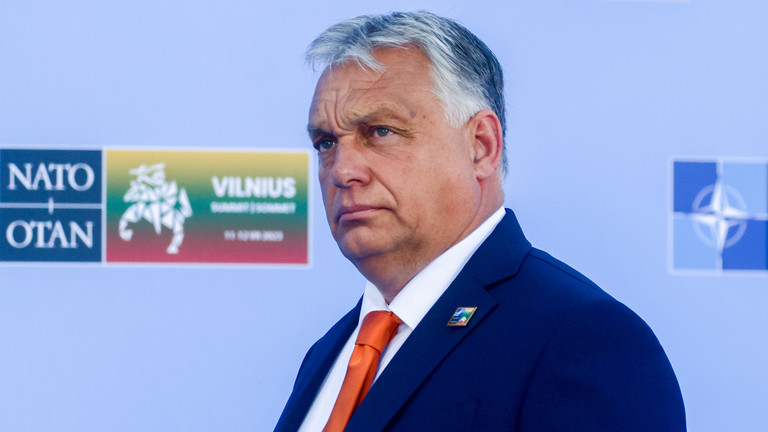
Hungarian Prime Minister Viktor Orban attends the NATO summit in Lithuania © Beata Zawrzel / NurPhoto via Getty Images
RT | July 24, 2023
Leaving the European Union may soon become “a real alternative” for Hungary, the former governor of the Hungarian National Bank claimed in a television interview on Sunday.
Speaking on Hungary’s ATV network, Andras Simor said that while a Brexit-style departure from the bloc is an unlikely scenario, “it is a possible one.”
“It’s probability,” he explained. “If it was 10% last year, by now it has risen to 20%, to 30%.”
Citing the country’s rising inflation rate and the EU’s withholding of $30 billion in funding to Budapest, Simor stated that he is “afraid that Hungary’s government will maneuver the country into a situation where an exit from the European Union becomes a real alternative.”
Although Hungary is a net beneficiary of EU aid, much of this assistance has remained frozen for several years, with officials in Brussels citing Prime Minister Viktor Orban’s hardline anti-immigration policies and alleged crackdown on judicial independence and media freedoms as reasons for the holdup.
While Orban’s government successfully gained access to some of this money by lifting a veto on EU economic aid for Ukraine last year, the Hungarian PM has continued his criticism of the bloc’s support for Kiev. Orban has repeatedly called for an immediate ceasefire in Ukraine, and accused “pro-war Brussels bureaucrats” of stoking conflict with Russia “at the expense of European interests.”
Orban’s disagreements with the EU go beyond the realm of geopolitics. Speaking at a youth event in Romania on Saturday, he declared that the bloc “rejects Christian heritage, carries out the replacement of its population via migration… and conducts an LGBTQ offensive” against conservative societies.
Despite his regular broadsides against Brussels, Orban has repeatedly dismissed the idea of leaving the EU. Polls taken since the 2016 Brexit referendum have consistently found high public support for staying in the bloc, although a recent Eurobarometer survey recorded a 12-point drop in those with a “positive image” of the EU, with only 39% now viewing the union favorably.
Russia’s Surgical Strike On The Moldovan-Romanian-Ukrainian Tri-Border Sent Several Messages
BY ANDREW KORYBKO | JULY 24, 2023
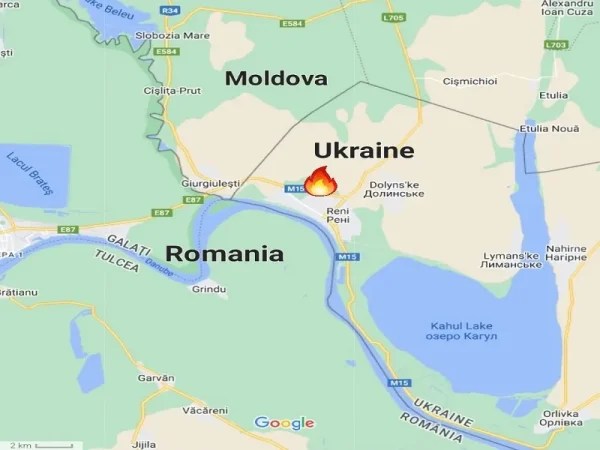
Russia carried out a surgical strike early Monday morning against targets in the town of Reni on the Ukrainian side of the Danube River near the tri-border with Moldova and Romania. This video alleges to show one of the explosions at its port while this image purports to be of a grain warehouse that was supposedly destroyed in the aftermath. It can’t be ruled out that military and/or terrorist assets were hidden there, however, since Russia insists that it doesn’t strike purely civilian infrastructure.
In any case, Monday morning’s surgical strike was very important since it sent several messages that Russia’s opponents would do well to heed. For starters, Reni is located on the other side of the Danube from NATO-member Romania, which demonstrated that Russia will hit targets anywhere in Ukraine and can do so with maximum precision. Those military and/or terrorist assets based on the literal border of that bloc but just outside of Article 5’s jurisdiction can no longer take their security for granted.
The second message is that Russia is serious about cracking down on those threats to its security that were previously untouchable due to Kiev exploiting the grain deal to protect some of its aforesaid assets. Russia remained committed to that agreement in spite of that since it sincerely expected that the West would eventually remove those sanctions that impeded its agricultural exports. Since that didn’t happen and Russia therefore declined to extend the deal, Kiev’s selfsame assets are now fair game.
Third, carrying out a surgical strike on Reni proved that Russia had actionable intelligence regarding the Danube’s role in Kiev’s military logistical network, which many observers have suspected for a while. Related targets were previously untouchable for the abovementioned reason, but that’s no longer the case now that the grain deal expired. Accordingly, it can be expected that this won’t be the last surgical strike on the Danube, though it of course can’t be known when the next ones will occur.
The fourth message is that Russia now knows that NATO won’t extend its air defense umbrella over any part of Ukraine after no effort was made to stop its surgical strike in Reni on the Romanian border. The bloc either didn’t see the missiles approaching their air defense zone or detected them but declined to attempt an interception in order for Russia not to think they’re ready to get directly involved in this proxy war. Either way, NATO looks weak and Russia thus feels emboldened to continue striking near its borders.
And finally, this successful strike signifies that no part of Kiev’s military logistical network is safe, which could lead to Moscow’s edge in the NATO-Russian “race of logistics”/“war of attrition” growing even larger if it keeps up the tempo of these attacks against its opponent’s previously untouchable assets. In that event, peace talks might resume earlier than many expect if this accelerates the erosion of Ukraine’s military capabilities and thus forces its patrons to move up their timeline for freezing the conflict.
With these five messages in mind, there’s no doubt that Russia’s surgical strike against military and/or terrorist assets on the Moldovan-Romanian-Ukrainian tri-border is much more important than it might appear at first glance. Not only did Russia hit closer to NATO than ever, but that bloc didn’t even try to stop it, thus suggesting that they’re reluctant to get dragged even deeper into this proxy war. If Poland doesn’t unilaterally intervene by summer’s end, then peace talks might recommence shortly after.
Featured Video
BRITAIN’S WARNING: PREPARE FOR WAR
or go to
Aletho News Archives – Video-Images
From the Archives
British weapons and personnel doing much of the killing in Yemen
Press TV – June 18, 2019
A detailed report published by the Guardian newspaper has shown how Britain is massively contributing to Saudi Arabia’s devastating war on Yemen as it suggests that London is not only supplying the bombs that fall on Yemenis, but it provides the personnel and expertise that keep the war going.
The comprehensive report by Arron Merat published on Tuesday showed that Britain was doing much of the killing in Yemen as the country continues to provide Saudi Arabia with everything it needs to turn its southern impoverished neighbor into a graveyard.
“Every day Yemen is hit by British bombs – dropped by British planes that are flown by British-trained pilots and maintained and prepared inside Saudi Arabia by thousands of British contractors,” said Merat in the report. … continue
Blog Roll
 Aletho News
- Yemen denounces European Parliament’s ‘hypocritical’ push to blacklist Ansarullah
- Qalibaf: UAE’s UN bid aims to ‘clear the runway’ for ‘Greater Israel’, whitewash genocide
- Pakistan reopens Iran border after boosting security: Report
- Why are so many Brazilians voting for Flávio Bolsonaro?
- Democrats Put Anti-Russia Agenda Ahead of American Workers
- Elijah Magnier: Yemen’s Strikes Are Shattering Saudi Arabia’s Long-Term Strategy
- Pentagon designates Chinese cultural centers national security threat
- Israel Demolishes Home Of Lebanese Journalist Whose Viral Film Exposed Pager Attack
- Record Oil, Empty Tanks: The UAE’s Miracle Recovery
- Burnham tackles Britain’s poverty with aggression in Yemen
- If Americans Knew
- An error has occurred; the feed is probably down. Try again later.
- No Tricks Zone
- Sudden Stratospheric Warming, Powerful El Niño Combination May Lead To Extreme Europe Cold, Energy Crisis!
- Two New Studies Find Thwaites Glacier Melt Cannot Be Driven By Human Activity Or A Warming Ocean
- E-Cars Reduce CO2 Emissions By Only 41% Compared To Internal Combustion Engine Vehicles
- Predictions Made By Renowned Climate Professor Over Past Decades Have Been Proven To Be Poor
- New Study Suggests Large Regions Of The Pacific Ocean Have Been Cooling For The Last 80 Years
- Germany’s Green Energy Debacle: High Energy Costs Force Kahla Porzellan to Close After 182 Years!
- New Study: 50 Years Of The Most Aggressive ‘Net Zero’ Policies Can Only Affect The Global Climate By 0.03°C
- US September “Heat” Was No Record…Many Records Set Decades Ago
- Latest European Green Energy Debacle; Portugal’s Largest Flagship Solar Park Insolvent!
- Green Energy Debacle: German Expert Professor Fritz Vahrenholt Warns Of Severe Economic And Social Consequences

