Biden regime wants private companies to censor online speech
By Tom Parker | Reclaim The Net | April 26, 2022
The White House continued pressuring the tech giants to censor content that it deems to be “misinformation” yesterday by throwing its support behind the use of Section 230 and antitrust reforms to combat misinformation.
White House Press Secretary Jen Psaki shared the Biden administration’s support for these reforms when a reporter asked whether the White House would be interested in working with Twitter, “like it has in the past,” to continue to combat COVID misinformation and disinformation.
The reporter didn’t point to a specific past partnership between the White House and Twitter when asking his question but Twitter has previously facilitated a White House Q&A as part of its “work on COVID-19 vaccine misinformation” and reportedly partnered with the White House to promote COVID vaccines. The White House has also admitted that it regularly contacts social media platforms about misinformation and even flags content for Facebook to censor.
Psaki responded to the question by confirming that Biden’s White House is still “engaging regularly with all social media platforms about steps that can be taken.”
She continued by suggesting that Congress should impose reforms on Big Tech platforms. Specifically, Psaki said the White House would support reforms of Section 230 of the Communications Decency Act (CDA) (which currently gives large tech platforms immunity from civil liability if they act in “good faith” to moderate content), antitrust reforms, and “requiring more transparency” from tech platforms.
Psaki also commented on Tesla and SpaceX CEO Elon Musk’s recent acquisition of Twitter by warning that President Joe Biden wants Big Tech platforms to be “held accountable for the harms that they cause.”
Additionally, when she was asked about “purveyors of election misinformation, disinformation” having more of an opportunity to speak on Twitter after Musk’s takeover, Psaki said: “The President has long talked about his concerns about the power of social media platforms, including Twitter and others, to spread misinformation, disinformation, the need for these platforms to be held accountable.”
Psaki’s comments are the latest of many calls from the Biden administration for tech platforms to purge speech that the Federal Government deems to be misinformation. Research has shown that the current levels of Big Tech censorship already heavily favor Biden.
The Biden White House’s previous demands for tech platforms to censor misinformation are currently the subject of a lawsuit that alleges these demands violated the First Amendment.
The Illusion of Freedom: We’re Only as Free as the Government Allows

By John W. Whitehead & Nisha Whitehead | The Rutherford Institute | April 26, 2022
“Rights aren’t rights if someone can take them away.”— George Carlin
We’re in a national state of denial.
For years now, the government has been playing a cat-and-mouse game with the American people, letting us enjoy just enough freedom to think we are free but not enough to actually allow us to live as a free people.
Case in point: on the same day that the U.S. Supreme Court appeared inclined to favor a high school football coach’s right to pray on the field after a game, the high court let stand a lower court ruling that allows police to warrantlessly track people’s location and movements through their personal cell phones, sweeping Americans up into a massive digital data dragnet that does not distinguish between those who are innocent of wrongdoing, suspects, or criminals.
Likewise, although the Supreme Court gave the go-ahead for a death row inmate to have his pastor audibly pray and lay hands on him in the execution chamber, it refused to stop police from using hidden cameras to secretly and warrantlessly record and monitor a person’s activities outside their home over an extended period of time.
For those who have been paying attention, there’s a curious pattern emerging: the government appears reasonably tolerant of those who want to exercise their First Amendment rights in a manner that doesn’t challenge the police state’s hold on power, for example, by praying on a football field or in an execution chamber.
On the other hand, dare to disagree with the government about its war crimes, COVID-19, election outcomes or police brutality, and you’ll find yourself silenced, cited, shut down and/or branded an extremist.
The U.S. government is particularly intolerant of speech that reveals the government’s corruption, exposes the government’s lies, and encourages the citizenry to push back against the government’s many injustices. For instance, Wikileaks founder Julian Assange, the latest victim of the government’s war on dissidents and whistleblowers, is in the process of being extradited to the U.S. to be tried under the Espionage Act for daring to access and disclose military documents that portray the U.S. government and its endless wars abroad as reckless, irresponsible, immoral and responsible for thousands of civilian deaths.
Even political protests are fair game for prosecution. In Florida, two protesters are being fined $3000 for political signs proclaiming stating “F—k Biden,” “F—k Trump,” and “F—k Policing 4 Profit” that violate a city ban on “indecent” speech on signs, clothing and other graphic displays.
The trade-off is clear: pray all you want, but don’t mess with the U.S. government.
In this way, the government, having appointed itself a Supreme and Sovereign Ruler, allows us to bask in the illusion of religious freedom while stripping us of every other freedom afforded by the Constitution.
We’re in trouble, folks.
Freedom no longer means what it once did.
This holds true whether you’re talking about the right to criticize the government in word or deed, the right to be free from government surveillance, the right to not have your person or your property subjected to warrantless searches by government agents, the right to due process, the right to be safe from militarized police invading your home, the right to be innocent until proven guilty and every other right that once reinforced the founders’ belief that this would be “a government of the people, by the people and for the people.”
Not only do we no longer have dominion over our bodies, our families, our property and our lives, but the government continues to chip away at what few rights we still have to speak freely and think for ourselves.
On paper, we may be technically free.
In reality, however, we are only as free as a government official may allow.
We only think we live in a constitutional republic, governed by just laws created for our benefit.
Truth be told, we live in a dictatorship disguised as a democracy where all that we own, all that we earn, all that we say and do—our very lives—depends on the benevolence of government agents and corporate shareholders for whom profit and power will always trump principle. And now the government is litigating and legislating its way into a new framework where the dictates of petty bureaucrats carry greater weight than the inalienable rights of the citizenry.
With every court ruling that allows the government to operate above the rule of law, every piece of legislation that limits our freedoms, and every act of government wrongdoing that goes unpunished, we’re slowly being conditioned to a society in which we have little real control over our lives.
In our quest for less personal responsibility, a greater sense of security, and no burdensome obligations to each other or to future generations, we have created a society in which we have no true freedom.
Government surveillance, police abuse, SWAT team raids, economic instability, asset forfeiture schemes, pork barrel legislation, militarized police, drones, endless wars, private prisons, involuntary detentions, biometrics databases, free speech zones, etc.: these are mile markers on the road to a fascist state where citizens are treated like cattle, to be branded and eventually led to the slaughterhouse.
We are overdue for a systemic check on the government’s overreaches and power grabs.
Where we find ourselves now is in the unenviable position of needing to rein in all three branches of government—the Executive, the Judicial, and the Legislative—that have exceeded their authority and grown drunk on power.
The American kleptocracy (a government ruled by thieves) has sucked the American people down a rabbit hole into a parallel universe in which the Constitution is meaningless, the government is all-powerful, and the citizenry is powerless to defend itself against government agents who steal, spy, lie, plunder, kill, abuse and generally inflict mayhem and sow madness on everyone and everything in their sphere.
Unfortunately, there is no magic spell to transport us back to a place and time where “we the people” weren’t merely fodder for a corporate gristmill, operated by government hired hands, whose priorities are money and power.
As I make clear in my book Battlefield America: The War on the American People and in its fictional counterpart The Erik Blair Diaries, our freedoms have become casualties in an all-out war on the American people.
If we continue down this road, there can be no surprise about what awaits us at the end.
Constitutional attorney and author John W. Whitehead is founder and president The Rutherford Institute. His books Battlefield America: The War on the American People and A Government of Wolves: The Emerging American Police State are available at www.amazon.com. He can be contacted at johnw@rutherford.org. Nisha Whitehead is the Executive Director of The Rutherford Institute. Information about The Rutherford Institute is available at www.rutherford.org.
Corruption of Language, Corruption of Thought
With a brief discourse on totalitarian regimes and conspiracy theories
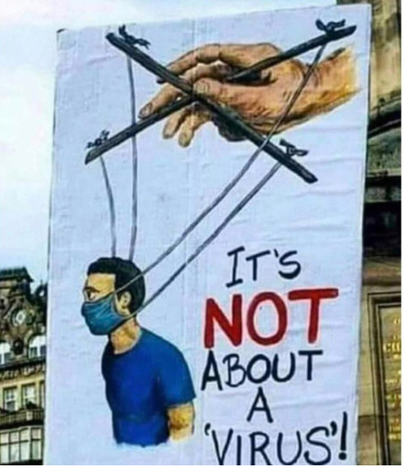
By Aaron Kheriaty, MD | April 27, 2022
In his classic dystopian novel 1984, George Orwell famously wrote, “If you want a picture of the future, imagine a boot stamping on a human face—for ever.” This striking image served as a potent symbol for totalitarianism in the 20th Century. But as Caylan Ford recently observed, with the advent of digital health passports in the emerging biomedical security state, the new symbol of totalitarian repression is “not a boot, but an algorithm in the cloud: emotionless, impervious to appeal, silently shaping the biomass.” The new forms of repression will be no less real for being virtual rather than physical.
These new digital surveillance and control mechanisms will be no less oppressive for being virtual rather than physical. Contact tracing apps, for example, have proliferated with at least 120 different apps in used in 71 different states, and 60 other digital contact-tracing measures have been used across 38 countries. There is currently no evidence that contact tracing apps or other methods of digital surveillance have helped to slow the spread of covid; but as with so many of our pandemic policies, this does not seem to have deterred their use.
Other advanced technologies were deployed in what one writer has called, with a nod to Orwell, “the stomp reflex,” to describe governments’ propensity to abuse emergency powers. Twenty-two countries used surveillance drones to monitor their populations for covid rule-breakers, others deployed facial recognition technologies, twenty-eight countries used internet censorship and thirteen countries resorted to internet shutdowns to manage populations during covid. A total of thirty-two countries have used militaries or military ordnances to enforce rules, which has included casualties. In Angola, for example, police shot and killed several citizens while imposing a lockdown.
New Zealand Used Selective Science and Force to Drive High Vaccination Rates
By J.R. Bruning | Brownstone Institute | April 26, 2022
We expect that knowledge produced and applied in a health emergency will produce information that is protective of health. But it is increasingly apparent that over the last two years New Zealand’s Ardern government has designed policy, regulation, and information to coercively steward citizens to accept a drug under provisional consent.
Strict lockdowns were promised to end when 90% of the population was vaccinated. This was unprecedented: policy endpoints required population-level uptake of novel technology, no matter whether the individual was at risk or not.
In addition, data production was contracted by the department intent on a 90% vaccination rate. For decades governments have promoted ‘evidence-based science’ as the gold standard for public reasoning and risk deliberation. What we saw was internally produced and contracted science that focused on case rates, while (inconvenient) information in the published scientific literature on vaccine risk, waning and breakthrough was ignored.
This produced a tightly controlled scope of knowledge production that then failed to adhere to long-established democratic and public health principles. Responsible risk governance requires that governments must be responsive to data that indicates a technology is not as effective or is possibly more harmful than estimated, – for a democratic government’s primary role is the protection and safety of all citizens. Technology must not be valorized, and uncertainty set aside, in order to achieve policy ends.
Universal Vaccination Assumed from April 2021
New Zealand’s Unite Against Covid-19 ‘elimination’ strategy was confirmed in the first quarter of 2020. Policy, propaganda and legislation predominantly centred around the case, or infection rate, rather than the fatality rate as the measure of risk.
Even though the clinical trials did not demonstrate that the vaccine prevented transmission and infection, the Government promoted ‘the jab’ as a way to protect families in the Unite Against Covid-19 campaign. Persistent reporting of case rates fostered a perpetual state of fear and uncertainty among the population, who perceived infection from the SARS-CoV-2 virus to be something more like Ebola.
The Ardern government’s intention for the entire population to get the mRNA vaccine was declared through the signing of a supply agreement. This intention was then embedded in policy and regulation via the Traffic Light system, designed to nudge the population over 12 into compliance.
It was known by July 2021 that the vaccine waned and was leaky. Breakthrough infections were relatively common and for many. The clinical trials remain incomplete, lacking long-term safety data. The trials did not demonstrate that the vaccine prevented hospitalization and death.
However, in April 2022 in New Zealand, mandatory vaccinations remain compulsory for border workers, and workers in health and disability; corrections; defence; Fire and Emergency New Zealand (FENZ) and Police. These professions must be vaccinated and have received a booster vaccination against COVID-19.
At ‘Traffic Light Orange’ Kiwis ‘must wear a face mask’ in retail businesses, on shared and public transport, in government facilities and when visiting a healthcare service. This is despite the fact that Omicron ripped through New Zealand in February.
In the first week back at school and university after the summer holidays –the obedient mask-wearing young friends of my kids, including my son, from Otago and Canterbury down on the South Island up to the capital Wellington and Auckland – were locked down with Omicron in their first weeks back at university. No evaluation of Omicron and mask efficacy has been provided by the state.
The Risk Modellers
Government policy processes have persistently excluded uncomfortable knowledge that suggested uncertainty or risk. First, the policy accompanying and justifying Covid-19 legislation and Orders, and modelling by the contracted institution Te Pūnaha Matatini (TPM) contained narrow reasoning central to the state’s claims, locking in the narrative that infection was the predicator of risk, modelling wave after wave of infection.
Second, policy supporting the legislation excluded consideration of age-stratified risk and failed to address common principles of infectious disease management embedded in the New Zealand Health Act. Third, reviews of the scientific literature that could publicly identify and communicate risk relating to vaccine-related harm and issues relating to efficacy simply never occurred.
The gaps are considerable. The Government’s Covid-19 Unite campaign failed to communicate age-stratified risk of hospitalization and death as the pandemic evolved. New evidence on infection fatality rates were not reported to the public. In modelling papers, TPM used old infection fatality rate statistics that overestimated death rates.
The potential for the vaccine to wane or for breakthrough infection to occur was ignored in a major policy paper focussed on elimination and by the modellers at TPM. The role of natural infection in producing a broader, and protective structural response, assisting populations to shift to herd immunity status was downplayed. While herd immunity was recognized, testing and data modelling was undertaken to identify naturally derived herd immunity in the population. Later modelling exclusively associated herd immunity with vaccination.
Perhaps the problems addressed here are not surprising, when most modelling was undertaken outside of New Zealand’s public health institutions. Instead, number-crunching was carried out by data analysts, mathematicians affiliated with TPM, with scarce few infectious disease epidemiologists trained in public health ethics participating. And of course, the science and data modelling were directly funded by the government departments and Ministries dedicated to over 90% vaccine compliance.
Global vaccination policies ignored the fact that infection-related risk always centered on the aged and infirm and those with complex multimorbid conditions. Disconcertingly, the clinical trial data had conceded that vaccine efficacy remained uncertain for the most at-risk of harm from Covid-19 – the immunocompromised, autoimmune and people who were frail, and those with inflammatory conditions (see p.115). In addition, as coronaviruses readily mutate, it was highly probable the vaccine would have a short shelf life.
Early Treatments Sidelined
Governments are entrusted with an overarching obligation to protect health – this includes putting populations directly at risk through bad policy. There was always a role for safe, established drugs with a long history of safe use that had undergone complete testing before launching onto the market.
Early treatments could have been integrated as a major tool to prevent hospitalisation and death. Early treatments avoid the dilemma of mutating variants while acting to protect at-risk groups whose immune systems might not be as responsive to a vaccine.
Conventionally doctors are at liberty to repurpose drugs for their patients, such as antivirals with a long history of safe use. However, in July 2021, the government locked in approved drugs for treatment.
From at least October, New Zealand doctors were instructed to ‘not use any other antiviral outside of a clinical trial’ while Medsafe warned against use of the safe antiviral Ivermectin for a respiratory virus. Yet the clinical guidelines were intended as last resort medicine for the hospitalized, rather than designed as protective nor preventative at home therapies.
These directives have fractured the practice of informed consent, which forms the basis of trust in the doctor-patient relationships. Even the New Zealand Medical Council, the organisation that grants licences to practice medicine, declared that there was ‘no place for anti-vaccination messages in professional practice.’ These actions may unwittingly undermine trust in vaccines and the doctor-patient relationship for years to come.
The implications of silencing doctors, some who have had their medical licenses suspended, when observed alongside the above-mentioned data gaps, are extraordinary.
Ethical questions continue to be sidelined. The principle of proportionality, embedded in the 1956 Health Act, has been effectively dropped. Proportionality, which allows for individual risk, is a core consideration in public health. Medicine is a technology, and the space where biology meets technology – including medicine – is never constant, and requires value-based judgement. Risk management of a medical intervention for a pregnant woman, young person or child requires significantly different deliberation to a 75-year-old.
Democratically Unaccountable Legislation
Since January 2020, a tsunami of rights-limiting has been rolled out purposefully and consistently. There was scant citizen consultation with public input limited to a few short days in most cases. The unprecedented barrage of rules and orders released by the Ardern government entrenched requirements for almost everybody to get the mRNA vaccine.
By mid-2021 – before most mandates – the scientific literature was revealing that the vaccine waned; that breakthrough infection occurred and that there was extensive evidence that it produced a wide range of side effects, and even death. This knowledge should have invalidated any workforce vaccine mandate, but instead by October, the state doubled down and locked in mandates and regulations that would legally and socially coerce most of the population over 12 into accepting the shot.
It’s probable that the mountain of legislation produced over the last two years never fulfilled democratic norms of accountability and transparency. For science in a pandemic to be harnessed to serve the public interest, the institutions that set those terms of reference must be guided by principles that protect health.
The failure of government agencies to draw on peer-reviewed scientific literature while prioritizing internal modelling is clear from tracking the literature stored online with the relevant agencies. Most compellingly, it is documented in the policy supplied in support of the unprecedented quantity of law-making.
It appears that from late 2019, institutional interests anticipated that there would be hesitancy around vaccine safety. Yet there was no public forum. Instead, groups who sought to question the safety of the novel mRNA vaccine remained outside ‘accredited’ media, possibly due to the chilling effect of unprecedented Covid-19 funding and advertising boosts which effectively captured mainstream media.
That the New Zealand state mandated not-at-risk people accept a novel technology, creating rules (as nudge policies) that limited economic and social life for the non-vaccinated when there was early evidence the vaccine was leaky and potentially harmful, will take years to unpick. As mandates continue, injured groups continue to face barriers to justice following vaccine injury and death.
Ultimately, practices such as this raise nagging doubts concerning the state’s capacity to honor broader obligations to protect health and the public interest in future emergency situations. New Zealand’s response to the Covid-19 pandemic serves as a case study – a precedent, for future health emergencies.
A deeper dive on this discussion can be found in the paper, Covid-19 Emergency Powers and on Rumble. The paper is offered to assist academic and legal experts, citizens and communities to consider use of policy and science by the Ardern Government from 2020-2022. I question the potential for the New Zealand state to navigate future pandemics, and future techno-controversies, in the public interest.
J.R. Bruning is a consultant sociologist (B.Bus.Agribusiness; MA Sociology) based in New Zealand. Her work explores governance cultures, policy and the production of scientific and technical knowledge. Her Master’s thesis explored the ways science policy creates barriers to funding, stymying scientists’ efforts to explore upstream drivers of harm. Bruning is a trustee of Physicians & Scientists for Global Responsibility (PSGR.org.nz). Papers and writing can be found at TalkingRisk.NZ and at JRBruning.Substack.com and at Talking Risk on Rumble.
Christian Drosten, Karl Lauterbach try to block Health Ministry committee set to evaluate lockdowns and other containment measures

Health minister Karl Lauterbach caught maskless on a train
eugyppius | April 25, 2022
In March 2021, the German Bundestag ordered the Ministry of Health to set up an expert committee to evaluate the effectiveness of containment measures in Germany, from lockdowns to masks. They required this committee to complete their evaluation by 30 June 2022, and to publish a report before the end of September.
The committee finally convened on 22 April via video conference, delayed apparently because communicating with Karl Lauterbach’s ministry has been a huge problem. In the hours after that meeting, the committee chair notified its members that he had finally heard from Lauterbach. The health minister had raised the idea of extending the evaluation deadline to 31 December, and suggested that the committee mandate might end up being redefined.
As Welt explains, Christian Drosten had previously voiced staunch opposition to the project of investigating the efficacy of containment measures:
… [A]n internal virtual meeting in March, Charité virologist Christian Drosten argued against individually evaluating the containment measures. In a nine-minute speech, he said there was too little data, it was too early for such a study, and one could end up “in hot water,” according to WELT information. In view of this intervention from Drosten, who has been one of the most important advisers to political decision-makers since the start of the pandemic, the committee turned to the Ministry of Health for further instructions.
Nothing came of that meeting; the committee had a mandate from the Bundestag, the legal force of which does not rest upon Drosten’s feelings.
When Welt asked the health ministry to comment on the latest delays, a Lauterbach spokesman said the experts don’t have sufficient data, and that the ministry is in discussions with the Bundestag about how to handle this. He even denied that there would be any delay in the committee’s work, which is plainly a lie, because Welt has documents and off-the-record statements from committee members to the opposite effect. One such member even complained to their reporter that “It shows great disrespect to try to withdraw our mandate to evaluate containment measures after so many hours of work.”
We are asked to believe that containment measures have been super successful in the past, and that they remain an important tool for future waves. Lauterbach himself has promised the return of containment in the Fall, because he did not get his vaccine mandate. At the same time, nobody must be permitted to evaluate the efficacy of these allegedly crucial measures. We can’t be allowed to know which ones work and which ones don’t. That would be dangerous somehow, even for an expert committee. In fact it would be so dangerous, that Christian Drosten, the public face of mass containment in Germany, felt compelled to deliver a secret lecture warning against any such evaluative process.
What’s really galling about all this, isn’t that they’re lying, but that they’re terrible at it.
Big Tech monopolies are good for national security, former intelligence officials say
By Didi Rankovic | Reclaim The Net | April 25, 2022
Big Tech, its lobbyists and allies, have come up with yet another, opportunistic given the current geopolitical situation, “argument” as these corporate behemoths fight to prevent any legislation that would limit their already vast and growing power.
And the argument is that Big Tech serves US foreign policy as an important asset, essentially by means of providing wide-reaching censorship, and needs to be preserved just the way it is: with its monopolistic power not restricted with new laws, and that means no breaking up of these companies into parts that would render their stranglehold on the market weaker, nor passing any meaningful new regulation.
The ongoing war in Ukraine is used as a handy example and excuse for how important Big Tech companies are to the ability of the US to advance its policy around the world. (How this functions domestically, and what ties to what centers of power Big Tech has in that scenario, is a different question.)
The recommendation to leave Big Tech alone for the sake of US national interests abroad came in a letter signed by a number of former intelligence officials, whose names have already been cropping up over the years in a variety of now debunked affairs, complete with the claim that the Hunter Biden emails were not authentic, and were instead a product of Russian disinformation.
These officials include Obama administration-era CIA head Michael Morrell, Leon Panetta, who was both at the helm of Pentagon and the CIA during that time, and former Director of National Intelligence James Clapper. Observers critical of the Big Tech-Big Government dynamic, like Glenn Greenwald, consider these figures to be “disinformation agents” themselves, while presenting their activities as a relentless fight against disinformation; and on top of that, some of them have financial ties to some of the largest tech corporations. None of that is stopping these figures from assuming the self-styled role as spokespeople for national security.
But what’s happening here is just another instance of Big Tech lobbying, which has over the years and decades gone through different phases, enlisting at different times lobbying pros, public figures, and even small businesses who wind up suffering from the giants’ grip on the digital markets. Sometimes this lobbying has been “hidden” inside alleged grassroots campaigns, but not this time – this time it’s former spies, bringing up the issue of the importance Big Tech has for foreign policy, at a time when geopolitics is on everyone’s mind.
Boiled down, however, they do it to shore up Big Tech’s offensive against two particular pieces of legislation currently considered at various levels in the US Congress: these are bipartisan proposals that aim to tackle tech giants’ antitrust behavior that harms competition, thanks to the comprehensive nature of these companies’ control over various markets. One example given is how Google can – and does – use its Search to downrank video platforms, competitors to another of Google’s arms, YouTube. Not to mention what are by now notorious app store practices put in place by the Google/Apple duopoly. Beyond that, there’s the issue of the digital ad market tightly controlled by Google and Facebook.
Both bills designed to put an end to this and loosen the monopolistic stranglehold of Google, Apple, Amazon, and others – one in the Senate, and another in the House – have been doing well so far, receiving support from many lawmakers from both parties, emboldened by the general anti-Big Tech mood.
Even those senators that have financial ties with these corporations and refused to sponsor the Senate bill, eventually voted in favor when it was considered by the Judiciary and Antitrust Committee. This is seen as a sign that the public’s odium toward tech giants has now gained momentum that means politicians can no longer afford to ignore it, despite their campaigns, donations, and personal financial priorities.
All in all, many believe that the two bills have a good shot at becoming law – and that has clearly been the signal to the rattled tech juggernauts to bring out the big lobbying guns. And wrap the message in a big narrative: national security, and the Russian threat.
The signatories of the new letter, Greenwald writes, demand that the anti-Big-Tech bills “first be reviewed not only by the judiciary and antitrust committees, but also the national security committees where they wield power and influence, which have traditionally played no role in regulating the technology sector.”
‘Traitors’ collaborating with Russia will be executed – Ukrainian governor
Samizdat | April 25, 2022
Vitaly Kim, who serves as the governor of Ukraine’s Mykolaiv Region, warned that citizens helping Russian forces would face extrajudicial execution. He revealed the chilling fate awaiting “traitors” during a live broadcast on Ukraine 24 TV channel last Thursday.
Kim made the comment after the presenter brought up claims made earlier by officials in Kherson, according to which, information about pro-Ukrainian activists, veterans who had fought in the Donbass, as well as journalists living in the city had been leaked to Russian forces.
Kim, in turn, cited the recent killing of a pro-Russian blogger in the city, who was shot dead on April 20, as proof that “Kherson is Ukraine,” and that “there are guerrilla fighters there.”
Moreover, Kim warned that “traitors will be executed,” adding that he is “not afraid of this word.”
The Ukrainian official expressed absolute certainty that “it will be like that.”
In response, the presenter cited a top Ukrainian official who had previously said that a special force had been established which would be eliminating traitors.
Kim interjected, assuring the anchor that this secret force was in fact already operating. The presenter, in turn, urged everyone listening to the broadcast to keep this fact in mind.
The governor also claimed that Ukraine had developed superior tech and IT capabilities which allowed its special services to track down practically anyone. Kim concluded that “no one will be able to hide from justice.”
Why We Sued to Overturn the Federal Travel Mask Mandate — And Why We Won
By Leslie Manookian | The Defender | April 22, 2022
In America, the ends don’t justify the means. There are legal guardrails in place to protect our basic liberties and rights — even during a pandemic.
That was the message in the decision handed down Monday by a federal judge in our lawsuit to overturn the federal travel mask mandate.
Since early 2021, anyone traveling on a plane, bus or train, or anyone who used a shared ride service — or even walked into an airport or train station — was compelled to wear a face covering, often for hours at a time.
President Biden, on his first full day in office, signed an executive order on mandatory masking.
The Centers for Disease Control and Prevention (CDC), citing a public health emergency, promulgated the order just eight days later.
The CDC circumvented a required notice and comment period and issued no scientific justifications for the specifics of the order.
Americans were supposed to take the government’s word for it, put on our masks and ask no questions.
But when flight attendants announced — repeatedly on each flight — that compliance is required “by federal law,” did you ever wonder: what federal law?
I did. And it led us at the Health Freedom Defense Fund to file suit against the mandate in federal court.
With assistance from our lawyers at the Davillier Law Group, we learned there is no “federal law” compelling masks for travel.
The CDC does not have the statutory authority to issue a sweeping mandate requiring masking. Nor does the agency have the authority to penalize Americans for non-compliance.
The Biden administration claimed its mask mandate was rooted in authority granted under the Public Health Service Act.
However, a careful reading of that law shows Congress never intended to grant such sweeping powers. In fact, the law is limited and specific, as the court pointed out in its decision.
One of the bigger red flags for the court was the CDC’s claim it could bypass a period of public notice and comment.
The CDC cited the pandemic “emergency” as justification for bypassing notice and comment.
Yet, as we all recall, by early 2021, the pandemic had been wreaking its havoc for nearly a year, yet the agency had proposed no such travel mask mandate.
It is hard to justify requiring emergency powers and circumventing all citizen comments when the CDC was marking time on masks for more than a year.
Indeed, if a mask mandate was key to the pandemic battle, Congress could have enacted such a bill, with debate, transparency and accountability. It did not.
In fact, public comment is at the core of credible and transparent regulatory policy because it allows for flaws and pitfalls to be cited and hopefully corrected.
Despite telling us all for years to “follow the science,” the CDC cited no scientific research to justify the mandate, nor did it offer justification for choosing the age of 2 for its exemption — clearly indicating the agency arbitrarily chose that age.
An abundance of research in major medical and scientific publications, including in the Journal of the American Medical Association, details the negative effects of prolonged mask-wearing, including among medical professionals and the military.
The CDC also ignored the serious, and medically verified, concerns voiced by Americans about how mask-wearing creates severe anxiety, as the two individual plaintiffs in our case detailed.
Clearly the federal government simply brushed away bona fide questions about mask efficacy and risk, and chose not to cite rationale of its own.
The government’s rationale is what we parents say often when our children question our demands: “Because I said so.”
That approach usually doesn’t work well with kids — and it sure falls short in setting policy for hundreds of millions of Americans.
As our lawsuit pointed out, never has a president entered an executive order mandating that every American citizen be required to don a type of garment or device, whether when traveling or otherwise, for any reason whatsoever.
And the U.S. Constitution certainly doesn’t grant the president power to enact nationwide edicts just because Congress failed to pass legislation he deems needed.
So now that you can choose to fly or ride mask-free, remember: Even in response to a pandemic, your government cannot do what it wants, when it wants and to whom it wants.
We are governed by laws, not the preferences of elites, and the Constitution is not suspended in an emergency.
Leslie Manookian is president and founder of Health Freedom Defense Fund, a nonprofit which seeks to rectify health injustice through education, advocacy and legal challenges to unjust mandates, laws and policies that undermine our health freedoms and human rights.
© 2022 Children’s Health Defense, Inc. This work is reproduced and distributed with the permission of Children’s Health Defense, Inc. Want to learn more from Children’s Health Defense? Sign up for free news and updates from Robert F. Kennedy, Jr. and the Children’s Health Defense. Your donation will help to support us in our efforts.
EU commission sued over Covid-19 vaccine secrecy
Samizdat | April 23, 2022
Five Green MEPs are suing the European Commission over its ultra-secretive vaccine contracts, arguing that the heavily redacted versions released by the EC “made it impossible to understand the content of the agreements,” in a statement published Friday.
“Secrecy is a breeding ground for distrust and skepticism, and it has no place in public agreements with pharmaceutical companies,” Margrete Auken, a Danish MEP involved in the suit, declared, adding that “the European Commission’s refusal to provide transparency on its vaccine contracts affects the public’s confidence in the EU’s ability to obtain the best possible outcome for its citizens.”
The MEPs are demanding the details of the contracts the EC signed with vaccine-makers BioNTech, Pfizer, Moderna, AstraZeneca, Johnson & Johnson, and Novavax, including price per dose, advance payments, conditions for vaccine donations, liability, and indemnification matters.
“Purchases made with public money should come with public information, definitely in matters of health,” Dutch MEP and party to the lawsuit Kim van Sparrentak said in the group’s statement, noting that “confidentiality under the guise of trade secrets only fuels uncertainty and fear.”
In addition to Auken and van Sparrentak, the MEPs signing on to the suit are Tilly Metz (Luxembourg), Jutta Paulus (Germany), and Michele Rivasi (France), the chair of the parliament’s committee on Covid-19.
The lawsuit, filed in the European Court of Justice in Luxembourg, comes as EC President Ursula von der Leyen revealed that every EU member state would be required to adopt EU Digital Covid Certificates, a digital health passport issued to those with proof of vaccination, a negative PCR test, or proof of recovery from Covid-19. While the validity period for such certificates was due to lapse at the end of June, the EC is not only renewing it another year, but making it mandatory for all 27 EU countries from July 1. Only 15 are currently using it, according to von der Leyen.
The move comes despite many EU states winding down their Covid-19 restrictions, moving away from some of the stricter measures imposed in the first 18 months of the pandemic. Germany, which had initially sought to require all citizens over the age of 60 to receive a Covid-19 vaccine, has been forced to axe those plans after they were voted down in the Bundestag, though the country’s health minister has warned that the government may reimpose mask mandates, as he expects infections to increase in the fall.
In response to the lawsuit, the EC has insisted it cannot reveal the contracts it signed with the vaccine-makers back in 2020, claiming “the commission is in the business of respecting contracts.” At the time, EU lawmakers who wanted to see the contracts were prohibited from taking notes and forced to sign non-disclosure agreements.
Much of the world seemed to be headed for mandatory Covid-19 vaccination six months ago. However, the realization that despite their manufacturers’ initial promises, the vaccines were no magic bullet – not only incapable of stopping the spread, but incapable of preventing further infection – has cooled public fervor for mandates. Health concerns and complaints of discrimination against the unvaccinated have also contributed to the backlash. However, the manufacturers, as well as most officials, continue to insist that the vaccines are “safe and effective.”
Bavaria to introduce ‘eco-token’ to reward ‘environmentally conscious behavior’
Free West Media | April 22, 2022
MUNICH – In Bavaria, in the course of the creeping establishment of a climate dictatorship, climate-friendly good behavior will soon be rewarded with an “eco-token”. It is nothing more than a points system to indirectly punish unruly citizens.
This new control system is to be introduced later this year. This is a project that was first described in the Bavarian “Climate Protection Offensive” of 2019, has been in preparation for a long time and is designed to “promote sustainable behavior in everyday life by rewarding environmentally conscious action”.
Specifically, a documentation system is to be developed in which users can collect bonus points for “environmentally conscious behavior” in the form of sustainability tokens. These can then be redeemed at swimming pools or theaters, for example. For better implementation, a state office and a financial service provider are involved.
Unstoppable
Even if these are only the first steps of a model that can be expanded – and is intended to be expanded – it will not be long before even more companies, cultural and leisure facilities and ultimately government agencies will grant privileges for “climate protectors” (or supporters of coercive state measures). At a certain point, social “privileges” will inevitably be those things which are now taken for granted.
The Corona crisis, as the perfect blueprint for this development, has already ensured through 2G/3G apartheid rules or compulsory masks that fundamental rights and even bodily autonomy can easily be suspended by the state and Corona profiteers.
Similar programs are being implemented not only at EU level, but also within the member states: In Austria, the “ID Austria” app was introduced, which records driving licenses, passports and one’s own car. The entire identity is linked to the smartphone as is the “pilot project” of a “Smart Citizen Wallet” in Bologna, Italy.
Has Le Pen paved the way for more Macron?
By Richard Ings | TCW Defending Freedom | April 23, 2022
TOMORROW the French go to the polls to finish the job begun two weeks ago and choose their next elected monarch; if opinion polls can be trusted (with their manipulative influence on voting having become a major discussion point in France over the last few weeks) it looks as if Emmanuel Macron will be returned to the throne for another five years.
If Marine Le Pen, who has never been closer to power, falls at the final fence, she will not be blameless in her failure to take advantage of the seething resentment against the present incumbent. In the traditional head-to-head television debate four days before polls open, with the chance to voice the anger felt towards Macron by her potential supporters, she chose the route of trying to out-technocrat the technocrat. The result was that the smirking, supercilious bean-counter was invited to play on his home turf, within minutes deflecting the discussion away from his record in power to Le Pen’s record in opposition. The opportunity for a reckoning on Macron’s use of state forces against his own people, his enthusiastic embrace of digital IDs to coerce people into taking a novel medical intervention and his contempt for health workers who declined it, was squandered. At the end of the confrontation, he praised the fact that it had been much more ‘controlled’ than their previous meeting in 2017. It was clear to most who had been in control throughout.
Le Pen clearly also has only herself to blame for her political programme. Having once supported lockdowns and the huge accumulation of debt associated with them, she is largely joined at the hip with Macron in her plan to borrow and spend France’s way out of a problem caused by astronomical government borrowing and spending. Her flagship policy of reducing VAT on 100 ‘essential products’ is no match for Macron’s policy of continuing to send people cheques to bail them out, both a pitiful response to the enormous economic problems his decisions have created. Meanwhile, her desire to ban the wearing of the Muslim headscarf in public spaces as a puny symbol of the fight against Islamism essentially codifies the state’s right to decide what you are permitted to wear in public (indeed, Le Pen defended its enforceability in law by pointing out that Macron had found a way of policing his mask mandates).
Her own shortcomings aside, however, Le Pen is handicapped by the fact that, although she mobilised more than 8million people to vote for her, no one is allowed to say publicly that they support her without choosing the path of ostracism. In Britain by 2019 we had become painfully aware of the phenomenon of the ‘shy Brexiteer’, unable to ‘come out’ among friends and family without attracting a torrent of insults which often included the word ‘Nazi’. That’s been the norm in France for Le Pen voters for a long, long time.
However, something not widely reported happened ten days ago when a panellist on a major television show, former Miss France Delphine Wespiser, ‘came out’ in front of millions and said she understood why people might vote for Marine, suggesting she was like ‘France’s mum’. Did she realise what a pile-on would happen in saying that? She got a taste from her colleagues in the studio, but over the next few days found herself threatened on social media for daring to ‘contribute to the normalisation of the far Right’.
Removed from the show under byzantine French rules to do with ‘political balance’, she had to come back as an unpaid guest to report how her accidentally courageous opinion had seen her receive thousands of threats, as well as the call for her to be stripped of other sources of income, such as her featured role on the TV show Fort Boyard. Not being able to make a living for having expressed a view deemed unacceptable by the media (and not even an unpopular view) was, she said, ‘the price of my freedom’, adding defiantly: ‘I’m the spokeswoman for all those unhappy about what has happened over the last five years.’
Wespiser’s small, principled stand for freedom of speech and conscience is a marker of a very positive development. Dissenters are beginning to abandon their natural reticence and defend the right to have a different ‘non-mainstream’ point of view in the public square. The form that seems to be taking at the moment is voting for Marine Le Pen. Whatever her political shortcomings, Le Pen represents the dissident point of view. Crudely expressed, she is the biggest middle finger French people can currently give to the system which has crushed and oppressed many of them over the last few years.
And if not Le Pen, who? Macron has not ruled out a return to mandatory masking, and vaccine passports remain in place for access to hospitals. Le Pen has said she will scrap the system, has called vaccinating children against Covid ‘a kind of child abuse’, and will reinstate the health-workers ‘kicked out like scum’ for refusing to take the vaccine. Macron set up an undemocratic ‘citizens’ convention’ on the environment (only to ignore it) while touring the country in what he called his ‘great debate’ during which he lectured an invited audience for several hours. He’s committed to continuing to bore on if re-elected. Le Pen, on the other hand, has proposed a ‘Citizen’s choice referendum’ which, while it may struggle to get passed into law, holds out the promise of a new avenue for political change.
Take her at face value or not, Le Pen has put the word ‘freedom’ front and centre of her campaign. She is making commitments that will, in however limited a way, expand the power of ordinary people to influence what happens in their country. This promise to extend and defend liberty and democracy would be hard to break in circumstances where (unlike Boris Johnson and his smug party-loyal 80-seat majority) she would have to work hard to maintain the trust of those who lent her their vote.
Moreover, the prospect of her coming to power has so spooked the European establishment that they have taken the unprecedented step of calling for the French not to vote for her in what used to be called ‘interference in national elections’ but is now, it seems, just seen as doing the morally correct thing.
With all this in mind, the French now need to consider how much of a defiant middle finger they are brave enough to give to the established order when even today’s poster-boy of ‘democracy’ Volodymyr Zelensky says he is rooting for Macron. Will they stand up to conventional opinion and take the kind of risk Delphine Wespiser, or a nation of Brexiteers, were willing to take? The door to more freedom is definitely ajar. Dare they step through it?
Featured Video

New positive ivermectin evidence
or go to
Aletho News Archives – Video-Images
From the Archives
Fanatical Followers of the Covid Regime: A Jim Jones-Style Cult?
By Professor Roger Watson and Dr. Niall McCrae | The Daily Sceptic | November 15, 2021
As scholars at leading British universities over recent decades, we witnessed the replacement of critical thinking and debate by narrative: facts are discrimination and scientific method is imperialism; truth, instead, is derived from ‘progressive’ values. This educational trend may be a major contributory factor to the ease in which society has been inculcated to the Covid ‘new normal’ of masking, testing, and repeated doses of vaccines for a disease of similar risk to severe influenza.
One doesn’t need much critical reasoning to observe the flawed logic of some vaccination enthusiasts, such as people who respond to experiencing any side effects, however debilitating, by saying “at least I know it’s working”, or, after contracting the disease despite their promised inoculation (over 90% effective, according to initial drug company claims), “I’d have been worse off without the jab.” … continue
Blog Roll
 Aletho News
- EU Council Advances Chat Control 2.0 Scanning Proposal
- Ex-Greek MEP files complaint against Israeli spyware firm over alleged Pegasus surveillance
- Troubling ideas throughout the Torah, Talmud, Mishneh Torah and Tanya
- ‘Grave, alarming’: Iran mission on Trump’s UNGA ‘annihilation’ threats
- Najaf airport to reopen to Iranian flights within 24 hours: Ambassador
- From ‘How Will This End For Iran’ to ‘When America Walks Away’: A tale of two Economist covers
- Tehran blasts ‘baseless’ speculation linking Iran to alleged bomb plot at UK air base
- The Rise And… Rise Of ‘Color Revolutions’
- The Coming GOP Bloodbath?
- Arctic Scare Stories Melt Away
- If Americans Knew
- Netanyahu Asked UAE Leader to Deny Report on Oct. 7 Warning in Secret Visit, Sources Say
- CNN Chief Int’l Correspondent Clarissa Ward on Journalists in Gaza
- Democratic Party Consultants Surround Troy Jackson with Pro-Israel Donors
- Christian Leader Responds To Netanyahu’s Claims Regarding Palestinian Christians
- In Gaza, ‘Whoever Survives the Bombing Won’t Survive the Rubble’
- Israel kills more Palestinians, amid push to resettle Gaza – Daily Update
- Israel forces Gazans to live in constant peril – Daily Update
- Deconstructing Netanyahu’s pants-on-fire UN rant – Daily Update
- Trump betrayed voters with his campaign lies and prioritized a foreign country once he took office
- Netanyahu calls Israel’s war in Gaza ‘opposite of genocide’ in UN speech to near-empty hall
- No Tricks Zone
- New Study: Earth And Venus Surface Warmth Largely Explained By Convection And Lapse Rate, Not CO2 Or Radiation
- 2025 Nature Paper Claiming Worsening Global Drought Gets RETRACTED …Heavily Flawed
- New Study: ‘Global Drought Shows No Detectable Recent Acceleration Under Climate Warming’
- Economic Masterminds: German Socialists Suggest Taxing Productivity Gains Stemming From Using AI
- The South China Sea Has Not Been Cooperating With The Climate Change Narrative
- Energy Crisis: Germany Enters Heating Season With Historically Low Gas Reserve Fill Levels
- New Study: The Antarctic Ice Sheet Gained Mass From 2020-2024 Due To Staggering Snow And Ice Accumulation
- Study: Ocean Heating Rates From Thousands Of Years Ago ‘Dwarf’ Modern Ocean Heating Rates
- Climate Extremists Target, Attack Large-Scale Power Grid Infrastructure In Germany!
- New Study: Antarctic Ice Melt Has Contributed Less Than 1 Centimeter To Sea Level Rise In The Last 30 Years

