IMF Correctly Predicts Arrival of Compulsory Vaccination Across Russia After Gifting Kremlin $18 Billion
By Edward Slavsquat | Anti-Empire | November 16, 2021
Before October, most of Russia’s 85 regions had few (if any) COVID-related restrictions; mandates requiring businesses to vaccinate the majority of their employees—introduced in Moscow and several other regions in June—had not yet become the norm.
This all changed after the State Duma elections in late September. Speaking a day before the election results were announced, Annette Kyobe, IMF Representative in Russia, made a prophetic observation. As TASS reported at the time:
“There is no appetite [in Russia] for restrictive measures, lockdown, at least on the part of state authorities. <…> After the parliamentary elections, perhaps a more unpopular measure, like mandatory vaccination, can be initiated as early as October-November. “
What an incredible prediction! As it just so happens, COVID “cases” and “deaths” inexplicably began to skyrocket immediately after the Duma elections, forcing Russian authorities to introduce mandates and QR codes across the country.
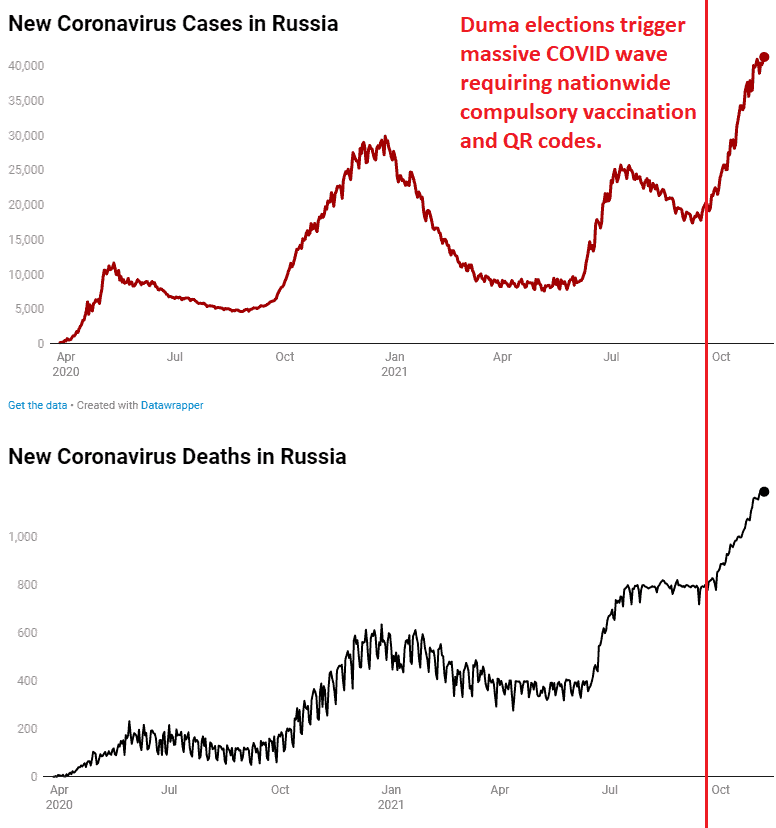
IMF totally called it!
Starting in October, Russian regions began the mass adoption of vaccine mandates and digital “health” passes. On October 14, Deputy Finance Minister Timur Maksimov told the IMF and World Bank that Russia’s government understood how important it was to shove a needle into every arm:
Participants in the autumn session of the IMF and the World Bank on Wednesday came to the conclusion that the problem of the crisis in the global economy cannot be solved until the population of all countries is vaccinated in the required proportion, Russian Deputy Finance Minister Timur Maksimov told reporters following these meetings.
“Until all countries are vaccinated in the required proportion, the world will not return to the old normality. Therefore, the question was raised that it is necessary to increase efforts to produce, to ensure access to vaccines. more and more waves of COVID cover different countries, “Maksimov said.
But wait… how was the IMF—an organ of Western Financial Extortion—able to so accurately predict Russia’s warm embrace of the global Vax Caste System?
Just a lucky guess. Obviously it had nothing to do with the 18 billion United States Dollars that the IMF shoveled into the Kremlin’s coffers back in August. The head of the IMF described the generous cash-injection as part of a “vaccination for the world economy during an unprecedented crisis.” (We should note for the sake of accuracy that the $18 billion was awarded in the form of “special drawing rights.” SDRs are units of account for the IMF and represent a claim to currency held by IMF member countries for which they may be exchanged.)
Outrageously, some Russian analysts and media outlets have suggested that something is slightly suspicious about all this—but why would they suggest something so silly? Anyway:
“There is no appetite for restrictive measures, lockdown, at least on the part of the state authorities. After the parliamentary elections, perhaps a more unpopular measure, such as compulsory vaccination, can be initiated as early as October-November.”
This is an excerpt from the speech of the IMF Resident Representative in Russia Annette Kyobe during the Fitch Ratings webinar “Russia – Macroeconomic Forecast 2021”.
On the air on the Tsargrad TV channel, Alexander Losev, a member of the Presidium of the Council on Foreign and Defense Policy, explained why our country continues to cooperate with discredited organizations and why the IMF wants to vaccinate all of Russia:
“The IMF and the World Bank are two organizations that have introduced such a concept as the Washington Consensus.
Adherence to this Washington Consensus is written for all developing countries.
First of all, this is a limitation of state sovereignty, less support for business, more – the market, invisible hands of the market, there are many of them, and some requirements for budgets and budgetary policy.
All countries that followed the Washington Consensus ended up poorly, with crises.
The second point is why the IMF says it.
At the end of August, the Bank of Russia received $ 18 billion from the IMF in the form of special drawing rights, that is, it received money. I’m not hinting at anything, I’m just stating: was the money accepted? Accepted.
These are the institutes of world governance created by the United States. And now the activity of these institutions is an attempt by the United States to preserve its hegemony, to preserve its power over the world.
They are tools. Behind them is the United States and their establishment, those who manage capital, world politics – or think they do.
[…]
The main beneficiaries of the pandemic are, of course, financiers. Because all the money that governments and central banks sent to help the economy, they basically all went through the banking system. The American banking system is $ 90 trillion in assets. All the money that the government allocated went there too.
The estimate is how much money was allocated and how much got into the banking system, from 24 to 27 trillion dollars. Equivalent. In different countries, including developing countries.
Utter nonsense! Russia adopted nationwide compulsory vaccination policies because there was a huge, dangerous wave of COVID that emerged immediately after Duma elections, which required more Sputnik V, everywhere and for everyone. If Russians don’t like it, they will have a chance to vote again, in the next Duma elections, in 2026.
Public health is a funny thing.
Test results for steel used in US Navy subs ‘falsified’ for decades
RT | November 9, 2021
A former metallurgist at a Washington state foundry that produced steel used in US Navy submarines has admitted to taking “shortcuts” and doctoring the results of strength and toughness tests on the metal for over three decades.
Elaine Marie Thomas, 67, pleaded guilty to the fraud at a Tacoma court on Monday. Thomas was the director of metallurgy at a foundry in the city that provided steel castings used by Navy contractors Electric Boat and Newport News Shipbuilding to manufacture submarine hulls.
According to the Justice Department, the tests were to prove that the steel would hold up in a collision or during certain “wartime scenarios.” While there was no information on whether any submarine hulls had failed, authorities said the Navy had incurred additional costs and maintenance-related expenses to ensure the vessels were seaworthy.
Although the government did not reveal which subs were affected, the contractors have jointly built Virginia class submarines for about two decades. In a statement to the court, Thomas’ attorney noted that the “government’s testing does not suggest that the structural integrity of any submarine was in fact compromised.”
In her plea agreement, Thomas told the court that she faked test results for at least 240 steel productions between 1985 and 2017 – roughly half the steel the foundry supplied to the Navy. Her attorney said Thomas “took shortcuts,” but “never intended to compromise the integrity of any material.”
In 2017, a metallurgist being groomed to replace Thomas noticed the suspicious test results and alerted the foundry’s parent company, Bradken Inc. The Kansas City-based firm fired her and disclosed the falsified data to the Navy, but suggested that the discrepancies were not the result of fraud. Prosecutors said this affected the Navy’s efforts to investigate the scope of the problem and address potential risks to personnel.
The Justice Department said that when investigators confronted Thomas with the fraudulent results, she admitted that it “looks bad” and revealed that she had given passing grades in some tests because she thought the Navy’s temperature-testing requirements were “stupid.”
Thomas, who faces up to 10 years in prison and a $1 million fine when she is sentenced in February, was apparently not “motivated by greed nor any desire for personal enrichment,” her attorney said, adding that she “regretted failing to follow her moral compass.”
8 Top Leaders in Field of Medicine Say Don’t Trust Science

By Fred Burks | WantToKnow
Throughout the pandemic, we were told by the powers that be to trust the science. But science is a process, not a person in whom we can place our faith. This process always produces meaningful data about how the world works, yet correctly interpreting that data isn’t always easy or possible. And for a variety of reasons, official interpretations of scientific data appear broadly untrustworthy. When science is used by powerful interests to support questionable policies, it ceases to be a tool for the betterment of all mankind.
Why do these eight top leaders in the field of medicine say that the science is not to be trusted?
- Dr. Marcia Angell, former editor-in-chief of the New England Journal of Medicine (NEJM) – “It is simply no longer possible to believe much of the clinical research that is published. I take no pleasure in this conclusion, which I reached slowly and reluctantly over my two decades as an editor of the New England Journal of Medicine.”
~~ Taken from this webpage on a U.S. National Institute of Health website - Dr. Richard Horton, the current editor-in-chief of the Lancet (considered to be one of the most well respected peer-reviewed medical journals in the world) – “The case against science is straightforward: much of the scientific literature, perhaps half, may simply be untrue. Science has taken a turn towards darkness.”
~~ Taken from this webpage on a U.S. National Institute of Health website - Dr. Fiona Godlee, 16 years as editor-in-chief of The BMJ – “It’s estimated that 70 per cent of the retractions are based on some form of scientific misconduct. I think we have to call it what it is. It is the corruption of the scientific process.”
~~ Taken from this webpage on the website of the CBC (Canadian Broadcast System) - Kamran Abbasi, current executive editor of The BMJ – “Science is being suppressed for political and financial gain. COVID-19 has unleashed state corruption on a grand scale, and it is harmful to public health.”
~~ Taken from this webpage on the website of The BMJ (formerly British Medical Journal) - Dr. Raeford Brown, chair of the Food and Drug Administration (FDA) Committee on Analgesics and Anesthetics – “Congress is owned by pharma. The pharmaceutical industry pours millions of dollars into the legislative branch every single year. In 2016, they put $100 million into the elections. That’s a ton of money.”
~~ Taken from this webpage on the Yahoo! News website - Assistant Professor Ray Moynihan, one of the leaders of a campaign sponsored by The BMJ to separate medicine from big Pharma – “When we want to decide on a medicine or a surgery, a lot of the evidence we used to inform that decision is biased. It cannot be trusted … because so much of that has been produced and funded by the manufacturers of those healthcare products.”
~~ Taken from this webpage on the website of the Sydney Morning Herald - A group calling itself CDC Scientists Preserving Integrity, Diligence and Ethics in Research, or (CDC SPIDER), put a list of complaints in writing in a letter to CDC Chief of Staff. The members of the group have elected to file the complaint anonymously for fear of retribution – “It appears that our mission is being influenced and shaped by outside parties and rogue interests … and Congressional intent for our agency is being circumvented by some of our leaders. What concerns us most is that it is becoming the norm and not the rare exception. These questionable and unethical practices threaten to undermine our credibility and reputation as a trusted leader in public health.”
~~ Taken from this webpage on the website of The Hill - Dr. Herbert L. Ley Jr, head of the FDA in the late 1960s – “What the FDA is doing and what the public thinks it is doing are as different as night and day.” He complained further that during his 18‐month tenure he had been under “constant, tremendous, sometimes unmerciful pressure” from drug industry officials.
~~ Taken from this webpage on the New York Times website
For more specific details on how science has been corrupted, explore a 10-page summary of former NEMJ editor-in- chief Marcia Angell on this webpage. For concise summaries of revealing major media articles on corruption in science, see this webpage. See also the Great Barrington Declaration on better ways of dealing with COVID-19 signed by over 50,000 scientists and medical professionals. By spreading the word on this message from top leaders in the health field, we can make a difference. Thanks for caring.
FDA makes it hard to identify the temporary members who voted on COVID vaccines for 5-11 year olds
By Meryl Nass, MD | November 7, 2021
I want to make it easier for others to correctly identify their conflicts of interest.
Below are the permanent members of the committee–but most were not at the meeting, which was stuffed with 11 temporary members whose votes were assured, plus 7 or 8 of the permanent members.
I have put a line through those who did not attend, and added the temporary members who replaced them at the bottom of the page.
Chair
Expertise: Vaccines, Infectious Diseases
Term: 06/21/2019-01/31/2022
Professor
Department of Molecular Virology and Microbiology
Department of Medicine
Section of Infectious Diseases
Baylor College of Medicine
Houston, TX 77030
Expertise: Industry Representative
Term: 02/01/2020-01/31/2024
Vice President and Therapeutic Area Head
Vaccines Clinical Research
Merck
North Wales, PA 19454
Expertise: Pediatrics, Infectious Diseases
Term: 06/21/2019-01/31/2023
Dean Chicago Medical School
Vice President for Medical Affairs
Rosalind Franklin University of Medicine and Science
North Chicago, IL 60064
Expertise: Infectious Diseases
Term: 08/06/2018-01/31/2022
Senior Associate Dean
Vice Chair for Research & Faculty Development
Associate Professor, ObGyn
Department of Obstetrics & Gynecology
Division of Maternal-Fetal Medicine
Duke University
Durham, NC 27710
Expertise: Infectious Diseases
Term: 05/09/2018-01/31/2022
Simon & Bessie Grollman Distinguished Professor
Associate Dean for Global Health
Vaccinology and Infectious Diseases
Center for Vaccine Development
University of Maryland School of Medicine
Baltimore, MD 21201
Expertise: Biostatistics
Term: 02/01/2020-01/31/2023
Professor
Fred Hutchinson Cancer Research Center
Vaccine and Infectious Disease Division
Division of Public Health Sciences
Seattle, WA 98109
Expertise: Pediatric & Infectious Diseases
Term: 02/01/2018-01/31/2022
Professor of Pediatrics
Director
Division of Pediatric Infectious Diseases
Emory University School of Medicine
Atlanta, GA 30322
Expertise: Infectious Diseases
Term: 08/06/2018-01/31/2022
Professor of Pediatrics
Tufts University School of Medicine
Director, Pediatric Infectious Disease
Tufts Medical Center
Boston, MA 02111
Expertise: Pediatrics, Vaccines
Term: 02/01/2020-01/31/2024
Chief Medical Officer
National Center for Immunizations and Respiratory Diseases
Centers for Disease Control and Prevention
Atlanta, GA 30333
Expertise: Pediatrics, Infectious Diseases
Term: 06/21/2019-01/31/2023
Professor of Pediatrics
Department of Pediatrics
Stanford University Medical Center
Stanford, CA 94305
Expertise: Infectious Diseases, Pathology
Term: 08/06/2018-01/31/2022
Director, Division of Clinical Innovation
National Center for Advancing Translation Sciences
National Institutes of Health
Bethesda, MD 20852
Expertise: Infectious Diseases
Term: 02/01/2018-01/31/2022
Professor of Pediatrics
Division of Infectious Diseases
Abramson Research Building
The Children’s Hospital of Philadelphia
Philadelphia, PA 19104
Expertise: Infectious Diseases
Term: 02/01/2020-01/31/2024
Medical Director
Infection Prevention
Seattle Cancer Care Alliance
Seattle, WA 98109
Expertise: Pediatric & Infectious Diseases
Term: 05/09/2018-01/31/2022
Director, Division of Infectious Diseases
Albert B. Sabin Chair in Pediatric Infectious Diseases
Cincinnati Children’s Hospital
Medical Center
Professor, Department of Pediatrics
University of Cincinnati School of Medicine
Cincinnati, OH 45229
Expertise: Alternate Industry Representative
Term: 02/01/2020-01/31/2024
Vice President
Medical Affairs
Seqirus Inc.
Summit, NJ 07901
UN-Backed Banker Alliance Announces “Green” Plan to Transform the Global Financial System
BY WHITNEY WEBB |
UNLIMITED HANGOUT| NOVEMBER 5, 2021
On Wednesday, an “industry-led and UN-convened” alliance of private banking and financial institutions announced plans at the COP26 conference to overhaul the role of global and regional financial institutions, including the World Bank and IMF, as part of a broader plan to “transform” the global financial system. The officially stated purpose of this proposed overhaul, per alliance members, is to promote the transition to a “Net-Zero” economy. However, the group’s proposed “reimagining” of international financial institutions (IFIs), according to their recently published “progress report”, would also move to merge these institutions with the private banking interests that compose the alliance; create a new system of “global financial governance”; and erode national sovereignty among developing countries by forcing them to establish business environments deemed “friendly” to the interests of alliance members. In other words, the powerful banking interests that compose this group are pushing to recreate the entire global financial system for their benefit under the guise of promoting sustainability.
This alliance, called the Glasgow Financial Alliance for Net Zero (GFANZ), was launched in April by John Kerry, US Special Presidential Envoy for Climate Change; Janet Yellen, US Secretary of the Treasury and former chair of the Federal Reserve; and Mark Carney, the UN Special Envoy for Climate Action and Finance and former chair of the Bank of England and Bank of Canada. Carney, who is also the UK Prime Minister’s Finance Advisor for the COP26 conference, currently co-chairs the alliance with US billionaire and former Mayor of New York City, Michael Bloomberg.
Upon its creation, GFANZ stated that it would “provide a forum for strategic coordination among the leadership of finance institutions from across the finance sector to accelerate the transition to a net zero economy” and “mobilize the trillions of dollars necessary” to accomplish the group’s zero emissions goals. At the time of the alliance’s launch, UK Prime Minister Boris Johnson described GFANZ as “uniting the world’s banks and financial institutions behind the global transition to net zero” while John Kerry noted that “the largest financial players in the world recognize energy transition represents a vast commercial opportunity.” In analyzing those two statements together, it seems clear that GFANZ has united the world’s most powerful private banks and financial institutions behind what they see as, first and foremost, “a vast commercial opportunity”, their exploitation of which they are marketing as a “planetary imperative.”
GFANZ is composed of several “subsector alliances”, including the Net Zero Asset Managers Initiative (NZAM), the Net Zero Asset Owner Alliance (NZAOA), and the Net Zero Banking Alliance (NZBA). Together, they command a formidable part of global private banking and finance interests, with the NZBA alone currently representing 43% of all global banking assets. However, the “largest financial players” who dominate GFANZ include the CEOs of BlackRock, Citi, Bank of America, Banco Santander and HSBC, as well as David Schwimmer, CEO of the London Stock Exchange Group and Nili Gilbert, Chair of the Investment Committee of the David Rockefeller Fund.
Notably, another Rockefeller-connected entity, the Rockefeller Foundation, recently played a pivotal role in the creation of Natural Asset Corporations (NACs) in September. These NACs seek to create a new asset class that would put the natural world, as well as the ecological processes that underpin all life, up for sale under the guise of “protecting” them. Principals of GFANZ, including BlackRock’s Larry Fink, have long been enthusiastic about the prospects of NACs and other related efforts to financialize the natural world and he has also played a key role in marketing said financialization as necessary to combat climate change.
As part of COP26, GFANZ – a key group at that conference – is publishing a plan aimed at scaling “private capital flows to emerging and developing economies.” Per the alliance’s press release, this plan focuses on “the development of country platforms to connect the now enormous private capital committed to net zero with country projects, scaling blended finance through MDBs [multilateral development banks] and developing high integrity, credible global carbon markets.” The press release notes that this “enormous private capital” is money that alliance members seek to invest in emerging and developing countries, estimated at over $130 trillion, and that – in order to deploy these trillions in invest – “the global financial system is being transformed” by this very alliance in coordination with the group that convened them, the United Nations.
Proposing a Takeover
Details of GFANZ’s plan to deploy trillions of member investments into emerging markets and developing countries was published in the alliance’s inaugural “Progress Report”, the release of which was timed to coincide with the COP26 conference. The report details the alliance’s “near-term work plan and ambitions,” which the alliance succinctly summarizes as a “program of work to transform the financial system.”
The report notes that the alliance has moved from the “commitment” stage to the “engagement” stage, with the main focus of the engagement stage being the “mobilization of private capital into emerging markets and developing countries through private-sector leadership and public-private collaboration.” In doing so, per the report, GFANZ seeks to create “an international financial architecture” that will increase levels of private investment from alliance members in those economies. Their main objectives in this regard revolve around the creation of “ambitious country platforms” and increased collaboration between MDBs and the private financial sector.
GFANZ Progress Report (Download)
Per GFANZ, a “country platform” is defined as a mechanism that convenes and aligns “stakeholders”, i.e. a mechanism for public-private partnership/stakeholder capitalism, “around a specific issue or geography”. Examples offered include Mike Bloomberg’s Climate Finance Leadership Initiative (CFLI), which is partnered with Goldman Sachs and HSBC, among other private-sector institutions. While framed as being driven by “stakeholders,” existing examples of “country platforms” offered by the GFANZ are either private-sector led initiatives, like the CFLI, or public-private partnerships that are dominated by powerful multinational corporations and billionaires. As recently explained by journalist and researcher Iain Davis, these “stakeholder capitalism” mechanism models – despite being presented as offering a “more responsible” form of capitalism – instead allow corporations and private entities to participate in forming the regulations that govern their own markets and giving them a greatly increased role in political decision-making by placing them on equal footing with national governments. It is essentially a creative way of marketing “corporatism,” the definition of fascism infamously supplied by Italian dictator Benito Mussolini.
In addition to the creation of “corporatist” “country platforms” that focus on specific areas and/or issues in the developing world, GFANZ aims to also further “corporatize” multilateral development banks (MDBs) and development finance institutions (DFIs) in order to better fulfill the investment goals of alliance members. Per the alliance, this is described as increasing “MBD-private sector collaboration.” The GFANZ report notes that “MDBs play a critical role in helping to grow investment flows” in the developing world. MDBs, like the World Bank, have long been criticized for accomplishing this task by trapping developing nations in debt and then using that debt to force those nations to deregulate markets (specifically financial markets), privatize state assets and implement unpopular austerity policies. The GFANZ report makes it clear that the alliance now seeks to use these same, controversial tactics of MDBs by forcing even greater deregulation on developing countries to facilitate “green” investments from alliance members.
The report explicitly states that MDBs should be used to prompt developing nations “to create the right high-level, cross-cutting enabling environments” for alliance members’ investments in those nations. The significantly greater levels of private capital investment, which are needed to reach Net-Zero per GFANZ, require that MDBs are used to prompt developing nations to “establish investment-friendly business environments; a replicable framework for deploying private capital investments; and pipelines of bankable investment opportunities.” GFANZ then notes that “private capital and investment will flow to these projects if governments and policymakers create the appropriate conditions”, i.e. enabling environments for private-sector investments.
In other words, through the proposed increase in private-sector involvement in MDBs, like the World Bank and regional development banks, alliance members seek to use MDBs to globally impose massive and extensive deregulation on developing countries by using the decarbonization push as justification. No longer must MDBs entrap developing nations in debt to force policies that benefit foreign and multinational private-sector entities, as climate change-related justifications can now be used for the same ends.
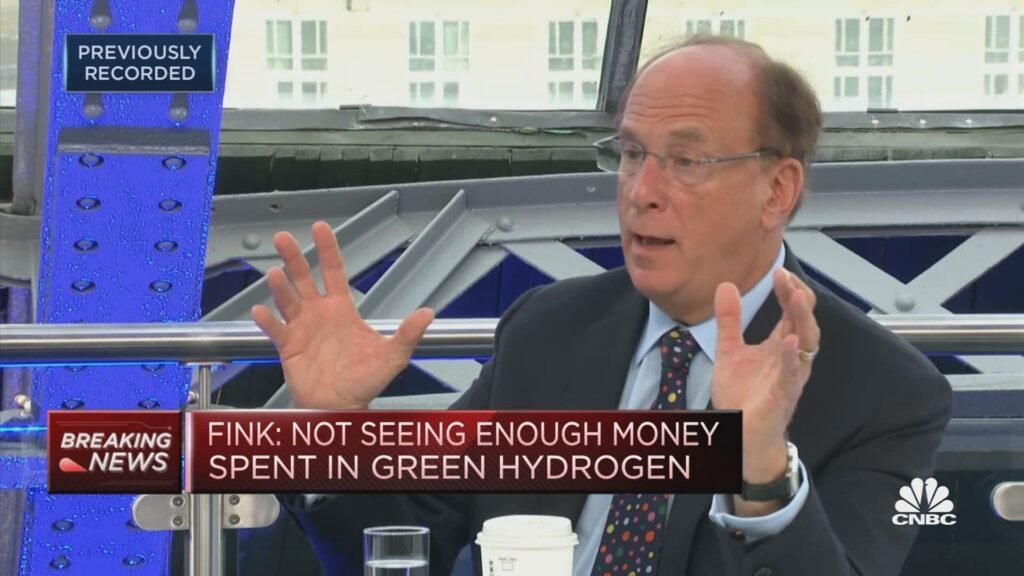
BlackRock CEO and GFANZ Principal Larry Fink talks to CNBC during COP26; Source: CNBC
This new modality for MDBs, along with their fusion with the private sector, is ultimately what GFANZ proposes in terms of “reimagining” these institutions. GFANZ principal and BlackRock CEO Larry Fink, during a COP26 panel that took place on November 2nd, explicitly referred to the plan to overhaul these institutions when he said that: “If we’re going to be serious about climate change in the emerging world, we’re going to have to really focus on the reimagination of the World Bank and the IMF.”
Fink continued:
“They are the senior lender, and not enough private capital’s coming into the emerging world today because of the risks associated with the political risk, investing in brownfield investments — if we are serious about elevating investment capital in the emerging world … I’m urging the owners of those institutions, the equity owners, to focus on how we reimagine these institutions and rethink their charter.”
GFANZ’s proposed plans to reimagine MDBs are particularly alarming given how leaked US military documents openly admit that such banks are essentially “financial weapons” that have been used as “Financial Instruments and Diplomatic Instruments of US National Power” as well as Instruments of what those same documents refer to as the “current global governance system” that are used to force developing countries to adopt policies they otherwise would not.
In addition, given Fink’s statements, it should not be surprising that the GFANZ report notes that their effort to establish “country platforms” and alter the functioning and charters of MDBs is a key component of implementing pre-planned recommendations aimed at “seizing the New Bretton Woods moment” and remaking the “global financial governance” system so that is “promote[s] economic stability and sustainable growth.”
As noted in other GFANZ documents and on their website, the goal of the alliance is the transformation of the global financial system and it is quite obvious from member statements and alliance documents that the goal of that transformation is to facilitate the investment goals of alliance members beyond what is currently possible by using climate change-related dictates, as opposed to debt, as the means to that end.
The UN and the “Quiet Revolution”
In light of GFANZ’s membership and their ambitions, some may wonder why the United Nations would back such a predatory initiative. Doesn’t the United Nations, after all, chiefly work with national governments as opposed to private-sector interests?
Though that is certainly the prevailing public perception of the UN, the organization has – for decades – been following a “stakeholder capitalist” model that privileges the private sector and billionaire “philanthropists” over national governments, with the latter merely being tasked with creating “enabling environments” for the policies created by and for the benefit of the former.
Speaking to the World Economic Forum in 1998, then-UN Secretary General Kofi Annan made this shift explicit:
“The United Nations has been transformed since we last met here in Davos. The Organization has undergone a complete overhaul that I have described as a ‘quiet revolution’… A fundamental shift has occurred. The United Nations once dealt only with governments. By now we know that peace and prosperity cannot be achieved without partnerships involving governments, international organizations, the business community and civil society…The business of the United Nations involves the businesses of the world.”
With the UN now essentially a vehicle for the promotion of stakeholder capitalism, it is only fitting that it would “convene” and support the efforts of a group like GFANZ to extend that stakeholder capitalist model to other institutions involved in global governance, specifically global financial governance. Allowing GFANZ members, i.e. many of the largest private banks and financial institutions in the world, to fuse with MDBs, remake the “global financial governance system” and gain increased control over political decisions in the emerging world is a banker’s dream come true. To get this far, all they have needed is to convince enough of the world’s population that such shifts are necessary due to the perceived urgency of climate change and the need to rapidly decarbonize the economy. Yet, if put into practice, what will result is hardly a “greener” world, but a world dominated by a small financial and technocratic elite who are free to profit and pillage from both “natural capital” and “human capital” as they see fit.
Today, MDBs are used as “instruments of power” that utilize debt to force developing nations to implement policies that benefit foreign interests, not their national interests. If GFANZ gets their way, the MDBs of tomorrow will be used to essentially eliminate national sovereignty, privatize the “natural assets” (e.g. ecosystems, ecological processes) of the developing world and force increasingly technocratic policies designed by global governance institutions and think tanks on ever more disenfranchised populations.
Though GFANZ has cloaked itself in lofty rhetoric of “saving the planet,” their plans ultimately amount to a corporate-led coup that will make the global financial system even more corrupt and predatory and further reduce the sovereignty of national governments in the developing world.
FDA approves Pfizer jab for kids, but even they don’t seem sure it’s safe
By Helen Buyniski | RT | November 1, 2021
American children have no choice but to act as experimental test subjects for the Pfizer Covid-19 vaccine to determine the jab’s safety, the Food and Drug Administration has apparently concluded. Good luck, kids!
“We’re never going to learn about how safe the vaccine is unless we start giving it,” editor of the New England Journal of Medicine and Harvard adjunct professor Eric Rubin argued last week, his words buried within the eight-hour barrage of presentations and discussions that swirled around the FDA advisory panel’s approval of the mRNA jab for children aged five to 11.
The FDA followed up on the advisory panel’s 17-0 recommendation with approval, as it typically does, on Friday. If the Centers for Disease Control and Prevention follows suit, some 28 million American children will be quickly served up as fresh-faced fodder for a smaller dose of the Covid-19 vaccine already poised to inject some 100 million American adults. That is, as soon as President Joe Biden is able to whip up a legally-binding demand he can submit to the Occupational Safety and Health Administration.
Friday’s FDA approval means only the CDC stands between American children and a warp-speed rollout of the Pfizer jab. However, the rush to approval doesn’t necessarily mean there are no concerns. A disturbingly large portion of the FDA committee’s members are connected to Pfizer in some way or another, leading vaccine skeptics to cry foul. Meanwhile, a growing portion of the country continues to denounce the mandates in general, insisting everyone should be able to make their own decision regarding whether or not they wish to get injected.
Echoing the newly-reanimated pro-choice slogan, mandate protesters recently swarmed the Brooklyn Bridge declaring ‘My body, my choice’ as New York City employees faced the potential loss of their jobs as firefighters, police officers, sanitation handlers, and corrections officers due to Mayor Bill de Blasio’s insistence that all municipal employees get vaxxed or be relegated to the purgatory of open-ended unpaid leave.
The FDA’s effort to put the cart so far in front of the horse mirrored the words of House Speaker Nancy Pelosi during the congressional tug-of-war over Obamacare in 2010. Faced with a phonebook-sized, dubiously-legal bill unlike anything Congress had passed before and no realistic timeframe to wrangle with the details, Pelosi suggested Congress would have to “pass the bill to find out what’s in it, away from the fog of controversy.”
Since then, legislation by brute force has only grown as the means by which laws are passed in the US, as ever-more-polarized parties refuse to give an inch and betray the appearance of weakness. Allowing the ‘other side’ to be seen as achieving even the slightest victory is unconscionable, and that framework remains in place in the vaccination arena – where it makes less sense than anywhere else.
After all, it was former President Donald Trump’s Operation Warp Speed that brought the world the Pfizer shot, even if the jab itself wasn’t rolled out until shortly (some would say deliberately) after the 2020 election and vaccine mandates have since become a cause celebre of the Democratic Party.
With half the US up in arms about the other half’s supposed refusal to roll up its sleeves and submit to an intensely politicized needle, anyone who hesitates is denounced posthaste in a 21st-century witch hunt – to be fired, if not set on fire; outfitted with the scarlet A for anti-vaxxer, not adulteress; and otherwise chased out of the public square – deplatformed from Twitter, YouTube and Facebook, if not chased physically with pitchforks and torches. Similar divisions have erupted across Europe, and countries like Italy and France have pushed the issue even further, barring the unvaccinated from so much as entering grocery stores to buy food.
While the US study of the Pfizer vaccine’s effects on children five to 11 failed to turn up any deadly side effects, critics argued its population size was too small to be effective for such a purpose. Parents of some jab recipients have observed disturbing symptoms in their offspring in the hours and days following the shots and filmed heartbreaking testimonials describing their downfall from healthy children to pain-wracked perma-patients experiencing near-constant seizures, facial distortions, debilitating heart problems, or other dire health issues.
Another doctor on the FDA committee, Michael Kurilla of the National Institutes of Health, abstained from voting on recommending Pfizer-BioNTech’s vaccine entirely, citing a lack of evidence that all children need the shot, and while Kurilla, an infectious disease and pathology expert, was the only panel member to abstain from voting, he was not the only member to openly express misgivings about doling out the jab to young Americans. His colleague, Dr. Cody Meissner of Tufts University, suggested that it would be an “error” to mandate the jab for children to return to school until there was more hard data.
“We simply don’t know what the side effects are going to be,” he said, acknowledging the shot – like its adult equivalent – probably wouldn’t prevent transmission of the virus. While he was not opposed to administering the shot to certain vulnerable subgroups inside the 5-11 age group, Meissner was concerned approving the shot for everyone in that category would lead to a heavy-handed mandate the likes of which is currently being wielded against American adults.
Children who receive the Pfizer-BioNTech jab may actually get less immunity and face more risk than supplied by getting and recovering from a current strain of Covid-19, Kurilla told the Daily Mail, referring to the Delta variant and other current strains of Covid-19 circulating among the population. “The question really becomes, does this vaccine offer any benefits to them at all?” he asked rhetorically during the FDA committee meeting. He would have voted ‘yes’ if the FDA had merely proposed opening up access to the vaccine to a ‘subset’ of those ages five to 11, but he disagreed with administering it to all children within that age group.
Two other panel members voted to approve despite their misgivings. Meissner argued that a “very small percent of otherwise healthy six-to-11-year-old children…might derive some benefit,” while President and CEO of Meharry Medical College James Hildreth agreed that “vaccinating all of the children…seems a bit much for me,” pointing to the relatively low risk of hospitalization and near-zero risk of death by Covid-19 for children.
Speaking up against the jab, even circumstantially, has become the kiss of death in the medical community, with even medical rock stars like Robert Malone, one of the inventors of mRNA as a drug, cast into the dustbin of history for expressing skepticism that his invention was being incorrectly used to deliver the Covid-19 vaccine.
However, governments worldwide are setting themselves up for civil war as populations are forced to choose one ‘side’ or another. Even many of the vaccinated have acknowledged that the jab should not be forced on anyone, while entire industries like shipping, air travel, defense, and the like grind to a halt as mandates run up against the stubborn will of their employees. Southwest Airlines was allegedly forced to cancel thousands of flights earlier this month, due to a reported mass ‘sickout’ by air traffic controllers unwilling to get vaxxed, though the airline itself has denied this, and rumors of trucker strikes from Australia to America have food sellers panicking at the thought of empty shelves.
As it stands, parents who were willing to submit themselves to experimental shots in the name of convenience and retaining employment may not be so willing to offer up their children as sacrifices to a company once denounced by the US Justice Department as the worst fraudster in the pharmaceutical industry.
Governments that have shown themselves as profoundly untrustworthy throughout the Covid-19 pandemic are unlikely to change their behavior at the last minute, and parents are wise to take care in where they place their trust.
Media Kinda-Sorta Forgets to Mention Doctor’s $2 Million From Pfizer
By Dr. Joseph Mercola | November 02, 2021
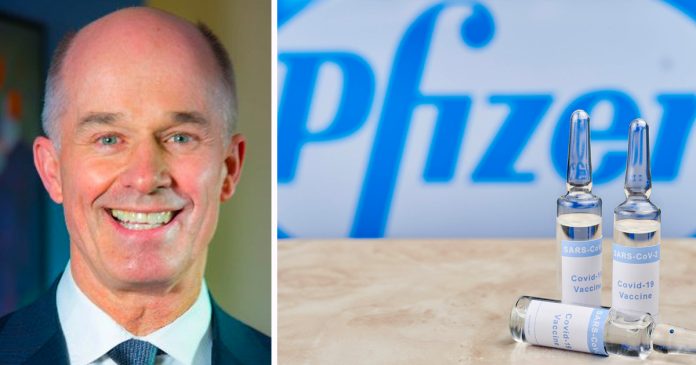
A Canadian doctor pushing COVID-19 vaccine shots for children ages 5 years and up who’s been featured in numerous media reports received nearly $2 million in Pfizer funding for vaccine research.
Whether it was intentional or if the media kinda-sorta forgot to mention the conflict, or if they simply didn’t bother doing their own research before using Dr. Jim Kellner as a lead adviser on the COVID shot isn’t clear. But what is clear is that Pfizer has given the University of Calgary professor and pediatrician $1.9 million, with $787,004 of it still being allocated until 2022.
Kellner didn’t attempt to hide his conflict of interest; it’s easily found in his publicly posted curriculum vitae, with the current funding explicitly stated.
Yet, according to True North news, “Kellner’s name turns up over 41 times and appears in numerous videos and articles on the topic of vaccination without any indication of how much money he has received from the vaccine manufacturer Pfizer.”
CDC’s Committee Member Dr. Chen Should Be Removed Immediately Due to Conflict of Interest
By Toby Roger Ph.D. | The Defender | November 1, 2021
Dr. Wilbur H. Chen wants you to know that he’s very upset (see comment’s section)!
He’s upset the peasants have access to email!
He’s upset the peasants have access to common sense and reason!
He’s upset the peasants actually read scientific studies for themselves!
And he’s very upset that the peasants are speaking to him without his express written permission!
Apparently, he’s also clairvoyant (like Santa) because he knows what you are writing before you even send it to him, so he has set up an auto-reply on his email account to let you know he’s very important, he gets lots of emails and he does not like “misinformation.”
Chen defines “misinformation” as anything that contradicts the Pharma narrative. Chen is adamant that nothing be allowed to pierce his protective Pharma information bubble.
I’m reminded of the phrase, “Methinks thou doth protest too much.”
What Chen is actually mad about is that he got caught with his hand in the cookie jar.
A search of the government website Open Payments reveals Chen accepted $437,250.70 from Emergent BioSolutions and GlaxoSmithKline (GSK) in 2020.
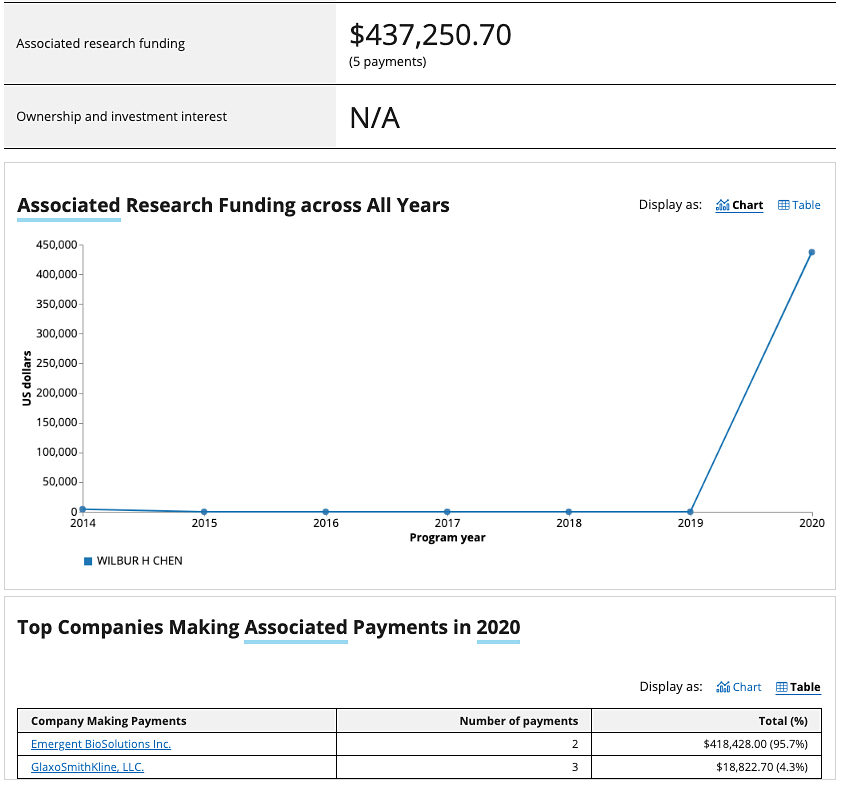
GSK is one of the four largest vaccine makers in the world. GSK makes the incredibly toxic Hep B vaccine (Engerix-B), the troubled HPV vaccine (Cervarix), a meningococcal vaccine that is loaded with aluminum (Bexsero) and various flu vaccines among others.
GSK is also working on a COVID-19 vaccine that is now in Phase 3 clinical trials.
All of GSK’s products must go before the Centers for Disease Control and Prevention (CDC) Advisory Committee on Immunization Practices (ACIP), that Chen sits on, in order to be approved.
Emergent BioSolutions is a contract manufacturer that makes vaccines for others including the Johnson & Johnson (J&J) COVID-19 vaccine that has been linked to blood clots and a bleeding disorder.
Emergent BioSolutions has an abysmal safety record. Even though federal regulators are generally like Mr. Magoo when it comes to spotting safety problems, the issues at Emergent’s plant in Baltimore were so egregious that earlier this year the U.S. Food and Drug Administration shut down the plant and ordered J&J to take it over and run it themselves.
The FDA also ordered 75 million doses of COVID-19 vaccines manufactured at that plant be destroyed because of contamination. All of the vaccines manufactured at the Emergent BioSolutions plant must first be approved by the ACIP where Chen is a member.
This is completely unacceptable. According to the Bureau of Labor Statistics, there were 27,550 pediatricians employed in the U.S. There is absolutely no reason for the ACIP to utilize a person with such extensive financial conflicts of interest.
The CDC must be above reproach in order to have any credibility with the general public. Sadly the CDC appears to do whatever it can get away with — a classic example of the fox guarding the henhouse.
The fact that these decisions involve the health of our children makes corruption all the more appalling.
Please contact the following four officials (as well your elected representatives) to let them know that you are troubled by Chen’s extensive financial conflicts of interest and please ask that he be removed from the ACIP before it meets on Tuesday, Nov. 2.
Dr. Rochelle Walensky
Director, Centers for Disease Control and Prevention
Roybal Building 21, Rm 12000
1600 Clifton Rd, Atlanta, GA 30333
phone: (404) 639-7000
Aux7@cdc.gov
Xavier Becerra
Secretary, Health and Human Services
200 Independence Avenue S.W., Washington, D.C. 20201
c/o Sean McCluskie
sean.mccluskie@hhs.gov
Captain Amanda Cohn
Chief medical officer
National Center for Immunizations and Respiratory Diseases
Centers for Disease Control and Prevention
1600 Clifton Rd, Atlanta, GA 30333 MS C-09
phone: (404) 639-6039
fax: (404) 315-4679
acohn@cdc.gov
anc0@cdc.gov
Grace Lee, M.D.
Chair, Advisory Committee on Immunizations Practices
Center for Academic Medicine
Pediatric Infectious Diseases, Mail Code: 5660
453 Quarry Road, Stanford, CA 94304
phone: (650) 497-0618
phone: (650) 498-6227
fax: (650) 725-8040
It is beyond alarming that the ACIP has failed to properly monitor financial conflicts of interest amongst its members. All prior ACIP votes involving Chen should be reviewed by an independent outside review board to see if they must be thrown out because of this blatant corruption.
The CDC should also examine and release publicly all financial conflict of interest statements from all remaining ACIP members to determine if there are additional problems before Tuesday.
© 2021 Children’s Health Defense, Inc. This work is reproduced and distributed with the permission of Children’s Health Defense, Inc. Want to learn more from Children’s Health Defense? Sign up for free news and updates from Robert F. Kennedy, Jr. and the Children’s Health Defense. Your donation will help to support us in our efforts.
Featured Video
Seyed M. Marandi: Toward Total War in the Middle East
or go to
Aletho News Archives – Video-Images
From the Archives
The Geopolitics behind the War in Yemen (I)
By Mahdi Darius NAZEMROAYA | Strategic Culture Foundation | 30.03.2015
The United States and the Kingdom of Saudi Arabia became very uneasy when the Yemenese or Yemenite movement of the Houthi or Ansarallah (meaning the supporters of God in Arabic) gained control of Yemen’s capital, Sanaa/Sana, in September 2014. The US-supported Yemenite President Abd-Rabbuh Manṣour Al-Hadi was humiliatingly forced to share power with the Houthis and the coalition of northern Yemenese tribes that had helped them enter Sana. Al-Hadi declared that negotiations for a Yemeni national unity government would take place and his allies the US and Saudi Arabia tried to use a new national dialogue and mediated talks to co-opt and pacify the Houthis.
The truth has been turned on its head about the war in Yemen. The war and ousting of President Abd-Rabbuh Manṣour Al-Hadi in Yemen are not the results of «Houthi coup» in Yemen. It is the opposite. Al-Hadi was ousted, because with Saudi and US support he tried to backtrack on the power sharing agreements he had made and return Yemen to authoritarian rule. The ousting of President Al-Hadi by the Houthis and their political allies was an unexpected reaction to the takeover Al-Hadi was planning with Washington and the House of Saudi. … continue
Blog Roll
 Aletho News
- Finland’s Stubb tells European leaders to calm down
- Defeating Russia on battlefield impossible – Fico
- Finland’s Gender Clinic Reversal
- Massachusetts Wants Mental Health Visits, Why Does Government Use ‘Health’ to Enter Our Homes & Families?
- US lawmaker admits American people footing bill for Trump’s failed aggression against Iran
- Pfizer Gave $500,000 to Groups That Lobbied to End Religious Exemption in Massachusetts
- HE SAVED LIVES. NOW HE FACES PRISON.
- Israeli lobby seeks to bind US fate to ‘Israel’: Araghchi
- Pakistan-Iran talks secure LNG shipment to Islamabad through Hormuz
- Black Sea grain crisis puts global wheat supplies under pressure
- If Americans Knew
- Gaza desperately needs tents, wheelchairs, fuel… and everything else (Israel blocks it all) – Daily Update
- Israeli Attacks in Gaza Kill at Least Seven Palestinians Over Three Days, including Woman and Child
- Trump’s militarization of Washington DC as he pursues Israel’s war against Iran
- Why Israel Fears This Searing New Documentary
- Huckabee aide solicited cash gifts from Israelis
- This isn’t sci-fi, AI is already killing people
- ‘The Most Brutal Thing’: Investigation Reveals Execution of Elderly Woman in Rafah
- Inside Israel’s ‘soft’ ethnic cleansing plan for Gaza through the eyes of its victims
- New online database tracks pro-Israel political donations in the United States
- Israeli president pardons soldier convicted for killing wounded Palestinian
- No Tricks Zone
- 2025 Nature Paper Claiming Worsening Global Drought Gets RETRACTED …Heavily Flawed
- New Study: ‘Global Drought Shows No Detectable Recent Acceleration Under Climate Warming’
- Economic Masterminds: German Socialists Suggest Taxing Productivity Gains Stemming From Using AI
- The South China Sea Has Not Been Cooperating With The Climate Change Narrative
- Energy Crisis: Germany Enters Heating Season With Historically Low Gas Reserve Fill Levels
- New Study: The Antarctic Ice Sheet Gained Mass From 2020-2024 Due To Staggering Snow And Ice Accumulation
- Study: Ocean Heating Rates From Thousands Of Years Ago ‘Dwarf’ Modern Ocean Heating Rates
- Climate Extremists Target, Attack Large-Scale Power Grid Infrastructure In Germany!
- New Study: Antarctic Ice Melt Has Contributed Less Than 1 Centimeter To Sea Level Rise In The Last 30 Years
- Fear Of Debate: Alarmist German Climate Scientist Calls On Mainstream Media To Discredit Skeptic Voices
 Aletho News