U.S. Muslim Leaders Headline UAE Conference at Expense of American Muslim and Palestinian Rights
American Muslims for Palestine | December 12, 2018
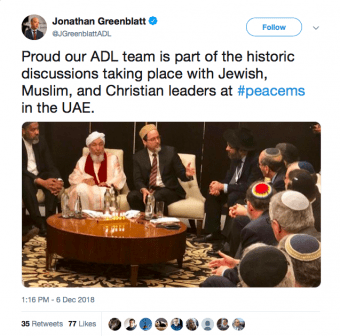 WASHINGTON, D.C. – Last Wednesday, a group of prominent and select American Muslim leaders traveled to the United Arab Emirates to participate in the fifth annual conference of the Forum for Promoting Peace in Muslim Societies (FPPMS), which is sponsored by the Minister of Foreign Affairs, Abdullah bin Zayed, and headed by Mauritanian Islamic scholar, Abdullah bin Bayyah. Despite the country’s appalling human rights record, U.S. Muslim leaders present praised the country for being “committed to tolerance […] and civil society.”
During the conference, the same Muslim figures were photographed in a meeting with several leading members of the Zionist-Jewish American community including representatives of the American Jewish Committee (AJC) and the Anti-Defamation League (ADL), a powerful pro-Israel lobby organization whose dark history of domestic spying and investment of millions of dollars to extinguish all criticism of Israel is documented in a 2014 report by AMP. The photo, which was widely tweeted on Friday by ADL CEO Jonathan Greenblatt, features Sh. Hamza Yusuf, a California-based scholar who has been described by the Guardian as “arguably the West’s most influential Islamic scholar,” and Imam Mohamed Magid, the former president of the Islamic Society of North America (ISNA), who serves as the Executive Imam of the All Dulles Area Muslim Society (ADAMS) Center in Virginia.
It is worth noting that the UAE “Promoting Peace Forum” was founded in 2014, the same year that the UAE government designated CAIR, the largest Muslim civil rights organization in America, a terrorist organization. Several critics have denounced this forum as part of a series of counter-revolutionary measures carried out in the wake of the Arab Spring to crush pro-democracy efforts in the region and promote obedience toward autocratic rulers. It’s been previously exposed that conferences such as these are part of a sophisticated PR campaign by the Emirati government to pursue its own political agenda in the name of “moderate Islam”. AMP is disturbed by the continuous participation of some American Muslim leaders in these propaganda conferences that whitewash the nefarious agenda of the UAE government.
“Given the UAE’s dismal record on human rights and its catastrophic policies in the region, as in Yemen and the staging of counter-revolutions, it is the last country to allege the promotion of peace in Muslim societies. The American Muslim leaders and scholars who participated in the conference should not have lent their names to an event aimed at legitimizing a regime that has brought much harm to their own communities and other nations,” said AMP National Policy Director Osama Abuirshaid. If “promoting peace” in Muslim societies is the purported objective of this forum then it should have called for the immediate ceasefire and end to the armed intervention in Yemen, and expressed solidarity with the Palestinians living under Apartheid conditions and occupation.
Not only has the UAE labeled the most prominent American Muslim civic group as a terrorist organization, it also has elevated virulently Islamophobic and pro-Israel organizations such as the neoconservative Foundation for Defense of Democracies (FDD), whose senior researcher Jonathan Schanzer has waged a longstanding smear campaign against AMP and was recently captured maligning Palestine activists in the censored Al Jazeera documentary on the Israel Lobby . The film sheds light on the operations directed at demonizing Muslims and Palestine activists in the U.S. The hosting of the ADL at this year’s conference is especially disconcerting given the group’s sinister history of instigating political prosecutions against prominent American Muslim and Palestinian leaders and institutions, as detailed in Israeli author Miko Peled’s recent book Injustice: The Story of the Holy Land Foundation Five. Peled recently commented to AMP that the ADL “is an organization dedicated to protecting Israel from criticism. They conflate anti-Semitism with anti-Zionism. The ADL supports the racism, ethnic cleansing, genocide and apartheid regime to which Israel has subjected the Palestinians. ADL does not represent Jewish people and must be shunned by people of conscience.” Rather than invite the ADL and AJC to the stage, the primary purveyors of Islamophobia and anti-Palestinian discourses, the “Peace Forum” should have expressed support for the peaceful and nonviolent BDS movement and highlight the global success of the Palestinian struggle.
Since the Arab Spring, the UAE government has exposed itself as an enemy of human rights and democracy. From intervening in Libya and Egypt to aiding and abetting Saudi crimes in Yemen, supporting its blockade of Qatar, and helping cover up its recent murder of dissident Jamal Khashoggi, it is clear that the country is willing to secure its regional strategic interests at all costs and on the backs of millions of Muslims and Arabs. Meanwhile, it continues to openly tighten its relationship with Israel, working with lobby groups in the U.S. and purchasing Israeli spyware to target civil society both locally and abroad. No conference or publicity stunt can change these critical facts or boost this country’s corrupt image.
“This was a conference to normalize Islamophobia, bigotry against Muslims in the West, in addition to normalizing relations and engagement with apologists for Israel’s aggression against the Palestinian people. The participation of these Muslim leaders and scholars make us wonder whether they are involved in last year’s revealed attempts of UAE’s ambassador in Washington to hijack the representation of Islam in the U.S. under the pretext of promoting ‘moderate’ Islam which is in essence a distorted complacent form of Islam that aligns itself with Zionists and Islamophobes in the U.S. through trojan horses within the American Muslim community,” Abuirshaid added.
The active participation of some American Muslim leaders in these dubious initiatives with a deeply troubling agenda demands serious and urgent accountability.
Israel propaganda trips target ‘Pacific Progressive Leaders’ – no one will say who’s going

The Israel lobby is working to woo people like Andrea Beth Damsky, second from right. Damsky, active in numerous progressive causes, is a member of the La Mesa, California Environmental Sustainability Commission and on the California Democratic Party Executive Board. She was taken on an all-expenses-paid trip to Israel.
By Alison Weir | If Americans Knew | December 8, 2018
An Israel lobby organization is taking “Pacific Northwest Progressive Leaders” to Israel today on an all expense-paid propaganda trip to Israel. Another group just returned on December 2nd from a similar trip, officially billed as an “Educational Seminar in Israel for Southern Pacific Progressive Leaders.” No one will divulge the rosters.
The sponsoring organization is the American Israel Education Foundation (AIEF), a tax-exempt organization that serves as an arm of the powerful Israel lobbying organization AIPAC (American Israel Public Affairs Committee).
Roll Call reports that the AIPAC and AIEF “share leaders, employees and money.” They also share the same address and phone number.
AIPAC used to sponsor such tours itself until it became illegal for lobbying organizations to organize these. A “charitable” arm, AIEF, was then formed to continue the practice. While such trips are now “legal,” they appear to violate the spirit of the law.
Craig Holman of the watchdog group Public Citizen told Roll Call: “The purpose of the 2007 travel restrictions was to remove these types of sponsored trips. Most of these trips tend to be nothing but an extension of lobbying. “ Unfortunately, Holman explains, “When it came to negotiating the travel rules regarding privately funding trips, a huge gaping loophole was written in to exempt nonprofits. … I call it the ‘AIPAC loophole.’”
Israel advocacy organizations have exploited this loophole intensively.
Tailored trips
AIEF is an $85 million operation that takes thousands of American officials and opinion makers on all expense paid trips. It pays for their international flights, hotel accommodations, tourist excursions, meals, drinks, etc. Roll Call estimates the cost of a trip for one Congressional representative to be $10,000.
And AIEF is just one of the many pro-Israel organizations that do this; some others are the American Jewish Committee’s Project Interchange, Passages Israel, (backed by hedge fund billionaire Paul Singer), the Jewish Public Affairs Committee of Northern California (JPAC), and the American-Israel Friendship League, which has been operating since 1971 and largely targets young people. Last year it gave a special award to potential presidential candidate Michael Bloomberg. A fundraising video featured former Secretary of State Henry Kissinger, New York Times columnist Bret Stephens, Elie Wiesel, and others (see below).

A fundraising gala for the American-Israel Friendship League
These and other groups organize tours for every sector of American society, tailoring the trips carefully for each group. There are trips for military veterans, business leaders of all races and ethnicities, educators, athletes, students, etc, and every level of political office.
They treat each chosen group to an exotic, extravagant tour replete with visits to historic sites, exciting night life, beaches, religious sites, official offices, academics; whatever will appeal to the group members. There are meetings with congenial, impressive Israeli hosts of the political and social category that will best fit the visiting delegation, and the meetings even include a few hand-picked “Palestinian representatives” and Druze Israelis who play their role in the skillfully crafted tours.
And through it all those with political, professional, and/or economic ambitions will pick up something more: this is a group that has the money and power to further their careers. The particularly astute trip members will also pick up the converse: this is not a group to alienate.
Such trips are oddly public and secretive at the same time.
On the one hand, there are numerous videos extolling the sponsoring groups’ power and the trips’ effectiveness; diverse, wide-eyed Americans are seen being shown around Israel, and then, on cue, these American visitors describe how much they’ve learned and how wonderful Israel is (see below).
At the same time, however, the trips are sometimes run with extraordinary secrecy. AIEF’S website contains only one paragraph and an email address to contact for information. When we wrote asking who was going on the upcoming delegation for progressive leaders, the response was: “We don’t publicize our trip rosters.” Phone calls were unreturned.
The progressive participants were also unforthcoming about the delegations’ composition; some refused to provide this information, others pled ignorance. None of the participants seem to have publicly announced their trips ahead of time, perhaps aware that many progressive voters today are aware of Israel’s record of brutality against Palestinians, as described by former Israeli soldiers, documented in videos, and reported by human rights organizations.
The California participants
So far we’ve only identified three of the participants on the current progressive trips.
Andrea Beth Damsky – a member of the La Mesa Environmental Sustainability Commission and member of the California Democratic Party executive board and credentials committee – went on the November 24-December 2, 2018 trip for “Southern Pacific Progressive Leaders.” Contra Costa County Supervisor John Gioia and Santa Clara Supervisor Joseph Simitian are going on the December 8-16 trip.
(Simitian also went on a lobby sponsored trip to Israel in 2005, when he was a Democratic state legislator. He is already in Israel, apparently having departed on Wednesday. It is unknown why Simitian left early and whether AIEF is paying for the extra days, or whether Simitian is paying his own way.)

John Gioia – backrow, glasses blue suit jacket & jeans. From his Facebook page

Santa Clara County Supervisor Joe Simitian with farmworkers – photo on his campaign page
While it seems implausible that public elected officials would go on a trip without knowing the names of any other participants, staff members at both offices say they “have no idea” who’s going on the delegation. Damsky would not reveal which public officials were on her trip.
While not everyone is taken in by tours organized by advocacy organizations, the probability is that many will be influenced by them, some significantly. That, of course, is why groups like IEAF shell out millions of dollars for them.
Damsky herself says: “I feel more educated on the issue than I did before.”
When asked if she would go on a trip organized by a group without a pro-Israel agenda, she said she would. However, she said she couldn’t afford to pay for such a trip herself and that the trip would have to be paid for by others.
And that’s the stumbling block.
Palestine solidarity groups don’t have anywhere near the astronomical budgets of the multi-billion dollar Israel lobby.
Therefore, it would seem, those with the most money will provide the free trips, and call the shots on this, as in so many other issues – unless Americans do four things:
Actions to take
(1) Prohibit public officials from going on trips paid for by others. Congress tried this before; now it’s time to close the loophole. If government officials are going to take trips, let them pay for them out of their own pockets. Until such legislation is forthcoming, there are additional steps that can be taken:
(2) Require transparency from our public officials. They should be required to announce these trips publicly and divulge the details. American tax-exempt corporations should be required to reveal the details of the free tours they provide, including the names of those going on them.
(3) Require fairness. Voters should demand that officials who have gone on such lobby funded junkets afterward meet with people beyond the Israel advocacy crowd, so that they can learn facts the pro-Israel tours may have left out.
For example, some of the reports that came out while the southern delegation was in Israel included the fact that Doctors Without Borders reported that more than1,000 Gazans shot by Israel are at risk of infection, which could lead to permanent disabilities or death; Israel’s Shin Bet admitted the use of torture, and a number of human rights groups have documented the “routine use of torture” by Israeli forces; a report found that Israeli settlers, with IDF complicity, have destroyed 800,000 Palestinian olive trees since 1967.
Such post-trip meetings could inform these progressive officials that Israel was founded – in the words of an Israeli historian – by ethnic cleansing, that its settlements are illegal under international law, and that a typical day for Palestinians looks like this. Officials could be shown a list of those killed and learn about the victims:
Given that the Israel trips last a week or longer, the post-trip meetings should take place over a similar time frame and be accorded equal attention.
It seems possible that Damsky, Simitian, and Gioia would be willing to take part in such meetings, especially if they are invited publicly. These are individuals with a record of caring about human rights and indigenous peoples, and who oppose discrimination and oppression; if so, they will not refuse to learn about the plight of Palestinians.
Damsky, who is Jewish, has already suggested that she would meet with other groups, and Supervisor Gioia has stated that he wishes to learn the full facts. In an email response to questions for this article, he wrote: “My goal in this trip is to hear from many individuals, ask hard questions and critically learn. My learning will not end when the trip is done. I intend to continue to read and speak with those who hold positions on the issue.” Their contact information is below.
Trip participants’ contact info:
Supervisor John Gioia: 510-231-8686 / John.Gioia@bos.cccounty.us
Supervisor Joe Simitian: 408-299-5050 / 650-289-9038 Twitter
Andrea Beth Damsky: 619-884-7918 / abdamsky@yahoo.com
Finally, there is a fourth action that Americans can do about these influence buying trips, and this one is probably the most important:
(4) Support politicians who do not give in to Israel lobby pressure.
Many politicians go on these tours because they feel they have no choice – and they may be right. If they fail to dance to the Israel tune, there is a large likelihood that their opponent will get the money, organization, and media support that is usually required to win an American election.
Until and unless Americans who desire fairness, peace, and justice in Israel-Palestine help on political campaigns and make their wishes known at the ballot box, politicians of all backgrounds will continue to go on these trips, Israel will continue to get American tax money and support, and the tragedy will continue.
Ultimately, it’s up to all of us.
Alison Weir is executive director of If Americans Knew, president of the Council for the National Interest, and author of Against Our Better Judgment: The Hidden History of How the U.S. Was Used to Create Israel.
Unz Goes Nuclear
By Israel Shamir • Unz Review • December 6, 2018
Some discoveries are just too shocking to digest. Recently I wrote of intrepid Ron Unz, the Californian maverick publisher and IT-genius, who dared to share with his readers his insights into the ideas and motifs of revisionists, or Holocaust Deniers, as their enemies call them. But this absolutely verboten topic fades into irrelevance in comparison with his most momentous discovery that has made somewhat less resonance, paradoxically, because of its magnitude. It was too big. Dark pages of the world war history or of interracial relations in 1930s, or even the whodunit of 9/11, all that is fine and very interesting, but hardly a Stop Press kind.
His other, most significant discovery is not just Stop Press, but Burn the Press Down. He discovered and proved with hard data that Jews discriminate against you to a degree you could not even guess. While you queue at the front door of the Elites, they enter freely by the back door. Chances of a smart non-Jewish “white” American kid getting there are ten-fold lower than that of a Jew. There are ten times more smart non-Jewish white American kids than smart Jewish kids, but there are more Jewish students in the Ivy League than white non-Jews. The system is biased, and not in your favour.
Once you could work your way up to success, like Henry Ford did. That was the American Dream. Not anymore. Now the only way to the best jobs, into the American elites leads through a few top colleges of the Ivy League. You can’t bypass this funnel of opportunity. “A greater and greater proportion of our financial, media, business, and political elites being drawn from a relatively small number of our leading universities” (all unattributed quotes are from the Unz essay). Unless you get the imprimatur of Harvard or Yale, your future is dim. Well-paid middle class jobs in the manufacturing sector for those lacking college degrees are scarce, and workers are being paid less now than forty years ago. When America’s richest 1 per cent has as much wealth as the bottom 95 per cent, it is winner takes all, and this winner is probably a Jew.
The elites have duties, too. The elite universities are supposed to pick the best boys and girls to lead America to its glory and greatness. By your own experience you already know that it does not happen; that the new US elites lead themselves to prosperity, while pushing you to poverty and perdition. The new elites failed you, failed your country, failed the world (always excepting the Jewish state). This failure is the main reason to explore how the elites produce their new generation.
The great surprise is that WASPs, the legendary descendants of the Founding Fathers, have lost their privilege, or even their fair chance to success. Unz proves that a smart Christian American boy of English or German parentage has ten times less chance to get into these crème-de-la-crème universities than an average Jewish boy. This very unfair way of forming tomorrow’s elites has been made possible by the sheer nepotistic networking of the universities’ admission offices. Clannishness, the Jews were (justifiably) accused of.
In actual words of Ron Unz, “Jews are enrolled at Harvard and other elite colleges at a rate some 1,000% greater than white Gentiles of similar academic performance”. One thousand per cent, OMG! Provided that these Ivy League colleges are the only sure-fire way into American elites, into best jobs and into good and important positions, this biased enrolment guarantees the Jews their position of the top dog well into next generation.
In 1920s, Jews accused the WASPs of discriminating them at university admission. The WASPs kept them under 15% of admissions. Now with Jews at the top they show what real discrimination is all about. However, there is one major difference. Then, the Jews volubly complained, now the Christians do not even dare to complain.
While the White Christian Americans kept mum, the Asians dared to speak and went to court against the colleges. The colleges have been forced to explain how they admit students. The heavily-Jewish elites of the legal system and MSM allowed this case of Asian-Americans to proceed (after many years of rejection) for a good reason: they wanted to obscure this fragrant discrimination against white Gentiles by Jews by a SEP device.
In Douglas Adams’s 1982 novel Life, the Universe and Everything, (a sequel to his Hitchhiker’s Guide), the protagonist explains: a SEP is something we can’t see, or don’t see, or our brain doesn’t let us see, because we think that it’s somebody else’s problem. That’s what SEP means. Somebody Else’s Problem. The brain just edits it out, it’s like a blind spot. SEP is the best way to hide a pink elephant in a room: people would have walked past the elephant, round it, even over it, and simply never have noticed that the thing was there.
The problem of Asian-American discrimination is an excellent SEP. Indeed, as Unz said, the Asian-Americans are discriminated at Ivy League universities (though much less than ordinary Americans). But even if they are discriminated, who cares? There are not too many of them, and they anyway manage well. Thus the real point of Unz – you are discriminated! – had been hidden.
The UNZ essay is very long with its 26,000 words, too long for average reader, so here are its salient points:
- Jews organized a clannish network to get themselves into best universities in numbers well beyond their share in population, and (!!!) well beyond their abilities;
- their fight against discrimination of Blacks has being carried at the expense of America’s white Christians. If previously discriminated minorities, be it Afro-Americans or whatever, enjoy the fruits of affirmative action (positive discrimination), it is no loss for Jews, as only Gentiles, once privileged WASPs are being screwed up.
- if once upon a time Jews had got into best colleges because they were smart, smarter than Gentile kids, now they are noticeably less smart, but they get there anyway because they are Jews.
The numbers distilled by Ron Unz out of dusty spread sheets are terrifying. You can look at the diagram he compiled, or immerse yourself in the ocean of data he provides, to get convinced: the discrimination is very real.
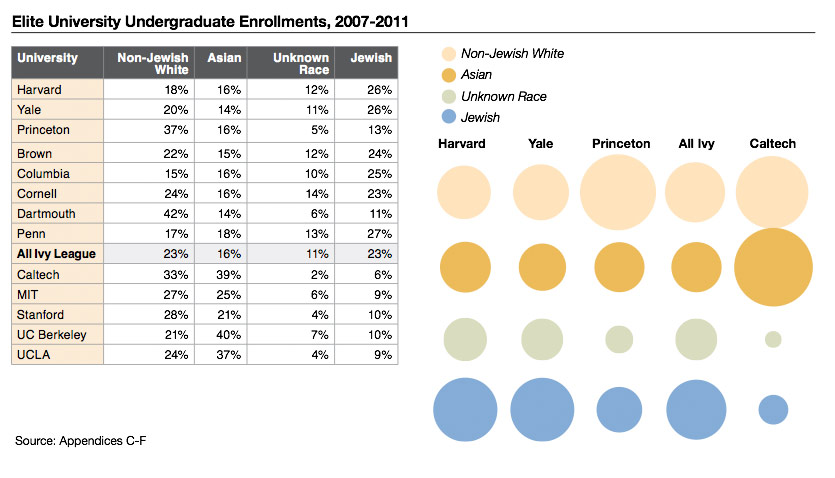
Unz quotes a Jewish writer who exhilarates that “the WASP demographic group which had once so completely dominated America’s elite universities and virtually all the major institutions of American life had by 2000 become a small and beleaguered minority at Harvard, being actually fewer in number than the Jews whose presence they had once sought to restrict.” For a Jewish nationalist, it is a cause for celebration. For a WASP, it is a reason to regret the unwise decisions of his fathers who tried to play a fair game with Jews and were Jew’d.
But for an average American, the answer lays in the macro picture. Do the new Jewified elites manage America better than WASPs did? Are they better shepherds? Is America-2018 (with Jews getting over 25% of all seats in the express train to better future, leaving 20% or less to WASPs) better for Americans than America-1962 with 15% of Jews and 80% of WASPs in Yale and Harvard? If you belong to 1% of Americans, the answer is positive; if you are one of the 99%, it is not.
Unz is very meticulous, very cautious in his approach. He asks an almost-insulting question: perhaps the Jews are so smart (after all, that is the kin of Einstein and Freud) that their share in the Ivy League is a result of meritocratic selection? And he provides an almost-insulting answer: no, they aren’t. There are some universities that admit strictly by merit; in these universities Jews do not exactly star. Caltech, the California Institute of Technology is one of them. The Jewish presence there is quite small; Hillel, the Jewish students’ body, gives it as zero. In reality, it is about 6 per cent, like in other merit-based competitions.
It can’t be zero, for sure. In 2003, two Palestine Solidarity activists, Adam Shapiro and Huwaida Arraf, had been booed there by pro-Israeli Jews who tried their beastly best to drive away the speakers. But there are not many Jews. There are few Jewish Olympiad winners; once they were in dozens, now there are hardly any. Altogether Jewish kids make up some six per cent of NMS, the highest-performing students’ list. This is a good result, in line with Jewish admissions into meritocratic colleges, but it is four times less than what you would expect judging by their Yale admissions. The Jewish IQ, as Unz found out, is also in line with that of their Gentile peers, and not the fabulous 110-115, as the Jewish newspapers claim. Jews are not all that smart anymore, judging by their score.
Unz explains this “sudden collapse of Jewish academic achievement” by inertia. The youngsters just do not try hard enough, in contradistinction to their fathers’ generation. They will succeed, they think, by their old-school-tie connections or through their parents’ links. Indeed when you look at the face of President Trump’s son-in-law, Mr Jared Kushner, you understand that the Nature took a nap in his generation. His parents’ generation were predators and major crooks (his father actually served two years in jail for tax evasion while obtaining his two-billion-dollar loot), but Jared’s generation could not enroll or graduate without assistance, while his political meddling made a mess of already troubled American Middle East politics.
This is the Nature way to deal with problems. Thomas Mann in his 1901 novel Buddenbrooks subtitled The Decline of a Family depicts three generations of a North German family: the first generation amasses fortune, the second maintains it, the third wastes it away in Bohemian pleasures. Smart people’s kids are usually not that smart, and have much less drive. For this reason, I wouldn’t be bothered too much by Jewish achievement of the elder generation; the young generation will waste it all right.
The problem is, there is more than one way to shine. One is to be brilliant, another is to dim others to shine in their background. In Israel, the Jews promoted plethora of laws and regulations circumcising Palestinians’ ability to compete. In the US, Jewish support of migration from underdeveloped countries and discrimination of the white American students achieve a similar effect as it lowers the average ability of non-Jewish population and allows the Jews to excel in comparison.
Unz exploration could bring enormous benefits to the American society. His diagnosis of the malady allows to cure it. In his consequent article on the subject, Unz discovered that after publication of his article, the numbers of Jewish admissions in the best colleges had been sharply readjusted downwards. What was 25% (Jews in Harvard) became 12%. But do not rejoice before time. The Jews responded with subterfuge instead of correcting action. Now they refer in their statistics only to Jews who state that they are followers of Jewish faith; and this is a dwindling lot. If one counts the students who refer to themselves as “descendants of Holocaust survivors” and speak of “my true home Israel”, we are back to 25%.
So the US Jews have learned how to perpetuate their dominance, by jealously guarding the gates of the best universities. Can it be corrected?
Jews broke the glass ceiling of admissions to Harvard by mass protests and media pressure. The Gentiles are not likely to emulate their strategy as they became even more obedient and placid as if being bred for these traits. The Americans aren’t rebellious by nature; that’s why the US is so prosperous and that’s why the lot of a working American is going from bad to worse. Yes, Scylla and Charybdis guard the passage to well-being: over-rebellious folk grows poor as revolutions diminish the treasury; on the other hand, over-docile folk grows poor because their betters oppress them fearing not for harsh response. Wise elites navigate these narrow straits cautiously like the Swedes did until 1990. Obstinate elites have to be cured by revolution, like in England or France, or by state terror, as in Russia or China.
Now you have to live with Jewified elites. Historically, the record is not encouraging. Jews are not very good in the top dog position. They are too obstinate, doctrinaire and despise the low classes to whom they feel no affinity. A single person of Jewish origin can be very good as a leader (Bruno Kreisky, the Austrian chancellor, is a good example). Some Jewish politicians are very loyal – the much-denigrated Kaganovich remained loyal to Stalin when all the rest switched to Khrushchev. But when Jews form a prominent part of elites, like it happened in a few states in different times, the result is not very good. We have the example of Israel, where the natives have nor basic rights neither citizenship, and by millions they are deprived of property and locked up in the ghetto of Gaza.
The Unz revelation demonstrates the main feature of Jews: as a rule, they are immoral (or, if you prefer, they have a different, Jewish moral, as many Rabbis claim). It gives them an advantage in some dealings but eventually courts disaster. In the Tsar’s days, the Jews complained vociferously about two things: one, Numerus Clausus, (a Jewish quota of students) and two, the Pale of Settlement, a part of the country where Jews could reside freely. They – my grandparents – sounded so sincere denouncing these evils. Nowadays, the victorious Jews established the Pale of Settlement for Gentiles in Palestine, while in the US, they fixed the low quota for previous lords of the land, and very few Jews complain about it, as I noted at length.
When it is good for Jews, it is bad for Gentiles, says the Talmud. “If you hear that Caesarea (a symbol of Gentile rule) and Jerusalem (a symbol of Jewish rule) are both in ruins or that both are flourishing peacefully, do not believe it. Believe only a report that Caesarea is in ruins and Jerusalem is flourishing or that Jerusalem is in ruins and Caesarea is flourishing”. (Talmud, Tractate Megillah 6a). History confirms it – up to a point. Jews can have it good under Gentile rule, though not as good as they would like to. But under Jewish rule, not only Gentiles, but even middle-to-low-class Jews are being screwed up, as you can observe in the Jewish state of Israel – and in the heavily Jewified US, as well. Like fire, like women, – Jews are good when under control and dangerous and destructive when they are in control.
Still, there is a free will; everyone can choose one’s own way. Nobody born in the Jewish family has to stick with Jews. The best of Jews, from Christ Apostles to Joseph Brodsky and Ron Unz always escaped it to join the people.
Israel Shamir can be reached at adam@israelshamir.net
After Soros Flees Turkey, Will He Flee The Rest Of The “Global South” Too?
By Andrew KORYBKO – Oriental Review – 03/12/2018
Soros’ “Open Society Foundation” decided to leave Turkey.
The organization’s representatives said that it was due to the recent accusations that they’ve meddled in the country’s internal affairs, which is an allusion to President Erdogan’s claims last week about their involvement in the 2013 Gezi Park Color Revolution attempt and is ironically the group’s raison d’etre. Truth be told, they’re making a responsible move after seeing the writing on the wall and calculating that a crackdown would be imminent if they don’t leave on their own volition, which works out to be a win-win for both their organization and the government. The “Open Society Foundation” can evacuate its foreign assets from the country and disband its public network, while the state doesn’t have to endure the weaponized infowar campaign that the Mainstream Media would predictably launch if Turkey undertook Russian-like measures to kick this organization out of the country.
This quid-pro-quo is pragmatic for both parties because the “Open Society Foundation’s” domestic Hybrid War operatives get off scot-free, though the state is already likely aware of who they are and won’t hesitate to detain them if they ever pose a future threat to security in the event that they decide to “go underground” to continue their destabilizing activities. At the same time, however, some of the most zealous among them might more safely relocate abroad instead, which would allow them to continue their work remotely through social media and other channels. Still, seeing as how the Turkish state retains strong control over the internet, this threat is conceivably manageable and isn’t seen as being anywhere near as dangerous as if the “Open Society Foundation” and its employees continued their activities in the country unchecked.
Soros’ retreat from Turkey might be a harbinger of what’s to come because President Erdogan commands tremendous respect among the international Muslim community or “Ummah”, so other Muslim governments might be inspired by his leadership in fearlessly calling out the “Open Society Foundation” and seek to emulate his example in the hopes that this will prompt the Color Revolution fifth column to preemptively flee from their countries too. Soros and his organization might try to push back against any similar state pressure if they feel that the authorities there aren’t as strong as their Turkish counterparts and could be influenced by any infowar smear campaign against them, but that’s nevertheless still a fight that they’d be choosing to wage and one which might ultimately be unsuccessful, especially if those governments round up the group’s domestic employees on the pretext that they’re security threats.
It’s still too early to say, but the tide might finally be turning against Soros in the “Global South”.
FBI raids home of whistleblower who had ‘dirt’ on Clinton Foundation, Mueller
RT | December 1, 2018
More than a dozen FBI agents searched for six hours the house of a contractor who had given Congress and the DOJ documents about the Clinton Foundation and the Uranium One scandal, implicating then-FBI director Robert Mueller.
Sixteen agents showed up at the Maryland home of Dennis Nathan Cain on November 19, the Daily Caller reported this week, citing Cain’s attorney Michael Socarras. They demanded to see the documents Cain had already turned over to the Department of Justice inspector-general and the House and Senate intelligence committee.
“I cannot believe the Bureau informed the federal magistrate who approved the search warrant that they wanted to search the home of an FBI whistleblower to seize the information that he confidentially disclosed to the IG and Congress,” said Socarras. He also objected to the fact that the FBI at no point reached out to him, even though Cain provided the agents with his contact information, calling that “serious misconduct.”
FBI spokesman Dave Fitz confirmed to the Daily Caller that the bureau had conducted “court authorized law enforcement activity,” declining to comment further.
The search warrant, signed by federal magistrate Stephanie A. Gallagher in the US District Court for Baltimore, said that Cain possessed “stolen federal property.”
Cain informed the agents that he was a federally protected whistleblower, but gave them the documents at their insistence, Socarras said. Even so, they searched his house for hours afterward.
What were the agents looking for? According to the Daily Caller, they were after the document suggesting that Robert Mueller – now special counsel in charge of the “Russiagate” probe targeting President Donald Trump, but FBI director back in 2001-2013 – failed to investigate allegations of criminal misconduct in the case of Uranium One.
The Canadian-based mining company controls over 20 percent of the US uranium supply, and was sold to the Russian conglomerate Rosatom in 2010. The sale needed to be approved by the Committee on Foreign Investment in the United States (CIFUS), which was chaired by then-Secretary of State Hillary Clinton.
Since then, multiple whistleblowers have revealed claims of misconduct, bribery and fraud on part of the people involved in the sale, even suggesting a “pay for play” scheme in which the Clinton Foundation received millions of dollars in donations in exchange for greenlighting the deal. Republicans have also pointed to Bill Clinton’s $500,000 fee for a speech in Moscow in 2010 as evidence the Clintons were peddling influence for Russian money.
Democrats have dismissed the apparent scandal as a right-wing conspiracy theory, and Clinton herself called the accusations of wrongdoing “baloney.”
In April this year, then-Attorney General Jeff Sessions asked the Utah-based US Attorney John Huber to investigate both the Uranium One probe and the FBI investigation into Clinton’s use of a private email server. That second probe was the subject of a scathing report in June by the DOJ IG Michael Horowitz, the same official to whom Cain gave the documents as a whistleblower. The status of that investigation is currently unknown.
Also on rt.com:
FBI documents detail Clinton and Mueller’s own ‘Russiagate’ – but they’re classified
Failed Oregon Solar Equipment Plant Leaves Behind Millions in Taxpayer Losses
By Bonner R. Cohen | The Heartland Institute | November 26, 2018
A multi-year effort by federal, state, and local agencies to prop up an Oregon solar-panel manufacturer has ended in a shuttered factory, millions of taxpayer dollars down the drain, and a heavily polluted manufacturing site.
In 2010 SoloPower Systems (SoloPower) claimed it could manufacture “flexible” solar PV cells and modules that were light and thin enough to be installed on buildings that couldn’t support regular solar panels. Promising to employ hundreds of people at its 225,000-square-foot manufacturing plant, SoloPower attracted millions of dollars in loans and tax credits from government agencies.
Governments Provide Funding
In 2010 the U.S. Department of Energy loaned SoloPower $10 million. Business Oregon, a state agency, granted SoloPower $20 million in tax credits. The City of Portland agreed to cover half of SoloPower’s debt to the state, provided the solar-panel factory was located within the city’s limits, while Multnomah County, where Portland is located, declared the company’s factory site was in an enterprise zone, freeing the company from paying property taxes as long as it met certain job creation requirements.
By August 2011, the Obama administration increased is commitment to the project, furnishing $197 million in DOE loan guarantees to the company, and the California Energy Commission loaned the company nearly $5 million.
Company Falters
SoloPower’s prospects yielded relatively quickly to marketplace realities with the company’s largely untested technologies proving unreliable and more expensive than those offered by its competitors.
In April 2013, the company shut down its factory and laid off most of its workforce. By July 2013 it stopped making payments on its state loans and shortly thereafter, California sued the company for failing to make payments on its loan.
Subsequently, the U.S. Energy Department withdrew its $197 million in loan guarantees, and in the fall of 2017, the Trump Energy Department declared SoloPower in default of its original $10 million loan.
Also in 2017, Multnomah County sued the company for $1.8 million in back property taxes the county says the company owes for failing to meet the job commitments necessary to qualify for the property tax breaks it received, and SoloPower ceased making to the state of Oregon, saddling Portland with repaying the company’s entire $5 million loan guarantee from the state.
Toxic Waste Site
In an audit of the company Oregon’s Secretary of State pointed out although “Multnomah County had the legal right to seize the borrower’s equipment for delinquent taxes,” it was unlikely to do so because the plant was heavily polluted with cadmium and hydrochloric acid.
Seizing the equipment may not be an option given the level of pollution at the plant.
This stuff is very caustic,” Michael Vaughn, Multnomah County accessor told Oregon Live. “And there’s lots of it. It’s one big mess.”
Cleaning up the plant is estimated to cost more than $500,000.
Academic Journals: High Stakes, Few Safeguards
By Donna Laframboise | Big Picture News | November 28, 2018
If a journal’s decision can make or break your career, its employees wield extraordinary power.

A week ago I discussed a paper that comes right out and says what everyone knows: most academic research eventually gets published in a peer-reviewed journal of some description. After all, there are 34,000 journals out there.
Because universities need criteria by which to award promotions and fast-track careers, it has become accepted wisdom that the most dazzling discoveries are the ones that get published in the most fashionable places. This is a hierarchy, with everyone scrambling for a spot in the high prestige journals at the top of the pyramid.
In the words of a former editor-in-chief of the British Medical Journal, “For an academic, publication in a major journal like Nature or Cell is to win the jackpot.”
As neurobiologist Bjorn Brembs observes, the “underlying assumption is that only the best scientists manage to publish in a highly selective tier of the most prestigious journals.” Where their research appears is “one of the most crucial factors determining their career.”
Government grants get distributed along exactly the same lines. Everyone knows that a scientist whose work has just been accepted by Science has a bright future.
This is an alarming state of affairs. Brilliant minds shouldn’t be sidelined by subjective, unsophisticated snobbery. For his part, Brembs demonstrates that “several lines of evidence” suggest high prestige journals may actually be publishing lower quality research than less prestigious ones.
But there’s actually an entire minefield lurking here. If a journal’s decision can make or break your career, it then follows that the people who work at these journals wield extraordinary power. They exercise that no-fooling power every day. They hold, in their hands, the lives of real people.
We all know power corrupts. We also know the stakes are incredibly high. So what safeguards are in place? What checks and balances prevent journal employees from abusing their power? What mechanisms discourage blatant corruption?
Let us not be naive. As Scott Adams, the creator of Dilbert, explains:
Whenever the following three conditions are met, you always have rampant cheating:
1. Cheating is easy
2. The payoff is huge.
3. The odds of getting caught are low
Western, affluent societies have placed tremendous trust in institutions of higher learning, in the scholarly publishing industry, and in entities that spend our tax dollars on scientific research.
It takes one’s breath away to comprehend the wobbly foundations on which all three of those now stand.
Pentagon Fails First Audit, Neocons Demand More Spending!
By Ron Paul | November 19, 2018
The Pentagon has finally completed its first ever audit and the results are as many of us expected. After spending nearly a billion dollars to find out what has happened to trillions in unaccounted-for spending, the long look through the books has concluded that only ten percent of all Pentagon agencies pass muster. I am surprised any of them did.
Even the Pentagon is not surprised by the failure of the audit. “We failed the audit. But we never expected to pass it,” said Deputy Secretary of Defense Patrick Shanahan. Can we imagine any large US company subject to the prying eyes of the IRS being so unfazed by the discovery that its books have been so mis-handled?
As with all government programs, but especially when it comes to military spending, the failure of a program never leads to calls for funding reductions. The Pentagon’s failure to properly account for the trillions of taxpayer dollars shoveled in year after year only means, they say, that we need to send more money! Already they are claiming that with more resources – meaning money – they can fix some of the problems identified by the audit.
If you subsidize something you get much more of it, and in this case we are subsidizing Pentagon incompetence. Expect much more of it.
Outgoing chairman of the House Armed Services Committee, Rep. Mac Thornberry, warned against concluding that this mis-handling trillions of dollars should make us hesitant to continue sending trillions more to the Pentagon. The failed audit “should not be used as an excuse for arbitrary cuts that reverse the progress we have begun on rebuilding our strength and readiness,” he said.
The neocons concur. Writing in the Free Beacon, editor Matthew Continetti (who happens to be Bill Kristol’s son-in-law) warns that now is “the wrong time to cut defense.”
But I agree with the young neoconservative Continetti. I would never support cutting a penny of defense. However the Pentagon’s lost trillions have nothing to do with defense. That is money propping up the high lifestyles of those connected to the military-industrial complex.
Continetti and the neocons love to throw out bogeymen like China and Russia as excuses for more military spending, but in fact they are hardly objective observers. Look at how much the military contractors spend funding the neocon publications and neocon think tanks telling us that we need more military spending! All this money is stolen from the productive economy and diverted to enrich neocon cheerleaders at our expense.
Of course the real problem with the Pentagon and military spending in general is not waste, fraud, and abuse. It is not ten thousand dollar toilet seats or coffee mugs. The problem with military spending is the philosophy that drives it. If the US strategy is to maintain a global military empire, there will never be enough spending. Because there is never enough to control every corner of the globe. But if we are to return to a well-defended republic, military spending could easily be reduced by 75 percent while keeping us completely safe. The choice is ours!
‘Highly likely’ that Magnitsky was poisoned by toxic chemicals on Bill Browder’s orders – Moscow
RT | November 19, 2018
Russian accountant Sergey Magnitsky may have been poisoned and his former employer, financier Bill Browder, is possibly behind the murder, prosecutors revealed. Now, Moscow will place Browder on the international wanted list.
UK businessman Browder had much interest in the death of Sergey Magnitsky after receiving what he wanted from the accountant, an adviser to the Russian Prosecutor General, Nikolay Atmonyev, told the briefing.
“Based on the documents that were shown, an obvious conclusion can be made that, having received a false statement from Magnitsky that was used for provocation, Browder was interested in Sergey Magnitsky’s death more than anyone else in order to avoid exposure,” Atmonyev said.
Journalist Oleg Lurie, who shared a prison cell with Magnitsky in 2009, testified both at a New York court and in Moscow that lawyers working for Browder had tried to make Magnitsky sign false documents regarding theft from the Russian budget. Russian prosecutors believe that the testimony is further proof that Magnitsky’s death was in the interest of the US-born investor.
Moscow also suspects Browder of being involved in the murder of three men allegedly linked to his business – Octay Gasanov, Valery Kurochkin and Sergey Korobeinikov. Gasanov and Kurochkin were initially thought to have died naturally of health problems, while Korobeinikov died in an accident.
Now Moscow wants to reinvestigate the cases as they claim the three men may have been poisoned by “diverse chemical substances with aluminium compounds” that eventually led to heart and liver failure.
“It is highly likely that they were killed to get rid of accomplices who could give an incriminating testimony against Browder,” an official with the office of the Russian prosecutor general said.
Moscow is to put Browder on the international wanted list for creating an international crime group under a UN convention. This implies extradition of a criminal even if Russia does not have a bilateral treaty on the matter with a country he is arrested in.
Browder is a US-born British financier, whose change of citizenship had the benefit of allowing him to avoid paying tax on foreign earnings. However, he claimed the switch was prompted by his family being persecuted in the US during the McCarthyism witch hunt, while the UK seemed like the land of law and order.
He made a fortune in Russia during the country’s chaotic transition to a market economy, having invested before there was a stock exchange in Moscow. His Hermitage Capital Management fund was a leading foreign investment entity in the late 1990s and early 2000s.
Described by critics as a ‘vulture capitalist,’ Browder seemed quite comfortable earning millions of dollars in the financial wild west. In 2005, as fallen oil tycoon Mikhail Khodorkovsky was standing trial for tax evasion, Browder scolded him on the BBC for using personal wealth to grasp at political power, and for leaving “in his wake aggrieved investors too numerous to count.” He was also a staunch public supporter of the policies of Russian President Vladimir Putin.
The transformation of his public image from a financial shark into a human rights crusader started when Browder himself entered the spotlight of Russian law enforcement. In 2007, the foundation he ran was targeted by a probe into possible large-scale embezzlement of Russian taxpayers’ money. Magnitsky, who worked for Browder and had knowledge of his firms’ finances, was arrested and held in pre-trial detention until his death in November 2009. The British businessman insisted that the entire case was fabricated and that Magnitsky had been assassinated for exposing a criminal scheme involving several Russian tax officials.
The investor then reinvented himself as an anti-Putin figure, using the death of Magnitsky to lobby various countries to impose sanctions on the Russian officials he blamed for his employee’s death. The US Magnitsky Act was passed in 2012, allowing people accused by Washington of human rights violations to be targeted. However, it is perceived by the Kremlin as just a tool to restrain Russia for the sake of global political and economic competition.
Browder’s new-found status as a rights advocate and self-proclaimed worst enemy of Putin helps him deflect Russia’s attempts to prosecute him. On several occasions, Russia filed international arrest warrants against him with Interpol, which even led to his brief detention in Spain last May. But being a Kremlin critic is a good excuse not to be extradited to Russia.
Among Browder’s latest exploits is playing a role in the ‘Russiagate’ story. A key part of the elusive search for collusion between US President Donald Trump and the Russian government is a meeting between Donald Trump Jr. and a Russian lawyer. The meeting was apparently organized with a view to lobbying for the repeal of the Magnitsky Act. Its architect, Browder, has therefore been eager to lend his expertise on ‘Russian machinations’ to US lawmakers and media outlets.
Featured Video
Integrity Initiative: UK-funded network framed dissent as Russian disinformation for years
or go to
Aletho News Archives – Video-Images
From the Archives
Why Saudi Ties to 9/11 Mean U.S. Ties to 9/11
By Kevin Ryan | Dig Within | September 27, 2015
Media interest in Saudi Arabian connections to the crimes of 9/11 has centered on calls for the release of the 28 missing pages from the Joint Congressional Inquiry’s report. However, those calls focus on the question of hijacker financing and omit the most interesting links between the 9/11 attacks and Saudi Arabia—links that implicate powerful people in the United States. Here are twenty examples. … continue
Blog Roll
 Aletho News
- Iraqi Resistance faction links arms to sovereignty, questions US exit
- Cannon fodder no more… South Korea rejects Trump’s pressure to join his criminal war on Iran
- Neria Leiter Was A Legitimate Military Target
- Integrity Initiative: UK-funded network framed dissent as Russian disinformation for years
- ‘We don’t seek permission to defend our country’: Snippets from President Pezeshkian’s UNGA address
- NATO chief wants Europeans to fight American wars [for Israel]
- German chemicals giant reveals details of downsizing
- Refaat Al-Areer Was The Canary In The Coal Mine In Israel’s War On The Truth
- Israeli election committee bars candidate from Knesset race over Gaza war opposition
- French-Lebanese man files war crimes complaint over Israeli attacks
- If Americans Knew
- Trump administration digs an ever-deeper hole of complicity in genocide – Daily Update
- US-Israel $2.8 Billion Arms Deal, 40,000-Bomb Supply Faces New Gaza Complicity Accusations
- Caught on Tape: AIPAC CEO Boasted of Controlling Trump’s National Security Officials
- Why Hamas Attacked Israel in October 2023 – Israeli professor Ilan Pappé
- They see them, then kill them: Israeli quadcopters track, deliberately target civilians in Gaza
- Winter could turn Gaza’s treacherous, war-damaged buildings into deathtraps
- Majority of Democratic Voters Want to Prosecute Both Biden and Trump Administration Officials Over Gaza
- As Gaza languishes, world leaders gather at the UN – Daily Update
- Sanctions are collective punishment: immoral and self-defeating
- Phosphorus Munitions Fired by Israel Burn Groves, Orchards in Southern Lebanon
- No Tricks Zone
- New Study: Earth And Venus Surface Warmth Largely Explained By Convection And Lapse Rate, Not CO2 Or Radiation
- 2025 Nature Paper Claiming Worsening Global Drought Gets RETRACTED …Heavily Flawed
- New Study: ‘Global Drought Shows No Detectable Recent Acceleration Under Climate Warming’
- Economic Masterminds: German Socialists Suggest Taxing Productivity Gains Stemming From Using AI
- The South China Sea Has Not Been Cooperating With The Climate Change Narrative
- Energy Crisis: Germany Enters Heating Season With Historically Low Gas Reserve Fill Levels
- New Study: The Antarctic Ice Sheet Gained Mass From 2020-2024 Due To Staggering Snow And Ice Accumulation
- Study: Ocean Heating Rates From Thousands Of Years Ago ‘Dwarf’ Modern Ocean Heating Rates
- Climate Extremists Target, Attack Large-Scale Power Grid Infrastructure In Germany!
- New Study: Antarctic Ice Melt Has Contributed Less Than 1 Centimeter To Sea Level Rise In The Last 30 Years

