No, We Don’t Need More Nuclear Weapons
By Ryan McMaken | Mises Institute | March 17, 2023
Republicans and Democrats may quibble over how federal tax dollars might be spent on various social welfare programs like Medicaid and food stamps. But alongside Social Security, there is one area of federal spending that everyone can apparently agree on: military spending. Last year, the Biden administration requested one of the largest peacetime budgets ever, at $813 billion. Congress wanted even more spending and ended up approving a budget of $858 billion. In inflation-adjusted terms, that was well in excess of the military spending we saw during the Cold War under Ronald Reagan. This year, Joe Biden is asking for even more money, with a new budget request that starts at $886 billion. Included in that gargantuan amount—which doesn’t even include veterans spending—is billions for new missile systems for deploying nuclear arms, plus other programs for “modernizing” the United States’ nuclear arsenal.
Indeed, over the past year, the memo has gone out among the usual advocates of endless military spending that the US needs to spend much more on nuclear arms. This is a perennial position at the Heritage Foundation, of course, which has never met a military pork program it didn’t like. Moreover, in recent months, the Wall Street Journal has run several articles demanding more nuclear arms. The New York Post was pushing the same line late last year. Much of the rhetoric centers on the idea that Beijing is increasing its own spending on nuclear arms and thus the United States must “keep up.” For instance, last month, Patty-Jane Geller insisted that the US is in an “arms race” with China. Meanwhile, writers at the foreign-policy site 1945 claimed Congress must “save” the American nuclear arsenal.
Congress will surely be happy to cooperate. Such spending is an enormous cash cow for weapons manufacturers, although it has little to do with actual military defense. The US nuclear arsenal is huge, and China’s efforts to expand its own arsenal will have no effect on the already substantial deterrent effects of the US’s existing nuclear arsenal. Although the 1945 article insists that China soon “will field a peer or superior arsenal to the United States,” it’s difficult to see by what metric this is actually true.
Contrary to claims that the US nuclear arsenal needs to be “saved” or it will soon be eclipsed by the Chinese arsenal, the US remains well in the lead of every single nuclear power except Russia. Even if Beijing increases its arsenal to one thousand warheads, as the New York Post breathlessly predicts, the Chinese arsenal will remain well behind that of the US.
This is true even if we remove all the retired US warheads from the equation. In that case, Moscow retains the global lead with more than forty-four hundred weapons, and the US comes in second with more than thirty-seven hundred. Presently, Beijing has approximately 350 of these weapons, France has 290, and the rest of the world is well behind that.
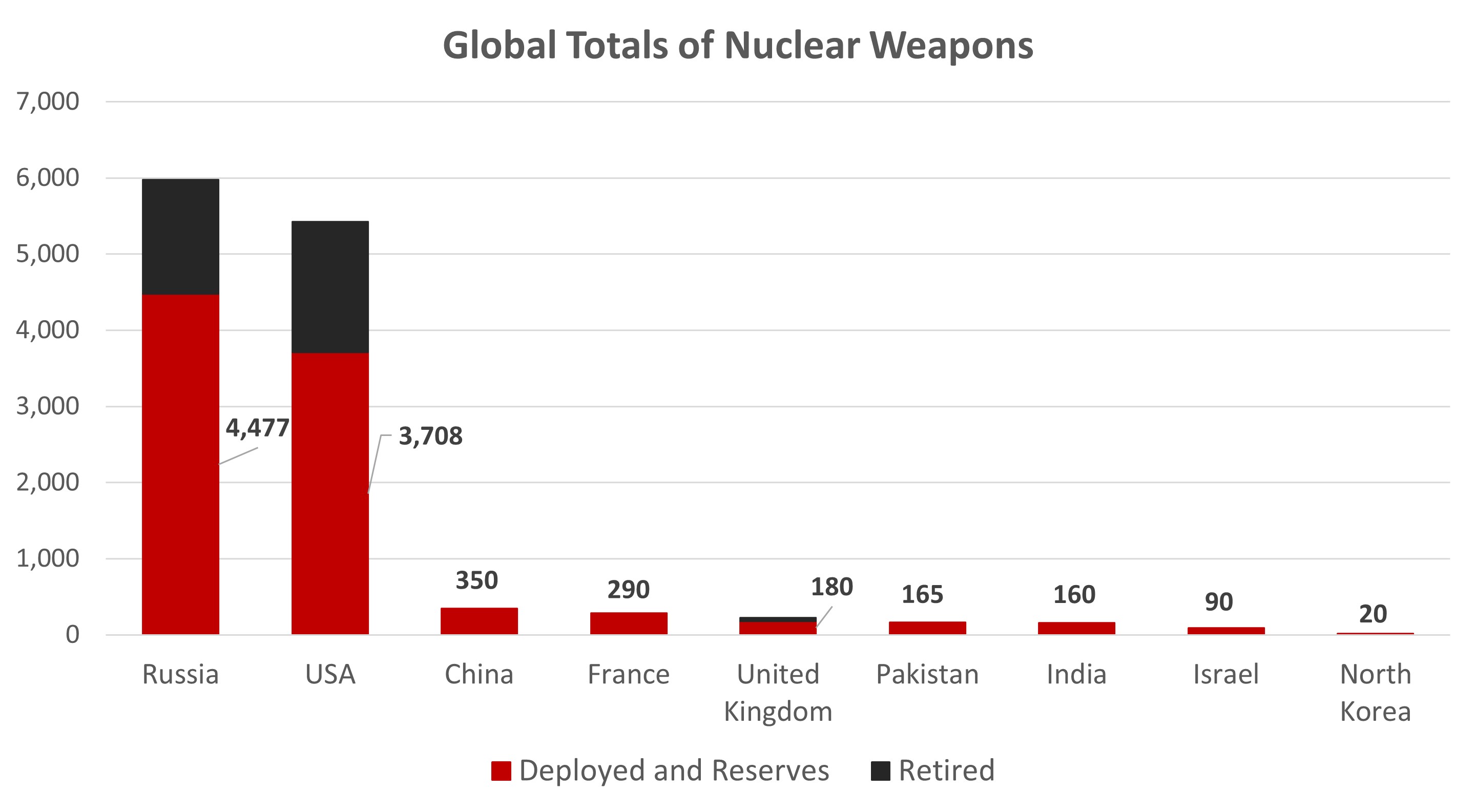
Source: Data from Our World in Data, “Inventories of Nuclear Weapons.”
Like Moscow, Washington has a full-blown and well-developed nuclear triad, complete with a fleet of nuclear subs that can launch up to twenty missiles—each containing multiple independently targeted warheads—land-based missile silos, and bombers. Each option provides ways to deliver hundreds of warheads. The submarine fleet, of course, is constantly mobile, ensuring first-strike survivability.
The Nonexistent Missile Gap
This won’t stop advocates of more spending from calling for more. They’ll always have reasons why there is some sort of missile gap. Lately, the obsession is with hypersonic missiles and having various forms of delivery, as well as the claim that the current gap between the US arsenal and rival arsenal is not sufficiently large.
There’s a reason US advocates of an aggressive nuclear posture invented the “missile gap” myth during the Cold War. It sows doubt about US security and ensures a certain level of paranoia about US nuclear capability. Nowadays, it’s acknowledged that the missile gap was always a myth, but this was much less known in the days when debates over US rocket technology were a frequent cause for alarm and debate. Nonetheless, the nonfactual basis of the “gap” was known at least as early as the 1960s, and then defense secretary Robert McNamara noted to John F. Kennedy:
There was created a myth in the country that did great harm to the nation. It was created by, I would say, emotionally guided but nonetheless patriotic individuals in the Pentagon. There are still people of that kind in the Pentagon. I wouldn’t give them any foundation for creating another myth.
How Much Do Numbers Matter?
The myth persists, however, and Geller claims: “Given the hundreds of new Chinese missile launchers and other new weapons, the U.S. will need more nuclear weapons to hold these targets at risk. In nuclear deterrence, numbers matter.”
How much do numbers really matter? Yes, in matters of deterrence, ten is certainly better than zero. But is three thousand better than one thousand, or even one hundred? That logic often works with conventional arms, but it makes little sense with nuclear arms, a single unit of which can destroy an entire city. As John Isaacs noted last year in the National Interest:
In the nuclear age, a country that deployed 1,000 nuclear weapons rather than an adversary’s 500 is not twice as powerful since a handful of weapons could devastate both countries. But the Pentagon and political leaders did not learn this critical lesson. This is a numbers game that may have been relevant for tanks and battleships before [the invention of nuclear weapons] but is not today.
What is key in nuclear deterrence is not simply numbers. Nuclear strategist Albert Wohlstetter identified this problem in the early 1960s and concluded that “the criterion for matching the Russians plane for plane, or exceeding them is, in the strict sense, irrelevant to the problem of deterrence.” Rather the key, Wohlstetter went on, is creating a force that is “survivable” to ensure the possibility of a retaliatory “second strike.” This is what establishes deterrence.
Wohlstetter certainly wasn’t the only one to come to this conclusion. In a 1990 essay titled “Nuclear Myths and Political Realities,” Kenneth Waltz—perhaps the most influential scholar of international relations of the past fifty years—concludes that the total number of missiles in these enormous arsenals is of little importance for nations that are already well above the threshold for achieving nuclear deterrence.
What really matters is the perception that the other side has second-strike capability, and this certainly exists in both US-Russia and US-China relations. Once each regime knows that the other regime has second-strike capability, the competition is over. Deterrence is established. Waltz notes:
So long as two or more countries have second-strike forces, to compare them is pointless. If no state can launch a disarming attack with high confidence, force comparisons become irrelevant. . . . Within very wide ranges, a nuclear balance is insensitive to variation in numbers and size of warheads.
The focus on second-strike capability is key because pro-arms-race policy makers are quick to note that if a regime’s first strike is able to destroy an enemy’s ability to retaliate in kind, then a nuclear war can be “won.”
Second-Strike Capability Evens the Score
But, as shown by Michael Gerson in “No First Use: The Next Step for U.S. Nuclear Policy” (2010) establishing second-strike capability—or, more importantly, the perception of it—is not as difficult as many suppose. Gerson writes:
A successful first strike would require near-perfect intelligence, surveillance, and reconnaissance (ISR) to detect, identify, and track all of the adversary’s nuclear forces; recent events surrounding U.S. assessments of Iraq’s suspected WMD [weapons of mass destruction] capabilities forcefully demonstrate the challenges of reliable, accurate, and unbiased information. Intelligence regarding where an adversary’s nuclear weapons are located and if the state is actually planning to attack could be wrong or incomplete, and an attempted first strike based on inaccurate or incomplete information could have far-reaching negative consequences.
The threat of a successful first strike can be countered through a variety of methods, including secrecy and the ability to shift weapons delivery channels. This is why the US, Russian, and Chinese regimes have long been so enthusiastic about the so-called nuclear triad. It is assumed that if nuclear weapons can be delivered by submarine, aircraft, and land, then it is impossible for an opposing regime to destroy all three at once and achieve first-strike victory.
But even in the absence of a triad, an opposing regime that seeks a total first-strike victory has few grounds for much confidence. As Waltz shows, “nuclear weapons are small and light; they are easy to move, easy to hide, and easy to deliver in a variety of ways.” That is, if a regime manages to hide even a small number of planes, subs, or trucks, this could spell disaster for the regime attempting a successful first strike. Gerson explains:
A nuclear first strike is fraught with risk and uncertainty. Could a U.S. president, the only person with the power to authorize nuclear use and a political official concerned with re-election, his or her political party, and their historical legacy, ever be entirely confident that the mission would be a complete success? What if the strike failed to destroy all of the weapons, or what if weapons were hidden in unknown areas, and the remaining weapons were used in retaliation?
Nor must it be assumed that a large number of warheads is necessary to achieve deterrence. Waltz recalls that Desmond Ball—who advised the US on escalation strategies—convincingly asserted that nuclear deterrence could be achieved with as few as fifty warheads.
Proceeding on the assumption that an enemy has no warheads left following a first strike requires an extremely high level of confidence because the cost of miscalculation is so high. If a regime strikes and misses only a few of the enemy’s missiles, this could lead to devastating retaliation both in terms of human life and in terms of the first-strike regime’s political prospects.
This is why a rudimentary nuclear force can achieve deterrence even with a small but plausible chance of second-strike capability. A small nuclear strike is nonetheless disastrous for the target, and thus “second-strike forces have to be seen in absolute terms.” Waltz correctly insists that calculating an arsenal’s relative dominance is a waste of time: “the question of dominance is pointless because one second-strike force cannot dominate another.”
The US Is Already Far beyond the Deterrence Threshold
One could certainly debate how much the US nuclear stockpile could be cut without sacrificing deterrence. Given the enormous size of the stockpile, however, the answer is that “most of it” could be cut. Indeed, the US arsenal could be cut by 90 percent and still have hundreds of warheads available for silos, submarines, and bombers.
Moreover, reductions in the arsenal are prudent for reasons of avoiding unintended nuclear war. As Wohlstetter noted, a prudent policy also requires “strategic nuclear forces to be not only capable of riding out and operating coherently after an actual preemptive attack against them; but also completely controllable in times of peace, crisis, and war—and especially in the face of ambiguous warning—so as to avoid unauthorized operations, accidents, and war by mistake.” Having large numbers of nuclear warheads actually is imprudent because it creates more potential for accidents, mistakes, and unauthorized use. Maintenance remains expensive and risky.
In spite of all this, it remains popular among some to keep arguing for more nuclear expansion year after year. Surely, some of these advocates are true believers, but there is also a lot of money at stake for government contractors. Thus, in one form or another, the myth of the missile gap—and its modern variants—endures.
Senate Committee Handles Bancel with Kid Gloves
Theater with Moderna Billionaire CEO Stephane Bancel Fails to Ask Key Questions
By Peter A. McCullough, MD, MPH | Courageous Discourse | March 24, 2023
In 2006, Stephane Bancel was a sales director then head of Belgium operations for Eli Lilly, a mid to high level big pharma sales executive. In 2007 he catapulted to become CEO of French diagnostics company BioMérieux and began work with the Chinese to build the biosecurity annex level 4 at the Wuhan Institute of Virology. His company trained the Chinese lab technicians. Bancel then joined startup Moderna in 2011. Moderna has three patents that claim priority to applications filed between 2011 and 2016 covering its foundational intellectual property on mRNA, code to SARS-CoV-2 Spike protein, and related functions. In April 2020, Moderna’s sales and stock price skyrocketed on the promise of a COVID-19 vaccine that was planned for years. Bancel’s stake of the company is about 9% and net worth estimated to be ~$6 billion.
While the countenance Senator Rand Paul was stern and his questions on the surface appeared intimidating, he and the committee failed to drill Bancel on issues that would reveal corruption, racketeering, fraud, conspiracy to commit domestic terrorism, public harm, or mass negligent homicide.

Here are five question sets the Senators either didn’t have the foundational understanding, perceptiveness, or courage to ask:
- What was Bancel’s involvement with the Chinese in the construction of the lab annex? Was it intended for bioterrorism? How many times did Bancel visit the lab between 2007 and 2020?
- Did Moderna collaborate with or rely upon Dr. Ralph Baric’s NIH work on chimeric SARS-CoV-2 as published in 2015 in Nature Medicine and the Proceedings of the National Academy of Science? Is the patented genetic code for Moderna mRNA derived from Baric’s chimeric virus or another one originating from the WIV BSL-4?
- Did Bancel know ahead of time his product would cause myocarditis, neurologic injury, blood clotting, and immunologic syndromes (VITT, MIS)?
- How many deaths and serious adverse events did Moderna record in its 90 day obligatory post-release safety data? Why has this dossier not been released to the public? When will it be? Assuming Moderna’s dossier has similar numbers of fatalities to Pfizer, why did Moderna fail to pull their product off the market early in 2021 due to excess risk of death?
- Has Moderna or FDA or any third party at any time inspected its mRNA–1273 vaccine for quality, purity, and concentration as it is being produced by biodefense contractor National Resilience or other supplier? How does Moderna assure the quantity of mRNA in the final fill and finish of the vials before they are shipped to pharmacies and vaccine centers?
In conclusion, the Senate Committee on Health, Education, Labor and Pensions needs to step up its game if America wants to get to the bottom of what is going on with the COVID-19 vaccine debacle. I suggest they call in some doctors with courage, expertise, and clear vision to advise them on questioning. Wednesday March 22, 2023 fell short by a Kentucky mile and Bancel must be skipping away in relief.
Indiana’s Bureau of Motor Vehicles is caught collecting and selling personal data
By Ken Macon | Reclaim The Net | March 21, 2023
Indiana’s Bureau of Motor Vehicles (BMV) has been caught selling drivers’ personal information without their consent and without the option to opt out. Last year alone, the BMV made around $25 million from selling personal information, according to WRTV.
Asked if the BMV sells personal information, a BMV employee said to WRTV: “No. Well, you’re not supposed to. Can’t tell you for sure what they do, but they’re not supposed to!”
Though the employees might not be aware of the practice, an investigation by WRTV found that the Indiana BMV does sell personal information and the practice is legal. The BMV can sell personal information like your name, date of birth, past and current addresses, license plate number, make and model of your vehicle, VIN, date of purchase, license type, and your driver’s record.
In the past decade (2012 to 2022) the BMV made over $237 million from selling drivers’ personal information. It sells the personal information to lawyers, bail bond companies, insurance companies, private investigators, debt collection companies, recovery agents, law enforcement agencies, security guards, auto dealers, tow companies, school corporations, and mobile home parks.
The BMV refused an on-camera interview. However, in an emailed statement, a spokesperson said: “Data is only available to qualified entities who meet the eligibility and use requirements in Indiana Code § 9-14-13-7 or § 9-14-13-8.
“Consumers do not have the option to opt out at this time,” they added.
Asked how the money generated from sale of personal information [is spent], the BMV said: “The revenue generated from sales to qualified entities goes to various accounts within the BMV, most significantly the Tech Fund. The funds support maintenance and ongoing upgrades to infrastructure, databases, and security.”
Send in the Clowns
Yellen and Garland perform back-to-back surprise visits to Ukraine

BY PHILIP GIRALDI • UNZ REVIEW • MARCH 21, 2023
Sometimes I think that the script being used by the Biden Administration to manage its foreign and national security policies has been written by George Orwell, though I am not sure if it based on 1984 or Animal Farm. Maybe it is a combination of the two. Either way, it would help explain why there is something seriously wrong here. For example, at the end of February Congress, confronted by a debt ceiling, began discussing cutting Medicare and Social Security while more recently a banking sector crisis seems to be developing so Treasury Secretary Janet Yellen decided to go off doing photo-ops in Kiev embracing Ukraine’s President Volodymyr Zelensky shortly after handing him the keys to the US economy. She explained to Zelensky how the White House had approved an additional $12 billion in aid to Ukraine during the previous week, including $2 billion for the military and $10 billion to support Zelensky’s government and other infrastructure needs. The US Treasury is now de facto the source of the Ukraine government’s entire annual budget. In addition, Yellen described glowingly how the Treasury and State Departments will implement a new round of sanctions against more than 200 entities and individuals with ties to Russia’s military, high-technology industries, and its metals and mining sectors. The US Department of Commerce is also enforcing export restrictions on materials and technology, including semiconductors, sold by American companies to customers in Russia and China.
In defense of her grand mission, Yellen penned an op-ed for the always compliant New York Times explaining the importance of Ukraine to the United States. She wrote how in Ukraine “… Russia’s barbaric attacks continue — but Kyiv stands strong and free. Ukraine’s heroic resistance is the direct product of the courage and resilience of Ukraine’s military, leadership and people. But President Volodymyr Zelensky and the Ukrainians would be the first to admit that they can’t do this alone — and that international support is crucial to sustaining their resistance. I’m in Kyiv to reaffirm our unwavering support of the Ukrainian people. Mr. Putin is counting on our global coalition’s resolve to wane, which he thinks will give him the upper hand in the war. But he is wrong. As President Biden said here last week, America will stand with Ukraine for as long as it takes… Ukrainians are fighting for their lives on the front lines of the free world. Today, and every day, they deserve America’s unyielding support.”
The Yellen op-ed drones on with a lie so large that it is astonishing that the New York Times would even print it: “When confronted with scenes of brutality and oppression, Americans have always been quick to stand up and do the right thing. Our strength as a nation comes from our commitment to our ideals — and our capacity to see in others the same desires that animated our own struggles for freedom and justice.” But then she tops that with assurances from “President Zelensky, [who] has pledged to use these funds in the ‘most responsible way.’ We welcome this commitment, as well as his longstanding agenda to strengthen good governance in Ukraine.” Huh?
And here is Yellen’s version of “Why We Fight!”: “Our support is motivated, first and foremost, by a moral duty to come to the aid of a people under attack. We also know that, as President Zelensky has said, our assistance is not charity. It’s an investment in ‘global security and democracy.’ Let’s look at the strategic impact of our support for Ukraine so far. Mr. Putin’s war poses a direct threat to European security, as well as to the laws and values that underpin the rules-based international system.”
So, Americans have a “moral duty” apparently up to and including sending their sons and daughters to die supporting Ukraine. And ah yes, it’s all about the “free” world, democracy and the notorious rules based international system! Has anyone yet cited Hegel’s observation that the President Joe Biden Administration’s foreign policy has already “repeated itself, first as a tragedy in Afghanistan, second as a farce”? Meanwhile one suspects Zelensky was laughing all the way to the bank as Yellen disappeared over the horizon to come up with the cash, as that old expression goes, and he probably already has one of his buddies shopping for a new villa on the French Riviera to supplement his other real estate! But wait! The story became even more exciting the following week, involving another visit to Mr. Z by America’s nearly invisible Attorney General Merrick Garland, a man who can literally look Z in the eye as they are both very short. Garland is generally engaged in chasing white supremacists and requiring all new FBI hires to learn all about how to identify and pursue antisemites, but he has made two trips to Kiev to meet mano-a-mano with the brave olive drab t-shirt clad warrior who is already being beatified as the twenty-first century’s Winston Churchill.
Garland was in town to do the other thing that engages his sense of law and order, which is to set up a tribunal to arrest, prosecute and punish Russian war criminals after Ukraine emerges triumphant from its conflict with the unimaginably evil President Vladimir Putin. It would be modeled on the Nuremberg Tribunals that tried leading Nazis after the Second World War, and Garland has cited his family’s escape from the so-called holocaust to explain why he is intent on personally being involved in delivering what he describes as “justice.” A Justice Department spokeswoman described Garland’s mission as being in Kiev to personally “reaffirm America’s commitment to help hold Russia responsible for war crimes committed in its unjust and unprovoked invasion against its sovereign neighbor.”
Garland had several meetings with President Volodymyr Zelensky and foreign law enforcement officials including Ukrainian Prosecutor General Andriy Kostin while attending what was billed as the “United for Justice Conference.” Zelensky elaborated that the purpose of the conference was to hold Russia’s leadership accountable for the alleged atrocities carried out by its army. “The main issue of all these meetings is accountability,” he said. The US Justice Department is reportedly actively engaged in the gathering of evidence to indict the Russians. During Garland’s first visit to Ukraine in June 2022 he announced the appointment of Eli Rosenbaum, an Office of Special Investigations prosecutor best known for going after former Nazis, to direct American efforts to identify and track Russian war criminals.
Garland laid it on thick, as was expected from someone responsible for prosecuting the rest of the world when it steps out of line. He told his hosts that “Just over twelve months ago, invading Russian forces began committing atrocities at the largest scale in any armed conflict since the Second World War. We are here today in Ukraine to speak clearly, and with one voice: the perpetrators of those crimes will not get away with them. In addition to our work in partnership with Ukraine and the international community, the United States has also opened criminal investigations into war crimes in Ukraine that may violate US law.” He concluded by throwing out the complete bullshit party line much beloved by Joe Biden and Tony Blinken, that “The United States recognizes that what happens here in Ukraine will have a direct impact on the strength of our own democracy.”
Of course, there is more than a little bit of irony in all this, not to mention top level hypocrisy, as the United States has killed more people directly or indirectly while committing more crimes against humanity dished out in various ways over the past twenty years than any other country, except, predictably, Israel, which currently is committing crimes against humanity on a nearly daily basis. Curiously, however, the normally tone-deaf White House and Pentagon seem to understand, on a certain level, that opening up Pandora’s box might not be a good idea when it comes to war crimes. Last week Secretary of Defense Lloyd Austin refused to share US information on alleged Russian crimes with the International Criminal Court (ICC) in the Hague. The Pentagon is blocking the Biden administration from sharing evidence with the ICC collected by American intelligence agencies regarding Russian activities in Ukraine because helping the court investigate Russians might set a precedent that could help pave the way for it to prosecute Americans. Washington does not recognize the ICC, fearing that it might well seek to examine the sorry record of US military crimes in Asia and Africa. Israel similarly does to recognize the court for roughly the same reason.
So here we are, two top level officials from the Biden regime sneak into Kiev to give an arch crook money and unlimited moral support, together with a pledge that more cash is on the way as are arms and war crimes tribunals await those nasty Russians. And guess what? It is all packaged as being good for America! This sounds like a song that was sung previously in places like Vietnam, Iraq and Afghanistan and it was a tissue of lies then just as it is now. Yellen ought to have stayed home to tend to the banking system and should be giving the billions of dollars earmarked for Zelensky back to the American people. If Garland wants to investigate anyone it should be the Pentagon, the intelligence agencies, and Congress. And yes, his own FBI! And don’t forget how the Bidens and Clintons became multi-millionaires! And then there is the destruction of Nord Stream. Funny how every time one turns over a rock in and around the US government something really smelly surfaces.
Philip M. Giraldi, Ph.D., is Executive Director of the Council for the National Interest, a 501(c)3 tax deductible educational foundation (Federal ID Number #52-1739023) that seeks a more interests-based U.S. foreign policy in the Middle East. Website is councilforthenationalinterest.org, address is P.O. Box 2157, Purcellville VA 20134 and its email is inform@cnionline.org.
Launched on a Wing and a Prayer (For Billions of Dollars)

By Laurie Calhoun | Libertarian Institute | March 14, 2023
Way back in the spring of 2020, the provocative title of an article caught my eye. Upon reading it, I learned that researchers were rushing to create a vaccine before the COVID-19 virus mutated, which would render the vaccine nugatory and destroy all hopes of creating a blockbuster panacea. Curious at the time, such a warning can be viewed today as having been prophetic. (Note: That article, which offered a business slant on the historic vaccine competition, is no longer available through Google—“some results have been removed,” and are seemingly irretrievable—but here’s one with a similar title from April 2020: “Coronavirus mutation could threaten the race to develop vaccine.”)
Consider the stunning conclusion of a peer-reviewed scientific journal article published in January 2023:
“Viruses that replicate in the human respiratory mucosa without infecting systemically, including influenza A, SARS-CoV-2, endemic coronaviruses, RSV, and many other “common cold” viruses, cause significant mortality and morbidity and are important public health concerns. Because these viruses generally do not elicit complete and durable protective immunity by themselves, they have not to date been effectively controlled by licensed or experimental vaccines.”
Accustomed as everyone is by now to a relentless barrage of contradictory proclamations and retaliatory responses to them, the claim that mRNA was never fit to purpose for rapidly mutating coronaviruses might be written off by the usual suspects as the ravings of yet another antivaxxer conspiracy theorist. Except that this paper was co-authored by Dr. Anthony Fauci, the most visible and persistent pusher of the newfangled COVID-19 vaccines throughout 2021 and 2022. So what happened?
Against all conventional wisdom on the ethical practice of medicine, Fauci did everything in his power to achieve maximal uptake of an experimental treatment by human beings across all cohorts, without regard to patient health, age, or any other identifying factor beyond their possession of an arm into which to inject a novel product granted Emergency Use Authorization (EUA) after an accelerated review by the Food & Drug Administration (FDA). Not only did Fauci ignore the vast disparities in vulnerability to severe illness and death between healthy infants and frail nonagenarians, but he also conducted himself for two years as though natural immunity through previous infection were somehow irrelevant to the question of whether a patient should roll up his sleeve.
Now, in the light of Fauci’s own published scientific findings, it would appear that he was right, in a sense, about natural immunity all along, albeit in an unexpectedly perverse way. First of all, as we already witnessed in real time, coronaviruses as a class, including SARS-CoV-2 (COVID-19), mutate rapidly in order to propagate themselves. This “discovery” served as the basis for the development of “boosters,” which, it was claimed, became necessary when “fully vaccinated” persons continued to become infected with COVID-19. Major outbreak-inducing strains such as Delta and Omicron, which arise through mutation, will always be one step ahead of last year’s vaccines, having survived precisely by evading the antibodies induced by injection into the body of the previous virus generation’s mRNA.
According to Fauci’s own findings, however, there is a second, even more compelling reason for denying that either vaccine or natural immunity to COVID-19 can ever be permanent. The primary difference between diseases such as measles, for which vaccines work, and the seasonal flu or SARS-CoV-2, for which they do not, is that the body’s natural immune response rises only to the level of the severity of the pathogen. Since most people can survive coronaviruses, the minimal response needed to defeat the invader is rather mild, which is why immunity dissipates rapidly over time and people can become reinfected again and again, even if they have recovered from natural infection, and whether or not they have undergone vaccination.
There are of course people who die of the flu or COVID-19, but they nearly always have comorbidities, infirmities or weaknesses, rendering them vulnerable to a pathogen which healthy bodies are capable of defeating. Notwithstanding the massive propaganda campaign for universal vaccination, most healthy young persons would have survived COVID-19, and would not have been hospitalized, with or without vaccination. Given the abundance of statistical evidence, there is simply no sense in which it can be truthfully asserted that healthy young persons with no comorbidities were “saved” by the shots. On the other hand, extremely frail and elderly persons can indeed be killed by the virus, regardless of how many “vaccines” they have taken. When it comes to the mercurial class of coronaviruses—instantiated by not only the common cold and the seasonal flu, but also COVID-19—so-called vaccines will never transcend their pedestrian identity as mere shots, for they are constitutionally incapable of offering longterm protection, not only because these viruses rapidly mutate, but also, and more fundamentally, because the body’s natural response to infection by such transitory viruses is never robust enough to be permanent. Just as having survived the flu one year has nearly no bearing on whether one will contract another case of the flu, from a different variant, in the future, no so-called vaccine solution to COVID-19 can confer longlasting protection.
Take as many boosters as you like, until the end of time, but having done so may or may not prevent you from contracting the latest iteration of the virus—or protect anyone else—since every booster or flu shot is the result of researchers’ “best guess” of what the specific properties of the next generation of viruses will be. It appears, then, that the widely celebrated and aggressively marketed, and in some cases mandated, COVID-19 vaccines, paid for thrice by the recipients of “free” shots, were in fact launched on a wing and a prayer. There was really no hope all along that the shots would or could offer longterm protection, although it was claimed for marketing purposes that they were highly effective and would save millions of lives. That those selling points were in fact lies may explain why they were supplemented all along the way with such eerily self-contradictory slogans as: “The vaccinated need to be protected from the unvaccinated!”
Dr. Fauci’s surprising publication reveals that the abundant optimism exuded by him and others in attempting to maximize vaccine uptake was scientifically unfounded from the beginning. Neither the mRNA technology nor the traditional vaccines (which introduce a small amount of the live or dead pathogen into the body to elicit an immune response) can be effective for rapidly evolving pathogens such as coronaviruses to which the highly efficient human body mounts the weakest possible effective response. But this is hardly news, for we already knew long before 2020 that, despite assiduous efforts spanning decades, no one ever managed to develop a vaccine against the common cold. Likewise, the widely touted flu shots, marketed in very public ad campaigns only slightly less aggressive than those for the COVID-19 treatments, are in fact mediocre at best, as Fauci himself has averred.
If vaccine technology, whether vector- or mRNA-based, is simply a mismatch for the nature of rapidly mutating viruses, and this is a matter of common knowledge, readily accessible to anyone working in virology, then how are we to understand Fauci’s comportment throughout the Coronapocalypse? And why did he and his coauthors boldly reaffirm in January 2023 what many other researchers have been saying for years, including a few brave souls who were silenced when they tried to suggest the same from 2020 to 2022?
Fauci faces something of a “Charybdis or Scylla” dilemma here, for if he was ignorant of basic truths of immunology known by competent and knowledgeable scientists before 2020, then he had no business serving as the nation’s fount of public health wisdom. Double-masked Fauci devotees, in the aftermath of what was empirically indistinguishable from a full-scale psyop spanning more than two years, will no doubt remain reluctant to renounce their allegiance to the person who, they believe, “guided” us through the pandemic. Confronted with the revelations of Fauci et al.’s January 2023 publication, such followers may most charitably conclude that the object of their reverence did genuinely believe in the mRNA vaccines and continues to follow “The Science” where it leads, in this case, to finally acknowledge failure.
That Fauci honestly did not know that the mRNA shots would never work has also been the conclusion of a few of his most vociferous critics, including Alex Berenson, who somewhat ironically was spurned as “The Pandemic’s Wrongest Man” by The Atlantic back in April 2021. (Morally speaking, that title surely belongs to Dr. Anthony Fauci himself, for the sheer brazenness with which he defied all known principles of medical ethics in pushing for universal vaccination across all cohorts.) Berenson was banned from social media under pressure by no less a power than the U.S. government itself when he dared to question the Fauci script at the height of the Coronapocalyptic hysteria. (Berenson’s lawsuit alleging the government’s violation of his First Amendment right to free speech is pending.)
Notwithstanding the superficial appeal (and attendant Schadenfreude) of the “Fauci was ignorant and is now eating crow” hypothesis, the Scylla horn of the interpretive dilemma would seem to cohere far better with the character of a man who remarkably responded to his critics on national television that “You’re really attacking not only Dr. Anthony Fauci, you’re attacking science.” Certainly such a person is not someone whom we would ordinarily regard as endowed with the humility needed to admit either ignorance or error. To my mind (and others, such as Dr. Robert Malone, agree) Fauci’s recent publication is yet another gambit perfectly consistent with his comportment throughout the pandemic. While Fauci’s admission that the mRNA technology is not fit to purpose for coronaviruses may on its face seem surprising, in fact, it is entirely true to form.
Yes, Fauci’s gambit is most plausibly interpreted as the latest chapter in his time-tested “fail forward” playbook: to use the outcome of the COVID-19 shot experiment to rally for yet more funding for the pharmaceutical industry. Like all good bureaucrats, Fauci uses government fiascos as a springboard to increase the reach and budget of his domain. In other words, Fauci, having quite effectively painted the COVID-19 virus as the most evil bogey man of them all, is simply continuing his efforts to impel politicians to dole out even more billions of dollars to the government-boosted industry which he has loyally supported throughout his entire career, as has been ably documented by Robert F. Kennedy, Jr. In addition to being consistent with Fauci’s dismissive, smug, and seemingly shameless character, this interpretation coheres well with the general modus operandi of the pharmaceutical industry, which has displayed in recent decades an uncanny capacity to “fail forward” by pivoting and innovating so as to be able to reap massive profits even when their products generate consequences worse than the conditions which they were intended to address.
Note that slippery snake-oil salesmen such as Pfizer’s CEO, Albert Bourla, carefully calibrated their pitches from the beginning so as to protect themselves from future allegations of fraud by equivocating about the “efficacy” of their COVID-19 treatments. When directly questioned in December 2020 about the vaccine’s ability to limit transmission of the virus, Bourla offered casual, off-the-cuff replies such as, “I think that’s something that needs to be examined. We’re not certain about that right now.” His colleague, Ugur Sahin (co-founder and CEO of BioNTech), cagily couched his anticipatory optimism in these terms: “The first interim analysis of our global Phase 3 study provides evidence that a vaccine may effectively prevent COVID-19.” [my emphasis] The rest is history. When it later emerged, to the surprise of everyone whose understanding of the crisis was shaped exclusively by the Pfizer-sponsored mainstream media, that the company never even tested the shots for their ability to prevent transmission, gaslighting fact-checkers rushed to the defense of the executives. Why in the world would anyone ever have believed that the new vaccines would prevent transmission and infection?
The government-subsidized pharma giants succeeded in profiting enormously from the politically amplified crisis by persistently touting the efficacy of their products against a virus which 99+% of people were perfectly capable of surviving on their own. The shot salesmen claimed victory when injected persons did not die, when in reality most of them would have survived even if they had declined the treatment or been injected with an inert placebo instead. But the scheme ultimately worked because marketers (including public health authorities such as Anthony Fauci and Rochelle Walensky) unerringly referred to the shots as “vaccines,” a piece of sleight of hand made possible by the CDC’s own diluted redefinition of the term in 2021 to mean “a preparation that is used to stimulate the body’s immune response against diseases.” This linguistic legerdemain worked wonders to promote the new shots, when in fact the new definition is so broad and open-ended as to make it possible to label as a vaccine anything that strengthens the immune system, including leafy green vegetables, vitamins C and D, etc.
In retrospect, there can be no doubt that the populace and the politicians crafting policy all assumed that the labeling of the mRNA treatment as vaccines implied that the shots stopped transmission and infection, even while the savviest of the snake-oil salesmen evinced ignorance from the start about the most important question of all: whether these “vaccines” were indeed like all of the other vaccines, capable not just of “stimulating” the immune system, but of producing dependable and durable immunity.
Given the statistics now available, even the more modest claim, continually chanted by pharma marketers and their lackeys in the media, that the mRNA treatment greatly diminished severe illness and hospitalization, may have been false. For the death toll of COVID-19 victims increased rather than decreased in the year after the “vaccine” launch, and the countries with the worst vaccine uptake had some of the best outcomes. On top of the virus deaths, thousands of people were diagnosed with post-vaccine injuries of a variety of sorts, believed by many of them, their families, and at least some of their doctors to have been caused by the shots. Some of the vaccine injured ended up dying long before their time, and excess deaths were also caused by the disastrous political response to the virus, with fatal drug overdoses reaching record levels. Millions of persons missed vital health screenings, having been terrorized into believing that they could not leave their homes (much less enter COVID-19–infested health facilities!) without contracting something akin to the Black Plague. Among those who sought help for their ailments, some were flat-out denied treatment for acute illnesses, either because they were not dying specifically of COVID-19, or because they had refused the experimental treatment.
In coming to terms with what transpired over the past three years, it is helpful to bear in mind pre-2020 history. When the pharmaceutical industry’s newfangled psychotropic medications did not work as advertised, they created and blitz-marketed “add-on” drugs to increase the efficacy of antidepressants now known to have exhibited success in clinical trials on a par with placebos, but with far worse longterm adverse effects, up to and including addiction and suicidal ideation. Similarly, the slick pivot of the industry in response to the opioid catastrophe (caused by itself) was to launch and market drugs which could help people in the throes of narcotics addiction.
The flu shots marketed in collaboration with and subsidized by governments have been demonstrated in clinical trials to succeed on a par with placebos, while post-flu shot deaths are invariably written off as “coincidental.” Nonetheless, the industry capitalizes on the fact that they are starting anew each year—the previous year’s flu shot results being irrelevant to the next year’s projected success. As a result, when heavily lobbied and propagandized authorities impose mandates in some places (such as the State of Massachusetts), this may lead others to follow suit. Crony capitalist windfall profits ensure the ever-augmenting marketing budget of pharma firms, with the result that each subsequent year’s sales will exceed the previous year’s tally.
Given such precedents, no one should be surprised if the failure of the COVID-19 shots to prevent infection and transmission, or even to diminish the number of persons who died from the virus, does indeed end up serving as the pretext for governments to infuse even more money into research and development of new and what are promised once again to be “miraculous” cures to be used in the future. Not long after the launch of the COVID-19 vaccines, auxiliary treatments such as Pfizer’s Paxlovid and Merck’s Lagevrio were developed to treat people who became infected with the virus despite having been “fully” vaccinated. As clear evidence that many people’s capacity for critical thought continues to be compromised by fear, when legislation to rescind the utterly illogical and unscientific COVID-19 vaccine mandate on foreigners entering the United States made it to the floor of the House of Representatives, 201 Democratic congresspersons voted to keep the executive order in place.
The ongoing support of the official government pro-pharma narrative by the president, the press secretary, the defense secretary, and most Democratic members of Congress, even in the face of ample evidence (including post-vaccination positive COVID-19 tests) demonstrating that the shots did not diminish the incidence of infection is best explained by the fact that policymakers prefer not to own up to their mistakes. Ordinarily, individuals base their future actions on what they have learned from past experience. The question arises in the present circumstance: Why is there still a push for vaccine passports when the COVID-19 vaccines do not in fact confer immunity? The assumptions funding the push for universal vaccination continue to be embraced, as though the vaccines worked resplendently, despite an accumulation of scientific evidence to the contrary.
Now that Fauci himself has clearly explained why the mRNA technology will never offer a lasting solution to COVID-19, why would anyone, including Joe Biden and other advocates for the WHO (World Health Organization), still be in favor of implementing a universal health passport system regulating the movement of persons throughout the world? The current crop of shots do not offer longterm protection and do not moderate illness except in the case of persons in a very narrow cohort. Why require anyone to demonstrate that they participated in the experimental mRNA trial more than two years ago in order to be able to enter a country where the circulating variants bear little resemblance to the strain used to determine the formula of the first crop of vaccines?
There is no plausible health pretext available to explain why political leaders around the world would be keen to impose such a restrictive health passport program on free people, preventing them from traveling unless they first demonstrate their willingness to comply with future possible arbitrary orders decreed by public health authorities. That anyone not holding pharma stocks would support at this point the adoption of a health passport is best explained, again, by the politically induced trauma which appears to have psychologically scarred some persons for life. But just as the failure of the lockdowns to “stop the spread!” impelled leaders at every level of government—local, state, and federal—to prolong and intensify the lockdowns, those who pushed vaccine mandates will continue to press for universal vaccination passport requirements under the flatly false assumption that the reason why so many people died of COVID-19 was because of the evil antivaxxers who refused to comply.
What we are witnessing, the strangely intransigent push for vaccine passports, is entirely consistent with the comportment of the very persons who just succeeded in selling billions of shots. They will continue to insist that what we need to do is provide even more government funding to the pharmaceutical industry so that they can develop more and better cures for our ills. As disturbing as this may be, the most plausible explanation for the vigorous attempt to impose a health credential system on the people of the world is to provide the pharmaceutical industry with a limitless supply of not only customers, but also future experimental subjects.
As we have seen, the addition of the COVID-19 shot to the CDC’s immunization schedule for children—whose chances of dying from the virus are minuscule—serves only industry interests, by ensuring an endless crop of healthy young arms into which to inject the latest and greatest snake oils claimed to be panaceas (until it emerges that they are not). Likewise, the implementation of a universal health passport scheme restricting the motion of persons who opt not to undergo medical treatments of which they have no need would not only reap massive profits to the pharmaceutical industry but also represent the dawning of the pharma-techno state, in which citizens are subjects whose bodies are owned by their government.
The upshot here is that all of the pro-mRNA treatment propaganda and the incredibly vicious efforts to denounce and blame the noncompliant as the reason for the lengthy duration of the COVID-19 pandemic were nothing more than marketing ploys. That those who work behind the scenes of this well-oiled marketing machine were willing to destroy people’s relationships, their livelihoods, and in some cases even their very lives, reveals that their true motives were never to save the world from the virus but, instead, to profit from it. This is why we must resist any and all attempts by these same people and their toadies to foist upon us legal requirements to serve as guinea pigs in their future experimental trials, which is precisely what “health passports” would bring.
Laurie Calhoun is the Senior Fellow for The Libertarian Institute. She is the author of We Kill Because We Can: From Soldiering to Assassination in the Drone Age, War and Delusion: A Critical Examination, Theodicy: A Metaphilosophical Investigation, You Can Leave, Laminated Souls, and Philosophy Unmasked: A Skeptic’s Critique, in addition to many essays and book chapters. Questioning the COVID Company Line: Critical Thinking in Hysterical Times will be published by the Libertarian Institute in 2023.
“Disinformation experts” blame “conspiratorial narratives,” “far-right websites,” for Silicon Valley Bank panic
Amidst calls for online censorship
By Cindy Harper | Reclaim The Net | March 18, 2023
Just days after a Senator was caught asking whether there were systems in place to censor social media in an attempt to prevent a bank run, “disinformation experts” are partially blaming the Silicon Valley bank collapse exacerbation on online conspiracy theorists on social media.
“Russian media outlets, far-right websites, short sellers and doomsday preppers were among those who pushed and amplified conspiracy theories online focused on the collapse of Silicon Valley Bank,” Bloomberg alleges.
According to anti-disinformation for-profit firm Alethea, a wide range of accounts used the bank’s collapse to promote their own agendas.
The firm’s founder Lisa Kaplan told Bloomberg that the claims by venture capitalists speculating the collapse of the bank that were amplified “propagandists and foreign influencers” contributed to the collapse of the bank.
“We assess that these outlets may have increased online panic and contributed to the broader cross-platform spread of false or misleading content about SVB,” Kaplan said to Bloomberg.
“We also assess that conspiratorial narratives may have accelerated panic, which then posed a risk to the broader financial system,” she said.
“This shut down a bank, and I’m concerned about it happening again,” Kaplan added.
Multiple pundits and websites claimed that the bank collapsed because of the prioritizing of environmental, social, and government initiatives over risk management.
Pfizer wants EU to keep paying for unused Covid jabs
RT | March 15, 2023
Pfizer has offered to extend its Covid-19 vaccine contract with the European Union while scaling back deliveries, but still expects the bloc to pay billions of euros for unused doses amid a major supply glut in some countries, the Financial Times has reported. The offer prompted outrage from a handful of member states, who say the deal would serve the interests of Big Pharma over their own citizens.
The contract extension would push the vaccine agreement out to 2026, with a proposed 40% reduction in the number of doses supplied as well as delays to deliveries, the newspaper reported on Tuesday, citing two unnamed officials.
However, despite the suggested cuts, the US pharma giant still insists that it be paid for the full number of doses originally agreed upon, many of which would never be produced under the new terms.
The amendments to the deal – the full text of which has never been made public – were presented by European health commissioner Stella Kyriakides during a closed-door meeting in Brussels on Tuesday, but faced objections from some EU members.
In a joint statement issued following the meeting, officials from Bulgaria, Hungary, Lithuania and Poland said they would not sign the agreement with the proposed changes, as they “do not present a final and fair solution to the problems of the Covid-19 vaccine surplus and do not meet the needs of the healthcare systems, the needs of citizens and the financial interests of the member states.”
Polish Health Minister Adam Niedzielski argued that the current Pfizer proposal would favor Big Pharma, and has called for the secretive contract to be published, questioning the role European Commission President Ursula von der Leyen played in the negotiations for the massive vaccine deal.
An EU watchdog launched a probe into the negotiation and procurement process late last year, after von der Leyen’s office failed to produce personal text messages sent to Pfizer CEO Albert Bourla during the talks for nearly 2 billion vaccine doses, prompting accusations of corruption.
The 27-member bloc originally signed a joint contract with Pfizer in 2020, but since the pandemic receded, demand for vaccines has steadily dropped, leaving an overabundance across the continent. Some countries have been forced to throw away vaccines, with Germany alone tossing out some 36.6 million doses, according to public broadcaster BR24, while others are sitting on large stocks of unused shots, such as Austria, which has reported around 17.5 million in its supply.
However, Czech Health Minister Vlastimil Valek pushed back on the criticisms, arguing that the “majority of countries” had agreed to the deal and that “the contract is not bad.” He added that the large stock of doses would not pose a problem as “Covid is still here” and “It will be necessary to repeat vaccination each year for a particular group of patients.”
Leaked Documents Show ‘Vaccine’ Conspiracy in Austria
Thanks to German-speakers’ orderliness, we now have written proof of collaboration between gov’t, doctors, and legacy media–time for tribunals!
By epimetheus – Die Fackel 2.0 – March 13, 2023
This is literally ‘hot off the ‘presses’: Austrian alternative media outlet Der Status published leaked documents from the Austrian Chamber of Physicians (Ärztekammer ) that show, beyond reasonable doubt, the grand conspiracy between government, the Chamber, and its protagonists.
Without much further ado, here’s my translation; as always, emphases and bottom lines mine. The below text has been lightly edited for clarity.
The Austrian Medical Association, under the ousted red [i.e., Social-Democratic] president Szekeres and its current president Steinhart, worked closely with the Health Ministers for years. And in doing so, it betrayed the interests of doctors. [to say nothing about patients]
Spring 2020: Collaboration with the Politicians Commences
In April 2020, Szekeres, Steinhart, and Minister Anschober [Greens, since retired] signed a ‘Memorandum of Understanding Concerning COVID-19 Vaccinations’. That is, at a time—more than half a year—before the conditional approval of these injectable products, this Memorandum dealt with, among other things, advertising campaigns by doctors for the vaccinations, the vaccination of health-care workers and their family members, vaccinations in homes and schools, and reimbursement agreements.
Yet, secretly, an additional deal was also negotiated: it was literally agreed that ‘clear blanket vaccination recommendations will be made via the National Immunisation Consortium (Nationales Impfgremium, or NlG) on the suitability of the various vaccines and their applicability, esp. for various high-risk groups’.
Explosive: the Minister of Health and the Austrian Medical Association leadership signed a contract in which they go over the head of the National Immunisation Consortium—and they did so long before the injections were even available—to determine what the National Immunisation Consortium will recommend.
[this means, in other words, that the NIG never had anything to say about the data or the underlying clinical trials; this much we already knew, but now we have the receipts: these people have failed the public, betrayed the trust of patients, and soiled themselves]
It was never about Facts or Truth
Until now, the public was not aware of any document that so clearly showed that various ‘expert panels’ and ‘commissions’ obviously only served to obligingly recommend what politicians and the medical association leadership wanted. It was never about expertise, about advice, about objective science, about health.
Long before the beginning of the mass vaccination campaign, when vaccines did not even exist (!), it was only about one thing: vaccinate, vaccinate, vaccinate! The various ‘expert committees’ and doctors served only as Komparsen [extras, in German, one may also use the term Statisten, which literally implies undue influence of the state]. And it is obvious that the medical association leadership was ‘bought’ off with the reimbursement fee agreement [I’ve omitted the screen shots of some original documents, which can be checked out, if you read German, in the original article; it suffices to say that the fees are extraordinarily high, esp. in light of the incidence of injection: 25 Euros for the first jab and 20 Euros for every successive jab; this piece of evidence is reproduced below in the same position as in the original article]. April 2020 thus was the decisive moment in the history of the Medical Association in which its leadership handed the soul of the medical profession to politicians for the equivalent of thirty pieces of silver.
The Persecution of Doctors is Decided Upon
That was not all: in an ‘Amendments to the Memorandum of Understanding on COVID-19 Vaccinations between the Austrian Chamber of Physicians and the Ministry of Health, concluded in April 2020’, dated 2 Sept. 2021, the medical association leadership ‘promised action with respect to the services rendered by the medical profession’. These, too, signed off by both parties:
The Chamber of Physicians will conduct a media campaign as well as a campaign among the medical profession to increase the willingness of the population to be vaccinated. This includes raising the vaccination issue at other medical appointments (e.g., regular health check-ups) and the promise to take stronger action against doctors who spread misinformation.
As is well known, what constituted ‘misinformation’ was left to the arbitrary whims of the leadership of the Chamber of Physicians. This disgraceful agreement formed the basis for the persecution of critical doctors, which continues to this day. The medical disciplinary law was, in fact, misused for intimidation and propaganda purposes. In doing so, the leadership of the Chamber of Physicians had turned against its paying members [membership is mandatory in Austria as the Chamber also certifies physicians, much like these boards and associations in the U.S.], which cemented into place the persecution of doctors in the style of the Inquisition.
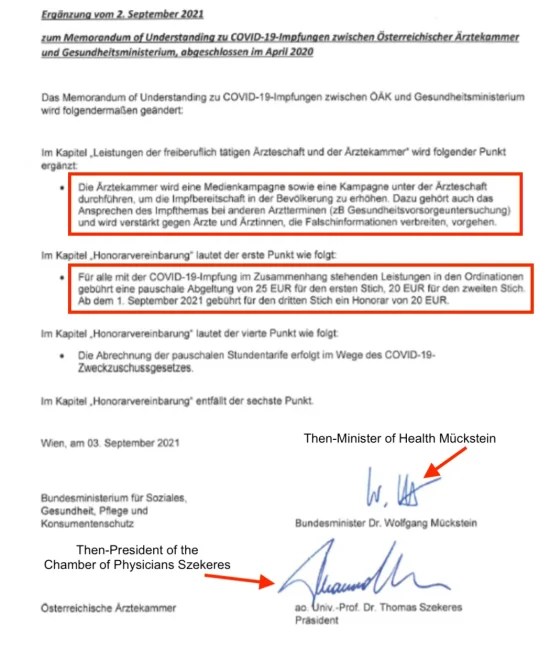
Highlighted passages are translated above; source: https://derstatus.at/politik/aerztekammer-diktierte-impf-empfehlung-466.html
Disciplinary Proceedings by the Medical Association Were (Are) Illegal
The behaviour of the leadership of the Chamber of Physicians’ leadership in recent years is now coming back to haunt them. For months, the medical association has been attacked, ridiculed, and had its very existence openly questioned by politicians. Having done their duty for politicians in the last three years without a peep, the Chamber is apparently no longer needed and may well be let go of. The Chamber of Physicians is sinking more and more into political insignificance. According to insiders, it is now even regarded as a political opponent, a situation that can also be seen in legacy media. After having served as a ‘doormat’ for politicians of all stripes for years, the Chamber of Physicians is now also being treated as such. Various scandals internal to the medical association reinforce this tendency. [talk about Karma, eh? Those who don’t have self-respect will have a hard time getting others’ respect… ]
In the meantime, the Regional Administrative Courts of Vienna, Lower Austria, and Vorarlberg have petitioned the Constitutional Court to repeal parts or the entire Disciplinary Law in the Physicians’ Act [Ärztegesetz, these parts of the Act permit the Chamber of Physicians to enforce standards] on grounds of their suspected unconstitutionality; it is possible that the Constitutional Court will rule even the entire Physicians’ Act unconstitutional. The Chamber of Physicians is a self-governing body. All its committees are to be selected from among its members, i.e., from medical professionals. However, the Disciplinary Commission consists of two medical assessors and a ‘judicially competent chairman’ who is appointed by the Minister of Health in agreement with the Minister of Justice, i.e., someone who must not be a trained physician and who does not come out of the Chamber of Physicians. Thus, the composition of the Disciplinary Commission is a violation of the Federal Constitution. This is the unanimous legal opinion of three state administrative courts [Verwaltungsgerichtshof] and countless jurists.
[I’ll have more to say about this particularity below, for time being: this is potentially huge—and it would be akin to completely re-writing the rules of medicine]
The Chamber of Physicians has unintentionally awakened sleeping dogs with its wave of ill-advised disciplinary hearings against critical doctors. The consequence may be that it now has to be completely re-imagined. But this could also be an opportunity for the medical profession after all the repression of doctors in recent years. For in its current form, the Chamber of Physicians is a politically superfluous enemy and, for its members, the doctors, a very expensive mandatory association whose dues are used to finance the functionaries’ luxury salaries.
From time immemorial, we’ve all known that a man’s—or woman’s—price is about, in purely monetary terms, 30 pieces of silver, to say nothing about the amorality and, yes, cowardice of most physicians everywhere.
The notion of buying off support has been well-established in the U.S. (see, e.g., here).
Here, we’re talking individual doctors who are paid handsomely for jabbing people.
Yet, this isn’t even the worst part of this.
The Three Axioms of Governance-by-Bureaucracy
You’ve gotta love them German-speakers for being so stupid to actually put these things into writing.
We now have definitive proof that the subsequent shenanigans—first and foremost the obnoxious Covid Passports — were based on the unholy trinity of questionable medical ethics (ahem), government coercion, and arbitrary definitions.
Remember that ‘fully vaccinated’ used to be two injections? Now it’s at least three, with the fourth jab ‘optional’ (haha, see above), and the Covid Passports come with expiration dates varying from 3-6 months, irrespective whether you’re ‘vaccinated’ or ‘recovered’.
Thus, we may formulate whatthe first axiom of governance-by-bureaucracy is: everything leaks.
In other words: arbitrary categories by government fiat, arrived at with the collaboration of the overwhelming majority of the medical profession.
If history is any guide, the Covid Passports are the functional equivalent of the Aryan Certificate deployed by Nazi Germany: both documents were clearly politically motivated and based on sham ‘The Science™’.
Yet, Covid is revelatory: we’ve seen the abject lack of integrity, morality, and compassion on part of the political caste, its willing executioners in legacy media, and its perpetrators among medical professionals.
Don’t ask what’s wrong with individuals. It’s the bloody ‘system’ that stands exposed.
Thus, we may formulate the second axiom of governance-by-bureaucracy: everyone has his or her price.
We’ve known this for quite some time; sure, I could cite the Nazi and Stalinist atrocities here, but I’d like to point you also to the Asch Conformity, the Milgram, and the Stanford Prison Experiments. Or the book The Wave.
And yet, despite all of this, there’s also a bright spot in all of this: contrary to the claims of postmodernist woke-fied agents-provocateurs, not everything in human society and relations is ‘socially constructed’ or about ‘power’.
A sizeable share of people everywhere has resisted the pressure to ‘get vaccinated’.
A group of doctors have resisted the pressures and temptations—remember the 30 pieces of silver—of collaboration and compliance with government tyranny.
If ‘booster’ uptake is any guide, more and more people are realising that they’ve been had.
Thus the third axiom: incentives and coercion work, until they don’t.
Our highly complex societies are, of course, more than the sum of their moving parts. Yet, given the highly integrated structures, it would be far-fetched to believe that anyone is able to control everything.
True, a lot can be dominated, but in the end, the ‘normative power of the factual’ (Georg Jellinek), in combination with individual experiences, is a powerful antidote to tyranny.
Still, this ain’t over yet, far from it.
If history is any guide, all that humans have ever been able to do is punish the perpetrators in the (vain) hope of establishing deterrence.
It has happened before, it is happening again, and it will happen again.
The next step is to see this through, re-establish the rule of law, and hold these people to account.
This is the moment. This is the time.
Where Is Occupy Silicon Valley?
By Craig Pirrong | Brownstone Institute | March 13, 2023
Bank failures tend to come in waves, and we are experiencing at least a mini-wave now.
Banks fail for three basic reasons: 1. Credit transformation: deterioration in borrower creditworthiness, usually due to an adverse economic shock (e.g., a real estate bust). 2. Maturity transformation: borrowing short, lending long, and then getting hammered when interest rates rise. 3. Liquidity transformation combined with an exogenous liquidity shock, a la Diamond-Dybvig, where idiosyncratic depositor needs for cash lead to withdrawals that exceed liquid assets and therefore trigger fire sales of illiquid assets.
The two most notable failures of late–Silicon Valley Bank and Silvergate–are examples of 2 and 3 respectively.
In some respects, SVB is the most astounding. Not because a bank failed in the old-fashioned way, but because it was funded primarily by the deposits of supposed financial sophisticates–and because of the disgusting policy response of the Treasury and the Fed.
SVB took in oodles of cash, especially in the past couple of years. The cashcade was so immense that SVB could not find enough traditional banking business (loans) to soak it up, so they bought lots of Treasuries. And long duration Treasuries to boot.
And then Powell and the Fed applied the boot, jacking up rates. Bonds have cratered in the last year, and took SVB’s balance sheet with it.
Again, an old story. And hardly a harbinger of systemic risk–unless such reckless maturity mismatches are systemic.
SVB was the Banker to the Silicon Valley Stars, notably VCs and tech firms. These firms are the ones that deposited immense sums in exchange for a pittance of return. Case in point, Roku, put almost $500 million–yes, you read that right, 9 figures led with a 5–into SVB!!!
I mean: what the eff? Was the Treasurer a moron? For who other than a moron would hold that much in cash in a single institution? (Roku claims its devices “make your home a smarter.” Maybe they should have hired a smarter treasurer and CFO, or replaced them with one of its devices). Hell, why is a company holding that much in cash period?
A few of these alleged masters of the universe (like Palantir) saw the writing on the wall and yanked their deposits: deposits fell by a quarter on Friday alone, sealing the bank’s doom. Those who were slow to run howled to the high heavens over the weekend that if there was not a bailout there would be a holocaust in the tech sector.
Even though the systemic risk posed by SVB’s failure is nil (or if not, then every bank is systemically important), the Treasury Department and the Fed responded to these howls and guaranteed all the deposits–even though the FDIC’s formal deposit insurance limit is $250,000. You know, .05 percent of Roku’s deposit.
When evaluating this, one cannot ignore the reality that the Democratic Party is completely beholden to Silicon Valley. This is beyond scandalous.
Occupy Silicon Valley, anyone?
Treasury Secretary Janet Yellen insulted our intelligence by assuring us this is not a bailout. Well, it’s not a taxpayer bailout, strictly speaking, because the Treasury is not providing the backstop. Instead, it is being funded by a “special assessment” on solvent banks. Which are owned and funded by people who also pay taxes. And such an “assessment” is a tax in everything but name–because it is a contribution by private entities compelled by the government.
The policy implications of this are disastrous. The whole problem with such bailouts is moral hazard. What is to stop banks from engaging in such reckless behavior as SVB did if they can obtain seemingly unlimited funding from those who know that they will be bailed out if things go pear-shaped?
And the regulatory failure here demonstrates that bank regulation–despite the supposed “reforms” of Frankendodd–can’t even catch or constrain the oldest bet-the-bank strategy in the book. Free banking–no deposit insurance, no bailing out of depositors–couldn’t do worse, and would likely do better.
No, the failure of SVB is not the scandal here. The scandal is the political response to it. This reveals yet again how captured the government is. This time not by Wall Street, but by tech companies and oligarchs that are currently the primary source of Democratic political funding.
A couple of weeks ago the Silvergate story looked juicy, but SVB has put it in the shade. Silvergate also grew dramatically, but on the back of crypto rather than SV tech. It became the main banker for many crypto firms and entrepreneurs. The crypto meltdown did not affect Silvergate directly, but it did crush its depositors, the aforesaid crypto firms and entrepreneurs. They withdrew a lot of funding, and an old-fashioned liquidity mismatch did it in.
In traditional banks, deposit funding is “sticky.” Banks that rely on wholesale funding (“hot money”) are more vulnerable to runs. Silvergate’s funding was not traditional sticky deposit funding, nor was it hot money per se. It was money that was pretty cool as long as crypto was cool, and became hot once crypto melted down.
A run started, but the run was precipitated by a liquidity shock. Simple story, really.
Silvergate’s failure was not a scandal. SVB’s failure per se was not a scandal (except to the extent that our vaunted banking regulators failed to prevent the most prosaic type of failure).
Again–the scandal is the politically tainted response that will have baleful consequences in the future, as the response virtually guarantees that there will be more SVBs in the future.
Let’s compare China’s ‘agents’ in Canada to Israel’s
By Yves Engler | March 11, 2023
What would happen if the media and intelligence agencies applied the same standard used regarding China to the Israel lobby?
In the Globe and Mail Andrew Coyne has written two columns in recent days arguing that the discussion over Chinese interference should focus on “domestic accomplices”. “What we need a public inquiry to look into is domestic complicity in foreign interference”, noted the regular CBC commentator.
In a similar vein Justin Trudeau responded to criticism regarding purported Chinese interference by noting, “We know that Chinese Canadian parliamentarians, and Chinese Canadians in general, are greater targets for interference by China than others.” The prime minister added, “We know the same goes for Iranian Canadians, who are more subject to interference from the Iranian government. Russian speakers in Canada are more vulnerable to Russian misinformation and disinformation.”
Why ignore how Israel and its Canadian lobby use Jewish MPs and Jewish organizations as their agents?
The leading Israel advocate in parliament, Anthony Housefather chairs the Canada-Israel Interparliamentary Group. That group was previously led by another Jewish Liberal MP, Michael Leavitt, who resigned to head Israel lobby group Friends of Simon Wiesenthal Center. Housefather and Leavitt have repeatedly met Israeli officials in Canada.
As part of the media frenzy about Chinese interference, there has been significant discussion about Trudeau attending a 2016 Liberal Party fundraiser at the Toronto home of Chinese Business Chamber of Canada chair Benson Wong. Among the attendees was Chinese Canadian billionaire Zhang Bin who is alleged to have donated to the Trudeau Foundation/University of Montréal at the request of a Chinese government official.
But Trudeau has far more extensive ties to pro-Israel funders. Since 2013 the chief fundraiser for the Trudeau Liberals has been Stephen Bronfman, scion of an arch Israeli nationalist family. Bronfman has millions invested in Israeli technology companies and over the years the Bronfman clan has secured arms for Israeli forces and supported its military in other ways. Bronfman openly linked his fundraising for Trudeau to Israel. In 2013 the Globe and Mail reported:
“Justin Trudeau is banking on multimillionaire Stephen Bronfman to turn around the Liberal Party’s financial fortunes in order to take on the formidable Conservative fundraising machine…. Mr. Bronfman helped raise $2-million for Mr. Trudeau’s leadership campaign. Mr. Bronfman is hoping to win back the Jewish community, whose fundraising dollars have been going more and more to the Tories because of the party’s pro-Israel stand. ‘We’ll work hard on that,’ said Mr. Bronfman, adding that ‘Stephen Harper has never been to Israel and I took Justin there five years ago and he was referring at the end of the trip to Israel as ‘we.’ So I thought that was pretty good.’”
In 2016 Trudeau attended a fundraiser at the Toronto home of now deceased billionaire apartheid supporters Honey and Barry Sherman. The event raised funds for the party and York Centre Liberal party candidate Michael Levitt. In 2018 CBC reported on multimillionaire Mitch Garber attending one of Bronfman’s fundraisers with Trudeau. On Federation CJA Montréal’s website Garber’s profile boasts that his “eldest son Dylan just completed his service as a lone soldier serving in an elite Cyber Defense Intelligence Unit of the IDF in Israel.”
A thorough investigation of pro-Israel Liberal fundraising would uncover a litany of other examples. And they’ve had far greater success. While the Trudeau government has banned Chinese firms, arrested a prominent Chinese capitalist and targeted that country militarily, they’ve been strikingly deferential to Israel. The Trudeau government has expanded the Canada-Israel free trade agreement, organized a pizza party for Canadians fighting in the Israeli military, voted against over 60 UN resolutions upholding Palestinian rights, sued to block proper labels on wines from illegal settlements and created a special envoy to deflect criticism of Israeli abuses. During a 2018 visit to Israel former foreign affairs minister Freeland announced that should Canada win a seat on the United Nations Security Council it would act as an “asset for Israel” on the Council.
Part of the Chinese interference story is about funding University of Montréal and University of Toronto initiatives tied to China. But Jewish Zionist donors have set up far more initiatives, including numerous Israel and Israel-infused Jewish studies programs.
Having fought to establish Israel and with major investments in Israel, David Azrieli spent $5 million to establish Israel studies and $1 million on Jewish studies at Concordia University. At the University of Toronto more than $10 million was donated to establish the Anne Tanenbaum Centre for Jewish Studies and the Andrea and Charles Bronfman Chair in Israeli Studies. Millions of dollars more have been donated to launch similar initiatives at other universities.
On many occasions pro-Israel donors have leveraged donations to block academic appointments or suppress discussion of Palestinian rights. The hundreds of millions of dollars donated by Israel supporters (Schwartz/Reissman, Peter Munk, Seymour Schulich, etc.) partly explains why over a dozen Canadian university presidents recently traveled with apartheid lobby group, the Centre for Israel and Jewish Affairs, to Israel despite opposition from significant segments of their institutions.
Much more influential than the ‘China lobby’, the Israel lobby has largely been ignored in recent discussion about the need for an inquiry into foreign interference. But any serious foreign agent registry ought to include the apartheid state’s domestic accomplices.
US House Passes Bill Prohibiting Government Workers From Censoring Speech in Official Role
Sputnik – 10.03.2023
WASHINGTON – The US House of Representatives passed a bill to prevent federal government employees from censoring speech in their official capacity, amid hearings by congressional committees on the collusion between tech companies and the government to “moderate” content online.
House lawmakers passed the Protecting Speech From Government Interference Act along partisan lines on Thursday in a vote of 219-206.
The bill prohibits employees of executive agencies or those otherwise in the competitive service from using their official authority to influence or advocate for a third party, including private entities, to censor speech.
“Government agencies such as the FBI and the State Department have been working behind-the-scenes with Big Tech to silence American citizens expressing conservative views online,” House Majority Leader Steve Scalise said in a statement on the bill. “Americans have the right to express themselves lawfully online without the government controlling the narrative.”
Earlier on Thursday, a House select subcommittee held a hearing with authors of the so-called Twitter Files to hear testimony on the collusion between Big Tech, government agencies and private organizations – dubbed the Censorship-Industrial Complex – to moderate, suppress and censor online content.
The Twitter Files have revealed how the US government collaborated with Big Tech companies such as Twitter to suppress information related to COVID-19 and the Hunter Biden laptop story, among others.
Featured Video

ARE PATIENTS BEING PROPERLY INFORMED ABOUT OZEMPIC?
or go to
Aletho News Archives – Video-Images
From the Archives
Trans ‘milk’ as good as the real thing – NHS
RT | February 18, 2024
The drug-induced nipple secretions of trans women are as good as mothers’ breast milk for babies, the University of Sussex Hospitals NHS Trust claimed in a letter to campaigners made public in a report by British think tank the Policy Exchange on Sunday.
The healthcare trust’s medical director, Rachel James, argued that the off-label prescription drug cocktail men transitioning to female take in order to produce milk was “similar to the natural hormones which encourage lactation to develop when the baby is newly born.”
“The evidence which is available demonstrates that the milk is comparable to that produced following the birth of a baby,” James wrote in the letter, sent to Children of Transitioners last August.
Biological men who wish to lactate must first take hormones to grow milk glands and then take high doses of either domperidone or metoclopramide to stimulate milk production. Neither drug is approved for this use, though they are occasionally prescribed off-label to biological women who have trouble lactating.
However, domperidone’s own manufacturer, Janssen, warns patients the drug “may cause unwanted side effects affecting the heart in a breastfed baby” and “should be used during breastfeeding only if your physician considers this clearly necessary.” … continue
Blog Roll
 Aletho News
- 2025 Nature Paper Claiming Worsening Global Drought Gets RETRACTED …Heavily Flawed
- Your Milk Is Not the Problem
- The Truth About the Trump Shootings with Ken Silva
- ARE PATIENTS BEING PROPERLY INFORMED ABOUT OZEMPIC?
- US lawmaker blocks $2.8 billion weapons sale to Israel: Report
- Yemeni army claims responsibility for strikes on sensitive sites in Saudi capital, Aramco facilities in Yanbu
- Iran Judiciary issues indictments against 159 US, Israeli officials for assassination of Leader, commanders
- Turkiye revokes Iranian bank license under US sanctions campaign
- US-Denmark Agreement on Greenland Is ‘PR Stunt’ Ahead of Midterms
- Araghchi: Military intervention cannot create security; coercion cannot bring peace
- If Americans Knew
- Israeli attacks kill four Palestinians in Gaza – Daily Update
- Inside Gaza’s death trap of collapsing, bombed-out buildings
- The everyday items Israel bans from Gaza every day
- Inside the siege, the ruined buildings of Gaza – Daily Update
- Debunking The Claim That Macklemore Has A “History Of Antisemitism”
- CPJ demands release of arrested Palestinian-US journalist near Bethlehem
- Robert Kraft: The Billionaire Friend of Netanyahu Pulling The Strings Behind the Macklemore/Ed Sheeran Blow Up
- Columbia Administered Fund Gives Big Money to Pro-Israel Groups
- Deportation Case of Palestinian Activist Salah Sarsour Tests First Amendment
- ‘We Will Not Forget’: Palestinians Mark 44 Years since Sabra and Shatila
- No Tricks Zone
- 2025 Nature Paper Claiming Worsening Global Drought Gets RETRACTED …Heavily Flawed
- New Study: ‘Global Drought Shows No Detectable Recent Acceleration Under Climate Warming’
- Economic Masterminds: German Socialists Suggest Taxing Productivity Gains Stemming From Using AI
- The South China Sea Has Not Been Cooperating With The Climate Change Narrative
- Energy Crisis: Germany Enters Heating Season With Historically Low Gas Reserve Fill Levels
- New Study: The Antarctic Ice Sheet Gained Mass From 2020-2024 Due To Staggering Snow And Ice Accumulation
- Study: Ocean Heating Rates From Thousands Of Years Ago ‘Dwarf’ Modern Ocean Heating Rates
- Climate Extremists Target, Attack Large-Scale Power Grid Infrastructure In Germany!
- New Study: Antarctic Ice Melt Has Contributed Less Than 1 Centimeter To Sea Level Rise In The Last 30 Years
- Fear Of Debate: Alarmist German Climate Scientist Calls On Mainstream Media To Discredit Skeptic Voices
 Aletho News