State Attorneys General tell Twitter to preserve censorship evidence
By Dan Frieth | Reclaim The Net | December 14, 2022
Missouri’s Attorney General Eric Schmitt who, together with Louisiana’s Attorney General Jeff Landry, filed a lawsuit alleging collusion between the federal government and social media companies to censor certain speech, sent a letter to Twitter asking for the preservation of evidence related to communications between the company and federal government officials on content moderation and misinformation.
We obtained a copy of the letter for you here.
Schmitt, who was elected to the Senate in November, referenced the internal documents, dubbed “Twitter Files,” that are being released by CEO Elon Musk via journalists Matt Taibbi, Bari Weiss, and Michael Shellenberger.
The files showed that then-deputy legal counsel Jim Baker, who was at the FBI before joining Twitter, was involved in the decision to censor the Hunter Biden laptop story.
After the release of the first batch of the Twitter Files, it was revealed that Baker was vetting the documents being released to Taibbi and other journalists. Baker was fired immediately.
On Monday, Schmitt announced: “We sent a letter to Twitter asking the platform to look into whether any key documents were deleted.”
The letter asks Twitter to preserve evidence related to the lawsuit, adding that the platform should take the necessary steps to prevent the destruction of evidence that might have happened at the direction of Baker.
“Further, we asked Twitter to reveal who from the federal government communicated with Twitter to censor speech. Based on our recent depositions, we believe the previous list we received pursuant to a third-party subpoena was incomplete,” Schmitt wrote. “Lastly, we asked Twitter to provide responsive documents pursuant to our original third-party subpoena.”
Related: Elon Musk hints censorship docs may have been hidden or deleted
Former Twitter CEO Takes Responsibility for Social Network’s Political Censorship
Samizdat – 14.12.2022
Co-founder and former CEO of Twitter Jack Dorsey said on Wednesday that he was the one responsible for the company’s susceptibility to government and corporate influence.
“Social media must be resilient to corporate and government control. Only the original author may remove content they produce. Moderation is best implemented by algorithmic choice. The Twitter when I led it and the Twitter of today do not meet any of these principles. This is my fault alone, as I completely gave up pushing for them when an activist entered our stock in 2020,” he wrote in his personal blog.
Dorsey said he realized that companies have become “far too powerful” once Twitter suspended the account of former US President Donald Trump in January 2021.
His biggest mistake was investing in the development of tools allowing the company “to manage the public conversation,” instead of “building tools for the people using Twitter to easily manage it for themselves,” Dorsey added. This, according to the former CEO, “burdened the company with too much power” and made it susceptible to “outside pressure.”
Twitter’s new owner, US billionaire Elon Musk, has reportedly given access to internal papers to a few independent journalists to investigate politically-motivated censorship in the company before his takeover. Bari Weiss and Matt Taibbi presented their findings in threads tweets earlier this month.
Weiss said she found that Twitter allegedly used to have a special team instructed to “build blacklists, prevent disfavored tweets from trending, and actively limit the visibility of entire accounts or even trending topics.” Taibbi alleged that prior to the 2020 US presidential elections, Twitter deliberately took measures to downplay the scandal around the laptop of US President Joe Biden’s son Hunter. The laptop reportedly had evidence of Hunter Biden’s participation in tax-related crimes, drug use, money laundering and illegal business dealings in foreign countries including Ukraine and China.
UK admits it sent troops to Ukraine
RT | December 13, 2022
British Royal Marines conducted high-risk operations in Ukraine in April, Lieutenant General Robert Magowan wrote in the force’s official journal. Before Magowan’s admission, Russia’s claims that NATO troops were active in Ukraine had been dismissed by Western analysts and media.
Members of 45 Commando Group of the Royal Marines left Ukraine in January after evacuating the British embassy in Kiev to Poland. However, some 300 members of the elite unit were sent back into the country in April to reestablish the British mission in Kiev, before going on to conduct “other discreet operations,” Magowan wrote in the force’s magazine, according to a report by The Times on Tuesday.
These operations took place “in a hugely sensitive environment and with a high level of political and military risk,” Magowan, who formerly served as commandant general of the Royal Marines and is now deputy chief of Defense Staff at the Ministry of Defense, stated.
While Magowan did not elaborate on what kind of missions the commandos carried out, his statement marks the first time that the UK has admitted its troops conducted special operations in Ukraine. The Ministry of Defense refused to confirm earlier accounts of British special forces training Ukrainian troops in Kiev in April.
Russian President Vladimir Putin has described the conflict in Ukraine as one between Russia and the “entire Western military machine,” and claimed in September that there are entire military units in Ukraine “under the de-facto command of Western advisers.”
Putin’s words were rejected by Western media outlets. “There is no evidence of NATO ground forces participating in Ukraine,” Edward Arnold of the Royal United Services Institute think tank told the BBC at the time. “Nor of NATO commanders directing Ukrainian units on the battlefield. There is also a very low likelihood of this happening in the future as Nato seeks to mitigate escalation risks.”
Magowan’s admission proves Arnold incorrect, but the UK is not the only NATO country to acknowledge the presence of its forces in Ukraine. An unnamed Pentagon official told reporters in October that an unspecified number of US troops were inspecting American arms shipments somewhere within Ukraine.
Elon Musk says some political candidates running for office were secretly shadow banned on Twitter
By Cindy Harper | Reclaim The Net | December 10, 2022
On Friday, Elon Musk confirmed that under previous leadership, political candidates were blacklisted on Twitter. In 2018, Twitter executives testified that the platform did not “shadow ban” people.
On Wednesday, journalist Bari Weiss published the second batch of “Twitter Files,” which showed that “teams of Twitter employees” built blacklists that were used to limit the spread of content.
People have always suspected that some users are shadow banned but Twitter has never been transparent about it and never tells users when they’re being suppressed. The documents obtained by Weiss showed that Twitter used “visibility filtering” to “suppress what people see to different levels.”
Weiss mentioned some of those who were added to the blacklists, including conservative commentators Dan Bongino and Charlie Kirk, Dr. Jay Bhattacharya, and Libs of TikTok. She did not say whether or not politicians were among those that were blacklisted.
Reporter Ian Miles Cheong asked both Musk and Weiss, “were any political candidates – either in the US or elsewhere – subject to shadowbanning while they were running for office or seeking re-election?” Musk responded, “Yes.”
Testifying before Congress in 2018, Twitter executives denied that users were suppressed based on political views.
“To be clear, our behavioral ranking doesn’t make judgments based on political views or the substance of tweets,” said Kayvon Beykpour, the former head of product.
“We don’t shadow ban, and we certainly don’t shadow ban based on political viewpoints. We do rank tweets by default to make Twitter more immediately relevant (which can be flipped off),” said former CEO Jack Dorsey.
UK-Israel Tech Hub facilitates Zionists’ penetration into British governance
Press TV – December 11, 2022
A leading British academic has depicted the integration of the UK-Israeli tech industry as a tool of Zionist “operatives” to infiltrate into the “very fabric” of the British governance.
David Miller, a former professor at Bristol University and a scholarly critic of Israel, made the comments on Press TV’s Palestine Declassified aired on Saturday, clarifying on the UK Israel Tech Hub’s true mission.
The UK Israel Tech Hub is based in the British Embassy in the occupied Palestine and is funded directly by the British taxpayer.
The organization, committed to Israel’s economic and tech interests, receives its financial resources through the British Foreign Office along with departments for Trade and Media.
The UK Israel Tech Hub, Miller said, is there to encourage integration between the tech industry in the UK and Israel, which is already happening and “on many occasions, we are seeing a penetration essentially into the very fabric of British governance by operatives of the Zionist regime.”
“A large number of people have gone straight from working for the Zionist entity into effectively working for the British taxpayer,” Miller said.
Indeed, when glancing at the employees of this organization who sit inside the British Embassy, the picture of state capture becomes clearer.
Haim Shani, the chairman of the UK Israel Tech Hub, previously served as director general of the Israeli ministry of finance. The director of this suspicious organization is Keren Shurkin, who started in the liaison department of the Israeli military.
The deputy director of the UK Israel Tech Hub is Ella Caplan, who claims to have been directly behind all interactions between a specific foreign army and the Israel military during her time in the liaison department.
Avital Levitsky went from working in Israeli military intelligence to the cyber security sector lead at the UK Israel Tech Hub in the British Embassy. And the list goes on.
Miller also added that the tech contracts between the UK and the Zionist regime are being used simply as a sort of data grab for the Israeli intelligence, citing Benjamin Netanyahu’s previous efforts to send people from Israeli intelligence organizations, in particular the signals intelligence Unit 8200, into the tech startups.
“These are people who are intended by the regime to carry the interests of Israel into the startups that they are engaged in,” he said.
Meanwhile, Mick Napier, a co-founder of the Scottish Palestine Solidarity Campaign, also described the UK Israel Tech Hub a “job creation program” for Israelis and a part of “100 percent full spectrum complicity” between the UK and Israel.
Napier stated that such projects “clearly” aim to defeat the Boycott, Divestment, Sanctions (BDS) campaign “as far as it possibly can.”
It is worth mentioning that BDS works to end international support for Israel’s oppression of Palestinians and pressure Israel to comply with international law.
Israeli firms infiltrate NHS
It is “very worrying that Israeli tech firms, staffed by people from former Israeli intelligence agencies, are able to get access to data in the British National Health Service (NHS),” Miller said of the Israeli tech industry penetration into the UK NHS.
The British Embassy-backed project, UK Israel Tech Hub, has been integral to the signing of a memorandum of understanding between Israel and the Northern Health Services Alliance (NHSA) to facilitate the expansion of the Israeli tech industry into the NHS.
Accordingly, the UK-Israel Tech Gateway, established through the tech hub, is set to grant the access of vast swathes of British citizens’ health data to Israeli tech companies.
Napier also voiced concerns over Israel’s access to British citizens’ health data saying that it allows “all sorts of blackmail” and “force people to collaborate and change their political behavior.”
Miller termed the extensive digital collaboration between Britain and Israel as “melding” rather than integration which is not merely limited to business activities but have an “intelligence component or interest.”
“There is integration increasingly between the interests of the Israelis and parts of the [UK] government apparatus, there are many other examples of people who are effectively operating for the interests of the Israelis inside the governmental apparatus in the [Palace of] Whitehall at Westminster,” Miller concluded.
In another episode of Palestine Declassified aired on November 26, Huda Ammori, a Palestinian activist and co-founder of the direct action network Palestine Action said that tech companies including Amazon and Google, are working with the Israeli military, and aiding in human rights violations and the colonization of the Palestinian people.
Ammori was making a reference to the notorious Project Nimbus Google’s $1.2bn artificial intelligence and surveillance contract with Amazon and the Israeli military.
What did the biggest anti-terror raid in German history uncover?
Free West Media | December 10, 2022
Some 36 hours after the largest raid in the history of Germany, there are increasing indications that the investigators apparently did not find the expected arsenal of weapons. The Attorney General has offered no explanation.
The massive raid continues to make waves, especially after more than 3 000 police officers searched more than 150 properties across Germany on Wednesday. At least 27 people were arrested and another 25 are being investigated. They are said to have planned an extensive armed coup.
But what have the investigators actually found in this unprecedented large-scale operation?
According to the Federal Criminal Police Office, weapons were found in 50 of the 150 locations searched. That sounds like an operation with a high risk potential, but conveys very little. In the past, baseball bats, Swiss army knives and brass knuckles were also considered “weapons” in comparable large-scale operations.
It is still not clear if the authorities have found machine guns, grenades or actual firearms. It would presumably take more than a handful of kitchen knives to launch a so-called planned military coup.
Attorney General is unusually unresponsive
Berlin weekly Junge Freiheit therefore sent the Federal Public Prosecutor a comprehensive catalog of questions about what items had been confiscated, how many firearms were among them and which of them were illegal. In view of the extent of the raid and the importance that Nancy Faeser’s (SPD) interior ministry has attached to it, it can be ruled out that the authorities do not know this already.
However, the Federal Public Prosecutor’s Office refuses to respond to the JF request: A spokesman asked “for your understanding that we are currently not commenting on the evidence found during the search measures – which have not yet been completed”.
It is apparently completely unclear why questions are raised in this regard or when the public will be informed. As a reminder, Faeser spoke of an “abyss of terrorist threat” from the rightwing.
These are strong words in a country where the RAF swept through Germany in the 1970s and where an Islamist with a truck killed twelve people and injured dozens more while driving into pedestrians at a Berlin Christmas market in 2016. It would be in Faeser’s interest to back up her peculiar comments with facts as soon as possible.
Service weapons found
According to German daily Welt, so far “a firearm”, stun guns, prepper supplies and thousands of euros in cash have been found. That sounds like a rather meager yield, especially since “thousands of euros” distributed over 150 houses searched certainly is no indication of the formation of a terrorist group. Notably, the Ministry of the Interior, in view of the risk of power cuts, has itself called for cash to be kept at home at all times.
The same applies to the supposed “prepper supplies”. The government has recommended that citizens prepare themselves extensively for emergencies due to risks associated with German support for the war in Ukraine.
It is therefore not clear where crisis prevention ends and supposed “prepping” starts. Since some of the suspects are said to have gun ownership cards, the discovery of stun guns is not surprising in the least. As a reminder, no parliament can be stormed with the latter.
The representatives of the Interior Committee in the Bundestag were said to have been informed a little more extensively on Friday. According to media reports, two rifles, a pistol and swords, stun guns and flare guns were confiscated. Even service weapons from accused police officers were taken. It is not yet known whether there were gun permits for the various weapons.
More and more media outlets have doubts
Meanwhile, doubts are growing in the media as to whether the historical raid was really appropriate. The editor-in-chief of Cicero, Alexander Marguier, wrote on Wednesday: “Today I spoke to a number of colleagues from other media – including those media that were at the forefront of the exuberant coverage of the treasonous plan. In unison (and of course only in confidence) it was said: It all seems completely exaggerated to us, but when the competition reacts so dramatically, we can’t take a tepid approach.”
The reporter Anna Schneider spoke on Twitter of an “extremely peculiar hysteria and staging of this spectacle”.
The former head of the parliamentary office of the Bild newspaper, Ralf Schuler, wrote on the social network that he could only hope that those responsible for the “giant raid” would also provide evidence of the alleged coup attempt.
The fact that numerous media had apparently been informed about the raids for some time can be considered proven in view of the fact that they arrived with camera teams on site at the same moment as the police task forces.
‘Organized media support’
The Neue Zürcher Zeitung (NZZ) commented: “The historical large-scale operation and the accompanying media reporting raise questions.”
The author noted: “In political Berlin it has been heard for days that there is ‘a big thing in the bush’. Some media obviously knew about the impending raids and arrests, because many editorial offices published extensive reports on the breaking news, which was actually quite new, almost at the same time – as if after an embargo.”
She considered the “organized media support of the operations” to be fundamentally problematic. “It indicates that the matter wasn’t that dangerous after all. In the latter case, the impression could arise that this is primarily – or also – a political public relations exercise.”
A ‘show’
The domestic policy spokeswoman for the Left Party in the Bundestag, Martina Renner, criticized the handling of the Interior Ministry with the raid by 3000 police officers. The so-called “anti-terror operation” against 25 suspects around the 71-year-old Heinrich XIII living in Frankfurt am Main, Prince Reuss shouldn’t be a “show”, said the politician, who has been in the Bundestag since 2013.
What Is CISA and Why Does It Matter?
By Jeffrey A. Tucker | Brownstone Institute | December 10, 2022
On October 27, 2022, Elon Musk fired Vijaya Gadde from her job at Twitter where she was general counsel and the head of legal, policy, and trust. It became quickly obvious to him and others on his team that it was she who drove the censorship policy within the company, including that which blocked all information about Hunter Biden’s laptop before the 2020 election and otherwise shut down critics of government Covid policy.
Her termination from Twitter did not leave her unemployed and homeless. A year earlier, she had already been tapped as an advisor to CISA, which is the government’s Cybersecurity and Infrastructure Security Agency headed by Jen Easterly, who was chosen to head the new agency (created in 2018) out of her tenure at the National Security Agency. As Freddy Gray puts it in the UK Spectator, “That seems fishy, to put it mildly.”
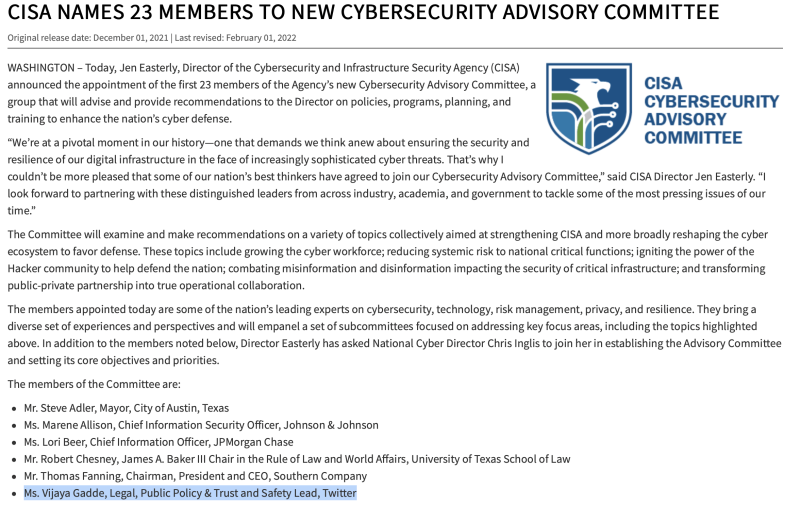
Easterly was called to give a deposition in the case brought by the Attorneys General of Missouri and Louisiana but the government rejected the idea. Fauci and others could be called but not the head of CISA. According to Epoch Times, the judge “ruled that three of the individuals—Murthy, Easterly, and Flaherty—will no longer be required to appear for a deposition after a federal appeals court blocked the move last month, stating that the judge had failed to consider whether alternative and less ‘intrusive’ means could be used to obtain the information being sought.”
Don’t want to be intrusive, right? That would be inhumane. Can’t make such a demand of the head of CISA.
And yet, it was CISA itself that gave the whole of the initial advisory in 2020 for all the stay-at-home orders that were imposed around the country. The agency is also the one primarily responsible for the division of the whole of the American workforce into sharp lines between essential and nonessential. It was a clear sign that something had gone very wrong, even to the point of feeling like martial law.
I’ve puzzled about where this all came from for almost three years. Thanks to research done by many Brownstone writers, we now know. It was CISA from the very beginning. Indeed the webpage laying it all out still survives, including a video. You can look at it all here.
The initial edict was issued March 19, 2020, three days following the catastrophic press conference that announced the need for universal social distancing and issued what is surely one of the most totalitarian edicts in the history of public policy: “indoor and outdoor venues where groups of people congregate should be closed.”
CISA explained the exception. It includes this helpful graphic of those who were entitled or even required to work while everyone else stays home.
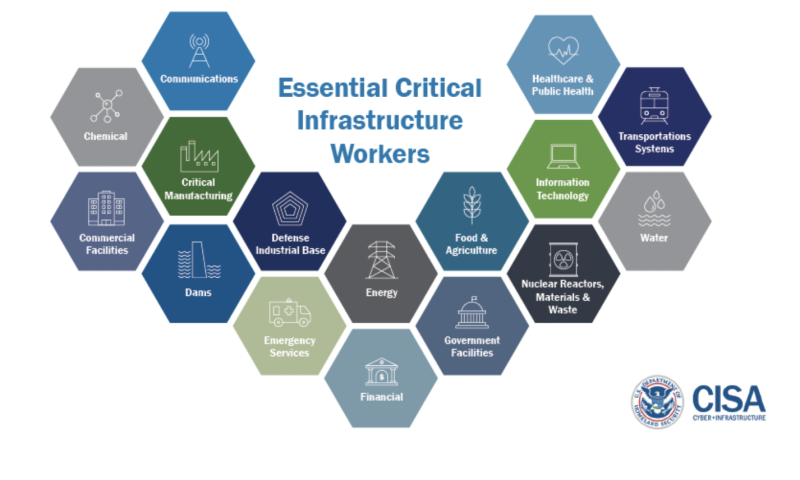
Note the inclusion of communications, which of course, means all media, and of course information technology, which means all Big Tech. As for “commercial facilities” that ended up meaning big-box chain stores while small businesses were brutally shut. Reinforcing the Trump administration’s fatwa against “bars, restaurants, and gyms,” they were closed immediately following the release of CISA’s order.
But of course, and consistent with all this machinery, CISA was careful to note that “This guidance was provided to clarify the potential scope of critical infrastructure to help inform decisions by state and local jurisdictions, but does not compel any prescriptive action.”
Further: “This guidance is not binding and is primarily a decision support construct to assist state and local officials. It should not be confused as official executive action by the United States Government.”
This way, like Fauci, CISA can claim that it didn’t force the shutdown of anything. It only made recommendations and state-level agencies took it from there. And yet here is a FAQ to give you a sense of the military footing that the whole country entered up on in the course of only a few days.
How is this different than traditional disasters or emergencies impacting critical infrastructure?
COVID-19 is different than any emergency the Nation has faced, especially considering the modern, tightly interconnected economy and American way of life. In traditional emergencies, government coordinates with the private sector to get businesses back to business. In this case, as the government works with partners to slow the spread of COVID-19, the economic goal is maintaining resilience of the Nation’s foundation—its critical infrastructure.
In retrospect, the whole thing seems truly hard to believe, all for a respiratory virus with an infection fatality rate that compares with the flu except with a huge risk gradient by age. A military-style cooperation was unleashed on the entire country even as basic therapeutics were completely neglected and concern for collateral damage to health, culture, education, and enterprise were tossed out the window.
The initial lockdowns were followed by quarantine rules, travel restrictions, violations of religious freedom, forced masking and eventually forced medicalization of quickly approved shots that most of the population never needed and vast numbers now regret.
As CISA said, this crisis was “different than any emergency the Nation has faced.” Instead of keeping business going, the response this time was massive destruction of everything except “critical infrastructure.”
Indeed, the whole country fell into complete shambles and trauma for the better part of 2020, leading up to the November elections that gutted Republican control of Congress and flipped the White House. We are now finding out with piles of evidence that this was the ambition of many employees at Twitter, including the general counsel who ended up as a consultant to the very agency that issued the stay-home advisory.
CISA is part of the Department of Homeland Security, created only in 2018 with an act signed by President Trump. As is clear from the text of the law, the whole point was to protect the nation against cyber attacks and develop a response. Nowhere in the text could one discern a broad edict to divide the whole workforce, crush civil liberties, smash businesses, and trample on the Bill of Rights, much less shepherd into being a vast machinery of censorship that would effectively nationalize all major tech platforms on behalf of regime priorities.
On the weekend of March 14-15, 2020, Trump surrounded himself with a handful of advisors including Fauci, Birx, Pence, Kushner, along with a few outside consultants from pharma and tech, and agreed to “15 days to flatten the curve.” It seems highly unlikely he knew that he was approving a complete takeover of the country by the national security arm of the government, much less empowering this one agency with the task of crushing the whole economy except that which government called essential.
We are finding out ever more about what went on behind the scenes, especially thanks to the exceptional research of Debbie Lerman, who has fleshed out the underlying shift that occurred in these days. We went from being a normal nation with all the usual struggles to a country under quasi-martial law, ruled by administrative bureaucrats drawn from the national security arm of government. CISA was an agency that led the charge. Did Trump have any idea what he had approved? I would say it is highly doubtful.
I’ve been unable to find out anything about the agency’s budget or payroll but we do know that it is hiring: “CISA is always searching for diverse, talented, and highly motivated professionals to continue its mission of securing the nation’s critical infrastructure. CISA is more than a great place to work; our workforce tackles the risks and threats that matter most to the nation, our families, and communities. With more than 50 career fields available CISA offers multiple opportunities as well as multiple tracks for employment.”
Jeffrey A. Tucker, Founder and President of the Brownstone Institute, is an economist and author. He has written 10 books, including Liberty or Lockdown, and thousands of articles in the scholarly and popular press.
Featured Video
Integrity Initiative: UK-funded network framed dissent as Russian disinformation for years
or go to
Aletho News Archives – Video-Images
From the Archives
Why Saudi Ties to 9/11 Mean U.S. Ties to 9/11
By Kevin Ryan | Dig Within | September 27, 2015
Media interest in Saudi Arabian connections to the crimes of 9/11 has centered on calls for the release of the 28 missing pages from the Joint Congressional Inquiry’s report. However, those calls focus on the question of hijacker financing and omit the most interesting links between the 9/11 attacks and Saudi Arabia—links that implicate powerful people in the United States. Here are twenty examples. … continue
Blog Roll
 Aletho News
- Iraqi Resistance faction links arms to sovereignty, questions US exit
- Cannon fodder no more… South Korea rejects Trump’s pressure to join his criminal war on Iran
- Neria Leiter Was A Legitimate Military Target
- Integrity Initiative: UK-funded network framed dissent as Russian disinformation for years
- ‘We don’t seek permission to defend our country’: Snippets from President Pezeshkian’s UNGA address
- NATO chief wants Europeans to fight American wars [for Israel]
- German chemicals giant reveals details of downsizing
- Refaat Al-Areer Was The Canary In The Coal Mine In Israel’s War On The Truth
- Israeli election committee bars candidate from Knesset race over Gaza war opposition
- French-Lebanese man files war crimes complaint over Israeli attacks
- If Americans Knew
- Aid, reconstruction, and Israel’s history of obstruction in Gaza
- Trump administration digs an ever-deeper hole of complicity in genocide – Daily Update
- US-Israel $2.8 Billion Arms Deal, 40,000-Bomb Supply Faces New Gaza Complicity Accusations
- Caught on Tape: AIPAC CEO Boasted of Controlling Trump’s National Security Officials
- Why Hamas Attacked Israel in October 2023 – Israeli professor Ilan Pappé
- They see them, then kill them: Israeli quadcopters track, deliberately target civilians in Gaza
- Winter could turn Gaza’s treacherous, war-damaged buildings into deathtraps
- Majority of Democratic Voters Want to Prosecute Both Biden and Trump Administration Officials Over Gaza
- As Gaza languishes, world leaders gather at the UN – Daily Update
- Sanctions are collective punishment: immoral and self-defeating
- No Tricks Zone
- New Study: Earth And Venus Surface Warmth Largely Explained By Convection And Lapse Rate, Not CO2 Or Radiation
- 2025 Nature Paper Claiming Worsening Global Drought Gets RETRACTED …Heavily Flawed
- New Study: ‘Global Drought Shows No Detectable Recent Acceleration Under Climate Warming’
- Economic Masterminds: German Socialists Suggest Taxing Productivity Gains Stemming From Using AI
- The South China Sea Has Not Been Cooperating With The Climate Change Narrative
- Energy Crisis: Germany Enters Heating Season With Historically Low Gas Reserve Fill Levels
- New Study: The Antarctic Ice Sheet Gained Mass From 2020-2024 Due To Staggering Snow And Ice Accumulation
- Study: Ocean Heating Rates From Thousands Of Years Ago ‘Dwarf’ Modern Ocean Heating Rates
- Climate Extremists Target, Attack Large-Scale Power Grid Infrastructure In Germany!
- New Study: Antarctic Ice Melt Has Contributed Less Than 1 Centimeter To Sea Level Rise In The Last 30 Years

