More Game-Playing on MH-17?
By Robert Parry | Consortium News | May 24, 2016
A newly posted video showing a glimpse of a Buk missile battery rolling down a highway in eastern Ukraine has sparked a flurry of renewed accusations blaming Russia for the July 17, 2014 shoot-down of Malaysia Airlines Flight 17 killing 298 people. But the “dash-cam video” actually adds little to the MH-17 whodunit mystery because it could also support a narrative blaming the Ukrainian military for the disaster.
The fleeting image of the missile battery and its accompanying vehicles, presumably containing an armed escort, seems to have been taken by a car heading west on H-21 highway in the town of Makiivka, as the convoy passed by heading east, according to the private intelligence firm Stratfor and the “citizen journalism” Web site, Bellingcat.
However, even assuming that this Buk battery was the one that fired the missile that destroyed MH-17, its location in the video is to the west of both the site where Almaz-Antey, the Russian Buk manufacturer, calculated the missile was fired, around the village of Zaroshchenskoye (then under Ukrainian government control), and the 320-square-kilometer zone where the Dutch Safety Board speculated the fateful rocket originated (covering an area of mixed government and rebel control).
In other words, the question would be where the battery stopped before firing one of its missiles, assuming that this Buk system was the one that fired the missile. (The map below shows the location of Makiivka in red, Almaz-Antey’s suspected launch site in yellow, and the general vicinity of the Dutch Safety Board’s 320-square-kilometer launch zone in green.)
Another curious aspect of this and the other eight or so Internet images of Buk missiles collected by Bellingcat and supposedly showing a Buk battery rumbling around Ukraine on or about July 17, 2014, is that they are all headed east toward Russia, yet there have been no images of Buks heading west from Russia into Ukraine, a logical necessity if the Russians gave a Buk system to ethnic Russian rebels or dispatched one of their own Buk military units directly into Ukraine, suspicions that Russia and the rebels have denied.
The absence of a westward-traveling Buk battery fits with the assessment from Western intelligence agencies that the several operational Buk systems in eastern Ukraine on July 17, 2014, were under the control of the Ukrainian military, a disclosure contained in a Dutch intelligence report released last October and implicitly confirmed by an earlier U.S. “Government Assessment” that listed weapons systems that Russia had given the rebels but didn’t mention a Buk battery.
The Netherlands’ Military Intelligence and Security Service (MIVD) reported that the only anti-aircraft weapons in eastern Ukraine capable of bringing down MH-17 at 33,000 feet on July 17 belonged to the Ukrainian government. MIVD made that assessment in the context of explaining why commercial aircraft continued to fly over the eastern Ukrainian battle zone in summer 2014.
MIVD said that based on “state secret” information, it was known that Ukraine possessed some older but “powerful anti-aircraft systems” capable of downing a plane at that altitude and “a number of these systems were located in the eastern part of the country,” whereas the MIVD said the ethnic Russian rebels had only MANPADS that could not reach the higher altitudes.
Ukrainian Offensive
On July 17, the Ukrainian military also was mounting a strong offensive against rebel positions to the north and thus the front lines were shifting rapidly, making it hard to know exactly where the borders of government and rebel control were. To the south, where the Buk missile was believed fired, the battle lines were lightly manned and hazy – because of the concentration of forces to the north – meaning that an armed Buk convoy could probably move somewhat freely.
Also, because of the offensive, the Ukrainian government feared a full-scale Russian invasion to prevent the annihilation of the rebels, explaining why Kiev was dispatching its Buk systems toward the Russian border, to defend against potential Russian air strikes.
Just a day earlier, a Ukrainian fighter flying along the border was shot down by an air-to-air missile (presumably fired by a Russian warplane), according to last October’s Dutch Safety Board report. So, tensions were high on July 17, 2014, when MH-17, flying from Amsterdam to Kuala Lumpur, broke apart over eastern Ukraine, believed downed by a surface-to-air missile although there have been other suggestions that the plane might have been hit by an air-to-air missile.
At the time, Ukraine also was the epicenter of an “information war” that had followed a U.S.-backed coup on Feb. 22, 2014, which ousted democratically elected President Viktor Yanukovych and replaced the Russian-friendly leader with a fiercely nationalistic and anti-Russian regime in Kiev. The violent coup, in turn, prompted Crimea to vote 96 percent in a hasty referendum to secede from Ukraine and rejoin Russia. Eastern Ukraine and its large ethnic Russian population also revolted against the new authorities.
The U.S. government and much of the Western media, however, denied there had been a coup in Kiev, hailed the new regime as “legitimate,” and deemed Crimea’s secession a “Russian invasion.” The West also denounced the eastern Ukrainian resistance as “Russian aggression.” So, the propaganda war was almost as hot as the military fighting, a factor that has further distorted the pursuit of truth about the MH-17 tragedy.
Immediately after the MH-17 crash, the U.S. government sought to pin the blame on Russia as part of a propaganda drive to convince the European Union to join in imposing economic sanctions on Russia for its “annexation” of Crimea and its support of eastern Ukrainians resisting the Kiev regime.
However, a source briefed by U.S. intelligence analysts told me that the analysts could find no evidence that the Russians had supplied the rebels with a sophisticated Buk system or that the Russians had introduced a Buk battery under their own command. The source said the initial intelligence suggested that an undisciplined Ukrainian military team was responsible.
Yet, on July 20, 2014, just three days after the tragedy, Secretary of State John Kerry appeared on all Sunday morning talk shows and blamed the Russian-backed rebels and implicitly Moscow. He cited some “social media” comments and – on NBC’s “Meet the Press” – added: “We picked up the imagery of this launch. We know the trajectory. We know where it came from. We know the timing. And it was exactly at the time that this aircraft disappeared from the radar.”
Two days later, on July 22, the Obama administration released a “Government Assessment” that tried to bolster Kerry’s accusations, in part, by listing the various weapons systems that U.S. intelligence believed Russia had provided the rebels, but a Buk battery was not among them. At background briefings for selected mainstream media reporters, U.S. intelligence analysts struggled to back up the administration’s case against Russia.
For instance, the analysts suggested to a Los Angeles Times reporter that Ukrainian government soldiers manning the suspected Buk battery may have switched to the rebel side before firing the missile. The Times wrote: “U.S. intelligence agencies have so far been unable to determine the nationalities or identities of the crew that launched the missile. U.S. officials said it was possible the SA-11 [Buk anti-aircraft missile] was launched by a defector from the Ukrainian military who was trained to use similar missile systems.”
However, after that July 22 briefing — as U.S. intelligence analysts continued to pore over satellite imagery, telephonic intercepts and other data to refine their understanding of the tragedy — the U.S. government went curiously silent, refusing to make any updates or adjustments to its initial rush to judgment, a silence that has continued ever since.
Staying Silent
Meanwhile, the source who continued receiving briefings from the U.S. intelligence analysts told me that the reason for going quiet was that the more detailed evidence pointed toward a rogue element of the Ukrainian military connected to a hardline Ukrainian oligarch, with the possible motive the shooting down of President Vladimir Putin’s plane returning from a state visit to South America.
In that scenario, a Ukrainian fighter jet in the vicinity (as reported by several eyewitnesses on the ground) was there primarily as a spotter, seeking to identify the target. But Putin’s plane, with similar markings to MH-17, took a more northerly route and landed safely in Moscow.

A side-by-side comparison of the Russian presidential jetliner and the Malaysia Airlines plane.
Though I was unable to determine whether the source’s analysts represented a dissenting or consensus opinion inside the U.S. intelligence community, some of the now public evidence could fit with that narrative, including why the suspected Buk system was pushing eastward as close to or even into “rebel” territory on July 17.
If Putin was the target, the attackers would need to spread immediate confusion about who was responsible to avoid massive retaliation by Moscow. A perfect cover story would be that Putin’s plane was shot down accidentally by his ethnic Russian allies or even his own troops, the ultimate case of being hoisted on his own petard.
Such a risky operation also would prepare disinformation for release after the attack to create more of a smokescreen and to gain control of the narrative, including planting material on the Internet to be disseminated by friendly or credulous media outlets.
The Ukrainian government has denied having a fighter jet in the air at the time of the MH-17 shoot-down and has denied that any of its Buk or other anti-aircraft systems were involved.
Yet, whatever the truth, U.S. intelligence clearly knows a great deal more than it has been willing to share with the public or even with the Dutch-led investigations. Last October, more than a year after the shoot-down, the Dutch Safety Board was unable to say who was responsible and could only approximate the location of the missile firing inside a 320-square-kilometer area, whereas Kerry had claimed three days after the crash that the U.S. government knew the launch point.
Earlier this year, Fred Westerbeke, the chief prosecutor of the Dutch-led Joint Investigative Team [JIT], provided a partial update to the Dutch family members of MH-17 victims, explaining that he hoped to have a more precise fix on the firing site by the second half of 2016, i.e., possibly more than two years after the tragedy.
Westerbeke’s letter acknowledged that the investigators lacked “primary raw radar images” which could have revealed a missile or a military aircraft in the vicinity of MH-17. That apparently was because Ukrainian authorities had shut down their primary radar facilities supposedly for maintenance, leaving only secondary radar which would show commercial aircraft but not military planes or rockets.
Russian officials have said their radar data suggest that a Ukrainian warplane might have fired on MH-17 with an air-to-air missile, a possibility that is difficult to rule out without examining primary radar which has so far not been available. Primary radar data also might have picked up a ground-fired missile, Westerbeke wrote.
“Raw primary radar data could provide information on the rocket trajectory,” Westerbeke wrote. “The JIT does not have that information yet. JIT has questioned a member of the Ukrainian air traffic control and a Ukrainian radar specialist. They explained why no primary radar images were saved in Ukraine.” Westerbeke said investigators are also asking Russia about its data.
Westerbeke added that the JIT had “no video or film of the launch or the trajectory of the rocket.” Nor, he said, do the investigators have satellite photos of the rocket launch.
“The clouds on the part of the day of the downing of MH17 prevented usable pictures of the launch site from being available,” he wrote. “There are pictures from just before and just after July 17th and they are an asset in the investigation.”
Though Westerbeke provided no details, the Russian military released a number of satellite images purporting to show Ukrainian government Buk missile systems north of the eastern Ukrainian city of Donetsk before the attack, including two batteries that purportedly were shifted 50 kilometers south of Donetsk on July 17, the day of the crash, and then removed by July 18.
Russian Lt. Gen. Andrey Kartopolov called on the Ukrainian government to explain the movements of its Buk systems and why Kiev’s Kupol-M19S18 radars, which coordinate the flight of Buk missiles, showed increased activity leading up to the July 17 shoot-down.
Necessary Secrets?
Part of the reason that the MH-17 mystery has remained unsolved is that the U.S. government insists that its satellite surveillance, which includes infrared detection of heat sources as well as highly precise photographic imagery, remains a “state secret” that cannot be made public.
However, in similar past incidents, the U.S. government has declassified sensitive information. For instance, after a Soviet pilot accidentally shot down Korean Airlines Flight 007 over Russian territory in 1983, the Reagan administration revealed the U.S. capability to intercept Soviet ground-to-air military communications in order to make the Soviets look even worse by selectively editing the intercepts to present the destruction of the civilian aircraft as willful.
In that case, too, the U.S. government let its propaganda needs overwhelm any commitment to the truth, as Alvin A. Snyder, who in 1983 was director of the U.S. Information Agency’s television and film division, wrote in his 1995 book, Warriors of Disinformation.
After KAL-007 was shot down, “the Reagan administration’s spin machine began cranking up,” Snyder wrote. “The objective, quite simply, was to heap as much abuse on the Soviet Union as possible. … The American media swallowed the U.S. government line without reservation.”
On Sept. 6, 1983, the Reagan administration went so far as to present a doctored transcript of the intercepts to the United Nations Security Council. “The perception we wanted to convey was that the Soviet Union had cold-bloodedly carried out a barbaric act,” Snyder wrote.
Only a decade later, when Snyder saw the complete transcripts — including the portions that the Reagan administration had excised — would he fully realize how many of the central elements of the U.S. presentation were lies.
Snyder concluded, “The moral of the story is that all governments, including our own, lie when it suits their purposes. The key is to lie first.” [For more details on the KAL-007 deception and the history of U.S. trickery, see Consortiumnews.com’s “A Dodgy Dossier on Syrian War.”]
In the MH-17 case, the Obama administration let Kerry present the rush to judgment fingering the Russians and the rebels but then kept all the evidence secret even though the U.S. government’s satellite capabilities are well-known. By refusing to declassify any information for the MH-17 investigation, Washington has succeeded in maintaining the widespread impression that Moscow was responsible for the tragedy without having to prove it.
The source who was briefed by U.S. intelligence analysts told me that the Obama administration considered “coming clean” about the MH-17 case in March, when Thomas Schansman, the Dutch father of the only American victim, was pleading for the U.S. government’s cooperation, but administration officials ultimately decided to keep quiet because to do otherwise would have “reversed the narrative.”
In the meantime, outfits such as Bellingcat have been free to reinforce the impression of Russian guilt, even as some of those claims have proved false. For instance, Bellingcat directed a news crew from Australia’s “60 Minutes” to a location outside Luhansk (near the Russian border) that the group had identified as the site for the “getaway video” showing a Buk battery with one missile missing.
The “60 Minutes” crew went to the spot and pretended to be at the place shown in the video, but none of the landmarks matched up, which became obvious when screen grabs of the video were placed next to the scene of the Australian crew’s stand-upper. [See Consortiumnews.com’s “Fake Evidence Blaming Russia for MH-17.”]
Yet, reflecting the deep-seated mainstream media bias on the MH-17 case, the Australian program reacted angrily to my pointing out the obvious discrepancies. In a follow-up, the show denounced me but could only cite a utility pole in its footage that looked similar to a utility pole in the video.
While it’s true that utility poles tend to look alike, in this case none of the surroundings did, including the placement of the foliage and a house shown in the video that isn’t present in the Australian program’s shot. [For details, see Consortiumnews.com’s “A Reckless Stand-upper on MH-17.”]
But the impact of the nearly two years of one-sided coverage of the MH-17 case in the mainstream Western media has been considerable. In the last few days, a lawyer for the families of Australian victims announced the filing of a lawsuit against Russia and Putin in the European court for human rights seeking compensation of $10 million per passenger. Many of the West’s news articles on the lawsuit assume Russia’s guilt.
In other words, whatever the truth about the MH-17 shoot-down, the tragedy has proven to be worth its weight in propaganda gold against Russia and Putin, even as the U.S. government hides the actual proof that might show exactly who was responsible.
(Research by Assistant Editor Chelsea Gilmour.)
Investigative reporter Robert Parry broke many of the Iran-Contra stories for The Associated Press and Newsweek in the 1980s. You can buy his latest book, America’s Stolen Narrative, either in print here or as an e-book (from Amazon and barnesandnoble.com).
Brother of ‘Guantanamo Diary’ author denied entry to US
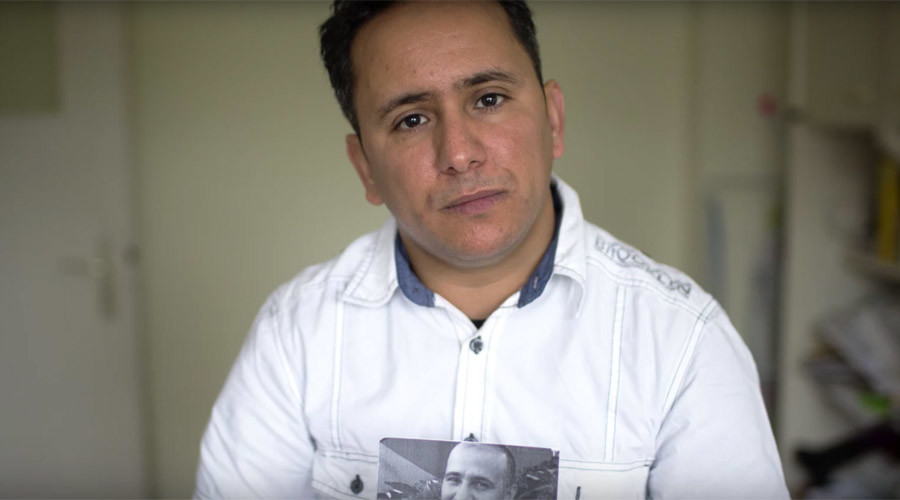
Yahdih Ould Slahi holds up a photo of his brother Mohamedou in a May 2016 video by American Civil Liberties Union © acluvideos / YouTube
RT | May 24, 2016
US authorities detained, interrogated and sent back a German citizen flying in to campaign for the release of his brother – author of the best-selling “Guantanamo Diary,” who has been imprisoned and tortured at the US camp since 2002.
Mohamedou Ould Slahi’s memoir, heavily redacted by government censors, was published in 2015 and quickly became a best-seller. The Mauritanian native was arrested in 2001 and rendered to Jordan for interrogation by the CIA. He was transferred to Guantanamo Bay the following year.
His younger brother Yahdih, a German citizen, has campaigned for Mohamedou’s release for years. Yahdih was supposed to attend a number of events in the US this week, seeking to persuade Guantanamo’s Periodic Review Board to set Mohamedou free at the June 2 hearing.
When Yahdih Slahi arrived at the John F. Kennedy airport in New York on Saturday, however, he was detained by US Customs and Border Patrol (CBP) agents, questioned for hours, and sent back to Germany the following day, The Intercept reported.
“He was asked questions about his family, his brother, and what he knew about why his brother was in Guantánamo,” said Hina Shamsi of the American Civil Liberties Union. “It was a harrowing, stressful, and exhausting experience.”
Yahdih Slahi is a German citizen who lives in Düsseldorf, and would have been able to enter the US under the visa waiver program that Germany participates in. The CBP gave no explanation for denying Slahi entry.
In his memoir, Mohamedou Slahi described being held in isolation and subjected to beatings, extreme cold, sleep deprivation, sexual abuse, a simulated kidnapping, and a simulated execution. At one point, his captors tried to trick him by showing him a forged letter from his mother, Yahdih recounted in 2015. The ploy failed because the forgery misspelled Slahi’s name – and because, unbeknownst to his jailers, Slahi’s mother was illiterate.
Mohamedou Slahi admits that he fought in Afghanistan in the early 1990s with what became Al-Qaeda– when the organization was backed by the US in its struggle against the socialist government in Kabul. While he had nothing to do with Al-Qaeda since 1992, Slahi did stay in touch with his cousin and former brother-in-law, Mahfouz Ould al-Walid, who served as a lieutenant to Osama Bin Laden.
Slahi was never charged with any crime, but the 2010 decision to release him has been held up by government appeals.
“The judge said there was no evidence in 2010 to hold him. There’s certainly not evidence now. The Chief Prosecutor said when he resigned in 2007, that there was no evidence then,” Slahi’s attorney Nancy Hollander told RT in January 2015.
Slahi’s family and friends hope the Periodic Review Board will recommend his release at the June 2 hearing. The inter-agency panel ruled on Monday to set free an Afghan man, known only as Obaidullah, who was held at Guantanamo for 14 years.
It took a decade of fighting with the government for the Guantanamo Diary, written in 2005, to see the light of day. Slahi is the first Guantanamo prisoner to publish a memoir while still at the camp. He has not been allowed to receive a copy of his book.
U.S. Government Secretly Destroyed Evidence in Trial of Accused “9/11 Masterminds”
By Derrick Broze | Activist Post | May 21, 2016
In another setback for the death penalty trial of the five men accused of aiding the terrorist attacks of September 11, 2001, two defense lawyers for Khalid Shaikh Mohammed say the U.S. government secretly destroyed relevant evidence.
On May 11, defense lawyers for the accused mastermind of the 9/11 terror attacks asked for judge Col. James Pohl and the prosecution team to be recused from the trial, and for the case to be shut down. Defense lawyers David Nevin and Maj. Derek Poteet say that the U.S. government destroyed evidence related to the case, according to the New York Times. The two men are unable to provide further details because the issue is classified, but Mr. Nevin said the evidence was “favorable” to the defendants.
Major Poteet also told the Times that the defense was first informed in February that Colonel Pohl would provide them with a “summary of a substitute” for the original, classified evidence. The defense requested Colonel Pohl to preserve the evidence for the record and Pohl complied. Or so they thought.
“But they learned in February, they said, that about 20 months earlier, and without their knowledge, prosecutors had obtained from Colonel Pohl a secret order that reversed his previous decision,” the Times writes. “By the time they found out, the government had already destroyed the evidence, giving them no opportunity to challenge the move.”
Major Poteet said the situation created the appearance that Colonel Pohl was “colluding with the government.” The Times reports that the original, now destroyed evidence, may have been related to one of several foreign black site prisons operated by the Central Intelligence Agency in Thailand, Poland, Romania, Lithuania and Afghanistan, and at a secret site at the Guantánamo base. KSM was tortured for several years at one of these sites before being transferred to the military prison at Guantánamo Bay, Cuba in 2006.
The accusations are likely to delay upcoming scheduled hearings from May 30 to June 3. If there is a delay it will be latest in a long line of interruptions to this alleged pursuit of justice. Most recently, Col. Pohl canceled two weeks of hearings that were scheduled to begin on Friday, April 1st.
“The whole thing is really odd to me. I thought it was an April Fools’ joke,” said Chicago defense attorney Cheryl Bormann, who was already in Washington to travel to Guantánamo this weekend to represent alleged 9/11 plot deputy Walid bin Attash.
The destruction of evidence is, unfortunately, not the first controversy this trial has faced. Another conflict of interest became an issue in 2014 when the defense attorneys for Mohammed and the four alleged co-conspirators said they believed they were being spied on by the Federal Bureau of Investigation.
Foreign Policy reported,
the FBI had secretly conducted an investigation into possible wrongdoing on the part of one or more members of the five separate defense teams (one for each defendant). Such an investigation could put defense team members in the untenable position of having to provide information to defend themselves or others against possible criminal action — information that could be used against the interests of their own clients.
There was also the issue of interference from outside sources during the hearings. FP continues:
In January 2013, the court’s audio-visual feed, visible to a small set of commission observers, was abruptly cut off by someone other than Judge Pohl; previously, Pohl was believed to be the only person with the authority to use the unique-to-Guantanamo “kill-switch.”
Later, a clearly annoyed Pohl learned that something called the Original Classification Authority (OCA) — which is likely the CIA given that most of the information subject to censorship in the case is related to the agency’s rendition, detention, and interrogation program — had hit the kill switch. Judge Pohl promptly cut off their privileges.
In February 2013 it was revealed that listening devices were hidden within smoke detectors, possibly infringing upon attorney-client privileges. The defense also claimed their emails and work files were disappearing. Former defendant Ramzi Bin al-Shibh was also removed from the trial by the judge in an attempt to speed the process along after so many delays. However, critics argue that al-Shibh was removed because he refused to be quiet, complaining loudly of sleep deprivation.
Is this trial really about truth, justice, and upholding law and order? If the military court hopes to find something close to the truth they should open the hearings to the public, end the spying on the defense team, and be transparent about the treatment of the alleged hijackers. Only by allowing the truth to be released will the wounds of 9/11 begin to heal.
Derrick Broze is an investigative journalist and liberty activist. He is the Lead Investigative Reporter for ActivistPost.com and the founder of the TheConsciousResistance.com. Follow him on Twitter.
New Brazil cabinet in trouble after leaks on anti-Rousseff plot
Press TV – May 24, 2016
Brazil’s interim government has been rattled by a leaked audio tape suggesting a plot against suspended President Dilma Rousseff, a scandal that forced a key minister in the new cabinet to resign.
Brazilian Planning Minister Romero Juca, a close ally of acting President Michel Temer, said Monday he is stepping down.
The decision came a day after a Brazilian newspaper published the transcript of a secretly-taped conversation between him and Sérgio Machado, a former senator.
Juca was caught on the tape saying Rousseff needed to be removed in an attempt to quash a vast corruption investigation that implicated him and other politicians, in what analysts call a first major political blow to the acting administration.
“We have to change the government to be able to stop this bleeding,” he was reportedly recorded saying.
Juca admitted earlier in the day that one of the two voices heard on the tape was his, but said his comments have been misinterpreted and taken out of context.
Later in the conversation, Juca says he talked about his plans to Supreme Sourt justices, who told him the corruption investigation and its media coverage would never come to an end as long as Rousseff remained in power.
The tape was recorded just weeks before the lower house of parliament voted to impeach Rousseff, according to the Folha de Sao Paulo newspaper, which published chunks of a 75-minute conversation on Monday.
The impeachment bid was launched over allegations that the president manipulated government accounts before the last election. Rousseff, however, has denied the allegations.
Earlier this month, Brazil’s upper chamber of the National Congress voted to suspend Rousseff and begin an impeachment trial against her. Acting President Michel Temer stepped up from the post of vice-president and replaced her.
Reacting to the leaks, Rousseff said the tape proves that she has been a victim of a “political coup d’état.”
“This only confirms what we have been talking about for some time: it confirms the coup against Dilma,” said Paulo Rocha, the Senate leader for the Workers’ Party of Rousseff.
Ever since her suspension, the Latin American country has been the scene of nationwide demonstrations.
On Friday protesters took to the streets of Sao Paulo, calling for the resignation of Temer. They held banners and chanted slogans to support Rousseff.
Why Obama Accused Russia of Showing No Interest in Nuke Reduction
Sputnik – May 23, 2016
US President Barack Obama tried to show Russia in a bad light when he said that Moscow is not doing enough to reduce its stockpile of nuclear weapons, but Russia has many reasons for not accepting Washington’s initiative, Svobodnaya Pressa asserted.
“The US president mentioned Russia, but preferred not to name other members of the official nuclear club, including China, the United Kingdom and France,” the media outlet noted, pointing out that several other nations are believed to have nuclear weapons, including India, Pakistan, Israel and North Korea.
Another major reason for Russia to keep its nukes intact involves Washington. The US has not ratified the 1996 Comprehensive Nuclear-Test-Ban Treaty (CTBT), which bans all nuclear weapons in all environments. Moscow ratified the deal in 2000, but CTBT will only enter force when all signatories ratify it.
In addition, Moscow, according to the Svobodnaya Pressa, has to consider the funds that the US allocates for defense purposes – nearly $600 billion a year. Washington’s “gargantuan” military budget, as analyst Finian Cunningham described it, exceeds those of other big spenders, including China, Russia, Saudi Arabia, France, the UK, Germany, Japan and India.
But this is not the whole picture – alliances and affiliations also matter.”Three of these countries [France, the UK and Germany] are NATO members, while Japan has been a longtime US ally. This means that the gap [in military spending] between the US and Russia is even wider,” the media outlet explained.
Last week, Obama told Japan’s public broadcaster NHK that “we can go further” in reducing the stockpiles of Russian and US nuclear weapons “but so far Russia has not shown its self interest in doing more.”
Russian lawmaker Vyacheslav Tetekin pointed out that the US foreign policy is “disingenuous.”
“Any disarmament initiatives launched by US hawks, who are pretending to be ‘doves of peace,’ serve merely as an instrument designed to weaken their opponents. The Pentagon is making every effort to deploy its missile defense system, upgrading its nuclear weapons. Meanwhile they are offering Moscow to stop,” he said.
Earlier this month, the US-made Aegis Ashore base became operational in Romania. The site is part of a larger initiative aimed at creating a missile shield to cover the US and Europe from Iranian ballistic missiles. Russian officials have called the system a threat to the country, as well as global security.In this context, Moscow has no other option than to keep its nukes. Defense analyst Mikhail Alexandrov noted that Russia’s “nuclear weapons guarantee the country’s national security.”
Read more: Kim Jong Un Vows to Avoid Using Nukes Unless Sovereignty Violated
Another Antarctic Sea Level Rise False Alarm
By Rud Istvan | Climate Etc. | May 22, 2016
Aitken et. al. in Nature newly comports to confirm 2015 fears about instability of the Totten Glacier in Eastern Antarctica. This could ‘suddenly’ raise sea level as much as 4 meters! (Or, based on the abstract, maybe only 0.9 meters in ‘modern scale configuration’, but over 2 meters [2.9-4] in unspecified other configurations).
There are two parts to the story of Aitken et. al. 2016: the author’s comments as reported by MSM, and what the paper actually found.
Media reports
An example from the Weather Channel:
“An Antarctic glacier three-fourths the size of Texas continues to melt into the sea, and if it disappears completely, sea levels will rise dramatically around the world, a new study says. The Totten Glacier is melting quickly in eastern Antarctica and threatens to become yet another point of concern as global temperatures rise, according to the study published in the journal Nature. It’s getting close to a “tipping point,” the study found, and if the glacier collapses, global sea levels could rise nearly 10 feet…”I predict that before the end of the century the great global cities of our planet near the sea will have two- or three-meter (6.5 to 10 feet) high sea defenses all around them,” study author Martin Siegert told the French Press Agency.” [Bolds mine]
From Science Daily, drawn from the Imperial College London press release:
Current rates of climate change could trigger instability in a major Antarctic glacier, ultimately leading to more than 2m of sea-level rise. By studying the history of Totten’s advances and retreats, researchers have discovered that if climate change continues unabated, the glacier could cross a critical threshold within the next century, entering an irreversible period of very rapid retreat. This would cause it to withdraw up to 300 kilometres inland in the following centuries and release vast quantities of water, contributing up to 2.9 metres to global sea-level rise. [Bolds mine]
Finally, the lurid title of Chris Mooney’s article in the WaPo on May 18: ‘Fundamentally unstable’: Scientists confirm their fears about East Antarctica’s biggest glacier
Paper
Most of the paper is a complex analysis of detailed gravimetric and magnetic data captured from low pass aircraft mapping an important ridge component of Totten’s subglacial geology.
It is helpful to understand the context for seeking evidence of alarming seal level rise (SLR) (see my previous CE post Sea Level Rise Tipping Points). SLR is not accelerating, so warmunists have searched for future ice sheet ‘tipping points’ that might cause the abrupt SLR supporting urgent CO2 mitigation. Greenland was the initial focus; it is not cooperating because of its bowl shaped geology. See my previous post for details and references.
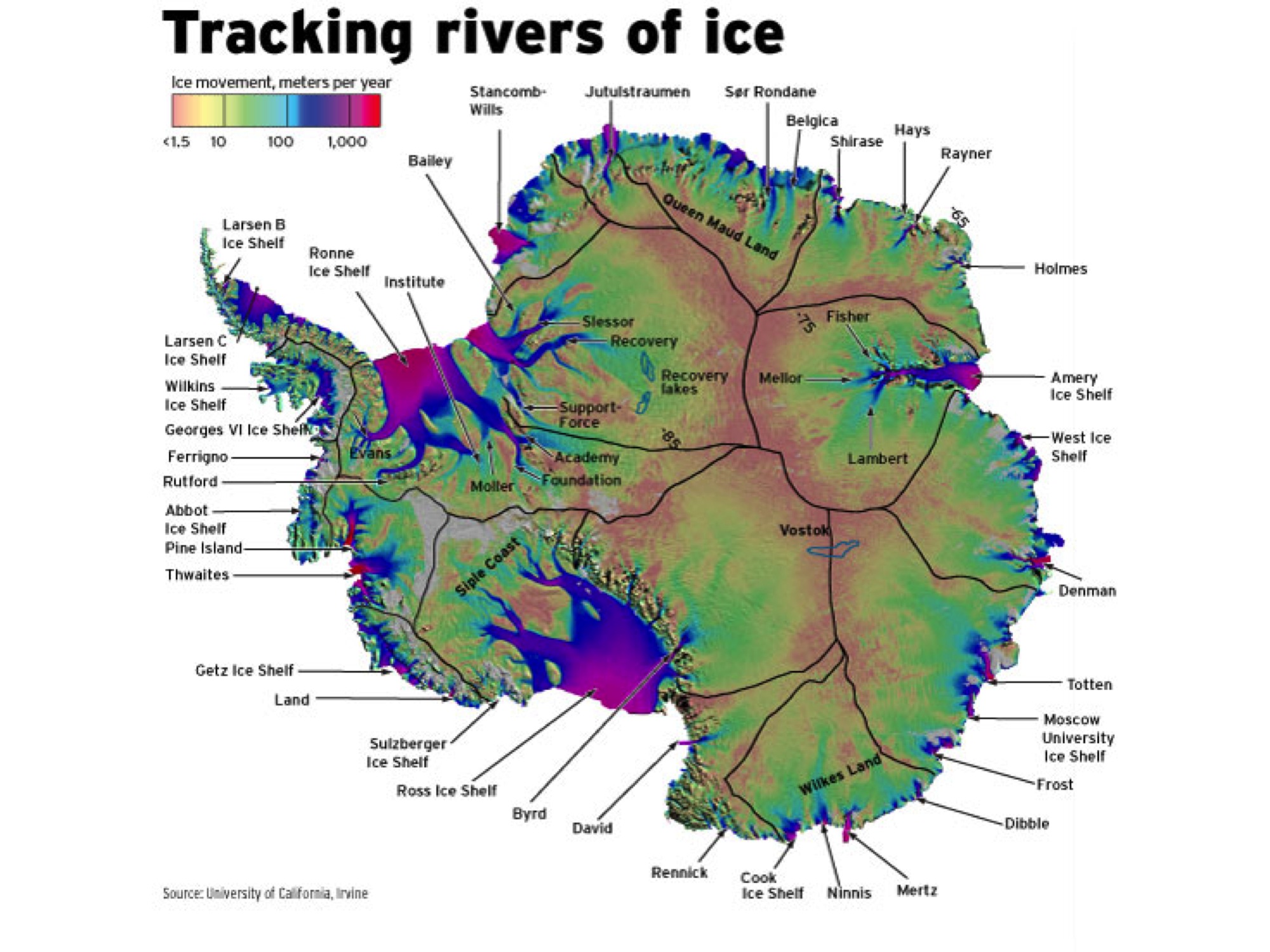
The West Antarctic Ice Sheet (WAIS) was the next focal point. The Ronne Ice Shelf proved pinned and stable per the above linked Tipping Points guest post. ANDRILL showed that the Ross Ice Shelf is also stable; its grounding line hasn’t shifted for about 4 millennia, ditto the Tipping Points sites linked to above. Attention then shifted to the Amundsen Embayment, where much was made in 2014 of the flowing Pine Island Glacier (PIG)–until it was pointed out PIG sits on an active volcano that has nothing to do with global warming. (There are volcanic ash layers embedded in PIG.) WAIS is not cooperating, either. So attention has now shifted to the East Antarctic Ice Sheet (EAIS) where Totten is the biggest glacier/catchment basin, almost half of the above figure’s NASA defined geological sector (which also contains the Moscow University Ice Shelf and the Frost glacier) just ‘east’ of the Wilkes Land sector in the figure below.
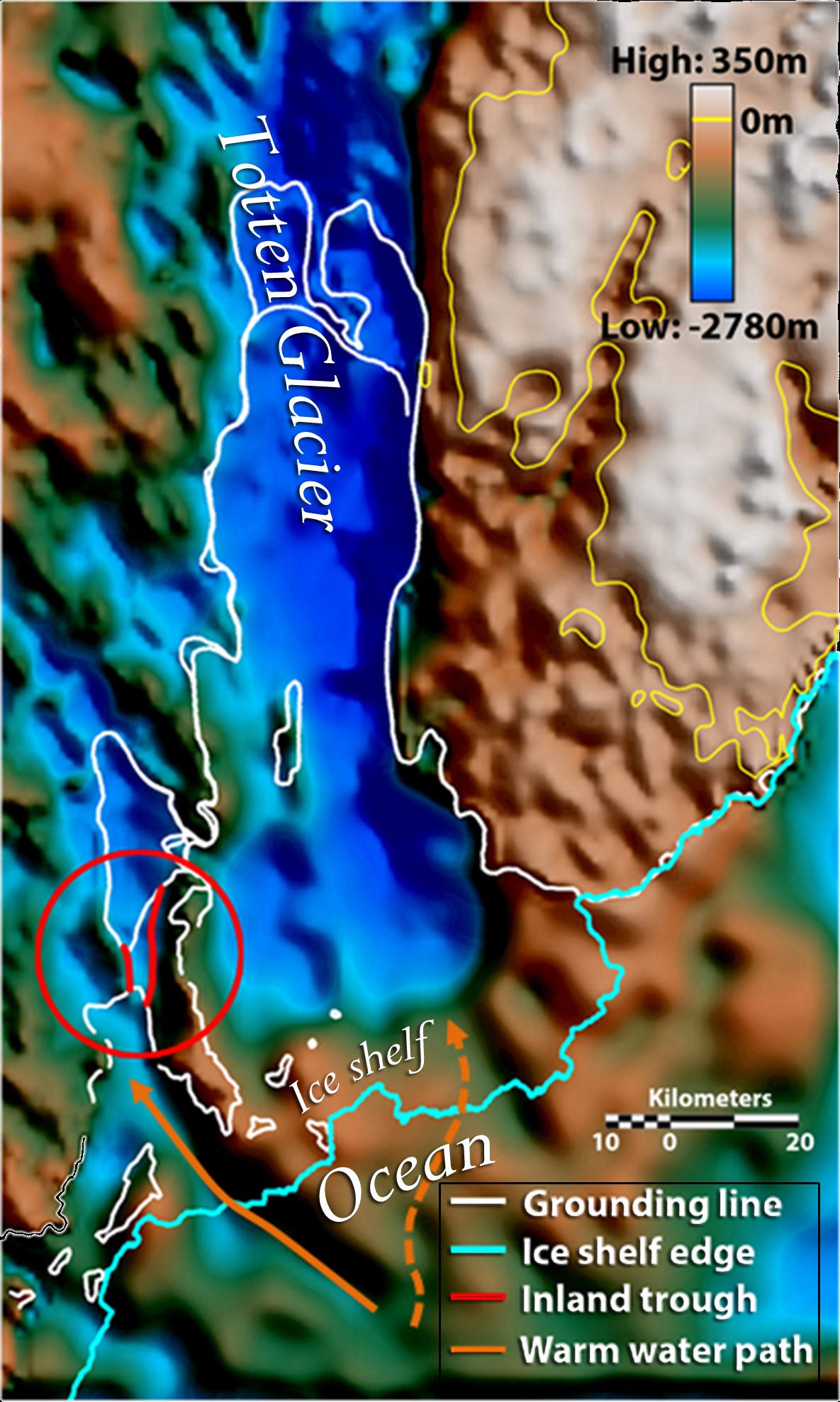
Where Totten enters the Southern Ocean, it is mostly grounded in shallows <500 meters deep. This does not affect its stability (like the Ross Ice Sheet), since the first ~500 meters of Antarctic coastal seawater is basically at the freezing point. But warmer seawater below about 500 meters is melting Totten’s base at a deep trough about 5 km wide and about 800 meters deep, discovered in 2015 [link]. This melting causes a slow retreat of the grounding line behind the trough. The annual basal melting/grounding line retreat rate is presently about 100 meters/year, (but as fast as 175 meters per year in some places according to Aitken per WaPo). It is useful to note that Aitken was an author, but not lead author, on the 2015 trough discovery paper.
This deep ocean melting process could move inland for about 150 km through the Sabrina subglacial basin (deep blue in the following figure from the 2015 paper) over about 1500 years before hitting a sub-ice rock ridge perpendicular to the glacier only about 200 meters below sea level, which would stop the melting (since melting water is below ~500 meters). Aitken et. al. 2016 estimate that this would raise sea level about 0.9 meters, or ~6 cm/century. No cause for alarm.
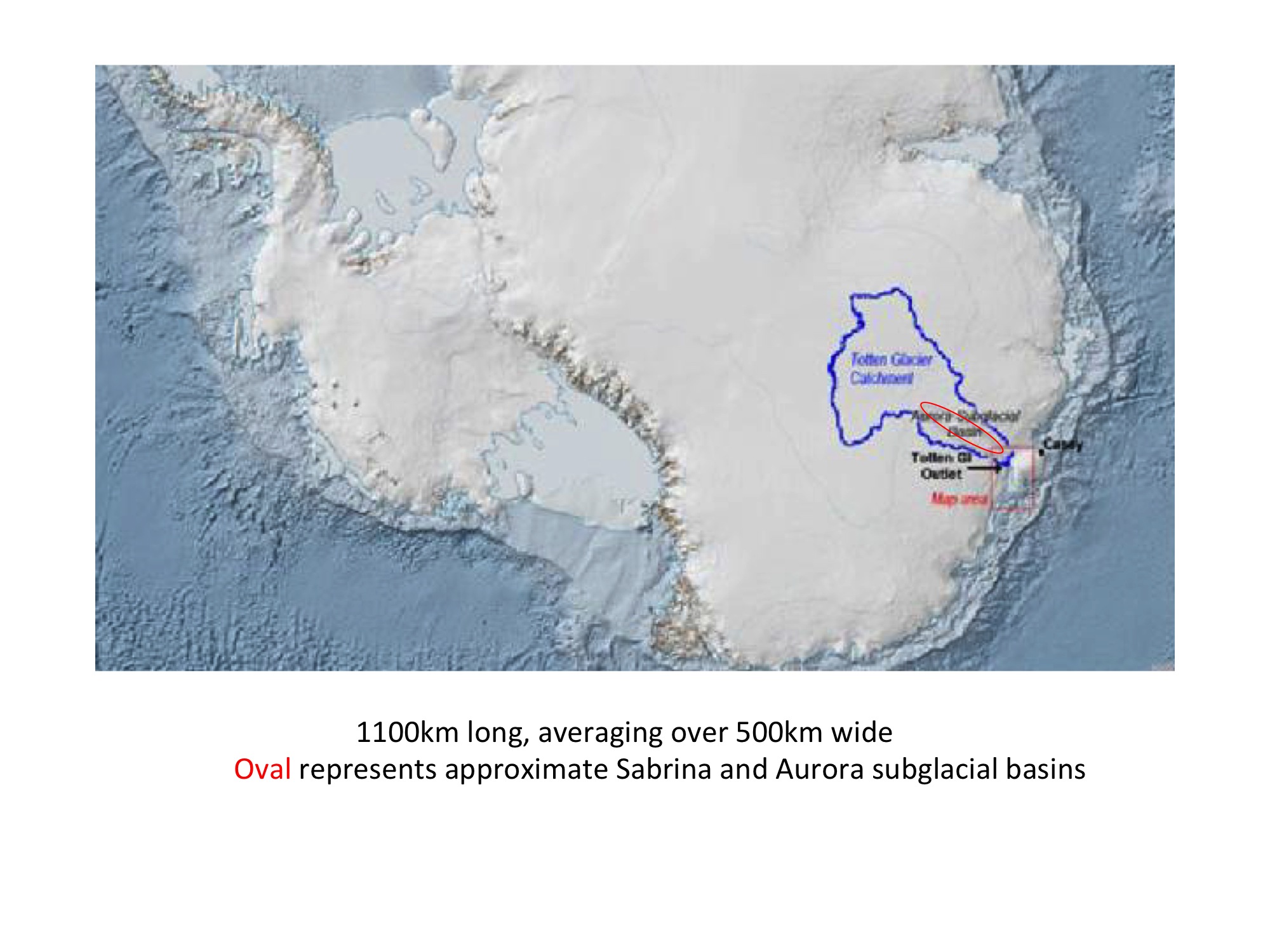
What Aitken et. al. 2016 reports is another fjord like deep ‘fault trench’ through this blocking ridge, which would (if water temperature stratification remained undisturbed) enable basal melting to proceed through the interior Aurora subglacial basin behind the ridge. This process would continue for about another 350 km, or about 40% back into the Totten catchment basin. Aitken et. al. also used ice-penetrating radar to probe both the Sabrina and Aurora basin floors to confirm that Totten did in fact melt back through both basins about 3 million years ago in the Pliocene (before the onset of the current ice ages), with CO2 at about 400 ppm. That was spun into the PR alarm—it happened before at 400 ppm!!! At the current melting rates this would take about 3 millennia and could raise sea level about 2.9 meters, an unalarming 10cm/century. This is probably still far too fast, since all the Aurora warming water would have to enter undisturbed through the newly reported narrow trench through the ridge.
This is NOT fundamentally unstable collapse, implying 2-3 meters SLR by the end of this century, as the authors clearly intimated in their press releases.
How to get 3 feet of SLR by melting the Sabrina basin back to the ridge? Simply assume that all the ice in the catchment basin to the ridge disappears, even that above sea level not subject to seawater melting. To the ridge and ‘trench’, the catchment basin is about 200-250 km wide, the glacier about 100 km wide, its mouth and protruding ice shelf 145 km wide. The assumption is dubious, but not implausible. It would imply ice flow similar to that of coastal northeast Greenland glaciers today (another overhyped SLR alarm favorite), except where there are no such flowing glaciers today, and where Antarctica never gets above freezing in summer (while most of Greenland does, briefly).
How to get 2.9 meters SLR from the red oval? Easy. Just use the same entire catchment assumption to that deeper recessional melting point.
How to get ~4 meters (WaPo)? Just assume that if the Aurora basin behind the ridge melts via trough/trench intrusion of warmer seawater, the entire catchment will then lose all its ice because it lost its Totten ‘plug’ (up catchment ice is about 2.5 km thick).
This is the same assumption Rignot made in raising PIG alarm about losing all the ice in the Amundsen Embayment catchment, even though his own paper showed that is impossible (as per my previous post at CE).
This is the same assumption that the Greenbaum et. al 2015 trench paper cited above made (on which Aitken was a co-author), upon which Aitken et. al. 2016 builds. From its SI,
8. Sea Level Potential for Totten Glacier and the Aurora Subglacial Basin
We estimate the global sea level potential of ice flowing through Totten Glacier using a modified approach applied for Thwaites and Pine Island Glaciers. We find the ice volume within the Totten Glacier Catchment20, correct for the higher density of seawater, subtract the volume of seawater required to replace the submarine ice, and divide the result by the area of the world oceans (3.6E14 m2). The result, ~3.5 meters, is conservative because it implies vertical catchment boundaries whereas, in reality, ice from neighboring catchments would contribute to the total sea level contribution if the entire catchment was drained of ice.
We follow a similar procedure to compute the total potential global sea level contribution of the Aurora Subglacial Basin (ASB) using catchment 13 defined on NASA Goddard Space Flight Center’s drainage basin website21. Using that catchment we find that at least 5.1 m of global sea level potential is grounded below sea level and is therefore more susceptible to retreat. This figure assumes that all remaining ice grounded above sea level remains as it is today with unrealistic vertical cliffs. If all of the ice in the ASB were to melt, the total sea level contribution would be closer to 6.7 meters. The sea level figures here have not been corrected for isostatic rebound associated with the removal of ice loading of the crust.
[Note: the 6.7 meters assumes all the ice in this entire sector of the first figure disappears. It is easy to build scary PR from bad assumptions. Rignot blazed a false trail now relied on [SI fn 17, 18] by others.
Conclusion
The alarming estimates from this new Nature paper, particularly as represented by the media, are grievously wrong both with respect to the amount of and the rate of sea level rise that might be associated with melting of the EIAS Totten glacier.
There is unjustified author spin in the press releases and author’s interviews. There are underlying bad assumptions never mentioned except by reference to a previously refuted [here] bad paper by Rignot. A tangled web of deceit, to paraphrase a famous poem.
Academics call for boycott of genocide conference in Israel
Palestinian Campaign for the Academic and Cultural Boycott of Israel | May 23, 2016
In a letter to the International Network of Genocide Scholars (INoGS), 270 academics from 19 countries have called for the cancellation of the 5th Global Conference on Genocide taking place on 26-29 June at the Hebrew University of Jerusalem.
The letter sent to the organizers of the conference on the 3rd of May points at the hypocrisy of having the conference in Israel at a time when Israel’s actions are “increasingly being viewed through lenses of ethnic cleansing and genocide linked to settler colonialism”. The signatories call on scholars and professionals to boycott the conference should it go ahead.
John Dugard, former UN Rapporteur for Human Rights in the OPT and a signatory to the letter, commented: “There are serious allegations that Israel committed crimes against humanity in its 2014 assault on Gaza. In these circumstances it is highly inappropriate to hold a conference on Genocide in Israel.”
Citing Israel’s treatment of Palestinians, the letter expresses shock “that INoGS plans to hold its 2016 Global Conference at the Mt. Scopus campus of the Hebrew University that is partially built on stolen Palestinian land in occupied East Jerusalem”. The INoGS conference website bills Jerusalem as part of Israel, defying international consensus on the issue and ignoring Israel’s ongoing and systematic campaign of displacement of Palestinians from the city.
According to Professor John Docker, who has written extensively in the fields of genocide and massacre studies, “Genocide studies is now, it seems clear, actively seeking opportunities to be complicit in Israel’s flouting of international law, not least the Fourth Geneva Convention.”
INoGS did not respond to the joint letter and it had ignored an earlier appeal by the Palestinian Campaign for the Academic and Cultural Boycott of Israel (PACBI).
Dr. Haidar Eid, a member of PACBI, said: “I am an academic living in besieged Gaza. I have witnessed three massacres committed by Israel, I almost lost my own life and saw my comrades, colleagues, relatives, and students perish in them. I have read with agony the names of 44 of our students and colleagues who lost their lives and 66 families wiped out by Israeli weapons. INoGS is lending its name to the perpetrators of these crimes in a move that is not unlike holding a conference on racism in apartheid South Africa.”
The conference is sponsored by five Israeli academic institutions, including the Hebrew University, which have been deeply complicit in Israel’s decades-long oppression of Palestinians. Thousands of academics in the UK, Ireland, Italy, South Africa, US and Brazil have signed national pledges to boycott Israeli academic institutions. The pledges are part of a growing movement to hold Israeli universities accountable to their role in systematic Israeli state violence against the Palestinian people.
The joint letter remains open for endorsements at the following link.
America Should Rule the World, Says Neocon Infested Think Tank Report
By Stephen Lendman | May 22, 2016
The neocon infested Center for a New American Security (CNAS) promotes endless wars on the phony pretext of protecting US security at a time America’s only enemies are ones it invents.
Its aim is solidifying US global dominance by eliminating all sovereign independent states. Several CNAS members hold or previously held key Obama administration posts.
The organization and like minded ones threaten world peace. They publish reports on militarism, terrorism, irregular warfare and national security challenges.
Its conferences feature top US military and government officials as speakers, promoting the gospel of America the indispensable nation with a divine right to rule the world.
Extremist policies groups like CNAS endorse risk influencing policymakers to launch WW III. Unchallenged power alone matters, they believe, no matter the human and material cost.
People everywhere have cause for concern. The fate of humanity and planet earth hang in the balance.
A new CNAS report co-produced by the neocon Project for the New American Century co-founder Robert Kagan (Victoria Nuland’s husband, responsible for replacing Ukrainian democrats with Nazi-infested putschists) is titled “Extending American Power: Strategies to Expand US Engagement in a Competitive World Order.”
Kagan and former Clinton state department official James Rubin co-headed “a group of current and former government officials, strategists and scholars…with the goal of… shap(ing) the national conversation on America’s role in the world during the run-up” to the November presidential election.
They produced a thinly veiled scheme for unchallenged US world dominance – claiming American leadership “is critical to preserving and strengthening the bedrock of today’s international order,” jeopardized they believe by rival world powers Russia and China, along with radical Islamic terrorists groups – ones America created and supports, they left unexplained.
They believe it’s vital to brainwash Americans to believe US world leadership is essential to preserve and extend its new world order dominance globally.
They urge adoption of stealth corporate coup d’etat, anti-consumer, anti-worker, anti-environment, anti-fundamental freedom TPP and TTIP trade bills.
They urge America usurp sovereignty over parts of the world not its own, international law ignored. They call “the transatlantic community… both the foundation and the core of the liberal (sic) world order” – now threatened by nonexistent Russian aggression.
They support greater NATO commitment to militarism, including deploying larger numbers of combat troops near Russia’s borders.
They argue for using Ukraine as a dagger targeting its heartland, claiming it’s a way for it to “achieve political and economic stability,” controlled by Washington.
They urge supporting ISIS and like minded terrorist groups while pretending to oppose them. Assad must go, they demand, wanting him forcibly ousted, Syria partitioned on the phony pretext of creating “safe space” for its people to “relocate without fear of being killed by (his) forces.”
They endorse using Syrian territory to “arm, train, and organize” terrorist groups masquerading as moderates. They claim nonexistent Iranian aims for regional dominance must be prevented.
Neocon infested groups like CNAS and extremist policymakers they influence are the greatest threat to world peace – especially if war goddess Hillary Clinton succeeds Obama.
Stephen Lendman lives in Chicago. He can be reached at lendmanstephen@sbcglobal.net. His new book as editor and contributor is titled Flashpoint in Ukraine: US Drive for Hegemony Risks WW III.
Edward Snowden’s data dump: Where’s the beef?
By Cynthia McKinney | RT | May 22, 2016
After a big announcement on May 16, 2016, The Intercept made 166 documents available to the public. At this rate, it will take an estimated 600 years to read all of the documents! I would like to ask The Intercept, ‘Where’s the beef?’
Last updated on May 16, 2016, Pierre Omidyar’s The Intercept released its first data dump of the Snowden NSA files. For a long time, I wondered why the Snowden files weren’t available to us like the WikiLeaks files were. After all, the information could further research on US “asymmetric warfare.” I wanted to search them just as I had done with WikiLeaks. And then, perhaps it was fate that gave me a partial answer: I used Wikileaks documents for my dissertation and was forced to scrub every WikiLeaks reference in order to get my dissertation published and receive my Ph.D.
You see, in its zeal to crack the whip on whistle blowers revealing the government’s multitudinous dirty dealings and to deter even more acts of conscience from potential whistle blowers, the Obama Administration chose to prosecute and imprison journalist Barrett Brown who had merely republished via hyperlinks some of the same WikiLeaks sources found in my dissertation.
Thus, my institution foreclosed a similar fate for me and I can write this article from a comfortable room rather than the federal penitentiary—where Barrett Brown currently is located. In one place, I had compiled Operation Condor, COINTELPRO, and WikiLeaks documents pertaining to America’s use of “asymmetric warfare” against inconvenient states and their leaders, as well as US actions against inconvenient civil society leaders.
Our knowledge of COINTELPRO helps us to understand that what was done at home to organizations like the Black Panther Party is also done abroad. In fact, many US political prisoners today are incarcerated as a result of the illegal actions of the US government against organizations like the American Indian Movement as well as the Black Panther Party. If the US would carry out such actions against its own citizens, why wouldn’t it do such things to foreigners?
My dissertation captures some of what was done abroad to President Hugo Chavez of the Bolivarian Republic of Venezuela and places these actions in the larger context of US practice of asymmetric warfare against people and states it doesn’t like. Therefore, I relished the new information revealed in WikiLeaks about US attitudes toward Venezuela and Chavez written by American bureaucrats who believed that their words would be cloaked by classification.
So, when the Snowden leaks became known, I rushed to all sites political to find the treasure trove of US misdeeds—er, asymmetric warfare – that I knew would be buried inside the raw data. But, alas, it was nowhere to be found! I wrote e-mails to everyone I could think of who might have access to the information, but continued to draw a blank. The dribble of stories, sanitized by a suspect press, was not good enough for me. I began to have my doubts about whether I would ever see the data for myself and search it for my research needs. Indeed, articles began to question if we would ever see the Snowden data.
Cryptome, a digital library site especially for whistle blowers, began to keep a count of the released data versus the total number of pages. On May 14, 2016, Cryptome estimated that at its current rate of release, it would take as many as 620 years for the public to see all of the Snowden documents. On May 16, 2016, Omidyar’s Intercept released a fully-searchable tranche of 166 Snowden documents and promised that more are on the way. Sadly, this pace may take more than six hundred years as there are hundreds of thousands or even millions of documents to be released.
The Intercept has set aside a special section for its signals intelligence directorate newsletter releases, known in the National Security Agency (NSA) as SIDtoday. By scrolling down the page, one can find a download button to download all 166 documents, which I have done. Here, The Intercept explains its methodology of unveiling the oldest documents from 2003 first and then working its way through to its most recent 2012 articles.
The Intercept requests readers to contact them if something of public interest is found, while also noting that the names of low-level functionaries have been redacted by its staff. Additionally, it writes that its innovative approach is to partner with newspapers like Le Monde to go through the documents. The Intercept warns that some documents will not appear because of the speculative nature of accusations leveled against individuals by government operatives at NSA. The Intercept maintains that it chose a different route from WikiLeaks (fully searchable complete archive of all documents) because of different conditions set for release of the documents by different whistle blowers which The Intercept is bound to honor.
The Intercept accompanies release of the 166 documents with a story highlighting the “most intriguing” NSA reports. This first release of documents demonstrates how closely the NSA worked alongside the CIA and the Pentagon and other government departments to fight the US ‘war on terror.’ One example is the April 14, 2003 SIDtoday that boasts of the NSA role in the rescue of Jessica Lynch. What is not mentioned (how could it be?) is the role played by signals intelligence in the fabrication of the ‘Jessica-Lynch-is-an-American-hero’ story! Politifact, in reconstructing the false story, finds that the faked intelligence didn’t come from the Pentagon, and came from Iraqi “intercepts.”
The SIDtoday boasts that six government agencies, most from NSA, contributed to the successful rescue of hero Jessica Lynch. It wrote, “Such information assists the warfighter in planning operations to destroy or disable an underground facility, or, in this case, to rescue U.S. personnel and save lives.”
Recently, another leak came to our attention, the results of which are still reverberating throughout the international scene. The Panama Papers came to our attention and caused quite a stir about off-shore bank accounts, usually used to stash tax-free, ill-gotten cash abroad. Even David Cameron, the U.K. Prime Minister was found to have an off-shore account—even while calling an anti-corruption summit!
The Guardian calls the Panama Papers, at over eleven million documents, “history’s biggest data leak.” The Panama Papers contain a who’s who and a how to stash cash offshore. At 11 million plus documents, the International Consortium of Investigative Journalists has made the database available to the public in a fully-searchable format. I can go there and find any information that I want. The possibilities for research are phenomenal. So, what’s up with the Snowden documents and why can’t I search the approximately one million or so of them?
Well, as of May 16, the situation is improved, somewhat. Only 166 documents can be found in chronological order here; 166 documents are not going to create the kind of consciousness for which I believe Edward Snowden made his tremendous sacrifice. He is now marooned in Russia when he would much rather be at home with his family and friends, I would imagine.
Still, I believe he was right to inform us about what the US government is doing with our tax dollars, to its citizens at home and to the rest of the world. In my opinion, the US government is a rogue state and COINTELPRO, Operation Condor, WikiLeaks, and what little we know of the Snowden documents amply demonstrates that. The time for keeping secrets from the people who are paying for them is long over, in my opinion.
Edward Snowden said that he wanted to start a bottom-up revolution. The drip-drip-drip of the Snowden documents is the best way to ensure document release without revolution! I can’t help but wonder what’s going on with The Intercept, Glenn Greenwald, whom Vice called “Snowden’s journalist of choice,” and the documents that I can’t wait to review! The researcher in me still wishes that, after doing its due diligence, The Intercept will see to it that Snowden’s more than one million documents will be made available to the public on a fully searchable platform in the manner that WikiLeaks and the Panama Papers has provided to the world.
After serving in the Georgia Legislature, in 1992, Cynthia McKinney won a seat in the US House of Representatives. She was the first African-American woman from Georgia in the US Congress. In 2005, McKinney was a vocal critic of the government’s response to Hurricane Katrina and was the first member of Congress to file articles of impeachment against George W. Bush. In 2008, Cynthia McKinney won the Green Party nomination for the US presidency.
Colombia: the Displaced & Invisible Nation
By Dan Kovalik | CounterPunch | May 20, 2016
The latest thematic report by the Inter-American Commission on Human Rights (IACHR) concerning Colombia makes for shocking though quite important reading. In short, it details human rights abuses on a massive scale, and lays the blame for these abuses chiefly upon the right-wing paramilitaries aligned with the Colombian State. Citing Colombia’s Center for Historical Memory, the IACHR concludes that Colombia, with its over 6 million internally displaced persons, is indeed “a displaced nation.”

Exhibit at Center for Historical Memory, Showing Personal Effects of “False Positive” Victim
As the IACHR explains, the paramilitaries were responsible for 72% of the attacks recorded in the first half of 2015. Incredibly, the Colombian State, along with its U.S. sponsor, insist that the paramilitaries (also known as Autodefensas) no longer exist as a result of a demobilization (largely faked) back in 2003-2006. And, it is this very denial, the IACHR points out, which allows the paramilitaries to carry out their reign of terror with near complete impunity. After all, the State will not dismantle or prosecute what it claims does not even exist.
As explained in the report, “during 2015 the IACHR has continued receiving information about actions of the illegal armed groups that emerged after the demobilization and which are identified as being related or having among their members, persons that belonged to paramilitary groups who, in many cases allegedly continue acting under the protection of State agents.”
The misdeeds the paramilitaries are carrying out under State protection include disappearances, of which there were an incredible 3,400 during the first 7 months of 2015 alone. In all, the IACHR reports that there have been a total of between 45,000 and 61,918 forced disappearances in Colombia in the past 30 years. Thus, there have potentially been more than three times the disappearances in Colombia than in Argentina during all of the Dirty War years. And, of course, with such disappearances come mass graves, of which Colombia has many – 4,519 of them to be exact, with 5,817 bodies exhumed from them so far.
Meanwhile, the IACHR reported on the fact that at least 5,736 individuals were the victims of extrajudicial executions by the Colombian State forces between 2000 and 2010 – that, is during the period of the U.S.’s major military support for Colombia known as Plan Colombia. Nearly all of these executions were “false positive” killings in which the Colombian military murdered innocent civilians – many of them young, unemployed men – and then dressed them up as guerillas to justify to the U.S. the military assistance the Colombian military was receiving for counter-insurgency purposes. And, while the rate of such killings has decreased since 2010, they nonetheless continue, with 230 reported cases since then.
To the extent Colombia is covered at all in the mainstream press these days, one rarely gets a glimpse into the horror show which is taking place in that country. And, casual visitors to places such as Bogota or Medellin would rarely get a glimpse of this either. This is so because the lion’s share of the violence described above is taking place in the more remote areas where Colombia’s Afro-Colombian and indigenous communities live, and it is these communities which are suffering the brunt of this violence.
As the IACHR explains, these communities are largely “invisible” in Colombian society, “are victims of racial discrimination and disproportionately affected by violence, forced displacement, poverty and social exclusion.” In addition, “the majority of victims of sexual violence in armed conflict are Afro-descendant and indigenous women.” And, impunity for sexual violence in Colombia is near total “given that sexual violence against women would be perpetrated mainly by paramilitary, but also by agents of the government . . . .”
As for the issue of poverty, these communities are suffering from some of the most extreme versions of it, and live in conditions of misery which residents in the major cities are often shielded from. For example, in Choco – a town nestled in between the Pacific and Caribbean coasts and populated by mostly Afro-Colombian and indigenous – the infant mortality rate is 42.69 per 1000. This figure is higher than that of post-invasion Iraq, and nearly as high as that in such countries as Burma, Bangladesh, Namibia and Haiti. Meanwhile, in Bogota, the figure is 12.88 per 1000. These figures underscore the incredible inequities and disparity in wealth which make Colombia one of the most unequal societies on earth, with a very stark divide along racial and ethnic lines.
However, the violence against Afro-Colombians and indigenous is not just the product of racism, but is also the product of the unfettered capital penetration of their rich, ancestral land. As the IACHR points out, large scale megaprojects – many of them mining projects – “have led to the appropriation of Afro-Colombian’s collective territories, and have resulted in “brutal forced displacements, massive violence and selective assassinations.”
And, of course, many of these megaprojects are owned, in whole or in part, by North American companies to which the U.S.-Colombia Free Trade Agreement (FTA) has opened Colombia wide open.
An example of such a deadly megaproject detailed in the IACHR report is the port expansion of Buenaventura, a town which is 90% Afro-Colombian. This port expansion was carried out to facilitate the trade and tourism created by the FTA. And, the struggle of the paramilitaries to control the wealth generated by the port expansion has led to the forced disappearances of hundreds of Buenaventura residents “and the operation of ‘chop houses’ (casa de pique)” where people are chopped up alive.
Like the Colombian and U.S. governments denials of the existence of the paramilitary death squads, the very failure of our mainstream media to acknowledge or discuss the existence of the above-described crimes allows them to continue. Thus, the U.S. government is able to continue supporting the Colombian military, and by extension its paramilitary allies, and North American multi-nationals are able to keep violently exploiting the Colombian people and their land by virtue of the fact that we are kept in the dark about this reality by a press corps which is failing in its duty to report on such matters of public concern. It is only by breaking this silence around these crimes that we have any chance of stopping them.
Daniel Kovalik lives in Pittsburgh and teaches International Human Rights Law at the University of Pittsburgh School of Law.
Syria White Helmets: Humanitarians or “Executioners”?
UK Column News – May 20, 2016
In this UK Column News special, Mike Robinson speaks to Vanessa Beeley about Syria’s “first responder” group, the White Helmets who are being pushed forward for nomination for a Nobel Peace Prize. Do they deserve it?
For more background on this, please see our previous interview from November last year: http://youtu.be/mLa9ztvAGWw
Also see Vanessa’s articles on 21st Century Wire:
http://21stcenturywire.com/2015/10/23…
Featured Video

Seyed M. Marandi: US-Iran War Inevitable: Kuwait and Bahrain May Fall
or go to
Aletho News Archives – Video-Images
From the Archives
Oil and the Israel Lobby
Reknowned economist M. Shahid Alam offers this excellent critique of Noam Chomsky’s defective analysis of the relative influence of Oil versus the Israel lobby over US foreign policy: … continue
Blog Roll
 Aletho News
- ICC ignored ‘very well-documented’ NATO crimes – ex-Libyan minister
- SNSC secretary dismisses US response to Iran’s conditions as ‘inadequate’
- Sanaa says Taiz roads open, secure for residents, warns Saudi forces
- Iraqi resistance group urges Saudi leadership to admit defeat, lift Yemen siege
- Trump’s Retreat: How Al-Aqsa Flood Took Down the US Empire
- Israel’s Military Actions in Lebanon Grossly Violate International Law — Lavrov
- Seyed M. Marandi: US-Iran War Inevitable: Kuwait and Bahrain May Fall
- Leaders Condemn Ansarallah Attack on Saudi Arabia While Ignoring Illegal War Against Yemen
- Leaked: Britain’s Covert Iraqi Psyops Network
- Yemeni Armed Forces Warn Airlines Against Using Saudi Airports, Exempt Mecca and Medina
- If Americans Knew
- Israel’s Destruction of Southern Lebanon Intensified After the Cease-Fire
- The Last-Minute Decision That Gave Israel Its Name
- The American Conservative: How Trump Made the World Go Nuclear
- Meet the US generals and admirals advancing Israeli policy
- Opinion: Why news organizations should boycott Israel
- The Israeli witch hunt of Sami Abu Shehadeh exposes the lie of the ‘Jewish and democratic’ state
- No state has a ‘right’ to exist – least of all Israel
- Testimonies about Gaza’s civilian death toll expose Israel’s atrocities – Daily Update
- How Israel Conquered the Latin American Right
- Agents search Rep. Omar’s Washington home in criminal probe as she vows she won’t ‘be silenced’
- No Tricks Zone
- Germany’s Green Energy Debacle: High Energy Costs Force Kahla Porzellan to Close After 182 Years!
- New Study: 50 Years Of The Most Aggressive ‘Net Zero’ Policies Can Only Affect The Global Climate By 0.03°C
- US September “Heat” Was No Record…Many Records Set Decades Ago
- Latest European Green Energy Debacle; Portugal’s Largest Flagship Solar Park Insolvent!
- Green Energy Debacle: German Expert Professor Fritz Vahrenholt Warns Of Severe Economic And Social Consequences
- Two More Paleo Reconstructions Affirm Meters-Higher Sea Levels Across Ireland, Brazil 7000-6000 Years Ago
- New Study: Earth And Venus Surface Warmth Largely Explained By Convection And Lapse Rate, Not CO2 Or Radiation
- 2025 Nature Paper Claiming Worsening Global Drought Gets RETRACTED …Heavily Flawed
- New Study: ‘Global Drought Shows No Detectable Recent Acceleration Under Climate Warming’
- Economic Masterminds: German Socialists Suggest Taxing Productivity Gains Stemming From Using AI

