The FBI says it caught a terrorist trying to blow up a synagogue on the outskirts of Miami.
But the FBI supplied the bomb.
The device was fake, part of an undercover FBI sting operation that, like hundreds of controversial investigations before it, used an undercover informant to target an alleged terrorist.
In the Miami case, federal authorities accuse 40-year-old James Medina of planning to bomb the Aventura Turnberry Jewish Center north of the city.
The FBI started their investigation of Medina in March 2015 “based on his suspected desire to attack” the Jewish center, according to an affidavit filed in federal court and a statement released by the US Attorney’s Office in the Southern District of Florida.
Medina, who said he converted to Islam four years ago and referred to his alias “James Muhammad” in court, has been charged with “attempted use of a weapon of mass destruction.” He pleaded not guilty on Monday morning.
Apart from the fact that the FBI supplied Medina with the weapon that he intended to use against the Jewish center, rights activists and legal experts are troubled by the facts presented by the FBI and Justice Department. Their concern includes instances where the informant, or “confidential human source” in bureau parlance, offered to assist Medina in attacking the center, and even suggested that he link the attack to the Islamic State.
The FBI’s affidavit — which reveals only enough information to justify the criminal complaint against Medina, and does not include all of the evidence against him — says that an informant met with Medina in March and secretly recorded conversations with him after he expressed a desire to attack the Jewish center.
But the affidavit does not say how the FBI learned of Medina’s “suspected desire” to attack the Jewish center, or what initial remarks or actions led agents to believe that Medina was willing to use violence before he devised his plans with the informant.
David Shapiro, a former New Jersey prosecutor and FBI special agent who is now a professor at the John Jay College of Criminal Justice in New York, said the affidavit makes it appear that the FBI did more than a little pushing to get Medina to develop the synagogue bombing plan.
“It seems this desire was developed,” he said. “It was watered with very potent fertilizer.”
The affidavit lays out how the FBI informant took an active part in helping Medina cook up the bombing plot. It recounts how the informant drove Medina to the Jewish center and suggested that he launch the attack on a Jewish holiday.
When the two later discussed a claim of responsibility, the affidavit says that the informant “indicated that they should leave a ‘clue’ as to who was responsible and Medina concurred.” It’s the informant, rather than Medina, who suggests linking the bombing to the Islamic State, also known as ISIS, or the East African al-Qaeda affiliate al-Shabaab.
“You can, you can do all that,” the affidavit quotes Medina as saying. “Yeah, we can print up or something and make it look like it’s ISIS here in America. Just like that.”
The informant later suggested that Medina could use “untraceable” firearms instead of AK-47s that an acquaintance of Medina’s said he could provide. At another meeting, the informant “addressed the concerns of entering the synagogue with firearms and then getting shot and instead proposed leaving an unspecified object behind and leaving the scene.” The informant suggested that Medina could use a bomb with a timer, and then introduced Medina to a man described as having “explosives expertise and access.” The bomb expert was really an undercover FBI agent.
Medina didn’t do himself any favors by repeatedly telling both the FBI informant and undercover agent that he was willing to leave the bomb at the synagogue, then escape with the informant and watch as they remotely detonated it. He also repeatedly assured the undercover agent that he was willing to go forward with the plot, according to the affidavit.
When asked why, Medina answers, “Because I realize that I have a lot of love for Allah. And I know that all these, all these wars that are going on, it hurts me, too. You know? It’s my call of duty. I gotta get back, when I’m doing this, I feel that I’m doing it for a good cause for Allah.”
In a subsequent conversation, the agent asked Medina if he was okay with killing women and children. Medina appeared to say yes, but he also seemed hesitant.
Medina: I think so. I think I’m fine, Urn hmm.
Agent: You need to be sure brother.
Medina: I am pretty sure. I think so. I believe so. I’m ready bro!
Agent: Ok. Cause you know you don’t have to do any of this.
Medina: What do you mean doing it?
Agent: No, you don’t have to do it if you’re not comfortable with it.
Medina: What? I’m ready.
Agent: It’s Allah’s will but you know…
Medina: I’m up for it. I really am. This is no joke. This is serious dog. If I have the equipment, believe me, in the time is, is that day and we doin’ it, I’m up for it bro. Just like I said.
The FBI says Medina and the undercover agent decided to bomb the synagogue on Friday, April 29. Medina made three videos on the informant’s phone: One as a goodbye to his family in case he was killed, and the other two to explain why he conducted the attack.
“I am a Muslim and I don’t like what is going on in this world. I’m going to handle business here in America. Aventura, watch your back. ISIS is in the house,” he said in one video. In another, he said, “Today is gonna be a day where Muslims attack America. I’m going to set a bomb in Aventura.”
On the appointed day, the agent met with Medina, gave him the fake bomb, instructed him how to use it, and then drove him to the synagogue. Medina exited the vehicle and began to walk toward the synagogue, at which point the authorities arrested him.
The US government has convicted more than 200 people on terrorism-related charges using similar methods, according to Trevor Aaronson, executive director of the Florida Center for Investigative Reporting and author of The FBI’s Manufactured War on Terrorism. He said that the FBI “isn’t finding people with a bomb in their garage. They’re finding people who are loudmouths and they say, “Oh, we can help you in the name of al-Qaeda or the Islamic State.”
“These are sting operations where the FBI provides the means and opportunities for people to commit crimes,” Aaronson said. “And the most disturbing part is that most of these people seem to be mentally ill and do not have connections to overseas terrorists on their own.”
Medina fits this profile. The 40-year-old is divorced, single, and unemployed. He was arrested previously for behavior consistent with mental illness, including sending more than 50 text messages, some threatening violence, to his estranged family and then telling a cop about it.
Karen J. Greenberg, director of the Center on National Security at Fordham Law School, said the quoted conversations in the affidavit that are supposed to damn Medina instead make it look like he can “barely seem to string a sentence together.”
And while it appears to be clear that Medina is a bigot who harbors anti-Jewish feelings, neither of those two things is illegal. Of course, plotting to blow up a synagogue is illegal. Retired FBI counterterrorism executive David Gomez says the FBI’s investigative techniques were legitimate, even if Medina does have mental or cognitive issues.
“Just because you’re dumb doesn’t mean you’re not dangerous,” he said. “Just because you have some mental incapacitation doesn’t mean you’re not capable of murder.”
Gomez said he’s seen other cases where lonely, fringe suspects join gangs or right-wing extremist groups to gain approval, and then peer pressure or other factors leads them to commit violent acts. In cases such as Medina’s, he argued, the FBI is just getting to these suspects before other malicious actors.
“Let’s say we didn’t get a source on this person, and somebody else talks to them and says, ‘Wanna blow up some Jews?’ It doesn’t matter if you blow them up for the KKK or ISIS. Some guy says, ‘I’ll drive you there,’ and there are plenty of people out there who would do that,” Gomez said. “The FBI and others are worried about a guy who gets in with the wrong crowd.”
Greenberg questioned where the rationale for this type of investigation ends.
“If you want to look for individuals who are susceptible to some kind of inducement to violence, and who have to be told whose name the violence is in, there are countless people and countless extremist groups you could identify them with,” she said.
Gomez said that the FBI’s informants and undercover agents set up the suspect for the “next proactive move,” but don’t make them take it.
“At some point he has to have an overt act,” he said — such as taking what he thinks is a bomb onto the grounds of a synagogue with the intent to detonate it.
Under the law, this act essentially closes the door to an entrapment defense.
“Those are hard to assert in this situation,” said Hugh Handeyside, a staff attorney with the American Civil Liberties Union’s National Security Project. “That’s the situation that the FBI and DOJ are taking advantage of.”
According to Greenberg, the FBI has been using these types of investigations to send a message: “If someone approaches you and asks you if want help with a terrorist attack, you’re supposed to say no.”
Gomez notes that since 9/11, the bureau has been tasked with preventing another terrorist attack on US soil.
“The attitude is, do what you have to legally do to prevent a Paris-style attack in the US,” he said, “and I think there are a lot of prosecutors out there who would say, ‘I would rather prosecute a case and take the chance on losing on technicality or jury nullification than take a chance to not prosecute on terrorism charges.”
But most terrorism cases do not go to trial, meaning prosecutors rarely lose. Most defense lawyers encourage their clients to enter into a plea agreement in order to avoid a lengthy prison sentence.
“The threat of long-term incarceration compels people to cut their losses,” said Michael German, a former FBI agent who worked on undercover domestic terrorism investigations. “Part of reason they’re encouraged to cut losses is that when these cases go to trial, despite the judges expressing concerns about FBI methodology, the political and social climate is such that fear actually compels them to not acquit people based on entrapment or other government misconduct.”
The FBI declined to comment on the Medina case or other counterterrorism investigations like it, but said in a statement that there are “strict guidelines governing the use of undercover operations which involve extensive legal reviews and senior-level approvals.”
The bureau’s director, James B. Comey, told Congress in February that “preventing terrorist attacks remains the FBI’s top priority” as he requested more than $9 billion to fund the bureau’s operations in 2017.
Nearly half of the FBI’s 2016 budget was committed to “counterterrorism and counterintelligence” operations, along with more than 13,000 members of the bureau’s 35,000 employees.
According to German, the funding means the FBI is under pressure to show Congress that it’s using its resources to stop terror attacks.
“Is there actually a threat being resolved, or is the FBI manufacturing these terrorism cases to make its counterterrorism efforts look worthwhile?” he asked. “Knowing that there are real threats out there, are they wasting resources when the people they’re targeting don’t present an immediate threat?”
Handeyside said counterterrorism cases like Medina’s are not only a waste of resources, they might actually be making America less safe.
“It’s not only that they’re manufacturing terror plots, but also sowing fear and distrust within minority communities in ways that I think are damaging to counterterrorism efforts,” he said. “So there are not only constitutional issues, but also effectiveness issues.”
Follow Benjamin Gilbert on Twitter:
Related: The FBI Suspected an Army Vet Was Plotting Attacks in the US — So They Gave Him Guns
May 18, 2016
Posted by aletho |
Civil Liberties, Deception, False Flag Terrorism, Mainstream Media, Warmongering | FBI, Human rights, ISIS, United States |
Leave a comment
Does any intelligent person look at a New York Times article about Russia or Vladimir Putin these days and expect to read an objective, balanced account? Or will it be laced with a predictable blend of contempt and ridicule? And is it any different at The Washington Post, NPR, MSNBC, CNN or almost any mainstream U.S. news outlet?
And it’s not just Russia. The same trend holds true for Iran, Syria, Venezuela, Nicaragua and other countries and movements that have fallen onto the U.S. government’s “enemies list.” We saw the same pattern with Saddam Hussein and Iraq before the 2003 U.S. invasion; with Muammar Gaddafi and Libya before the U.S.-orchestrated bombing campaign in 2011; and with President Viktor Yanukovych and Ukraine before the U.S.-backed coup in 2014.
That is not to say that these countries and leaders don’t deserve criticism; they do. But the proper role of the press corps – at least as I was taught during my early years at The Associated Press – was to treat all evidence objectively and all sides fairly. Just because you might not like someone doesn’t mean your feelings should show through or the facts should be forced through a prism of bias.
In those “old days,” that sort of behavior was deemed unprofessional and you would expect a senior editor to come down hard on you. Now, however, it seems that you’d only get punished if you quoted some dissident or allowed such a person onto an op-ed page or a talk show, someone who didn’t share Official Washington’s “group think” about the “enemy.” Deviation from “group think” has become the real disqualifier.
Yet, this conformity should be shocking and unacceptable in a country that prides itself on freedom of thought and speech. Indeed, much of the criticism of “enemy” states is that they supposedly practice various forms of censorship and permit only regime-friendly propaganda to reach the public.
But when was the last time you heard anyone in the U.S. mainstream say anything positive or even nuanced about Russian President Putin. He can only be portrayed as some shirtless buffoon or the devil incarnate. Former Secretary of State Hillary Clinton got widespread praise in 2014 when she likened him to Hitler.
Or when has anyone in the U.S. media been allowed to suggest that Syria’s President Bashar al-Assad and his supporters might actually have reason to fear what the U.S. press lovingly calls the “moderate” rebels – though they often operate under the military command of Sunni extremist groups, such as Al Qaeda’s Nusra Front. [See Consortiumnews.com’s “Obama’s ‘Moderate’ Syrian Deception.”]
For the first three years of the Syrian civil war, the only permissible U.S. narrative was how the brutal Assad was slaughtering peaceful “moderates,” even though Defense Intelligence Agency analysts and other insiders had long been warning about the involvement of violent jihadists in the movement from the uprising’s beginning in 2011.
But that story was kept from the American people until the Islamic State started chopping off the heads of Western hostages in 2014 – and since then, the mainstream U.S. media has only reported the fuller story in a half-hearted and garbled way. [See Consortiumnews.com’s “Hidden Origins of Syria’s Civil War.” ]
Reason for Conformity
The reason for this conformity among journalists is simple: If you repeat the conventional wisdom, you might find yourself with a lucrative gig as a big-shot foreign correspondent, a regular TV talking head, or a “visiting scholar” at a major think tank. However, if you don’t say what’s expected, your career prospects aren’t very bright.
If you somehow were to find yourself in a mainstream setting and even mildly challenged the “group think,” you should expect to be denounced as a fill-in-the-blank “apologist” or “stooge.” A well-paid avatar of the conventional wisdom might even accuse you of being on the payroll of the despised leader. And, you wouldn’t likely get invited back.
But the West’s demonization of foreign “enemies” is not only an affront to free speech and meaningful democracy, it is also dangerous because it empowers unscrupulous American and European leaders to undertake violent and ill-considered actions that get lots of people killed and that spread hatred against the West.
The most obvious recent example was the Iraq War, which was justified by a barrage of false and misleading claims about Iraq which were mostly swallowed whole by a passive and complicit Western press corps.
Key to that disaster was the demonization of Saddam Hussein, who was subjected to such unrelenting propaganda that almost no one dared question the baseless charges hurled at him about hiding WMD and collaborating with Al Qaeda. To do so would have made you a “Saddam apologist” or worse.
The few who did dare raise their voices faced accusations of treason or were subjected to character assassination. Yet, even after their skepticism was vindicated as the pre-invasion accusations collapsed, there was very little reappraisal. Most of the skeptics remained marginalized and virtually everyone who got the WMD story wrong escaped accountability.
No Accountability
For instance, Washington Post editorial-page editor Fred Hiatt, who repeatedly reported Iraq’s WMD as “flat fact,” suffered not a whit and remains in the same prestigious job, still enforcing one-sided “group thinks” about “enemies.”
An example of how Hiatt and the Post continue to play the same role as neocon propagandists was on display last year in an editorial condemning Putin’s government for shutting down Russian activities of the U.S.-funded National Endowment for Democracy and requiring foreign-funded groups seeking to influence Russian politics to register as foreign agents.
In the Post’s editorial and a companion op-ed by NED President Carl Gershman, you were led to believe that Putin was delusional, paranoid and “power mad” in his concern that outside money funneled into non-governmental organizations was a threat to Russian sovereignty.
However, the Post and Gershman left out a few salient facts, such as the fact that NED is funded by the U.S. government and was the brainchild of Ronald Reagan’s CIA Director William J. Casey in 1983 to partially replace the CIA’s historic role in creating propaganda and political fronts inside targeted nations.
Also missing was the fact that Gershman himself announced in another Post op-ed that he saw Ukraine, prior to the 2014 coup, as “the biggest prize” and a steppingstone toward achieving Putin’s ouster in Russia. The Post also forgot to mention that the Russian law about “foreign agents” was modeled after a U.S. statute entitled the Foreign Agent Registration Act. [See Consortiumnews.com’s “Why Russia Shut Down NED Fronts.”]
All those points would have given the Post’s readers a fuller and fairer understanding of why Putin and Russia acted as they did, but that would have messed up the desired propaganda narrative seeking to demonize Putin. The goal was not to inform the American people but to manipulate them into a new Cold War hostility toward Russia.
We’ve seen a similar pattern with the U.S. government’s “information warfare” around high-profile incidents. In the “old days’ – at least when I arrived in Washington in the late 1970s – there was much more skepticism among journalists about the official line from the White House or State Department. Indeed, it was a point of pride among journalists not to simply accept whatever the spokesmen or officials were saying, but to check it out.
There was plenty of enough evidence – from the Tonkin Gulf lies to the Watergate cover-up – to justify a critical examination of government claims. But that tradition has been lost, too. Despite the costly deceptions before the Iraq War, the Times, the Post and other mainstream outlets simply accept whatever accusations the U.S. government hurls against “enemies.” Beyond the gullibility, there is even hostility toward those of us who insist on seeing real evidence.
Examples of this continuing pattern include the acceptance of the U.S. government line on the sarin gas attack outside Damascus, Syria, on Aug. 21, 2013, and the shoot-down of Malaysia Airlines Flight 17 over eastern Ukraine on July 17, 2014. The first was blamed on Syria’s Assad and the second on Russia’s Putin – quite convenient even though U.S. officials refused to present any solid evidence to support their claims.
Reasons for Doubt
In both cases, there were obvious reasons to doubt the Official Story. Assad had just invited United Nations inspectors in to examine what he claimed were rebel chemical attacks, so why would he pick that time to launch a sarin attack just miles from where the inspectors were staying? Putin was trying to maintain a low profile for Russian support to Ukrainians resisting the U.S.-backed coup, but provision of a large, sophisticated and powerful anti-aircraft battery lumbering around eastern Ukraine would just have invited detection.
Further, in both cases, there was dissent among U.S. intelligence analysts, some of whom objected at least to the rushes to judgment and offered different explanations for the incidents, pointing the blame in other possible directions. The dissent caused the Obama administration to resort to a new concoction called a “Government Assessment” – essentially a propaganda document – rather than a classic “Intelligence Assessment,” which would express the consensus views of the 16 intelligence agencies and include areas of disagreement.
So, there were plenty of reasons for Washington journalists to smell a rat or at least insist upon hard evidence to make the case against Assad and Putin. Instead, given the demonized views of Assad and Putin, mainstream journalists unanimously fell in line behind the Official Story. They even ignored or buried evidence that undermined the government’s tales.
Regarding the Syrian case, there was little interest in the scientific discovery that the one sarin-laden rocket (recovered by the U.N.) had a range of only about two kilometers (destroying Washington’s claims about the Syrian government firing many rockets from eight or nine kilometers away). [See Consortiumnews.com’s “Was Turkey Behind Syria-Sarin Attack?”]
Regarding the MH-17 case, a blind eye was turned to a Dutch intelligence report that concluded that there were several operational Buk anti-aircraft missile batteries in eastern Ukraine but they were all under the control of the Ukrainian military and that the rebels had no weapon that could reach the 33,000-foot altitude where MH-17 was flying. [See Consortiumnews.com’s “The Ever-Curiouser MH-17 Case.”]
Though both those cases remain open and one cannot rule out new evidence emerging that bolsters the U.S. government’s version of events, the fact that there are substantive reasons to doubt the Official Story should be reflected in how the mainstream Western media deals with these two sensitive issues, but the inconvenient facts are instead brushed aside or ignored (much as happened with Iraq’s WMD).
In short, there has been a system-wide collapse of the Western news media as a professional entity in dealing with foreign crises. So, as the world plunges deeper into crises inside Syria and on Russia’s border, the West’s citizens are going in almost blind without the eyes and ears of independent journalists on the ground and with major news outlets delivering incessant propaganda from Washington and other capitals.
Instead of facts, the West’s mainstream media traffics in demonization.
Investigative reporter Robert Parry broke many of the Iran-Contra stories for The Associated Press and Newsweek in the 1980s. You can buy his latest book, America’s Stolen Narrative, either in print here or as an e-book (from Amazon and barnesandnoble.com).
May 18, 2016
Posted by aletho |
Deception, Mainstream Media, Warmongering, Militarism | Iraq War, Middle East, National Endowment for Democracy, Syria, United States, Washington Post |
Leave a comment
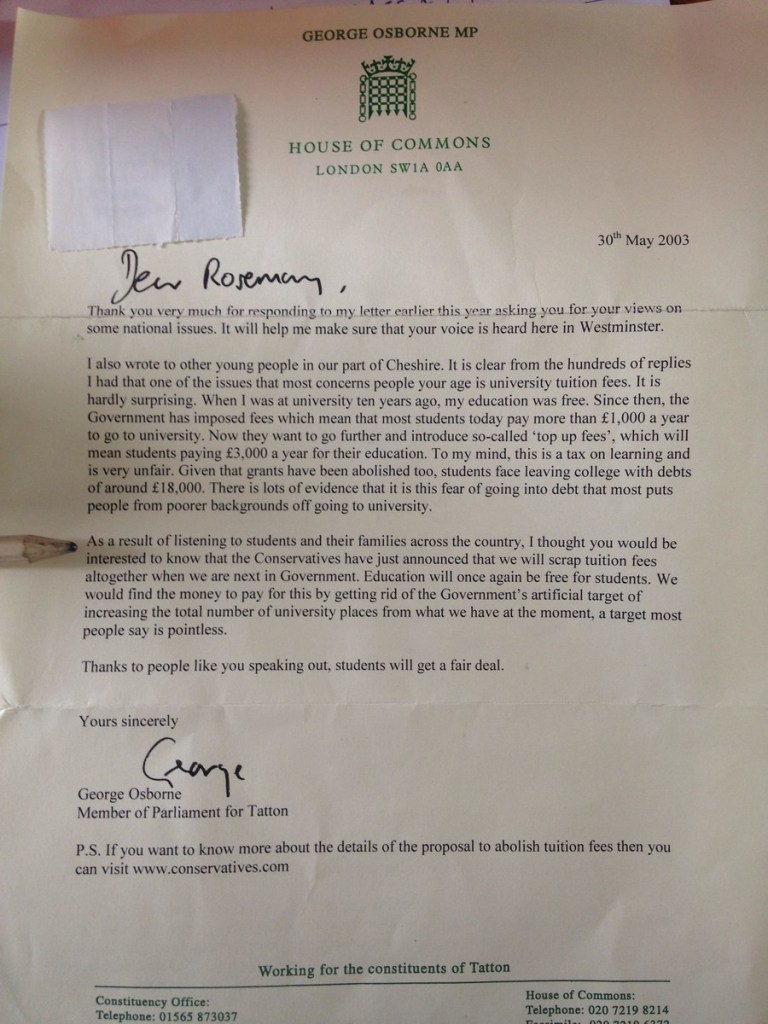
Well, that’s embarrassing. Chancellor George Osborne said university tuition fees were a “tax on learning” and “very unfair” in a letter he wrote 13 years ago – but that didn’t stop him from tripling fees after taking office in 2010.
The letter, sent by Osborne when he was a Tory whip, criticised the then-Labour government’s plan to triple fees to £3,000 (about US$4,350), and pledged to scrap fees totally. Osborne wrote:
“To my mind, this is a tax on learning and is very unfair.”
“There is a lot of evidence that it is this fear of going into debt that puts most people from poorer backgrounds off going to university.
“I thought you would be interested to know that the Conservatives have just announced that we will scrap tuition fees altogether when we are next in government.”
How he must regret making that pledge all those years ago.
When the Tories came to power in coalition with the Liberal Democrats in 2010, one of Osborne’s first acts was to triple tuition fees from £3,000 per year to £9,000 per year.
The chancellor’s embarrassing letter has re-emerged a day after a new government white paper suggested universities that meet certain ‘high standards’ will soon be allowed to raise fees yet again in line with inflation.
Violinist Rosy Williams posted the letter on Facebook on Tuesday afternoon after finding it in storage.
“Rooted through a box of old letters last night and discovered this brief exchange … with a young, up and coming MP by the name of George Osborne.
“So glad he made sure our ‘voices were heard in parliament.’”
Labour’s shadow business secretary, Angela Eagle, told the Mirror :
“This letter exposes George Osborne’s rank hypocrisy. He called the tuition fees a ‘tax on learning.’
“Then, when he was Chancellor, he trebled them. He warned of the fear of debt putting young people off, but on his watch, students are leaving university owing tens of thousands of pounds.”
Read more:
£9,000 not enough? University fees may rise again under new Tory white paper
May 17, 2016
Posted by aletho |
Deception, Economics | George Osborne, UK |
Leave a comment
The Russian Defense Ministry has denied allegations reported by the AP that Russia is constructing an army base in the ancient city of Palmyra, which has recently been freed from Islamic State.
“There are no ‘new army bases’ on the territory of the Syrian town of Palmyra and there will never be,” Defense Ministry spokesman Major-General Igor Konashenkov said in an official statement on Tuesday.
Earlier in the day, the AP news agency came out with a report stating that the Russian military is building an army base in Palmyra within the zone listed by UNESCO as a world heritage site, and without permission from authorities. The agency cited an “American heritage organization” and a “top Syrian archaeologist” as its sources, as well as satellite images that appear to show some construction on the edge of the ancient site.
Yet, as General Konashenkov states, the pictures show something else entirely.
“The satellite pictures of this area posted by UNESCO, which were mentioned by AP, show the temporary camp of the International Demining Center of Russia’s Defense Forces, which were demining the archaeological monument of Palmyra, and now the broader area of Tadmor city.”
The installation of this temporary camp until the area is cleared of explosives has been approved at the Ministry of Culture and other official departments of the Syrian State,” Konashenkov pointed out.
Furthermore, Maamoun Abdulkarim, head of the Antiquities and Museums Department in Damascus, who the AP cited as its source, told the agency himself “that IS [Islamic State, formerly ISIS/ISIL] is close to the town and the presence of Russian and Syrian troops is important to ensure that the site remains in government hands.”
Palmyra was captured by jihadist in May of 2015. The Syrian Army backed by Russian forces managed to recapture the city on March 27th of this year, an event largely viewed as a victory and turning point in the war against the terrorists in Syria.
During 10 months of brigandry, executions, and other types of savagery, many ancient monuments were damaged to a worse extent than during all of the centuries they had stood there. A number of remarkable monuments, including the Arch of Triumph, the Temple of Baalshamin, and the iconic 2,000-year-old Bel Temple, are now in ruins.
Moreover, the city and adjacent territories were left ridden with explosive devices, which have now been largely demined by Russian sappers. A Russian-drafted resolution on the role of UNESCO in restoring the devastated ancient city of Palmyra back to its former glory was unanimously approved by the organization in April, with restoration work set to begin when the area is fully cleared of mines.
Read more:
US reporters ignore first journalist tour of liberated Palmyra organized by Russian military – MoD
May 17, 2016
Posted by aletho |
Deception, Mainstream Media, Warmongering | Russia, Syria, United States |
Leave a comment
I believe I first read George Orwell’s essay, Politics and the English Language, as part of the reading list for an English 101 college class. I was a teenager at the time and I don’t believe I really understood what Orwell was getting at. I think my understanding was at the superficial level. I mostly just took it to be a screed against crappy writing — which it is, of course. But it is much more than that. Some of the ideas in that essay were later developed in his magnum opus, the dystopian novel Nineteen Eighty-Four, wherein the government of Oceania are designing a new language called Newspeak, which brings to mind the current-day scourge of “political correctness”. Come to think of it, Nineteen Eighty-Four is also something I first read around that time but did not fully understand.
Now, here we are, 66 years after Orwell’s untimely death and many of these ideas he explores in his writing are still topical and relevant. In fact, increasingly so. When it comes to understanding the pervasive propaganda matrix, one important aspect is seeing how language is manipulated to frame issues. Much of this is quite blatant. Anybody paying the slightest attention ought to notice how different words are used depending on the desired framing. Thus, Osama Bin Laden was a “freedom fighter” when he was fighting the Soviet Union, but when he started opposing the United States, he became a “terrorist”. Likewise, if an enemy uses a torture method like water-boarding, it is simply called torture and is utterly deplorable. When we do it, it is “enhanced interrogation”.
I wonder what Orwell would have made of what happened to the word “gay”. Surely, in his time, it was perfectly normal to say: “You seem in a very gay mood today!” Nowadays, not so much. Granted, language is a living, dynamic thing, and thus tends to evolve over time. However, I don’t think this particular change of meaning happened organically. It seems to be an example of deliberate framing. While there already was a perfectly good, neutral term, “homosexual”, and we still have that word, it seems there was a conscious attempt to promote “gay” as an alternative term with a more positive connotation, what with its normal meaning of “merry” or “cheerful”.
The case where Orwell would have had a field day, though, is with the word “conspiracy”. The official dictionary definition has not changed since Orwell’s day. From the Merriam-Webster dictionary online:
- a secret plan made by two or more people to do something harmful or illegal
- the act of secretly planning to do something that is harmful or illegal
By that definition, a conspiracy theory would just mean some theory that posits that two or more people planned in secret to do some shit. Nonetheless, the very same Merriam-Webster dictionary has a separate entry for “conspiracy theory”.
- a theory that explains an event or situation as the result of a secret plan by usually powerful people or groups
Truth told, I don’t think the above definition of “conspiracy theory” is really adequate, at least assuming that the purpose of a dictionary is to document how words are actually used. This definition comes nowhere near fully capturing to what extent this has become a term of derision. In popular usage, the person who believes in conspiracies, the conspiracy theorist, is taken to be self-evidently crazy and anything he says can be dismissed out of hand.
I assume that Orwell would note that the way this term is used contains built-in question-begging. By all means, tell me that what I am saying is absurd and crazy, be my guest. Except, now, you do have to demonstrate that it is!
Well, apparently not… When somebody says: “Oh, that’s just a conspiracy theory!” don’t hold your breath waiting for the explanation of why the theory is wrong. ‘Cause it ain’t coming! No, somehow the person who trots out this cliché is relieved of any obligation to demonstrate, using facts and logic, that an idea is mistaken. It’s enough to just say “Conspiracy theory!” like some sort of magical incantation that short-circuits all the necessary debate.
Actually, it is well established that this state of affairs did not come about on its own, but rather, was deliberately engineered by the CIA in the wake of the Kennedy assassination. Nonetheless, I do wonder whether they anticipated just how successful they would be in implanting this notion in the public mind — that believing in so-called “conspiracies” was the hallmark of a nutter.
We can read old novels and characters say things like: “I’m feeling a bit queer, it must be something I ate.” But nowadays, most of us find some other way to express the idea. Rage, by all means, that yet another perfectly innocent English word has suffered an identity theft. But know that it serves no purpose. Once you recognize that a word has become effectively unusable, you just have to look for an alternative term to use. In the case of “conspiracy”, I would propose that we talk more in terms of “deep events” and “deep politics”. Using that framing, the Kennedy assassination and 9/11 are quintessential “deep events” that require a “deep political analysis” to be properly understood. I think this is a good counter-framing of the question. If you say, quite correctly, that Lee Harvey Oswald was just a patsy and there was a high-level conspiracy to kill Kennedy, you’ve all but conceded the debate, given how the word “conspiracy” has been hijacked. If you say, on the other hand, that the JFK assassination was a “deep event” that requires a “deep political analysis”, you are implicitly saying that the people repeating this discredited “Lee Harvey Oswald acted alone” nonsense are not engaging in a deep political analysis, but rather a shallow analysis. I mean to say, there really is the need to think about how they manipulate language to frame these questions and to come up with a counter to that.
When it comes to this sort of framing, aside from the overloading of already existing words, like “conspiracy” or “gay”, there is also the invention of new words — neologisms to use the more academic term. For our purposes here, there is nothing particularly interesting about the cases where a new word is invented to describe something that really did not exist before and now does — like “smartphone”. What we need to examine are the cases where new words enter common usage for propaganda or framing purposes.
In this vein, the term “blowback” really merits some careful consideration. The aforementioned Merriam-Webster dictionary claims that the first known use of the word is from 1973, while the wikipedia page on the term cites CIA internal documents from 1954. Said documents expressed the concern that the CIA operation to overthrow the government of Mossadegh in Iran could lead to “blowback”. (Boy, did it ever!)
It seems that the discrepancy between Wikipedia’s first usage of the term in 1954 and Merriam-Webster saying that it was 1973 is that Merriam Webster was referring to public usage. It does not seem under dispute that “blowback” began as internal CIA shorthand that meant unintended (and undesirable) consequences of CIA covert operations.
The “Blowback” theory of terrorism
At this point in time, the term “blowback” seems to have gone from being internal CIA jargon to being a sort of shibboleth of the left-liberal intelligentsia. The basic idea is that the major terrorist events of recent history, such as 9/11 or 7/7 in London or the recent events in Paris and Brussels, are a natural (yet unintended) result of the brutal policies of Western governments in far off (largely Muslim) countries. Anybody listening to these people would surely conclude that this is a well established phenomenon. But what is odd is that when you step back and look at this with ample historical perspective, the whole concept looks pretty dubious. Let’s consider certain key facts:
The British Empire…
Some people look back on it fondly, but it is safe to say that a lot of people around the world really did not appreciate it; they had their reasons… So, if “blowback terrorism” is a real, important phenomenon, the British Empire should have had a huge “blowback” problem, no? Surely angry Indians or Africans or Arabs were plotting how they would make their way to London and kill some random Brits to express their dissatisfaction with British government policies, no? And surely, the local authorities in the home country of Britain were on constant guard against this “blowback”, right?
Well…. not exactly….
The police departments of American cities have been acquiring military grade weaponry to deal with an alleged terrorism threat, yet throughout the entire period of the British empire, English cops felt no need to even carry a firearm. Ain’t that something?
What is striking about this is that, not only were the authorities of the time not concerned about “blowback”, they did not even have a word for it! The very word had not been invented yet! This phenomenon, disgruntled people showing up in London or Paris or New York and carrying out terrorist attacks as a result of whatever meddling in their country — there was not even a word for it!
Well, the sun set on the British Empire a while back and it could be that something happened since then such that blowback terrorism became a big problem. Scan forward a bit…. the United States carpet bombed villagers throughout Southeast Asia, killing literally millions of innocents, yet I cannot recall a single “blowback” terrorism incident, where somebody who lost his entire family, entire village, decided to get even by blowing up some Americans in California. It never happened, I think not even once. There are large ethnic Vietnamese populations in the U.S. and all it would take is one embittered person, but no… nothing.
Fast forward to the 1980′s and we can make some similar comments about very brutal U.S. policies in Central America, the support for Nicaraguan contras or the Salvadoran death squads. Surely the U.S. suffered a wave of “blowback terrorism” as a result, no? Uh,.. no. There was a large population of refugees from those countries. Most of them, in my own personal experience, are very nice people, but out of hundreds of thousands of them, surely all it would take is one person with a grudge to do a suicide bombing or some such thing. But it doesn’t seem to have happened.
So, on the face of it, so-called “blowback terrorism” is a very dubious concept, no? There are so many situations where, by all rights, there should have been plenty of “blowback terrorism”, or some amount anyway, but it just never happened! And I don’t mean to say that it was rare. No, there simply was not a single case! I think it bears repeating: it was so rare that nobody had yet bothered to invent a word for it!
Magical Incantations
In the above, I referred to the term “conspiracy theory” as a magical incantation of a sort. Another way of putting this is that the use of the term contains built-in question-begging. The person using this loaded term is strongly implying that the so-called “conspiracy theory” is self-evidently crazy. However, that is precisely what needs to be demonstrated!
The term “blowback” is similar. It contains an implicit theory of events that there should be a need to demonstrate. Specifically, the concept of “blowback” is that a certain outcome is an unfortunate, and unintended consequence of whatever policy. Thus, the rise of these “jihadist” or “islamist” groups such as Al Qaeda or ISIS/Daesh was an unanticipated consequence of U.S. policy. Or to put it another way, this is a bug, as opposed to a feature.
But is that true? Well, maybe… but that is precisely what there is a need to demonstrate, no? The person using this “blowback” term is simply begging the question, assuming the proposition that needs to be proven, that whatever phenomenon is an unintended consequence of the government’s foreign policy — as opposed to it being an intended result.
Of course, more importantly, the people using the term “blowback terrorism” assume invariably that the people whom the authorities claim carried out the terrorist attacks in question actually did so! They always seem to be willfully ignorant of all of the independent research that shows that the people in question were just patsies. But hey, that’s what the other magical incantation, “conspiracy theory”, is for: to dismiss all of that independent research! Don’t even bother to look at any of that. Those are all just “conspiracy theories”.
Now, the foregoing discussion leads us two key questions — well, I think they are two separate questions, albeit rather entangled with one another:
- Given that the “blowback” theory of terrorism is quite tenuous at best (since in situations where there should have been a lot of blowback terrorism, there was none) then why is the entire American “intelligentsia” so invested in this explanation? In particular, figures such as Noam Chomsky and Chris Hedges and many others (practically anybody who writes for Counterpunch and other such “alternative media”) never tire of telling us that an event such as 9/11 is “blowback”. Likewise for the recent events in France and Belgium.
- The aforementioned people are not stupid. So, must we conclude that they are being consciously dishonest when they use these magical incantations such as “blowback” or “conspiracy theory”?
I think the first question can be answered with some level of confidence. As for the second question, whether these people are being consciously dishonest, it is hard, maybe impossible, to come to any determination on that. Possibly these various intellectual gatekeepers are not even being consciously dishonest for the most part. In their own minds, they are honest, but they have internalized a kind of tortuous mental gymnastics to such a degree that it has become second nature to them. This is the phenomenon that I shall now explore.
The HIQI revisited and introducing the concept of TITT
In a previous article, I introduced the concept of the HIQI, which is the “High IQ Idiot”. A HIQI is a person with a fairly high IQ and typically a high level of formal education (the two things usually go together obviously…) who has an abysmally low BDQ, Bullshit Detection Quotient.
Now, nobody really took much issue with the HIQI or BDQ concepts. I guess it corresponds to most people’s casual observation: somebody can have an arbitrarily high IQ and still be utterly incapable of seeing through political propaganda (a.k.a. bullshit). In fact, the bullshit can be really laughably absurd, cartoonish — hence my terminology of RRN, Roger Rabbit Narrative — yet the HIQI in question cannot see through it. So I made that observation in the article and I don’t think hardly anybody really disagreed with me, but what I didn’t do was make any attempt to explain why.
Well, actually, I don’t even presume to know fully the reasons why so many high IQ people are so easily taken in by absurd political propaganda. What I’ll attempt to do though is to lay some groundwork that could be useful in exploring the question. What I shall do now is go off on what looks like a tangent and introduce a sort of archetypal situation. My point may not be initially obvious but please bear with me.
Let us consider an intellectual figure in the Middle Ages, who has a great interest in understanding celestial phenomena. Let’s say this early astronomer has developed a theory to explain a certain phenomenon — the solar eclipse, let’s say. Let us call this theory A.
Theory A is a very clear, very elegant model of the solar eclipse. However, it has a very major problem. Theory A is based on the heliocentric model, i.e. the earth revolves around the sun. Well, that is not the problem precisely. After all, the earth does revolve around the sun. The problem is that, at this point in time, this was considered to be heresy. (Heresy, by the way, is the older term, what they used to call inconvenient truths, long before the CIA came up with the term “conspiracy theory”.)
Or, alternatively, the real problem is that our medieval astronomer does not fancy getting burnt at the stake, which is what they used to do to conspiracy theorists heretics back then. (Medical knowledge was not as advanced as it is now, but it was generally understood that this was not good for one’s health.)
So what is one to do? Well, let’s say that the not so heroic hero of our story decides to tear up his elegant theory A and comes up with a new theory, theory B.
Theory B is very inelegant and complicated compared to theory A. It has a very contrived feel about it. Despite having invented the theory himself, our astronomer is not really very happy with it, thinking that it is actually kind of self-contradictory and doesn’t withstand very much scrutiny at all.
The advantage of theory B — actually its only positive point — is that it is not heretical. Theory B is based on the sun revolving around the earth, as Church doctrine claims. What happens now in the story is that, much to this person’s surprise, theory B is widely lauded and accepted by the leading minds of the day.
Okay, this is the story and we can make certain observations about it. First of all, we do not need to introduce any new terminology to describe theory A. Theory A is simply the correct explanation, the truth. Yes, it runs counter to Catholic Church dogma, but hey, guys, check out this radical concept:
Objective reality simply exists. It is not the slightest bit constrained by Catholic Church dogma… OR any other dogma!
Now, theory B is, of course, not the correct explanation. In fact, it only comes into existence because the correct explanation, theory A, is taboo, heresy. And that, obviously, is why the leading thinkers of the day rush to endorse theory B and disavow theory A. Theory B is not a very good theory, it doesn’t withstand much serious scrutiny, but it won’t get you burnt at the stake!
Now for some new terminology. The phenomenon that the above story illustrates is Taboo Induced Tortuous Thinking (or Theorizing) which we can call TITT for short. Such tortuous thinking leads to Taboo Induced Tortuous Theories, or TITTs, of which theory B above is an example. (As for the approved pronunciation of TITT, I’m not going to be very prescriptive. I always assumed that the pronunciation of HIQI was pretty clearly “hickey”. As for TITT, if the final T is pronounced separately, it is Tit-Tee. If the term really catches on, we could have a vote. It does not strike me as such an important matter to resolve in any case. For example, if British readers prefer to think that BDQ stands for “Bollocks Detection Quotient”, I have no particular objection. A native speaker of Spanish would tend to pronounce TITT more like “teat”, which also seems appropriate. So I’m willing to leave this up to the reader.)
Grasping TITT
Now, once you understand this concept, then (as per Doctor Freud) you start seeing TITTs everywhere! You open the op-ed page of the New York Times or some such mainstream publication and you just see nothing but TITTs — explanations for events that are very tortuous and contrived and you realize they are necessary because the correct, simpler explanation is a taboo. It dawns on you that many of the conventional explanations of events that you were taught as part of your (mis)education are actually just examples of Taboo Induced Tortuous Thinking. Thus:
- The mainstream history of the Second World War is chock full of TITTs.
- The Warren Commission explanation of the Kennedy assassination is a TITT.
- The 9/11 Commission Report is a TITT.
- All the mainstream media explanation of what happened in Ukraine in the past few years is TITT.
- The theory of “Blowback Terrorism” is a TITT.
This is a very incomplete list, of course…
Yes, WW2, a.k.a. the “Good War”. I was hesitant to go there for obvious reasons, but aspects of the conventional history are such major examples of TITT that I think we really need to examine it a moment. So here goes:
On 22 June 1941, Germany launched an invasion of the Soviet Union. Some months later, the German army was occupying a large part of the country, had encircled major Soviet army groups, taking millions of prisoners. And not long after that, German troops were on the outskirts of Moscow and Leningrad. So, at this historical juncture, when this country, the Soviet Union, the flagbearer of international communism, was on the verge of collapse, what did the major capitalist countries do?
- Simply stay out of it and hope that Hitler’s Germany would finish off the USSR, and thus remove the specter of communism for good
- Actively join in with Germany to make sure they finished off the USSR
- Pull out all the stops in order to save the USSR, economic aid, lend-lease, sending supplies and equipment…
Well, it’s a silly question, right? You all know the answer. (I hope to hell you know the answer. If you don’t, go get some remedial education…) What happened is number 3. The question to consider, though, is this: let’s say you didn’t know that the answer was 3, let’s say you are Rumpelstiltskin and you went to sleep on 21 June 1941 and just woke up. And now you are catching up on the last 75 years of history, what would you guess?
I put it to you that option 3 is very surprising. In particular, why would the United States, the pre-eminent capitalist power in the world, be so intent on saving the Soviet Union? My own guess would be that option 1 is the most likely as there is no strong reason for the U.S. in particular to want the Soviet Union to survive. Surely the owners of the country, the capitalist corporate elite, would very much like to the see the Soviet Union destroyed.
Now, option 2 seems less likely than option 1 because, okay, they may not like the German regime that much either, not enough to actively ally with it. In any case, in principle, you need a positive reason to actually get involved in a fight; simply remaining neutral in a conflict so far away is the default option, no? So option 2 seems less likely than option 1. However, a priori, option 3 seems even less likely, since it is very hard to understand why the capitalist elite of the U.S.A. would prefer Stalin over Hitler, certainly not enough to get involved actively on Stalin’s side.
Yet we know what happened: option 3. But why? It is pretty well established that Hitler never had any designs against the West and his war aims were in the East. In 1941, Hitler would have been delighted to make a separate peace with Churchill, thus freeing him to concentrate on smashing the Soviet Union. He hated the idea of a two-front war which had been Germany’s downfall in the previous war. No, certainly after Germany invaded the USSR, Britain was, effectively, staying in the war against Germany specifically to save the USSR, to save Stalin.
Why?
Well, the intent of this essay is not to be a lesson in World War 2 history any more than to discuss medieval astronomy. I just want to make a simple point here.
If you believe that you can explain this episode of history without any reference to the political power of world Jewry, I believe you have your work cut out for you.
I suppose few readers need it explained to them that Jewish power generally is a very major taboo. To engage in “conspiracy theories” is one thing, but to engage in “anti-semitic conspiracy theories”? Hardly the way to advance your academic career if you are an ambitious historian, eh?
So, again, just like the medieval astronomer who does not want to be branded as a heretic, you must come up with an alternative explanation that avoids the taboo. So you engage in some “Taboo Induced Tortuous Thinking”. You publish some TITT. Pass Go, collect tenure….
Now, okay, if you were up to that, and you’ve come up with your TITT explanation of why Britain and the U.S. helped Joe Stalin in his hour of need, it’s time for the next exercise in TITT and… boy, it’s a doozy:
Explain how, some 60 years later, the same countries basically, America and Britain, got embroiled in something called the Global War on Terror, all of these disastrous military adventures in Muslim countries — Afghanistan, Iraq, Libya, Syria…. (Actually, one should mention Iran, where they have tried but not been successful in getting something going. Yet….)
Explain how we got into this huge mess BUT:
- WITHOUT any mention of the Jewish lobby, a.k.a. the Zionist Power Configuration (ZPC, to use the term of James Petras)
- WITHOUT any mention of false flag terrorism (specifically as a tool to manipulate public opinion in favor of the disastrous wars)
I welcome you to have a go at it, but I am pretty sure that any explanation that you come up with which fails to mention both the ZPC and false flag terrorism will be yet another example of pure TITT.
Earlier, I posed the question: given how tenuous and implausible the blowback theory of terrorism is when you examine it, why is the the left-liberal intelligentsia in the U.S.A. so committed to it? Well, I think the foregoing analysis basically answers the question. “Blowback” is a perfect example of TITT in action, Taboo Induced Tortuous Thinking. The correct explanation is taboo so there is a need to come up with an alternative. The “Blowback” theory of terrorism is a TITT but there are many other examples of TITT as well.
Doublethink, Cognitive Dissonance, and the Emperor’s New Clothes
When you reach a certain adult understanding of the world, sometimes you look back on stories you heard or read as a child with a much greater understanding. We all probably heard some version of the Hans Christian Andersen story “The Emperor’s New Clothes” in our childhood. We have the little naive child who just says: “That man is naked”. And we have the adults in the story, courtiers… sycophants… who fulsomely praise the emperor’s fine new clothes. I suppose that the idea is that the sycophants in the story know perfectly well that the king is naked but pretend that he is clothed. What I wonder nowadays is whether the courtiers, at least some of them, actually believe somehow that the king is clothed despite the fact that their own eyes tell them that he is not! In Nineteen Eighty-Four, George Orwell introduces doublethink, the capacity of the indoctrinated person to hold contradictory views at the same time.
So, applying it to this story, doublethink would allow somebody to see a naked man right in front of him with his own two eyes and simultaneously believe — I mean sincerely believe — that he is dressed in a fine set of clothes! In light of this, I now wonder whether some of the courtiers really possess this Orwellian doublethink capability and thus believe (on some level, somehow) that the king really is wearing clothes, while others are just pretending.
In this whole doublethink/emperor’s new clothes vein, consider a video that I found quite appealing, entitled “This is an Orange”:
https://www.youtube.com/watch?v=Zv7BImVvEyk
I later learned that the man who created that video, the late Anthony Lawson, was a retired advertising professional. It shows. In just over two minutes, he really gets to the heart of the issue. At the end, he shows the viewer an orange and basically says: “Are you going to believe somebody if they say this is an apple?” That is a rhetorical question obviously, but I guess the retort could be: “Damn right. I’ve gotten so good at doublethink that you can show me an orange and I can sincerely believe it is an apple.” (Okay, I know these people would never really say that. They aren’t that self-aware!)
The other question I posed above is whether the people pushing the “blowback” and the other TITT explanations are being consciously dishonest. This is a tough question. How many people, for example, really believe in “gender fluidity”? Do so many people sincerely believe that Bruce Jenner is really, somehow a woman? I have no idea, it’s mind-boggling. There really is this problem when you live in a society that is so utterly suffused with… drenched in… bullshit; it can be very hard to know who really believes all of it and who is just playing along. There can be massive rewards for going along with all the bullshit, and though they no longer burn people at the stake, the personal cost people pay for going against it can be very high. My own speculation is that, in most cases, somebody whose entire career in academia or as a commentator is based on espousing TITTs is never going to admit even to himself that he is basically a charlatan. That is simply too disturbing. If so, this means that many people really have mastered doublethink. The problem is that doublethink produces a lot of mental tension. In fact, there is a technical word in psychology for this: cognitive dissonance.
TITT Monger Tactics (TMTs)
Now, regardless of whether they are being consciously dishonest or really have mastered Orwellian doublethink, the various intellectual gatekeepers, the TITT mongers, do not debate in an intellectually honest manner. Their discourse is invariably chock full of all manner of illegitimate argumentation: straw men, arguments from ignorance, you name it. Especially question-begging. They just constantly assume as a given the proposition that they need to demonstrate.
The basic problem they have is that they are espousing an explanation of events that does not really fit the available facts. Not only that, but there is usually a competing explanation (the taboo explanation like the earth going round the sun) that does fit the facts. In my last article, I wrote a section about how the most basic HIQI approach to defending ridiculous stories (WOP, Wings on Pigs narratives) is that they simply never cede the initiative. So there is always an onus on you to respond to them, but they never have to respond to you. I got a fair bit of positive feedback about that and I think that it is maybe the most practically useful part of the article.
As infuriating as it is, one should probably not take it too personally. When somebody is up bullshit creek without a paddle, they must resort to illegitimate tactics. They have no other option. So, as a public service, it could be useful to outline the basic tactics they use. Also, I find it useful, just for myself, to sit down and delineate it all.
So, let’s look at it from their point of view. If you are committed to your TITTs, you will typically resort to a set of basic tactics. These, we can call “TITT Monger Tactics” or TMTs for short:
- Guard the Gate! Suppress or disallow the competing explanation that actually does explain the facts.
- The Memory Hole. Suppress or ignore the facts that do not conform to your explanation.
- Coincidence Theory. Also Lower the Bar. Recognize the facts that do not fit your theory but attribute it all to “coincidence”. What you will typically need to do is to “lower the bar” such that you no longer need to prove that your theory is true, just that it is possible.
- Blowhard Tactics. This is a grab-all category, a varied repertoire of bullying methods — pseudo-intellectual browbeating, hyper-emotionalism… Also, never concede a debating point.
The first tactic above, guard the gate, is self-explanatory. Actually, it’s not really a debating tactic per se; you just don’t let the other people into the debate. Typically, you just say that’s a “conspiracy theory” and it’s like: “We’re a respectable venue, we don’t discuss conspiracy theories here!” Well, if they do discuss a so-called “conspiracy theory”, it’s some sort of hit piece in which a straw-man version of the theory is presented and then lampooned. The actual independent researchers (whom they call “conspiracy theorists”) will never be allowed to present and defend their case in an open, intellectually honest setting.
The next TMT, the memory hole, comes from Orwell of course. The protagonist of Nineteen Eighty-Four, Winston Smith, works in the Ministry of Truth (sic) and when he comes across some item, like a photo or news clipping that contains one of these pesky facts that do not support the current official dogma, it goes down the memory hole. I think the single most glaring example in recent history of this is the collapse of the third building, WTC7, on the day of 9/11. How do they explain the fact that a third building collapsed into its own footprint and was definitely not hit by a plane? The most important component of the establishment strategy is simply to suppress the fact, just never mention it. In fact, the 9/11 Commission issued a report and simply never mentioned the third building.
Another example of the memory hole in action is when the coup in Ukraine against the constitutional, elected government, is presented as some sort of popular revolution. People who depend solely on Western mainstream media for their information are not likely to know about this:
https://www.youtube.com/watch?v=WV9J6sxCs5k
Yes, two American functionaries discussing who will form the next Ukrainian government after the U.S. instigated armed coup popular revolution.
In this vein, “doublethink” (again from Orwell) can be understood as a fallback. Let’s say some pesky little fact, like the above video, pops out of the “memory hole” and you are confronted with it. (Poor little things, they must hate it when that happens.) Now, if you are one of these TITT mongers, obviously you never concede that this pesky little fact refutes your TITT. For example, in this case, the TITT you would be embracing is that there was a popular revolution in Ukraine and that the new government was put in there by the Ukrainian people. Say you are shown the above video, two unelected American officials deciding who will be in the next Ukrainian government, with no input from any Ukrainian. Of course, you will never admit that it is what is clearly is, proof that “Yatz” is an American-installed puppet leader of a puppet regime. No, you just keep hanging onto the TITT. When shown the orange, you maintain that it is an apple. Maybe you can give way a tiny bit to appear reasonable. “Okay, I know it looks a little bit like an orange, and yeah, I can see why an uneducated person such as yourself would be duped into thinking that it is, but I’m a Harvard-educated expert and I can assure you that this is definitely an apple.” So, there, you make a show of being open-minded and reasonable while still maintaining the appropriate arrogant condescending tone. Anyway, you can vary the parameters on all that a fair bit, but of course, I’m sure you understand, whatever you do, you never admit that the orange actually is an orange! “The collapse of building 7 does look a tiny bit like a controlled demolition and those “conspiracy theorists” try to make a big deal out of that, but we know those people are all whack jobs….”
Coincidence Theory
The other major approach to pesky facts is coincidence theory; you explain away the pesky fact by saying that it is some sort of “coincidence”. Well, of course, what that really means is that your TITT offers no explanation of the fact. Now, in a normal, non-corrupted intellectual process, if a theory doesn’t fit the facts and another theory does, you eventually must abandon the first theory in favor of the second one. But that doesn’t happen here. (Surprise, surprise…) No, if you’re committed to your TITT — “blowback” or “lone nut gunman who self-radicalized” — you never let go of it. But you do have a problem. What you need to do now is you need to drastically lower the bar. Rather than having to prove that your theory, your TITT, is true — or even likely — you only need argue that it is within the limits of the possible. That’s a great trick because all kinds of utterly far-fetched things are still possible. For example, if I told you that a monkey banged away at a keyboard randomly and produced a Shakespeare sonnet, you would (quite reasonably) say that this is impossible. But no! It’s not absolutely impossible! So in a mode of absolute logical rigor, we cannot say it is impossible. The problem is that the probability, while not a true absolute zero, is so infinitesimal that, in terms of everyday common-sense use of language, it is perfectly reasonable to say that this is simply impossible!
So if your TITT, to be viable, requires some event of a very low order of probability, you simply argue that it is possible, i.e. it is not absolutely impossible….
So…. therefore it happened.
(Did you catch the sleight of hand there?)
And then you dance your victory dance, chant your victory chant: “I really showed those conspiracy theorists, kicked their asses!”
The classic example of “lowering the bar” would surely be the “single bullet theory”, which is part of the Warren Commission report on the assassination of President Kennedy. The JFK research community tends to call this the “magic bullet theory”, to emphasize the far-fetched nature of the story, one bullet causing seven different wounds on two men.
In any case, this “single/magic bullet theory”, proposed by an ambitious young lawyer by the name of Arlen Specter, is really an archetypal TITT. The task of the Warren Commission was to issue a report saying there was only one shooter, Lee Harvey Oswald, who was acting alone. They had some thorny problems though. Oswald’s alleged murder weapon was a cheap Italian-made WW2 surplus bolt action rifle. Given the very short window of time, Oswald could only have fired at most three shots (and even that is in dispute) yet they had to explain eight wounds on two different men, Kennedy and John Connally. The utterly obvious explanation is that, in fact, there were other people shooting. However, that is the theory that could not be admitted, it’s the taboo, thus the need for this very contrived explanation, the TITT, the magic bullet theory.
Now, I do not know offhand precisely how unlikely the magic bullet story is — assuming that it even is possible. However, I think it is quite safe to say that it is pretty damned unlikely — sufficiently unlikely that a reasonable, honest person, given the available facts, would conclude that Oswald could not have acted alone. What you’ll notice when you look at the arguments of people who defend the Warren Commission story is that they have set the bar very low for themselves. They don’t even try to argue that the single bullet theory is particularly likely, or that it is more likely than the alternative theory of more than one shooter. They simply set out to argue that it is possible. Nothing more. It’s possible, therefore it happened, so I win the argument…. And, of course, you should know that, not only do they set the bar very low for themselves, but they also set the bar impossibly high for anybody on the other side of the debate.
With so many of these deep events, they are running a drill of the event on the same day. If this were a crime mystery from Agatha Christie, surely something like this would be a very big clue. For example, with the Sandy Hook shooting, Adam Lanza (for no obvious reason) decides to get a gun and shoot his momma and then go to the nearest primary school and shoot a bunch of cute little kids. On the very same day, they are running a “live shooter drill” which is a simulacrum of the event that actually happens. This was also the case with 9/11. The actual attacks coincided with large-scale drills in which a scenario being drilled is multiple plane hijackings.
Here is an article I came across a couple of years ago and I think I belly laughed when I read it.
https://skeptoid.com/blog/2013/08/12/terror-attacks-and-drills/
The author of the article, one Mike Rothschild, outlines a large number of cases in which a terrorist attack coincides with a drill, at a level that it is beyond belief that this is a pure coincidence, and then argues that the so-called “conspiracy theorists” are crazy because they do not accept that all this is just a coincidence. It’s a funny article because the author seems so oblivious to the fact that what he has written refutes itself! In any case, it’s the same sort of thing. The rock-solid chain of reasoning goes something like this: “It is possible that the conjunction of drills and real events is a coincidence, therefore it is, therefore people who suggest otherwise are crazy.”
Blowhard Tactics
What I call blowhard tactics is really a set of different things. I already outlined some of them in my previous essay. One is simply never relinquishing the initiative. Now, any game or sport with formalized rules is structured in a fair manner. Consider tennis. The serve (the initiative) alternates: if I play a tennis match with you, and in this game, I am the one serving, then the next game, you serve. Well, needless to say, to the people we are talking about here, a fairly structured situation like that is anathema. They need to play a rigged game. So, for them, it’s more like a tennis match in which they always get to serve, and even if their opponent executes a perfect return of serve, they don’t recognize any need to respond to that. They just grab another ball and serve again and never concede the previous point. Actually, this is what characterizes the blowhard tactics in a debate generally speaking: never, ever concede a point. Like so:
https://www.youtube.com/watch?v=hnTmBjk-M0c
Monty Python meant this as a comedy skit, but little did they know that it would prove to be invaluable training material for participants on Sunday morning talk shows.
Actually, thinking of Sunday morning talk shows, this immediately brings to mind another major blowhard tactic, the resort to hyper-emotionalism. Basically, you affect that you are infuriated at the person who brings up whatever uncomfortable fact. For example, somebody asks legitimate questions about 9/11 and you angrily claim that they are dishonoring the memory of the victims of that day. Don’t concern yourself that it doesn’t make any sense. (Does it have to? Does it make sense to say that an orange is an apple?) The idea is that if somebody’s brother or best friend died in some murky incident, then a person who investigates and tries to get to the bottom of what happened is dishonoring their loved one’s memory. Or, conversely, the people who are trying to cover up the circumstances of the death of one’s spouse or family member are honoring them?! Go figure that one out.
The key thing to understand here is that if you can say something, even something nonsensical, with enough emotional intensity, it somehow becomes convincing — for weak-minded people, I suppose, but that is most people and is good enough. They’ll tell you as much in any sales training course: emotional intensity sells… excitement… So this is well understood by sales people. It is less well understood by bookish, intellectual types.
Counter-Tactics, Turning the Tables, Fighting Fire with Fire
While I think it is already somewhat empowering to outline all the illegitimate tactics these people use, the real question is now how to counter this. I don’t presume to have all the answers. It’s easier to say what not to do than what to do. The old adage that the best defense is a good offense has a real core of truth to it. As I said in my previous essay, regardless of the game or contest, a passive, reactive stance is almost never a winning strategy — in any activity. Another way of putting this is that we must be on the lookout as to how to seize the initiative — to turn the tables. What this amounts to, I think, is not accepting the preset framing of the issue and finding the appropriate counter-framing.
Take the JFK assassination, which is really the canonical “conspiracy”. After all, the whole weaponized “conspiracy theory” construct was created by the CIA as part of the subsequent cover-up. What has happened is that they have managed to create such a stigma around the term “conspiracy” that, as I point out earlier, we probably should do our best to avoid using the very word — just like we avoid using “gay” or “queer” for their original meanings.
One does have to hand it to them. They really have created a bizarro inverted world. A HIQI can fall for any bullshit and there is really no attached stigma. He can believe in the magic bullet that caused seven wounds on two people. He can find it perfectly normal that a reporter announces the collapse of a steel-framed skyscraper (from fire) before it happens. He can believe that cartoon characters portrayed by actors, like Jihadi John and Jihadi Joseph, are real people. He can fall for any crude hoax and nobody questions his sanity. But if you say that there was a “conspiracy” to kill Kennedy (when there obviously was) then you are crazy. Go figure…
I guess the perceptive reader will have noticed that I have invented some rather… well… silly sounding terminology. The High IQ Idiot, the HIQI… or, a Taboo Induced Tortuous Theory, i.e. a TITT. And saying that somebody who espouses such theories however badly they fit the facts is “grasping TITTs”. This is not just sophomoric humor (though, okay, there is a bit of that) but rather, an attempt to turn the tables. They say: “You’re crazy, you believe in conspiracies”. Now we can say: “Get real, you HIQIs. Let go of the TITTs.” So, yes, I am very consciously inventing terminology to cast these people in a ridiculous light. If they are going to have these question-begging magical incantations, like “conspiracy theory” to smear us as crazy for telling the truth, then it’s high time we fight fire with fire. Rather than deal with the truth, that these are Deep State false flag operations, they invent these pathetic silly theories like “blowback”. To call their silly explanations TITTs and refer to these people as “TITT mongers” seems right and proper to me. Who knows? Maybe other people feel the same way and my terminology will catch on.
Reclaiming Reality
In my last essay, I started with the Matrix, and developed the idea of the Roger Rabbit mental world, in which cartoons are superimposed on reality. In this essay, I started by riffing on George Orwell and ended up developing the idea of magical incantations and TITT. Somehow this reminds me of the proverb of the blind men and the elephant. Are we not all blind men groping at the same creature and reporting different things? Or finding different terms to describe the same thing? There is Orwell with “doublethink” and the “memory hole”. Ron Unz refers to “American Pravda”. Here I am with Roger Rabbit narratives and Taboo Induced Tortuous Theories. Well, hey, there is nothing wrong with having more than one term to refer to roughly the same thing — slime, ooze, goo… twaddle, nonsense, bullshit, bollocks… Whether you call it the Matrix or the Roger Rabbit mental world, or American Pravda, there is this feeling of a need to reclaim reality.
We live in a world of great specialization. Given the vastness of human knowledge at this point in time, few people can have expert domain knowledge in more than one or two fields. The optimal career strategy for most people (assuming they have the capacity and the follow-through) is to develop deep expertise in some fairly narrow field. This means that, when it comes to anything outside that narrow field in which you are a specialist, you would defer to the corresponding experts in that domain. In principle, that sounds right, but as we see, there really is a need to be able to detect bullshit, to be able to discern when the alleged experts are bullshitting you. But how can you tell if you are not an expert in the relevant field (or fields)?
For example, suppose we are watching CNN and some general or expert on military affairs is on there explaining how they had to incinerate some isolated village in the Hindu Kush, using a drone or cruise missile or whatever…. in order to defend America. I ask you: do we need domain expertise to know that this is absolute bullshit?! (Criminally insane bullshit to boot…)
Or suppose some economist from Harvard or some place comes on espousing “austerity economics”, telling us, essentially, that the way a country gets rich is by impoverishing itself. Can a non-specialist, a generalist, figure out that the prestigious professor is, in fact, talking shit?
Obviously, I think the answer to the above two questions is yes. Yes, I believe that, armed with only generalist knowledge and a certain baseline BDQ level, we can state that the aforementioned “experts” are full of shit. (Shout after me: Yes, we can!) It occurs to me that some of what I’m talking about here, the HIQI/BDQ concept, is reclaiming the ability of the generalist to come to some understanding of the world. We need not (and must not) be so utterly defenseless against all this pompous bullshit.
If we were to form a new 12-step group, HIQIs anonymous, the redemption of the chronic HIQI must start with some first step, and what would that be? Well, I guess like with Alcoholics Anonymous, it would start with a recognition of the problem.
HIQI: Hi, my name is Jon and I’m a HIQI.
Group: Hi, Jon. (in unison)
HIQI: You know, I used to read the New York Times every morning.
Group: OMG! (collective gasp)
HIQI: Yeah, and I believed every word of it.
Group: (another collective gasp)
HIQI: Yep, I ate up all that shit with a spoon — every morning with my corn flakes. etcetera, etecetera
Step by step. Reclaim reality. There are things one can know without being a specialist. Pigs cannot fly. If a naked man is standing in front of you, you believe what you see. If somebody tries to tell you otherwise, he’s bullshitting you. If somebody tries to tell you that an orange is an apple, it doesn’t matter how many phD’s he’s got, he’s talking shit… Just tentatively, these might be some initial steps towards reclaiming reality.
When they show you something that is basically a cartoon and ask you to accept that this is real, you do not need domain expertise to reject it. This is for a very simple reason: a grownup knows that the real world ain’t a cartoon. And getting back to a main theme of this essay, TITT issue, a theory is a TITT if the only reason for its existence is to avoid a taboo, i.e. it’s taboo-induced. So another rule could be:
If you can see that something is a TITT, then you don’t need specialized domain knowledge to know that the theory is not correct.
Or, to put it more succintly, TITTs are always bullshit. (A Brit would say that TITTs are always bollocks, which, I know doesn’t make a lot of sense to the uninitiated, but never mind…)
Concluding Remarks
I must make a point about one aspect of this essay. I’m quite aware that I broke a major taboo by alluding to the revisionist history of the Second World War. Asking people to reconsider the conventional analysis of WW2 is akin to heresy. Well, actually, it is not akin to heresy. It is heresy! The History Channel Atlanticist version of WW2 is, to all intents and purposes, a secular religion at this point in time.
Arguably, I did not have to go there at all. There are so many examples of what I call Taboo Induced Tortuous Thinking, TITT, that I did not need to use this one. But, finally, I think I did have to go there because it makes no sense to decry all these taboos and then consciously skirt around one, especially when it is the biggest taboo of them all.
Now, if you want to attack what I am saying, feel free. However, I would dissuade you from one particular line of attack (that I already anticipate). I anticipate people asking me (quite aggressively) why I think I am such an expert on the Second World War. Since I anticipate the question, I answer it in advance.
No, I do not consider myself very knowledgeable about WW2. In fact, many people who comment on this very website have a much more detailed knowledge of the history of that period. But, you see, that is a completely invalid critique of my point in this article. My first example of what I call TITT was the medieval astronomer. Was I implying at all that I myself have any expertise in astronomy? No, actually, I was implying the opposite! I was saying that, even given my lack of expertise, I can say with absolute confidence that an explanation of the solar eclipse that is based on the sun going round the earth cannot be correct.
So, if your line of attack is that I am not an expert in WW2 history, or that I lack expertise in whatever other thing, then you might as well save us both the bother. In fact, such a critique would mean that you don’t understand what I am saying. You see, I’m not claiming any particular expertise in anything. I am reclaiming the ability of the generalist, with a certain level of BDQ, to come to some understanding of the world. We have to stop being so defenseless against all the bullshit, stop being such HIQIs. Truth told, all the right/left sorts of debates are starting to bore me. I now tend to believe that the central front in the battle for the future is…. Roger Rabbit!!!
Now, when it comes to all these various big honking issues — capitalism versus socialism, religion versus secularism, ethno-nationalism versus multiculturalism, right to bear arms versus gun control, spank your kids or don’t spank your kids… — I don’t mean that these various debates are not important. The problem is that I have this growing, gnawing sense that one cannot really debate these things or anything else if one does not escape from the Roger Rabbit mental universe. In other words, when people end up allowing the various debates to be framed for them by the MSM via Roger Rabbit narratives, the situation is hopeless from the get-go. Whatever your mix of views on these issues, if you insist on believing in cartoons, you can really only be part of the problem, not any solution. Not to say that taking the red pill or putting on the sunglasses solves things on its own. It’s not sufficient, but it is a necessary initial step.
On or around September 11 of every year, we have articles that come out, especially in the left-liberal media, decrying what has happened since that fateful day over a decade ago. What has become of the country: the loss of basic constitutional freedoms, the perpetual paranoia and state of warfare, the criminality, the wars, the torture… But such articles will still pretend that the official Roger Rabbit narrative is true — the bearded religious fanatic in the cave and the nineteen suicide hijackers.
Well, guys, if you really care so much, really care — I mean care more about it than about your career in the commentariat — maybe it’s time to let go of all the TITTs and grow yourselves a pair of bollocks.
Fan mail (as well as hate mail) can be directed to revusky at gmail.
May 17, 2016
Posted by aletho |
Deception, False Flag Terrorism, Full Spectrum Dominance, Timeless or most popular, Wars for Israel | 9/11, Kennedy assassination |
Leave a comment
Five Ways the Newest Story in Iraq and Syria is… That There Is No New Story
One of the most popular apps these days is Snapchat. It allows the sender to set a timer for any photo dispatched via the app, so that a few seconds after the recipient opens the message, the photo is automatically deleted. The evidence of what you did at that party last night is seen and then disappears. POOF!
I hope you’ll forgive me if I suggest that the Iraq-Syria War against the Islamic State (ISIS) is being conveyed to us via Snapchat. Important things happen, they appear in front of us, and then… POOF!… they’re gone. No one seems to remember them. Who cares that they’ve happened at all, when there’s a new snap already arriving for your attention? As with most of what flows through the real Snapchat, what’s of some interest at first makes no difference in the long run.
Just because we now have terrifyingly short memories does not, however, mean that things did not happen. Despite the POOF! effect, events that genuinely mattered when it comes to the region in which Washington has, since the 1980s, been embroiled in four wars, actually did occur last week, last month, a war or two ago, or, in some cases, more than half a century in the past. What follows are just some of the things we’ve forgotten that couldn’t matter more.
It’s a Limited Mission — POOF!
Perhaps General David Petraeus’s all-time sharpest comment came in the earliest days of Iraq War 2.0. “Tell me how this ends,” he said, referring to the Bush administration’s invasion. At the time, he was already worried that there was no endgame.
That question should be asked daily in Washington. It and the underlying assumption that there must be a clear scope and duration to America’s wars are too easily forgotten. It took eight long years until the last American combat troops were withdrawn from Iraq. Though there were no ticker tape parades or iconic photos of sailors smooching their gals in Times Square in 2011, the war was indeed finally over and Barack Obama’s campaign promise fulfilled…
Until, of course, it wasn’t, and in 2014 the same president restarted the war, claiming that a genocide against the Yazidis, a group hitherto unknown to most of us and since largely forgotten, was in process. Air strikes were authorized to support a “limited” rescue mission. Then, more — limited — American military power was needed to stop the Islamic State from conquering Iraq. Then more air strikes, along with limited numbers of military advisers and trainers, were sure to wrap things up, and somehow, by May 2016, the U.S. has 5,400 military personnel, including Special Operations forces, on the ground across Iraq and Syria, with expectations that more would soon be needed, even as a massive regional air campaign drags on. That’s how Washington’s wars seem to go these days, with no real debate, no Congressional declaration, just, if we’re lucky, a news item announcing what’s happened.
Starting wars under murky circumstances and then watching limited commitments expand exponentially is by now so ingrained in America’s global strategy that it’s barely noticed. Recall, for instance, those weapons of mass destruction that justified George W. Bush’s initial invasion of Iraq, the one that turned into eight years of occupation and “nation-building”? Or to step a couple of no-less-forgettable years further into the past, bring to mind the 2001 U.S. mission that was to quickly defeat the ragged Taliban and kill Osama bin Laden in Afghanistan. That’s now heading into its 16th year as the situation there only continues to disintegrate.
For those who prefer an even more forgotten view of history, America’s war in Vietnam kicked into high gear thanks to then-President Lyndon Johnson’s false claim about an attack on American warships in the Gulf of Tonkin. The early stages of that war followed a path somewhat similar to the one on which we now seem to be staggering along in Iraq War 3.0 — from a limited number of advisers to the full deployment of almost all the available tools of war.
Or for those who like to look ahead, the U.S. has just put troops back on the ground in Yemen, part of what the Pentagon is describing as “limited support” for the U.S.-backed war the Saudis and the United Arab Emirates launched in that country.
The new story is also the old story: just as you can’t be a little pregnant, the mission never really turns out to be “limited,” and if Washington doesn’t know where the exit is, it’s going to be trapped yet again inside its own war, spinning in unpredictable and disturbing directions.
No Boots on the Ground — POOF!
Having steadfastly maintained since the beginning of Iraq War 3.0 that it would never put “American boots on the ground,” the Obama administration has deepened its military campaign against the Islamic State by increasing the number of Special Operations forces in Syria from 50 to 300. The administration also recently authorized the use of Apache attack helicopters, long stationed in Iraq to protect U.S. troops, as offensive weapons.
American advisers are increasingly involved in actual fighting in Iraq, even as the U.S. deployed B-52 bombers to an air base in Qatar before promptly sending them into combat over Iraq and Syria. Another group of Marines was dispatched to help defend the American Embassy in Baghdad after the Green Zone, in the heart of that city, was recently breached by masses of protesters. Of all those moves, at least some have to qualify as “boots on the ground.”
The word play involved in maintaining the official no-boots fiction has been a high-wire act. Following the loss of an American in Iraqi Kurdistan recently, Secretary of Defense Ash Carter labeled it a “combat death.” White House Press Secretary Josh Earnest then tried to explain how an American who was not on a combat mission could be killed in combat. “He was killed, and he was killed in combat. But that was not part of his mission,” Earnest told reporters.
Much more quietly, the U.S. surged — “surge” being the replacement word for the Vietnam-era “escalate” — the number of private contractors working in Iraq; their ranks have grown eight-fold over the past year, to the point where there are an estimated 2,000 of them working directly for the Department of Defense and 5,800 working for the Department of State inside Iraq. And don’t be too sanguine about those State Department contractors. While some of them are undoubtedly cleaning diplomatic toilets and preparing elegant receptions, many are working as military trainers, paramilitary police advisers, and force protection personnel. Even some aircraft maintenance crews and CIA paramilitaries fall under the State Department’s organizational chart.
The new story in Iraq and Syria when it comes to boots on the ground is the old story: air power alone has never won wars, advisers and trainers never turn out to be just that, and for every soldier in the fight you need five or more support people behind him.
We’re Winning — POOF!
We’ve been winning in Iraq for some time now — a quarter-century of successes, from 1991’s triumphant Operation Desert Storm to 2003’s soaring Mission Accomplished moment to just about right now in the upbeat third iteration of America’s Iraq wars. But in each case, in a Snapchat version of victory, success has never seemed to catch on.
At the end of April, for instance, Army Colonel Steve Warren, a U.S. military spokesperson, hailed the way American air power had set fire to $500 million of ISIS’s money, actual cash that its militants had apparently forgotten to disperse or hide in some reasonable place. He was similarly positive about other recent gains, including the taking of the Iraqi city of Hit, which, he swore, was “a linchpin for ISIL.” In this, he echoed the language used when ISIS-occupied Ramadi (and Baiji and Sinjar and…) fell, language undoubtedly no less useful when the next town is liberated. In the same fashion, USA Today quoted an anonymous U.S. official as saying that American actions had cut ISIS’s oil revenues by an estimated 50%, forcing them to ration fuel in some areas, while cutting pay to its fighters and support staff.
Only a month ago, National Security Adviser Susan Rice let us know that, “day by day, mile by mile, strike by strike, we are making substantial progress. Every few days, we’re taking out another key ISIL leader, hampering ISIL’s ability to plan attacks or launch new offensives.” She even cited a poll indicating that nearly 80% of young Muslims across the Middle East are strongly opposed to that group and its caliphate.
In the early spring, Brett McGurk, U.S. special envoy to the global coalition to counter the Islamic State, took to Twitter to assure everyone that “terrorists are now trapped and desperate on Mosul fronts.” Speaking at a security forum I attended, retired general Chuck Jacoby, the last multinational force commander for Iraq 2.0, described another sign of progress, insisting that Iraq today is a “maturing state.” On the same panel, Douglas Ollivant, a member of former Iraq commander General David Petraeus’s “brain trust of warrior-intellectuals,” talked about “streams of hope” in Iraq.
Above all, however, there is one sign of success often invoked in relation to the war in Iraq and Syria: the body count, an infamous supposed measure of success in the Vietnam War. Washington spokespeople regularly offer stunning figures on the deaths of ISIS members, claiming that 10,000 to 25,000 Islamic State fighters have been wiped out via air strikes. The CIA has estimated that, in 2014, the Islamic State had only perhaps 20,000 to 30,000 fighters under arms. If such victory statistics are accurate, somewhere between a third and all of them should now be gone.
Other U.S. intelligence reports, clearly working off a different set of data, suggest that there once were more than 30,000 foreign fighters in the Islamic State’s ranks. Now, the Pentagon tells us, the flow of new foreign fighters into Iraq and Syria has been staunched, dropping over the past year from roughly 2,000 to 200 a month, further incontrovertible proof of the Islamic State’s declining stature. One anonymous American official typically insisted: “We’re actually a little bit ahead of where we wanted to be.”
Yet despite success after American success, ISIS evidently isn’t broke, or running out of fighters, or too desperate to stay in the fray, and despite all the upbeat news there are few signs of hope in the Iraqi body politic or its military.
The new story is again a very old story: when you have to repeatedly explain how much you’re winning, you’re likely not winning much of anything at all.
It’s Up to the Iraqis — POOF!
From the early days of Iraq War 2.0, one key to success for Washington has been assigning the Iraqis a to-do list based on America’s foreign policy goals. They were to hold decisive elections, write a unifying Constitution, take charge of their future, share their oil with each other, share their government with each other, and then defeat al-Qaeda in Iraq, and later, the Islamic State.
As each item failed to get done properly, it became the Iraqis’ fault that Washington hadn’t achieved its goals. A classic example was “the surge” of 2007, when the Bush administration sent in a significant number of additional troops to whip the Iraqis into shape and just plain whip al-Qaeda, and so open up the space for Shiites and Sunnis to come together in an American-sponsored state of national unity. The Iraqis, of course, screwed up the works with their sectarian politics and so lost the stunning potential gains in freedom we had won them, leaving the Americans heading for the exit.
In Iraq War 3.0, the Obama administration again began shuffling leaders in Baghdad to suit its purposes, helping force aside once-golden boy Prime Minister Nouri al-Maliki, and pushing forward new golden boy Prime Minister Haider al-Abadi to — you guessed it — unify Iraq. “Today, Iraqis took another major step forward in uniting their country,” National Security Adviser Susan Rice said as Abadi took office.
Of course, unity did not transpire, thanks to Abadi, not us. “It would be disastrous,” editorialized the New York Times, “if Americans, Iraqis, and their partners were to succeed in the military campaign against the Islamic State only to have the politicians in Baghdad squander another chance to build a better future.” The Times added: “More than 13 years since Saddam Hussein’s overthrow, there’s less and less reason to be optimistic.”
The latest Iraqi “screw-up” came on April 30th, when dissident Shia leader Muqtada al-Sadr’s supporters broke into the previously sacrosanct Green Zone established by the Americans in Iraq War 2.0 and stormed Iraq’s parliament. Sadr clearly remembers his history better than most Americans. In 2004, he emboldened his militias, then fighting the U.S. military, by reminding them of how irregular forces had defeated the Americans in Vietnam. This time, he was apparently diplomatic enough not to mention that Saigon fell to the North Vietnamese 41 years ago on the day of the Green Zone incursion.
Sadr’s supporters crossed into the enclave to protest Prime Minister Abadi’s failure to reform a disastrous government, rein in corruption (you can buy command of an entire army division and plunder its budget indefinitely for about $2 million), and provide basic services like water and electricity to Baghdadis. The tens of billions of dollars that U.S. officials spent “reconstructing” Iraq during the American occupation of 2003 to 2011 were supposed to make such services effective, but did not.
And anything said about Iraqi governmental failures might be applied no less accurately to the Iraqi army.
Despite the estimated $26 billion the U.S. spent training and equipping that military between 2003 and 2011, whole units broke, shed their uniforms, ditched their American equipment, and fled when faced with relatively small numbers of ISIS militants in June 2014, abandoning four northern cities, including Mosul. This, of course, created the need for yet more training, the ostensible role of many of the U.S. troops now in Iraq. Since most of the new Iraqi units are still only almost ready to fight, however, those American ground troops and generals and Special Operations forces and forward air controllers and planners and logistics personnel and close air support pilots are still needed for the fight to come.
The inability of the U.S. to midwife a popularly supported government or a confident citizen’s army, Washington’s twin critical failures of Iraq War 2.0, may once again ensure that its latest efforts implode. Few Iraqis are left who imagine that the U.S. can be an honest broker in their country. A recent State Department report found that one-third of Iraqis believe the United States is actually supporting ISIS, while 40% are convinced that the United States is trying to destabilize Iraq for its own purposes.
The new story is again the old story: corrupt governments imposed by an outside power fail. And in the Iraq case, every problem that can’t be remedied by aerial bombardment and Special Forces must be the Iraqis’ fault.
Same Leadership, Same Results — POOF!
With the last four presidents all having made war in Iraq, and little doubt that the next president will dive in, keep another forgotten aspect of Washington’s Iraq in mind: some of the same American leadership figures have been in place under both George W. Bush and Barack Obama, and they will initially still be in place when Hillary Clinton or Donald Trump enters the Oval Office.
Start with Brett McGurk, the current special presidential envoy for the global coalition to counter ISIS. His résumé is practically a Wikipedia page for America’s Iraq, 2003-2016: Deputy Secretary of State for Iraq and Iran from August 2013 until his current appointment. Before that, Senior Advisor in the State Department for Iraq, a special advisor to the National Security Staff, Senior Advisor to Ambassadors to Iraq Ryan Crocker, Christopher Hill, and James Jeffrey. McGurk participated in President Obama’s 2009 review of Iraq policy and the transition following the U.S. military departure from Iraq. During the Bush administration, McGurk served as Director for Iraq, then as Special Assistant to the President, and also Senior Director for Iraq and Afghanistan. In 2008 McGurk was the lead negotiator with the Iraqi Government on both a long-term Strategic Framework Agreement and a Security Agreement to govern the presence of U.S. forces. He was also one of the chief Washington-based architects of The Surge, having earlier served as a legal advisor to the Coalition Provisional Authority from nearly the first shots of 2003.
A little lower down the chain of command is Lieutenant General Sean MacFarland. He is now leading Sunni “tribal coordination” to help defeat ISIS, as well as serving as commanding general of the Combined Joint Task Force. As a colonel back in 2006, MacFarland similarly helped organize the surge’s Anbar Sunni Awakening movement against al-Qaeda in Iraq.
And on the ground level, you can be sure that some of the current colonels were majors in Iraq War 2.0, and some of their subordinates put their boots on the same ground they’re on now.
In other words, the new story is the old story: some of the same people have been losing this war for Washington since 2003, with neither accountability nor culpability in play.
What If They Gave a War and No One Remembered?
All those American memories lost to oblivion. Such forgetfulness only allows our war makers to do yet more of the same things in Iraq and Syria, acts that someone on the ground will be forced to remember forever, perhaps under the shadow of a drone overhead.
Placing our service people in harm’s way, spending our money in prodigious amounts, and laying the country’s credibility on the line once required at least the pretext that some national interest was at stake. Not any more. Anytime some group we don’t like threatens a group we care not so much about, the United States must act to save a proud people, stop a humanitarian crisis, take down a brutal leader, put an end to genocide, whatever will briefly engage the public and spin up some vague facsimile of war fever.
But back to Snapchat. It turns out that while the app was carefully designed to make whatever is transmitted quickly disappear, some clever folks have since found ways to preserve the information. If only the same could be said of our Snapchat wars. How soon we forget. Until the next time…
Peter Van Buren blew the whistle on State Department waste and mismanagement during the “reconstruction” of Iraq in his book We Meant Well: How I Helped Lose the Battle for the Hearts and Minds of the Iraqi People. He writes about current events at We Meant Well. His latest book is Ghosts of Tom Joad: A Story of the #99Percent. His next work will be a novel, Hooper’s War.
May 17, 2016
Posted by aletho |
Deception, Mainstream Media, Warmongering, Militarism, Progressive Hypocrite, Timeless or most popular | Iraq, Obama, Syria, United States |
Leave a comment
The FBI is expanding their operation and looking to enlist religious leaders, social workers, mental health professionals, and leaders in local communities in order to prevent terrorism, North Jersey’s The Record reports.
The plan is to establish a network of Shared Responsibility Committees (or SRCs) across America that would keep an eye out for potential rabble-rousers, a 4 page FBI letter acquired by the Intercept implies.
The document states “the primary goal of an SRC intervention is disengagement,” and the “FBI’s primary objectives in referring an individual to the SRC are to enable community partners to develop community-led multidisciplinary solutions and to build community resilience and foster greater community trust, while also fulfilling the FBI’s national security and public safety responsibilities.”
Some of these solutions decided by the committee may include “mentoring support, life skills, anger management, cognitive or behavioral therapies, constructive pursuits, education skills, career building and support, family support, health awareness, housing support, drug and alcohol awareness and treatment, engagement and exposure with perceived adversaries, and mental health care.”
Civil-liberties groups and Muslims are upset over the FBI’s connection to the committee, predicting that SRCs will become “government informants,” and that “private conversations could become part of criminal investigations.”
Law enforcement officials believe the organization is justified, claiming, “it targets not just Muslim extremists but also people influenced by U.S.-based extremist groups, and it seeks to help people before they turn to violence.”
How does the FBI intend to identify individuals who need rehabilitation? Local police forces across America are acquiring Real Time Crime Centers (RTCC) which use a “citizen ranking” system that compiles data from social media, smartphones and even pizza deliveries to compute your threat score.
The FBI has adopted a similar style of policing using a “$1 billion Next Generation Identification project, which is creating a trove of fingerprints, iris scans, data from facial recognition software and other sources that aid local departments in identifying suspects,” The Washington Post reports.
The FBI does not consider these community groups a form of “government spying,” since they may not see every incident. An FBI official interviewed by The Record stated, “I don’t think it’s spying by the government because some of this stuff may never arise to us.”
The FBI document claims that these committees will not be used “as a means to gather intelligence,” however, it also makes a few clear contradictions to this claim throughout the rest of the document.
For example, the letter explains, “the SRC can, but will not be required to, inform the FBI of an individual’s progress throughout the course of the program.” So what happens to the information that is voluntarily given up? The FBI document forewarns that, “the FBI may share any information the SRC provides with other law enforcement agencies, members of the U.S. Intelligence Community, and foreign government agencies as needed.”
SRC members are required to “immediately notify the FBI of any civil, administrative, or criminal claim, complaint, discovery request, or other request for information of which the SRC member receives notice, concerning or arising from any FBI referral or otherwise relating to any FBI referral,” indulging the FBI with intelligence they’ve gathered.
“The community sees problems first. When the FBI sees it, it’s too late. If the community can be empowered to take over, it will save us time in the end [instead of] having to arrest people,” an FBI official told North Jersey‘s The Record. Justifying the pre-crime tactics by SRCs, the agent said, “We want to get to him when he’s 16 and not 20 and shooting up a place.”
May 16, 2016
Posted by aletho |
Civil Liberties, Deception, Full Spectrum Dominance | FBI, Human rights, United States |
Leave a comment

© Flickr/ sualk61
The United States is contemplating investing into additional propaganda efforts targeted against Russia as mainstream Western media does not seem to be doing a very good job of getting Washington’s message across to Europe and preventing the continent from getting closer to Russia, former US diplomat Jim Jatras told RT.
The analyst was referring to a recent initiative aimed at establishing a new federal agency that will be tasked with countering Russian and Chinese “propaganda.”
The bill, known as Countering Information Warfare Act of 2016, has been in fact designed “to insure that there is no corrective to the information put out by [the US] government and then dutifully picked up by the Western media,” Jatras observed.
American media outlets, he added, “pick up like bulletin boards from government agencies very uncritically and just simply put it out there. And no other points of view are really entertained.”
The initiative is primarily focused on Europe and its warming relations with Russia, he added. US policymakers are apparently concerned that Europeans are increasingly disappointed in Washington’s stance on Russia, with some urging to lift the restrictive measures that were imposed on Moscow following the outbreak of the Ukrainian civil war.
“What I think the fear is, especially if you look at the changing mood in Europe towards, for example, the sanctions on Russia, I think that the people here in Washington feel they are losing that argument,” Jatras said.
The US policymakers’ logic, according to the analyst, is the following:
“Rather than reexamine their policy and think: ‘Well, maybe there is something wrong here, maybe we should change our course,’ they are saying: ‘They just don’t understand us well enough. We just have to make our propaganda better than it has been.'”
The bill, introduced by Senator Rob Portman, has been referred to the Committee on Foreign Relations. If passed, it would create the Center for Information Analysis and Response, armed with a $20-million budget for 2017 and 2018.
“This is especially, it seems, targeted toward Europe where there will be a $20 million over the next two fiscal years made available in the form of grants to unspecified people in Europe that one assumes in the European media to carry a story that is more in line with US policy,” Jatras explained.
Read more:
US, NATO, EU ‘Obsessed’ With ‘Highly Efficient Russian Propaganda’
May 16, 2016
Posted by aletho |
Deception, Mainstream Media, Warmongering | European Union, United States |
Leave a comment
“John Doe” made a bad call when he leaked the Panama papers to the corporate media.
“Can a corporate media system be expected to tell the truth about a world dominated by corporations?” the Media Lens editors once asked rhetorically.
Assuming the best of intentions on the part of whoever leaked the Panama Papers, trusting hundreds of corporate journalists to wage war on income inequality was a bad mistake. However, the corporate media can be trusted to wage war on the enemies of income inequality, in particular progressive governments in Latin America, and use the Panama Papers to do so even if the ammunition they have is pitiful.
Consider an article in the Miami Herald that ran with the mocking headline, “Ecuador’s leader demands release of Panama Papers, and learns he’s in them.” A very similar article with an almost identical headline ran in the UK Independent, and in many other outlets. The article in the Herald began:
“… Ecuadoran President Rafael Correa called out his country’s journalists and boasted that, unlike other countries, he and his government weren’t found in the leak.
However, the secret documents show that he and his estranged brother, Fabricio, caught the attention of anti-corruption authorities in Panama in 2012.”
Anyone who follows Ecuadorian politics will find this very underwhelming. Fabricio Correa is a long-time bitter foe of his brother’s government. Fabricio is also a businessman who has long been accused of being less than ethical by his brother and many other people. That’s old news and it is hardly surprising that it would have “caught the attention” of investigators years ago. How could it not have? A book was written in 2010 – “El Gran Hermano” – alleging that Rafael Correa was complicit with his brother’s corruption and in 2012 Correa won a defamation suit against the authors.
The article in the Herald is convoluted and often unclear, but that actually serves its purpose. It is padded with details that ultimately fail to land a blow against Fabricio Correa, never mind President Correa, but readers unfamiliar with Ecuador, even if left confused by the article, will probably still come away thinking that something damning has been uncovered.
The use of meaningless statistics is another way the article is padded. It says “searching the word ‘Ecuador’ yields more than 160,000 secret documents. Guayaquil, the wealthy coastal city, shows up in 109,000 documents,” as if that refutes Correa’s observation that hostile Ecuadorean journalists who have had access to the documents for a year have not found anything to discredit his government. Correa would be the last person to deny that corruption, in particular tax avoidance by his elite opponents, is still a big problem in Ecuador. That’s one reason why Correa demanded that all the information be released rather than cherry-picked by corporate journalists. Ecuador’s private media led a very dishonest propaganda campaign last year against tax reforms that would have almost entirely impacted Ecuador’s wealthiest 2 percent. Moreover, Guayaquil’s mayor for the past 16 years has been Jaime Nebot, a right-winger who is arguably Correa’s most prominent opponent. Applying the shoddy logic suggested by the article, Nebot and his right wing allies – including his many allies in Ecuador’s private media – are discredited by how often the word “Guayaquil” appears in the Panama Papers.
Reporters are not always so sloppy. When a journalist I recently corresponded with found a Venezuelan opposition member mentioned in the Panama Papers he explained to me that “he was simply mentioned in newspaper articles passed around by IMF staff.”
The article in the Herald also cited an NGO as follows:
“Last year, Transparency International ranked 168 countries and territories on its government corruption index. It found that 106 nations were less corrupt than Ecuador.”
It neglected to mention that the head of the groups’ Chile branch just resigned after being linked to offshore firms. Much more importantly, it has been obvious for many years that a little transparency does not flatter Transparency International (TI). In 2008, Calvin Tucker wrote a hard hitting piece about a shockingly dishonest report that TI published about Venezuela’s state oil company. He reported “TI says that they ‘stand by their report’ and stand by the person who compiled the data, an anti-Chávez activist who backed the 2002 military coup against democracy.”
The Miami Herald also used the Panama Papers as an excuse to rehash the farcical “suitcase scandal” of 2008. It was a comical example of the US government using its prosecutors and a more than cooperative media to smear governments it didn’t like – in this case the left governments of Venezuela and (at the time) Argentina. How could the United States possibly claim jurisdiction over a case based on far-fetched allegations that the Venezuelan government had tried to smuggle a suitcase full of cash into Argentina to influence an election? The U.S. government weaseled in by alleging that an “unregistered agent” of Venezuela’s government had come to the United States to convince one of the people involved to keep quiet. There had never been an indictment under this law unless there was an espionage or national security accusation to go along with it. Mind you, several years later the Obama Administration would officially declare Venezuela an “extraordinary threat to the national security” of the United States – and then defend the insane declaration by saying it didn’t mean it. The U.S. media responded with some timid criticism. That should be unsurprising. Media outlets owned by the rich and powerful, whose most influential customers, advertisers, are rich and powerful are not going to lead movements for serious reform, never mind revolution.
None of this is to say that the Panama Papers will not be of any help in the fight against income inequality. Time will tell. There must be a very small number of journalists working in the private media who are genuinely interested in fighting inequality, but one can easily imagine how much more positive impact these leaks may have had. Recall how wisely Edward Snowden singled out Glenn Greenwald as a journalist he could trust. Remember where Julian Assange, a real thorn in the side of the most powerful and violent people in the world, ended up seeking refuge; and never forget how viciously the corporate media turned on him.
The battle against inequality, which is a crucial part of the battle for meaningful democracy, requires a struggle against the corporate media, a real movement to democratize the means of communication, not (a few exceptional corporate journalists aside) collaboration with it.
RELATED:
Panama Papers: The Caribbean Connection
May 15, 2016
Posted by aletho |
Corruption, Deception, Mainstream Media, Warmongering, Timeless or most popular | Ecuador, Latin America, Panama Papers, Rafael Correa |
Leave a comment
The so-called “mastermind of 9/11” is appearing before the kangaroo court at the US Torture Chamber and Concentration Camp in Guantanamo Bay Cuba. The main defendant appearing before the secretive military proceedings is a person the US government says is Khalid Sheikh Mohammed, aka KSM.
In 2003 the Asia Times highlighted the controversy over the actually status of the entity said to be KSM. A person by this same name was earlier reported to have been killed by Pakistani authorities in Karachi. Sayed Saleem Shahzad reported for AT, “Clearly, no one has the final word on whether Khalid is dead, was captured earlier, or is still free.”
In 2003 and 2004 the US government depended heavily on the real or concocted personae of KSM as a major source of “evidence” in the Philip Zelikow-authored fable known as the 9/11 Commission Report. An expert in the engineering of public mythology to secure popular consent for so-called pre-emptive warfare, Professor Zelikow was one of the key point persons responsible for pinning the false flag terror extravaganza of 9/11 on CIA asset Osama bin Laden.
Interestingly bin Laden’s homies in al-Qaeda have reverted back to a role similar to that assigned them by the US government during the presidency of Ronald Reagan. Along with its offshoot, al-Nusra, al Qaeda is part of the so-called “moderate rebels” engaged in Syria in something of a repeat of the US-backed operation in Afghanistan in the 1980s. As in Afghanistan and now in the Syrian theatre of superpower confrontation, al-Qaeda is part of a US proxy army put together by the CIA to bring about violent regime change. The current target is the Syrian government of Bashir al-Assad.
Once cast in the role of #3 jihadist in the staged drama associated with al-Qaeda, KSM was assigned an important part in Zelikow’s fictionalized narrative of 9/11. KSM was alleged to be the primary source of “evidence” that pinned the 9/11 debacle on Islamic jihadists rather than on a closely knit group of Zio-American Israel Firsters including Zelikow himself. A growing body of evidence has exposed this neocon clique, many of whom are dual Israeli and US citizens, as the primary group that led the planning, execution and attempted cover up of the 9/11 crimes.
Much to the eventual chagrin of even the figure heads set up to be co-chairs of the 9/11 Commission, the concocted evidence on which Philip Zelikow drew was obtained in torture sessions at secret CIA dark sites where the entity know as KSM was supposedly locked away until he was delivered to Guantanamo Bay in 2006. Even by the government’s own accounting of this torturing of KSM included 183 waterboardings over the period of a single month.
Like a New Pearl Harbor
George W. Bush’s war-cabinet-in-waiting signaled its plans for the global coup d’é·tat a year prior to the 9/11 false flag terror event. In a report of the Project for a New American Century (PNAC), the Israel Firsters laid out a plan whose real aim was to transform the Jewish state’s dispossessed regional enemies into one part of a worldwide Islamic enemy said to be posed against the so-called “West.” In order to build up the military muscle of the US Armed Services so it could act as an enforcer of the interests of a “Greater Israel,” public consent for this agenda would have to be engineered through the manufacturing of a surprise attack “like New Pearl Harbor.”
On 9/11 the United States was delivered its new Pearl Harbour. In 2004 the Zelikow Report, also known as The 9/11 Commission Report, formalized officialdom’s adoption of the Israeli Firsters’ cover story of what transpired on September 11, 2001. The 9/11 Commission helped reify as supposed fact an engineered fable purposely saturated with evocative religious symbolism. This religious fable attributed the strikes on the major architectural icons of US military and commercial might to a globalized Islamic fighting force said to be acting with self-directed independence.
Within the flash of a single news cycle the military-industrial complex and its attending national security apparatus were supplied with precisely the kind of malleable global enemy required to maintain and grow the business of aggressive warfare abroad, police state intervention at home. Obsolete Cold Warriors like Donald Rumsfeld and Dick Cheney immediately walked into new and prestigious roles as czars of an open-ended War on Terror.
The vast military and intelligence establishment formerly built up as an instrument of US-directed anti-communism was thereby turned to the task of anti-terrorism. Old elites and pyramids of power were thereby preserved. Many of those at the heights of these structures of privilege were further empowered, entitled and entrenched, all in the name of a specious Global War on Terror.
In the course of this process the entity said to be KSM became an important prize and asset for those engaged in cashing in on the lucrative privatized growth of the national security business. Through the intervention of White House operative Philip Zelikow, KSM’s supposed testimony was transferred from a torture chamber in Eurasia to serve the interests of insiders buzzing in and around the Washington Beltway. One of the patsies had to be singled out to incriminate the other patsies and the entity know as KSM was inducted to serve that strategic function.
The shape of things to come was foreshadowed on the morning of 9/11 with the BBC’s extension to Ehud Barak, a former Prime Minister of Israel, of full license to finger on world television the targets for post-9/11 revenge. Without any formal investigation at all, the former Israeli General and intelligence officer named as probable culprits Osama bin Laden, Yasser Arafat, Iraq, Iran and Libya. Barak provided this list only minutes after an aircraft was pictured not even slowing down as it cut into the South Tower like a hot knife slicing through butter.
Some of the most basic laws of physics were apparently defied by the televised spectacle of an aluminum plane smashing seemingly unobstructed through thick steel beams; of massive skyscrapers plunging symmetrically down to earth through the course of maximum resistance at near free fall speeds. What was the exotic technology that transformed three massive steel-frame WTC Towers into huge plumes of vapor and toxic dust clouds? Such a dramatic change in the composition of gargantuan masses of matter could not have been realized without the igniting of energy sources far more explosively powerful than some combination of jet fuel fires, melted metal and the pancaking effects of gravity.
The demise of a third structure, sometimes known as Lucky Larry Silverstein’s World Trade Center 7, poses its own unique set of questions. It is completely impossible that an office fire caused this 47-story steel-frame structure not hit by any airplane to instantly collapse late in the afternoon of 9/11. The only credible explanation is that of the late Danny Jowenko, Europe’s leading expert in controlled demolition before he died under mysterious circumstances in 2011. In his filmed response to a 9/11 researcher Jowenko insisted that only a group of pros would be in a position to wire the Building 7 in a way that would make it plunge to the ground as it did on 9/11.
9/11 and the US Government’s Destruction of Damning Evidence
It was the 9/11 Commission Report that bestowed on the real or constructed personae of KSM his title as “the mastermind of 9/11.” Gradually even the figure heads that co-chaired the 9/11 Commission have tried to distance themselves from their own study, one that they have asserted was “set up to fail.” And fail it did in very consequential ways. As Benjamin DeMott explained in his review in Harper’s Magazine of The 9/11 Commission Report, it’s a “whitewash” and a “fraud” that “dangerously reenergizes a national relish for fantasy.”
As they came to understand the deceptiveness to which they had been subjected, the co-chairs became especially chagrined that they were not permitted to question KSM and the other “witnesses” whose supposed damning evidence was derived from illegal torture. The resort of key US officials to criminal acts of internationally outlawed torture became the subject of a major report of the US Senate Committee that presented in 2014 a very damning account of Central Intelligence Agency’s Detention and Interrogation Program.
Chaired by Diane Feinstein, the Senate investigation came in response to news that CIA officials had destroyed about 100 videos recording the intelligence agency’s ghastly extremes in extracting supposed information from those it so violently abused. Among the destroyed tapes were some on which the 9/11 Commission based some of its key conclusions.
The massive and systematic destruction of state evidence has itself become something of a smoking gun exposing the fraud and deception integral to the Global War on Terror that originated in the false flag events of 9/11. An early example of the rush to destroy evidence was marked by the actions at Ground Zero of the Federal Emergency Measures Agency, FEMA. The FEMA agents’ priority was to cart away the remnants of the three steel frame structures mostly pulverized into dust clouds on 9/11. The physical evidence of the high-tech takedown of the three WTC structures was whisked out of Manhattan and then out of the USA to be sold at discount prices to Chinese firms.
Now the US government’s already highly problematic prosecution of KSM for the crimes of 9/11 is running into telling revelations that key evidence in the case has been destroyed without so much as a notice to KSM’s lawyers, David Nevin and Marine Corp Major Derek Poteet. The result is that these jurists are asking the judge, Army Colonel James Pohl, and the prosecutor, Army Brigadier General Mark Martins, to withdraw themselves from the proceedings. “There’s at least the appearance of collusion between the prosecution and the judge,” Poteet said.
As reported in The Guardian, “Nevin and Poteet said that they were ultimately seeking the end of Mohammed’s military commission, even if Pohl recuses himself in favor of a different available military judge and a new prosecution is appointed. ‘The effect is there would be no further prosecution,’ Nevin said.”
We Need Trials of the Real Culprits, Not the Patsies
The withholding of the much-publicized 28 pages from the Joint Congressional Report on the events of September 11, 2001 is just the tip of the iceberg when it comes to the destruction and secreting away of evidence about what really happened on 9/11. Before the Twin Towers were pulverized, Ehud Barak floated the fiction that Osama bin Laden was the chief culprit. Then it was made to seem that the main imperative flowing from the events of 9/11 was for the US Armed Forces to invade and overthrow the Iraqi regime of Saddam Hussein.
The disinformation that Saddam’s government possessed Weapons of Mass Destruction is just one piece of a vast complex of lies involving 9/11 and its aftermath. The growing awareness of millions of citizens the world over of the extent of these lies and subsequent cover up has long been eroding the credibility of many major institutions starting with the US government and the mainstream media outlets that regularly report on its operations.
After the administration of Barack Obama decided to take over the neocon lies and deceptions first disseminated on the very day of 9/11, the focus of public attention was shifted onto Khalid Sheikh Mohammed. It seemed for a time that the Obama administration would conduct in New York a public criminal trial of KSM as its way of commemorating the tenth anniversary of 9/11.
That concept, however, was shelved in favor of concocting a fake hunting down of Osama bin Laden in Pakistan. This way of shutting down the contemporary life of a fabricated myth from the Bush era was meant as a way for President Obama to begin engineering his own specious justifications for the Democratic Party’s extension of 9/11 Wars.
There have been many reports that KSM is a very unstable individual wanting to take credit for dozens and dozens of terror attacks. Some reports claim he has a martyr complex and covets the possibility of being executed by the US government. Among the violent actions he claims as his own is the beheading of Wall Street Journal reporter Daniel Pearl. Bernard-Henry Levy, the neocon propagandist who is France’s leading Israel First advocate, put great emphasis on KSM in advancing his favored political agenda in his volume, Who Killed Daniel Pearl?
The breakdown of due process even in the rigged system of military-style jurisprudence at the Guantanamo Bay Concentration Camp helps illuminate the latest chapter in the task of trying to keep the 9/11 scam alive. Fortunately there is now a large and growing body of genuine scholarship subjecting the lies and crimes of 9/11, including those contained in fraudulent 9/11 Commission report, to skeptical scrutiny.
Surely the US government’s destruction of yet more evidence in the prelude to the long-delayed trial of Khalid Sheikh Mohammed, or whoever it is that is currently cast in the part, is yet another indication that there is much for authorities to hide when it comes to 9/11. What will it take to force some genuine reckoning with the role of 9/11 and the long series of false flag terror events that will continue to accelerate in frequency unless and until the corrupt core of this vile psychological operation is exposed? When will the real culprits rather than the patsies of 9/11 be brought to justice?
Professor Tony Hal is Editor In Chief, AHT and Co-Host of False Flag Weekly News
May 14, 2016
Posted by aletho |
Deception, False Flag Terrorism, Timeless or most popular, Wars for Israel | 9/11, Central Intelligence Agency, CIA, United States |
Leave a comment
The US Environmental Protection Agency chalked elevated gamma radiation levels around America’s largest nuclear waste storage facility, the Hanford site, up to natural causes, but RT’s Alexey Yaroshevsky has found a few inconsistencies in its claims.
RT has reported extensively on the situation at Washington State’s Hanford Nuclear storage facility since various leaks and injuries to workers were reported. An incident on May 5th covered by RT, when radiation levels in the area adjacent to the site skyrocketed, prompted a federal investigation.
However, following the RT report, a local newspaper urged its audience not to “believe everything on the Internet” in an article extensively quoting a statement from the EPA that claimed the elevated radiation levels had a natural cause and were not connected to the Hanford facility in any way.
“The US Environmental Protection Agency and the Washington State Department of Health agree that radiation from naturally occurring radon was measured on an EPA monitor,” the EPA statement reads.
“The scientists determined that the cause was a temporary elevation of radon levels from the natural decay of certain types of elements found in nearly all rocks and soil.”
The statement also stresses that the spike in radiation could not have been due to emissions from Hanford because the wind was blowing from the opposite direction at the time the measurements were taken.
“The Department of Health said that was not possible because the wind was blowing the wrong direction for the radiation to have come from Hanford at the time the reading was taken,” the EPA notes.
Yet RT America correspondent Alexey Yaroshevsky compared the graph of the radiation readings to wind maps provided by the US national weather service and discovered that the EPA’s findings may not be entirely correct, as the graph appears to show the wind circling around the Hanford site and the area where the readings were taken.
Meanwhile, health protection authorities seem to have quickly taken up the radon-related scenario, emphasizing that radon is common in the area, accumulating in places closer to the ground, and urging people with basements to get radon-measurement canisters to check their homes for excessive levels.
Radon gas is a natural byproduct of Uranium decay in the soil and considered a dangerous carcinogen that can cause lung cancer. Estimates state that outdoor radon levels cause some 800 of the 21,000 radon induced lung cancer deaths that occur in the United States every year.
However, according to a map of radon levels from the EPA’s own website, Benton County, in which the Hanford nuclear plant is located, has relatively low levels radon, even when compared to other American states.
The Hanford nuclear site, on the other hand, holds some 56 million gallons of radioactive waste stored in underground tanks that were built between the 1940s and 1970s. Those who used to work at the facility have told RT that vapor incidents are common when radioactive waste is being transported between tanks, which happens often, as the tanks are wearing out.
READ MORE:
‘I thought I was dying’: Ex-Hanford worker gravely ill after inhaling toxic fumes
Hanford Site not ‘controlling what comes out of nuclear waste tanks to protect workers’ – public
May 14, 2016
Posted by aletho |
Deception, Environmentalism, Militarism | EPA, Hanford, United States |
Leave a comment
Several old Russian-made military trucks packed with Syrian security forces rolled onto a hard slope on a valley road between Daraa al-Mahata and Daraa al-Balad. Unbeknown to the passengers, the sloping road was slick with oil poured by gunmen waiting to ambush the troops.
Brakes were pumped as the trucks slid into each other, but the shooting started even before the vehicles managed to roll to a stop. According to several different opposition sources, up to 60 Syrian security forces were killed that day in a massacre that has been hidden by both the Syrian government and residents of Daraa.
One Daraa native explains: “At that time, the government did not want to show they are weak and the opposition did not want to show they are armed.”
Beyond that, the details are sketchy. Nizar Nayouf, a longtime Syria dissident and blogger who wrote about the killings, says the massacre took place in the final week of March 2011.
A source who was in Daraa at the time, places the attack before the second week of April.
Rami Abdul Rahman, an anti-government activist who heads up the Syrian Observatory for Human Rights (SOHR), the most quoted Western media source on Syrian casualties, tells me: “It was on the first of April and about 18 or 19 security forces – or “mukhabarat” – were killed.”
Syria’s Deputy Foreign Minister Dr. Faisal Mekdad is a rare government official familiar with the incident. Mekdad studied in Daraa, is from a town 35 kilometers to the east called Ghasson, and made several official visits to Daraa during the early days of the crisis. The version he tells me is similar, down to the details of where the ambush took place – and how. Mekdad, however, believes that around 24 Syrian army soldiers were shot that day.
Why would the Syrian government hide this information, when it would bolster their narrative of events – namely that “armed groups” were targeting authorities from the start, and that the uprising was not all “peaceful”?
In Mekdad’s view, “this incident was hidden by the government and by the security for reasons I can interpret as an attempt not to antagonize or not to raise emotions and to calm things down – not to encourage any attempt to inflame emotions which may lead to escalation of the situation – which at that time was not the policy.”
April 2011: The killing of soldiers
What we do know for certain is that on April 25, 2011, nineteen Syrian soldiers were gunned down in Daraa by unknown assailants. The names, ages, dates of birth and death, place of birth and death and marital/parental status of these 19 soldiers are documented in a list of military casualties obtained from Syria’s Defense Ministry.
The list was corroborated by another document – given to me by a non-government acquaintance involved in peace efforts – that details 2011 security casualties. All 19 names were verified by this second list.
Were these the soldiers of the “Daraa massacre?” April 25 is later than the dates suggested by multiple sources – and these 19 deaths were not exactly “hidden.”
But even more startling than actually finding the 19 Daraa soldiers on a list, was the discovery that in April 2011, eighty-eight soldiers were killed by unknown shooters in different areas across Syria.
Keep in mind that the Syrian army was mostly not in the field that early on in the conflict. Other security forces like police and intelligence groups were on the front lines then – and they are not included in this death toll.
The first Syrian soldiers to be killed in the conflict, Sa’er Yahya Merhej and Habeel Anis Dayoub, were killed on March 23 in Daraa.
Two days after those first military casualties, Ala’a Nafez Salman was gunned down in Latakia.
On April 9, Ayham Mohammad Ghazali was shot dead in Douma, south of Damascus. The first soldier killing in Homs Province – in Teldo – was on April 10 when Eissa Shaaban Fayyad was shot.
April 10 was also the day when we learned of the first massacre of Syrian soldiers – in Banyas, Tartous – when nine troops were ambushed and gunned down on a passing bus. The BBC, Al Jazeera and the Guardian all initially quoted witnesses claiming the dead soldiers were “defectors” shot by the Syrian army for refusing to fire on civilians.
That narrative was debunked later, but the story that soldiers were being killed by their own commanders stuck hard throughout 2011 – and gave the media an excuse to ignore stories that security forces were being targeted by armed groups.
The SOHR’s Rami Abdul Rahman says of the “defector” storyline: “This game of saying the army is killing defectors for leaving – I never accepted this because it is propaganda.” It is likely that this narrative was used early on by opposition activists to encourage divisions and defections among the armed forces. If military commanders were shooting their own men, you can be certain the Syrian army would not have remained intact and united three years on.
After the Banyas slayings, soldier deaths in April continued to pop up in different parts of the country – Moadamiyah, Idlib, Harasta, al-Masmiyah (near Suweida), Talkalakh and the suburbs of Damascus.
But on April 23, seven soldiers were slaughtered in Nawa, a town near Daraa. Those killings did not make the headlines like the one in Banyas. Notably, the incident took place right after the Syrian government tried to defuse tensions by abolishing the state security courts, lifting the state of emergency, granting general amnesties and recognizing the right to peaceful protest.
Two days later, on April 25 – Easter Monday – Syrian troops finally moved into Daraa. In what became the scene of the second mass slaying of soldiers since the weekend, 19 soldiers were shot dead that day.
This information also never made it to the headlines.
Instead, all we ever heard was about the mass killing of civilians by security forces: “The dictator slaughtering his own people.” But three years into the Syrian crisis, can we say that things may have taken a different turn if we had access to more information? Or if media had simply provided equal air-time to the different, contesting testimonies that were available to us?
Facts versus fiction
A report by Human Rights Watch (HRW) relies entirely on 50 unnamed activists, witnesses and “defected soldiers” to set the scene for what was taking place in Daraa around that time.
HRW witnesses provided accounts of “security forces using lethal force against protesters during demonstrations” and “funeral processions.” In some cases, says HRW, “security forces first used teargas or fired in the air, but when the protesters refused to disperse, they fired live ammunition from automatic weapons into the crowds… From the end of March witnesses consistently reported the presence of snipers on government buildings near the protests who targeted and killed many of the protesters.”
The HRW report also states: “Syrian authorities repeatedly claimed that the violence in Daraa was perpetrated by armed terrorist gangs, incited and sponsored from abroad.”
Today we know that this statement is fairly representative of a large segment of Islamist militants inside Syria, but was it true in Daraa in early 2011 as well?
There are some things we know as fact. For instance, we have visual evidence of armed men crossing the Lebanese border into Syria during April and May 2011, according to video footage and testimony from former Al Jazeera reporter Ali Hashem, whose video was censored by his network.
There are other things we are still only now discovering. For instance, the HRW report also claims that Syrian security forces in Daraa “desecrated (mosques) by scrawling graffiti on the walls” such as “Your god is Bashar, there is no god but Bashar” – in reference to Syrian President Bashar al-Assad.
Just recently a Tunisian jihadist who goes by the name Abu Qusay, told Tunisian television that his “task” in Syria was to destroy and desecrate mosques with Sunni names (Abu Bakr mosque, Othman mosque, etc) in false-flag sectarian attacks to encourage defection by Syrian soldiers, the majority of whom are Sunni. One of the things he did was scrawling pro-government and blasphemous slogans on mosque walls like “Only God, Syria and Bashar.” It was a “tactic” he says, to get the soldiers to “come on our side” so that the army “can become weak.”
Had the Syrian government been overthrown quickly – as in Tunisia and Egypt – perhaps we would not have learned about these acts of duplicity. But three years into this conflict, it is time to establish facts versus fiction.
A member of the large Hariri family in Daraa, who was there in March and April 2011, says people are confused and that many “loyalties have changed two or three times from March 2011 till now. They were originally all with the government. Then suddenly changed against the government – but now I think maybe 50% or more came back to the Syrian regime.”
The province was largely pro-government before things kicked off. According to the UAE paper The National, “Daraa had long had a reputation as being solidly pro-Assad, with many regime figures recruited from the area.”
But as Hariri explains it, “there were two opinions” in Daraa. “One was that the regime is shooting more people to stop them and warn them to finish their protests and stop gathering. The other opinion was that hidden militias want this to continue, because if there are no funerals, there is no reason for people to gather.”
“At the beginning 99.9 percent of them were saying all shooting is by the government. But slowly, slowly this idea began to change in their mind – there are some hidden parties, but they don’t know what,” says Hariri, whose parents remain in Daraa.
HRW admits “that protestors had killed members of security forces” but caveats it by saying they “only used violence against the security forces and destroyed government property in response to killings by the security forces or… to secure the release of wounded demonstrators captured by the security forces and believed to be at risk of further harm.”
We know that this is not true – the April 10 shootings of the nine soldiers on a bus in Banyas was an unprovoked ambush. So, for instance, was the killing of General Abdo Khodr al-Tallawi, killed alongside his two sons and a nephew in Homs on April 17. That same day in the pro-government al-Zahra neighborhood in Homs, off-duty Syrian army commander Iyad Kamel Harfoush was gunned down when he went outside his home to investigate gunshots. Two days later, Hama-born off-duty Colonel Mohammad Abdo Khadour was killed in his car. And all of this only in the first month of unrest.
In 2012, HRW’s Syria researcher Ole Solvag told me that he had documented violence “against captured soldiers and civilians” and that “there were sometimes weapons in the crowds and some demonstrators opened fire against government forces.”
But was it because the protestors were genuinely aggrieved with violence directed at them by security forces? Or were they “armed gangs” as the Syrian government claims? Or – were there provocateurs shooting at one or both sides?
Provocateurs in “Revolutions”
Syrian-based Father Frans van der Lugt was the Dutch priest murdered by a gunman in Homs just a few weeks ago. His involvement in reconciliation and peace activities never stopped him from lobbing criticisms at both sides in this conflict. But in the first year of the crisis, he penned some remarkable observations about the violence – this one in January 2012:
“From the start the protest movements were not purely peaceful. From the start I saw armed demonstrators marching along in the protests, who began to shoot at the police first. Very often the violence of the security forces has been a reaction to the brutal violence of the armed rebels.”
In September 2011 he wrote: “From the start there has been the problem of the armed groups, which are also part of the opposition… The opposition of the street is much stronger than any other opposition. And this opposition is armed and frequently employs brutality and violence, only in order then to blame the government.”
Certainly, by June 5, there was no longer any ability for opposition groups to pretend otherwise. In a coordinated attack in Jisr Shughur in Idlib, armed groups killed 149 members of the security forces, according to the SOHR.
But in March and April, when violence and casualties were still new to the country, the question remains: Why would the Syrian government – against all logic – kill vulnerable civilian populations in “hot” areas, while simultaneously taking reform steps to quell tensions?
Who would gain from killing “women and children” in those circumstances? Not the government, surely?
Discussion about the role of provocateurs in stirring up conflict has made some headlines since Estonian Foreign Minister Urmas Paet’s leaked phone conversation with the EU’s Catherine Ashton disclosed suspicions that pro-west snipers had killed both Ukrainian security forces and civilians during the Euromaidan protests.
Says Paet: “All the evidence shows that people who were killed by snipers from both sides, among policemen and people from the streets, that they were the same snipers killing people from both sides… and it’s really disturbing that now the new (pro-western) coalition, they don’t want to investigate what exactly happened.”
A recent German TV investigation the sniper shootings confirms much about these allegations, and has opened the door to contesting versions of events in Ukraine that did not exist for most of the Syrian conflict – at least not in the media or in international forums.
Instead of writing these things off as “conspiracy theories,” the role of provocateurs against targeted governments suddenly appears to have emerged in the mainstream discourse. Whether it is the US’s leaked plan to create a “Cuban twitter” to stir unrest in the island nation – or – the emergence of “instructional” leaflets in protests from Egypt to Syria to Libya to Ukraine, the convergence of just one-too-many “lookalike” mass protest movements that turn violent has people asking questions and digging deeper today.
Since early 2011 alone, we have heard allegations of “unknown” snipers targeting crowds and security forces in Tunisia, Egypt, Libya, Syria and Ukraine. What could be more effective at turning populations against authority than the unprovoked killing of unarmed innocents? By the same token, what could better ensure a reaction from the security forces of any nation than the gunning down of one or more of their own?
By early 2012, the UN claimed there were over 5,000 casualties in Syria – without specifying whether these were civilians, rebel fighters or government security forces. According to government lists presented to and published by the UN’s Independent International Commission of Inquiry on Syria, in the first year of conflict, the death toll for Syrian police forces was 478, and 2,091 for military and security force casualties.
Those numbers suggest a remarkable parity in deaths between both sides in the conflict, right from the start. It also suggests that at least part of the Syrian “opposition” was from the earliest days, armed, organized, and targeting security forces as a matter of strategy – in all likelihood, to elicit a response that would ensure continued escalation.
Today, although Syrian military sources strongly refute these numbers, the SOHR claims there are more than 60,000 casualties from the country’s security forces and pro-government militias. These are men who come from all parts of the nation, from all religions and denominations and from all communities. Their deaths have left no family untouched and explain a great deal about the Syrian government’s actions and responses throughout this crisis.
Sharmine Narwani is a commentator and analyst of Middle East geopolitics. She is a former senior associate at St. Antony’s College, Oxford University and has a master’s degree in International Relations from Columbia University. You can follow her on Twitter at @snarwani
May 13, 2016
Posted by aletho |
Deception, Mainstream Media, Warmongering, Timeless or most popular | Human rights, Syria |
Leave a comment

 Aletho News
