‘UK, France barring UN Syria inspection’
Press TV – April 29, 2013
Syrian Ambassador to the United Nations Bashar al-Jaafari says Britain and France are trying to undermine Damascus’s official request from the United Nation to investigate chemical weapons use in Aleppo.
Al-Jaafari said in an interview with the Lebanese NBN TV channel that the western governments seek to repeat the Iraqi scenario in Syria through questioning its sovereignty by opening its borders to undisciplined inspections by the UN under the pretext of chemical weapons use.
Al-Jaffari said the western sides do not want an investigation to take place suggesting they know full well that the anti-government militants used chemical agents in the town of Khan al-Asal, near Aleppo, and elsewhere.
The Syrian official said the comparison with Iraq is pretty clear as the UN also sent an inspection team to the country to examine weapons of mass destruction claims, but Iraq was occupied despite the fact that the inspection team did not find any WMDs.
He also rejected claims by Britain and France that chemical weapons were used in Homs four months before the Khan al-Asal incident saying they would have reported it earlier if any such attack ever existed.
The Syrian Foreign Ministry has written to the UN Secretary General Ban Ki Moon calling on the body to explain the details of a likely inspection in Khan al-Asal.
However, Britain and France have demanded the team to be also sent to other areas of the country to investigate the use of chemical weapons.
The request has been rejected by the Syrian government that says inspectors cannot have unlimited access to all regions of the country without coordination with Damascus.
The Syrian government has also called for an independent inspection of Khan al-Asal saying Damascus and the UN could discuss the details on other alleged chemical weapons uses separately, though the UN has so far refused to do so.
Related articles
- Russia accuses UN of politicizing approach to chemical weapons in Syria (voicerussia.com)
- Bashar Al-Jaafari: “West Raising Chemical Weapons Issue Part of Pressure Campaign” (syrianfreepress.wordpress.com)
Pro-Israeli US lawmakers urge bombing Syria air bases, arming militants, invasion
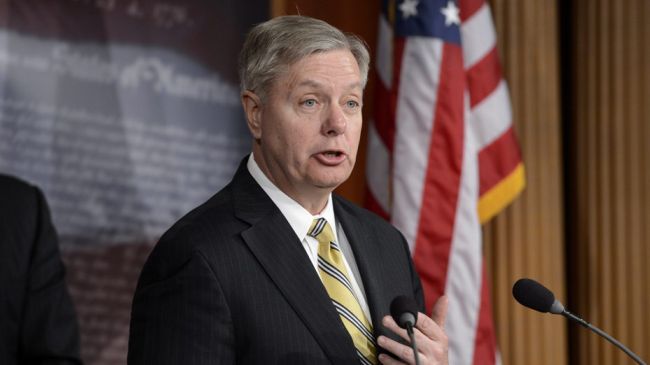
US Senator Lindsey Graham (R) South Carolina (file photo)
Press TV – April 29, 2013
Top US Republican lawmakers have again called for further American actions against Syria, including the bombing of its air bases, leading a multi-nation invasion of the country and sending lethal weapons to anti-Damascus militant gangs.
Fervently pro-Israeli Senators John McCain of Arizona and Lindsey Graham of South Carolina further cited widely challenged claims by the Israeli regime of chemical weapons use in Syria to urge swift Washington action to “secure” chemical arms arsenals in the Arab country in efforts to prevent al-Qaeda-linked militants from gaining access to such weapons, US press reports said on Sunday and Monday.
The two lawmakers, however, did not explain how American forces would secure the alleged cache of Syrian chemical weaponry.
Graham went as far as warning that if the US does not intervene in Syria the next terrorist bombing in American soil will include chemical agents.
“The chemical weapons (in Syria)… are going to be compromised and fall into wrong hands and the next bomb that goes off in America may not have nails and glasses in it,” said Graham during a televised interview with major US network CBS on Sunday.
The senior member of US Senate’s Armed Services Committee also expressed serious concerns about the potential fall of Jordan’s dictator King Abdullah II if Washington did not intervene quickly enough to stop the growing flow of Syrian refugees into his country.
Describing the Jordanian ruler as “a moderating influence and a good [US] ally,” Graham predicted that his regime will fall if the “flood” of Syrian refugees into Jordan continued.
He also predicted a US war with Iran if the Obama administration does not intervene in Syria on the grounds that Tehran would doubt Washington’s resolve in taking action against their nuclear energy program.
The American senator went on to urge the US military to “bomb Syrian air bases with cruise missiles in a bid to “neutralize” the government’s air advantage over the foreign-backed militant gangs and turn the “tide of battle pretty quickly” in favor of the anti-Damascus insurgents.
Moreover, Senator McCain said the US should move into Syria as part of an “international force” to secure the country’s chemical weapons, but did not elaborate on how such international military force would be established and which countries would be involved.
Syria has been faced with a foreign-sponsored armed insurgency since 2011. Thousands of people in the country, including a large number of security forces, have been killed in the unrest with many foreign nationals infiltrating the key Arab state in a bid to destabilize the government of President Bashar al-Assad.
Related article
- Israeli lawmaker urges intervention in Syria (foxnews.com)
Canada’s slavish obedience to US, Israel
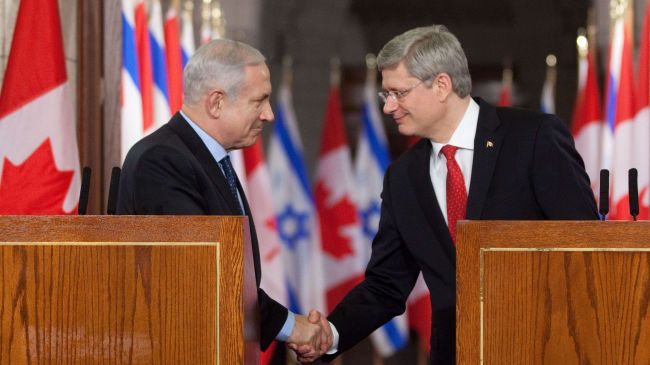
This picture shows Canada’s Prime Minister Stephen Harper (R) and Israeli Prime Minister Benjamin Netanyahu shaking hands after a joint press conference on Parliament Hill, Ottawa, March 2, 2012.
Press TV – April 28, 2013
The world is taking note of the ruling Conservatives’ shameful betrayal of Canada’s once admirable reputation as a fair country, sincerely working on the world stage to improve the lot of the disadvantaged and suffering.
In the UN Human Rights Council’s Universal Periodic Review, Canada was criticized to such an extent that the Council decided to send the Special Rapporteur on the Rights of Indigenous Peoples, and representatives of the Committee on the Elimination of Discrimination Against Women and the Inter-American Commission on Human Rights, to investigate.
Minister of Foreign Affairs spokesman Joseph Lavoie dismissed complaints by
*China of “widespread racial discrimination”,
*Iran of “child sexual exploitation and trafficking, the right to food, discriminatory law and regulation against indigenous people and minority groups including Muslim, Arab and African communities”,
*Pakistan of “increased poverty and unemployment rate among immigrant communities”,
*Egypt of “racial profiling in law-enforcement action”, and
*Cuba of “racism and xenophobia” in Canada,
insisting that “Canada has a track record of being a human rights leader, at home and around the world.”
The visits come at an awkward moment for the Conservatives, as it makes a public display of victimizing Muslims as part of a campaign to ram through the “Combating Terrorism Act” (Bill S-7), which gives the state extraordinary powers to detain suspects without any charges and without any legal protections for up to a year.
This sorry state of Canadian political life is the fruit of the Conservatives’ slavish obedience to every US whim, and of its decision to abandon any pretense of an independent foreign policy, making all decisions in consultation with Israeli advisers under the public security cooperation “partnership” signed in 2008 by Canada and Israel to “protect their respective countries’ population, assets and interests from common threats”. Israel security agents now officially assist Canada’s security services, the RCMP and CSIS, in profiling Canadian citizens who are Muslims and monitoring individuals and/or organizations in Canada involved in supporting the rights of Palestinians and other such nefarious activities. Even the usually timid UN is appalled.
The past two weeks of public spectacle could be lifted from a perverse Alice-in-Wonderland scenario. The latest claim to have uncovered a dastardly scheme by Muslim furriners plotting to explode weapons of mass destruction came just a week after the now legendary Boston bombing. Both incidents were dramatically unfolded to a gullible public as classic ‘good vs evil’, though neither holds water.
Canadian authorities boasted Monday afternoon that, working in concert with the FBI and other US national security agencies, they had broken up a terrorist conspiracy involving an “Iranian-based al-Qaeda cell”. The announcement, made at an RCMP press conference, came out of the blue, just days after the Boston bombing, and a few days after the House of Commons agenda was changed to debate final reading of the draconian anti-terrorism legislation.
On cue, US Ambassador to Canada David Jacobson hailed the action as “the result of extensive cross-border cooperation” showing “that we face serious and real threats.” The men were arrested in a Hollywoodesque fashion–Chiheb Esseghaier while eating at McDonald’s in Montreal’s main train station; Raed Jason, by scores of police armed with rifles and accompanied by search-dogs at his workplace in the Toronto borough of North York. They were charged with conspiracy to bomb a New York-bound Via passenger train, though the RCMP conceded that there had never been an imminent threat of an attack or even a definite plan, that Esseghaier and Jaser have been under police radar since last August (based on a year-old tip from an imam), and that their alleged crimes date back to last year.
The reason for their delayed and then sudden arrest is beyond a doubt the notorious Bill S-7, a bill that was forced on Canada by Big Brother in post-911 2001, and which was not renewed in 2007 thanks to Liberal opposition (they originally passed it and then had enough sense to oppose it). The Conservative government suddenly changed the House of Commons agenda as US authorities placed Boston under martial law. The Canadian copycat arrests clearly are intended to add a Canadian pretext for proceeding with Bill S-7, while showing that “We are all Americans now.”
This episode calls to mind the terrorist scare in 2006, when the RCMP staged the dramatic arrest of 18 young Muslims, whom they accused of preparing extensive terrorist attacks, including blowing up the parliament buildings. During the trial, it emerged that the “Toronto 18” was riddled with police agents, one providing the arms instruction at a “terrorist training camp” while another providing harmless bomb-making ingredients. Nevertheless, eleven were convicted and most given lengthy prison terms.
When Esseghaier, a Tunisian-born Montreal PhD student in nanotechnology, told the judge, “These conclusions are being reached based on facts that are nothing but words and appearances,” he was told to shut up, and the hearing was shut down. Jaser’s lawyer John Norris said his client was “in a state of shock and disbelief” and “intends to defend himself vigorously”. Norris took exception to the police’s attempt to present his client as a non-Canadian, noting that the Palestinian refugee has lived with his family in Canada for the past twenty years.
Is it just possible that UN Human Rights Council members read the ‘news’, are appalled, and are genuinely concerned about what’s happening to human rights in Canada?
Canadians’ plight is bad enough, but this recent orchestration of Islamophobia has another angle, just as appalling. The RCMP assertion that these damn furriners acted under the “direction and guidance” of “al-Qaeda elements located in Iran” is a blatant falsehood, as Iran (like Iraq before the US invasion) is probably the most anti-al-Qaeda country in the world. The fundamentalist al-Qaeda delights in killing Shia, was (and is?) supported by the US and financed by Canada’s enlightened Saudi oil-millionaire allies. So it’s not just a question of stripping Canadians of their rights, but of adding toxic fuel to the US-Israeli fires intended to launch war against peaceful (pro-Palestinian) Iran.
The RCMP admitted that they had no evidence of Iranian government involvement, but still… (nudge, nudge, wink, wink). When Canada broke off diplomatic relations with Tehran last autumn, Foreign Minister John Baird labeled Iran “the most significant threat to global peace and security in the world today”. All Iranian Foreign Ministry spokesman Ramin Mehmanparast had to do was to point to the hypocrisy and cynicism of Canada’s government backing the campaign to overthrow the Syrian government -a campaign in which some of insurgents are openly aligned with al-Qaeda: “The same [al-Qaeda] current is killing people in Syria while enjoying Canada’s support.”
And what about the latest hit on the American 911 funny bone? Tamerlan Tsarnaev was under surveillance for four years by the FBI, who were asked by the Russian government to arrest him in 2010 (which they did not do). They do admit to interviewing him in 2011 and sifting through his computer files, but, remarkably for someone allegedly radicalized by the internet, they found nothing of concern. It’s not clear why Russia let him go to visit his parents in the center of terrorism (Dagestan) in Russia in 2012, where purportedly he received some form of terror training or further Islamist indoctrination. Nor how he managed to attend a workshop next door in hostile Georgia organized by the “Fund of the Caucasus” (which works with the US rightwing thinktank the Jamestown Foundation) focused on destabilizing the Caucasus region.
Were both the FBI and the Russian FSB asleep? Was Tamerlan an FBI operative? Was he set up to do the bombing, or did he go AWOL on the FBI? Is this Chechen connection intended to frighten Russia into acquiescing to US-Israeli plans for Syria? “This [official] scenario is simply impossible in the real world,” writes former UK Ambassador Craig Murray. In an interview with Russia Today, Tamerlan’s mother said, “‘They were set up, the FBI followed them for years.” Is this international intrigue-intended to scare both Russia and Iran into abandoning the beleaguered Syrian government -really what Canadian domestic human rights and foreign policy should be based on? Why should we trust Ambassador Jacobson’s blah-blah about “serious threats”?
Canadians are left with security forces eager to show they are doing something, a craven government intent on passing a draconian bill to take away freedoms, and a foreign policy based on a US-Israel obsession with finding some spark to ignite the latest war craze -attack Iran. The supposed pretext -Iran’s nuclear energy program- is after all wearing a tad thin. Peter Osborne in the Telegraph explained how the West has turned down one serious offer after another by Iran (two in 2005 alone), and argues that it is western rather than Iranian intransigence that prevents a deal being struck today. So if no one believes the cry of “Wolf!” on that boondoggle, then the next best thing is “al-Qaeda”. Hell, Bush got away with it against Iraq in 2003; maybe it will work again.
Iran poses only an ideological threat -telling the truth to the US-Israeli tyrant and inspiring Arab Springs.
As for being killed by a bona fide terrorist, the odds are 1 in 20 million, while every year, 4,600 Americans are killed in workplace-related accidents, and more than 30,000 are killed by gun violence. Every 28 hours a black person is killed by police, security guards or vigilantes. On Boston Marathon Day, six Pakistanis died in a drone strike, while scores were killed in car bombs in Iraq. I won’t even begin to recount the daily horrors inflicted by the US in Afghanistan.
Not that these latter crimes against humanity -committed by us- justify retributive violence in any religion, especially Islam. “You shall not be treacherous, you shall not deceive, you shall not mutilate, you shall not kill children.” But the fact that we in the West are unconcerned with preventing senseless deaths at home, and are unaware or don’t care about the murders committed daily in our name abroad, does not bode well for the future. Only when we stop perpetrating violence will violence against us end.
Israel spy agency has presence in Syria, says senior rebel general
By Joseph Fitsanakis | intelNews | April 25, 2013
Israel is one of several countries that maintain a significant intelligence presence inside Syria, according to the top commander of the Syrian rebel forces.
General Salim Idriss, Chief of Staff for the Free Syrian Army, told CNN’s Christiane Amanpour that the Jewish state has “many, many” intelligence officers in various parts of Syria. The Arab country has been rocked since 2011 by a violent civil war, which has cost the lives of at least 60,000 people.
Idriss was responding to comments made earlier this week by Brigadier General Itai Brun, senior intelligence analyst for the Israel Defense Forces (IDF). Brun, who heads the Division for Research and Analysis of the IDF’s Military Intelligence Directorate, was speaking at a conference hosted in Tel Aviv, Israel, by the Institute for National Security Studies. He told an audience of intelligence experts that the IDF was “quite certain” that the Syrian government headed by President Bashar al-Assad had resorted to the use of chemical weapons against rebel forces on at least one instance.
According to Brun, footage obtained by the IDF of rebel casualties from a March 19 attack by Syrian government forces, pointed to the use of sarin nerve gas. He referred to evidence such as the victims’ dilated pupils and “the foam coming out of their mouths” as strong proof of the use of weaponized sarin nerve gas in the battlefield.
Responding to Brun’s allegations, General Idriss suggested that Syrian government forces had used chemical weapons repeatedly in a variety of locations, including Aleppo, Homs, and the outskirts of capital Damascus. He added that rebel forces had collected “some samples of soil and blood” and surrendered it to outside “observers” of the civil war —though he refused to identify these observers. After some pressure from Amanpour, Idriss said it made sense for the IDF to know that sarin nerve gas had been used by the Syrian government, since Israel was one of several countries that had “many, many” intelligence officers inside Syria. Asked by Amanpour whether he was referring to Israeli covert-action agency Mossad, Idriss responded “yes”.
In response to Brun’s comments, White House Press Secretary Jay Carney told reporters on Tuesday that Washington was “looking for conclusive evidence, if it exists, if there was use of chemical weapons”.
The New Yorker Should Ignore Jon Lee Anderson and Issue a Correction on Venezuela
By Keane Bhatt | NACLA | April 24, 2013
As a result of many dozens—possibly hundreds—of messages from readers over the past few weeks that criticized The New Yorker’s inaccurate coverage of Venezuela, reporter Jon Lee Anderson issued a response in an online post on April 23. This marks the first time the magazine has publicly addressed its controversial and erroneous labeling of Venezuela as one of the world’s most “socially unequal” countries (I highlighted the error in mid-March). Although Anderson deprives his readers of the opportunity to evaluate his critics’ arguments (he offered no hyperlinks to either of my two articles on the subject, nor to posts by Corey Robin, Jim Naureckas, and others), he is clearly writing in response to those assertions.
To his credit, Anderson unequivocally admits two of his three errors: regarding Venezuela’s homicides, he acknowledges that he falsely wrote “that Venezuela had the highest homicide rate in Latin America. Actually, Honduras has the top rate.” Anderson proceeds to explain why Venezuela’s high homicide rate is nevertheless a grave problem—a position none of his critics, myself included, dispute.
The importance of this error rests instead in its revelation of a media culture under the influence of the consistent demonization of a country deemed an official U.S. enemy. This culture certainly played a role in allowing Anderson’s obvious falsehood to remain uncorrected for five months—five months after I first wrote about it, one month after I directly and publicly confronted Anderson about the error, and even then, days after I wrote another article urging readers to demand a correction.
While The New Yorker has dedicated literally no articles to U.S. ally Honduras since its current leader Porfirio Lobo came to power in repressive, sham elections held under a military dictatorship, Anderson was allowed to assert that Venezuela—a country with half the per capita homicides of Honduras—was Latin America’s leader in murders. One might reasonably suspect that a claim on The New Yorker’s website asserting that the United States had a higher homicide rate than Bolivia (Bolivia’s rate is actually over two times as high), would be retracted more expeditiously.
Anderson’s explanation for his second error—claiming that Chávez came to office through a coup d’etat rather than a free and fair election—further lays bare the corrupting effects of the generalized vilification of Chávez on basic journalistic standards of accuracy.
Anderson writes that despite his gaffe, he obviously knew Chávez “gained the Presidency by winning an election in 1998,” as he had “interviewed Chávez a number of times, travelled with him, and came to know him fairly well.” For Anderson to write such an egregious misstatement, then, and have it pass through what is likely the most rigorous fact-checking process in the industry, exposes a pervasive ideology under which he and his many editors and fact-checkers operate. As Jim Naureckas of Fairness & Accuracy in Reporting wrote, “It’s like writing a long profile on Gerald Ford that refers to that time when he was elected president.”
Finally, Anderson offers a desperate attempt to justify his third factual error, stating:
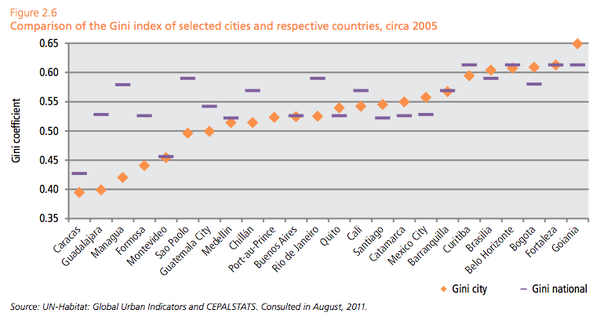
A number of letters I’ve received dispute, out of context, my reference to “the same Venezuela as ever: one of the world’s most oil-rich but socially unequal countries”; several cite an economic statistic known as the Gini coefficient—a measure of income inequality.
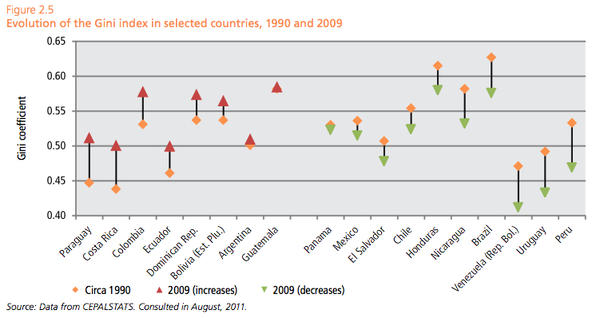
Notice that Anderson never tells his readers what Venezuela’s Gini coefficient actually is. According to the United Nations, Venezuela’s Gini, at 0.397, makes it the least unequal country in Latin America and squarely in the middle range of the rest of the world. Only by sidestepping this brutal empirical obstacle can Anderson attempt to lay out his case. He carries on by reposting three paragraphs of his original essay, which in no way mitigate the falsity of his original claim, for “context.” Anderson finally concludes by offering a novel justification for his error:
In terms of some of the components of social inequality, notably income and education, Chávez had some real achievements. (Income is what’s captured by the Gini coefficient, although that statistic has its own limitations, some particular to Venezuela.) But in housing and violence, his record was woefully insufficient. Those social factors are intimately related, to each other and to the question of equality.
A quick recap is in order before unpacking Anderson’s argument. Readers may remember that he first responded to evidence on income inequality by proclaiming, on Twitter, his agnosticism toward empirical data. Next, a senior editor at the magazine justified Anderson’s contention by arguing that Venezuela was one of the most unequal amongst other oil-rich countries—a point I debunked. Now, Anderson has settled on a definition of social inequality that minimizes Venezuela’s high educational and income equality in favor of high homicide rates and unequal housing.
But simply saying that Chávez’s record “was woefully insufficient” on housing and violence does not naturally equate to Venezuela’s standing as a world leader in social inequality. Anderson must rely on comparative international statistics to justify his position, but fails to do so.
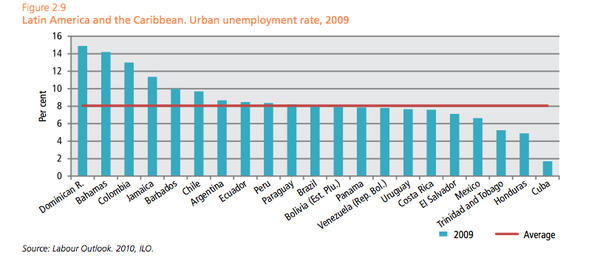
While Venezuela’s homicide rate is high by international standards and a significant social ill, this alone does not necessarily make the country more socially unequal than another country with a lower homicide rate. Are Venezuelan homicides more skewed toward low-income residents than those in Costa Rica? Or Haiti? Are Venezuelan murders more targeted at women or ethnic minorities than those in Mexico or Guatemala? And given that the high homicide rate directly affects far fewer than one in a thousand Venezuelans annually, how could this statistic possibly outweigh the effect of massive income-inequality and poverty reductions? If he is solely basing his argument on murder rates, Anderson has no credible explanation as to why Venezuela is one of the world’s most socially unequal countries.
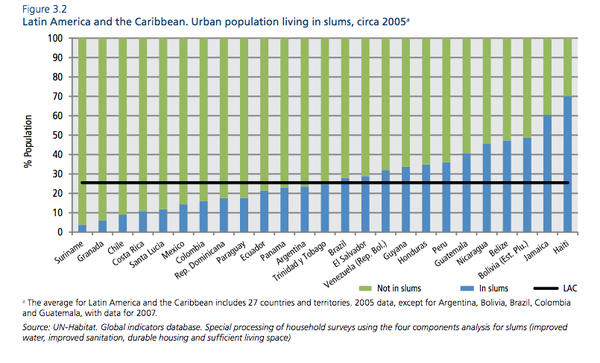
Anderson also doesn’t offer statistics showing that housing is more unequal in Venezuela than anywhere else. That’s because it’s not.
Out of the 91 countries for which the United Nations has available data, Venezuela is 61st in terms of the percentage of its urban population living in slums. That is to say, two-thirds of the world’s countries with available data have larger percentages of their urban citizens living as slum dwellers. In the Western Hemisphere, this includes Guayana, Honduras, Peru, Anguilla, Guatemala, Nicaragua, Belize, Bolivia, Jamaica, and Haiti.
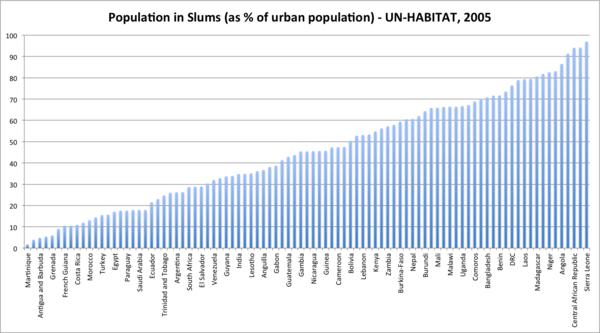
It is also worth mentioning that this data was taken from 2005, when the percentage of Venezuela’s urban population living in poverty and extreme poverty was at 37%. By 2010, according to the United Nations, it had been cut by a quarter, to 28% (p. 43). Furthermore, 2005 predates a massive governmental push in 2011 to build affordable housing. Earlier this year, Venezuela’s Housing Commission chair asserted that “in the years 2011 and 2012, the Bolivarian government together with the people reached the goal of building 350,000 homes.”
It appears, then, that Anderson has discovered a new definition of “social inequality” that has eluded economists and sociologists worldwide—one that systematically downplays Venezuela’s educational and income equality while emphasizing a high frequency of murders and a rate of slum-dwelling that is low by international standards.
While one can applaud Jon Lee Anderson for finally acknowledging the value of social indicators and statistical data, he and his magazine cannot be allowed to define “social inequality” any way they see fit. No social scientist analyzing the available data could argue, like Anderson, that Venezuela is one of the world’s most socially unequal countries. While semantics games may be expedient in avoiding a necessary correction, readers should let The New Yorker’s editor David Remnick (david_remnick@newyorker.com) know that a retraction of Anderson’s claim is long overdue.
Update (4/24): FAIR’s Jim Naureckas also offers sharp criticism of Jon Lee Anderson and his fact-checkers for a transparently inadequate attempt to justify his error regarding Venezuela’s social inequality. Read more, at “Jon Lee Anderson Explains: Because I Said So.”
~
Keane Bhatt is an activist in Washington, D.C. He has worked in the United States and Latin America on a variety of campaigns related to community development and social justice. His analyses and opinions have appeared in a range of outlets, including NPR, The Nation, The St. Petersburg Times, and CNN En Español. He is the author of the NACLA blog “Manufacturing Contempt,” which critically analyzes the U.S. press and its portrayal of the hemisphere. Connect with his blog on Twitter: @KeaneBhatt
Related articles
- The New Yorker Corrects Two Errors on Venezuela, Refuses a Third (alethonews.wordpress.com)
- On Venezuela, The New Yorker’s Jon Lee Anderson Fails at Arithmetic (alethonews.wordpress.com)
- 50 Truths about Hugo Chavez and the Bolivarian Revolution (alethonews.wordpress.com)
- ‘Little Twerp … Get a Life’: The New Yorker’s Jon Lee Anderson Thinks He’s Somebody on Twitter (gawker.com)
Venezuelan Government Accuses Capriles of Making “Impossible” Demands
By Chris Carlson | Venezuelanalysis | April 25, 2013
Maracaibo – Opposition leader Henrique Capriles claimed yesterday that the presidential elections were “stolen”, and demanded further audit measures that the Venezuelan government has said are “impossible”.
Capriles made the statements during a press conference on Wednesday in which he gave the government an ultimatum regarding the audit.
“The truth is that you stole the elections, that’s the truth. You stole the elections and now you have to explain that to the country and the world,” he said.
Capriles demanded that the National Electoral Council (CNE) begin the auditing process immediately, and said his campaign will refuse to wait any longer.
“That is what we are demanding. We will give you until tomorrow,” he said, though he did not say what would happen if the CNE did not respond.
However, the CNE had already said last week that it would announce the beginning of the audit this week, and was expected to make an announcement today.
The Capriles campaign went on to demand a series of additional audit measures that are not included in the audit that has been approved by the CNE. His campaign representative Roberto Picón said that in addition to a complete audit of the electoral machines and the paper ballots, they are also demanding access to the electoral registry, the fingerprint system and a verification of each individual voter.
“We are asking for complete access to the electoral registry, not only to count how many people voted but also to audit all of the details, to audit the people that voted to see if there are dead people who voted, or foreigners, or duplicates, and to see if there are fake fingerprints,” said Picón.
He further said that they are demanding the CNE validate every individual fingerprint in the system, comparing each fingerprint to every other to assure none are duplicated, validate every person’s signature on the day of the elections and that they provide proof that none of the electoral data has been altered since the elections last week.
“If it doesn’t include the electoral registry, then it is not an audit. We won’t accept a shoddy audit,” said Capriles.
Various government officials have responded to these demands, saying they would be impossible to meet, and that the Capriles campaign knows it.
“They are making requests to the CNE that are absolutely impossible to grant. They are asking that every fingerprint and every signature of the almost 15 million people who participated in the electoral process be verified,” said Calixo Ortega.
“This would take like 5 years to verify, because it takes hours to verify a single fingerprint or signature, and there are 15 million that would have to be verified,” he said.
“It appears that they are purposely making requests that cannot be granted so that they can later say that the CNE has denied their request,” he explained.
Maduro’s campaign manager Jorge Rodgriguez also responded to Capriles, accusing him of attempting to create more violence in the country.
“Now Capriles says the elections were stolen. Where is the proof? Where is a single piece of evidence of that? If you can’t show any evidence, then it didn’t happen,” said Rodriguez.
Rodriguez also accused Capriles of attempting to generate more violence in the country.
“What are you doing giving the government an ultimatum like that? You have already left a cemetery in your wake with 9 fellow Venezuelans dead from the violence you created,” he said.
Capriles has yet to present any evidence of fraud in the April 14th elections. In the days following the elections, he mentioned various examples that were all promptly shown to be false.
Venezuela’s electoral council is expected to announce the timeframe of the auditing process today or tomorrow. It is unlikely that the additional measures being demanded by the Capriles campaign will be included in the audit.
Related articles
- Venezuela’s Electoral Council Approves Audit of 100 Percent of Votes (alethonews.wordpress.com)
- Capriles Falsifies Evidence in Order to Claim Fraud in Venezuela’s Elections (alethonews.wordpress.com)
- Capriles Attacks Venezuelan Electoral Council, Refuses to Sign Document (alethonews.wordpress.com)
Obama administration bypasses CISPA by secretly allowing Internet surveillance
RT | April 24, 2013
Scared that CISPA might pass? The federal government is already using a secretive cybersecurity program to monitor online traffic and enforce CISPA-like data sharing between Internet service providers and the Department of Defense.
The Electronic Privacy Information Center has obtained over 1,000 pages of documents pertaining to the United States government’s use of a cybersecurity program after filing a Freedom of Information Act request, and CNET reporter Declan McCullagh says those pages show how the Pentagon has secretly helped push for increased Internet surveillance.
“Senior Obama administration officials have secretly authorized the interception of communications carried on portions of networks operated by AT&T and other Internet service providers, a practice that might otherwise be illegal under federal wiretapping laws,” McCullagh writes.
That practice, McCullagh recalls, was first revealed when Deputy Secretary of Defense William Lynn disclosed the existence of the Defense Industrial Base (DIB) Cyber Pilot in June 2011. At the time, the Pentagon said the program would allow the government to help the defense industry safeguard the information on their computer systems by sharing classified threat information between the Department of Defense, the Department of Homeland Security and the Internet service providers (ISP) that keep government contractors online.
“Our defense industrial base is critical to our military effectiveness. Their networks hold valuable information about our weapons systems and their capabilities,” Lynn said. “The theft of design data and engineering information from within these networks greatly undermines the technological edge we hold over potential adversaries.”
Just last week the US House of Representatives voted in favor of the Cyber Intelligence Sharing and Protection Act, or CISPA — a legislation that would allow ISPs and private Internet companies across the country like Facebook and Google to share similar threat data with the federal government without being held liable for violating their customers’ privacy. As it turns out, however, the DIB Cyber Pilot has expanded exponentially in recent months, suggesting that a significant chunk of Internet traffic is already subjected to governmental monitoring.
In May 2012 less than a year after the pilot was first unveiled, the Defense Department announced the expansion of the DIB program. Then this past January, McCullagh says it was renamed the Enhanced Cybersecurity Services (ECS) and opened up to a larger number of companies — not just DoD contractors. An executive order signed by US President Barack Obama earlier this year will let all critical infrastructure companies to sign-on to ECS this June, likely in turn bringing on board entities in energy, healthcare, communication and finance.
Although the 1,000-plus pages obtained in the FOIA request haven’t been posted in full on the Web just yet, a sampling of that trove published by EPIC on Wednesday starts to show just exactly how severe the Pentagon’s efforts to eavesdrop on Web traffic has been.
In one document, a December 2011 slideshow on the legal policies and practices regarding the monitoring of Web traffic on DIB-linked systems, the Pentagon instructs the administrators of those third-party computer networks on how to implement the program and, as a result, erode their customers’ expectation of privacy.
In one slide, the Pentagon explains to ISPs and other system administrators how to be clear in letting their customers know that their traffic was being fed to the government. Key elements to keep in mind, wrote the Defense Department, was that DIB “expressly covers monitoring of data and communications in transit rather than just accessing data at rest.”
“[T]hat information transiting or stored on the system may be disclosed for any purpose, including to the government,” it continued. Companies participating in the pilot program were told to let users know that monitoring would exist “for any purpose,” and that users have no expectation of privacy regarding communications or data stored on the system.
According to the 2011 press released on the DIB Cyber Pilot, “the government will not monitor, intercept or store any private-sector communications through the program.” In a privacy impact assessment of the ECS program that was published in January by the DHS though, it’s revealed that not only is information monitored, but among the data collected by investigators could be personally identifiable information, including the header info from suspicious emails. That would mean the government sees and stores who you communicate with and what kind of subject lines are used during correspondence.
The DHS says that personally identifiable information could be retained if “analytically relevant to understanding the cyber threat” in question.
Meanwhile, the lawmakers in Congress that overwhelmingly approved CISPA just last week could arguably use a refresher in what constitutes a cyberthreat. Rep. Michael McCaul (R-Texas) told his colleagues on the Hill that “Recent events in Boston demonstrate that we have to come together as Republicans and Democrats to get this done,” and Rep. Dan Maffei (D-New York) made unfounded claims during Thursday’s debate that the whistleblowing website WikiLeaks is pursuing efforts to “hack into our nation’s power grid.”
Should CISPA be signed into law, telecommunication companies will be encouraged to share Internet data with the DHS and Department of Justice for so-called national security purposes. But even if the president pursues a veto as his advisers have suggested, McCullagh says few will be safe from this secretive cybersecurity operation already in place.
The tome of FOIA pages, McCullagh says, shows that the Justice Department has actively assisted telecoms as of late by letting them off the hook for Wiretap Act violations. Since the sharing of data between ISPs and the government under the DIB program and now ECS violates federal statute, the Justice Department has reportedly issued an undeterminable number of “2511 letters” to telecoms: essentially written approval to ignore provisions of the Wiretap Act in exchange for immunity.
“The Justice Department is helping private companies evade federal wiretap laws,” EPIC Executive Director Marc Rotenberg tells CNET. “Alarm bells should be going off.”
In an internal Justice Department email cited by McCullagh, Associate Deputy Attorney General James Baker is alleged to write that ISPs will likely request 2511 letters and the ECS-participating companies “would be required to change their banners to reference government monitoring.”
“These agencies are clearly seeking authority to receive a large amount of information, including personal information, from private Internet networks,” EPIC staff attorney Amie Stepanovich adds to CNET. “If this program was broadly deployed, it would raise serious questions about government cybersecurity practices.”
Related articles
- To Ease Internet Snooping, Feds Promise To Ignore Privacy Violations (reason.com)
- Congressman evokes Boston bombings as reason to pass CISPA (rt.com)
- U.S. gives big, secret push to Internet surveillance (philosophers-stone.co.uk)
Every Day Terror
By Margaret Kimberley | Black Agenda Report | April 24, 2013
Every year, 4,600 Americans are killed in work place related accidents. Every 28 hours a black person is killed by police, corrections officers, security guards or vigilantes. Every year more than 30,000 people are killed by gun violence in this country. The odds of being killed by a terrorist are only 1 in 20 million.
These statistics are rarely mentioned and never had a chance to be addressed after two bombs were exploded during the Boston marathon. Death under horrific but commonplace circumstances attracts scant media attention or political action. Acts labeled as terrorism, which are unlikely to kill anyone, bring an inordinate amount of hysteria among the populace and cynical attention from press and politicians.
Just two days after the Boston marathon a fertilizer plant in West, Texas exploded, killing 14 people, most of them the much worshiped “first responders.” The risk of dying in an industrial accident is far greater than the odds of being killed by a terrorist, but no matter. The people were whipped into a frenzy and told to cast their eyes in the place where they should pay less attention rather than more.
It is frightening that the risks which Americans are subjected to on a daily basis are ignored as if they are unwanted background noise. Some of the passivity is understandable. Black people in particular are able to function in large part because the ever present risk of stop and frisk, false arrest, and police brutality are difficult to bear. There is a thin line between being conscious and losing one’s mind.
All Americans’ behavior is understandable if one acknowledges that we are constantly subjected to propaganda of various kinds. We have been propagandized to believe that some lives, white Americans’, are more valuable than others, namely anyone not white nor from the United States. There is no other way to explain why the government’s killing of thousands of people abroad is met with a shrug, if it is acknowledged at all. Americans are like spoiled children, whining over their suffering, while showing no empathy for anyone else’s. They feel that only their victimization is worthy of note, and in fact many of them support their government’s acts of violence carried out around the world.
That feeling of entitlement is a direct result of centuries of white supremacy which has never been examined or challenged. It has been fed as corporate power has grown and corrupted the media who now aren’t even very good at the basics of their profession. CNN, NPR, the Associated Press and other supposedly reputable news organizations reported wrongly on basic facts of the case such as the number of suspects, whether arrests had been made or not, or who was or wasn’t a person of interest. A “dark skinned man” was said to be under arrest but actually wasn’t. An Indian student missing since March was named as a suspect on social media and his family were threatened as a result.
After the wave of manufactured hysteria an easily frightened people were then convinced to accept tanks in their streets and heed government calls to “shelter in place.” The nonsensical overreaction was superseded only by the use of Orwellian jargon used to create an even more compliant public.
The predictably maudlin moments of silence weren’t restricted to Boston. More than $20 million in monetary contributions were raised without the donors knowing who needed it or for what purpose. Tributes flowed along with money and no one ran a race anywhere on earth without mentioning the bravery of Bostonians. The president showed up and as always on such occasions uttered words seemingly written by his worst speechwriters. The full force of the government would catch the cowards and the people would not be frightened because they are the best and freest in the world and the prayers of the nation went out to them because of democracy and the whole world stood beside them. Amen.
There is another kind of terror that goes on continually. Most reported terror plots of recent years were created entirely by government agents. The FBI had some contact with Tamerlan Tsarnaev who was killed by police in the bombing after math. It is possible that the FBI moved from creating phony terror plots to actually carrying one out. The likelihood that there will ever be impartial fact finding on this and other questions are slim to none.
Dzokhar Tsarnaev now lies in a hospital wounded by police gunfire and questioned without being read his rights. That treatment is a result of an Obama executive order which states that in cases of a “public safety exception” we have no such rights. Now that is everyday terror.
Margaret Kimberley can be reached via e-Mail at Margaret.Kimberley(at)BlackAgendaReport.com.
Related article
- Manufacturing Terrorists – How FBI sting operations make jihadists out of hapless malcontents (therearenosunglasses.wordpress.com)
Featured Video

Why the U.S. Should Pull Back From the First Island Chain
or go to
Aletho News Archives – Video-Images
Book Review
‘Why Fauci Must Rot in Prison’: A Tale of Two Diaries
By Jill Erzen | The Defender | October 13, 2026
Dr. Anthony Fauci’s private diary reveals a “mind-numbing” contradiction between what the former top U.S. infectious disease official knew about COVID-19 and what he told the public, senior White House adviser Peter Navarro, Ph.D., said last week on “American Thought Leaders.”
In his new book, “Why Fauci Must Rot in Prison,” due out Oct. 20, Navarro compares Fauci’s private entries to his own pandemic-era diary, and uses what he calls “a tale of two diaries” to argue that Fauci should face criminal prosecution.
“I show, actually, how a prosecution can and should happen … at the state level, most likely,” Navarro said. “He should wind up in prison, and we’ve got the receipts in this book to put him there.”
Navarro said Fauci repeatedly acknowledged important facts in private, then publicly pursued policies that contradicted those facts — with devastating consequences.
“What he says many times privately in his diary is so at odds with both his public behavior and public statements that it’s mind-numbing,” Navarro said.
Navarro examines the lasting damage caused by lockdowns and other pandemic policies, and the ongoing toll of long COVID.
His book also addresses questions about vaccine safety, including why healthy young people faced COVID-19 vaccination mandates despite concerns about myocarditis, and why women were not warned about miscarriage risks linked to the shots. … continue
Blog Roll
 Aletho News
- Jennifer Kavanagh: Why the U.S. Should Pull Back From the First Island Chain
- Yemen denounces international community’s silence on Saudi aggression, siege
- UAE and Saudi Arabia move toward renewed coordination against Sanaa
- How Iran’s two-week retaliatory strikes exposed cracks in US military architecture in Persian Gulf
- The mother of all propaganda: Why the hype over US MOAB strike against Iran is nothing but theater
- Iran says it possesses technology behind US 14-ton GBU bunker-buster
- Trump asks Iran not to retaliate after he strikes Pickaxe Mountain – w/ Prof. Marandi
- Vice President J.D. Vance’s Deceptive ‘Antiwar’ Campaign Speech
- Iran: Palestinians’ rights must not be compromised in Gaza’s future; US, Israel to blame for Hormuz situation
- Ongoing tales of Syrian chemical weapons
- If Americans Knew
- Israeli rabbi permits occupiers to steal Palestinian olive harvest in West Bank
- Netanyahu’s spin on latest settler attack is laughable – Daily Update
- Israeli soldiers debunk Israel’s talking points
- In West Bank, Israeli settlers are totally out of control – Daily Update
- NPR investigation finds evidence of widespread fraud at mall kiosks tied to Israeli skincare brand
- Tucker Carlson exposes Israeli Lies about the Oct 7th attack, Charlie Kirk, and the U.S.
- Israel has detained thousands of Palestinian children since Oct 7th – over half spent time in solitary, many uncharged
- Israeli Analysis: Is Netanyahu Planning an ‘October Surprise’ Attack Before Israel’s Election?
- Israeli settlers brutally attack Palestinians and Washington Post female photographer, 65
- Words Have Changed, Occupation Continues: The Reality of the Gaza Ceasefire
- No Tricks Zone
- Predictions Made By Renowned Climate Proifessor Over Past Decades Have Been Proven To Be Poor
- New Study Suggests Large Regions Of The Pacific Ocean Have Been Cooling For The Last 80 Years
- Germany’s Green Energy Debacle: High Energy Costs Force Kahla Porzellan to Close After 182 Years!
- New Study: 50 Years Of The Most Aggressive ‘Net Zero’ Policies Can Only Affect The Global Climate By 0.03°C
- US September “Heat” Was No Record…Many Records Set Decades Ago
- Latest European Green Energy Debacle; Portugal’s Largest Flagship Solar Park Insolvent!
- Green Energy Debacle: German Expert Professor Fritz Vahrenholt Warns Of Severe Economic And Social Consequences
- Two More Paleo Reconstructions Affirm Meters-Higher Sea Levels Across Ireland, Brazil 7000-6000 Years Ago
- New Study: Earth And Venus Surface Warmth Largely Explained By Convection And Lapse Rate, Not CO2 Or Radiation
- 2025 Nature Paper Claiming Worsening Global Drought Gets RETRACTED …Heavily Flawed

