Vietnam reassures China: no foreign military bases will be hosted on its territory
By Ahmed Adel | November 2, 2022
China and Vietnam are strengthening their partnership to resist Western interference in their internal and regional affairs. Although the two Asian countries have major issues between them and centuries worth of historical animosity, Hanoi will never allow the US to use Vietnam to fight or pressure China.
Chinese President Xi Jinping met with Vietnamese Communist Party (VCP) Central Committee General Secretary Nguyen Phu Trong in Beijing on October 31. Xi Jinping emphazised in their meeting that the Communist Party of China and the Communist Party of Vietnam should not allow anyone to interfere in the sustainable progress of their respective countries.
For his part, Phu Trong clarified that China has the right to count on Vietnamese support in sensitive issues of regional security. Specifically, the Vietnamese leader assured that his country would maintain peace and stability at the land and sea border and not let issues over territorial waters hinder overall bilateral relations. He assured that Hanoi would not develop any official relations with Taiwan, and significantly, that no foreign country will be allowed to set up military bases on Vietnamese territory.
Reaffirming Vietnam’s position on issues that are sensitive and critical to regional security was one of the important outcomes of the high-level talks in Beijing. As Vietnam is the biggest country in Southeast Asia which borders China, in terms of economic power, the US hoped to use Vietnam as a tool of pressure against China. For Washington, it would be ideal if Vietnam and China clashed in the South China Sea so Hanoi could pivot towards AUKUS and/or QUAD.
To Washington’s disappointment though, Hanoi made it clear that it shares Beijing’s position on no foreign military bases and military alliances. At the same time, Vietnam maintains its position against Beijing on the South China Sea issue. Although this could be an issue for the US to exploit, Hanoi has stated that it will not use military force to solve it. Effectively, Vietnam signalled to the US that it will not be a tool to confront China.
At the meeting in Beijing, Xi Jinping noted that development between China and Vietnam faces serious risks and challenges. The Russia-Ukraine conflict has further highlighted the geopolitical issue between great powers, which has contributed to the multitude of challenges that developing countries are facing. Specifically, the energy and food crises are issues that deeply concern Southeast Asian countries like Vietnam.
According to the World Bank, Vietnam is projected to become the fastest growing economy in Asia this year despite a regional downturn caused by China’s sharp economic deceleration. In its most recent economic outlook report for East Asia and the Pacific, the World Bank forecast these regions to grow by 3.2% in 2022, down from 7.2% in 2021, before accelerating to 4.6% in 2023. The projected growth rate for this year marked a significant reduction on the 5% that the World Bank forecast for the year in its last outlook report in April.
Vietnam appears to be one of the biggest beneficiaries of this growth, with the World Bank estimating the country’s economy to grow by 7.2% in 2022, up from its projection of 5.3% in April. The World Bank then projects it to grow by a further 6.7% in 2023. Impressively, Vietnam was one of the few countries whose economy grew during the coronavirus pandemic in 2020. This comes as there is also a continuing trend to move high-tech production from China to Vietnam.
Given Vietnam’s growing importance in the region, the US hoped to exploit the historical animosity the Southeast Asian country has with Beijing and differences over the South China Sea. However, this has failed.
In fact, the two countries, along with several ASEAN countries, are working on a Code of Conduct in the South China Sea, something that Washington opposes. The Americans want to tighten pressure on China, but the successful visit of Phu Trong to Beijing has ended any thoughts of the US using Vietnam to pressure China. In this way, the US is finding it extremely difficult to find Southeast Asian allies to oppose China.
Ahmed Adel is a Cairo-based geopolitics and political economy researcher.
UK-Aided Ukrainian Attempt at Sabotaging Grain Deal to Backfire, Expert Says
Samizdat – 31.10.2022
MOSCOW – Ukraine attacked Russian naval ships that escorted vital grain exports in an attempt to escalate the hunger crisis for the world and blame it on Russia, but the move will likely backfire to make Africa and the Middle East wary of the West and more trustful of Moscow, French political commentator Charles Gave told Sputnik.
Russia quit the UN- and Turkey-brokered grain shipping deal on Saturday after its Black Sea naval ships and civil vessels were attacked in a drone strike that it said was coordinated by the UK. Russia, a leading global grain producer, promised to supply up to 500,000 tonnes of grain to the poorest countries free of charge in the coming months to offset shortfalls from Ukrainian exports.
“The only reason for this drone attack, which is a provocation that really threatens to stop altogether the delivery of grain from Ukraine, is the will to sabotage the grain agreement and present Russia as the arch-villain in the conflict,” Gave said.
He believes, however, that the opposite will likely happen.
“In the end the boomerang effect will probably be that African and Middle East countries will be made much more aware that they can count on Russian grain and that the West, by disrupting the export of grain through the Black Sea, is to blame for this new negative development,” he said.
The attack caused wheat and corn to trade higher on the global stock markets on Monday after the July grain deal saw cereal and vegetable oil prices drop to pre-conflict levels.
Gave, the founder of TVLibertes news channel, said Russia only stood to benefit from the Ukrainian drone strike because it would inflate its grain revenues, while its offer of free grain to those in need would strengthen its image as a reliable partner among the developing countries.
He also called Ukraine’s behavior irresponsible because it risked a deal that had been painstakingly negotiated by Turkey to stage a “public relations exercise and a provocation to create the buzz.”
“I see Russia gaining more and more capacity to influence ‘the rest of the world’ and turn developing countries away from the West,” Gave said. “The consequences are very bad for the countries of destination of the grain export. The West should stop involving itself more and more as a co-belligerent in the conflict and actively support negotiations,” he cautioned.
Russia closes Black Sea ‘grain corridor’
Samizdat – October 31, 2022
The Russian military closed the so-called “grain corridor” used to ship Ukrainian agriculture products through the Black Sea on Monday. The move was provoked by the actions of Ukraine, which used the route to launch attacks on Russia, the Russian Defense Ministry said.
“Any navigation through the security corridor designated under the Black Sea [grain shipment] initiative would be halted until the situation around the Ukrainian … terrorist attack on the military and civilian vessels in Sevastopol is cleared,” the Russian Defense Ministry said in a statement.
The ministry also said that Kiev should specifically commit not to use the corridor for military purposes. At the same time, it maintained that Russia does not withdraw from the deal but only suspends it for an indefinite period of time.
Earlier on Monday, Kremlin spokesman Dmitry Peskov said that Russia was ready to compensate for the missing Ukrainian grain exports to the poorer nations from its own stocks. He also warned that the grain deal has become “much more risky, dangerous” now since Russia cannot guarantee maritime security in the waters of the designated grain corridor.
Russia is “still in contact” with other parties, including the UN and Türkiye, Peskov said, adding, however, that Moscow was not ready to be talked into resuming its participation in the deal.
A dozen ships carrying Ukrainian grain were cleared to leave Turkish ports earlier on Monday. The Joint Coordination Centre (JCC) in Istanbul agreed on a plan to inspect a further 40 ships, despite Moscow’s decision to suspend the deal. It is unclear whether it will follow on its plan now.
US sanctions Chinese chip industry
Free West Media | October 31, 2022
With new US sanctions against China, which came into force on October 12, the Biden administration delivered a serious blow against the Asian giant. Any cooperation with Chinese chip and memory manufacturers and in particular the export of semiconductors to China is now prohibited.
Foreign companies that do not comply with these US requirements also run the risk of becoming victims of American sanctions. What is particularly disastrous is that the new sanctions require all US citizens working in China to immediately stop working for Chinese partner companies or company subsidiaries – otherwise there is even a risk of their US citizenship being revoked.
Chinese media such as the South China Morning Post reported that, as a result, US engineers have already left China “en masse”.
The US measures could have serious consequences for Chinese industry and the Chinese military. According to the German business daily Handelsblatt, the new trade restrictions could lead to massive supply bottlenecks and “throw the Chinese chip industry back by years”.
The Sino-American analyst Jordan Schneider goes even further and speaks in a detailed tweet of an “industry-wide decapitation” of the Chinese chip industry. The US plans meant “annihilation” for China’s chip manufacturers.
The US government justified its latest sanctions as a “national emergency” in relation to telecommunications and information technology.
Some time ago, US President Biden commissioned the establishment of a completely American semiconductor industry. On October 7, he said: “The supply chain will start here and end here.”
But in a Politico opinion piece, another analyst lamented that it could be up to “2 years before officers actually move in [to the US State Department’s new ‘China House’]”. The urge to compete with China while struggling to build a 60-person office in less than a year, does not bode well for American ambitions to compete.
From China’s perspective, it will be difficult to isolate the country. It is therefore doubtful whether the US can enforce unilateral executive orders to prevent non-US chip companies from conducting normal cooperation and trade with China.
For non-US companies refusing to join a chip boycott, it means escaping unilateral US bans which will eventually undercut US companies’ competitiveness by depriving them of the huge Chinese market.
“US restrictions will only accelerate the development of China’s chip sector, because the Chinese market won’t wait for the US to come to its senses. If the Chinese chip sector catches up quickly and no longer relies on imports, it will not be a $2,5 billion loss for a single US company, but hundreds of billions of dollars of loss for the chip industry,” the Global Times opined.
The export ban in May 2019 of Chinese tech firm Huawei, saw top American chipmakers reporting a median revenue decline of up to 9 percent in some cases.
The Biden administration’s latest tech controls threaten to accelerate such losses, creating chaos in the global semiconductor sector, especially if China decides to retaliate. US companies could lose 18 percent of their global market share and 37 percent of their revenues if the US completely bans semiconductor companies from selling to Chinese customers.
The German government meanwhile plans to approve a Chinese takeover of the chip production of Dortmund-based company Elmos, business daily Handelsblatt reported, citing government sources.
The economy ministry is examining the sale of Elmos‘ chip factory to competitor Silex, a Swedish company that is a subsidiary of Chinese group Sai Microelectronics, with approval expected in the coming weeks. The ministry had no immediate comment when contacted by Reuters.
‘Inflation came from nowhere’ – Lagarde
Samizdat | October 31, 2022
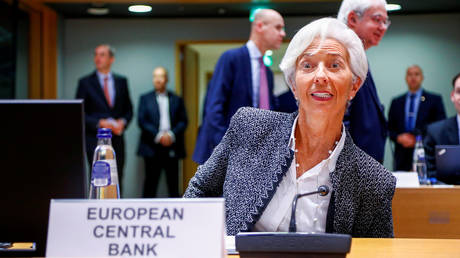
The European Central Bank (ECB) has doubled its key interest rate to the highest level in more than a decade in an attempt to combat soaring inflation, ECB President Christine Lagarde has explained.
In October, the inflation rate in the Eurozone reached 10.7%, according to official preliminary data, released on Monday.
In an interview with Irish state broadcaster RTE on Friday, Lagarde said: “We do it because we are fighting inflation” that had “pretty much come about from nowhere.” She pointed to a speedier-than-expected economic rebound from the pandemic as a cause alongside “the energy crisis caused by Mr. Putin who has decided in an unjustifiable way to invade another country.”
The ECB chief added: “That’s what he [Putin] is trying to do, cause chaos and destroy as much of Europe as he can. This energy crisis is causing massive inflation which we have to defeat.”
She went on to say that “Anybody who is behaving in that way has to be driven by evil forces,” and that the “sick” Russian president is a “terrifying person.”
Discussing her previous meetings with the Russian leader, Lagarde described him as an “unbelievably super-briefed person” with “flashing, freezing eyes.”
After expressing her view, Lagarde however stressed that she’s “just a central banker,” and “shouldn’t be saying all these things.”
On Thursday, the ECB announced another interest rate hike, taking Eurozone rates to the highest level since 2009. According to Lagarde, they are aimed at bringing inflation back to “reasonable levels so the cost of living isn’t as high as it is for people.” In October, inflation across the euro area hit 10.7%, according to preliminary data from Eurostat.
The EU has blamed Russia for the spiraling energy crisis across the continent. However, many economists point to the bloc’s fiscal policy responses as a major reason behind the crisis. Moscow has also criticized the “illogical and often absurd” moves by Western nations, saying that the sanctions imposed by the US, EU, and other countries on Russia have backfired and resulted in a sweeping energy crisis as well as record inflation across the West.
Fossil Fuel Investment Has Dropped By A Third Since 2015
By Paul Homewood | Not A Lot Of People Know That | October 30, 2022
There was one chart I forgot to show from the IEA’s World Energy Outlook yesterday:

https://www.iea.org/reports/world-energy-outlook-2022
As we can see, investment in fossil fuels has fallen by a third since 2015 in terms of GDP. Part of this was due to the collapse in oil and gas prices in 2014, but undoubtedly the anti-fossil fuel agenda pursued across the West for climate reasons has had a major impact as well.
Either way, this is the real reason why prices have rocketed, not the invasion of Ukraine.
Further evidence can be found in Fig 1.3, which shows that investment has remained steady in countries without a Net Zero pledge:

The real concern is that we are only seeing the early signs of much worse to come. When the cuts in fossil fuel investment really start to bite and existing oil fields begin to dry up, there will be a catastrophic energy crisis. Shortages will be very real and prices will rise well above today’s levels, as demand stays high and we find that renewable energy simply cannot keep up with demand.
The IEA’s naively oversimplistic projections simply assume that building wind and solar farms will do the trick. But the world is a complex place and does not work like that.
The Russian invasion of Ukraine has given us a warning. We had better not ignore it.
Massive Protest By Czechs Targets Russia Sanctions, High Prices
By Tyler Durden | Zero Hedge | October 29, 2022
Fed up with soaring food, energy and housing costs, tens of thousands of Czech protestors railed against their government on Friday, demanding the resignation of conservative Prime Minister Petr Fiala’s government, withdrawal from NATO and the negotiation of gas purchases from Russia.
“This is a new national revival and its goal is for the Czech Republic to be independent,” said organizer Ladislav Vrabel. “When I see a full square, no one can stop this.”
The protests occurred both in the capital city of Prague as well as the second-largest Czech city of Brno. Organized under the slogan of “Czech Republic First,” the demonstrations drew their strength from both the left and right wings of Czech politics.
“Russia’s not our enemy, the government of warmongers is the enemy,” one speaker said, according to the Associated Press. Czechia has donated tanks and other heavy weapons to Ukraine, and provided nearly a half million visas to Ukrainian refugees, along with benefits. Protest organizers are also demanding that the refugees not be granted permanent residency.
https://www.bitchute.com/video/BWh1rYqHPGcl/
The protest was the third in a series organized by a group demanding Czechia’s withdrawal from NATO and better relations with Russia. As observed in the United States, the Czech government has attempted to marginalize them by calling them “pro-Kremlin propagandist narratives.”
The Czech government has tried to battle the rising prices with aid to businesses and household electricity price caps.
Friday’s protests were part of a rising wave of discontent throughout Europe. On Thursday, thousands protested in France, demanding higher wages to offset the rising cost of living — among them, striking teachers, healthcare providers and railway workers. Recent weeks have seen similar protests in Germany, Austria and Belgium too.
“This is merely the silence before the storm—the discontent is great, and people do not have any sense that the government has a plausible strategy to master the crisis,” German pollster Manfred Güllner tells The Wall Street Journal.
At a time when three quarters of German households are cutting back on energy consumption, just 9% say Chancellor Olaf Scholz has a sound strategy for surmounting the energy crisis. While the French protests didn’t target the Western sanctions regime against Russia, German protestors have called for an end to them.
The discontent is certain to rise all over the world, as more people connect the dots between Western sanctions and their personal misery… all for the latest proxy war over strategically irrelevant territory.
US Pretends to be ‘Open to Talks’ With North Korea While Boosting Sanctions
Samizdat – 28.10.2022
Russia and China will continue to jointly address the North Korea issue. The main cause of tensions on the Korean Peninsula is the pressure exerted on the DPRK and the show of force by South Korea and the United States.
Russia remains committed to a joint plan with China for a Korean settlement.
“We will adhere to the agreed position on this issue”, Russian President Vladimir Putin said on Thursday at a plenary session of the Valdai Discussion Club.
The Russia-China action plan is based on the principle of reciprocal steps by the United States and the DPRK. These steps could be taken by the United States without damaging its reputation, and on the same basis by DPRK leaders. Moscow and Beijing believe that success in the settlement can only be achieved on the basis of reciprocal movement: action after action, step by step, gradually, and consistently.
At the same time, Moscow and Beijing have repeatedly warned that the formula, according to which North Korea must first completely get rid of its nuclear missile program and only then it will be possible to think about lifting sanctions on the DPRK and ensuring its economic development, is absolutely unsustainable.
“Our roadmap, which we proposed together with China, was that first we should build confidence through mutual meetings, and then we should take some tangible measures, including the suspension of military exercises, tests, and missile launches, and then proceed to negotiations,” Russian Foreign Minister Sergei Lavrov said earlier, presenting a joint Russia-China plan for a Korean settlement.
The plan was put forward to the two Koreas, the United States, and Japan in the fall of 2019 after three meetings between the US and DPRK leaders in Singapore, Hanoi, and the demilitarized zone in Panmunjom ended inconclusively. These meetings were held on June 12, 2018, February 27-28, 2019, and June 30, 2019, respectively.
When answering experts’ questions at the Valdai Discussion Club related to the Korea issue, Vladimir Putin said that the unwillingness to talk and the absolutely boorish attitude to North Korea’s interests, including in the sphere of security, has led to the DPRK nuclear issue. In an interview with Sputnik, Alexander Zhebin, director of the Center for Korean Studies and member of the Russian Political Science Association, commented on the Russian president’s statements as follows:
“Vladimir Putin was referring to the boorish behavior of the United States, because the US and the DPRK had an agreement at Trump’s meeting with Kim Jong-un in Singapore that Pyongyang would not launch long-range missiles that could reach American territory, and would not test nuclear weapons. The Americans would respond to this, as recorded in the Singapore declaration, by building a new relationship. Instead, the Americans continued to impose more and more sanctions against the DPRK, which means that they have not fulfilled their part of the commitments.”
According to Alexander Zhebin, the US behaves arrogantly towards the DPRK in the UN Security Council as well:
“Each UN Security Council resolution that imposed sanctions on the DPRK stipulated that positive steps by the DPRK to reduce nuclear missile activity must be accompanied by reciprocal steps by those who imposed sanctions and lead to their partial lifting. This has not happened. On the contrary, no matter what the DPRK has done, the US has kept imposing new sanctions, both by Trump and then by Biden.”
Today, instead of negotiations, the US and South Korea are working on scenarios for destroying the top political leadership of the DPRK and the country’s control centers.
“On the one hand, the Americans say they are ready to negotiate with the DPRK at any time, anywhere, and without any conditions. However, at the same time, they have imposed unprecedentedly harsh sanctions on the DPRK and do not intend to lift them. On the contrary, they are obstructing all attempts by China and Russia to reduce the sanctions burden and start a dialog process. In fact, the invitation to negotiations is just talk. Under that guise, the US is implementing a longstanding plan according to which, eventually, the DPRK, under the weight of economic sanctions, will not survive, thus forcing Kim Jong-un to surrender.
They are not hiding the fact that large-scale military exercises carried out by the US and South Korea are used to practice the elimination of the DPRK’s top political leadership and the country’s control centers. The scale of the recent maneuvers is simply off the chart. 240 American and South Korean aircraft, including the latest F-35 stealth fighters, have been deployed off the coast of North Korea. This cannot but cause serious concern to the DPRK leadership, since everything is happening near its borders. The DPRK is very much concerned about its security,” Alexander Zhebin stressed.
The DPRK’s missile launches are a response to US and South Korean military drills, which constantly press Pyongyang to demonstrate its power, Jin Xiangdong, a researcher at Xiamen University’s School of International Relations, said in an interview with Sputnik :
“Since coming to power, the new South Korean government has conducted a series of military exercises near the Korean Peninsula. The DPRK has responded by launching ballistic missiles. The main problem with the situation on the peninsula is that the new South Korean government is constantly putting pressure on North Korea and demonstrating its power. China’s position on the Korean Peninsula issue is consistent and clear. China defends the maintenance of peace and stability on the peninsula, denuclearization on the Korean Peninsula, and the resolution of issues through dialog and consultations. Meanwhile, in general, the solution to the Korean Peninsula problem is still complicated.”
The Joint Chiefs of Staff of the South Korean Armed Forces said that North Korea fired two short-range ballistic missiles toward the Sea of Japan on Friday. The launches took place on the last day of South Korea’s Hoguk military exercises, which began on October 17. These maneuvers featured a large-scale amphibious landing exercise near the city of Pohang on the coast of the Sea of Japan.
On October 31, the Republic of Korea and the United States will launch large-scale joint air exercises. The high intensity and scale of the drills provoke growing tensions in Northeast Asia. The US threatening to give a strong response to a possible nuclear test by the DPRK has aggravated the situation.
US scales back plan for Russian oil price cap – Report
Samizdat | October 27, 2022
President Joe Biden’s administration has reportedly been forced back to the drawing board on its plan to cap international prices for Russian oil, having failed to secure enough commitments to control how much Moscow is paid for the bulk of its crude exports.
The US and the European Union will likely have to settle for a “loosely policed” pricing cap, enforced by fewer buyers and at a higher price than envisioned, Bloomberg News reported on Wednesday, citing unidentified people familiar with the plans. The original goal was to drastically reduce Russia’s oil revenue – the latest effort to punish Moscow for its military offensive in Ukraine – by imposing a strict price lid to which a broad “buyer’s cartel” of nations would adhere.
Instead, only G7 nations and Australia have committed to honoring the price cap, Bloomberg said, attributing failure of the original plan to investor skepticism, volatile financial markets and efforts to tame inflation around the world. The cap level also might need to go higher than a previously targeted range of $40-$60 per barrel.
Biden’s administration has denied that its plan would fall short of throttling Russian oil revenue. “The White House and the administration are staying the course on implementing an effective, strong price cap on Russian oil in coordination with the G7 and other partners,” White House National Security Council spokeswoman Adrienne Watson told Bloomberg in a statement.
Russian officials have said the country won’t sell oil or other commodities under price caps or unprofitable market conditions. Nor will Moscow supply energy to nations that adopt trade policies contradicting the terms of their existing oil and natural gas contracts, Russian Deputy Prime Minister Aleksandr Novak said earlier this month. A cap on crude wouldn’t be viable because prices are driven by the global supply-demand balance, he added.
The G7 price cap is scheduled to go into force on December 5, along with an EU ban on imports of seaborne Russian crude. Reuters reported last week that after December 5, Russia would still be able to ship the vast majority of its oil exports at market prices because it would have ample access to tankers and other services. The outlet cited a US Treasury official as saying that between 80% and 90% of Russian oil would continue to flow to buyers outside the cap mechanism.
Russia would have access not only to its own oil tankers, but also to Chinese and Indian ships, Reuters added. Traders and insurance companies from Russia, Asia and the Middle East would provide the necessary transactional services. Brent crude, a leading international oil benchmark, is currently selling for around $95 per barrel.
China Urges US to Stop Spreading Myth About Alleged Chinese Threat: Foreign Ministry
Samizdat – 26.10.2022
BEIJING – China calls on the United States to stop spreading the outdated theory of the Chinese threat and better engage in building a new concept of mutually beneficial cooperation, Chinese Foreign Ministry spokesman Wang Wenbin said on Wednesday.
“China is a partner and an opportunity for the development of all countries, not a challenge or a threat,” Wang told a briefing.
China urges Washington to try to build a new concept of openness, inclusiveness, and mutually beneficial cooperation, and do more to promote world peace and development, Wang added.
Earlier in the day, US President Joe Biden and UK Prime Minister Rishi Sunak agreed during a telephone conversation to jointly respond to challenges from China.
Norwegian PM for restoration of contacts with Russia: “Nothing good in isolation”
By Ahmed Adel | October 26, 2022
Norwegian Prime Minister Jonas Gahr Store said that Western countries should not isolate Russia and should instead establish direct communication with Moscow to resolve the exceptionally difficult situation in Ukraine. However, Norway, a NATO member, is also one of the leading countries to oppose Russia through sanctions and support for the Ukrainian military.
“There is nothing good in isolating Russia. It is alarming that today we have so few contacts and direct communication with Russia,” Store told the Norwegian parliament on October 25.
This is an especially surprising statement since Norway has donated 4,000 M72 anti-tank weapons to Ukraine, as well as an air defence system, 22 self-propelled artillery vehicles, long-range rocket artillery and armoured vehicles. Norway will also donate the Black Hornet micro-drone system and Hellfire missiles, and will also train Ukrainian soldiers in Britain.
Although Norway is following Washington and Brussels in supporting Ukraine and acting hostile to Moscow, perhaps there is a realization setting in Oslo that the war will not end with the Ukrainian military capturing Donetsk, Kherson, Luhansk and Zaporozhye from Russia. By coming to such a conclusion, the only realistic option left is to call for direct communications with Russia, something the West cut in the false belief that sustained isolation and economic pressure would make Moscow capitulate and end its military operation in Ukraine.
This was of course a naïve belief since the Kremlin has for years attempted to resolve the situation in Donbass through negotiations and discussions, something that Kiev, with the West’s support and backing, never supported. Moscow was forced to take matters into their own hands to protect the Russian-speaking minority from Kiev’s fascistic policies. Although Moscow has taken the military approach, it is still open to honest and open dialogue, but of course with different demands since the situation on the ground has significantly changed.
According to the Norwegian prime minister, the lack of dialogue with Moscow undermines the possibility of reaching a peaceful settlement in Ukraine. He also added that the current political situation was the most difficult since World War II, and it is for this reason as well that communication channels must reopen.
Russian President Vladimir Putin has repeatedly warned the West that Russia could not be isolated, and this is reflected in the fact that several major countries, including China, India and Brazil, have vocally opposed the idea of imposing unilateral sanctions on Moscow and called for the continuation of dialogue in the interest of peaceful world development.
Sanctions against Russia have led to disruptions in logistical and financial operations and to a spike in energy prices worldwide, pushing many European governments to resort to contingency measures. At the same time, Brussels has been looking for alternatives to Russian natural gas as it has pledged to end its dependence on energy supplies from Russia, thus making Norway all the more important to the EU.
The Scandinavian country is now the EU’s leading natural gas supplier, overtaking Russia. It is not forgotten that the Nord Stream pipelines leaks corresponded with the opening of a new pipeline from Norway to Poland. Although Norway is being heralded as a saviour for energy-struggling Europe, it has been criticised for essentially war profiteering.
“There is no question that the fallout from the war is making Norway richer. The state is a major player in the oil and gas industry. All told, Oslo expects to bring in about $109 billion from the petroleum sector this year — $82 billion more than in 2021. Much of that will go to the country’s sovereign wealth fund, a national nest egg worth more than $1 trillion,” The Washington Post reported.
Andreas Bjelland Eriksen, state secretary at the Ministry of Energy and Petroleum, denied that Norway is profiting off the war, stressing that high energy prices “hurt Norway too.” He noted that gas exports to Europe are up 8 percent year over year. “Europe sees that, and it sees that we are a good partner,” Eriksen added.
In this way, Norway has essentially become a big winner from the war in Ukraine as it has now become the main supplier of natural gas to Europe despite charging astronomical prices. However, this is not reflected on ordinary citizen life as Norway is not immune from the effects of the self-sabotaging anti-Russia sanctions.
Complementing the higher electricity bills arriving every month, Norwegians are also experiencing higher prices for almost everything else. State statistics bureau SSB (Statistics Norway) recently reported an 11.3 percent rise in transport costs, a 12.1 percent rise in food and non-alcoholic drinks, an 8.7 percent rise in hotel and restaurant bills and a 7.6 percent rise in prices for household items and maintenance. Norway’s biggest bank, DNB, also reported that its customers are now spending much less money on expensive items.
It is for this reason that Norway, despite making record profits in the energy sector, wants dialogue with Moscow to reopen so that there can be an alleviation in the cost-of-living crisis and other sectors of the economy. Nonetheless, Oslo itself makes little contribution to peace efforts as it maintains anti-Russia sanctions and continues to train, fund, and supply the Ukrainian military.
Ahmed Adel is a Cairo-based geopolitics and political economy researcher.
Pfizer will Charge Two Billion Dollars per Pound of Covid mRNA Nanoparticles
This is a 12,370% Markup
By Igor Chudov | October 23, 2022
We all know that Pfizer likes to “move at the speed of science”.
Nowhere is the “speed of science” more pronounced, than in raising prices for its products. Pfizer used to charge its only customer in the United States — the Federal Government – $19.50 per dose.
Now Pfizer decided to diversify and sell its Covid vaccine through health insurance companies. It plans to charge $130 per dose. Mind you, each dose costs $1.18 to produce.
The business plan here, of course, is to keep as many vaccine mandates as possible and have health insurers cover the cost of increasingly frequent vaccinations, child vaccinations etc.
For example, right now the CDC recommends getting the bivalent booster two months after a previous booster.
People ages 12 years and older: A 2-dose primary series and 1 bivalent mRNA booster dose (Moderna or Pfizer-BioNTech) is recommended. The primary series doses are separated by 3–8 weeks and the bivalent mRNA booster dose is administered at least 2 months after completion of the primary series (for people who have not received any booster doses), or at least 2 months after the last monovalent booster dose.
If you think that two months is too frequent, consider that CDC’s Rochelle Walensky was bivalent-boosted only a MONTH ago, and is now suffering from Covid — the same variant she was boosted for. Ms. Walensky is, of course, vaxxed to the max and is thankful for all the shots she received:

The Price
Most of each dose of Pfizer’s “Covid vaccine” is cheap stuff like water, polyethylene glycol, and other chemicals. The actual active ingredient is the mRNA nanoparticles, and those are given at 30 micrograms per dose.
Do the math:
Price Per gram = 130/.000030 = $4,333,333
So Pfizer is selling us their gene juice for over $4,333,333 per gram.
A pound (454 grams) of Pfizer’s mRNA nanoparticles would cost TWO BILLION DOLLARS.
The cost of making that two-billion-dollar pound of mRNA juice is under one percent of the price.
A pretty good deal for Pfizer, right?
Thank God I have a free immune system!
Featured Video

The Truth About the Trump Shootings with Ken Silva
or go to
Aletho News Archives – Video-Images
From the Archives
The Geopolitics behind the War in Yemen (I)
By Mahdi Darius NAZEMROAYA | Strategic Culture Foundation | 30.03.2015
The United States and the Kingdom of Saudi Arabia became very uneasy when the Yemenese or Yemenite movement of the Houthi or Ansarallah (meaning the supporters of God in Arabic) gained control of Yemen’s capital, Sanaa/Sana, in September 2014. The US-supported Yemenite President Abd-Rabbuh Manṣour Al-Hadi was humiliatingly forced to share power with the Houthis and the coalition of northern Yemenese tribes that had helped them enter Sana. Al-Hadi declared that negotiations for a Yemeni national unity government would take place and his allies the US and Saudi Arabia tried to use a new national dialogue and mediated talks to co-opt and pacify the Houthis.
The truth has been turned on its head about the war in Yemen. The war and ousting of President Abd-Rabbuh Manṣour Al-Hadi in Yemen are not the results of «Houthi coup» in Yemen. It is the opposite. Al-Hadi was ousted, because with Saudi and US support he tried to backtrack on the power sharing agreements he had made and return Yemen to authoritarian rule. The ousting of President Al-Hadi by the Houthis and their political allies was an unexpected reaction to the takeover Al-Hadi was planning with Washington and the House of Saudi. … continue
Blog Roll
 Aletho News
- Pakistan-Iran talks secure LNG shipment to Islamabad through Hormuz
- Black Sea grain crisis puts global wheat supplies under pressure
- IRGC air defenses destroy another US MQ-1 drone over Strait of Hormuz
- Imran Khan’s entire immediate family detained in Pakistan ahead of mass protest demanding his release
- EU nation detains former presidential frontrunner
- Leaked: Britain’s Sham Conviction Of Hashim Thaci
- Seyed M. Marandi: U.S. Strike Imminent – Toward Total War in the Middle East
- Russia Voted Under Fire. Washington Is Loading the Tankers.
- 12 Things Your Oncologist Was Trained Not to Tell You
- Anthrax Attacks Paved Way for COVID-Era ‘Junk Drugs and Vaccines’
- If Americans Knew
- Trump’s militarization of Washington DC as he pursues Israel’s war against Iran
- Why Israel Fears This Searing New Documentary
- Huckabee aide solicited cash gifts from Israelis
- This isn’t sci-fi, AI is already killing people
- ‘The Most Brutal Thing’: Investigation Reveals Execution of Elderly Woman in Rafah
- Inside Israel’s ‘soft’ ethnic cleansing plan for Gaza through the eyes of its victims
- New online database tracks pro-Israel political donations in the United States
- Israeli president pardons soldier convicted for killing wounded Palestinian
- Singer Ed Sheeran says his ‘heart broken’ by Gaza devastation, addresses Macklemore controversy
- Israel Has Imprisoned Female Journalist Bushra Al-Tawil Without Trial Or Charge In Solitary Confinement For Past Month
- No Tricks Zone
- 2025 Nature Paper Claiming Worsening Global Drought Gets RETRACTED …Heavily Flawed
- New Study: ‘Global Drought Shows No Detectable Recent Acceleration Under Climate Warming’
- Economic Masterminds: German Socialists Suggest Taxing Productivity Gains Stemming From Using AI
- The South China Sea Has Not Been Cooperating With The Climate Change Narrative
- Energy Crisis: Germany Enters Heating Season With Historically Low Gas Reserve Fill Levels
- New Study: The Antarctic Ice Sheet Gained Mass From 2020-2024 Due To Staggering Snow And Ice Accumulation
- Study: Ocean Heating Rates From Thousands Of Years Ago ‘Dwarf’ Modern Ocean Heating Rates
- Climate Extremists Target, Attack Large-Scale Power Grid Infrastructure In Germany!
- New Study: Antarctic Ice Melt Has Contributed Less Than 1 Centimeter To Sea Level Rise In The Last 30 Years
- Fear Of Debate: Alarmist German Climate Scientist Calls On Mainstream Media To Discredit Skeptic Voices
 Aletho News