German Energy Apocalypse Update VII
eugyppius – October 25, 2022
The only published footage of the damage to the Nord Stream pipelines, featured on my Nord Stream Conspiracy Thread, turns out to come from Expressen, a Swedish newspaper. Their reporters hired undersea drone operators and took a boat out to the site of the explosions off the island of Bornholm. There, they found a sizeable crater and 50 metres of missing pipeline. That this is how the images should have made their way to us, rather than through any official path, speaks volumes about the eagerness of Swedish authorities to suppress this story.
Protests against the insane energy policy of the German government are gathering momentum, particularly in the East; sporadic reports are even appearing in major media outlets now. This is surely one reason that the Minister President of Saxony, Michael Kretschmer, continues to stray from official CDU talking points, calling for negotiated peace in Ukraine and likening EU sanctions to a “tsunami” threatening the German economy.
Feared gas shortages are causing chaos as customers rush to change suppliers in search of better prices, or because their current contracts have been cancelled. Several municipal utilities have flatly stopped accepting new customers, but this option is not available to the so-called Grundversorger or “basic suppliers”—the utilities that supply the majority of gas in their region. These are legally bound to take all comers, and many of them are already having difficulty meeting sudden surges in demand.
Their day-to-day solvency may also soon be a problem:
[I]t is not only the procurement prices that have risen sharply, but also the interim financing costs—that is, the sum with which the municipal utilities must bridge the time from the purchase of gas to the onward sale to the customer, and to the increase in customers’ instalment payments, [an Association of Municipal Enterprises] spokesman explained. “Both together increase the liquidity needs of the municipal utilities, and this in turn affects their ability to supply customers with electricity and gas.”
Who knows how all this will play out, and what effect (if any) proposed price limits on electricity and gas will have on the markets, but I have a crazy vision of a near-future dystopia, where a minority of wealthy customers who have maintained wildly expensive contracts with alternate providers can still heat their homes, while everyone else deals with constant outages and ad-hoc rationing schemes.
Zelensky’s economic advisor has announced that he expects the Federal Republic to contribute 500 million dollars every month to Ukraine’s defence. That sounds like a lot, but we must remember that Germany’s antigen testing program, at its height, cost around a billion Euros a month. The government has pissing away money on crazy things for a long time now.
A survey of German companies, the majority of them small businesses, shows that 25% (up from 14% four months ago) are considering whether to lay off employees, and that 90% are planning to raise prices further than they already have. Almost six in ten are delaying planned investments.
“We have been seeing a creeping shift in industrial production for some time now,” says Rainer Kirchdörfer, Chairman of the Family Business Foundation [which conducted the survey]. “We will only recognise the deindustrialisation and loss of prosperity years from now, and by then it will be irreversible.”
The economic chaos has hit the chemical industry especially hard, and among the early shortages are iron and aluminium salts, crucial precipitating agents used in wastewater treatment. Four federal states have already relaxed their rules on water purification. Chemicals necessary for the treatment of drinking water are also increasingly scarce.
Can’t we just increase our production of biogas to end our dependence on Russia and save the climate at the same time, asks the drooling knuckle-dragging morons at Westdeutscher Rundfunk ?
Overall, the share of biomethane in the German gas market could triple, according to a study by the German Biomass Research Centre in Leipzig. The Capital Bioenergy Office says in a statement that biogas plants could offset about 4 percent of Russian natural gas imports in the short term. It also says it is possible for biogas to provide 46% of the electricity from gas-fired power plants.
So, if we put all of our grain into power production, we have the prospect not only of freezing to death, but of starving to death too. I’m glad state media are investigating this promising angle.
Finally, Business Insider has discovered that the real victims of the gas crisis won’t be young children in fragile health or elderly pensioners on fixed incomes, but female professionals. Ordinances requiring offices to set thermostats at 19C, according to some garbage study, will cognitively disadvantage women, while (even worse) advantaging men, who bizarrely are alleged to perform their best at this precise temperature. Happily, though, Tagesschau has consulted Dr. Georg Ertl from University Hospital at Würzburg, who believes this unfortunate sexism, brought upon us by the furtherance of liberal democracy, can be countered by … caps and stockings.
The EU’s energy security now rests in Turkey’s hands
Europe has sought to bypass Russian gas with disastrous results. Turkey is set to reap the benefits.
By Karin Kneissl | The Cradle | October 24 2022
“Geography is the constant of history,” is a quote attributed to the German statesman Otto von Bismarck. Today, those words ring true as we witness geography altering global politics, finance, and alliances.
The geostrategic importance of Turkey has rarely been as clear to European politicians as it has been in recent months, as the continent grapples with a burgeoning energy crisis this coming winter.
Whether it is grain exports from the Black Sea region or the flow of energy supplies from the eastern producing countries, the Bosphorus and the links to Eurasia are once again playing a decisive geopolitical role, as they so often have throughout history. The fact is, Turkey is now crucial for the security of Europe.
Pipeline politics
On the occasion of Turkish President Recep Tayyip Erdogan’s meeting with his Russian counterpart Vladimir Putin in Sochi at the beginning of August 2022, the focus was mainly on bilateral cooperation in energy matters.
Putin told journalists after the tete-a-tete that Europeans should be grateful to Ankara for its gas supplies due to the reliability of the TurkStream pipeline.
Last year, Russian natural gas accounted for around 45 percent of European gas imports. But that share has fallen to less than 10 percent after supplies were halted via the eastbound Yamal-Europe pipeline and suspected US-backed operatives blew up Nord Stream, which also curtailed exports via Ukraine.
The Russian-Turkish TurkStream gas pipeline project was announced in December 2014 after Moscow realized that the long-planned SouthStream project – meant to deliver Russian natural gas via the Black Sea directly to European Union (EU) member state Bulgaria – was not feasible.
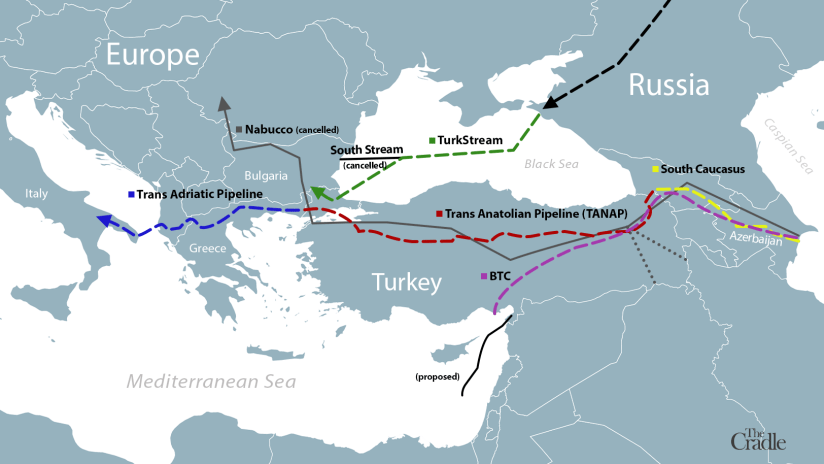
Russian energy giant Gazprom and the Italian energy company ENI were the main partners in the consortium. However, following the Crimean crisis in March 2014, the EU Commission blocked this major infrastructure project, citing competition rules.
As far as Moscow was concerned, this arrangement had already been completed in the form of terminals and pipeline routes. Thousands of work contracts had been issued between Bulgaria and Hungary at the time.
Construction was scheduled to begin in June 2014, but Brussels alluded to apparent violations of competition rules in the awarding of contracts by the Bulgarian authorities and brought everything to a halt.
Turkey as a Russian energy hub
Nine months later, during a joint press conference with Erdogan in Ankara, Putin remarked that “If Europe does not want to carry it out, then it will not be carried out.” Putin then announced the TurkStream project, which was formally launched in early 2020.
One pandemic and a war later, the world has experienced and continues to experience rising natural gas prices, while Russian-Turkish energy cooperation is intensifying. On 19 October, Erdogan said he had agreed with Putin to set up a comprehensive hub for Russian natural gas built in Turkey from where Europe could meet its energy needs.
“If Turkey and our potential buyers are interested, we could consider building another gas pipeline and creating a gas hub in Turkey for sale to third countries, especially in Europe,” Putin proposed. In addition, a gas exchange could also be created in Turkey to determine prices, he added.
Neither the EU nor the US have welcomed these developments or, in some cases, faits accomplis. Turkey makes no secret of the fact that it wants to expand its status in the China-led Shanghai Cooperation Organisation (SCO) and will probably soon become the tenth member of this important regional organization.
It should be noted that the SCO’s statutes stipulate energy and security – especially the fight against terrorism – as its essential agenda. The EU, it must be said, is only just discovering the importance of these issues.
Attempts to bypass Russian gas
In the recent past, governments and energy companies have looked to Turkey as an alternative to the existing transit routes for oil and gas between the east and west. In 2005, the 1750 km long Baku-Tbilisi-Ceyhan (BTC) pipeline was opened, transporting Caspian oil across the Caucasus to the Turkish Mediterranean port.
Crucially, this route had the backing of Washington, reinforcing the close connection between politics and the oil business. As per an apt saying from the early 20th century US oil industry: “The oil business is too important to leave it to the oil people.”
The Nabucco pipeline project, intended to reduce Europe’s reliance on Russia’s gas, consisted of a consortium of six corporations based on the initiative of the Austrian partly state-owned OMV. The project was supported politically and financially by the European Commission, with the premise being that natural gas would be supplied from the Caspian region via Turkey to Central Europe to the Baumgarten hub in Austria.
Billions were spent on marketing this project between 2002 and 2014. However contractual agreements surrounding the deal never materialized. Though inconceivable now, Iran was also initially planned as an alternative supplier, yet these efforts failed from 2005 onwards due to UN Security Council sanctions on Iran from 2008 until the present.
Additionally, supply contracts with Iraq and Turkmenistan were targeted in vain, although these arguably had a lot to do with complete mismanagement. In the case of Turkmenistan, countless advisory opinions were commissioned on the status of the Caspian Sea under international law, sea, or lake, and the possible transit pipelines for landlocked Turkmenistan.
A failed strategy
After many years of mere marketing and a lot of hot air between Brussels and Vienna around the Nabucco project, OMV’s partners finally backed out in 2014. It was clear that there was no natural gas available.
In my book “Der Energiepoker” (The Energy Poker) I wrote in 2006: “If the managers had not gone to the State Opera to see Verdi’s Nabucco, but had seen the operetta by Johann Strauss “Wiener Blut” (Viennese Blood), then this natural gas pipeline would have been given a more appropriate name.
Now, in view of the Nord Stream 2 pipeline boycotted by the EU, OMV is facing further setbacks, as the contracts with take-or-pay clauses were drafted in such a way that payment would have to be made for the Russian natural gas, even if there was no physical delivery. These conditions apparently apply until 2040.
EU will buy Russian energy indirectly
While the EU wants to bypass Russian energy sources for political reasons, Turkey, India, and China, among others, will gladly fill in the consumer void. As described, Turkey already benefited in 2014 from the SouthStream project, which became TurkStream. The EU ultimately lost out, while Ankara stood to gain, with the EU presently buying Russian natural gas via Turkey.
This energy route is set to expand even further once the Russian natural gas hub in Turkey is established. Turkey thus becomes the safeguard of the EU’s energy security. While this was the case a few years ago with non-Russian natural gas and oil, it now looks as if Russia is merely adapting its role for the European market on a regional basis.
For some years, Ankara aligned its prospective role as a hub for BTC and the Nabucco project with its EU accession ambitions. Now it seems that Turkey will become a member of the SCO much faster, and despite its NATO membership, part of the security cooperation with Russia and China.
The EU is more dependent than ever on the goodwill of those it once created obstacles for, and Turkey and Russia are no exception. The coming months will show with all their force just how irresponsibly the EU governments handled the continent’s energy security needs.
Nord Stream repair time frame assessed
Samizdat – October 24, 2022
Russia’s Nord Stream gas pipelines, which were damaged and made inoperable by underwater explosions in late September, can be repaired within a few months.
That’s according to the state-backed Danish Broadcasting Corporation (DR) which was citing Sten Ussing, Chief Engineer with consultant group COWI.
Ussing assessed from underwater video-footage that the pipes will not be damaged by rust for some time as there is little oxygen at a depth of 80 meters, where they are located. He noted that the fracture surfaces look “very clean and almost shiny,” which suggests that “the pipe will not rust in a few weeks, as one would expect in a more oxygenated environment.”
“We can expect corrosion inside the pipe to be limited as well,” he added.
The engineer, however, explained that the explosion caused a pressure surge, and that could have damaged sections of the pipeline some distance from the site, adding that they can be repaired by elevating the pipes slightly above the seabed, which would allow underwater welders to remove the damaged sections and replace them with new ones.
“It is standard procedure to weld such a piece of pipe under water. It has been done many times before, and the technologies – vessels, pipes and specialists – that need to be used already exist,” Ussing explained.
“Finally, the pipeline would have to be emptied, the strings cleaned of dirt and grime, blown and dried – and that’s it, you can have gas flowing again,” the engineer concluded, saying the process will likely take several months. He warned, however, that even with little oxygen, the fractured pipes can accumulate rust over time, and advised to carry out the repairs within a year.
The footage of the pipeline fractures which Ussing inspected was taken by Swedish media outlet Expressen, which sent a camera down one of the pipes.
The cause of the explosions which damaged three out of four strings of Russia’s 1,200-kilometer Nord Stream 1 and 2 gas pipelines is still being investigated. Sabotage is suspected to be the likely cause. President Vladimir Putin branded it “an act of international terrorism.”
Germany forced to slash rearmament plans
Berlin loudly announced the scheme earlier this year, after years of pressure from the US
Samizdat | October 23, 2022
Germany is “massively” reducing its rearmament plans as high inflation and a strong dollar have made the equipment too expensive to buy for the country, unnamed political and defense industry representatives have told Handelsblatt newspaper.
Many projects, especially those for the navy and airforce, would likely have to be canceled, the outlet reported on Friday.
The fate of a third batch of K130 corvettes is now hanging in the balance, along with new Eurofighter jets for electronic warfare, frigates, and self-propelled howitzers, which were to be ordered to replace equipment sent by Berlin to Ukraine, the sources claimed.
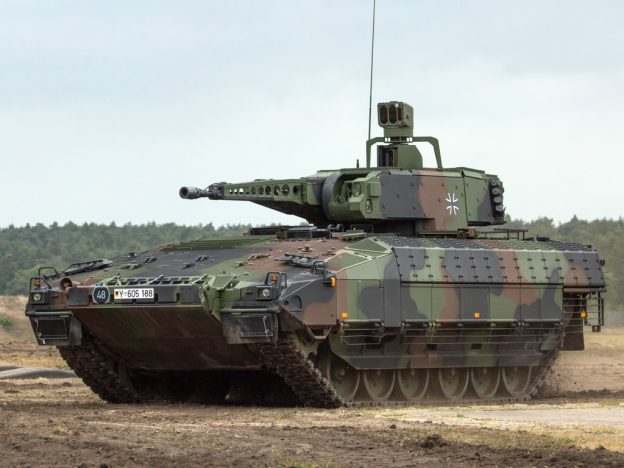
The number of units in a second batch of Puma infantry fighting vehicles, the cost of which was estimated at €304 million ($299.8 million) earlier this year, is also being reduced on a weekly basis, an unnamed politician from the ruling ‘traffic light’ coalition told the paper.
“Since many projects run for five to seven years, inflation in this dimension creates a serious financial problem,” one of the sources explained. The economic situation has been fraught in Europe as the burden of the Covid-19 pandemic was further aggravated by the fallout from sanctions imposed by the EU on Moscow over its military operation in Ukraine, and the subsequent reduction in the supply of Russian energy to the bloc.
Arms manufacturers have reportedly been unhappy with the size of a special €100 billion ($98.6 billion) fund allocated by the German government for rearmament purposes. “In order to fulfill the wishes of the Bundeswehr, €200 billion is needed,” a defense firm manager told Handelsblatt.
When announcing the investment in June, Chancellor Olaf Scholz promised that it would help turn the German military into the “biggest conventional army” among European NATO member states. The Bundeswehr would be able to “defend every square meter” of the US-led military bloc’s territory, he insisted.
Russia’s homage to Nord Stream pipelines
BY M. K. BHADRAKUMAR | INDIAN PUNCHLINE | OCTOBER 22, 2022
David Brinkley, the legendary American newscaster with a career that spanned an amazing fifty-four years from World War II once said that a successful man is one who can lay a firm foundation with the bricks others have thrown at him. How many American statesmen ever practised this noble thought inherited from Jesus Christ remains doubtful.
Russian President Vladimir Putin’s stunning proposal to Turkish President Recep Erdogan to build a gas pipeline to Turkiye to create an international hub from which Russian gas can be supplied to Europe breathes fresh life into this very “Gandhian” thought.
Putin discussed the idea with Erdogan at their meeting in Astana on October 13 and since spoke about it at the Russian Energy Week forum last week where he proposed creating the largest gas hub in Europe in Turkey and redirecting the volume of gas, the transit of which is no longer possible through the Nord Stream, to this hub.
Putin said it may imply building another gas pipeline system to feed the hub in Turkiye, through which gas will be supplied to third countries, primarily European ones, “if they are interested.”
Prima facie, Putin does not expect any positive response from Berlin to his standing proposal to use the string of the Nord Stream 2, which remained undamaged, to supply 27.5 billion cu. metres of gas through the winter months. Germany’s deafening silence is understandable. Chancellor Off Scholz is terrified about President Biden’s wrath.
Berlin says it knows who sabotaged the Nord Stream pipelines but won’t reveal it as it affects Germany’s national security! Sweden too pleads that the matter is far too sensitive for it to share the evidence it has collected with any country, including Germany! Biden has put the fear of God into the minds of these timid European “allies” who have been left in no doubt what is good for them! The western media too is ordered to play down Nord Steam saga so that with the passage of time, public memory will fade away.
However, Russia has done its homework that Europe cannot do without Russia gas, the present bravado of self-denial notwithstanding. Simply put, the European industries depend on cheap, reliable supplies of Russian gas for their products to remain competitive in the world market.
Qatar’s energy minister Saad al-Kaabi said last week that he cannot envisage a future where “zero Russian gas” flows to Europe. He noted acerbically, “ If that’s the case, then I think the problem is going to be huge and for a very long time. You just don’t have enough volume to bring (in) to replace that (Russian) gas for the long term, unless you’re saying ‘I’m going to be building huge nuclear (plants), I’m going to allow coal, I’m going to burn fuel oils.’”
Quintessentially, Russia plans to replace its gas hub in Haidach in Austria (which Austrians seized in July.) Conceivably, the hub in Turkiye has a ready market in Southern Europe, including Greece and Italy. But there is more to it than meets the eye.
Succinctly put, Putin has made a strategic move in the geopolitics of gas. His initiative rubbishes the hare-brained idea of the Russophobic European Commission bureaucrats in Brussels, headed by Ursula von der Leyen, to impose a price cap on gas purchases. It makes nonsense of the US’ and EU’s plans to put down Russia’s profile as a gas superpower.
Logically, the next step for Russia should be to align with Qatar, the world’s second biggest gas exporter. Qatar is a close ally of Turkey, too. At Astana recently, on the sidelines of the summit of the Conference on Interaction and Confidence-Building Measures in Asia (CICA), Putin held a closed-door meeting with the Emir of Qatar Sheikh Tamim bin Hamad Al Thani. They agreed to follow up with another meeting soon in Russia.
Russia already has a framework of cooperation with Iran in a number of joint projects in the oil and gas industry. Russian Deputy Prime Minister Alexander Novak recently disclosed plans to conclude an oil and gas swap deal with Iran by the end of the year. He said that “technical details are being worked out – issues of transport, logistics, price, and tariff formation.”
Now, Russia, Qatar and Iran together account for more than half of the world’s entire proven gas reserves. Time is approaching for them to intensify cooperation and coordination on the pattern of the OPEC Plus. All three countries are represented in the Gas Exporting Countries Forum (GECF).
Putin’s proposal appeals to Turkiye’s longstanding dream to become an energy hub at the doorstep of Europe. Unsurprisingly, Erdogan instinctively warmed up to Putin’s proposal. Addressing the ruling party members in the Turkish parliament this week, Erdogan said, “In Europe they are now dealing with the question of how to stay warm in the coming winter. We don’t have such a problem. We have agreed with Vladimir Putin to create a gas hub in our country, through which natural gas, as he says, can be delivered to Europe. Thus, Europe will order gas from Turkey.”
Apart from strengthening its own energy security, Turkiye also can contribute to Europe’s. No doubt, Turkiye’s importance will take a quantum leap in the EU foreign policy calculus, while also strengthening its strategic autonomy in regional politics. This is a huge step forward in Erdogan’s geo-strategy — the geographic direction of Turkish foreign policy under his watch.
From the Russian viewpoint, of course, Turkiye’s strategic autonomy and its grit to pursue independent foreign policies works splendidly for Moscow in the present conditions of western sanctions. Conceivably, Russian companies will start viewing Turkiye as a production base where western technologies become accessible. Turkiye has a customs union agreement with the EU, which completely removes customs duties on all industrial goods of Turkish origin. (See my blog Russia-Turkey reset eases regional tensions, Aug 9, 2022)
In geopolitical terms, Moscow is comfortable with Turkiye’s NATO membership. Clearly, the proposed gas hub brings much additional income to Turkiye and will impart greater stability and predictability to the Russia-Turkey relations. Indeed, the strategic links that tie the two countries together are steadily lengthening — the S-400 ABM deal, cooperation in Syria, the Akkuyu Nuclear Power Plant, Turk-stream gas pipeline, to name a few.
The two countries candidly admit that they have differences of opinion, but the way Putin and Erdogan through constructive diplomacy keep turning adverse circumstances into windows of opportunity for “win-win” cooperation is simply amazing.
It does need ingenuity to get the US’ European allies to source Russian gas without any coercion or boorishness even after Washington buried the Nord Stream gas pipelines in the depths of the Baltic Sea. There is dramatic irony that a NATO power is partnering Russia in this direction.
The US foreign policy elite drawn from East European stock are rendered speechless by the sheer sophistication of the Russian ingenuity to bypass without any trace of rancour the shabby way the US and its allies — Germany and Sweden, in particular — slammed the door shut on Moscow to even take a look at the damaged multi-billion dollar pipelines that it had built in good faith in the depths of the Baltic Sea at the insistance of two German chancellors, Gerhard Schroeder and Angela Merkel.
The current German leadership of Chancellor Olaf Scholz looks very foolish and cowardly – and provincial. The European Commission’s Ursula von der Leyen gets a huge rebuff in all this which will ultimately define her tragic legacy in Brussels as a flag carrier for American interests. This becomes probably the first case study for historians on how multipolarity will work in the world order.
Ukraine war is ‘Biden’s war’ now
BY M. K. BHADRAKUMAR | INDIAN PUNCHLINE | OCTOBER 21, 2022
Russian Foreign Minister Sergey Lavrov said on Oct 18, 2022 that evidence of military personnel of United States and other Western countries having their boots on the ground in Ukraine is mounting.
The most obvious explanation to the mysterious air dash of the UK Defence Minister Ben Wallace to Washington on Tuesday could be that he was canvassing for the support of the Biden Administration for his pitch to succeed Liz Truss as Britain’s next prime minister. But another plausible explanation can be that the secret, hurried trip marked a defining moment in the conflict in Ukraine, which is showing all signs of turning into a full-fledged war.
To be sure, the Biden team cannot but be worried that London is drifting into chaos and the Conservative Party’s faction leaders scurry around like headless chickens looking for a substitute Truss who stepped down on Thursday.
The British economy is disintegrating and the Chancellor of the Exchequer Jeremy Hunt anticipates that a cut on the defence budget is inevitable. That is to say, the Deep State’s fun and frolic in Kiev is no longer affordable. The UK is heading for hard times, the rubric of Global Britain looks delusional.
Enter President Biden. The reports from Moscow suggest that Russians have hard intelligence to the effect that Washington has demanded from President Zelensky some spectacular performance on the battlefield as the midterms in the US on November 8 is around the corner.
That adds to the enigmatic comment by a second defence minister in London James Heappey that the conversations that Wallace would be having in Washington were “beyond belief,” hinting that particularly sensitive and serious issues were on the agenda.
Indeed, after arrival in Washington, Wallace headed straight for the White House to meet up with National Security Advisor Jake Sullivan, Biden’s point person for the Ukraine war. A White House readout said the two officials “exchanged views on shared national security interests, including Ukraine. They underscored their commitment to continue providing Ukraine with security assistance as it defends itself against Russian aggression.”
As British politics descends to skulduggery that will extend into months, the US will be a stakeholder. Historically, since the World War 2, Britain led the US from the rear in critical situations involving Russia.
Indeed, Biden issued a rare statement on Truss’ exit, which stated that the US and the UK “are strong Allies and enduring friends — and that fact will never change.” He thanked her “for her partnership on a range of issues including holding Russia accountable for its war against Ukraine.” Biden underscored that “We will continue our close cooperation with the U.K. government as we work together to meet the global challenges our nations face.”
Biden has sent a powerful message to Britain’s political class signalling that he expects them to come up with a new prime minister who will faithfully adhere to the compass set by Boris Johnson on Ukraine. In immediate terms, what does it signal for the Anglo-American project in Kherson? Will it go ahead? That is the big question.
The situation in Kherson is assuming the nature of a large-scale military confrontation, as Zelensky is throwing everything into it in an attempt to wrest control of the strategic Kherson city, which has been under Russian control since March, before the midterms in the US.
At a press conference in Moscow on Tuesday, Army general Sergei Surovikin, the newly-appointed theatre commander for Ukraine operations, conceded that there was a danger of the Ukrainian forces advancing toward Kherson city.
To quote the general, “A difficult situation has arisen. The enemy deliberately bombards infrastructure and residential buildings in Kherson. The Antonovsky Bridge and the dam of the Kakhovskaya hydroelectric power station were damaged by HIMARS missiles, traffic there was stopped.
“As a result, the supply of food in the city is difficult, there are certain problems with the water and electricity supply. All this greatly complicates the lives of citizens, but also poses a direct threat to their lives.
“The NATO leadership of the Ukrainian armed forces has long been demanding offensive operations against Kherson from the Kiev regime, regardless of casualties… We have data on the possibility that the regime in Kiev will use prohibited methods of war in the area of the city of Kherson — preparation for a big missile attack on the Kakhovskaya hydroelectric dam, massive and indiscriminate missile and artillery attacks on the city…
“In these circumstances, our top priority is to preserve the life and health of citizens. Therefore, the Russian army will first of all ensure the safe, already announced departure of the population according to the resettlement program being prepared by the Russian government. Our further plans and actions regarding the city of Kherson itself will depend on the current military-tactical situation. I repeat, it is already very difficult today. [Emphasis added.]
“In any case, as I said, we will start from the need to protect the lives of civilians and our military as much as possible. We will act consciously and in a timely manner, without excluding difficult decisions.” [Emphasis added.]
The full interview of Gen. Sergey Surovikin to Russian media is below:
The Kremlin thinking gets echoed in a public appeal by the head of the Kherson region Vladimir Saldo where he explained that the evacuation of civilians was not only for people’s safety but also for the operational freedom of the military:
“Dear compatriots, I want to say again that our army has very strong capabilities to repel any attack. But in order for our military to work quietly and not to think that civilians are behind their backs, you MUST get out of these neighbourhoods I mentioned and allow the military to do its job properly, with fewer casualties for the civilians. Our cause is just and we are sure we will win!”
The message here is that the Russian military is prepared to expand the scope of the conflict in Kherson, if need arises. There has been talk about a massive Russian offensive circa mid-November. The new security measures announced by Putin this week and the establishment of a special coordination council headed by Prime Minister Mikhail Mishustin to support the needs of Russia’s Armed Forces imply that time is being put on a war footing.
Significantly, Gen. Surovikin said at one point in his press conference: “The enemy does not give up trying to attack the positions of the Russian troops. This concerns, first of all, the directions Kupyansk (Kharkov oblast), Krasnolimansky (Donetsk oblast) and Mykolaiv-Krivoy Rog (neighbouring Kherson oblast.) Our enemy is a criminal regime that is killing the citizens of Ukraine. We are one people with Ukrainians and we wish Ukraine to become a state independent of the West and NATO, friendly to Russia… [Emphasis added.]
“The Ukrainian regime is trying to break through our defences. To this end, the AFU is pulling all available reserves to the front lines. These are mainly territorial defense forces that have not completed full training. In fact, the Ukrainian leadership is condemning them to destruction.”
Then, he added, “We have a different strategy. The Commander-in-Chief [President Putin] has already talked about this. We don’t aim for high advance figures, we take care of every soldier and methodically “grind” the advancing enemy. This not only limits our losses, but also significantly reduces the number of civilian casualties.”
That is to say, specifically, the set parameters of the special military operations with focus on “demilitarisation” and “denazification” remain unchanged while also aiming at the replacement of Zelensky’s regime.
Russia will be keenly watching the profound political crisis developing in Europe, of which the paroxysms in Britain are an early harbinger, which could erode the rock-like UK support for Zelensky, as the western capability and interest to bankroll the Ukrainian economy and fuel the military conflict may also be on the wane.
Nonetheless, Surovikin did not take to hyperbole but instead chose to communicate directly, realistically. He echoed Putin’s priority to take all necessary measures and resources in accordance with the operational and tactical situation at the front with the supreme objective of saving the lives of Russian soldiers and local civilians.
The general conveyed the impression that the Russian command is ready for every development of the situation in Kherson — both tactical withdrawal and heavy city fighting.
In political terms, with the UK bogged down in a domestic quagmire, Biden has the option to shift to diplomacy. This is “Biden’s war” now. He is about to script his presidential legacy as the fifth of the 14 American presidents in office since World War II to “own” a war — after Harry Truman, Lyndon Johnson, George HW Bush and George W. Bush.
‘Profiles of the Vaccine-Injured’: New CHD Book Exposes Life-Changing Impact of Vaccine Injuries

The Defender – October 17, 2022
Governments, public health experts and the media have so often repeated the false claims that vaccine injuries are “rare,” “almost nonmeasurable” or “one in a million,” that many people believe them — until they experience an injury.
The controlled messaging — together with censorship of vaccine injury stories in the public square and indecent gaslighting of injured individuals who speak up — have thrown a cloak of invisibility over vaccination’s potential to ruin health and torpedo financial security.
“Profiles of the Vaccine-Injured: ‘A Lifetime Price to Pay’” — a new book by Children’s Health Defense (CHD) with a foreword by Robert F. Kennedy, Jr. — exposes the official soft-pedaling of vaccine risks as a dangerous lie.
As the book takes pains to explain, vaccine injuries are common, not rare. They are “equal opportunity,” affecting all demographic groups, including young and old, rich and poor.
Vaccine injuries are, more often than not, profoundly life-changing, and they have significant ripple effects on family members.
And, with the advent of experimental COVID-19 injections, they are occurring on a scale never before seen.
Because nearly all vaccines, whether fully licensed or authorized for emergency use, are liability-free, in most cases, families are left holding the bag for the medical, educational, caregiver and other expenses that a serious vaccine injury generates — costs that have the potential to bankrupt not only individual households but the nation.
Nine stories
The heart of the book resides in nine vaccine injury stories, told by mothers of injured children and by persons injured as adults.
Their injuries, at ages ranging from 12 months to 49 years, followed receipt of “routine” childhood vaccines, travel vaccines or COVID-19 shots.
The interviews convey in vivid detail what it’s like to live with conditions such as severe autism, chronic pain or immune systems gone haywire — and, in one case, describe the tragic loss of a promising teenager’s life shortly after receiving a shot.
The nine individuals also describe experiences with gaslighting and obfuscation by the medical profession, strained family relationships and interrupted or curtailed careers, along with immense regret for “the worst decision of their life.”
Equally importantly, they identify a theme that, while common, is perhaps one of the most underrecognized facts about vaccine injury: “When it comes to vaccine injuries, there’s no help legally or financially — you’re on your own.”
Dollars and cents
Although the two pieces of legislation that established vaccines’ liability-free status have been in place for years or decades — the 1986 National Childhood Vaccine Injury Act (for most licensed vaccines) and the 2005 Public Readiness and Emergency Preparedness (PREP) Act (for Emergency Use Authorization vaccines) — the laws and their financial ramifications remain unknown to large swaths of the public.
Both laws created mechanisms for vaccine injury compensation, but little more than one in four petitioners (28%) to the National Vaccine Injury Compensation Program have obtained anything — usually after years of wrangling with adversarial government attorneys — and no one has received compensation from the Countermeasures Injury Compensation Program (CICP) for a COVID-19 vaccine injury.
Just after the COVID-19 vaccine rollout, The Associated Press described the CICP as “an obscure program with a record of seldom paying claims,” and interviewed worried experts who admitted the program could “get overwhelmed very, very quickly.”
Instead of getting “overwhelmed,” Forbes noted that relatively few individuals had, by November 2021, applied to CICP for compensation for COVID-19 vaccine-related injuries or deaths — around 1,360 — but the financial magazine speculated that the low number might be because “people don’t know the special fund exists.”
By September 2022, the landscape had shifted, with nearly 9,000 CICP petitions filed, though the program’s fiscal year 2022 budget contained funds sufficient to compensate at most three applicants.
As Wayne Rohde, a long-time analyst of U.S. vaccine injury compensation statistics, stated in an analysis of the CICP, “Our government really does not want to compensate those who have been injured.”
An unhealthy nation
In its introductory chapters, “Profiles of the Vaccine-Injured” also takes a comprehensive look at other sources of information on vaccine injuries, ranging from vaccine package inserts to published research.
Discussing the poor showing of U.S. children — and adults — in global health rankings, the book reiterates a point that CHD has emphasized in other books: namely, that vaccination must be considered a key “elephant in the room” linked to America’s chronic disease epidemics.
The recent forced release of data from the Centers for Disease Control and Prevention’s (CDC’s) V-safe app suggests that the COVID-19 injections are responsible for shocking numbers of debilitating symptoms, including severe pain as well as unprecedented rates of hospitalization and worse.
In fact, while Americans’ health disadvantage — which “begins at birth and extends across the life course” — had translated into plunging life expectancy even before the COVID-19 injections, premature deaths have become especially noticeable since the vaccines’ rollout.
Exposing the truth behind the vaccine safety myth, “Profiles of the Vaccine-Injured” is, as Kennedy writes in his foreword, ultimately a call to arms.
“When you are done weeping and tearing out your hair from fury, frustration and indignation, join Children’s Health Defense in doing something about it,” Kennedy wrote.
This article was originally published by The Defender — Children’s Health Defense’s News & Views Website under Creative Commons license CC BY-NC-ND 4.0. Please consider subscribing to The Defender or donating to Children’s Health Defense.
ExxonMobil exits Sakhalin-1 oil and gas project
Samizdat – October 18, 2022
US energy giant ExxonMobil announced on Monday that it has left Russia completely, discontinuing operations in the Sakhalin-1 project in the country’s Far East, after it was transferred to a local entity.
“With two decrees, the Russian government has unilaterally terminated our interests in Sakhalin-1 and the project has been transferred to a Russian operator,” the company said in a statement, adding, “We have safely exited Russia following the expropriation.”
Exxon did not elaborate on whether it received compensation for the assets, which it had valued at more than $4 billion.
Last month, ExxonMobil reportedly threatened the Russian government with a lawsuit unless Moscow allowed the company to exit the oil and gas project. The company reportedly said in a statement that it had been trying to leave the Russian project since March but was prevented from doing so by a presidential order.
Russian President Vladimir Putin signed a decree earlier this month preventing investors from ‘unfriendly states’ from selling their shares in certain strategic enterprises, including the Sakhalin ventures.
The decree mandated the Russian government to form a new legal entity to take over the rights and responsibilities of the Sakhalin-1 project, its investor rights, and its operator, Exxon Mobil subsidiary Exxon Neftegas Limited, which held a 30% stake in the project.
Foreign stakeholders were given one month to declare whether they wished to maintain their stakes in the new company. The decree stated that those who choose not to would be offered compensation, adjusted for the potential losses brought on by the halt in production at Sakhalin-1 earlier in the year.
Russian oil major Rosneft, India’s ONGC Videsh, and Japan’s SODECO also have stakes in the venture.
Earlier in March, ExxonMobil announced its intention to exit oil and gas operations in Russia due to Western sanctions.
Arab oil giants endorse OPEC+ production cut, shoot down US claims of ‘Saudi pressure’
The Cradle | October 17, 2022
Members of the OPEC+ group of countries issued a slew of statements on 16 October to endorse a major oil production cut that was announced earlier this month.
These statements were released in response to the accusations of irate US officials, who said Saudi Arabia “coerced” their OPEC partners into supporting the cut, allegedly to “increase Russian revenues and blunt the effectiveness of [western] sanctions.”
Washington went on to claim that several Gulf nations contacted them “privately” to say they disagreed with the OPEC+ decision.
“I would like to clarify that the latest OPEC+ decision, which was unanimously approved was a pure technical decision, with NO political intentions whatsoever,” the UAE Energy Minister, Mohamed al-Mazrouei, Tweeted on Sunday.
Kuwait Petroleum Corporation Chief Executive Officer, Nawaf Saud al-Sabah, also welcomed the decision by OPEC+ and said the country was “keen to maintain a balanced oil market.”
Similarly, Iraq’s Oil Marketing Company (SOMO) said via a statement on Sunday that OPEC+ decisions are “based on economic indicators and are taken unanimously.”
“There is complete consensus among OPEC+ countries that the best approach in dealing with the oil market conditions during the current period of uncertainty and lack of clarity is a pre-emptive approach that supports market stability and provides the future the guidance it needs,” the SOMO statement reads.
Algerian Energy minister Mohamed Arkab called the recent production cut “historic” and expressed his full confidence in the organization’s decision during a meeting on Sunday with OPEC Secretary General Haitham al-Ghais, who said that “these statements … are proof that the decision was correct.”
Oman’s energy ministry also released a statement endorsing the decision, saying via Twitter: “The recent decision of OPEC+ to cut production is in line with its previous decisions in terms of its reliance on market data and its variables, which was important and necessary to reassure the market and support its stability.”
A day earlier, the Oil Minister of Bahrain, Dr. Mohamed Bin Daina, said in a statement that the decision to cut production “was taken unanimously and after a thorough technical study of the global market.”
On 5 October, OPEC+ – a bloc of over 20 OPEC and non-OPEC nations, including Russia – announced an oil production cut of two million barrels per day (bpd) for November, their largest cut since the start of the COVID pandemic.
The decision was made despite intense lobbying by the White House, which had hoped to keep fuel prices down ahead of upcoming midterm elections, as Joe Biden’s democratic party is facing an uphill battle.
After yet again failing to coerce their Gulf partners into boosting production levels in order to keep fuel prices down, US officials have been scrambling for an appropriate response, even reviving a piece of legislation that would allow for sovereign states to be sued in federal court.
Moreover, Washington has accused Saudi Arabia of orchestrating the cut to “benefit Russia” after the kingdom responded to the US pleas with a “resounding no.”
A war Russia is set to win
The Europeans have been nicely played by the Americans
By MK Bhadrakumar | The Tribune | October 17, 2022
Two massive terrorist strikes misfired spectacularly and a terrible beauty is born in the Ukraine war. These two carefully planned attacks in quick succession — on Nord Stream gas pipelines and Crimean Bridge — were intended as a knockout blow to Russia. According to President Vladimir Putin, people ‘who want to finally sever ties between Russia and the EU, weaken Europe’ are behind the Nord Stream blasts. He named the US, Ukraine and Poland as ‘beneficiaries’.
Last Wednesday, Russia’s domestic intelligence service FSB identified Ukraine’s military intelligence chief, Kyrylo Budanov, as the mastermind behind the Crimean attack. The New York Times and Washington Post also pointed fingers at Kiev, quoting ‘sources’. While Nord Stream-1 has been crippled, one of the strings of Nord Stream-2 remains intact. Putin said last week that the pipeline could be restored and Russia could deliver about 27 billion cubic metres of gas. ‘The ball is on the side of the European Union, if they want — let’s turn on the tap,’ he said.
But mum’s the word from Brussels. It is a profoundly embarrassing moment for the EU. The triumphalism has vanished as Europe is threatened by years of recession caused by the blowback from sanctions against Russia, where the US insisted on the cut off of energy ties with Moscow. The EU has now become a captive market for Big Oil and is left to buy LNG from the US at the asking price, which is six to seven times higher than the domestic price in the US. (Contracted price for long-term Russian supply for Germany used to be about $280 per 1,000 cubic metres as against the current market price hovering around $2,000.)
Plainly put, the Europeans have been nicely played by the Americans. India should take note of the US’ sense of entitlement. Basically, the Biden administration created a contrived energy crisis whose real aim is war profiteering.
The Crimean Bridge attack of October 8 is much more serious. Zelenskyy has crossed a red line that Moscow had repeatedly warned him against. Putin has disclosed that there have also been three terrorist attacks against the Kursk NPP. Russians will settle for nothing less than the ouster of the Zelensky regime.
Russia’s retaliation against Ukraine’s ‘critical infrastructure’, something Moscow refrained from so far, has serious implications. Since October 9, Russia has begun systematically targeting Ukraine’s power system and railways. Noted Russian military expert Vladislav Shurygin told Izvestia that if this tempo was kept up for a week or so, it ‘will disrupt the entire logistics of the Ukrainian military — system for transporting personnel, military equipment, ammunition, related cargo, as well as the functioning of military and repair plants.’
The Americans are cocooned in a surreal world of their self-serving narrative that Russia ‘lost’ the war. In the real world, though, Ivan Tertel, KGB chief in Belarus, who has an insider view of Moscow, said last Tuesday that with Russia boosting its troop strength in the war zone — 300,000 troops who have been mobilised plus 70,000 volunteers — and the deployment of advanced weaponry, ‘the military operation will enter a key phase. According to our estimates, a turning point will come in the period from November of this year to February of next year.’
Policy-makers and strategists in Delhi should make a careful note of the timeline. The bottom line is, Russia is looking for an all-out victory and will not settle for anything less than a friendly government in Kiev. Western politicians, including Biden, understand that there is nothing stopping the Russians now. The US’ weapon kitty is running dry as Kiev keeps asking for more.
When asked whether he’d meet Biden at the G20 in Bali, Putin derisively remarked on Friday, ‘He (Biden) should be asked whether he is ready to hold such negotiations with me or not. To be honest, I don’t see any need, by and large. There is no platform for any negotiations for the time being.’
However, Washington has not yet thrown in the towel and the Biden administration remains obsessed with exhausting the Russian military — even at the cost of Ukraine’s destruction. And, for the Russians too, there is still much to be worked out on the battlefield: the oppressed Russian populations in Odessa (which suffered unspeakable atrocities from the neo-Nazis), Mykolaiv, Zaporizhya, Dnipropetrovsk, Kharkov are expecting ‘liberation’. It’s a highly emotive issue for Russia. Again, the overarching agenda of ‘demilitarisation’ and ‘denazification’ of Ukraine must be taken to its logical conclusion.
When all that is over, Putin knows Biden will not even want to meet him. Hungarian PM Viktor Orban said last week:
‘Anyone who seriously believes that the war can be ended through Russian-Ukrainian negotiations lives in another world. Reality looks different. In reality, such issues can only be discussed between Washington and Moscow. Today, Ukraine is able to fight only because it receives military assistance from the United States…
‘At the same time, I do not see President Biden as the person who would really be suitable for such serious negotiations. President Biden has gone too far. Suffice it to recall his statements to Russian President Putin.’
India should expect the defeat of the US and NATO, which completes the transition to a multipolar world order. Sadly, Indian elites are yet to purge their ‘unipolar predicament’. Europe, including Britain, is devastated and there is palpable discontent over the US’s ‘transatlantic leadership’. Indo-Pacific strategy is hopelessly adrift. New power centres are emerging in India’s extended neighbourhood, as the OPEC’s rebuff to Washington shows. A profound adjustment is needed in the Indian strategic calculus.
EU urged to rethink its China policy
Samizdat – October 17, 2022
The European Union must embrace a tougher stance towards China, as Beijing has come to pose a more significant challenge to the West, the bloc’s foreign service has recommended, as reported by the Financial Times. The new stance is partly due to China’s refusal to denounce Russia over the Ukraine conflict.
The ministerial paper, which advises EU countries on overall China strategy, reportedly said that it “has become an even stronger global competitor for the EU, the US” and their allies, adding that this development makes it necessary “to assess how best to respond” to challenges stemming from Beijing’s actions.
According to the paper, the factors that should prompt the EU to rethink its China policy include Beijing’s “backing for Russia in its invasion of Ukraine,” its alleged threats to the self-governed island of Taiwan, which China regards as its own territory, and the supposed crackdown on human rights.
Meanwhile, China’s deepening ties with Russia amidst the Ukraine conflict are said to be “a worrying development . . . [that] cannot be ignored.” Beijing’s stance on the hostilities has “brought China to more directly contest western democracies,” the paper said.
One EU official, interviewed by the outlet, noted part of the document which claims “China is not going to change,” adding that it’s moving towards “all-out competition” with the West, both in economic and political dimensions.
The policy paper, which is supposed to be discussed by EU foreign ministers in Luxembourg on Monday prior to a debate on China at a summit on Thursday, explained that the EU’s view of Beijing as “partner-competitor-systemic rival” is no longer valid.
Only one paragraph of the document is said to be dedicated to potential partnership areas, including climate change, environment, and health.
Earlier this year, the EU, while confirming its commitment to cooperation, publicly recognized that relations have deteriorated, due to such “irritants” as Beijing’s counter-measures against EU human right sanctions and its stance on the Ukraine conflict.
While many Western countries have imposed sweeping sanctions on Russia after Moscow started its military campaign in Ukraine in late February, China has refused to join them. It has repeatedly stated that the West and Ukraine had failed to address Russia’s “legitimate security concerns” while blasting NATO for pushing tensions between Moscow and Kiev to a “breaking point.”
Americans should know if US pressured Middle East ally – congressman
Samizdat – October 16, 2022
House Speaker Nancy Pelosi should look into whether the White House pressured Saudi Arabia to delay OPEC+’s promised oil production cut, Republican Tom Tiffany demanded in a letter to the congresswoman on Thursday.
The Saudi government had claimed earlier that day that the US government had requested a one-month delay in the 2 million barrels per day production cut announced earlier this month. Putting off the cut, it implied, would postpone the surge in energy prices expected to accompany the move until after the US midterm elections. However, “postponing the OPEC+ decision by a month… would have had negative economic consequences” for Riyadh, a statement from the Kingdom read.
The administration of US President Joe Biden responded by accusing its sometime Arab ally of attempting to “spin and deflect.” The Saudis “knew [the production cut] would increase Russian revenues and blunt the effectiveness of sanctions,” White House spokesman John Kirby reminded Americans.
However, Kirby did not deny their claim outright. He suggested that “other OPEC nations” had “privately” approached the US to support its bid to postpone the reduction, implying that it could not have been solely motivated by the desire to keep control of Congress in November.
“If the Biden administration did attempt to pressure a foreign government to influence the outcome of the US election, that’s something Americans deserve to know,” Tiffany tweeted on Thursday alongside his letter to Pelosi.
If the Saudis’ claims are to be believed, he wrote, the administration’s efforts to postpone the cut amounted to an “illegal solicitation of a foreign in-kind contribution by the White House on behalf of Democrats’ midterm campaign efforts.”
In addition to investigating whether calls took place between the Biden administration and the Saudis about potentially delaying the production cut, Tiffany urged Pelosi to obtain the transcripts of those calls. He also insisted that US administration officials who may have asked Saudi officials to delay the cut be identified.
Biden’s national security adviser, Jake Sullivan, confirmed on Sunday that the president would act “methodically” to re-evaluate the US relationship with Saudi Arabia. The administration has been threatening to “reassess” the partnership ever since the price cut was announced. However, while the president warned there would be “some consequences” for the Saudis, their nature has yet to be publicly revealed.
Inflation and the high cost of living are the chief issues on voters’ minds heading into the midterms next month, casting the Democrats’ ability to hold onto both the House and Senate into doubt as polls indicate few voters trust Biden to effectively manage the economy.
Featured Video

The Truth About the Trump Shootings with Ken Silva
or go to
Aletho News Archives – Video-Images
From the Archives
The Geopolitics behind the War in Yemen (I)
By Mahdi Darius NAZEMROAYA | Strategic Culture Foundation | 30.03.2015
The United States and the Kingdom of Saudi Arabia became very uneasy when the Yemenese or Yemenite movement of the Houthi or Ansarallah (meaning the supporters of God in Arabic) gained control of Yemen’s capital, Sanaa/Sana, in September 2014. The US-supported Yemenite President Abd-Rabbuh Manṣour Al-Hadi was humiliatingly forced to share power with the Houthis and the coalition of northern Yemenese tribes that had helped them enter Sana. Al-Hadi declared that negotiations for a Yemeni national unity government would take place and his allies the US and Saudi Arabia tried to use a new national dialogue and mediated talks to co-opt and pacify the Houthis.
The truth has been turned on its head about the war in Yemen. The war and ousting of President Abd-Rabbuh Manṣour Al-Hadi in Yemen are not the results of «Houthi coup» in Yemen. It is the opposite. Al-Hadi was ousted, because with Saudi and US support he tried to backtrack on the power sharing agreements he had made and return Yemen to authoritarian rule. The ousting of President Al-Hadi by the Houthis and their political allies was an unexpected reaction to the takeover Al-Hadi was planning with Washington and the House of Saudi. … continue
Blog Roll
 Aletho News
- Pakistan-Iran talks secure LNG shipment to Islamabad through Hormuz
- Black Sea grain crisis puts global wheat supplies under pressure
- IRGC air defenses destroy another US MQ-1 drone over Strait of Hormuz
- Imran Khan’s entire immediate family detained in Pakistan ahead of mass protest demanding his release
- EU nation detains former presidential frontrunner
- Leaked: Britain’s Sham Conviction Of Hashim Thaci
- Seyed M. Marandi: U.S. Strike Imminent – Toward Total War in the Middle East
- Russia Voted Under Fire. Washington Is Loading the Tankers.
- 12 Things Your Oncologist Was Trained Not to Tell You
- Anthrax Attacks Paved Way for COVID-Era ‘Junk Drugs and Vaccines’
- If Americans Knew
- Trump’s militarization of Washington DC as he pursues Israel’s war against Iran
- Why Israel Fears This Searing New Documentary
- Huckabee aide solicited cash gifts from Israelis
- This isn’t sci-fi, AI is already killing people
- ‘The Most Brutal Thing’: Investigation Reveals Execution of Elderly Woman in Rafah
- Inside Israel’s ‘soft’ ethnic cleansing plan for Gaza through the eyes of its victims
- New online database tracks pro-Israel political donations in the United States
- Israeli president pardons soldier convicted for killing wounded Palestinian
- Singer Ed Sheeran says his ‘heart broken’ by Gaza devastation, addresses Macklemore controversy
- Israel Has Imprisoned Female Journalist Bushra Al-Tawil Without Trial Or Charge In Solitary Confinement For Past Month
- No Tricks Zone
- 2025 Nature Paper Claiming Worsening Global Drought Gets RETRACTED …Heavily Flawed
- New Study: ‘Global Drought Shows No Detectable Recent Acceleration Under Climate Warming’
- Economic Masterminds: German Socialists Suggest Taxing Productivity Gains Stemming From Using AI
- The South China Sea Has Not Been Cooperating With The Climate Change Narrative
- Energy Crisis: Germany Enters Heating Season With Historically Low Gas Reserve Fill Levels
- New Study: The Antarctic Ice Sheet Gained Mass From 2020-2024 Due To Staggering Snow And Ice Accumulation
- Study: Ocean Heating Rates From Thousands Of Years Ago ‘Dwarf’ Modern Ocean Heating Rates
- Climate Extremists Target, Attack Large-Scale Power Grid Infrastructure In Germany!
- New Study: Antarctic Ice Melt Has Contributed Less Than 1 Centimeter To Sea Level Rise In The Last 30 Years
- Fear Of Debate: Alarmist German Climate Scientist Calls On Mainstream Media To Discredit Skeptic Voices
 Aletho News