An Environmental Nakba: The Palestinian Environment Under Israeli Colonization

Artwork by Andrea Settimo
By Mazin B. Qumsiyeh and Mohammed A. Abusarhan | Volume 23, number 1, Science Under Occupation
Prior to the 1948 war and even the Zionist Congress of 1897, Palestine had some thirteen hundred villages and towns, each with a small and manageable population living sustainably with nature. The land was owned or worked by the Palestinian people, who were 85 percent Muslim, 9.2 percent Christian, and 5.3 percent Jewish.1 This structure changed radically when mostly European Jews mobilized for massive migration to Palestine and began to assume colonial control over the land. In its long recorded history, Palestine has indeed undergone significant environmental and demographic changes, but it is really only in the past century that these changes took on a colonial dimension. The best-known of these changes is the forcible removal of the indigenous population, which reached its peak between 1948 and 1950. During those years, five hundred villages and towns were destroyed by Zionist militias, resulting in the largest wave of refugees after the Second World War.2 But the environmental dimensions of the catastrophe, or Nakba, is little talked about.3 In 1967 Israel occupied the remaining 22 percent of historic Palestine, namely Gaza and the West Bank, and built settlements throughout these occupied territories in contravention of to international law (the Fourth Geneva Convention).4 These dramatic transformations were detrimental to the people and nature of Palestine. Here, we focus on the environment and sustainability in Palestine, an often overlooked casualty of the colonial occupation.
Colonial Impact on the Environment
Once Israel was declared a Jewish state in May 1948, native trees (such as oaks, carobs, and hawthorns) and agricultural crops (olives, figs, and almonds) were systematically uprooted and replaced by European pine trees. These planted pines reduced biodiversity and harmed the local environment.5 Pines shed leaves that are acidic and prevent the growth of underbrush plants. These trees are also very susceptible to fire because of their resins. Indeed, fires are now a common occurrence in the areas in which they were planted. Trees, however, were not the only targets of Israel’s colonial practices. Natural resources, primarily water aquifers, have also been confiscated from the Palestinians. This often happened by deliberately building Israeli colonies on hilltops to ensure effective access to these resources and to maintain surveillance over the Palestinians.6 Environmental sustainability was never a priority for Israel, whose practices detrimentally affected the landscape, resulting in the destruction of diverse habitats and water runoff.7
The occupation of the West Bank and Gaza in 1967 opened opportunities for Israeli industries. Many of the highest polluting companies moved to the West Bank and were provided with tax incentives to do so.8 There the companies only faced the opposition of the Palestinians who had no way to stop them. For example, pesticide and fertilizer manufacturer Geshuri, which faced significant court setbacks in its original plant in Kfar Saba, was moved to an area adjacent to Tulkarm inside the West Bank in 1987. Significant pollution caused by Geshuri and other companies in this area has damaged citrus trees and vineyards.9 Moreover, research on genotoxicity in the Occupied Territories shows the significant impact of the Barkan industrial settlement on the Palestinians of Burqeen village.10 As DNA and chromosomes are damaged, there are increasing cases of miscarriage, cancer, and congenital birth defects. Air and water pollution has also caused diseases ranging from respiratory illness to gastrointestinal failures. Other health-related problems have resulted from the Israeli practice of sending trash, including electronic debris, across the Green Line.11 This debris is often recycled by destitute Palestinians in environmentally harmful ways, such as using fire to remove plastic from useful metals. This practice releases substances that cause serious ailments, including cancer and lung diseases.
Israel has also built an extensive network of roads and other infrastructure serving settlers. Trees and any buildings within seventy-five meters of these roads are bulldozed and declared closed military zones to the Palestinians. The total area used in the West Bank for settler roads was 51.2 km2 in 2000 and has doubled since. Added to the 150.5 km2 of built settlement-colonies, this is a huge area that was previously used by Palestinians for agriculture, pasture, or leisure.12 The disparity between settlers and natives in land control and standard of living is compounded by disparity in access to other natural resources, especially water.13 Israeli officials have deliberately ignored facts and selectively presented falsified or inaccurate data to serve their political interests in the Jordan River while catastrophically impacting Palestinian access to water. For example, 91 percent of the total water of the West Bank is expropriated for Israeli settler use.14
The Israeli occupation has resulted in considerable loss of biodiversity in the Palestinian territories. This began many years ago when Israel diverted the waters of the Jordan Valley, and when trees surrounding destroyed Palestinian villages were replaced by monoculture crops. More recently the apartheid wall in the West Bank obstructs human activities and animal movement, causing a loss of both human and animal biodiversity.15 Humans and nature have been intertwined in Palestine for thousands of years, and the continuing loss of biodiversity irreversibly damages Palestine’s cultural and natural heritage, threatens endangered species, and harms agriculture and environmental sustainability.16
There are many other practices through which the occupation has undermined sustainable development and protection of the environment. These include refusal to issue building permits in most of the West Bank and destruction of any “unauthorized” structures, even including cisterns and solar panels.17 Another example is the policy of Israel to absorb the Palestinian tourism sector, including ecotourism.18
One of the major threats to the Palestinian landscape is the confiscation of land for settlements, sometimes with temporary false excuses of preventing damage to nature.19 For example, the Palestinian village of Ras Imweis and six adjacent areas were initially confiscated under such an excuse then turned into the settlement of Nahal Shilo. In many other instances, the Israeli occupation authorities prevented Palestinian sustainable development by claiming certain stretches of land as “green areas,” then turning them into Jewish settlements within the span of two to three years. Such exploitation was also obvious in the Bethlehem district, where Abu Ghuneim Mountain, one of the largest forests in the Bethlehem district, was turned into the Har Homa settlement in 1997. This is how Israel is “green-washing” the occupation.20
International Failure
Israel’s colonial settlements have had a devastating impact on the Palestinian environment and on indigenous Palestinian lives. This raises significant questions about the possibility of sustainable development under occupation.21 Indeed, there are ample grounds, backed by solid scientific and legal research, to bring claims of environmental injustice to local, national, and international forums.
Article 49 of the Fourth Geneva Convention (which Israel ratified) states that “the Occupying Power shall not deport or transfer parts of its own civilian population into the territory it occupies,” adding that life in military occupied areas must be allowed to proceed as normally as possible. UN Security Council Resolution 465 of 1980 reads in part that “all measures taken by Israel to change the physical character, demographic composition, institutional structure or status of the Palestinian and other Arab territories occupied since 1967, including Jerusalem, or any part thereof have no legal validity and that Israel’s policy and practices of settling parts of its population and new immigrants in those territories constitute a flagrant violation of the Fourth Geneva Convention.”
Israel has largely ignored international law. This impunity is enabled by the international community. For example, a 2003 United Nations Environment Program report identified key effects of the occupation on the environment and made over one hundred recommendations but failed to prioritize them or set target dates. This failure of the international legal system to hold Israel accountable is not just related to environmental issues, but extends across many other areas including Israel’s abuse of prisoners and destruction of civilian life.22 Israel’s aggressive political lobby has also influenced many governments and shapes decisions at the UN, where the United States has veto power. [Mazin B. Qumsiyeh, Sharing the Land of Canaan: Human Rights and the Israeli-Palestinian Struggle (London: Pluto Press, 2004).] The international failure to hold Israel accountable has left the issue—like in South Africa under apartheid—up to organizers and activists on the ground.23
Grassroots Organizing for Environmental Justice
In situations where international law fails, civil society often intervenes, as we have seen in the movements for boycott, divestment, and sanctions (BDS) in South Africa and in Palestine against the respective apartheid regimes. The BDS movement and other forms of civil or popular resistance do make a difference.24 That we have not yet reached the post-apartheid era like South Africa is due to the fact that the settler-colonial occupation of Palestine has been strengthened by international complicity and by agreements, such as the Balfour Declaration and resolutions by the League of Nations and the UN, that exclude the Palestinians. The international community has long abrogated its responsibilities and has thus given Israel a green light to engage in significant violations of human rights (including environmental rights). Civil society must increase pressure on international leaders to assume their responsibility to return dignity and sovereignty to the Palestinian people. International bodies must enforce law and implement sanctions against Israel to rectify the rampant environmental injustices that disproportionately harm the indigenous Palestinian population. Palestinians have no recourse to domestic laws since what laws are available are those of an apartheid settler-colonial state.25 There is recent scholarly and activist interest in using international law to buttress environmental justice claims, especially in developing countries, but as Noura Erekat pointed out, this is undermined by the imbalance of power and influence of the Zionist movement around the world.26 Although we are witnessing the growth of the BDS movement, we need much more pressure and mobilization to enforce recognition of Palestinian rights.27
Nevertheless, a significant movement for environmental justice and sustainability is growing even under the very difficult conditions of occupation and colonization. People are working at the grassroots level to build popular institutions that enhance and promote sustainable natural and human communities in the context of a larger anti-colonial struggle.28 Educating new generations of Palestinians in their culture and history can also help address some of the challenges Palestinians are facing.29 Because colonizers work to separate the colonized from their land and destroy their culture and history, strengthening the connection between the indigenous people and their land will help new generations understand the value of nature beyond the exploitative framework imposed by colonialism.30 Environmental struggles are an integral part of the struggle for freedom and justice in Palestine as elsewhere.
Acknowledgement: We thank the Darwin Initiative (UKaid) and the European Union for their support of some of our work at PMNH/PIBS/Bethlehem University.
About the Authors
Mazin B. Qumsiyeh is a professor and researcher at Bethlehem and Birzeit Universities. He previously served on the faculties of the University of Tennessee, Duke University, and Yale University. He and his wife returned to Palestine in 2008 to start a number of institutions and projects, including the Palestine Institute for Biodiversity and Sustainability (PIBS) at Bethlehem University. He, his wife, and volunteers and staff at PIBS have “joyful participation in the sorrows of this world” and make a difference for sustainability of nature and human communities.
Mohammed A. Abusarhan is a masters student in biotechnology at Bethlehem University and Palestine Polytechnic University. He earned a degree in Biology from Bethlehem University. Since 2017, he has worked at the Palestine Museum of Natural History as a Museum Biologist conducting animal collecting, taxidermy, and identification. His research interests are focused on conservation, museum digitization, biodiversity databases, and bat echolocation. He has published several research articles and spent the summer of 2019 in Germany in a prestigious laboratory as an exchange researcher.
References
- “Demographics of Historic Palestine prior to 1948,” Canadians for Justice and Peace in the Middle East CJPME, July, 2004, https://www.cjpme.org/fs_007.
- Ilan Pappe, The Ethnic Cleansing of Palestine (Oxford: Oneworld Publication, 2006).
- Mazin B. Qumsiyeh, “The Coming Environmental Nakba” in The Third Palestinian Environmental Awareness and Education Conference. EEC (Bethlehem, 2013), 57–59.
- Nur Masalha, Expulsion of the Palestinians: The Concept of “Transfer” in Zionist Political Thought, 1882–1948 (Institute for Palestine Studies, 1992). See also Mazin B. Qumsiyeh, Sharing the Land of Canaan: Human Rights and the Israeli-Palestinian Struggle (London: Pluto Press, 2004).
- Pappe, The Ethnic Cleansing of Palestine.
- Meron Benvenisti, Sacred Landscape: The Buried History of the Holy Land since 1948 (Berkeley: University of California Press, 2002). See also Eyal Weizman, Hollow Land: Israel’s Architecture of Occupation (Brooklyn: Verso Books, 2012).
- ARIJ, Status of Environment in OPT (Applied Research Institute – Jerusalem, 2015).
- United Nations Conference on Trade and Development, “The Economic Costs of the Israeli Occupation of the Palestine People: The Unrealized Oil and Gas Potential,” United Nations, 2019 Report.
- ARIJ, Status of Environment in OPT.
- Khloud M. Hammad and Mazin B. Qumsiyeh, “Genotoxic Effects of Israeli Industrial Pollutants on Residents of Bruqeen Village (Salfit District, Palestine),” International Journal of Environmental Studies 70, no. 4 (2013): 655–62.
- Nadia Khlaif and Mazin B. Qumsiyeh, “Genotoxicity of Recycling Electronic Waste in Idhna, Hebron District, Palestine,” International Journal of Environmental Studies 74, no. 1 (2017): 66–74.
- ARIJ, Status of Environment in OPT.
- Neve Gordon, “From Colonization to Separation: Exploring the Structure of Israel’s Occupation,” Third World Quarterly 29, no. 1 (2008): 25–44. See also Weizman, Hollow Land: Israel’s Architecture of Occupation.
- Clemens Messerschmid and Jan Selby, “Misrepresenting the Jordan River Basin,” Water Alternatives 8, no. 2 (2015): 258–79.
- Qumsiyeh, Mazin B. Unpublished data.
- Alon Tal, Pollution in a promised land: An environmental history of Israel (Berkeley, Calif:Univ. of California Press, 2002); International Union for Conservation of Nature – Regional Office for West Asia (IUCN – ROWA), State of Palestine Fifth National Report to the Convention on Biodiversity. Amman, Jordan 2015; Abdallah T, Swaileh K. “Effects of the Israeli Segregation Wall on biodiversity and environmental sustainable development in the West Bank, Palestine,” International Journal of Environmental Studies 68: 543-555 (2011).
- MOPAD, “State of Palestine National Development Plan 2014-2016’” (Ministry of Planning and Administrative Development, 2014).
- Talia Shay, “The Ethnocracy of the Palestinian Urban Space and the Indigenous Approach: Praxis and Theory,” Archaeologies 12 (2016): 73–90. See also Rami Isaac, C. Michael Hall, and Freya Higgins-Desbiolles, eds., The Politics and Power of Tourism in Palestine (London: Routledge, 2015).
- Dror Etkes and Hagit Ofran, “Construction of Settlements and Outposts on Nature Reserves in West Bank,” Peace Now, February 13, 2007, https://peacenow.org.il/en/nature-reserve.
- Sara Hughes, “‘Greenwashing’ the Occupation: The Role of Environmental Governance and the Discourse of Sustainability in Sustaining the Israeli Occupation of Palestine,” in The Annual Meeting of the American Association of Geographers, 2018.
- Jad Isaac, Khaldoun Rishmawi, and Abeer Safar, “The Impact of Israel’s Unilateral Actions on the Palestinian Environment,” (Applied Research Institute-Jerusalem, 2004).
- Susan M Akram et al., eds., International Law and the Israeli-Palestinian Conflict: A Rights-Based Approach to Middle East Peace (London: Routledge, 2010). See also Noura Erakat, Justice for Some: Law and the Question of Palestine (Stanford, California: Stanford University Press, 2019).
- Mazin B. Qumsiyeh, Popular Resistance in Palestine: A History of Hope and Empowerment (London: Pluto Press, 2012).
- Qumsiyeh, Popular Resistance in Palestine.
- “Environmental Injustice in Occupied Palestinian Territory: Problems and Prospects,” Al-Haq, August 4, 2015.
- Ruchi Anand, International Environmental Justice: A North-South Dimension (London: Routledge, 2017); Erakat, Justice for Some.
- Mazin B. Qumsiyeh, “A Critical and Historical Assessment of Boycott, Divestment, and Sanctions (BDS) in Palestine,” in Conflict Transformation and the Palestinians (Routledge, 2016), 114–29.
- Mazin B. Qumsiyeh, “Nature Museums and Botanical Gardens for Environmental Conservation in Developing Countries” BioScience 67, no. 7 (2017): 589–90. See also Mazin B. Qumsiyeh et al., “Role of Museums and Botanical Gardens in Ecosystem Services in Developing Countries: Case Study and Outlook,” International Journal of Environmental Studies 74, no. 2 (2017): 340–50, https://doi.org/10.1080/00207233.2017.1284383.
- Mazin. B. Qumsiyeh, “Ethnoecology of Palestine: Preserving Culture Heritage of Palestine’s Natural History,” presented at the 4th Hyperheritage International Seminar Proceedings (International Conference): Smart Heritage, 2018.
- Michael R Dove, “Indigenous People and Environmental Politics,” The Annual Review of Anthropology, 35 (2006): 191–208.
Japan to release Fukushima contaminated water into sea: Reports
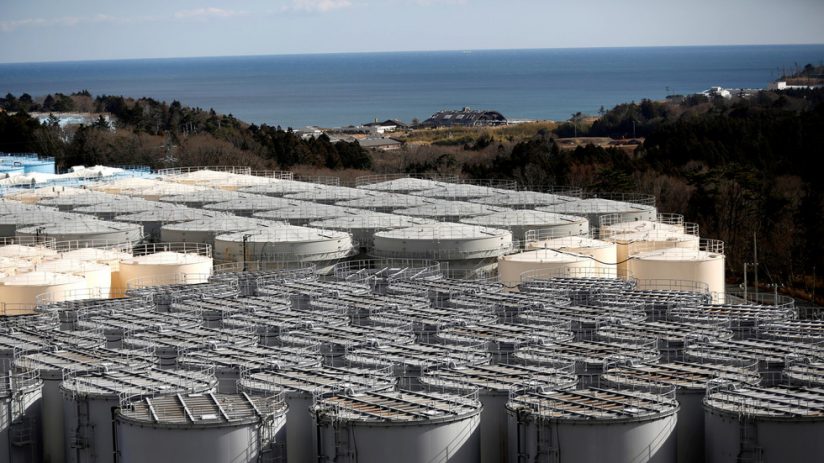
Storage tanks for radioactive water at TEPCO’s tsunami-crippled Fukushima Daiichi nuclear power plant in Okuma town, Fukushima prefecture, Japan. (Photo by Reuters)
Press TV | October 16, 2020
Nearly a decade after the Fukushima nuclear disaster, Japan’s government has decided to release contaminated water from the destroyed plant into the sea, media reports said on Friday, with a formal announcement expected to be made later this month.
The decision is expected to rankle neighboring countries like South Korea, which has already stepped up radiation tests of food from Japan, and further devastate the fishing industry in Fukushima that has battled against such a move for years.
The disposal of contaminated water at the Fukushima Daiichi plant has been a long-standing problem for Japan as it proceeds with a decades-long decommissioning project. More than one million tonnes of contaminated water are currently stored in huge tanks at the facility.
The plant, run by Tokyo Electric Power Company Holdings Inc., suffered multiple nuclear meltdowns after a 2011 earthquake and tsunami.
On Friday, Japan’s industry minister Hiroshi Kajiyama said no decision had been made on the disposal of the water yet, but the government aims to make one quickly.
“To prevent any delays in the decommissioning process, we need to make a decision quickly,” he told a news conference.
He did not give any further details, including a time-frame.
The Asahi newspaper reported that any such release is expected to take at least two years to prepare, as the site’s irradiated water first needs to pass through a filtration process before it can be further diluted with seawater and finally released into the ocean.
In 2018, Tokyo Electric apologized after admitting its filtration systems had not removed all dangerous material from the water, collected from the cooling pipes used to keep fuel cores from melting when the plant was crippled.
It has said it plans to remove all radioactive particles from the water except tritium, an isotope of hydrogen that is hard to separate and is considered to be relatively harmless.
Last week, Japanese fish industry representatives urged the government not to allow the release of contaminated water from the Fukushima plant into the sea, saying it would undo years of work to restore their reputation.
South Korea has retained a ban on imports of seafood from the Fukushima region that was imposed after the nuclear disaster and summoned a senior Japanese embassy official last year to explain how Tokyo planned to deal with the Fukushima water problem.
During Tokyo’s bid to host the Olympic Games in 2013, then-Prime minister Shinzo Abe told members of the International Olympic Committee that the Fukushima facility was “under control”.
The Games have been delayed to 2021 because of the pandemic and some events are due to be held as close as 60 km (35 miles) from the wrecked plant.
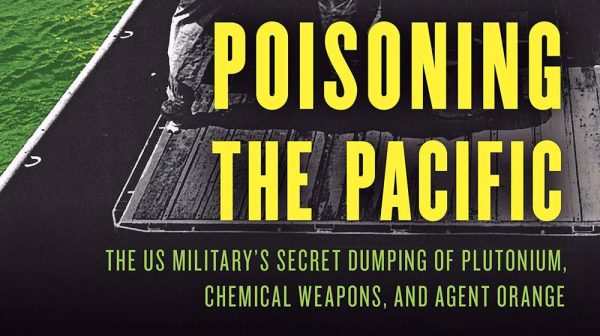
‘Poisoning the Pacific’ details US military’s secret dumping of poison into Far East
Press TV – October 11, 2020
A new book has revealed that the US military has contaminated the Pacific Ocean with radioactive waste and weapons-grade chemicals for decades.
The new book titled Poisoning the Pacific, written by British journalist Jon Mitchell, details how the US military has been disposing toxic substances, including plutonium, dioxin, and VX nerve agent at the Pacific.
Based on more than 12,000 pages of US government documents, Poisoning the Pacific narrates the story of soldiers, their families, and residents who have been exposed to poisonous substances.
The documents have been obtained under the US Freedom of Information Act (FOIA) and through interviews with local residents, military veterans and researchers.
The US government, however, has covered up the extent of the damage and refused to help the victims.
In one case, Leroy Foster – a US Air Force master sergeant who was assigned to the Anderson Air Force Base in Guam in 1968 – was ordered to mix “diesel fuel with Agent Orange” and spray “it by truck all over the base to kill the jungle overgrowth.”
Soon after, Foster suffered serious skin complaints and eventually fell sick with Parkinson’s and ischemic heart disease. Later, his teenage daughter had cancer, and his grandchild was born with 12 fingers, 12 toes, and a heart murmur. Foster died in 2018.
“My reporting has helped these sick men and women to receive compensation from the US government. Investigative journalism is ultimately a job that ought to help people suffering from mistreatment to receive the justice they deserve,” Mitchell says in his book.
The voices of the suffering indigenous groups in the Pacific region, however, consistently go unheard, said Mitchell, who in 2015 was awarded Japan’s Freedom of the Press Lifetime Achievement Award for his work about the environmental impact and damage caused by US military presence in Okinawa.
Researchers report that villages where herbicides were believed to have been sprayed by the US suffered higher rates of infant deaths from birth defects.
The US government was split over claims of herbicide use on Guam following an investigation in 2017. The Department of Defense reported that tests on soil did not contain herbicides, but the Environmental Protection Agency reported the opposite.
The health and environmental impacts on Guam mirror those that have happened to local residents and US soldiers based in Okinawa, Japan, where the US has maintained a base for decades.
‘Eco-modernist’ Germans pitch Nukes over reliance on Russia
As Renewables Falter, Environmentalists Stand Up For Nuclear

By Michael Shellenberger | Forbes | September 9, 2020
Environmentalists have long promoted renewable energy sources as better for nature.
But a new study suggests that the expansion of mining for the materials to make solar panels and wind turbines may pose a greater threat than climate change to endangered species.
“Most mining areas (82%) target materials needed for renewable energy production,” note the authors in the peer-reviewed journal Nature Communications. And, they add, “these new threats to biodiversity may surpass those averted by climate change mitigation.”
The study comes at a moment when the expansion of solar and wind energy is increasing local opposition, raising electricity prices, and contributing to electricity shortages.
Recent electricity outages in California forced the state’s governor to acknowledge the dangers posed by attempting to rely on unreliable sources of renewable energy.
“We cannot sacrifice reliability,” Gov. Gavin Newsom said on August 17. “We have to sober up to the reality that… we’re going to have to do more, and be much more mindful, in terms of our capacity to provide backup and insurance.”
The problem with relying on solar panels is that the sun sets during peak demand, which is between 5 pm and 10 pm, requiring a massive ramping up of natural gas power plants. And the same lack of wind behind the heatwaves has also meant a lack of electricity from industrial wind turbines.
Meanwhile, environmental resistance is blocking and slowing the expansion of industrial wind and solar energy projects.
In Britain, Greenpeace has opposed a massive new solar farm, “arguing that ‘vast continuous fields of panels on agricultural land” are not “the best way to go solar.’” New York environmentalists, meanwhile, “say large-scale solar installations will spoil beautiful farmland,” reported Financial Times.
As renewables have faltered, pro-nuclear environmentalists have become increasingly vocal, even in Germany, the world’s most anti-nuclear nation.
Europeans Protest Greenpeace
Last Saturday pro-nuclear activists organized by the German pro-nuclear organization Nuklearia dropped a banner in front of Greenpeace’s Germany headquarters. It read, “Climate Crisis? Nuclear energy!”
Pro-nuclear activists similarly protested in front of Greenpeace’s Paris headquarters in late June, denouncing the NGO’s role in replacing nuclear plants with fossil fuels.
“Several dozen protesters — wearing face masks — carried banners in front of the Greenpeace headquarters in Paris, with slogans such as ‘Less nuclear means more coal,’” reported Reuters.
“In the following weeks, there will be similar rallies,” reported the Frankfurter Allgemeine Zeitung (FAZ) last week, “where the five other German nuclear power plants that are still running but whose operating licenses will soon expire.”
Over the next six weeks, there will be over forty pro-nuclear demonstrations around the world organized by the Nuclear Pride Coalition. (My nonprofit organization, Environmental Progress, is a member of the coalition, but did not organize the demonstrations in Germany, France, or other nations.)
The chairman of Nuklearia is Rainer Klute, a computer scientist and eco-modernist. That’s someone who, according to FAZ, ”wants to save the world by relying on modern technology, not on using jute bags.” FAZ noted that Klute is finding allies “among those who oppose wind turbines out of concern for noise and the landscape.”
It wasn’t the first pro-nuclear demonstration in Germany. In December 2019, 120 people from Germany, Poland, Switzerland, Austria, the Netherlands, and the Czech Republic rallied near the Philippsburg nuclear power plant, forty-five minutes from the French border, which the German government had forced to close prematurely.
While Klute emphasizes the need for nuclear to combat climate change, Peters stresses the need for nuclear energy to avoid over-dependence on imported natural gas from Russia. … Full article
US agrees to pay South Carolina $600 million, dispose of plutonium by 2037
Press TV – August 31, 2020
The US Energy Department said on Monday it has reached a settlement with South Carolina on removing weapons-grade plutonium by 2037 from a Cold War-era site and shipping most of it to a disposal facility in New Mexico.
South Carolina, which had sued the energy department, will receive an upfront payment of $600 million. The state will waive its right to bring any more lawsuits over the plutonium until 2037.
“Today’s announcement is a guarantee to the people of South Carolina that plutonium will be removed safely from this state,” said US Energy Secretary Dan Brouillette.
The US government had planned to build a mixed oxide (MOX) plant to convert the material into fuel for nuclear power. But a MOX plant had never been built in the United States, and the Trump administration axed the program in 2018 saying it would cost about $48 billion more than $7.6 billion already spent on it.
That decision was a blow to South Carolina politicians, including Republican Senator Lindsey Graham, who had touted the jobs it would provide.
The department said 9.5 metric tons of plutonium will be removed from the Savannah River site. Much of the material will be sent to New Mexico, where it will be diluted and disposed of in a nuclear waste site near Carlsbad.
A notice in the Federal Register on Friday indicated that the department and its arm the National Nuclear Security Administration will dispose 7.1 metric tons at New Mexico’s Waste Isolation Pilot Plant.
The energy department was required by law to either build the MOX plant or remove the plutonium but it had done neither.
The US government had secretly shipped plutonium from South Carolina to Nevada sometime before November 2018, the Trump administration revealed last year. Democratic officials in Nevada were angered when they learned the news.
South Carolina Attorney General Alan Wilson said the deal was the largest single settlement ever in the state’s history. The deal will prevent the state from becoming a dumping ground for nuclear waste and the money will help its economy recover from the coronavirus pandemic, he said.
No more water pollution from oil? Russian scientists create method to effectively clean petroleum products from industrial waste
By Jonny Tickle | RT | August 10, 2020
Scientists from Siberia have developed a technique that effectively removes petroleum from wastewater. Using a sorbent, the new system separates impurities, meaning waste released into the environment will cause much less damage.
The research, published by the United Kingdom’s IOP Publishing, was conducted by scientists based in Krasnoyarsk, a large Siberian city 3,300km east of Moscow.
According to Olga Dubrovskaya, associate professor at Siberia Federal University (SibFU), cultures “eat away” at oil, cleaning the water of “impurities.” Current wastewater treatment technologies only capture about 30 percent of dangerous substances, meaning that many toxicants enter the environment and cause significant environmental damage. By contrast, SibFU’s method removes over 99 percent of all surface and emulsified oil.
The newly developed technique was tested on heat and power equipment at Krasnoyarsk CHP-2, one of the largest thermal power plants in Siberia.
“Bacteria are placed in special spores in the structure of the sorbent,” Dubrovskaya explained. The bacteria sit dormant and activate when oil is detected, at which point the water purification begins.
Mines, Minerals, And ‘Green Energy’: A Reality Check
By Mark P. Mills – Manhattan Institute – July 9, 2020
 As policymakers have shifted focus from pandemic challenges to economic recovery, infrastructure plans are once more being actively discussed, including those relating to energy.
Green energy advocates are doubling down on pressure to continue, or even increase, the use of wind, solar power, and electric cars.
Left out of the discussion is any serious consideration of the broad environmental and supply-chain implications of renewable energy.
As I explored in a previous paper, “The New Energy Economy: An Exercise in Magical Thinking,”[1] many enthusiasts believe things that are not possible when it comes to the physics of fueling society, not least the magical belief that “clean-tech” energy can echo the velocity of the progress of digital technologies. It cannot.
This paper turns to a different reality: all energy-producing machinery must be fabricated from materials extracted from the earth.
No energy system, in short, is actually “renewable,” since all machines require the continual mining and processing of millions of tons of primary materials and the disposal of hardware that inevitably wears out.
Compared with hydrocarbons, green machines entail, on average, a 10-fold increase in the quantities of materials extracted and processed to produce the same amount of energy.
This means that any significant expansion of today’s modest level of green energy—currently less than 4% of the country’s total consumption (versus 56% from oil and gas)—will create an unprecedented increase in global mining for needed minerals, radically exacerbate existing environmental and labor challenges in emerging markets (where many mines are located), and dramatically increase U.S. imports and the vulnerability of America’s energy supply chain.
As recently as 1990, the U.S. was the world’s number-one producer of minerals. Today, it is in seventh place.
Even though the nation has vast mineral reserves worth trillions of dollars, America is now 100% dependent on imports for some 17 key minerals, and, for another 29, over half of domestic needs are imported.
Among the material realities of green energy:
- Building wind turbines and solar panels to generate electricity, as well as batteries to fuel electric vehicles, requires, on average, more than 10 times the quantity of materials, compared with building machines using hydrocarbons to deliver the same amount of energy to society.
- A single electric car contains more cobalt than 1,000 smartphone batteries; the blades on a single wind turbine have more plastic than five million smartphones; a solar array that can power one data center uses more glass than 50 million phones.
- Replacing hydrocarbons with green machines under current plans—never mind aspirations for far greater expansion—will vastly increase the mining of various critical minerals around the world. For example, a single electric car battery weighing 1,000 pounds requires extracting and processing some 500,000 pounds of materials. Averaged over a battery’s life, each mile of driving an electric car “consumes” five pounds of earth. Using an internal combustion engine consumes about 0.2 pounds of liquids per mile.
- Oil, natural gas, and coal are needed to produce the concrete, steel, plastics, and purified minerals used to build green machines. The energy equivalent of 100 barrels of oil is used in the processes to fabricate a single battery that can store the equivalent of one barrel of oil.
- By 2050, with current plans, the quantity of worn-out solar panels—much of it nonrecyclable—will constitute double the tonnage of all today’s global plastic waste, along with over three million tons per year of unrecyclable plastics from worn-out wind turbine blades. By 2030, more than 10 million tons per year of batteries will become garbage.
Read more at Manhattan Institute
An Israeli Charity Group is uprooting Palestinians not planting Trees
By Jonathan Cook | The National | July 22, 2020
The Jewish National Fund, established more than 100 years ago, is perhaps the most venerable of the international Zionist organisations. Its recent honorary patrons have included prime ministers, and it advises UN forums on forestry and conservation issues.
It is also recognised as a charity in dozens of western states. Generations of Jewish families, and others, have contributed to its fundraising programmes, learning as children to drop saved pennies into its trademark blue boxes to help plant a tree.
And yet its work over many decades has been driven by one main goal: to evict Palestinians from their homeland.
The JNF is a thriving relic of Europe’s colonial past, even if today it wears the garb of an environmental charity. As recent events show, ethnic cleansing is still what it excels at.
The organisation’s mission began before the state of Israel was even born. Under British protection, the JNF bought up tracts of fertile land in what was then historic Palestine. It typically used force to dispossess Palestinian sharecroppers whose families had worked the land for centuries.
But the JNF’s expulsion activities did not end in 1948, when Israel was established through a bloody war on the ruins of the Palestinians’ homeland – an event Palestinians call the Nakba, or catastrophe.
Israel hurriedly demolished more than 500 cleansed Palestinian villages, and the JNF was entrusted with the job of preventing some 750,000 refugees from returning. It did so by planting forests over both the ruined homes, making it impossible to rebuild them, and village lands to stop them being farmed.
These plantations were how the JNF earned its international reputation. Its forestry operations were lauded for stopping soil erosion, reclaiming land and now tackling the climate crisis.
But even this expertise was undeserved. Environmentalists say the dark canopies of trees it has planted in arid regions such as the Negev, in Israel’s south, absorb heat unlike the unforested, light-coloured soil. Short of water, the slow-growing trees capture little carbon. Native species of brush and animals, meanwhile, have been harmed.
These pine forests – the JNF has planted some 250 million trees – have also turned into a major fire hazard. Most years hundreds of fires break out after summer droughts exacerbated by climate change.
Early on, the vulnerability of the JNF’s saplings was used as a pretext to outlaw the herding of native black goats. Recently the goats, which clear undergrowth, had to be reintroduced to prevent the fires. But the goats’ slaughter had already served its purpose, forcing Bedouin Palestinians to abandon their pastoral way of life.
Despite surviving the Nakba, thousands of Bedouin in the Negev were covertly expelled to Egypt or the West Bank in Israel’s early years.
It would be wrong, however, to imagine that the JNF’s troubling role in these evictions was of only historical interest. The charity, Israel’s largest private land owner, is actively expelling Palestinians to this day.
In recent weeks, solidarity activists have been desperately trying to prevent the eviction of a Palestinian family, the Sumarins, from their home in occupied East Jerusalem to make way for Jewish settlers.
Last month the Sumarins lost a 30-year legal battle waged by the JNF, which secretly sold their home in the late 1980s by the Israeli state.
The family’s property was seized under a draconian 1950 law declaring Palestinian refugees of the Nakba “absent” so that they could not reclaim their land inside the new state of Israel.
The courts have decreed that the law can be applied in occupied Jerusalem too, in violation of international law. In the Sumarins’ case, it appears not to matter that the family was never actually “absent”. The JNF is permitted to evict the 18 family members next month. To add insult to injury, they will have to pay damages to the JNF.
A former US board member, Seth Morrison, resigned in protest in 2011 at the JNF’s role in such evictions, accusing it of working with extreme settler groups. Last year the JNF ousted a family in similar circumstances near Bethlehem. Days later settlers moved on to the land.
Ir Amim, an Israeli human rights group focusing on Jerusalem, warned that these cases create a dangerous legal precedent if Israel carries out its promise to annex West Bank territory. It could rapidly expand the number of Palestinians classified as “absentees”.
But the JNF never lost its love of the humble tree as the most effective – and veiled – tool of ethnic cleansing. And it is once again using forests as a weapon against the fifth of Israel’s population who are Palestinian, survivors of the Nakba.
Earlier this year it unveiled its “Relocation Israel 2040” project. The plan is intended to “bring about an in-depth demographic change of an entire country” – what was once sinisterly called “Judaisation”. The aim is to attract 1.5 million Jews to Israel, especially to the Negev, over the next 20 years.
As in Israel’s first years, forests will be vital to success. The JNF is preparing to plant trees on an area of 40 sq km belonging to Bedouin communities that survived earlier expulsions. Under the cover of environmentalism, many thousands of Bedouin could be deemed “trespassers”.
The Bedouin have been in legal dispute with the Israeli state for decades over ownership of their lands. This month in an interview with the Jerusalem Post newspaper, Daniel Atar, the JNF’s global head, urged Jews once again to drop money into its boxes. He warned that Jews could be dissuaded from coming to the Negev by its reputation for “agricultural crimes” – coded reference to Bedouin who have tried to hold on to their pastoral way of life.
Trees promise both to turn the semi-arid region greener and to clear “unsightly” Bedouin off their ancestral lands. Using the JNF’s original colonial language of “making the desert bloom”, Mr Atar said his organisation would make “the wilderness flourish”.
The Bedouin understand the fate likely to befall them. In a protest last month they carried banners: “No expulsions, no displacement.”
After all, Palestinians have suffered forced displacement at the JNF’s hands for more than a century, while watching it win plaudits from around the world for its work in improving the “environment”.
Featured Video

Trita Parsi: Israel Set a Trap for Total War in the Region
or go to
Aletho News Archives – Video-Images
From the Archive
Zionism’s Violent Legacy
By Donald Neff | Washington Report On Middle East Affairs | January 1996
On January 4, 1948, Jewish terrorists drove a truck loaded with explosives into the center of the all Arab city of Jaffa and detonated it, killing 26 and wounding around 100 Palestinian men, women and children.[1] The attack was the work of the Irgun Zvai Leumi – the “National Military Organization,” also known by the Hebrew letters Etzel – the largest Jewish terrorist group in Palestine. The Irgun was headed by Revisionist Zionist Menachem Begin and had been killing and maiming Arabs, Britons and even Jews for the previous ten years in its efforts to establish a Jewish state.
This terror campaign meant that at the core of Revisionist Zionism there existed a philosophical embrace of violence. … continue
Blog Roll
 Aletho News
- Trita Parsi: Israel Set a Trap for Total War in the Region
- Trump’s Iran war is on an Israeli leash
- Saudi oil boss issues global supply warning
- Riyadh Says Its Oil System Is Intact. The Numbers Say Otherwise.
- Trump and Netanyahu Want to “Finish the Job” on Iran
- US ‘one-sided dictation’ not Iran’s beliefs makes rational talks impossible: Baghaei
- Iran’s Next Strike May Not Explode. It Could Shut You Down /Col Doug Macgregor
- Iran: US political targets legitimate if assassinations return
- Iraq shuts key border crossing with Iran under US pressure: Report
- Undersea Internet cables could be targeted in retaliation for attacks on Iran: IRGC deputy chief
- If Americans Knew
- The Israel Lobby’s Changing Fortunes
- AIPAC has become such a political liability that it’s shifting to a more “nimble” approach to buying politicians
- At least 160 Israeli settler attacks in 2 weeks
- Will Gaza’s Ancient Christian Community Disappear Forever?
- Israel’s vision of regional security rests on keeping Arab states weak
- Heidi Levine recounts how Palestinian youths helped save her in settler attack
- DAILY UPDATE: Latest essential news on Palestine, Israel, & region
- Trump’s Intensifying Sabotage of the ICC, for Israel’s Sake
- Israeli military detain US and UK volunteers in West Bank including Democratic NY politician Brad Lander
- Americans at National Conservatism Conference held in Israel this year criticize Israel
- No Tricks Zone
- E-Cars Reduce CO2 Emissions By Only 41% Compared To Internal Combustion Engine Vehicles
- Predictions Made By Renowned Climate Professor Over Past Decades Have Been Proven To Be Poor
- New Study Suggests Large Regions Of The Pacific Ocean Have Been Cooling For The Last 80 Years
- Germany’s Green Energy Debacle: High Energy Costs Force Kahla Porzellan to Close After 182 Years!
- New Study: 50 Years Of The Most Aggressive ‘Net Zero’ Policies Can Only Affect The Global Climate By 0.03°C
- US September “Heat” Was No Record…Many Records Set Decades Ago
- Latest European Green Energy Debacle; Portugal’s Largest Flagship Solar Park Insolvent!
- Green Energy Debacle: German Expert Professor Fritz Vahrenholt Warns Of Severe Economic And Social Consequences
- Two More Paleo Reconstructions Affirm Meters-Higher Sea Levels Across Ireland, Brazil 7000-6000 Years Ago
- New Study: Earth And Venus Surface Warmth Largely Explained By Convection And Lapse Rate, Not CO2 Or Radiation

