Economic Implications of the Yemeni Seizure of the Galaxy Leader
Sputnik – 21.11.2023
As confirmed by multiple media sources, the ship seized by the Houthis in the Red Sea is the Bahamian flagged Galaxy Leader. According to marinetaffic.com, this ship is designed to carry vehicles, and has a capacity of 1500 passenger cars.
The ship was en route from the Turkish port of Korfez to the Indian port of Pipavav with 25 crew members, including Bulgarians, Filipinos, Mexicans and Ukrainians, but no Israelis on board.
According to Reuters, Netanyahu’s office described the ship as ” British-owned and Japanese-operated”, adding that, “There were no Israelis on the ship,” and “Israel was not involved in its ownership or operation.” However, Yemen’s official news agency, SABA, states that multiple Israeli news media have reported that “The ship controlled by the “Houthis” belongs to the Israeli billionaire Rami Unger, who is close to the Mossad.” Unger is, indeed, a veteran of the Intelligence Corp of the IDF, and has had a decades long close personal and business relationship with Yossi Cohen, the former Director of Mossad, and National Security Advisor to Netanyahu.
In 2019, the personal net worth of Rami Unger and his wife was estimated at $2.1 billion. In 2004, it was reported that Unger owned between 12 and 14 vehicle transport ships, worth about $50 million each, a reasonable estimate of the value of the Galaxy Leader, which was built in 2002. The political and economic impact of this operation goes far beyond the mere value of the ship.
In spite of the estimated $50 million cost/value of the ship, from an economic point of view, it is actually of little worth to the Houthis. They can’t sell it, they can’t use it, Unger and his insurance companies probably won’t ransom it. The ship was sailing without cargo, which if it had been, would have been approximately 1,500 new cars, worth between $20 and $30 million in total. So, clearly, there was no economic benefit from the seizure of the vessel for the Houthis, but the full political and economic ramifications remain to be seen.
It should be understood that the Houthis have not just seized the Galaxy Leader, they have put all Israeli shipping in the Red Sea under threat. The value of that shipping can be roughly estimated by the fact that out of Israel’s $165 billion in total exports in 2022, 24% went to Asian markets. The shortest shipping route from the Mediterranean to Asia is the Suez Canal. Everything that goes through the Suez Canal goes through the Red Sea, and 12% of all global trade passes through the Suez Canal. With these calculations, the economic impact on the Israeli economy by the seizure of this single ship can be estimated in the billions of dollars. The Houthi area of military operations in the southern Red Sea is more than 1,000 miles from Israel, and beyond the reach of timely Israeli military response.
Economic warfare and military warfare are two sides of the same coin. The Houthis, with one helicopter and less than a dozen commandos, have hit the Israeli economy as hard as the entire Israeli military is hitting the people of Gaza. All in all, it must be admitted, it was a successful gambit. Especially considering that it was a bloodless operation in which, unlike the Israeli operation in Gaza, no one was harmed.
Of course, like the October 7th Hamas attack, Netanyahu could very well try to exploit this incident to “justify” another Israeli attack, this time on Iran. War is by nature, always full of dangers and deception. However, the Houthis are likely to find broad and real support for their raid across the Arab and Muslim world.
In an announcement by Yemeni Armed Forces, ” the Armed Forces renewed their warning to all ships belonging to the Israeli enemy or dealing with it that they will become a legitimate target. It called on all countries whose nationals work in the Red Sea to refrain from any work or activity with Israeli ships or ships owned by Israelis.” The statement pointed out that the operations of the armed forces only threaten the ships of Israel and those owned by Israelis, as was previously indicated.
Raisi Calls on BRICS Leaders to Use Economic, Political Opportunities to Pressure Israel
Sputnik – 21.11.2023
TEHRAN – Iranian President Ebrahim Raisi on Tuesday called on BRICS leaders to use all economic and political opportunities to put pressure on Israel.
Amid escalating horrors in the Gaza Strip during the “second phase” of Israel’s conflict with Hamas, the former has intensified its actions, resulting in a rise in civilian casualties. Iranian President Ebrahim Raisi, in response, has called on BRICS leaders to leverage economic and political avenues to exert pressure on the Israeli government.
“The United States has made all international organizations faceless. Iran wants BRICS members and governments to stand up for security, establish justice and fight racial discrimination in the world, as well as use all their political and economic opportunities and power to exert pressure on Israel and its supporters from Western countries,” Raisi at the BRICS extraordinary summit on the Middle East.
Raisi urged the BRICS countries to recognize the Israeli government as a “terrorist regime.”
“Israel’s continuous attacks on hospitals, medical centers and religious sites, as well as the murder of women and children, doctors, nurses and journalists are acts of terrorism, and it is necessary to recognize the Israeli regime as a terrorist regime and its army as a terrorist organization,” Raisi said.
BRICS countries must adopt a resolution at the UN to stop Israel’s crimes in the Gaza Strip, Raisi said.
Israel having difficulties and suffering losses both on land and sea
By Lucas Leiroz | November 20, 2023
It seems increasingly clear that the conflict in Palestine is not an easy task for Israel. In addition to the difficulties of advancing on the battlefield and the heavy losses that the IDF has suffered during clashes with Palestinian troops, defeats at sea are beginning to occur. Yemeni forces, who previously declared full support for Palestine, captured an important Israeli merchant ship, taking new hostages and improving the Palestinians’ bargaining power in the prisoner exchange negotiation process.
Undoubtedly, Israel is stronger than its adversaries in the current Palestinian war. Tel Aviv is a state with a complex and organized structure, having a regular national army and sufficient strength to defeat armed militias such as Hamas and many other Palestinian armed groups. The problem is that the fighting is not happening symmetrically, and, despite territorial advances, Israel is clearly suffering significant damages, which could generate great difficulties in the near future.
The Al-Qassam Brigades, the military wing of Hamas, frequently announce the neutralization of Israeli soldiers and tanks. Several videos have been published on social media showing Hamas fighters using rockets and grenades against Israeli tanks and instantly disabling them. Confirming what had been predicted by analysts, Israel is having difficulty using its combat vehicles in an urban area full of debris. IDF’s bombings destroyed civilian buildings, making the ground in Gaza difficult terrain for tanks, which end up becoming an easy target for Hamas.
In the same sense, it is important to remember that Israel has not yet managed to enter the Hamas’ tunnels. The IDF claimed that the Palestinian Resistance was using Al Shifa Hospital and other civilian facilities as a human shield. With these excuses, several bombings were carried out against hospitals, but no bunkers were found. In practice, the IDF is unable to find the correct way to reach the enemy’s underground system. So, the bombings against civilians have really no strategic value.
However, the situation is complicated not only on the land battlefield. At sea, things are getting worse for the Zionist state, which is starting to suffer not only military but also commercial losses. On November 19, Yemen’s Houthi armed forces captured a major Israeli merchant ship in the Red Sea. The ship belongs to an Israeli businessman and was being operated by employees of German and Japanese companies on a voyage from Turkey to India.
Commenting on the topic on social media, Houthi military spokesperson Yahya Saree said that the seizure was a response to the “heinous acts against our Palestinian brothers in Gaza and the West Bank”, adding that “if the international community is concerned about regional security and stability, rather than expanding the conflict, it should put an end to Israel’s aggression against Gaza”.
A number of 25 people were reported taken prisoner by the Houthis. None of the crew are believed to be Israeli citizens, which makes the case even more complicated. By capturing an Israeli vessel with foreign crew, the Houthis create a situation of diplomatic instability for Tel Aviv. Countries whose citizens have been captured will demand a quick and safe rescue operation, but this is almost impossible to be achieved by military means. Therefore, the bargaining power of the Palestinians is increased. To avoid a diplomatic crisis with the possible death of foreigners in a naval operation, Israel will have to agree to release Palestinian prisoners, withdraw militarily or meet any other request from the Yemenis.
All these factors lead Israel to diplomatically and militarily difficult circumstances. The IDF has to face long military attrition, heavy losses and, in parallel, Tel Aviv has great diplomatic and political instability. The Netanyahu government is the most harmed by this crisis as any of its actions turn against it. If Netanyahu increases attacks, he is criticized for human rights violations and fomenting war. If he reduces the intensity of the fighting, opponents call him a weak leader and incapable of achieving Israel’s objectives.
In parallel to all this, the chances of the conflict reaching an international level raise day by day. Recently, Hezbollah published a video on its social media with the message “We are coming”. This has generated expectations that the Lebanese militia’s troops will begin a full-scale attack soon. The group has been a de facto participant in the conflict since the beginning, using artillery and drones to destroy Israeli military and intelligence infrastructure on the border with Lebanon. Considering the massive military power of Hezbollah – apparently the largest non-state armed group in the world – the beginning of a land incursion would greatly harm Israeli plans.
Lucas Leiroz, journalist, researcher at the Center for Geostrategic Studies, geopolitical consultant.
Wadi Tiran: Facing Ethnic Cleansing, Longing For Home

Car smashed in Wadi Tiran
International Solidarity Movement | November 20, 2023
South Hebron Hills – Wadi Tiran is a good example, and sadly one of many, of Israel’s big plan to make Palestine the land without people. Over the last month, the community of Wadi Tiran has been repeatedly “visited” by either settlers or soldiers, or both (since distinguishing between them is more and more difficult nowadays), ordering everybody in the village to leave or they would kill them. One of these “visits” resulted in all windows on their tractor, pickup and their car being smashed.
The ISM team, together with Israeli activists, has been part of the protective presence in Wadi Tiran for over a week and has witnessed some of the threats this small herding homestead has endured, including settlers on motorbikes and a quad coming nearby, and only yesterday (November 18) a four wheel drive vehicle with settlers appeared inside the homestead. The settlers did not get out of the car but instead drove around provocatively and proceeded to another Tiran homestead located on the nearby hill.
The Israeli activists called the Israeli police only to be asked by them, “Why are you supporting the terrorists?” Having witnessed the terror being inflicted on the residents of Wadi Tiran first hand, we ask the same question of the Israeli government, the United States government, and other national and international bodies that enable, support, and fund the ethnic cleansing of communities like Wadi Tiran.
Wadi Tiran is a small homestead where two brothers and their families, altogether about 30 people, most of them children, live, herding around 300 sheep and goats. The father of the two farmers was expelled in 1948 from the Yattir area and moved to the arid slope of the Wadi Tiran hill where they made life ever since.
The two brothers talked with sadness and longing about their ancestral land where their father grew wheat, corn, chickpeas and lentils and where water was available in abundance. “Only in one part of Yattir there were more than 100 springs,” they recalled.
Now the water they have comes from the rain collected in one well, which they use for animals, but there is not enough of it. Additional water has to be purchased and brought from the outside at the expense they could ill afford nowadays. Both brothers used to work from time to time doing agricultural work in Israel until the start of the current escalation in hostilities, and together with all other Palestinian workers they have now lost their jobs.
Efforts by the occupiers to make their already hard lives impossible have peaked now, but it started long ago. On our way to Wadi Tiran via the dirt road, we could see that in many parts it has been destroyed. That was the work of the Israeli army bulldozers, which three months ago piled boulders and piles of earth and rocks on the road in several locations to make access to the homestead difficult. We had to drive around them and sometimes over them, causing an unpleasant rocky ride, fearing for the damage to our vehicle.
The main threat to the farmers’ livelihood was ‘the law’ introduced verbally by the settlers setting out a boundary of 200 meters from the homestead where grazing is now banned. Since then, the brothers have had to buy practically all the food for their animals, and drive the seven monthly tons of it down the road ravaged by the army.
Not that the Israel occupation was ever “light”, but since the war on Gaza all the rule books and established practices have been abandoned. Feeding on the rage the Israeli nation is in the grip of following the attacks by the fighters from Gaza, settlers are out of control and all pretences that occupation authorities are attempting to stop them from committing violence, has been dropped. The military knows about settler violence and either chooses to turn a blind eye or joins in on their violence.
What is also different currently is that nobody knows if those doing the harassing, attacking, and threatening are soldiers, settlers or settler security. The regular army has been sent to attack Gaza. The occupation of the West Bank and the “protection” of the illegal settlements was handed over to army reservists, many of whom are illegal settlers and settler security. They have formed “regional defence battalions” and these violent thuggish armies, often masked and fully or partially dressed in army uniforms, block the roads and village entrances and appear any time of day and night to attack the Palestinians, destroy their fields, their livestock and the contents of their homes.
They are either joined or are led by the “civilian” illegal settlers who have been handed large quantities of arms by Ben Gvir’s Security Ministry so that they can “defend” their settlements. While in the past the settlement security would mostly operate within the boundaries of the settlements, post October 7th, they are tasked with terrorizing and ethnically cleansing wide areas surrounding the settlements.
There is little doubt that without serious consequences from Israel’s powerful allies, and the United States in particular, the horrendous and criminal lawlessness and violence will leave the Wadi Tiran families without a future in this area.

Children in Wadi Tiran
Fathers of the two families told us that they fear for their future and the future of their children. “We have been farmers all our lives and that is what we do. Where shall we go?” the two farmers asked. That is the most asked question in the South Hebron Hills these days, leading to long sleepless nights, anxiety, fear, and a living nightmare, echoed in the lives of people from dozens of villages facing the same fate.
Joe Biden’s Washington Post op-ed shows the US never learns its lessons
By Tarik Cyril Amar | RT | November 20, 2023
The president of the United States, Joe Biden, has recently published an op-ed. Appropriately released through the Washington Post, it is, of course, really the equivalent of a regime policy declaration – a laying down of the party line, if you wish. As such, the text deserves attention, never mind that it is impossible that America’s leader, clearly challenged by worsening senescence, has written it himself. This is, to borrow a phrase from the Russia-watching crowd, America’s “collective Biden” speaking.
Translated from official jargon and scrubbed of empty rhetoric and euphemisms, the long proclamation makes only two substantial points about what the US and its “allies” (really clients and vassals) must do: Continue waging a proxy war against Russia in Ukraine and continue backing Israel in its genocidal war against the Palestinians (no, it is not a “war against Hamas,” that’s a side effect).
In that sense, there is nothing surprising, or hopeful, in collective Biden’s announcement: It took them more words this time, but this Democratic administration of neocons is simply repeating the equally tone-deaf slogan of a former Republican president representing a past gaggle of neocons: Stay the course, as George W. Bush put it succinctly during the Iraq disaster. Deja Vue all over again, in the words of America’s greatest philosopher.
But the details of the text still merit scrutiny. Let’s pick out a few highlights:
Hamas is repeatedly denounced as carrying out “pure, unadulterated evil” and such. Every fair observer would reserve such terms by now for what the Israelis are doing in Gaza. But let’s set that aside for now and let’s also set aside that we now know that substantial numbers of Israelis were killed by Israeli forces. Let’s instead focus on Hamas. Is such language factual? The rational answer to that question is not a matter of opinion, and it has to be “no”: In reality, the empirical record shows that Hamas is a resistance organization engaged in a legally and ethically justified struggle against massive national oppression. It has attacked military targets, which is legitimate, as well as committed terrorist crimes. But if any political and armed organization that does both engage in legitimate violence and terrorist crimes is carrying out “pure evil,” then almost every halfway powerful state in this world has done just that or is doing it even now. Clearly, we are dealing with an absurd statement here.
Usually, the cause of such absurdities is strategic dishonesty. That holds here as well. For the Biden administration is transparently pursuing two aims with this Orwellian abuse of terminology: First, make Israel’s crimes against the Palestinians appear, if not justified, then at least so “understandable” or “inevitable” that we stop objecting to them (and, if we are Americans, vote for Democrats, even while they support these perfectly avoidable crimes).
Secondly, prepare the ground for the proposal, following further down in the proclamation, to entirely eliminate Hamas from any post-assault settlement and, instead, “ultimately” make a “revived Palestinian Authority” rule both the West Bank and Gaza, while work on some lasting settlement continues.
This proposal is wrapped in deceptive and revoltingly cynical rhetoric: If Joe Biden has a broken heart over the slaughtered children of Gaza, then Andrew Jackson must have cried while signing the Indian Removal Act. If Biden wants a two-state solution, then why is he allowing and helping one of the “two states” to wipe out the other? If he has “counselled” Israeli leaders to refrain from excessive violence, then why has he not backed up his kind words with using his massive leverage and stopping the flow of arms, money, information, and diplomatic cover to help their genocidal attack? If Biden is worried about antisemitism spreading, why does he allow far-right Zionists to claim that their policies, which lead to deaths of thousands upon thousands of Palestinian children, are somehow “Jewish”?
Hypocrisy like that may still fool some Americans, namely those who really believe that the adequate answer to the umpteenth mass shooting at home is “thoughts and prayers.” But a US president and those writing and thinking for him would be well-advised not to embarrass themselves further before everyone else, at home and abroad.
The real policy proposal, meanwhile, is nothing else but an attempt to return to the post-Oslo Accords system on even worse terms. That means, creating a situation in which urgent, vital Palestinian needs and crystal-clear Palestinian rights will, once again, be de facto suspended in an endless dishonest “process,” which really only serves as a screen and stalling device for Israel, while the latter settles occupied land, practices the internationally recognized crime of apartheid, and conducts the occasional massacre.
But the proclamation addresses more than the Middle East. Turning on Russia, the collective Biden personalizes the issue, in bad old neocon style. Instead of any attempt at a rational – albeit critical, even hostile – approach to Moscow’s actions and interests, we find the usual daft insults: Russian President Vladimir Putin is juxtaposed with Hamas, as if he were a one-man “terrorist organization.” (Never mind that Hamas is not, actually, a terrorist organization, although it also engages in terrorist acts; see above.)
The war in Ukraine is reduced to Putin’s personal “drive for conquest,” as if there has been no history of two decades of American provocations by reckless over-expansion, bad faith, and refusal to negotiate serious issues of international security in earnest and constructively. In that regard, Russia is receiving the same rhetorical treatment as the Palestinians: When it fights, we are forbidden to notice all the very real reasons it was given to do so.
And finally, both “Putin” – read: Russia – and Hamas stand accused of two things: Wanting to “wipe a neighboring democracy off the map” and taking us to a new, vile international order, where the strong abuse the weak and might makes right.
Newsflash: Actually, neither Israel nor Ukraine are democracies. In Israel’s case, the claim is vitiated by the simple fact that its government exerts de facto control over millions of Palestinians, all of whom face discrimination and the vast majority of whom do not have a vote, or, for that matter any ordinary civil and human rights. Ukraine, meanwhile, has Vladimir Zelensky, Washington’s darling in decline, who started dismantling the country’s brittle democratic structures – for what they were worth – in 2021, well before the war, and clings to power by cooperating with a violent far-right, eliminating the political opposition, streamlining the media, and delaying elections. Again, these are not matters of opinion but facts.
Secondly, Hamas is not trying to wipe out Israel, despite endless claims to the contrary. In the past, it has repeatedly signaled a willingness to compromise and accept a two-state solution. Claiming Hamas wants the total destruction of Israel is akin to using one idiotic quote from former US President Ronald Reagan to “prove” that he wanted to erase the whole Soviet Union. Hamas also simply does not have the capacity – not by a very far stretch – to do so.
Likewise, Russia is not trying to abolish Ukraine. As its compromise proposals of late 2021 clearly showed, its key aim is a neutral Ukraine that is not used as a proxy by the West. It is true that Russia, by now, claims some Ukrainian territory. Depending on how long the war continues, it may end up claiming and taking even more. You may very well object to that. Yet it is not the same as a will to exterminate a whole state or, for that matter, its population.
Finally, regarding the warning that Hamas, Russia, and who knows who else (China? India? Brazil? Simply everyone who won’t do as told by Washington?) are hellbent on dragging us all into new dark ages of ultra-cynical realpolitik and brute force, guess what: That is precisely where we are now. And have been for the last quarter of a century, under the benevolent aegis of the USA. Don’t believe it? Ask Gaza.
In sum, all we can really learn from this letter from on-high is that the Biden administration has understood nothing and is determined to learn even less. If, in the words of the declaration, the world is ever supposed to have even a slight chance of seeing “more hope, more freedom, less rage, less grievance, and less war,” then we first need to see much less of Joe Biden and everything and everyone he stands for.
Tarik Cyril Amar is a historian from Germany working at Koç University, Istanbul, on Russia, Ukraine, and Eastern Europe, the history of World War II, the cultural Cold War, and the politics of memory.
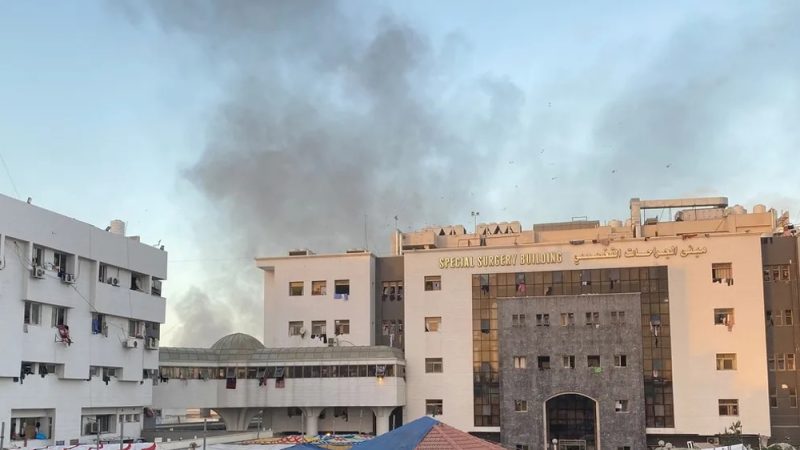
Jakarta slams Israel for striking Indonesian Hospital in Gaza
Press TV – November 20, 2023
Indonesia’s foreign minister has condemned in the strongest terms Israel’s attacks on Indonesian Hospital in the besieged Gaza Strip as a “clear violation of international humanitarian laws.”
“All countries, especially those that have close relations with Israel, must use all their influence and capabilities to urge Israel to stop its atrocities,” Retno Marsudi stated on Monday.
Israeli forces opened fire and launched artillery strikes on the hospital and the surrounding areas in the early hours of the day.
The Gaza Health Ministry’s General Manager Munner al-Bursh said the regime forces began artillery strikes “in the middle of the night and targeted the surgical department, wounding the doctors working there and killing 12 civilians who were taking refuge.”
Elsewhere in his remarks, Bursh said Israeli forces also targeted people leaving the facility and shot them outside the hospital. “Their bodies are still lying on the ground, and nobody has been able to bury them.”
“We are using a small power generator that runs on vegetable oil, manufactured by some creative individuals who sacrificed some of their food supply to run the generator,” Bursh said.
Ashraf al-Qudra, Gaza’s Health Ministry spokesman, said the situation is “catastrophic” in Indonesian Hospital. “The Indonesian Hospital staff are insisting they will stay to treat the wounded. There are about 700 people, including medical staff and injured people, inside the hospital.”
Reports said Israeli forces are going to repeat what happened at Shifa Hospital and will also occupy the Indonesian Hospital as tanks surrounded the facility.
Meanwhile, Palestinian Prime minister Mohammad Shtayyeh has said the Israeli military operation in Gaza “is for the purpose of killing, in the spirit of revenge and with the aim of displacing our people.”
And UN Secretary-General Antonio Guterres has said the number of civilians killed in Israel’s war on Gaza has been “unparalleled and unprecedented” since he took office in 2017.
Children make up virtually 47 percent of Gaza’s 2.3 million population. UNICEF has labeled the Gaza Strip “a graveyard for thousands of children.” It has also described the situation in Gaza as “a growing stain on our collective conscience”, calling the rate of children casualties “simply staggering.”
Save the Children says more children have been killed in Gaza than in all other conflicts around the world since 2019 combined.
Israel has killed 13,000 Palestinians in Gaza since October 7.
Canada: censoring pro-Palestine voices triggers backlash at university
MEMO | November 20, 2023
The University of Ottawa is under fire for suspending a medical student over pro-Palestine social media posts. A petition signed by nearly 50,000 people has accused the faculty of misusing its authority, and intimidating residents and students through censorship. The signatories have urged people to call on the university to investigate associate professor of family medicine Dr Yoni Freedhoff.
A resident physician in his 4th year of Public Health and Preventive Medicine, Dr Yipeng Ge, is said to have been suspended after Freedhoff, who appears to be an ardent support of Israel according to his profile on X, accused Ge of anti-Semitism. In a blog, Freedhoff targeted Ge for his pro-Palestinian social media posts. He also called out Ge on X, claiming that he was spreading anti-Semitism. Ge was suspended shortly after the publication of Freedhoff’s blog.
A petition demanding Ge’s reinstatement has been signed by 48,365 people. The petition expresses solidarity with Ge and calls on the university to reverse his suspension and apologise for failing to follow due process. It demands a thorough investigation into the decision to suspend Ge and condemns the rise in anti-Palestinian discrimination and censorship at the university, arguing that the suspension violates university policies on free expression, student rights and occupational health and safety.
Ge should have the chance to challenge the suspension with impartial oversight, insist the signatories, who call on the university to protect him from harassment by a faculty member, Freedhoff, that puts him at physical and reputational risk without repercussions. Furthermore, it criticises the university administration for failing to provide a safe learning environment and enable Palestinian advocacy on campus through actions like Ge’s suspension.
This suspension is another example of the growing crackdown on pro-Palestine voices on campuses and social media platforms. Pro-Israel groups have doubled their efforts to silence criticism of the apartheid state. Members of the Palestine Society at the School of Oriental and African Studies (SOAS) in London were suspended by the university last month, following a solidarity rally for Gaza. Moreover, a chilling threat to student free speech has emerged across US campuses. Rights groups have warned that pro-Israel donors are seeking to crush pro-Palestine activism through intimidation and threats.
A glimpse into the scale of Israel’s crackdown on social media users was given earlier this year with the revelation that the occupation state is one of the world’s leading countries in demanding the removal of videos from social media giant TikTok. Last week, the site came under pressure from pro-Israel celebrities and “Jewish influencers” to crack down on pro-Palestine voices and content, according to a shocking new report by the New York Times.
Israeli army detains dozens, including women, journalists, in West Bank raids

Israeli soldiers raid the Balata camp for Palestinian refugees, east of Nablus in the occupied West Bank on November 19, 2023 [JAAFAR ASHTIYEH/AFP via Getty Images]
MEMO | November 19, 2023
Ministers from Arab, Muslim countries embark on China visit to end Gaza war
MEMO | November 19, 2023
Ministers from Arab and Muslim-majority countries are to head to China tomorrow as part of the first leg of a tour aimed at ending Israel’s genocidal war in Gaza, the Saudi Foreign Minister Prince Faisal bin Farhan said.
In an announcement shared on social media platform X, the Kingdom’s top diplomat said “The first stop will be in China and will then move to a number of capitals to deliver the clear message that there must be a ceasefire immediately as well as aid and humanitarian needs must be immediately delivered to Gaza.”
Prince Faisal made the comments after a meeting with EU foreign policy chief Josep Borrell on the sidelines of the Manama Dialogue 2023 conference in Bahrain.
“We must work to end this crisis and end this war on Gaza as soon as possible,” Prince Faisal added.
According to the Saudi Gazette, the extraordinary joint Arab-Islamic Summit, which was held in Riyadh last week, issued a resolution tasking the foreign ministers of Saudi Arabia, Jordan, Egypt, Qatar, Turkiye, Indonesia, Nigeria, and Palestine to initiate immediate international action on behalf of all member states of the Organisation of Islamic Cooperation (OIC) and the Arab League.
“The goal is to formulate an international initiative to halt the war in Gaza and push for a genuine and serious political process, leading to a permanent and comprehensive peace in accordance with established international references,” it said.
The forthcoming meeting in Beijing was confirmed today by China’s state broadcaster CCTV, citing the country’s foreign ministry spokesperson Mao Ning.
“During the visit, China will have in-depth communication and coordination with the delegation on ways to deescalate the ongoing Palestinian-Israeli conflict, protect civilians and seek a just settlement of the Palestinian question,” said Mao.
In May, a poll conducted for Arab News by Yougov found that the majority of Palestinian respondents – 80 per cent, preferred China as a potential peace broker in the conflict with the occupation state, with the US seen as the least trusted mediator.
READ ALSO:
Featured Video

New positive ivermectin evidence
or go to
Aletho News Archives – Video-Images
From the Archives
Fanatical Followers of the Covid Regime: A Jim Jones-Style Cult?
By Professor Roger Watson and Dr. Niall McCrae | The Daily Sceptic | November 15, 2021
As scholars at leading British universities over recent decades, we witnessed the replacement of critical thinking and debate by narrative: facts are discrimination and scientific method is imperialism; truth, instead, is derived from ‘progressive’ values. This educational trend may be a major contributory factor to the ease in which society has been inculcated to the Covid ‘new normal’ of masking, testing, and repeated doses of vaccines for a disease of similar risk to severe influenza.
One doesn’t need much critical reasoning to observe the flawed logic of some vaccination enthusiasts, such as people who respond to experiencing any side effects, however debilitating, by saying “at least I know it’s working”, or, after contracting the disease despite their promised inoculation (over 90% effective, according to initial drug company claims), “I’d have been worse off without the jab.” … continue
Blog Roll
 Aletho News
- The Coming GOP Bloodbath?
- Arctic Scare Stories Melt Away
- Wrong, Euronews: Climate Change Has Not Created a Food, Energy, and Economic “Meta-Crisis”
- New positive ivermectin evidence
- Met Office Caught Fabricating Daily Temperature Record Claims
- Merck Virologists Admitted to Falsely Certifying Vaccine Efficacy
- Mandatory Folic Acid for every man, woman & child
- Pro-Palestine protesters arrested outside UK’s ruling Labour Conference in Liverpool
- Mauritius denies landing permit to flight from Israel, forcing cancellation: Tour operator
- Israeli finance minister calls for genocidal war on West Bank, annexation of south Lebanon
- If Americans Knew
- Israel kills more Palestinians, amid push to resettle Gaza – Daily Update
- Israel forces Gazans to live in constant peril – Daily Update
- Deconstructing Netanyahu’s pants-on-fire UN rant – Daily Update
- Trump betrayed voters with his campaign lies and prioritized a foreign country once he took office
- Netanyahu calls Israel’s war in Gaza ‘opposite of genocide’ in UN speech to near-empty hall
- Settler Kidnappings: Torture, Sexual Abuse and Terrorisation of Palestinian Abductees as Israel Deepens Annexation of West Bank
- Gaza winter nears as 162,000 tents become unusable, raising fears of humanitarian crisis
- Netanyahu says, “It’s the opposite of genocide”; UN says Gaza economy is world’s ‘most severe crisis on record’ – Daily Update
- Israel’s US-Backed Assault on Gaza Has Created the ‘World’s Most Severe Economic Crisis on Record’: UN
- ‘Protecting U.S. Citizens’… From Israel
- No Tricks Zone
- New Study: Earth And Venus Surface Warmth Largely Explained By Convection And Lapse Rate, Not CO2 Or Radiation
- 2025 Nature Paper Claiming Worsening Global Drought Gets RETRACTED …Heavily Flawed
- New Study: ‘Global Drought Shows No Detectable Recent Acceleration Under Climate Warming’
- Economic Masterminds: German Socialists Suggest Taxing Productivity Gains Stemming From Using AI
- The South China Sea Has Not Been Cooperating With The Climate Change Narrative
- Energy Crisis: Germany Enters Heating Season With Historically Low Gas Reserve Fill Levels
- New Study: The Antarctic Ice Sheet Gained Mass From 2020-2024 Due To Staggering Snow And Ice Accumulation
- Study: Ocean Heating Rates From Thousands Of Years Ago ‘Dwarf’ Modern Ocean Heating Rates
- Climate Extremists Target, Attack Large-Scale Power Grid Infrastructure In Germany!
- New Study: Antarctic Ice Melt Has Contributed Less Than 1 Centimeter To Sea Level Rise In The Last 30 Years

