Yemeni naval forces seize Israeli-linked vessel

The Cradle | November 19, 2023
Fifty-two crew members on an Israeli-linked ship in the Red Sea were detained by Yemeni naval forces who intercepted and seized the vessel on 19 October, sources told Al-Mayadeen.
An official Yemeni source confirmed to the outlet that the news is true.
Saudi media also reported that Yemeni forces seized the Israeli-linked Galaxy Leader vessel. According to Hebrew media reports, the ship is owned by a British company owned by Israeli businessman Abraham Unger, who goes by the name ‘Rami.’
In an official statement, the Israeli army described the incident as “very serious” and clarified that the ship was not Israeli:
“The ship departed from Turkiye on its way to India, staffed by civilians of various nationalities, not including Israelis.”
The Yemeni army is expected to release a statement later on Sunday.
Yemen’s Armed Forces, allied with the Ansarallah resistance movement, had announced earlier in a statement on 19 November that they would target all vessels associated with Israel in the Red Sea.
“To provide relief to our oppressed people in Gaza,” the armed forces announced, “they will target … ships carrying the flag of the Zionist entity, ships operated by Israeli companies, ships owned by Israeli companies.”
The Yemeni statement also calls on “all countries of the world to withdraw citizens working on the crews of these ships,” to “avoid shipping on or handling these vessels,” and to “inform ships to stay away from these vessels.”
This is not the first statement issued by Ansarallah and the Yemeni army vowing to attack Israeli-linked vessels in the Red Sea.
Less than one week ago, Ansarallah leader Abdel Malik al-Houthi said that “eyes are open,” and vowed to “monitor and locate Israeli ships in the Red Sea.”
“We will continue to plan for additional operations. We can’t stop,” he said, adding that “we will not hesitate to target” Israeli-linked ships.
The Yemeni resistance has been carrying out frequent drone and missile attacks against Israel, which it began last month in solidarity with the Palestinian resistance in Gaza.
In response, the Israeli army has deployed warships to the Red Sea.
According to Hebrew media reports, some of these attacks have been intercepted by Saudi Arabia and Jordan.
Nonetheless, Yemen has vowed to continue attacking Israel.
The Prime Minister of Yemen’s National Salvation Government (NSG), Abdulaziz bin Habtour, said on 10 November that Sanaa will continue to conduct attacks on Israel for as long as the ethnic cleansing campaign of Gaza continues.
Bin Habtour added that the attacks will continue despite possible setbacks to peace talks with the Saudi-led coalition in Yemen, as fighting for Palestine is “a sacred duty for every Muslim and Arab.”
The Sanaa government has also decided to ban all US-made goods and those produced by international companies that support Israel’s occupation of Palestine.
‘Israel’s’ ‘Nakba Doctrine’
By Alastair Crooke | Al Mayadeen | November 17, 2023
“We are now actually rolling out the Gaza Nakba”, says Avi Dichter, “Israel’s” Minister for Agriculture and former head of Shin Bet. The Israeli cabinet has been briefed that up to 1,700,000 Gazans (out of a total population of 2.2 million) are no longer able to live in their own homes, either because they’ve been ‘displaced’, or because their homes have been destroyed/damaged.
To project the image of the Israeli military as ‘bounding ahead’ with its operation to eradicate Hamas however, we see many videos of tanks and armoured personnel carriers around Gaza City — but by contrast, observe notably few images of IOF soldiers patrolling on foot – either to protect the tanks, which are subject to sniper or RPG fire, or (as many commentators suspect) out of fear of Israeli casualties.
Plainly, “Israel” sticks to their armoured vehicles, though they are taking regular losses of their vehicles from ‘flash’ mini squads of Hamas fighters emerging suddenly from concealed tunnels to destroy the vehicles – before disappearing again underground.
The IOF has entered Gaza City, progressing a couple of kilometres over the month, yet showing no serious evidence to date of having encountered the Hamas’ forces, nor having eliminated an appreciable number of them. Why?
Simply put, the Israelis are fighting a conventional war-model (an armoured ‘fist’ inching ahead under massive air support). But the contradiction to this model is blatantly obvious: the so-called ‘enemy’ on the ground simply are civilians, who are dying in horrifying numbers, whilst the Hamas forces remain intact, deep underground. That, too, is where the Hamas infrastructure lies.
The contradictions inherent to this approach lie rooted in the IOF’s evolution over decades to become a quasi-colonial police force, used to policing occupation through the twin vectors of massive force, plus absolute force protection. It is no secret that the IOF fears to engage in hand-to-hand firefights with Hamas units in the tunnel complex (for which their fighters are not adapted). So instead, we have a show of armoured vehicles parading on the surface, coupled with largely unsubstantiated IOF claims of damage inflicted on Hamas.
The most obvious contradiction is the Israeli Cabinet’s claim that the near non-existent military pressures on Hamas per se, are creating the conditions for the releasing of hostages; whereas the real pressure — the incessant air strikes – that are devastating the civilian population and its infrastructure (hospitals, schools, bakeries and refugee camps), is facilitating a second Nakba — more than any hostage release.
Maybe Hamas will release more hostages (calculated in terms of its strategic aims). If so, this likely will be construed – wrongly – as Hamas feeling pain. The conclusion, therefore, may be drawn that carpet bombing ‘works’. As Zvi Bar’el outlines in the liberal Israeli daily, Haaretz:
“According to Israel’s conception, the humanitarian crisis is part of an arsenal at its disposal, which can be used not just as a bargaining chip in negotiations over the release of hostages. Its role is to sear into Palestinian consciousness the apocalyptic punishment facing anyone who from now on dared challenge Israel.
This is a continuation of the deeply rooted strategic concept according to which humanitarian suffering might yield security-related gains …
More importantly, the humanitarian crisis in Gaza now gives Israel diplomatic leverage which includes getting concessions … Above all, it entails a defanging of the American rush to reach a two-state solution.”
The ineluctable logic to this analysis therefore is to continue with the status quo: If it isn’t working in respect to freeing hostages, or degrading Hamas, it can be presented to the Israeli public as ‘working’ through forcing civilians to flee their devastated communities (what Dichter calls the “Gaza Nakba”).
With the ‘Nakba Doctrine’ taking a hold, so favourable conditions for the release of hostages (which Hamas predicates upon a lengthy ceasefire and humanitarian supplies) melts away. The IOF can have one or the other: Either continuous destruction, or conditions for hostage releases. (It seems the cabinet has opted for the former.)
The other (more profound) dilemma is that international pressures for a ceasefire (and hostage release) are accumulating. Time is short, and the military operation may be required to cease. The issue for the Netanyahu Cabinet is — once stopped — will it be possible to resume the massacres of civilians and the Gaza Nakba pressures?
In this context, Israeli popular sentiment — even amongst former liberals — is moving toward a Greater Nakba. Gaza is under Nakba pressures. So is the West Bank, as settler violence against Palestinians surges. Even a ‘liberal’ such as former opposition leader Lapid now agrees that ‘settlers’ in the occupied West Bank are not ‘settlers’ at all, since the land is but the ‘Biblical land of Israel’.
Nakba ‘ambitions’ are widening to South Lebanon (up to the Litani River) too. The radical members of Netanyahu’s government say Israelis will never return to the kibbutz adjacent to Lebanon, without Hezbollah’s removal from the border area.
So, the call is heard for “Israel” to ‘take’ Lebanon up to the Litani (a key water source) — and ‘serendipitously’ the Israeli air force has begun operating up to 40 kms inside Lebanon. Cabinet members now openly speak of the IOF needing to turn its attention to Hezbollah once Hamas has been ‘obliterated’.
The northern border inevitably is heating up. Hezbollah is using its more sophisticated, and more lethal weaponry against IOF positions in northern “Israel” as the ‘rules’ of engagement continuously blur. And “Israel” is responding, with attacks shifting ever deeper into South Lebanon (ostensibly to strike at Hezbollah’s rear infrastructure).
Last night the Israeli War Cabinet voted for striking a major blow at Hezbollah — but Netanyahu demurred. The US reportedly suspects that “Israel” is provoking Hezbollah, hoping to entice the US into a war on Lebanon.
Plainly, the White House is struggling to avoid the slide towards full regional war, as both the Lebanese front and the Iraqi front heats up: On Sunday, Iraqi movements again fired missiles at the American base in Shaddadi.
“Israel” is sensing the present crisis to be both an existential risk, but an ‘opportunity’ too – an opportunity to establish “Israel” across ‘its Biblical lands’ over the long term. There is no mistaking it — this is the direction of travel of Israeli popular sentiment, from both Left and Right wings, to bloody eschatology.
As one prominent Israeli commentator wrote after watching (the unsubstantiated) 47-minute IOF film on the 7 October events:
“After seeing the film I have no compassion for any person in Gaza, not a woman, not a child, and certainly not a man. Everyone deserves a painful death, you were all complicit in this massacre. I hope that no one is left alive in Gaza, period! … I am sure that your God despises you, is ashamed of you, and would burn you in hell, just as the IDF is doing to you now”.
The ‘tribe of Amalek’ today is quoted widely. (King Saul, in the first Book of Samuel, commands Samuel to kill every person of the Amalekites: “Do not spare them; put to death men and women, children and infants, cattle and sheep, camels and donkeys”).
As the Israeli mood swings Biblical, so the global majority’s anger rises. And so Muslims come to see the crisis as an uncompromising civilisational war — The West versus ‘us’.
The concomitant two conferences — the Arab League and the OIC (held concurrently in Riyadh) — underlined the complete collapse of “Israel’s” image across the Islamic world. The outpouring of anger and passion was palpable, and is metamorphosing new global politics.
In the West, the anger is splintering mainstream political structures, and causing wide convulsion. Global protests are massive.
Thus, as “Israel” swings towards a Biblical “Greater Israel”, the Islamic world turns increasingly uncompromising. Though the conferences did not agree on any action-plan, the image of President Raisi sitting next to MbS; and that both Presidents Erdogan and Assad were co-mingling at the conference, was arresting.
The strategic implication is stark: Israelis now abjure the risks of living with Muslims, and the sentiment is fully reciprocated by Palestinians towards Hebraic zealotry. The old paradigm for a political solution is rendered obsolete.
Acting PLC Speaker Ahmed Bahr martyred in Gaza

MEMO | November 18, 2023
The Acting Speaker of the Palestinian Legislative Council Dr Ahmed Bahr died on Friday as a result of his wounds from an air strike during the attack launched by the occupation forces on the Gaza Strip.
On 23 October, his son Muhammad, his wife and children were martyred when the occupation aircraft bombed their house.
PLC Deputy Speaker elected in 2006 Hasan Khreisheh mourned the martyr Bahr, expressing: “In my name and in the name of the members of the Legislative Council elected in 2006, we mourn with all pride the acting Speaker of the Legislative Council, Dr Ahmed Bahr (Abu Akram), who was martyred as a result of the occupation’s bombing.”
Khreisheh posted on Facebook: “You will remain present in the memory of our people and everyone who knew you as an honest and genuine national symbol and a partner in advocating for Palestine, Gaza and its people. We are a nation that sacrifices its leaders for the sake of pride and freedom. To Him we belong, and to Him we return, my dear brother and colleague Abu Akram.”
The martyred Palestinian politician Bahr was born in the Gaza Strip in 1949. He was a member of the Hamas political bureau and assumed the position of first deputy speaker of the PLC after obtaining around 74,000 votes in the legislative elections.
After the occupation arrested PLC President Aziz Dweik in the West Bank, Dr Bahr became the acting speaker of the PLC.
The martyr obtained a doctorate in the Arabic language, and the occupation forces arrested him for two years without charge in 1989.
On 23 October, Jamila Al-Shanti, a member of the Hamas Political Bureau, was also martyred. Al-Shanti was the founder of the Women’s Movement of the Hamas Movement and the first female member of the political bureau.
On 10 October, the two leaders of the Hamas Movement, Zakaria Abu Muammar and Jawad Abu Shamala, were martyred as a result of an Israeli bombing.
Zakaria Abu Muammar was the head of the National Relations Department of the Hamas Movement in the Gaza Strip, while Jawad Abu Shamala was the head of the Economic Department.
Five countries ask ICC to probe war crimes in Gaza
Palestine Information Center – November 18, 2023
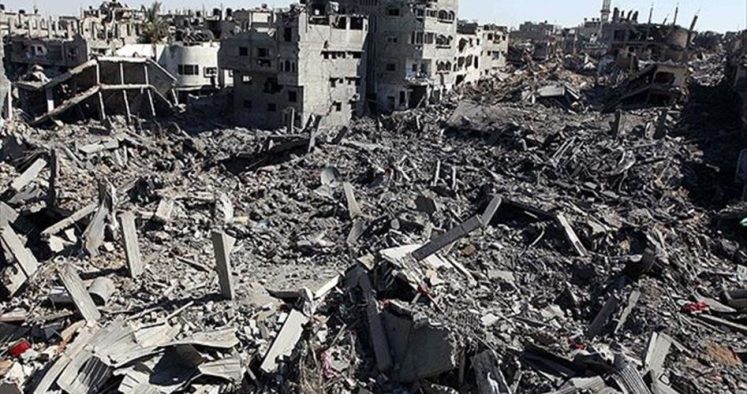
GAZA – The International Criminal Court (ICC) announced that it received referrals from five states seeking an investigation into Israeli war crimes in Gaza.
ICC Prosecutor Karim Khan disclosed that South Africa, Bangladesh, Bolivia, Comoros, and Djibouti submitted the referrals.
Khan confirmed in a statement that the ICC is already investigating the situation in Gaza.
“In accordance with the Rome Statute of the International Criminal Court, a State Party may refer to the Prosecutor a situation in which one or more crimes within the jurisdiction of the Court appear to have been committed requesting the Prosecutor to investigate the situation for the purpose of determining whether one or more specific persons should be charged with the commission of such crimes,” he said.
Khan mentioned the establishment of a specialized team upon assuming his term in June 2021, aimed at advancing the investigation in Palestine.
The prosecutor emphasized that the team will probe crimes suspected to be committed during the Israeli aggression on Gaza.
South Africa declared that it had submitted the referral request with “other countries that share the same concerns”, demanding that the International Criminal Court would urgently pay “attention to the seriousness of the current situation.”
The South African Ministry of Foreign Affairs stressed in a statement that Pretoria “urges other signatory states to the Rome Statute to join this referral request, or to submit their referral requests independently.”
The ICC opened an investigation in 2021 into war crimes suspected to be committed by the Israeli occupation forces in Palestine.
Since October 7, Israel has been waging a bloody aggression on the Gaza Strip, resulting in the martyrdom of more than 12,000 Palestinian civilians, most of whom are children and women.
Israeli Deceit & the Ongoing Battle of Shifa Hospital
By Gareth Porter | Ron Paul Institute | November 17, 2023
The Israeli military has attacked and is occupying parts of al-Shifa hospital in an ongoing operation in northern Gaza. It is the biggest and most modern hospital in Gaza, which has ceased to function normally because of a lack of power, while tens of thousands of displaced Gazans take shelter in it.
An attack on a hospital is normally considered a clear violation of the rules of war. The Israeli Defense Forces is justifying it by claiming that Shifa has long served as civilian medical cover for the command center of the entire Hamas war operations and weapons storage.
That IDF claim has been cited constantly in Israeli propaganda as an argument that Shifa — and other hospitals in Gaza — should not be accorded the normal legal hospital immunity from attack.
Israeli forces closed in on Shifa while demanding for the last few days that the staff and patients remaining in the hospital be evacuated immediately. CNN reported Monday night that “the Biden administration has now signaled that it supports the Israeli position, as National Security Advisor Jake Sullivan declared on CNN’s State of the Union Sunday: ‘You can see even from open-source reporting that Hamas does use hospitals, along with a lot of other civilian facilities, for command-and-control, for storing weapons, for housing its fighters.’”
Those Sullivan remarks were an obvious green light for the IDF to press on for complete evacuation of the hospital.
The problem with that “open source reporting” is that it is never anything more than unsupported claims based on mere supposition. In fact, when the history of supposedly damning revelations about Shifa hospital providing cover for Hamas military activities are examined more carefully it becomes clear that it has been no more than a thinly veiled excuse for the IDF to attack and close down Gaza’s most important provider of medical care for the population of Gaza.
A History of Deception
The Israeli claim that Shifa hospital was providing such a cover for an Hamas military presence there is in fact the longest running theme in Israeli war propaganda on Gaza, dating back nearly 15 years to the first days of the Gaza war of January 2009.
That was when Yuval Diskin, the head of Israel’s domestic intelligence service Shin Bet, told Amos Harel of Haaretz newspaper that “many” senior Hamas officials were “believed” to be hiding in the “basements” of Shifa hospital, and that the Israelis knew all about those underground levels of the hospital, because they had originally been been built by the Egyptians before 1967 and extensively refurbished by the Israelis themselves in the mid-1980s.
Diskin also explained to Harel that Hamas was confident that it wouldn’t be attacked, because of the patients on the upper floors.
Apart from the fact that Israel’s intelligence service had admitted that it only suspected Hamas’ military presence under the hospital rather than having actual knowledge, Harel was, however, honest enough to report that his Palestinian contacts were telling him senior Hamas leaders never stayed in the same location but constantly moved from one location to another — a revelation that obviously made far more sense than the claim that those same senior Hamas officials were hanging out in a basement that was obviously well known to the Israelis.
Harel’s report also included a revelation — apparently from a Palestinian source — that raised problems for the nascent official Israeli propaganda line: “Some of the bunkers they are using,” Harel wrote, “were linked by tunnels Hamas built in recent years.”
The existence of numerous bunkers that could be used for command were thus independent of Shifa hospital, which the Israelis would always be able to invade. That reality clearly implied that it would make no sense for Hamas to depend on Shifa hospital for that purpose.
IDF Tale Resurfaces in Washington Post
Nevertheless, during the next Israeli-Palestinian war in July 2014, the IDF tale of the Hamas leaders’ secret hideaway in the basement of Shifa hospital re-emerged as if it were an unassailable fact that justified IDF threats to attack the hospital.
In a story published July 15, The Washington Post reported as unassailable fact that Shifa “has become the de facto headquarters for Hamas leaders, who can be seen in the hallways and offices.”
Post reporter William Booth clearly did not see Hamas leaders in Al Shifa himself. Had he done so, he would have described the scene and identified one or two Hamas figures who had been pointed out to him at the hospital. So he was apparently passing on the self-interested claim of his Israeli interlocutors without informing Post readers that the information in question was far less reliable than it was made to appear.
The IDF became fixated on closing up another Gaza hospital in July 2014 Just two days after that initial appearance of the Shifa-Hamas theme in the 2014 war, Israeli airstrikes bombed Al Wafa Rehabilitation and Geriatric Hospital in Gaza City and forced its closure.
The IDF specialists created a video distributed three weeks later aimed at defending the destruction of Wafa hospital as a necessary response to Hamas using the hospital for military operations. But they had resorted to multiple levels of trickery to make their political point, as this writer discovered in investigating the video.
The IDF propagandists had spliced together videos from five years earlier and from different times of day so as to suggest that firing from an unused building more than 100 yards away from the hospital was a recent Hamas rocket attack on IDF forces. Then they spliced in an audio clip from an entirely different incident in which the IDF returned fire to try to show that the IDF bombing of Wafa hospital was justified.
At the end of July 2014, the Post reaffirmed its support for Israel’s primary propaganda theme in that six-week war. Terrence McCoy reported from Washington that Shifa Hospital had “become a de facto headquarters” of Hamas. That reporting reflected in turn the general readiness of much of the national press in Washington to accept the word of the Israelis as all they needed to know on that pivotal issue.
Eight years later, the same Israeli propaganda line immediately resurfaced after the Oct. 7 Hamas attack, as the Israelis mounted a new propaganda offensive. On Oct. 27, IDF Spokesman Adm. Daniel Hagari, briefed the International press on the main lines of Israel’s position regarding Shifa hospital and Hamas operations: He repeated the line that a bunker underneath Shifa is Hamas’ main base of operation, and that Hamas operates “several tunnels inside and under” the hospital.
Maximum Suffering
But Hamas’ tunnels outside Shifa could obviously be used for the same function of command of military operations without having to bother with Shifa hospital.
So the drumbeat of Israeli concern about the alleged Hamas command bunker underneath Shifa appears to have been a phony issue from the start, aimed merely at bringing pressure to bear on the medical system, namely to close down Shifa as the largest, most modern and most effective hospital in Gaza to create the maximum amount of suffering to the people of Gaza.
As of Tuesday, Shifa Hospital had ceased to function, as it had no electricity, having run out of fuel. The Israelis gallantly offered the hospital 300 liters of fuel — enough to function for about six minutes according to the hospital’s calculation.
They thus failed to take any emergency action to save 36 babies facing possible death from the non-functioning incubators after three had already died.
The scene at Shifa hospital early on Wednesday was eerie, as Israel tanks rumbled into the hospital grounds and Israeli troops entered the darkened main hospital building.
IDF spokesman Hagari would say only that Israeli forces were carrying out an operation “based on intelligence information and an operational necessity” and that it was in a “specified area in Shifa hospital”.
Later Wednesday the IDF’s Peter Lerner told CNN that the operation at al-Shifa hospital was “ongoing” and would say only that it had not found any sign of hostages in the hospital.
The Gazans who have been staying in Shifa have been afraid to take the approved routes away from the hospital because of relentless Israeli attacks on civilians trying to do so. The IDF will no doubt continue to use force against the hundreds of thousands huddled there to make them leave.
And now that Israel has control over many thousands of military age males in the hospital, it is doubtful that they will be allowed to go free, since they are considered as potential Hamas fighters.
The time has come for a reckoning on the long-running IDF propaganda ploy of claiming that Shifa has been used to hide Hamas’s command center.
Unless the IDF can show journalists convincing evidence of that long-claimed Hamas command presence under the hospital, they should stand for the truth and denounce that massive Israeli deception about Gaza.
Israel sets sights on southern Gaza: Report
The Cradle | November 17, 2023
Members of the Israeli war cabinet are in favor of expanding the current ground invasion into the southern Gaza Strip, a senior security official told Hebrew news outlet Walla on 17 November.
According to the source, Defense Minister Yoav Gallant, minister Benny Gantz, and former army chief of staff Gadi Eisenkot are all in agreement for expanding the ground war – regardless of ongoing talks for prisoner releases.
Intense clashes have been raging across the northern Gaza Strip. Israel expanded its limited incursions into the strip late last month and, by early November, had begun its advance toward Gaza City.
This week, Israel announced the capture of a number of Hamas government buildings, as well as the main port in Gaza.
Since the start of the war, Israel has repeatedly told Gazan civilians to evacuate to the south, claiming they would be safe.
However, the Israeli army dropped leaflets in the southern city of Khan Yunis on 15 November, warning people to evacuate and saying that anybody found in close proximity to Hamas fighters would be in “danger.”
The army’s Chief of Staff Herzi Halevi said on Friday, 17 November, that Israel is “close to dismantling the military system in northern Gaza,” adding that it “will continue to work in other areas.”
Warplanes have continued to target southern Gaza despite Israel simultaneously urging civilians to evacuate south.
Israel is “ordering residents on the eastern side of Khan Younis, close to the border, to move to the western side [of the south],” Al-Jazeera correspondent Hani Mahmoud said on Thursday.
“All these claims of supposedly safe areas in Gaza are baseless; there’s no place that is safer than the other, and the entire Strip has been equally targeted and is equally dangerous,” Mahmoud added.
Meanwhile, no end to the war is within sight, as Israel has planned to eradicate Hamas, who remain deeply entrenched across a vast network of underground tunnels.
Deliberations on expanding the ground war into southern Gaza come as prisoner release talks – being mediated by Qatar and the US – continue to stall.
Hamas announced on 13 November that it informed Doha of its willingness to release around 70 women and children in exchange for a five-day ceasefire.
However, Israel is insisting on three days, Haaretz analyst Amos Harel said on Friday.
“This is a smaller number than Israel had originally hoped for,” Harel added, stating that the proposed deal also includes “about 150 female [Palestinian] prisoners and minor prisoners” to be returned to Hamas.
According to the analyst, Netanyahu is rejecting the deal in order to appease members of the extreme right within his coalition, including National Security Minister Itamar Ben Gvir, who has been criticizing the government’s decisions lately.
“If the extreme right attacks Netanyahu’s position in the wake of the concessions made to Hamas in return, the prime minister will lose his grip on his original coalition,” Harel states, adding that “even in the midst of a terrible war, political survival, which keeps him away from the possibility of being thrown into prison, remains the prime consideration for the prime minister.”
Biden admin justifies Israel’s assault on Gaza hospitals with recycled Israeli ‘intelligence’
BY WYATT REED · THE GRAYZONE · NOVEMBER 15, 2023
As Israel assaults Gaza’s Shifa Hospital, the Biden administration claims that “Hamas does use hospitals” as military bases. Once again, Washington appears to be relying on dubious Israeli propaganda rather than independent analysis.
With Israeli troops storming Gaza’s Al-Shifa and Al-Rantisi hospitals, the United States and Israel are doubling down on discredited claims that Hamas has been maintaining “command centers” out of the basements of hospitals in Gaza, even after so-called evidence produced by Tel Aviv was thoroughly debunked.
“I can confirm for you that we have information that Hamas, and the Palestinian Islamic Jihad, used some hospitals in the Gaza Strip, including Al-Shifa, and tunnels underneath them, to conceal and to support their military operations and to hold hostages,” National Security Council spokesman John Kirby told reporters Tuesday.
Kirby’s claim echoed the assertion by National Security Adviser Jake Sullivan, who maintained that “open-source reporting” shows “Hamas does use hospitals, along with a lot of other civilian facilities, for command-and-control, for storing weapons, for housing its fighters.”
On November 14, Pentagon spokeswoman Sabrina Singh told reporters that US intelligence had no “boots on the ground,” nor any intelligence assets capable of independently gathering intelligence from or about Shifa. When asked if the declassified intel briefing spun out by Kirby and Sullivan arrived through Washington’s “Israeli counterparts,” she refused to answer. But she strongly suggested the intelligence dump was politically motivated.
“This is newly-downgraded information that we felt was important to get out today, because there have been a lot of questions about the hospital and how Hamas operates, and so it was important to get out there,” Singh insisted.
Hamas denies using hospitals for military purposes, and both local healthcare workers and international humanitarian organizations back that up. “I’m sick and tired of these [Israeli] claims that there are Hamas command centers [in hospitals],” Norwegian physician Dr. Mads Gilbert told Al-Jazeera on November 12. Having performed life-saving procedures for several weeks inside Shifa during Israel’s 2014 assault on Gaza, Gilbert noted, “As I’ve said 100 times… we’ve never seen high-ranking Hamas people in Al-Shifa,” adding “we’ve been able to roam freely.”
But that did little to prevent Israeli troops from waging an all-out assault on the facilities. As Israeli forces surrounded Shifa hospital on Tuesday with the full-throated support of the Biden administration, arresting journalists outside the facility and violently clearing displaced people from its grounds, doctors inside were forced to move babies in intensive care from one wing of the hospital to another to save their lives. A lack of fuel had already forced many of those infants off vital oxygen supply units.
Meanwhile, Israeli forces have been unable to find any presence of hostages inside or around the hospital. As Israeli Army Radio reported on November 15, “There is no indication of the presence of abductees inside the hospital.”
Systematic Israeli misinformation campaign dismissed by US as “fog of war”
Israeli and American officials have yet to produced any proof that Hamas operates a “command center” under Al-Shifa. Video published by the Israeli military purporting to prove Hamas kept hostages in the basement of Al-Rantisi Children’s Hospital, Gaza’s last remaining medical center with a pediatric cancer ward, was less than convincing.
In that video performance, top Israeli army spokesman Rear Admiral Daniel Hagari claims that what appears to be a bomb shelter for young children is actually a Hamas torture chamber, citing objects as unlikely as a baby bottle and a woman’s clothes. In one particularly memorable and widely panned moment, Hagari insisted the days of the week written in Arabic on a calendar were actually the names of the “terrorists” meant to guard captive Israelis ostensibly being held there.
The Israeli military has since attempted to downplay the deception as a “mistake in translation.”
It was hardly the first round in Tel Aviv’s fake news campaign. In the weeks since Palestinian resistance groups launched their shock assault on October 7, native Arabic speakers have taken to social media to mock the audio recordings Israel regularly publishes which purport to show Hamas members gleefully discussing carrying out war crimes.
In November alone, official Israeli social media accounts have been forced to walk about at least a half-dozen false assertions. A video showing a crying woman describing how she retrieved her son’s decomposing body from the streets of Gaza was transformed by Israel’s embassy to the US, which used fake captions to falsely claim she was blaming Hamas for the siege. When questioned, the embassy subsequently deleted the post.
The same week, Israel’s main government account on Twitter had to delete its false claim that “AP, CNN, NY Times, and Reuters had journalists embedded with Hamas terrorists on October 7th massacre” – a lie which the New York Times condemned as “reckless” and said put its journalists on the ground in Israel and Gaza “at risk.”
Days later, Israel’s official Arabic-language Twitter account deleted footage of a woman dressed in nursing scrubs who claimed to work as a nurse in Gaza’s Al-Shifa hospital denounced Hamas for supposedly stealing fuel and medicine. Other doctors and nurses at the medical center reportedly told journalist Younis Tirawi: “We don’t know this woman; she has never worked here before & we’ve never seen her at the hospital.”
Social media users claimed the woman was Israeli actress Hannah Abutbul, who moonlights as a social media manager of an Israeli company named Aish International that works alongside the Israeli Ministry of Foreign Affairs. Abutbul denies appearing in the video.
On November 10, Israel’s Coordination of Government Activities in the Territories (COGAT) claimed Hamas was “INSIDE the Indonesian hospital last night,” citing a video which appeared to show a firearm being displayed. An observer who pointed out that the object was actually a billy club had their reply ‘hidden’ by the official Israeli account.
Throughout the blood-spattered onslaught on the Gaza Strip, US officials have consistently taken Israeli claims at face value, even parroting Tel Aviv’s excuses when prompted. Following Biden’s now-retracted claim to have seen “confirmed pictures of terrorists beheading children,” US officials continue to exhibit a remarkable willingness to side with the Israeli government and echo its talking points.
During a November 14 press briefing, a reporter asked State Department spokesman Matthew Miller about the Israeli government’s habitual spreading of “misinformation.” Miller responded by brushing off Israel’s parade of fabrications as an inevitable feature of the “fog of war.”
“In the fog of war, from thousands of miles away at the podium,” the spokesman insisted, “I have no way to independently adjudicate the various claims that are being made.”
Britain implicated in murder of Gaza doctor sponsored by its Foreign Office
BY KIT KLARENBERG · THE GRAYZONE · NOVEMBER 14, 2023
The UK government refused to condemn Israel’s targeted murder of Dr. Maisara Alrayyes, a Palestinian alumnus of the British Foreign Office’s prestigious Chevening scholarship. Meanwhile, London has instructed media outlets to keep silent about its direct involvement in the Gaza slaughter.
Since the beginning of Israel’s military assault on the besieged Gaza Strip, the British government has remained unflappably silent on the carnage inflicted on Palestinian civilians with one notable exception.
On November 8th, the Foreign Office announced the death of Dr. Maisara Alrayyes, a Palestinian alumnus of its prestigious Chevening scholarship scheme, under which “outstanding emerging leaders from all over the world” can pursue all-expenses-paid master’s degrees at prestigious British universities.
The Foreign Office refused to state the cause of Alrayyes’ death, provoking a wave of condemnation.
Meanwhile, King’s College, where in 2019 Alrayyes studied Women and Children’s Health, issued a brief statement stating he and his family were “killed,” though it refused to name the perpetrator. The college noted that his work had been published “in a number of high-profile journals… and he was well respected and known among his colleagues for his dedication to improving healthcare for women and children in low-income and war-affected regions.”
Colleagues of Alrayyes subsequently revealed that he and his family had been murdered as a result of Israeli airstrikes after spending 30 hours trapped under rubble.
In the days leading up to their deaths, the physician texted his former classmates at King’s College, telling them:
“In the last few days, I’m starting to feel more terrified than ever. I imagine myself underneath the rubble, and I have a great fear of staying alive under the rubble.”
His worst nightmares were realized thanks in no small part to the British government sponsors of his Chevening Scholarship.
Britain’s Cleverly meets Alrayyes, signs off on Israel’s killing spree
The Chevening Scholarship is considered something of a crown jewel in Britain’s soft power arsenal, and a vital mechanism for promoting her interests abroad. Over 15 Chevening graduates have gone on to become heads of state, and London is keen to promote the success of alumni the world over. A leaked Foreign Office report on improving public perceptions of Britain in the former Yugoslavia found London was “favourably associated with education (universities, schools, the Chevening scholarship programme).”
A Chevening Journalism Scholarship was therefore made available in every country in the region, to “improve the perception of the UK with participants, who are influencers in the Western Balkans.”
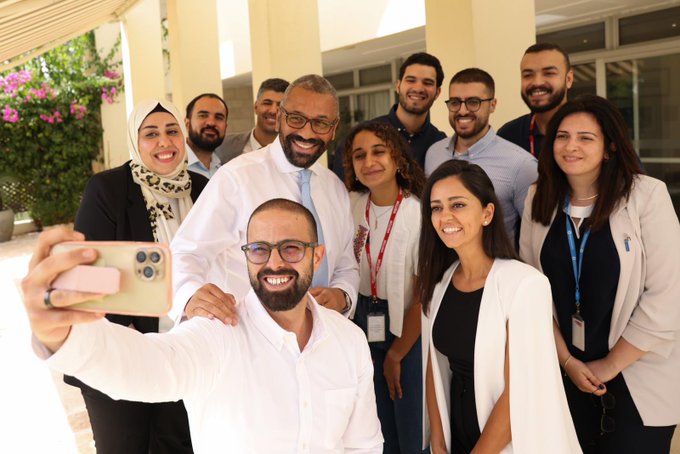
As Alrayyes met his fiancee, also a Chevening scholar, while studying in Britain, London was particularly enamored with his example. In September, he was among a select group of graduates granted a meeting with Foreign Secretary James Cleverly in Jerusalem.
These British leaders failed to provide Alrayyes with even the slightest measure of protection when the brutal bombardment of Gaza began this October. While sleeping in his home with his family, he became a target of the Israeli military. In death, he has become a public relations problem for the British Foreign Office that once sponsored him.
Cleverly has repeatedly dismissed calls for a ceasefire in Gaza while insisting Britain fervently supports Israel’s right to “defend” itself – a euphemism for backing Israel’s crushing assault. When grilled about Alrayyes’ murder by ITV, the Foreign Secretary half-heartedly mumbled:
“Every loss of life is heart-breaking. And there are people both Palestinian and Israeli who have lost their lives. That is why we are so focused on getting humanitarian aid into Gaza.”
Britain implicated directly in the Gaza slaughter
In every way, Alrayyes’ horrific death is a nightmare for London, not least because the British government itself may be somehow implicated. Analysis by Declassified UK indicates that since October 7, 33 military transport flights have traveled to Tel Aviv from Britain’s vast airbase in Cyprus. The outlet could not find records of similar journeys before the attack on Gaza began. A Ministry of Defence spokesperson denied the planes were ferrying “lethal aid”, but supported “diplomatic engagement.”
This explanation is rendered all the more dubious given that in late October, the Defence and Security Media Advisory (DSMA) Committee wrote to the editors of major British news outlets to demand they not report on British special forces “deployed to sensitive areas of the Middle East.”
DSMA is a Ministry of Defence body that imposes a very British form of censorship on the press. It brings together representatives of the intelligence and security services, military veterans, high ranking government officials, press association chiefs, senior editors, and journalists. Together, they decide what issues related to national security can be reported on, and how. It creates a situation in which the overwhelming majority of British national security journalism is directly influenced by the state.
The Committee’s recent intervention was spurred by media reports of the SAS being stationed in Cyprus to assist with hostage rescue operations. This was almost certainly designed to explain the presence of British special forces in the region while concealing their involvement in the assault on Gaza, where Alrayyes was murdered.
‘Israel controls the Foreign Office’
The Foreign Office’s handling of Alrayyes’ death reportedly sparked outrage even among its own staff, who were already outraged at Whitehall’s refusal to acknowledge, let alone condemn, the spiraling civilian death toll in Gaza. Historically, the department was pro-Arab. Its conversion to the cause of Zionism is a relatively recent development, although sympathy for the Palestinians endures in certain quarters.
This is somewhat remarkable, given British politicians who dare speak up for the Palestinians are routinely targeted for reputational destruction by the Israel lobby. Both Labour and the Conservatives have highly influential “Friends of Israel” clusters within parliament, which operate in close, clandestine concert with Tel Aviv’s embassy in London.
In 2017, undercover Al Jazeera journalists caught Israeli embassy representative Shai Masot on tape in meetings with Conservative Friends of Israel (CFI), discussing a “hit list” of parliamentarians to “take down” due to their support for Palestine. This included MP Crispin Blunt, a longtime critic of Israel, and Foreign Office minister Alan Duncan. Masot expressed a desire to “destroy” Duncan, to ensure he wouldn’t receive a top post within the department.
In response, Duncan telephoned Mark Regev, then-Israeli ambassador to Britain, who alleged Masot was a junior “local hire” with no formal diplomatic status. In reality, Masot was an Israeli Defense Forces veteran who had served as the embassy’s senior political officer since November 2014, acting as chief point of contact between the Israeli embassy and the Foreign Office.
Israel returns to kill Alrayyes’ family
On November 8, friends of Maisara Alrayyes learned that his two brothers were also murdered by the Israeli military as they dug through the rubble of his home to extract his dead body. They had survived the attack on their home two days prior, but became targets when they returned in an attempt to give their brother a proper burial.
Having whitewashed the murder of Alrayyes, the British Foreign Office has been silent about Israel’s targeted killing of Alrayyes’ family. Meanwhile, UK Rishi Sunak continues to reject calls for a ceasefire between Israel and Palestinian factions in Gaza.
Euro-Med: Israel used over 1,000 white phosphorous bombs in Gaza
Palestine Information Center – November 16, 2023
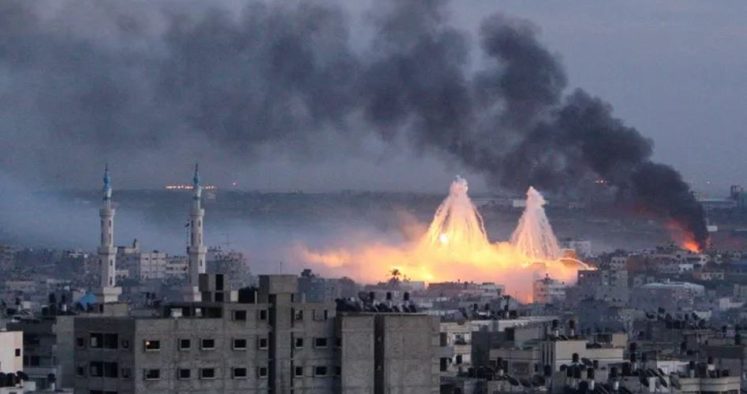
GAZA – The Euro-Med Human Rights Monitor has said that the Israeli army has launched more than 1,000 strikes, utilizing internationally prohibited white phosphorus, on populated areas since it started its genocidal war on the Gaza Strip on October 7.
In a statement on Thursday, the Euro-Med Monitor said it had documented the Israeli army’s indiscriminate use of white phosphorus against civilians, describing it as an “incendiary substance that burns human flesh and causes lifelong suffering.”
Euro-Med said that its team received testimonies affirming that the Israeli army carried out 300 strikes with white phosphorus bombs and projectiles within a period of about 40 minutes on Wednesday evening, November 15, on a residential block in Beit Lahia town, north of Gaza.
“The night before, a large number of white phosphorus shells were reportedly seen falling on a crowded populated area in Sheikh Radwan neighborhood, north of Gaza City. Similar attacks also occurred on several occasions in al-Shati refugee camp in western Gaza and the town and camp of Jabalia, north of the Strip,” Euro-Med elaborated.
“Palestinian residents said they suffered from severe shortness of breath and coughing as a result of inhaling white phosphorus in the midst of extremely unpleasant odors spreading in the air and severe blurred vision due to the thick white smoke,” Euro-Med cited.
According to Euro-Med, people exposed to white phosphorus can suffer from respiratory damage, organ failure, and other serious and life-altering injuries, including burns that are extremely difficult to treat and cannot be relieved with water.
“The escalating use of white phosphorus and smoke bombs against densely populated areas comes within the framework of forced displacement and ethnic cleansing that are being practiced by the Israeli army in order to force half of the Gaza’s population to leave their homes, shelters and hospitals and move to areas in the south of the Gaza Valley.”
Euro-Med accused Israel of persisting in violating the principles of proportionality and precaution by launching random attacks on the Gaza Strip and directly targeting the lives and health of civilians, and using internationally prohibited weapons in flagrant violation of the international humanitarian law and the rules of war.
“In addition to that, Israel uses bombs with huge destructive power against populated areas, and such bombs pose the single greatest threat to civilians in modern armed conflicts. This explains the severity of the massive destruction that turns entire residential neighborhoods into rubble and ruins in the Gaza Strip.”
Dozens killed in latest Israeli bombing of Gaza Mosque
The Cradle | November 16, 2023
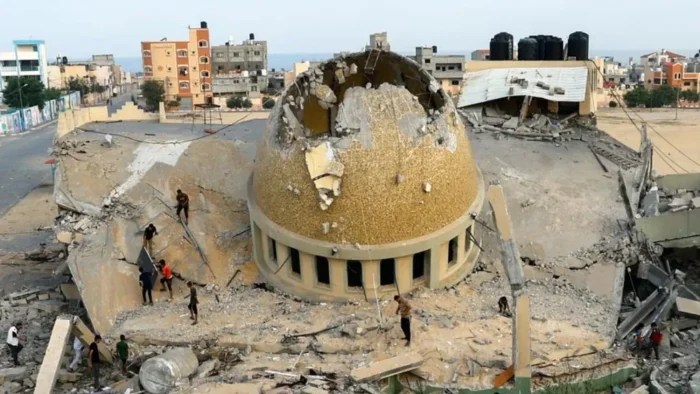
At least 50 Palestinians were killed and dozens of others injured on 15 November after the Israeli army targeted a mosque in the besieged Gaza Strip, WAFA news agency reports.
The attack on the Sabra neighborhood was conducted during a congressional prayer when the mosque was full of Palestinian worshippers.
Israel has conducted similar attacks on places of worship since its inception; in this war alone, multiple Mosques and churches have been leveled, including ones dating back centuries.
On 20 October, the Israeli army destroyed the Grand Al-Omari Mosque in Jabalia, dating back to the 7th century; it was one of the largest mosques in Palestine.
Hours before the Al-Omari bombing, the Israeli army targeted and destroyed the Church of Saint Porphyrios in Gaza, the third oldest church in the world.
“We condemn this unconscionable attack on a sacred compound and call upon the world community to enforce protections in Gaza for sanctuaries of refuge, including hospitals, schools, and houses of worship,” World Council of Churches (WCC) general secretary Rev. Jerry Pillay said in response to the bombing of the 1,400-year-old structure.
“Our prayers go out for healing to all those wounded, along with our condolences to Patriarch Theophilos II and all our Greek Orthodox brothers and sisters in Christ,” Pillay added.
Outside of Gaza, Israel launched an airstrike against the Al-Ansar mosque in Jenin refugee camp, West Bank, on 22 October.
An Israeli statement justifying the Al-Ansar Mosque attack said it was a“joint operation between the army and the Shin Bet” and that the strike targeted an “underground terrorist route.”
This has been a line used by Israel to justify their attacks on not only multiple places of worship but also civilian residences and hospitals.
As of 15 November, 11,470 Palestinians have been killed by Israeli airstrikes in Gaza, of whom are 4,707 children, 3,155 women, and 686 elderly.
Featured Video

New positive ivermectin evidence
or go to
Aletho News Archives – Video-Images
From the Archives
Fanatical Followers of the Covid Regime: A Jim Jones-Style Cult?
By Professor Roger Watson and Dr. Niall McCrae | The Daily Sceptic | November 15, 2021
As scholars at leading British universities over recent decades, we witnessed the replacement of critical thinking and debate by narrative: facts are discrimination and scientific method is imperialism; truth, instead, is derived from ‘progressive’ values. This educational trend may be a major contributory factor to the ease in which society has been inculcated to the Covid ‘new normal’ of masking, testing, and repeated doses of vaccines for a disease of similar risk to severe influenza.
One doesn’t need much critical reasoning to observe the flawed logic of some vaccination enthusiasts, such as people who respond to experiencing any side effects, however debilitating, by saying “at least I know it’s working”, or, after contracting the disease despite their promised inoculation (over 90% effective, according to initial drug company claims), “I’d have been worse off without the jab.” … continue
Blog Roll
 Aletho News
- The Coming GOP Bloodbath?
- Arctic Scare Stories Melt Away
- Wrong, Euronews: Climate Change Has Not Created a Food, Energy, and Economic “Meta-Crisis”
- New positive ivermectin evidence
- Met Office Caught Fabricating Daily Temperature Record Claims
- Merck Virologists Admitted to Falsely Certifying Vaccine Efficacy
- Mandatory Folic Acid for every man, woman & child
- Pro-Palestine protesters arrested outside UK’s ruling Labour Conference in Liverpool
- Mauritius denies landing permit to flight from Israel, forcing cancellation: Tour operator
- Israeli finance minister calls for genocidal war on West Bank, annexation of south Lebanon
- If Americans Knew
- In Gaza, ‘Whoever Survives the Bombing Won’t Survive the Rubble’
- Israel kills more Palestinians, amid push to resettle Gaza – Daily Update
- Israel forces Gazans to live in constant peril – Daily Update
- Deconstructing Netanyahu’s pants-on-fire UN rant – Daily Update
- Trump betrayed voters with his campaign lies and prioritized a foreign country once he took office
- Netanyahu calls Israel’s war in Gaza ‘opposite of genocide’ in UN speech to near-empty hall
- Settler Kidnappings: Torture, Sexual Abuse and Terrorisation of Palestinian Abductees as Israel Deepens Annexation of West Bank
- Gaza winter nears as 162,000 tents become unusable, raising fears of humanitarian crisis
- Netanyahu says, “It’s the opposite of genocide”; UN says Gaza economy is world’s ‘most severe crisis on record’ – Daily Update
- Israel’s US-Backed Assault on Gaza Has Created the ‘World’s Most Severe Economic Crisis on Record’: UN
- No Tricks Zone
- New Study: Earth And Venus Surface Warmth Largely Explained By Convection And Lapse Rate, Not CO2 Or Radiation
- 2025 Nature Paper Claiming Worsening Global Drought Gets RETRACTED …Heavily Flawed
- New Study: ‘Global Drought Shows No Detectable Recent Acceleration Under Climate Warming’
- Economic Masterminds: German Socialists Suggest Taxing Productivity Gains Stemming From Using AI
- The South China Sea Has Not Been Cooperating With The Climate Change Narrative
- Energy Crisis: Germany Enters Heating Season With Historically Low Gas Reserve Fill Levels
- New Study: The Antarctic Ice Sheet Gained Mass From 2020-2024 Due To Staggering Snow And Ice Accumulation
- Study: Ocean Heating Rates From Thousands Of Years Ago ‘Dwarf’ Modern Ocean Heating Rates
- Climate Extremists Target, Attack Large-Scale Power Grid Infrastructure In Germany!
- New Study: Antarctic Ice Melt Has Contributed Less Than 1 Centimeter To Sea Level Rise In The Last 30 Years

